



Abstract
This article examines the intersections between ritual speech, woodcarving, and painted sacred cloths among the Toraja of upland Sulawesi, Indonesia. The author argues that the longstanding division between studies of speechmaking and material culture has obfuscated significant overlaps between what in fact are related systems of semiotic expressions in Indonesia and beyond. By bringing within a single analytic field the forms of ritual speech, textiles, and woodcarving she documented during long-term intermittent fieldwork in Sulawesi (2002–2018), the author highlights fundamental commonalities in how these different semiotic codes operate and in the local conceptions of authorship and craftsmanship. She shows how key aspects of Toraja vernacular semiotics, aesthetics, and hermeneutics are embedded in a materialist ideology of language and suggests that a joint approach to meaning-making practice across different modalities, channels, and media may further our understanding of Indonesian figurative languages and help delineate the larger cultural poetics underlying Austronesian artistic productions.
Introduction
A longstanding tradition – or, to say it with Keane (2003, 2007), a powerful semiotic ideology –within Western thought has conceptualized language as a system of (primarily symbolic) signs clearly separate from material reality and aimed at enabling the transmission of information. 1 As Appadurai (1986: 4) pointed out, the divide between the intangible realm of language and the material domain of things has informed scholarship across several disciplines. In this article, I question this division by fostering a dialogue between textiles and woodcarving experts and scholars of Indonesian verbal art. 2 I analyze the modes of verbal and visual expression of the Toraja highlanders – an ethno-linguistic group dwelling in the mountainous interiors of the island of Sulawesi, in the northeast part of the Indonesian archipelago, and renowned for their finely carved dwellings, their complex gift exchange system, their ‘unusual’ mortuary practices, and their elaborate speechmaking (Adams, 2006; Coville, 1988; Hauser-Schäublin, 1991; Rappoport, 2009; Volkman, 1985; Waterson, 2009). The Toraja highlands have also been historically a center of weaving production and a hub for the trade of textiles. Well before the early 16th-century arrival of the first European traders in Southeast Asia, textiles-based trade networks between the Indonesian archipelago and the Indian subcontinent were well established and the Sulawesi highlands played an important role in these exchanges (Maxwell, 1991; Waterson, 2013: 176).
I argue that the adoption of a joint approach to meaning-making practices across different modalities (i.e. aural, visual, haptic), channels (i.e. spoken, painted, carved), and media (i.e. sound waves, cloth, wood) may advance the understanding of the semiotic organization and the aesthetic ideologies underlying the verbal and material forms of expression used in Toraja, Indonesia, and beyond. Using linguistic and ethnographic analysis, I discuss significant (and largely overlooked) overlaps between ritual speechmaking, woodcarving, and textiles. More specifically, I suggest that a comparative study of verbal and material art forms may highlight important intersections in the ways in which these different semiotic codes operate, as well as in the local conceptions of authorship and craftsmanship, thus revealing the markedly materialist approach that informs Toraja vernacular theories of semiosis, interpretation, and aesthetic judgment. Not only do the motifs appearing on Toraja sacred textiles – hand or block painted cloths of unknown origin widely used in a vast array of rituals – bear striking and largely unexplored similarities with those appearing on the carved gables and walls of the Toraja origin-houses, 3 but their semiotic mode of operation (i.e. what they signify, how they are read and understood, how images are connected to meanings or how several images are combined to produce larger units of signification) is closely connected with the highly figurative language used in the local ritual register. In this sense, I propose to look at textile designs, wood-carved decorations, and ritual speech metaphors as material words that operate according to a common underlying aesthetic grammar, that is, a cultural structure orienting at once the interpretation of artistic and semiotic processes and the production of aesthetic judgments. An additional goal of this endeavor is to foster a dialogue between scholars of Southeast Asian languages and material culture, which may further our understanding of local figurative languages and help delineate the larger cultural poetics underlying Austronesian artistic productions.
The Toraja (better known in the ethnographic literature as Sa’dan Toraja or South Toraja) are a highland community dwelling in the northern part of the South Sulawesi Province. Numbering roughly 500,000 people (plus a large diaspora of around one and a half million scattered through several Indonesian and international urban and mining areas), the Toraja today inhabit the two neighboring regencies (I: kabupaten) of Tana Toraja and North Toraja. Their indigenous religion (T: aluk to dolo), now almost entirely replaced by a syncretic form of Christianity, revolved around a system of ritual practices and prohibitions (T: pemali), a cult of ancestors (T: to dolo), and the worshipping of a pantheon of deities (T: dewata) inhabiting the heaven, the earth, and the underworld. 4 Based on the combination of a fluid cognatic kinship and a relatively rigid birth-determined rank system composed of four groups or stakes, the local forms of sociality pivot on inequitable agrarian relations of sharecropping, a patrimonial system of remuneration in kind, and a complex gift system based on the ritual exchange and slaughtering of pigs and buffaloes (Nooy-Palm, 1979; Volkman, 1985; Waterson, 2009). A key role in structuring social relations is played by origin-houses (T: tongkonan) (see Figure 1).
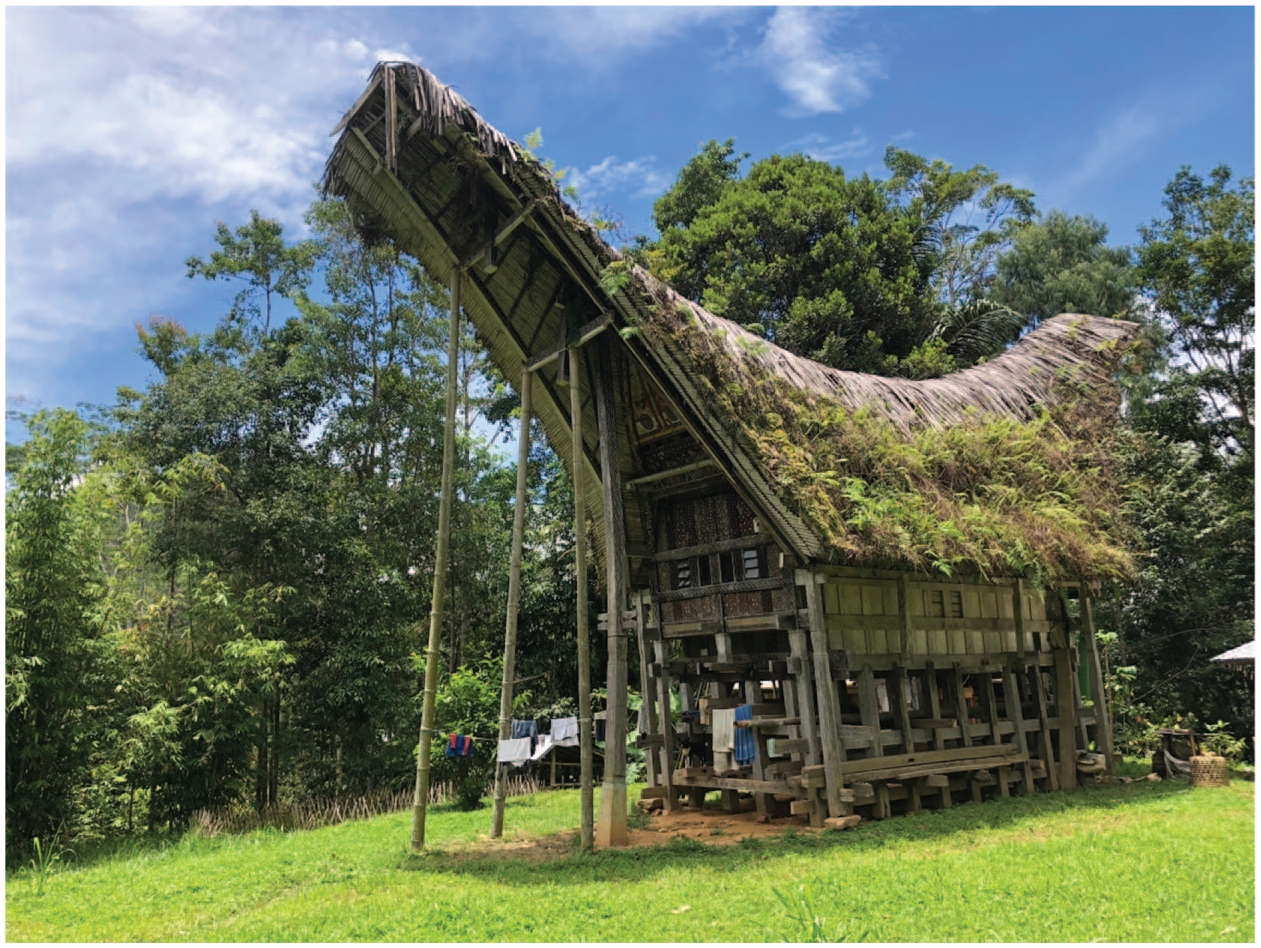
An old tongkonan in the district of Makale, Tana Toraja regency. © Photograph: Aurora Donzelli.
As is the case in other ‘house societies’ (Lévi-Strauss, 1983[1979]), the tongkonan functions as a conceptual and material device that links different generations. Established to celebrate the marriage of a founding couple and its descendants, origin-houses are generally inhabited by a family, a couple, or a representative of the group of living descendants – the pa’rapuan. This kinship group is commemorated through the physical structure and the ritual feeding of the origin-house, which entails the offering of cuts of meat from the ritually slaughtered animals (Figure 2).
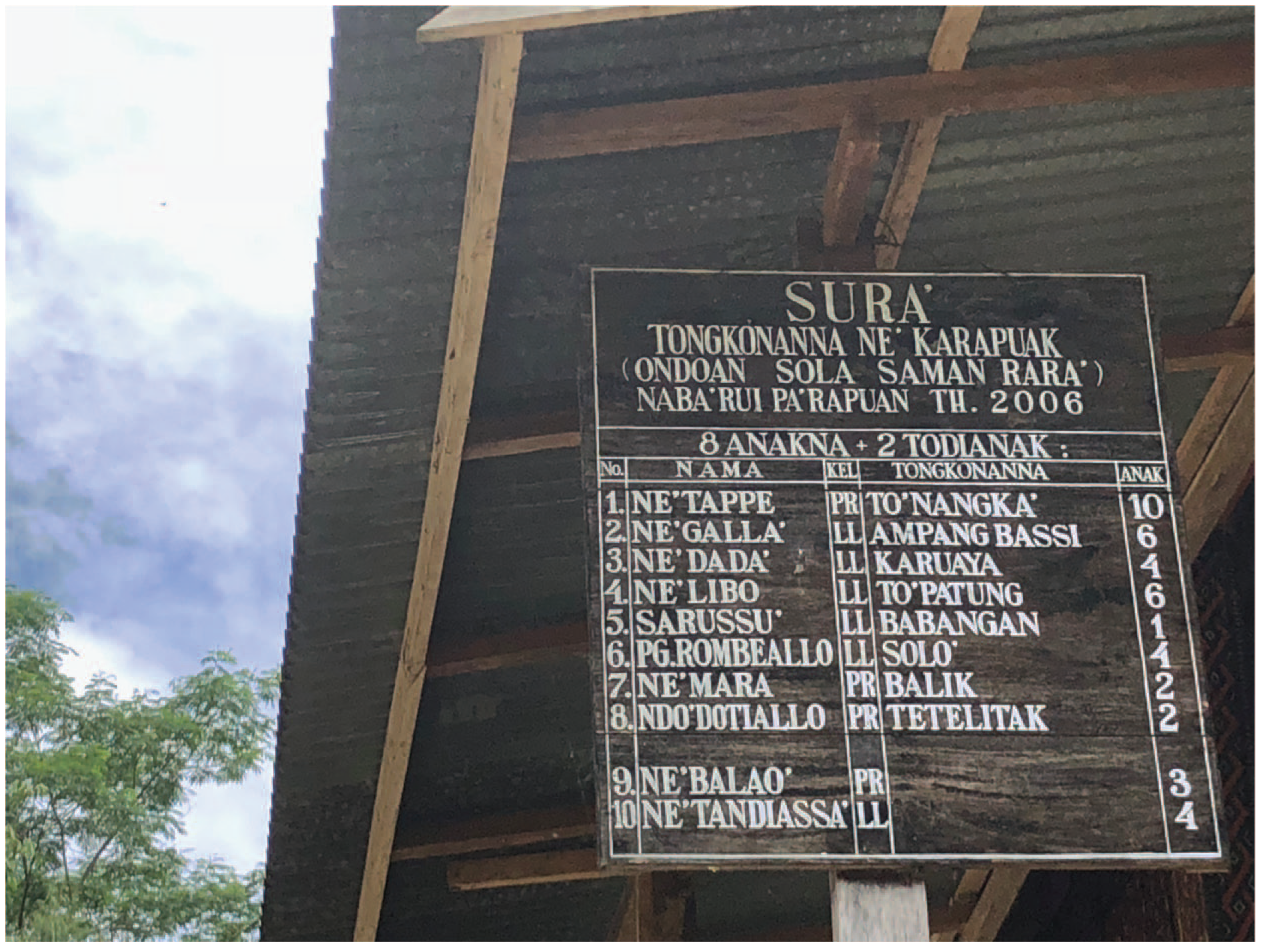
Tongkonan Sura’, in Balik, Sangalla’ district. The photo shows the detail of a plank attached on the house façade listing the descendants who took part in the house renovation ceremony. © Photograph: Aurora Donzelli.
Historically, rank differences were reflected in the quantity and elaboration of the carvings adorning the origin-house walls and gables (Nooy-Palm, 1979: 235). In more recent years, the flow of money that Toraja émigrés inject into the local ritual economy has considerably altered these longstanding modes of marking rank. As Adams (2006) points out, contemporary lower-ranking families are increasingly deploying decorative patterns that were formerly a prerogative of the aristocracy.
The most important origin-houses have their own individual names. Individuals trace their genealogy bilaterally and are required to maintain an active membership in as many origin-houses they can afford to offer ritual contributions to, generally picking the most high-ranking ones. Besides functioning as symbols of the clan’s inherited or achieved status and as memorial sites of its founding ancestors, tongkonan are repositories of the inalienable regalia belonging to the dispersed kindred group. These include daggers, magic amulets, and sacred cloths, called sarita and maa’ (or mawa’). During ritual occasions, origin-houses were decorated with sacred cloths (nowadays generally replaced with industrially made fabric banners) and other heirloom objects, such as daggers and beadwork ornaments (T: kandaure).
As we will see, there are important intersections between the decorations appearing on Toraja origin-houses, those embellishing maa’ and sarita, and the elaborate figurative language constituting the local ritual register. These intersections, I argue, can be understood through the framework of a common underlying aesthetic grammar. By this I mean an aesthetic-cum-semiotic meta-structure that organizes at once the formal composition of these different modes of expression (through fixed and tightly packaged bundles of images arranged through a dyadic structure), their creative process (through an unintentional form of authorship and an anti-demiurgic ideology of making), the interpretation of the semantic and perfomative meaning of the iconic units contained in sacred cloths, carved origin-houses, and ritual speechmaking, and the production of aesthetic judgments about ritual speechmaking, carving, and textile decoration. Before discussing each of these facets, I provide an overview of how the interconnections between Toraja sacred cloths, carved origin-houses, and ritual speechmaking stretch across different dimensions of the highlands practical and symbolic life.
Connecting sacred cloths, carvings, and ritual speechmaking
Maa’ and sarita are the most treasured and revered type of sacred textiles in upland Sulawesi (see Hauser-Schäublin, 1991; Holmgren and Spertus, 2013; Nooy-Palm, 1989). Used in both life and death ceremonies, sarita have a distinctively long and narrow shape, and are generally of brown or dark blue and white color, while maa’ are wider and shorter with respect to the sarita and feature a central image with decorated borders. 5 Both sarita and maa’ were generally block or hand painted using a wax-resist technique – a local adaptation of the batik dyeing method based on the use of beeswax and sometimes mud – on plain cloth, which was either locally hand-woven or, more often, machine-made in India (Kusakabe, 2012).
Believed to have originated in heaven and been brought to earth by the ancestors who descended from the sky (T: to manurung), sarita and maa’ constitute powerful heirloom objects, owned jointly by the extended kinship group. In spite of the beliefs in their celestial provenance, the historical origin of Toraja sacred textiles is quite mysterious (Nooy-Palm, 1989: 163). Although some of these ancient textiles were made locally, other sarita and maa’ were imported from India and the Netherlands.
6
The foreign origin of these cloths is also described in Toraja ritual chants, such as the thanksgiving ceremony (T: merok) documented by the Dutch linguist and Bible translator Henk van der Veen (1965: 115): 577. A long journey was made in order to obtain the old and narrow blue woven cloth with the design of men fording a river
Dilando lalannimi sarita to lamban
A distant tour was undertaken, lasting some seasons, with the object of acquiring the old short wide fabric with the pattern of swimming men
Dilaka pa’taunanni maa’ to unnorong
578. A long journey was made, in order to fetch the keris of great size
Dilando lalannimi gayang ditarapangi
A distant tour was undertaken, lasting some seasons, with the object of bringing back the piece of headwork with the cords hanging low
Dilaka pa’taunannimi kandaure salombe’
579. A long journey was made, in order to obtain precious things of all kinds
Dilando lalannimi ianan sanda rupanna
A distant tour was undertaken, lasting some seasons, with the object of acquiring all the possessions together
Dilaka pa’taunannimi barang apa mintu’ sola nasang
Aside from displaying a parallelistic structure made of pairs of complementary verse-units (which, as we will see, presents many commonalities with the organization of printed and carved motifs embellishing Toraja sacred cloths and origin-houses), the fragment’s content effectively conveys the ideology of the foreignness of local heirlooms widespread throughout the region. In line with the political myth of stranger-kings rooted in the common Southeast Asian belief in the foreign source of authority (Henley and Caldwell, 2008), the origin of all the objects the Toraja highlanders considered most valuable is a remote one. While a full analysis of its implications lies beyond the scope of this article, this ideology of the alien nature of local valuables is congruent with a material history of commercial exchanges. For centuries, South Sulawesi seafarers traded Indian cloths and Chinese ceramics with forest products, slaves, and spices (Andaya, 2008, 2016; Nooy Palm, 1989: 170). As Waterson (2013: 176) points out: ‘the Toraja highlands were for six hundred years an end destination in the long networks of trades that stretched from India and China across Island Southeast Asia.’
Usually kept inside a dedicated area of the ancestral clan house, Toraja sacred cloths were believed to have supernatural beneficial powers (e.g. warding off disease and ensuring abundant crops). In this sense, Toraja sacred cloths pertain to the domain of ‘inalienable possessions’ (Weiner, 1992: 6). At least up until the major weave of conversion to Christianity begun in the highlands in 1960s, they were passed on from a generation to the next and were preserved and kept out of circulation, for their loss was believed to be a serious threat for the group they belonged to. Interestingly, maa’ and sarita share many properties with Toraja ritual language, which, although intangible, should be understood as also pertaining to the realm of the inalienable – a status that, as we will see in detail in the next section, also impacts local ideologies of linguistic apprenticeship and authorship. As Weiner (1992: 38) points out, ‘among groups where durable objects are scarce, texts as inalienable possessions are guarded and carefully transmitted from one generation to the next’.
Although the spread of Christianity has largely undermined the beliefs in the magical powers of these fabrics, ancient maa’ and sarita still play an important role in the ritual life of the highlands. They are still used during life and mortuary rituals to adorn the origin-houses or worn as scarves or headdresses by ritual specialists. While maa’ are/were predominantly used in life-enhancing rites associated with the East, or rambu tuka’ (see also Waterson, 2013: 177), an interesting property of sarita is that, in spite of the binary structure of the Toraja ritual system – notoriously divided between rites of the descending sun (T: rambu solo’) and rites of the rising sun (T: rambu tuka’) – they are/were used in both types of rituals (Kusakabe, 2012: 78). As once woodcarver Ne’ Maro’ insightfully pointed out to me: ‘As for the sarita they can be used everywhere. In the good or in the bad, they are used no matter what’ (T: Kameloan, kadakean, dipake nasang).
Almost all of the hand painted and all block-painted sarita develop symmetrically from a conceptual center, which rarely corresponds to the physical center of the cloth. 7 Maa’ tend instead to be organized around a central motive/medallion, with the other patterns generally proceeding from left to right – which in Toraja is called the ‘direction of the deities’ (liling deata). 8
While some are used in the rare aluk to dolo ceremonies that are still performed today (Figure 3), ready-made block-printed reproductions are currently used in every Toraja ceremony (Figure 4). Genuine and fake sarita and maa’ are sold in the local and international antique markets and, in fact, mentioning the words sarita and maa’ to almost anyone in Toraja would unavoidably evoke the names of the major art dealers working in the area.

At an aluk funeral in Balik, a sacred cloth is wrapped around the head of a temporary effigy of the deceased. © Photograph: Aurora Donzelli.
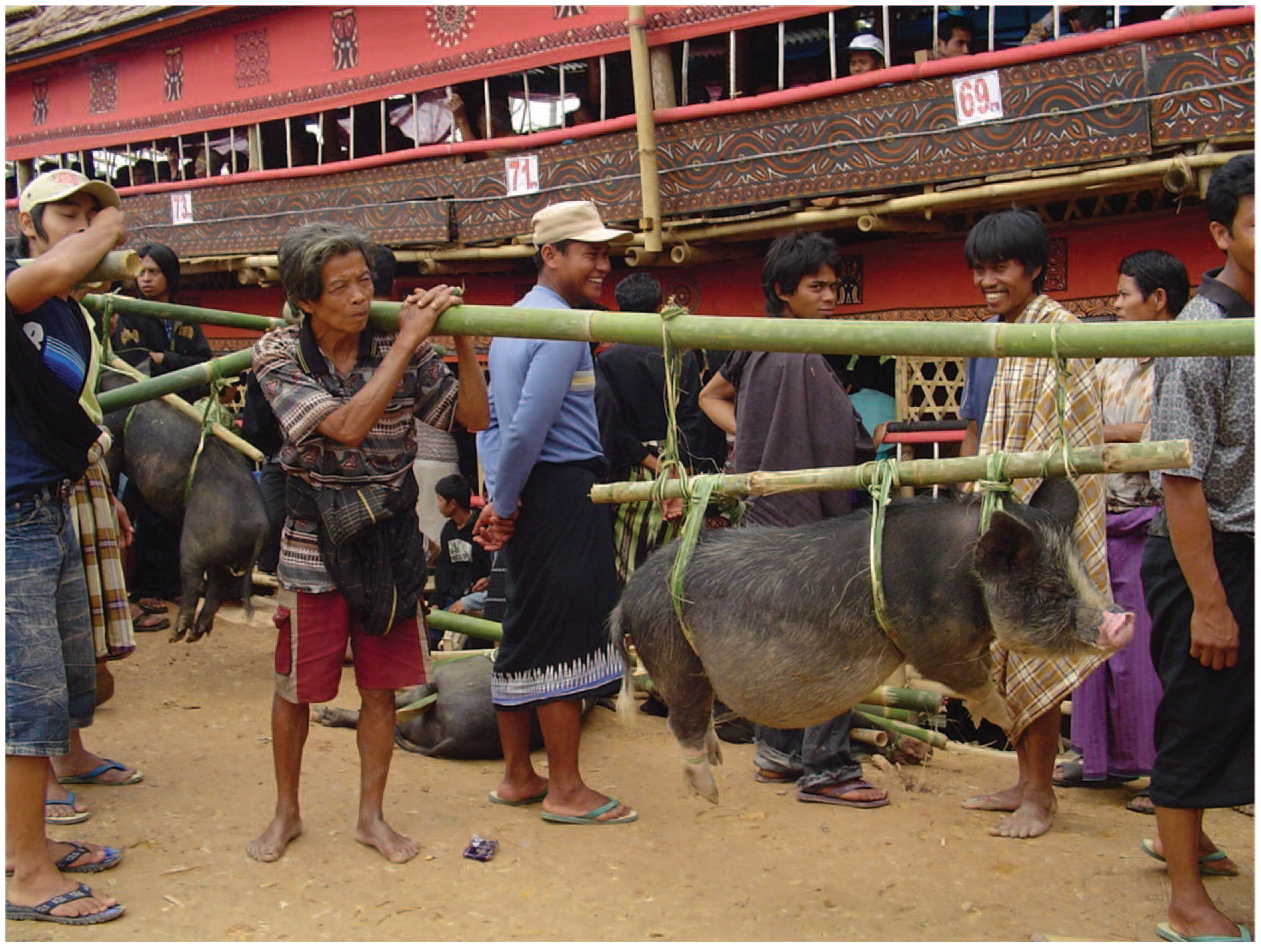
Digitally printed fabrics with traditional motifs adorn temporary shelter (T: lantang) for hosting guests at a Toraja funeral. © Photograph: Aurora Donzelli.
From an iconographic standpoint, sarita (and only to a limited extent maa’) present an interesting combination between geometric and figurative motifs. Both types of motifs are interpreted locally as naturalistic, regardless of the different degree of abstraction which characterizes them. In other words, most if not all the names of the pattern reflect an iconic relation with some element of the natural or cultural world. Sarita generally present an organization in sections made of paired rectangular panels (see Figure 5 and 13), while maa’ generally do not present this type of segmented design (see Figure 10). In the type of textile called sarita to lamban (T: sarita with people crossing a stream), human and animal figures are represented in the act of crossing from one rectangle to another (see Figure 5).

Detail from an exquisite example of sarita to lamban from the Collection of Dr. Albert and Elissa Yellin, reproduced courtesy of Dr. Albert and Elissa Yellin.
The motifs of both maa’ and sarita display an interesting interplay between local elements and a clear influence of Indian imported cloths. 9 While it is difficult to reconstruct the origin of all the motifs appearing on sarita and (to an extent) maa’, important overlaps do exist between houses and textiles, suggesting interesting interconnections between woodcarving (passura’) and textile decorations. For example, the rows of triangles (T: passora’) at each end of wood-carved decorations are clearly derived from the motifs of Indian patola textiles (Figure 6). 10

A Mamasan origin-house. The rows of triangles (a motif the Toraja call passora’) decorating the carving’s borders are clearly derived from Indian textiles (patola). © Photograph: Aurora Donzelli.
The motifs present on these ancient fabrics are often the same as those appearing on the carved walls of Toraja origin-houses and coffins (T: eron). 11 The idea – initially formulated by Hauser-Schäublin (1991) and Nooy-Palm (1989) – that the decorations appearing on maa’ and sarita may have inspired the carved motifs of Toraja woodwork is an intriguing one, which has not been fully explored. At first glance, conceiving textile motifs as the iconographic origin for the wood-carved decorations might appear as a rather counterintuitive thesis. In the first place, the general perception of the carvings as an emblem of a distinctively indigenous identity (Adams, 2006) seems to be at odds with the foreign (or unknown) origin of the textiles. In the second place, he fact that wood is more durable than textiles and that the oldest Toraja sacred cloths are not more than a century old (Kusakabe, 2012) would lead us to look at the carvings as the iconographic source of the textiles and not the other way round. A closer examination suggests, however, that textiles are likely to be the possible source of house decorations. In the first place, the high-gabled Toraja origin-house is a relatively new architectural development. Originally, roofs protruded much less and the exterior panels were made of beaten and plaited bamboo (Kis-Jovak et al., 1988). As house-building became more sophisticated, the plaited mats and beaten bamboo used for the walls were replaced by wooden planks, which presumably entailed novel and more elaborate forms of carving techniques (Hauser-Schäublin, 1991). In the second place, the belief in the sacred origin and in the magic function of sarita and maa’ may explain both the change in woodcarving patterns – from simple lines to the more elaborate patterns copied from the cloths – and the ritual function of the textiles (Hauser-Schäublin, 1991: 189). The practice – widespread in other Indonesian regions (Adams, 1973, 267–268; Gittinger, 1979: 29; Kron-Steinhardt, 1991: 102) – of hanging sacred textiles from the houses’ beams and gables during rituals in order to infuse the kindred group with fortune and prosperity is, in fact, likely to have prompted the practice of carving the textile motifs directly on the house walls and gables. Thus, the penetration of rare and valuable cloths in the highlands possibly triggered a stylistic change in woodcarving patterns. Toraja started to replace the simple motifs used to decorate their houses with those borrowed from the imported textiles (Nooy-Palm, 1989: 179), which were carved directly on the houses in order to ‘ensure prosperity and well-being to its inhabitants, in contrast to the temporary effect attained by displaying the well-guarded textiles during ceremonies only’ (Hauser-Schäublin, 1991: 189). These connections call for a further exploration of the relations between these different forms of expression.
Unintentional ideologies of learning and making
Toraja are renowned for their elaborate ritual speech. Proficiency in this special register is the prerogative of a limited number of experts, the tominaa (i.e. ritual specialists of the ancestral religion) and the gora-gora tongkon (i.e. secularized speechmakers converted to Christianity). 12 Basa tominaa, as this ritual/high register is locally termed, 13 is highly metaphorical, semantically indirect, and socially prestigious and it is believed to have been handed down by the ancestors and to have remained unchanged through time.
As is the case with many other ‘dyadic languages’ (Fox, 1988: 1) typically used in the eastern part of the archipelago, 14 Toraja ritual speech is characterized by structural parallelism, that is, by fixed pairs of semantic elements that ‘are usually morphologically identical and grammatically equivalent, and appear in corresponding positions within parallel lines’ (Forth, 1988: 129). Van der Veen (1952: 216), the Dutch linguist who devoted almost 40 years to the study of Toraja language, defined parallelism as a form of semantic redundancy, consisting of ‘a second line repeating the meaning of the first but in somewhat different words’. As we saw in the excerpts from the merok ritual chants presented in the previous section, Toraja poetic style consists of canonical couplets in which the first line parallels the second line in both rhythm and meaning. The dyadic structure of Toraja ritual speech encompasses lines as well as smaller units within lines (Coville, 1988; Sandarupa, 2004; Van der Veen, 1965; Volkman and Zerner, 1988). In fact, not only are sentences organized in couplets, but also words are paired. Every item can be understood as the expression of a fixed set of alternatives, for the words employed in the couplets are embedded in complex ‘semantic networks’ of potential alternates (Fox, 1988: 25).
In the next section, I will show how the arrangements of the motifs appearing on wooden panels and sacred cloths present interesting overlaps with the parallelistic arrangement of ritual speech’s words and lines. In this section, I will focus on vernacular notions of authorship and craftsmanship, and on local ideologies of making to show how the Toraja aesthetics of pairedness stems from a materialist view of language, and mediates important correspondences between models of carpentry and speechmaking. 15
The Toraja are often explicit in asserting the dyadic aesthetic characterizing their speech: lines and words that are not paired result, in their view, in wobbly and lame speech. As the famous aluk ritualist and tominaa Tato’ Dena’once put it: Words that are not paired (T: kada-kada sondo’) are not pleasant to hear. A man who speaks uncoupled words sounds like someone who limps. Unpaired words are unbalanced, that is shorter on one side.
Sam Barumbung, a much junior and secular ritual speech specialist (i.e. a gora-gora tongkon) expressed a similar vision of the local aesthetics of parallelism: Toraja language is always coupled like the two halves of a split bamboo’ (T: dipasimuane tallang). When a bamboo is cut in two pieces and then reassembled, the two halves are ‘married’ (T: dipasibali) and made to stick together. In a similar way, the couplets, like the two bamboo halves are complementary, they reciprocally close one another.
Reminiscent of the technique for building the bamboo roof of the tongkonan, this popular (see Sandarupa, 2004: 71–73) metaphorical image of the two matching bamboo halves is interesting on multiple levels. Not only does it establish a strong connection between the verbal and the material, encouraging us to look at words as natural entities or material artifacts, but it also connects the assemblage logics of the ritual couplets to the roof-building techniques. According to the metaphorical juxtaposition between couplets and bamboo sticks underlying the expression simuane tallang (T: paired like two bamboo halves), the verbal ingenuity of the ritual speechmakers is conceived as similar to the skill of carpenters who build the high-pitched roof of tongkonan through pairs of matching split bamboos (Figures 7 and 8).
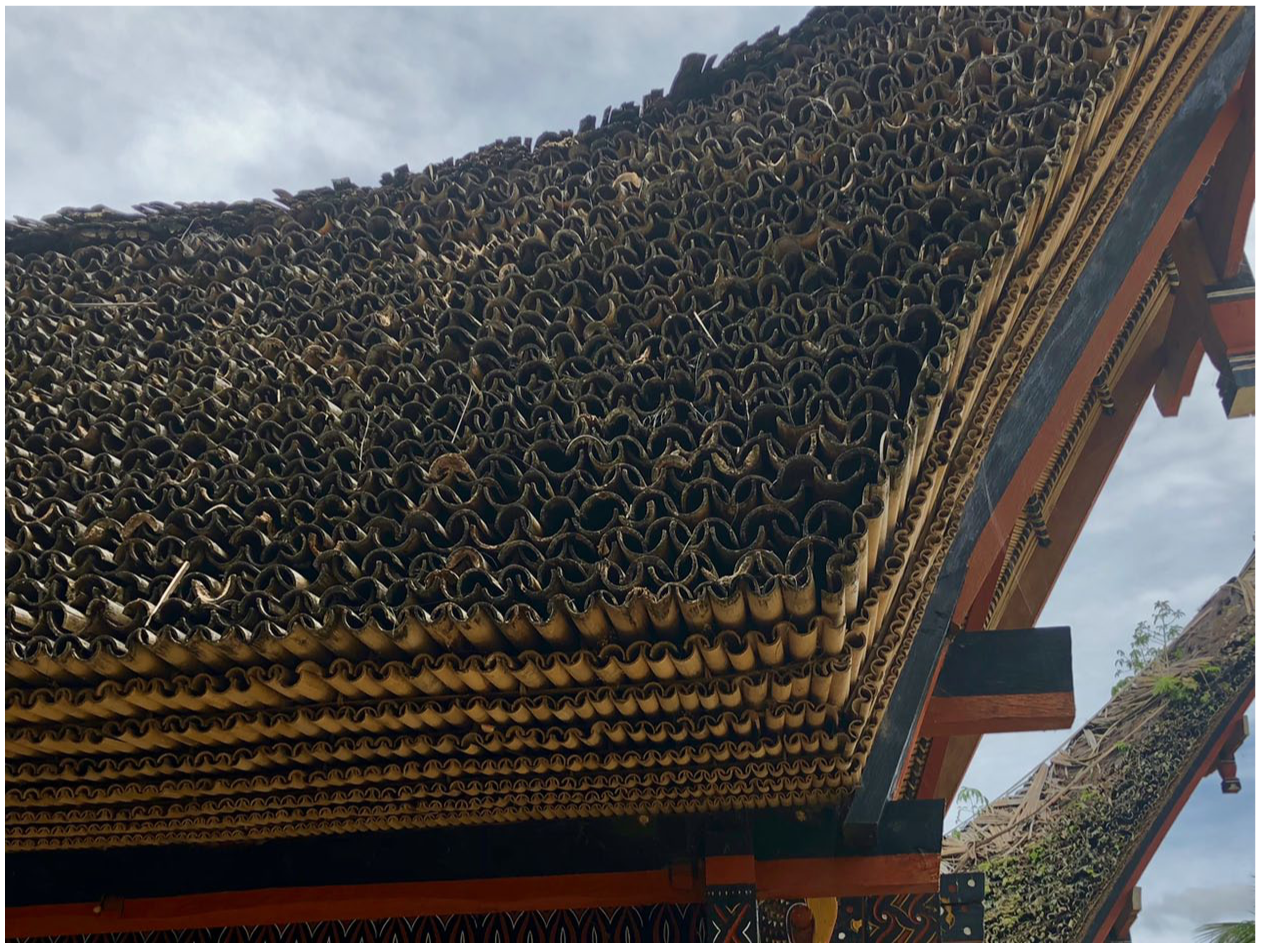
Bamboo roof illustrating the simuane tallang technique. © Photograph: Aurora Donzelli.
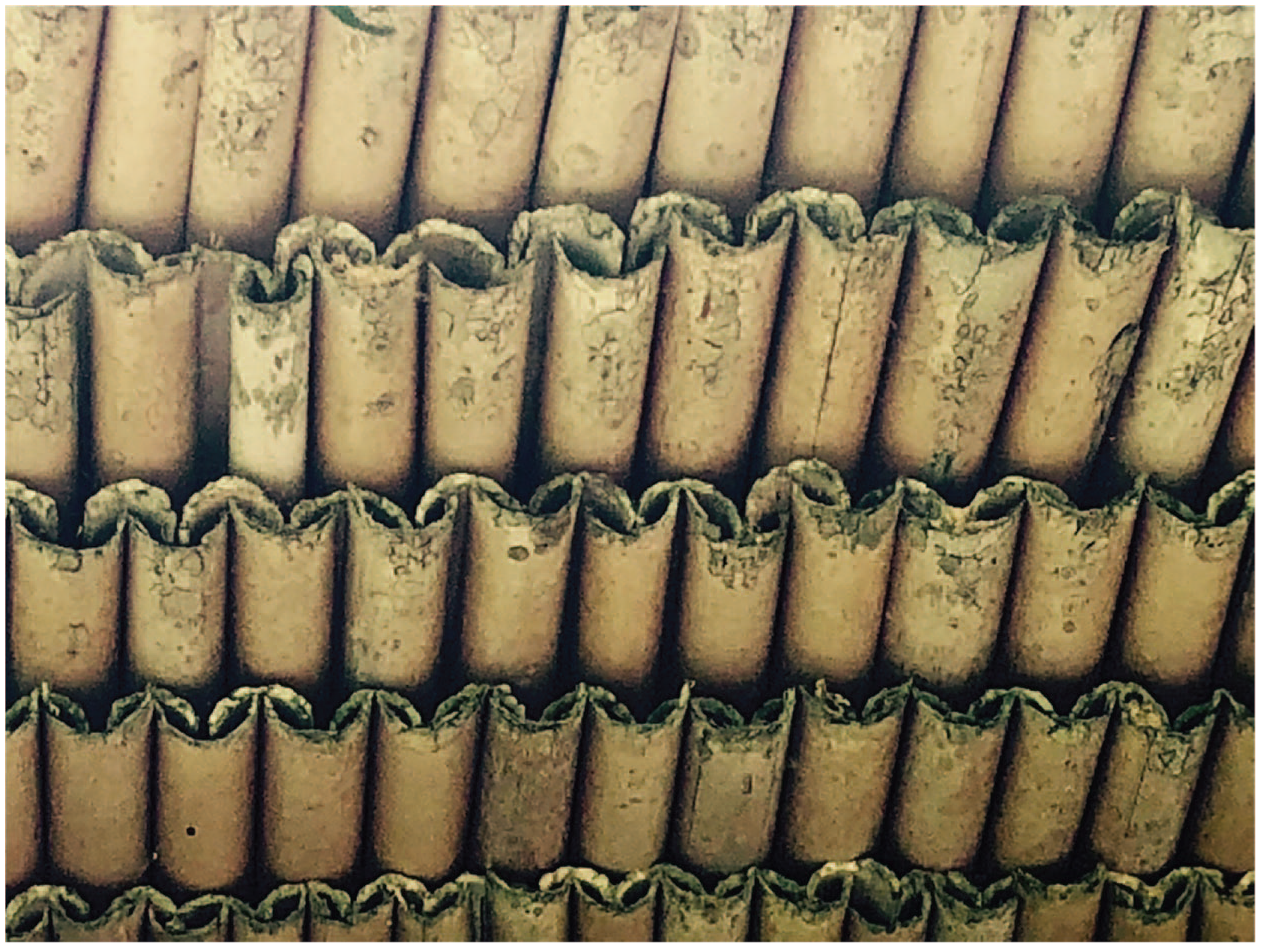
Simuane tallang roof detail. © Photograph: Aurora Donzelli.
We thus may begin to grasp local conceptions of verbal eloquence and manual dexterity crisscrossing the compositional techniques of both carpentry and speechmaking. 16 Couplets, like bamboo sticks, are not invented but masterfully assembled according to a longstanding technique aimed at manufacturing stable roofs and balanced speeches. In this sense, ritual speech specialists and traditional carvers and carpenters are not conceived (nor do they conceive themselves) as original authors or makers. Rather they could be seen as skillful and talented bricoleurs who masterfully combine and reassemble stocks of existing couplets, motifs, and materials they have inherited from the ancestors.
As is the case for other ritual registers used across the world and in several other eastern Indonesian contexts (see Du Bois, 1993; Fox, 1988; Hanks 1996; Keane, 1997; Kuipers, 1990, 1998), Toraja ritual speech is seen as possessing a minimal degree of individual authorship. Conceived as the ‘words of the ancestors’ (T: kada-kada to dolo), ritual speech draws its authority from its alleged ancestral origin and from the deployment of formal linguistic features that allow the speakers to downplay responsibility for what they say. As Kuipers (1998: 71) observed in Sumba, the ritual register’s formal features (i.e. lack of verbs of saying and personal pronouns, minimal use of spatial and temporal deixis, etc.) contribute to ‘detach discourse from the immediate constraints of utterance and attach it to a shared, coherent, and authoritative tradition’. Disclaiming the performer’s authorship, intentionality, and agency, results in presenting ritual speech as emanating from external sources of authority that transcend the context of performance (Keane, 1997: 117). Accordingly, the ‘words of the ancestors’ can only be re-animated by contemporary speechmakers (Fox, 1988: 14–16; Hanks, 1996: 161). Understood to be largely independent from the here-and-now of the context of performance and treated as an ancestral legacy whose source of authority lies ‘outside the present’ (Weiner, 1992: 42), Toraja ritual speech thus appears akin to more tangible forms of inalienable possession, such as landed property, heirlooms, and sacred regalia, which should be passed on from one generation to the next. This form of linguistic materiality is further corroborated through specific ideologies of making that crisscross material and verbal culture, as well as through the ways in which the units of Toraja ritual language, sacred cloths, and wood carvings are assembled and interpreted.
Before delving into the semiotics and hermeneutics of Toraja figurative languages, both verbal and visual, a discussion of the local conceptions of artistic authorship, apprenticeship, and making is in order. Contemporary Toraja carpenters and wood-carvers present themselves as assemblers and executors of motifs and techniques inherited from the ancestors (I: leluhur; T: neneta dolo). In spite of the innovations in architectural techniques and wood-making craftsmanship during the last century (see Kis-Jovak et al., 1988), the master carpenters and carvers I interviewed in Toraja systematically portrayed themselves as mere replicators of ancestral styles and techniques. Accordingly, their personal inventiveness and artistic flair can only be expressed by adding embellishments to firmly established patterns. Ne’ Maro’, an 80-year-old carver who began working in the mid-1970s and is now the most renowned carpenter in the Sesean area north of Rantepao, framed his view of his own craftsmanship and ingenuity thus: These carvings (passura’) are part of the Toraja heritage (mana’ toraya), they have been inherited from the ancestors (dimana’i to dolo) and we as their descendants (marapuan) have to keep on using them without changing them. Today people want to make additions and changes, but the carvings should not be changed and in fact they rarely are. I myself may add details and embellishments (kameloanna), but I never deviate from the basic patterns. I only make small additions to improve them (dipameloi). The carver looks for beauty (to passura’ undaka’ tu melona), that is, how to make his carvings as beautiful as possible while following the rules. The motifs cannot be changed, but embellishments can be changed and added.
Ne’ Maro’ then showed me how some of his carvings’ inner borders are adorned with little dots, meant, as he explained to me, as embellishments. He then pointed to one of my pictures of a house gable and made me notice that the cross motif (doti’ langi’) was added as a decorative border to make the craftsman’s signature style recognizable.
Likewise, when they perform at funerary and fertility rituals, Toraja speechmakers draw from a stock of thousands of couplets and a vast inventory of semantically connected words, and link lines and words together according to the situation and to the appropriate genre conventions. Within this fixed repertoire, individual spokesmen develop their personal styles and own habits of expression. Several ritual speech specialists I interviewed emphasize that they craft their own individual styles by carefully selecting the couplets. Toraja speechmakers (especially the younger ones who get monetary compensations for their performances) generally develop sophisticated metalinguistic reflections on their signature rhetorical styles, openly voicing their personal aesthetic preferences in tandem with proclaiming their deference to ritual speech formulaic structure (see Donzelli, 2007b). Toraja ritual speech authority is in fact grounded in an ideology of invariance. This conception is paralleled by a way of representing apprenticeship as a process of unintentional mimesis. Several speechmakers consistently deny that their verbal expertise originated from a deliberate process of learning. According to local ideas, to be a ritual language specialist, one has to be gifted and to have a natural talent.
This learning ideology is not restricted to the verbal domain, but it also undergirds the local conceptions of textile and wood making, for weaving and carpentry skills are generally believed to manifest naturally and be inherited from one’s parents or grandparents. Likewise, oratorical skills are not considered to be the outcome of some form of training. When I asked him about how he became a famous woodworker, Ne’ Maro’ stated he learned by himself and did not have a teacher. He saw people carving and as soon as he tried it out, he immediately succeeded. Morrell’s (2005: 159) ethnographic exploration of wood artisans in Toraja also highlights how her interlocutors believed that carving skills and aesthetic sense ‘cannot be taught’. Stemming from an exclusive and hierarchical conception of knowledge, these unintentional attitudes toward making and learning also inform the local approach to weaving. Access to textile making was historically regulated by rank. In precolonial times, to be a master weaver, a woman had to be of noble origin. These hierarchical conceptions of craftsmanship still play a key role in the local weaving and carving practices. For example, one of the major obstacles encountered by Toraja Melo – a social enterprise local entrepreneur Dinny Jusuf founded in 2008 with the aim of revitalizing community-based hand-weaving and improving women’s livelihoods in Toraja and Mamasa – has been precisely the interplay between an unintentional approach to apprenticeship and a hierarchical structure of knowledge. As Dinny explained, Toraja Melo efforts at revitalizing traditional and almost forgotten weaving patterns clashed against older master weavers’ initial resistance to share their knowledge with women who were of lower rank or outside their kin group. Even the training workshop format Toraja Melo used to foster the sharing of manual know-how among weavers of different generations collided with local attitudes towards learning, which are grounded on the unintentional view of natural talent and the kin-centered transmission of knowledge across generations.
The fact that in Toraja the terms sura’ and uki’ (T: to write, to carve, to decorate) can be indifferently used to refer to writing, carving, and painting further validates placing in the same analytic field different expressive forms (see also Morrell, 2005: 118). Speaking about his own carvings (T: passura’), wood artisan Ne’ Tato’ described his creations as letters of an indigenous Toraja alphabet: These are called Toraja carvings (T: passura’ Toraya), which means Toraja letters (I: huruf Toraja). Carving (I: mengukir) is like writing (T: massura’). The former is done with a knife while the latter is done with a pen, but they are just the same thing.
The woodworker’s insight is meaningful on a number of levels. In the first place, it offers a counter-narrative to the derogatory view of Toraja language as primitive due to its lacking an indigenous script. Highlanders, who are generally quite self-conscious about the lack of an original scripture and the limited diffusion of literacy, often point to their carvings and textiles as a type of ancestral writing, thus asserting a form of ethnic pride vis-à-vis the longstanding literary tradition of their Bugis neighbors (Donzelli, 2007a). 17 In the second place, the woodworker’s comment provides an analogy between wood-carved motifs (T: passura’) and letters, which resonates with the anti-demiurgic ideologies of making outlined above. Much like letters of an indigenous script, whose shape and value cannot be radically altered or invented anew, the motifs embellishing Toraja tongkonan are not the product of individual creativity and invention, but rather the embodiment of a fixed repertoire of forms and meanings. In the third place, the analogy between letters and carved motifs suggests important similarities in the compositional logics of larger units of verbal or visual expression. Aside from the intriguing lexical overlap between the Toraja words used to refer to writing, painting, and carving, I argue that these different expressive forms share interesting parallels in their semiotic and hermeneutic logics. As I will show in the next section, textiles, carvings, and ritual language present similarities in their modes of signification and interpretation (i.e. how signs are attached to their referents, how they are combined together to produce larger units of meaning, and how they are read and understood).
The semiotics and hermeneutics of Toraja figurative languages
As several scholars working on closely-related contexts have observed (e.g. Fox, 1988), Toraja ritual speech proceeds through a series of paired couplets that evoke figurative and yet highly formulaic images to convey a conventional meaning. In order to understand how meaning is produced and interpreted in Toraja ritual language, we need to engage one of its major poetic devices – the pa’pasusian, a Toraja term that covers the semantic scope of ‘metaphor’, ‘synecdoche’, ‘metonymy’, ‘simile’, ‘comparison’. The term pa’pasusian derives from the root susi, a Toraja word – equivalent, both in function and meaning, to the English ‘like’, ‘similar’, ‘akin to’ – which clearly indicates the process of semantic transference and equivalence between separate domains established by metaphorical processes.
18
While metaphors and parallelism are used in a great variety of languages across the world (Jakobson, 1973), in eastern Indonesia, these poetic devices operate through recurrent sets of paired linguistic elements. Put differently, the Toraja see the meaning of each couplet as irrevocably fixed. To clarify this point we may consider the common ritual couplet reproduced below (note that the first line presents the original Toraja lines, the second line contains a word-by-word English gloss, and the third line corresponds to a free English translation: Simbolong manik Chignon Necklace Knot of hair, (shining like) a necklace made of beads Lokkon loi rara’ Chignon Long Necklace Roll of hair, (hanging down like) a golden neck ornament
The single elements of the two lines are paired (simbolong with lokkon and manik with rara’) and so are the two lines, which, combined, are understood by local speakers as a conventional term of reference and address. Based on metonymic and synecdochic processes (i.e. relations of contiguity, the former, and part for whole, the latter), the pairing of these elements form a figurative–poetic expression conventionally used for addressing or referring to noble women. Toraja speakers, in fact, consider these lines as a unique semantic bundle, simply meaning ‘noble woman’. 19 The formation and the meaning of the couplet are thus not open to improvisation or interpretation. Although the couplet actually speaks of the hairdo and ornaments typically used by Toraja aristocratic ladies, the highlanders interpret the lines not as a metonymic image, but as a conventional sign referring to the more general concept of noble woman. In this sense, pa’pasusian function like logograms, that is, pictorial/iconic symbols intended to stand for entire concepts and words. The conventional/symbolic meaning (i.e. noble woman) of the couplet is derived – through abstraction and categorization – from its literal/iconic meaning (i.e. the hair bun and the precious necklace). 20
The process of meaning formation underlying Toraja ritual metaphors is indeed similar to the semiotic processes of abstraction and categorization at work in hieroglyphic writing (see Lincke and Kutscher, 2012). Abstraction entails a process of simplification: certain details and properties of the object are disregarded and dismissed, while other properties of the object are given special salience. Categorization is used instead when a particular object or image (hairdo, accessories, etc.) is chosen as representative for a more general sense (i.e. concept, or signified). This process of sign formation is culturally specific. Toraja noble women wear a particular hair-do and necklace, which may not be the case for noble women in other parts of the world. This association is conventionalized because the bun plus necklace is chosen to always represent the referent. The couplet is not the result of an impromptu metaphorical association made by a specific ritual speech specialist, nor is the image made object of a speculative process interpretation (see also Keane, 1997: 111). As is the case for all Toraja honorific epithets, the correspondences are fixed and readily understood.
The semiotic and hermeneutic modes of operation of Toraja tropes is apparent in the local attitudes toward translation. A number of linguistic anthropologists have documented the difficulties they encountered in translating and morpho-syntactically parsing the content of ritual performances they recorded in eastern Indonesia (Donzelli, 2007a; Keane, 1997; Kuipers, 1990). My Toraja language assistants would generally object to my attempts at undoing (through translation and interpretation) the ritual metaphors, which, they argue, cannot be unpacked because they form ‘a bundle’ (I: satu paket). Seen as tightly woven bundles of meanings, Toraja ritual metaphors cannot be easily dissected through semantic translation or morpho-syntactic analysis. Besides reflecting a form of resistance towards the hegemony of the national language and emanating from a performative and anti-referentialist ideology of language – as other scholars point out (see, for example, Keane, 1997: 111; 2007; Kuipers 1990) – these metalinguistic attitudes can also be connected to the modes of signification and interpretation common to the different expressive domains of speechmaking, woodcarving, and textiles. This approach shows how the metaphors of ritual language and the decorations appearing on sacred textiles and origin-houses form a common figurative language made of fixed conventional images arranged through a dyadic logic.
Eastern Indonesian ritual languages operate through the same meaning-making logics underlying the material artifacts produced in the same area. My argument is that the decorations appearing on Toraja material artifacts and the poetic metaphors of which ritual invocations are made should be treated as different instantiations of a unique figurative language that stretches across different media, modalities, and channels, but operates according to a very similar compositional structure and hermeneutic logics. The designs appearing on Toraja sacred cloths and origin-houses can be interpreted as visual enactments of the same imagery of ritual couples. Not only on carvings and textiles do we find the same tropes of ritual speech, but these pictorial elements also function – much like ritual couplets, logograms, or iconic hieroglyphs – as signs that due to their repetitive use have become (at least partially) detached from their iconic-indexical substratum, thus functioning primarily as symbols (i.e. signs that stand for their referents in a conventional way). Let us consider the famous trope of the barre allo (i.e. the sun disk with beaming rays), which often appears as a decorative motif on wood and textiles, and as a verbal image in ritual speech: To ka-barre-an allo Person NOM-Sun disk with rays Sun People (who are like the) radiant sun To ka-lindo bulaan Person NOM-Face Gold People (whose) faces (are like) gold
In a similar way to the previous metaphorical honorific epithet used to refer to and address noble women by evoking the image of the hair bun and golden necklace, the image of the beaming sun disk and the golden face is a recurrent metaphor used in ritual speech to refer to the members of the golden stake (T: tana’ bulaan). Furthermore, the image appears almost invariably as a printed or carved disk made of concentric circles and stylized rays on Toraja sacred textiles and origin-houses (see Figures 5 and 13). For those who are familiar with the repertoire of images constituting the bedrock of Toraja poetic and iconographic language, the barre allo motif-metaphor is conventionally understood as a term of address and reference for the highest-ranking nobility, simply meaning ‘noble person’. For outsiders, who are not familiar with the cultural code to interpret the image (be it either the design or the poetic couplet), the meaning of the trope is either opaque (if they have little or no knowledge of Toraja language) or primarily iconic (if they know the language, but do not know the conventional meaning of the trope).
Not only the way in which meaning is encoded in ritual tropes is similar to the form-meaning–referent relationship characterizing the motifs present on Toraja carvings and textiles, but the graphic motifs and the linguistic tropes undergo a similar metapramatic treatment. 21 Consider, for example, the circular motif called lola’. During a recent period of fieldwork in Toraja, I noticed the motif was being carved on the frontal pole of a noble origin-house that was being reconstructed/renovated in the village of Batutumonga (Figure 9). As I normally do with my language assistants, I asked the master carver: ‘apa battoananna?’ (T: what does it mean?). Mirroring my language assistants’ recalcitrance to provide a lexical, semantic, and morpho-syntactic analysis for the ritual couplets, the master carver glossed the motif’s meaning with its status-marking function: ‘It means/indicates – he said – highest-ranking nobility (T: tana’ bulaan). Metonymically modeled over a type of large bracelet-ornament having the same name, the lola’ motif is in fact considered a marker of aristocratic rank.
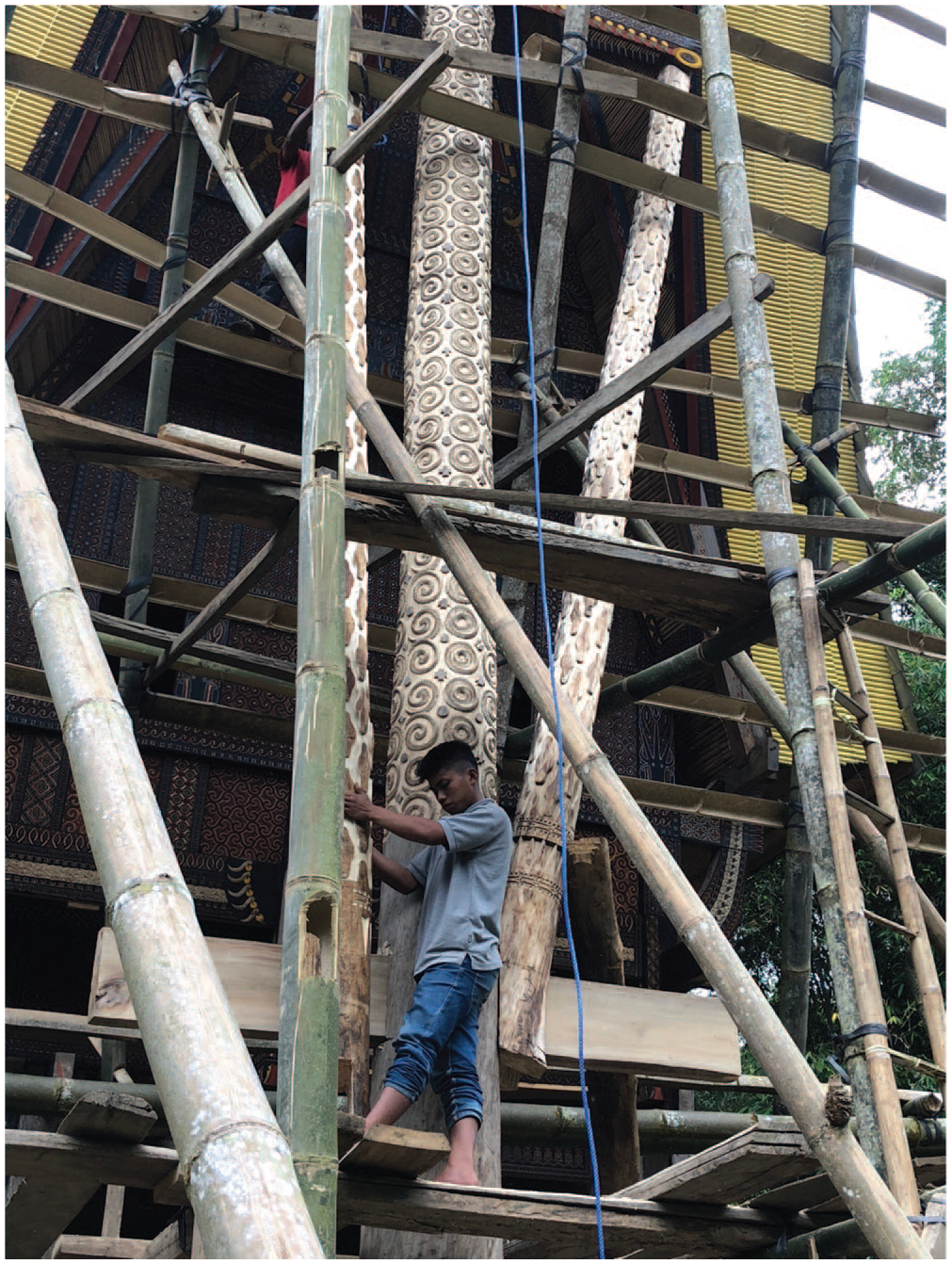
Lola’ motif being carved on the pole of a tongkonan in Batutumonga. © Photograph: Aurora Donzelli.
Used, much like the ritual couplets, either as performative utterances to bring about ritual outcomes (i.e. ensure blessing, abundant crops, perform healing functions, etc.) or rank-marking signs and forms of honorific address, the iconographic motifs of Toraja textiles and carvings resist translation and semantic analysis and are rarely traced back to their figurative/iconic origin. Rather than ‘what does this mean?’, the right question to ask to understand the meaning of Toraja verbal and visual tropes is ‘when should this be used?’
Another example may further illustrate how Toraja understand and use the patterns of their textiles and carvings. In this old (probably early 20th-century) maa’ (Figure 10), we may see a naturalistic representation of the tadpole motif, a very common iconographic element both of Toraja carvings and textiles.
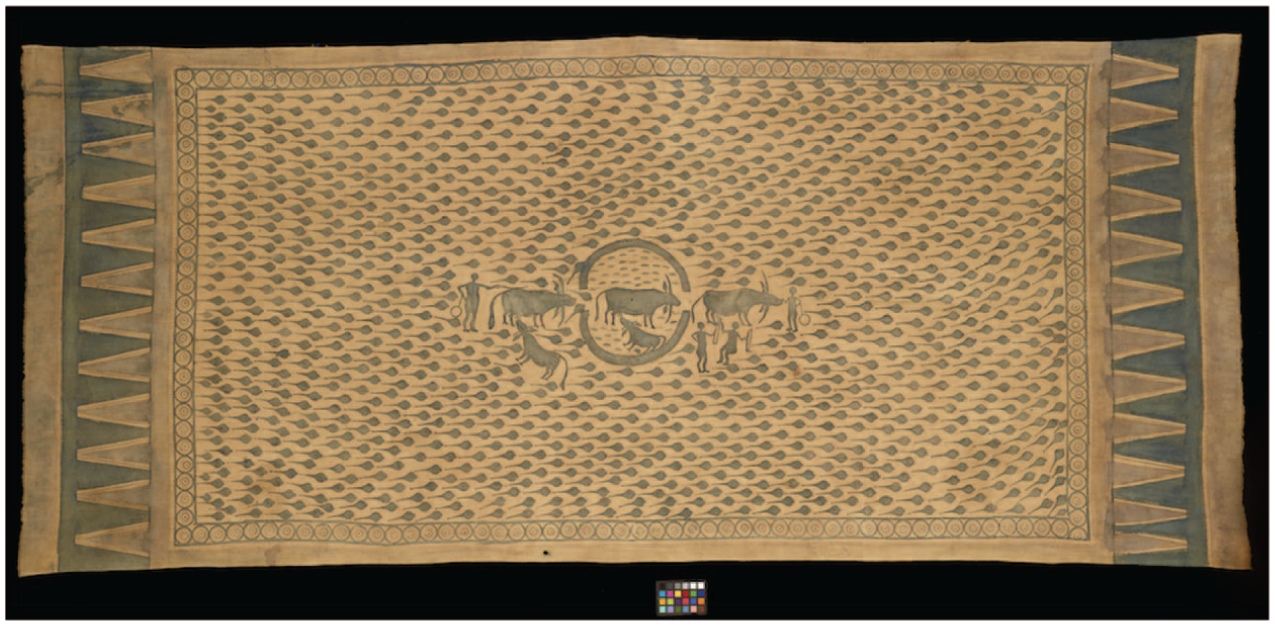
Old maa’ with tadpole motif. The Dallas Museum of Art, The Steven G. Alpert Collection of Indonesian Textiles, gift of the Eugene M. McDermott Foundation. 1983.116. Credit; Photographer: B. Flowers. Notice also the passora’ decoration at the border and compare it with the one on wood appearing in Figure 6.
The same motif – called bulintong si teba’ (T: tadpoles kicking each other) – appears on sarita and on woodcarvings (Figures 11 and 12) although in a much further stylized form.
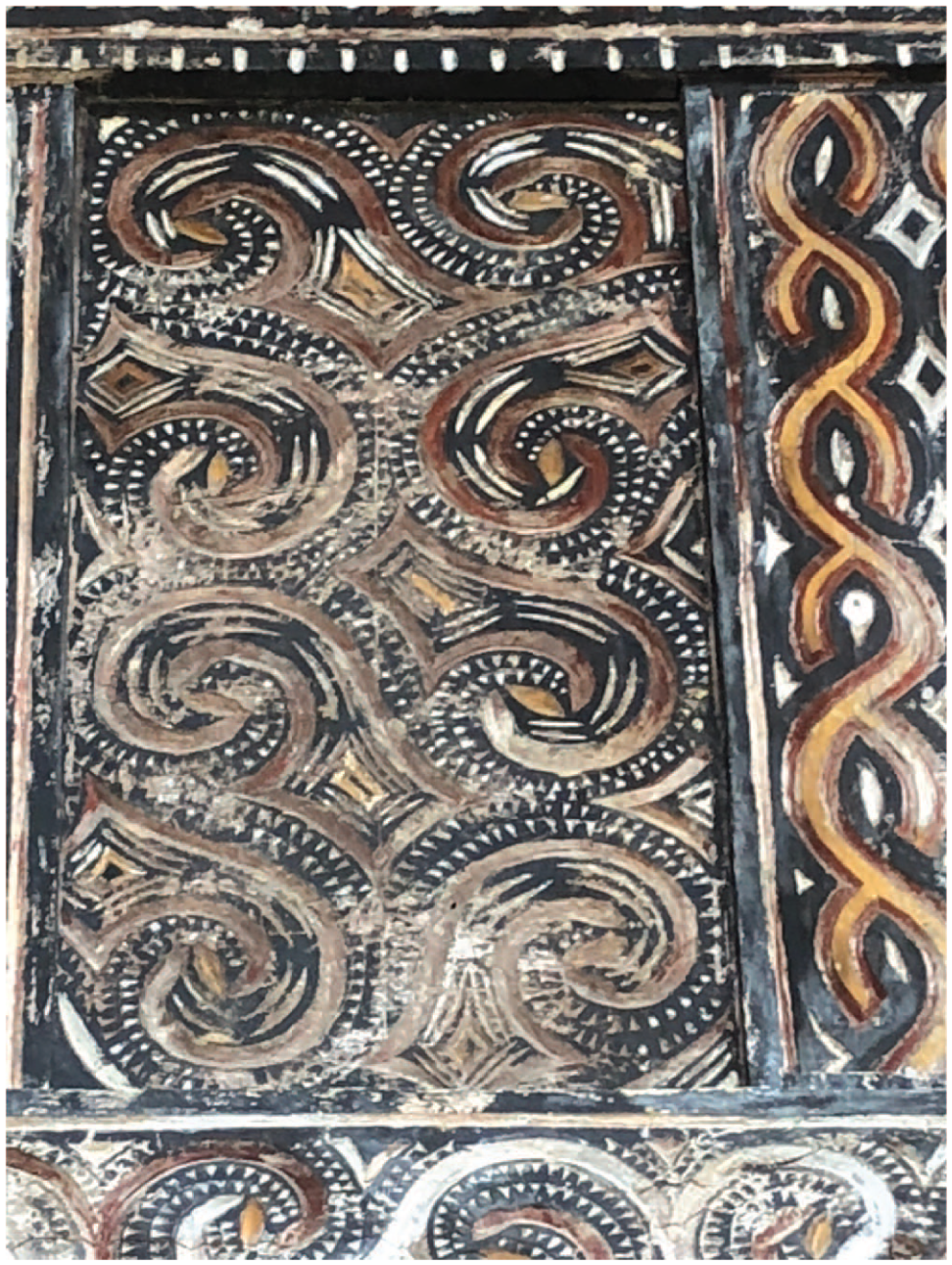
Stylized tadpole motif embellishing a tongkonan façade. © Photograph: Aurora Donzelli.
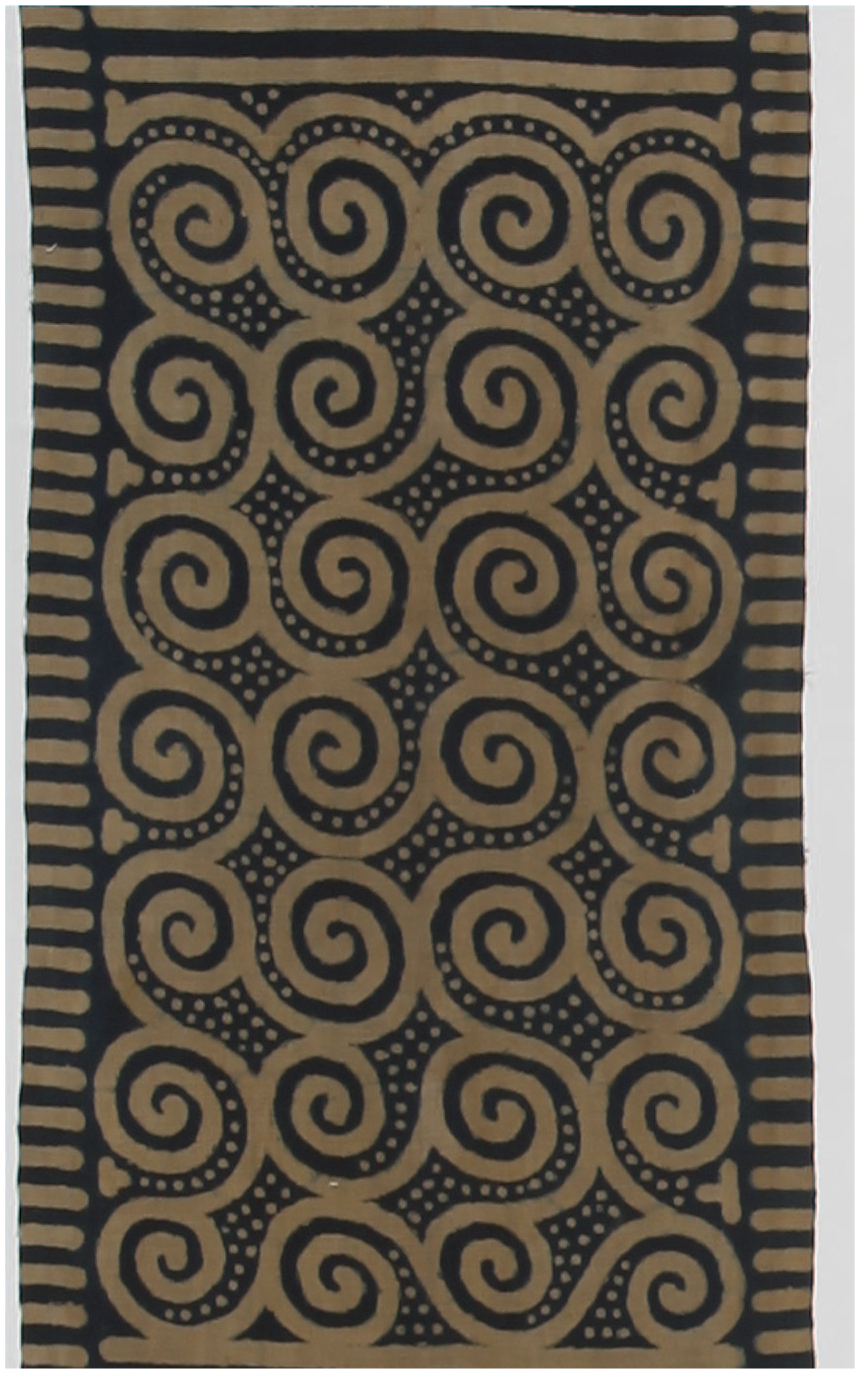
Stylized tadpole motif on a sarita. © Photograph: Aurora Donzelli.
In Toraja, tadpoles are generally associated with ideas of fertility and abundance. As Waterson (2013: 189) notes, ‘tadpoles flourish in flooded rice fields that lie fallow in the months between harvest and the planting season.’ Their use as a decorative motif for sarita and maa’ and for the origin-house wood panels aims at provoking an auspicious outcome: abundant crops, fertile fields, copious offspring, and overall prosperity for the members of the extended family (T: pa’rapuan) and village (T: tondok). In this sense, we may categorize the tadpole element as a performative symbol of prosperity. According to the perspective developed by Speech Act Theory (Austin, 1962), words not only name the world, but they actually perform what they name through the enactment of acts of speech. Similar to the performative function of magic spells and ritual formulas used by ritual speech specialists, these designs are not simply visual representation of an external reality, but graphic instruments aimed at calling their referents into existence, actualizing their users’ expectations and desires for well being (T: pelambean). Thus, far from simply representing tadpoles as iconic symbols of abundance, the bulintong si teba’ motif (often decorating the maa’ and sarita hung from origin-houses during the performance of life-enhancing rituals) aims at bestowing abundance over the rice fields and bringing prosperity to the kindred group. However, even though the members of the Toraja community interpret the graphic sign as immediately evocative of images of life and fertility, they are rarely able to trace the meaning of the motif back to the referent it iconizes and to undo the tadpole visual trope (and the semantic bundle associated to it) into an analytical explanation, such as the one I have just offered. Put differently, for the Toraja, the bulintong si teba’ motif is readily and straightforwardly interpreted as ‘fertility’ and its connection with actual tadpoles is generally forgotten and absorbed within the motif’s conventional meaning.
The semiotic connections between referent (i.e. the actual tadpoles), sign vehicle (i.e. the bulintong si teba’ design), and concept (i.e. fertility) are to a great extent enabled by the parallelistic arrangement of the motifs. Similar to the encoding and decoding of the meaning of the ritual couplets, the interpretation of carved and painted decorations largely relies on how the motifs are arranged in pairs. During my most recent period of fieldwork in Toraja and Mamasa (March 2018), I showed pictures of the sarita cloths that are part of several Museum collections to contemporary Toraja master carvers and printmaking artists, and asked for their comments.
Toraja often claim that the term sarita originates from the Indonesian word cerita, which means story (see also Morrell, 2005: 121), and, in fact, to my great surprise, my interlocutors reacted to the pictures of the sarita I showed them as if they were written texts, or verbal narratives. First of all, they tried to determine whether the direction of the narrative proceeded left to right or top to bottom. Then they analyzed the alternation of the patterns and whether they repeated themselves. As is often the case, patterns on both cloth and wood proceed through a parallelistic structure, quite similar to the compositional mode of ritual speech.
In order to illustrate this interesting compositional symmetry between spoken words and the graphic designs, let us go back to the fragment from the merok chant quoted in section 2 and reproduced below – this time without the English gloss in order to highlight the parallelistic structure – each couplet (lines 577, 578, 579) is made of two paired lines (a. and b.), which, in turn, are composed of sets of paired words.
577. a. Dilando lalannimi sarita to lamban b. Dilaka pa’taunanni maa’ to unnorong 578. a. Dilando lalannimi gayang ditarapangi b. Dilaka pa’taunannimi kandaure salombe’ 579. a. Dilando lalannimi ianan sanda rupanna b. Dilaka pa’taunannimi barang apa mintu’ sola nasang
Every a. line opens with the word di-lando – a passive form deriving from the root lando (‘long’), which combined with lalanni (‘journey’) means ‘a long journey is undertaken in order to find’. Every b. line opens with a morphologically and semantically symmetrical term di-laka, which is also produced through the combination of the passive prefix /di-/ and the stem laka (or langka’), that is, ‘far’ or ‘tall’, meaning ‘a long tour is undertaken to find’. So, each unit (at the level of morpheme, word, and sentence) stands in parallel with another unit, producing an incremental structure in which each dyad is semantically and formally paired with the following ones in multiples ways.
A close look at the composition of the decorations appearing on Toraja textiles and carvings reveals interesting traces of the same structural parallelism that characterizes ritual speech. For example, in the image of a sarita reproduced below (Figure 13), we may be able to appreciate the parallel repetition of the pa’tangke lumu’ (T: seaweed branches) pattern and pa’bulintong si teba’ (T: tadpoles kicking each other) pattern that appear in parallel positions. This alternation between ferns and tadpoles motifs, and the other types of visual parallelisms, which may be easily observed on the wooden panels of the origin-houses, is consistent with the Toraja cultural semantics, in which the tadpole and the ferns are symbolic icons of rapid growth and fertility.

Parallelistic arrangement of sarita motifs, here reproduced in two halves. Collection of the Asian Civilisations Museum, Singapore. Gift of the Caddys in memory of M. Daly Adjas. Reproduced with Permission. Notice in particular the bulintong (tadpole) and pa’tangke lumu’ (waterweeds) motifs appearing on the longer rectangles, which, in a way similar to paired ritual lines, conjure parallel images of fertility. Notice also the parallelistic alternation between the motifs on longer rectangles and those on the shorter squares: the pa’sulan (the crisscross motif) and the kabarrean allo (sun disk with rays)—both considered emblems of the nobility— appear in parallel positions. The pa’daun bolu (the betel leaf motif, generally associated with conviviality) appears at both ends of the cloth.
Conclusion
In this article, I questioned the longstanding divide between language and material culture by establishing a dialogue between the recent scholarship on language and materiality, which is mostly concerned with the semiotic products of (late) capitalism (Cavanaugh and Shankar, 2014, 2017; Chumley and Harkness, 2013; Murphy, 2015) and earlier analyses of eastern Indonesian art forms, which engage the verbal and material artifacts of small-scale island communities (Adams, 1973; Fox, 1988; Hauser-Schäublin, 1991; Keane, 1997, 2007; Kuipers, 1990, 1998; Nooy-Palm, 1979). I scrutinized the semiotic and aesthetic ideologies underlying Toraja iconographic tradition as related to Toraja ritual language – a specialized register that shares many characteristics of other eastern Indonesian ritual codes. While a longstanding division between the literatures on verbal art and material culture has obfuscated important overlaps between what are in fact related forms of semiotic expression, I argued that in order to fully appreciate the expressive styles and artistic traditions of eastern Indonesia (and Austronesian cultures, more broadly) we may need to look at how similar signs are produced, used, and interpreted through different modalities (i.e. the sensory system in which the sign is perceived, be it visual, aural, or haptic), and channels (be it spoken words or visual depictions), and examine the different signaling systems or modes (i.e. speaking, carvings, painting) and the various media (i.e. sound waves, painted cloth, carved wood) through which signs are transmitted.
Although the complex meaning-making practices characterizing Toraja expressive and material culture are still somewhat opaque, this type of integrated analysis may reveal important commonalities in local notions of artistic creativity and poetic authorship – namely, a backward-looking conception of artistic production, based on a more imagined than real notion of tradition. In fact, in spite of the important transformations that have affected Toraja expressive and material culture – only some of which were discussed in this article – Toraja makers tend to present themselves as meticulous followers of pre-established patterns. According to this conservative and anti-demiurgic cultural view of making things as well as speeches, the speaker/craftsman is understood as an animator, editor, and assembler of ancestral words and motifs. The recent introduction of cash compensations for ritual speechmakers and professional carvers, and the increasing value of traditional sacred cloths on the international ‘tribal art’ market are challenging this local anti-demiurgic conception of expressivity in interesting and complex ways, which space limitations prevent me from discussing further here (but see Donzelli, 2007b).
The proposed integrated approach also exposed important commonalities in the semiotic working of Toraja ritual metaphors and decorative motifs. Carvings, textiles, and ritual speech all proceed through bundles of images. Although they do not share the same modality, medium, or channel, carved/painted signs and ritual metaphors operate through similar semiotic processes. Spoken ritual couplets and carved and painted motifs are based on a similar process of sign formation and operate through similar performative notions of the visual or verbal utterance. The process of semantic transference characteristic of any metaphorical language is marked, in Toraja ritual speech, by a high degree of formalization, for Toraja metaphors are both highly iconic and endowed with a strictly conventional meaning. Thus, as we saw, while most members of the Toraja cultural and linguistic community are able to identify the tadpole motif and decode its meaning as an auspicious invocation for fertility and prosperity, they are at pains to provide a lexical–semantic exegesis for it. This interpretative approach to visual tropes has strong parallels with how verbal metaphors are understood and with the general resistance toward the literal and semantic analysis of ritual couplets.
Finally, traces of the structural parallelism documented for eastern Indonesian ritual languages also appear in the decoration of carvings or textiles. Similar to the semantic networks connecting ritual couplets, the designs appearing on wood and cloth are linked through meaningful webs of associations. For example, the tadpole motif discussed earlier is often associated with the trailing waterweeds (T: pa’ tangke lumu’) or the water boatman (T: pa’ bombo wai). This mode of compositional organization, typical of both carvings and textiles, closely resembles how fixed pairs of semantic elements in ritual speech may appear ‘in corresponding positions within parallel lines’ (Forth, 1988: 129). While a full exploration and a complete description of these analogies lies beyond the scope of this article, the present discussion will hopefully provide a starting point for developing an integrated analysis of the spoken and visual languages of Indonesia and beyond.
Besides conceiving textiles, woodcarving motifs, and ritual speech as mana’ (T: heritage, inalienable possessions), the Toraja, in the accounts I collected, offer several analogies between ritual speechmaking and woodworking, alongside an unintentional vision of authorship and craftsmanship. Further, my analysis of how meaning is produced and interpreted across different media, channels, and modalities highlights interesting commonalities between ritual metaphors and the motifs embellishing woodcarving and sacred cloths. So, to return to where I started, unlike the longstanding representation of language as a symbolic code separate from materiality, the Toraja vernacular theories of artistic making as well as of sign formation and interpretation – something I refer to by the larger framework of aesthetic grammar – display a markedly materialist inflection. This analysis invites a wider reflection on the unexpected convergence between contemporary North American linguistic anthropological scholarship and the indigenous semiotic ideology of a community living in a peripheral region of Indonesia.
Footnotes
Declaration of conflicting interests
The author(s) declared no potential conflicts of interest with respect to the research, authorship, and/or publication of this article.
Funding
The author(s) received no financial support for the research, authorship, and/or publication of this article.
