




Abstract
In this article, we examine a collection of 47 American Indian baskets collected in the early 20th century, at the height of the ‘basket craze’. Currently stored in a Danish museum without much archival information, the baskets encapsulate art historical developments taking place at the turn of the century, a time fuelled by the Euro-American preoccupation with collecting and displaying Native American artefacts. Academic debates developed around the derived ‘tourist art’ and the colonial framework still haunt Euro-American notions of authenticity. We investigate the baskets, their role, cultural affiliation and significance in a bottom-up approach, with a persistent view to this historical context as well as their material testimony to the agency of the weavers navigating in a transformed economy and legislative restrictions. We show how the baskets materialize the entangled identities of makers, collectors and museums and how interdisciplinary research can provide a spatio-temporal context to overlooked collections.
Introduction
During the transformative period of the late 19th to the early 20th century, Euro-American collectors found themselves engaged in an intense scramble for Native American artefacts. Pottery, rugs and beadwork were popular but American Indian baskets were perhaps the most sought-after items (Hutchinson, 2009; Lee, 1999; Smith-Ferri, 1998). This article revolves around a collection of 47 baskets of varying styles and weaving techniques, all produced by Native American and Native Alaskan artists prior to 1922 and exported to Europe. Today, they are held at Ringkøbing-Skjern Museum, Denmark, located some 5,000 miles from their area of origin. The collection is contemporary with the zenith of the so-called ‘basket craze’, which was one of the driving factors in their collecting, though the museum records have no information regarding the collector's motivation or the Indigenous artists that wove the baskets. A contextual investigation of the cultural setting from which these baskets sprung reveals how the Euro-American construct of ‘authenticity’ troublingly was operationalized as a colonial tool that could be afforded or denied American Indian basketry and other art forms. The collection in Ringkøbing forms a point of departure for a bottom-up investigation of the baskets in their own right. The article further explores the role of these and other ‘fancy baskets’ as art historical developments with a persistent view to the artists navigating in a transformed market economy of the Victorian era. Thus, we argue, the baskets function as identity-making artefacts on several levels at various stages of their life history. By considering these aspects, we show how a collection with limited archival information holds promise in elucidating cultural developments and identity formation across time and space.
The baskets stem from the American Southwest and the Pacific Coast area and were likely bought from curio shops and Indian markets. They are almost exclusively classic ‘fancy baskets’ of fine quality produced for sale. The collection includes both well-known types and shapes (i.e. RIM-1746-A), as well as some more unusual, unique specimens (RIM-1746-AC, Figure 1). Collected by Danish immigrant Niels Madsen (1864–1922), the baskets were later donated along with his ‘other curios’ to the local Danish museum after his passing in January 1922. Madsen grew up in rural Ølstrup in the immediate vicinity of Ringkøbing and migrated to America as a 23-year-old in early 1888 as about 250.000 other young Scandinavians did during this period (Bender, 2007). Upon obtaining American citizenship in 1899, he lived and worked in Tyler, Minnesota, where he also spent his retirement. He seemingly undertook two travels in the last decade before his death, as records show that he applied for a passport at least twice. It is possible that this relates to travel to the Pacific Coast as inferred by the nature of the material in his collection.

Classic and unique styles. Left, Hopi wicker plaque. Sumac, rabbitbrush, yucca leaf, dye. Diam. ca 33.5 cm (RIM-1746-A). Right, Tlingit twined flask with lid and strap. Spruce root, beargrass, dye, thread. Diam. 12 × 14 cm (RIM-1746-AC). All photos by Laura Ahlqvist; courtesy Ringkøbing-Skjern Museum.
The presence of Native American and First Nations material in a Danish local museum is not unique. A pilot study from 2019 revealed an unexpected number of artefacts of Indigenous American and Canadian origin residing in Danish regional museums, rarely exhibited and sometimes misidentified. Mostly stone tools, they were collected by Danish emigrants and sent back to Denmark as gifts to family or local museums. In addition, it emerged that items that were perceived to encapsulate the European classic notion of ‘the American Indian’ such as moccasins and miniature totem poles had been favoured. The collecting efforts mainly coincide with the period of extensive migration from Scandinavia to America in the late 19th century (Ahlqvist et al., 2019), a time, where the general Zeitgeist viewed the collecting of foreign artefacts and donation to Danish museums as the patriotic duty of Danish expats. The colonizing efforts of the Danish state, which began as an economic endeavour, in time spread to academic institutions such as the Danish National Museum, where it came to define part of the collecting strategy (Ahlqvist et al., 2019: 60–61). Following this, requests were published for the collecting of ethnographic artefacts abroad followed by donation to Danish institutions of knowledge (e.g. Birket-Smith, 1931; Gabriel, 2016: 276). This was a way of serving one's country by enhancing the general state of knowledge, it was argued. The Niels Madsen collection in Ringkøbing exhibits some relationship with these larger tendencies as well as some rather unusual traits.
The entire collection of Madsen's American ethnographica comprises of a large number of seashells, 47 American Indian baskets and a Philippine basket, Puebloan pottery, a so-called ‘Tesuque rain god’ (see King, 2000), a pair of sealskin moccasins from Nuvuk (Point Barrow), two zoomorphic rattles and two miniature totem poles, one of argillite and identified as Haida by Aay Aay Hans, Haida Gwaii Museum. A sticker from the well-known Ye Olde Curiosity Shop can be seen on one of the rattles, suggesting that Madsen travelled to Seattle. It is also possible that he went to Alaska, as he collected two Alaskan, two Aleutian and several Tlingit baskets. Likewise, several baskets from California and Arizona were probably acquired personally during his travels. Two of the baskets have tags attributing them to the Fred Harvey Trading Company, which sold Native arts from Alaska, California and the Southwest (Howard and Pardue, 1996: 24). Since Madsen's donation, the artefacts have been on display from the 1920s until the 1970s and again in the 1990s. The present article brings these baskets into the light once more.
The baskets: presentation, description, context
The lack of archival information about these baskets initially constituted a challenge, as the museum entry stating that they were ‘Indian-made baskets’ did not suffice as identification of their cultural affiliation and area of origin. As basketry relies on naturally available material, the identification of baskets involves an overview of the availability of natural resources as well as cultural signifiers. From thin blades of grass to roots and tree branches, the types of materials used in a basket direct the construction techniques employed; together, the materials and techniques used in a basket are key in placing it in a geographic area. For instance, delicate seagrass in Alaska and fern fronds in Northern California are used to create tiny stitches in several twining techniques. In contrast, tribes in Southern California wove juncus and other tribes used willow for coiled basketry, whereby wefts are sewn around a central foundation. Specific characteristics such as rim finishes, stitch types, or design motifs provide important clues in determining tribal origin. Identifying these aspects most often necessitates physically handling the baskets. In the case of Madsen's collection, physical presence in the storerooms allowed for detailed inspection of materials and techniques, granting more certainty to the observations below. Following our inspection, the baskets were rehoused before being returned to storage; as cultural affiliation had been established, it was now possible to store baskets from the same region and tribe together. Historically, European museums have paid little attention to ensure that objects from the same tribe were placed together as Native American artefacts were often utilized as reference material to illustrate a perceived evolutionary continuum (Ahlqvist et al., 2019: 61). Housing collections from the same tribe and culture area together is considered appropriate in many Native American tribes.
The collection covers the American Southwest and the Pacific Coast, and contains a wide variety of basket types, representing at least 19 tribes. Based on the archives, it seems likely that Madsen took a train trip to the Grand Canyon, an experience undertaken by countless travellers. This would have provided rich opportunity to interact with basket weavers during train stops or excursions, experiences which were mainstream components of tourism at this time. Such a journey presents a plausible context for baskets in Madsen's collection deriving from several Arizona tribes: Akimel O’odham, Apache, Chemehuevi, Havasupai, Hopi, and Tohono O'odham. Several baskets have old tags, including ‘Pome [sic] Indian Northern Cal.’; ‘Warner's Ranch, California Mission’; ‘Orobi [sic]’; for each of these, the tag designations are consistent with the basket's identification. One original label on a Philippine basket in the collection stems from the 1915 Panama-Pacific International Exposition in San Francisco, which places Madsen in California, from where eight American Indian baskets originated. It is also possible that Madsen procured his artefacts from curio shops and mail-order basket dealers, businesses that abounded during his collecting days. Typical for a traveller, Madsen picked up small souvenirs; unlike most tourists, he systematically chose Native American baskets (see Lee, 1999). That the baskets were bought with the intended destination far from their area of origin is inferred by their size; in general, they are small, easy to pack, easy to ship.
Some designs are specific to certain tribes and could be used as identifying markers when reviewing the collection in Ringkøbing. For instance, a small Cupeño bowl woven with sumac, black-dyed juncus, and deer grass (RIM-1746-AQ, Figure 2) sports an eagle design (headless, as the basket is unfinished). In this case, the design and the original tag make it possible to pinpoint the location of origin as well as its accompanying story of loss. The small basket stems from the village of Kupa, which later became known as Warner's Ranch following an act of forced removal. Cahuilla/Cupeño author Gordon Johnson writes: In May 1903, armed soldiers encircled the thatched-roof adobe homes and ordered people to pack what they could into mule-drawn wagons and leave… It was a forty-mile trek from Kupa down to their new home on the Pala Indian Reservation. To this day, Cupeños refer to it as the Trail of Tears (2007: 20).
In this case, the identification by motif supplies the museum with a historical context for an artefact, which previously had none in the records.
Coiled yucca leaf and gallenta grass plaque (RIM-1746-B, Figure 2) bears a recognizable motif that is distinctly Hopi. In this case, Angwusnasomtaqa Poota, Crow Mother Katsina, an overseer of children's initiation rites, is identifiable by her white sash, black dress and wings (Finger and Finger, 2006: 75). Carved dolls (tithu) representing her and other supernaturals (katsinam) were originally given as gifts in ceremonies but came to play important economic roles in Hopi society as tourists showed an interest in buying the carvings. This created a market for tithu specifically made to be sold as tourist art (Pearlstone, 2011), a development comparable to American Indian baskets. Like in the case of the Cupeño bowl, the materials used for Madsen's Hopi basket plus the motif, provide a cultural setting for the object and place it within a spatio-temporal context.
A large Pomo bowl woven with sedge root, bulrush and willow (RIM-1746-AR, Figure 2) displays a seemingly non-figurative design. The pattern is organized in thirds starting at black bands at the base and continuing on sides in geometric figures. Small inconsistencies recognized in relation to the symmetry of the design could be Pomo Dau marks. Such marks are deliberate changes to an otherwise symmetrical motif or openings between stitches that are incorporated by the weavers for diverse cultural reasons (Winther, 1996). Other baskets incorporate unique designs, such as an Apache basket jar (RIM-1746-G), which possibly portrays 14 horses encircled by a structure resembling a corral. Whilst some designs are specific to certain tribes, others are chosen for personal reasons. Clint McKay, a weaver of Dry Creek Pomo-Wappo-Wintun heritage, notes: ‘The designs we use are family designs. Not even tribal, but family. Sometimes I get a message to do a new one, and I will’ (Potter, 2017: 66). These examples illustrate the variety of the designs on the baskets in the collection in Ringkøbing and exemplify how museum objects with little accompanying archival information can be researched.
The Apache tray and Hopi plaques in Madsen's collection derive directly from basketry types used by Native people in daily life. Hopi plaques are carried in basket dances, exchanged by families in a wedding, and more, while Apache trays can be used for food gathering. Olla-shaped basket jars were another popular form adapted from larger storage baskets; the examples in Madsen's collection (e.g. RIM-1746-G, Figure 2) are minuscule Apache and Tohono O’odham versions. The assemblage also includes a woman's cap (RIM-1746-V, Figure 2) from one of many northwestern California tribes who shared similar basketry styles. These hats are worn to protect one's forehead from a tumpline, which would support a gathering basket worn on one's back. More elaborate caps are worn in dances and ceremonies, and they may include ornamentation such as redheaded woodpecker scalps and dangling dentalium shell pendants. Basketry caps play a symbolic role for Hupa women, as they were worn as a resilient response to the US government's assimilation efforts in the 19th century (Baldy, 2018: 125). Today, caps continue to be made and worn in ceremonies and for other important events, illustrating how basketry continues to be a contemporary art practiced throughout Native North America. Basket caps in museums can aid in processes of cultural revitalization as knowledge is anchored in the objects, making it more accessible when taught to younger generations. They are considered sacred, living things that want to fulfil their purpose, and so, claims for repatriation have been made and, in some cases, been successful (Esquivido, 2015: 63–67).
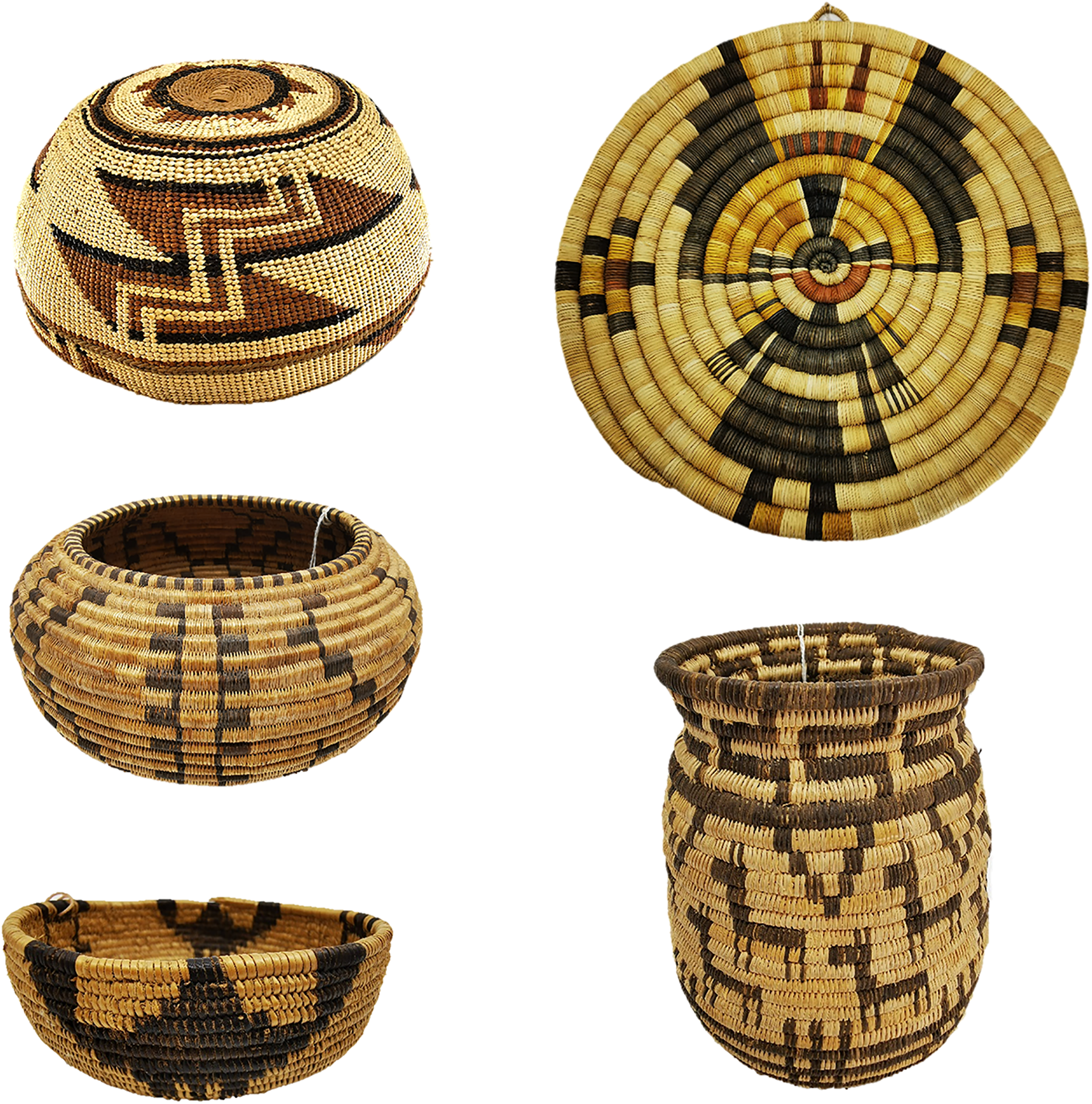
Various types and designs. Top left, Basket cap, twined, unidentified culture. Conifer root, beargrass, maidenhair fern, dyed woodwardia fern, willow or hazel. Diam. 8.5 cm (RIM-1746-V). Similar caps were made and worn by many Northwestern California tribes. Top right, Hopi coiled plaque. Yucca, gallenta grass, dye. Diam ca. 33.5 cm (RIM-1746-B). Design represents Angwusnasomtaqa Poota, Crow Mother Katsina. Center left, Pomo coiled bowl. Sedge root, bulrush, willow. Diam. 19 cm (RIM-1746-AR). The intentional break in the design may be a Dau mark. Lower right, Apache coiled olla. Willow, cottonwood, devil's claw. Diam 14 cm (RIM-1746-G). Design could represent horses in a corral. Lower left, Cupeño unfinished basket. Sumac, juncus, deer grass, dye. Diam. 10.5 cm (RIM-1746-AQ). Designs of eagles, heads missing as the basket is unfinished.
The majority of baskets in Madsen's collection were made to be sold and remain authentic pieces of original Indian art. As Indigenous people were removed from their homelands to reservations, sometimes nomads transitioned to farmers on land with poor soil and needed another way to survive. Selling art was one way to keep food on the table, and basketry's role in this is well-documented (Howard and Pardue, 1996; Hutchinson, 2009; Phillips, 1998). With the spread of the railroad, Indigenous artists found willing buyers on trains: elaborate designs, bright colours and unusual shapes appealed to tourists, travellers and collectors alike, and weavers rose to the challenge with an explosion of woven creativity. Baskets shaped like beverage containers constitute examples of such innovative forms in Madsen's collection. An unusual flask (RIM-1746-AC, Figure 1) and a teacup and saucer set (RIM-1746-AA & AB, Figure 4), all made by Tlingit artists, are elegant but are not made to be used; likewise, a glass bottle was covered with plaited cedar bark by a Tsimshian weaver and topped with a woven cap (RIM-1746-AG, Figure 4) likely for aesthetic reasons. All objects are produced by skillful weavers and emanate a quirkiness, which might have been what appealed to Madsen. As a collector, he was seemingly preoccupied with documenting various aspects of basketry, and he appreciated the artistry of it. He had a good eye, choosing pieces that were visually pleasing, finely woven with even stitching and symmetrical forms and designs. It appears that he and later custodians cared well for the baskets, which are all in very good condition. Although a couple are faded from light exposure during decades-long display, most of them are in impeccable condition, an admirable state after a century in a museum.
‘It walks in two worlds’: basketry as living art
Native American basketry encompasses a widely diverse and complex set of practices with an important heritage. Basket weaving and the gifting of baskets mark life events and shape, substantiate and materialize relationships (Bernstein, 2003: 9). In a range of interviews in Bernstein (2003), various Indigenous basket weavers convey the sense of living heritage that weaving and interaction with baskets bring. Basketry's cultural significance emerges in the common viewpoint that histories of Native Americans and basketry are interwoven; some tribes include baskets in their creation stories. For the Cahuilla, Elka Menyille is their Sister the Moon. She brought songs, dances and healing plants to the people, and she taught the women basketry (Museum of Riverside, 2021). For Alaska's Tlingit, the Sun's human wife and children were lowered to the earth in a large basket (Paul, 1991: 9). California's Kawaiisu people have an earth diver creation story: a bird dove into the sea to bring up soil, carefully building the land in a basket which supports the earth today (Zigmond, 1980: 27–28). For some Native Americans, baskets remain an integral part of life.
The harvesting of materials for baskets is usually an elaborate and time-consuming affair, often involving many community members and generations. Clint McKay explains: ‘We weave with the same plants that have been gathered in the same place for generations. My aunties, and their mother, and before her time – at least 5 generations from what I know – gathered in these places.’ These days, Clint's family gathers with him. His wife and daughters are accomplished weavers, and his grandchildren are beginners (Potter, 2017: 67). The act of weaving itself is often learnt through observation and hands-on teaching. The creation of a basket consists of several steps and is a bodily experienced practice; weavers Julia Parker (Coast Miwok/Kashaya Pomo) and Sherrie Smith-Ferri (Dry Creek Pomo/Bodega Miwok) describe basket weaving like a dance (Parker and Smith-Ferri, 2003: 27).
Two of the baskets in Madsen's collection may be examples of a collaborative process where an experienced weaver started the basket, and a novice finished it. In the case of a spruce root Tlingit basket tray (RIM-1746-S, Figure 3), the start of the basket is woven with even stitches and high degree of control and skill; the rows after the first design band are considerably more inconsistent and exhibit possible mistakes in stitches and design symmetry. One interpretation is that this and another Tlingit basket (RIM-1746-AE) were apprentice pieces.

Tlingit twined tray. Spruce root, beargrass, dye. Max. diam. 25.5 cm (RIM-1746-S). Detail, weaving inconsistency.
Basket weaving is a living art in which artists draw on a range of cultural concepts that they are free to work with and interpret in their own way. Considering cultural tradition as a restraint controlling the weave and pattern of a given basket is a flagrant oversimplification; rather, the basket weaver, like any artist, works within a set of notions and applies them with regard to individual creativity and aesthetics. This may include novel interpretations of motifs, transitioning between different weaving techniques within the same basket, or incorporating unusual materials. As Wasco weaver Pat Courtney Gold remarks: ‘I enjoy experimenting with new fibers and trying variations on old designs. I’m sure that if my ancestor basket-weavers were transplanted into this century, they would be inspired to do the same’ (Gold, 2003: 25). Tohono O’odham weaver Terrol Johnson explains that his work ‘reflects my connection to tradition as well as the diversity of contemporary life. It walks in two worlds’ (Johnson, 2003: 29).
Even though the historical tourist consumption of Indian baskets became a driving force behind artistic development in basketry (see below), the unequal power relationship between artist, buyer and government must be kept in mind. The expansion of the American state and the resulting marginalization of Indigenous communities, including forced relocation to reservations, meant that living arrangements and modes of subsistence were forced to change; ‘dire economic straits’ drove ‘the use of expressive culture as a source of income’ (Tone-Pah-Hote, 2019: 23). The developments in basketry are material testimonies to the deliberate choices of Indigenous artists in a response to a transformed subsistence economy plus climatic and environmental changes. For example, Tohono O’odham baskets transitioned from being largely willow and cattail pre-1930s to today's woven yucca baskets due to worsened growing conditions linked to farming surrounding the reservations (Johnson, 2003: 29). Legislative pressures such as altered property regimes also played a role as the seizure of Indigenous lands severely restricted or shut off access to some material gathering sites. Governmental interference with Native-based ecological practices, such as controlled burning, has had an environmental impact on the landscape and affected the quality of, for example, raw material for baskets (Baldy, 2013). The specific cultural development taking place in basketry around 1900 thus includes elements of both duress and dominance as well as creativity and resilience.
Basketry is ancient and encapsulates thousands of years of skill and landscape knowledge, that is, where to harvest and how to prepare materials, but simultaneously this history is continuously unfolding and developing through new weavers and their way of engaging with this knowledge base. Examples of this development include Kelly Church (Potawatomi/Odawa/Ojibwe heritage) incorporating copper splints into her baskets (2009, personal communication), and Don Johnston (Aleut – Qagan Tayagungin Unangax^) weaving with silver wire (2019, personal communication). And always, weavers take care to teach the next generation, ensuring survival of the art. Thus, each basket is at once contemporary and connected to its cultural context (Johnson, 2003: 29).
The ‘basket craze’
Room for interpretation means that basketry is constantly developing, which defies the faulty Euro-American narrative of the 20th century considering the innovations and incorporation of new designs as indications of a deteriorating practice. This narrative is symptomatic of the colonial era academic view of Native Americans and other Indigenous communities as destined to perish with the inevitable spread of Western culture and ideals. Such notions developed in Anglo-European mindsets especially after increasing levels of contact between Indigenous and European communities and to some extent still characterize non-Native perceptions of Native people (Ambros and Buzinde, 2021: 3–4). Linking up with the formative museum era, this attitude was reified by targeted collecting undertaken by museums aimed at preserving Euro-American idealized aspects of ‘Native life’ that were deemed worthy (Phillips, 2021: 11). This salvage anthropology largely centred on ‘ceremonial objects’ such as masks, rattles, totem poles and weaponry, as well as descriptions of technology and collections of stories (Cohodas, 1999: 146).
The decades surrounding the turn of the 20th century also saw the consolidation of the bourgeoisie, its pastimes and worldviews. The rise of tourism came to affect the collecting of American Indian artefacts, as contemporary advertisements celebrating the pristine nature of the American West and Alaskan wilderness quickly came to encompass the ‘uncivilized Indians’ inhabiting these areas. Spun in romanticizing phrases, travel companies would bring white tourists into contact with Native people via interaction with their objects bought directly from the makers or curio dealers, or via visits to reservations (Lee, 1999: 269). The Fred Harvey Company capitalized on this trend by organizing so-called ‘Indian Detours’ and incorporating Euro-American interpretations of Indigenous art and architecture in the newly built hotels along the railroad. Indigenous imagery was also appropriated into advertisements (Berthier-Foglar, 2016: 134; Van der Hooft, 2016: 115). Through this exposure to select aspects of Indigenous culture, Victorians developed a preoccupation with the collecting of Native American culture and were soon engaged in an intense scramble for artefacts. In contrast to the Native American objects prioritized by museums, private collectors largely focused their energy on rugs, pottery and baskets, objects that sat firmly in the domestic sphere but still signified an ‘ethnic’ identity (Cohodas, 1999). Another difference was that the anthropologists that collected for the museums were primarily male whilst several private collectors were female (Lee, 1999; Mulin, 2001).
The pursuit of Native objects developed into a frenzy, specifically known as the ‘basket craze’ as Indian baskets were highly sought after (Smith-Ferri, 1998). The baskets were considered epitomic material representations of 'the American Indian' as they fed into the popular Euro-American image of the Native makers. As such, they attracted the attention of the bourgeoning Arts and Crafts movement as they were reimagined as the antithesis of the Industrial Age and came to serve as symbols of anti-modernism (Lee, 1999: 273), even though the temporal setting creating them was, in fact, modernist; economic factors and marginalization had significantly transformed the type of relationships materialized through the exchange of baskets as well as the style. This view of the Native weavers quickly became prevalent and it was not uncommon for white art dealers to claim that the baskets they were selling were made by ‘the last of the great weavers’ or construct myths and stories attached to the baskets and their motifs to invoke notions of longevity (Cohodas, 1992; Smith-Ferri, 1998). Thus, the general Euro-American gaze regarded the baskets as remnants of pre-contact times, and by acquiring these artefacts, one could signal cultural awareness and claim to help preserve aspects of cultures ‘destined to perish’. One outcome of this non-museum version of salvage anthropology was the construction of the ‘Indian corner’, a room or section of a room dedicated to Native American artefacts in white households. The Indian corner embodies the antithetical relationship between the perceived wild, pristine beauty of the American Indian relocated to the comforts of a domestic Euro-American setting (Hutchinson, 2009), permitting families to display their cosmopolitanism while revealing their part in colonization and imperialism (Phillips, 1998: 209–210).
Art, authenticity and the colonial gaze
The Victorians failed to realize that their trinket baskets were innovative products that had developed as a response to the transformed social context of most tribes in the wake of discriminatory legislation and the increasing Euro-American demands for American Indian baskets. As Indian baskets became popular among Euro-Americans, weavers created new types that referenced European shapes (Cohodas, 1999: 145), and the availability of synthetic materials and dyes inspired some weavers to incorporate these into their art, like silk thread and wool yarn in Madsen's Aleutian baskets (RIM-1746-T and RIM-1746-AF) (Figure 4).
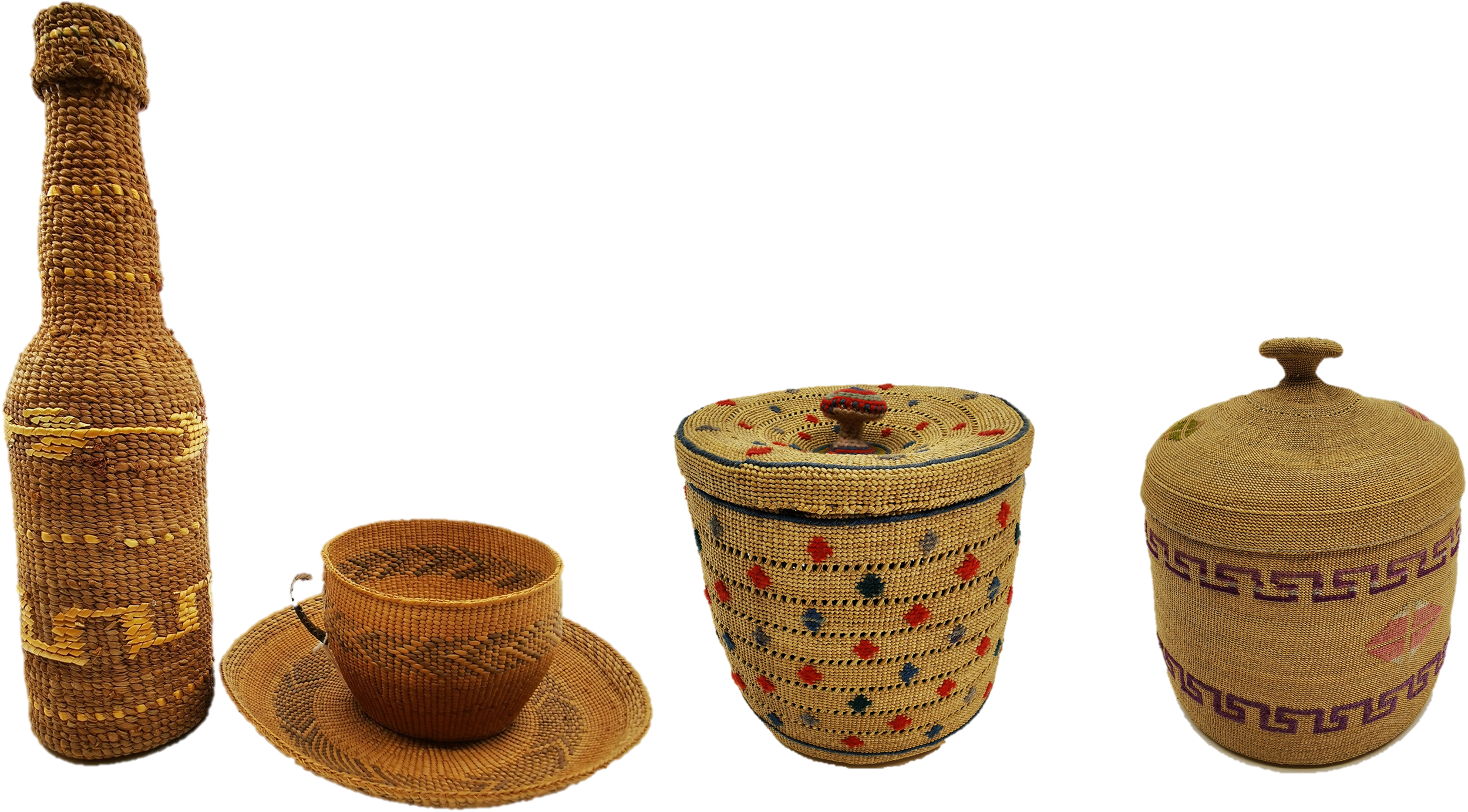
Tourist art. Far left, Tsimshian basketry covered bottle with lid. Cedar bark, beargrass, glass. Diam 7.5 cm (RIM-1746-AG). Left, Tlingit twined cup and saucer. Spruce root, beargrass, dye. Saucer diam. 16 cm (RIM-1746-AA). Cup diam. 9 cm (RIM-1746-AB). Right, Aleutian twined basket with lid. Beach grass, dyed wool yarn. Diam. 14 cm (RIM-1746-T). Far right, Aleutian twined basket with lid. Beach grass, dyed silk thread. Diam. 9.5 cm (RIM-1746-AF).
Such innovations were initially considered healthy signs of ‘progress’ by scholars and collectors that wished for the global colonial rule to ‘civilize’ colonized people. By creating products that responded to the market economy, these people were perceived as becoming more ‘industrious’. However, not long after, the same voices grew concerned with the transformation of art that linked up with the rise in demand for Native American art products. The artists’ response to the market economy was seen by white academics as compromising the authenticity of their culture (Hutchinson, 2009: 32–35; Phillips and Steiner, 1999: 10). James, a prolific Victorian author on basketry, bemoans ‘vicious forms [and] imitation’ like pedestal baskets and alphabet letter designs, while imploring collectors to ‘Discourage, whenever possible, the introduction of vicious elements into the art’ (James, 1902: 97, 192, 230). Likewise, in 1896, the ethnographer Stolpe lamented, ‘The style is no longer genuine but spoiled by European importations’ (Stolpe, 1927 [1896], in Phillips and Steiner, 1999: 10). With the modernization paradigm, the new art forms were rejected as evidence of contamination and the dwindling state of the ‘traditional societies’, an outcome that was originally dreaded yet for different reasons. The concept of authenticity quickly became a measure for how ‘unspoiled’ by contact with European culture a given piece of Native art was, and as a result, came to reinforce Victorian ideals about purity and hierarchy (Cohodas, 1999: 145–146).
Authenticity as a concept is inherently mixed up in emotion, though it is often presented as a rigorous, even scientific term that can be used as an objective marker for an artefact's designation within a particular context. Yet, the struggle of defining authenticity compels academics to invoke numinous concepts when attempting to aptly encapsulate what is implied in the idea. As such, it may be described as relating to aura (Benjamin, 1935), nostalgia, pastness (Holtorf, 2013), memory, mystery, even magic (Jones, 2010). This hazy concept is accompanied by the right to authenticate, and so it embeds a power relation that can be used to establish or reproduce hierarchy and inequality (Holtorf, 2013: 441), which is key in our analysis. Stylistic hybridity such as in the new forms of basketry constituted an insurmountable issue for culture historians in their pursuit to assign a given ‘culture’ to a step on the evolutionary ladder. Likewise, the thought of an artist creating with an intended buyer in mind appalled Western philosophical thought that regards ‘art for art's sake’ as the purest and therefore most authentic (Phillips and Steiner, 1999: 6–9). The troubling associations linger on in Euro-American mindsets as we, for example, tend to attach more significance to pre-contact forms. Similarly, it is not unusual to be met with the question, ‘Is it authentic or is it just a souvenir?’, when working with Native American artefacts donated to Danish museums. A Universalist, materialist view on authenticity is still imminent in many academic and museum approaches that assume that authenticity can be established and measured and that it associates with objects, styles, fabric, etc., which do not diverge ‘too much’ from their origin. Indeed, conventional classification systems employed by Euro-American museums are inherently Universalist (Jones, 2010). Following this, pottery and basketry are often considered functional objects rather than art by academics, and feminist scholars note the tendency to consider weaving, basketry, beadwork, etc., most often associated with women, as crafts rather than authentic art. When the criteria for considering something as an authentic piece of art is measured against a baseline of Western ideals it creates a hierarchy that systematically devalues non-Western artists and women's work whilst simultaneously ignoring Indigenous meaning and significance (Phillips and Steiner, 1999: 6–9).
As Euro-American academics have largely refused to acknowledge tribal oral stories as source material, the (Western) state of knowledge regarding Indigenous art and tradition mostly rests on the colonizers’ biased accounts, misunderstandings or misinformation. That this is one of the foundations for the non-Native use and application of ‘authenticity’ onto American Indian art is problematic and the term continues to be contested as it often involves non-Native voices and authorities passing judgment over Indigenous claims (Sapiel Neptune, 2008: 3–5). Similarly, the Indian Arts and Crafts Act of 1990 and its potential to regulate cultural appropriation and ethnic fraud has been critiqued for creating exogenous, Universalist standards for authenticity of Native-made art that can be impossible for artists to live up to. For example, it operates with a strict view on which materials constitute as ‘authentic’ in the creation of Native art thereby potentially limiting artistic freedom. In effect, it benefits the buyers rather than the artists (Gilio-Whitaker, 2018). However, some Indigenous artists and dealers of art take pride in certifying their art as authentic. The artistic choice to incorporate novel materials such as titanium, copper or film rolls by Indigenous artists (Indian Pueblo Cultural Center, 2021) is also widely understood to be authentic as it is made by Native artists, and as explored earlier, basketry and Native art have always organically developed over time. Pat Courtney Gold puts it thus: When I look at baskets in museums, I can see the differences in designs, see the changes in designs and change in materials… I realized our culture changes. What around me has inspired me to do something different?
Seeing changes throughout history - the weavers were not static - I can look outside my culture and make changes. I can use different materials and designs but keep the Wasco technique. (2010, personal communication)
Similarly, the Indian Pueblo Cultural Center states: For centuries Native American artists have created fine art in both traditional and contemporary styles with hundreds of highly skilled artists who maintain the highest levels of craftsmanship and technical excellence. They honor their ancestors, cultural heritage and the artistic legacies passed down to them, while also pushing the boundaries of what Native American art is (2021).
Today, Indigenous artists express interest in actively shaping their buyers’ perception of authenticity in relation to inter alia connection to their community, their relationships with proper materials and self-respect as artists (Felker et al., 2014). This resonates with Jones’ understanding of authenticity linking up with interrelationships between people, places and objects; intangible yet anchored in the specific context of an object or building. Difficult to put into words, people tend to refer to it as a particular aura or significance that somehow establishes a connection to past life and experience (Jones, 2010).
The general Victorian attitude towards American Indian baskets was ambiguous as it was simultaneously appreciative of their artistic value but disdaining of their makers. As a reflection of this attitude, regarding the Fred Harvey Company's Indian Detours to her home at Santa Clara Pueblo, artist Rina Swentzell expresses: the feelings I had even as a child watching the buses come in, the feeling of – we were not good enough, ourselves, as people were not good enough, everything about us was not good enough… We were made to feel totally devalued. As money was becoming valued, our culture, ourselves, our way of life was devalued. (Howard and Pardue, 1996: 127–128).
This fascination, yet distaste for the ‘exotic Other’ characterizes the colonial gaze, and manifests in the rise of tourism (Hovens, 2016: 91). By visiting ‘the Other’, white tourists were represented with an image that fit the colonial narrative, and by buying their products as souvenirs, they could claim ownership over the experience (Love and Kohn, 2001). In turn, these encounters and the prevailing narrative affected ethnic identity internally and continues to do so (Ambros & Buzinde, 2021; Hoves, 2016: 91) Modern day tourism still reifies an unequal relationship between ‘the tourer’ and ‘the toured’, which mostly translates to visitors from Northern, industrialized countries visiting Southern countries. A range of authors have investigated the Eurocentric core-periphery notions structuring such travels as well as the hierarchical framing of people inhabiting the perceived peripheries. Advertisements, travel agencies and guides perpetuate in language, tone and imagery, the inferior and submissive position of ‘the Other’ encountered by the white tourist, who is liberated from any ethical or political responsibility, evidently rooted in colonial discourse (Tucker, 2019). The unequal power balance between buyers and sellers, which transpires in some white collectors’ recounts of their procuring of artefacts, reproduces state-level colonizing efforts on a micro-level. Such interactions were sometimes described as conquests. One buyer proudly described how he almost tore earrings off ‘a Cree girl’ as he had to run for the train (Hutchinson, 2009: 26–7).
The Niels Madsen collection revisited
The type of material collected by Madsen and the historical background afford insights into the cultural setting that he navigated, even though much remains unknown regarding his motivations. Madsen seems to fit all four categories of collectors put forth by Phillips (1998: 56–65), and so, acted at different times as a tourist, an ethnologist, an agent with buyers and a rare art collector. Some baskets illustrate that Madsen's motivations to collect surpassed the desires of the common tourist. The acquisition of unfinished baskets does not match the profile of the average buyer of ‘fancy baskets’ sold in curio shops and along the railroads (Lee, 1999). A purchase like this would, however, not be unexpected from an anthropologist in the interest of academic research. Likewise, the unique baskets in the collection indicate that Madsen collected more systematically than the average Euro-American tourist did, possibly with the intent of public education in mind, a potential reason behind his decision to donate his entire collection to Ringkøbing-Skjern Museum.
This may be a clue as to why Madsen chose to collect baskets, whereas most Danish-American immigrants collected and donated stone tools, objects that they were likely to stumble upon in daily farming practices. In contrast, Madsen's collection appears to be targeted specific materials. If Madsen was preoccupied with a philanthropic desire to educate, it may explain why he chose to collect baskets from the American Pacific; Alaska and Inuit practices were considered of particular interest to the Danish state due to its colonial undertakings in Greenland (Krupnik, 2016). The exoticization of basketry complies on a more general level with notions governing what other Native American artefacts were sent to Denmark. The idea of the Native American basket weaver, unspoiled by European influence and destined to extinction, resonates with the reductionist image of the ‘classic Native American’ as produced and perpetuated in a Scandinavian context during the late 1800s (Ahlqvist et al., 2019).
Madsen's basketry collection thus touches upon his personal motivations for collecting, yet constitutes a piece of art history and encapsulates a cultural movement. During the transformative time around 1900, societal structure was being renegotiated with the rise of urban culture and various shareholders were struggling with manifesting their identity (Mullin, 2001); the use and display of American Indian baskets was one of the ways that this was attempted. This mirrored the collecting strategies of ethnographic museums in the late 19th century. In the attempt to reconceptualize and define human culture, European museums positioned their understanding of self in relation to ‘the Other’ (Gabriel, 2016). This structured museum collecting strategies and created a European understanding of what Indigenous identity was. Self-reference as the main motivating factor in the scramble for artefacts undertaken by collectors and museums meant that the material collected during this formative period of museum history exhibits Euro-American societies renegotiating their own identity rather than that of the cultures supposedly on display (Dominguez, 1986). In this sense, the collectors displaying their basket collections in their homes mostly exhibited their own Euro-American point of self-reference. Madsen's collection of American Indian baskets likely played a similar role in the minds of the local Danish visitors in Ringkøbing. With their extralocal aura, the baskets embodied the distant and adventurous ‘Other’ yet substantiated a tangible link via their connection to the local man that procured them, Madsen. Local visitors were, through the baskets, presented with an image of Native Americans that spoke to wider Scandinavian constructed narratives of what America and Native Americans were and should be (Ahlqvist et al., 2019: 60–61). The interplay between the local and the global, the self and ‘the Other’ manifested in the baskets was replicated through the staging in the museum display and through Madsen's own actions as he arranged for the baskets to end up in Denmark.
Basket weaving can be seen as a resilient response to discriminatory legislation endured by Indigenous people during this period of government expansion. The resourcefulness of the weavers aided in retaining communal knowledge and skill of basket making (Roberts, 2018); thus, the ‘basket craze’ partly functioned as an accessory to the persistence of American Indian basket weaving rather than its disappearance as feared by its Victorian critics. Some Indigenous artists also built careers and travelled, opportunities that were somewhat fuelled by the Euro-American attraction to Native art (Sapiel Neptune, 2008: 6). This, however, does not mean that they were met with the same opportunities as white artists as racism and marginalization governed much of society. That this was rampant alongside a general appreciation, even appropriation of Native American artistry remains a curious and tragic paradox (Hutchinson, 2009: 93–129).
In this sense, American Indian baskets function as identity-mediating objects in a trifecta of processes as they were imbued different meanings by the various people and institutions interacting with them (Morgan and Pritchard, 2005: 31, 45). They serve as a testimony to the agency and creativity of Native artists, and they reveal Euro-American academia's preoccupation with defining itself in its pursuit of ‘the Other’. Manifesting self-identity necessitates an understanding of self and one's situation in the world, and so, place is almost as important as the individual. Notions of place may be communicated through the use of things, such as souvenirs (Morgan and Pritchard, 2005). The baskets epitomize the bourgeois understanding of the untamed American land and spirit and their use in white homes can be said to constitute early pieces of Americana, anchoring the Victorian sense of self in an environmental, cultural context. Similarly, by acquiring American Indian baskets and probably displaying them in his home, Niels Madsen could reinvent himself as he embraced his new American identity, underscored by the Manifest Destiny narrative (Turner, 1893). American pioneering spirit and settler resilience united in the idealist inevitable domestication of the wilderness, which necessitated acts of forced removal and genocide and became key constituent parts in the nationalistic construction of American identity (Byrd, 2009).
Concluding remarks
Prior to our study of the basket collection in Ringkøbing-Skjern Museum, Denmark, little was known about it other than the name of its collector/donor and the fact that the baskets were American Indian. Our visit to the storerooms, physically handling these 47 baskets have revealed their cultural affiliation (covering the American Southwest and the Pacific Coast) making it possible to organize them according to region and tribe. Other museum material without contextual knowledge may yield similar enlightening insights, which provides possible scope for working with so-called ‘orphaned collections’ (cf. Voss, 2012). When interacted with in this manner, the baskets express a distinct link to historical events, people and places on differing levels: from the account of forced removal, to the symbolic importance of basketry in performing Indigenous identity.
Through our analysis of the baskets and their cultural, temporal setting, they emerge as a material anchor for the formation and consolidation of identity of the different stakeholders that these artefacts encountered as they moved through the world. The baskets showcase in their design and material the art historical developments foregoing their production; a development that emerged through colonialism and Euro-American notions of primitivism. Victorians could negotiate their romantic notions of what it meant to be an American citizen against the perceived antithesis of Native American culture, materialized in the baskets they acquired from them. Similarly, the Danish visitors to Ringkøbing-Skjern Museum could relate their own sense of identity to the exotic artefacts from ‘the Other’, mirroring the general strategy behind collecting and displaying ethnographic artefacts in European museums and possibly also Madsen's personal motivations. But, perhaps most importantly, the baskets speak of Indigenous resilient responses to discriminatory legislation and attitudes in the transformed social context of the 19th and 20th century in America.
Footnotes
Acknowledgements
The author(s) wish to thank the Ringkøbing-Skjern Museum, especially Christian Ringskou, for providing access to the collections. They extend their thanks to Magdalena Naum and Mathias Bjørnevad-Ahlqvist and two anonymous reviewers for helpful comments on the manuscript. They are also grateful to the AUFF Nova foundation for the financial support.
Declaration of Conflicting Interests
The authors declare that Bryn Potter was a paid consultant on the research project resulting in this paper. Potter is a non-Native member of Californian Indian Basketweavers Association and has been associated with other Native American organizations.
Funding
The author(s) disclosed receipt of the following financial support for the research, authorship and/or publication of this article: This work was supported by the Aarhus Universitets Forskningsfond (AUFF NOVA).
