




Abstract

… making the connections that allow larger pictures to be seen, allowing us to know by imagining, not simply by registering.
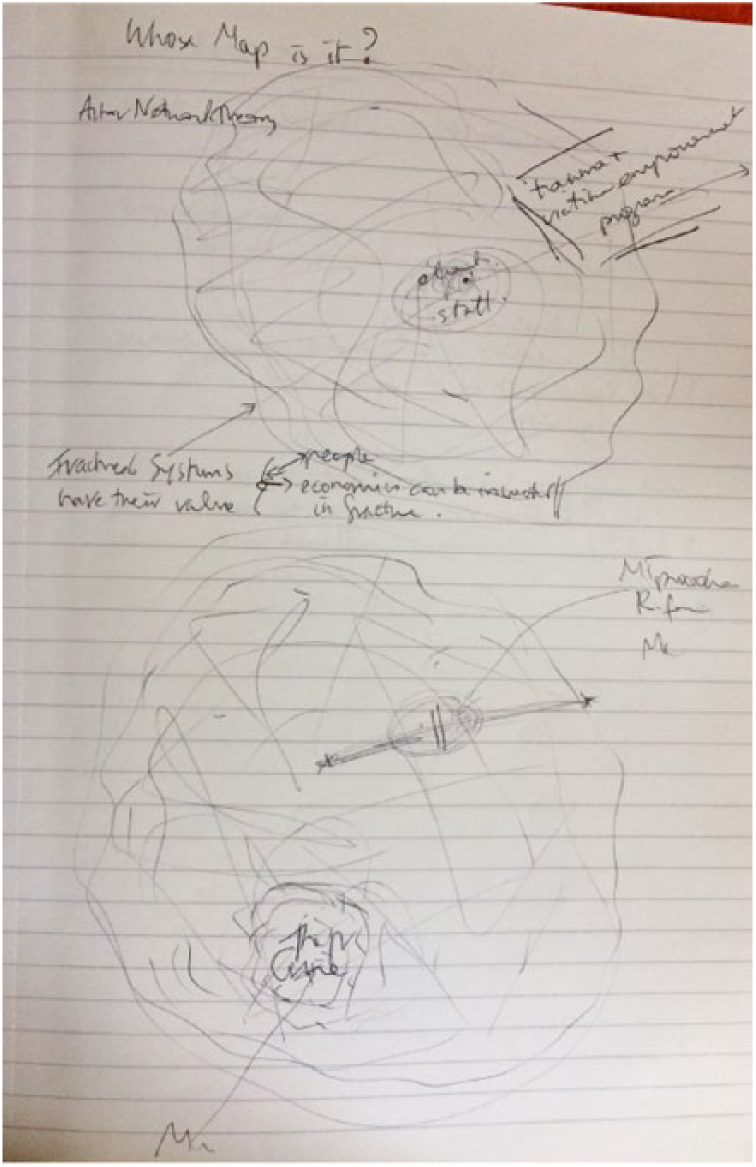
Those of you who were taught or supervised by Mercédès Pavlicevic – or perhaps just caught one of her conference presentations – will probably recognise a sketch something like this. Rapidly done, messy, clarifying. Often they were also imaginative and whimsical, reminding you of Klee’s drawings – like this one with its conveyor belt of ideas:
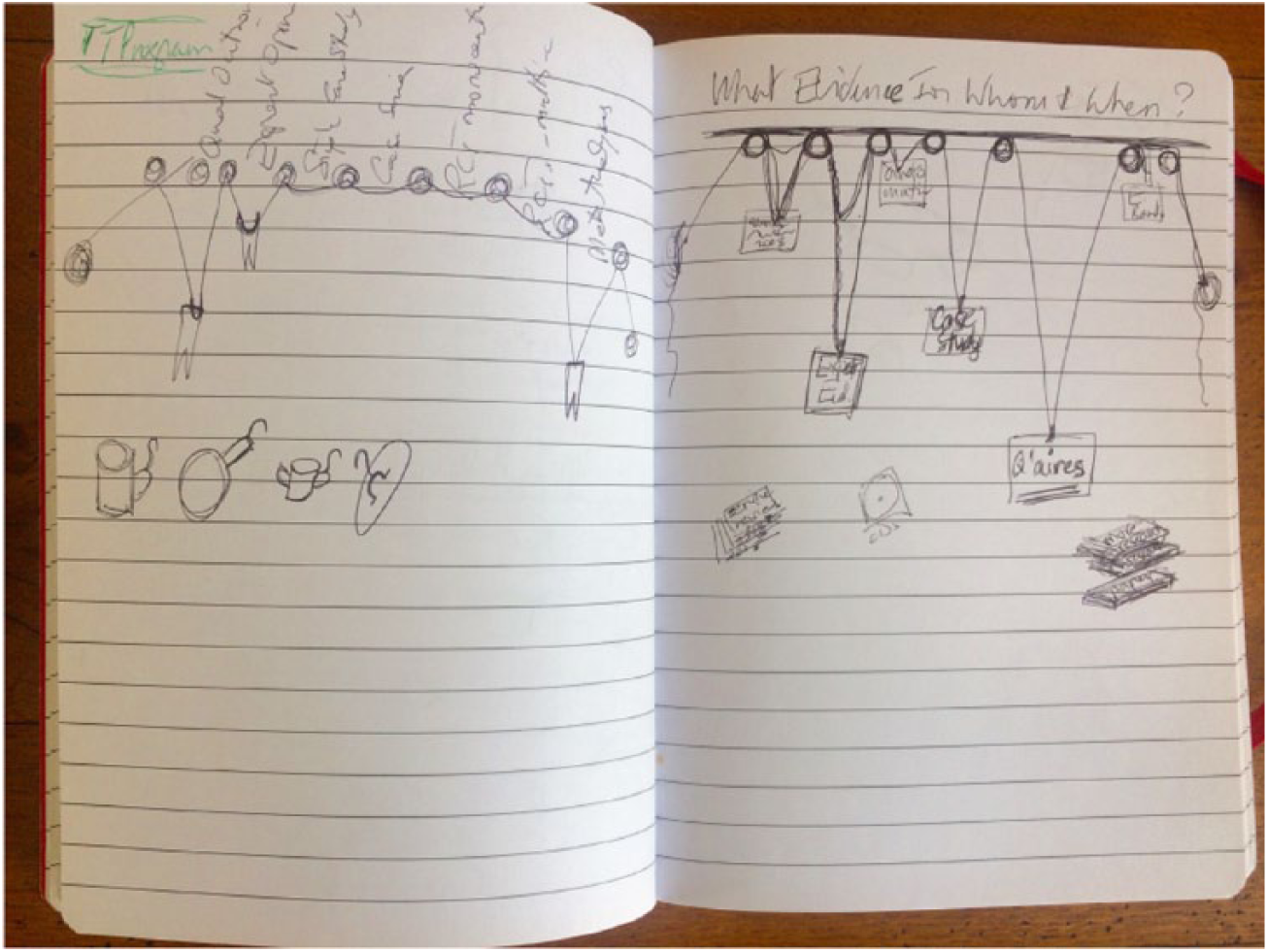
These sketches often accompanied Mercédès as she talked about something or thought through something – a simultaneous visual communication, further animated by her expressive hands and face. I found the doodle above when sorting through the remaining papers Mercédès left, at the request of her partner Mary. We’ve kept a sample of the notebooks as a record of this aspect of Mercédès’ working method, to stand alongside the completed articles and books. We think they nicely convey another side to Mercédès’ endeavour – her mercurial style, her charm and talent at combining serious thinking with humour and imagination.
Mercédès had always sketched, fiddled with diagrams, doodled. Later in life, she became more dedicated to serious drawing and painting and by the final phase of her life, she’d become a passionate artist. This is perhaps a surprise for those who think of her ‘only’ as a music therapist, theorist, writer and academic, where words and tones were her main currency. But I think it was perhaps ultimately with images that she felt most satisfied, most creative, most at home. As she coped resiliently with her cancer in the last few years, images became her guide and therapy. This short article is a series of sketches on Mercédès’ ‘image-ination’ – quite literally how images helped form and develop her thoughts and feelings, and how this aspect of work in turn perhaps sheds another kind of light on her influential practice, advocacy and research in both music therapy and more widely in how and why the arts help us all – in health and sickness.
Criss-crossing modalities
This multi-media sensitivity of Mercédès led to both artistic and intellectual discoveries. She’s perhaps most famous in arts therapies circles for her theory of ‘dynamic form’ that had its inspiration both in the early infant research of Colwyn Trevarthen and Daniel Stern, but also in the philosopher Suzanne Langer’s (1951) theory of music as an ‘unconsummated symbol’. Mercédès told me how she visited the then elderly Langer at Oxford when she was researching her PhD and they had a nice conversation over tea about how the arts can be symbolic but in ways that often helpfully withhold their ‘meaning’ (or rather urge us not to search for one). Also that the various art forms quite naturally mutate into each other within our personal and shared experiences of feeling as form. Music, the theory goes, sounds how emotions feel; images look how gestures move; words speak how music melodies, and so on. Meanwhile, Trevarthen and Stern were exploring empirically the micro-level of how infants and mothers create a proto-musical dance of cross-modal significance – building their dynamic forms of unconsummated symbolism. So it’s no surprise that Mercédès’ voyage – both intellectually and artistically – took shape through this increasing understanding of cross-modality: showing us how to act and think not just within but also across the various artistic forms, traditions and media.
Working imaginatively
Mercédès had little patience with the dull or the pretentious. ‘Boring!’ was her usual response to any work that lacked the quality of imagination that was the primary criterion that redeemed any thinking or writing for her – whether she agreed or disagreed with it. We often talked about how this was what research and scholarship in music therapy so often lacks – the ability to lift above its immediate material, take imaginative wings and let us view its horizon rather than its navel. ‘Where’s the bigger picture here that this stuff is calling you towards?’ she’d often ask. Her doctoral supervisions and other helping conversations she had with people were often about prodding people towards imagining or re-imagining the scope of their work, or their career … or their life, which sometimes meant letting go, culling, scrapping, re-jigging. Learning to be true to some (perhaps hidden) image of the work was her way of reaching a truth in the work or the life.
‘Imagination’ is of course one of those broad umbrella concepts that can mean different things within different intellectual and cultural traditions. The philosopher Simon Critchley’s (2005) version is near to what I’m trying to characterise in relation to Mercédès approach (Critchley is discussing here the poet Wallace Stevens’ play between imagination and reality): What is imagination? Imagination is that activity or, better, power in the sense of the German Einbildungskraft. Understood in this way, the imagination is a power over external objects, or the transformation of the external into the internal through the work of subjective creation, a creation that is given sensuous form and is therefore rendered external in the work of art, the poem. (p. 24)
I like the idea here of imagination being a power, not just a faculty. Imagination releases its own store of energy as it transubstantiates images, tones, words into thoughts, and backwards again. Importantly, imaginative thinking for Mercédès was not about removing us from reality but rather re-balancing our stance towards it – working ‘With Rigour and Imagination’ (the title to Chapter 4 of Music Therapy in Context (Pavlicevic, 1997), perhaps her key text).
Theorising through images
For a period during the 2000s, Mercédès and I worked happily developing theoretical ideas to support the then burgeoning practice of Community Music Therapy. She was then in South Africa and I was in London, so our thinking happened mainly through email. Our stimulating creative dialogue at these times took place not just in words but also through Mercédès’ visual thinking. When Colwyn Trevarthen asked us to write a chapter for the famous compendium Communicative Musicality (Malloch and Trevarthen, 2009), we set to work out more explicitly what the relationship was between the largely dyadic forms of communicative musicality most people were writing about, and the broader and more complex forms we’d witnessed in groups and communal situations in Community Music Therapy projects. I remember how the theory of this chapter gradually took form through the development of two diagrams you can find in our chapter. The images changed shape, resembling first a torpedo, then a cigar, as they functioned to clarify the conceptual point. They put together in visual space the different ways of relating ideas, playing logically with different configurations. Here’s a draft of one of the diagrams in this chapter, depicting the path to togetherness that music can pull people into. It shows this link between image and developing thought (incidentally the second image, the star that only appears as a result of the aligned arrows, was inspired by a traditional Sufi teaching image – which again makes the point that some ideas need to be seen before they can be understood):

I’m no mathematician, but I can guess that this same process happens when mathematicians think conceptually through symbols and spacial media. I’m used to thinking through tones and words, but the process of thinking-through and writing this chapter with Mercédès showed me the potential of theorising through images. I know that many of her supervisees at doctoral level have learned a similar lesson from her.
Listening from images
Mercédès certainly identified professionally as a music therapist, but from an early stage in her career, she became dissatisfied by the conventional carving-up of the arts therapies into separate silos. Her own experience of the arts moved rather across music/dance/image/word. This is not to say that she approved of synthetic approaches such as ‘expressive therapies’, which for her made the mistake of mashing-up the arts under a weak umbrella of psychotherapy theory. She wanted instead that each art form retains its unique power and unique affordance within therapeutic and social development contexts, and for therapists to be sensitised and skilled in the key features and potential of each art. This was perhaps her key belief: Allow yourself the freedom of imagination within the phenomenology of each unique art; learn to listen to what is coming through to you from this artistic process; allow it to guide you without forcing premature meaning onto or from it.
This view of the art therapy process was shared by pioneer art therapist Martina Thomson, who Mercédès briefly had sessions with during a period of disorientation and exploration when she first moved from South Africa to London again in the mid-2000s. Before I met Mercédès, I’d read Thomson’s (1989) inspiring little book On Art and Therapy: An Exploration when it first appeared. It clarified for me how both art and music therapy had taken similar routes in the United Kingdom (and elsewhere): turning from the mystery of the art medium and its unconsummated symbolism towards ‘art/music psychotherapy’ where the process became too explicit, too verbalised, too distant from the unique phenomenology of each artistic medium, and each artwork in and of itself.
In the last 5 years in Mercédès and Mary’s home in South London, the hallway served as an ‘exhibition space’. The images up the staircase were largely of boats, harbours, coastlines and sea. These images originated from her stays with artist friends who lived by the sea. But looking at them you sensed that there was also something more numinous in this iconography. Mercédès never spoke to me of any meaning to these paintings but they seemed to play with a vocabulary of unconsummated symbols (perhaps like any artist?). In her last 6 months, Mercédès worked with an art therapist at St Christopher’s Hospice, valuing greatly these sessions. This work was the last stage of Mercédès’ long-standing personal process of using image as guide within an unsentimental and courageous engagement with the realities of life and death.
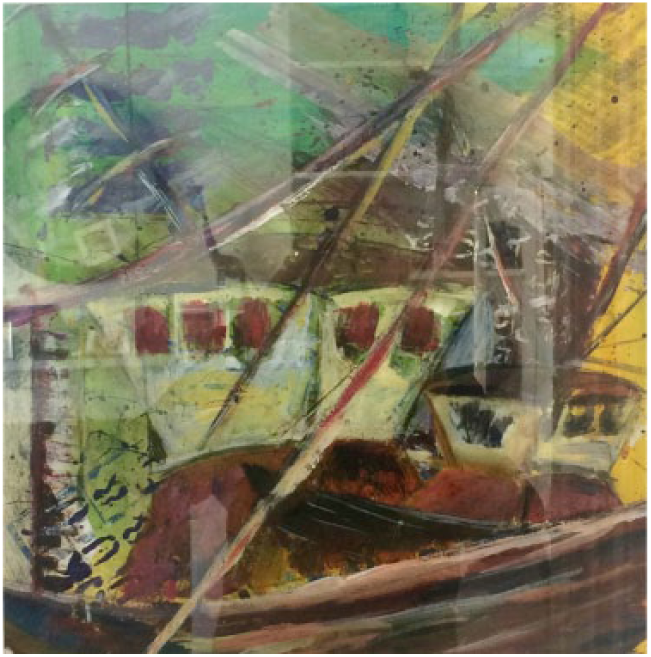
Martina Thomson (1989) writes, Every picture tells a story, goes the story, but stories are strung along horizontally – ‘and then, and then, and then’ – like the stories of our lives. The image, like the symbol, contains what it points to; meaning does not follow the image but somehow resonates within it. […] A series of images may then make up a journey. (pp. 107–108)
Imagining musicking
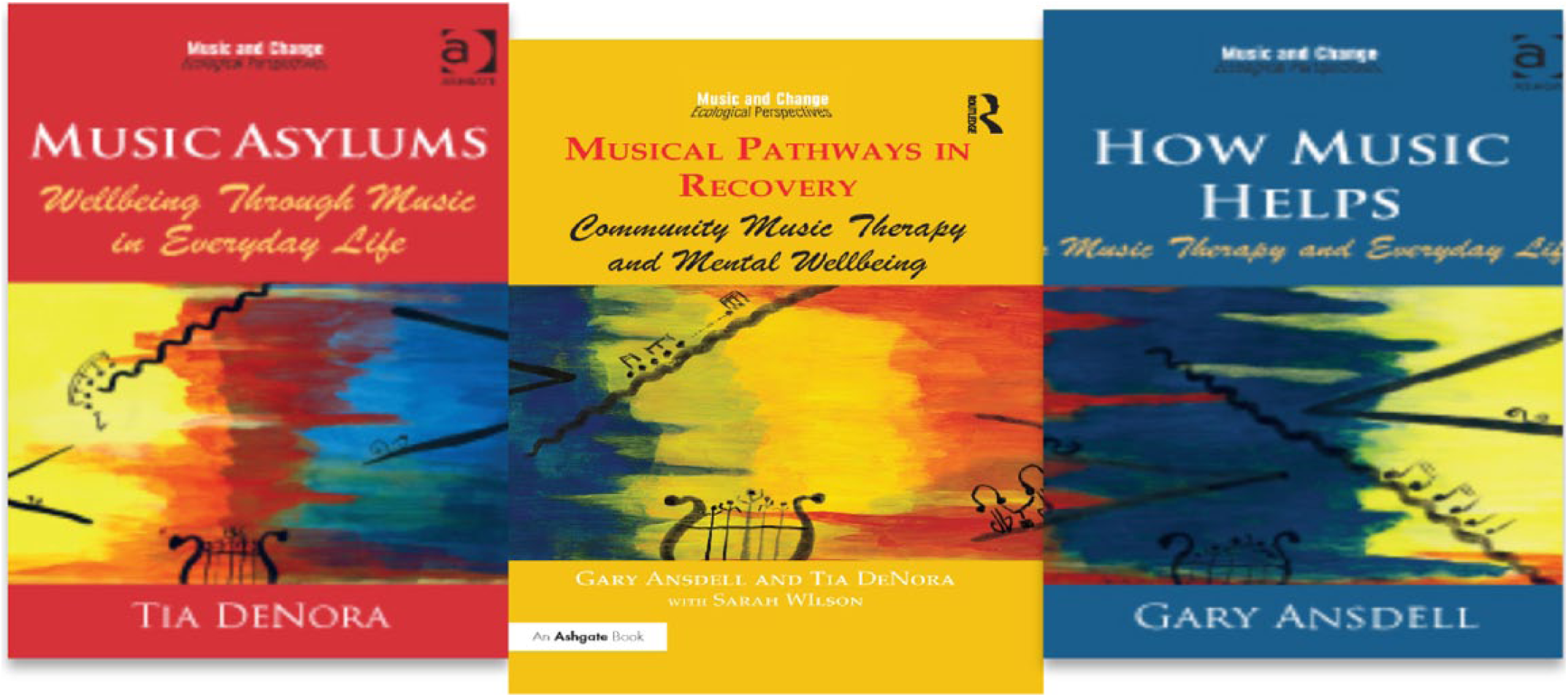
When I was writing Music for Life in 1995, I asked Mercédès to make an image for the cover. A patient in the hospital in Herdecke where I worked then had given me a postcard at the end of a course of therapy of Picasso’s fawn with panpipes. For the book cover, Mercédès did a lovely re-working of this image. Fifteen years later, Tia DeNora and I were surprised in 2010 when Ashgate Publishers (now Routledge) agreed to what we thought then was a rather audacious proposal that they publish a ‘triptych’ of three books on music, health and well-being to start off the new series Music and Change. As the idea had been inspired by seeing a mediaeval triptych painting, we wanted a single image to play across the three books and turned again to Mercédès for help. The image she produced in a single weekend is a wonderful, quirky panel that perfectly suggests the ecological theme of the books. She imagines the process of musicking through a Paul Klee inspired image of musical symbols that have come to life and traverse the dynamic landscape of shifting colours and forms. We are back to Mercédès’ theory of ‘dynamic form’ here – ‘ [T]hese dynamic forms of feeling [that] exist as abstract functional entities in the mind and are signalled through the qualities of our expressive acts’ (Pavlicevic, 1997: 121). We are also back quite simply to the fun and whimsy of Mercédès’ doodles – where image, thought, energy and (e)motion interpenetrate.
***
These sketches are not just to celebrate Mercédès the artist – although some of you may be surprised at this aspect of her polymathism. Rather it’s to do justice to the biggest idea she had in her personal and professional life; the need to keep meeting the world with creative imagination; resisting dullness, or the temptation to prematurely complete or fix our ideas or artistic creations; resisting the temptation to be too certain, too closed against where our creative imagination is prompting us to see and understand right here and now – allowing ourselves to ‘know by imagining, not simply by registering’ as Rowan Williams (2018) puts it. I’d argue that her true inspiration and legacy is this advocacy of an imaginative attitude to life and work. For her, the arts therapies are useful, but only as partial vehicles for this larger imaginative understanding of the role of the arts in human healing and ongoing well-being. A word, a tone, an image or an expressive body gesture can combust (a favourite Mercédès word!) the transformative work of the imagination in any given minute or place. These imaginative moments can join minds, bodies and worlds to allow us a new thought, a new feeling or a new situation to come about between and among us; to move us on; light us up; calm us down … or just to produce that kind of shared sympathy that is unique to imaginative life and uniquely necessary to being human together.