



Abstract
In this article, we explore Susan Strange’s multidimensional and non-reductive international political economy (IPE) approach to structural power. Strange’s key weakness is the failure to account for her knowledge structure’s regulative form relative to her security, production and financial structures. We seek to develop Strange’s account through the addition of Manuel Castells’ account of digital network structures. Castells’ morphogenic structural approach to digital network power helps to clarify the mechanisms by which today’s knowledge structure achieves autonomy, internal regulation and generative capacity. This sociological completion of Strange’s theory, an international socio-political economy approach as it were, better explains the capacity and limits of today’s digital network knowledge structure to resist reduction to other structural interests. Strange’s non-reductive structural approach to power is significant for sociology as it helps identify ‘social order’ in a global age, but an additional sociological dimension is also necessary for the fulfilment of Strange’s theoretical project.
Outline
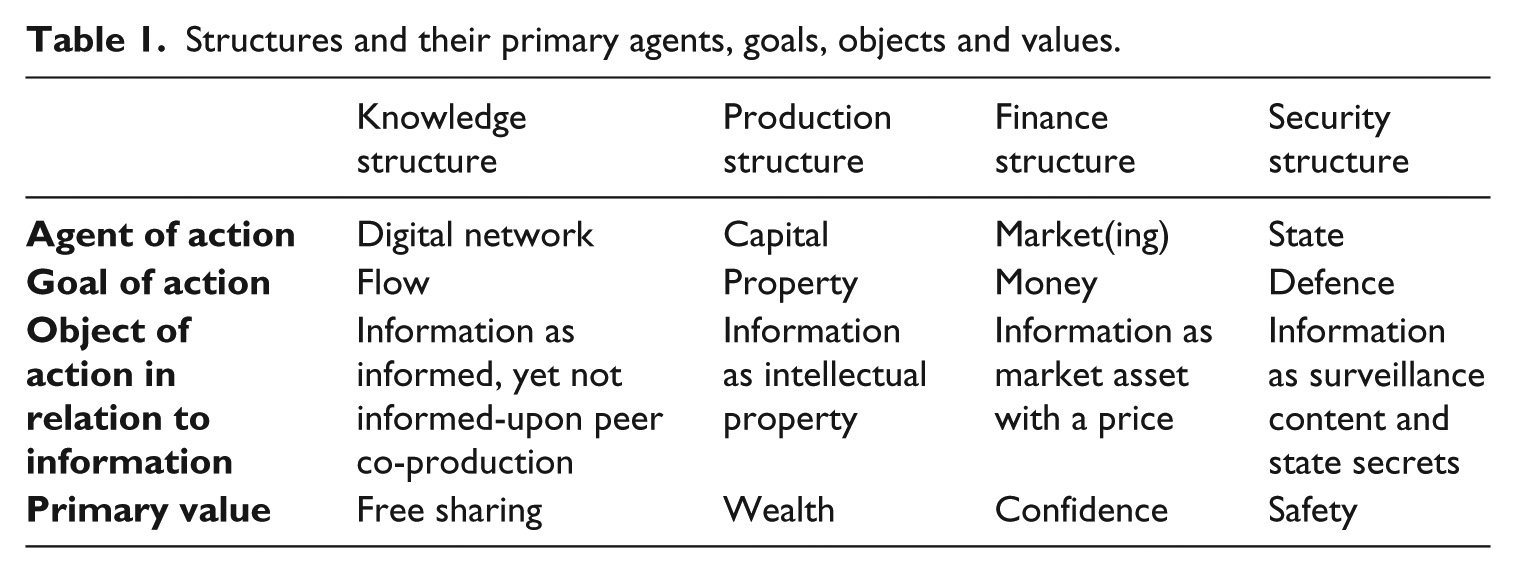
This article highlights the value of Susan Strange’s multi-dimensional structural account, even while sociologically supplementing Strange’s International Political Economy (IPE)’s weakest link (that of knowledge structure). We begin by outlining how Strange avoids the reductive determinism of any one structure through a multidimensional account of production, finance, security and knowledge structures. The question of what regulates the play of priorities between competing structures highlights an unresolved weakness in Strange’s work, that of what ‘knowledge structure’ actually means. We suggest Manuel Castells’ morphogenic structural account of digital networks better conceptualises knowledge structure. Finally, we explore how far attempts to colonise today’s knowledge structure by production, finance and security interests (see Table 1) undermines the autonomy, order and efficacy of digital network communications. While colonisation attempts are real and significant, they are not fundamentally successful, and, as such, knowledge structure, as we conceptualise it, is real. Susan Strange is significant for sociology; first, because she aspires to an account of social order in a global age; the social has not been dissolved by unregulated economic competition even after nation states ceased to appear synonymous with the category of ‘societies’; and second, because Strange’s approach can only be successfully realised with the addition of a sociological dimension.
Structures and their primary agents, goals, objects and values.
Strange’s IPE theory was central to the late- and post-cold war turn against state centric (‘realist’) theory. One strand of anti-realism highlights transnational neo-liberal deregulation and global corporate regulation beyond state control. Today’s attention to the interplay of state authority and market exchange (Crouch, 2004; May, 2015) reflects Strange’s influence. Production, finance and political structures are core but knowledge is not ignored. However, in Colin Crouch’s (2016) Knowledge Corruptors and Christopher May’s (2007a) digital rights management research, production interests dominate knowledge. May’s (2007b) intellectual property (IP) research identifies open source challenges to dominant institutions, but here too economic and political actors largely control knowledge. Another strand of anti-realism questions the rationality of state actors: post-realism adopting an intertextual approach (Der Derian and Shapiro, 1989; Smith et al., 1996), while critical theorists (Held, 2010) identify cosmopolitan agencies motivated by universal value rationality beyond instrumental state interests. For some anti-realists, knowledge is driven by economic and political structures. For other anti-realists, knowledge is autonomous text. Strange’s structural approach sought to avoid this split within anti-reductionist international relation (IR) scholarship.
May (2002) questions Castells’ claims regarding the disruptive effect of the Internet on capitalism. Assigning the mode of development (the forces of production) an autonomous capacity to affect outcomes is, for May, technological determinism, though Castells’ (2009) later account of communication power is closer to May in integrating knowledge networks with dominant economic and political networks (David et al., 2017). Here, we distinguish scope for counter power afforded by networks from the notion that such resistance is inevitable. New possibilities are not compulsions. An account of knowledge structure, irreducible to either technical systems or other social structures, nor simply a free-floating intertextual signifier, is what remained incomplete in Strange’s own account, and remains divergent in later strands of anti-realism. Here, we offer resources for an account of knowledge structure that we hope can assist in overcoming these limitations.
Susan Strange’s multidimensional theory of power
Strange’s (1994a) fundamental aim is to move beyond the relational theory of power manifest in ‘realist’ approaches to IR, towards a structural theory of power: Relational power … is the power of A to get B to do something that they would not otherwise do … Structural power, on the other hand, is the power to shape and determine the structures of the global political economy … (p. 25)
There are winners and losers in particular interactions and within ongoing relationships, but such outcomes are shaped not just by the relative capacities of actors (states, non-governmental organisations or individuals), but also by the rules and conditions within which such actors ‘play’. If realists take such rules and resources for granted and simply study relations between actors, critical theorists tend to focus on the uneven nature of the ‘playing field’. Strange highlights structures to demonstrate their necessity for the effective, if often highly unequal, pursuit of desirable goals. She criticises states, firms and other organisations for failing to maintain effective structures; she problematises blind pursuit of relational advantage by powerful actors that leads to a neglect of structural order; and she highlights that different structures may in fact come into conflict with one another. To this end, even while she rejects a purely Hobbesian realist concern with security as an overriding priority in IR, she also rejects the Marxist Political Economy (PE) counterpoint that the economy determines everything else. Her IPE approach notes that the tension between state focus on security and market focus on wealth creation cannot be simply reconciled, nor can it be reduced from one to the other. As she notes, ‘economics tacitly prefers efficiency and international relations tacitly prefers peace’ (Strange, 1994a: 175).
Strange wants to make things more complicated than simply noting the tension between a Hobbesian attention to security and a Marxist attention to material production. Her model of power has four dimensions, not just two. These are security, production, finance and knowledge: ‘[T]he security structure and the production, financial and knowledge structures constantly interact with each other and cannot therefore be analysed in isolation’ (Strange, 1999: 346). Each of these four power structures, Strange claims, acts to frame and shape the conduct of relational power within them. However, she also claims none of these structures are either fully independent or even fully distinct from any of the others, and that none of these structures are predominant in determining the others. To the extent that Strange rejects the notion that any one structure regulates the overall social order, and that there are multiple structures in play, the question of how exactly any one supposed structure regulates relational power becomes a case of empirical enquiry. While rejecting the goal of prediction in social science, Strange does claim that theory should explain events – even if such explanations are always retrospective and particular, not universal predictions. Her studies – of state rivalries and globalised production (Stopford et al., 1991), and of finance, credit and market deregulation (Strange, 1997, 1998) – have all been such attempts to explain the particular in terms of a complex, multidimensional structural theory. Yet, while states, property and money are relatively clear objects of study when addressing security, production and financial structures, respectively, the knowledge structure remained more opaque: The fallacy is that while some things are not entirely new, it is not true that nothing is new. (Strange, 1994b: 210)
Strange suggests that the future is not what it used to be: Changes in the four primary structures of finance, production, security and knowledge (ideas and their communication systems) are slowly but surely eroding the power of states to provide for their own security from attack; to intervene to correct slumps and unemployment; to determine the value of currencies at home and abroad; to raise revenues by taxing enterprises; to demand military service from conscripts; to satisfy the welfare needs of citizens. (Strange, 1994b: 213)
It is not that power is diminishing, nor that traditional ‘authorities’ (primarily nation states – and predominant among these, the United States of America) are disappearing or becoming redundant. Rather, the ‘Westfailure’ system (Strange, 1999) of states is being replaced by a tripartite system of state-to-state, state-to-firm and firm-to-firm negotiations of power (Stopford et al., 1991). It is the transnational firm that has risen to power in recent decades to match the power of states at the negotiating table, and Strange even refers to the emergence of a global business civilisation (Strange, 1990).
Mismatched structures, values and conflicts
For Strange, there is no single goal or value to which all others are subservient. Such goals or values as wealth, justice, security and freedom are not reducible one to another and different individuals, regimes and social institutions will place greater or lesser value on each relative to the others when determining what they consider a ‘rational’ course of action; they may even interpret each of these goals/values differently. The balance between values, as well as the meaning attached to each such value is undetermined by any universal metric or philosophy.
However, a double tension exists for Strange in the relationship between supposed structures and the values that motivate action. While, for her, the four dominant power structures are, as stated, security, production, finance and knowledge, the four dominant values described above only partially align with them. For example, while security is seen to be both a structure and a value, the value of wealth is linked to both production and finance structures. If freedom, meanwhile, is simply the absence of political control, Strange does suggest that money creates that space for liberty (Strange, 1994a: 25). However, if freedom is the absence of want, then production may best achieve that, combined with a demand for justice and security (Strange, 1999). In places, Strange links values to structures. Elsewhere, values are seen to emerge from within the knowledge structure, and only then filter out to determine priorities between other structural goals concerning security, production and finance.
Strange accepts some element of realist state theory when accounting for her security structure, but counterbalances this with recourse to a largely Marxist account of the production structure. She then adds her own detailed account of the finance structure to limit the reductive force of Marx’s account of capital accumulation. Strange’s detailed mapping of relations between these three structures further highlights the most significant weakness in her account: the meaning and content of a supposed knowledge structure, and the relationship such a structure has with other structures. Security, production and finance are shown to have clear relational objects – defence, property and money – each within its own system of regulation (structural power). It might be suggested that safety, wealth and confidence represent the core values linked to the security, production and finance structures (see Table 1). Strange details how, while interacting, security, production and finance structures maintain a degree of autonomy, internal ordering and generative effect relative to one another. This is what makes each a non-reducible structure in her view. What remains lacking is a developed account of knowledge structuring power, the mechanisms that sustain some degree of external autonomy, internal self-regulation as well as generative effect, and that would therefore evidence the knowledge structure.
Strange (1994a) points out that priests and sages have often asserted authority over warriors, farmers and traders in pre-modern societies, and can sometimes still do so today (p. 30). This, she argues, shows their knowledge structures (in religious doctrines of salvation, damnation and heresy) were not reducible to physical security, property or money. She also suggests that, today, science retains – sometimes – a similar degree of autonomy from reduction to military and economic expediency (Strange, 1994a: 122). Suggesting a degree of autonomy for knowledge producers, however, still does not offer a substantive account of the internal regulative structuring of such a field, in either producing internal order, resisting external determination, or in generative action.
The ‘weakness’ in the theory, not the ‘limitations’ of theory
Chris May suggests ‘some possible shortcomings of Strange’s work, namely the difficulties in conceptualising a “knowledge structure” and in understanding the mechanics of historical “change” in the international political economy’ (May, 1996: 167). The former issue, of conceptualising the knowledge structure, is a significant problem within Strange’s theory. However, the inability to predict the future is a limitation of all social theories. Strange’s non-predictive approach to complex interactions between multiple structures and between actors within them is in fact highly productive precisely because it is not prescriptive or predictive.
While relational power, in Strange’s framework, can allow a dominant state, transnational firm or other actor to exercise leverage in influencing the rules by which relational exchange takes place, dominant relational actors often bear the cost of maintaining such power structures – and less powerful actors may be able to exercise forms of resistance or adjustment that the dominant players cannot. Dominant structures facilitate and even encourage challenges. The non-predictive nature of Strange’s complex, multi-dimensional account of power allows us to better study the contradictory nature of power in today’s global network society. While May is correct to say non-prediction is a limitation, we do not consider this limitation is one that can be solved. As such, we focus on the weakness in Strange’s conception of knowledge structure, and what can be done to solve that. While Strange’s IPE approach goes beyond reductive state and production-based theories, it remains deficient, and requires a sociological dimension, enabling what we would call an international socio-political economy approach. Accepting the value of Strange’s work, we want to take it one-step further. In today’s ‘network society’, we ask whether the concept of ‘knowledge structure’ is valid. Given the security, production and financial forces that shaped today’s global network architecture, do digital networks manifest the characteristics that would warrant the notion of ‘knowledge structure’: that is, substantial levels of autonomy from external determination, internal self-regulation and generative effect back on the external environment?
Knowledge structure: information, communication and beliefs?
As May (1996: 184) writes, While the inclusion of the fourth structure – knowledge – is what makes the general theory [of Strange’s] so alluring, it also opens up a major problem area insomuch as it forces the theory to deal with issues that in its current state of theoretical development it has difficulty understanding.
Strange indeed admits as much. The knowledge structure is a less well understood but no less significant form of structural power, she argues, This is partly because it comprehends what is believed (and the moral conclusions and principles derived from those beliefs); what is known and perceived as understood; and the channels by which beliefs, ideas and knowledge are communicated – including some people and excluding others (Strange, 1994a: 119).
Knowledge then, according to Strange, covers beliefs, information and communication – three very broad and complex concepts, whose interconnections are even more difficult to pin down.
Strange seeks to make things a little simpler for herself by effacing the distinction between knowledge and information (Strange, 1994a: 122), and distancing herself from discussions regarding the sociology and philosophy of knowledge (Strange, 1994a: 136). However, she does still wish to retain the notion that knowledge is structured in a similar fashion to other kinds of social relationship: If a production structure determines what is produced, by what means, by whose efforts and on what terms, so a knowledge structure determines what knowledge is discovered, how it is stored, and who communicates it by what means to whom and on what terms. (Strange, 1994a: 121)
Despite accepting her knowledge structure formulation ‘was too sketchily explained’, Strange (1996a) rightly refused to specify in advance how knowledge ‘interacts with and affects the other structures’ (p. 304). She uses an example. Belief in economic growth reinforces the capitalist production structure, while Buddhist economics would challenge it (if disseminated). However, despite Strange’s resistance, this does beg May’s (1996) question of how knowledge structure (belief and communication combined) can, if it ever does, challenge rather than reinforce other structures. Does knowledge have the structural properties Strange identifies in production, finance and security? May’s question is important because, as Strange rightly suggests, the answer is not pre-given.
This article cannot resolve, nor even fully catalogue all sociological attempts to explain or understand culture and knowledge. Marx’s ideology critique through to Gramsci, the Frankfurt School, Williams, Hall and subsequent accounts of hegemony, Durkheim’s conscience collective through structuralism and beyond, Simmel’s formalist approach, Weber’s interpretivism and elective affinity, subsequent variations of phenomenology, Mannheim’s relational approach, Blumer, Becker and others’ variations of symbolic interactionism, Geertz’s thick description, Bourdieu’s relational approach to habitus, figuration/structuration and beyond all set out to document the interplay of regulative systems of knowing in relation to individual belief, and the interplay of such regulative systems of knowing with economic and political systems. Dispute hinges over the degrees of determination within and between regulative systems, their conceptual boundaries and their scale.
We suggest, following Paul McLean (2017) that network analysis offers a route through this conceptual labyrinth. Network analysis focuses attention on exploring complex interactions rather than starting from any one pre-given theory. Communication networks precede today’s digital network architecture. Communication networks are channels through which information connects actors. Information is abstracted meaningful content, such as it can be stored, processed and distributed through communication networks. This is true of spoken languages and writing as much as of print, post, telegraph, broadcasting and today’s digital networks. Knowledge refers to meaningful content enacted in cultural practice. The distinction between information and knowledge/culture parallels that between text and context. Communication networks and culture/knowledge may be shaped by economic and political interests, but may afford levels of autonomy and influence of their own. Newspapers challenged the status quo in 17th century Europe but were largely colonised by advertising revenues in the 19th century. The printing press fuelled agitation in one context, but reinforced centralised authority in others. Whether cultural networks are colonised by other interests or sustain a degree of autonomy, self-regulation and external effect requires empirical study. If the latter is the case, we would suggest such a combination of communication networking and cultural practice constitutes a knowledge structure in the sense that Strange describes other structures.
McLean offers a five dimensional account of the relationship between networks and culture. ‘Networks from culture’ refers to existing cultural forms shaping the development of communication networks; ‘cultures from networks’ and ‘networks as culture’ are poles in a spectrum along which communication networks shape or determine new cultural content; ‘culture through networks’ refers to the way particular network forms can accelerate and reinvent existing cultural practices, while ‘networks of culture’ refers to relational emergence or co-construction. Today’s digital network architecture shapes and is shaped by cultural content. The extent to which what arises is or is not reducible to other structural forces is what interests us. As McLean documents, networks do not determine cultural content. Knowledge structure, if it exists, cannot dictate every last norm, value and belief held by individuals. However, networks may sustain, afford or even encourage new ‘horizons of possibility’ or ‘social imaginaries’ (Taylor, 2004) in the face of ideological colonisation by dominant economic and political interests, warranting classification as a knowledge structure. In what follows, Castells’ theory of digital networks as morphogenic structures will be deployed to provide Strange’s theory of knowledge structure with a clearer focus.
Digital networks as knowledge structure and the limits of power
Manuel Castells (1989) showed how increased computer storage and processing power – and particularly networked computing scope and power – was initially fuelled by largely US corporate, state and military interests. Such investment, however, created a network of affordances that enabled what Castells called ‘capitalist perestroika’: a shift from hierarchical command and control, towards more distributed network enterprises. The newly created ‘space of flows’, ‘timeless time’ and ‘real virtuality’(Castells, 2000) enabled the rise of today’s global network capitalism – akin to what Strange variously documents in her accounts of today’s global finance, production and trade. In creating conditions within which particular forms of action are made either easier or possible at all, digital networks represent, Castells claims, structures that are irreducible to relational interactions. Such structures condition the scope for activity of human agents. Castells refers to this performative quality of digital networks as morphogenic structure. For Castells, digital networks are irreducible to the interests of the production, finance and political actors that initially enabled them, and are also irreducible to the actors whose actions currently constitute them. We suggest Castells’ account of digital networks as today’s knowledge structure enables a sociological completion of Strange’s otherwise incomplete approach. We do not simply seek to criticise Strange from Castells’ sociological viewpoint, but rather to improve the former’s insightful perspectives my means of the insights offered by the latter.
Before 2000 Castells’ documented political (Castells, 1997) and cultural (Castells, 1998) reactions to the new economic ‘mode of production’ afforded by digital network structures, identifying networks as the latest technical ‘mode of development’. However, in recent work, Castells has sought to map out a more complex relationship between economic, political and cultural power (Castells, 2009) and (at least, cultural and political) counter-power (Castells, 2012). Crucial to the maintenance of power within networks is the ability to programme and switch. Programming refers to the content of networks, while switching refers to the ability to connect networks – and hence connect to the programming (content) within those networks.
Network programming and switching permeate economic, political and cultural systems. Digital networks constitute the knowledge structure in modern societies, and this structure has significant impacts on other structures as well. Castells identifies Rupert Murdoch as the paradigmatic network node (or super-node), someone at the centre of a wide range of networks and, within his array of cross-media, global corporate holdings, in a position of power to control the content (programming) and flow (switching) of information. Global digital networks – the largely privately owned cables, satellites, packet-switching routers, decoders, subscription services, Internet service providers, search engines, software and hardware providers, and content providers, and so on – are, in Castells’ account of communication power, a powerful morphogenic structure influencing thought, culture, politics and economic life (Castells, 2009). Castells offers a significant supplement to Strange’s relatively underdeveloped account of structural power in today’s information technology networks.
A structural account of power explains agency, the capacity to cause effects, as a product of position within a systematic allocation of resources, not simply at the surface level of individual interactions. All structures are networks, systems of communication, and actors (individuals or not) are nodes in such networks. Bureaucratic modern states are ideal typical hierarchies with network communication colonised to transmit information in vertical chains, rather than horizontally. Capitalist markets and production systems are more distributed, but remain hierarchical through money, management and property rights.
The significance of networks for an understanding of power within and between social structures lies in the extent to which networks afford power and counter power (resistance). Georg Simmel (McLean, 2017: chapter 2) identified the third in any triad as fundamental to understanding the structure of power regulating micro-interactions. If A knows B and B knows C, but A does not know C, both A and C require B to mediate. B occupies a ‘structural hole’. They may act as a bridge overcoming the gap, an exploiter of its maintenance, or even a conqueror through widening divisions. Transitive triads generate hierarchical chains. Circular triads – scissors, stone and paper, for example – foster greater equality. A fully distributed network, where all nodes are effectively connected to all other nodes, affords a level of egalitarian communication that challenges hierarchy. Where the printing press widened access to text, editorial controls and censors acted to regulate culture at the nodal nexus (the structural hole) between production and consumption. Old print and broadcast media’s editorial nexus allowed political/economic structural interests to exercise control. Today’s digital network architecture is designed to avoid such structural holes, singular pinch-points in the transmission of information. However, as Castells observes someone like Rupert Murdoch stands out as a super-node even within today’s network society. Google and Facebook, Amazon, Microsoft and Apple are the biggest such super-nodes on the Internet, actively seeking to exploit their popularity to create effective structural holes. Whether these holes in the knowledge structure are successfully used to effect political and economic control over culture (such as in the efforts to manipulate voting or consumption patterns through micro-targeting) is the on-going struggle of our time. Such structural holes, if successfully used as editorial nexus points, undo the relative autonomy of the knowledge structure. However, the Internet is not simply the sum of its more powerful super-nodes, in their efforts to re-programme the Internet with old media forms of central control.
On the Internet and Web, power is affected by means of the very protocols that enable distributed communications (Galloway, 2004). Distributed, packet-switching, network architecture prohibits centralised and even decentralised modes of censorship and regulation, as messages can be rerouted to avoid blockages. However, the Internet Engineering Task Force is the (mainly US-based) group who determines the protocols that assign addresses online, and which writes the common code that enables distributed computers to communicate without a central server. Such a role is a quintessential form of networked structural power (programming and switching). Nonetheless, Castells’ structural analysis of digital network power highlights affordances for counter-power as well as for dominance. The relational dominance of the United States in computing (Castells, 1996) – a dominance that allows one country to largely determine the protocols that networked computers use, and the address/searching systems that search engines use to locate content – does not mean that this state can control content online. To censor the Internet in this fashion (by removing the IP addresses of countries the United States does not approve of, for example) would destroy the very global communication structure within which the United States enjoys its relational advantage (David, 2017). As such, and in line with Strange’s account of power, dominance is not without limits. Even Rupert Murdoch’s capacity to close down those that would challenge his power to programme and switch within digital networks is limited. Digital networks afford some degree of autonomy, internal regulation and generative effect, and we suggest this is sufficient to warrant the term knowledge structure.
In this article we evaluate the claims for the (1) autonomy/non-reducability, (2) internal regulative efficacy, and (3) generative effect (impacting upon other structural systems) of digital networks. Table 1 sets out the elements that are the focus of our discussion. Do digital networks structure the flow of communication in the way that the state, capital and markets structure security, production and finance through defence, property and money? If so, the object of action within the knowledge structure, information, would display the ‘structural qualities’ outlined above, of external autonomy, internal self-regulation and generative effect. This prediction can be tested by identifying whether information flows resist regulation by production, finance, and security structures; as (1) IP under the dominance of capital/property in the interests of wealth creation; as, (2) marketing asset for sales and to maintain market confidence, or as (3) surveillance and state secrets ordered around the priorities of the defence and the value of safety. Capital, markets and states certainly seek to control the flow of information. However, digital networks afford alternative forms of communication, constructions of information and values. In the following three sections, we show first how attempts by actors from within the production structure seek to control information flows within digital networks as tradable assets in the form of IP. Second, we look at similar attempts to reduce information/communication to financial interests in the form of advertiser colonisation of traditional and new media. Finally, we show similar attempts and resistances to control information in the interests of state security. By affording distributed information flows, digital networks resist reduction of knowledge to other structural interests, encourage a ‘social imaginary’ conducive to the free circulation of information, and challenges other structural interests and the values associated with them.
Information: culture or capital?
Production based interests seek to regulate information to secure wealth by defending property (see Table 1 – column three). However, digital networks afford the creation and distribution of information beyond the control of these external constraints, and so manifest what might reasonably be called a knowledge structure. Paralleling Strange (1996b: 106–107), Castells (2009: 86) writes, ‘The 1996 US Telecommunications Act, the founding of the World Trade Organization in 1995, and support for media privatisation from the International Monetary Fund (IMF) and other international institutions helped to denationalize the processes of media production and distribution’. While deregulation of the media took place by such means, it also saw a wholesale intensification of regulation. The first action of the World Trade Organization which replaced the General Agreement on Tariffs and Trade (GATT) was the Trade-Related Aspects of Intellectual Property Rights agreement (TRIPS). While the World Trade Organization (WTO) seeks to deregulate trade, TRIPS requires all signatories to WTO to sign into their own domestic-legislation newly extended and globally harmonised monopoly rights for IP holders from all other signatory states, not just their own (David, 2017). Media corporations still require states to enforce regulation in their rights to collect monopoly rents on informational goods. However, immaterial goods circulate freely (as non-rivalrous public goods) when not effectively protected by IP law in all states combined. Despite de jure protection, the circulation of immaterial goods without payment does happen. The United States used its extensive relational power to press through the TRIPS agreement, which then gave it additional structural advantage. The limit on TRIPS comes from the fact that the affordances of a US-led global digital network structure actually mean infringement of IP is now possible on a scale previously unimaginable.
The capacity to share IP-infringing content online became clear in 1999, when a 17-year digital profit storm in the music industry, ushered in by the compact disc, collapsed with the arrival of the Napster file-sharing service. Sharing software simply became more distributed in its structure with each legal attempt to target particular nodes within the network (uploaders, downloaders, software providers and Internet service providers). Technical attempts to lock down content with various forms of encryption have proven equally unsuccessful, as free-sharing software coders have hacked every corporate form of digital rights management that has been introduced (David, 2017). Moreover, what started in music has migrated out to other forms of digital content, to film, books, journalism, computer games and television – and then to live television content. The advent of the 3D printer is even making IP-rich physical goods open to free sharing. Sky/Fox seek to sell live sports broadcasting. Others stream it for nothing, using Internet services supplied by Sky/Fox among other equally conflicted businesses. The production structure does not fully control the knowledge structure. If Rupert Murdoch is the paradigmatic master of the knowledge structure, the failure of his Sky/Fox television broadcasting companies to prevent mass livestreaming of his monopoly-rights-regulated sports programming, often using Internet services provided by his companies, is evidence that, even at the heart of power, there is substantial counter-power – that is, from within the knowledge structure (David et al., 2017).
The widespread peer-to-peer sharing of information initially produced/distributed for wealth creation by IP holders, indicates that the architecture of the digital network knowledge structure affords a flow of information beyond the production structure’s control. Free programming and switching of information in digital networks has been a common practice since personal computers entered households in the early and middle years of the 1980s. Independent and free-share information products – such as the Linux operating system and LaTeX word processor – first started to be co-produced and distributed by users in the early 1990s, in distinction from top-down programming and marketing of products like Windows and its Office package.
The co-production of free-share software constitutes not only a resistance to attempts from within the production structure to colonise the knowledge structure. Free-share software also displays the capacity of network communications to generate information that permeates other structures. First, free-share software allows peer collaboration. Second, because it is open source, it is more flexible and capable of adapting than corporate products. In contrast, corporate strategies are usually based on the incompatibility of their products with those of commercial and non-commercial competitors. As a result, a third driver emerges, elegance (the simplest fusion of access and adaptation). This is why, for instance, LaTeX is preferred in academic and financial settings over commercial text processors. The protocols that govern Internet communications cannot be owned, and the World Wide Web Consortium prohibits IP claims over the web’s core code.
The valuing of knowledge as free information that is co-produced and shared across the network frames a belief over what information is and who has the right to use, adapt and distribute it. The value of information as culture, not capital, something to be freely shared, has institutionalised the belief that at least some forms of knowledge should be available to everyone. The digital infrastructure has allowed the proliferation of free or low cost educational software. Since its release in 2012, the award-winning free language learning platform Duolingo has expanded from 2 to over 20 languages. Although they keep a management team responsible for the friendly interface and learning structure, the development of Duolingo’s courses is done by volunteer bilingual contributors that monitor the accuracy of each other’s work. Moreover, its legitimacy as an educational tool has been institutionalised by its success in formal educational environments, through Duolingo’s classroom version, and the launch of their language certificate in partnership with Carnegie Mellon University.
Information: meaning or marketing?
What then of the influence of finance (money and marketing – see Table 1 – column four) in seeking to determine the knowledge structure? Every week, multiple digital applications are released. Many are made free to users through advertising. Belief in the right to produce, know and share information, challenges dominant interests within the production structure. Two decades of legal, technical and cultural efforts by record companies to limit free digital sharing have failed. The nearest thing to success is free legal sharing services sponsored by advertising. Even copyright infringing downloading and streaming services are predominantly financed by advertising. Does free-sharing’s challenge to the authority of the production structure necessarily surrender digital networks to the finance structure in the form of advertising revenues? We suggest not.
Taylor argues that one of the defining characteristics of the modern public sphere is that it constitutes a space of discussion about economic and state power, but that it is consciously seen as existing outside of such power structures (Taylor, 2004). It is also a meta-topical space, ideally disengaged from specific locations, parties or organisations. The public sphere is, then, an unofficial discussion about state/economic power, outside of such powers, but with a challenger role in relation to them. The modern public sphere emerged simultaneously with the nation-state as an imagined community. Anderson explains that newspapers were fundamental to the emergence of these imagined communities; they were able to communicate, on a single page, events that happened in different times and places (Anderson, 1991). The emergence of the public sphere in 18th century Europe saw a relatively autonomous knowledge structure develop, insofar as it was not controlled by the needs of the newly emerging state power. ‘A social imaginary carries within it an image of moral order, which imbues embodied practices and the accompanying cultural forms with meaning and legitimacy’ (Taylor, 2004: 189). Having escaped reduction to state power, newspapers (and, later, broadcast mass media) were subsequently, and continue to be, colonised by commercial interests (Habermas, 1992 [1962]). New media networks today recreate the public sphere, and hence the possibility of a relatively autonomous knowledge structure (Dutton, 2009), because alternative channels and messages proliferate beyond the capacity of state and commercial control over content.
What has changed is that, where broadcast and print media channels control their mediated public communication, this editorial nexus is weaker in new media. New media is awash with advertising content, but, unlike traditional broadcast and print media, there is no editorial nexus by which content is determined by state/commercial interests in a manner comparable to what has been the case in newspapers since the 19th century and with radio and television since the 20th century. What citizens come to believe as natural, necessary and right about information and communication, constitute the social imaginaries of the knowledge structure. Social imaginaries, although they are institutionalised beliefs, are not static structures. On the contrary, social imaginaries are permanently contested in the public sphere. Self-selecting new media ‘bubbles’, combined with attempts by commercial/political actors to colonise search engine algorithms to spread ‘fake news’, recreate elements of closure previously afforded by editorial controls. Such pathologies reinvent old problems that new media can at least offer some potential to overcome, even if such potential is not always realised.
Attempts to remove ‘net neutrality’ to advantage commercial interests, chips away as the elegance of non-reduction in today’s distributed knowledge structure (Berners-Lee, 2014). The decision of the Federal Communication Commission of the United States in December 2017 to redefine Internet access as a commercial service rather than as a public utility increases the scope for throttling and slowing, prioritising and limiting access on commercial grounds. However, such practices are prohibited in most other Western countries, have produced significant resistance where they have been adopted, and has highlighted for many in the US the need to select service providers more carefully to avoid having one’s access ‘managed’ in a non-neutral fashion.
The belief that information must or even wants to be free is a social imaginary fostered, circulated and empowered by a digital network knowledge structure that cannot be shut down by powerful economic interests. The rise of ‘super-nodes’ (Baker, 2018) within the Internet’s distributed network architecture, in particular Google and Facebook, create a hierarchical ecology of attention that tilts towards ‘old media’ centralisation. The central servers through which such businesses direct users, and the scope this creates to mine user content and link it to targeted promotional content again replicates ‘old media’ models of centralised access and dissemination. Nonetheless, these central server based super-nodes do not eliminate the distributed architecture they parasitise. While commercially or politically motivated ‘fake news’ replicates online the worst features of old media propaganda, new media at least retains the potential to look elsewhere, assuming of course that old media style censorship is resisted. Making network providers liable for user-generated content would require service providers to act as editors/censors, and has been variously contested politically and undermined technically.
The informed or the informer society?
Resistance to control over the knowledge structure discussed above in relation to production and finance exists as well in the interaction between the knowledge and security structures. Such interaction is particularly sensitive given that modern societies have bestowed upon the state the responsibility for public security. However, changes in distribution and access to information facilitated by digital networks created a society that is as vigilant of the state, as the state is vigilant over its citizens.
Chadwick and Collister (2014) illustrate how The Guardian’s reporting on documents leaked online by whistle-blower Edward Snowden, leaks which evidenced US security infrastructure surveillance of British and US citizens, led to a wave of news and comment questioning government actions in the name of ‘security’. The official National Security position that such matters were ‘Top Secret’ and so not open to discussion, and the charges of treason levelled against Snowden, did not control the media storm. The Obama administration was held liable for the actions of security agencies deemed wrong by the ‘court of public opinion’ beyond state control. Obama was forced to admit that the National Security Agency had ‘engaged in “bulk collection” and mass storage of large quantities of metadata from the phone communications of millions of Americans and that such mass storage should come to an end’ (Chadwick and Collister, 2014: 2421).
Digital networks allow a technologically equipped citizenry to participate in public debate, reconnecting audiences with their imagined communities, and allowing the emergence of new communities defined not by territorial boundaries but by political sensibilities. The enabling of such communities of public opinion afforded by alternative media, themselves enlivening traditional media as well, sustain overt challenges to state censorship. WikiLeaks is the paradigmatic example of alternative media contesting the exclusivity of state control over security information, and opening an avenue for discussion in the public sphere about the boundaries of public information. In particular, state practices warranted on grounds of public security have been questioned in two ways: first, over the legitimacy of on mass surveillance of private citizens and second, concerning the veil of secrecy behind which such a surveillance strategy has been concealed. This debate proliferated not just through WikiLeaks and alternative media more widely, but also through mainstream media. However, it is the distributed architecture of the Internet that affords such knowledge getting and staying outside the control of the security structure. Once again, digital networks foster belief in citizens’ rights to know, afford challenges to control, and resists reduction of knowledge to other interests.
Donald Trump’s presidential campaign and administration have each been characterised by harsh and spontaneous remarks on twitter. However, this departure from traditional media management has been a two-way street. Trump’s attempts at discrediting mainstream media channels as producers of ‘fake news’ has fuelled criticism not only of his administration. His character and personal suitability for office are also under constant discussion in the digital public sphere. Trump has surrounded himself with high-profile media gurus who have been unable to replicate the election campaign success in using social networks and television to present controversial measures on National Security and Foreign Policy – such as the Mexican border wall – in the form of reality entertainment. As allegations of collusion with the Russian government to rig the 2016 US election through hacking into high-profile Democrats’ emails gained strength, Trump attempted to turn the Oval Office into the board room of ‘The Apprentice’ and announced on social networks a series of dismissals from both his cabinet and governmental offices. Trump’s attempt to colonise new media to manage the security structure in the interests of business (Kellner, 2017) backfired. News of his inner circle’s meetings with key Russian agents circulates freely through digital networks. The failure of the ‘entertainment government’ provides additional evidence that while the ability to control new media can be a powerful political tool, it also invites increased scrutiny over the events that those wielding political power would prefer to conceal.
Conclusion
It has been the contention of this article that Susan Strange’s multi-dimensional theory of structural power requires the addition of a sociological dimension, just as she herself sought to add additional structural accounts in her IPE approach, relative to the realism of international relations theory and the reductionism of Marxist political economy. In adding an account of knowledge structure based upon Manuel Castells’ morphogenic structural approach to digital networks we contend that Strange’s general theory is rendered more useful in exploring complex interactions in today’s global network capitalist society. In addressing whether today’s digital networks constitute a knowledge structure we examined whether such networked culture can resist colonisation by production, finance and security structures, and even undo elements of other structures’ internal regulative power. While there are strong forces seeking to contain knowledge to serve other structural interests, digital networks do afford cultural resistance and even counter challenges. To a significant extent, digital networks allow for internal self-regulation in facilitating new social imaginaries that value the right to know over other values, external autonomy from reduction to other interests and even effectiveness in influencing other structural domains. We therefore conclude that such digital networks do indeed constitute a knowledge structure in the sense that Strange suggested but which the addition of a sociological dimension better elaborates. Strange balanced international relations and political economy within her IPE. We suggest an international socio-political economy approach offers an even greater level of insight.
Footnotes
Funding
The author(s) received no financial support for the research, authorship, and/or publication of this article.