




Abstract
The purpose of this article is to explore the motivations behind some men’s recreational use of illicit drugs from a gender standpoint. The rationale for this analysis stems from men’s predominance as illicit drug users and their likelihood of experiencing problem drug use and becoming a part of an over-represented population in drug treatment services. Explanations for men’s problematic/addicted patterns of drug use often point to marginalisation, disadvantage, and/or men’s tendency towards problematic health behaviours. This article argues that men’s illicit recreational drug use is often glossed over as a gendered activity and receives less scrutiny than problematic/addicted patterns of drug taking. It examines the drug-taking motivations of 20 Irish men who identified as illicit recreational drug users to expand on and deepen current explanations for men’s illicit recreational drug use. The article demonstrates how men engage in drug use for complex and contradictory reasons that include embodied quests for pleasure and excitement, achieving connection with other men, and performing or contravening masculinities in homosocial contexts.
Introduction
This article examines Irish men’s motivations for engaging in illicit recreational drug use and the meanings they ascribe to their drug taking/intoxication from a gender standpoint. The rationale for conducting this analysis stems from men’s predominance as illicit drug users and the consequence of this gendered pattern of drug use on men’s health European Monitoring Centre for Drug and Drug Addiction (EMCDDA), 2017a, 2017b; UNODC, 2017. Men are three times more likely than women to use illicit drugs, such as cocaine, cannabis, and ecstasy (UNODC, 2017), they are over-represented in drug treatment programmes (EMCDDA, 2017a) and constitute the majority of drug-related deaths (EMCDDA, 2017b). Problematic/addicted drug use is characterised as prolonged, habitual drug taking that is difficult to limit or stop and that causes harm to the health and wellbeing of the user (Coomber et al., 2013). Explanations for problematic/addicted drug use have pointed to a combination of factors, including genetic predisposition and personality traits (Muscat et al., 2009), unemployment (O’Kelly et al., 1988), imprisonment (O’Mahony, 1997), marginalisation (McCrystal et al., 2007), poverty and social exclusion (Comiskey, 1998), and an inability to cope with emotional pain and stressful events (Cleary, 2012; DoHC, 2008). Much of the research exploring masculinities and men’s illicit drug use has focused on problematic/addicted drug use rather than recreational drug use. Some men’s problematic/addicted drug use is attributed to them shaping masculine identities against backdrops of stress (Copenhaver et al., 2000; Lash et al., 1998), subordination, and oppression (Ezzell, 2012). Whittington (2007) observes a link between men’s problem drug use and histories of violence and emotional trauma. For other men, problematic/addicted drug use can develop as part of a mechanism for street survival (Quintero and Estrada, 1998). Wilton et al. (2014) argue that the relationship between masculinities and illicit drug use is under-researched, while Ezzell (2012) contends that much of the research on gender and drug use/treatment is focused on women rather than men. Recreational drug use refers to occasional or sporadic drug use that occurs for pleasure in the company of others in recreational settings (Fletcher et al., 2010). Illicit recreational drug use is not restricted to particular social classes (Coomber et al., 2013; Parker et al., 1998) and is not attributed to marginalisation or disadvantage (Coomber et al., 2013; Parker et al., 1998; Riley and Hayward, 2004). It is important to note that the lines between recreational and problematic/addicted drug can become blurred. A problematic drug user can regard their drug use as recreational and recreational drug users can become drug dependent. Explanations for men’s predominance as illicit recreational drug users are limited. Some suggest men’s illicit recreational drug use is linked to men’s propensity for risk taking (Thom, 2003) and ‘sensation-seeking’ (DoHC, 2008: 54–57). While these explanations may be accurate for some men, given the range of recreational drugs available and the varying contexts in which they can be used (EMCDDA, 2017a; UNODC, 2017), this article argues these explanations provide only a partial picture of men’s rationale for illicit recreational drug use.
Masculinities and illicit drug use in Ireland
Ging (2009) argues that Ireland’s ‘genderscape’ is saturated with paradoxes, and notions of genetic determinism dominate contemporary discourses about Irish masculinities. Darcy (2019) contends that some Irish men maintain a complex conceptualisation of masculinities, characterised as ambiguous, contradictory, and fluid. This conceptualisation stems from the nexus between men’s understanding of what constitutes masculinity in Irish society and their lived experiences as men (Darcy, 2019). Of particular relevance to this study is the relationship between Irish masculinities and Irish men’s consumption of alcohol (Darcy, 2019; Greenslade et al., 1995; Lloyd, 2000; Maclaran and Stevens, 2009; Tilki, 2006). For many Irish men, the consumption of alcohol has become intertwined with doing masculinity, and drinking practices can play a central role in some men’s gender performances (Darcy, 2019; Lloyd, 2000). Within Irish culture, men who engage in heavy drinking are often glorified (Greenslade et al., 1995). According to Tilki (2006), heavy drinking and hard physical labour are a means of demonstrating masculinity for some Irish men. Reflecting the global gender pattern of illicit drug use (UNODC, 2017), Irish men’s predominance as illicit drug takers has been in evidence since the 1980s (Bradshaw, 1982), yet this pattern has been largely overlooked from a gender standpoint (Darcy, 2018). This is partly explained by the historic invisibility of masculinities within Irish society. In Ireland, gender was something attributed to women; it took some time before men were viewed with a gender lens and Irish masculinities came into focus (Cleary, 2005; Ferguson, 2001). While gender differences in drug prevalence rates in Ireland are noted (HRB, 2016), explanations for this pattern have only recently been sought (Darcy, 2018). This article works to illuminate some Irish men’s motivations for engaging in illicit recreational drug use and to explore the gendered meanings they ascribe to their drug taking.
Theoretical framework
This study draws from Connell’s (1995) concept of masculinities in forming a theoretical approach. Masculinities refer to the socially constructed and temporal gendered expectations, expressions, practices, or beliefs about men within societies. The plurality of masculinities reflects the fact that men are not a homogeneous group and that masculinities are expressed differently, depending on cultural context and location. Conventional masculinities are conceptualised here as expectations, expressions, practices, or beliefs about men that are accepted and maintain a normative position in a given society (Darcy, 2018). Masculinities are not all equal nor expressed in the same way; men employ different strategies to (re)produce and convey masculinities, strategies influenced by their social position and location (Dolan, 2011). Some men’s ideas about how to display masculinity can involve them rejecting ‘healthy beliefs and behaviours in order to demonstrate and achieve manhood’ (Courtenay, 2000: 1389). Kilmartin (2000) and Seidler (2006) contend that some men equate emotional displays with signs of weakness and as a result find it difficult to share emotional pain. The problems some men have with displaying emotion and seeking help when in emotional distress have been identified as contributing factors in them engaging in heavy drinking and/or illicit drug use (Cleary, 2012; DoHC, 2008; Whittington, 2007). Hegemonic masculinity refers to the most culturally ascendant and dominant idealised form of masculinity, the antithesis of femininity (Connell, 1995). Hegemonic masculinity does not describe real men, but rather speaks of an ‘ideal set of prescriptive social norms’ that influence how ‘men manage their everyday lives’ (Arxer, 2011: 391). For example, hegemonic masculinities are often built upon notions that men should be powerful, stoic, financially successful, sexually dominant, and physically strong and able. These cultural ideals form a benchmark that men are measured against, resulting in the dominant position of some men and the marginalisation or subordination of others (Connell, 1995). Hegemonic masculinity cannot be understood without the concept of emphasised femininity, which is defined around notions of compliance and subordination (Connell, 1995). Connell (1995) and Connell and Messerschmidt (2005) conceptualise masculinities within a competing gender order. Masculinities that become subordinated can ‘protest’ against (or challenge) hegemonic masculinities, and by doing so, shape a masculine identity that is local and which utilises resources specific to their social position (Connell and Messerschmidt, 2005: 847). This research employed the concept of masculinities to help uncover, understand, and explain some men’s rationales for engaging in illicit recreational drug use.
Research design
A qualitative methodology was utilised in order to achieve an in-depth understanding of how masculinities and men’s illicit recreational drug use can intersect. As the research sought to uncover men’s motivations for drug taking and to explore the meanings they ascribed to their drug use/intoxication, an interpretative approach was adopted. This article is based on 20 in-depth interviews, conducted as part of a broader study (Darcy, 2017). Interview participants spanned the social spectrum and rural/urban divide, with mixed levels of educational attainment, employment, and relationship status. Eleven of the interview participants were aged between 18 and 30 years, seven participants were between 31 and 40 years, and two participants were between 41 and 50 years. There was an equal mix of representation from working and middle classes. Eighteen participants were White-Irish, one participant was Black-Irish (Zen), and one participant identified as White-Irish Traveller (Olly). Participants resided in the East/South-East Region of Ireland. To participate in the research, the men had to self-identify as illicit recreational drug users. They had to declare they were neither engaged in a drug treatment programme or service nor engaged in legal proceedings regarding their illicit drug use. Nine participants were recruited through formal methods, by contacting a variety of community and voluntary organisations that had contact with drug using men. Another nine were recruited through informal methods, such as open requests for participation made through the researcher’s social network. Two participants were recruited by snowball methods. Eighteen of the men were poly-drug users. Drugs most commonly used by the men included cannabis, cocaine, ecstasy, and a range of new psychoactive substances. Alcohol was commonly used along with illicit drugs. Ethical approval was granted by University College Dublin, Office of Research Ethics. Interviews were transcribed verbatim, data were de-identified, all place names have been changed, and participants assigned pseudonyms. While this was not a grounded theory study, the research did draw from methods used within that tradition. Grounded theory informed the analytical approach used here, in so far as, concurrent data collection and analysis occurred throughout the study. Data were manually coded in order to identify and categorise major themes, concepts, and commonalities. The narratives included in this article were chosen based on themes that emerged during analysis in relation to the men’s motivation for drug use.
Integral to high-quality qualitative research is researcher reflexivity (Robertson, 2006). Reflexivity provides a lens for interrogating the ‘subjectivity and role of the researcher in the process of knowledge production’ (Day, 2012: 63). The author was cognisant of the interviews being more than an interaction between researcher and participants; they were ‘encounters between men’ (Dolan, 2011: 589). The researcher carefully navigated power asymmetries during the fieldwork. Participants chose the time and location for the interview, more often choosing public places. The choice to meet in public spaces to discuss illicit drug use might appear counterintuitive given the sensitivity of the topic. However, it provided participants with a greater degree of control, anonymity, and secrecy, in that the participant could easily terminate the interview, the researcher did not know where the participant lived and the men could participate without partners and/or family members knowing. In one case, the participant requested to do the interview over Skype. During the interview, the researcher enabled the video so the participant could see them, but the participant chose not to enable the video from their end. An example of power asymmetries at play, this created an uneasy dynamic for the researcher, making it difficult to build rapport, as there were no visual cues to determine the participant’s mood. Across the interviews, the researcher had to work hard to gain the men’s trust and build rapport through a conversational and informal approach.
The following sections explore how masculinities and men’s recreational use of illicit drugs intersect for this group of drug-taking Irish men.
Men’s rationale for drug taking and the quest for pleasure
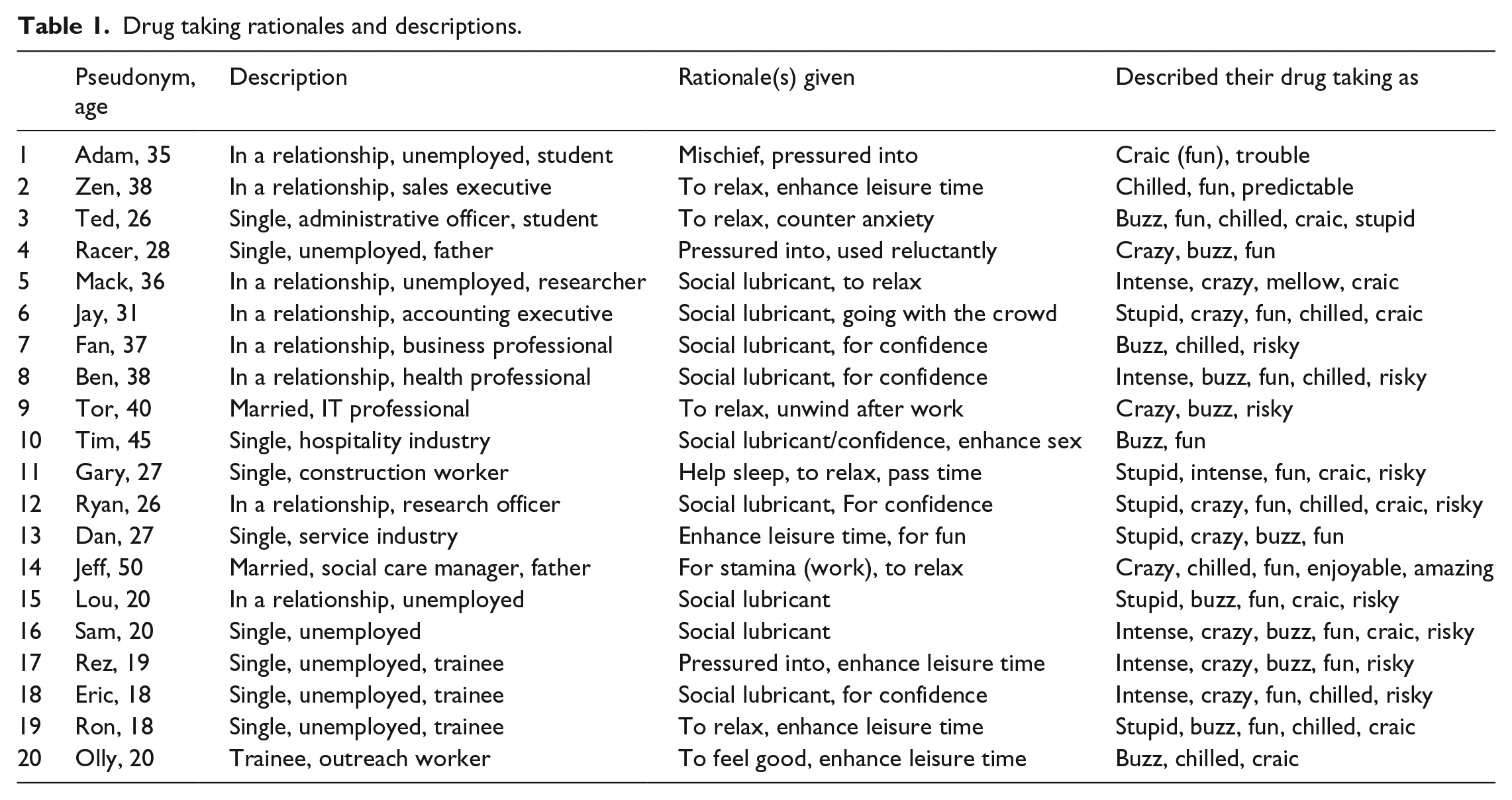
All men in this study divulged varied and complex rationales for engaging in drug use, some of which are explored in this article. Commonalities were in evidence across the sample, the most dominant being the pursuit of pleasure. The men’s age appeared to have the biggest influence on how they reported their drug taking and the types of drug-taking practices they disclosed engaging in. The stories that emerged during the interviews reflect what each of the men’s drug use meant to them. Drug-taking stories are a reflection of the diversity of reasons an individual can have for engaging in illicit drug use and the subjectivity of drug intoxication. Table 1 offers a summary of the rationales men provided and the adjectives they used to describe their drug taking. Younger men (those between 18 and 30 years) were more likely to describe their drug use as ‘crazy, fun and risky’. Older men (31–50 years) were more likely to describe their drug use as ‘chilled’. For some participants, drug taking was about ‘sensation-seeking’ as other sources suggest (DoHC, 2008: 54). However, this article will reveal that words, such as ‘buzz’, ‘craic’ [fun], ‘crazy’, and ‘chilled’, were often used by men to gloss over drug experiences and disguise deeper motivations for drug taking that related to them demonstrating, and at other times contravening, masculinities within homosocial contexts. Some men reported using drugs as a ‘coping mechanism’, reflecting findings from other research (Cleary, 2012; DoHC, 2008). Using drugs to combat social anxieties provided other men with confidence and a sense of conviviality. Illicit drugs were social lubricants for these participants. Emerging strongly from interviews was the centrality of men’s pleasure and excitement when taking drugs. Key to understanding why some men derived pleasure and excitement relates to how drug taking was perceived by them as enhancing their masculinity (discussed in detail later). Other men derived pleasure and excitement from temporarily contravening conventional masculine behaviours while intoxicated. Drug taking was a quest for pleasure and excitement that was inextricably linked to men performing and embodying masculinities. Findings to support these contentions are provided in the following sections.
Drug taking rationales and descriptions.
Masculinities and embodied drug experiences
While physical sensations brought about by drug intoxication can be significant for any drug taker, what was important to this study was how drug-taking men understood and ascribed gendered meanings to drug sensations. Some men rationalised their drug taking in simple terms, in that, they simply took drugs because they enjoyed the experience. However, drug taking was an embodied experience. Dolan et al. (2017) argue embodiment is a way of conceptualising beyond ‘the body we have’ and as more than a ‘physiological vessel open to the scrutiny of others’ (p. 2). Embodiment allows for the conceptualisation of ‘the body we are’ (Dolan et al., 2017: 2). In other words, identities are embodied and in turn bodies shape how the environment and situations are perceived and experienced. Men derived pleasure and excitement from the physical feelings certain drug intoxication brought about in them: [. . .] That state of euphoria was just, ah, just hyper charged and just blissful. Like it was just, just blew me away literally you know [. . .] (Tim, 45)
A key dimension to men’s experiences of intoxication involved how drugs brought about changes in their bodies, and in turn, how intoxication temporarily altered and complicated men’s connection with their bodies. Part of the pleasure and excitement that men experienced from drug taking relates to the tension between their perception of coping with intoxication and their ability to maintain a masculine gender performance while intoxicated. For Olly, demonstrating strength by exerting control during drug taking was implicitly linked to him displaying masculinity: I’ve a strong mind when I’m taking drugs, like ‘cause I know like what I’m doing [. . .] people say drugs put you out of your mind like but no, it’s you, if you have a strong mind you’re able to think and talk yourself and you can control your body if you want yourself. Do you know what I mean? So people say they can’t help it, I can help it. (Olly, 20)
Olly sets himself apart from other drug takers, believing he could exert his will over the effects of intoxication and maintain physical control. For Olly, a strong mind is equated with being a strong man, purposeful, and in control. Men’s accounts of control are their perception, in this regard, they may have been discursive rather than embodied. For Rez, stimulants enhanced his perceived physicality and by extension his ability to perform masculinity; cocaine enabled him to ‘do more things’. He perceived himself as more active, independent, and able-bodied when using stimulants: I hate being real slow and all, I hate that real tired feeling [right]. I prefer [. . .] that’s why I prefer doing coke [cocaine] ‘cause [. . .] you can do more things and you can fly around like, do everything [. . .] (Rez, 19)
Similarly, Jeff enjoyed the perceived physical enhancement brought about by cocaine: [. . .] you could do anything and do it eh, faster than anyone else and better than anyone else [. . .] Everything seemed to be, you know, turned up like as if you had a button on you that you just hyper [. . .] (Jeff, 50)
For some men, there was a blurring between instrumental and recreational drug use. Men’s instrumental use of cocaine was perceived as enhancing their masculinity. Fan, Lou, Gary, Olly, and Sam used cocaine to sustain bouts of heavy drinking, aiding their performance as ‘big drinker[s]’ while in the pub with other men; a recognised signifier of masculinity for some Irish men (Darcy, 2019). Cocaine could bolster inebriated bodies and counteract the effects of alcohol: [. . .] cocaine just makes you more alert and [right] stuff like that, just you can drink as much as you want on it [. . .] (Olly, 20)
Being able to sustain bouts of heavy drinking contributed to some men’s perceived ability to uphold a masculine gender performance reified by heavy drinking. A performance aligned with a dominant notion of masculinity within Irish society (Greenslade et al., 1995; Lloyd, 2000; Tilki, 2006). These men embodied masculinity by ‘holding their drink’ and staving off tiredness: No, coke is . . . basically just to keep you awake so you can keep drinking [ok] yeah. It’s good, no it is like, I’m not saying I don’t get a good buzz off it, it’s not like I’m just doing it for the sake of it, I do like, I wouldn’t do it if it wasn’t a buzz off it [. . .] (Sam, 20)
Research conducted in other locations found that young men ‘ranked their drinking and linked drinking competency to masculinities’ (deVisser and Smith, 2007: 601). For cocaine-using men, their drug use enabled their continued participation in a collective demonstration of masculinities through heavy drinking. Cocaine was a resource for competing masculinities: there’s a few buddies that I know that would do these things called roll-overs [. . .] they start drinking on a Friday and end on a Sunday. So the roll-over is that you do a two, do a two days in a row [. . .] those guys might get whatever, you know, three or four hours sleep on the Friday, three or four hours sleep on the Saturday and they just keep going, so I’d say I think that’s why they do the coke as well, because it you know you’re about to fall asleep I suppose, cuz and then you do the coke and you’re back. (Jay, 31)
Cocaine allowed some men to enhance their masculinity by continuing to drink long past the point at which their body could tolerate: You’d get a bit of a buzz and whatever talk away, a few pints, it’s mainly just to keep you straight, from, if I went out for the day I’d do a few just to keep me like awake [. . .] and to stay up, smarten me self up, instead of being real sloppy drunk and [. . .] having to go home [. . .] sometimes I don’t like going home just rather stay out [. . .] and have the craic like. (Lou, 20)
For Lou, using cocaine sustained his ability to remain socially active and participate in ‘the craic’ [fun] with other men. Lou’s reference to ‘have the craic’ is important, given its context. What Lou is essentially implying here, is that cocaine allows him to continue in a collective demonstration of masculine behaviours. His use of cocaine to maintain control over his intoxicated body echoes what Seidler (2007) describes as a ‘tradition of Enlightened modernity’ where ‘men learn to relate to their bodies as machines that they need to be able to control’ (p. 13). Cocaine allowed Lou to control his body and participate in ‘behaviours to demonstrate idealised forms of masculinity’ within this homosocial context (Courtenay, 2009: 26). It is important to note that Irish pubs are key locations where some men attempt to (re)produce hegemonic masculinities through their drinking practices and interactions with other pub-going men (Darcy, 2019). For some men, cocaine had become a common feature of pub life:
[. . .] if I’ve probably a few pints in me on a Saturday night and [. . .] someone was in the jacks [toilet] and some one said here ‘do you want a line of that?’ probably nine times out of ten I’d say ‘yeah’.
So would there be a lot of sharing of stuff?
Yeah, Jesus some weeks in one of the pubs you’d go in and there could be six young lads in a cubicle all at once (laughs), it’s just gone that bad.
For Fan, Lou, Gary, Olly, and Sam, their instrumental use of cocaine to sustain bouts of heavy drinking contributed to their perceived enjoyment of alcohol and enabled them to demonstrate behaviours in keeping with conventional Irish masculinities. Their cocaine use allowed them to maintain a particular gender performance (achieved through heavy drinking) that reflects dominant understandings of masculinity within Irish society (Darcy, 2019). Drug taking and intoxication allowed some men to temporarily feel more connected to their body and derive novel pleasure from their body. These men perceived they were more able-bodied, enhanced, and by extension, better able to demonstrate conventional masculine behaviours. Embodied drug effects were not the only aspects of drug taking that men found pleasurable and exciting. The following section explores how men demonstrated masculinities through risky drug taking and derived pleasurable excitement from the drug ‘buzz’.
The drug buzz, risk and demonstrating masculinities
For some of the men in this study, risk played an important role in deriving excitement from their drug use. These men can be conceptualised as ‘edgeworkers’ and their drug taking as a form of ‘edgeworking’ (Lyng, 1990). This type of drug taking involved a pleasurable tension between maintaining and loosening social and personal restraints, and between retaining and losing control. Navigating these boundary lines or edges, and experiencing ‘edgework sensations’ (Lyng, 1990: 860) contributed to men’s derived excitement from drug taking. Being observed taking risks and having risk acknowledged contributed to some men’s perceived demonstration of masculine behaviours. Notions aligned with Western Hegemonic Masculinities (Connell, 1995). However, this is not to suggest that all men viewed their drug taking as risky, some did not. Many of the older drug takers (e.g. Tor, Ted, Zen, Fan, Ryan, and Lou) perceived their drug use as being controlled. However, for some other men, risky drug taking provided contrast to banality in their everyday lives. Rarely did the men in this study intentionally seek to relinquish complete control. To do so would have endangered their safety and signified failure as drug takers/edgeworkers; they would have lost drug-taking games: Yeah ‘I can smoke more than you’ like, ‘who is going to go green first?’ Use to be a bit of a game we played [ok] to keep pumping, pumping until someone got sick. (Sam, 20)
The presence of risk did not mean there was an absence of control; rather men carefully navigated the boundaries between severe and dangerous degrees of intoxication by employing skills and experience accumulated over time: I knew how much to smoke that wouldn’t make me too high but also enough that I’d be nice and mellow [. . .] I was in a lot more control of what was happening. (Mack, 36)
Pushing the boundaries of what was considered normative or socially acceptable was exciting to many of the interview participants. For them, contravening social norms was indicative of having a good night out. For younger men in particular, the drug buzz transformed otherwise normative leisure time into novel and exciting interactions: But if I’m on ket [ketamine] I’ll be like, like doing big mad walks and all just be looking at you weird and doing, saying mad things and all. Well actually I prefer ket than coke because it’s cheaper and the buzz you get off it is much better because like, when me and all me mates are doing it we were all doing mad things like we were just sitting there laughing. (Rez, 19)
For Rez, the buzz was central to ‘having a good time’, as was doing ‘weird’ and ‘mad’ things. Rez’s enjoyment of the drug buzz was rooted in the collective activity. Doing ‘mad things’ while intoxicated functioned as a demonstration of masculinity through high-risk behaviours in homosocial contexts: [. . .] like me mates smacked a plate off someone else’s head and he got the broken bit and just start jabbing in me chest and just all across there (points to his chest) and all like. Just looking at him going ‘why did you do that?’ ‘Just thought I’d do it’ [. . .] and I went ‘fuck you!’ (laughs) Just laughing about it after that [. . .] ‘we’re weird!’. (Rez, 19)
By engaging in potentially dangerous behaviours (smashing plates off heads and stabbing each other) in the context of a homosocial drug-taking group, Rez and his peers are demonstrating a shared understanding of masculinity. It is also indicative of competing masculinities and some young working class men’s attempts at demonstrating aspects of hegemonic masculinity (e.g. displaying toughness) despite having limited resources to do so. It must be remembered that context is key. The manifestation of these behaviours in other social contexts would be viewed entirely differently. Men’s internalised masculinity ideology shaped their responses to risky and dangerous drug-related situations. Rez recalled another drug-taking experience that resulted in him fearing he was having a heart attack. Not wanting to lose face in front of other men, Rez continued to take drugs: And I turned around to someone that was sitting beside me and I went ‘I think I’m about to die!’ and they were like ‘don’t be saying that’ and I went ‘I think I’m about to die like!’ (laughs) ‘Me heart is speeding up, I’m sweating buckets here, I think I’m about to die’ I think I should stop. Then as I, as I was saying ‘I think I should stop’ I was doing it again, like I kept, I was doing it while I was saying ‘I think I should stop’ and they were like ‘then stop’. ‘Ah fuck it! If I die, I die!’ (Rez, 19)
In the excerpt above, Rez presents himself as being ambivalent in the face of harm. Both Connell and Messerschmidt’s (2005) concept of ‘Protest Masculinity’ and Seidler’s (2007: 83) ‘strategies of denial’ can be drawn on to explain what Rez is trying to achieve in the two examples above. Although Rez acknowledges hurt in both instances, he plays it down and the precarious position he finds himself in. Rez’s accounts are attempts by him to perform masculinity despite limited means to do so. He tries to align himself with aspects of hegemonic masculinities, despite the fact he would otherwise (outside of this context) find himself subordinated and marginalised among other groups of men. Rez’s stories are ultimately about not compromising his masculine identity in front of his peers while under the influence of drugs. His stories are discursive means of affirming himself as a hard man, and by doing so, maintaining a masculine performance that borrows from hegemonic masculinities and through his reckless actions results in a protest masculinity. While some men derived pleasure from the stimulation and buzz of certain types of drug taking, others found pleasure in being ‘chilled’ and feelings of sedation and relaxation. As will be seen, this type of drug taking was complexly interwoven with how men dealt with adversity and unwanted emotions.
A masculine escape: chilled out and coping
Participants such as Ryan (26) and Mack (36) derived considerable pleasure from being ‘chilled out’ while under the influence of drugs. It was a significant factor for their motivation to use cannabis, which can have a sedative affect. However, it appeared being ‘chilled out’ was often a masculine code for coping with emotions and/or anxiety. Ted believed his use of cannabis helped him deal with anxieties: I suppose what I like about weed is, it’s kind of like an anti-anxiety thing as well, ‘cause occasionally I have a kind of a problem with anxiety sometimes, so that kind of like just kind of chills it out a little bit. (Ted, 26)
While men like Mack, Ben, Jeff, Zen, Gary, Ted, and Ron pursued a quest for pleasure that involved sedation, their drug taking was (at times) essentially about coping with stresses, adversity, and/or unwanted feelings. Drug taking enabled them, in their view, to get through difficult times. Pleasure was derived from feeling different to being sad, stressed, or troubled. Intoxication was a state of contrasting otherness and pleasurable sedation. Thus, drug taking enabled these men to detach from their emotive self and maintain a stoic front, aligning them to a construct of masculinity that ‘tends to suppress emotion and deny vulnerability’ (Connell, 2000: 5). In this way, men’s drug taking can be viewed as a means of embodying a particular relationship to their emotional life, revealing complex intersections between men’s drug use, masculinities, and emotive tensions. These findings resonate with the work of Whittington (2007) who observed men’s illicit drug use as a ‘method of “self medication” for trauma’ (p. 348). For example, Gary’s mother was diagnosed with an aggressive cancer when he was about 23 years and passed away approximately 6 months after diagnosis. During his mother’s illness, Gary was distressed and had trouble sleeping. He began self-medicating by using cannabis to aid sleep. His drug use became quest for pleasure and relief during a difficult period in his life: Four years ago me mother got cancer and [I] wasn’t sleeping well, I was living in Woodfield at the time and I was, just started smoking every night to try get me self a sleep, ‘cause I didn’t want to take sleeping tablets or [. . .] then just continued on, got into the habit of it. (Gary, 27)
For Gary, sedation became a means of coping and controlling emotion. Intoxication offered respite from emotional distress. In this way, drug taking and intoxication enabled some men to uphold a performance of masculinity characterised by being emotionally controlled and stoic. This study does not reveal whether the men’s drug taking did actually help them cope better with distress and/or adversity. Rather it is the men’s perception their drug taking helped them cope. While some men enjoyed the state of pleasurable sedation brought about by drug intoxication, other men enjoyed the stimulation and intensification of emotion achieved through the use of drugs like ecstasy. This adds an additional layer of complexity to understanding men’s rationales for drug taking. Although some men had difficulty dealing with emotions and used drugs to circumvent these difficulties, this is not to say all of the men wanted to be un-emotive.
The spirit of ecstasy and feeling connected
While there may be a dominant social expectation (certainly within Irish society) for men to be stoic and emotionally detached (Cleary, 2012), this does not mean that men do not derive pleasure from being emotive or from experiencing feelings of intimacy and connection with others. Men deriving pleasure from the intensification of emotion, and the displaying of affection towards others, raises interesting questions about the disconnect between clichéd discourses on masculinity and the lived experiences of men. It undermines patterns of masculinity that reinforce the gendering of emotionality as feminine and helps highlight ‘the importance of men’s emotional lives’ (Connell, 2000: 5). While Irish masculinities are often underpinned by the notion that men must exert restraint and suppress emotion (Darcy, 2019), some men in this study derived pleasure from intensified emotions and their expression. Illicit recreational drug use enabled them to achieve a sense of togetherness and connection with other men in drug-taking contexts. However, it appeared these men needed drugs in order to express a sense of connection to other men. Dan recounted an experience of using ecstasy with a group of other men, where the combination of drug effects and the collective experience contributed to a heightened sense of enjoyment from feeling connected to his peers: We were all just in a house, was like seven or eight of us (all men) in a house doing it together (laughs) and eh we just, we all did it (ecstasy) at the same time and all came up at the same time and eh it was just one of my favourite nights I’ve ever had, it was great! (Dan, 27)
The spirit of ecstasy enabled some men to achieve a heightened sense of connection with other men that was a considerable source of enjoyment. Fan described how ecstasy enabled this: [. . .] you love everyone like you know and everyone loves you so yeah like, if I was with my friends and we’re out on ecstasy and we’re sitting there I’d be like telling him I love him and he’s my best friend and then the next morning I’d be like (laughs) you know, call him a prick or whatever like, so yeah, you’d react very differently. (Fan, 37)
Fan’s intoxication from ecstasy allowed him to ‘react very differently’ and express affection towards another man without detracting from his masculinity. For Fan, these temporary displays only occurred when intoxicated by ecstasy. Once the drug wore off, the men had to revert to interactions that aligned with conventional masculinities. Ecstasy was unique in the types of interactions it enabled between men and feelings of euphoria overrode some men’s ability to maintain restraint. Dan highlights how ecstasy produced an overwhelming desire to express affection towards others, and how in turn this expression of affection and sense of connection was pleasurable: I’ve had some of my favourite nights on it. Eh the few times that I’ve done it (ecstasy) eh it’s been great for me [. . .] it just worked for me the few times and just the feeling it gave me was just, was just a really great feeling [. . .] all the cliché things that people have probably said before, it’s just like, just really euphoric kinda like, it kinda tingles through your body and you, you just want to hug everybody [. . .] especially like when everybody around you is doing it at the same time as well, everybody kinda has the same feeling. (Dan, 27)
Dan’s ecstasy use was about maintaining and enhancing feelings of social connection. Part of the pleasure and excitement derived from ecstasy was how it enabled some men to contravene social norms and do something out of the ordinary for them as men: The last time I had [. . .] ecstasy was good fun actually because [. . .] just kind of dancing all night and everything, it was good fun, ‘cause usually I get to do that fairly rarely, usually if I go out as well it’s like a chilled out thing, just few pints [. . .] it’s usually not my thing to go dance around the place, so that was quite fun, it’s a different kind of buzz [yeah], like if you have the ecstasy like I was saying it’s just much more, you kind of just love everything and want to dance around and you don’t care about that you’re dancing like an eejit or anything. (Ted, 26)
For Ted, his intoxication from ecstasy induced a sense of freedom from the constraints of daily life. It enabled him to relax his adherence to conventional gender expectations and partake in an activity that he otherwise would not have done. Ted derives considerable pleasure from being uninhibited and engaging in non-hegemonic behaviours. It is a ‘different kind of buzz’ for him. His intoxicated ambivalence assisted him transgress normative expectations of masculinities and disregard the potential disapproval of others. To Ted, his drug intoxication exonerated his transgression.
Conclusion
This article has worked to demonstrate that men engage in illicit recreational drug use for complex reasons. On the surface there are a number of similarities between the way men use alcohol and the way they use illicit drugs, such as equating greater levels of consumption with a greater degree of masculinity or using intoxication as a means of escaping adversity. Moreover, there are similarities between the way some men in this study used drug intoxication to excuse non-hegemonic behaviours and studies such as Emslie et al. (2013) that found men use alcohol in a similar way. It is important to note that while there are similarities in how the men in this study used alcohol and drugs, this is not to suggest that men’s relationship with drugs is the same as men’s relationship with alcohol. Nor does men’s illicit recreational drug use automatically confer masculinity. While this article has illustrated how some men’s drug taking can become suffused with gendered meanings, incorporated into their gender performances and contribute to them doing masculinities, it is important to state it will not be viewed this way by all observers in all contexts.
To be clear, this article is not suggesting that men’s recreational use of illicit drugs is a straightforward expression of masculinity. Rather it is arguing that men’s rationale for engaging in illicit recreational drug use, can and does, subtly intersect with masculinities. Illicit drugs can be conceptualised as resources for competing masculinities and this adds an additional layer to previous explanations for men’s recreational drug use. Embodied drug experiences were central to the gendered meanings men ascribed to their illicit drug use. Men derived pleasure and excitement from drug taking that they perceived enhanced their senses and/or bodies. Drug use enabled some men to connect with their bodies in novel ways and ‘give voice to emotions that would otherwise remain disconnected’ (Seidler, 2007: 16). Other men engaged in drug taking because they believed it enhanced their bodies and contributed to them carrying out activities they viewed as being masculine, or that for them aligned to hegemonic masculine ideals (Connell, 1995). For example, men who used cocaine instrumentally, to sustain long bouts of alcohol consumption, were using a recreational drug to enhance their ability to participate in masculine behaviours used to demonstrate a dominant construct of masculinity that is reified by heavy drinking in an Irish context (Darcy, 2019).
Men’s conceptualisation of masculinities and how they ought to act as men shaped their responses to risky and potentially dangerous drug-related situations, especially in homosocial contexts. Men’s displays of ambivalence about personal safety hid underlying fears and were a manifestation of men having learned ‘strategies of denial’ (Seidler, 2006: 83). Not wanting to appear fearful or weak, these men negated self-protection for the maintenance of behaviours that borrowed from a notion of hegemonic masculinity characterised by strength, stoicism, and bravado. For other men, drug taking was pleasurable when used to cope with stress, adversity, or unwanted emotion. Being ‘chilled out’ was a masculine code for coping used by some drug takers, signifying an escape from adversity and unwanted emotions. The complex and contradictory nature of men’s drug experiences is evident by the fact that not all men sought to suppress emotion through their drug use. Men’s enjoyment of the ‘love buzz’ confronts clichéd notions of how men ought to feel and act. It reveals alternative ways that some men (dis)engage with conventional masculinities. The contribution of this article is that is provides new insights into how masculinities and men’s recreational use of illicit drugs can intersect. For some men, their illicit drug use allowed them to embody aspects of conventional masculinities, while for others, illicit drugs were a temporary means of circumventing conventional gender expectations. The findings presented here suggest men’s rationales for engaging in drug use are more complex and multifaceted than some previous explanations have allowed for. While illicit drugs are resources that can be used in the social construction of masculine identities within homosocial contexts, men’s rationales for engaging in recreational drug use reveals that the way masculinities are sometimes performed are in tension with how they are experienced, embodied, and lived by drug-taking men.
Footnotes
Acknowledgements
I would like to express my sincere gratitude to the men who were so generous in giving their time and participating in this research project. Thank you to the four anonymous reviewers who provided very helpful suggestions and comments on earlier drafts of this paper. Finally, I would like to dedicate this paper to Michael ‘Daddy’ Sheridan (RIP) – a man of few words but of many meaningful actions.
Funding
The author(s) received no financial support for the research, authorship, and/or publication of this article.