




Abstract
In this article, a dance metaphor is developed to deepen our understanding of the material, sensual, processual, and experiential potential of digital data relations. Premised upon Blumer’s notion of a sensitising concept, ballroom dance theory is applied to everyday use of the Apple Watch so as to prompt investigation of subtle interactional features of device use. The aim is to engender an inclusive umbrella concept while simultaneously stimulating questions of analysis of and access to small-scale and intimate moments of embodied behaviours in future interactional analysis. In so doing, the article contributes to the sociology of data relationality in everyday life, as well as constituent approaches such as science and technology studies and the interactional study of bodies and machines.
Introduction
Recognition of the material, sensual, processual, and experiential potential of digital data has resulted in an increasing interest in body-oriented concepts and analyses. At the same time, there has been a fragmentation of conceptual language and focus. Sprinkled throughout contemporary accounts of technology is the metaphor of dance, 1 which neatly captures these features and provides a possible focus. However, the metaphor is often jettisoned when it comes to theoretical or methodological development. Dance rarely moves from metaphor to ‘sensitizing [analytic] concept’ (Blumer, 1954), and from there to the production of dance-oriented theory and analysis. By advocating a productive dance metaphor, this article provides foundation for such work and also offers an umbrella concept under which other approaches can nestle (as ‘dance-like’). The dance metaphor provides impetus towards emerging areas in embodied interaction concerned with intercorporeality (Meyer et al., 2017), particularly those based on embodied interaction in everyday life (Mondada, 2016) and dance (Broth and Keevallik, 2014; Keevallik, 2010). 2
This article builds on recent investigations of digital technologies that reject an informationalist notion of data as adequate starting point, and instead premise their insights on the pre-conscious experience of the body in space interacting with other bodies. This includes the internal body, its experience, and movements. Foregrounding the senses and characterising the ‘interactions’ of technology use as a form of somatic relationality, these approaches question received understandings and broaden our conceptual arsenal. Where these require extension, however, is in terms of method, specifically in relation to how such relations should be empirically studied. This article goes some way to resolving this issue by drawing a connection between conceptual and methodological matters through a metaphor of dance. Already an established metaphor, I clarify and deepen its import and advocate for a form of close examination of embodied interactions with data devices based upon the sensual and embodied character of the Apple Watch. By utilising dance theory, I suggest a focused examination of subtle, often imperceptible, aspects of embodied interaction and in so doing set out a path for methodological development. Dance informs not just how we think and theorise, but also how we undertake empirical investigation in a practical sense.
The literature on contemporary forms of data-generating technology is broad and ranges across numerous disciplines. While the emphasis in Sociology has been on particular technologies in context, recent work has turned to the relationship with and through data more generally. A small number of authors have advocated for the close examination of data relationships in everyday life (Beer, 2009; Couldry and Powell, 2014; Kennedy and Hill, 2017; Lupton and Maslen, 2018; Wilmott, 2016). For example, Pink et al. (2017) call for an ‘in-depth investigation of the human experiences, routines, improvisations and accomplishments which implicate digital data in the flow of the everyday’ (p. 1). Lupton (2017) usefully introduces the term ‘personal digital data’ to capture such relationships.
While a single device, the Apple Watch is a useful means to draw down to such embodied interactions. Not only does it sit close to the body, capturing and generating body-relevant data, it also communicates with and through the body, implicating forms of somatic-technological relationality. I use the Apple Watch as an example of how the dance metaphor can be deployed to engage with these features of contemporary digital data.
Background literature
The Apple Watch is chosen as a case study because of its sensory relationship to the human body. It functions in a reciprocal relationship, both collecting and giving information, and is incorporated into the daily practices and routines of people. It is also the basis for a number of contemporary investigations of human relationality with and through technology and data. Such investigations foreground the sensual, embodied, and processual relationality of the device. The body, therefore, figures strongly in these accounts, and body-oriented concepts emerge.
There are those approaches which claim a ‘naturalistic’ starting point, a pure empiricism that builds from simple observation and leaves theorising to later. While these approaches have their utility in some forms of visible interaction, the dynamics of embodied interaction often escape such simple observation. What is required is a framing concept that provokes investigation of particular (embodied) matters.
There are a number of theoretically formulated examinations of the Apple Watch that emphasise the mundane, relational, and processual nature of the human technology relationship (Davies, 2018; O’Neill, 2017; Pink and Fors, 2017). Some approaches are content with theorising, while others allow theory to frame applied methods, such as autoethnography, sensory ethnography, and observation. The problem is the direction of travel, from theory to method and findings. The danger is that only those pre-theorised elements are foregrounded, drawn out, and developed. The dance metaphor offers a means to turn this over and start with a sensitising concept that, while framing the gaze, inspires exploratory lines of empirical investigation rather than affirming the utility of pre-conceived theory. Arguably, this is how theory should function (Blumer, 1954).
Building on the intimate experiences of an autoethnographic approach, Wilmott et al. (2017) reveal the relationship with the Apple Watch as a form of embodied and reflexive interaction that leads to forms of performance and play or what they term ‘ludic labour’ (p. 78). Utilising Serres’ notion of the ‘quasi-object’, the Apple Watch is realised in interaction: ‘it only becomes something when we wrap it around our wrists’ (p. 87). It is construed only when attached to the moving body, part of ‘an assemblage in which data and bodies constantly and intimately produce each other’ (p. 87). At the same time, the Watch implicates productive forms of embodiment and ‘intercorporealisation’ (Richardson (2012) as cited in Wilmott et al. 2017) wherein ‘technologies mediate and shape our understanding of space through the centrality of embodiment’ (p. 88). Not only this, ‘the Watch also shapes the way we locate within ourselves: from eye to finger, from heart to skin, from ears to arms’ (p. 89).
Data are normally characterised as disembodied information, yet a number of authors have begun to question such assumptions. Through what she terms the ‘encounters and entanglements’ with ‘personal digital data’, Lupton (2017) highlights the way that digital data are ‘translated’ into material form to make them accessible to sensory engagement. In so doing, she affirms their body-relational qualities. She advocates a move from notions of ‘data literacy’ to ‘data sense’ to underline the numerous ways that digital data are encountered through the senses and to ‘[bring] the body back in’ (p. 1603). Lupton presents data as dynamically intertwined with human bodies in ‘digital data assemblages’ that act as ‘dynamic, responsive and distributed forms of selfhood’ (p. 1602). As a consequence of ‘their mutable nature’, she notes, ‘they are elusive and hard to pin down and confront’ (p. 1602).
To help engender such ‘confrontations’, Lupton lists art and design practices of ‘data physicalisations’ in which three-dimensional (3D) materialisations of personal and social data enable creative sensuous engagement. In doing this, she advances the idea that data and devices are already constituent elements of the physical and spatial world: ‘Bodies, spaces and places are . . . simultaneously digital-material’ (p. 1601).
Perhaps most useful is the concept of pulse by Davies (2018) that implicates both the facility to detect and record heart rate as well as a metaphorical notion or quality – the ‘pulse’ of a business, for example. Here, then, an existing ‘body concept’ is incorporated into a conceptual account. Moving beyond (or before) the acquisition of knowledge about the person, the focus on pulse re-orients the perspective to the ‘the dynamic techno-somatic rhythms that are sensed, but not necessarily known in Cartesian terms’ (p. 4). For Davies, this enables an appreciation of ‘cybernetic control of bodies, environments and the emergent interplay between the two’ (Davies, 2018) and ultimately a ‘proto-cybernetic imaginary’ (p. 15).
Davies undertakes a study of ‘pulse’ through two examples: the Moodbox, a simple negative positive experience sampling tool, and Ripple, a wearable heart rate synchronisation device. By contrasting them in terms of ‘internal’ and ‘external’ forms of rhythm, monitoring, and measurement, he shows how contemporary forms of control are premised upon embodied activities of various sorts. Key to the Ripple device is a focus on ‘rhythm synchronisation’ or forms of ‘choreographic rhythm’ in which the device acts in accord with the body to affect behaviours and implicate forms of collective experience. Davies positions this as an emerging form of ‘metronomic vitality’. An underlying example for Davies is that of dance, which resists simple patterned measurement as it emerges as an expressive form underpinned (but not determined by) a pulse or rhythm. Key is the manner in which these devices exert forms of control without a normative measurement structure; intriguingly, with these devices, the feeling of rhythm is ‘from the inside’ of the body. Just as dance is aesthetically appreciated and valued (rather than rationally), so is the emerging coordination of bodies and rhythms merely monitored – and not set against some normative standard – a form of aesthetic and kinaesthetic control:
As with a dance or Lefebvre’s example of horse dressage, these technologies do not govern the individual via norms or discipline, but nevertheless they provide some choreographic rhythm to which the individual might conform, perhaps without even noticing it. (Davies, 2018: 20–21)
At the same time, this rhythm is expressed numerically as a measure, ‘rather as a dancer or conductor might say “one, two, one, two” in time to a piece of music’ (p. 22). Key is not some external judgement against a normative set of standards, but instead a judgement premised upon motility and an expectation of continual movement.
Performativity, dance, and technology
The dance metaphor extends and deepens the performative turn in sociology, and in particular technology studies. Pickering (1995, 2010; Pickering and Guzik, 2008) argues for a move from a ‘representational’ to a ‘performative idiom’ and Law and Singleton (2000) suggest that humans and technologies (non-humans) perform each other.
Pickering’s performance turn rests on the ‘dance of agency’ in technology innovation (Pickering, 1995: 102). The dance of agency is implicated in what he terms the ‘mangle of practice’ that in turn represents a ‘dialectic of resistance and accommodation, which is brought to bear on scientific and technological advances’ (Olohan, 2011: 344). For Pickering (2010), ‘. . . dances of agency are themselves performative, not linguistic, cognitive, or whatever. They have to do with actions, human and non-human, in the material world and the interplay of those’ (p. 198). While his original writings were oriented to processes of innovation, he later maintained that they could become ‘a coherent and productive approach across the humanities, social sciences, and beyond’ (Pickering and Guzik, 2008: vii).
Such processes of resistance and accommodation can be seen in the work of McCarthy and Wright (2004) in Human Computer Interaction (HCI). Here, they describe the ‘felt experience’ of technology as a continual rhythmic matter of resistance and release, in the ‘accumulation of experience’ and its payoff in moments of engagement with technology. They label such processes the ‘rhythmic dance of aesthetic experience’ (p. 65). While such processes have a temporal unfolding, as seen in Pickering,
. . . the rhythmic dance . . . connects aesthetic experience to its history and circumstances. The dance involves a continuous interplay between past, present, and future, each shaping and renewing the others. (McCarthy and Wright, 2004: 65)
These moments of reflection are a key route into the ‘sense’ of any dance. By reflecting on what happened (or should have happened) in line with a history of expectation and circumstances of use, the experience of the dance is brought into the present moment as object.
In a recent collection of articles, Sutil and Popat (2015) sketch out an intriguing position in relation to body, movement, and technology that centres on technology relations, and in particular, the algorithm as digital movement. It is not only the human who is afforded a processual ability to move through social life, ‘the machine can also walk through data, and then produce a memory of these walks. The computer machine can be fed an input, from where it will walk, algorithmically (i.e. step by step), to an output’ (p. 2). If the algorithm animates the footsteps of the machine, it also aligns with the footsteps of the human – human and machine ‘walk together’. They might also be said to dance together.
Extending Heidegger’s notion of ‘technology to hand’, Sutil and Popat (2015) argue that the algorithm, and by extension all computer code, is ‘already handed’. The performativity of the machine is animated by the algorithm. Rather than an abstract and/or controlling influence, this opens up the potential for speaking about moving with, and through, the machine and introduces a sense of embodied relations resting upon patterned behaviours. It also evokes a relational sensibility of mutuality and empathy. To walk with someone or something is to share and combine to form a ‘kinesthetics empathy’ (Brandstetter et al., 2013; Ehrenberg and Wood, 2011; Reynolds and Reason, 2012). Such close relations dissolve the separation of human and machine and instead they come together and move to the same rhythm. Rhythmic walking becomes dance-like. Human and machine become dance partners, in which individuality gives way to ‘the couple’. This simple move opens up a means to combine the ‘performativity’ of technology with the performativity of the human actor through a conceptualisation of the data dance.
Sutil and Popat have in mind a specific instance of the data dance, in the capture of body movements for film. Here, I argue that many data relationships can be conceptualised as a dance, born of embodied processual relations, and that this can inform a methodological position and strategy for understanding technology-mediated social life. In turn, the fundamentally structured practices of movement and embodiment become the bedrock for understanding the introduction and emergence of new forms of digital practice and performance.
The intellectual space of digital performance is an intriguing one, and provides many inspirations for a dance metaphor (Leeker et al., 2016). Kozel (2007), in detailing the ‘WHISPER (wearable-handheld-intimate-sensory-personal-expectant-responsive)’ project, asks a pertinent question, ‘What about the way our communication occurs on the threshold between the tangible and the intangible most of the time, between that which can be articulated and that which escapes language?’ In response, she proposes that technology use ‘provides the experiential basis for reflections upon flesh and data choreography’ (p. 280, emphasis added). I mean for the dance metaphor to incline us towards such ‘flesh and data choreography’.
Dance theory
The dance metaphor retains a performative character as relational and emergent but extends this towards the sensual and embodied. We get a strong sense of how the dance metaphor can evoke embodied relationality in the work of Ericksen (2011) who speaks to the ‘instant intimacy’ of couple-dancing. The key issue – and provocation – is that we should extend the notion of intimacy and relationship to data and device interaction, which in turn brings into view questions of power and acquiescence in such relations.
Ballroom dance theory (Moore, 2002 [1939]) helps deepen and develop the dance metaphor. The performance of the dance requires complementary movement in both bodies. While premised upon existing competence (knowing the ‘routine’, the ‘figure’, the ‘repair moves’ composed of retardation of movement, small sways in place, simple figures), it is produced in every next moment – continual, intimate and ephemeral (Sheets-Johnstone, 2015 [1966]), as ‘co-action’ (Scheflen, 1982: 13). In performance theory terms, the dance is mimetic, a form of (mirrored) mimicry, but also poietic (creative) and kinetic (formed through dynamic change and movement) (Denzin, 2003).
For this to occur, and for the couple to coordinate their activities, one partner ‘leads’ while the other ‘follows’. The uncertainty of any next movement, the step, the body position, is negotiated with, and through, the projecting ‘lead’ – the bodily expression of intentionality and expectation of joint movement. However, without the accommodating ‘follow’, there could be no lead. The responsive partner is able to read the lead through appropriate preparedness (hold, frame, embodied readiness) and this is required to enable any ‘next turn’ in the dance.
Rather than viewing the term as composed of two separated elements (‘lead’ and ‘follow’), it quickly becomes apparent in any dancing couple that both partners must play an active role in maintaining the ‘lead-follow’ relationship. It is only in mutual preparedness that such dynamics function. This is accomplished through a specific form of body alignment called ‘the frame’ (Moore, 2002 [1939]).
A couple’s frame is the t-shape formed by the hands, arms, and shoulders of each person. To ‘maintain the frame’ requires that both dancers produce a certain tension in the shoulder’s arms and hands. DeMers (2013) describes this as a continual practice of ‘frame matching’:
Frame Matching is the act of creating, maintaining, or changing tension between partners with posture and tone, in order to lead and follow energy and direction. Changes in tension are made to create rhythmic variations in moves and movements, and are communicated through points of contact. This communication is what dancers commonly call partner connection. (p. 71)
The embodied frame is a necessary foundation, an inherent requirement for dance to occur. The notion of partner connection is a key component of the metaphor, as we will see.
Dance involves a preliminary set of ordering practices and features. A set of differentiated ‘dances’ with particular rhythms and tempos, each involving pre-defined ‘figures’ and ‘routines’. The dance performance involves fitting these elements together – in dancing in-time and in-character – while negotiating the space of the dance floor, and other couples, as the dance emerges. The dynamics of lead and follow, allow for a responsive and adaptive movement across the floor, and between other bodies in couples.
In light of the above discussion of performance, dance and technology, I will now apply dance as metaphor to a single instance of technology interaction and show how it sensitises us to features of the data relationship in everyday life and from there inspires an interactional analysis of the actions and agencies of human and device.
Dancing with data – the Apple Watch
The dance metaphor inclines us to think of the intimate and embodied processes and practices of technology use. Here, the dancing couple is most clearly implicated in the physical and embodied relationship between device and human. Wearable devices rely on a wide range of informational exchanges, including haptic and audio cues, voice input, skin-based sensors, movement and position sensors, and visual display. These device-based elements inform an ‘ensemble’ of technology-based practices and perceptions. Wearable devices are a logical extension of the mobile phone, both in terms of the technological components and the close relationship to the body of the user. It is typical, for example, for the phone to sit close to the skin in the pocket and has been implicated in sensory relationships, including sensory ‘illusions’ such as the ‘phantom vibration’ that turns body movement into haptic cue (Deb, 2014).
Since its release in 2015, the Apple Watch has become a popular wearable device. To introduce the device, Apple produced a series of instructional videos. The following example is taken from a video posted on YouTube. The video can be viewed at www.youtube.com/watch?v=mvyssYADug4.
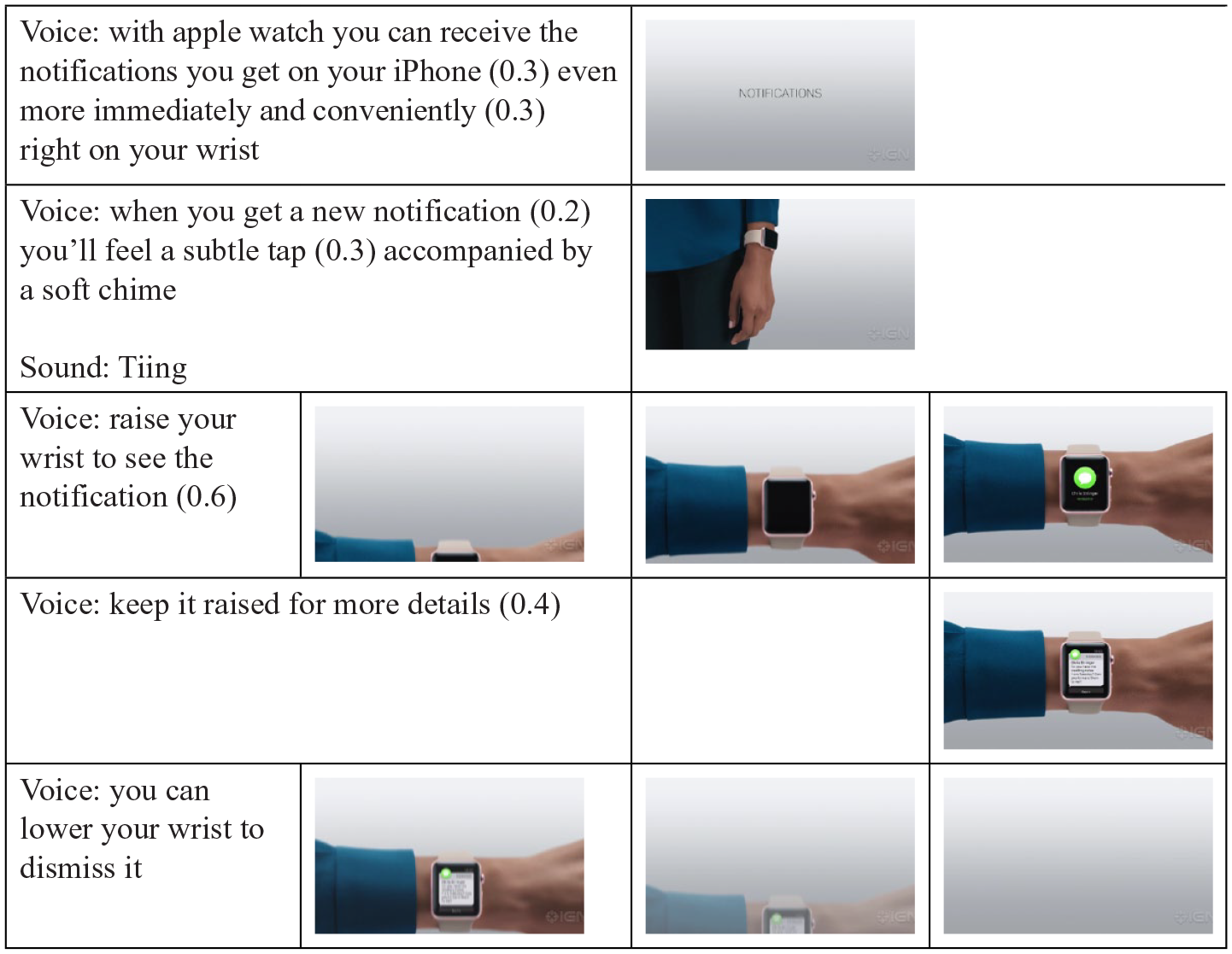
The segment in Figure 1 shows the first few moments of the video as a form of ‘embodied instruction’ of how to respond to a ‘notification’. A female voice speaks over accompanying music and images. These elements are highly choreographed, the voice speaking in time with the music, the narrative following its phrasing. The actions described are replicated in the visual imagery. What is most striking about the video is the abstraction of the use of the Watch from everyday life. The video performance shows the smooth operation of the device in aestheticised isolation. I use this video as a stepping off point, to show the utility of the dance metaphor.
The Apple Watch.
Relations with the Watch are clearly embodied. Notifications are felt and heard. Understood as a dancing couple, the person and the Watch are in constant physical contact. This is a requirement of the body-monitoring features of the device. Data creation requires continual contact. For example, to feel the pulse of the person, the sensor on the back of the Watch must be in contact with the wrist. The Watch and the wrist must be in a particular embodied frame, ‘under tension’. The strap must be ‘tight enough’, but a ‘heavy touch’ would dispel such body intimacy.
Only once the body has registered the ‘summons’ (Schegloff, 1986) of the notification – through the ‘subtle tap and soft chime’ – does the person enact a gesture to bring the screen into visual range. Termination of the visual interaction is again gestural, as the person returns their hand to their side (see Streeck, 2009, 2013; for an appreciation of gesture and kinesthetics).
One fascinating aspect of the notification routine is that it replicates an existing watch-based gesture – that of looking at the time. We know from interactional studies (and common sense) that the action of looking at the time is not merely instrumental (as something like information accessing) but also has social meaning. Looking at the time, while walking quickly, might indicate to onlookers that the person is late. A glance at the Watch in a conversation might indicate a wish for its termination.
Yet here it is not the person who instigates the gesture. The gesture is in response to the summons of the device. Without looking the person has no idea of what the summons relates to. It could be a message (as with the video), but could equally be a reminder of an upcoming meeting. Numerous applications on the Watch produce notifications, based on a range of informational categories, including health, weather, and communication. At the same time, the haptic nature of the summons is invisible (or, is that ‘un-hearable’ or ‘un-feelable’?) to onlooking actors. The person wearing the Watch could, if they wish, ignore the summons and this would again be imperceptible to most onlookers.
Raising the wrist to look at the Watch in public is not simply an expressive act, it is a response to the machine. The Watch is an agent in social life, it is a dance partner. We can further this understanding with the notions of lead and follow and frame matching.
For the Watch to express agency, it must be in close contact with the body of the ‘wearer’. This is the only way that the ‘frame’ of ‘wearer/wearable’ can be maintained. The vibration only becomes a meaningful social action (‘notifying’) through such perceptual connection, and only by acknowledging the haptic cue by lifting the wrist does the technical feature have sequential meaning. This ‘accommodation’ (McCarthy and Wright, 2004) to the experience of the technology sits within a performative process, whereby it implicates (but does not guarantee) a sequence of ordered practices (lift wrist, look, lower wrist, etc.). Through such constitutive practices, the activity of data and information interaction become perceptually and socially meaningful.
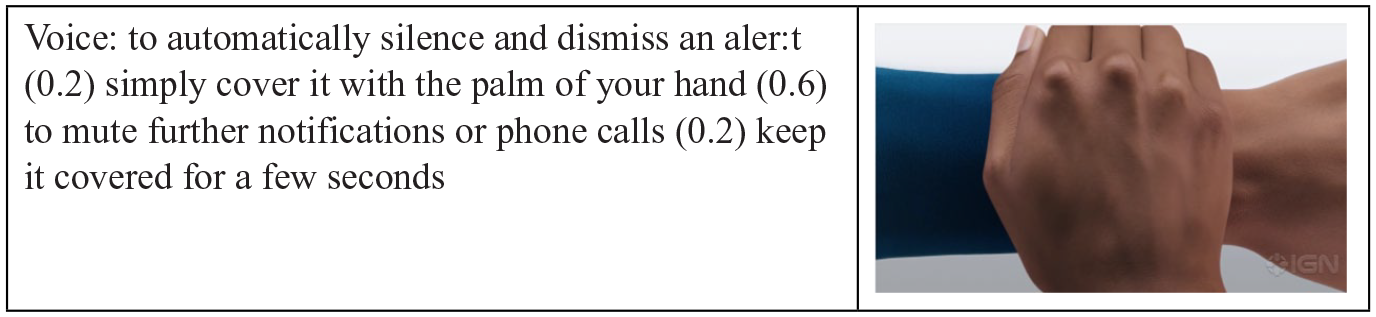
Such meaning includes embarrassment, when a demand for attention interrupts ongoing social interaction – when, for example, the summons extends in time to denote a phone call. We see this propensity in an instruction provided at the end of the video (Figure 2).
The Apple Watch - covering the face.
The meaningful gesture of ‘covering’ and ‘hiding from view’ further aligns body and technology ‘action’ and mimics other body-gesture assemblages, such as covering the mouth, drawn from the cultural history of body technique (Mauss, 1973).
By applying the sensitising metaphor of the dance, the embodied interactional practices of the human and Apple Watch are foregrounded. The metaphor asks that we pay particular attention to the relational and experiential interactions in sequences of movement and sense-making.
The video is a form of embodied instruction. By presenting a simple sequential practice of Watch and human interaction, it proposes a definition of what each move by each partner (human and Watch) means to the other. The video presents a series of ‘dance figures’, ordered sets of movement, action, and mutual corporeality. The video encapsulates a moment of dance tuition.
A haptic and aural action by the Watch indexes a ‘notification’ and summons. It says, this sensation has this meaning. As we will see, this indexical fixity does not hold ‘in real life’. Such moments connect to the ‘cumulation’ and ‘conservation’ of experience of the Watch interaction and the ‘anticipation’ of a set of experiential outcomes.
In raising the wrist, the person is also moving the Watch in a particular way. This simple action would mean nothing (to the Watch) if not for the ability to sense this movement. That is, it would be nothing if the Watch was not ‘following’ the movement with corresponding and complementary movement and understanding, if the Watch was not frame matching. Of course the Watch does not move itself; yet it does not resist the movement by the human.
This notion of resistance might sound like a ridiculous assertion. The Watch is a mere object, manipulated by a human agent. Yet, this is to miss its material ‘affordances’ (Gibson, 1977). The materiality of the Watch includes its size, shape, weight – as well as its physical design – and these allow for its connection and response to human movement. There are reasons why these types of wearables are only now being developed. Only after the miniaturisation and combination of computer components could the Watch have such ‘wearability’. To ascribe agency to the Watch is to take account of its material affordances. We might say, then, that the Watch follows the lead of the human.
The Watch not only follows the lead of the human in this single gesture, it also understands this movement to have particular intent, as manifesting a particular social action in a particular dynamic context. This implicates a set of programmed understandings written into the algorithm affording such understanding.
Raising the arm is understood by the Watch as a response to its summons, and so it produces a next relevant action, which is to switch on the display screen. This turns the notification – and the information it promises – towards a visual mode of perception. No longer does the human feel and hear the Watch, it now sees it. This precipitates a transformation in the sensorial response of the human. That is, it requires the human align their body so as to see the screen, turning the head away from other concerns. Such a requirement immediately implicates the physical and kinetic context. Looking towards, entails looking away, and at particular moments this requires the prioritisation of one visual foci over another.
Only now can we begin to speak about the linguistic and visual content of the display as information. As the screen responds to the human movement, the visual display resolves the ‘summons’ into particular and specific ‘content’ or information. Displaying and reading come together as ‘co-action’, the one entirely entwined with the other. One mode of attention is transformed into another, accomplished through a form of mutual ‘tuning in’ (Schutz, 1951) between human and device. There is a continuity of movement – or more precisely physical stance – in the requirement to maintain a body-device positional alignment. To ‘keep it raised’ is to maintain this embodied frame.
At this point there are a restricted number of possible next ‘moves’. The human can ‘dismiss’ the summons to information – as we see in the video – by employing an embodied sequence that is understood by the machine as a termination of the interaction – a ‘turn final’ action. But there is also the potential for a set of moves or figures that require the recruitment of the person’s other hand in performing a further gesture. We see such a move in the second video element, in that another way to dismiss the screen (and sound, should the notification involve continuing ‘ring’) is to cover the ‘face’ of the watch with the palm of the alternate hand. Again, such a move entails a reprioritisation of body engagement and potential disruptions to the ongoing embodied dynamic. A person driving a car, for example, would have to remove their hand from the steering wheel.
A further set of gestural movements entails physical interaction with the Watch. These interactions have three prescribed formats: touch, turn, and tap and form the next dance ‘figure’. The hand can be employed to touch the screen, turn the circular ‘crown’, or tap the second button on the right side of the Watch. Each of this restricted set of movements will lead to a different sequence of embodied actions and figures. These sequences are also limited, and one could imagine a detailed analysis of their scope and consequence.
We can say then that the Apple Watch is worn next to the skin and the various sensors within the device capture a prescribed set of inter-actions based on the current components and capabilities of the device. These include movement through local spatial field (in the sensing of orientation, speed and direction of the device) and movement across geographical spaces (through GPS positioning). Various ‘biometric’ sensors record heart rate, skin capacity, and the like.
These are the senses of the device, and they are not without their limitations. Any perception of movement and action of the part of human is constructed from such ‘senses’, and an algorithm is deployed to ‘make sense’ of each element (as data) and enact their combination to effect a socially meaningful and socially relevant conclusion.
One might say that such an ensemble of elements is completely hidden from the dance partner. Yet, it is precisely in anticipation of mutual understanding that such reasoning becomes an accountable matter. That is, it is precisely in the anticipation of a meaningful interaction that such mutual regard is reflected upon and reasoned with. The experience of the device accumulates over time and the expectations of meaningful interaction are forged through such histories. Once accommodated, mutual understanding is pursued through routinised figures of dance interaction.
The video presents an initial opportunity to detail and analyse the embodied dance. Using it as a stepping off point, I have extended the account through analogy and reflective reasoning. As noted, the video presents an idealised and abstracted performance of the human–device relationship. Capturing such interactions in everyday life, while not impossible, is far more difficult. However, there is no reason why a set of capture technologies could not be deployed to record such interactions. This would likely entail both visual recording and data extraction from the device.
Just as with the dancing couple, human and device have a continual embodied relationship that rests on mutual attention and intention. It is precisely in this relationship that matters become hidden. Concerns expressed in the literature about the invisible surveillant nature of such devices and the manner in which they affect human behaviour and understanding are seen here. Yet, what the dance metaphor brings is a re-evaluation of such unilateral control. To be clear, I am not proposing that there is no control, and that we should not be concerned with the invisible activities of data devices, rather the metaphor encourages a critical examination of where and when such control occurs and how it is afforded.
Discussion
Helen Thomas (1995) points out that dance escapes the sociological gaze precisely because of its nature:
unlike a painting or a novel, the dance work is never fixed at any one point in space and time but is always in the process of becoming the work itself, from the beginning to the end. In that sense dance each and every dance is unique. (pp. 26–27)
Dance is a process. It resists objectification, and instead demands we attend to its processual and experiential production and performance, what Engel (2008) calls the ‘dance of the now’. Sheets-Johnstone (2015 [1966]) asserts this requires a phenomenological analysis. Yet, the ‘process of becoming’ is a social achievement, especially when we dance together. Capturing and understanding the processual, emergent, and relational aspects requires we attend to the interactional productive performance. The embodied prelinguistic nature of dance escapes easy formulations of symbolic interaction. Bodies moving together, and what Birke and Brandt (2009) call ‘mutual corporeality’, problematises simple notions of individual bodies and individual perceptions (see also Brandt, 2006). Instead, a sociological approach should be concerned with the ordering practices of dance as performance.
Examination of an instructional video began my investigation of the data dance. The video has its own social-material-technical qualities and context. It is a professionally produced video that entails various choreographic elements, not least in its production and editing (Pearlman, 2009). Yet, it is a decontextualised display of the functionality of the Watch. It removes such context precisely to engender a pedagogic interaction. As such, it is akin to dance tuition.
The video presented the writer with an opportunity to detail and analyse the embodied dance, and to evidence the utility of the metaphor. The example of the wearable Apple Watch was developed in terms of the dance metaphor. The advantage of such a move is that it brings out and capitalises on the ‘dance of agencies’ purported by Pickering, and the ‘rhythmic dance of aesthetic experience’ of Wright and McCarthy. I do not merely state such dances, but pursue through dance theory–inspired interaction analysis, the power relationships inherent within the dance.
The metaphor draws our analytic attention to the sensual and interactional, the material and relational. So often such features of our relationship with technology, while evoked by concept and theory, are never addressed empirically. This is inadequate. If theory does not lead to analysis, then what is its purpose? It becomes a conversation between theorists as Blumer points out. Such sensual and relational features are available (in part) through the technology-produced data to hand. This sits with Marres’ (2017) formulation of ‘digital sociology’ as implicated in technology relations and ‘social-material-technical’ practice.
The dance with data in wearable performances brings us to a realisation of the dynamic, fluid, momentary, yet engaged, dialogic, and focused nature of information interaction. It is not simply ‘wearables’ that are implicated. The recent enthusiasm for driverless cars is a pertinent example. Here, power and control, and the lead and follow roles, are implicated in potential failed performances – seen in high-profile instances of crashes. Indeed, as social life becomes more and more entwined with the algorithmic agencies of code, such dances will proliferate.
Conclusion
This article has developed and deepened the playful and provocative metaphor of ballroom dance as a means to bridge the gap between theoretical and empirical approaches to data. Data and information become entwined in social-material-technical practices of sense-making and interaction in the embodied (digital) movements of people and devices. Quite what we mean by data, its agentic qualities, and the manner in which devices and systems become part of everyday experiences are problematised by the metaphor and its insistence on a focus on the embodied, processual, and interactive. The metaphor, therefore, is itself performative in a methodological sense and critical, where criticality entails a form of mimesis, poiesis, and kinesis. Such a move promises further development, especially in our understanding of data as representational and objective. It also opens up issue of power and interaction. It is in the interactional that we deploy the metaphor analytically, in asking how and in what ways the dance occurs in ongoing matters. Clearly other authors have not taken the metaphor of dance in such a direction.
While I have focused on data relationships in everyday practices, and the metaphor of dance could be extended to a wide range of emerging (and existing) data relationships, there is also opportunity to apply the metaphor to the analysis itself. Marres’ formulation of digital sociology as already implicated in social-material-technical relations brings a much-needed reflexivity to the full range of sociological analytic practices, but especially those oriented to technology relations. The performative turn must involve sociological practice as well. There is then a reflexive imperative in the application of the metaphor. It is not only people out there that dance with data, it is also people in here.
This article has used the metaphor of dance in two ways. First, as a methodological spur to think differently about contemporary human-data-device relationships, and second, as a means to engender a form of close analysis of embodied mutual experience through close analysis of moments and sequences of interaction, where action and hence actor relates to the human and the technology. It is intended as an initial exploration of this space that acts as foundation for the development of concept and method in the future.
Footnotes
Funding
The author(s) received no financial support for the research, authorship, and/or publication of this article.
