




Abstract
European citizens continue to engage in solidarity activities in support of vulnerable groups within and beyond their own countries. Many of these organised practices of transnational solidarity provide research with important insights into the features and conditions of organisational forms of support. This article makes use of a unique dataset of transnational solidarity organisations in eight European countries during a period of economic recession and immigration crisis, and aims to empirically describe the different forms and types of solidarity prevalent within three different organisational sectors. It strives to identify the organisational features explaining the elective affinities between organisational forms and solidarity approaches. The empirical analysis validates that organisational traits and types matter when favouring vertical and/or horizontal forms of support towards vulnerable groups. Findings corroborate the relevance of professionalisation, aims, and values, in addition to action repertoires to explain organisational profiles and collective approaches to solidarity-based practices.
Keywords
Introduction
Solidarity is one of the recurrent missions of social movements and civil society organisations. Helping the needy, raising voices for the forgotten, and claiming rights for the excluded are activities undertaken by many citizens’ organisations and groups. In an age of increasing immigration and economic distress, solidarity is a crucial component of their oratory and activism (Giugni and Passy, 2001; Smith et al., 1997). Due to the importance of solidarity as a mission and ingredient of collective action (Diani, 1992), scholars of social movements have studied solidarity across the local, national, and global level (Baglioni, 2001; Eterovic and Smith, 2001; Hunt and Benford, 2004; Smith, 2002). Although many of these groups and organisations have a long history and have received attention by scholars (Ataç et al., 2016; Davies, 2016; Hande and Christine, 2015; McCallum, 2013; Soldatic and Grech, 2014), there is a lack of up-to-date empirical, systematic, and cross-national studies addressing solidarity activism. Previous research has recurrently stated that civic engagement and political protests are strongly linked to solidarity (Ataç et al., 2016; Giugni and Passy, 2001; Hunt and Benford, 2004; Smith et al., 1997); however, solidarity has rarely moved to the centre stage of analysis, and when it has done so, its focus remained within national boundaries.
This article engages in a systematic analysis of citizen groups and organisations committed to transnational solidarity in terms of activities, beneficiaries, supporters, volunteers, collaborators, and/or frames. It is devoted to two main research questions. First, we wish to unravel which kind of ‘solidarity’ approaches are prevalent in social movement and civil society organisations across the sectors of unemployment, disability, and immigration. According to our understanding, solidarity is an active relation of support towards target groups undertaken by nonstate, nonparty, civil society support organisations. These relations can entail vertical interactions of unilateral support between donors and beneficiaries, or horizontal relations of mutual support between equal associates. We assume that transnational solidarity organisations (TSOs) diverge with respect to the organisational relationships between beneficiaries and associates. Our empirical analyses will assert which solidarity approaches are diffused concerning sectors and countries. Second, we wish to better understand the organisational factors associated with the specific solidarity approaches proclaimed by TSOs. Given that our analysis is interested in organised forms of collective action, we assume that the prevalence of specific solidarity approaches is interdependent with the organisational traits of the groups and initiatives involved in the various sectors of activities. Thus, we identify and test a series of hypotheses aimed at validating the importance of organisational features (action repertoires, cultural and ideational orientations) and the elective affinities between organisational profiles (nongovernmental organisations (NGOs), charities, unions, and grassroots initiatives) regarding solidarity approaches.
Previous studies show that ‘organisation’ is an important factor when analysing collective action because organisations are necessary to translate latent grievances and discontents into actual activities (Diani and Donati, 1999; McCarthy and Zald, 1977). ‘Organisation’ thus matters in terms of effectivity. The analysis of civil societies and nonprofit sectors has added insights by highlighting that ‘organisation’ is also tied to specific ways of organising tasks and activities along shared norms, rules, and myths (DiMaggio, 1987; Powell and Steinberg, 2006). Thus, ‘organisation’ also matters in terms of legitimacy. Following these perspectives, our study seeks to understand whether the choice of specific organisational pattern has implications for the type of solidarity approach citizen groups proclaim. Using the analytical tool of solidarity approaches as a quasi-behavioural measure informing us about the approach of the various relations of support (vertically or horizontally) linking organisations, groups, and individuals, we delve into the elective affinities between organisational forms and solidarity approaches.
The analyses will make use of a dataset comprising information on TSOs from eight countries (Denmark, France, Germany, Greece, Italy, Poland, Switzerland, and the UK) and three sectors of activity (migration, unemployment, and disabilities). Our aim is not to delve into the impact of different contexts (countries or sectors) on organised solidarity action, but to ascertain the role of organisational features and profiles across issue sectors and countries. By engaging in a cross-sectoral and cross-national analysis, we seek to corroborate whether ‘organisation’ matters when citizens enact solidarity in its various approaches, irrespective of where the group is located and at whom support activities are directed.
Previous research, concepts, and research hypotheses
The analysis of organised solidarity can build on a wide, albeit fragmented field of research. A first strand of study focuses on civil society and is mainly interested in those citizen groups and organisations engaged in the production and safeguarding of common or public goods by means of voluntary, nonprofit, and cooperative work. These organisations are distinguished from state actors as well as market actors (Rifkin, 1995; Salamon and Anheier, 1995) because they deliver services and goods on a voluntary and nonprofit basis, through cooperatives, mutualisms, shared economies, and others (Laville and Nyssens, 2000; Moulaert and Ailenei, 2005). A second strand of research resides in the analysis of social movements (Diani, 1992; McCarthy and Zald, 1977), focusing on citizen groups and organisations, too, but showing particular interest in more contentious forms of civic engagement. They thus centre on a subsector of initiatives and organisations tied to contentious issues, engaged in political advocacy and protest actions (Gerlach, 1999; Kriesi, 1996). These two strands of research have evolved separately, but are relevant sources of knowledge and inspiration because borders between organisational sectors and forms of activism are fluid. More than that, research has argued that many organisations exhibit hybrid forms of organisation and collective action, given that they engage in service provision and political advocacy, and rely on volunteering and paid staff alike (Baglioni and Giugni, 2014; Minkoff, 2002). Studies furthermore acknowledge that the groups and organisations also espouse hybridity by merging aspects of nonprofits, business, and/or public entities (Battilana and Lee, 2014; Brandsen and Karré, 2011).
Both strands of research are important references for our study, offering valuable insights into the two basic cornerstones of our analysis: ‘solidarity’ and ‘organisation’. With respect to ‘solidarity’, both strands of research have highlighted different aspects of what we conceive to be the core features of solidarity. Our understanding of solidarity is the disposition and practice of support towards others (Bayertz, 1999; Stjernø, 2012: 88) However, solidarity transcends relations of care and altruism because it is grounded in group-bound rights and obligation (Scholz, 2008). Solidarity builds (implicitly and/or explicitly) on the notion of rights because it stipulates that people can expect to be helped, and solidarity entails an (implicit and/or explicit) notion of obligations because people are expected to help each other. In this sense, solidarity merges a civic and political dimension, given that the provision of (charitable) help to others is tied to (political) demands requiring the recognition of (citizens’ and/or human) rights.
The study of civil society and social movement organisations has been interested in the specific manifestations of solidarity. They have identified, on one hand, a more vertical (top-down) approach of social activities, concerning voluntary and nonprofit organisations providing services and goods to target groups in need (Baglioni and Giugni, 2014; Salamon and Anheier, 1995). Very often, this approach is connected to a philanthropic, charitable mission of helping others and supporting local communities. On the other hand, studies also have focused on solidarity organisations committed to a more horizontal approach that privileges cooperation between equals, highlights reciprocity and mutualism, and promotes a political notion of solidarity (Hunt and Benford, 2004), claiming the need to empower citizens, local communities, or the larger public and enabling them to claim and enforce their rights on their own. Scholars have highlighted that these approaches are associated with different organisations: either formalised NGOs, which are very often larger, centralised, and highly professionalised entities with a wider scope of activities, or community organisations, usually smaller, informal, and independent entities anchored at the local level (Moulaert and Ailenei, 2005; also Baglioni and Giugni, 2014).
With respect to ‘organisation’, previous studies have been highly interested in the organisational forms of collective citizen action. Following the resource mobilisation theory, collective (protest) action requires ‘organisation’ and organisational entrepreneurship to stimulate and stabilise citizens’ involvement (Cress and Snow, 1996; Gerlach, 1999; McCarthy and Zald, 1977). Thus, solidarity activities in the public sphere are to some degree ‘organised’ or facilitated by ‘organisations’, even though the types of organisations involved can vary (Kriesi, 1996; McCarthy, 1996). The relevant argument for our analysis is the assumption that ‘organisation’ refers to different forms of ‘organising’ collective action. These choices are not without consequences because they strongly pattern the way in which collective action is stimulated, formed, and stabilised. In broad terms, two opposing strategies and forms of organisation have been identified (Gamson and Schmeidler, 1984). On one hand, there are formalised, centralised, professionalised, and bureaucratic organisations, on the other hand, a more loosely organised network of informal and decentralised local actions (Gerlach, 1999). More often than not, differences between these groups are tied not only to organisational structures but also to action repertoires and collective identities, given that they tend to be strongly committed to service provision or political advocacy, philanthropic or political values, and missions.
These theoretical reflections help us to identify three hypotheses to be tested in the following empirical analysis. The first hypothesis takes up a long-standing research debate within social movement studies and argues that organisational choices have important consequences for the type of solidarity approaches citizen groups promote. Following an early controversy, we assume that formal organisations will have a negative impact on contentious protest activities (Piven and Cloward, 1979) by exposing social movements to Michels’ iron law of oligarchy (e.g. Kandlik Eltanani, 2016). Resource mobilisation theorists have argued that processes of formalisation, centralisation, and professionalisation will lead to an institutionalisation of social movements, at the expense of citizen-driven protest activities. However, they are convinced that other forms of ‘organisation’ of collective action have developed as well. These organisational patterns are less formalised and professionalised, and thus allow for a more decentralised grassroots-driven structure of protest activities, even among the most deprived (Cress and Snow, 1996; Gerlach, 1999). According to Diani and Donati (1999), four organisational types – from participatory protest to public interest lobby organisations – result from different organisational models and action forms. Following these insights, it is very likely that organisational structures will privilege certain types of solidarity. Formalised and professionalised organisations should promote a vertical solidarity approach, given the entrepreneurial role of a professionalised and paid staff, and given the more centralised and formalised relations between staff, members, and/or beneficiaries. Informal, less professionalised grassroots organisations should privilege a more horizontal approach strongly committed to reciprocity and mutualism, given that organisational activities depend on the ability to mobilise resources from their participants.
According to these reflections, we thus hypothesise that there should be an elective affinity between solidarity approaches and organisational structures: strongly formalised and professionalised organisations will lean towards the vertical approach of altruistic solidarity, while the more informal and less professionalised groups will be more likely to promote a horizontal solidarity of mutualism. In empirical terms, we assume that this distinction should be measurable when comparing different degrees of professionalism and formalisation:
Most findings provided by the early resource mobilisation theory support this by stressing the importance of (organisational) resources for the mobilisation and coordination of collective protest actions (Diani and Donati, 1999; McCarthy and Zald, 1977).
This hypothesis might be addressing the obvious, given that professionally led organisations should most likely follow a different logic of action than volunteer-led groups. Still, this explanation needs to be empirically checked. There seems to be evidence for an elective affinity, given that formal structures and professionalised staff are effective forms of organising ‘vertical’ support activities for the needy, while informal structures and a lack of specialised staff are effective in organising horizontal support activities and joint actions. However, different solidarity approaches might be compatible with diverse organisational structures, particularly if we consider the possibility of hybrid combinations, both in regard to solidarity approaches and organisational patterns.
In addition, based on sociological neo-institutionalism, legitimacy is an important ‘resource’; organisations need to subsist within competitive organisational sectors, also in view of the state, professions, and the general public (Powell and DiMaggio, 1991). This applies in particular to social movement and civil society organisations, which depend strongly on their credibility, trustworthiness, and legitimacy, given their dependence on public funding and/or the recruitment of volunteers, donations, and other forms of public support. The relevance of legitimacy puts the organisational mission at the centre stage, but also the choice of organisational means to reach these ends (Stryker, 2000). Credibility, trustworthiness, and public acceptance might be eroded, when organisational means contradict organisational missions. Thus, the focus of research is on the organisations’ legitimate ends and their acceptable means, which is also echoed by social movement analysis showing the importance of shared collective identities and values for the arousal and stabilisation of collective action. The idea of solidarity is particularly tied to such a shared vision because activism and constituency groups (beneficiaries or/and participants) are assumed to be part of a collective ‘we’, held together by relations of interdependency, mutual support, and reciprocity (Diani, 1992; Hunt and Benford, 2004; Smith, 2002; Waterman, 2001). Therefore, we expect that ‘organisation’ becomes a highly contested element conforming to the shared identities, norms, and values of those adhering to the group.
Following these insights, we are able to formulate a second hypothesis, according to which the likelihood of opting for a solidarity approach will be determined by the organisations’ aims and values. Solidarity approaches demarcate the type of relations which organisations and constituency groups maintain in behavioural terms, in the form of hierarchical and unilateral relations of help (vertical solidarity), or in the form of mutual relations between equals (horizontal solidarity). Aims and values will most probably have an effect on the choice of solidarity approach because the former might inspire organisations to make specific choices in the way they relate to their beneficiaries and counterparts. Therefore, we also assume elective affinities as the following:
In both cases, we expect that certain aims and values lead and justify the choice of specific solidarity approaches, while concurrently discrediting others. Vertical solidarity relations are easier to justify in regard to humanitarian values and policy reform aims, than with a mission devoted to social change and empowerment. However, empirical tests might demonstrate that solidarity approaches are less dependent on organisational aims and values, possibly because solidarity relations might be less constrained by the ideas, identities, and oratories of the organisation, and more tied back to specific activities.
Finally, based on previous studies, we highlight that social movements and civil societies are primarily defined by what they do. Recent research shows that organisations are often involved in very different activities, for instance, protest groups complement contentious actions (e.g. demonstrations, strikes, and boycotts) with activities of social support concerning urgent/basic needs related to health, food, housing, and social solidarity economy initiatives (Baglioni and Giugni, 2014; Bosi and Zamponi, 2020). However, protest analysis has shown that historically speaking, social movements have developed and adapted action repertoires (Rucht, 1990; Tilly, 2002) that have patterned their protest activities across time and space. The formation of citizen groups and organisational fields is thus strongly driven by their action repertoires. Consequently, we expect the specific activities conducted by citizen groups or organisations to be decisive sources from which their solidarity approaches emerge. Vertical solidarity should be more diffused among organisations whose preferred activism is dominated by goods provision to meet urgent needs. Horizontal solidarity should be more diffused among groups centred more strongly on collective protest actions. In empirical terms, different action repertoires should help to explain the diffusion of solidarity approaches:
Data and methods
The aggregate dataset of this study comprises information from eight countries and three issue sectors. The selection of countries and issue sectors was guided by a most dissimilar case approach that strove to consider diverse contexts. Countries were selected to include different socio-economic hardships (i.e. exposure to the Eurozone and refugee crisis), diverse systems of institutionalised solidarity (e.g. universalist, Bismarckian, residual welfare regimes), and diverging prevalence of civil society engagement and volunteering. Issue sectors were selected to spot target groups exposed to a different degree of conditionality, following Van Oorschot’s (2000) findings, ranging from disabilities to refugees. In this article, we check whether organisational traits are a pervasive predictor of solidarity cross-sectorally and cross-nationally within a variety of cases grouped in country sectors.
The data were produced through Action Organisation Analysis (ΑΟΑ), a new approach with foundations on protest event analysis (e.g. Tilly, 2002) aiming towards a comprehensive and systematic study of the sector of civil society activism, using hubs-retrieved organisational websites as sources of information (Kousis et al., 2018). The unit of analysis is the transnational solidarity initiative/organisation (TSO), a specific formal or informal group of initiators/organisers acting in the public sphere through solidarity events with visible beneficiaries and claims on their economic and social wellbeing. The unit of observation is the TSO website, systematically extracted from hubs/subhubs – that is, networks/nodes of similar websites. The hubs/subhubs selected for each country provide large numbers of links to solidarity organisations’ websites, retrieved via search engines. Based on a ‘population’ of 29,277 organisational websites, 300 TSOs were randomly selected, cleaned, and coded per country (reaching a total sample of 2408 TSOs, active during the period 2007–2016). The nodal websites were used as content sources similarly to high-circulation national newspapers in protest event or political claims analysis. We also incorporated social media outlets connected to the TSO websites, such as their Facebook pages or Twitter profiles (see TransSOL, 2016).
This new approach traces TSO features focused on transnational and solidarity-oriented organisational forms within three sectors: migration, unemployment, and disability. State, EU, or corporate organisations were excluded. The selected organisational websites fulfilled two criteria. First, they were ‘transnational’ if the TSOs following organisational traits transcended their own country in at least one further nation state: organisers/organisational entities, actions/activities, beneficiaries/participants, supporters, partners/collaborating groups, sponsors, volunteers, spatial scope, and value frames.
Second, TSOs were selected as long as they conformed to at least one of the following categories:
Mutual help/mobilising or collaborating for common interests (bottom-up); solidarity exchanges within a group or organisation, oriented towards self-help, or mobilising and collaborating for the promotion of common interests at the grassroots level.
Support/assistance within similar groups, offering support or/and assistance between groups.
Help/offer support to others in vulnerable situations or seeking alternatives within an altruistic manner to provide services and support to others.
Distribution of goods providing solidarity (top-down), reflected in a philanthropic approach for the distribution of goods and services to others.
This classification is used to measure four dependent variables, namely, solidarity relations. For each of these solidarity approaches, we have a dichotomous variable that describes the TSOs’ solidarity approach (1 ‘Applicable’ 0 ‘Not applicable’). Multiple answers were possible, suggesting that TSOs could be committed to various forms of solidarity. So, we control for the correlation of the other three remaining solidarity relations when modelling each solidarity approach.
To test the hypothesis formulated before, we operationalised the various predictors by identifying the following organisational traits as independent variables. First, we created two measures for the formalisation and the degree of professionalisation of the organisations. We based our measures, using principal component analysis (PCA), on the organisations’ structural traits; the two main components account for 45% of the variance of the organisations’ structural traits (detailed information and factor loadings in annexes). Formalised organisations comprise the following three structural traits: written constitution, general assembly or general body, and board-appointed or elected supervisory board (dichotomous variable, 0 ‘less than three structural traits’, 1 ‘all three structural traits’). The degree of professionalisation is a standardised and additive scale of the following six structural traits: a president or CEO, a secretary or administrative assistant, a treasurer, paid staff, trustees, a spokesperson or media representative, and specialised committees (range 0–1). Highly professionalised groups are in the higher score range.
Second, we identified a number of variables that measure the organisations’ missions, beliefs, and values, to examine the choice of organisational means to reach the organisational aims, which also justify and legitimise its actions. Using the coding of the organisational missions, we examined the TSOs’ proposed routes to reach their organisational aims. Subsequently, from a battery of 16 binary variables used to describe the various organisational routes to achieve aims, we focused on and formed two binary variables to measure organisational routes to aims, as reform-oriented routes versus routes oriented towards social change. The first consisted of system reforms, aiming to bring policy change in various areas, ranging from family/children to migration and labour, while the other aimed to change the government, the system, or establishment and centered on collective protest. Categories for the reform-oriented covariate refer to 0 ‘no use of reform-oriented routes to attain aims’ and 1 ‘use of one or more reform-oriented routes to attain aims’; categories for the social change–oriented covariate refer to 0 ‘no use of anti-establishment routes to attain aims’ and 1 ‘use of one or more anti-establishment routes to attain aims’. Subsequently with respect to the stated organisational values, we made use of information on the core principles on which the activities and missions of TSOs are based. From the list of potential values, we grouped the items into three binary variables that provide a picture of the breadth of different values: (1) humanitarian and philanthropic values (e.g. altruism, dignity, voluntarism, inclusiveness), (2) rights-based values (e.g. human rights, equality, civil liberties, fairness, or social justice), and (3) empowerment (e.g. community building, individual empowerment, participation, emancipation, multiculturalism, or internationalism). Each of these three variables was coded as dichotomous (e.g. rights-based values variable: 0 ‘no rights-based core principle was stated’ and 1 ‘at least one rights-based core principle was stated’).
Third, our final theoretical assumption pointed out that solidarity approaches might be conditioned by the TSOs’ action repertoire. Our dataset provided nuanced information on this aspect, given that coders were asked to extract information on all activities described on the TSOs’ websites. Our classification comprised 11 different groups of activities, from which we selected and grouped the following 6 main activities: urgent needs (e.g. provisions of shelter, food, health, clothing, education, emergency relief), preventing hate crime, economic activities (e.g. job opportunities, training programmes, financial support, fundraising, secondhand shops), dissemination in the public sphere, culture (arts, theatre, music, sports), and lobbying. In addition, we computed a variable that identified TSOs using protest-related activities as supplementary action repertoire (i.e. demonstrative or confrontative forms of protest actions: demonstrations, boycotts, strikes, or road blockades). Likewise, we developed and included a measure of the transnationalism of the activities, assuming that transnational actions might promote or influence horizontal and vertical solidarity approaches. For this purpose, we made use of information on those organisations that have a transnational scope of activities (i.e. via activities in at least one other country) and created a binary variable to measure whether TSOs engage transnationally (1) or not (0).
Finally, following the study of our three major theoretical assumptions, we also confronted our theoretical stand against previous literature on organisational forms and their expected elective affinity with solidarity approaches. This translates to a more practical and integrated picture of our assumptions, which allows us to identify the organisational profiles that covariate more strongly with each solidarity approach, under control of the organisational traits and TSOs’ degree of transnationalism. For this purpose, we identify four dominant and mutually exclusive organisational profiles across groups and sectors: (1) informal solidarity groups and grassroots, (2) unions, (3) NGOs and professional associations, and (4) charity and religious organisations. These four profiles were constructed and regressed as four dichotomous profile variables.
To test our hypotheses and to account for the hierarchical structure of the data, we used a random intercept multilevel model. Concretely, we built four multilevel logistic regressions whose upper level combines and clusters observations by country and sector. As we have eight countries and three sectors, our models are regressed on 24 upper level groups with at least 100 observations each (lower level). Level 1 observations correspond to the coded organisational features, with no explanatory predictors at level 2.
Findings
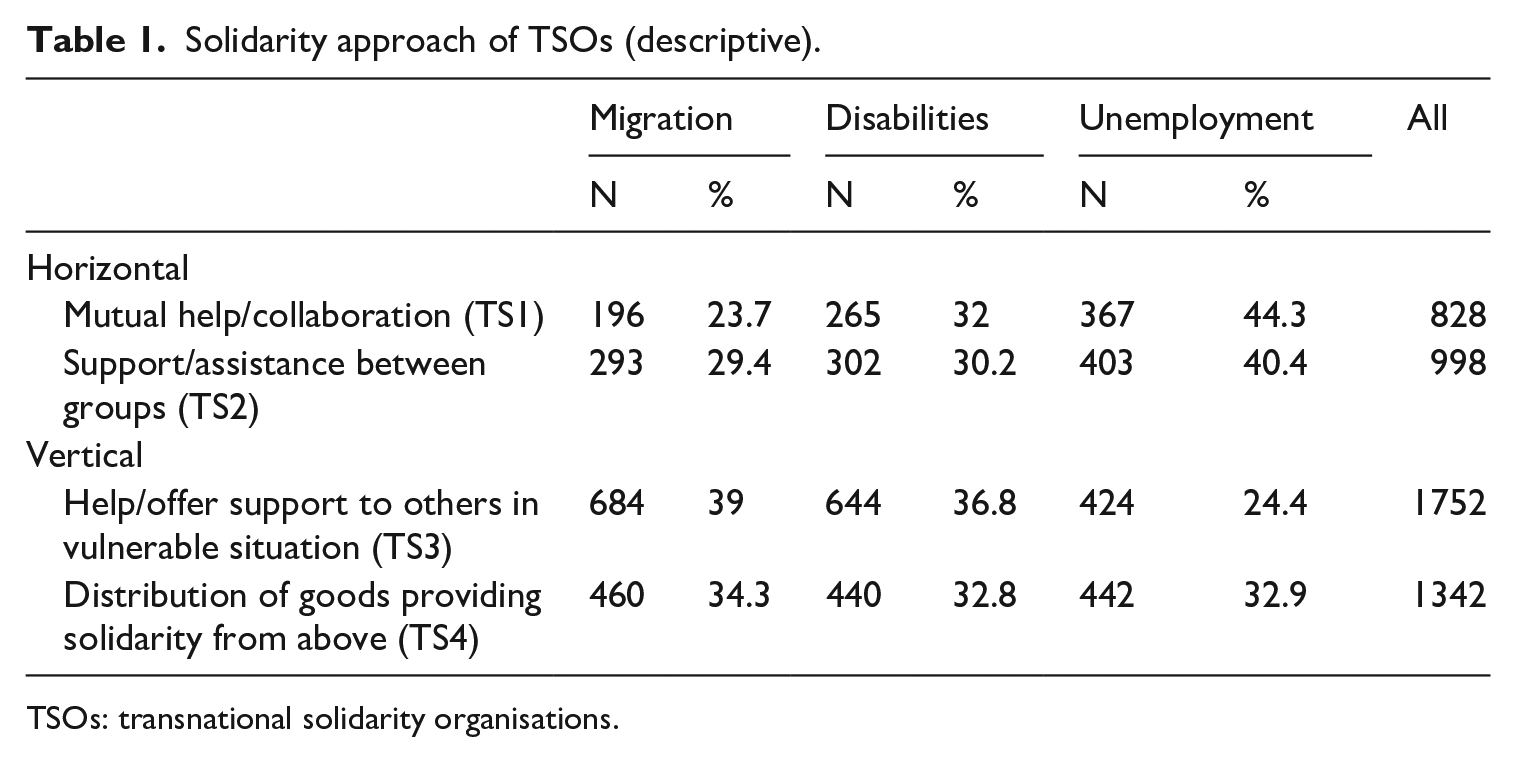
Descriptive findings show that we can distinguish between vertical (top-down) solidarity relations that put an emphasis on the unilateral support of specific (vulnerable) groups, and horizontal solidarity relations that privilege mutual support, either by mobilising and collaborating for common interests or by exchanging support between groups. As shown in Table 1, vertical solidarity is strongly diffused with more than 1300 and 1700 TSOs engaging in top-down forms of solidarity, while horizontal forms of solidarity are less common. Nevertheless, sector differences stand out: horizontal solidarity is more diffused in the unemployment sector, while vertical solidarity is prevalent in the migration sector, with a more even distribution between solidarity approaches existing in the disability sector.
Solidarity approach of TSOs (descriptive).
TSOs: transnational solidarity organisations.
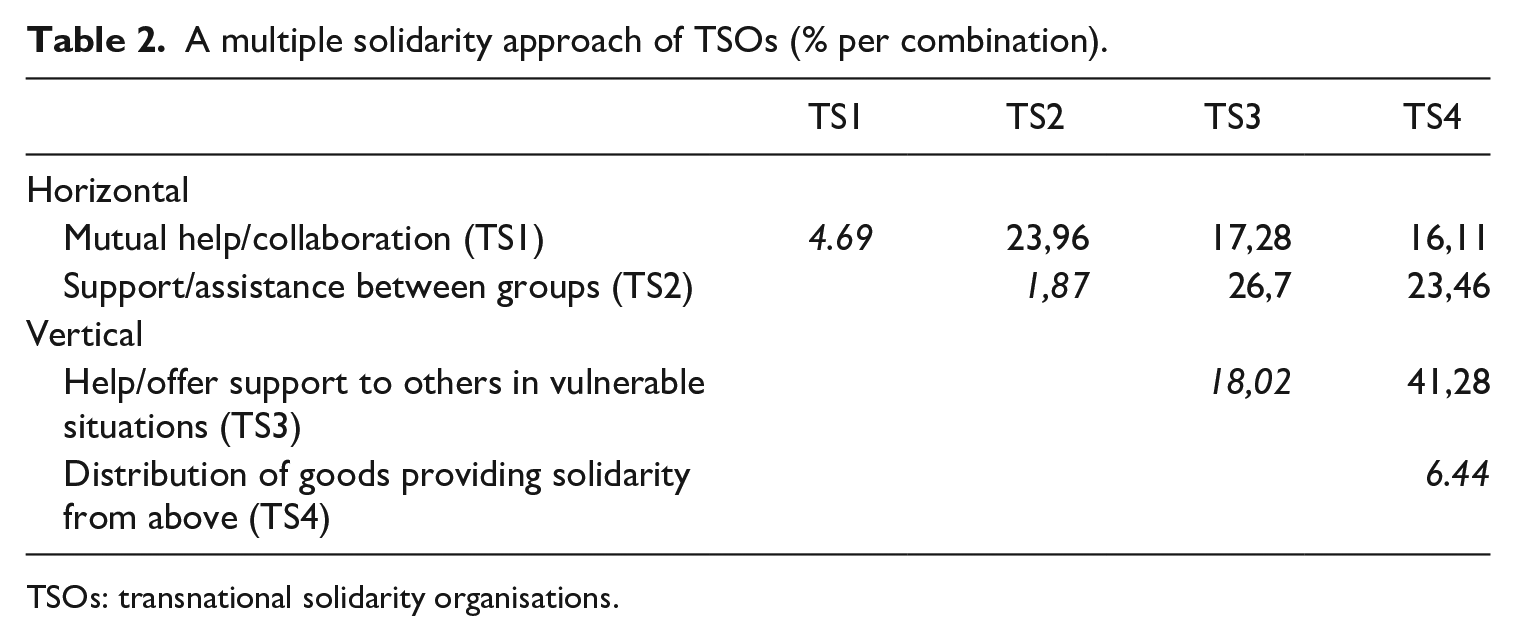
TSOs may follow various solidarity approaches. Table 2 shows pairs between solidarity approaches and the percentage of TSOs committed to a solo solidarity approach (numbers in italics). The biggest groups consist of organisations that engage in both types of vertical solidarity support (41.28%). Also the two horizontal types are quite diffused; almost every fourth TSO is devoted to the idea of mutualism in one of its two variants. However, some TSOs mixed solidarity types, in particular, the reciprocal support between groups (TS2) with vertical approaches to solidarity (TS3 and TS4).
A multiple solidarity approach of TSOs (% per combination).
TSOs: transnational solidarity organisations.
These findings offer initial indications that civic groups and organisations tend to separate into different segments with differing solidarity approaches, depending on whether they proclaim a rather vertical or horizontal approach to solidarity. However, the separation is far from being clear-cut, given the substantial proportion of TSOs promoting both types. Are these differentiations between organised solidarity forms due to the organisational patterns and traits of the TSOs active in these areas? To test our hypotheses, we included the independent variables presented in the previous section, in a multilevel logistic regression model. Table 1A (see Online Appendix) presents results for the full model, with all independent variables for each solidarity approach. The tables include odds ratios (with robust standard errors), as well as goodness-of-fit statistics. In logistic regression, we use the odds ratio to compare the odds of the outcome event (in this case, enacting within a solidarity approach). The odds correspond to a constant change across one-unit values of the predictors, where the ratio stays constant independently of the value of x.
General findings: covariation between solidarity approach and predictors
A full picture of the regression models suggests that TSOs privileging vertical solidarity appear more professionalised and transnationally engaged in unilateral philanthropic activities related to service provision from above (e.g. urgent needs), while its covariations with political activities (lobby or protest) are statistically insignificant (see Figure 1). In contrast, more politically oriented TSOs, governed by ideals of cooperation, reciprocity, and mutualism, in addition to transformatory political aims and values (social change and empowerment) covary positively with horizontal solidarity (see Figure 2). More specifically, mutual help solidarity (TS1) positively relates to values of empowerment and social change and to political activities (lobby or protest), while policy reform aims and protesting are statistically significant and correlate positively to solidarity of support and collaboration between groups (TS2; Table 1A, Online Appendix).
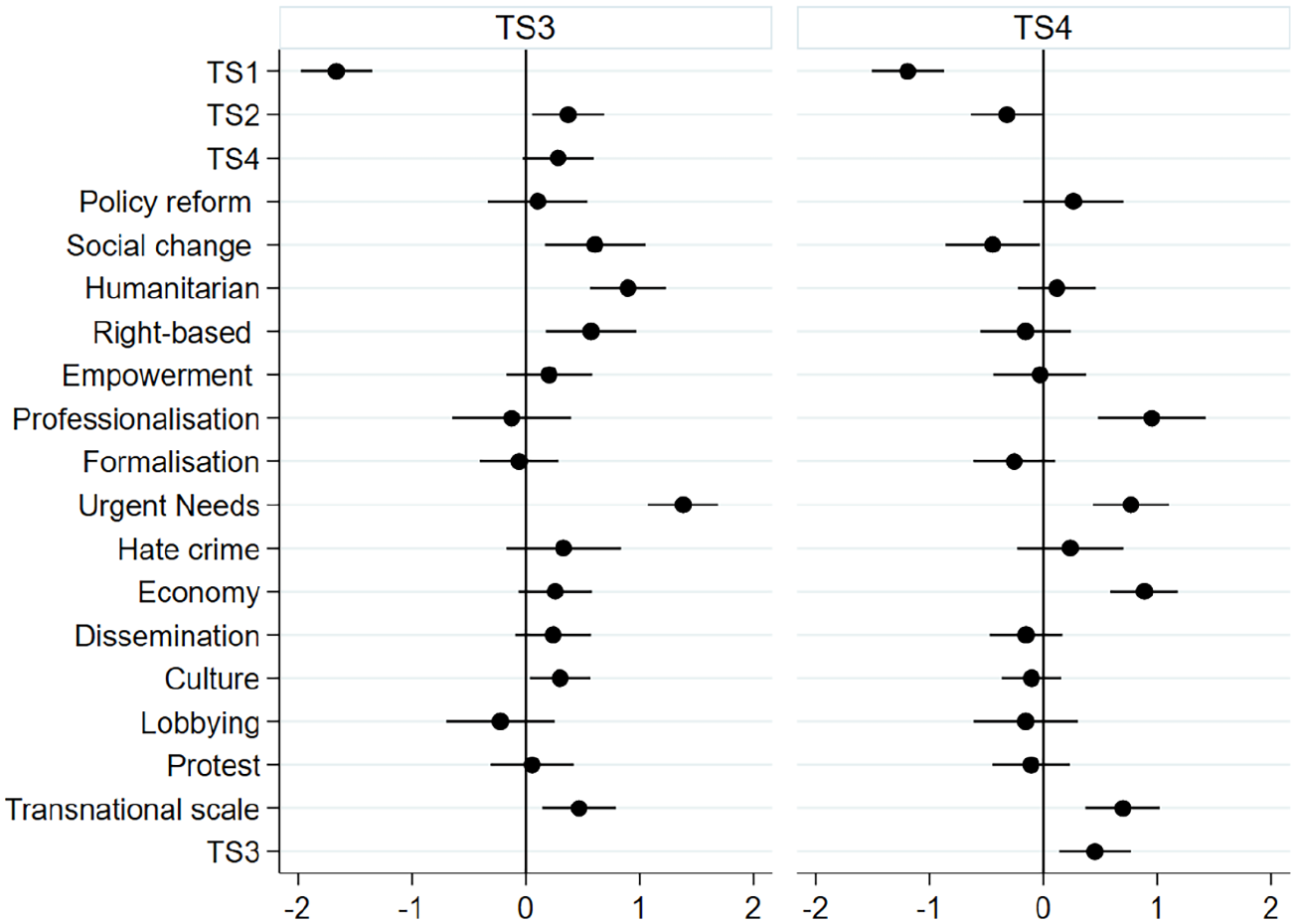
Predictors’ average marginal effects on vertical forms of organisational solidarity: Altruistic (TS3) and philanthropic (TS4).

Predictors’ average marginal effects on horizontal forms of organisational solidarity: Mutual help (TS1) and support and collaboration between groups (TS2).
Likewise, a deeper look into the other coded value frames shows that rights-based and humanitarian values are only relevant to explain vertical forms of solidarity related to altruistic support and provision of services and goods (TS3), while philanthropic forms of solidarity (TS4) correlate negatively to social change aims. Therefore, solidarity approaches are interrelated with organisational activities and covary with organisational ends – in terms of the organisations’ aims and values promoting either more political- or humanitarian-oriented goals. These first results of the positive relations between organisational engagement and values suggest a humanitarian versus political divide between organisations and their elective solidarity approach.
Analysis of the covariation between solidarity approaches and organisational traits, practices, and aims
With respect to H1, we assumed a positive relation between the high degrees of professionalisation and formalisation vis-à-vis the diffusion of vertical solidarity approach, while decreasing horizontal organisation solidarity approach across TSOs (H1). Concerning H1, we can only confirm the professionalisation criteria but cannot confirm the formalisation one; Table 1A (see Online Appendix) presents mixed and insignificant results on the formalisation trait. Formalisation is thus less able to differentiate between solidarity approaches, which might be due to the fact that even less formalised groups and organisations exhibit some degree of formalisation (e.g. in terms of written constitutions, assembled bodies, or boards). Thus, we suggest that by providing services, goods, and support to others, these organisations need channels for the effective accomplishment of these solidarity practices, requiring some degree of formalisation, which results in some minimal structuring features. In addition, literature has also shown that civic organisations in sectors, such as unemployment, have been taking a subsidiary welfare role, influencing their formal structures (Baglioni and Giugni, 2014). These findings point out that organisational practices also shape organisational traits.
In contrast to formalisation, the degree of professionalisation is extremely relevant to differentiate between solidarity approaches. Figure 3 shows an inverse relation between philanthropic vertical solidarity and horizontal solidarity related to cooperation, mutualism, and reciprocity, vis-à-vis professionalism. Highly professionalised organisational forms increase the predicted probability of engaging in a philanthropic service-oriented solidarity by 20%, while they decrease the predicted probability of engaging in horizontal mutual help solidarity by almost 15%. The degree of organisational professionalisation advances that professionalised organisations tend to engage in vertical solidarity approaches. Their degree of professionalisation is likely to be the result of the entrepreneurial role translated into professionalised and paid staff, and more centralised and sectorial relations between staff, members, and/or beneficiaries. In contrast, less professionalised organisations privilege a horizontal approach to solidarity and are strongly committed to reciprocity and mutualism, given that organisational activities also depend on the ability to mobilise internal members and their resources.
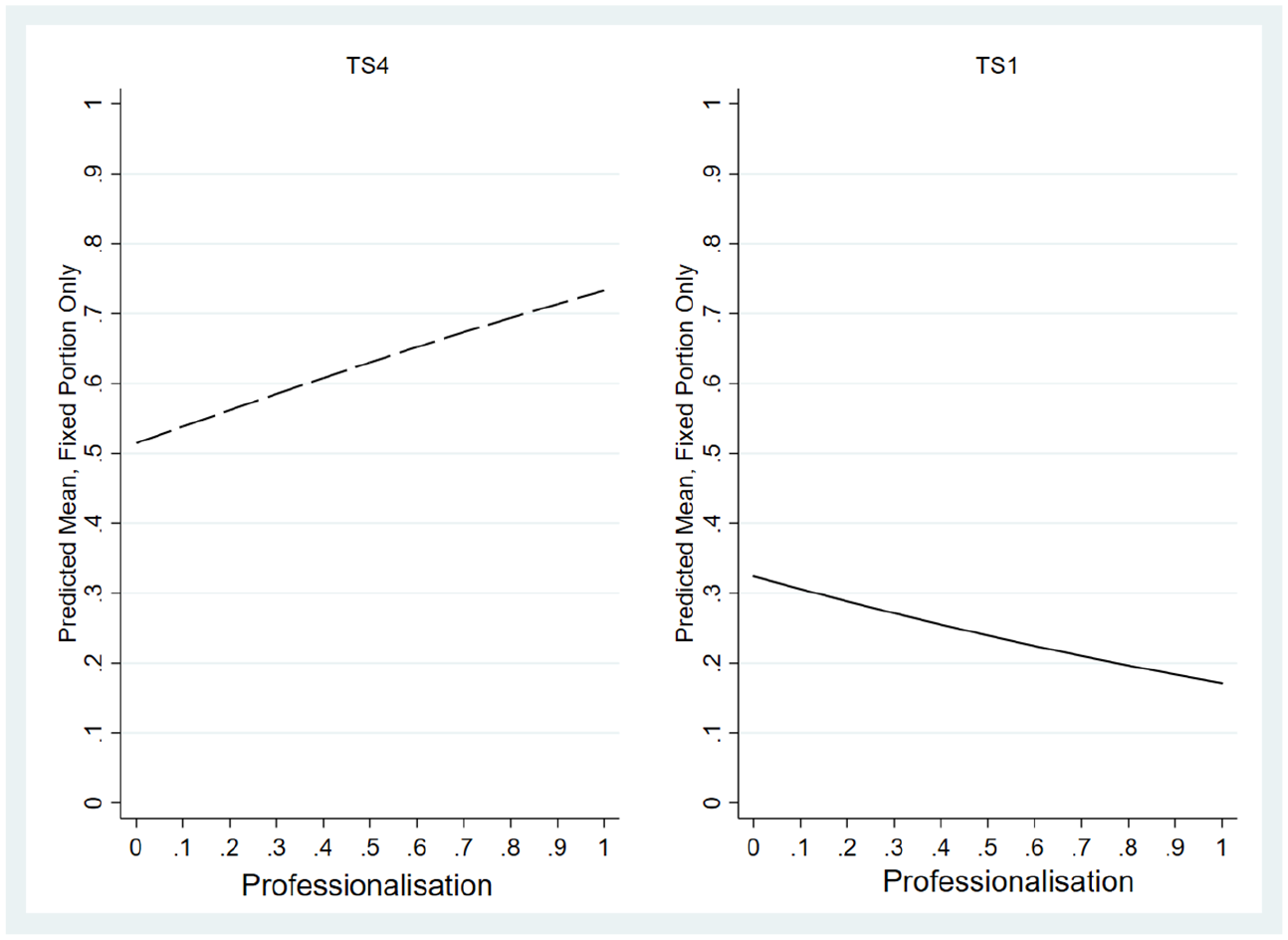
Predicted probabilities of professionalisation traits upon philanthropic (TS4) and mutual help (TS1) oriented forms of solidarity.
The likelihood of rallying behind a specific solidarity approach can be explained by the organisational missions, values, and aims, following our second hypothesis. Results in Table 1A (Online Appendix) show that solidarity approaches are strongly linked to the aims of organisations: political solidarity routes (policy reform and/or social change) and the value of empowerment help to explain horizontal forms of solidarity (Table 1A, Online Appendix). We advance that horizontal solidarity is more often tied to political routes. This might be due to the fact that political TSOs seek to empower citizens, local communities, or the larger public, by enabling them to claim and enforce their own rights. Conversely and taking into account within-differences between the vertical forms of solidarity, we confirm that humanitarian and rights-based values covariate positively with some vertical forms of solidarity (Table 1A, Online Appendix). This finding suggests that philanthropic and altruistic approaches to solidarity do not necessarily aim to empower vulnerable groups, as they are primarily interested in increasing their immediate welfare. In addition, we need to qualify H2, when looking at mixed approaches. On one hand, organisational aims and solidarity approaches are closely interrelated: the more a group is committed to social change and empowerment, the more inclined to horizontal solidarity (TS1) and the less oriented towards vertical solidarity (TS4) it will be. However, on the other hand, the picture gets blurred once we look into the mixed solidarity forms (horizontal TS2 or vertical TS3), which carry some degree of political contentiousness translated into either the TSOs’ aims, values, or action repertoire. These results suggest that collective actors’ missions of promoting social and political change can be reconciled with a top-down perspective of solidarity (Table 1A, Online Appendix, models TS2 and TS3).
Finally, with respect to our third hypothesis, results corroborate that action repertoires are tightly associated with solidarity approaches. In particular, we confirm that the more the activities targeting urgent needs are at the centre stage, the more important the vertical solidarity and the less important the horizontal solidarity appear to be (H3). Thus, the type of organisational activity is a key feature to help explain solidarity approaches. Figure 4 shows that TSOs engaging in urgent needs activities increase the average predicted probability of engaging in philanthropic and altruistic service-oriented solidarity approaches by almost 20%, while marginally increasing the solidarity approach towards mutual help (TS1). The most interesting aspect of these covariations, however, is the fact that activities directed towards urgent needs tend to decrease or very marginally increase (low statistical significance) the likelihood of TSOs promoting horizontal solidarity support (TS1 and TS2). In contrast, urgent needs activities strongly increase the likelihood of TSOs promoting vertical solidarity.
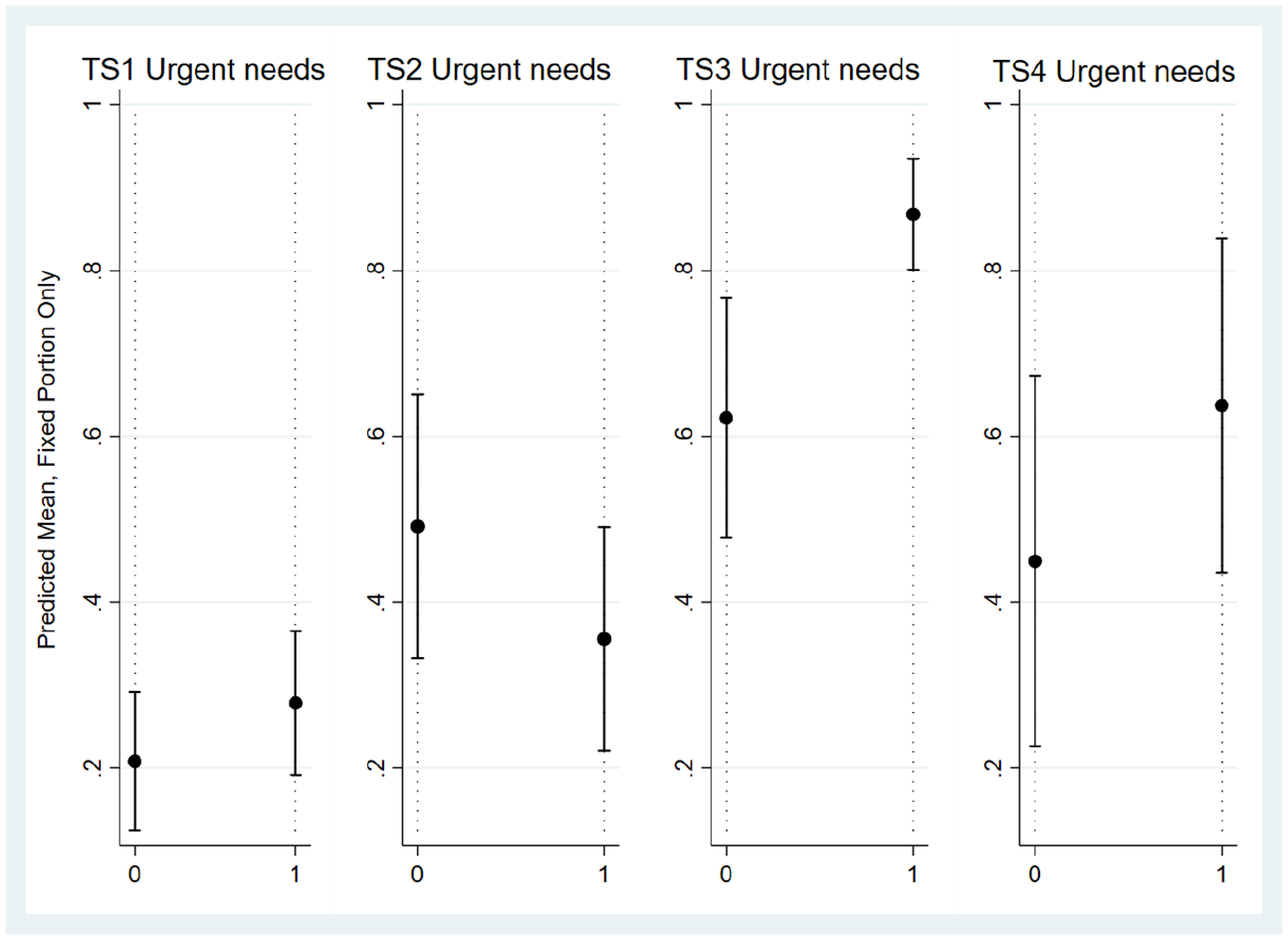
Predicted probabilities of engaging in urgent needs activities on philanthropic (TS4), altruistic (TS3), support and collaboration between groups (TS2), and mutual help (TS1) oriented forms of solidarity.
A deeper analysis between the elective affinity of TSO solidarity approaches and practices shows that organisations engaging in humanitarian activities privilege vertical solidarity, while those promoting political activities privilege horizontal solidarity (Table 1A, Online Appendix). Lobbying, protest, and demonstration activities are only relevant activities to explain and differentiate between groups engaging in horizontal solidarity approaches. The commitment to political practices (any type) seems to make a difference between these TSOs. TSOs engaging in political activities have a significant change in their average predicted probability of promoting horizontal solidarity, when compared to TSOs not engaged in political activities (Figure 5). The action repertoires, and thus the specific activities mobilised by the organisations, corroborate that the activities are a decisive source from which organisational patterns and solidarity approaches emerge. In this sense, collective action understood as humanitarian practices or political practices allows us to differentiate between the two organisational solidarity approaches.
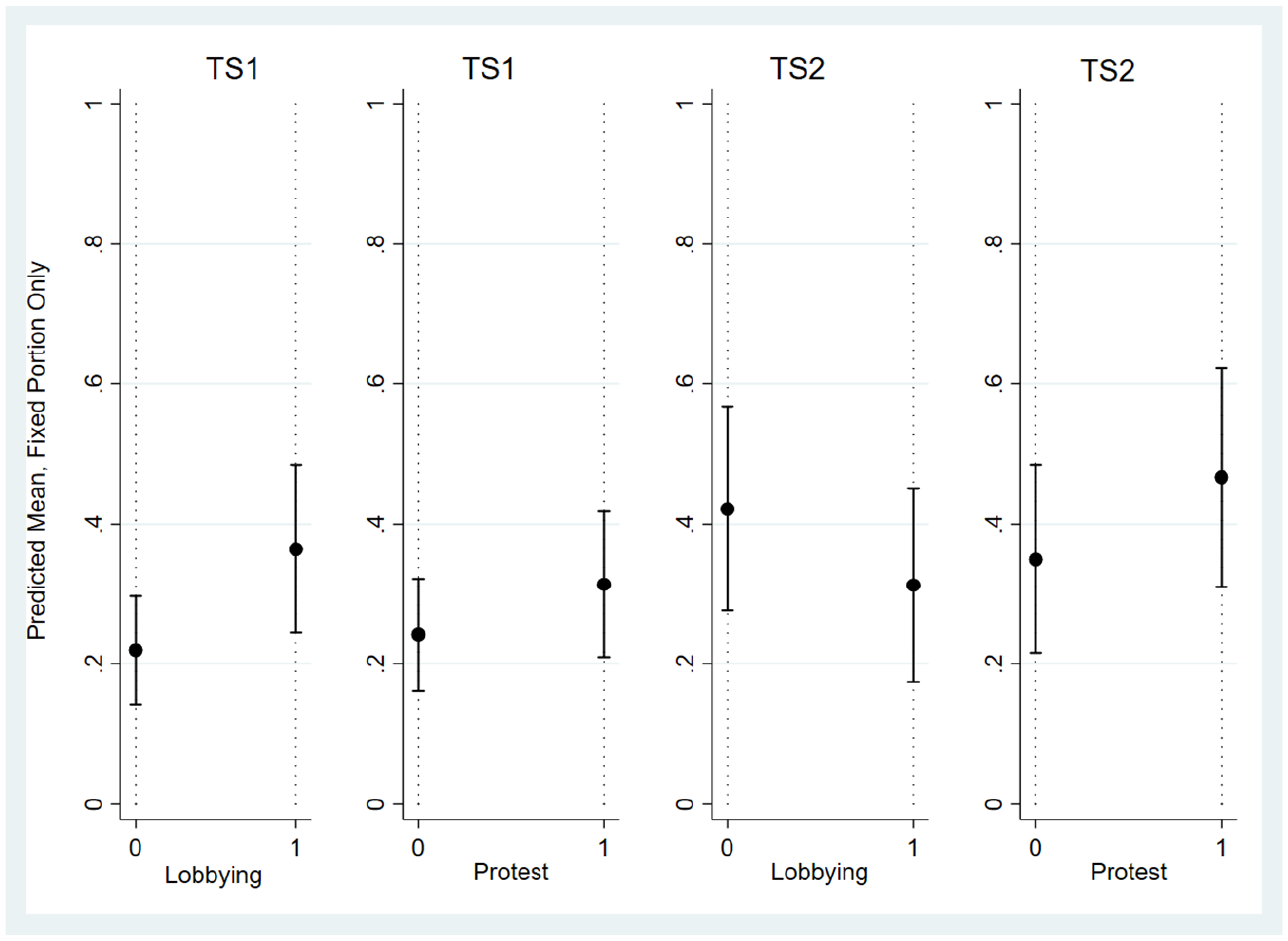
Predicted probabilities of engaging in political activities on support and collaboration between groups (TS2) and mutual help (TS1) oriented forms of solidarity.
Corroborating theoretical findings against organisational profiles
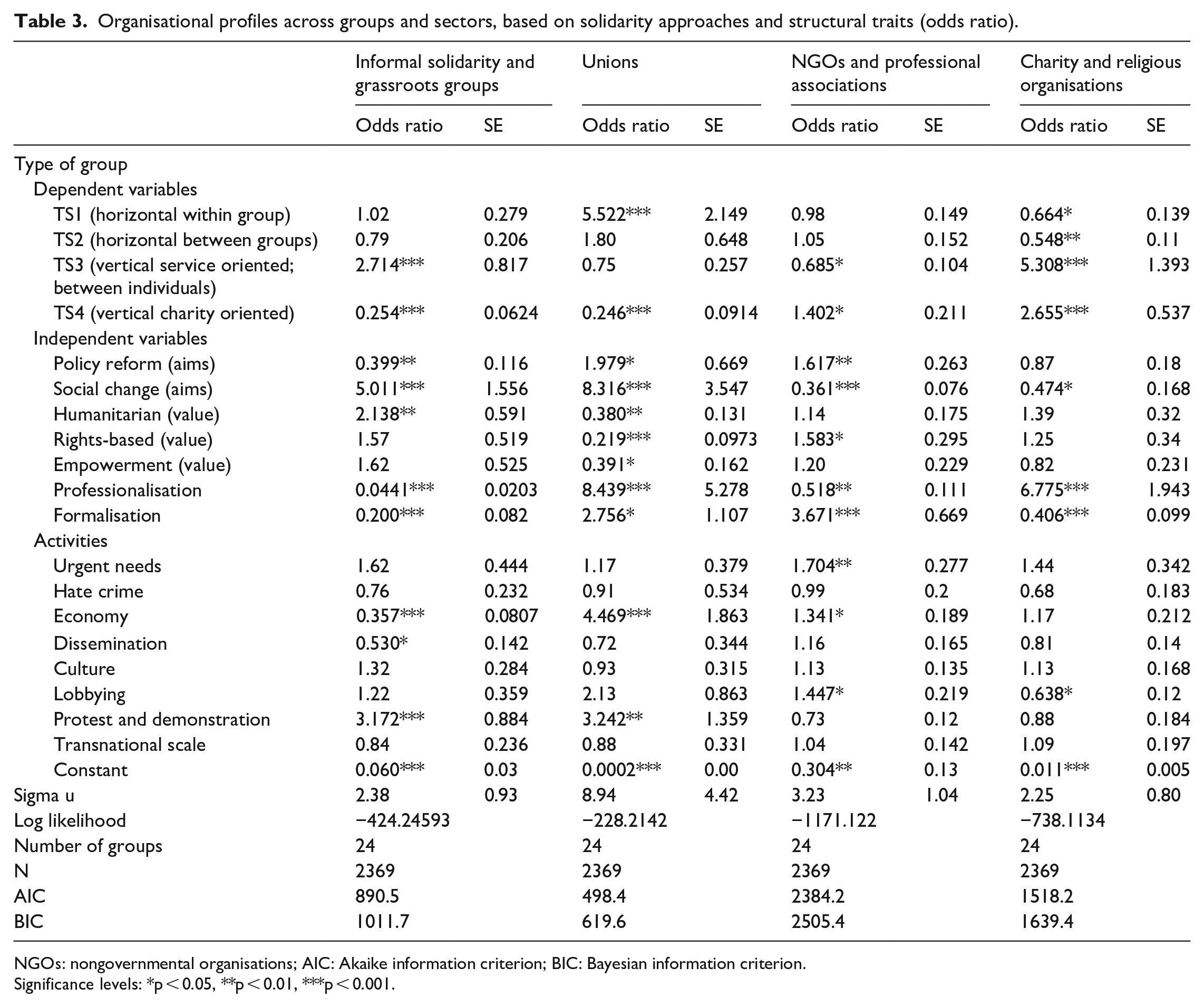
The findings thus far have validated important aspects of our three guiding hypotheses, even though not all could be confirmed. In particular, formalisation does not help to distinguish TSOs engaged in vertical and/or horizontal solidarity approaches. In addition, literature findings tend to highlight that different organisational types seem to lean more towards specific types of solidarity. Types of organisation should matter when explaining the kind of solidarity approach prevailing among TSOs. To provide insights into this cross-sectoral debate and to match our findings with previous strands of scholarly writing (e.g. social movements, unionism, civil society, or nonprofit sector), we go beyond a portrayal of generalised organisational characteristics, and we identify four dominant organisational profiles across groups and sectors, to study their correlation vis-à-vis our four solidarity relations (Table 3). In particular, we observe differences between informal groups and unions on one hand, and NGOs, professional associations, charities, and religious organisations on the other hand. The various predictors help to distinguish between the organisational profiles of these groups. The vertical solidarity approach (TS4) is strongly diffused among NGOs, charities, and religious groups. These organisations also share a considerable degree of formalisation (NGOs) or professionalisation (charities and religious groups). In particular, charities and religious groups tend to embody norms of care, as philanthropic support (TS4) and/or altruistic help (TS3). Results suggest that the vertical type of solidarity (philanthropic support TS4) seems to be more prevalent among TSOs that focus on entrepreneurial capabilities to help those in need. The vertical philanthropic solidarity approach, however, is strongly negatively correlated among informal solidarity groups, as well as unions. Nevertheless, vertical support to people in vulnerable conditions (altruistic help TS3) is presented among informal organisational forms of transnational solidarity, confirming that civil society (informal or formal organised) provides some welfare subsidiarity.
Organisational profiles across groups and sectors, based on solidarity approaches and structural traits (odds ratio).
NGOs: nongovernmental organisations; AIC: Akaike information criterion; BIC: Bayesian information criterion.
Significance levels: *p < 0.05, **p < 0.01, ***p < 0.001.
With respect to activities and organisational forms, only the charity and religious organisations show no relevant positive correlation to any specific activities they engage in, aims, or values. Likewise, when looking into the relationship between political aims and organisational forms, as expected, grassroots and informal groups engage in political activities to encourage social change but also humanitarian values. These two value frames embodied both contesting political voicing as well as altruistic concerns about welfare provision, possibly due to contextual factors (e.g. economic crisis). Thus, this type of TSOs incorporated the provision of services and goods in their action repertoire, and thus tend to combine the struggle for political change with the social engagement of caring for the vulnerable. Furthermore, even though NGOs show positive correlations to rights-based values and solidarity activities about the economy and provision of services, in contrast to grassroots and informal organisations, they tend to follow policy reform routes.
These findings confirm previous studies with respect to civil society and its active role combining the provision of services, support, and advocacy in favour of vulnerable groups (Baglioni and Giugni, 2014; Warren, 2001). However, when looking into the horizontal solidarity approach, we were expecting that TS1 and TS2 would be more closely linked to social movement organisational types. This is not the case, given that informal groups do not promote this type of solidarity in a significant manner. Only unions share a statistically relevant and positive covariation vis-à-vis a horizontal, within-group, solidarity approach (TS1). Thus, we argue that unions build up strong norms of reciprocity among their members, since constituencies are simultaneously active participants as well as direct beneficiaries, forging the arousal and stabilisation of collective action. That said, unlike unions, social movement organisations are not restricted to horizontal solidarity. In addition, unions represent a very particular organisational form, combining institutional and noninstitutional political repertoires, with relevant formalisation and professionalisation traits in contrast to grassroots groups. The organisational trait differences between these two organisational forms could result from the privileged access that unions have to institutional arenas and policy-making. Finally, our findings on the transnational scale show no statistical significance. Higher degrees of transnationalism correlate significantly with solidarity approaches, but not with organisational profiles. Most probably, TSOs committed to horizontal solidarity relations within a specific constituency are less prone to expanding their scope of activities, while groups engaged in horizontal and vertical relations between groups are more amenable to transnational activism, for instance, via cooperation and joint action. However, unions which are the only profile correlating positively to horizontal solidarity relations within a specific constituency, independently of their strong mutualistic support, also convey strong conceptions of transnational workers’ rights. Thus, the scale of the activities does not seem to correlate with any specific organisational type, suggesting that all organisational profiles have a similar inclination to engage or not in activities beyond countries.
Further discussion and conclusions
Solidarity activism is highly patterned by organisational traits and profiles of citizen groups engaged in related activities and relations. Vertical solidarity approaches that focus on top-down relations between TSOs and beneficiaries are associated more strongly with highly professionalised TSOs that promote humanitarian and rights-based missions and centre on service provision to meet urgent needs, while horizontal approaches of mutualism and joint action are more often linked to less professionalised groups that privilege political routes, contentious action repertoires, and values of empowerment. Our findings thus suggest an elective affinity between solidarity approaches and organisational profiles. Vertical solidarity – philanthropic actions and/or altruistic help – is more common among NGOs, charities, and religious groups sharing formal and/or institutionalised traits, while not engaging in horizontal relations of solidarity. The inverse elective affinity between informal grassroots groups and solidarity approaches, however, is much less apparent, given that the latter tend to be involved in both horizontal and vertical solidarity. Our data demonstrate that only unions share a statistically relevant and positive relationship with horizontal solidarity approaches. We attribute this to the strong norms of reciprocity, common aims, and identities embodied in union membership. In contrast to union constituencies – who are active participants and, in most cases, direct beneficiaries with common collective action goals – the other TSOs seem to embrace more diverse constituency groups with a wider range of actions, aims, and identities.
Our findings illustrate that organisational traits do matter in explaining the prevalence of different types of solidarity approaches in the field of civil society and social movements, supporting previous studies (Diani and Donati, 1999; Kriesi, 1996; McCarthy, 1996). Our analysis supports works differentiating solidarity approaches by different types of organisations (Baglioni and Giugni, 2014; Moulaert and Ailenei, 2005). We confirm that whereas TSOs engaging in vertical solidarity (goods distribution and unilateral help oriented) are highest in frequency, TSOs embracing horizontal solidarity (mutual help oriented) are also active across sectors. Beyond these works, however, we offer new evidence showing that TSOs also adopt hybrid/mixed solidarity approaches, particularly visible in the combination of reciprocal support between groups and vertical altruistic solidarity approaches (Baglioni and Giugni, 2014; Minkoff, 2002).
Moreover, our analyses confirm that organisation matters when addressing transnational solidarity work, even though we are not able to detect causal relations. In fact, our calculations have spotted correlations, and thus elective affinities between solidarity approaches and organisational profiles. Therefore, it is highly plausible to assume that ‘solidarity’ and ‘organisation’ are highly interdependent: citizens will opt for organisational profiles leading to a specific organisational approach to solidarity, but organisational choices will also determine the range of potential solidarity relations with beneficiaries or participants, particularly if organisations evolve (professionalise, formalise, or institutionalise). Our findings provide insights into this intricate relation by highlighting its ambivalence. ‘Organisation’ is an essential prerequisite of collective protest action because some organisation is necessary to translate latent grievances and discontents into actual protest activities (Diani and Donati, 1999; McCarthy and Zald, 1977), meaning that solidarity work is linked to ‘organisation’ in terms of effectivity considerations. At the same time, however, ‘organisation’ is also tied back to a specific way of organising tasks and activities along shared norms, rules, and myths (DiMaggio, 1987; Powell and Steinberg, 2006). In this sense, ‘organisation’ matters also in terms of legitimacy. Our study confirms findings from both strands of research because it shows that the relation between ‘solidarity’ and ‘organisation’ conforms to exigencies of effectivity and legitimacy. However, organisational traits ensuring effectivity seem to differentiate much less between solidarity approaches than legitimacy criteria. Vertical and horizontal solidarity approaches can be reconciled much more easily with diverging organisational profiles, while this is not the case concerning organisational missions and values. In this sense, we see that shared collective identities, values, and aims (Diani, 1992; Hunt and Benford, 2004) seem to be a more consequential factor patterning organisational sectors into diverging, in part conflicting, solidarity approaches.
Supplemental Material
Supplementary_material – Supplemental material for Does Organisation Matter? Solidarity Approaches among Organisations and Sectors in Europe
Supplemental material, Supplementary_material for Does Organisation Matter? Solidarity Approaches among Organisations and Sectors in Europe by Fernández G. G. Eva, Christian Lahusen and Maria Kousis in Sociological Research Online
Footnotes
Funding
The author(s) disclosed receipt of the following financial support for the research, authorship, and/or publication of this article: Results presented in this article have been obtained from the project ‘European paths to transnational solidarity at times of crisis’ (TransSOL) that received funding from the European Union’s Horizon 2020 research and innovation programme under grant agreement No. 649435.

Supplemental material
Supplemental material for this article is available online.
Author biographies
References
Supplementary Material
Please find the following supplemental material available below.
For Open Access articles published under a Creative Commons License, all supplemental material carries the same license as the article it is associated with.
For non-Open Access articles published, all supplemental material carries a non-exclusive license, and permission requests for re-use of supplemental material or any part of supplemental material shall be sent directly to the copyright owner as specified in the copyright notice associated with the article.
