




Abstract
Sociological research has long suggested that cultural participation is socially stratified. We build on this literature to discuss the role of the subjective and objective dimensions of stratification and how they are linked to practices of social distinction through cultural consumption. The aim of this study is to understand (1) the effect of subjective and objective social status on patterns of cultural participation and (2) the implications of the status inconsistency. We use a probabilistic and representative sample of the Chilean urban population older than the age of 18. Latent class analyses show that a significant proportion of Chileans can be considered cultural omnivores. Multinomial diagonal reference models suggest that omnivorousness is positively predicted by subjective and objective social status. Moreover, regarding inconsistency, objective social status is prominent in the explanation of omnivorousness for both status-underestimating and status-overestimating individuals. These findings provide important insights for discussing the implications of status inconsistency on cultural consumption.
Keywords
Introduction
Sociological research has long shown that cultural participation is stratified by individuals’ objective social status (Bourdieu, 1979; Chan and Goldthorpe, 2007a; Lizardo, 2019; Peterson, 1992). Nevertheless, across societies, researchers have pointed out that subjective and objective social status (hereafter SSS and OSS, respectively) often do not coincide (Kelley and Evans, 2017), which has important implications for individuals’ outcomes, such as their health status and political behaviour (e.g. Baer et al., 1976; Jackman and Jackman, 1973; Jin et al., 2019). In this study, we extend the research on subjective dimensions of stratification by examining the relationship between SSS and OSS inconsistency and social distinction practices through cultural consumption.
We focus on what the tradition in cultural sociology terms the cultural omnivore (Chan and Goldthorpe, 2007a; Peterson and Kern, 1996). Specifically, the focus is on the weak interpretation of the omnivore hypothesis (de Vries and Reeves, 2021). In that form of omnivorousness, (1) individuals in high-status positions tend to be more culturally engaged than lower-status groups, (2) and their engagement crosses the boundary between elite and popular culture. 1 Since Peterson’s pioneering work (Peterson, 1992; Peterson and Kern, 1996; Peterson and Simkus, 1992), cultural omnivorousness has become one of the most prolific research agendas in cultural sociology. It has led to an end of the simplistic notions of snobbishness that hinder high-status groups from engaging in popular culture (Wright, 2016). Therefore, the omnivore of the late-20th century, in its weak and strong interpretations, contrasts with Bourdieu-inspired approaches that characterise the Parisian snob of mid-late-20th century. From this, we bring together the literature on omnivorousness into dialogue with status inconsistency research.
Cultural consumption is a central element of boundary-making and, thereby, an important signal of group belonging (Reeves, 2019). If subjective status motivates identification with symbolic communities, individuals who identify themselves with high-status groups may seek to engage in omnivorous activities that characterise elite consumption to be accepted as such (Lamont and Molnár, 2002). Hence, understanding cultural consumption as a function of subjective status positioning enables us to bridge omnivore studies and subjective social status research. Moreover, the theoretical significance of examining inconsistency lies in its puzzling implications for practices of distinction through cultural consumption. Despite the evidence supporting a positive relationship between measurements of status and cultural omnivorousness (Chan and Goldthorpe, 2007a; Torche, 2010), status inconsistency is a common situation where actors also receive and develop inconsistent expectations of group boundaries. Therefore, this framework raises important questions about the behavioural implications of status inconsistency in the cultural consumption field. Do individuals who overestimate their position in the social hierarchy differ from those who are objectively located in that position? Do individuals balance or combine subjective and objective social positions? How do these dimensions of social stratification relate to omnivorousness when they are inconsistent? Furthermore, in addition to examining whether subjective social position affects cultural stratification, we aim to understand the implications of inconsistent objective and subjective social positioning for cultural practices.
We develop arguments regarding the dominance of OSS or SSS, and the combination of both dimensions of stratification in the explanation of the cultural omnivore. Regarding specific scenarios of inconsistency, namely, status-overestimating and status-underestimating individuals, a balancing mechanism is tested against the predominance of one of the two resources across types of inconsistency. Moreover, the empirical literature on status inconsistency has suffered from methodological and conceptual shortcomings (Zhao et al., 2018). Following recent studies (Chan and Turner, 2017; Jin et al., 2019), as explained in the analytical strategy section, we seek to overcome these limitations by using multinomial diagonal reference models (DRM). The use of multinomial DRM on status inconsistency research is a substantial methodological contribution of this study. In a nutshell, DRM isolates the effect of status inconsistency from OSS and SSS effects, which is not possible by traditional regression approaches due to collinearity issues.
We use a unique dataset from Chile, which provides objective and subjective social positioning measurements in tandem with cultural participation. We study the Chilean case, looking at whether patterns of consumption in this Latin American country resembles patterns in other societies, where cultural omnivorousness stands out as one of the most prominent characteristics (e.g. Chan and Turner, 2017; Peterson and Kern, 1996). Besides expanding the cultural consumption literature towards developing and Latin American countries, the Chilean case’s theoretical relevance lies in its higher level of inequality that dominates the access to culture. As shown by Torche (2010), in Chile, cultural participation is much more stratified than in other countries such as France, Britain, and The Netherlands. It could be explained because of the high economic barriers to cultural access. For instance, Figure 1 compares the price of a cinema ticket as a proportion of the average net monthly income for OECD countries. Among this selected group of countries, Chile is one of the countries with the highest proportion, and much higher than other countries where cultural omnivore has been intensively studied. Thus, using this case study, we discuss how cultural omnivore could manifest itself in highly unequal contexts with high economic barriers to cultural participation and how objective and subjective status are combined to explain it. A more detailed account of the Chilean case is provided subsequently.

Cost of going to the movies as a proportion of the average net monthly income by country.
The article is structured in five sections. First, we theorise the implications of status inconsistency for cultural omnivorousness. The Chilean context and the contribution of the case are further developed in the second section. Third, the data, the creation of latent profiles, and multinomial diagonal reference models as the analytical strategy are detailed. Results and conclusions are presented in the fourth and fifth sections, respectively.
Implications of status inconsistency
Subjective social status is an individual’s self-perception of positioning in a top-to-bottom social hierarchy (Jackman and Jackman, 1973). When individuals declare their position, they also express their membership to a symbolic community (Lamont and Molnár, 2002; Reeves, 2019). Nevertheless, as Jenkins (2014) explains, this internal identification process requires outsiders to recognise it for an objective collective identity to emerge. In addition, cultural consumption has long been recognised as a mechanism used by social groups to signal their social position (Bourdieu, 1979; Friedman and Reeves, 2020). Thus, subjective social positioning itself is important for an ample range of socially meaningful distinctions, including cultural consumption.
Empirical evidence has shown subjective social positioning to have an independent effect on cultural consumption, net of objective status measurements, such as income, education, and occupation (Reeves, 2019). As boundary-making elements, cultural participation or consumption is more effective than other strategies, such as taste, because they have been materialised, and most of the traditional forms of cultural participation are observable by other actors. Going to the theatre or cinema provides a strong external signal of belonging to a specific group. Moreover, as Karademir Hazır and Warde (2016) point out, the most common operationalization of omnivorousness is through cultural consumption.
Drawing on Weber’s multidimensionality of status, scholars have widely discussed the relationship between objective and subjective social position (e.g. Jackman and Jackman, 1973; Karlsson, 2017). While unequal resources define social boundaries, subjective status is a conceptual definition made by individuals that demarks symbolic boundaries (Lamont and Molnár, 2002). However, due to a tendency across societies to locate oneself in the middle of the social hierarchy (Evans and Kelley, 2004), objective and subjective status often do not converge. Several studies have attempted to explain this divergence (Lamont, 1992; Oddsson, 2018) and its consequences in fields such as health and political preferences (Jin et al., 2019; Zhang, 2008). We move this literature forward by incorporating a discussion and empirical examination of the effects of status inconsistency on omnivorousness.
Based on quantitative data collected in Paris during 1960, Bourdieu documented distinctions in which people higher up the social hierarchy have highbrow tastes and cultural consumption (Bourdieu, 1979). Thus, those with higher cultural capital define what constitutes taste within the society and those with low overall capital (economic, social, or cultural) accept it as legitimate.
In an attempt to reproduce Bourdieu’s findings in the United States, in 1982, Peterson and Simkus administered a large representative survey comparable with those of Bourdieu in Paris (Peterson, 1992; Peterson and Simkus, 1992). Similar to the Parisian upper-class’s snobbishness, elites in the United States were more prone to express a taste for highbrow culture and engage in highbrow activities. Nevertheless, a serendipitous finding showed that this social group also developed a taste for a wide variety of lowbrow activities. High-status persons are far from being snobs, they are omnivores instead, a kind of cultural consumer who, at their roots, chooses a large variety of distinctive tastes or activities rather than refinement or exclusion (Peterson, 2005). Thus, similarly to Bourdieu, elite groups do have a distinctive pattern of consumption. However, this pattern of cultural engagement and taste is not solely focused on elite culture but also on mass culture.
Recent efforts of integrating the extensive omnivorousness literature (de Vries and Reeves, 2021) have divided the theoretical and empirical standings between weak (e.g. Alderson et al., 2007; Chan and Goldthorpe, 2007a) and strong (e.g. Atkinson, 2011; Warde et al., 2007) versions of the cultural omnivore hypothesis. In the weaker interpretation, as aforementioned, high-status groups consume a larger variety of cultural forms than low-status groups. In contrast, in the strong interpretation, high-status groups do not systematically reject non-elite cultural forms. It is a distinction between engagement and explicit dislike. To provide conceptual clarity, our understanding of the cultural omnivore is consistent with eclectic consumption of the weak omnivore hypothesis and not with an explicit dislike for lowbrow consumption.
Furthermore, how individuals’ OSS and SSS predict cultural omnivorousness could lead to different mechanisms in scenarios of inconsistency. First, materialistic perspectives state that economic conditions are the overwhelming structuring principle for modern societies (e.g., Domhoff, 1998; Wright, 1997). As scholars in cultural stratification (Chan, 2010; Lizardo, 2010) have pointed out, economic resources are fundamental for sustaining and providing opportunities for lifestyles of higher-status groups. Studies of elites have also suggested that omnivorousness is the new symbolic boundary of the affluent, like snobbishness in the past (Khan, 2011). This argument is consistent with the psychological evidence showing a positive association between openness and different objective social status measurements, such as income and occupation (Mueller and Plug, 2006). Similarly, Lizardo and Skiles (2012) suggest that naive conceptualizations of omnivorousness provide explanations from versions of action theory, which understand eclectic consumption as a rational or conscious attempt to gain status. Instead, they argue that cultural practices are the results of the embodiment of objective class positions. Hence, regardless of one’s subjective social standing, OSS may be the main explanation of the probabilities of belonging to a cultural omnivore profile (H1a).
Nevertheless, the likelihood of engaging in a certain behaviour (e.g. cultural participation) can be seen as a function of subjective norms and self-identification. This second perspective suggests that practices of distinction will require a subjective motivation or an intention of boundary making. These norms are beliefs about what individuals want to be and how they portray themselves as belonging to a specific social group. In recent literature, subjective positioning has become central to cultural consumption identification (Reeves, 2019) of symbolic communities. If their cultural openness characterises high-status groups, identifying with this group, either by distinction or pretension, will be determinant in the definition of cultural profiles. Individuals will seek to signal their subjective belongings and be accepted as such (Lamont and Molnár, 2002). Therefore, from this second perspective, cultural participation will be led by individuals’ SSS (H1b).
Moreover, an important tradition in studies on status inconsistency argues that individuals often combine different resources of stratification in the explanation of their behaviour (Berger et al., 2005). Self-positioning in the social hierarchy is one more of those structuring resources with effects on individuals’ agency. The expectations of certain social groups based on different status characteristics possessed by actors, OSS and SSS in our context, are combined to form overall expectations for the individuals (Fişek, 1998). In this combining mechanism, both dimensions of stratification cohere in their effect on social outcomes without necessarily establishing a hierarchy among them. For instance, we might expect that individuals who are located high in both hierarchies might be more likely to belong to the omnivorous group than any other combination of resources. Likewise, when actors have a low objective and subjective social positions, they will be the least likely to form part of such a group. Hence, the deployment of omnivorous consumption requires both OSS and SSS. OSS provides opportunities for consumption and will affect behaviour when it corresponds to the subjective belief that one is located in that objective position. A similar argument has been suggested as an explanation of political behaviour (Calhoun, 1982; D’Hooge et al., 2018), but researchers have not examined whether it applies to cultural consumption. Therefore, the combining mechanism considers both OSS and SSS as simultaneous predictors of omnivorousness.
Nevertheless, by a motivation to see the self positively (Kraus and Tan, 2015), individuals often inconsistently self-identify their social status. In scenarios of inconsistency, we can find two types of individuals. That is, we have individuals with a higher subjective than objective status (SSS > OSS) and individuals with a higher objective than subjective status (SSS < OSS); henceforth, status-overestimating actors and status-underestimating actors, respectively. Bourdieu (1979) uses the status-overestimation to characterise the petit bourgeoisie, which is consistent with pretension instead of distinction. They engage in cultural consumption aspiring to high-status groups distinction but do not possess the capital or habitus to do so. In this study, as explained in the analytical strategy section, the methodology enables us to analytically separate OSS/SSS inconsistency effects from their absolute values.
The effect of OSS and SSS could have specific configurations or interact with these types of inconsistency. In the explanations of elite consumption (Hahl et al., 2017), high-status groups engage in lowbrow culture to address authenticity suspicions. However, we do not know whether this behaviour is led by their objective position or desired notion of status. If we follow the rationale of a materialistic perspective, we might expect that OSS will dominate for both overestimating and underestimating individuals (H2a). Even if certain individuals aspire to high-status social group distinction, they are strongly limited by their OSS. For instance, this constraint characterises the cultural consumption of the working class in Bourdieu’s (1979) work, for whom their cultural consumption is driven by material necessity and function. In the opposite case, objectively high-status groups that self-identify in a lower position could engage in high- and low-brow consumption due to the voracious opportunities given by their higher endowments. Nevertheless, when following the subjective argument, SSS may be the predominant factor explaining cultural omnivorousness in both cases (H2b).
However, a third alternative is the Lenski balancing hypothesis (Lenski, 1954; Zhang, 2008), which indicates that actors will focus strategically on the characteristic in which they rank higher (H2c). Therefore, SSS will have a higher weight for overestimating actors (SSS > OSS), while OSS will be predominant for underestimating actors (SSS < OSS). D’Hooge et al. (2018) summarise an argument that could explain this mechanism for cultural consumption. Groups with higher SSS are associated with a process of adaptation to values, norms, and preferences of the high-status group, where they desire to belong. Thus, their behaviour is driven by SSS, where they rank higher. For groups identified with a lower social position, people tend to hold on to the norms and values associated with their objective position since they are perceived as superior. Hence, their engagement in omnivore consumption might be led by their objective social position. Overall, to guide their omnivore distinction behaviour, individuals could rely on the objective or subjective endowment in which they rank higher.
Omnivorousness in Chile
Since 1990s, the number of comparative studies testing the shift towards omnivorousness has increased, with works conducted in many industrialised societies (Peterson, 2005). However, whether this pattern holds only for developed Western countries is still inconclusive. The prevalence of inclusive omnivorousness could be a function of the cosmopolitan elite’s size in a particular country, the level of economic development, or cultural traditions, among others (Peterson, 2005). These factors could explain variations in the social stratification of cultural consumption.
In this context, Chile is an exemplary case for testing the validity of the omnivorousness thesis. Torche (2010) pointed out three reasons for the contribution of the Chilean case to the international literature on cultural consumption. First, with a Gini of 44.4, according to World Bank estimates in 2017, Chile is a highly stratified country in comparison to the industrialised societies in which omnivores have been found. Recent estimations (De Rosa et al., 2020) indicate that Chile is one of the most unequal countries in the region, and it has increased further over the last years. Despite its inequality, citizens tend to self-positioning around the mean of subjective status (Castillo et al., 2013). This contradiction of objective inequality and subjective mean-tendency brings status inconsistency into sharper relief.
Second, Chile is a more culturally homogeneous country than its neighbours (Torche, 2007). Migration is relatively low, and the recent wave of migration comes mainly from other Latin American countries. A large majority identify with Catholicism, and the indigenous population is relatively small compared to other Latin American countries. Thus, cultural consumption boundaries overlap with socioeconomic distinctions more clearly than with other sources of distinction, facilitating the explanation of consumption by OSS and SSS.
Third, the actual configuration of the cultural field provides a different cultural hierarchy. For instance, according to Torche (2010), despite a higher level of consumption, the social gradient indicates that going to the movies is a highbrow activity, whereas attending rock concerts and plays is less consumed but more widespread across the board. In contrast to other contexts, the cluster of omnivores is small, and there are no univores. This suggests the need to consider profiles of cultural consumers (Chan and Goldthorpe, 2007a; Chan and Turner, 2017) over an omnivore–univore continuum (Lizardo and Skiles, 2009). For the Chilean case, income, status, and education, but not social class, are important predictors of omnivorousness (Torche, 2007), suggesting the multidimensionality of the cultural stratification. Therefore, we extend the literature on the cultural omnivore in Chile, Latin America, and worldwide by incorporating the effect of subjective dimensions of social stratification.
An additional contribution of this study is the incorporation of digital cultural consumption into cultural consumption clusters. Here, the Chilean case contributes to understanding the stratification of cultural consumption through digital media. The Internet penetration in Chile is relatively high. According to the World Bank (2021), 82% of Chileans use the Internet, which is a high rate considering that the overall rate in Latin America and the Caribbean is 66% and 85% for the European Union. Moreover, compared to traditional means of consumption, the costs of e-books or online streaming are lower. Therefore, there are no major inequalities in access to the Internet and digital culture. Under the democratisation perspective in digital inequality (Weingartner, 2020), this high accessibility could indicate that the Internet could facilitate access to cultural consumption across the board. Nevertheless, recent studies of the Chilean context have also shown that there are persistent differences by socioeconomic status on the quality of Internet and digital skills (Correa et al. 2020), where the latter significantly mediates the effect of Internet mode on the diversity of online activities. In this context, this study examines whether cultural consumption patterns are also stratified when accounting for digital media in a society with a high level of Internet penetration but with persistent gaps in the quality of connectivity and skills.
Data and method
Data
This study uses data from the Longitudinal Social Study of Chile (ELSOC, in Spanish). A unique survey in Latin America designed to monitor, on a yearly basis and across a decade, the Chilean population’s beliefs, feelings, and attitudes about cohesion and conflict. For this analysis, we use the second wave of the panel study carried out in 2017, which measured cultural consumption, alongside objective and subjective status. A total of 2,473 individuals were surveyed, being representative of the urban population older than the age of 18. The sampling design uses the 2011 pre-Census as a sampling frame and follows a probabilistic, stratified, clustered, and multistage procedure. Due to the small fraction of incomplete cases, we assumed missing data at random, and a listwise deletion was applied for defining a comparable analytic sample across models. As a result, the sample was further restricted to 2,154 respondents. All the reported statistics are estimated using sampling weights provided by the survey.
Cultural profiles
A multinomial variable was generated using Latent Class Analysis (LCA). This data reduction technique is the most used by quantitative studies of omnivorousness (de Vries and Reeves, 2021). Respondents reported the frequency with which they participated in eight different cultural activities. Although the activities’ hierarchization goes beyond this study’s aims, the items represent a combination of low- and high-brow consumption in the Chilean context, according to previous studies (Gayo, 2017; Torche, 2010).
Five items (cinema, theatre, museum, pop or rock concert, and classical music concert) range from 1 ‘never’ to 5 ‘at least once a month’. To conduct an LCA, and following a standard procedure in cultural sociology (Chan and Goldthorpe, 2007a, 2007b; Katz-Gerro and Jæger, 2013), we recoded each of these variables into dummy indicators where 0 represents ‘never’ and 1 ‘once a year or more’ to identify those respondents who effectively engaged in the activity in a 1-year period. In addition, two indicators capture reading activity. Respondents declared the number of (1) printed and (2) e-books read in the last year. 2 The variables were recoded into dummy indicators where 0 represents ‘none’ and 1 ‘at least one book’. A single indicator of movies on streaming services was considered, ranging from 1 ‘never’ to 5 ‘at least once a month’. Like the other variables, it was transformed into a binary indicator where 0 represents ‘never’ and 1 ‘once a year or more’. Table 1 shows each item and the percentage of people who engaged in each of the activities.
Percentage of ELSOC respondents who participated in cultural activities.
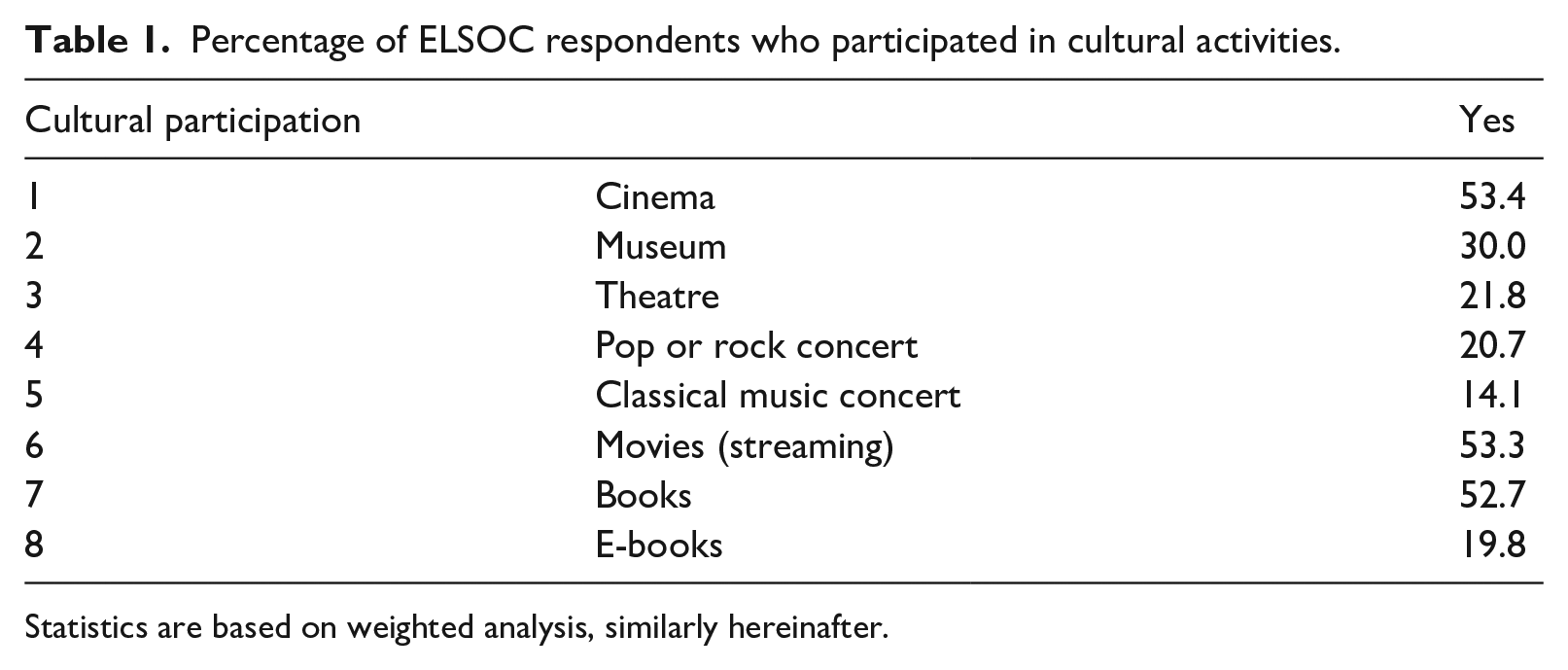
Statistics are based on weighted analysis, similarly hereinafter.
The indicators of cultural participation form an eight-way contingency table of 256 (28) cells. These are used to perform LCA models to identify latent patterns of cultural consumption. These analyses were conducted using the software Latent Gold 5.1. Table 2 reports the LCA solutions for cultural participation. None of them fits the data with the criterion of less than 5% of probability of type error I (p < .000). Given that, the solution with the lowest BIC is Model 4. In addition, L2 is larger for solutions with smaller numbers of clusters and substantially larger when compared to their respective df. The larger the difference between L2 and df, the poorer the model fits the data (Vermunt and Magidson, 2005). Above all, we use the 4-class solution because it is parsimonious and provides a substantive data organisation.
Latent class solution for cultural consumption.

LL is the log-likelihood of the model, BIC refers to its Bayesian information criterion, N is the number of parameters, L² stands for the model fit likelihood ratio chi-square statistic, df refers to its degree of freedom, p-value is the probability of type I error, and ∆ is the percentage of cases misclassified.
The four patterns of cultural participation are described in Table 3. The largest share of respondents (47%) is classified in Cluster 4. This class is characterised by a low proportion of respondents engaging in cultural activities. We have called this class passives. Cluster 1 groups together 1 of each 5 respondents. The proportion of participation is more than 50% for each item. Thus, it is the omnivore class in the case of cultural participation. Cluster 2 (12%) represents those respondents who go to the cinema, but with a lower – but still relevant – level of engagement in other activities such as attending the museum and theatre. These activities can be considered as a middlebrow taste (Katz-Gerro and Jæger, 2013). They also consume the highbrow cultural product (classical music concert) but with a much lower proportion compared to the cluster of omnivores. We labelled this class as middlebrow. Cluster 3 has the same proportion as omnivores (20%). Individuals in this cluster report a high frequency of going to the cinema and watching movies on streaming platforms. They also report a high proportion of reading behaviour. Given the outstanding importance of cinema and streaming, we label this class as cinephiles.
The proportion of profiles of cultural consumption and distribution of activities.
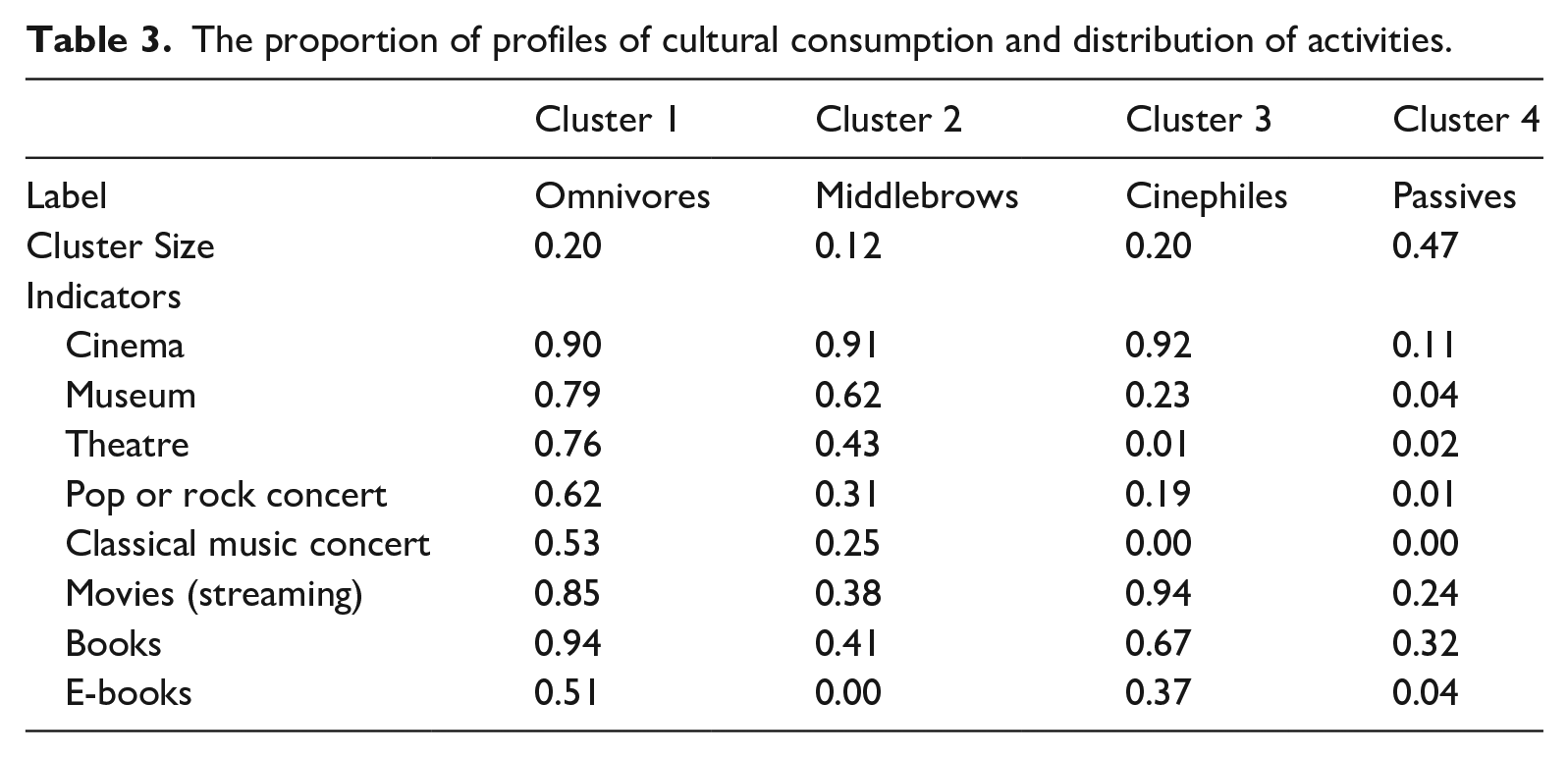
We found a notable group of passive individuals, which could be a potential distinctive feature of countries with higher barriers to cultural participation. In addition, the incorporation of digital consumption enables us to identify a distinctive profile of individuals that combine traditional means of consumption (cinema and printed book) and new digital platforms (streaming and e-books).
Independent variables
The key predictors for examining the status inconsistency effect are OSS and SSS. Individuals’ OSS for this study was based on the declared net household income in the last month. The original variable ranges from 0 to 25 million Chilean pesos (33,000 USD). DRM is a computationally demanding technique and, for each combination of SSS and OSS, requires a higher number of cases per category than the original variables. Therefore, we recoded these indicators into three groups of equal size. The higher the value, the higher the position is in the income structure.
The indicator of objective status is used because cross-national evidence has shown that income is one of the most important determinants of the probability and volume of cultural participation among socioeconomic and demographic correlates (Falk and Katz-Gerro, 2016). In contrast, net of income, education could capture information processing, cosmopolitanism, or cultural capital, which are not part of our central research question. Nevertheless, we controlled for the dichotomic status that if respondents have some tertiary education to avert the possible confounding bias brought by the educational level. The results without controlling for education are consistent and reported as a robustness check in the supplementary material.
To measure SSS, respondents were also asked: ‘In Chilean society, some groups locate themselves in the upper levels of society and others locate themselves in the lower levels. Where do you locate yourself?’ Answers could be rated from 0 (lowest level) to 10 (higher level). To make the response compatible with OSS, it was also recoded into a three-category variable (0–4, 5, 6–10) to mostly equalise the size of each category. Alternative recodifications and measurements of OSS and SSS are reported in the sensitivity analyses section.
Models were controlled for conventional sociodemographic variables that have been suggested by the literature as affecting both the independent and the dependent variables. Gender, age, geographical area (north, centre, south, and metropolitan region), number of household members, employment status, the presence of children, a three-category variable indicating subjective social origin were included. In addition, given that income is highly correlated with education, we controlled for a dummy indicator of tertiary education where 0 represents ‘less than tertiary education’ and 1 ‘some tertiary education’.
Analytical strategy
To examine the effects of OSS, SSS, and status incongruence on cultural consumption, we adopt diagonal reference models (DRMs) to separate them and overcome collinearity.
The DRM is a nonlinear model proposed by Sobel (1981, 1985), intended to deal with the identification problem in social mobility research. In this model, respondents are cross-classified in a contingency table by OSS (row factor) and SSS (column factor). The DRM takes the main effect of the ‘core members’ with consistent social status (diagonal cells in the cross-tabulation) as the reference group for those incongruent individuals (off-diagonal cells). The relative importance of the two status dimensions is represented by the respective weight of row and column dimensions, with the sum of two weights being equal to one. Thus, the expected possibility of belonging to a certain category of culture consumption can be expressed by the weighted sum of the effects of the two status dimensions rather than to the reference category. Technical details of the models are reported in section 2 of the supplementary material.
Results
Descriptive results
Figure 2 shows the percentage of subjective social status for each objective status group, which indicates that status inconsistency exists in all three levels of OSS. For those of high objective status, only 32% have a consistent perception of belonging to high status. How does the prevalent status inconsistency affect the probability of being omnivorous? Table 4 documents the distribution of cultural consumption profiles across status groups. The highest social status (OSS and SSS) group has the highest proportion of omnivores and the lowest for the passives group relative to other status groups. This finding indicates that high-status individuals in Chile, no matter whether objective or subjective, are more omnivorous in cultural consumption than other status groups. Furthermore, the proportion of omnivores for the high-status group is slightly higher in OSS compared to SSS (37.3% vs 30.4%). The gap between high- and middle-status groups is also larger in OSS rather than SSS.
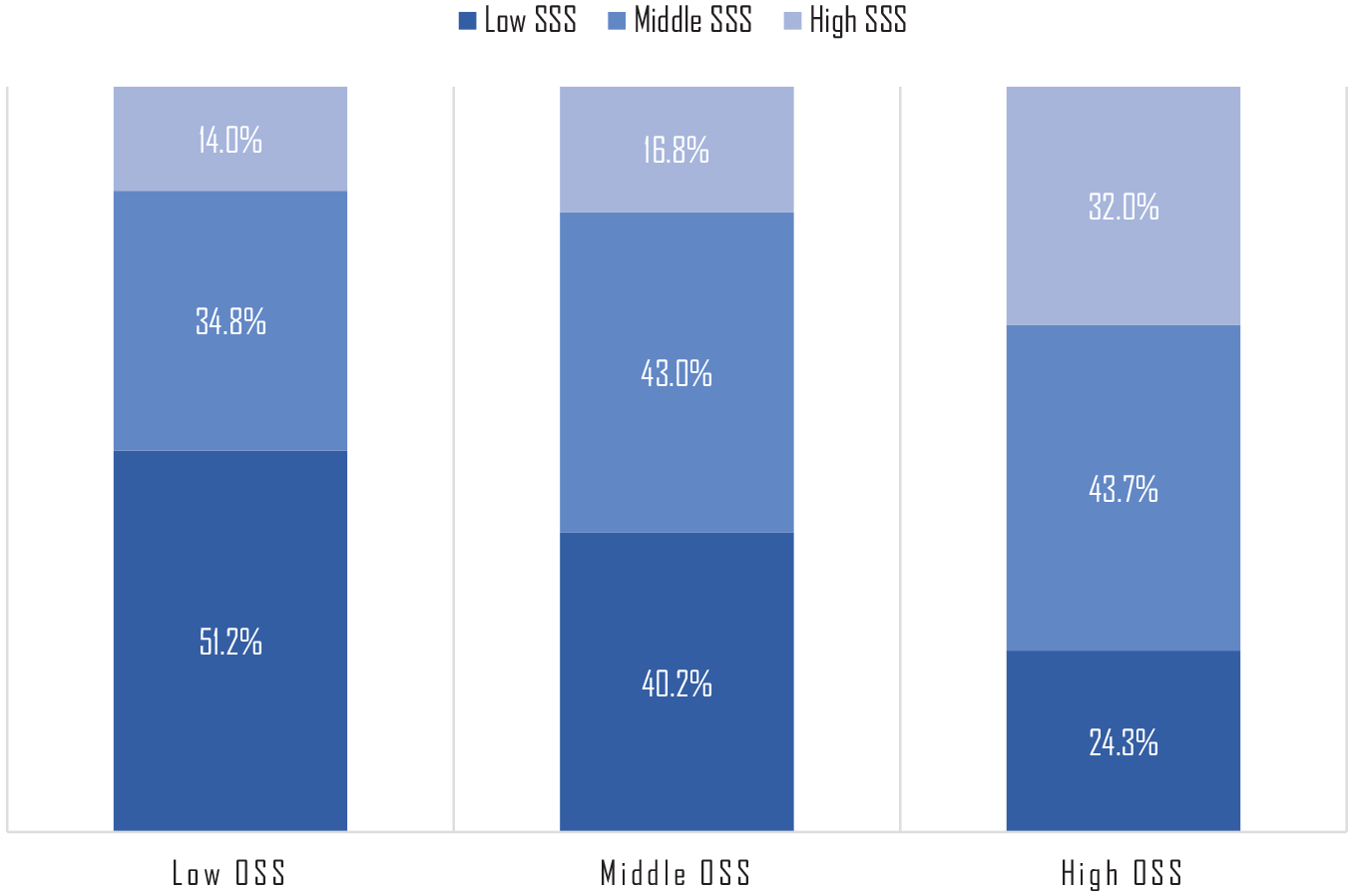
Percentages of subjective status for objective status subgroups.
Profile of cultural consumption across status groups.

Nevertheless, Table 4 cannot tell us whether OSS or SSS plays a more critical role in determining people’s cultural consumption, or whether their effects differ across status inconsistency types. DRM-based analyses are needed to answer these questions.
DRMs for status inconsistency
Tables 5 reports the results from Model 1 described in the statistical models section of the supplementary material. The passives cluster is chosen to be the reference group in our multinomial diagonal reference models. The results show that both OSS and SSS weights are significant predictors for the likelihood of belonging to the omnivore profile rather than to the passive profile. This main finding indicates that objective and subjective status both exert an influence on eclectic cultural consumption, which supports the combining mechanism. Nevertheless, OSS is much more influential than SSS. Thus, although both OSS and SSS are combined to explain omnivorousness, there is a preponderance of the materialistic hypothesis (H1a).
Estimates of effects from Model 1 (passives as the reference group).
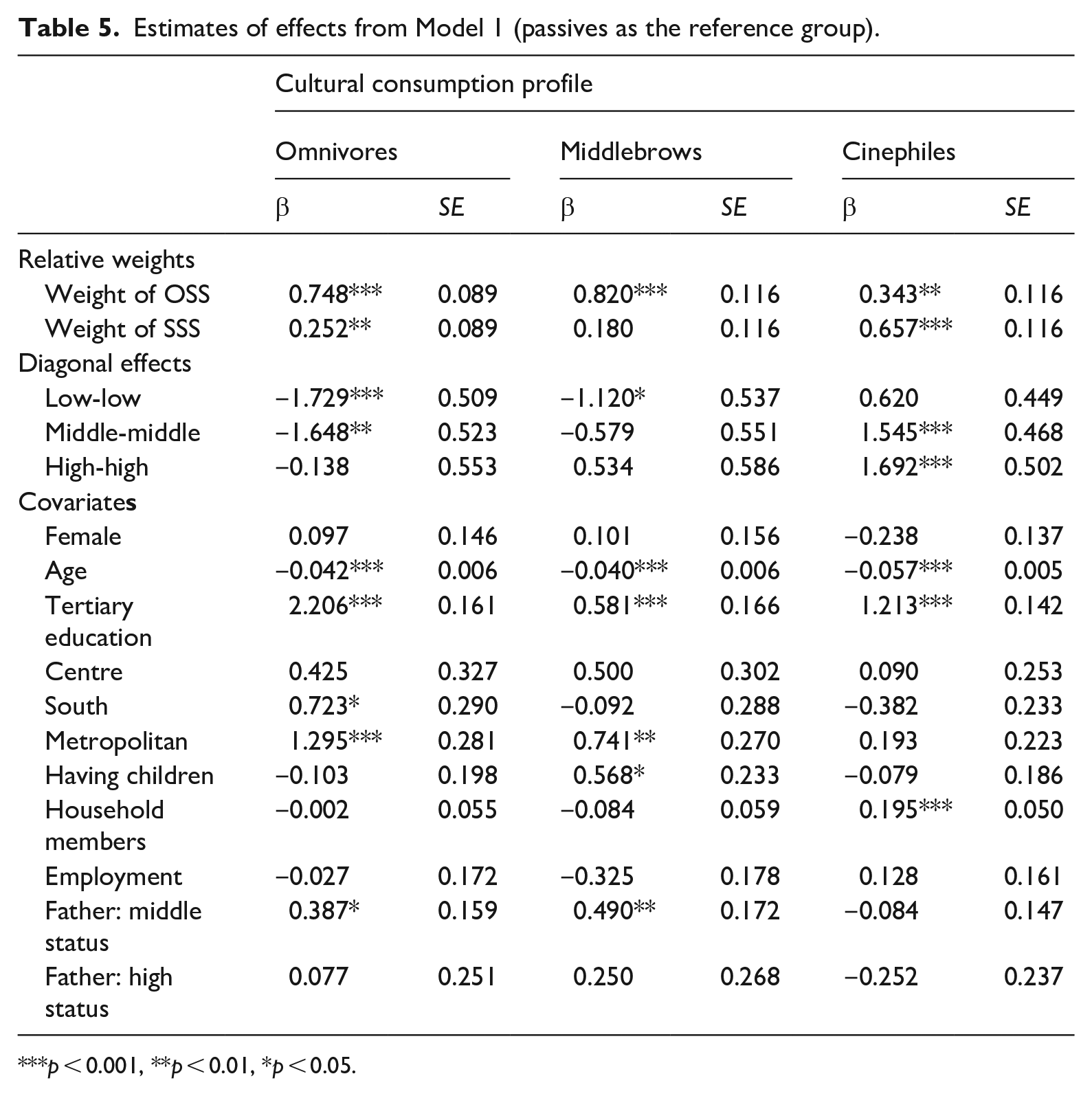
p < 0.001, **p < 0.01, *p < 0.05.
Meanwhile, the diagonal cells’ main effects augment with status, indicating that the likelihood of being omnivores rather than passives increases along with the increase in status when OSS and SSS are congruent. As for middlebrows, the weight of subjective status is small and not significantly different from zero. The objective status accounts for more than 80% of the likelihood of belonging to this cluster. That is to say, objective status is a major determinant for middlebrow individuals. Opposite to the former two clusters, subjective status plays a more important role in being a cinephile. The easier access to digital products could explain this compared to other forms of cultural activities. Still, we are unsure whether this explanation holds when we consider different types of status inconsistency, which will be tested in the next section.
To present the relative effects of OSS and SSS more directly, Figure 3 reports the predicted probabilities of belonging to a certain consumption profile given a set of common covariates’ values based on Model 1 (supplementary material). The covariate scenario is set to being a Chilean man who is 40 years old, has no tertiary education experience, has children, has a job, lives in the Metropolitan Region, and grew up in a family of middle socioeconomic status. Figure 3 shows six combinations of OSS and SSS for predicting cultural consumption under this scenario. This finding supports the combining mechanisms because individuals with high OSS and high SSS have the highest probability of being omnivores, while individuals with low OSS and low SSS have almost the lowest probability of becoming omnivores. While the difference between scenarios 1 and 4 is quite small, the largest gap arises between these scenarios and scenarios 5 and 6, which further supports the relative importance of objective status (especially high objective status) compared to subjective status in affecting individuals’ cultural consumption.
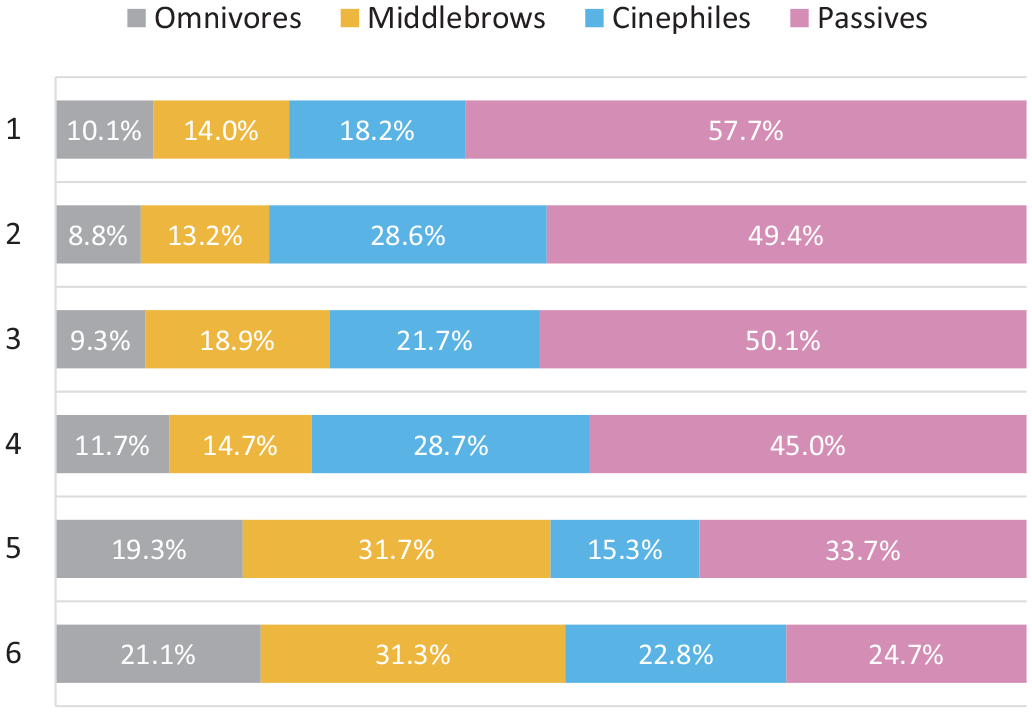
Predicted probabilities of profiles in cultural consumption given a certain set of covariates.
Weights of OSS and SSS under inconsistency
A basic finding from the models above is that cultural omnivorousness is affected more by objective than by subjective status for status incongruent individuals. Nevertheless, it is still unclear whether OSS and SSS’s relative importance varies between different types of status inconsistency. That is, whether status-overestimating and -underestimating actors share the same weights of effects for OSS and SSS on their cultural consumption. Figure 4 reports the relative weights of OSS and SSS for status-underestimating and -overestimating groups in cultural consumption based on Model 2 described in the supplementary material. 3 The results are different across consumption clusters. For the likelihood of becoming omnivores rather than passive actors, despite OSS being higher than SSS or vice versa, objective status always exerts a stronger influence (81.8% and 64.6%). While the weight of SSS increases to some extent for status-overestimating individuals, this result contradicts the Lenski balancing hypothesis – which expects the weight will incline to the higher status dimension. Although subjective status has a positive effect on omnivorous behaviour, it is always limited relative to the role of objective status. People have little intention or few opportunities to identify their class affiliation by practicing omnivorous cultural consumption that does not conform to their objective social status.
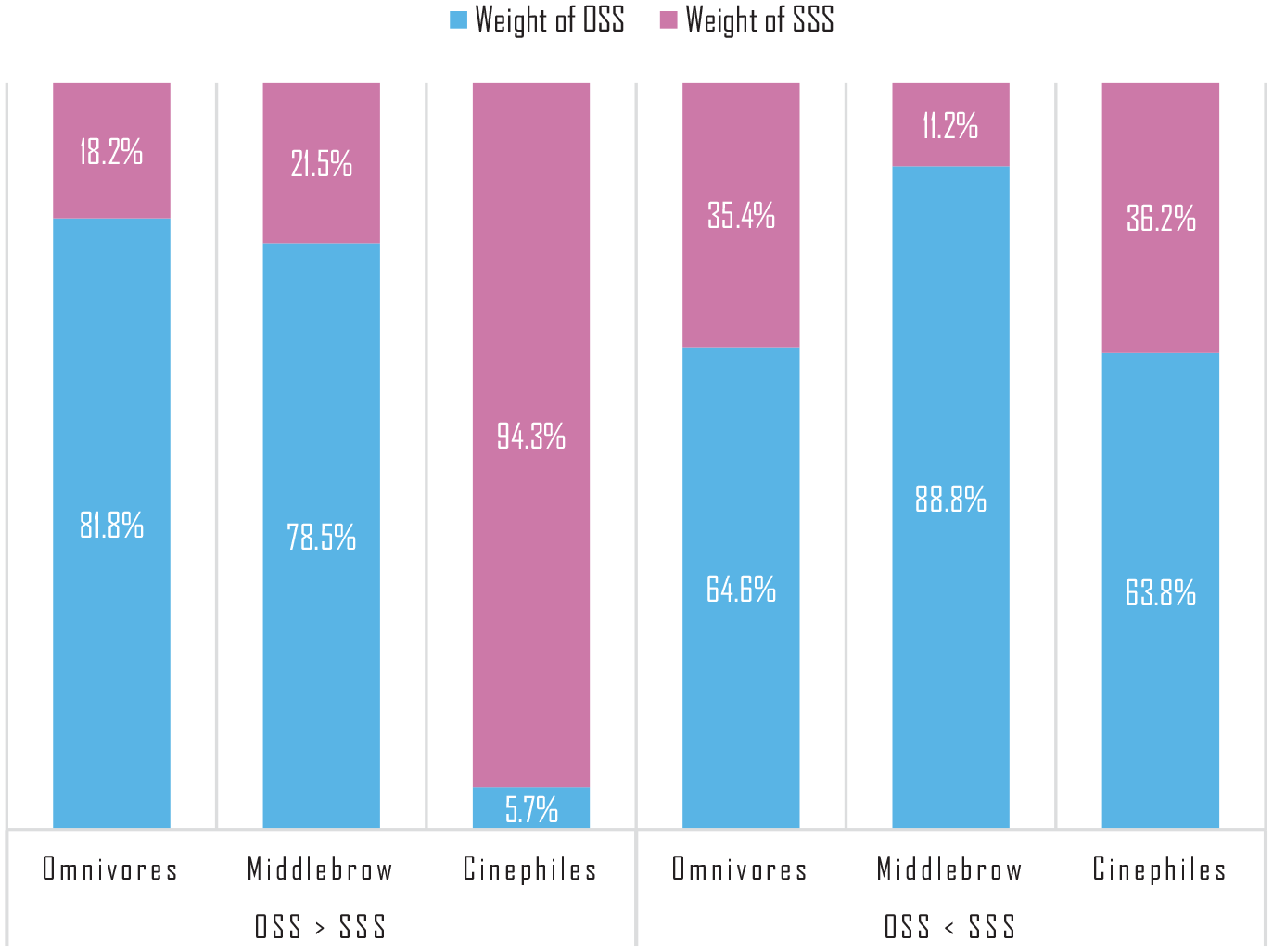
Relative weights of objective status and subjective status for underestimating (OSS > SSS) and overestimating (OSS < SSS) status groups in cultural consumption.
Similarly, OSS plays a leading role in determining individuals’ activity of consuming middlebrow cultural products for both types of status inconsistency. On the contrary, for the likelihood of becoming cinephiles, individuals’ subjective status matters more when their objective status is higher than their perceived status. However, when people have a higher subjective than objective status perception, the importance of objective status has a greater impact in predicting their cultural participation for cinephiles. Since this profile incorporates digital media, it refutes the idea in ‘DRMs for status inconsistency’ section that access to digital cultural activities is more democratic than other forms of activities. Instead, objective status still imposes restrictions on individuals’ cultural consumption of digital products for those who perceive themselves as high-status.
Overall, these results support H2a that the objective social position exerts a dominant effect on cultural omnivorous practice across status inconsistency types. Generally speaking, lower subjective status can economise cultural consumption and increase the likelihood of being passive but not vice versa. In the circumstance of SSS > OSS, lower objective status inhibits individuals’ engagement in higher brow cultural activities, which may signal their desired collective identity, making subjective status retain its subordinate impact. Thus, with financial barriers and the capacity of aesthetic judgment for accessing these cultural practices, subjective social status plays a smaller role in influencing people’s cultural participation.
Sensitivity analyses
Four crucial sensitivity analyses were conducted to check the robustness of our results. They are reported in section 3 of the supplementary material. Our findings are robust against different and fewer items in the LCA; models without education as control; analyses using a continuous indicator of omnivorousness; and alternative explanatory variables’ recodifications.
Conclusion
The aim of this study was to examine the relationship between SSS and OSS and one of the most significant theoretical paradigms in cultural sociology: the cultural omnivore. Our results suggest that subjective and objective status positively predict omnivorousness. When both dimensions of stratification are high, individuals have the greatest likelihood of being cultural omnivores, as suggested by the combining mechanism. However, when comparing both resources, individuals’ OSS stands out as the prominent determinant of omnivorousness: its weight is 3 times higher than SSS’ weight. From this result, we join the conceptualisation of the omnivorousness phenomenon as a disposition that reflects internalised objective social positions (Lizardo and Skiles, 2012). Although there is still an effect of subjective social status, the higher weight of objective position does not support the understanding of omnivorousness as a primary conscious or rational desire to gain status. Policies aiming to achieve a higher level of cultural engagement across the board might address inequalities in objective resources that restrict participation.
Furthermore, Chileans showed a significant rate of inconsistency between objective and subjective social status. This is consistent with previous studies in the Chilean context (Castillo et al., 2013). The findings indicate that, for both status-overestimating (SSS > OSS) and status-underestimating (SSS < OSS) individuals, OSS is the most significant predictor of omnivorousness. Although we cannot rule out other determinants of socioeconomic advantage, this finding is consistent with the materialistic hypothesis, which suggests that OSS is a relatively more important predictor of cultural omnivorousness than subjective dimensions of stratification. In other words, the consciousness or intention to signal belongingness to a certain social group is strongly limited by material conditions.
This finding is particularly relevant for studies of elite consumption. Elite groups who identify themselves with lower socioeconomic status are part of what we have termed as underestimating individuals. One of the explanations offered to the elite consumption of lowbrow culture phenomena is a desire for ruling out suspicions of authenticity (Hahl et al., 2017). Our study shows that this group mainly uses objective social positioning to consume a wider range of cultural products and not their subjective or desired notion of status.
For omnivorous literature, a long-standing finding is that status, education, and income are important predictors of developing eclectic profiles of cultural consumption (Alderson et al., 2007; Jæger and Katz-Gerro, 2010; Peterson, 2005; Torche, 2007). In this study, we have incorporated self-placement as an additional dimension of social stratification of culture. Both objective and subjective status are combined to explain cultural omnivorousness. Despite their relative weights, a comprehensive understanding of cultural participation patterns might consider both dimensions of status as resources of distinction.
As recently suggested by Reeves (2019), the incorporation of subjective identification enables sociologists to elucidate cultural politics and how material and symbolic distinctions play out. Under certain conditions, self-identification with a status group could even substitute objective status but combined are the most effective deployment of resources to facilitate omnivorousness. Therefore, to the few studies examining omnivorousness in Chile (Torche, 2007, 2010), in Latin America (Gayo, 2016), and developing countries (Rankin and Ergin, 2017), we add the contribution of self-placement in the explanation of cultural consumption. For Chilean society, diversity in cultural participation is a vehicle to express social distinctions based on both objective and subjective social status. Despite the prominence of objective status, the incorporation of subjective social status in explaining individual behaviour responds to recent calls (Pérez-Ahumada, 2014) in the social stratification literature to incorporate subjective dimensions of stratification as explanatory factors of individual behaviour in Chile.
In addition, interview-based evidence has made important contributions to omnivore research over the last years (Jarness, 2015; Yalvaç and Karademir Hazır, 2020). It has made possible the introduction of important nuances to survey-based research. One of those contributions is the emphasis on how individuals engage in cultural consumption (Yalvaç and Karademir Hazır, 2020). Although our research design does not enable us to examine the meaning-making process, we have included cultural consumption items that could shed light on those nuances. Namely, digital forms of consumption. In our measurement strategy, individuals declared whether they read or watch movies and whether they do it by traditional or digital means. Only recent empirical studies have started to consider digitalization in cultural omnivore research (Weingartner, 2020). In this study, two are the main implications of this innovation. First, the cluster of omnivores engages in both digital and non-digital activities. Second, there is a clear-cut distinction between middlebrow individuals who prioritise going to the cinema and individuals who watch films (cinephile) in both cinemas and streaming. We have shown that subjective status has a stronger weight than the objective social position for cinephiles than for other more eclectic profiles. However, when analysing the particular resource configuration of underestimating and overestimating actors, the formers can deploy their subjective social status, while the latter group is strongly constrained by their objective social position. Therefore, the profile that distinctively uses streaming platforms reflects important social inequalities.
Peterson’s work has been criticised for conflicting cultural tastes and practices (Brisson, 2019). When taste and consumption are combined without distinction, researchers talk about incomparable objects. Thus, cultural sociologists have called for greater conceptual clarity in this regard (Karademir Hazır and Warde, 2016). In this study, we have focused only on cultural practices and not on taste or cultural knowledge. In this regard, by incorporating taste measurements, the operationalization of omnivores as individuals who do not dislike lowbrow culture has been recently termed as the strong version of omnivorousness (de Vries and Reeves, 2021). Therefore, it opens avenues for further research addressing the effect of stratification on other omnivore conceptualizations. Studies may also consider causal examination of the relationship between status and cultural consumption. Our findings suggest potential causal relationships, but we cannot rule out all the possible confounders or reciprocal effects. A related limitation of the study is the set of cultural participation measurements. Although we used a heterogeneous array of eight items, and incorporated items that have not been used in previous studies, certain everyday cultural activities (Miles and Gibson, 2016) with lower economic barriers have not been addressed, such as watching television or amateur sports. Future studies might incorporate these kinds of indicators that are often left out of surveys gauging cultural consumption.
Another possible extension is a closer examination of the resources of subjective self-placement in the social hierarchy. A recent study has suggested that class consciousness could be a fruitful research agenda in Chile and current capitalist societies in general (Pérez-Ahumada, 2014). In addition, empirical evidence suggests that the majority of Chileans define their social position in reference to unequal distribution of socioeconomic resources, rather than making an explicit reference to specific social classes (MacClure et al., 2020). In contrast to class identity, SSS does not include a specific dimension of stratification (Karlsson, 2017). Individuals could attribute divergent meanings to different social hierarchies and explain a different configuration with OSS in the explanation of omnivourness. Thus, class identity, for example, could have different effects on patterns of consumption.
Supplemental Material
sj-pdf-1-sro-10.1177_13607804221078023 – Supplemental material for Cultural Omnivorousness and Status Inconsistency in Chile: The Role of Objective and Subjective Social Status
Supplemental material, sj-pdf-1-sro-10.1177_13607804221078023 for Cultural Omnivorousness and Status Inconsistency in Chile: The Role of Objective and Subjective Social Status by Francisco Olivos and Peng Wang in Sociological Research Online
Footnotes
Acknowledgements
Francisco Olivos acknowledges the support of the Hong Kong PhD Fellowship Scheme. We are grateful to the editor and reviewers for their suggestions that improved this article. We also thank Saoussane Ghali, Pablo Geraldo, and Alexis Sossa for their comments on the previous version of the manuscript. We thank the generosity of Tak Wing Chan and Heather Turner for their advice on estimating multinomial diagonal reference models and for openly sharing their codes. All the errors and omissions are ours.
Declaration of conflicting interests
The author(s) declared no potential conflicts of interest with respect to the research, authorship, and/or publication of this article.
Funding
The author(s) received no financial support for the research, authorship, and/or publication of this article.

Supplemental material
Supplemental material for this article is available online.
Notes
Author biographies
References
Supplementary Material
Please find the following supplemental material available below.
For Open Access articles published under a Creative Commons License, all supplemental material carries the same license as the article it is associated with.
For non-Open Access articles published, all supplemental material carries a non-exclusive license, and permission requests for re-use of supplemental material or any part of supplemental material shall be sent directly to the copyright owner as specified in the copyright notice associated with the article.
