




Abstract
This study aims to investigate and compare the determinants of gender preference for children in rural and urban China under the values of children to parents (VOC) approach by focusing on the effects of attitudes to elder care and gender roles, and the attainment of insurance programs. Using pooled cross-sectional data from 2013 and 2015 of the Chinese General Social Surveys, we found that rural individuals expecting children responsible for old-age support exhibit daughter preference, followed by balance preference, whereas their urban counterparts show similar son preference and daughter preference. In addition, balance preference is associated with traditional gender role attitudes among rural individuals but correlated with more equal gender attitudes among urbanites. Furthermore, having more economic security decreases rural individuals’ preferences for having more daughters. The findings suggest that the prevalent balance preference and the rising preference for daughters have quite different implications on the gender relationship between rural and urban China, and traditionalism still drives gender preference in rural China. Policy implications are also discussed.
Keywords
Introduction
Son preference is a deeply trenched cultural tradition in China. Balance preference, specifically the ‘one son and one daughter’ composition, however, has been found to be the most popular in recent years (Hou et al., 2018; Shi et al., 2017). Gender preference for children to a certain degree reflects gender relations in a society. Theoretically, when gender relations in a society become equal that means sons and daughters play interchangeable roles, and gender preference will transit to gender indifference. Gender indifference refers to a situation in which people have little incentive to prefer one gender over the other, as parents feel that a son is as good as a daughter, or vice versa (Lin, 2009; Pollard and Morgan, 2002; Tian and Morgan, 2015). As people’s perception of gender is not synchronized with the ‘actual’ social change, people may still want children of both genders, such as the balance preference (Gray et al., 2007). Differing from gender indifference, balance preference indicates that people desire an equal number of sons and daughters, in which gender is still a main consideration (Lin, 2009).
The bulk of research has found that the traditional son preference in Western societies with equal gender system has been replaced by the other three forms of gender preferences, such as gender indifference in America, balance preference in Australia, and daughter preference in Nordic countries (Andersson et al., 2006; Gray et al., 2007; Pollard and Morgan, 2002; Tian and Morgan, 2015). The findings suggest that equal gender relations may bring the non-traditional gender preference for children, but not the other way around. Using data from the Japanese National Fertility Survey in 1997, Fuse (2013) examined the relationship between daughter preference and gender relations in Japan and found that women with more traditional gender role attitudes are more likely to prefer daughters over sons. She argued that the emerging daughter preference in Japan was not a reflection of the high status of women, but the persistent divergence in gender roles.
The gender system in China has become increasingly equal, especially since the 1990s (Qian and Li, 2020; Yang, 2017). Meanwhile, recent research has also identified that daughter preference has been rising and gender balance preference for children has been the most prevalent against the backdrop of low fertility intention in China (Hou et al., 2018). However, some research has found that a growing number of parents value daughters, especially in rural China, mainly because daughters are more reliable caregivers for aged parents than sons (Liu, 2017; Shi, 2009; Zhu et al., 2023). If daughters are desired based on the gendered division of labor, then the prevalence of balance preference should be interpreted with caution, as it may still indicate unequal gender relations.
Therefore, in the present study, we examine the extent to which the preference for ‘one son and one daughter’ composition or the daughter preference is a reflection of persistent divergence in gender roles in China. As there exist huge social and economic gaps between rural and urban China, it is essential to explore whether and how the implications of gender preferences on gender relations differ between rural and urban China. To address these questions, the study will directly examine and compare the effects of elder care attitudes, gender norms, and social security attainment on gender preference for children between rural and urban individuals against the backdrop of low fertility intention in China. The article adds to previous findings on the relationships between gender preference for children and the unequal gender system of Chinese society and provides evidence for policy development toward a more gender-equal society.
The VOC approach and rural–urban disparity of the changing values of sons and daughters in China
Many of the studies on fertility behavior are founded on the value of children (VOC) to parents approach. The VOC approach, first developed in the 1960s, identifies nine values of children to parents, such as economic utility, expansion of the self, adult status and social identity, and so forth (Hoffman, 1975; Hoffman and Hoffman, 1973). Although this approach has been criticized for it being grounded on the rational choice theory where people weigh the pros and cons, and as if they know all the options and the consequences of these options (Adams, 2016), it draws extensive attention to three broad aspects shaping fertility intentions and behavior: (1) the value of children to parents, (2) the costs of having children, and (3) alternative ways in which those values can be attained (Eklund, 2016; Nauck, 2014). Under the VOC approach, we analyze how the changing values of sons and daughters in old age support as well as the development of social security affect rural and urban people’s gender preferences in China.
In the traditional patriarchal society of China, sons are mainly expected to take responsibility for the prosperity of the family, to continue the male lineage, and to provide old-age support for their parents. The economic and cultural utilities of sons have long been the main reasons for son preference in China (Murphy et al., 2011). Regarding the values of daughters, there is an old saying in China that a daughter is like a little quilted vest (xiao mian’ao) to warm her parents’ hearts, which means daughters are expected to provide intimate care, love, and affection for parents. As the traditional standards of filial practice do not emphasize emotional care, therefore, daughters have been relegated to a peripheral role within their natal families (Evans, 2010, 2012; Murphy et al., 2011).
Since the late 1970s, China has conducted economic reform and implemented the one-child policy. The one-child policy was to curb population growth by restricting most families to one child, and in early 2016, it was replaced by the two-child policy. During the one-child policy era, with the decrease in the number of siblings, daughters, especially singleton daughters in urban China, enjoyed unprecedented parental investment and support in education (Fong, 2002; Hu et al., 2022; Lee, 2012). In addition, the development of the market economy provided millions of job opportunities for both men and women. The growing educational achievement and economic independence significantly improved women’s status inside and outside the family (Wu et al., 2014).
Consequently, adult daughters, especially those in urban areas, obtained the ability to demonstrate their filial piety by playing a more active role in providing their aged parents with daily care and emotional bonding, and also at least as much financial support as sons do (Evans, 2012; Ling, 2017; Liu, 2017). Zeng and his colleagues (2016) analyzed the datasets of the Chinese Longitudinal Healthy Longevity Survey and found that elder parents enjoyed better filial piety and care from daughters than sons in both rural and urban China. Lei (2013) used Chinese General Social Survey data to compare the monetary and emotional support provided by sons and daughters and also found that parents received a higher level of monetary and emotional support from daughters than from sons in urban areas (similar findings can also be found in Hu, 2017; Xie and Zhu, 2009).
Meanwhile, the traditional standards of filial practice have also been modified. Previous research has identified that as society modernizes, the emotional value of children has become increasingly essential to parents (Caldwell, 1976). Recent studies lend support to the argument by demonstrating that the emotional bond with parents has become an essential standard of filial practice in both rural and urban China (Evans, 2010, 2012; Ni, 2023). In line with the standards, daughters are considered as more reliable caregivers for parents both emotionally and financially (Ling, 2017), whereas sons are generally perceived to lack the ability to build emotional ties with their parents (Eklund, 2016). It seems that urban daughters’ assistance for parents is comparable to sons’ contributions, and gender disparity of filial practice has been diminished in urban areas, accordingly.
However, sons are still desired among the rural people because of their financial and cultural significance to parents (Cong and Silverstein, 2014; Lin et al., 2021). For instance, Liu (2017) based on her study in rural China found that although daughters played a more active role in caring for their parents, aged parents still named sons to be the preferred financial support providers. Gao (2014) in a study on the changing roles of sons and daughters in rural China also found that although daughters provided much more daily care for parents than sons, the latter still played an irreplaceable role in parents’ elder care and the funeral ceremony in rural China. Therefore, it remains difficult for rural people to give up the idea of having at least one son (Eklund, 2015).
Nowadays, the declining birth rate and fertility intention in China has drawn extensive attention. To increase the birth rate, the one-child policy was abolished in late 2015, and later succeeded by a two-child policy in 2016. Since 2021, the state has implemented the three-child policy. However, the total fertility rate in China is still quite low, with about 1.3 in 2020 (National Bureau of Statistics, 2021). The majority of women aged between 18 and 49 years in both rural and urban China reported no more than two children as their ideal number of children (Yu et al., 2021). Against this backdrop of low fertility intention, rural individuals with the idea that children should provide old-age support may shift away from the traditional son preference to a balanced gender composition with one boy and one girl as a strategic choice. As sons and daughters play interchangeable roles in old-age support, urban individuals may have no special preference for sons or daughters. Therefore, we hypothesize that rural individuals expecting children to provide old-age support tend to prefer a balanced gender composition of children, whereas their urban counterparts tend to exhibit gender indifference (H1).
Generally, individuals with traditional gender role attitudes are more likely to prefer sons, due to the values of sons for parents and family based on traditionalism. The rising preference for daughters in recent years seems like an indication of equal gender relations. However, if we take a closer look at the phenomenon, daughters are valued mainly because they are regarded as more reliable caregivers, and meanwhile, sons are still irreplaceable as financial providers among rural individuals (Ling, 2017; Zhu et al., 2023). The different expectations of parents on sons and daughters reflect the persistent gendered division of labor inside the family.
In addition, based on traditional gender norms, sons are expected to take more responsibilities for family prosperity and the welfare of parents, and accordingly, parents generally invest more in sons (Lin et al., 2021). For instance, parents are expected to be financially responsible for their sons’ marriage, such as providing housing, bride price, and the wedding banquet in China (Ling, 2017). With the urbanization in the recent two decades, housing prices in China have been soaring, and providing housing for sons has become the main financial burden of parents (Eklund, 2016). Rural parents may feel much stronger pressure because the issue of the ‘man surplus’ resulting from the past few decades of highly imbalanced sex ratios at birth is more severe in rural areas, which has increased the financial burden of marrying off sons (Ling, 2017). Therefore, the pressures that parents perceive to raise a son are found to attenuate individuals’ traditional son preference, particularly among rural parents (Kim and Fong, 2014; Ling, 2017).
Theoretically, traditional-minded individuals are likely to have a son preference. Meanwhile, individuals with traditional gender role attitudes also tend to feel the pressure to raise a boy in China. It is possible that in dealing with the contradictory feelings, they may choose a compromising option against the backdrop of low fertility intention, namely, the balanced gender composition of children. Therefore, we hypothesize that individuals with more traditional gender role attitudes tend to have a son preference, whereas rural counterparts are more likely to have a balance preference as well (H2).
The uneven development of social security system in rural and urban China
According to the VOC approach, children’s values can be attained in alternative ways, and as one possible alternative way for children’s values in terms of old-age support, the social security system is found to be interlinked with gender preference (Brockmann, 2001). Owing to the lack of retirement pensions, the rural elderly in China rely heavily on monetary transfers and other kinds of economic support, mainly from their sons. For instance, based on the 2008–2009 Chinese Longitudinal Healthy Longevity Survey data, rural elderly received 91% more financial support from sons than daughters (Zeng et al., 2016). The lack of pension income enhances the rural elderly’s reliance on sons’ financial support, which is therefore considered to be one important reason for the persistence of son preference in rural China (Liu, 2017; Zeng et al., 2016). By contrast, the elderly in urban China get most of their financial support from retirement pensions, personal savings, and social security programs (Zeng et al., 2016). Theoretically, if individuals receive enough support from social security, traditional son preference will be diminished, and vice versa. Eklund in her study on gender preference in China revealed that son preference has been intensified in urban China during the 1990s, coinciding with the dismantlement of welfare institutions (Eklund, 2011).
Basic pension insurance and basic medical insurance are the two key social security programs in China. The state started to conduct the basic pension insurance in rural and urban China in 2009 and 2011, respectively, and the two systems were merged as basic pension insurance in 2014. By the end of 2012, the number of participants in rural basic pension insurance reached 460 million, which represents nearly full coverage in rural China (Cheng et al., 2018). The basic pension insurance is jointly paid by individuals and the government to ensure a minimum income for all elderly participants (Zeng et al., 2016). According to the new minimum standard of the basic pension released in 2023, the monthly pension in most regions of the country is no more than 200 yuan, which is only about a tenth of the average monthly retirement pension (National Development and Reform Commission, 2023). The basic pension is far from adequate for elders’ daily life. As urban elderly mainly rely on retirement pension, therefore, the rural elderly are the main recipients of the basic pension insurance. Accordingly, there exists a huge rural–urban disparity in terms of pension income.
Regarding basic medical insurance, the new rural cooperative medical insurance has been implemented since 2003. Since then, the government has continuously increased its investment in the new medical insurance system and gradually raised the reimbursement standard. However, rural cooperative medical insurance still lags far behind urban basic medical insurance in terms of reimbursement ratio and coverage (Tao et al., 2020; Zhu et al., 2017). In addition, the state also advocates developing commercial insurance as an important supplement to social insurance. Theoretically, the more people have social and commercial insurance, the less they rely on children’s support, and accordingly, the traditional son preference will be attenuated. Furthermore, as urbanites have more ways than rural individuals to attain economic security, the effects of insurance attainment on urbanites’ gender preference will be less evident than on rural individuals’ preference. Therefore, we hypothesize that the more insurance programs people have, the less likely they are to show son preference, and the effects are more evident in rural individuals (H3).
Data and variables
Data
Data used in this study are drawn from the Chinese General Social Survey (CGSS). Modeled on the General Social Survey in the United States, CGSS collects data through face-to-face interviews using internationally standardized questionnaires adapted to the Chinese cultural and social context. CGSS collects data on social change from more than 10,000 households in China at regular intervals since 2003. CGSS is aimed to systematically monitor the changing relationship between social structure and quality of life in both urban and rural China. By now, more than 2500 journal articles have been published in mainly two languages, Chinese and English, based on CGSS data. 1
In this study, we pooled data from the two recent survey cycles conducted in 2013 and 2015 to get a large data sample. With a focus on people’s gender preference for children, the analytical sample includes people aged between 20 and 49 years old. Based on the household registration (hukou) system, every Chinese citizen is required to register as a rural or urban hukou. Hukou status was once closely correlated with social security attainment, and after several rounds of reforms since early 2000, hukou segregation has been gradually diminished, but urban hukou status still maintains advantage in accessing social pension insurance for retirement pension income (Wu and Xiao, 2020). Therefore, to do a rural–urban comparison, we separate respondents into two analytical samples based on their hukou status: respondents with rural hukou status are clustered into the rural sample, and respondents with urban hukou status are categorized into the urban sample. The final analytical sample sizes in survey 2013 and 2015 are 5466 and 4554, respectively, and the total sizes of rural and urban samples are 6399 and 3621, respectively.
Measures and variables
The dependent variable is gender preference for children. In the questionnaire, the respondents were asked, ‘If the policy allows, how many children would you want? And among them how many sons would you want, and how many daughters would you want? If you have no preference for either sex (wusuowei), please answer with 97’. We constructed a categorical variable. If respondents wanted more boys than girls, or gave the specific number of boys with 97 for the number of girls, then the answer was assigned to the ‘son preference’ category; if respondents wanted more girls than boys, or gave the specific number of girls but answered 97 for the number of boys, then it was assigned to the ‘daughter preference’ category; if respondents answered with an equal number of boys and girls, then it was assigned to the ‘gender balance’ category; if respondents answered 97 for both the numbers of boys and girls, then it was assigned to the ‘gender indifference’ category (Fuse, 2013; Lin, 2009). Hence, the dependent variable has four categories: son preference, daughter preference, balance preference, and gender indifference.
The key independent variables include elder care attitudes, gender role attitudes, and the number of insurance programs people have. For elder care attitudes, one question in the CGSS was about who should take responsibility for old-age support. Respondents were presented with four options: the government, self, children, and shared by government/children/the elderly. The latter two are categorized into the type of children and coded as 1, and the former two are categorized into the type of others and coded as 0.
Regarding gender role attitudes, there are four indicators measuring the attitudes toward the roles and status of women and men. All the indicators use 5-point Likert-type scales where 1 means ‘strongly disagree’ and 5 equals ‘strongly agree’. The four statements are: (1) men should focus on career development, and women should focus on family; (2) men are born to be more capable than women; (3) marrying well counts more than a career; (4) in a recession, female employees should be dismissed at first. The traditional gender role attitude is created by adding up the scores based on the responses to the four indicators. The higher the score, the more traditional the gender role attitudes are. Cronbach’s alpha of this measure of the traditional gender role attitudes is 0.65.
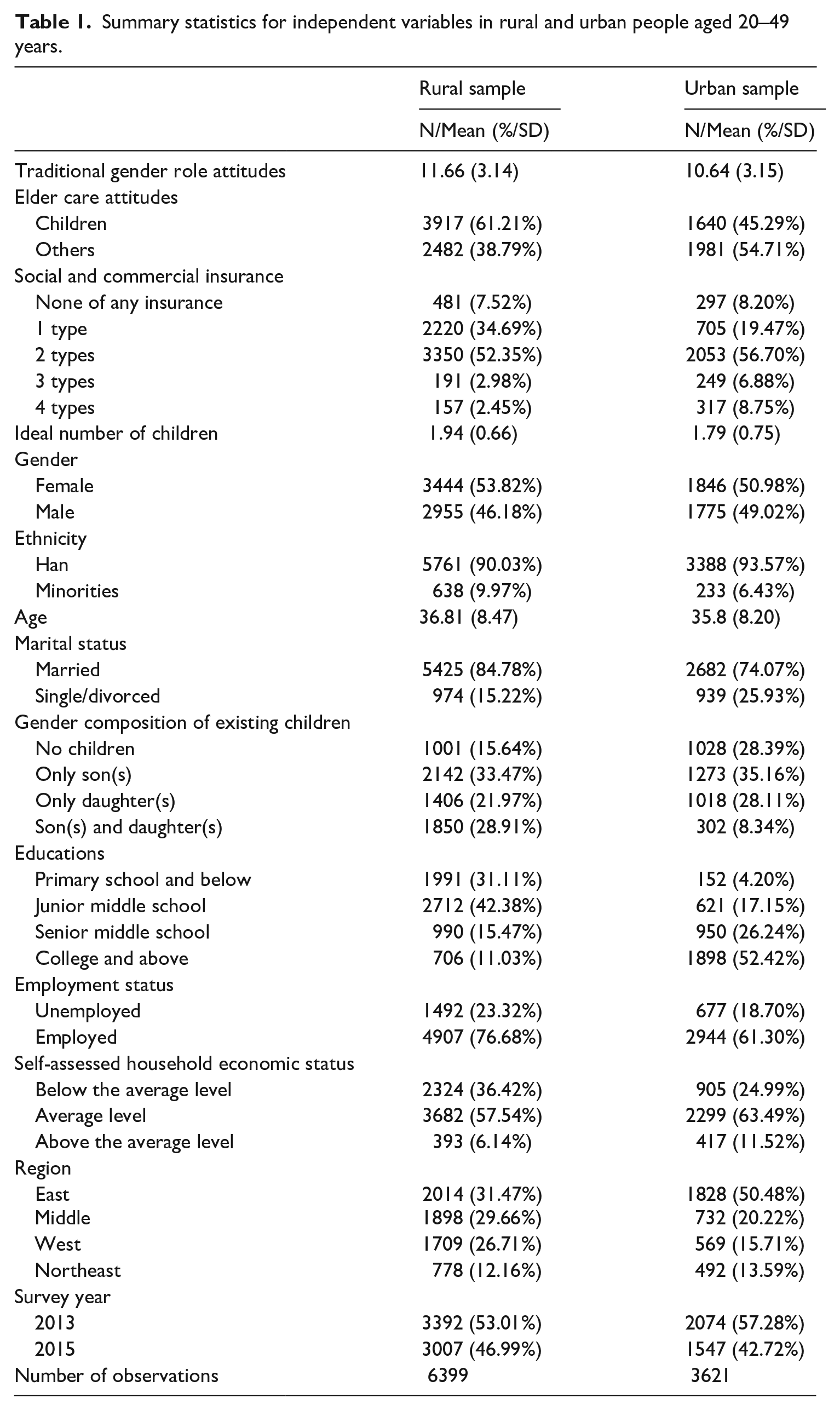
In the CGSS, respondents were asked whether they have basic pension insurance, basic medical insurance, commercial pension insurance, and commercial medical insurance. The number of insurance programs respondents have is from 0 to 4. Other individual and household characteristics include gender, ethnicity, age, education, gender composition of existing children, the ideal number of children people desire to have, employment status, self-assessed household economic status, and regions. Brief descriptions of these variables are presented in Table 1.
Summary statistics for independent variables in rural and urban people aged 20–49 years.
Analytical strategies
The analysis in this study is composed of two parts. In the descriptive statistics part, the preferred child gender composition by hukou status and an ideal number of children are presented. In the regression part, multinomial logistic regression analyses are conducted to examine the effects of the key independent variables on gender preferences in the rural and urban samples, respectively.
Results
Descriptive analysis
Table 2 presents a cross-tabulation that shows the ideal numbers of children and the corresponding preferred child sex composition. In the sample of preferring two children, around 85% of rural respondents and 86% of urban respondents reported balance preference. In the total samples, 62% of rural respondents and 56% of urban respondents had a balance preference. Based on Table 2, there exists a similar gender preference pattern in the rural and urban samples with the balance preference being the most popular, followed successively by gender indifference, son preference, and daughter preference.
Ideal gender composition of children by hukou status and the ideal number of children in the analytical samples.
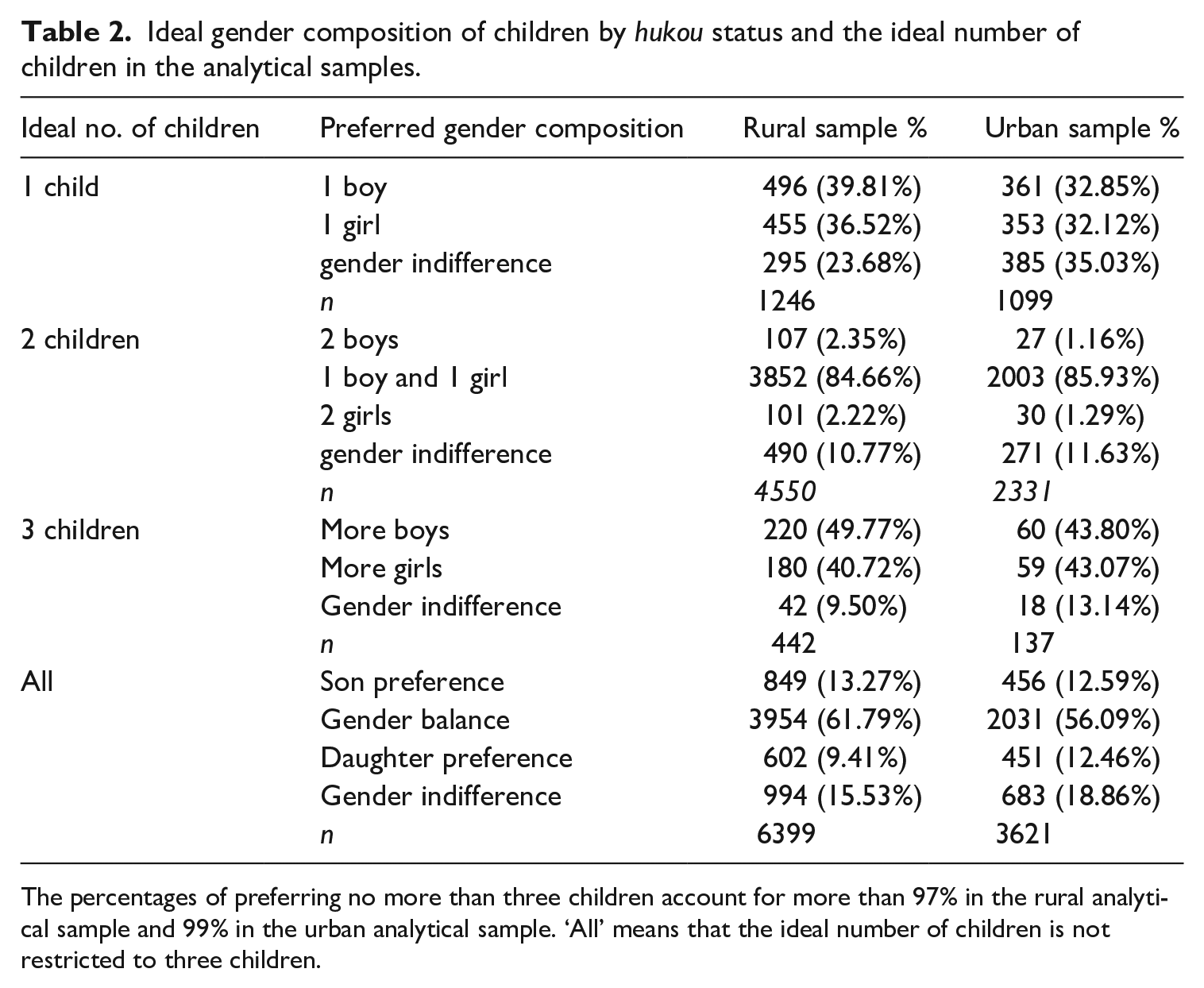
The percentages of preferring no more than three children account for more than 97% in the rural analytical sample and 99% in the urban analytical sample. ‘All’ means that the ideal number of children is not restricted to three children.
Regression results
Tables 3 and 4 present the results obtained through multinomial logistic regression analysis in the urban and rural samples, respectively. Elder care attitude affects the gender preference of rural individuals and urbanites differently. Rural respondents expecting children to provide old-age support have a greater probability to exhibit a daughter preference than the other three gender preferences. In addition, their odds of having a balance preference are higher than exhibiting gender indifference (p < .05). However, the urbanites expecting children for old age support have a greater probability to exhibit a son preference than a balance preference (p < .05) and a gender indifference (p < .05), whereas their odds of having a son preference is not significantly higher than exhibiting a daughter preference. Based on the results, our H1 is only partially supported.
Multinomial logistic regression results on gender preferences, rural people aged 20–49 years.
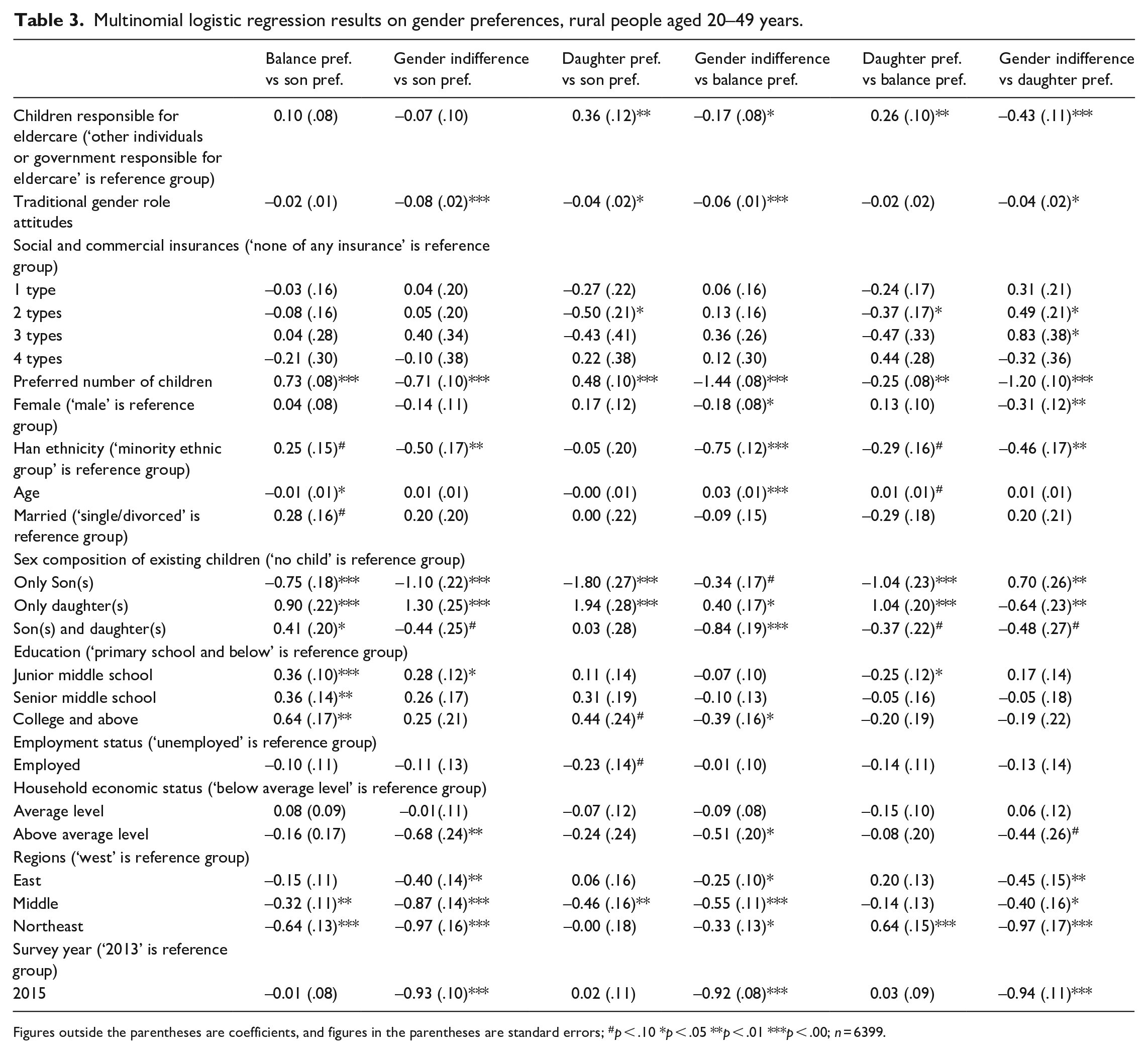
Figures outside the parentheses are coefficients, and figures in the parentheses are standard errors; #p < .10 *p < .05 **p < .01 ***p < .00; n = 6399.
Multinomial Logistic regression results on gender preferences, urban people aged 20–49 years.

Figures outside the parentheses are coefficients, and figures in the parentheses are standard errors; #p < .10 *p < .05 **p < .01 ***p < .00; n = 3621.
Gender role attitudes remain another significant variable in predicting gender preferences for children in both the rural and urban samples, but in different ways. In the rural sample, the higher the rural respondents score on the traditional gender role attitude scale, the greater likelihood for them to demonstrate a son preference than gender indifference (p < .001) and a daughter preference (p < .05), whereas there was no significant effect of gender role attitudes on the likelihood of demonstrating the balance preference versus son preference. In the urban sample, the higher urbanites score on the traditional gender role attitude scale, the less their probability of exhibiting a balance preference (p < .10), gender indifference (p < .05), and daughter preference (p < .05), compared with a son preference, and there were no significant effects of the attitudes on the likelihood of demonstrating the balance preference versus gender indifferent or versus daughter preference. The results suggest that rural respondents with more traditional gender role attitudes tend to have a son preference and then a balance preference, whereas a balance preference is associated with non-traditional gender role attitudes in the urban sample. The results lend support to our H2.
Consistent with our H3, having insurance exhibits more evident effects in the rural sample, but on decreasing daughter preference not on son preference. For rural individuals, those having two types of insurance programs have less probability to exhibit a daughter preference than a son preference (p < .05), balance preference (p < .05), and gender indifference (p < .05). Urbanites having three types of insurances have more probability to exhibit gender indifference than a son preference (p < .01), and meanwhile, urbanites having insurances have less probability to exhibit a daughter preference than a balance preference, with one type insurance at p < .05, two types at p < .10, and four types at p < .10.
Discussion
In this study, we used pooled cross-sectional data from 2013 and 2015 CGSS surveys to investigate and compare the determinants of gender preference for children in rural and urban China under the VOC approach by focusing on the effects of attitudes to elder care and gender roles, and the attainment of insurance programs. Consistent with the previous literature, there exists a similar pattern of gender preference in rural and urban individuals with the balance preference being the most prevalent; however, there is a rural–urban divide relating to the effects of gender role attitude, elder care attitude, and the insurance programs individuals have on gender preference for children.
Given the complementary roles of sons and daughters in parents’ old-age support based on the findings in previous research in rural families (such as Liu, 2017; Shi, 2009; Zhu et al., 2023), we assume rural people expecting children for their old-age support tend to have a balance preference. However, the results show that daughters are especially preferred, followed by balance preference. One possible explanation is that respondents in our analytical samples were aged between 20 and 49 years, and the young and middle-aged rural respondents may tend to place more importance on the emotional value of daughters. Importantly, individuals in this age group have more job opportunities and they therefore are more confident that women have the ability to provide economic support for aged parents. In comparison, the urban counterparts exhibit evident son preference compared with gender indifference, but did not show a significant preference for having more sons to having more daughters. The findings suggest that urbanites may believe daughters are as good as sons in old-age support, whereas they still care about children’s gender, and they exhibit a similar fondness for having son(s) or having daughter(s) when they expect just one or two children.
The rural–urban divide on the correlation between gender role attitudes and gender preference for children is also significant, demonstrating that traditional-minded rural individuals tend to have a son preference and balance preference, whereas balance preference is associated with more equal gender role attitudes in urban individuals. Against the backdrop of low fertility intention, rural people with more traditional attitudes tend to value sons’ cultural and financial utility for parents’ welfare, and meanwhile, they also feel the pressure to raise sons. Meanwhile, traditional-minded people also tend to believe that daughters have advantages in providing emotional and daily care for parents. Therefore, traditional-minded rural individuals are likely to prefer a balanced gender composition of children as a compromising option.
As one alternative way for children’s values, insurance programs in the study are found to enhance gender indifference compared with son preference in the urban sample, but casts negative effects on rural individuals having a daughter preference compared with the other three gender preferences. The findings suggest that when rural individuals have more security in life, they will decrease their preferences for having more daughters. This aligns with existing research indicating that the roles of daughters are more substitutable in rural people’s views and reflect the inequality of gender relations in rural China.
Based on the discussion above, traditionalism still drives gender preference in rural China. The findings of the study provide empirical evidence in support of the argument that daughters are desired in rural China primarily because they are reliable caregivers and because of their ‘natural’ advantage in emotional bonding with parents. The expectation for daughters’ roles is built upon the gendered division of labor in the domestic sphere, and accordingly, the prevalent balance preference in rural areas is not the manifestation of convergent gender roles, but the indication of the persistent divergence of gender roles. When traditionalism still drives gender preference in rural China, more attention should be paid to gender inequality, particularly inside the family.
Previous research has revealed that when daughters are desired mainly for their traditional role as family caregivers rather than their high status, the intrahousehold resources will not be equally distributed between sons and daughters (Hu et al., 2022). Since 2021, the state has implemented the three-child policy that allows each couple to have three children. During the three-child policy era, intro-household gender inequality should be paid more attention. Furthermore, if rural individuals prefer sons based on the traditional gender system, then it is still possible that they choose prenatal sex determination and abort female fetuses to guarantee to have a son under the social context of low fertility rate and low fertility intention (Zeng et al., 2016). Thus, more efforts should be devoted by the state to advancing women’s status in the family and in society, especially in rural China.
These findings are not only academically interesting but also have important policy implications. Although insurance attainment in the study is found to decrease rural individuals’ daughter preference, it does not mean that the social security system is beneficial to the traditional son preference and exacerbates gender inequality. As mentioned in the literature review section, current insurance programs in rural China are more backward, and the basic pension is not adequate for rural elderly’s daily life that, thus, sustains traditional son preference. To achieve a more gender-equal society, the state should devote more efforts to further developing the social security system, especially in rural China, by providing adequate pension and improving elder care service. When children’s values for their aged parents in terms of economic support and daily care can be attained through the social security system, then individuals’ gender preference based on the gendered division of labor will be eventually diminished.
Overall, the findings complement existing research and provide strong evidence for the theoretical argument on the relationship between gender preference and gender relations. Importantly, this study gave a detailed analysis of gender preference in China by focusing on the rural–urban disparity and the findings have important policy implications as well. Nonetheless, there are still some limitations. The study focused on adult individuals’ ideal gender preference for children based on their ideal number of children without considering the birth control policy, and therefore we do not examine the possible effects of the changing birth control policies on gender preference. In reality, people’s fertility intention and behavior are often affected by the birth control policies. China has experienced the one-child policy era, the two-child policy era, and now ushers in the three-child policy era. How the policy shifts affect gender preference for children is worth being further examined by using more recent datasets. Furthermore, the present study focused on rural–urban comparison in terms of gender preference for children. With the fast development of urbanization, millions of rural–urban migrants have settled down in cities. How rural–urban migration shapes individuals’ preference for gender composition of children is worthy of further research.
Footnotes
Acknowledgements
I am grateful to Professor Xiao Hong for the suggestions she gave me about drafts of this article. I also thank anonymous reviewers for the Sociological Research Online for their careful readings and detailed suggestions.
Funding
The author(s) received no financial support for the research, authorship, and/or publication of this article.