




Abstract
This study examines individuals’ religious tolerance (RT) using fuzzy hybrid TOPSIS and quantile regression applied to the WZB dataset. First, RT is measured using a thermometer scale, which is transformed into a semantic scale and synthesised into RT indicators for comparison. A quantile regression model is then used to assess the impact of socioeconomic factors on RT. The analysis covers eight nations – Germany, Cyprus, the USA, Lebanon, Palestine, Israel, Turkey and Kenya – based on four items assessing opinions about Jews, Christians, Muslims and atheists. The results show that Germans have the highest RT, while Lebanese have the lowest. Our results show that socioeconomic factors play an important role in shaping RT. Interesting insights are also obtained regarding the existing difference observed across countries.
Introduction
In the academic literature, the study of religious tolerance (RT) has made significant progress (Allport et al., 1954; Coward, 1986; Dion, 2002; Oviedo, 2016; Persson and Savulescu, 2013; Pettigrew and Tropp, 2013). The topic has been studied extensively, with particular emphasis on the possible relationships it may have with some socioeconomic characteristics (Ferrara, 2012; Kubicek et al., 2009; Oliveira and Menezes, 2018; Phillips and Kitchens, 2021; Rees, 2009). Kanol (2021) examines RT using four items from the Religious Fundamentalism and Radicalisation Survey module of the WZB–Berlin Social Science Center dataset. RT is measured by a feeling thermometer scale representing opinions about four groups: (a) Jews, (b) Christians, (c) Muslims and (d) atheists.
The study employs a fuzzy hybrid TOPSIS method to calculate and rank composite indices of RT, thereby addressing the inherent vagueness in attitudinal data. Unlike principal component analysis (PCA) or Confirmatory Factor Analysis (CFA) – which validate latent constructs under strong assumptions – fuzzy hybrid TOPSIS is flexible, assumption-light, and produces interpretable rankings, making it suitable for comparing RT across groups and countries. We apply both thermometer and semantic scales, using two aggregation methods for the former ( ‘down’ and ‘up’) and transforming the latter into 10- and 11-point versions. Quantile regression then assesses the socioeconomic determinants of RT. This approach complements prior work and showcases advanced quantitative methods in RT research.
The article proceeds by providing a Theoretical Background in the ‘Brief theoretical background on RT’ section. The ‘Data’ section presents the data extracted for this study, and the ‘Methodology’ section illustrates the methodologies implemented. The ‘Empirical results’ section will provide the results, while the ‘Discussion’ section will discuss them. Finally, the ‘Conclusions’ section will illustrate the conclusions of the study.
Brief theoretical background on RT
RT is a complex and multifaceted concept that encompasses not only coexistence but also mutual respect, understanding and the active recognition of pluralism (Dudin et al., 2018). Historically, the concept of tolerance has evolved considerably. In early civilisations such as Mesopotamia and Egypt, tolerance often had pragmatic roots, allowing for the coexistence of different religious practices (Shaw, 2008). However, it was not until the Middle Ages that religious exclusion became prominent, with the institutional dominance of Christianity and Islam (Soyer, 2007). The early modern period saw a renewed interest in the importance of tolerance, epitomised by the Treaty of Westphalia in 1648, which institutionalised religious coexistence in Europe (Armstrong, 2014).
Modern theories have extended this notion of RT as that which can develop social resilience at the individual level in multicultural settings. Puri and Kumar (2021) call for a move beyond liberal tolerance to an engaged pluralism that promotes mutual transformation and dialogue. This is also in line with the philosophical approach of Razavi and Ambuel (1997), who see continuous engagement and self-reflection as part of the definition of tolerance. These views, therefore, support RT not as a passive acceptance of the fact of diversity but as an active engagement with it as a means of ensuring social cohesion.
As in Preston (2010), religion is often seen as the source of morality, with absolute rules of right and wrong handed down by God. In addition, one of the foundational lessons of nearly every major world religion teaches us to treat others as we would like to be treated. For example, Jesus’ parable of the Good Samaritan (Luke 10: 25–37) (Preston et al., 2010). However, as in Allport et al. (1954), the role of religion is a paradox., having a contradictory role. On the one hand, it encourages mutual help, love for peace, and tolerance. Some researchers analysing religiosity found a positive correlation with prosocial attitudes and behaviours (Oviedo, 2016). Thus, believers tend to be more cooperative than atheists when assigned to a group (Yilmaz and Isler, 2019). On the other hand, religion has been the ideological banner of hostility, violence, and wars (Coward, 1986). Religious believers showed more hostility towards people outside their group than non-believers (Batson et al., 1993), and Christians have shown greater hostility towards non-believers than non-believers towards Christian believers (Kanol, 2021).
Sociological accounts emphasise the importance of RT in shaping behaviour and social organisation. Functionalists assume that tolerance serves to prevent conflict and promote stability (Nor et al., 2018), whereas conflict theorists view differences between religious groups, exacerbated by disparities, as a cause of division (Durkheim, 2021). Similarly, Crockett and Voas (2003) and Voas (2014) suggest that shifting attitudes reflect contradictions between old norms and new values shaped by societal structures and experiences.
Higher education and economic well-being correlate with tolerant attitudes, so education and income have a dominant influence on RT (Arneback and Jämte, 2022; Ferrara, 2012; Katnik, 2002). Education stimulates critical thinking, sympathy and cultural sensitivity, which promotes tolerance in multicultural societies (Sierra-Huedo et al., 2024). According to Bourdieu’s theory, religion is a form of cultural capital within socioeconomic hierarchies (McKinnon, 2017). However, challenges to RT persist, spurred by personal ideologies and structural inequalities. Ethnocentrism and fundamentalism tend to resist pluralism, perceiving variability as a threat (Astor and Mayrl, 2020; Verkuyten, 2018). However, these are affected by broader systemic factors, as noted by Joas (2015), and need to be counterbalanced by institutional and moral frameworks. Wineapple (2024) contextualises debates surrounding gender, sexuality, and identity within broader conflicts of power and morality.
Data
Data extracted are provided by the WZB–Social Science Centre Berlin through its survey module on Religious Fundamentalism and Radicalisation. The cross-sectional survey (between November 2016 and June 2017) was designed by Kanol et al. (2021), focusing on religious radicalisation among groups such as Christians, Jews, Muslims, and atheists in Cyprus, Germany, Israel, Kenya, Lebanon, the Palestinian Territories, Turkey, and the United States. These countries were chosen for the study because of their different religious, political and historical contexts. Germany is an example of a secular democracy facing challenges related to immigration and religious diversity (Modood & Sealy, 2021). In contrast, Israel, Palestine and Lebanon reflect regions where religious identity is deeply intertwined with conflict and national identity (Uwaydah, 2024). Further perspectives are provided by Kenya, which has a mix of indigenous, Christian, and Muslim practices (Wangila, 2023), and Turkey, which has a mix of secularism and Islamic traditions (Yavuz, 2020). Such contexts highlight how historical, cultural and political factors shape RT in different types of social structures.
The sample comprises 10,046 interviews. As shown in Table 1, the USA and Cyprus have the highest representation in the sample, while Palestine has the lowest. Younger people (under 25: 23.64%; 26–35: 25.99%) are over-represented in the sample, while those over 75 are the least represented group (2.19%). Men and women are equally represented, accounting for almost 50% of the sample each. Most respondents rarely or never experienced religious discrimination (38.90% and 31.68%, respectively). More than 17% or 33% of respondents disagreed or completely disagreed that those who cause mischief and do evil in the eyes of God or Allah should be killed. Interviewers were more likely to be Muslim (57.19%) or Christian (31.81%), with only 11% identifying as Jewish. The majority of respondents earn less than €3000 per month, with those earning between €500 and €1000 per month being the most numerous. Most respondents have a bachelor’s degree (20.33%) or have completed upper secondary education. Finally, while the majority of respondents were housewives/househusbands (14.42%), a considerable proportion of the sample were pensioners (8.42%). For more details, see Table 1.
Descriptive statistics.
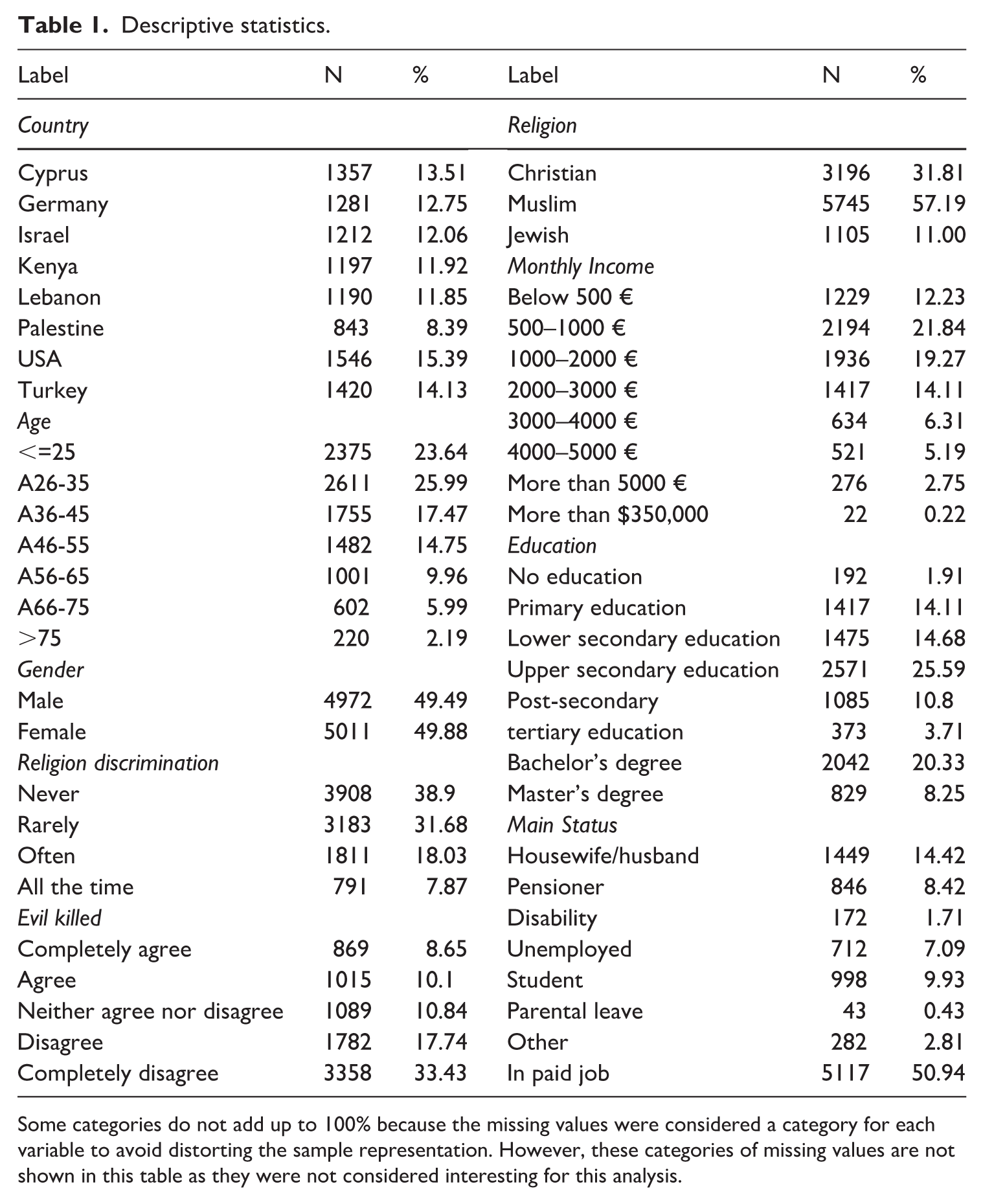
Some categories do not add up to 100% because the missing values were considered a category for each variable to avoid distorting the sample representation. However, these categories of missing values are not shown in this table as they were not considered interesting for this analysis.
The WZB dataset contains four items on RT. As in Kanol (2021), the items chosen to measure RT are the answers to the following question: ‘What is your opinion about the following groups [. . .]?’Respondents have to give an opinion from 0 to 100, so they give 0 if they have a very negative opinion and 100 if they have a very positive opinion. Respondents have to give their opinion on four groups: (a) Jews, (b) Christians, (c) Muslims and (d) Atheists. This scale allows for a much greater degree of specificity than the more common binary or categorical responses that can obscure nuances of tolerance. The inclusion of Jews, Christians, Muslims and atheists reflects a wide global diversity, with different religious and non-religious identities of varying historical, cultural and social significance. This selection also fits with the survey’s focus on intergroup relations and religious radicalisation, as these groups represent distinct perspectives that often feature prominently in discussions of RT and pluralism.
Methodology
Social scientists commonly measure attitudes in order to analyse their causes (Fishbein and Ajzen, 1977; Tesser, 1978; Zajonc, 1968), their changes (Hovland et al., 1953; Matz and Wood, 2005; Petty and Cacioppo, 1986) and their effects on behaviour (Lord et al., 1979). Scientists have a wide range of measurement techniques to measure citizens’ attitudes. The measurements may differ due to different optimality philosophies and the availability of resources that limit the assessment procedure (Albarracín et al., 2014).
Attitude measurement was first formalised on the assumption that attitudes could only be accurately assessed through a carefully selected large number of questions (Cohen et al., 2002; Likert, 1932). Today, however, attitude assessments mostly use single questions that are relatively simple in wording and structure, and there is considerable variability in methodologies, suggesting that there is not necessarily an optimal way to achieve the goal of accurate measurement (Albarracín et al., 2014).
Alwin (1997) compared different measurement techniques in a study of quality of life. He compares the results of two different survey methods, the first by extrapolating information through a questionnaire using semantic scales, and the second by implementing a thermometer scale. He concludes that scales that provide a wider range of responses are more reliable. As mentioned, the study analyses three scales: the 10-point, the 11-point semantic and the 0–100 thermometer scale. Data analysis was carried out using R packages, specifically for the application of Fuzzy Hybrid TOPSIS and Quantile Regression methods.
Fuzzy set logic
Following Gholamizadeh et al. (2022), the application of fuzzy set analysis in this study is motivated by its ability to model complex phenomena characterised by ambiguity and uncertainty, often present in survey responses. With fuzzy sets, membership need not be binary or ‘crisp’, but can be of varying degrees, capturing much finer shades of individual behaviour or attitudes (Ragin, 2000). This is particularly important for expressing subtle attitude variations that could easily be hidden within dichotomous or linear scales (Gholamizadeh et al., 2022).
Let
Thus, since the answers given by questionnaires tend to be vague and uncertain, the information is transformed into Triangular Fuzzy Numbers (TFN), using a 3-tuple
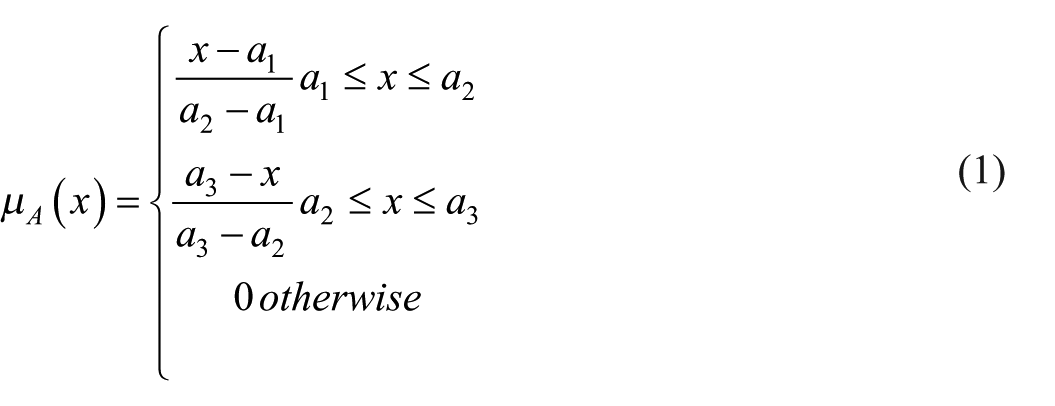
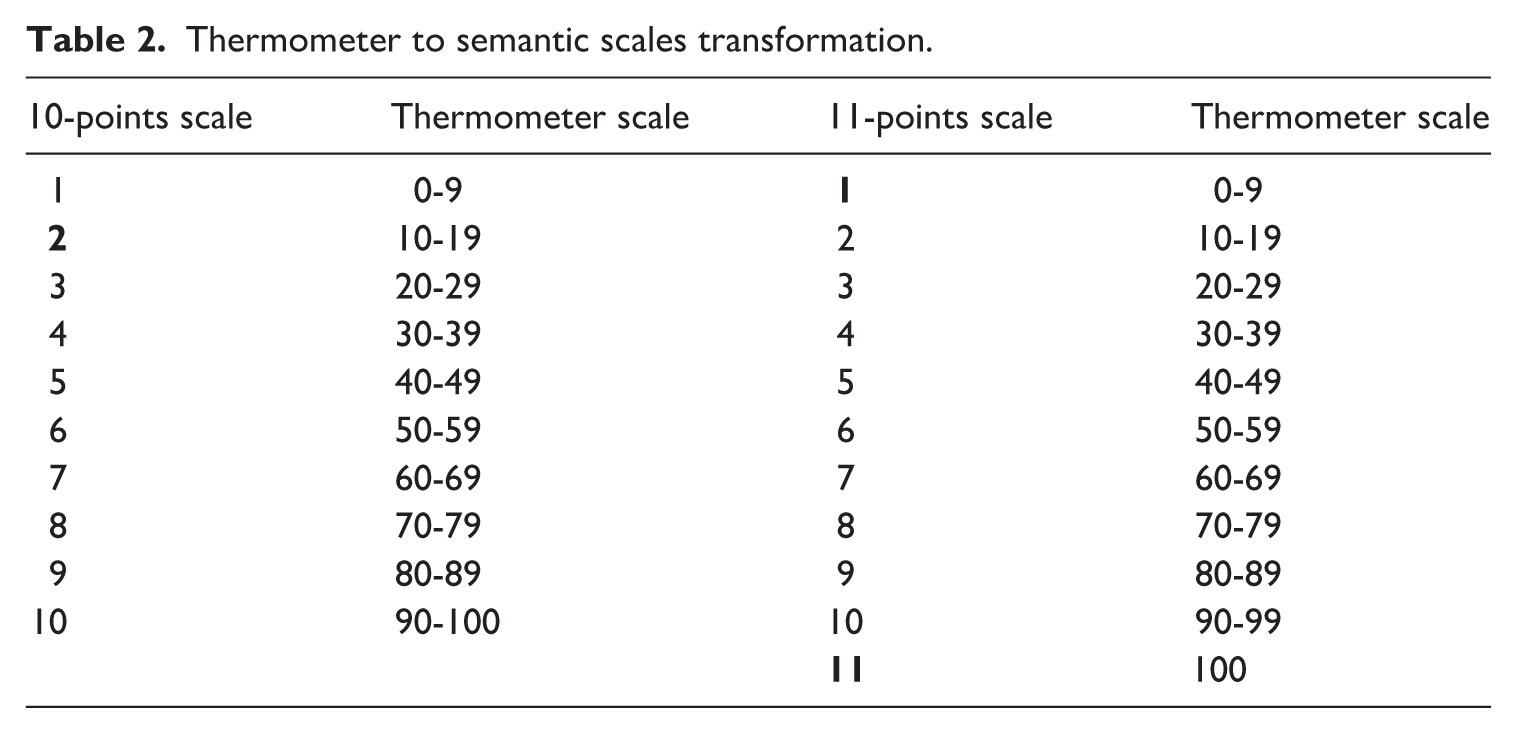
The information provided by the survey will be converted to TFN in a universe of discourse within the range [0, 100]. Table 2 shows how the 0–100 scale provided by the questionnaires is transformed into two semantic ten- and eleven-point scales, respectively.
Thermometer to semantic scales transformation.
For each group under analysis, for example, country, the information was aggregated through the Fuzzy Set Logic Algebra and the average fuzzy number is given by

where

Fuzzy-TOPSIS
TOPSIS enriches the analysis by constructing a composite indicator of RT and ranking individuals or groups according to their relative distance to the so-called ideal solutions. TOPSIS synthesises information into a synthetic indicator that provides a comprehensive and sensitive assessment. Fuzzy Logic and TOPSIS combination provides a strong analytical framework, with each method playing its relative strength in dealing with ambiguity and complexity in assessing RT. The method consists of 3 consecutive stages. First, the positive and negative ideal solutions will be calculated (Hwang and Yoon, 1981) as follows:


where
Then, the distance of each group with the ideal solutions is calculated using the Euclidean distance between each observation group and the ideal solutions as follows:


The RT indicator, which measures citizens’ RT, is given by the relative ratio of the distance of each group with respect to the ideal solution and the sum of the distances between each group and both ideal solutions. Mathematically, the ratio is given by

The interpretation of RT is straightforward, as the higher the value, the higher the tolerance of the group. Therefore, group tolerance could be analysed by ranking RT in descending order (Indelicato, 2023).
Quantile regression
This section aims to determine how socioeconomic factors affect individuals’ RT. Quantile regression extends other regression models, making it possible to observe which factors influence RT, as this methodology allows researchers to examine how the effects of explanatory variables vary at different points in the distribution of RT. Unlike ordinary least squares regression, which focuses only on the mean effect, quantile regression provides a more robust framework for detecting heterogeneity in the effects of socioeconomic factors on RT, allowing for a deeper understanding of the effects by examining different quantiles of the dependent variable as a function of the explanatory variables. Thus, quantile regression provides valuable insights into the data’s central and extreme tendencies (Östh et al., 2018).
Let

Such that


where
As this is a semiparametric model, the model provides richer results because the coefficients specified are indexed by
Let

where
Here, the dependent variable is the RT. The explained variables are country, age, religion, to be raised in a religion, gender, primary status, education, income, evil killed, group treatment, and religious discrimination. Three quantiles have been chosen: the 0.25 quantile, the median quantile, and the 0.75 quantile. Covariates are dummy variables where 1 represents the presence of the condition. For example, if the gender dummy variable is equal to 1, is female, or is male otherwise.
Empirical results
Religious tolerance
In this article, the TOPSIS approach has been applied to data provided by the WZB (Kanol et al., 2021) to measure RT (RT). A thermometer scale (from 0: not at all favourable to 100: very favourable) was used. TOPSIS was applied in two different ways: (a) a TOPSIS indicator was calculated by groups (thermometer down), and (b) TOPSIS was applied at the individual analysis level and then aggregated by groups (thermometer up). In addition, after transforming the thermometer scale into two semantic scales (10 and 11 points, named atr10 and atr11, respectively), the fuzzy TOPSIS approach was applied to obtain two new RT indices.
Table 3 shows all the results for each scenario studied, and in general, the RT values are similar. Germans, Israelis and Turks show more positive RT, while citizens of Cyprus, Lebanon and Palestine have lower RT scores. Older people show higher levels of RT, while those under 35 are less tolerant. The results also show that belonging to one religion rather than another can influence RT. Ranking the three Abrahamic religions, it appears that Jews have higher values of RT than Christians and Muslims. Those who profess Islam are the least tolerant. It is also observed that being raised by parents of the same religion does not affect RT. Regarding the primary status of the respondents, the results show that pensioners, the disabled and those on parental leave are more tolerant than housewives, the unemployed or students. Regarding education and income, citizens with higher education and higher income are more tolerant than those with lower education and lower income.
Religious tolerance indicators.
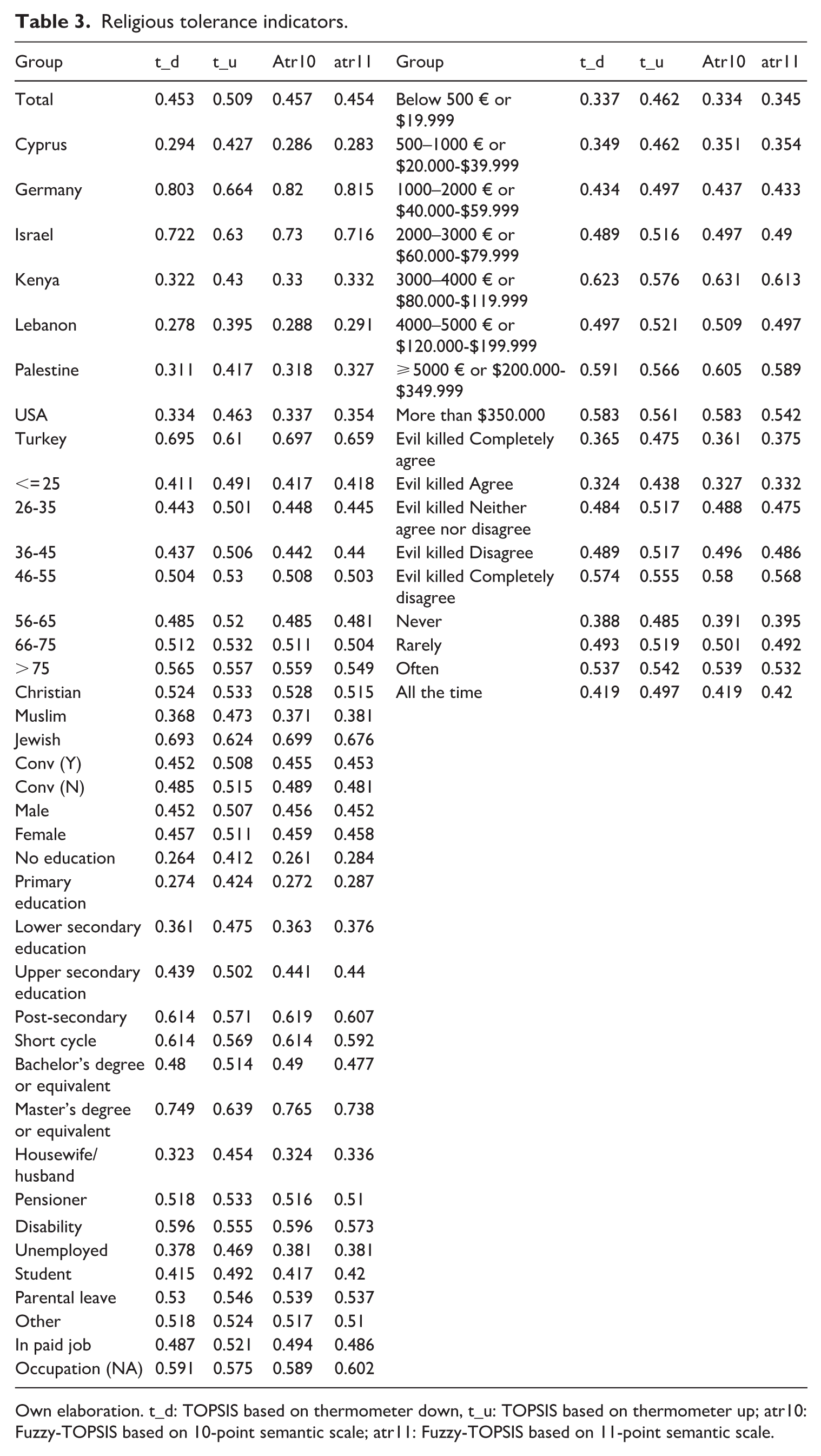
Own elaboration. t_d: TOPSIS based on thermometer down, t_u: TOPSIS based on thermometer up; atr10: Fuzzy-TOPSIS based on 10-point semantic scale; atr11: Fuzzy-TOPSIS based on 11-point semantic scale.
The questionnaire also asks respondents whether those who cause mischief and do evil in the eyes of God should be killed. Those who agree or strongly agree (citizens are more fundamentalist) show a less tolerant attitude than those who disagree. Concerning the experience of discrimination based on religion, we find contradictory results, as those who often or rarely experience discrimination are more tolerant than those who never or always experience religious discrimination.
The four indicators give similar results, but closer analysis reveals differences that can be explored using Spearman’s correlation coefficient. Spearman’s rho quantifies the strength of the association between two variables and ranges from –1 to +1, with values closer to 1 indicating stronger correlations between rankings (Myers and Sirois, 2004; Spearman, 1904). Figure 1 shows the Spearman correlation results (rho) for the four indicators assessing citizens’ RT. Notably, the fuzzy TOPSIS approach, based on a 10-point semantic scale, shows the most significant divergence between the indicators. This suggests that transforming the original 0–100 thermometer scale into a 10-point semantic scale may not be appropriate, and a word of caution is given here to researchers. In contrast, Figure 1 shows a remarkable consistency between the rankings derived from the thermometer and 11-point semantic scales. This consistency underlines the robustness and reliability of these two approaches to assessing RT.
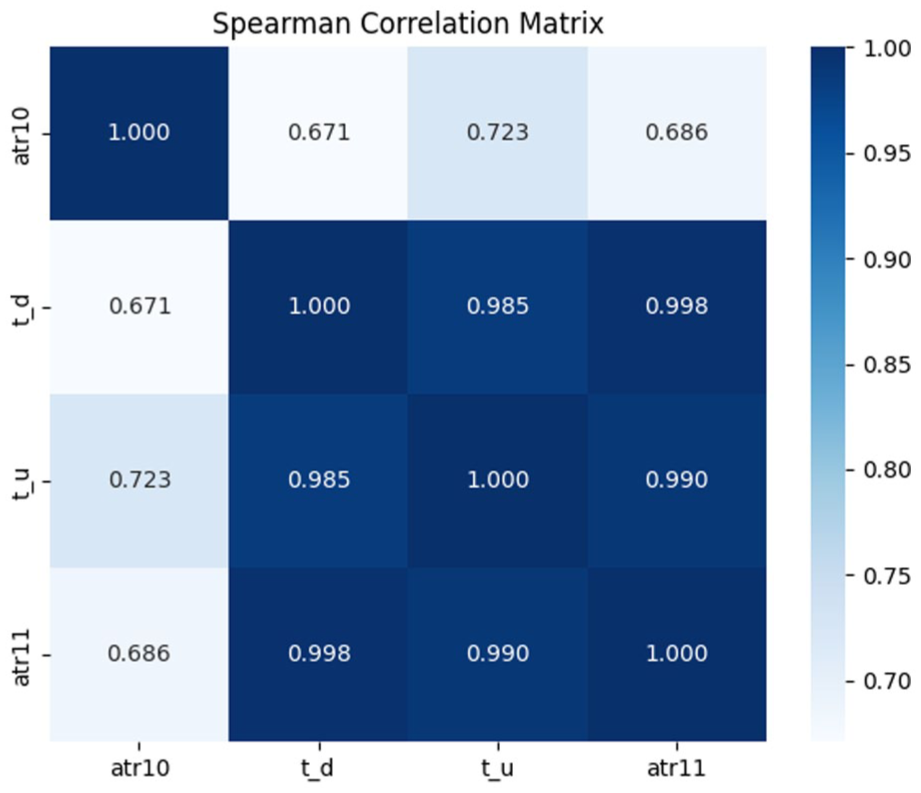
Rho Spearman correlation.
Socioeconomic influences on RT
Looking at the Rho Spearman correlation, the variable atr11 is chosen as a measure of RT to analyse the effects of socioeconomic factors. A quantile regression model is estimated to capture covariate effects at three different levels of RT: low, represented by the 25th quantile; median, represented by the 50th quantile; and high, represented by the 75th quantile. The regressors are dummy variables that take the value 1 if the condition is true, for example, ⩽25 equals 1 if the subject is under 25. Reference categories were defined for each categorical covariate: country, Cyprus; for age, under 25; for other covariates, the baselines are: being male, having no formal education, identifying as a Christian, being a housewife/husband, being in the lowest income bracket, being in the control group, never having experienced religious discrimination and agreeing with the statements that people who cause evil in the eyes of God or Allah should be killed.
Table 4 shows the estimated coefficients across the three quantiles. While neither age, religion, gender, nor employment status significantly affected RT, the respondent’s country of origin did. All countries except Lebanon had a positive significant effect on lower RT scores relative to Cyprus. In contrast, Germany, Israel, and Turkey had a much stronger positive effect for higher RT scores. Country-fixed effects in the quantile regression model accounted for contextual differences in the countries considered. Table 4 shows the magnitude of the influence of each country on RT for different quantiles, taking into account variations due to cultural, economic or political differences.
Quantile regressions.
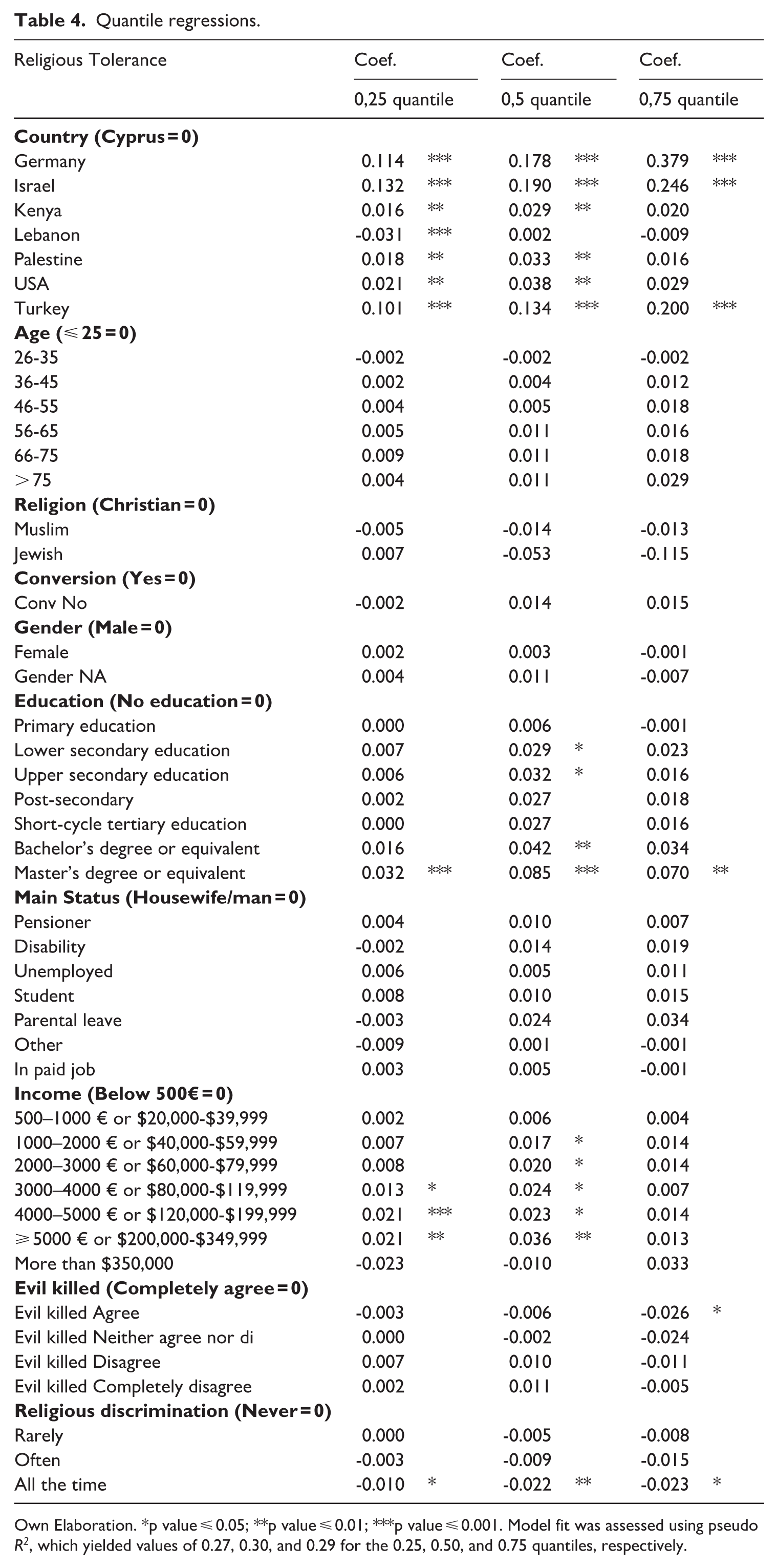
Own Elaboration. *p value ⩽ 0.05; **p value ⩽ 0.01; ***p value ⩽ 0.001. Model fit was assessed using pseudo R2, which yielded values of 0.27, 0.30, and 0.29 for the 0.25, 0.50, and 0.75 quantiles, respectively.
Education also played an important role. Individuals with a master’s degree had a higher RT than those with no formal education, especially in the lower quantiles. For the median RT, all levels of education from lower secondary education onwards – except a bachelor’s degree – had a positive effect. A bachelor’s degree is associated with higher RT at the upper quantiles, which may indicate a nuanced relationship between education and tolerance levels. Income level also affected RT, with medium and high-income categories positively affecting lower RT scores. These findings suggest that economic stability promotes more inclusive attitudes among those scoring lower in the tolerance spectrum. In addition, respondents’ attitudes towards killing those who cause evil and do wrong in the eyes of God or Allah also negatively influenced higher RT scores compared to full agreement with this measure. Similarly, individuals who reported experiencing religious discrimination consistently reported lower RT than those who had never experienced religious discrimination.
Discussion
At the national level, the results show two separate blocks of RT. First, Germany’s leading position in RT confirms Peter’s (2009) findings. This could be the result of the German government’s active policy of integrating religious minorities; for example, the ‘German Islam Conference’ was set up after the 9/11 attacks to promote the integration of Muslims in the country. Schweitzer (2007) attributes this to the German education system, which aims to promote tolerance in a multicultural society by avoiding hatred and prejudice. In contrast, Cyprus and Lebanon have lower levels of RT. Both countries face the challenge of coexisting with two dominant religions, Islam and Christianity (Constantinou et al., 2012; Faour, 2007). In Cyprus, religion is a highly political issue. Although Christianity is the majority religion in the country, it remains ethnically divided in its approach to religious education, and debates about teaching religion in schools reflect these tensions (Zembylas and Loukaidis, 2018). In Lebanon, the situation is even more complex. There are no official statistics on the proportion of Muslims and Christians in the country, as the last census attempted to address the ambivalence surrounding the balance between these two post-Jewish Abrahamic religions (Dralonge, 2008). Historical divisions between religious groups have contributed to significant conflicts, most notably the Lebanese Civil War from 1970 to 1990 (Ibrahim, 1998; Joseph, 2011).
Age is also an important determinant of RT, as the general trend seems to be that the older a person gets, the more tolerant they are compared to members of younger generations. This could be because older people seek comfort in religion (Oliveira and Menezes, 2018), while younger generations see religion and religious institutions as obstacles to civil rights and social advancement (Kubicek et al., 2009). Similarly, the dominant monotheistic religions, Judaism, Christianity and Islam, present unique challenges to the promotion of RT. The theological underpinnings of monotheism, in which the universe is said to be governed by a single divine being, can create barriers to tolerance both within these religions and towards others (Persson and Savulescu, 2013). As Morales (2008) notes, this exclusivist perspective can limit monotheistic traditions’ ability to develop a strong basis for RT. Consequently, the theological resources available within these traditions to promote tolerance may be inherently limited (Neusner and Chilton, 2008).
Our analysis, employing RT indicators derived from the fuzzy hybrid TOPSIS approach, yielded similar ranking order results. However, a note of caution is warranted. While the ranking order is established, the quantile regression analysis did not corroborate significant effects for age and monotheist religions, suggesting that the observed ranking may not fully reflect a true causal relationship. According to Karpov and Lisovskaya (2008), religious intolerance is more a product of reactionary ideologies and regional socio-political conditions than of religious beliefs and practices themselves. Such a perspective suggests that the relationship between religion and intolerance is complex and externally modulated.
Our results also show that the main status of citizens does not significantly influence RT. This observation contrasts with the findings of Katnik’s 2002 study, which suggested that workers who were born in the respondent’s country of residence showed higher levels of hostility towards foreign groups. In addition to status, income is an important determinant of RT. Our research highlights a trend whereby lower income levels correlate with greater religious intolerance. This phenomenon may be partly explained by the understanding that income inequality often fosters personal insecurity, which Rees (2009) argues is an important driver of intolerant attitudes towards out-groups. Also, education plays a fundamental role in shaping individuals’ attitudes towards religion. Governments in various countries have actively supported the promotion of RT within their education systems (Ferrara, 2012; Schweitzer, 2007). Interestingly, our research findings reveal a significant divergence in the appreciation of RT between individuals with master’s degrees and those with lower levels of education. This divergence underlines the transformative influence of education in shaping one’s perspective on religious issues.
The survey includes a question asking respondents whether they agree or disagree with the idea of killing those who harm God or Allah. The results are inconclusive as to the extent to which those who disagree with killing in the name of God and Allah have more RT than those who strongly agree. This does not confirm one of the main tenets of fundamentalism, namely that killing those who do evil against God or Allah can be advocated (Phillips and Kitchens, 2021), which is always highly uncorrelated with RT. However, fundamentalism refers to a strict adherence to an inflexible and exclusivist reading of religious doctrine in a universally valid and non-negotiable form (Verkuyten, 2018). Such a perspective is often seen as inherently incompatible with RT, which promotes pluralism, mutual respect and coexistence (Indelicato and Martín, 2024a). However, the lack of a strong correlation between this extreme belief and RT in the survey suggests a more complex relationship, suggesting that fundamentalist attitudes do not always translate into outright intolerance.
Finally, results also show that respondents who have experienced religious discrimination are less tolerant than those who have never experienced discrimination. According to Phillips and Kitchens (2021), people who are discriminated against develop intolerance towards out-groups as a response to mistreatment. Therefore, even if one can fall into the apparent discriminatory-tolerant dualism, citizens who have suffered religious discrimination often have an aversion to other groups that are not part of their social sphere (Phillips and Kitchens, 2021). Thus, the study also highlights the importance of addressing religious discrimination and income inequality, as these factors are associated with higher levels of religious intolerance. Addressing these issues can help create a more inclusive and tolerant society. Moreover, the study suggests that religion may be a barrier to RT, especially for monotheistic religions such as Christianity and Islam. Governments and religious institutions may need to work together to promote a more nuanced understanding of religious teachings and values that can support RT.
Conclusions
This article examines citizens’ RT using data from the Religious Fundamentalism and Radicalisation module of the WZB–Social Science Research Center Berlin. Synthetic indicators of RT were constructed at both aggregate and individual levels, using methods based on fuzzy logic and TOPSIS. The quantile regression model was used to examine the impact of socioeconomic variables on RT. The results show RT scores are high in Germany and relatively low in Lebanon. Socioeconomic factors such as age, income, and education positively impact RT.
The study builds on previous research (Hook et al., 2017; Jeong, 2017; Kanol, 2021) and introduces innovative methods to evaluate RT. The results demonstrate the robustness of the 11-point and thermometer scales, while the 10-point semantic scale diverges significantly, so the transformation in the 10-point semantic scale is not recommended. By using these methods, the study uncovers nuanced relationships between socioeconomic variables, providing new insights into RT dynamics.
We employed a fuzzy hybrid TOPSIS method to generate and rank composite indices of RT, offering a comprehensible and flexible alternative to conventional psychometric techniques. Unlike structural equation modelling (SEM), principal component analysis (PCA) or item response theory (IRT), which test latent structures but assume linearity and normality, fuzzy hybrid TOPSIS formally handles ambiguity in attitudes and produces clear group rankings without invoking strong distributional assumptions. Although it does not measure dimensionality or internal consistency, its ability to handle vagueness and facilitate comparison makes it highly suitable for our research goal. Further research comparing fuzzy MCDM with other psychometric models like PCA and CFA, or item response theory (IRT) or structural equation modelling (SEM) could reinforce the validity of applying fuzzy hybrid TOPSIS to the study of attitudinal latent variables.
While contributing to the broader literature, the study has limitations. It focuses on data from eight countries and uses a cross-sectional database, which limits the analysis of temporal dynamics. Future research should include data from the International Social Survey Programme and examine longitudinal changes in RT. In addition, the study recognises the diversity within Christianity, Islam and Judaism and emphasises the need to consider variations in beliefs and practices between and within these religions. This approach aims to improve understanding and interpretation of the results. Finally, the quantile regression model only considers three quantiles, which limits the disaggregation of RT bands. Further research is needed to identify which RT levels are most influenced by socioeconomic factors. Despite these limitations, the study provides a valuable methodological framework for analysing social science issues and encourages its application in future research.
Footnotes
Acknowledgements
This research was developed also thanks to the opportunity of the Short-Term Scientific Mission (STSM) of the COST Action COREnet (CA20107). The STSM was a valuable opportunity to learn from and collaborate with other scholars, and it helped to shape the direction of this research.
Author contributions
Conceptualisation A.I., and J.C.M; methodology, J.C.M.; software, A.I., and J.C.M; validation, A.I., and J.C.M.; investigation, A.I., and J.C.M.; data curation, A.I., and J.C.M.; writing – original draft preparation, A.I., and J.C.M.; writing – review and editing, A.I., and J.C.M. All authors have read and agreed to the published version of the manuscript.
Funding
The authors disclosed receipt of the following financial support for the research, authorship, and/or publication of this article: Dr Alessandro Indelicato research is funded by the research fellowship ‘Catalina Ruiz’ provided by the Consejo de Economía, Conocimiento y Empleo of the Gobierno de Canarias, the Agencia Canaria De Investigación Innovación Y Sociedad De La Información (ACIISI), and Fondo Social Europeo of the EU, through the Universidad de Las Palmas de Gran Canaria (Spain).
