




Abstract
Ability grouping – defined as a practice that places students into classrooms or small groups based on an initial assessment of their readiness or ability – has received considerable attention in educational research for years in many countries (Ireson & Hallam, 1999, 2001; Slavin, 1987). In Korea, ability grouping has been implemented in elementary, middle, and high school settings for certain subjects such as English. The purpose of the current study was to determine how the ability grouping policy has been implemented in Korean middle school English classes and to examine the perceptions of teachers (n = 55) and students (n = 754) regarding this policy. The results showed that schools implemented the policy in a variety of ways (e.g. different number of grouping levels). Teachers and students indicated their concerns regarding students’ emotional problems and showed mixed attitudes towards ability grouping. They also argued that schools need large support to maximize the putative effectiveness of ability grouping in different areas such as curriculum design, materials development, and teacher training. The findings are discussed in terms of pedagogical recommendations for increasing the effectiveness of ability grouping in English classes and other options for future research to investigate this and relevant educational language policies.
I Introduction
In any instructional setting, the question of how classes or the students in class should be organized has consistently been debated. Research on various grouping arrangements has received considerable attention in educational research literature for several decades (Ireson & Hallam, 1999, 2001, 2009; Johnson & Johnson, 1990; Slavin, 1987). One grouping format that has been used for many years is ‘ability grouping’. This format refers to the process of teaching students in groups that are stratified by achievement, skill, or ability levels (McCoach et al., 2006). Ability grouping has been implemented for many reasons in a variety of contexts, and most grouping plans exist because of one central fact: students differ in knowledge, skills, developmental stage, and learning rate (Slavin, 1987).
II Types of ability grouping and associated concerns
Previous studies have included much variety in terminology for different types of ability grouping. The major types of grouping arrangements fall into two main categories: between-class and within-class (McCoach et al., 2006; Slavin, 1988). According to Slavin (1988), between-class plans are school-level arrangements by which students are assigned to classes. That is, teachers or administrators divide students into separate classes on the basis of their perceived abilities or prior knowledge (Kulik, 1992). Some of the different types of between-class grouping include tracking, banding, regrouping and so on. Conversely, within-class grouping arrangements attempt to reduce the heterogeneity of instructional groups, as in the use of within-class ability grouping or mastery learning (Macintyre & Ireson, 2002). Accordingly, teachers divide their time among specific subgroups, providing adaptive instruction sensitive to the needs and abilities of one group, while other groups engage in more non-teacher-directed instructional activities (Slavin, 1987).
To cope with student diversity in class, grouping students of similar abilities has been implemented in school curricula. However, despite differing attempts to address diversity, the practice of ability grouping has become an increasingly controversial educational policy (Loveless, 1998). Advocates maintain that this technique promotes educational excellence and optimally challenges students of all ability levels (Allan, 1991; Kulik, 1992). They argue that ability grouping enables teaching to be more effectively geared towards students of diverse abilities, allowing the most capable to reach the highest standards in each group (Ireson & Hallam, 2001). However, these practices have been criticized due to concerns for social and economic equity and potential damage to students’ self-concept and self-efficacy (Oakes, 1985; Slavin, 1990). For example, Oakes (1985) addresses the problem of teachers developing lower expectations for students in lower ability groups, which possibly denied students in lower ability groups appropriate opportunities to learn and advance academically.
To date, a number of countries – including Hong Kong (Cheuing & Rudowicz, 2003), Korea (Jung, 2000; Pae, 1999), the UK (Hallam, Ireson, & Davies, 2004; Ireson & Hallam, 2001, 2005), the USA (Harklau, 1994; Slavin, 1987), and Zimbabwe (Chisaka, 2002) – have implemented ability grouping in school curricula with various outcomes. Accordingly, an increasing number of studies have investigated various topics related to ability grouping, including teachers’ attitudes towards and beliefs about ability grouping (Hallam & Ireson, 2003), students’ preferences for different types of ability grouping (Boaler et al., 2000; Hallam & Ireson, 2006), and the effects of ability grouping on subject attainment (Ireson et al., 2005). The majority of the previous studies have mainly addressed first language settings, but some countries started implementing ability grouping in English as a Foreign Language (EFL) contexts. For instance, the Ministry of Education, Science and Technology in Korea implemented ability grouping as a central educational reform in the current National Curriculum for certain subjects like English.
III Ability grouping in Korean EFL contexts
Korea has a centralized educational system administered by the Ministry of Education, Science and Technology. The instructional procedures for general education in primary and secondary schools are controlled by the National Curricula (Shohamy, 2006). Currently, the revised version of the 7th National Curriculum is being implemented, and one of the most provocative educational policies in the Curriculum is ability grouping. Similar to other countries, the purpose of ability grouping is to group learners based on their proficiency levels and provide appropriate English instructions for each group, i.e. between-class grouping within the same grade. Since implementing the policy, a growing number of Korean education researchers have examined ability grouping for different purposes (Jung, 2000; Lee, 2005; Park et al., 2004a, 2004b, 2005). For instance, the Korean Institute of Curriculum and Evaluation (KICE) has regularly published research reports that examine a variety of issues related to the implementation of ability grouping since 1997 (e.g. perceptions, problems). Park et al. (2005) synthesize previous research on ability grouping and report that although more than 70% of participants (e.g. teachers, students and parents) acknowledged the potential benefits of ability grouping in certain subjects, their actual level of satisfaction was extremely low. To date, although the government has carried out large-scale studies to explore the appropriateness of ability grouping in school contexts, none of the previous studies looked closely at de facto practices in schools. Without this information, it is difficult to understand the actual policy practices in school settings and the perceptions of teachers and students regarding this new education policy.
Although the issue of ability grouping has received growing attention among English educational researchers in Korea, only a few data-driven studies have been found. Jung (2000) carried out a case study in three Korean high schools that had implemented ability grouping in English classes. She observed classes in all three levels (low, mid, high) in three schools, analysed class time (e.g. teacher talk, class activities, distraction time), and interviewed teachers and students. The results indicate that the high-ability group had more learning opportunity time than the low-ability group and also that in the low-ability group, more time was spent in discipline issues than in the high-ability group. Finally, the low group students reported that because they did not have a student who could act as a role model for the class, they had fewer opportunities to interact with a more capable student who could help them. Lower level students also indicated that teachers seemed to care more about high level students’ improvement and prepared extra handouts for them. The findings of Jung’s study echoed some of the previous studies highlighting how the self-concept of low ability groups became more negative as they progressed through school (e.g. Hallam & Deathe, 2002; Oakes, 1985).
In a small scale case study, Park et al. (1998) provided extra English classes to 51 students after school to examine the effectiveness of ability grouping. Students were divided into three groups based on their English reading ability: low (n = 21), mid (n = 24), and high (n = 6). After-school English classes were provided two times a week (total 4 hours) for one semester. Students in the different levels were taught with different teaching materials and activities. The results indicated that the majority of students felt their English ability had improved after taking classes based on ability grouping. The authors acknowledged that especially low level students had positive attitudes towards this grouping in that they felt more comfortable being with similar level students. In terms of the teachers’ opinions, all of the six teachers indicated that providing extra classes for different levels of students was very helpful for their learning process. Students’ grades also showed improvement in their English ability.
In summary, previous ability grouping research focusing on EFL classes in Korea has indicated somewhat inconsistent results. This may be because of variation in implementation of ability grouping (e.g. after regular classes versus during regular class). These conflicting findings indicate that further research is needed to clarify relationships between different ways of implementing ability grouping and students’ perceptions of such policy or their achievement in learning English. Additionally, the lack of detail in government reports and the limited scope of individual research projects have created a need for additional research. Although the KICE government reports provide a large amount of survey data (e.g. with over thousands of students), the reports did not discuss the actual practices of the ability grouping in different schools and dealt with the surface level of perceptions of the policy without providing detailed feedback from participants. For individual research projects, authors tended to generalize results based on small-scale projects and apply them to all EFL school contexts in Korea. Moreover, previous studies did not highlight how students from different ability groups (e.g. low, mid, high) perceive the policy differently. Such information is important to promote English education in EFL school settings.
To address these research gaps in the literature, the current study explored the perceptions of ability grouping in EFL contexts specifically from middle school teachers and students from 19 schools representing six different regions in Korea. The ability grouping in this study was defined as between-group ability grouping. The purpose of the study was to determine how the ability grouping policy has been implemented in various Korean middle school English classrooms and to examine the benefits and problems associated with the practice based on teachers’ and students’ first-hand experiences. The research questions were as follows:
How has ability grouping been implemented in various middle school English classes in Korea?
Are there any differences between ability groups (e.g. low, mid, high) in students’ perceptions of ability grouping?
What are the benefits and problems of ability grouping as perceived by current English teachers and students in Korean middle schools?
IV Methodology
1 Participants
The participants were 55 English teachers and 754 students in Korean middle schools from six different regions in Korea.
a Teachers
The teacher participants consisted of 55 middle school English teachers, who ranged in age from 26 to 52 years (M = 38.75, SD = 7.3). They were recruited via e-mail or phone, and only teachers who had experience in ability grouping at their schools were included in the current study. The majority were females (n = 45), and they were from 19 different schools in six different cities. They had taught English for an average of 13 years (ranging from 20 months to 28 years). All teachers had a bachelor’s degree in English education or a related field. One teacher held a PhD degree; 19 had completed or were working on their Masters degrees. Fifteen teachers had previously studied English in a country where English is spoken as a native language (e.g. in an Intensive English program, Masters program), and they reported a length of residence in an English-speaking country ranging from 4 weeks to 2 years.
b Students
The student participants were 754 middle school students (87 seventh, 466 eighth and 201 ninth graders) who are from nine different schools in the same six different cities. The focused nine schools were selected for the study based on the school consent and the history of ability grouping (i.e. more than five years). The student participants’ age ranged from 13 to 16 years (M = 15.06, SD = .65). There were 269 female and 485 male students. Their amount of previous English study ranged from 4 to 11 years, with an average of 5.77 years (SD = 1.24). Thirty-five students had previously been to a country where English is spoken as a native language, and they reported a length of residence ranging from 1 month to 2 years.
2 Questionnaire
The data collection instruments used in this study were questionnaires that were written in Korean, and the participants’ answers were also provided in Korean to clarify the intended meaning as much as possible. Two different questionnaires for teachers and students were developed by the researcher. The initial questionnaires were piloted with three teachers and three students. For the current study, four sections in the original teacher questionnaire were taken into consideration in order to obtain a general understanding of the current middle school situation, including ability grouping (see Appendix 1): (1) Background, (2) School and courses, (3) Assessment, and (4) Ability grouping. The first section consisted of six items focusing on the teachers’ educational background, teaching experiences and experiences abroad. In the ‘School and courses’ section, six questions were presented in order to elicit information dealing with current teaching situations such as the teaching load and the ability grouping practices. In the ‘Assessment’ section, one item asked about current assessment tools in middle schools. The last section included eight questions which focused on the implementation of ability grouping as well as the teachers’ perceptions on ability grouping. Finally, the teachers were asked to provide any suggestions for improving ability grouping to promote English education in middle school settings.
In the student questionnaire, only three sections of the original questionnaire were considered for the current study (see Appendix 2): (1) Background, (2) English study, and (3) Ability grouping. Similar to the teacher survey, the first section included demographic questions such as age, gender and previous experiences with learning English. The second section contained five questions starting with one regarding their opinion about studying English. Items two to five asked about their perceptions of studying English as well as of English classes that they took both in school and after school. In the last section, eight questions dealt with ability grouping (e.g. students’ perceptions of ability grouping, the level of helpfulness in terms of improving their English skills). Finally, the last question asked students to provide suggestions for improving ability grouping to support their English learning in middle schools.
3 Administration
The data were collected over a two-week period of time in six regions. First, the teacher survey was introduced via e-mail or phone. With the teachers’ agreement to participate in the study (agreement rate: 90%), the questionnaires were sent to 19 middle schools in Korea. Teachers individually completed the survey during their free time. The student surveys were administered during regular class time at nine middle schools where ability grouping has been implemented more than five years as a minimum requirement by teachers who agreed to administer them. Only students who agreed to participate in the study were provided with the survey. While students were answering the survey, teachers were not present in the classroom in order to avoid any potential influence from their presence during this activity. The original copies of both the teachers’ and the students’ surveys were mailed back to the researcher upon completion.
4 Analyses
For research questions one and three regarding methods for implementing ability grouping and related perceptions, qualitative data analysis was used. The themes and coding categories for these questions emerged retrospectively from an examination of the data rather than being determined beforehand and imposed on the data (Bogdan & Biklen, 1992). After individual participants’ responses were read, common answers were grouped together to create taxonomies for each research question. Then, participants’ written responses were tallied to show frequency of responses. In order to answer the second research question about student perceptions across ability groups, the students’ responses on the Likert scale questions were analysed with descriptive statistics to compare the overall pattern among students from different ability groups. Students’ additional written responses were analysed qualitatively to understand their personal opinions.
V Results
1 Implementation of ability grouping
The first research question asked how ability grouping has been implemented in various middle school English classes in Korea. Based on the responses from teachers working in 19 different middle schools, a variety of practices were found. As shown in Table 1, three main differences categorized within three factors were found in implementing ability grouping: number of hours (entire 3-or 4-hour mandatory class periods per week vs. a selected English class time), number of ability levels, and students’ grade levels with which the ability grouping was applied.
Implementation of ability grouping in different schools
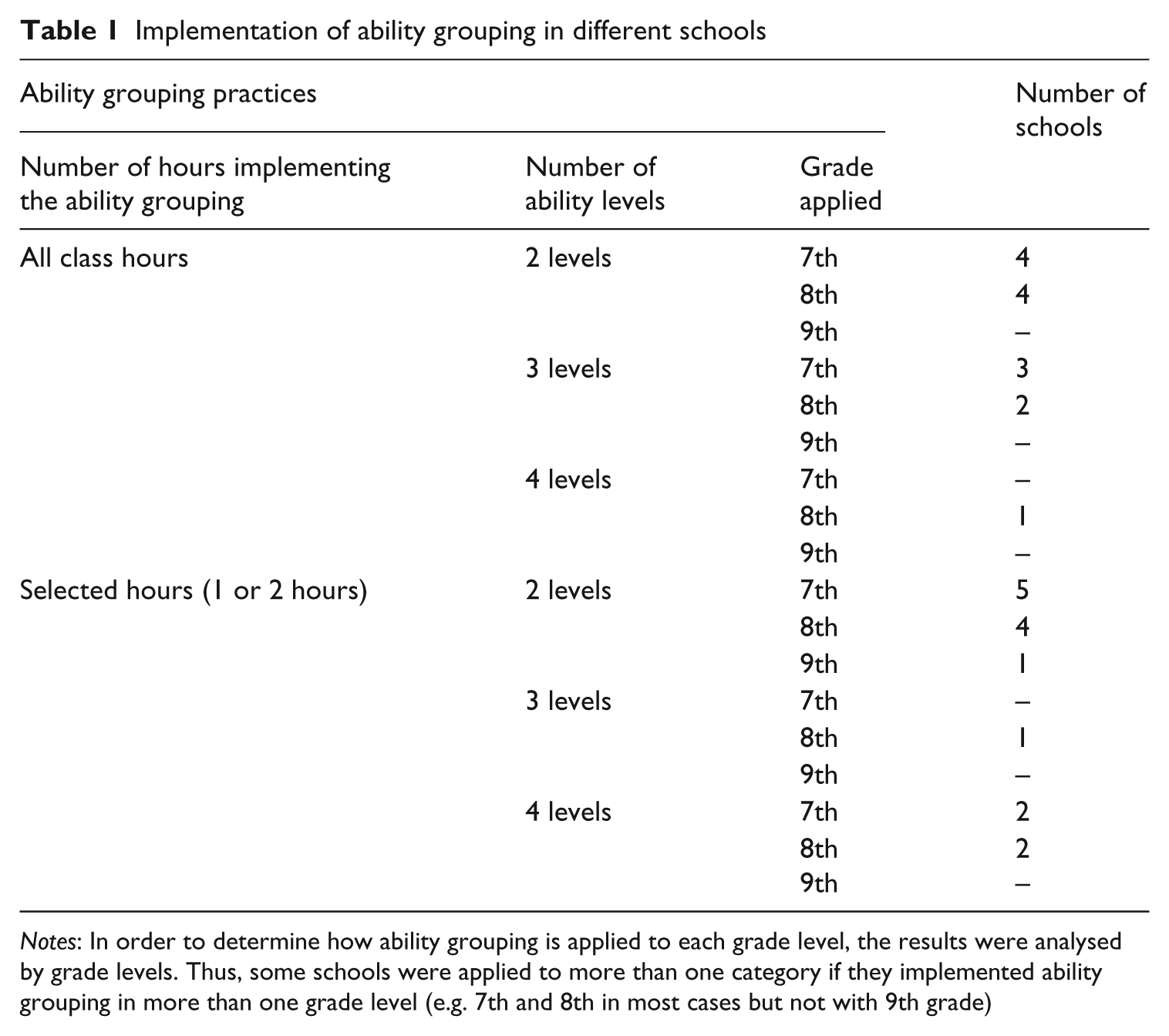
Notes: In order to determine how ability grouping is applied to each grade level, the results were analysed by grade levels. Thus, some schools were applied to more than one category if they implemented ability grouping in more than one grade level (e.g. 7th and 8th in most cases but not with 9th grade)
The results showed that 10 schools (53%) have implemented ability grouping for all mandatory English classes (i.e. 3–4 hours per week), whereas nine schools (47%) have implemented it for only selected hours. Teachers who worked in the latter school setting mentioned that they implemented ability grouping in one additional English class hour called ‘Jaeliang’ class, which is an extracurricular after-school class meant for the development of student interests and was provided in addition to three regular English hours per week. The results showed that nine schools provide additional English instruction in ‘Jaeliang’ classes and have implemented ability grouping only for the English ‘Jaeliang’ classes. Three schools reported that the English ‘Jaeliang’ class was team-taught by a native English speaker as well as a Korean English teacher and utilized a form of ability grouping.
In terms of the difference in number of levels, 12 schools out of 19 (63%) had two ability groups whereas only few schools offered three or four levels of ability grouping, as shown in Table 1. When there were two levels for certain subjects like English, for scheduling purposes two regular classes were combined and then based on their test scores the students were separated into high and low groups. The majority of schools following this system reported that they had 8–10 regular classes for each grade level; in other words, there were four/five low level and four/five high level English classes at the same grade level. In order to ensure equality among teachers, most teachers teach both low and high group learners. All schools used a semester system; thus, students were assigned to their levels based on the average score of the mid-term and final exams. However, one school reported that students were assigned to the groups four times a year, which indicates that students’ English ability levels were re-examined after every mid-term and final exam. The teachers working at this school reported that one of the strategic plans for this school focused on enhancing ability grouping, and thus they also offer multiple levels of ability grouping (i.e. 3 levels).
The last difference was found in the grade levels in which schools implemented ability grouping. The results indicated that 10 schools implemented ability grouping at 7th or 8th grade levels, but nine schools implemented ability grouping at only one grade level (mostly at 7th grade). In such schools, although students had ability-grouped English classes in 7th grade, students were no longer subject to the ability grouping practice when they became 8th graders. Additionally, all schools except one avoided implementing ability grouping in the 9th grade, which is the last year in middle school when the students were expected to focus on preparing for high school entrance exams. In sum, the findings for the first research question indicated that ability grouping practices in English classes varied.
2 Perceptions of ability grouping by ability groups
The second research question asked whether there were any differences between ability groups (e.g. low, mid, high) in terms of students’ perceptions of ability grouping in their English classes. As noted in the previous section, these schools implemented ability grouping in different ways. Therefore, students from different schools had different experiences according to how their schools implemented ability grouping in English classes. As a result, students who were classified as being in similar levels but from different schools were not necessarily comparable to each other. To minimize the effects of other factors on the perceptions of ability grouping by students and to highlight sensitivity to their contexts, students’ perceptions were therefore investigated between ability groups within only three selected schools with distinctive ability grouping practices. As shown in Table 2, the three schools included were: school A (full English class period/3 levels/8th grade), school B (full English class period/2 levels/8th grade), and school C (one hour English lesson/2 levels/9th grade).
Students’ attitudes towards ability grouping and helpfulness of ability grouping

Notes: 1 (highly negative/not helpful at all), 2 (negative/not helpful), 3 (neutral), 4 (positive/helpful), 5 (highly positive/very helpful)
School A is a public all-boys school, which is located in a metropolitan area. One of its strategic plans is to improve ability grouping as previously mentioned above. Unlike other schools included in the article, they made a decision four times a year, which may require that students change their levels in the middle of semesters based on their test scores. Additionally, they implemented ability grouping for the full English class period (i.e. 3 hours per week) with 8th grade students divided into three ability groups. For this school, the mean score of attitudes towards ability grouping indicated that students in all three levels overall had negative or neutral feelings about ability grouping in general (M = 2.05, 2.20, 2.63 for low, mid, and high groups, respectively).
The majority of the high group students who expressed negative attitudes toward ability grouping addressed two issues regarding studying with unfamiliar students and moving to a different classroom, as shown in the following quote: ‘Studying with students from other classes makes me uncomfortable and changing a classroom is troublesome.’ The high group students who favored ability grouping stated that they received a better quality of lessons (e.g. ‘I think we get a better quality of English lessons which are appropriate for our levels’). The mid group students addressed similar concerns/complaints (i.e. classroom changes) but other emerging common comments included that they felt embarrassed because their scores were publicized due to ability grouping (e.g. ‘I don’t like when other friends know my scores’). The majority of low group learners also indicated that they did not like to change classrooms (e.g. ‘I hate to change classrooms’) and they felt that the ability gaps among groups were likely to become larger (e.g. ‘I have to be apart [from] my friends and I cannot acquire their levels’).
In terms of the students’ perception of helpfulness of ability grouping in improving English, only high level students (M = 3.49) expressed positive beliefs about the benefits of ability grouping in their English learning. For instance, they indicated that having English lessons with students from a similar level promoted a better learning environment (e.g. ‘I can concentrate on lessons better because of a lack of noise’). However, some of the common concerns for all groups included the fact that the students did not experience significant differences in materials covered across different levels (e.g. ‘I don’t think there is that much difference in lessons’).
School B is a private all-girls school in a small town and it implemented ability grouping for the full class period for 8th grade students divided into two ability groups. In this school setting, high group students generally showed neutral feelings about ability grouping; whereas low group students demonstrated negative attitudes (M = 3.01 and M = 2.40, respectively). Frequently addressed comments from high group learners were related to invisible differences in their lessons at this school (e.g. ‘I don’t think there are any differences’). Some learners also addressed that changing classrooms caused unnecessary chaos (e.g. ‘Using someone else’s desk in a different classroom makes me uncomfortable, and it is chaotic to change classrooms during the break time’). Overall, some low group learners who expressed positive attitudes stated that the lessons were adjusted based on their English proficiency (e.g. ‘My teacher explains things in a simple way so it is easy to understand’). However, most low level learners did not like ability grouping because it created tension among students (e.g. ‘It separates intelligent students from other students’).
With regard to their perception toward helpfulness of ability grouping in their English learning, high group learners (M = 3.27) had more positive attitudes toward ability grouping for facilitating an environment for learning English than the low group learners (M = 2.92). The high group learners found ability grouping helpful because they could learn additional materials in addition to textbooks (e.g. ‘I can learn more advanced materials’) and the classroom environment promoted learning (e.g. ‘I can concentrate better in class’).
School C, which is located in a suburb area, was very distinct from the other two schools in that it offered two levels of ability grouping-based English classes once a week to 9th graders in addition to the 6th and 7th graders. This school also implemented ability grouping in ‘Jaeliang’ class only. Overall, both high (M = 2.60) and low (M = 2.48) group students demonstrated negative attitudes towards ability grouping. Students in both groups generally addressed a lack of differences between the groups (e.g. ‘I don’t see the differences between the groups’). Similarly both groups did not support the helpfulness of ability grouping (high = 2.34; low = 2.19).
In sum, findings for research question two indicated a common pattern. For all three schools, virtually none of the ability group students clearly demonstrated absolutely positive attitudes towards ability grouping. Although high group students were less negative than the other group(s) in all schools, their actual mean score was between positive and neutral. In terms of helpfulness of ability grouping for learning English, only high level students in schools A and B where ability grouping was implemented for all of their English classes reported a slight level of positive impact. In contrast, students in school C where ability grouping was implemented only during ‘Jaeliang’ class once a week reported negative perspectives and did not believe their grouping was helpful in language learning.
3 Benefits and problems of ability grouping
The third research question asked about the benefits and problems of ability grouping as perceived by current English teachers and students in various Korean middle schools. In order to answer this question, three open-ended questions were included in the teacher survey and two similar questions were included in the student survey. As described previously, the qualitative data were analysed inductively. The researcher first listed common themes based on the participants’ written responses to create a coding scheme. Then the responses for each category on a coding theme were tallied to get a total number and the percentages were calculated for each theme. The second coder coded the entire data, and Pearson’s r for inter-rater reliability for categorizing the themes and calculating responses was .94 for the teachers’ responses, .96 for student responses. The two raters resolved the disagreements through discussion.
a Benefits of ability grouping
For the benefits of ability grouping, teachers and students provided similar responses. Based on the participants’ written responses, five emerging themes on the benefits of ability grouping were identified by the teachers, and six by the students, as illustrated in Table 3.
Perceived benefits of ability grouping

Note: * The total number of responses from the teachers is more than the total number of participants because participants could provide multiple responses.
In teachers’ responses, 45 teachers (85%) addressed that the benefit of ability grouping is to provide appropriate level of lessons to students. However, one interesting observation was that the majority of teachers agreed on the benefits of ability grouping in theory, and most of them indicated that this did not always prove true in practice. Several teachers particularly stated that ability grouping was in fact beneficial especially for high level students. Some teachers noted that ability grouping facilitates students’ participation in class (21%) and promotes language learning (19%). However, such comments were mainly based on the high group learners’ performance, as shown below:
Compared to other subjects, students have a huge ability gap in the subject of English. These students are the ones who started having English as a compulsory subject in elementary school. When there is no ability grouping, we [teachers] are encouraged to adjust the level of content difficulty according to the mid group’s ability. In this case, high level students easily lose their motivation in class because it is too easy for them. However, ability grouping allows teachers to provide appropriate lessons for the high group students. I think high group learners, therefore get the most benefit from ability grouping.
With regard to the benefits of ability grouping, no particular pattern was found among teachers working at different schools that implemented ability grouping differently (e.g. number of levels).
For students, 43% of participants reported that the most noteworthy benefit of ability grouping was in receiving the appropriate level of lessons according to their English ability. Those who had very low English performance specifically mentioned that the benefit of ability grouping for them was to learn English at an appropriate pace. Furthermore, as shown in Table 3, students also indicated the positive impact of peer pressure in class (18%). Such statements were mainly from the high ability groups, who felt that they became more motivated when studying with other advanced students. About 18% of the students also demonstrated that classroom atmosphere during English lessons is more positive (e.g. less discipline issues, noise level decreases). One student in a high group from a school in a metropolitan area provided the following comment:
We can spend our class time for something that we do not know. We have more flexibility in our content. Also I can concentrate better due to a quiet atmosphere.
However, 27% of the students stated that they do not see any benefits of ability grouping. Overall, the benefits of ability grouping were expressed more by high group students than low group students regardless of schools.
b Problems in ability grouping
In terms of problems of ability grouping, a large number of participants provided more than one response. As shown in Table 4, teachers and students’ responses were categorized into seven emerging themes.
Perceived problems in ability grouping

As illustrated in Table 4, 40 teachers (75%) showed their concern regarding dealing with students’ attitudes toward ability grouping, and especially coping with discipline problems with low level learners. According to these teachers, when students were divided based on their English ability, there were no peer role models in low group classes. Low group learners often had discipline problems as well; therefore, when these students were grouped together in the same class, teachers often lost control. Teachers from the schools that had multiple levels of ability groups addressed such concern more than others. Furthermore, teachers’ reluctance to teach low level groups caused problems among co-workers. In order to reconcile teachers of low level groups in a fair manner, teachers often rotated, which often caused a lot of confusion for students.
Thirty-three teachers also addressed that the majority of schools were not ready to implement ability grouping because of administrative issues including large class size and a shortage of teachers and classrooms. Additionally, 27 teachers mentioned that within-group differences still exist, and the criteria for distinguishing students’ levels are not reasonable (e.g. based on one or two exam scores). According to these teachers, especially those working at a school that divided students into two levels like School B, two levels were not enough to promote the benefits of ability grouping. One teacher who worked at School B was more specific about the problems raised within-group ability gaps as well as the cut-off criterion for grouping:
I understand the rationale for ability grouping in English classes. However, due to the lack of school funding and shortage of teachers, our school has only two different groups: low and high. The problem occurs to those students who are around the cut-off points. Because of one or two points or even less, some potential students are placed in the low level. These students easily lose their motivation to study in low group. At the same time, some students, who have low level English, score high on the exam and are consequently assigned to the high group, but their actual English ability causes them to struggle.
Other problems that teachers addressed included their heavy workload as well as problems with the current assessment system. About 25 teachers (47%) protested the increased workload required to develop different materials. Furthermore, some teachers (47%) argued that with the current assessment system, it is very difficult to meet the purpose of ability grouping. The following comment from a teacher represented the majority of teachers’ voices from various schools:
The biggest problem has been derived from the assessment. Although the Ministry of Education required ability grouping, we still need to give the same exam to everybody. These regular exams can be considered as a high-stakes test since the percentile of the test score is a part of the criteria for the high school entrance exam. Anyway, we have to help our students prepare for these regular exams and treat every classroom equally when providing information on the exam.
Understandably, such problems also increased teachers’ stress level and workload. It appeared that teachers working at schools that tried to promote ability grouping expressed more concern (e.g. school A) than those working at schools where ability grouping was implemented at its weak form (e.g. school C). For high level students, teachers wanted to provide materials with challenging tasks. However, in the end, these activities/content would not be on the exam because the low group students had never been exposed to them. Also, 13 teachers mentioned that since they were not confident that ability grouping really promoted a better learning outcome, they had difficulty fully supporting this policy in actual classrooms.
In terms of students’ responses to the problems of ability grouping, seven themes emerged. First of all, 32% of the students were concerned that they were not being treated equally. In particular, mid or low group students reported that they did not like the fact that English scores were not confidential anymore since students could predict each other’s exam scores based on ability groups. In addition, some students mentioned that they felt teachers respected only high group learners, as shown in the following comment:
Since I am in a low group, I often have a feeling of being treated unequally. It seems like teachers like only students in the high group. My teacher always starts the class with discussing discipline problems. Like … ‘don’t do this … do study hard …’
Also low and mid group students mentioned that they do not have as many opportunities to learn more challenging concepts as high group students do. A total of 169 students (22%) mainly from the mid or the low groups indicated that they have difficulty concentrating on lessons, and that students are not serious about English classes. The following comment from a low group student demonstrated some major issues related to class atmosphere:
I want to learn more too. It seems like teachers teach more important and interesting content to high group students. My classmates are all loud, and they never concentrate on what we are doing in class. So I tend to follow the class atmosphere.
Furthermore, according to 142 students from all ability groups, changing classrooms was a serious inconvenience, and having different teachers resulted in confusion about figuring out teachers’ teaching styles and their expectations. Usually, students in Korea do not change their classrooms and have one English teacher for a school year; however, four schools reported that they either changed teachers after one semester or had two English teachers divide the teaching load. This point closely corresponds to teachers’ concerns regarding teaching only low level students. As noted in teachers’ responses, this practice was undertaken to avoid overwhelming certain teachers with teaching only low groups. However, providing equity to teachers caused some confusion from students’ perspectives:
I had a teacher A last semester in my English class. Now, I have a teacher B this semester. Their teaching styles are very different so I am confused. Since we [classmates] have experiences with two different teachers, we compare the quality of teachers as well. I want a good teacher to teach my English class.
Similar to teachers’ responses, 108 students also pointed out that using one or two exam scores as a criterion to group students is not fair. This issue makes their exams extremely important because of the risk of being moved to different ability groups based on the English test scores. Some students explicitly addressed their high anxiety when taking exams:
Now since my English classes will be assigned based on the test score, I feel more nervous when I take the English exam than any other subjects. I really do not understand why ability grouping is applied to only the English class. I am good at other subjects but English is my weakest subject. So I am very concerned about taking an English exam because of ability groups.
Furthermore, 106 students argued against the efficacy of ability grouping. One of the major issues addressed by the high group students was a lack of differences in English instruction among different levels. Students also mentioned that having ability grouping causes more ability gaps among low, mid, and high group learners rather than promoting a positive learning environment for students at all levels. In particular, because there are no advanced students in low group classrooms, students felt a lack of model students from whom they could get assistance.
In sum, some of the teacher’s concerns corresponded with the students’ responses. The findings suggested that students’ ability groups (i.e. high, mid, low) appeared to affect students’ perceived benefits and problems of ability grouping more than different school contexts. Overall, the benefits of ability grouping were acknowledged by the high group learners more than the other ability groups, which was also supported by several teachers. The responses suggested that mid and low group students struggled with ability grouping the most. Teachers had difficulties in dealing with low group students, especially when they were grouped into one class. They also pointed out that because there were no role models in the low groups, even the slightly higher level students in low groups tend to succumb to the ‘non-study environment’ and lose their motivation to study. From a student’s point of view, ability grouping was perceived as causing unequal learning opportunities, and causing more stress in English classes.
VI Discussion
The current study reported different ability grouping practices in various middle school EFL classes. Every school except one did not implement ability grouping in 9th grade English classes, perhaps because students at this grade level had to prepare for the annual high school entrance exam. Additionally, analyses indicated that various practices affected students’ attitudes towards ability grouping as well as perceived helpfulness of the policy. For instance, students in School C tended to be more negative towards ability grouping than students in School A and School B. This pattern occurred because students in School C did not appear to realize any significant differences due to the short amount of time they had (1 hour per week) under the ability grouping system compared to other schools.
The majority of middle schools included in the current study utilized regrouping, which is a type of between-class ability grouping (Ireson & Hallam, 2001; Slavin, 1988). In general, Korean middle school students remained in heterogeneous classes most of the day but regrouped based on their English abilities. Slavin (1988) addressed some advantages of regrouping. For instance, students may often identify themselves with the heterogeneous group, not with the ability group because they spend most of the time with the original heterogeneous group. Therefore, regrouping often prevents students from struggling with the negative effects of ‘labeling’ that occur with all-day grouping (i.e. tracking). However, the students in the current study indicated particularly negative attitudes toward the uncomfortable learning environment produced by regrouping. This was especially reinforced by their emotional concerns about receiving unequal treatment by having to switch classrooms. In their opinion, this situation exacerbated the labeling effect of ability grouping.
In addition, Slavin (1987) suggested that regrouping can be instructionally effective if (1) instructional level and pace are completely adapted to student performance level, and (2) the regrouping is done for only one or two subjects so that students stay in heterogeneous placements most of the day. In the current study, one major reason why some students expressed negative attitudes could be due to the fact that their English classes did not meet the first requirement addressed by Slavin.
In terms of teachers’ responses, although earlier studies of teachers’ attitudes toward ability grouping revealed that teachers generally hold positive attitudes towards teaching classes where students are grouped by ability (e.g. Hallam & Ireson, 2003), the teachers in the current study addressed many problems and concerns regarding implementing ability grouping. Teachers’ preference of teaching the high ability group was in line with the previous studies because high ability groups tend to exhibit pro-social behavior and create less discipline concerns in class (Finley, 1984).
As illustrated in Table 4, some students mainly from the high groups claimed that there was not much difference between ability group classes. One key question was frequently raised by these students: ‘If there is no difference in terms of teaching content, why do we have to deal with this chaos?’ However, most teachers claimed to have provided different levels of lessons between different ability groups. Figure 1 depicts teachers’ responses regarding whether or not there were any differences in four areas between different ability groups. According to teachers, they had to use the same textbook for every ability group; however, they tried to provide different class activities as well as additional materials after finishing all the required content and exam preparation.
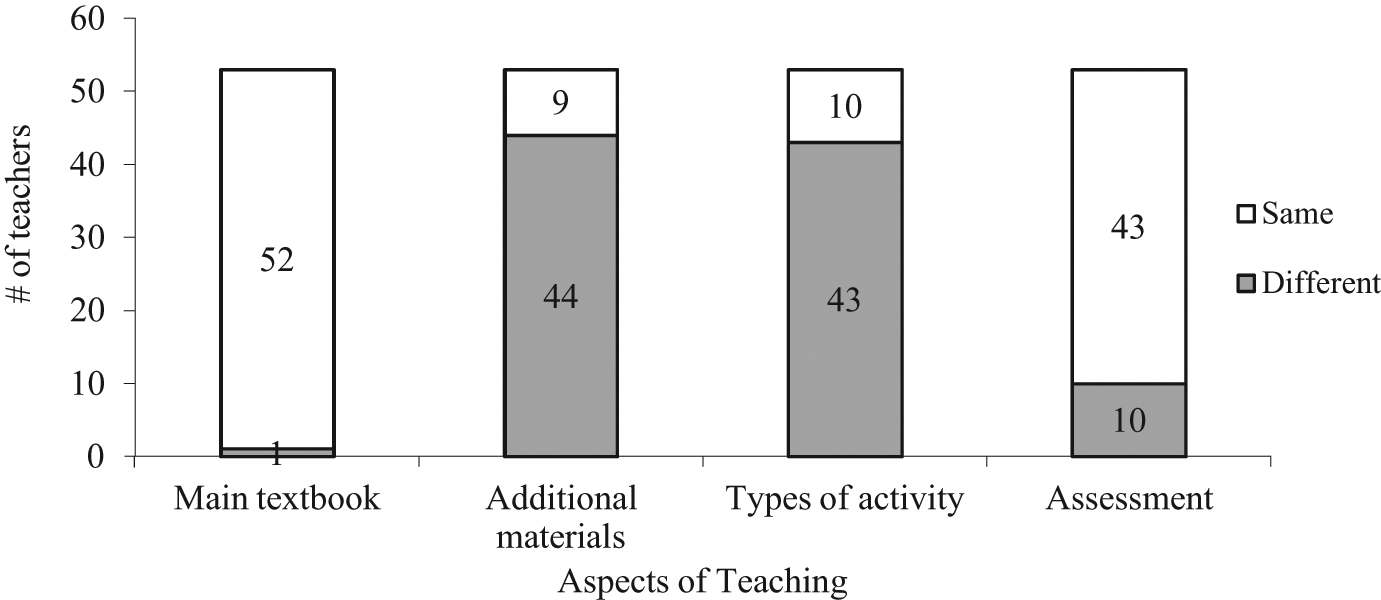
Teachers’ report on managing lessons depending on ability groups
In terms of assessment, 10 teachers indicated that they used different assessment tools for different groups. They differentiated the form of the task according to ability group (e.g. natural interview with the high group vs. memorizing dialogue with the low group). However, these teachers noted that they could be flexible only on the performance assessment section, which was about 20 percent of the total grade. The remaining 80% had to be a paper-and-pencil mid-term or final exam grade, which was required to be identical for every ability group.
The current study supported some of the key findings from previous research claiming that ability grouping benefited higher level learners regardless of ability grouping practices but created some learning disadvantages for lower level learners (Gamoran, 1992; Jung, 2000; Oakes, 1985). Wheelock (1992) also pointed out the educational inequality caused by ability grouping by stating that ability grouping has a detrimental effect on the performance of those in the lower ability groups, widening the gap between students in high and low groups. For instance, a number of high level participants indicated that the benefit of ability grouping was that teachers did not need to cover the basic content in class, which they had already mastered. In contrast, ability grouping was seen to be unfair to low group students, citing the problems of poor peer models, low teacher expectations, and slow instructional pace.
Overall, as previous researchers indicated, ability grouping in English classes seems to lead to inequitable educational practices in Korea. One teacher stated that it is rare for students who are placed in the low group to be given the opportunity to catch up and move on to a higher group. Therefore, some students in the low group who had the potential to improve tended to be negatively influenced by the rest of the low group students. The notion of ‘the rich get richer and the poor get poorer’ appears to be a good description of ability grouping practices in Korea.
In addition to the issue of low group students struggling with ability grouping practices, results also indicated that teachers easily lost motivation to teach low group learners. Previous studies have also shown that historically teachers have indicated preferences for teaching high ability groups (Ball, 1981; Finley, 1984). From a teachers’ point of view, teaching lower level students mandated extra energy and time for classroom management, which tended to shorten the actual learning time, as discussed in Jung (2000).
Although this study has contributed information about teacher and student perceptions to the ongoing debate on ability grouping in EFL contexts, its limitations need to be acknowledged and some caution should be required when interpreting the findings. First and foremost, it is important to acknowledge that the findings of the study were not intended to be generalized, but rather they should be understood with contextual sensitivity (e.g. characteristics of implementing ability grouping). Second, the current study was limited to data based on self-report. Other data sources such as classroom observations would certainly enrich understanding of ability grouping practices, especially regarding whether and how teachers manage their lessons differently according to ability groups. Class observation, in particular, would provide vital data related to classroom culture or other related factors which affect attitudes toward ability grouping. In addition, a number of teachers stated that they had to follow their administrator’s decision and consider parents’ opinions on ability grouping. Therefore, future studies would benefit from including data from other possible stakeholders such as school administrators and parents. Finally, the principal problem that teachers and students mentioned was the lack of evidence for positive outcomes from implementing ability grouping. Future research would benefit from the inclusion of reliable outcome measurements (e.g. students’ English achievement).
VII Conclusions and pedagogical recommendations
In conclusion, the current study provided additional insights into the perceptions of ability grouping from both teachers and students in middle school EFL settings. Classroom diversity has been an everlasting issue that English teachers need to address in their own teaching contexts. The present study demonstrated that ability grouping as currently practiced does not appear to result in expected positive outcomes in English education at the schools included in the current study, particularly with low level learners. It potentially may cause a negative impact on learners’ self-esteem, learning experiences, and their attitudes towards school and English learning. The negative results of adopting ability grouping, although considered an innovative educational policy, are a good example of fragmentation of policy creation and its implementation in a real Korean school setting.
As shown in the current research, this policy can be more effective only if systematic support is provided. In order to maximize the putative effectiveness of ability grouping, issues related to curriculum design, materials development and teacher training should be adequately addressed. As many teachers mentioned, the assessment needs to be modified to reflect the ability grouping. In order to address the materials development issues, a number of English textbook publishers have attempted to publish supplementary materials for students in different ability groups. For instance, the new national English curriculum implemented as of March 2009 included a student activity book by ability grouping in addition to a main textbook. This is a very positive movement in the area of materials development. When English teachers have access to materials for different levels of students, they have less pressure to design teaching materials. The results of this study suggest that English teachers in Korea are struggling with finding time to prepare different materials for various levels of students. This concern seems to be common in other English education contexts. In addition, as discussed in other studies (e.g. Butler, 2004; Li, 1998) preservice teacher education is also crucial for nurturing EFL teachers who can address some of the problems raised during the implementation of innovative educational policies such as ability grouping.
Furthermore, in order to address both teachers and students’ concern regarding low level learners’ performance in class, making a low level class size smaller so that students can get more attention from teachers would be one way to develop their self-esteem and maximize their learning. After the initial data were collected, a teacher working at School B reported that the school has started to divide two regular classes into three ability groups for English classes, which would allow smaller class sizes in each group, and less within-group gaps (personal communication, June 2010). Such positive modifications are much needed to make ability grouping more successful. Additionally, in order to address some of the concerns addressed by the low group learners, teachers also need to reward students’ ongoing effort rather than final attainment, and avoid making public comparisons between ability groups, but value the progress of all students and treat all students with equal respect.
Ability grouping alone will not lead to significant improvement in students’ achievement in English unless it is combined with curricula that have been created based on students’ learning styles, interests, and abilities. Ultimately, it is the students and teachers who suffer the most from any educational policy reforms. Policy makers and educators must be responsive to and understanding of students’ needs and concerns when making or reforming any education policy.
As a major issue in current Korean education policy, ability grouping deserves more attention. The essential remaining questions that now need to be addressed do not simply concern the overall benefits or problems of ability grouping, but more specifically to whom, how, and why is ability grouping supposedly beneficial or problematic. The next National Curricula of Korea could be better justified if educational decision-makers would continue to research these problems, decide how to address them, and only then decide on new education reforms.
Footnotes
Appendix 1 Questionnaire (for teachers)
Note: The questionnaire was translated into English.
Appendix 2 Questionnaire (for students)
Note: The questionnaire was translated into English.
Acknowledgements
I am very grateful to Mary McGroarty for her guidance and encouragement throughout the project. I would like to thank the Language Teaching Research anonymous reviewers as well as Joy Burroughs and Diana Trebing for their helpful comments on earlier drafts of this article. Special thanks go to the teachers and the students who participated in the study. Remaining errors are my own.