



Abstract
This study examines the beliefs of Chinese junior high school English teachers about foreign language teaching and influencing contextual factors in a time when curriculum innovation is confronting deep-rooted cultural traditions and complex teaching realities. Drawing upon data collected by means of questionnaires and interviews, this study reveals a multi-dimensional structure of teachers’ beliefs. On the whole, teachers’ beliefs are congruent with the constructivism-oriented curriculum reform, but a closer examination suggests that both traditional and constructivist beliefs exist. Constructivist beliefs favour student participation, interactive class, and learning strategy training while traditional beliefs involve focus on grammar and language form, drill and practice, rote memorization, and teacher authority. A variety of contextual factors are found to exert a strong influence on teachers’ beliefs, such as Confucian culture, curriculum reform, high-stakes testing, and school environment. These factors interact to facilitate or constrain the development of teachers’ beliefs. The study highlights the situated nature of teachers’ beliefs with implications for curriculum reform, teacher development and many other important issues in secondary foreign language education in China and other similar contexts internationally.
I Introduction
In the past decade, foreign language education in China has undergone massive top-down reforms at all levels. This marks a deliberate shift of emphasis from a teacher-centered to a student-centered approach to curriculum and pedagogy, from knowledge transmission to knowledge construction (Liu, 2011). Specifically, the English Curriculum Standards (ECS hereafter) (Ministry of Education, 2001, 2011) implemented since 2001 intends to develop learners’ communicative competence, foster learner autonomy, and encourage interactive classroom participation. Past reform efforts of many countries have shown that top-down educational reforms may not achieve the intended results if teachers’ beliefs are not congruent with the ideas underpinning innovation (Nunan, 2003). As agents of change, teachers need to incorporate reform ideas into their belief systems before they can make changes in their teaching practice. The significant mediating effect of teachers’ beliefs in curriculum implementation must be taken into account. However, research has shown that teachers’ beliefs are difficult to change (Pajares, 1992; Tsui, 2003). This is not only because teachers’ beliefs are deeply entrenched and resistant to change, but also because innovation entails the encounter of two cultures with possible conflicting values and goals (Barcelos & Kalaja, 2011). These sociocultural conflicts coupled with the complex daily work environment of teachers may hinder changes in teachers’ beliefs and practices. Therefore, in order to ensure the successful translation of innovative curriculum into teaching practice, teachers’ beliefs and the context that shapes teachers’ beliefs must be clearly understood.
In this article, we report a study that examines Chinese junior high school English teachers’ beliefs and related contextual factors in order to discover whether teachers’ beliefs are consistent with the new values, goals and teaching principles promoted by the curriculum reform and what contextual factors facilitate or hinder changes in teachers’ beliefs. We first review the literature, where we identify patterns and themes in relevant studies and gaps in research on Chinese EFL teachers’ beliefs. Second, we describe the methods, instruments and data for this study, which draws upon both qualitative and quantitative approaches. Third, we report the main findings, which reveal the multi-dimensional structure of teachers’ beliefs and the complicated contextual factors shaping teachers’ beliefs. Finally, we briefly discuss some implications for curriculum reform, teacher development and other issues of relevance to foreign language education in China and internationally.
II Literature review
Beliefs have been considered one of the most valuable psychological constructs to teacher education (Pintrich, 1990). In language teacher education, language teachers’ beliefs can be broadly defined as ideas and propositions that language teachers hold about all aspects of their work (Phipps & Borg, 2009). Teachers’ beliefs can exert a strong influence on teachers’ pedagogical decisions, instructional practices, and professional development. In the past two decades, a wide range of topics related to language teachers’ beliefs have been examined, such as the nature, structure and content of teachers’ beliefs, the dialectical relationship between teachers’ beliefs and teaching practice, and the factors affecting teachers’ beliefs. It has been found that language teachers hold unique beliefs about various aspects of language education (Borg, 2003). Teachers’ beliefs are context-dependent, dynamic and fluctuating, complex and dialectical, multi-faceted and often contradictory, and related to action in complex ways (Barcelos & Kalaja, 2011).
A number of studies have examined the orientations of teachers’ beliefs in various contexts. Richards, Ho, and Giblin (1996) studied a group of novice teachers in Hong Kong and distinguished between three different perspectives through which these teachers conceptualized teaching, including a teacher-centered perspective, a learner-centered perspective, and a curriculum-centered perspective. The teachers in their study conceptualized teaching through more than one of these perspectives, but one perspective often dominated a teachers’ view of a successful lesson. In the field of education, several studies have explored the multi-dimensional nature of teachers’ beliefs by examining traditional and progressive perspectives on education (e.g. Chan, Tan, & Khoo, 2007; Hermans, van Braak, & Van Keer, 2008). The traditional perspective refers to behaviorist approaches to teaching and learning, which stress subject matter knowledge, teacher-centered instruction, discipline, rote learning and memorization. The progressive (mainly constructivist) perspective involves more student-centered, task-based approaches that focus on individual students’ needs, interests and self-expression. It has been found that teachers usually hold layered belief systems, with both traditional and progressive dimensions coexisting in their belief systems.
Recently, the complex interplay between teachers’ beliefs and the teaching context has gained increasing recognition. A number of studies have examined the contextual factors influencing teachers’ beliefs, such as language policies, mandated curriculum, school culture, and resources. A few of these studies situated teachers’ beliefs in the context of curriculum innovation. For example, Waters and Vilches (2008), in their study of the implementation of curriculum innovation in the basic education sector in the Philippines, found that the English teachers continued to hold traditional beliefs and used methods not aligned with the principles of the new curriculum, such as authoritative and textbook-based instruction, directive supervision, and summative assessment. Although the teachers were willing to apply the new constructivist approach, their efforts to do so were constrained by such factors as shortage of resources, lack of professional training, prevailing cultural norms and some historical-political factors. The incongruence between teachers’ beliefs and the goals of curriculum innovation has also been reported by several other studies carried out predominantly in Asian settings (Goh, Zhang, Ng, & Goh, 2005, Singapore; Orafi & Borg, 2009, Libya; Underwood, 2012, Japan). These studies seem to suggest that western-based reforms are often hindered when western theories of teaching and learning negotiate their way into the local teaching context.
As a country with probably the largest number of EFL teachers, China has a very different socio-cultural environment from many other countries, and Chinese EFL teachers are very unlikely to share the same teaching beliefs as their counterparts working in ESL contexts. However, research on teachers’ beliefs in China is still a recent development. Several studies have explored such issues as the content and characteristics of teachers’ beliefs (Xia, 2002; Zheng & Jiang, 2005), the relationship between teachers’ beliefs and teaching practice (Lou & Liao, 2005) and factors affecting teachers’ beliefs (Xu, 2009). The focus is mainly on EFL teachers at the tertiary level, whereas EFL teachers working in primary and secondary settings are largely overlooked. Little is known in the international research literature about the interplay between EFL teachers’ beliefs, the school context and broader sociocultural realities within which teacher beliefs are inherently situated in China. This study intends to investigate the beliefs of secondary school English language teachers in relation to the current curriculum reform in China. Various sociocultural and institutional factors that may facilitate or hinder changes in teachers’ beliefs will also be examined. It is hoped that this examination can shed light on the complex nature of Chinese EFL teachers’ beliefs in a time when curriculum innovation confronts cultural traditions and teaching reality, and suggest implications for language teachers working in similar contexts.
III Data and methods
1 Overview
This study adopts a mixed-methods design. According to Tashakkori and Teddlie (2003), a combination of qualitative and quantitative methods can allow the researcher to capture a more complete picture of human cognition, behavior and experience, which are often embedded in a complex educational or social context. By collecting data through questionnaires and interviews, this study aims to provide a rich understanding of the beliefs of English language teachers in the context of Chinese secondary schools. Specifically it intends to address the following two research questions:
What beliefs do the Chinese secondary school English teachers hold about English teaching and learning?
What contextual factors affect the beliefs of these teachers?
2 Research context
The curriculum reform in Chinese secondary schools is a radical departure from the traditional behaviorism-orientated approach to foreign language education. Drawing heavily on the western constructivist understanding of language teaching and learning, this reform promotes various changes in English language curriculum and pedagogy, ranging from curriculum goals and contents, teaching and learning approaches, assessment and evaluation, to teachers’ and students’ roles (Ministry of Education, 2001, 2011). It places very high demands on English teachers, who are expected to master many new theoretical concepts such as task-based language teaching, cooperative learning, inquiry-based teaching, and formative assessment, and learn to incorporate these constructivist ideas into their daily teaching practice. This presents an unprecedented challenge to secondary English teachers, many of whom have been deeply influenced by the traditional teacher-centered, passive model of instruction.
3 Participants and data collection
The participants of this study were English language teachers working in Chinese junior high schools. First, 900 questionnaires were sent to English teachers working in junior high schools in over 10 provinces and municipalities in China to assess their beliefs about language teaching and learning. The sampling procedure took into account variation in the teaching context. Chinese secondary schools feature a distinct difference between urban schools and rural schools, as well as between key schools and ordinary schools, in terms of funding, teacher quality, student selection and resources. Therefore, this study classified Chinese secondary schools into three types: urban key schools, ordinary urban schools and rural schools. When distributing the questionnaires, effort was made to obtain a roughly equal proportion of questionnaires from each type of school (see Table 1).
Profile of respondents.

Seven hundred and thirty-three valid questionnaires were returned, the return rate being 81%. Of these, 259 were from urban key schools (35.3%), 226 from ordinary urban schools (30.8%) and 248 from rural schools (33.8%). The majority of respondents had Bachelor’s degrees (n = 519; 72.2%). A very small number of them had Master’s degrees (n = 59; 8.2%) or Associate degrees (n = 141; 19.6%). Female teachers (n = 549; 78.5%) far outnumbered male teachers (n = 150; 21.5%), reflecting gender imbalance in the teaching force. In terms of age, about half of the respondents were in their thirties (n = 351; 48.4%), with the other half below 30 (n = 233; 32.1%) or above 40 (n = 141; 19.4%). This demographic information is very similar to that in other surveys conducted with secondary school English teachers (e.g. Wu & Yang, 2008) and reflects the demographic makeup of the English teacher population in Chinese secondary schools.
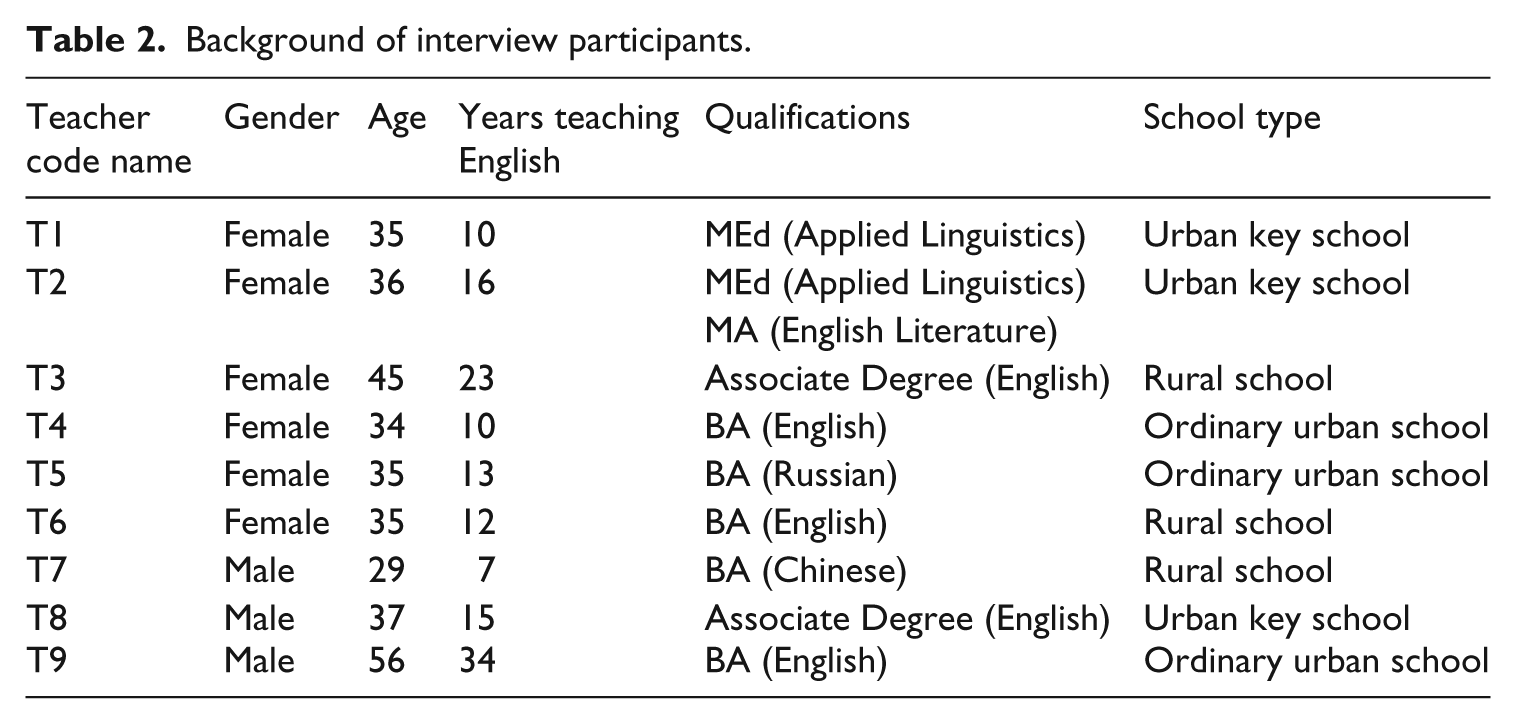
After a preliminary analysis of the questionnaire data, nine teachers (named T1 to T9 in this study) were invited to take part in semi-structured interviews using maximum variation sampling, which is ‘a selection process that includes units so that differences on specified characteristics are maximised’ (Wiersma, 2000, p. 286). An equal number of secondary English teachers were chosen from urban key schools, ordinary urban schools and rural schools in order to gain a better understanding of teachers’ beliefs in different types of school. The teachers had varying lengths of experience teaching English at the secondary level ranging from seven to 34 years. Most of them started teaching secondary English before or right after the implementation of the curriculum reform, so they had rich experience teaching English under the reform. In terms of gender, six of the teachers were female and three were male. As for educational background and qualifications, they varied considerably with two having a Master’s degree, five having a Bachelor’s degree and two having an Associate degree. It is interesting to note that two teachers did not major in English. One was initially trained to be a Russian language teacher and the other a Chinese language major. This is quite common in Chinese secondary schools where there is a shortage of English teachers, and thus some teachers who are not trained in this field are assigned to teach English. Table 2 presents the background information of the interview participants.
Background of interview participants.
4 Instruments
The Questionnaire of Secondary School English Teachers’ Beliefs (see Appendix 1) was developed to assess teachers’ beliefs about English teaching and learning in relation to the values and principles recommended by ECS (2001). It drew upon a number of related questionnaires (Bell, 2005; Cheung & Wong, 2002; Martin, Yin, & Mayall, 2007) in formulating the items. The questionnaire consisted of 35 items that measured teachers’ beliefs about curriculum, pedagogy, assessment, resources, and the roles of teachers and students. The items were rated on a five-point Likert scale (1 = strongly disagree, 5 = strongly agree). Some items were worded so that agreement with them indicated constructivist beliefs consistent with ECS, whereas other items were worded so that agreement with them meant traditional beliefs inconsistent with ECS. The questionnaire was written and administered in Chinese, and later translated into English.
In addition to the questionnaire survey, nine teachers took part in semi-structured interviews. Each interview lasted at least one hour and focused on the teacher’s beliefs about English teaching and factors affecting his or her beliefs. Salient themes and problems identified through preliminary analysis of the questionnaire data were also included in the interviews to seek further clarification. The interviews were all conducted in Chinese, audio recorded, transcribed into Chinese and then translated into English (for the main interview questions, see Appendix 2).
5 Data analysis
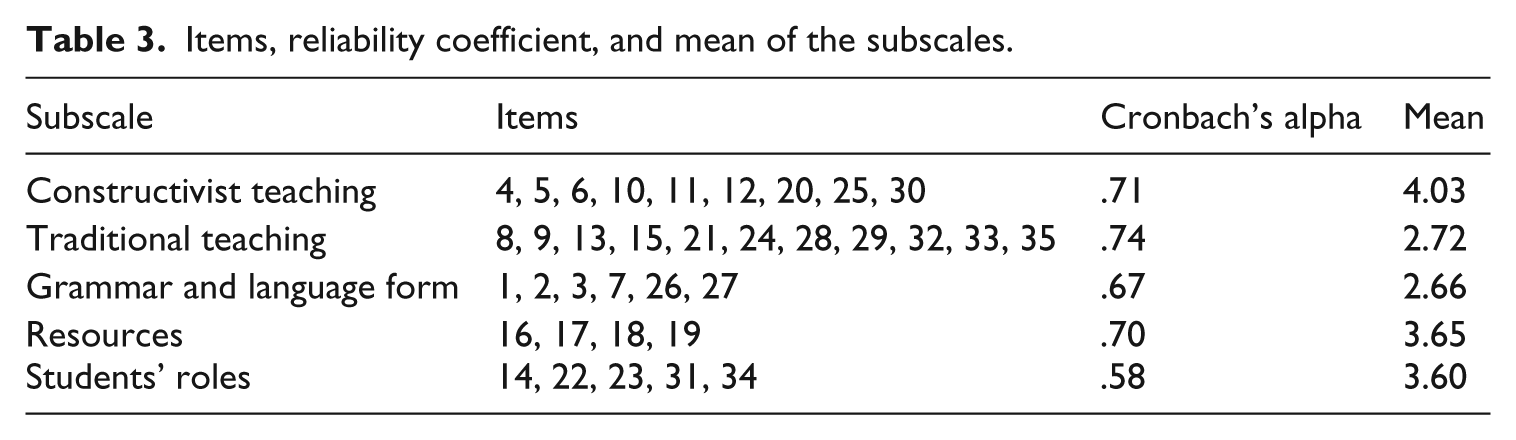
The quantitative data from the questionnaires were analysed using SPSS version 16.0. Factor analysis with principal components analysis and Varimax rotation revealed five subscales, which concerned teachers’ beliefs about constructivist teaching, traditional teaching, grammar and language form, resources, and students’ roles. The first subscale measured teachers’ beliefs about constructivist teaching methods and techniques recommended by ECS, including student participation, learning strategy training, collaborative learning, experiential learning, inquiry-based learning, task-based learning, and multiple ways of assessment. The second subscale involved teachers’ beliefs about traditional teaching methods and practices, such as lecture, teacher authority, drill, practice, and memorization. The third subscale assessed teachers’ beliefs about the role and instruction of grammar and language form, the relationship between language form and language function, and error treatment. The fourth subscale was concerned with teachers’ beliefs about resources they developed and drew upon to promote English teaching and learning, including instructional materials, instructional language, technology, and English learning opportunities outside of class. The fifth subscale measured teachers’ beliefs about students’ roles, especially student autonomy, student participation, and shared decision-making with teachers.
Descriptive statistics of all the subscales and items were obtained to examine whether the teachers’ beliefs were traditional or constructivist. Scoring for items in which agreement indicates traditional beliefs not consistent with ECS was reversed so that items with mean scores higher than 3.0 pointed to constructivist beliefs while items with mean scores lower than 3.0 were indicative of traditional beliefs. The higher the score, the more constructivist the teachers’ beliefs were, and the lower the score, the more traditional the teachers’ beliefs were. Table 3 presents the reliability coefficient and mean of each subscale as well as the relationship of statements in the subscales to ECS.
Items, reliability coefficient, and mean of the subscales.
The qualitative data from the interviews were analysed using thematic analysis, which is a commonly used method in social sciences for analysing qualitative data that involves identifying, coding, analysing and reporting themes within the data (Braun & Clarke, 2006). During the recursive process of data analysis, we first coded the data into two major categories which were teachers’ beliefs and contextual factors influencing teachers’ beliefs. We then gradually refined the broad categorization by creating sub-categories and identified salient themes and patterns related to the teachers’ beliefs about different aspects of foreign language teaching and various contextual factors that might impact on the teachers’ beliefs. Finally the quantitative and qualitative data were integrated to provide a more complete understanding of the teachers’ beliefs and influencing factors.
IV Findings and discussions
In this part, we first analyse the secondary teachers’ beliefs about English teaching and learning in relation to the values and principles underpinning ECS, both quantitatively and qualitatively. Second, we offer our interpretation of the multi-dimensional structure of the teachers’ beliefs by drawing upon selected interview data. Next, we discuss the contextual factors influencing the teachers’ beliefs based on interview data where participants’ perceptions of the contextual factors are found to influence their beliefs about English teaching and learning. Finally, we highlight the situated nature of teachers’ beliefs and provide some implications.
1 Teachers’ beliefs about English teaching and learning
The questionnaire results suggest that taken as a whole, Chinese secondary English teachers’ beliefs are more inclined toward the constructivist orientation than the traditional orientation, with a mean response of 3.28. But this score is only slightly higher than 3.0, indicating that after over a decade of reform efforts, secondary English teachers have developed a favorable attitude toward the constructivist ideas of English teaching and learning underpinning the curriculum reform, but for various reasons they may not accept all the reform ideas and still have some reservations about them. This can be seen from the mean scores of the five subscales, two of which (traditional teaching, grammar and language form) are under 3.0, indicating a traditional orientation. In the following, results of the five subscales of the questionnaire and relevant interview data will be analysed and compared. Possible discrepancies between these two types of data will be discussed too, which will shed light on the complex nature of teachers’ beliefs under the curriculum reform.
a Teachers’ beliefs about pedagogy
As described in the data analysis section, factor analysis yields two subscales measuring teachers’ beliefs about pedagogy, traditional and constructivist. In the subscale of constructivist teaching, the responses of all the items point to constructivist beliefs consistent with ECS. In the subscale of traditional teaching, the responses of most items fall in the inconsistent-with-ECS range, with only two exceptions: item 21 being undecided, and item 33 consistent with ECS. These results show that the secondary English teachers hold both traditional and constructivist beliefs about pedagogy.
This finding is supported by interview data. The interview participants generally welcome the constructivist ideas of student involvement and interactive learning, which bring energy and dynamism to the previously boring teacher-centered, lecture-based English classes. They consider these to be the biggest positive changes that the curriculum reform brings to secondary English teaching. However, the approval of constructivist ideas does not prevent the teachers from adhering to traditional beliefs, especially those in memorization and drill. All the interview participants require their students to memorize vocabulary, sentences or even texts. This practice is a basic element of English class in Chinese secondary schools, often reinforced by regular quizzes on a daily or weekly basis.
The interview participants also show a varying degree of approval for drill and practice, depending on factors such as teachers’ personal theory, student characteristics, and the pressure for test preparation. Although not every teacher uses drilling and practice throughout the three years of junior secondary teaching, they all agree that drill and practice is the most effective way for test preparation. Similarly, lecturing is also considered an important teaching form for test preparation because it is the most effective and efficient way to cover course content relevant to tests. These findings confirm the studies mentioned in the literature review section about teachers’ traditional pedagogy in the context of curriculum innovation (e.g. Waters & Vilches, 2008).
b Teachers’ beliefs about grammar and language form
The mean value of this subscale and most statements in it are under 3.0, indicating a traditional orientation inconsistent with ECS. The only exception is statement 26 about grammatical accuracy not as the major criterion for assessing students’ language output, which scores slightly higher than 3.0.
Interview data provide further insights into the teachers’ choice in this subscale. Generally speaking, the interview participants have favorable attitudes toward the curriculum goals of developing students’ communicative skills, but they also confess that for practical reasons, they tend to place more emphasis on grammar and language form than speaking because the senior high school entrance examination mainly assesses students’ knowledge of the language system such as grammar and vocabulary rather than the ability to communicate. This high-stakes exam has a strong washback effect on English teaching at the junior secondary level. In addition to the testing consideration, some teachers also indicate that knowledge of grammar and language form can help students lay a solid foundation for their overall language development. Although the reform has weakened the role of grammar in the curriculum, grammar should still have a place in the English class, because it can promote students’ language accuracy and indirectly improve their language fluency.
c Teachers’ beliefs about resources
The development and use of curriculum resources is an important part of the reform, which requires teachers to not only teach out of textbooks but also utilize a range of curriculum resources to support students’ learning. Although all the item responses in this subscale of the questionnaire indicate constructivist beliefs, subsequent interviews suggest that this topic is very complicated. Some questionnaire results contradict interview data, and a gap often exists between what teachers report in the questionnaires and what they practice in their classroom.
For example, in terms of instructional materials, textbooks are still the major teaching resource for most teachers, sometimes supplemented by other reading materials and exercise books, most of which serve the purpose of test preparation. Regarding the use of target language in class, there is great variation among the interviewees. Those from rural schools and ordinary urban schools report that although they are aware of the curriculum requirement to use a maximum amount of English in class, their actual use of English is limited by their students’ low language proficiency and sometimes by their own inadequate speaking skills. As to the use of computers and the internet, only about half of the interviewees, especially young teachers and those in the cities, often search the internet for teaching materials. The others either have no easy access to or no enthusiasm for using technology at all. Also, most interview participants rarely encourage their students to develop their own learning materials or take part in extracurricular activities for English learning because such opportunities are very limited in their schools. All these discrepancies call for extra care in interpreting the teachers’ self-report questionnaires, which might overlook individual differences in the teachers’ beliefs as well as possible gaps between the teachers’ stated beliefs and their actual practices.
d Teachers’ beliefs about students’ roles
The curriculum reform calls for student autonomy in language learning and a shift of students’ roles from passive receivers to active constructors of knowledge. This is incongruent with the Chinese educational culture which values teacher authority and thus may present a challenge for secondary school teachers. In this study, although the responses to all the items in the subscale about student roles indicate constructivist beliefs, interview data suggest that some of the constructivist beliefs the teachers agreed to in the questionnaire may not really be practiced. It is true that under the influence of the curriculum reform there has been increasing student participation in class, but students still have very limited freedom in deciding what to learn, how to learn, and how to be assessed.
One salient example concerns teachers’ tight control of students’ learning. To many interview participants, the idea of learner autonomy seems to be impractical for students at the junior high school level who are seen as incapable of studying English completely on their own. The teachers share the belief that it is of paramount importance for students to follow teachers’ instruction in class in order to learn best. T1 explains that ‘teachers’ methods are usually effective, so students must listen to their teachers.’ No matter how students learn after class, they must ‘follow the pace of their teachers during the 45-minute class time’. In order to keep students focused on teachers’ instruction, many teachers apply strict discipline to ensure that students do not get diverted from the lesson. It seems that the ability to control and lead a class is seen as a core qualification of secondary school teachers. Almost all the teachers cite this ability when they talk about effective teachers in the interviews. This has also been found in several studies carried out in traditional cultural contexts (e.g. Orafi & Borg, 2009).
2 Understanding the multi-dimensional structure of teachers’ beliefs
The above analysis of quantitative and qualitative data suggests that the beliefs of Chinese secondary English teachers are multi-dimensional. The teachers seem to embrace both the constructivist ideas of the curriculum reform and many traditional ideas about language teaching at the same time. These seemingly contradictory beliefs can exist in the teachers’ belief system without much conflict as they relate to different teaching contexts and serve different purposes. In this regard, the view of Green (1971) about the situated nature of teachers’ beliefs becomes very relevant. Green stated that seemingly conflicting beliefs can exist harmoniously in teachers’ belief system as isolated clusters. Such clusters of beliefs can develop and arise in independent contexts. This study provides ample instances supporting this proposition.
A typical example involves the teachers’ beliefs about teaching approaches and techniques. The teachers in the study tend not to view traditional and constructivist beliefs about teaching as irreconcilable opposites. Instead, they are usually able to integrate these two approaches into their teaching toolkit and use them in a flexible and practical way depending on teaching content, task type, student characteristics and many other considerations. T2 explains her flexible teaching approach: It depends. When the teaching content is simple, I will simply tell the students. When it comes to some practical items I will design some tasks. I don’t use too much task-based language teaching with first-year students. When they enter the second year I will teach them more learning strategies and design more tasks. In a word, I will adjust my teaching approach according to the needs and levels of the students and the curriculum requirements. When exams are coming up, I will fall back on cramming. When there is sufficient time, I will give students more communicative tasks.
T4 states that she varies her teaching approaches based on the content of the textbook. When teaching the listening and speaking sections, she will more likely use interactive tasks, whereas when teaching the reading section, she will rely more on teacher explanation. After the reading exercise, she will ask students to memorize some key phrases and sentence patterns in the reading text. T4’s practice is very common among secondary school English teachers.
The above examples suggest that the teachers hold a repertoire of beliefs that serve different purposes and work in different contexts. Instead of subscribing to any single theory about language teaching and learning, they opt for a ‘middle ground’ and choose to enact the most appropriate belief after making judgment and decisions about the teaching situation. This flexibility and practicability is exactly what is required in the post-methods era (Kumaravadivelu, 2001). Oyler and Becker (1997), by quoting Code (1991), eloquently summarized the necessity for a middle ground in an effort to view teaching beyond the progressive/traditional dichotomy: ‘a well-mapped middle ground offers a place to take up positions of strength and maximum productivity from which exclusionary theories can be tapped critically and creatively for criticism and reconstruction’ (p. 318).
3 Contextual factors affecting teachers’ beliefs
The findings of this study highlight the contextual nature of teachers’ beliefs. A number of contextual factors at both macro and micro levels are found to exert a strong influence on the teachers’ beliefs. These factors interact to facilitate or constrain the development of teachers’ beliefs. The following discusses the most salient factors.
a Teachers’ beliefs and curriculum reform
The curriculum reform has a great impact on secondary school English teachers’ conceptions of teaching and learning. For many teachers, it offers valuable professional learning opportunities that help them develop a sound knowledge of the constructivist approach to language teaching and learning. The middle-aged teachers, who started teaching around the launch of the curriculum reform, tend to attribute their professional growth largely to the curriculum reform. In the nationwide effort to implement curriculum innovation, they took part in many pedagogy and textbook training programs held at both national and local levels, observed demonstration lessons, entered into teaching contests, and sat in teacher qualification tests that test teachers’ knowledge of ECS. As T4 describes, in places that encourage curriculum innovation, ‘teachers accept the reform ideas naturally because they are immersed in an environment with extensive exposure to constructivism-oriented conceptions and practices.’ Younger teachers who received their teacher education after the inception of the reform are also aware of the new curriculum requirements because knowledge of the new curriculum and textbooks is often an integral part of their pre-service teacher education programs, which have also been updated to meet the requirement of curriculum innovation. In comparison, veteran teachers who have been deeply influenced by the traditional grammar-translation approach tend to have a harder time accepting the new teaching concepts. But they generally do not feel too much pressure to change their teaching beliefs and practices because their years of teaching experience have enabled them to be very good at preparing students for tests, which is an important criterion for teacher evaluation in many schools.
b Teachers’ beliefs and high-stakes testing
The most salient, though not striking, finding of this study is that despite the massive effort invested by the policymakers to change the old test-driven curriculum, high-stakes testing still exerts a huge impact on how teachers conceptualize and approach English language teaching. In the context of junior high schools, the most important test is the senior high school entrance examination. The importance of this exam can be seen from the metaphors that the teachers in the study use to describe it, such as ‘lifeline to schools’(T1), indicating that it concerns the survival and prosperity of schools, and ‘baton of teaching’(T5), suggesting its centrality in guiding English teaching at junior high schools. As Madaus and Kellaghan (1992) pointed out, testing may supersede other factors in shaping teachers’ beliefs and practices when the testing results are linked to important decisions regarding students, teachers, administrators, and schools. These decisions may include ‘graduation, promotion or placement of students, evaluation or rewarding of teachers or administrators, allocation of resources to schools or school districts, and school or school-system certification’ (p. 139). Although these two scholars wrote two decades ago, their description still holds true for the situation in Chinese secondary schools today.
Given the supremacy of the entrance examination to senior high school, any practice that can help students do well in the test becomes a good choice. This partly explains why the teachers tend to hold such traditional beliefs and practices as emphasis of linguistic knowledge over linguistic skills, drill and practice, and lecturing. The washback effect of high-stakes examinations on teachers’ beliefs has been reported by many studies carried out in diverse contexts, such as Orafi and Borg (2009) in Libya, Choi (2008) in South Korea, and Underwood (2012) in Japan. It highlights the necessity to adjust the focus of the exams according to ECS. Otherwise, ‘policy changes in pedagogy not supported by changes in assessment may have little practical impact in the classroom’ (Orafi & Borg, 2009, p. 252).
c Teachers’ beliefs and traditional cultural values
As Bruner (1996) noted, culture shapes mind. When examined beyond the surface, many traditional beliefs held by the teachers reflect deep rooted cultural values and conventions. In the Confucius tradition, teachers are considered authorities of knowledge and deserve high respect. Good teachers should be knowledgeable, capable of passing on knowledge to students effectively. As a famous eighth-century Chinese scholar, Han Yu, put it, a teacher’s role is to ‘spread wisdom, impart professional knowledge and resolve doubts’. This classic statement about the transmissive role of teachers still enjoys widespread popularity in China even today. Good teachers should also be moralistic and strict, with a strong sense of responsibility (Wu, 2005). In the interviews, several teachers explained their reason for exercising strict discipline by quoting a famous Chinese saying that goes ‘strict teachers produce outstanding students’. This traditional value has stood the test of time and is still well accepted in the contemporary Chinese society.
Another important aspect of this Confucian tradition is love for learning, by which students are encouraged to read extensively, memorize and practice (Gu, 2003). This kind of educational culture was strengthened by the Civil Examination System, which was the major means of selecting officials in China for over 13 centuries. Although no longer in existence, this exam tradition has had far-reaching consequences for Chinese society. Education is considered the only legitimate route for upward social mobility, and in the test-centered educational culture, successful education is reflected mainly in good test performance. Since exam results can determine an individual’s future, rote-learning, teacher instruction, and book-centered approach are practiced without being much questioned. In view of these deeply ingrained cultural values and conventions, which have widespread support in China, it is no surprise that the English teachers in this study still embrace traditional beliefs about language teaching and learning.
d Teachers’ beliefs and schools types
School environment has a direct influence on the teachers’ beliefs, professional development, and performance. Specifically, this study suggests that the teachers working in schools with an innovative school culture, supportive administration, well-trained colleagues, high-achieving students, and rich resources tend to hold more constructivist beliefs because these factors foster a favorable environment for change. These favorable conditions are more likely to be found in urban schools than in rural schools, in key schools than in non-key schools, and in eastern developed areas than in middle and western less developed areas, reflecting the uneven allocation of resources and the deeper-level problem of educational inequality in China.
e Interaction of contextual factors in shaping teachers’ beliefs
The aforementioned factors are strongly intertwined to shape the complex nature of the English teachers’ beliefs. On one hand, many factors work concertedly to facilitate the development of teachers’ constructivist beliefs, such as various curriculum reform initiatives, professional training, innovative school culture, and collegiality. On the other hand, some contextual factors seem to contradict each other, causing tension and confusion in the teachers’ belief system. This strained relationship manifests most obviously between the ambitious goals of the curriculum reform and the realities of secondary education in China (e.g. test-oriented education, inequity regarding access to quality language instruction and resources). The differences between Chinese cultural traditions, established conventions and Western ideas also have a bearing on the shaping of teachers’ beliefs. Similar findings have been reported in several recent studies (Nunan, 2003; Underwood, 2012; Waters & Vilches, 2008), predominantly within Asian contexts, suggesting that Western-based curriculum innovations have encountered challenges in the process of negotiating their way into the local context. How to adapt Western theories of teaching and learning to the local culture and teaching reality has become a major challenge for ELT practitioners in these contexts.
V Conclusions and implications
The findings of this study bring to light the complex nature of Chinese secondary English teachers’ beliefs in a time when the curriculum reform meets with Confucian traditions and existing practice. Analysis of the quantitative and qualitative data suggests that the beliefs of the English teachers are multi-dimensional. On one hand, the teachers are inclined toward many constructivist ideas underpinning the curriculum innovation, such as collaborative learning and teacher–student interaction. They feel supportive of these ideas not only because of the requirement from policymakers and school authority, but also because of the intrinsic appeal of the constructivism-oriented approach, which promises to help develop students’ communicative ability. On the other hand, the teachers also embrace such traditional beliefs and practices as teacher-centered and textbook-based instruction, focus on grammar and language form, recitation and imitation, drill and practice, and teacher authority. Some of these traditional beliefs have long been valued in the Chinese educational culture (e.g. recitation and practice), but other beliefs are related to the constraints of the teaching reality, such as high-stakes knowledge-based testing and limited resources. The multi-dimensional belief structure does not mean that the English teachers are inconsistent beings. Instead, they seem to be able to blend the Western-based theories of language teaching and learning with traditional Chinese cultural and educational values without much internal conflict. This suggests that the teachers are sensible, practical and flexible beings: they adopt a selective strategy and seek a middle ground that fits best the local context and their own comfort zone. In a word, this study highlights the contextual nature of teachers’ beliefs and the diverse approaches used in the post-methods era.
This study has implications for teacher development, curriculum reform, and many other important issues in secondary foreign language education in China. Teacher educators need to draw teachers’ attention to possible gaps between their own beliefs and the ideas endorsed by the curriculum innovation and help them fine-tune those incompatible conceptions so that teachers can make informed decisions about appropriate teaching practice in the midst of curriculum change. Policymakers need to bear in mind that teachers’ own beliefs can play an important mediating role in curriculum implementation. Sometimes teachers’ beliefs may not be congruent with the ideas underpinning the curriculum innovation and the reasons for this inconsistency need to be identified, analysed, and addressed. Many important issues such as the interaction of various shaping forces, the compatibility of curriculum ideas with the teaching reality, and the relationship between continuity and innovation should be adequately considered before educational innovation can truly achieve its intended purpose.
Footnotes
Appendix 1
Appendix 2
Funding
This work was supported by the China Social Science Foundation (grant number 07AYY003).