



Abstract
In view of ongoing debates about the future of task-based language teaching (TBLT) in contexts of English as a foreign language (EFL), we present a detailed case study of teacher beliefs and practices regarding TBLT conducted in a secondary school in mainland China with a long history of communicative and task-based teaching approaches. We used a mixed-methods approach to gather a broad range of triangulated data, combining individual interviews, material analysis and observations coded using a novel task-focused version of the scheme ‘Communicative Orientation of Language Teaching’ (COLT). Quantitative and qualitative findings revealed positive beliefs about TBLT principles in general, reflecting strong institutional support for communicative teaching. However, there was marked variability between beliefs and practices in using tasks, especially with beginner-level learners. Most teachers demonstrated an intrinsic lack of confidence in using tasks as more than a communicative ‘add-on’ to standard form-focused teaching. We argue that this demonstrates a need for building teacher autonomy, in implementing TBLT, even in supportive settings, to support successful authentic contextualizing TBLT principles in different EFL contexts.
I Introduction
For the past two decades, task-based language teaching (TBLT) has attracted increasing interest from educational researchers as well as practitioners (Thomas & Reinders, 2015; Zheng & Borg, 2014). However, its Western origin in a context of English as a second language (ESL) has led to mounting criticisms and debates when being developed for contexts of English as a foreign language (EFL), such as mainland China, Hong Kong, Japan, Middle East, and Thailand (Butler, 2011; Carless, 2007, 2012; Liao, 2004; Shehadeh & Coombe, 2012). Central to the debate is the need for rich data of how institutions introduce such an educational innovation into a new context, and how teachers may have the capacity to contextualize and adapt in EFL settings, while maintaining authenticity in line with TBLT principles (Adams & Newton, 2009; Sánchez, 2004; Waters, 2009).
II Contextualizing TBLT
One challenge facing teachers in implementing and contextualizing TBLT is to manage the degree of authentic ‘taskness’ in their teaching practice (Littlewood, 2011, p. 553). We consider authentic taskness here in two ways; first, as pedagogic approach and, second, in terms of content (see Guariento & Morley, 2001). First, current models of TBLT differentiate ‘task’ from a ‘non-task’ or ‘exercise’ (Ellis, 2003; Skehan, 1998), where a task should be a motivating activity with a clear outcome, using real-world relevant content in meaning-focused communication or message exchange. This more clearly defined differentiation in principle offers an important identity of its own for TBLT, emerging out of the broader context of communicative language teaching (CLT), while maintaining continuity of principles between the two (Littlewood, 2004, 2007). In practice this creates strong and weak versions of TBLT, extending the parallel distinction between strong vs. weak versions of CLT (Littlewood, 2011, p. 547). In strong TBLT, the task is the sole basis of the syllabus and material design; it serves as the means of language learning and building communicative competence, aiming to maintain the SLA/cognitive underpinnings driving CLT in the first place. In weak TBLT, seen as ‘task-supported language teaching’, more common in most EFL settings, tasks become communication activities, used as a class-based adjunct to a more explicit structure-based syllabus. TBLT in its weakest form may be adopted in name only, as a version of CLT and not necessarily clearly distinguishable in context – as discussed here – though in such a form we would argue that the approach does not reflect a confident commitment to the underlying principle of using tasks for communicative competence development (Ellis, 2003, 2009). Teachers trying to adopt TBLT may therefore feel constrained or confused about using tasks, lacking autonomy in how far they can deliver task-based teaching in practice, and may rely on a restricted view of TBLT as little more than oral group work or speaking activity. Such confusions are rife in foreign language classrooms where exam-based tests of explicit knowledge are still acknowledged to drive many curricular aims, lesson plans and resources (Ellis, 2009; Lai, 2015).
Second, concerns over task authenticity extend to teaching content within local learning contexts (Kumaravadivelu, 2002, 2006), distinguishing between ESL and EFL contexts, and what this means for authenticity of specific task design and purpose (Shehadeh, 2012). Task ‘authenticity’ (Long, 1985) is commonly taken to equate to materials and cultural practices exemplifying the target language community, often with native-speaker exemplars (Widdowson, 1996). In EFL contexts, learners do not usually have the contextual knowledge to authenticate English in native-speaker terms. Also ‘authentic’ materials may not reflect learners’ real-life communicative contexts, creating challenges for EFL educators and teachers, with limited access to authentic teaching materials or authentic tasks that reflect real-life language use (e.g. Hu, 2005; Luo & Gong, 2015; Sun & Cheng, 2002). Greater authenticity in EFL classrooms should arise when teachers feel confident in adjusting their task materials and outcomes to local adaptations (Ellis, 2003; Guariento & Morley, 2001; Nunan, 2004; Skehan, 2003; Widdowson, 1998). In this study we investigate how far teachers demonstrate confidence in contextualizing tasks for the Chinese EFL context, establishing a local but still authentic purpose for tasks, since the introduction of the ‘New English Curriculum’ in 2003 by the Ministry of Education, mandating the adoption of TBLT in China (Zheng & Borg, 2014).
Evaluative investigations (see, amongst others, Chen, 2008, 2011; Deng & Carless, 2010; Zheng & Borg, 2014) have identified on-going challenges in adapting and contextualizing local teaching goals within the broad aims of TBLT. Various constraints have been revealed (see Adams & Newton, 2009; Butler, 2011; Littlewood, 2007; Shehadeh, 2012; Yu, 2001) such as large class sizes, traditional views of teacher-fronted authority, pressures from an exam-based system, student reticence, conservative parental beliefs, lack of training and authentic materials. Yet, what other challenges or constraints may remain in a supportive environment where many of these barriers are in principle reduced? Here we investigate, in particular, what role does teachers’ own confidence play when applying TBLT? How far can TBLT remain authentically task-based when adapted to local EFL settings? This in-depth case study is designed to respond to these questions with fresh depth and insight through gathering extensive empirical data from a Chinese school environment, which institutionally is strongly committed to task-based communicative teaching. We argue that such detailed case-study research (Cohen, Manion, & Morrison, 2013) is required to provide rich evidence of challenges facing teachers trying to implement TBLT, and to identify examples of good practice for teachers to learn from. Such findings can support teachers’ intrinsic confidence in developing their own autonomous approach to professional practice (Aoki, 2002; Benson, 2007), and thus help validate claims about the efficacy of authentic contextualized TBLT.
III Methodology
1 Context and research questions
For this case study, we worked with a private high school (HSZC) in a medium-sized city in Zhejiang Province in southern China. Communicative and task-based teaching approaches have been in use in HSZC since their first introduction to China in the 1980s. Over this period, the school has formed its own English teaching framework: the Culture-Oriented Foreign Language Education (COFLE) framework. This framework incorporates communicative competence and inter-cultural awareness as central goals for teaching; many communicative activities and authentic English learning materials can be used in and outside the classroom, with consistent school rules emphasizing the value of communicative competence. HSZC management provides supportive leadership in offering training in delivering COFLE, opportunities for overseas placements, and access to British and American materials for English language teaching. We thus could use HSZC as an exemplar case-study for investigating teachers’ beliefs and practices, in order to investigate how far TBLT remained challenging even where many teacher-external constraints on TBLT do not apply.
Our overarching research goal was to see to what extent TBLT was effectively adapted in the COFLE framework of HSZC, by way of three research questions:
What are teachers’ beliefs at HSZC about COFLE in relation to TBLT?
What do teachers believe affects local adaptation of TBLT in HSZC?
How do teaching practices at HSZC resemble TBLT?
2 Data collection methods
To capture rich triangulated case study data to compare beliefs and practices, we attended the school over a period of three weeks. We conducted eight teacher interviews, each 30 minutes on average, a 30-minute interview with the Vice Principal, five 50-minute classroom observations, and collected samples of teachers’ pedagogic materials used by the teachers, e.g. lesson plans, hand-outs, e-resources.
a Interviews with teachers
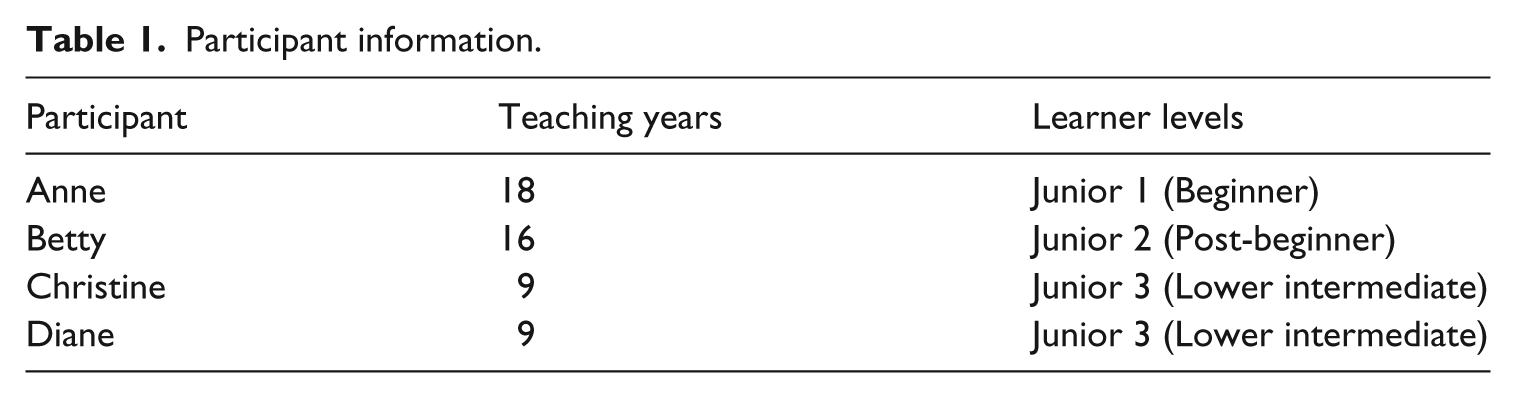
Semi-structured interviews to capture data for research questions 1 and 2 were held twice with four teachers, Anne, Betty, Christine and Diane (all pseudonyms), whose classes were also observed twice; interviews were held pre and post class-observation. All had teaching experience of nine years or more, and taught across the three Junior levels (i.e. beginner, post-beginner, lower intermediate); see Table 1. Two other teachers were also recruited from a pool of 100 across the school, but due to timetabling clashes they did not have matched observation data. We thus report only on these four participants, in order to maximize consistency in our research design, and to maintain clear links in analysing connections or dissonance between beliefs and practices (Borg, 2006). Full ethical procedures of the researchers’ universities were followed, guaranteeing anonymity and voluntary participation; interview and observation protocols were satisfactorily piloted at HSZC to ensure reliability.
Participant information.
Interviews were conducted in two parts, using an open-ended guiding protocol (see Appendix 1). The pre-class section of the interview covered all areas of COFLE including teacher training, the school focus in teaching English, preferred teaching methods, teaching material selection and design, classroom teaching procedures and assessment methods. The second part, used post-class observation, referred to teachers’ more general knowledge about TBLT, experience of implementing TBLT, perceived difficulties and suggestions for more effective adaptation. Each interview was at least 25 minutes, creating a total pool of 5 hours 20 minutes of data, seen as appropriate for effective case-study analysis (Dörnyei, 2007). All interviews were conducted in Mandarin Chinese, the participants’ native language, for convenience purposes.
b Classroom observation
Classroom observation was used for research question 3 to collect detailed qualitative and quantitative data on classroom teaching practices, and used to triangulate with the interview data (Yin, 2009). Eight lessons were video-recorded (two per teacher, each approximately 50 minutes long, matching aims and language focus as far as possible to ensure reliability and validity in comparing and triangulating data). We also took notes using a specifically-designed task-focused adaptation of the observation scheme ‘Communicative Orientation of Language Teaching’ (COLT), developed by Spada and Fröhlich (1995), adding a component of ‘communicativeness’ to the original COLT, based on Littlewood (2004, 2011; see Table 2) (see also Chen, 2008; Deng & Carless, 2009). By locating the learning activity on a communicative continuum, we identified how far the activity was meaning vs. form focused, and what degree of meaningful task-based message-exchange was managed, giving us a clear way of observing communicative ‘taskness’ in teaching practice (Littlewood, 2011, p. 553).
The communicative continuum.
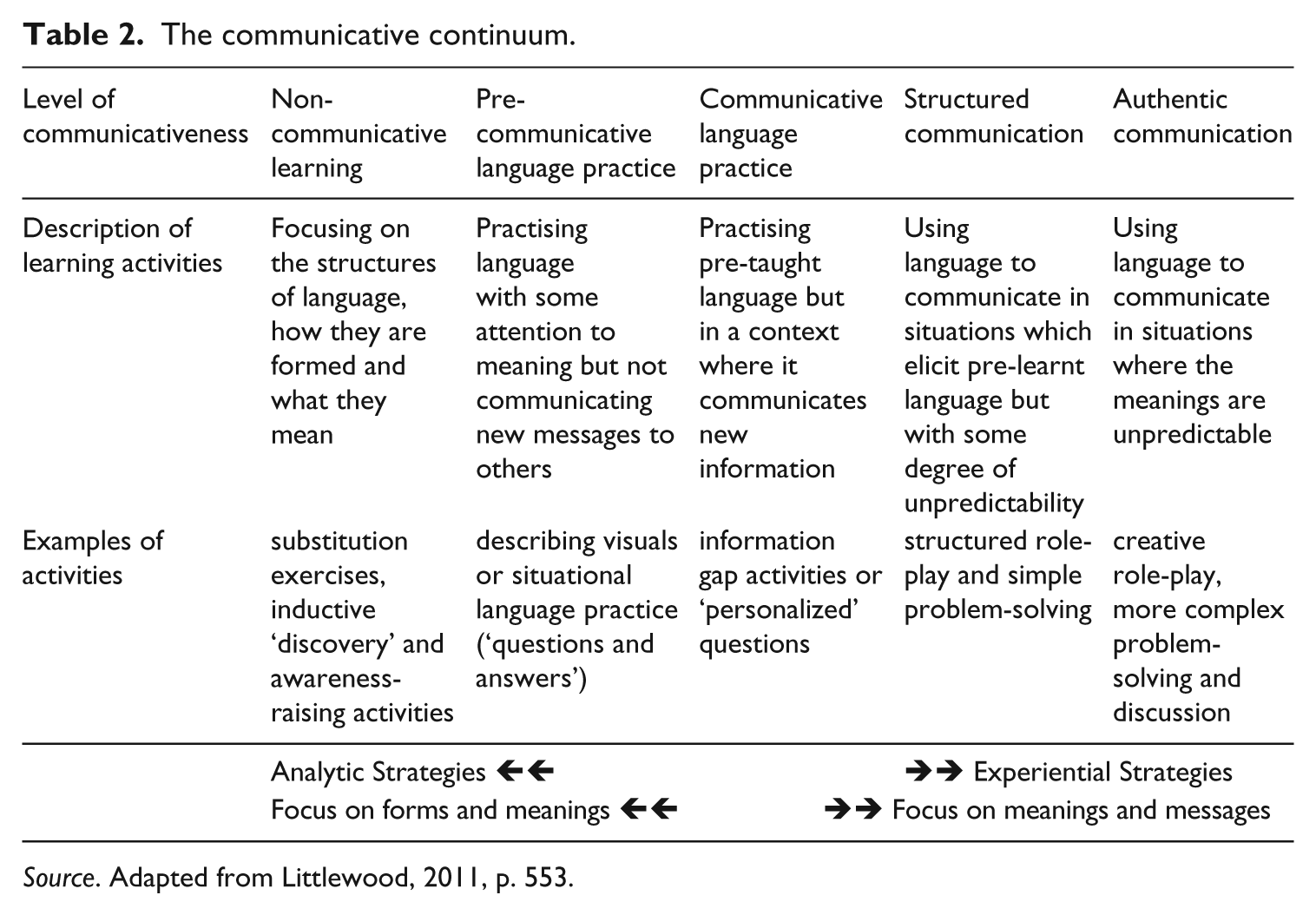
Source. Adapted from Littlewood, 2011, p. 553.
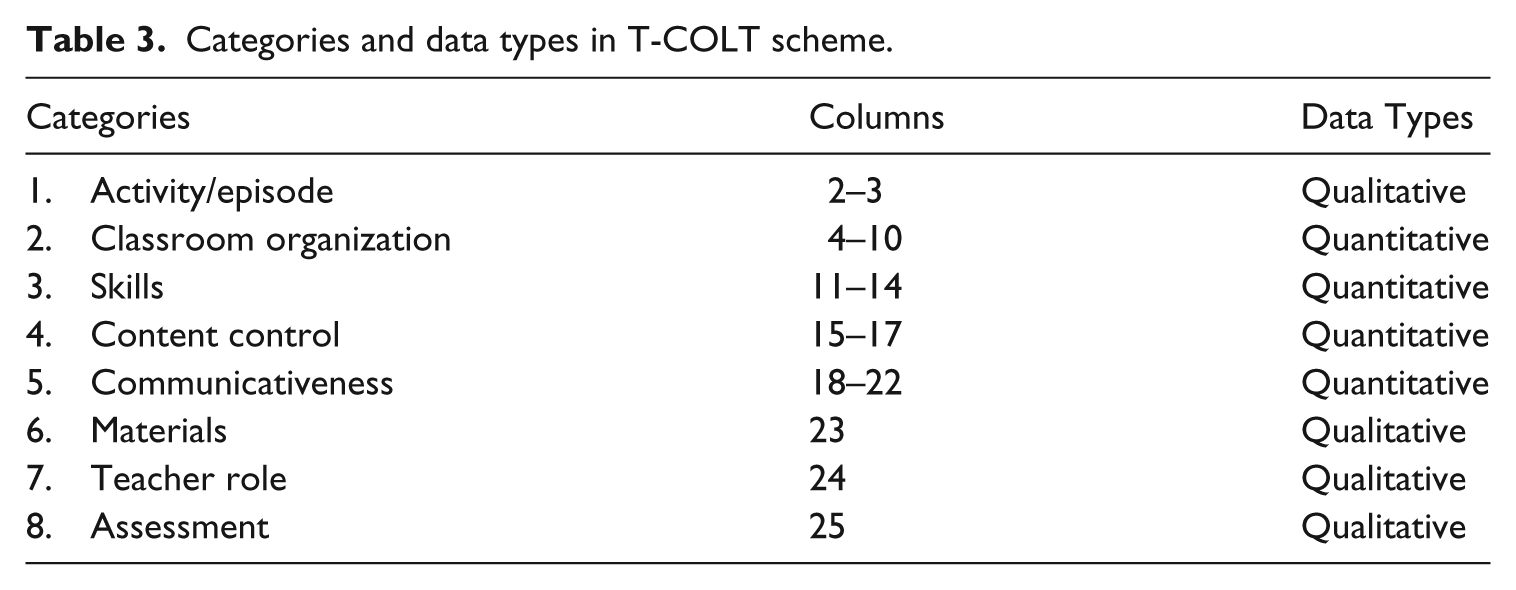
We used observation categories, taken from the first part of the original two-part COLT scheme (Spada & Fröhlich, 1995), to capture quantitative and qualitative information on organization of time, group work, use of materials and so on. We completed the observation scheme after each class by referring to video-recordings and materials gathered from that lesson. The T-COLT categories are summarized in Table 3 (for full details, see Appendix 2).
Categories and data types in T-COLT scheme.
3 Data analysis
Interview recordings were initially transcribed in Mandarin Chinese, then translated into English by the researchers and checked by a Mandarin-speaking institutional colleague for accuracy and reliability. Using emergent thematic analysis (Mackey & Gass, 2005, p. 241), the transcripts for each participant were segmented according to the questions used in the interview protocol (see Appendix 1), and then rechecked for emergent themes and patterns to allow for comparison of evidence of shared or differentiated beliefs and practices across participants. The second researcher checked themes and patterns, and the resulting set of themes were again rechecked by both researchers together to reach full agreement of key themes and illustrating comments.
To ensure that the T-COLT coding scheme was reliable, recordings of two lessons were randomly selected and coded by a native-Mandarin experienced teacher (one of the researchers’ institutional colleagues), trained to use the scheme. The inter-rater reliability of 94% (i.e. percentage of similar rating) was deemed acceptable (Cohen, Manion & Morrison, 2013; Suen & Ary, 1989).
III Findings
We first present qualitative interview-based data relating to the first two research questions investigating teachers’ beliefs about COFLE in relation to TBLT, and factors shaping their adaptation of TBLT. Second, we present observation data (quantitative and qualitative) to inform our third research question, how far teaching practice resembled TBLT; we finally present a sample lesson from the teacher to demonstrate how she clearly connected beliefs and practices in successfully adapting TBLT to this context.
1 Interview data
a Teachers’ beliefs about COFLE in relation to TBLT
Four consistent themes emerged from the analysis of the interview data about COFLE and TBLT: institutional support for targeted teacher training, use of authentic materials, clear teaching rules to foster the communicative classroom, and encouragement of learning outside the classroom. In terms of institutional support, the Vice Principal’s interview and teachers’ comments confirmed that teachers at HSZC receive specific training in their first year of teaching, including one-to-one coaching in communicative language and cultural-oriented teaching, peer observation and experience in pooling materials and resources to share expertise. They also have an opportunity to work in a partner school in the USA as a teacher assistant for at least six months; the Vice Principal confirmed that management see such sojourn experience as invaluable in developing cross-cultural and pedagogic expertise as well as boosting linguistic proficiency through immersion (Zhou, 2014). Common advantages mentioned were observing task-oriented teaching techniques of local language teachers, experiencing an English-speaking community and culture, and using a variety of original ESL/EFL textbooks and other resources. Christine commented:
I was impressed by how teachers in the USA source varieties of teaching materials freely for each lesson, comparing with strictly following the syllabus and the national textbook as we used to do.
The visits were seen as high in impact for boosting teachers’ knowledge of task-based teaching approaches, cross-cultural awareness and promoting their language proficiency.
According to the participants, a wide range of materials was used to build authenticity in teaching materials. To some degree, the choice reflected the teachers’ association of ‘authentic’ with ‘target-country origin’, but also indicated other local constraints in contextualizing what authentic input could be. Materials included ESL/EFL textbooks imported from the UK and USA, local EFL learning newspapers, BBC and VOA radio, English films, talk shows and internet materials (e.g. tourist guides to London). They were used as supplementary materials, aiming to enrich learners’ cultural knowledge and enhance the authenticity of the source material in line with TBLT principles, since
the texts in the national English textbooks are censored and altered by Chinese educators and [are] therefore not authentic enough. (Christine)
In order to foster communicative classrooms, the Vice Principal confirmed there were three school rules for communicative-oriented teaching: No first language (L1) in the class; encouraging implicit grammar teaching; fluency before accuracy. Teachers agreed the first rule of ‘No L1 in Classroom’ was seen as strictly adhered to: teachers claimed to always use English in teaching except for grammar lessons. Individual ways to encourage students could be used, for instance, by
asking the student who spoke Chinese in class to buy sweets for the whole class as a minor punishment. (Anne)
Second, teachers were trained and encouraged to teach linguistic forms and grammatical rules implicitly through meaningful and communicative activities, even if using the methodology ‘presentation–practice–production’ (PPP). For instance, instead of presenting separated linguistic forms
we contextualize them by linking them together using meaningful, real-life stories in a teacher-led discussion. (Diane)
Third, teachers valued the ‘fluency before accuracy’ policy in classroom teaching to develop learners’ speaking and listening skills:
we try to have minimum error corrections unless they are necessary in form-focused exercises, otherwise they would fail the exams. (Anne)
There was strong encouragement for out-of-class learning, including many communicative activities called ‘tasks’ in the interviews. These activities were planned by students after class and performed in class, either as a report-back on the previous lesson’s task focus (e.g. to script and act a drama based on texts), or a student-chosen report or discussion researching a cultural or social topic of general interest (e.g. Western festivals, campus news reports), and usually given during the first 5–10 minutes; there were also a variety of school-wide contests and regular meetings of interest groups, conducted in English.
These activities suit students’ age and proficiency levels and expose them in authentic cultural knowledge input beyond language learning. (Christine)
b Teachers’ beliefs about factors shaping adaptation of TBLT in HSZC
Our second research question elicited more variability than for the first, with broadly positive views about TBLT, especially about the potential for innovation and autonomy in teaching practice. Interviews also revealed fundamental differences in defining and applying TBLT in practice. These are summarized as consistency in degree allowed for student-centred teaching, using a task as more than a group-based communication activity, unsuitability of TBLT for beginners, and lack of confidence in adapting and contextualizing tasks for authentic outcomes. All participants saw TBLT similarly, as an innovative teaching approach in line with COFLE, as it
efficiently promotes learners’ communicative competence (Betty) [and] cultivates learning motivations and encourages integrated language use (Christine)
in and out of the classroom. It was noted by Diane that full task engagement could be cognitively challenging for students at Junior levels; however, she believed that time-on-task in class should be prioritized to build engagement and ensure task success. Participants recognized that they had a degree of freedom in applying task elements in the classroom, for instance:
in our shared lesson plan, new vocabularies and sentence structures are sometimes taught first following a PPP-procedure, but I prefer having these elements at the end and start the lesson with the main task and the text. (Diane)
Participants’ greatest divergences were found when asked to describe what a ‘task’ was and what made it different from an ‘exercise’. Responses are summarized in Table 4.
Task characteristics mentioned by participants.
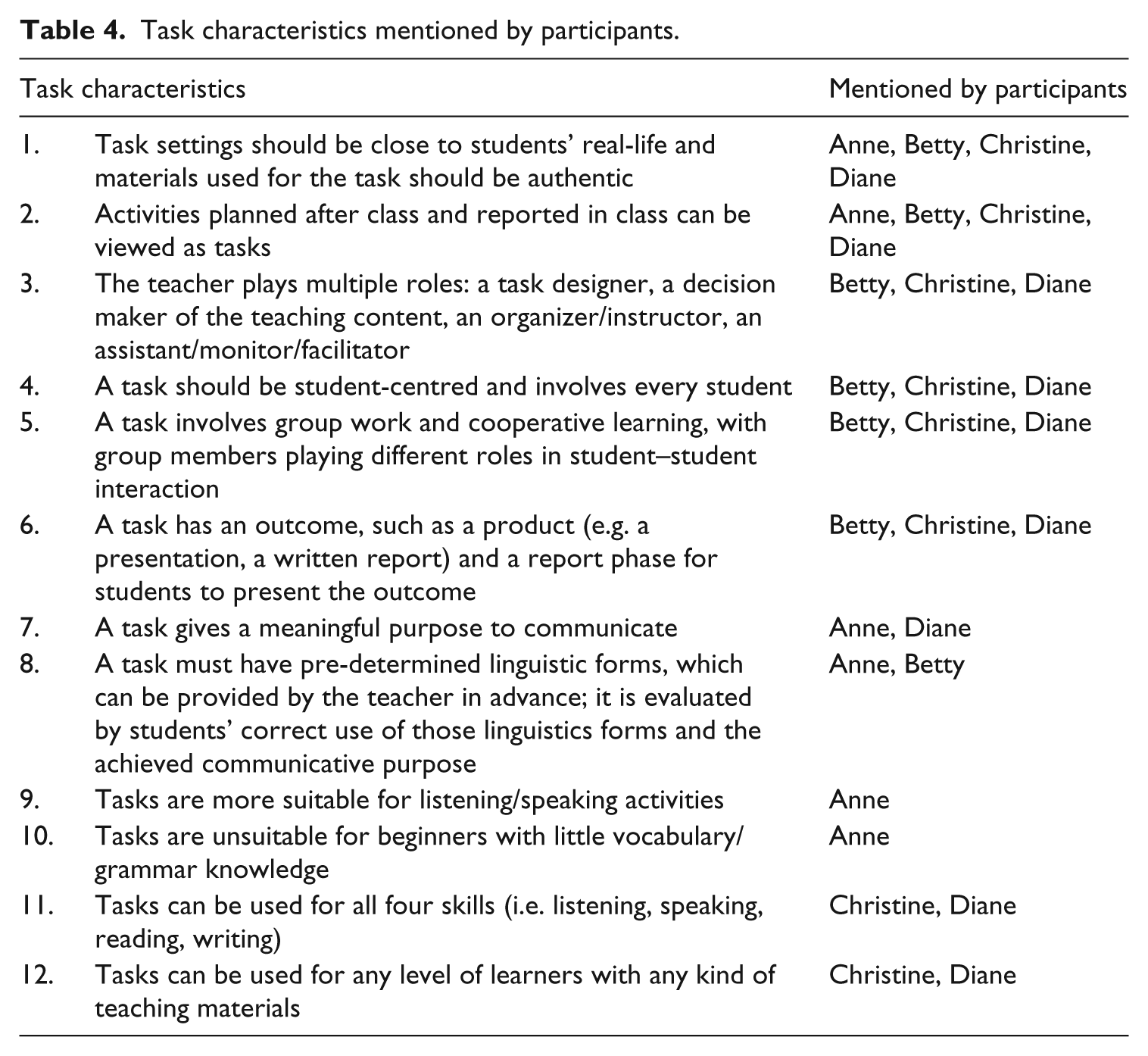
Characteristics 1 to 6 reveal areas of agreement and awareness of TBLT shared by three (or all four) teachers, including the importance of real-life task settings, authentic materials, value of the report stage, use of tasks both in and out of class, and student-centredness, though there was some evidence that group-work constituted a task. Characteristics 7 to 12, in contrast, reveal areas of disagreement, particularly from Anne compared to other participants (see comments 9, 10). These differences centred over use of focus on form, and a strong belief in the unsuitability of tasks, particularly for lower-level learners, claiming that
beginners have little knowledge of the target language and are unable to interact with each other, therefore meaning negotiation can only happen between teachers and students. (Anne)
Participants all felt constrained in using TBLT, which they ascribed to lack of professional development, despite the extensive training they all had during their first year of teaching in HSZC, and to a belief that TBLT was not always locally appropriate.
Memorization and rote learning still have their place in COFLE, in ways such as text recitation, imitation of native-like pronunciation and intonation, grammar-intensive lessons with pattern drills. (Anne and Christine)
All participants acknowledged that their classroom teaching was highly teacher-controlled, with common use of PPP in teacher–student interaction; yet only Diane saw this as being too teacher-centred, while others believe that this was unavoidable, especially at lower junior levels:
these students need more language scaffolding from teachers, because peer-scaffolding is too difficult for them. (Christine)
Participants also lacked confidence about their capacity for task design and achieving successful task outcomes; this was closely tied to concern over students’ poor accuracy in written English in exams. Anne and Christine both said that they were uncertain about how to design and manage input in a task that
covers the language forms in the textbook, and how to make sure students would use these forms when performing the task. (Anne)
Although textbooks contained communicative activities, they were not particularly task-based; thus,
it requires a lot of extra work for us to design a new task as we are so used to textbook-based ways of teaching. (Christine)
Due to this difficulty, Anne was
more comfortable using tasks for recycling previously taught language knowledge, rather than introducing new knowledge.
The lack of written accuracy was taken to be a direct consequence of the communicative focus of lessons, as
we focus too much on listening and speaking in our classroom teaching. (Christine)
Concerns arose over the nature of authenticity within TBLT revealing contrasting positions over western or local perspectives as authentic. Participants valued giving students a taste of western cultures through the COFLE; they referenced authenticity in terms of western native-speaker norms and settings (e.g. planning a tour of London using internet-based tourist resources), although realizing this notion of authenticity itself may be problematic. As Christine noted:
After all, we are not native speakers, we do not have the target language environment and resources that are needed to design tasks that reflect their real language use and communicative needs. But I believe we are doing the best we can.
When asked ‘what is task authenticity’, all participants acknowledged that tasks should link language knowledge to students’ daily life
with a real-life setting and real materials. (Diane)
Task authenticity for appropriate linguistic levels was seen as an issue for
beginner level teenager students who have developed a quite mature understanding of the world, yet their English proficiency seems only allowing them to do simple tasks such as shopping for groceries. (Christine)
The interview data from teachers thus reported HSZC as offering a rich institution-supported environment for communicative English activities, and some degree of individual freedom in using TBLT. But specific concerns were noted about implementing TBLT; three in particular were: (1) consistency in using student-centred TBLT vs. more traditional teacher-fronted approaches (including lack of confidence in using TBLT as more than group-based communication activities); (2) using TBLT at beginner levels; (3) confidence in adapting and contextualizing tasks for authentic outcomes. We therefore looked to see how these qualitative themes were reflected, or not, in actual practice.
2 Findings from classroom observation using T-COLT
The four interviewed teachers working across three Junior levels were observed using the adapted T-COLT scheme (see Table 3 above; for full details, see Appendix 2), to see how far their beliefs and concerns were reflected in communicative and task-like teaching practice.
a Quantitative findings
Data for categories 2–5 reflect teaching activities related to classroom organization, language skills, content control, and communicative taskness. Tables 5–8 show measures of time spent on each activity, calculated as total time spent across all eight lessons observed, averaged out to a mean percentage. Results are then given for each of the four individual participants, to allow for matching of earlier comments from the interviews with actual practice. The teachers are presented in order from lower to higher teaching levels: Anne taught Junior 1 level (beginner), Betty taught Junior 2 (post-beginner) and Christine and Diane both taught Junior 3 (lower-intermediate) level.
Time spent on types of classroom organization (percentages).
Time spent on four skills (percentages).
Time spent on types of content control (percentages).

Time spent on levels of communicativeness (percentages).
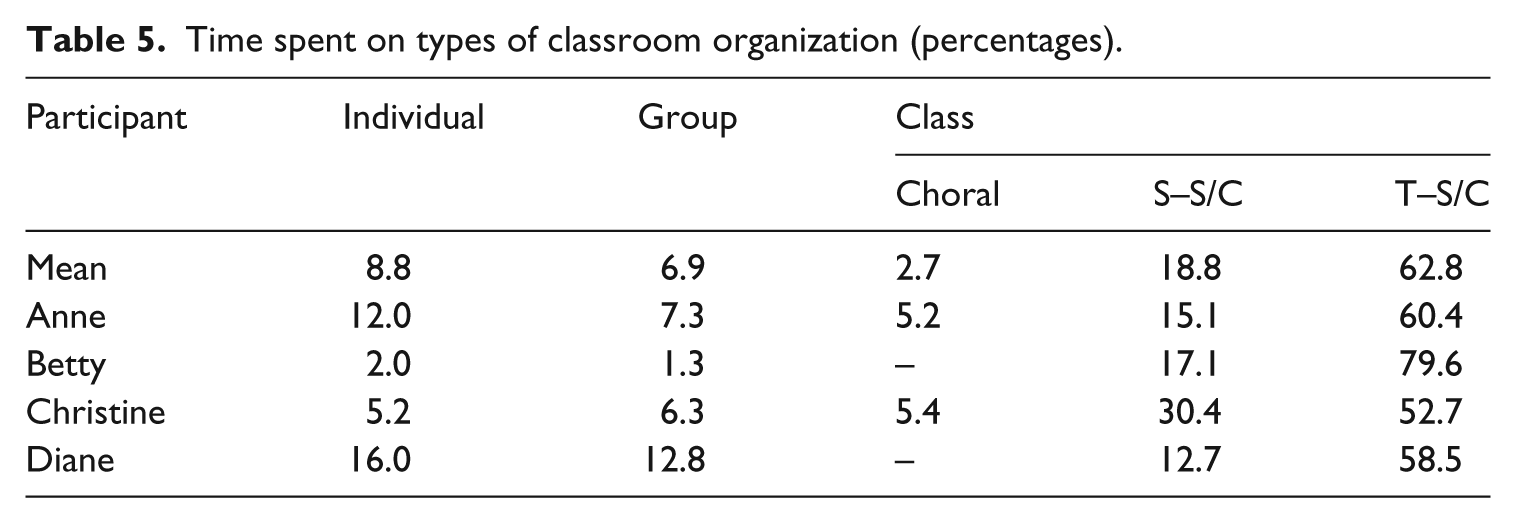
Under Category 2, ‘Classroom Organization’, each lesson was divided between different types of activities, i.e. individual, group work, whole class choral, students to whole class (S–S/C) and teacher to whole class (T–S/C); see Table 5.
On average, classroom teaching was predominantly delivered in teacher-to-whole-class manner (62.8% of the total time), while students-to-whole-class ranked second (18.8%), and just over 15% of the time was used for group and individual work altogether. These reflect interview findings acknowledging dominant teacher-fronted approaches. Betty used the least group-based activities, Diane the highest, despite both of them seeing group work as closely linked to TBLT principles (see Table 4).
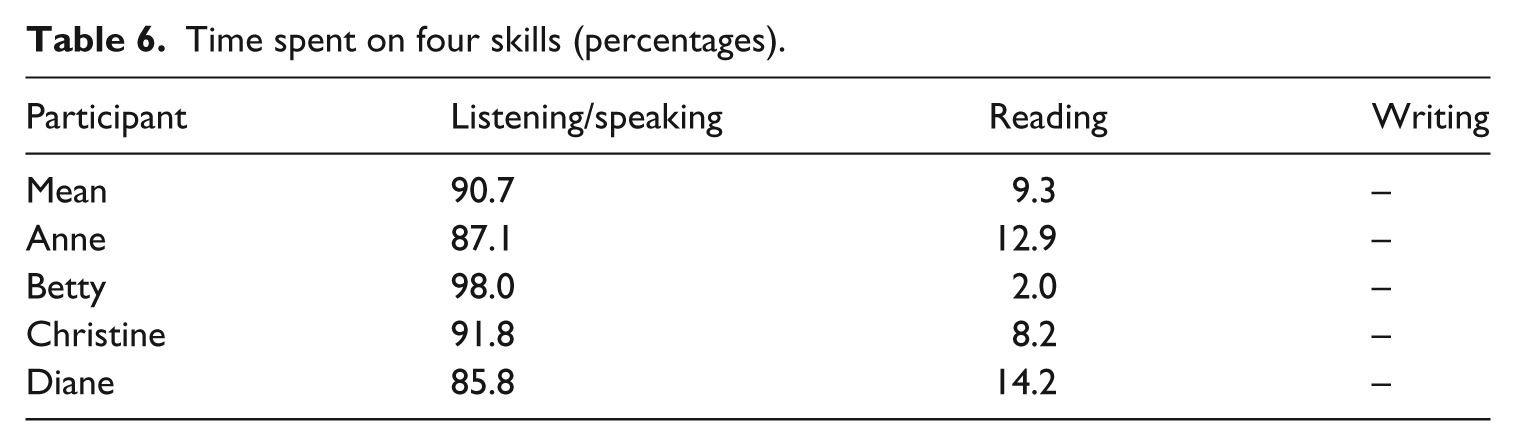
For Category 3, ‘Language Skills’, over 90% of class time was spent on listening and speaking. Only 9.3% of the time was spent on reading activities on average, with little relevant individual variation, and hardly any activities or instructions relating to writing were observed in any lessons. This contrasts with both Christine’s and Diane’s perceptions that tasks can be designed also for reading and writing activities (see Table 4), but resembles Christine’s concerns on learners’ lack of written accuracy caused, in her view, by insufficient focus on writing in the COFLE approach; see Table 6. Next, Category 4, ‘Content control’ relates to how far teachers handed over some choices to students on deciding the lesson content; see Table 7.
As noted, student-only or student/teacher involvement took over half of the time (64.1%), whereas 35.9% was spent on teacher-only control of materials and textbooks. Anne maintained the most teacher control, while Christine maintained similar levels across all three types of involvement (illustrated further below).
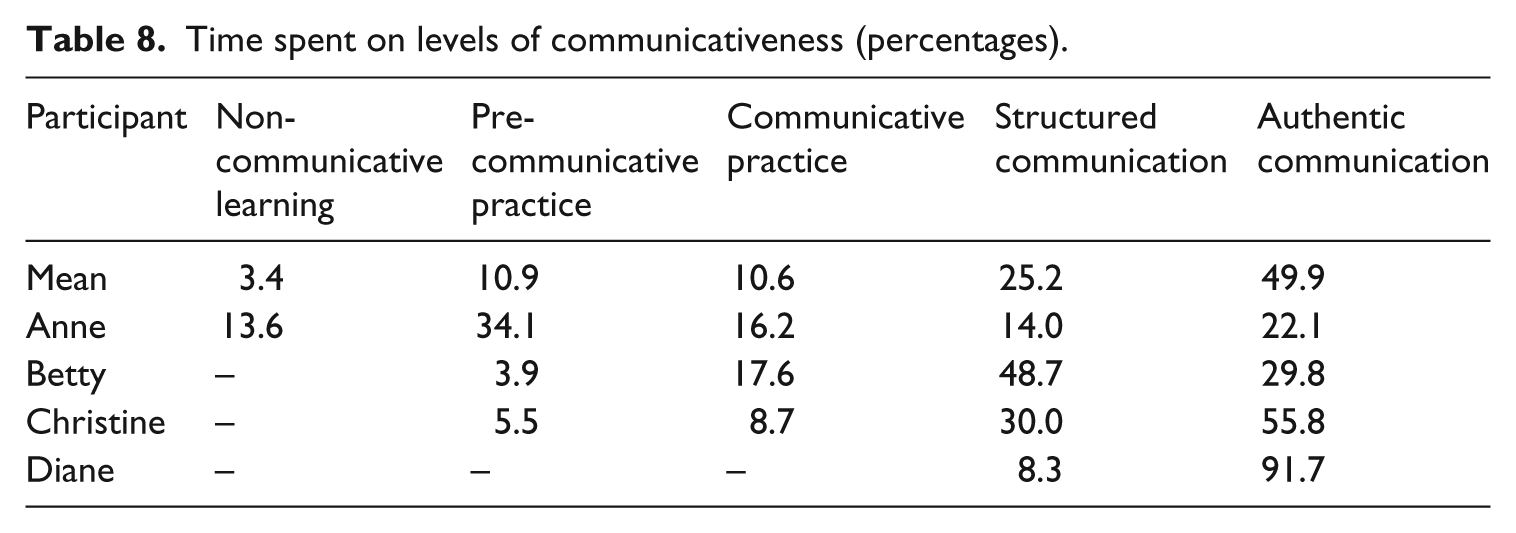
Finally, Category 5, ‘communicativeness’, represented the extent of ‘taskness’: the degree to which activities reflected Littlewood’s (2004, 2011) continuum from non-communicative learning to authentic task-focused communication, including progress through the task cycle and achieving meaningful task outcomes (Ellis, 2003); see Table 8.
In mean terms, most time spent during lessons was in communicative activities, with 49.9% spent on authentic communication, and lower than 15% on non-communicative learning or pre-communicative practice. Teachers’ individual timing on authentic communication seemed to increase with higher levels of student proficiency, although there was some difference between Christine and Diane, the two teachers working with the highest level (lower-intermediate), which reflected differences from interviews over task suitability for beginners.
b Qualitative findings
We used notes gathered under the sixth T-COLT category to analyse use of materials, supplemented with post-hoc reviews of classroom recordings to examine teachers’ terminology about TBLT while using materials. We noted that TBLT terminology was varyingly used, with some teachers referring to ‘main task’ and post-task ‘reports’, although ‘task’ could also refer to activities e.g. using stories as contexts for implicit learning.
For instance, stories were often used for implicit presentation of new vocabulary and linguistic structures. These were termed as tasks according to the teachers’ plans and in interviews, set in problematized situations, and supported by visual aids such as pictures or videos in pre-task activities, although the flow of the lesson more often resembled drills delivered in a traditional PPP approach, with up to half a lesson spent on structured PPP-based learning, with little group work or student control. Further, teachers often supported tasks with scaffolded instructions, e.g. slides with prompts to guide discussion. Although the aim was to give students opportunities to use pre-learnt language through tasks in a creative way, so many details and pre-selected forms were provided that students ended up reading from slides or reciting scripts rather than carrying out meaningful, authentic communication.
We also saw clear evidence in individual’ practices of a reliance on teacher-controlled activities during the main part of the lesson, at odds with expressed support for TBLT principles of learner autonomy (Skehan, 1998). For example, CLT-type activities, called tasks, were planned in task materials and handouts, but in reality authentic task activities might be limited to the final few minutes of a lesson, or left to homework, with more of the lesson following PPP-style teaching. This reflected a tension between participants’ comments about understanding the value of implicit communicative grammatical learning, but showed some lack of confidence in applying tasks for this purpose.
3 Sample task-based Lesson
However, the most confident and consistent teacher to apply TBLT was Diane, who was identified in holding the strongest positive views about the general value of TBLT, matched by observations of her teaching practice. Diane’s lesson ‘After the Fire’ used a high degree of authentic communication in task activities throughout, so we present this as an exemplar lesson plan, summarized in Table 9.
Sample task-based lesson plan.
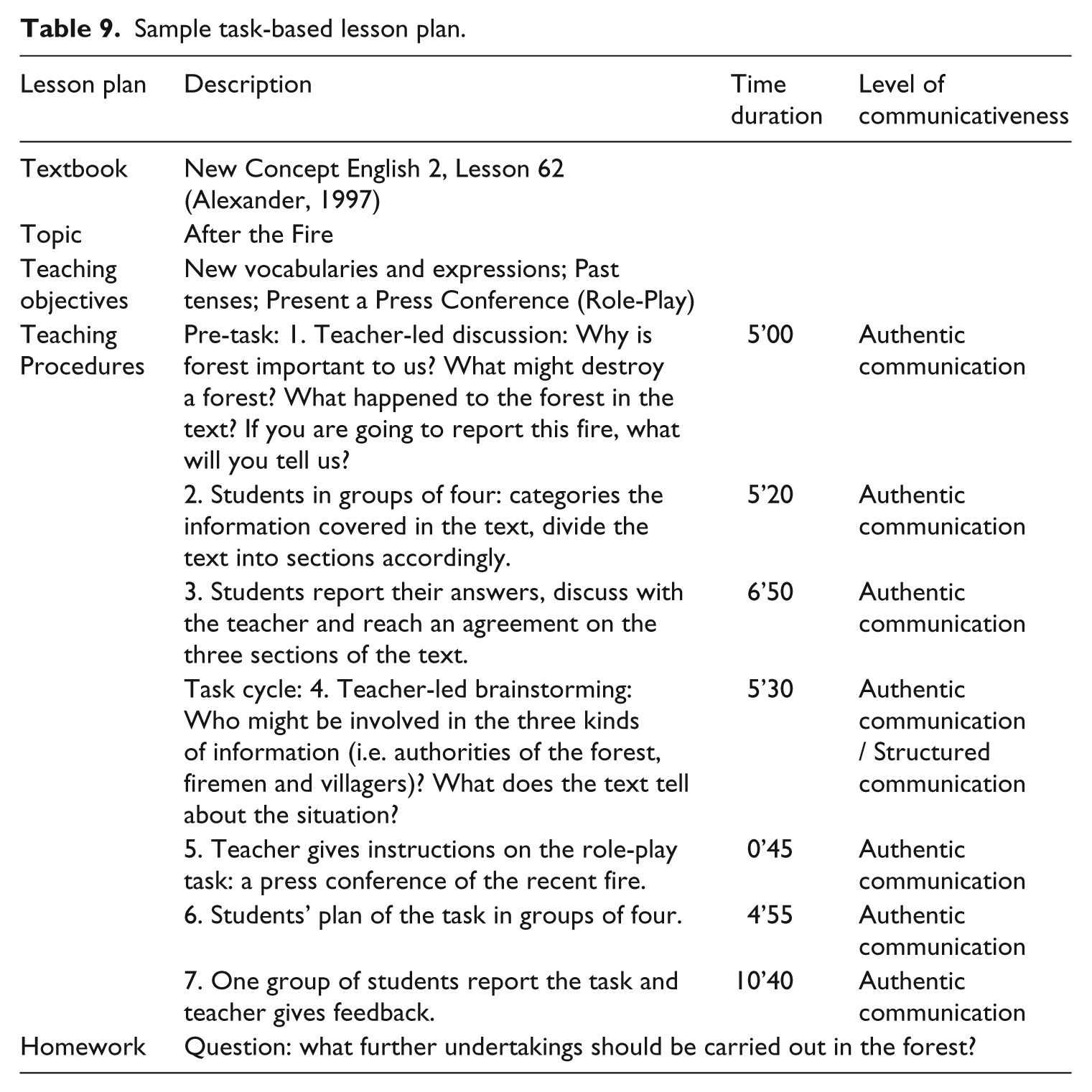
The first half of the lesson was a pre-task phase including teacher-led brainstorming, group discussion and whole class discussion; the second half used a classic task cycle (Willis & Willis, 2007) including task instruction, planning and report. The lesson revolved round a ‘government report task’ where students role-played government officials to briefly retell the real story of a forest fire (presented in a newspaper-style report), and to come up with appropriate recovery programmes. Diane noted, in her second post-lesson interview, that she adapted the task cycle by linking this lesson to the next follow-up lesson which focused on the linguistic structures in the text, including formative feedback on errors or omissions in target language structures used by students in the report stages; this follow-up lesson was included to explicitly assist students preparing for upcoming examinations, which we take here to be evidence of appropriate authentic adaptation and contextualization to local need.
IV Discussion and evaluation
This study aimed to create a rich source of empirical data triangulating teacher beliefs and practices among teachers using a task-based approaches in EFL in a private secondary school in China, which uses a specialized culture-oriented foreign language teaching framework based on CLT principles (COFLE). Our three research questions focused on teachers’ beliefs at HSZC about COFLE in relation to TBLT, factors that teachers believed shaped or limited local adaptations of TBLT, and how teaching practices resembled TBLT.
Summarizing key elements identified and discussed above, we saw in both the interviews and observation data, that teachers all possessed some knowledge of TBLT and were well aware of its position in COFLE as a preferable teaching method, but that this did not consistently translate into their own practice. The teachers knew that they were well supported by the school through training, materials and shared lesson planning, and shared a common aim of boosting students’ communicative competence in meaningful and authentic tasks. This was echoed by institutional enthusiasm for TBLT and management’s commitment to building communicative competence throughout the school, seen through school rules maximizing L2 use in and outside classrooms and fostering communicative English throughout school-wide activities. Being a private school, HSZC did not experience limitations that may be common to other schools in EFL contexts (class size, exam load), noted in existing empirical studies (e.g. Chen, 2008; Deng & Carless, 2010; Zheng & Borg, 2014). The school thus offered an acquisition-rich environment in which students had plenty of opportunities to use English in communicative contexts both inside and outside the classroom, setting a model for other institutions to learn from (Butler, 2011); however, as noted below, we saw that these benefits did not always translate into consistent TBLT.
For our second and third research questions about contextualizing TBLT in practice, we found clear evidence through interviews, classroom observations and lesson materials analysis that the four teachers represented a wide spectrum of beliefs and practice in using TBLT in the local context, despite the institutional commitment to communicative and TBLT principles noted above, and shared experience of extensive training and availability of resources. There was some overlap in individuals between their beliefs and practice, but also dissonances, particularly in the misconception of TBLT as being unsuitable for beginners, the over-reliance on the PPP model and closely associating tasks with practicing oral skills in group work: in line with other studies (e.g. Deng & Carless, 2009; Zheng & Borg, 2014). Our adapted T-COLT observation scheme, which included assessing the communicative continuum of tasks and activities, was found to be a powerful methodological tool, since it was able to describe how aspects of TBLT emerge across a range of data, whereas a more traditional observation tool, or a continuum-style analysis, alone can never reveal such a full picture. It is therefore suggested that teacher educators could make use of this T-COLT scheme as a self-reflection tool, for teachers to have a better understanding of their own classroom practice.
We found varied views over definitions of authenticity in task pedagogy and content, and further constraints and dissonances found in relation to observed practice. One dissonance was Anne’s belief that tasks were unsuitable for beginners (see Deng & Carless, 2009), despite her observed use of tasks in practice. Participants clearly felt unconfident in adapting strong TBLT, despite all their training (e.g. as in Betty’s data about feeling ‘safer’ using PPP or following exercises in the textbook) (see Chen, 2011). Participants’ planned activities, called tasks on their lesson plans, often became end-of-class add-on activities for practicing oral skills, rather than being authentic tasks (see Carless, 2007; Zheng & Borg, 2014). We suggest that the primarily weak pedagogic use of tasks, in name only, echoed a deeply-entrenched belief shared by three of the four teachers that the emphasis on communicative English came at the expense of accuracy, undermining their professed belief in the value of implicit grammatical learning. Participating teachers also varied over authenticity of task content, retaining a preference to consider western cultural and linguistic norms as authentic, reflecting the ESL/EFL debates over authenticity noted earlier (e.g. Butler, 2011).
These dissonances and particularly the teachers’ unconfidence in using TBLT were somewhat surprising, given that the usual external constraints in using TBLT did not apply in this context, and given the teachers’ long experience in the classroom (at least nine years). Examples of good practice were indeed found, e.g. Diane’s sample lesson, turning the post-task phase into another lesson with extra form-focused activities to cater for examination needs. We also found that some teachers were using potentially suitable task-focused activities for comprehension (Ellis 2003), such as whole class listen-and-do activities, vocabulary-building exercises linked to extensive reading, even at beginner levels. However, given that teachers did not feel consistently capable of designing and delivering contextualized tasks in practice, we argue that teacher training programmes need to do more to assist more confident and consistent TBLT at all levels in EFL settings. We call for further investigation into how teacher education programmes could support innovations in adapting local authentic TBLT both as pedagogic approach, and in locally contextualized content (Chan, 2012). We see such training, and use of examples of good practice as presented here, as vital for building what we term ‘intrinsic teacher autonomy’, supporting teachers to see themselves as empowered within their teaching context (Aoki, 2002; Benson, 2007).
V Conclusions and pedagogic implications
This study examined teacher beliefs and practices in communicative-oriented language teaching at a private school in China, to see how far TBLT principles were implemented and adapted to the context. We found evidence of commitment to the value of tasks within the COFLE framework, supported by teacher training abroad, pooled use of teaching materials and clear task-focused classroom communicative activities. We found some participants matching beliefs with practices that we offer as exemplars of best practice of strong TBLT, although other participants clearly preferred a weak view of TBLT activities ‘bolted on’ at the end of a class. We also noted dissonance between beliefs and practice for some participants, particularly in relation to definitions of authentic task pedagogy and content, allied to reluctance to relinquish teacher control over the classroom. We noted a general pattern of more time spent on task-based activities as students became more proficient. We identified these trends as primarily due to a lack of confidence, or of intrinsic teacher autonomy, in using TBLT, and call for more research into teacher professional development for building greater autonomy in adapting TBLT to local settings, especially at beginner levels.
The limitations of the case-study approach used here are fully acknowledged. We do not therefore make generalized claims for Chinese secondary schools, or other schools in a wider EFL context based on such small-scale research. This study prioritized teachers’ perspectives and practices, whereas in future studies, students’ perceptions would contribute greatly to research and pedagogic understanding. We focused on a rich description of how teachers’ beliefs and contextual factors shape their actual classroom practice in adapting TBLT, aiming to serve TBLT practitioners and researchers in similar situations, and bridge current gaps between the academic discourse community and the community of practice (Akbari, 2008).
Footnotes
Appendix 1
Interview guide.
Appendix 2
T-COLT (two-part Communicative Orientation of Language Teaching) observation scheme.
Funding
This research received no specific grant from any funding agency in the public, commercial, or not-for-profit sectors.