



Abstract
This study examined the effectiveness of explicit instruction and feedback, focusing on degrees of prior knowledge of the personal a in intermediate level second language (L2) Spanish. On the pretest, participants (n = 58) completed grammaticality judgment and picture description tasks, which found that learners had different degrees of receptive and productive command of the structure but had not mastered it above 90% accuracy. Based on pretest scores, participants were split into two groups: high prior knowledge (some receptive and productive command) and low prior knowledge (some receptive command only). On the posttest, half of each group was given computer-administered explicit instruction and feedback on the personal a followed by the two tasks. The control groups completed only the tasks. Results indicated that both instructed groups improved more than their respective control groups after treatment; however, while six individuals from the uninstructed high knowledge group improved over time on both tasks, no one from the uninstructed low knowledge group improved. Awareness results help to explain this difference, since both high prior knowledge and instruction with feedback were associated with higher levels of awareness. These results reveal a link between prior knowledge, awareness and the usefulness of instruction and feedback.
I Introduction
An area that has garnered much interest over the years in the field of second language acquisition (SLA) is that of prior knowledge. The idea is that having prior knowledge, either of a grammatical or morphological structure (Mackey & Philp, 1998; Pienemann, 1998, 2005; Spinner, 2013) or the lexicon (VanPatten, Williams & Rott, 2004), for example, gives learners an advantage in the acquisition of a second language (L2), although not all SLA theorists agree on this for all structures (N. Ellis, 2006). For specific examples of prior knowledge, see Leow and Mercer (2015). Many researchers, such as those in much of the previous instructional research, have used this belief in the importance of prior knowledge to eliminate data from their studies (Leow, 1998, 2000; Rosa & Leow, 2004a, 2004b). These studies omitted the scores of learners who had any ability to recognize or use the structure being tested, since learners’ initial knowledge would otherwise be confounded with effects of the treatment.
Other instructional research (Farley & McCollam, 2004; Mackey & Philp, 1998; Spada & Lightbown, 1999; White, 1991, among others) has purposely examined learners with prior knowledge of specific structures. This research has generally been conducted from the perspective of Pienemann’s Processability Theory, or PT (Pienemann, 1989, 1998, 2005), which focuses on developmental stages and the role of instruction on ‘emergence’, defined as initial productive use in spontaneous oral production, of grammatical structures. Several PT studies have found that learners who are deemed ‘ready’ to acquire the grammatical structure(s), or at the previous level on the developmental hierarchy, are more likely to produce the structure(s) in spontaneous oral production (Mackey & Philp, 1998; Spinner, 2013), although not all previous PT studies found an advantage for the ‘ready’ learners (Farley & McCollam, 2004; Mackey, 1999). 1
The current study seeks to more clearly define prior knowledge and its role in SLA, testing whether the effects of explicit instruction and feedback differ over time for intermediate L2 Spanish learners with different levels of receptive and productive knowledge of the personal a.
The reason for using this structure is that instructional research on the personal a to date has found it particularly difficult to acquire. Despite significant improvement after treatment, learners still scored at or below 50% accuracy on oral production (Farley & McCollam, 2004; Zyzik & Marqués Pascual, 2012) and written production (Bowles & Montrul, 2009). The second goal of this article is to study the role of awareness in the acquisition of the personal a, specifically its relationship to prior knowledge and instruction.
1 Degrees and types of knowledge
Degrees of knowledge of individual structures are independent from general learner proficiency in that they can refer to learners at the beginning, intermediate, or advanced proficiency levels. These degrees of knowledge are simply points on the continuum of learner acquisition of particular structures.
The current study focuses on two points in the middle of this continuum, which for the purposes of the current study will be called ‘low knowledge’ and ‘high knowledge’. Some specific points on the continuum include:
‘no knowledge’, or prior to emergence, in which learners are not able to recognize or produce the structure (orally or in writing);
‘some receptive knowledge’ (henceforth called ‘low knowledge’), in which learners have some ability to recognize the structure but still make significant errors in recognition and may not be able to produce the structure;
‘some productive and receptive knowledge’ (henceforth called ‘high knowledge’), in which learners have the ability to recognize and produce the structure but still make some errors in recognition and production; and
‘mastery’, in which learners have 90% accuracy or above on recognition and production of the structure.
While the specific points of high and low knowledge were created for the current study, the terminology of emergence and mastery has been used in child first language (L1) acquisition research (Berman, 2004; Huttenlocher, Vasilyeva, Cymerman & Levine, 2002; Morgan, Barrière & Woll, 2006); however, this research has tended to not clearly define these terms. The current study simply specified two middle degrees of acquisition, in which participants have only receptive or receptive and productive abilities on the grammatical structure. As explained below, the high and low learners in the current study were significantly different on the pretest on both the receptive and productive tasks.
The current study examined explicit knowledge, defined here as in R. Ellis, Loewen and Erlam (2006) as a product of learning, in which learners are consciously aware of what they are learning and which is available, typically through controlled processing. The knowledge tapped in this study is considered explicit as per R. Ellis (2005), because the tasks, a grammaticality judgment and elicited oral production task, were not timed and prioritized accuracy over fluency (p. 152). Neither task promoted spontaneous language use, since even the oral production task provided specific verbs to help participants complete the sentences in a particular way. 2 In principle, however, degrees of knowledge as defined above could be applied to and tested with implicit instruction/knowledge.
2 Personal a in Spanish
In Spanish, the preposition a obligatorily marks dative case and also optionally marks accusative case. As a marker of accusative case, it distinguishes the subject from the direct object of a sentence. No similar kind of object marking exists in English, the L1 of participants in this study. The prototypical use of the personal a is with animate and specific direct objects, as in (1), where it is obligatory. The structure is most often absent from other types of sentences, such as those with inanimate direct objects, regardless of specificity, as in (2). However, there are many exceptions to this, as in (3), which gives an example of the personal a with an inanimate direct object and (4) with an animate, non-human direct object. Typically, the a marking occurs with inanimate or non-human direct objects only when both subject and direct object could potentially be the subject of the sentence, as in (3) and (4). Example (5) illustrates another aspect of this structure in Spanish, in which the a marking can change the specificity of the sentence. Without the a, the sentence can mean that the referent has yet to be identified, and with the a it can mean that there is a particular referent that has been identified. 3
(1) Mario ve a la chica. ‘Mario sees the girl.’ (2) Mario ve el/un coche. ‘Mario sees the/a car.’ (3) El pronombre sustituye al sustantivo. ‘The pronoun replaces the noun.’ (4) El perro ve al gato. ‘The dog sees the cat.’ (5) Sara busca (a) una secretaria. ‘Sara looks for a secretary.’
Despite the complexity of the structure, the current study tested only the prototypical use of the personal a in order to directly compare the results with those of previous L2 instructional research. These previous studies (Bowles & Montrul, 2008, 2009; Farley & McCollam, 2004; Zyzik & Marqués Pascual, 2012) found that intermediate L1 English learners of Spanish made significant errors on the prototypical use of the personal a even after instruction and corrective feedback. Yet monolingual Spanish-speaking children productively acquire this use of the personal a by age 3 (Rodríguez-Mondoñedo, 2008). Before testing more complex usages of the personal a, such as those shown above, the current study sought to further our still incomplete knowledge of the effectiveness of instruction on the prototypical use of the structure.
Previous research on the personal a in L2 Spanish demonstrates the difficulty for L1 English learners in reaching mastery of even the prototypical use of the personal a (Bowles & Montrul, 2008, 2009; Farley & McCollam, 2004; Guijarro-Fuentes, 2011; Guijarro-Fuentes & Marinis, 2007; Zyzik & Marqués Pascual, 2012). Since the current study focused on instructional intervention, only previous research that included instructional treatment is discussed. These four studies (Bowles & Montrul, 2008, 2009; Farley & McCollam, 2004; Zyzik & Marqués Pascual, 2012) tested intermediate L2 Spanish learners.
Those studies that included grammaticality judgment task (GJT) or grammaticality preference pretest scores (Bowles & Montrul, 2008, 2009; Zyzik & Marqués Pascual, 2012) indicated that learners had receptive knowledge of the structure before beginning the studies. In Bowles and Montrul (2008), mean pretest scores for L2 participants on grammatical GJT items were 4.07 for the control and 3.93 for the instructed group (out of 5), and in Bowles and Montrul (2009), 3.76 out of 5 for L2 learner participants. Zyzik and Marqués Pascual (2012) found that on the grammaticality preference task the pretest mean for all L2 groups was 7.69 out of 15, so participants in these studies scored from around 50% to 80% accuracy on the pretests.
Those studies that included pretest scores for written or oral production measures (Bowles & Montrul, 2009; Zyzik & Marqués Pascual, 2012) revealed that learner scores on these tasks were very low, typically under 15% use in obligatory contexts. Therefore, learners from the previous personal a research are considered to have had low knowledge (receptive but not productive knowledge) on the structure at pretest time.
All four studies followed a pretest–posttest design, with an immediate posttest in Bowles and Montrul (2008) and up to a three-week delayed posttest in Zyzik and Marqués Pascual (2012). Learners improved significantly after treatment on the grammaticality judgment or preference tasks (Bowles & Montrul, 2008, 2009; Zyzik & Marqués Pascual, 2012), and on written production of the structure (Bowles & Montrul, 2009; Zyzik & Marqués Pascual, 2012). Yet, learners in all of this previous research continued to make errors on the structure after treatment. For example, on their grammaticality preference task, Zyzik and Marqués Pascual (2012) found that even the explicit instruction group, which improved the most after treatment, scored 11.6 out of 15, or about 78%, on the posttest. On the written cued sentence production task, this group did not score above 50% on the posttest. Farley and McCollam (2004), who were working within Processability Theory, indicated that less than half of the learners improved over time on spontaneous oral production of the structure.
3 Theories of prior knowledge
In addition to Pienemann’s Processability Theory, explained above, N. Ellis (2006) discussed the role of input on degree of knowledge, applying concepts from associative learning theory to language learning to explain why certain grammatical structures are difficult for L2 learners to acquire. For example, Andersen’s One-to-One Principle states that L2 learners initially prefer to link a form to just one meaning in the interlanguage (Andersen, 1984). In the acquisition of the personal a, this one-to-one form–meaning mapping cannot occur, since the structure is used in Spanish as both the dative and accusative case marker. In addition, learners sometimes pay attention to the wrong cue(s) because of L1 interference. In the case of the personal a, this means that L2 Spanish learners (L1 English) pay attention to word order cues (Bates & MacWhinney, 1989) as they would in their L1 rather than using the personal a to ascertain the direct object. Another problem for the personal a is its low salience, which occurs in part because it is a function word and difficult to perceive in rapid, informal speech, and also because its high frequency makes it more likely to become phonologically combined with adjoining elements in a sentence (p. 170).
Normally, N. Ellis states, L2 learners are able to add L2 cues over time. However, with low salience forms, particularly those with low communicative value (which do not contribute much to overall meaning) like the personal a, learners may never be able to notice these cues on their own. As he points out, ‘A sad irony for an L2 speaker under such circumstances of transfer is that more input simply compounds their error’ (p. 185). For these structures, then, N. Ellis asserts that it is necessary to help the learner ‘notice’ the cue to make it more salient, through methods such as instruction or consciousness raising, in order to facilitate acquisition. This is particularly true for those L2 learners who have prior knowledge of the structure but have already assigned cues incorrectly.
VanPatten et al. (2004) maintain that ‘if an initial encounter with a form in the input results in a weak connection with its meaning,’ then later encounters with the form in the input may add to the completeness, robustness, and proximity of the form as compared to the target form (p. 8). They claim that degree of knowledge itself likely plays an important role in the acquisition of individual structures and in the usefulness of instruction on these structures (p. 10), although they do not make specific predictions regarding the role of instruction on degree of knowledge. VanPatten et al. do state that over time, learners will presumably be able to restructure their interlanguage systems with more input (p. 9), and like N. Ellis they assert that, at least when the initial form–meaning connection (FMC) has already been made, increased learner attention is ‘more likely to lead to robust and complete FMCs’ (p. 17). Based on these theories, learners with high prior knowledge of the personal a may benefit differently from explicit instruction and feedback than those with lower prior knowledge, but only if they ‘notice’ the structure and re-assign cues correctly.
II The current study
The current study tested whether intermediate level learners with different degrees of knowledge of the personal a benefit differently from explicit instruction and explicit corrective feedback. To this end, two groups of learners were tested, one with low knowledge of the personal a, like the learners at pretest time in the previous instructional research (Bowles & Montrul, 2008, 2009; Farley & McCollam, 2004; Zyzik & Marqués Pascual, 2012), and one with high knowledge, like the learners at posttest time in the above studies. A subset of learners also carried out think-aloud protocols, to help determine whether awareness is related to instruction and prior knowledge, as predicted by N. Ellis (2006).
As the previous studies found differences in pretest scores on different types of tasks, with scores around 50–80% on receptive tasks (such as GJTs) and around 15% on productive tasks (such as written or oral production tasks), this study included both types of task. The study, like the previous personal a research, consisted of a pretest, posttest, delayed posttest design, with one week between the pretest and treatment/posttest and two weeks between the posttest and delayed posttest. Learners’ initial knowledge of the structure was determined by the pretest, as described below. The two research questions addressed in this study were:
Do the effects of explicit instruction and feedback differ over time for the high and low knowledge groups on a picture description task and/or a grammaticality judgment task?
Is there a relationship between participants’ level of awareness (as shown by think-aloud protocols) and prior knowledge of the personal a? Between level of awareness and instruction on the personal a?
1 Participants
Ninety-four intermediate L2 Spanish, L1 English learners were tested. To be included in the study, participants had to complete all three sessions, score at the intermediate level, or between 20–39 out of 50 points 4 on the proficiency test (a multiple choice vocabulary section from the Modern Language Association test and a modified cloze grammar passage from the Diploma de Español como Lengua Extranjera), and score below 90%, considered the level of mastery of a grammatical structure, on both the oral and written tasks on the pretest. Fifty-eight participants met the criteria for inclusion. The average age of the participants was 19.1 years (range 18–22 years). At the time of testing, participants were enrolled in various intermediate Spanish courses at the 5th or 6th semester, and they had been studying Spanish for an average of 6.1 years (range 3–8 years). This information was obtained via a background questionnaire administered at the beginning of the study.
2 Tasks
During the pretest session, participants completed: (1) a short background questionnaire that asked them to provide information about age, courses taken and years of study of Spanish, (2) the proficiency test and (3) a vocabulary task. The vocabulary task consisted of all non-distracter verbs in the study, and was used to allow participants to become familiar with the vocabulary.
The two main tasks were the oral production task and the written GJT. The oral task was a picture description task (PDT), which consisted of pictures with one or two Spanish verbs in the infinitive written above the picture. Participants were directed to say one or two sentences using these verbs. The pretest and delayed posttest were the same and consisted of 15 pictures containing 13 verbs with animate direct objects (requiring the personal a) and 12 verbs with inanimate direct objects (requiring no personal a). The posttest was a different set of pictures, and contained 17 pictures with 12 verbs for both the animate and inanimate direct objects. 5
The second task was an untimed written GJT, which consisted of 80 sentences, 40 grammatical and 40 ungrammatical. Of these 80 sentences, 48 were distracters, targeting gender agreement, number agreement of the subject and verb, and use of ser and estar, and 32 featured personal a items. Table 1 shows the distribution of personal a items on this task.
Distribution of personal a sentences, grammaticality judgment task.
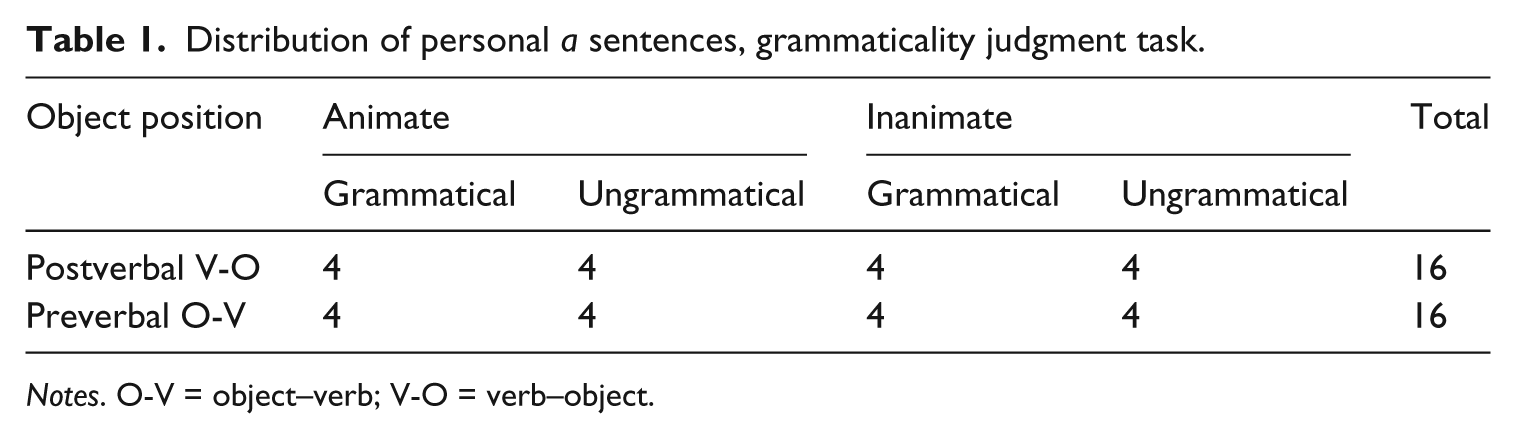
Notes. O-V = object–verb; V-O = verb–object.
A subset of participants carried out a think-aloud protocol concurrently with the GJT, saying their thoughts out loud while reading the sentences. These participants were given written instructions to keep talking constantly, and a warm-up task, which was unrelated to the GJT as suggested by Bowles (2010); in this case, a warm-up math problem. This subset consisted of about 10 participants in each of the four groups described below.
Immediately before the posttest, half of the participants were given computer-administered explicit grammar instruction and explicit corrective feedback in English. Learners were randomly assigned to treatment or control groups after the two initial groups were formed based on prior knowledge on the pretest, as explained below. The explicit grammar instruction consisted of two pages that participants read on the computer. The first contained an explanation of what direct objects are and how to identify them in a sentence. The second page of instruction informed participants about the prototypical use of the personal a in Spanish, that it is obligatory with animate direct objects, and typically obligatorily absent with inanimate direct objects, and gave examples of sentences in Spanish with and without the personal a. A short sample appears below: Leaving out the ‘personal a’ in sentences like Veo a Susana is ungrammatical. However, in sentences like Mario come un sándwich, it is actually ungrammatical to put in the ‘personal a’. So make sure to pay attention to who or what is the direct object of a sentence so that you know if it needs ‘personal a’.
Explicit corrective feedback was given during two computer activities of 10 questions each, completed immediately after the instructional treatment. These activities provided metalinguistic feedback, or information on the correct use of the personal a in Spanish, along with an indication of when the participants’ answers were incorrect, and a check next to the correct answer. The first feedback activity was selected response, and the second was constrained constructed response. Participants moved immediately from the activities to the PDT, although the researcher did ask participants if they had any questions on the activities or feedback before continuing to the picture description task. The entire treatment, including the two feedback activities, lasted approximately 20–25 minutes, a similar length to that of Bowles and Montrul (2009).
3 Sessions
On the pretest, participants completed the vocabulary task and background questionnaire, followed by the proficiency test, PDT and GJT.
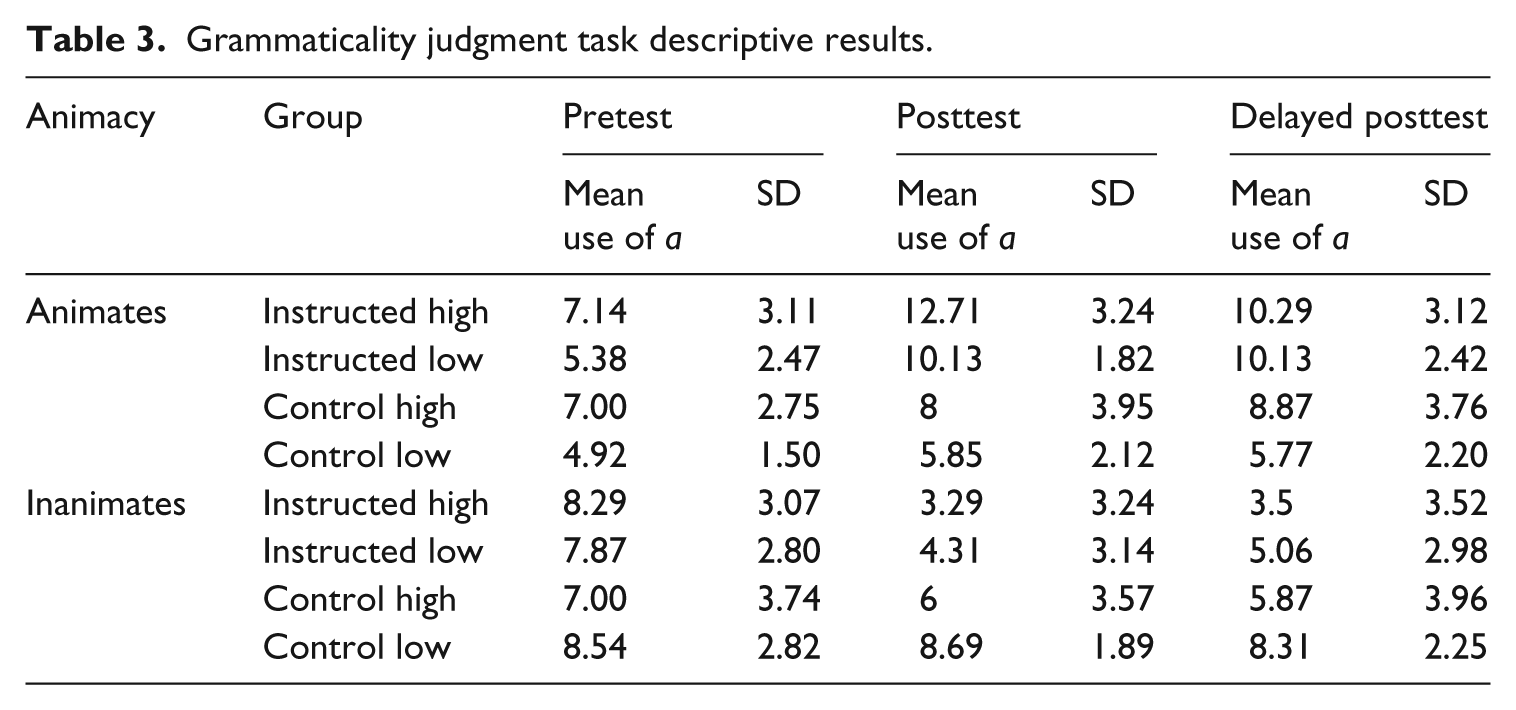
Participants were placed into the Low Knowledge group or the High Knowledge group by taking the median score on the GJT pretest (lowest score 8, highest 19, median 13) and PDT pretest (lowest score 0, highest 61%, median 23%) and making that the cutoff point. Those participants who scored above the median were put into the High Knowledge group and those who scored below, the Low Knowledge group. To be sure that this method created two statistically significantly different groups, independent samples t-tests were run for both pretest tasks. Significant differences were found between the two groups on animate items, t(56) = −2.881, p < .05, d = .757 on the GJT pretest, and on animate items, t(56) = −12.134, p < .001, d = −3.191 and inanimate items t(56) = −2.564, p < .05, d = –.674 on the PDT pretest. For mean pretest scores on each of these tasks, see Tables 2 and 3.
Picture description task descriptive results.
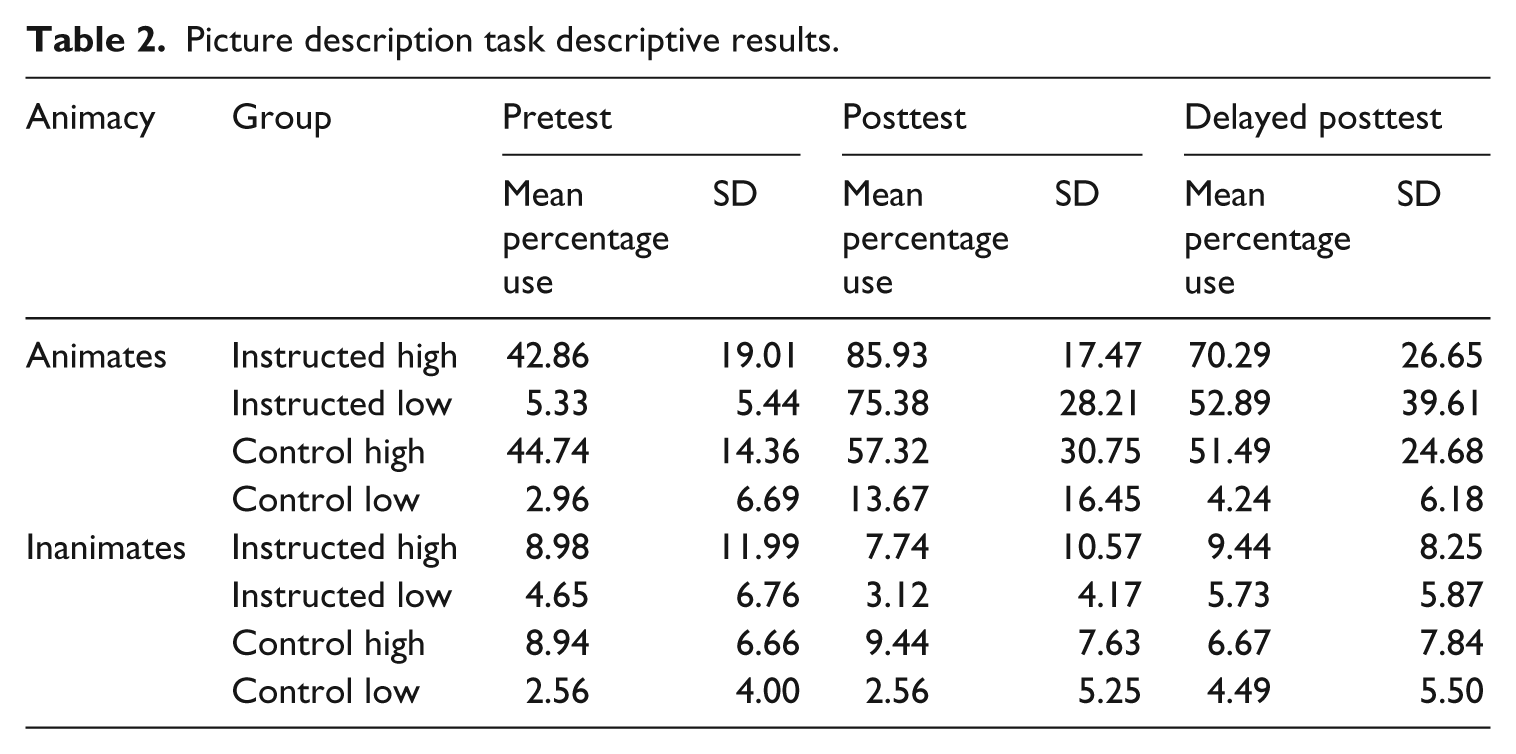
Grammaticality judgment task descriptive results.
One week later on the posttest, half of each of the above two groups completed the explicit instruction and explicit corrective feedback followed by the two tasks. Participants were told to read the two instructional pages at their own pace, and that they could move back and forth between pages if they wished. These two instructed groups are called Instructed High Knowledge (Instructed High, n = 14) and Instructed Low Knowledge (Instructed Low, n = 16). The other half of each group completed only the PDT followed by the GJT. These two groups are called Control High Knowledge (Control High, n = 15) and Control Low Knowledge (Control Low, n = 13). Again, the high knowledge groups had productive and receptive knowledge of the personal a, whereas the low knowledge groups had receptive knowledge only, scoring an average of about 4% on the PDT pretest. On the delayed posttest, two weeks after the posttest, all four groups completed the PDT and GJT.
4 Analysis
The PDT was scored using percent use of the personal a in obligatory contexts. This calculation was necessary because due to the format of the task, sometimes participants (correctly) did not use a full direct object, instead providing a clitic pronoun when describing the second verb in a picture, as shown in example (6). A total of 2% of the data (55 tokens over 41 participants) consisted of clitic pronouns.
(6) El niño visita a la niña y la niña lo/le saluda ‘The boy visits the girl and the girl greets him.’
While these sentences are more natural and grammatically correct in Spanish than providing both separate direct objects, sentences like (6) led to a different number of obligatory contexts for each participant. For example, if a participant used the personal a with animate direct objects 7 times (out of 13), but used a clitic pronoun the other 6 times, the score was 100% (7 out of 7 obligatory contexts).
On the GJT, one point was given for each correct answer and zero points for each incorrect answer. Raw scores were used for this task, for a total of 32 possible points.
Think-aloud protocols were coded as No Report (NR), Noticing (N) or Understanding (U), based on the coding used by Rosa and O’Neill (1999). In those reports coded as indicating Understanding, participants explicitly mentioned that the personal a is used to distinguish the direct object or discussed the animacy of the direct object, as in example (7). As per Leow and Mercer (2015), only those think-alouds with correct hypothesis/rule formation were coded as Understanding. Think-alouds were coded as showing Noticing when participants added and deleted ‘a’, said ‘needs “a” ’ or considered using or deleting the ‘a’ without indicating explicit rule formation, as in (8). Those think-alouds in which participants simply read the sentences aloud without commenting on the ‘a’ were coded as No Report, as in (9).
(7) El hombre visita al chico because there’s two people involved … El niño ataca a Felipe since that can happen to both of them so you need to distinguish … (8) El niño abraza al juguete, it should be el juguete, not al juguete … La mujer besa la niña, uh it should be besa a la niña … (9) El hombre visita el chico, that looks good … El niño ve a la pelota, looks good … La mujer besa la niña, good.
Two raters (one a native Spanish speaker) independently read and coded 20% of the think-alouds using the system described above, to establish reliability of scoring. Initial agreement between raters was 85%. The raters met to discuss, re-coding any disagreements together until 100% agreement was reached. The researcher continued to score the rest of the protocols without the help of the second rater.
III Results
To determine whether the effect of instruction differed over time for high and low knowledge learners on the PDT and GJT, two 2 × 2 × 3 repeated measures ANOVAs were run for each task, on animate and inanimate items, with prior knowledge (high and low) and instruction (instruction and control) as the between-subject factors, and time (pretest, posttest, delayed posttest) as the within-subjects factor.
Follow-up statistics consisted of 2 × 3 (group × time) repeated measures ANOVAs run on the two high knowledge groups (Instructed High and Control High) and the two low knowledge groups (Instructed Low and Control Low). Only the interactions are reported, since these ANOVAs were run to test whether each instructed group improved more than its respective control group.
1 Picture description task results
The PDT rMANOVA for scores on animate items found a statistically significant main effect for time, F(2, 108) = 47.255, p < .001, η p 2 = .467, a time by instruction interaction, F(2, 108) = 21.793, p < .001, η p 2 = .288, but no time by prior knowledge interaction, F(2, 108) = 1.591, p = .208, η p 2 = .029. Contrasts revealed that scores increased over time from pretest to posttest and from pretest to delayed posttest, and decreased over time from posttest to delayed posttest. Contrasts also indicated that instructed participants improved more over time than uninstructed participants, from pretest to posttest and from pretest to delayed posttest.
Follow-up statistics found a significant group by time interaction for high knowledge groups, F(2, 54) = 4.334, p < .05, η p 2 = .140 and low knowledge groups, F(2, 54) = 22.078, p < .001, η p 2 = .450. Contrasts indicated that Instructed High improved more than Control High from pretest to posttest only, but that Instructed Low improved more than Control Low from pretest to posttest and from pretest to delayed posttest.
The rMANOVA for scores on inanimate items revealed no statistically significant main effect for time, F(2, 108) = .345, p = .709, η p 2 = .006, no time by instruction interaction, F(2, 108) = .959, p = .386 η p 2 = .017, and no time by prior knowledge interaction, F(2, 108) = .755, p = .473, η p 2 = .014, so no further tests were carried out. Table 2 provides the descriptive results for the PDT.
Figure 1 depicts scores over time on animate items for this task. All effect sizes, reported as partial eta squared, of statistically significant results, were at/above .14, suggesting a high practical significance of these results.
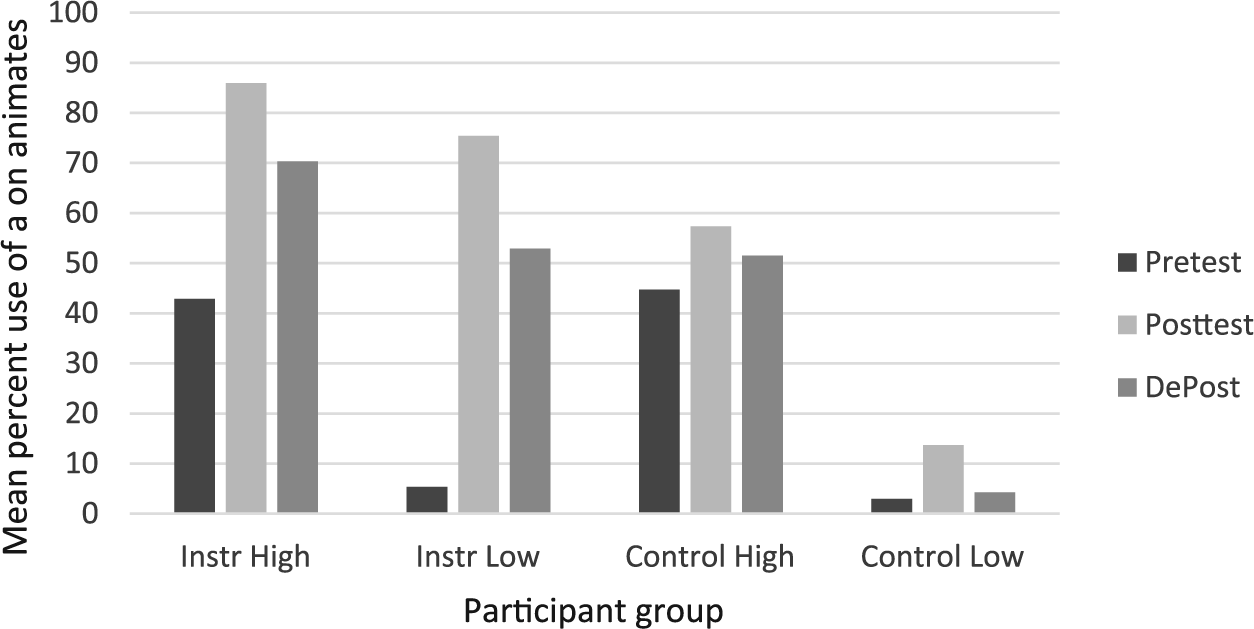
Picture description task (PDT) scores on animates.
2 GJT results
Just as with the PDT, the GJT rMANOVA for scores on animate items found a statistically significant main effect for time, F(2, 108) = 33.417, p < .001, η p 2 = .382, a time by instruction interaction, F(2, 108) = 13.579, p < .001, η p 2 = .201, but no time by prior knowledge interaction, F(2, 108) = .423, p =.656, η p 2 = .008. Contrasts revealed that scores increased over time from pretest to posttest and from pretest to delayed posttest. Contrasts indicated that instructed participants improved more over time than uninstructed participants, from pretest to posttest, from pretest to delayed posttest, and from posttest to delayed posttest.
Follow-up statistics found a statistically significant group by time interaction for high knowledge groups, F(2, 54) = 6.228, p < .05, η p 2 = .187 and low knowledge groups, F(2, 54) = 12.071, p < .001, η p 2 = .309. Contrasts indicated that Instructed High improved more than Control High from pretest to posttest but Control High improved more than Instructed High from posttest to delayed posttest, and that Instructed Low improved more than Control Low from pretest to posttest and from pretest to delayed posttest.
The rMANOVA for scores on inanimate items revealed a statistically significant main effect for time, F(2, 108) = 19.319, p < .05, η p 2 = .263, no time by instruction interaction, F(2, 108) = 1.722, p = .184 η p 2 = .031, but a statistically significant time by prior knowledge interaction, F(2, 108) = 11.497, p < .05, η p 2 = .176. Contrasts indicated that scores increased over time from pretest to posttest and from pretest to delayed posttest. Contrasts also revealed that high prior knowledge participants improved more over time than low prior knowledge participants, from pretest to posttest and from pretest to delayed posttest.
Follow-up statistics found a group by time interaction for high knowledge groups F(2, 54) = 6.273, p < .05, η p 2 = .189 and low knowledge groups, F(2, 54) = 5.373, p < .05, η p 2 = .166. Contrasts indicated that both Instructed High and Instructed Low improved more than their respective control groups from pretest to posttest and from pretest to delayed posttest. Table 3 illustrates the descriptive results for the GJT. Again, all effect sizes, reported as partial eta squared, of statistically significant results, were above .14, which suggests that the effects are meaningful and have practical significance. Figures 2 and 3 depict scores over time on animate and inanimate items for this task, respectively.
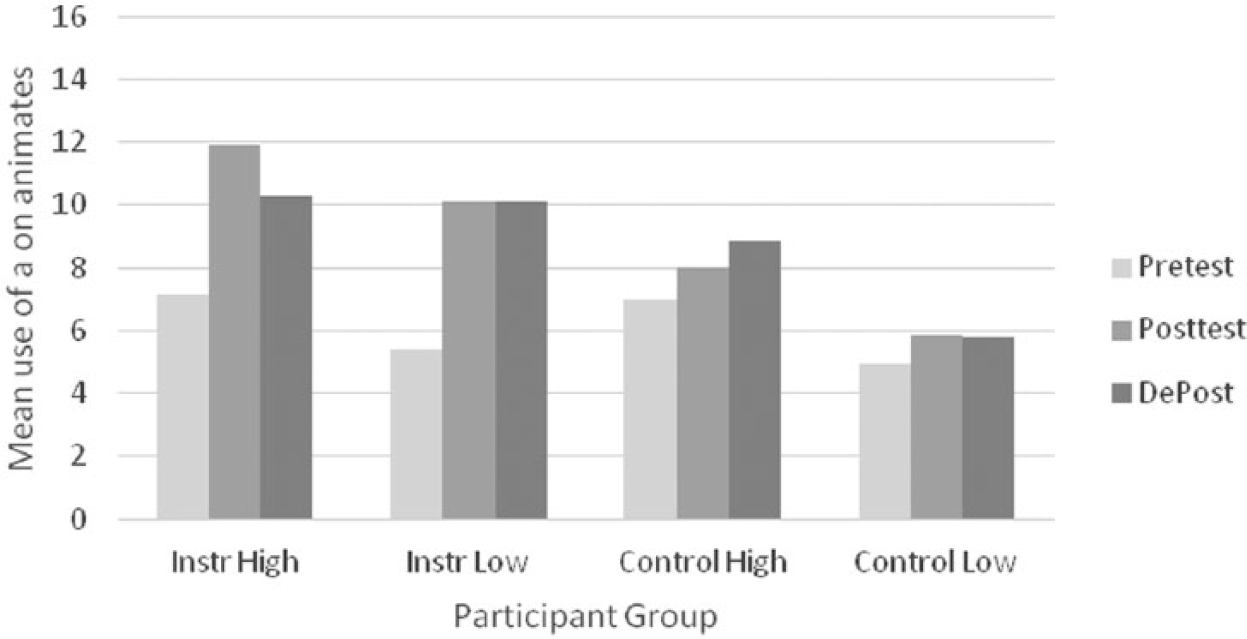
Grammaticality judgment (GJT) scores on animates.
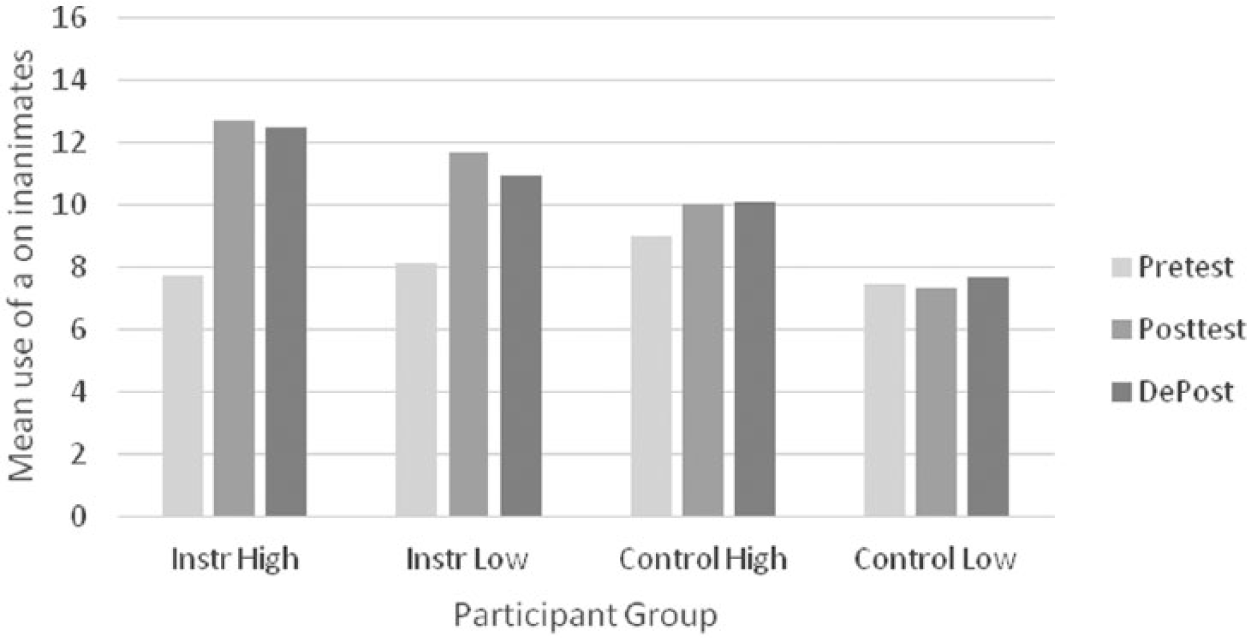
Grammaticality judgment (GJT) scores on inanimates.
3 Awareness results
In order to analyse the awareness data, as explained above each think-aloud was rated as indicating No Report of awareness (NR), awareness at the level of Noticing (N) or awareness at the level of Understanding (U), and frequency counts of the number of participants who carried out each type of verbal report were recorded. A Chi-square analysis was run using these frequency counts. Since the frequency counts for each individual participant group led to expected frequencies below 5 for each cell, groups were collapsed in two different ways in the Chi-square analyses.
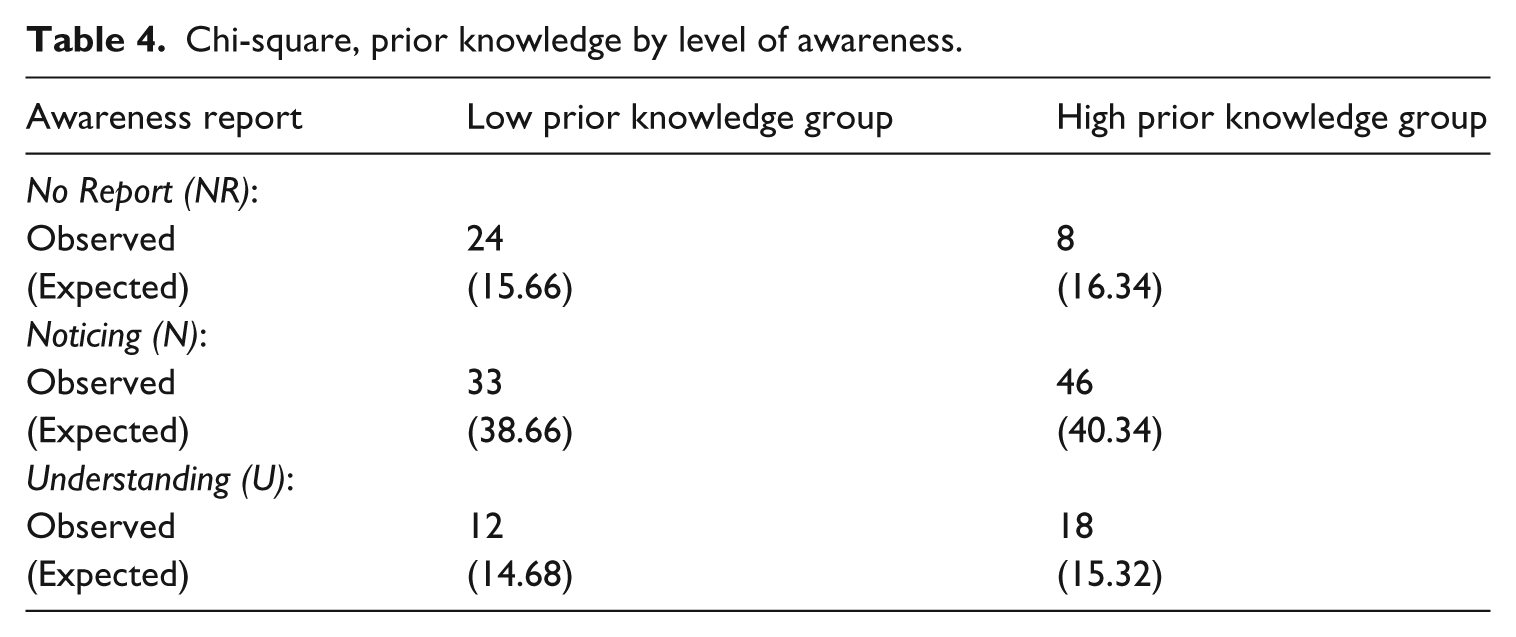
The first Chi-square test collapsed the two low prior knowledge groups and the two high prior knowledge groups, and compared them at three levels of awareness. This test showed a significant association between group and awareness level, χ2 (2) = 11.2805, p < .001, V = .2828. The significant results were likely because high prior knowledge groups had a higher than expected frequency of Noticing (observed 46, expected 40.34), and a lower than expected frequency of No Report (observed 8, expected 16.34), while low prior knowledge groups had a higher than expected frequency of No Report (observed 24, expected 15.66) and a lower than expected frequency of Noticing (observed 33, expected 38.66). Table 4 presents the Chi-square for prior knowledge by awareness.
Chi-square, prior knowledge by level of awareness.
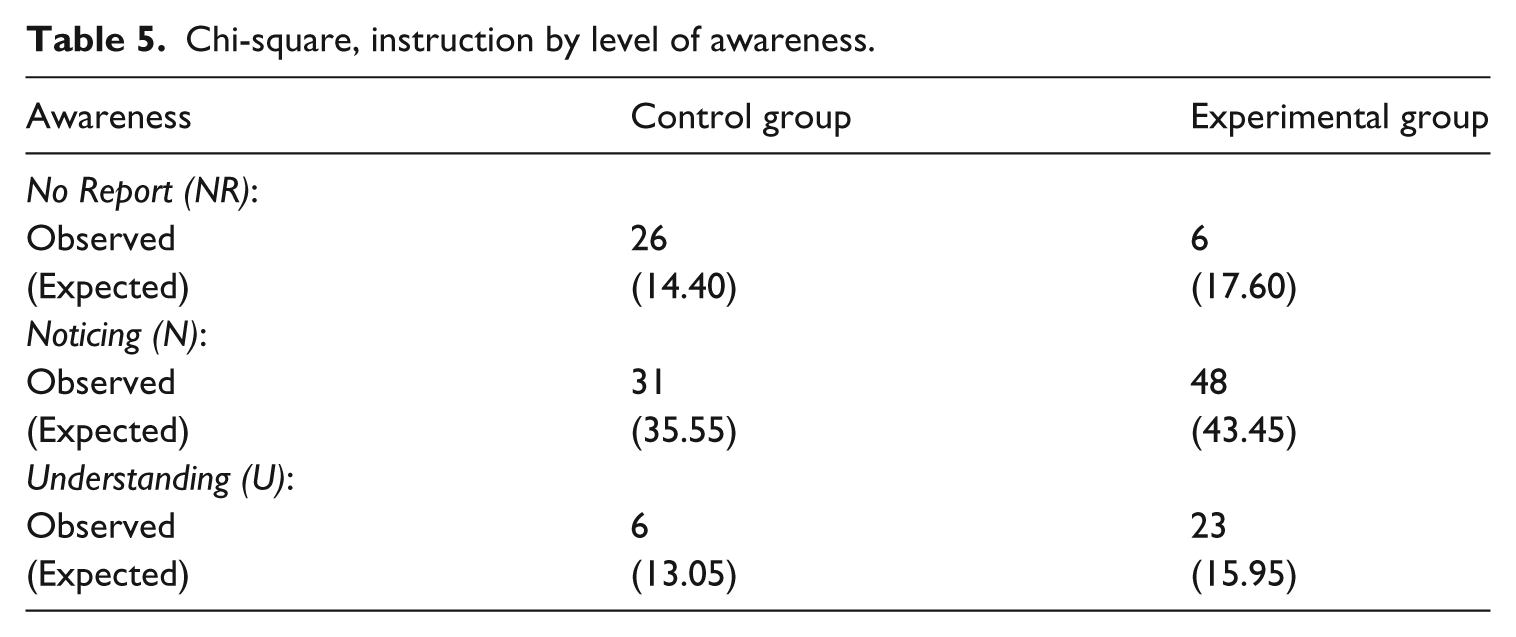
The second Chi-square test collapsed the two instructed and the two uninstructed groups, comparing them at three levels of awareness. This test also found a significant association between group and awareness level, χ2 (2) = 24.9735, p < .001, V = .4223. These significant results likely occurred due to instructed groups showing a higher than expected frequency of Understanding (observed 23, expected 15.95) and Noticing (observed 48, expected 43.45) and a lower than expected frequency of No Report (observed 6, expected 17.60), while uninstructed groups had a lower than expected frequency of Understanding (observed 6, expected 13.05), and higher than expected frequency of No Report (observed 26, expected 14.40). Table 5 shows the Chi-square for instruction by awareness. Both effect sizes for this research question, reported as Cramer’s V, indicated a medium effect size, or some practical significance of the results.
Chi-square, instruction by level of awareness.
IV Discussion
The first research question, which asked whether the effects of instruction would differ over time for high and low knowledge groups on a PDT and GJT, was answered in the affirmative for animate items on both tasks. Follow-up statistics revealed that Instructed Low improved more than Control Low on animate items on both tasks, from pretest to posttest and from pretest to delayed posttest.
And yet, while Instructed High improved more than Control High from pretest to posttest on animate items on the PDT and GJT, on the PDT delayed posttest they did not improve more and on the GJT delayed posttest, Control High actually improved more than Instructed High. Individual results indicated that six of the 15 participants in the Control High group improved in score over time on both the PDT and GJT. Additionally, although Instructed High improved from pretest to posttest on the GJT, they decreased in score from posttest to delayed posttest while Control High continued to gradually increase in score from pretest to posttest to delayed posttest.
These results confirm N. Ellis (2006) and VanPatten et al. (2004). As N. Ellis claimed, instruction and feedback gave learners with different degrees of prior knowledge on a difficult structure like the personal a an advantage as compared to similar uninstructed groups, at least immediately after instruction. However, having high prior knowledge along with exposure to the personal a on the GJT allowed six uninstructed learners to, as VanPatten et al. (2004) state, increase the robustness, completeness, and proximity of forms in the L2 input to the target forms (p. 8). And, per VanPatten et al., degree of knowledge was relevant, as no individuals in the Control Low group improved over time on both tasks. The lack of difference on the delayed posttest between the two high prior knowledge groups may be due to their ability to process the structure better; that is, their higher knowledge may have made it less likely for these participants’ attentional resources to be overwhelmed while attempting to process the structure (p. 7).
Perhaps for the Control High group, the personal a sentences on the GJT formed a sort of implicit instruction/input flood condition, which allowed them to form and revise hypotheses on the structure. Results from the second research question confirm that the high knowledge groups were better able to show awareness at the levels of Noticing and Understanding than the low knowledge groups, which as N. Ellis (2006) claimed, was crucial to their improvement.
The rMANOVA for inanimate items on the GJT found a significant time by prior knowledge interaction. The high knowledge groups improved more from pretest to posttest and from pretest to delayed posttest than the low knowledge groups, correctly rejecting ungrammatical inanimate sentences (personal a with an inanimate direct object). These results are different from previous personal a research (Bowles & Montrul, 2008, 2009) which found some overgeneralization of a to inanimates on a GJT after instruction. This difference can be better explained by the rule formation shown by high knowledge groups on the think-alouds.
The second research question, which asked whether there would be a relationship between level of awareness as shown by think-aloud protocols and degree of knowledge and instruction on the personal a, was answered in the affirmative. The Chi-square analyses revealed that learners in the instructed groups were more likely to show awareness at the higher levels of Noticing and Understanding than the uninstructed groups. Previous awareness research by Rosa and O’Neill (1999), Rosa and Leow (2004a) and others has also found that higher awareness levels correlated with more explicit treatment. Learners with high prior knowledge were also more likely to show awareness at the higher levels of Noticing and Understanding than learners in the low prior knowledge groups.
It is important to note that none of the participants in the low prior knowledge uninstructed group showed awareness at the level of Understanding (correct hypothesis/rule formation). These think-alouds, then, provide strong evidence that prior knowledge essentially has a consciousness raising function, helping learners to reach a higher awareness level, particularly after instruction.
And yet, despite that participants tended to process the structure deeply, with meaningful analysis of the form and potential activation of prior knowledge, comparing the form with other similar words already in their knowledge system (Leow & Mercer, 2015; 2), not all arrived at the correct underlying rule, as predicted by Leow and Mercer (2015). That is, in both high prior knowledge groups and the low prior knowledge instructed group there were many examples of rule formation, some of which were only partially correct, as in (10)–(12).
(10) The personal a is used for people but also means to. (11) The personal a is used for people and instruments. (12) The personal a also is used to describe the senses, like noise or taste.
Interestingly, the Control Low group, in addition to showing no Understanding of the personal a, was also the only group to not indicate any deep processing, or attempted rule formation. They did believe that the a meant to or at, but in general they focused on other parts of the sentence like adding le or se or changing articles from el to la. These results can be explained by VanPatten et al. (2004), who maintained that when there is not a one-to-one form–meaning mapping (as with the personal a), learners may make incomplete initial mappings (p. 7), and connect the form only to the most salient meaning, which in this case is the dative a, which means to in both English and Spanish. N. Ellis (2006) mentions a similar phenomenon, in which the more salient cue may overshadow the less salient cue, resulting in an ‘automatically learned inattention’ to the less salient cue (p. 178). As N. Ellis (2006) predicted, the one group to show little awareness of the structure, Control Low, was the only group that did not improve over time.
V Limitations
One limitation of this research that future studies could address was that the control groups received only very limited exposure to the structure, from the examples on the GJT. These groups could have received other input on the personal a while the instructed groups carried out the instructional intervention, which would serve to better determine whether input alone can improve learner scores on structures for which they have prior knowledge.
The short, 20–25 minute treatment is another limitation; however, it was at least similar in length to one of the previous personal a instructional studies (Bowles & Montrul, 2009). The short duration of the instructional treatment and two-week delayed posttest window, though not ideal, were used for practical reasons as well as to directly compare this research to the previous personal a studies, which as explained above had similar posttest/delayed-posttest windows. Finally, the format of the PDT could be improved, with more pictures so that percent use calculations would not be necessary, and the same test for the pretest/posttest/delayed posttest for easier direct comparison of scores, as in other studies (Zyzik & Marqués Pascual, 2012).
VI Conclusions
The current study found an important link between prior knowledge and the usefulness of explicit instruction and feedback. Low prior knowledge learners improved after instruction on the personal a, as in previous research (Bowles & Montrul, 2008, 2009; Farley & McCollam, 2004; Zyzik & Marqués Pascual, 2012), and high prior knowledge learners did as well, because as awareness results indicated, the treatment helped them to increase their awareness of the structure.
However, prior knowledge itself also had a consciousness raising function. Only the low knowledge uninstructed group did not improve over time, and these learners were also the only ones without awareness at the level of Understanding (correct hypothesis/rule formation) or any deep processing of the structure (comparing the form to other similar words) (Leow & Mercer, 2015).
The results of this research support the importance of explicit grammar instruction on difficult structures such as the personal a. At the same time, they point to the particular importance of instruction for learners with low prior knowledge, since only these learners were not able to improve without explicit instruction. In contrast, high prior knowledge learners may be able to improve over time with more implicit methods that raise their consciousness of the structure, such as input flood, task-based interaction, or recasts (Zyzik & Marqués Pascual, 2012). More generally, all learners may benefit from strategies to help them attend to and process lexical and grammatical items more deeply, as Leow and Mercer (2015, p. 10) suggest, since only the learners who did not process the form deeply failed to improve. However, more research is needed on the acquisition of learners with high and low knowledge of other structures, to establish whether the results of this study hold with other learners, other L2s, and other difficult grammatical structures.
Footnotes
Funding
The author(s) received no financial support for the research, authorship, and/or publication of this article.