



Abstract
This study tested relationships between foreign language (FL) reading and listening anxiety and learner variables in English as a foreign language (EFL). It tested links between foreign language anxiety (FLA) and its cognitive, affective and behavioral correlates in English (i.e. language learning strategies, learning motivation, and performance). Three-hundred-and-six Chinese undergraduates learning EFL were administered the measures via a questionnaire. Regression analyses indicated that EFL performance and EFL motivation were key factors that uniquely predicted EFL reading and listening anxiety. However, the role of EFL learning strategies was not significant after the effects of EFL performance and EFL motivation were controlled for. Despite this, mediation analyses revealed that EFL learning strategies had a significant indirect effect on EFL reading performance and listening anxiety levels with EFL learning motivation as a mediator. This suggests its secondary role in affecting FL anxieties. These findings provide important implications regarding assessment of students’ FL anxiety level as well as identification of and intervention for those with FL difficulties. These findings have extended past studies by highlighting the relative importance of these cognitive, affective and behavioral correlates on Chinese undergraduates’ EFL anxiety in specific domains.
Keywords
I Introduction
In order to obtain high levels of proficiency in a foreign language, learners have to master fundamental language skills and deal with their anxiety about the use of the foreign language (Horwitz, Horwitz & Cope, 1986). Research on foreign language anxiety (FLA) has generated considerable understanding of anxiety responses to foreign language (FL) learning (Ellis, 2008; Horwitz, 2010). However, to date, relatively less is known about how FLA is affected by and related to other learner characteristics (Dewaele, 2013; Dewaele & Ip, 2013; Dörnyei, 2005; Gardner, Tremblay & Masgoret, 1997). Understanding these relationships will help identify individuals that are prone to feeling anxious in the FL learning context, and allow for a better understanding of what factors exacerbate FLA. This study first fills in the research gap by investigating the links between FLA and its cognitive, affective and behavioral correlates (i.e. learning strategies, language learning motivation, and English language performance) in Chinese undergraduates learning English as a foreign language (EFL). It also extends past research by examining FLA at a finer level, focusing on skill-specific FLA in reading and listening.
1 Foreign language anxiety
Research has identified a unique form of situation-specific anxiety: foreign language anxiety, or FLA. It is defined as a ‘distinct complex of self-perceptions, beliefs, feelings and behaviors related to classroom language learning’ (Horwitz et al., 1986, p. 128). Further research has distinguished skill-specific anxieties from general FLA. This is based on the assumption that some learners may only experience anxiety when applying certain language skills (Cheng, Horwitz & Schallert, 1999; Horwitz, 2001; Pae, 2013). Saito, Garza and Horwitz (1999) observed that levels of reading anxiety, as opposed to general FLA, varied according to the target language (i.e. French, Japanese and Russian). It was therefore suggested that foreign language reading anxiety (FLRA) was a construct distinct from, but related to, general FLA. Similarly, Elkhafaifi (2005) found a significant portion of variance between ‘foreign language classroom anxiety’ (FLCA) and ‘foreign language listening anxiety’ (FLLA) and therefore suggested FLLA to be empirically distinguishable from general FLA. Both studies implied that, in order to accurately address language anxiety problems, these situation-specific anxieties should be considered independently (Pae, 2013).
a Foreign language reading anxiety
Reading anxiety is inherently more difficult to detect as, unlike during speaking, immediate reactions are not required. According to Saito et al. (1999), reading anxiety is a factor that ‘intervenes at some point between the decoding of a text and the actual processing of textual meaning’ (p. 215). FLA is likely to occur when the learner is unable to process the meaning of an unfamiliar text (Saito et al., 1999). Language ability, learner motivation and cultural backgrounds amplify the learners’ difficulty with a FL (Sellers, 2000). FL reading alone can provoke considerable frustration and anxiety among learners.
b Foreign language listening anxiety
Weak listening skills also bring about high levels of anxiety (Valizadeh & Alavinia, 2013), as listening is essential for successful FL oral comprehension. Vogely (1998) examined the sources of listening anxiety reported by Spanish learners at an American university and showed that the majority of participants found the nature of speech (e.g. too fast and lacking repetition), as well as the perceived need to understand every single word, anxiety provoking. Listening anxiety could form under the false assumption that one must exhibit faultless comprehension and recognize all of the vocabulary (Scarcella & Oxford, 1992; Vogely, 1998).
2 Correlates of foreign language anxiety
The distinction between reading and listening FLA has opened up areas in which skill-specific factors can be investigated. For example, studies in FLLA have revealed relationships with correlates including listening proficiency (Kim, 2000; Zhang, 2013) and learning strategies (Golchi, 2012; Gonen, 2009). Studies in FLRA have also established links with FL reading performance (Shi & Liu, 2006) and learning strategies (Sellers, 2000). However, the factors that affect listening and reading anxieties remain underexplored, highlighting a need to examine the interplay of independent skill-specific anxieties.
a Language performances
Studies on reading and listening anxiety have only recently gained the attention of researchers (Elkhafaifi, 2005; Sellers, 2000; Shi & Liu, 2006; Young, 2000; Zhang, 2013). Negative relationships of FLA and FL performance have been established in studies across different contexts and languages in a range of outcome measures (Al-Shboul, Ahmad, Nordin & Rahman, 2013; Horwitz, 2001). While a certain level of anxiety and apprehension can be a positive motivator for students’ performances (Brown, Robson & Rosenkjar, 2001), it is no doubt that language anxiety also has a negative impact on FL learning.
In a study of university students, Sellers (2000) showed that reading anxiety negatively affected the recall of Spanish texts. High-anxiety levels were therefore shown to interfere with the reading comprehension process. In another study, Young (2000) tested Spanish students using four different non-literary passages (e.g. magazines, newspapers) and found significant negative relationships between FLRA and FL comprehension among two of the passages tested. It can therefore be deduced that FL reading performance is both affected by, and directly related to, FLRA.
Negative relationships between FLLA and listening skills have also been illustrated. For instance, a study on 233 university students enrolled in Arabic language programs indicated significant negative correlations between FLLA and both listening comprehension grades and final course grades (Elkhafaifi, 2005). Golchi (2012) found that learners low in anxiety performed better in listening comprehension tasks, suggesting a strong link between listening anxiety and level of FL listening comprehension. Investigating causal relations, Zhang (2013) used structural equation modeling (SEM) on longitudinal data of Chinese students’ scores on the IELTS listening test and the FLLA scale. The results indicated that FLLA could cause deteriorated performance. The study demonstrated an increasing need to adopt quantitative methods and modeling to explore definitive relationships between skill-specific anxiety and skill-specific language performance.
Much effort has been made to discern the complex relation between FLA and FL performance. One interpretation is that FLA exerts negative effects on FL performance by interfering with the FL learning process (Horwitz, 2001; MacIntyre & Gardner, 1991). Studies evidencing a link between students with high levels of FLA and low FL aptitude have led to the opinion that FLA is a natural response to learning difficulties and poor achievement (Sparks & Ganschow, 1991; Sparks, Ganschow & Javorsky, 2000). Another interpretation has characterized the two as reciprocal: they simultaneously influence each other, and are influenced by other FL correlates (MacIntyre, 1995). Thus, the relationship is not straightforward to interpret. Few studies have examined the interaction of FL skill-specific anxieties and other FL learner factors thoroughly.
b Language learning strategies
Numerous studies have established that language learners with high FL proficiency employ language learning strategies more frequently than those with low proficiency (Oxford & Nyikos, 1989; Wu, 2008). O’Malley and Chamot (1990) emphasized the cognition of strategies, defining them as ‘thoughts or behaviours that … help [learners] comprehend, learn, or retain new information’ (p. 1). The current study focuses on the impact of metacognitive and social strategies on FLRA and FLLA. Multiple studies have identified these as the most frequently used strategy type (e.g. Park, 1999; Su, 2005).
Metacognitive strategies encompass the following: reviewing learned materials, self-monitoring and self-evaluating (Zare, 2010). These strategies are highly relevant to FLRA and FLLA. When listening, learners can adopt planning strategies at the pre-listening stage, monitoring strategies during the listening process, and evaluate the content at the post-listening stage (Vandergrift, 1999). Similarly, metacognitive strategies help clarify reading objectives, prioritize information that is read, and contribute greatly to reading comprehension skills (Block, 1992; Simpson & Nist, 2000).
Social strategies include strategies of communication and co-operation with others, facilitating learning through social interaction (Ellis, 2005). In FL listening and reading, social strategies instigate collaboration with others through verifying learners’ understanding of what is comprehended (Vandergrift, 2003). When one applies effective learning strategies, the learner’s confidence may develop and certain anxieties may therefore be reduced. Thus we would expect a negative relationship between these two factors. Among studies in this area, Golchi (2012) found that high-anxiety learners used fewer metacognitive strategies than low-anxiety learners. Learners feel less anxious when setting goals and monitoring their own learning, as it provides them with confidence in mastering the language (Sioson, 2011). Gonen (2009) examined the relationship between listening strategy and FLLA among Turkish EFL students. Results showed that FL listening strategy use decreases as students’ level of FLLA increases. While the study suggested the need to employ effective listening strategies to alleviate FLLA, the effectiveness of a broader range of strategy types on FLLA still requires examination.
c Language learning motivation
FL motivation has also been widely studied in FL learning (Dörnyei, 2005; Gardner, 1985). Under the socio-educational model, Gardner and colleagues were the first to differentiate between integrative and instrumental orientations. The former is characterized by a desire to interact with the FL community, while the latter is characterized by practical gains resulting from FL learning (Gardner, 1985). Of interest to the current study is Gardner’s notion of motivation under the integrative motive, where motivational intensity is considered a core FL motivation component.
Theoretically, it is assumed that FL motivation and FLA are closely related (Gardner, 1985). The significant negative relationship between EFL anxiety and EFL learning motivation suggests that less motivated students generally feel greater anxiety in FL classrooms (Khodadady & Khajavy, 2013; Liu & Zhang, 2013). Khodadady and Khajavy (2013) used SEM and found that students who lacked motivation to learn English exhibited a fear of communication, a fear of negative evaluation, and a negative attitude toward classes, all of which reflect greater anxiety levels. Among Chinese university students, Liu and Zhang (2013) illustrated differences in language learning motivation levels between students with low-, medium- and high-level FLA. These results suggested that enhanced motivation may help students make more of an effort to learn the language and thus relieve anxiety levels towards the FL. When anxiety levels are reduced, learners’ may be more motivated to learn the FL (Liu & Zhang, 2013). Others, however, have noted that highly motivated learners are also prone to experience anxiety (Tóth, 2007). It is equally possible that high levels of motivation help create a positive language experience, which mitigates the anxiety experienced by the learner (Tóth, 2007). As such, a bi-directional relationship has been suggested between motivation and FLA (Gardner & MacIntyre, 1993). The direction of the relationship and how these variables influence each other is yet to be clarified.
Only a handful of research has investigated the links between motivation and FLLA and FLRA respectively. In reading, Mills, Pajares and Herron (2006) focused on self-efficacy beliefs as a motivational construct and examined their relation to reading performances. They showed that students’ reading self-efficacy positively influenced reading proficiency, indicating its self-regulating role in dealing with anxiety. Students who perceive themselves as more competent in FL reading may experience lower anxiety levels (Mills et al., 2006). Broadening the scope in which motivation is examined against both reading and listening anxiety will help identify effective ways of cultivating student motivation to reduce specific language anxieties.
d Language learning motivation as a mediator
Many of the learner variables interact dynamically in FL learning (Dörnyei, 2009). Apart from anxiety, research has shown that FL motivation is strongly linked to the use of learning strategies (Djigunović, 2001; Gardner et al., 1997; Khamkhien, 2012) and EFL achievement (Khodadady & Khajavy, 2013). Many agree that motivation is key to mastering a FL (Csizér & Dörnyei, 2005). Motivation drives learners to persevere in learning the FL and influences the strategies they adopt, which then determine their language performance (Ellis, 2008). Thus, motivation plays roles in cognitive, affective and behavioral components of FL learning. It is reasonable to postulate that motivation can bridge many of these learner characteristics (i.e. learning strategies and FL performance) to FL anxieties, and also to FL skill-specific anxieties.
Several studies have revealed a possible mediating role of motivation between learning strategies and FL anxieties. Oxford and Nyikos (1989), for example, examined a range of variables affecting the choice of language strategies among 1,200 FL students. Degree of motivation was shown to have a powerful influence on strategy choice, as motivated students used a greater number of language strategies. Oxford and Nyikos (1989) also suggested that greater strategy use leads to higher motivation levels, which promotes further use of strategies. As language strategies are ultimately grounded in the affective characteristics of the learner, one has to be motivated in order to build experience applying strategies (Djigunović, 2001; Gardner & MacIntyre, 1992). Yan and Horwitz (2008) used grounded-theory analysis to investigate how students’ anxiety worked together with a range of learning variables, including language learning strategies. A theoretical model was generated, suggesting that learning strategies could interact with interest and motivation to affect FLA (Yan & Horwitz, 2008). In another study, specific relations between metacognitive strategies and intrinsic motivation suggested self-regulated students are motivated to invest more effort within the learning task (Baleghizadeh & Rahimi, 2011). One can hypothesize that social strategies could have a similar relationship with motivation. Without motivation, it would be unlikely for learners to adopt social strategies that require extra time spent interacting with other people. These studies suggest a mediating role of motivation on learning strategies and FLA. As research is yet to quantitatively examine the existence of these potential relationships, it would be interesting to see if motivation could mediate specific language strategies and skill-specific anxieties.
Positive relations between language learning motivation and language achievement have also been noted, suggesting that language motivation positively impacts language achievement (Khodadady & Khajavy, 2013; Yan & Horwitz, 2008). Studies have reported correlations between the two variables (Gardner & MacIntyre, 1991; Liu & Zhang, 2013), with some suggesting a bi-directional relationship between the two (Gardner & MacIntyre, 1993). It seems reasonable to suggest that FL achievement can interact with language learning motivation to influence learners FLRA and/or FLLA. It is worthwhile to quantitatively examine these prospective relationships and reveal how each individual variable influences skill-specific anxieties.
3 The importance of investigating sources of foreign language anxieties
Whilst research has focused on how different learner variables ultimately affect FL performance, an understanding of how learner variables affect FL anxieties is limited. FLA is a complex, multi-dimensional construct (Gardner et al., 1997; Onwuegbuzie, Bailey & Daley, 1999; Yan & Horwitz, 2008) that intertwines with other factors differently. FL research should therefore examine the simultaneous factors in play in order to fully understand sources of FLA.
A number of studies have examined multiple anxiety-related factors within a single EFL sample (Gardner et al., 1997; Khodadady & Khajavy, 2013; Yan & Horwitz, 2008). Gardner et al. (1997) evidences the effects of motivation and achievement on general language anxiety through causal modeling. Khodadady and Khajavy (2013) also modeled concurrent influences of language anxiety and motivation on language achievement and revealed motivation to have indirect links to achievement through general FLA. Many different models may account for the relationships among the major individual difference variables in language learning (Gardner et al., 1997). Meaningful relationships are demonstrated through the examination of multiple variables at the same time. These relationships should be tested across different learner groups to ensure a valid model. Studies of this nature remain scarce for examining skill-specific language anxieties. While some sources of FLRA (Saito et al., 1999) and FLLA (Vogely, 1998) have been put forward, major individual difference variables across cognitive, affective and behavioral disciplines (i.e. learning strategies, language motivation and language achievement), and their relative relationship to FL skill-specific anxieties are yet to be considered.
II The present study
This study investigated the effect of EFL motivation, EFL learning strategies (social and metacognitive), and EFL performances on EFL reading and listening anxiety. By taking into account the major variables in the affective (e.g. motivation), cognitive (e.g. language learning strategies), and behavioral (e.g. performance) areas, this study allows for a fuller understanding of the many aspects that influence an individual’s FLA.
We addressed two research questions. First, what are the relationships of EFL learning motivation, EFL learning strategies and EFL performance with EFL reading and listening anxiety among Chinese undergraduates? Does EFL learning motivation play a mediating role among learner characteristics in affecting EFL anxiety? Second, what are the relative contributions of these learner variables in predicting EFL anxiety?
III Method
1 Participants
A total of 306 Chinese undergraduate students (116 males and 190 females) in Hong Kong participated in the study. The students were all EFL learners and were between the ages of 18 and 26 years (M = 20.56, SD = 1.63). They were enrolled in credit-bearing, compulsory English language courses offered by the university. All participants had undergone compulsory English language instruction at primary and secondary school.
2 Procedure
Participants were tested in their regular classes at the beginning of the first semester of the academic year. They completed a 30-minute questionnaire on English learning. Participants were debriefed and informed that the questionnaire would have no effect on their grades.
3 Measures
Measures were obtained on 7 variables, each of which is described individually below.
a EFL language anxiety
Students’ reading anxiety was assessed by the Foreign Language Reading Anxiety Scale (FLRAS; Saito et al., 1999). The FLRAS contains 20 items on a 5-point Likert scale ranging from ‘strongly disagree’ to ‘strongly agree’. An example item is: ‘When reading English, I get nervous and confused when I don’t understand every word.’ The scale assessed factors that may contribute to reading anxiety and considered students’ perception of the difficulties they encounter. A high score would indicate high levels of anxiety. The maximum mean score of the scale was 5 and Cronbach’s α for the scale was .86. Students’ listening anxiety was assessed by the Foreign Language Listening Anxiety Scale (FLLAS; Elkhafaifi, 2005), including 20 items scored on a 5-point Likert scale, ranging from ‘strongly disagree’ to ‘strongly agree’. The FLLAS was adapted from the FLRAS, with occurrences of the words ‘read’ and ‘reading’ in the original scale changed to ‘listen’ and ‘listening’ (Elkhafaifi, 2005). An example item is: ‘I feel intimidated whenever I have a listening passage in English to listen to.’ A high score would indicate high levels of anxiety. The maximum mean score of the scale was 5 and the Cronbach’s α for the scale was .90.
b EFL learning motivation
Students’ level of language learning motivation was assessed by the Motivational Intensity subscale from the Attitude/Motivation Test Battery (AMTB; Gardner et al., 1997). The 10-item scale was scored on a 7-point Likert scale, ranging from ‘not at all true of me’ to ‘very true of me’. Five items were positively worded and five items were negatively worded. A positively worded example item is: ‘I really work hard to learn English.’ A high score would reflect considerable effort spent on learning English and thus a highly motivated EFL learner. The maximum mean score of the scale was 7 and the Cronbach’s α for the scale was .70.
c EFL learning strategies
Students’ use of metacognitive learning strategies and social learning strategies was measured respectively by the 9-item metacognitive strategy subscale and the 6-item social strategy subscale from the Strategy Inventory for Language Learning (SILL; Oxford, 1990). Both scales were a 5-point Likert scale ranging from ‘never true’ to ‘always true’. The metacognitive strategies scale measured students’ use of higher order executive skills (e.g. planning and evaluation) in EFL; while the social strategies scale assessed use of social interaction to facilitate EFL learning. High scores represent greater use of such strategies. An example item from the metacognitive strategy scale is ‘I think about my progress in learning English,’ and an example statement from the social strategy scale is ‘I ask English speakers to correct me when I talk.’ The maximum mean score of both scales was 5, and the Cronbach’s α for the whole scale was .84.
d EFL performance
Reading performance and listening performance was measured by students’ English reading and listening results from the public examination taken before university entrance in Hong Kong. The reading examination required students to read written texts of different levels of difficulty, and respond to corresponding questions. The listening examination required students to process information by comprehending data from a range of spoken texts. Both reading performance and listening performance measures ranged from 1 to 7, with 7 being the highest score reflecting better performance.
IV Results
Descriptive statistics of all variables are presented in Table 1. An examination of data normality was performed. Skewness and kurtosis values of tasks were within ±2, suggesting no departure from the normality in the distribution. To compute their composite scores, confirmatory factor analysis (CFA) restricted to one component was conducted on the subscales of learning strategies and language performance. Correlations are shown in Table 2. In general, significant correlations were found among all variables. EFL reading performance and level of listening anxiety exhibited a strong correlation (r = .73). Furthermore, EFL reading and listening anxiety had significant negative correlations with all other variables (rs range from –.24 to –.48).
Maximum score, means, standard deviations for all tasks.
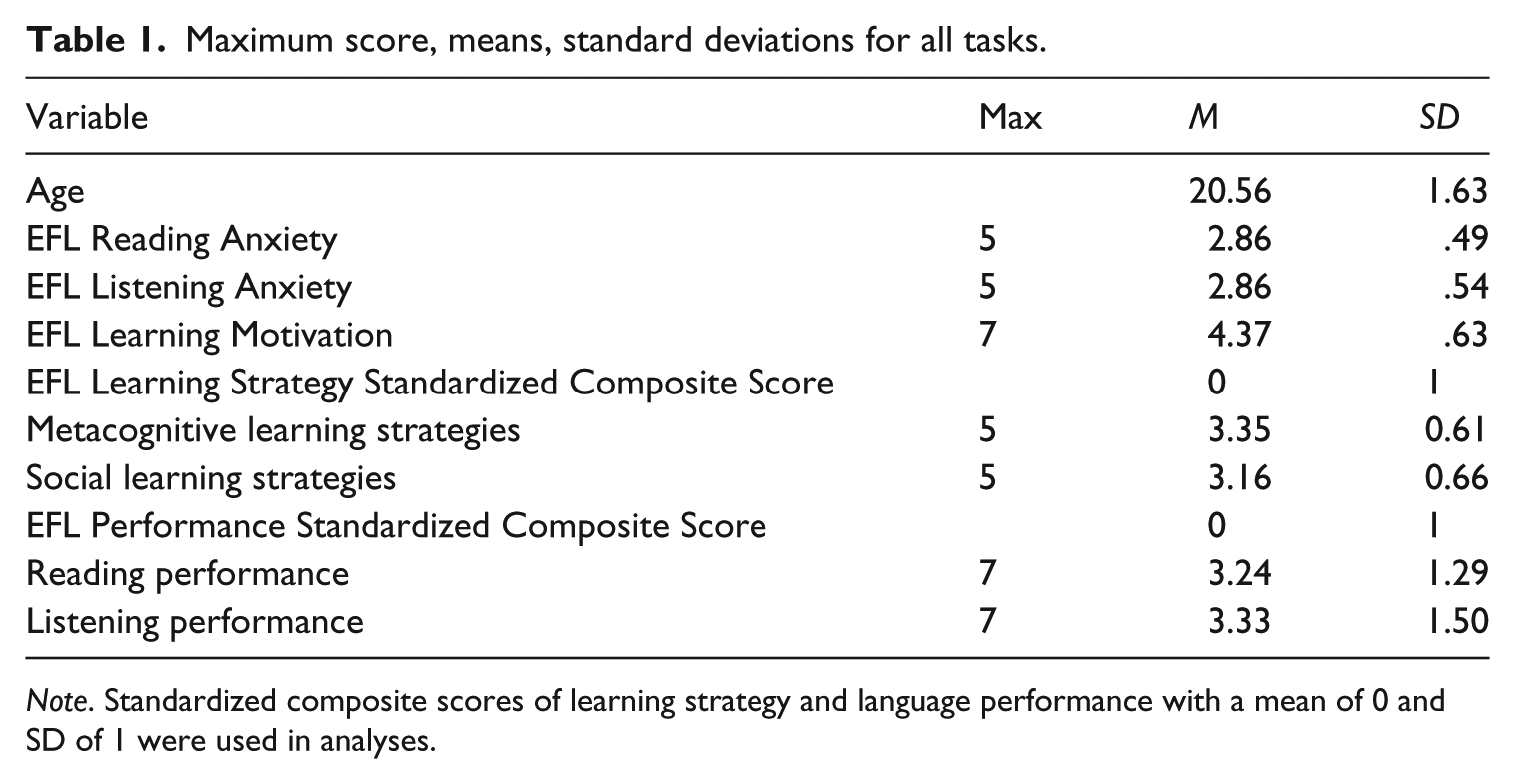
Note. Standardized composite scores of learning strategy and language performance with a mean of 0 and SD of 1 were used in analyses.
Zero order correlations of all measures.
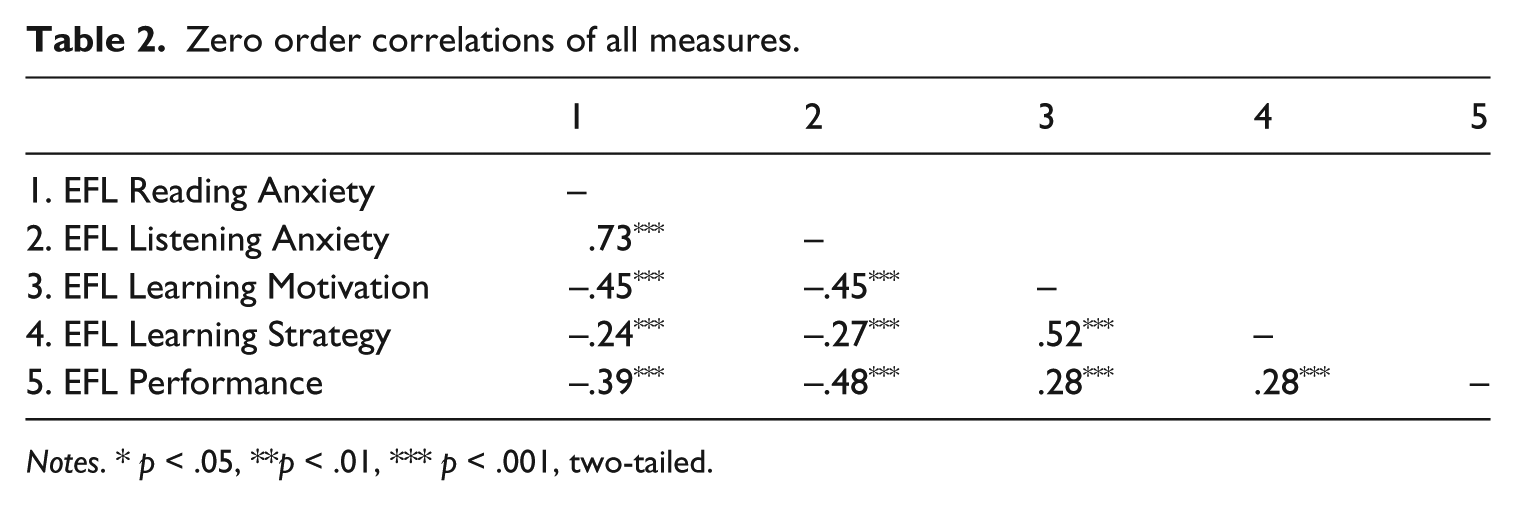
Notes. * p < .05, **p < .01, *** p < .001, two-tailed.
1 Path analyses
Path analyses via AMOS with direct maximum likelihood estimation (Arbuckle, 2006) were used to test: (1) the predictive effects of learner variables on EFL reading/listening anxiety; and (2) the mediating role of motivation in the relationship between English performance, learning strategies and reading/listening anxiety. A model is considered to have a good fit when the following is achieved: the chi-square test (χ2) is non-significant; the comparative fit index (CFI) is close to or greater than 0.95 (Hu & Bentler, 1999); the root mean square error of approximation (RMSEA) is less than or below 0.6 (Hu & Bentler, 1999); the goodness-of-fit index (GFI) is greater than 0.95 (Byrne, 1994); the incremental fit index (IFI) is greater than 0.9 (Bollen, 1989); and when the relative chi-square test (CMIN/DF) is below 2 (Kline, 1998).
2 Regression analyses
In the first model, EFL reading anxiety as the exogenous variable in the model was regressed on EFL learning strategy, EFL performance, and EFL learning motivation (see Figure 1). Age was entered as a control variable. Results showed that EFL performance, EFL learning motivation and EFL learning strategy collectively explained 33% of the variance in EFL reading anxiety. EFL performance and EFL learning motivation were significantly and negatively linked to EFL reading anxiety (β = –.40, p < .001, for EFL performance; β = –.39, p < .001, for EFL learning motivation), but EFL learning strategy did not predict EFL reading anxiety.

Regression model 1: Reading anxiety regressed on learning strategy, language performance, learning motivation and age.
In another model, EFL listening anxiety was regressed on the same set of endogenous variables (see Figure 2). Results showed that EFL performance, EFL learning motivation and EFL learning strategy together explained 35% of the variance in EFL listening anxiety. EFL performance and EFL learning motivation were significantly and negatively linked to EFL listening anxiety (β = –.45, p < .001, for EFL performance; β = –.35, p < .001, for EFL learning motivation), but EFL learning strategy did not predict EFL listening anxiety.
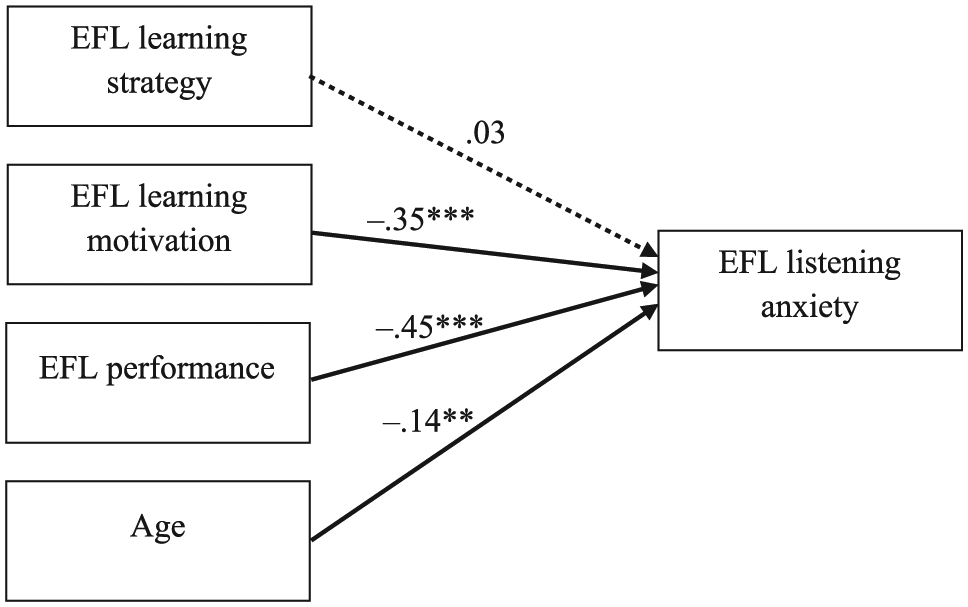
Regression model 2: Listening anxiety regressed on learning strategy, language performance, learning motivation and age.
Despite the non-significant standardized beta coefficient of learning strategy, the zero order correlation between EFL learning strategy and EFL reading anxiety or EFL learning strategy and EFL listening anxiety was significantly negative (r = –.24, p < .001; r = –.27, p < .001 respectively). This suggests a relatively high degree of covariation between EFL learning strategy and EFL reading/listening anxiety is left unaccounted for by the model. Therefore, learning strategy may have indirect effects on reading and listening anxiety.
3 Mediation analyses
The mediating role of learning motivation was examined. The first model tested the contributions of EFL learning strategy and EFL performance to EFL reading anxiety through EFL learning motivation as a mediator (see Figure 3). Age was entered as a control variable. The model had satisfactory goodness-of-fit (Mediation Model 1: χ2 (2, 306) = 2.15, p = .34, CMIN/DF = 1.08, CFI = 1.00, GFI = 1.00, IFI = 1.00, RMSEA = .02).

Mediation model 1: Mediation effect of learning motivation on reading anxiety and correlates.
According to Baron and Kenny (1986), several steps are required to detect mediation. First, the independent variable (i.e. learning strategy) must be associated with the dependent variable (i.e. reading anxiety) when the model is without a mediator. Second, the mediator (i.e. learning motivation) and the dependent variable must be associated. The association between the independent variable and the dependent variable is reduced when adjusting for the mediator. The 95% confidence interval (CI) of the indirect effects was obtained with 5,000 bootstrap resamples (Preacher & Hayes, 2008). A statistically significant mediation effect is indicated if the values between the upper and lower confidence limit do not include zero.
We first evaluated the direct association of EFL reading anxiety with EFL learning strategy and EFL performance respectively in a model without mediator. The associations between EFL learning strategy, EFL performance and EFL reading anxiety with learning motivation as a mediator were then evaluated (see Figure 3). Without EFL learning motivation as a mediator, EFL learning strategy and EFL performance were negatively associated with EFL reading anxiety (β = –.13 and β = –.47 respectively, p < .05). In a mediation model, EFL learning strategy was positively associated with EFL learning motivation (β = .47, p < .001); while EFL learning motivation as a mediator was negatively associated with EFL reading anxiety (β = –.39, p < .001). However, the direct association between EFL learning strategy and reading anxiety was no longer significant. The 95% CI of the indirect effects obtained by bootstrapping was –.25 to –.13. The results indicated a fully mediating role of EFL learning motivation in the relationship between EFL learning strategy and EFL reading anxiety. With language learning motivation entered as a mediator, the direct effect of EFL language performance on EFL reading anxiety was still significant (β = –.40, p < .001), despite a small decrease in correlation strength. The bootstrapping analysis indicated a significant indirect effect (CI [–.10, –.02]). Thus, EFL learning motivation appeared to partially mediate the relationship between EFL performance and EFL reading anxiety.
The same analysis was conducted for EFL listening anxiety. Listening anxiety was predicted by the same set of endogenous variables (see Figure 4) and the model had satisfactory goodness-of-fit (Mediation Model 2: χ2 (2, 306) = 2.15, p = .34, CMIN/DF = 1.08, CFI = 1.00, GFI = 1.00, IFI = 1.00, RMSEA = .02). Without EFL learning motivation as a mediator, EFL learning strategy and EFL language performance were negatively associated with EFL listening anxiety (β = –.14 and β = –.50 respectively, p < .05). In a mediation model, EFL learning strategy was positively associated with EFL learning motivation (β = .47, p < .001); while EFL learning motivation as a mediator was negatively associated with EFL listening anxiety (β = –.35, p < .001). However, the direct association between EFL learning strategy and EFL listening anxiety was no longer significant. The 95% CI of the indirect effects obtained by bootstrapping was –.24 to –.10. The results indicated a fully mediating role of EFL learning motivation in the relationship between EFL learning strategy and EFL listening anxiety. With language learning motivation entered as a mediator, the direct effect of EFL language performance on EFL listening anxiety was still significant (β = –.45, p < .001), despite a small decrease in correlation strength. The 95% CI was –.10 to –.02, suggesting a significant indirect effect. Therefore, EFL learning motivation also played a partial mediating role in the relationship between EFL performance and EFL listening anxiety. The mediation effects of language learning motivation were quite similar across the two language skills.

Mediation model 2: Mediation effect of learning motivation on listening anxiety and correlates.
V Discussion and implications
The result of the study suggested that students who felt greater anxiety when reading or listening exhibited lower levels of language learning motivation used fewer language learning strategies (social and metacognitive) and achieved lower performance scores. The moderate correlations among the variables indicate that their influence on FL anxieties are interdependent. Path analyses indicated that EFL performance and EFL learning motivation predicted EFL reading and listening anxiety (see Figures 1 and 2). However, EFL learning strategies were not a significant predictor when EFL learning motivation and EFL performance were included in the model. This suggests the greater importance of students’ EFL performance and EFL learning motivation over EFL language strategy use as unique predictors of FL anxiety domains.
However, this is not to say that learning strategies play an insignificant role in skill-specific anxiety, as revealed from the mediation analysis. EFL learning strategies had indirect effects on the anxieties with EFL learning motivation as a mediator. This suggests that language strategies help increase students’ level of learning motivation, which in turn helps reduce level of FLRA and FLLA. Language strategies seem to have a secondary role in influencing anxiety levels. Additionally, EFL performance was also found to indirectly affect EFL reading and listening anxiety through EFL learning motivation as a mediator. Considering these results overall, the greater importance of motivation as a key factor in FL anxieties is highlighted, as the variable additionally acts as a mediator in the relationship between strategies/language performance and FL anxieties.
1 EFL performance in reading and listening
The negative relationship between EFL performance with EFL reading and listening anxiety is well supported (Elkhafaifi, 2005; Saito et al., 1999; Sellers, 2000; Young, 2000). Though path analyses do not fully allow for causal interpretations, there is still strong evidence that higher levels of reading and listening performances link to lower levels of EFL listening and reading anxieties. This has been supported by research showing that poor performance can create anxious feelings (MacIntyre, 1995; Onwuegbuzie et al., 1999). Individuals may consider themselves lacking in the necessary language skills required for smooth communication and interaction, fueling their FLA.
In contrast to the present results, Zhang (2013) had found evidence for different directionalities as FL performance did not systematically affect FLLA but was a consequence of anxiety. A possible reason for the divergent results is that the nature of the performance scores used differed in the present study. Zhang (2013) suggested that the stability in which FLLA develops over time is unlikely to be affected by the performance on a single test (IELTS) during the study. In this study, the English reading and listening examination is compulsory for the sample group and is a clear indicator of how participants’ proficiency has developed throughout their education. Thus, poor performance in this examination will no doubt influence anxious feelings experienced in the respective FL skills.
We have also extended our findings to EFL reading and listening anxiety, adding to the results of studies focusing on general FLA (Al-Shboul et al., 2013; Horwitz et al., 1986). These findings suggest that good EFL performance is related to positive affective changes in EFL reading and listening anxiety and that, conversely, poor language proficiency is associated with high levels of anxiety.
2 EFL learning strategy use
Learning strategies may be a source of language anxiety as they are related to learners’ effective processing of the FL. Our analysis indicated that strategies could not explain significant portions of variance in anxiety skills after the effects of learning motivation and performance were accounted for. Nevertheless, the negative correlations found between metacognitive/social strategies and FLLA/FLRA do indicate a close relationship. This is consistent with previous research examining FL learning strategies and skill-specific anxiety (Gonen, 2009). This correlation suggested that EFL learning strategies had indirect rather than direct effects on EFL reading and listening anxiety. This claim was confirmed statistically, as a full mediation effect of language motivation was found. When learners are motivated, they will benefit from applying social and metacognitive strategies to FL learning. This is consistent with findings that evidence low-anxiety learners employing social strategies most frequently, followed by metacognitive strategies (Liu & Chen, 2014).
The close relationship between metacognitive strategies and language learning motivation is consistent with studies conducted by MacIntyre and Noels (1996) and Chang (2003), who concluded that this strategy type had the strongest link with motivation. Types of metacognitive strategies are applicable to both reading and listening skills (Simpson & Nist, 2000; Vandergrift, 1999). Learners who know how to adopt metacognitive approaches develop better focus and experience more opportunities to review their learning progress, both of which contribute to the success of their future FL learning. Metacognitive processes such as prediction, planning, monitoring, evaluating and problem solving can be specifically taught. Different models of strategy instruction have been proposed that offer useful guidelines for strategy training (O’Malley & Chamot, 1990; Vandergrift & Tafaghodtari, 2010). Such strategy training would facilitate motivated students’ FL learning in particular.
FL teachers should aid learners’ awareness of FL learning strategies and their effectiveness, and thus facilitate the reduction of FLRA and FLLA. They should intentionally offer opportunities for FL learners to interact with others using social strategies (Ehrman, Leaver & Oxford, 2003). Communicating and practicing a language with other people relieves fear and anxiety, and would also contribute to learning motivation by influencing students’ sense of progression. This is in line with the view that learning is dependent on the social interactions that occur in the classroom (Kaplan, Grabe, Swain & Tucker, 2002; Vygotsky, 1978). The results suggest that more attention should be paid to cultivating social interactions between FL learners.
3 EFL learning motivation
Motivation is crucial in determining whether learners will actively involve themselves in the FL learning process. Our findings are consistent with past research which indicates that greater anxiety levels are associated with motivation in the FL classroom (Khodadady & Khajavy, 2013; Liu & Zhang, 2013). The importance of motivation towards FL receptive skills highlighted in the results is also in line with the extended version of the socio-educational model (Gardner & MacIntyre, 1993; Tremblay & Gardner, 1995), whereby motivation is involved in determining the effort an individual exerts to learn a language. The current study demonstrated the predictive effect of learning motivation on FLRA and FLLA, rather than general FLA. This implies that enhancing student’s interest and motivation in FL learning can help lower language anxiety levels in specific skills.
4 Learning motivation as mediator
Other studies have found a similar relation between motivation and anxiety (e.g. Yan & Horwitz, 2008). Yan and Horwitz (2008) have further suggested bi-directional relationships between FLA and motivation, emphasizing that FLA should be addressed under the context of the network of factors within FL learning. Our finding that EFL learning motivation partially mediated the relationship between EFL performance and EFL reading/listening anxiety is further evidence of the integral role of motivation within the network of FL learning factors. Given the strong inter-links between language learning motivation and other learner correlates, language performance likely exerts direct and indirect effects through motivation on FL domain anxieties. After all, motivation is the driving force determining which learners adopt certain behaviors that influence language performance (Ellis, 2008). When students achieve better English grades, their motivation is reinforced by their achievement, and their anxieties will reduce as a result.
Furthermore, the fact that EFL learning motivation was found to fully mediate the relationship between EFL learning strategies and EFL anxiety domains allows for additional conclusions to be drawn. This mediatory relation suggests that students who use more language strategies tend be more motivated, which in-turn reduces FLRA and FLLA. Use of appropriate strategies is argued to generate higher self-esteem and stronger motivation, leading to higher levels of actual and perceived proficiency. Collectively, these factors then contribute to a reduction in anxiety levels. This mediated relationship extends the qualitative results presented by Yan and Horwitz (2008). To the best of our knowledge, no study has previously identified language learning motivation as a mediator of these variables to skill-specific anxiety.
Overall, these results implicate the importance of identifying students’ motivation levels (Liu & Zhang, 2013), and the need to raise and maintain their motivation to reduce specific FL anxieties. Raising awareness of the importance of studying English, enhancing students’ attitudes towards English through encouragement, and positive feedback or praise may be useful in increasing learners’ motivation levels (Liu & Zhang, 2013). A recent study by Busse and Walter (2013), which investigated long-term motivational changes in FL learning, indicated that students’ initial effort to engage in learning the FL decreased over the course of the first year. Thus, educators should adopt strategies to counteract decreasing motivation by making language materials personally relevant to the students. This approach is also in line with Gardner’s integrative motive (Gardner et al., 1997) and self-determination theory (Deci & Ryan, 1985). Raising learning motivation not only directly influences the impact of motivation on anxiety but also affects how other learner variables, such as language performance, influence FL anxiety.
5 Limitations and future studies
This study has three limitations. First, the results are correlational in nature and thus we cannot make strong claims about causality. Future longitudinal studies should shed light on the causal relationships in question. Second, the performance measures used in this study are participants’ performance scores before they enter university. Participants’ language proficiency however, may change between the university entrance examination and when tested on the other measures for the study. Thus, caution is needed when interpreting the relationship of the performance variables. Third, our study focused on measuring students’ motivation intensity. A more complete picture can be obtained when further components of motivation are considered, such as intrinsic and extrinsic motivation, and attitudes towards the foreign language.
VI Conclusions
This study has shown the varying contributions of EFL learning motivation, EFL learning strategies (social and metacognitive strategies) and EFL performance on EFL reading and listening anxiety. Previous research findings have been extended as the importance of EFL performance and EFL learning motivation in relation to students’ EFL reading and listening anxiety levels has been reinforced. The indirect role of EFL learning strategies via students’ EFL learning motivation on EFL reading/listening anxiety has also been illustrated. The findings provide important implications for successfully reducing students’ anxiety. Overall, the results encourage educators to continue to help students develop a genuine interest in FL learning and maintain their high-levels of motivation. In addition to training learners on effective strategies so that anxieties can be better regulated, FL teachers may also ensure a positive learning environment is created in order to facilitate effective FL learning.
Footnotes
Acknowledgements
We thank the students for their participation in this study.
Funding
The author(s) disclosed receipt of the following financial support for the research, authorship, and/or publication of this article: This study was supported by grants from the Hong Kong Research Grants Council (ECS846212) and City University of Hong Kong (9610316).