




Abstract
The goal of dialogic teaching is to position students as active participants who engage in academically accountable talk, but research consistently suggests that a major stumbling block is the teacher’s own interactional style. To explore the issue from an emic perspective, I carried out an action research investigation of advanced proficiency classes for English as a foreign language (EFL) that I taught on the university level in Japan. Data included audiotaped recordings of teacher-fronted whole-class discussions that were analysed qualitatively. I found that the effort to teach dialogically was somewhat successful, but missteps and misguided assumptions about effective instructional strategies were also evident. Findings point to both the complexities of orchestrating active engagement of reticent students within the third space of the second language (L2) classroom, and the critical role of teacher authority to elicit and coordinate student engagement.
I Introduction
Often, university instruction relies heavily on teacher fronted lecture (Hardman, 2008a), although there is widespread recognition that optimal learning comes from productive engagement (O’Connor, 2013) built on the creative co-construction of knowledge in interaction between teachers and learners (Wells, 2015). Classroom discussion, in both second language (L2) and first language (L1) contexts, works as the key medium to develop critical thinking and academic discourse skills, especially the ability to articulate complex ideas with supportive reasoning and explanation (O’Connor, Michaels & Chapin, 2015). Research on dialogic teaching (e.g. Alexander, 2008a) emphasizes thoughtful and sustained open-ended interaction that puts student expression at the center of whole-class pedagogy, but empirical studies show that teachers are often slow to abandon traditional styles of interaction.
In this article, I report on an action research study undertaken to investigate the attempt to teach dialogically in advanced academic English classes that I teach at a Japanese university. The goal was to solicit and scaffold accountable talk, collaborative ‘learning’ discourse that encourages students to articulate and expand reasons for opinions in ways that develop expressive ability, thus making a fundamental connection between language, thinking, and learning (Alexander, 2010). Findings suggest that, although teacher attention was generally oriented to drawing out student ideas as well as constructing a positive social environment in the class, there were notable missteps in addition to tacit assumptions and beliefs about classroom talk that worked to shape student discourse in decidedly unhelpful ways.
II Literature review
From a sociocultural theoretical perspective, learning first takes place in shared activity before being appropriated by the individual learner (Daniels, 2016; Mercer, 2000). This process of acquisition is developed in co-constructed engagement (Hardman, 2008b), which means that L2 students learn according to the ways in which they participate in the ‘intellectual life’ of the classroom (Mercer, 2016, p. 4), especially oral interaction. For advanced language learners, talk serves as both the means of instruction and the object of instruction, in that learners acquire academic discourse through the interpersonal and situated negotiation of meaning (Edwards & Mercer, 2012). In practical terms, academic skills are ‘made visible’ in the course of teacher-fronted class discussion (Gibbons, 2009), as learning to speak entails learning to think and reason critically, ‘reconstructing one’s understanding’ (Tasker, Johnson & Davis, 2010, p. 130). Internalization is tied to externalization, Thompson (2008) argues, to the extent that actively expressing ideas facilitates acquisition, especially when there are opportunities to engage in complex ‘extended talk for learning’ (p. 242).
In an ideal world, students would be positioned in language classrooms as active speakers who address problems and explain ideas (Alexander, 2008a). In reality, cognitively demanding talk is rare in many classrooms (O’Connor et al., 2017; Reznitskaya, 2012). Research consistently shows that instructional talk, in both L1 and L2 settings, is ‘overwhelmingly monologic’ (Mercer & Littleton, 2007, p. 67), dominated by the teacher with an aim to transmit ‘knowledge which students are required to remember’ (Skidmore, 2006, p. 504). This intention to convey facts and information characteristically follows a ‘recitation script’ based on display questions and short-answer responses (Cazden, 2001). Although some scholars (e.g. Haneda, 2005) argue that the evaluation move in recitation can be effectively exploited to facilitate participation, Cazden contends that recitation restricts thinking because it neglects the cognitively demanding discourse of extended argument. In sum, students are characteristically positioned in receptive roles with little opportunity to employ repertoires of academic expression that are the basis of acquiring literacy (Haneda & Wells, 2008).
Boyd & Markarian (2015) maintain that the key issue of dialogic teaching is how instructional talk functions to ‘model and support cognitive activity’ (p. 273), which points to ways that ideas are ‘taken up in a classroom community’ (p. 277). Within this general orientation, research has identified a broad repertoire of interactional talk moves that promote thinking (Reznitskaya, 2012; Wells, 2015). There is general agreement that ‘exploratory talk’ (Barnes, 2008) involves invitations to think critically and analytically, with solicitation of evidence and explanations that ‘provoke thoughtful answers’ (Sedova, Sedlacek & Svaricek, 2016, p. 15), supporting argument and encouraging students to ‘explicate reasoning’ (Michaels & O’Connor, 2015). The aim is to engage students in ‘focused, sustained discussion’ based on reflection and explanation (Mercer & Howe, 2012, p. 15–18), where there is ‘accountability’ to the text, to the community, and to standards of knowledge (O’Connor, Michaels & Chapin, 2015).
Dialogic teaching has been studied in a number of English as a foreign language (EFL) classrooms, where the goal is to develop cognitively complex skills of academic literacy (Spack, 1997). Teacher-guided collaborative interaction provides a critical means for L2 learners to engage in discourse that incorporates the ‘grounds, warrants, backing, modifiers, counterarguments, and rebuttals’ at the heart of academic argument (Reznitskaya et al., 2009, p. 32). The productive ability to present extended explanation is precisely what young adult learners of English need, especially in Japan and other Asian countries, where students typically begin university after years of study in overwhelmingly receptive, teacher-centered high school classrooms (Kikuchi & Browne, 2009), struggling with culturally situated reluctance to express opinions in front of classmates (Shea, 2017; Tsui, 1996).
There has been a broad range of research on dialogic interaction in second/foreign language contexts, involving both theoretical (Lantolf, Thorne & Poehner, 2015) and empirical studies (Hall & Johnston, 2013). In many cases, focus is placed on peer collaboration, although some studies have looked at whole-class instruction. McCormick and Donato (2000), for example, examined ways that teachers used scaffolding to maintain focus, facilitate comprehension, and build participation. One of the most compelling studies of dialogic teaching is Verplaetse’s (2000) portrait of a science teacher who used cognitively complex discourse to engage middle school students in reflective discussion involving a variety of participant structures, from open-ended elicitation to non-judgmental paraphrasing and speculative wondering in the voice of students. Gibbons (2003) found that recasts and reformulation requests in elementary classes for English as a second language (ESL) worked to extend student talk and strengthen academic registers, and Haneda and Wells (2008) demonstrated that teachers who expressed a direct emotional connection with young language learners while adopting an ‘inquiry orientation’ (p. 129) facilitated language development and successful enculturation.
Increased attention has recently been given to dialogic teaching in upper secondary and tertiary EFL. Teo (2013) investigated the creation of a ‘dialogic space’ in a high school social studies course in Singapore and found that, although the teacher still spoke more than students at the end of the intervention, increased participation generated feelings of ‘greater ownership’ and deeper ‘respect and tolerance’ (p. 95). Teo’s (2016) follow up study of a pre-university research class, however, found that teachers did not actually teach dialogically, but favored known-answer display questions, and seldom probed for reasons or invited students to contribute to the discussion. Teo concluded that many teachers are not very ‘interactionally aware,’ though they should be asking students ‘to question, to envision alternative perspectives and, ultimately, think critically’ (p. 58). Also in Singapore, Lee (2016) noted that, despite generally high-test scores, many university graduates reported a lack of confidence expressing ideas in the business workplace, which Lee attributed to widespread use of a monologic teaching style that precluded opportunities to engage in ‘creative and critical thinking’ (p. 2). Lee reported that the Ministry of Education has encouraged a reduction in teacher lecture and a corresponding increase in exploratory talk with a ‘higher level of dialogicity’ (p. 12) that includes invitations to elaborate ideas as well as consider alternative viewpoints and perspectives.
III Methods
To better understand the issue of dialogic teaching and the challenges associated with enacting particular strategies that engage students in accountable talk and collaborative interaction, I undertook to analyse the character of my own instruction. I wanted to address the issue from the emic perspective of a practicing teacher, not simply to catalog interactional moves but to understand how certain moves are taken up (or not), and why dialogic teaching is so difficult to implement. I adopted an action research approach (Burns, 2010), following the principle that teachers should investigate their own classrooms, addressing practical problems in search of local solutions, based on practitoner ways of knowing (Johnson, 2006). Principles of reflective practice also guided the inquiry. Walsh (2011) recommends that teachers committed to reflective practice ‘collect, analyse and interpret’ data themselves rather than rely on the ‘imposed perspective of the researcher’ (p. 46), while Sedova, Svaricek, Sedlacek, and Salamounova (2014) offer a reminder that the function of action research is to both understand and improve discourse patterns in the classroom.
Action research is heuristic and recursive, involving cycles of data collection, analysis, and implementation over time (Burns, 2010). The present investigation originally began in 2011 when I recorded whole-class discussion in an attempt, following Fanselow (1988), to question implicit assumptions about instruction and identify dialogic elements in the classroom. I found that interactional strategies often proceeded in unintended directions, which raised questions about dialogicality. With the earlier investigation in mind, I renewed data collection during the 2015 and 2017 academic terms, trying to trace (and retrace) features of dialogic instruction. Specifically, the aim was to measure the trajectories of discussion, identifying examples of instructional discourse that elicited and extended student talk. The goal of analysis was not to generate statistical evidence or theoretical generalization (Thomas, 2006), but to gain practical insight into how students were discursively positioned and their language proficiencies extended.
1 Context of the study
The investigation was carried out in advanced proficiency, content-based EFL courses at a large Japanese university in the Tokyo metropolitan area. The courses carried required graduation credit, with enrollment decided according to scores on the institutional TOEIC exam. There were approximately 22 students in each class. While officially designated EFL, students demonstrated strong academic motivation along with noticeably advanced language skills, scoring near the top of the TOEIC. Typically, 3–4 students in each class demonstrated near-native fluency, while approximately 5–6 students per class had experience living abroad in an English-speaking environment. That said, most students simply scored well on the test, demonstrating talent, motivation, and diligence in high school language study. In-class activities usually began with preliminary small group work followed by teacher-fronted whole-class discussion of themes and analytic interpretations. Subject matter is a major consideration in the implementation of dialogic teaching; consequently, as content-based seminars involving film and short stories, the classes allowed a great deal of flexibility and unquestionably lent themselves to open-ended discussion, with noticeable potential for reciprocal inquiry and dialogic interaction. At the same time, most students were deeply reluctant to speak in front of their peers, following cultural norms of reticence and reserve. Many reported that, before entering university, they had had few chances to speak at length about any academic topic in English.
2 Data collection and analysis
Students granted oral and written permission to record and analyse classroom talk, on condition of anonymity. As a result, all names have been changed to maintain confidentiality. In addition, transcript excerpts have with student permission been edited to correct minor grammatical errors in order to focus attention on the content of what was said.
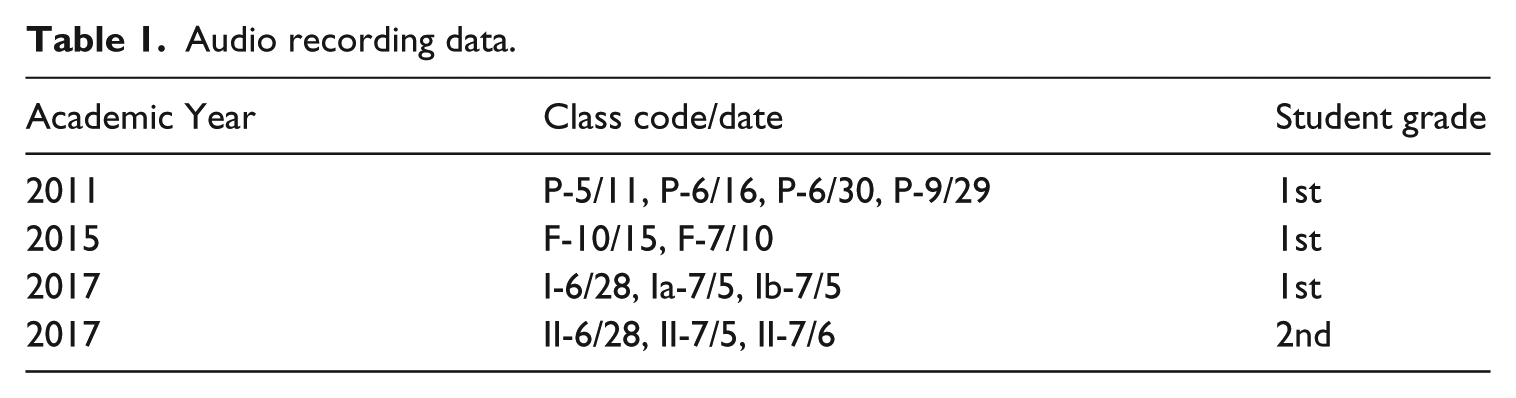
In total, 12 audio recordings were made in two courses, a first-year communication seminar and a second-year mixed reading/communication seminar: four recordings in 2011, two in 2015, and six in 2017 (see Table 1). Transcripts from the earlier 2011 study were included in the present data set. For the analysis, a preliminary review of the audio recordings was undertaken to identify relevant sections for transcription and further analysis. Open-ended coding (Patton, 2015) was employed to identify salient passages and patterns of interaction. Recursive coding sought to identify talk moves that were successful and to explain why (or why not), by making connections among categories and determining how categories fit together, with what implications. Analysis continued until axial codes appeared and theoretical saturation was reached, with all data accounted for. An attempt was made to produce a coherent narrative (Casanave, 2010) that captured both the general character of teacher talk and specific interactional patterns and strategies of instruction. In other words, coding generated a grounded interpretation, which suggested contradictory ways in which dialogic teaching was enacted. Results of the analysis are presented in the section below (for transcript conventions, see Appendix 1).
Audio recording data.
IV Findings
Three broad categories of interaction characterized teacher discourse, reflecting distinct discursive positionings. First, teacher interaction worked to elicit and extend student talk through use of such strategies as solicitation, extension, and expansion. Second, inadvertent missteps restricted student speaking positions in unplanned ways, due to such ‘errors’ as interruption and neglect. Third, implicit assumptions about what constituted effective strategies of talk, particularly recasts and explicit explanation, precluded students’ full and active engagement. Teacher-fronted interaction that sought to facilitate the individual student’s productive expression of ideas was balanced with broader concerns to orchestrate a supportive classroom environment where students felt comfortable speaking. Further, enacted patterns of interaction were rooted in habits and implicit assumptions, making it clear that bringing discursive practices into conscious awareness required critical reflection upon personal practice. In this respect, eliciting and extending student interaction was an issue of both bottom up engagement and top down coordination, which involved, importantly, the assertion of teacher authority to orchestrate a receptive atmosphere. In the following section, I delineate key strategies of interaction that emerged from the analysis.
1 The good
a Open-ended and authentic
A generally engaged dialogic stance was evident in many interactions, with a number of particular strategies that worked to solicit and scaffold student opinion. Questions were largely genuine and open-ended, with sincere interest in the answers, and uptake was evident in responses to students and in eliciting further comments from classmates. A number of the interactional strategies used across the lessons are evident in the following except involving Tomo (T), Shen (S) and Ichiro (I): 1 D Tomo, what did you just say, I’m sorry I didn’t catch it … 2 T … I think it was the first film I’ve watched that is from the perspective of the US side 3 D what do you mean by American perspective 4 T well, it’s an American director 5 D but wasn’t most of the dialog in Japanese/ 6 T yeah yeah 7 D so it seemed to me that it wasn’t as much an American perspective as dual perspective 8 T yes yes 9 D can anyone comment on this point about American perspective/ Shen/ 10 S you know when the soldier raped the girl, I thought it wouldn’t be taken seriously by the American investigators … I thought they would just act as if nothing had happened 11 D why would you think that/ 12 S it may be the education, it may be the media, I don’t know, 13 D you have a general- 14 S I think it’s the knowledge we see in our daily lives, like these problems are being solved 15 D generally speaking, would everybody agree with this/… Ichiro/ 16 I I think the US side still has the mindset that people of Okinawa are citizens of American territory, that they can take advantage of Japanese people … 17 D how did you get that impression/,, like Shen, from what you see on the media 18 I I guess, 19 D anybody else have a comment about American mistreatment/ II-6/28@1:00
The interactional posture evident in the selection illustrates the basic approach to classroom talk, with the goal to build the lesson around student expression of ideas. The exchange began characteristically with direct solicitation of student opinion, to which Tomo volunteered (turn 2). There was a follow-up clarification request (turn 3) as well as a counter-example offered (turn 7), to which Tomo concurred. A lateral invitation for other students to join the discussion followed (turn 9), and Shen replied (turn 10), offering his interpretation, which generated another request for explanation (turn 11), trying to draw out the reasoning behind his comment. Following Shen’s reply (turn 12), there was another broad query asking whether others agreed (turn 15), and a third student, Ichiro, responded (turn 16), which elicited another request for clarification (turn 17). Although Ichiro did not elaborate, he concurred (turn 18), and the exchange ended with yet another request for additional comments (turn 19).
The excerpt illustrates the way in which accountable talk was often negotiated in ongoing class discussion. There were follow-up requests for explanation: ‘what do you mean?’ (turn 3) and ‘why would you think that?’ (turn 11), as well as challenges to reasoning that prompted students to reconsider assertions and change their opinion (turns 5 and 7). There was multiple accountability: to the text, in the clarification about the film; to the community, in the incorporation of other student voices; and to standards of reasoning, in the requests for explanation and substantiation. Teacher questions were designed to elicit authentic responses that were placed at the center of the lesson. Students talked as much as the teacher and once, the student interrupted the teacher (turn 13), when Shen continued his point about the media.
What is perhaps not evident, however, is how difficult it was to generate a response from the students, who often proved reticent, even recalcitrant about expressing opinions to the whole class, and it was not unusual for discussion to falter or come to a complete halt. At times, the lack of involvement was frustrating, even though, as the excerpt suggests, students were also capable of generating insight and reflection. This contrast between engagement and culturally situated reserve was always an underlying source of concern, so that when extended discussion did occur, it felt like a gift, a reminder that with so many students unused to or unwilling to participate in whole class talk, an engaged response was not produced simply because it was requested. Accordingly, the effort to elicit accountable talk was simultaneously an attempt to solicit attention and encourage participation, illustrating what Skidmore (2006, p. 512) calls the ‘emotional colouring’ of discourse. Thus, discursive engagement with individual students went hand in hand with the effort to generate an atmosphere of assurance and collaboration. The elicitation of ideas was integral to instruction, but it was only part of the ongoing attempt to construct, only sometimes successfully, a community of speakers who shared an orientation and commitment to expression. In other words, the elicitation of accountable talk was coordinated by the teacher but contingent on student response, a tentative endeavor mediated by the social ties constructed in the class.
b Solicitation and wait time
Soliciting participation required particular attention to the hesitation that almost all students felt about speaking in public. Various strategies, including nomination, wait time, and humor were employed, in the attempt to overcome reserve and negotiate involvement. The strategies were evident in the following exchange with Eisuke (E) who was nominated to speak: 1 D another comment/ Eisuke/ 2 E um, 3 D you raised your hand right/, maybe you were scratching your nose 4 ss hhh 5 E I think, uh, the theme of the film is, uh, fight, for the truth, is very difficult, and, if, we can find the truth/, we keep, the unclear, feeling, in, our mind, Ohashi san, agreed to, sorry money/ … hush money II6/28@45:00
Eisuke had not raised his hand and he spoke only after the ‘push’ of being called upon (turn 1). Without the fabricated nomination, framed as a misreading of his gesture (turn 3), he would likely have maintained his status as silent listener, a receptive positioning with which many students said they felt comfortable. Once nominated, however, Eisuke displayed tenacity in articulating an interpretation (turn 5), though he struggled, speaking slowly and haltingly, with noticeable pauses (represented by the commas).
Similar to other students with little or no experience living abroad, Eisuke required significant wait time to express an idea. Soliciting response from students like Eisuke reinforced their right to hold the floor and framed their voice as central to class discussion. At the same time, consideration granted to one student concurrently increased the possibility of losing the attention of others. While the ideal was that one person’s response would serve as an ‘affordance’ (van Lier, 2004) to stimulate thinking among classmates, the reality was that other students sometimes lost focus, seen in the following exchange involving Aya (A) and Kai (K): 1 A adding to Sayuri/ I think Jules and Jess’ mother, push their own values to their daughter 2 D right, let’s use the word impose, Kai do you know what this word means 3 K I was completely spaced out I-6/28@51:00
Aya built her comment laterally (turn 1), responding to a classmate’s earlier contribution, but Kai, questioned in follow-up clarification of a vocabulary term, good-naturedly admitted that he had not even been listening (turn 3). In general, this tension between the individual speaker and the whole class always demanded consideration, and it was not easy to determine whether students were actually paying attention when their classmates spoke.
Thus, the multivalent orientation to discussion shaped the response to individual contributions, in part because the class served as the audience to whom the talk was addressed, in part because it was crucial that students felt comfortable expressing ideas even though they lacked confidence in their language skills. The discursive ambiguity meant that talking to an individual student required shifting attention back and forth between what was said with how it was heard – and ought to be heard. Comments were thus inevitably layered, addressing one student while trying to shape the speaking positions of others, with the aim to push everyone to participate in spite of hesitation and reserve.
c Extension of ideas
Another fundamental strategy used to enable participation involved the attempt to expand ideas. Sometimes, the extension entailed scaffolded assistance to jointly articulate an idea, seen in the following exchange with Kohei (K) regarding his response to a viewing assignment: 1 D Kohei you didn’t like it? 2 K no 3 D because it was too sunny and happy and perky/ 4 K the things what I thought was, I could not [?] ending 5 D because of the ideas in the movie/ 6 K yeah 7 D could you explain that a little more/ 8 K uh, in the beginning, I thought that um, how shall I say,,, the ideas in the movie was too um,, clear/ to see/ so it was not that interesting, 9 D too clear, too simple 10 K [simple 11 D [simplistic P-9/29@ 22:15
Initially, Kohei offered only a dismissive, one-word answer that he did not like the film (turn 2), although he was more forthcoming after the proposed restatement (turn 3), offering a diffident justification (turn 4), which subsequently led to a slightly more extended explanation (turn 8). In other words, the scaffolding helped Kohei expand an abbreviated dismissal into a relatively coherent idea that could serve as the beginning of an academic argument. The shared construction illustrates how a tentative expression was taken up and stretched, overcoming initial reluctance. Within this engagement, however, the affective complexity of the student’s response was also evident, involving both the assisted ability to articulate an opinion, and the skeptical attitude underlying it. The ambiguity of Kohei’s response demonstrates the difficulty of scaffolding student participation, trying to expand discursive proficiency while attempting to establish a positive social connection with the individual student on the one hand, and with the larger group on the other.
2 The bad
The impression held prior to the study was that class discussion was, for the most part, dialogic in tone and character, but analysis uncovered a number of discourse moves that worked to limit student participation in noticeably undialogic ways. Two categories stood out: unnecessary interruption and unrelated asides. Both restricted engagement, and though the intention was to coordinate a shared orientation, the actual result was to constrain student talk. Often these missteps were associated with trying to maintain a pace that sustained attention, but they also stemmed from trying to create rapport with students.
a Interruptions
There were a number of occasions when student comments were cut short, which is evident in the following exchange with Taku (T): 1 D Taku, talk to your classmates … 2 T this movie was like about how, talking can influence the society/ 3 D … how talking influences society … can you explain that/ 4 T like the- 5 D explain the point, ‘talking influences society’ 6 T ??? what was his name??? Nick/ when he was, uh,, like, uh, ??? 7 D thanks Taku, Sohei/ 8 ss hhh 9 T muri da [it’s no use] P-6/30@ 0:28
Taku commented appropriately at first (turn 2), but he was thrown off when asked for clarification (turn 3). He began a hesitant reply before being interrupted a second time (turn 5), which generated a confused, garbled statement (turn 6), at which point the next student was nominated, the class laughing at Taku’s good natured expression of resignation (turn 10). The interruption was ironic, in that the effort to elicit explanation worked to silence the student. Without doubt, the worry was that the pace and class attention would lag, which led to abandoning the request and leaving Taku for the next student. The move was not necessary, however, since neither wait time nor help clarifying the garbled comment had been extended. There was thus no real need to move so quickly, and the concern for maintaining a lively pace did not justify abandoning the exchange.
b Unrelated asides
Along similar lines, participation was sometimes limited in the attempt to create a personal connection with students. The goal was to increase the sense of membership and shared orientation, but personal remarks did not always work as expected, evident in the following exchange with Lina (L): 1 D Lina/ 2 L um- 3 D you’re taller when you stand up, most students seem the same size because they’re all sitting down, go ahead 4 L hhh I forgot what I was going to say 5 D sorry about that 6 ss hhh P-6/16@4:42
Lina began an answer (turn 2) when an unrelated comment about her height (turn 3) interrupted her train of thought. Her response was to comment on the interruption, noting the distraction (turn 4). Her aside generated an apology (turn 5) and laughter from the class (turn 6). While the tone of the exchange was light, it was certainly a mistake to comment on a student’s appearance. More importantly, the exchange illustrates how easy it was, given the proactive effort to coordinate discussion, to overstep and appropriate the student’s access to the floor. The challenge, unsuccessful in this case, was to position the student as the primary speaker, while directing the larger audience to consider what she had said. The error was to lose the balance between the class and the individual, focusing attention on the student while silencing her voice.
3 The misguided
In addition to inappropriate strategies of interruption and neglect, which were clear errors of judgment, a third category of teacher discourse reflected misguided assumptions about effective talk. Two particular strategies were evident: an over-reliance on recasts and a well-intentioned effort to explain the important. Neither seemed to be a mistake at the time. In fact, the strategies stemmed from expectations about how discussion should be managed and what might be said, in ways that felt appropriate. Both strategies demonstrate the strength of habit to reproduce familiar patterns of interaction, as well as ways in which interaction was shaped by broader assumptions about talk.
a Model recasts
The use of ‘model recasts’ that followed student comments was the most common interactional move in the data. The strategy, designed to restate and reformulate what a student had said, served various purposes: on one level, it aimed to ensure that the statement was heard by the class, while on another, it demonstrated support and validation of the student’s ideas, suggesting that the original comment had value and import, and was worth being heard. Perhaps most significantly, recasts allowed student comments to be rephrased and reformulated into more academic terms, introducing new ideas and expressions that provided a model of possible reasoning and connection (Gibbons, 2009). In theory, recasts granted primacy to the student’s voice and reduced teacher control over the discussion because attention was given to a topic that the student, not the teacher, had introduced. Use of the strategy, however, did not always facilitate either student response or extended interaction. The limitation is evident in the following exchange with Wataru (W) who responded to a question about the meaning of a film’s concluding scene: 1 D Wataru/ 2 W she was walking alone/- 3 D that’s a good point 4 W that meant like, they really didn’t get support, 5 D by herself, no support, so in a sense she’s symbolizing the Black community as well, so she’s one individual who’s walking alone, but she also symbolizes how Black people are not getting much support, or they’re not getting any support in this case, that’s a good point, thanks Wataru, somebody else/ F-10/15@6:16
Wataru’s interpretation (turns 2 and 4) that the solitary figure symbolized a lack of societal support was insightful, and while the recast (turn 5) did, to a degree, expand the comment by pointing out associated implications, it ended with an evaluation that closed the exchange and included no follow up. Critically, the response failed to introduce other strategies which would have created a more complex pattern of argument (Hardman, 2008a). For example, follow-up questions would have worked to ‘probe thinking’ (Alexander, 2008a, p. 109) and pressed Wataru to further ‘elaborate’ his idea (Mercer & Howe, 2012, p. 13). In fact, the teacher did most of the work, while the student, after his initial contribution, was positioned to listen, reproducing a receptivity associated with monologic address, thus shifting the locus of control from the student to the teacher.
The point here is not that the recast closed off avenues of the student’s contribution. In and of itself, the recast is an effective way to ‘re-voice’ a tentative comment, but in this exchange (and elsewhere), there was little room for other strategies, which would have generated more academic accountability and increased discursive complexity. Adding a variety of moves would have shifted the discussion away from a series of individual observations toward a more synthesized argument, deepening (and broadening) student engagement, and creating more complex patterns of talk. The reliance on recasts neglected such questions as ‘How does your comment connect with what others have said? How do you know that? How does it make us see the world today in a different light?’ In short, relying on the recast demonstrated a missed opportunity to incorporate additional strategies which would have strengthened student speaking positions as well as the quality of engagement.
b Explaining the important
A second misguided assumption that limited dialogicality was related to teacher-fronted explanation, particularly when trying to make an important point clear to students. The strategy was evident in the following exchange, discussing a short story read for homework: 1 D ‘on uttering the word, tomorrow’ … who’s she talking to/ 2 ss [Jess Jai Jeff Jei 3 D Jaiyuang, her boyfriend, ‘she flushed’ why did she flush? she was embarrassed, she was in love, realizing that he would come tomorrow, she felt excited, she realized she was in love with this guy, that’s why she flushed, she turned red … what kind of character was this guy/ 4 s he was kind/ 5 D he was kind and simple … he was actually a bit naive, … she was in love with a poor man II-7/5@1:11:32
The interpretation of the character’s motivation offered to students (turn 3) was an impassioned albeit ineffective attempt to make something clear that seemed necessary to understand. The excerpt reflects a near-complete shift in teacher talk to transmission mode suggestive of a recitation script, requiring a short answer response (turn 4), followed by teacher confirmation (turn 5). The reason for the lecture-style explanation was the feeling that an answer would not be forthcoming, because students appeared unwilling to speak, and since students did not understand, they needed to be told. The explanation, however, effectively closed off dialog, so that trying to explain what the text meant led to an impasse where students did not understand.
First, the explanation did not clarify the text for the students. Further, although the assumption that students would not answer the question was probably correct, it was the wrong question, because it presumed students knew the answer. A different approach, more dialogic in tone, would have been to ask, not what the text meant, but what the students thought. There was no guarantee that anyone would have responded, but the likelihood of increased engagement is greater, with more answers and broader interest. Shifting the assumption from what the teacher knew, in order to pursue dialogically what the students knew, would have opened a more interesting and interactive path. In other words, there is a world of pedagogic difference between asking ‘What does this mean?’ and ‘What do you think?’ There is also a world of insight in Reznitskaya’s (2012) comment that the dialogic teacher ‘refrains from expressing’ a personal opinion, but first ‘prompts students’ for their thoughts (p. 453).
V Discussion
The attempt to implement dialogic teaching proved more challenging and less successful than imagined going into the study. While some positive interactional patterns were evident (soliciting participation, eliciting explanation, scaffolding productive talk), there were also notable missteps and errors of judgment that served to restrict student participation. More importantly, misguided assumptions about effective talk, which seemed appropriate at the time, worked to limit accountable talk. In effect, there was too much missing to qualify as dialogic teaching, and more diverse interactional moves need to be introduced before the instruction might be called authentically dialogic. Still, the effort seems worthwhile for the chance not only to reflect on the character of reciprocal pedagogy but also to understand the challenges and limitations of instructional practice. Without doubt, a theoretically informed checklist of moves would have proved useful, but arguably, it was situated, personal reflection that allowed the implicit to emerge and a connection to be made between theory and practice.
Skidmore (2006, p. 506) wonders why, if monologic approaches are so ineffective, they are so prevalent. One traditional explanation is that teacher authority usurps the reciprocality that flourishes in an egalitarian atmosphere. The dialogic teacher, it is argued, should not exert authority because it is students who have ‘control over their own learning’ (Hardman, 2008c, p. 254) within a ‘deliberative democracy’ (Michaels, O’Connor & Resnick, 2008, p. 284) where students ‘freely interact with each other in their search for new meanings and understandings’ (Reznitskaya et al., 2009, p. 32). Dialogic teaching is thus seen to position students to ‘participate democratically’ within a community based on ‘mutual recognition’ (English, 2016, p. 166), as teachers and students ‘listen to each other’ in collaborative partnership (Sedova, Salamounova & Svaricek, 2014, p. 282). Classes would likely be more dialogic, the argument goes, if the teacher were less controlling. Xie (2010) for example, argues that the reticence of Chinese students is in large part a function of power dynamics in the classroom. Students do not speak out, Xie contends, because they have little control over discussion topics that ‘shut down student-initiated ideas’ (p. 17).
Based on the findings of the present study, however, I would argue that this interpretation is limited, largely because it portrays the teacher as the problem rather than the solution, particularly given the cultural context in which interaction takes place. Listening to students does not preclude actively orchestrating class discussion. In spite of errors and missteps, it is ultimately the authority of the teacher that makes dialogic interaction work, especially in L2 settings, through the assertive coordination of focus and participation. Certainly, instructional authority is detrimental when it results in monologic control of the floor, but only the teacher is able to mobilize construction of new cultural orientations within the shared third space of the L2 classroom (Kramsch, 2009). This fashioning involves going beyond cultural behaviors associated with traditional L1 patterns, such as reticence. Particularly in Japanese university classrooms, building an environment where L2 students feel comfortable speaking in front of peers entails a constant struggle to overcome deeply engrained reserve, doing things like ‘pushing’ sustained expression, prevailing on class members to listen while others are speaking, and ensuring that shy students have a chance to talk while classmates pay attention to voices that are often ignored. In this respect, dialogic engagement requires the teacher to assert authority, albeit in a tentative and contingent manner, to fashion an affirming atmosphere where students feel encouraged to speak.
It is not easy to change culturally situated behavior, certainly not just because the teacher asks for explanation. Students in this study struggled even when they had the floor, and requests to speak did not always produce fluent response. Given student reserve and uncertainty, the authority to persuade, invite, and sometimes compel participation is an integral part of the teacher’s subject position. The real question is not whether to relinquish authority, but how to use it effectively to promote attention and engagement. This authority is limited, of course, and in a real sense, the teacher is dependent on students, not because they have equal rights, but because if students do not comment, dialog does not take place. It is possible to compel students to stand and speak before they sit down, which actually works, but imposing an obligation only goes so far and, in the end, is not as strong as collaborative engagement that grows over time in a supportive atmosphere.
In a similar way, it is not easy to change teaching behavior, although it is certainly overly pessimistic to state that teachers are generally ‘not capable of implementing’ principles of dialogic interaction (Sedova et al., 2014, p. 276). Teaching dialogically is not an either/or proposition, akin to gaining certification. There is surely potential for becoming more dialogic in the classroom, but at the same time there is no endpoint where the teacher gets it right. There is always contingency, some provisional uncertainty in its implementation. Dialogic teaching is not a matter of established method, but more an issue of commitment, of trying to teach dialogically, which takes place over time and with reflection, pointing to the potential inherent in any pedagogic orientation.
It is not always a good idea to speak of personal mistakes in public, but errors illustrate the value in looking carefully at what goes wrong, which often tells as meaningful a story as what goes right. In the present study, for example, missteps point in particular to the complex, layered demands on teacher attention within the ‘fast flow of the lesson’ (Walsh, 2011, p. 44). Simultaneous concerns for class management and coordination (nomination, encouragement, pace, personal connection, etc.) mediated the shape of interaction and modified the enactment of scaffolding. When talking to one student means attending at the same time to the ‘cognitive, emotional and moral abilities’ (English, 2016, p. 165) of everyone in the room, miscalculations are an inevitable part of the equation, neither a reason for abandoning the dialogic project nor a rationale for criticizing its flawed enactment.
In sum, the ability to see one’s classroom differently is generated in the ‘lived experiences’ with which teachers engage instruction (Johnson, 2006, p. 242). Making fundamental changes in interactional style is a matter of reflective praxis, grounded in teacher ‘ownership’ not just of the data (Walsh, 2011, p. 142) but of the inquiry itself, involving an investment in the project and a commitment to the process. The motive to rethink such unhelpful discursive features as over-reliance on recasts and explanation of difficult-to-parse texts that at first seem so natural, is generated in dealing with the complex and contradictory issues that arise in social activity within the classroom. It is easy to assume that one is following theoretical principles but guidelines alone do not necessarily make it possible to see pedagogy in a new light. For teachers interested in dialogicality, improvement is tied to local practice and the intention to look carefully and critically at how interaction plays out personally, seeking to expand the good, reduce the bad, and adjust the misguided.
Footnotes
Appendix 1
Transcription conventions
, noticeable pause
/ rising intonation
hhh laugh
??? unclear
[ overlapping talk
= connected across turns
- abrupt cut off
… excerpted from transcript
D teacher
Acknowledgements
I would like to thank an anonymous reviewer at Language Teaching Research for particularly incisive critical remarks on an earlier draft off this paper. I also want to express appreciation to Paul Stapleton for his helpful comments and unflagging encouragement to pursue revision. Special thanks are due to the students involved in this study who participated with such good-natured enthusiasm and engagement.
Funding
The author(s) received no financial support for the research, authorship, and/or publication of this article.