



Abstract
Tasks with different design factors may dissimilarly affect oral production, and thus can be adopted for different pedagogical purposes. However, the functions of task types are not fully explored. To address this gap, this study investigates the influence of content familiarity and task repetition on sixty English as a foreign language learners’ speaking performance, in terms of complexity, accuracy, and fluency (CAF). Participants twice performed four monologic tasks, and received stimulated recall interviews. The findings indicate that participants produced structurally more complex speech under familiar conditions, and increased their CAF in task repetition. Furthermore, content familiarity and task repetition may facilitate conceptualization. Task repetition may also direct participants’ attention towards lexical choices and grammatical encoding. Moreover, repeating unfamiliar topics effectively increased CAF. The findings suggest content familiarity and task repetition are two dimensions of topic familiarity, and that teachers might consider implementing task repetition when presenting unfamiliar topics to learners.
Keywords
I Introduction
Using English for real-time communication has long been a goal for English as a foreign language (EFL) learners, as English-speaking competence is important for passing English examinations, and for gaining employment or pursuing further education (Long, 2015). However, many learners, despite years of efforts, still find it difficult to communicate well in English. Despite having mastered its linguistic forms, some learners are still unable to select appropriate expressions in real-life English communication. This phenomenon might be more obvious in EFL countries, where learners acquire English language mostly through classroom instruction and have few English communication opportunities outside the classroom. As learners rely on classroom instruction for English learning, teachers shoulder a heavy responsibility for developing students’ form-meaning speaking competence for real-life communication (Baker & Westrup, 2003).
Task-based approaches – i.e. those in which pedagogic tasks are adopted to develop communicative competence (Robinson, 2001; Skehan, 1996) – are recommended for language teachers. In this pedagogical method, a task is a meaning-based language use activity with an existing gap, in which learners are given some information to reach an outcome by achieving communicative purposes (Ellis, 2003). Studies (Bygate, 2001; Bui, 2014) have examined the functions of different tasks and suggested the pedagogical implications of designing and implementing tasks in second language (L2) classrooms. However, these studies are far from sufficient, as they leave some design/implementation variables relatively under-explored, and seldom discuss the interactions between design variables. Thus, teachers may still encounter uncertainties when designing tasks.
Skehan (2014) suggested adopting a processing perspective when exploring the functions of pedagogic tasks, and considering the relationships among task design, speaking procedures, and task performance to gain insights into learners’ attention and memory in task performance. Linking Levelt’s (1989) speaking model with L2 speaking performance, this study explores the influence of a task design variable (content familiarity) and an implementation variable (task repetition) on EFL learners’ speaking performance. Content familiarity refers to the content domain knowledge learners bring to their spoken discourse (Carrell, 1987). Task repetition means repeating the same task, with the same content, to the same audience. Obtaining prior knowledge and repeating the same task with the same content familiarize learners with the speech message (Mackey et al., 2007); hence, the two factors are related dimensions of topic familiarity. The interaction effect between these variables on oral production will also be discussed.
II L2 speech production: Levelt’s model
Levelt’s speaking model (1989, 1999), which describes the complete process of oral production, has been claimed to be effectively linked to task-based approaches (Skehan, 2018). Unlike other existing models, which focus on mistakes, Levelt’s model holds a more positive view towards speaking performance, and therefore receives much attention (de Bot, 1992; Kormos, 2006). In general, Levelt described that when a language learner intends to speak, he/she first activates relevant concepts from his/her memory, and then decides the content and order of that information (i.e. conceptualization). These content messages, called preverbal messages, contain the information needed to convert meaning into language, but are not linguistic (de Bot, 1992). In the grammatical encoding stage, lemmas – i.e. syntactic words related to lexical concepts – are activated in the mental lexicon, after which morpho-phonological codes and phonological scores are triggered before the learner finally articulates the speech to the outside world. The learner monitors his/her speech production, and repairs the speech throughout the process.
Levelt’s model was designed for unilingual speakers, but was later extended to bilingual or L2 speakers (de Bot, 1992). The oral production difference between unilingual and bilingual speakers is that the former’s production stages are simultaneous, whereas the latter’s are generally sequential; that is, most bilingual speakers finish one stage before moving to another. For example, when an L2 speaker introduces herself, she first decides the content (e.g. name) and activates single words for that content. She then connects the words into phrases, sentences, and overt speech. After the first round of speech production, she recycles the procedures in sequence for her next overt speech. In comparison, due to automaticity, a native (L1) speaker processes her first and second overt speeches simultaneously. L2 speakers’ conceptualization describes the activation of L1 and L2 episodic memory, and concepts from semantic memory (Kormos, 2011). Both L1 and L2 knowledge may be activated at the lexical, syntactic, phonological, and phonetic encoding stages, but they are likely to compete for selection, depending on the speaker’s L2 proficiency level. These specific characteristics of bilingual speakers or L2 production show the need for more in-depth exploration of the model, and of its adaptation to L2 task performance.
Skehan (2018) claimed the Leveltian model functions as an effective framework for analysing the cognitive processes of L2 oral production, and that task design factors can be linked to the model. Wang (2014), in her study of EFL learners’ manipulations of tasks using different forms of on-line planning and repetition, concluded that repeating the same oral tasks involves the conceptualization, formulation, and articulation stages. Skehan hypothesized familiarity with information could ease the cognitive load of the conceptualizer and that task repetition may facilitate both conceptualization and formulation.
The relationships among cognitive processes, task design factors, and task effects have been explored using two major instruments, with the more popular one involving measuring complexity, accuracy, and fluency (CAF). Previous studies (Bui, 2014; Wang, 2014) investigating the influence of task design factors on L2 oral production have suggested fluctuations in CAF under different conditions might be due to differences in learners’ attention orientation. Fluency can reflect the whole procedure of speech production, and accuracy and complexity might be relevant to the formulator.
For methodological triangulation (Izumi & Bigelow, 2000) and to explore how task factors influence learners’ attention orientation, some studies have captured stimulated recalls of speakers’ inner thoughts. For example, in Fukuta’s (2016) paper, the finding that EFL learners’ accuracy increased through task repetition was triangulated by retrospective reports that task repetition eased the cognitive load of the conceptualizer and directed participants’ attention to syntax. To obtain more insights about the influence of task variables on learners’ oral production, this study adopted these two instruments.
III Content familiarity
Content familiarity refers to the content domain knowledge learners bring to their spoken discourse (Carrell, 1987). The dividing line between familiar and unfamiliar topics is whether learners possess prior knowledge about a task topic. As considering learners’ familiarity with a task topic is an indispensable step in task design, the factor has been included as an important variable in task-based theories (Skehan, 2014; Robinson, 2011). Robinson categorized it as a resource-dispersing factor, in that a lack of prior knowledge may increase task complexity. Studies (Leeser, 2004; Markham & Latham, 1987) have shown topic familiarity facilitates L2 reading and listening comprehension; however, the effects of content familiarity on oral production are comparatively under-explored.
Content familiarity has been found to have positive effects on L2 production in some studies (Bui, 2014; Bui & Huang, 2018; Lambert & Robinson, 2014), but the effect of content familiarity on L2 learning and teaching remains debatable. Bui (2014) investigated how content familiarity affected 80 English as a second language (ESL) learners’ speech production in two monologic tasks. Participants, all majoring in either medicine or computer science, were asked to describe medical and computer viruses, respectively. Bui concluded that they produced more fluent, and slightly more accurate and complex speech for the familiar topic (describing virus within their disciplines), and proposed content familiarity may facilitate conceptualization and formulation stages. Furthermore, content familiarity was claimed to engage L2 learners in task performance behaviourally, cognitively, and emotionally (Phung, 2017; Qiu & Lo, 2018).
On the other hand, based on EFL learners’ oral production of 10 topics extracted from the IELTS speaking test and their familiarity levels with those topics, Khabbazbashi (2015) found the impact of familiar topics on speech production was not as powerful (small effect sizes) as claimed in other studies, and that learners’ test scores were not significantly affected by content familiarity. She argued, therefore, that few implications could be drawn regarding the use of familiar/unfamiliar topics in language testing. These conflicting findings indicate more research into the effects of content familiarity on task performance is needed to reach a conclusive answer.
IV Task repetition
Different types of task repetition involving different procedures/characteristics may dissimilarly affect L2 oral production. Some researchers (Fukuta, 2016; Kim & Tracy-Ventura, 2013) suggest procedural repetition (same task procedure, different content) improves syntactic complexity, whilst exact task repetition (same task procedure, same content) is more likely to shift learners’ attention to linguistic form and enhance their CAF. Lambert et al. (2016) argued that repeating the same tasks with the same content to different interlocutors increases fluency.
This study focuses on exact task repetition: repeating the same task with the same content to the same audience. Although exact task repetition has generally been found to benefit L2 oral production (Bygate, 2001; Wang, 2014), there is some debate about which aspect(s) of speaking skill it improves, and to what extent. Bygate (2001) found exact task repetition yielded more fluent and accurate L2 oral performance, whilst Wang (2014) showed it improved all the three aspects of L2 learners’ CAF, and Fukuta (2016) found significant improvements in accuracy and lexis. These results suggest exact task repetition directs L2 learners’ attention towards form (Van de Guchte et al., 2016). EFL learners’ retrospective reports (Fukuta, 2016) indicate task repetition automatized their speech production, released their conceptualization, and oriented their attention more to syntactic encoding. However, as these previous studies’ findings are inconsistent, this study incorporates stimulated recall interviews to explore the relationships among task factors, learner performance, and attention orientation.
Exact task repetition and content familiarity might have an interaction effect on L2 oral performance. Repeating tasks with unfamiliar topics engages EFL learners more effectively in task performance than does repeating task with familiar topics, as learners may perceive greater space for improvements in fluency and accuracy (Qiu & Lo, 2018). However, whether such progress can be observed in their oral production remains under-explored. Inconsistent findings on the impact of content familiarity and task repetition, and limited information on the interaction between the two factors motivate the current study, which draws on the Leveltian model to explore the effects of content familiarity and task repetition on EFL learners’ speech production.
V The study
This experimental study adopted a 2 × 2 full-factorial design containing two within-participant independent variables: content familiarity (familiar and unfamiliar topics) and task repetition (first and second performances). The dependent variable – EFL learners’ task performance – was measured in terms of complexity, accuracy, and fluency. The following three research questions and related hypotheses were raised.
What are the effects of content familiarity on EFL learners’ oral production in monologic tasks, in terms of complexity, accuracy, and fluency? In what way does content familiarity affect attention orientation?
Hypothesis 1: It is hypothesized that, under familiar conditions (i.e. +prior knowledge), participants will produce more complex, accurate, and fluent oral discourse than under unfamiliar conditions (i.e. –prior knowledge) (Bui, 2014). Content familiarity facilitates the conceptualization stage (Skehan, 2018).
What are the effects of task repetition on EFL learners’ oral production in monologic tasks, in terms of complexity, accuracy, and fluency? In what way does task repetition affect attention orientation?
Hypothesis 2: It is hypothesized that participants will utter more complex, accurate, and fluent speech in their repeated performance than in their first performance (Fukuta, 2016; Wang, 2014). Task repetition directs participants’ attention towards the formulation stage (Hawkes, 2012).
What are the interaction effects of content familiarity and task repetition on EFL learners’ oral production, in terms of complexity, accuracy, and fluency? In what way do these interaction effects affect attention orientation?
Hypothesis 3: It is hypothesized that repeating tasks with unfamiliar topics will be more effective in improving participants’ speech production than their repetition practice under familiar conditions. Based on pilot study findings and L2 learners’ stimulated recalls in Qiu & Lo’s (2018) study, repeating unfamiliar topics directs participants’ attention towards the formulation stage.
1 Participants
Sixty first-year undergraduate students (35 males and 25 females, aged from 18 to 19 years old) from a university in China voluntarily participated in this study. All had been raised in China and had at least six years of English learning experience; none had been abroad for more than one month at the time of data collection. Therefore, they shared a similar Chinese cultural background. An equal number of participants (n = 30) was selected from each broad group of disciplines (i.e. humanities and social science, and science and technology) to avoid the potential influence of disciplinary background.
To measure their general English proficiency levels before data collection, the participants sat a C-test (a kind of cloze test) containing five short passages from three previously published C-tests, to which 102 deletions had been made (Babaii & Ansary, 2001; Dörnyei & Katona, 1992; Raatz & Klein-Braley, 1981). The average accuracy rate for all participants was 56.34%, with a standard deviation of 15.20. As such, their English proficiency level ranged from the lower-intermediate to the intermediate level.
2 Monologic tasks
Two picture tasks and two short speech tasks were designed for this study, with each type of task containing a familiar and an unfamiliar topic. Picture tasks required participants to tell a story based on six sequential picture prompts. The familiar topic narrated Xiao Hong’s experience of preparing lucky money as a Chinese wedding gift; the unfamiliar topic described Lucy’s experience of preparing a microwave as wedding gift, based on Western culture. In the short speech tasks, participants either shared their own experiences of finding lost items (familiar topic), or their plans for job hunting after graduation (unfamiliar topic), without picture prompts. The participants scored their level of familiarity with each task topic (one to five) after their first performance. The results of two paired-sample t-tests showed participants were significantly more familiar with the Chinese wedding gift task (M = 4.22, SD = 0.76) than with the Western wedding gift task (M = 1.73, SD = 0.82), with a large effect size (d = 3.15). They reported that their experiences of finding lost items (M = 4.32, SD = 0.68) were significantly more familiar than their job hunting plans (M = 2.48, SD = 0.79), with a large effect size (d = 2.50). Their scores confirmed the divisions of familiar and unfamiliar topics.
3 Data collection procedures
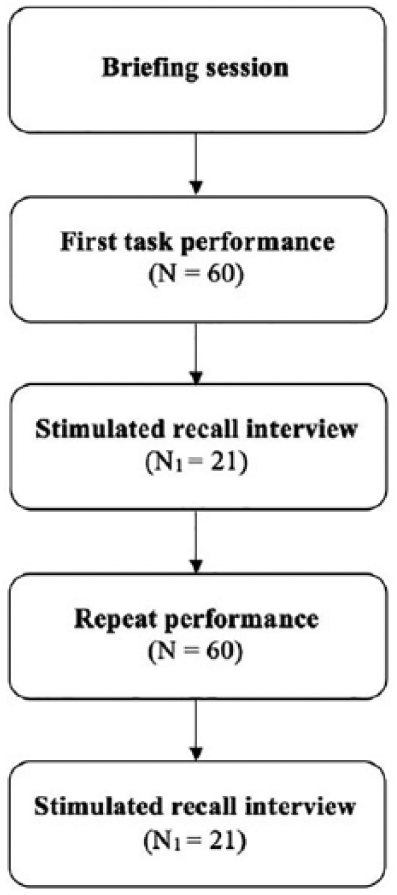
All participants were recruited via posters and in-class promotions, and were guaranteed their performances and interviews would be kept confidential, and would not affect their academic standing. Figure 1 describes the procedure of data collection. Each participant was invited to an office for a five-minute briefing session about the research project before data collection began. Participants were randomly divided into four groups and performed the four oral tasks with counterbalanced orders (i.e. each group started their performance in different tasks with different sequences). Participants were given three minutes to prepare for each task, as eight of 10 participants in the pilot study reported spending around three minutes on planning. There was no time limit for participants’ actual speech production, to enable them to provide complete stories without time pressure. The author, as the audience, provided responsive words (e.g. okay, right) to create a communicative environment, but those responses were excluded from data analysis. The average length of each task performance was 100.26 seconds (SD = 61.46).
The procedure of data collection.
After performing their four tasks, 21 participants were selected for one-on-one stimulated recall interviews, to capture their inner thoughts about their performance. Interview invitations were sent to all participants, but only 21 agreed to be interviewed. Their task performance was video-taped, and the video played immediately after their performance to simulate their recall. The author paused the video when the participants presented any long pauses, repetitions, repairs, or unnatural facial expressions (e.g. laughing) in the video, and prompted them to share their inner thoughts through such questions as, ‘What were you thinking about when you (paused)?’ followed by various follow-up questions, depending on the response. Interviews were conducted in Chinese, the participants’ first language, and were audio-recorded.
Participants then repeated the four tasks in the same order with the author as audience. Each of the four random groups was equally divided into three sub-groups. Each sub-group (five participants) repeated the four tasks with the author after a certain interval (i.e. immediately, after three days, or after a week). Kruskal–Wallis tests showed no significant differences among these three intervals with regards to CAF; hence, repetition interval influence was not considered in this study. After task repetition, another stimulated recall session was conducted with the same participants to gather their inner thoughts about their second performance. Their performance was audio-recorded or video-taped, depending on whether they were invited for stimulated recall interviews. After completing their tasks, participants were entered into a gift draw, as compensations for their participation.
4 Data analysis
Two kinds of data were collected: task performances and stimulated recalls. The spoken discourses were manually transcribed in both unpruned and pruned forms, following Kormos and Dénes’ (2004) convention. The unpruned form included spoken words, pause time, and filled pauses, whereas the pruned form excluded these features. The minimum pause length was determined to be 250 ms (Préfontaine and Kormos, 2016), as pauses over 250 ms provided more meaningful information in 10 randomly-selected participants’ oral discourses.
There were 480 pieces of oral discourses, spanning a total of 13 hours and 22 minutes. Ten percent of oral discourses (48) were checked by a research assistant, with an intercoder reliability (the percentage of words agreed upon by both sides) of over 95%. The stimulated recalls were first manually transcribed into Chinese, and then translated into English. The research assistant checked all the transcripts, back-translated four participants’ stimulated recalls, and then compared the back-translation with the original transcript, finding more than 90% were consistent.
Task performance was measured via four CAF indexes. Global measures of CAF were favoured, as this study intended to capture an overview of oral production. The first was linguistic complexity, which refers to learners’ use of the target language at the upper limit of their interlanguage systems and their preparedness to use more diverse structures (Ellis, 2012), and is generally divided into structural complexity and lexical complexity (Housen & Kuiken, 2009).
Structural complexity was measured in this study using average number of words per analysis-of-speech unit (AS-unit), the most commonly-used scale (Skehan et al., 2016); speech units analysed included independent clauses with/without subordinate clause(s) (Foster et al., 2000).
Lexical complexity was measured using the Guiraud index (G index; Guiraud, 1954), which is calculated by ‘dividing the number of word types in a speech sample by the square root of the number of the word tokens produced’ (Malicka & Levkina, 2012, p. 52). G index was selected over various other lexical indices, as it avoids the influence of different lengths of discourses.
Grammatical accuracy – which refers to ‘degree of deviancy from a particular form’ (Housen & Kuiken, 2009, p. 463) – was measured in this study based on the number of errors per unpruned 100 words (Chandler, 2003). Grammatical accuracy visualizes the learner’s overall accuracy performance.
Finally, L2 utterance fluency – ‘the fluidity of the observable speech as characterized by measurable temporal features’ (Segalowitz, 2016, p. 81) – was measured in this study by mean lengths of runs (MLR), a composite index that captures the mean length of syllables between two pauses, and thus considers the number of syllables and pauses in the overall speech (Skehan & Foster, 2005). MLR has the highest correlation with rater-evaluated scores (Kormos & Dénes, 2004).
A repeated measures multivariate analysis of variance test (MANOVA) was conducted to examine the effects of the two within-participant variables (content familiarity and task repetition), and their interaction effect. All data sets were square rooted to ensure their normality. Assumptions of the repeated measures MANOVA test were met. Bonferroni correction (Holm, 1979) was conducted to adjust the alpha from .05 to .0125, as there were four measures for oral performance. According to Cohen (1988), the benchmarks for partial η2 for small, medium, and large effect sizes are .01, .06, and .14, respectively. The research assistant calculated the CAF of six participants for inter-rater reliability. Correlation analyses were conducted using SPSS software, and found the author’s and research assistant’s data sets were highly correlated (p < .01, r > .80).
The coding scheme for the stimulated recalls followed that proposed by Fukuta (2016), and included conceptualizing, lexical choice, syntactic encoding, and phonological encoding. Grammatical encoding was added to the scheme, as an initial analysis of the recalls found some utterances related to this stage. Each interview’s questions and answers were read and categorized into the components of Levelt’s speaking model (1989). Examples are attached as supplemental material. A peer researcher was invited to check the coding of four participants, and agreed with 90% of the coding for the question-answer episodes. After coding, the interviews were read again, at which time some themes emerged that showed potential relationships between the variables and the theoretical framework.
VI Findings
On average, the participants spent 88.95 s (SD = 44.55) on the Chinese wedding task, 89.82 s (SD = 40.50) on the Western wedding task, 142.50 s (SD = 91.25) on the lost items task, and 118.58 s (SD = 58.89) on the job-hunting task.
1 Quantitative results of oral discourses
a Content familiarity
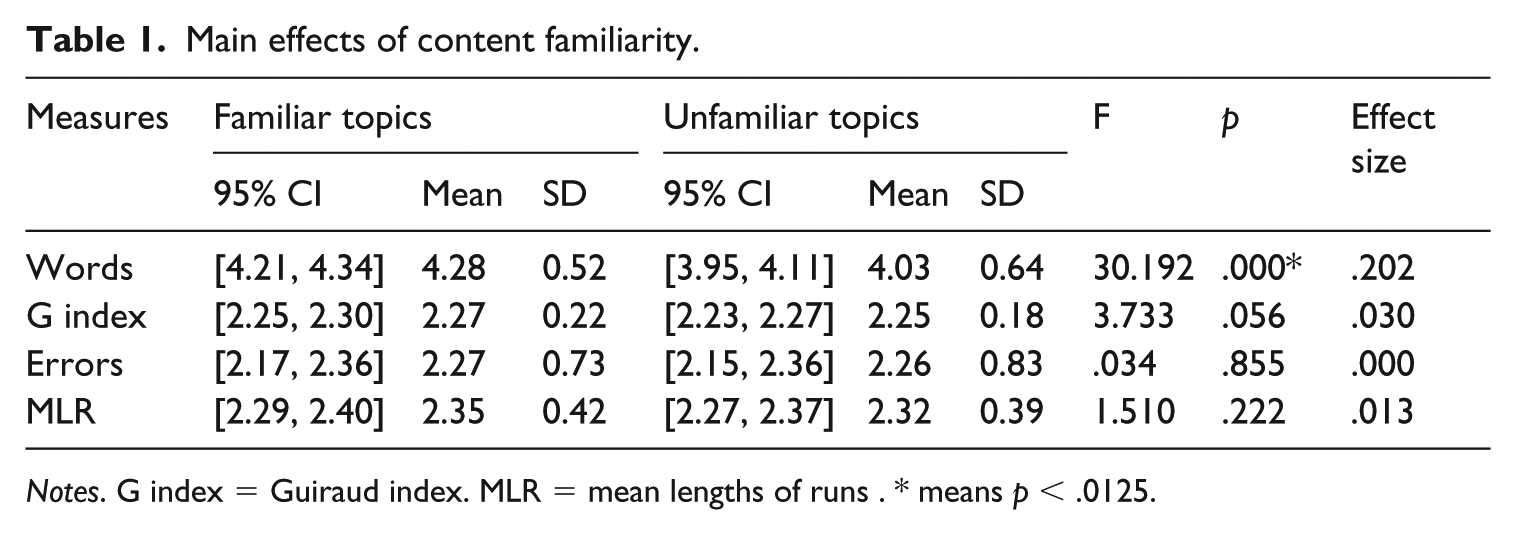
Table 1 describes the 95% confidence intervals, means, standard deviations, F value, p value, and effect sizes of the four measures for participants’ performance under familiar conditions, and under unfamiliar conditions. Repeated measures MANOVA test results indicated participants generally had better oral performance under familiar conditions than under unfamiliar ones, with a large effect size (V = .237, p = .000, partial η2 = .237). Specifically, participants uttered significantly more complex sentences under familiar conditions (M = 4.28, SD = 0.52) than under unfamiliar conditions (M = 4.03, SD = 0.64), with a large effect size (F = 30.192, p = .000, partial η2 = .202). The findings indicate content familiarity raised participants’ structural complexity. No significant differences (p > .05) were found in terms of lexical richness, accuracy, or fluency, which implies content familiarity did not significantly affect the three aspects.
Main effects of content familiarity.
Notes. G index = Guiraud index. MLR = mean lengths of runs . * means p < .0125.
b Task repetition
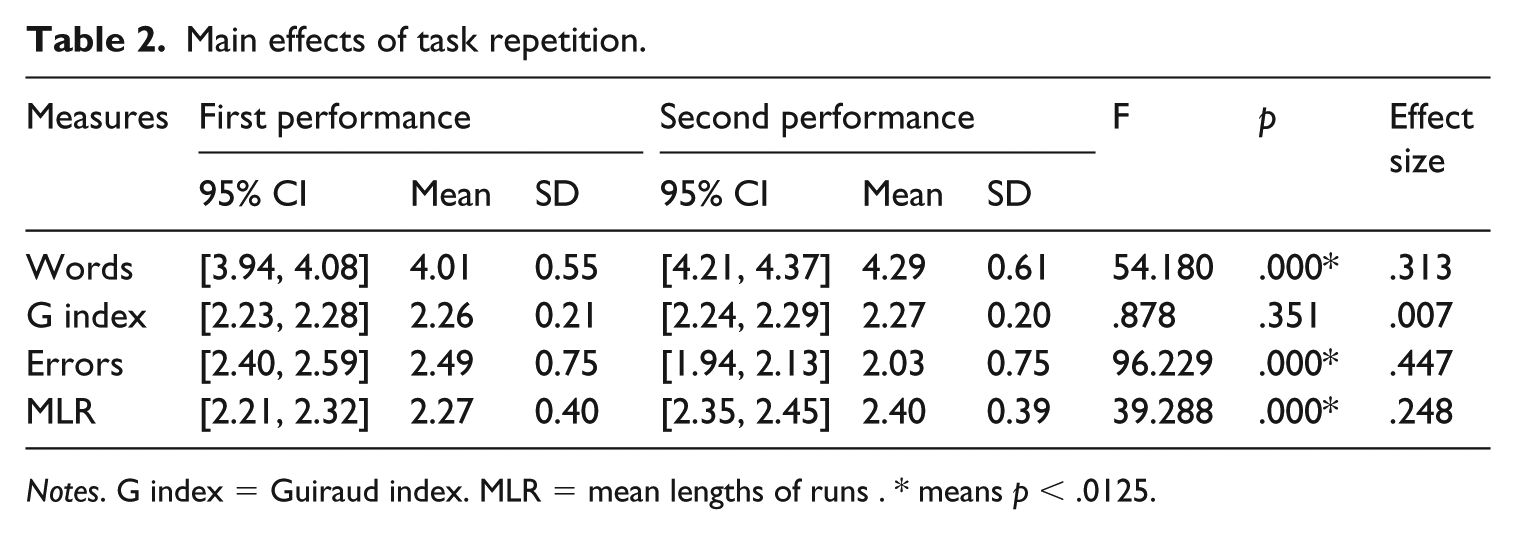
Table 2 describes the 95% confidence intervals, means, standard deviations, F value, p value, and effect sizes of the four measures for participants’ first and second performances. Generally, participants had better oral performance when they repeated the task than when they performed it for the first time, with a large effect size (V = .629, p = .000, partial η2 = .629). Moreover, participants uttered significantly more complex sentences in the second performance (M = 4.29, SD = 0.61) than in the first performance (M = 4.01, SD = 0.55), again with a large effect size. In terms of accuracy, participants produced significantly fewer grammatical errors in their second performance (M = 2.03, SD = 0.75) than in their first (M = 2.49, SD = 0.75), with a large effect size. Participants also produced significantly more syllables between pauses in their second performance (M = 2.40, SD = 0.39) than in their first (M = 2.27, SD = 0.40) with a large effect size. However, no significant differences were spotted in lexical richness (G index). To summarize, task repetition raised structural complexity, accuracy, and fluency.
Main effects of task repetition.
Notes. G index = Guiraud index. MLR = mean lengths of runs . * means p < .0125.
c Content familiarity * Task repetition
Results of the repeated measures MANOVA test indicated an interaction between content familiarity and task repetition for all CAF aspects, with a large effect size (V = .497, p = .000, partial η2 = .497). An interaction effect was found between the two variables in structural complexity, with a large effect size (F = 68.700, p = .000, partial η2 = .366). As shown in Figure 2, participants had an obvious improvement in average number of words per AS-unit when repeating tasks with unfamiliar topics, whereas their two performances did not obviously differ under familiar conditions. This shows that task repetition was more effective in raising structural complexity when conducted for tasks with unfamiliar topics.

Interaction effect in average number of words per analysis-of-speech unit (AS-unit).
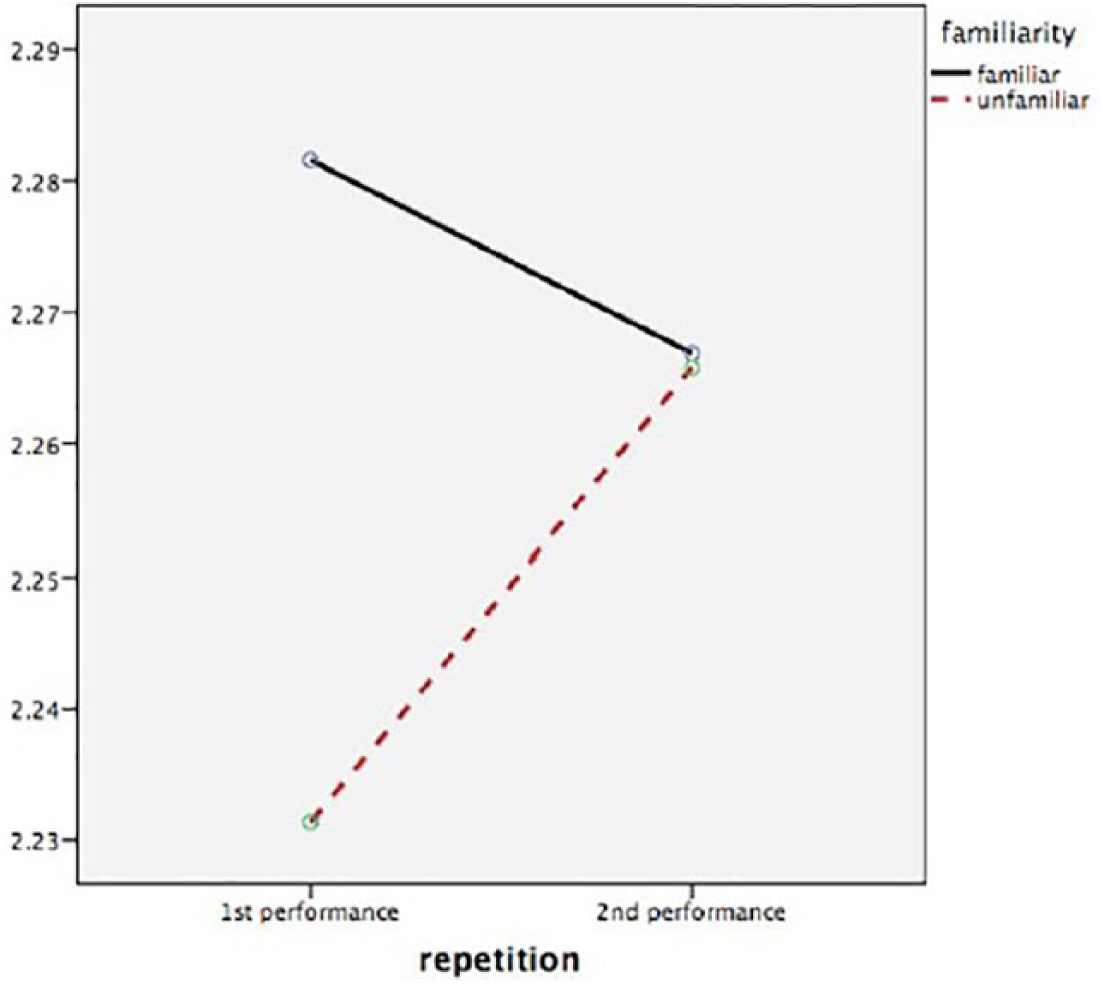
Second, the two variables interacted in lexical richness (G index), with a medium effect size (F = 8.233, p = .005, partial η2 = .065). From Figure 3, under unfamiliar conditions, participants adopted obviously richer word types in task repetition than in their first performance; however, under familiar conditions, a slight decrease in G index was found from first to second performance. Repeating tasks with unfamiliar topics was thus more useful for improving lexical richness.
Interaction effect in Guiraud index (G index).
Third, an interaction effect was found in accuracy (errors per 100 words), with a large effect size (F = 25.118, p = .000, partial η2 = .174). From Figure 4, task repetition was effective in improving grammatical accuracy under both familiar and unfamiliar conditions, but the improvement was more obvious when repeating tasks with unfamiliar topics.

Interaction effect in errors per 100 words.
Fourth, an interaction effect was found in fluency (MLR), with a small effect size (F = 6.975, p = .009, partial η2 = .055). From Figure 5, task repetition was also useful in raising fluency under both familiar and unfamiliar conditions, but this effectiveness was more obvious when repeating tasks with unfamiliar topics.

Interaction effect in mean lengths of runs (MLR).
To summarize: (1) participants produced structurally more complex oral discourses under familiar conditions than in their task performance with unfamiliar topics; (2) task repetition increased structural complexity, accuracy, and fluency; and, (3) task repetition was more effective in raising CAF in tasks with unfamiliar topics.
2 Qualitative findings of stimulated recalls
The stimulated recalls captured 217 question-answer episodes, of which 118 (54.38%) were categorized as content familiarity and 83 (38.25%) were related to task repetition. Eight episodes (3.69%) implied interactions between the two variables. Each participant received a similar number of stimulated recall opportunities (M = 10.33, SD = 1.39).
a Content familiarity
Thirty-five episodes (35.71%) under the conceptualizing theme, produced by 16 participants (76.19%), were related to the influence of content familiarity. This indicates content familiarity may be relevant to conceptualization, as depicted in Levelt’s model (1989). Ten participants (47.62%) reported it was easier and faster for them to activate relevant information and organize message content for familiar topics (i.e. the Chinese wedding and the lost item tasks). For example, participant Zhao said, ‘I could think of the details clearly and logically when sharing my own experience of finding the purse because I have experienced it and am very familiar with it.’
In addition, content familiarity inspired six participants (28.57%) to add more details to enrich their message content. When describing Xiao Hong’s experience of putting eight hundred yuan inside a red packet as a wedding gift, participant Tong mentioned, ‘this reminded me of the Chinese custom of sending the red packet and eight represents good luck in China.’ These participants understood Xiao Hong’s behaviour, and supplemented their description with a brief explanation of Chinese culture.
However, nine participants (42.86%) seemed to encounter more conceptualization problems with unfamiliar topics, and found it more difficult to think of message content. As participant Li reported, ‘I am not familiar with job hunting, which is too far away for me, so it is difficult to think about what kind of plans I will have for job hunting.’ When recalling her inner thoughts when depicting Lucy’s experience (unfamiliar topic), Liu said, ‘I was unfamiliar with the Western custom of sending wedding gifts, so I cannot develop in-depth insights on the content and do not know what should be included.’ Four participants (19.05%) felt unfamiliar topics negatively affected their oral fluency.
In terms of lexical choices, participants generally encountered difficulties in activating L2 expressions, even though they had already drafted the content in L1. For familiar topics, participants intended to insert explanations and evaluations; however, five (23.81%) failed to do so, because they could not retrieve the corresponding words or phrases. As participant Tang said, ‘I noticed that the number eight is auspicious and wanted to mention this, but I was not sure whether the word ‘auspicious’ was appropriate, so I paused.’ Furthermore, five participants (23.81%) attributed the lack of L2 vocabulary to their unfamiliarity with the topics; Wang reported, ‘I am particularly unfamiliar with job hunting, so I could not think of some words and steps, such as CV, interview, and intern.’ No themes emerged from the other stages.
b Task repetition
The stimulated recalls revealed task repetition may exert more influence on conceptualizing, lexical choice, and grammatical encoding stages. No themes emerged from the other two categories. Thirteen participants (61.90%) reported providing additional information and deleting redundant details in their repeated performance to make their production clearer and more audience-friendly. Four participants (19.05%) felt their speech became more logical during task repetition, while seven (33.33%) noted increased fluency. Dong, for example, observed, ‘I became more familiar with the content [in repetition], so I could speak more fluently’; he then added, ‘to speak more fluently, I even avoided some details that would negatively affect fluent oral production.’
Regarding lexical choice, six participants (28.57%) intended to adopt more complex and advanced words in repetition. For example, Ou said, ‘I have used ‘but’ so many times and would like to seek for substitutive words to improve the performance,’ while Tang mentioned, ‘Last time, I used basic words, such as ‘good’, but I changed them to more advanced ones this time, like “excellent”.’ Nonetheless, two participants (9.52%) sought ‘better’ substitutions, but failed, causing long pauses. For grammatical encoding, four participants (19.05%) mentioned they paid more attention to increasing grammatical accuracy – e.g. tense and third-person pronouns – during task repetition. These findings indicate that task repetition facilitated both the conceptualizing and the formulating stages.
c Content familiarity * Task repetition
Stimulated recalls of eight participants (38.10%) showed they found repeating unfamiliar topics more useful than repeating familiar ones. For example, Gan stated: I made more significant improvement and felt more motivated when repeating the two unfamiliar topics. I was unsatisfied with my first performance on these two topics because time was so limited and I was not prepared. For the two familiar topics, I had good preparation in the first performance, so there was limited space for me to make further changes in the second performance.
Participant Zhao felt he was not very fluent when repeating the familiar topic task, because he had talked about the same things the first time; ‘I did better job in the Western wedding task because I had to use some imagination on the topic, which made me more motivated to improve.’
Summarizing the findings, content familiarity may facilitate the conceptualization stage; task repetition may have a positive influence on conceptualizing, lexical choice, and grammatical encoding; and repeating unfamiliar topics may be helpful for organizing and formulating speech production.
VII Discussion
1 Effectiveness of content familiarity on structural complexity
The findings partially support the first hypothesis and findings in previous studies (e.g. Bui, 2014), that structurally more complex speech is more easily produced under familiar conditions than under unfamiliar ones; however, participants’ performances did not significantly differ in other CAF aspects, under either condition. Six participants reported adding details to enrich message content, as they were relatively familiar with Chinese culture (Xiao Hong’s experience) and had had personal experiences of finding lost items. Being familiar with the content, they may have been more willing to expand their descriptions and logically connect relevant details, and thus produced longer sentences. This confirms Skehan’s (2014) hypothesis, that content familiarity may ease the cognitive load of conceptualizing, as suggested by stimulated recalls.
Different from Bui’s (2014) research, which selected prior subject knowledge as task topics, this study gauged participants’ cultural knowledge (e.g. of Chinese and Western wedding customs) and personal life experiences. Although participants had dichotomous divisions regarding their familiarity with the task topics, they generally found the topics were related to their everyday-life knowledge. Despite being relatively unfamiliar with Western customs and job hunting, they could still describe the wedding gift pictures or mention some job-hunting steps. Their familiarity with all four topics might diminish the influence of content familiarity, so no significant effects were found regarding other CAF aspects.
Another possible explanation is based on the stimulated recalls, in which six participants reported avoiding expressions, grammatical structures, and details with which they were not confident. Such avoidance strategies may weaken the effects of content familiarity, because if learners are unconfident with an expression or unfamiliar with certain information, they might avoid it to ensure the accuracy and fluency of their speech production. Furthermore, a lack of L2 vocabulary under familiar and unfamiliar conditions might illustrate similar lexical richness. Among the 67 question-answer episodes indicating participants’ uncertainty about L2 expressions, 30 were related to tasks with familiar topics, while 37 were about their performance on unfamiliar topics. While participants might have striven to enrich their lexical items under familiar conditions, their efforts might have been restricted by their limited L2 resources, which were at the lower intermediate or intermediate level.
2 Effectiveness of task repetition on CAF
The findings on exact task repetition generally confirm the second hypothesis, and echo findings in the existing literature (e.g. Hawkes, 2012) that task repetition enhances CAF and shifts learners’ attention to ‘form’. Stimulated recalls showed participants became more familiar with their speech in task repetition, indicating that topic familiarity can be achieved in different ways (Mackey et al., 2007; Qiu & Lo, 2018); for example, both providing topics related to learners’ prior knowledge (Bui, 2014; Markham & Latham, 1987) and repeating the same task with same content can increase familiarity. The construct of topic familiarity is proposed in Figure 6, where content familiarity is the horizontal perspective, and task repetition the vertical. Based on the findings, the two dimensions may interact with each other and suggest teaching practice in the language classroom.
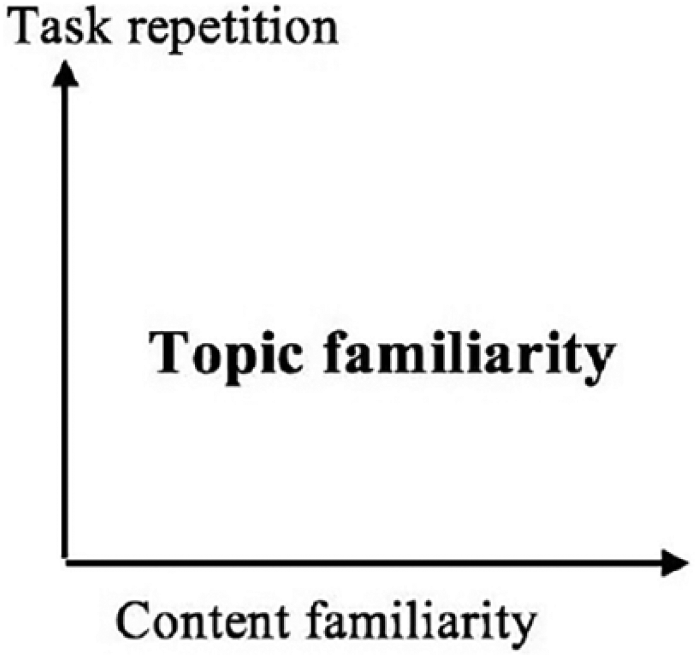
The construct of topic familiarity.
Task repetition released participants’ cognitive load for conceptualizing, and shifted their attention to grammatical encoding, based on the stimulated recalls. This accords with previous studies (e.g. Hawkes, 2012) that pointed out task repetition directs speakers’ attention to form, and helps explain why repeating the same task content enhances accuracy. Task repetition also increased structural complexity; participants reported they made efforts to improve the clarity of their speech by connecting relevant details and deleting redundant information.
Two explanations are proposed for the participants’ increased fluency during task repetition. The first is the automaticity function of repetition (Larsen-Freeman, 2012); the second is that participants may have prioritized oral fluency in their first performance, and avoided expressions and information that might have negatively affected it. Although six participants reported seeking more advanced lexical items during task repetition, their efforts were not significant enough to be reflected in the statistical analysis of G index. Two participants failed to find complex lexical items, which might indicate they intended to increase the variety of word types they used, but were hampered by their limited L2 linguistic resources. This study only focused on the effects of exact task repetition. Whether the findings can be extended to other kinds of task repetition remains uncertain and warrants future exploration.
3 Repeating unfamiliar topics as more effective practice
One surprising and important finding is that task repetition interacted with content familiarity in all CAF aspects, with medium to large effect sizes. Task repetition was more effective in raising CAF when implemented for unfamiliar topics. It is possible participants felt they had more room for improvement in their second performance for unfamiliar topics, since their first was relatively unsatisfying; however, the improvement may also suggest practice may have eased the cognitive load of participants’ speech production. When repeating familiar topics, participants raised their accuracy and fluency, but their lexical richness dropped slightly, and their structural complexity remained unchanged. The findings reveal that task repetition might exert different influences on L2 oral performance when implemented under familiar and unfamiliar conditions. However, this study only focused on EFL learners’ oral performance during exact task repetition on two types of tasks. Whether the findings can be extended to other kinds of task repetition and task types remains uncertain, and warrants future exploration.
VIII Conclusions and pedagogical implications
Based on the findings, content familiarity increased participants’ structural complexity and facilitated their conceptualization. Exact task repetition – repeating the same task with the same content to the same interlocutor – increased CAF, perhaps due to repetition’s positive role in conceptualizing, lexical choice, and grammatical encoding. Moreover, task repetition was more effective at improving CAF when implemented for unfamiliar task topics, than for familiar ones.
These findings provide empirical data to address the functions of monologic tasks with different design/implementation factors, and reveal the possible relationships among task design, speaking procedures, and L2 task performance. Selecting familiar task topics and employing exact task repetition can familiarize learners with message content; thus, the definition of topic familiarity can be extended (Figure 6). Besides the positive effects of task repetition and content familiarity on L2 oral production, the findings suggest that repeating unfamiliar topics might be more effective in facilitating speech production, raising CAF, and motivating L2 learners to engage in task performance (Qiu & Lo, 2018). If teachers intend to select unfamiliar topics for L2 learners, they might wish to consider whether repetition is necessary to release the conceptualizer’s cognitive load and direct learners’ attention to formulation. Future research on different kinds of task repetition, including diverse CAF measures, is needed before a definite conclusion can be reached.
This study has some limitations. First, although content familiarity was treated in a dichotomous fashion (i.e. participants either had prior knowledge, or did not) for the experiment, in reality, prior knowledge can be presented in a graded or continuous fashion, meaning one may hold partial knowledge about the task in question. Therefore, the dichotomous approach to content familiarity adopted in the research design may over-simplify the results. Second, this study only adopted two types of tasks (picture description and personal narratives); thus, whether the findings are generalizable to other task types is uncertain. Third, stimulated recall sessions after the first performance may have raised a reactivity issue (Leow & Morgan-Short, 2004), as participants might have divined the researcher’s assumptions and altered their second performance accordingly.
This study has revealed the positive influence of content familiarity and task repetition on EFL learners’ oral performance. It is hoped its findings can provide empirical data for researchers and language teaching practitioners, in terms of task design and implementation.
Supplemental Material
LTR-Supplementary_material – Supplemental material for Functions of oral monologic tasks: Effects of topic familiarity on L2 speaking performance
Supplemental material, LTR-Supplementary_material for Functions of oral monologic tasks: Effects of topic familiarity on L2 speaking performance by Xuyan Qiu in Language Teaching Research
Footnotes
Acknowledgements
This study is based on the author’s PhD research project. A presentation based on this study was given at AAAL 2016 in Orlando, USA. I would like to express my gratitude to my doctoral supervisor, Dr. Yuen Yi Lo, for her invaluable feedback and support during my doctoral candidature. Special thanks also go to the journal editors and the anonymous reviewers for their comments on earlier versions of this article.
Funding
The author(s) disclosed receipt of the following financial support for the research, authorship,and/or publication of this article: This study was supported in part by Faculty Research Fund 2014-15 from Faculty of Education, The University of Hong Kong.

Supplemental material
Supplemental material for this article is available online.
Author biography
References
Supplementary Material
Please find the following supplemental material available below.
For Open Access articles published under a Creative Commons License, all supplemental material carries the same license as the article it is associated with.
For non-Open Access articles published, all supplemental material carries a non-exclusive license, and permission requests for re-use of supplemental material or any part of supplemental material shall be sent directly to the copyright owner as specified in the copyright notice associated with the article.
