



Abstract
The study investigated the beliefs expressed by a sample of 206 Polish and Spanish teacher-trainees about the use of learners’ native language (L1) in teaching English as a foreign language (EFL). Quantitative and qualitative data from a questionnaire revealed considerable differences between the two nationality groups in their beliefs about both medium-oriented and framework-oriented functions of the L1 in an L2 classroom. Moreover, significant differences were found in the participants’ accounts of their prior EFL learning experience in terms of the L1–L2 proportion in teachers’ classroom language use. A possible interpretation of these findings relates trainees’ beliefs to the L2 educational cultures prevalent in different countries, pointing to a contextually-mediated complexity of teacher-trainees’ belief systems. The study adds to the existing research on the issues underlying L1 use in L2 teaching that are currently under debate by offering a cross-national comparison of teacher-trainees’ beliefs about the place of the L1 in L2 instruction.
I Introduction
Over the last two decades, the role of learners’ fist language (L1) in second language (L2) instruction has been revisited after years of being underappreciated in the communicative approaches which advocated L2-only teaching. The L1 is being discussed in numerous English language teaching (ELT) publications as a resource that performs important functions in the classroom (Butzkamm, 2003; Butzkamm & Caldwell, 2009; Gnutzmann, 2009; Turnbull & Daily-O’Cain, 2009). Although the amount and purposes of L1 use remains a controversial issue amongst teachers (see, for example, Hall & Cook, 2013), researchers in favor of incorporating L1 in L2 instruction (e.g., Gnutzmann, 2009; Hentschel, 2009; Littlewood, 2014; Rolin-Ianziti & Varshney, 2008; Sali, 2014) discuss its various functions connected with the teaching of L2 aspects such as grammar, vocabulary, and skills, as well as related to classroom management issues.
Teacher beliefs, which are part of a broader area of teacher cognition, have been investigated as a factor of influence in teachers’ preferences and decisions governing their classroom practices (Borg, 2006, 2009; Johnson, 2009). Investigating the belief systems of pre- and in-service teachers may provide an insight into a number of pertinent issues in the field of L2 education, and help improve teacher training programs. Teacher beliefs about L1 in the L2 classroom are a relatively recent, but a fast developing area of empirical investigation (e.g., Hall & Cook, 2013; Lasagabaster, 2013; Lee, 2016; Levine, 2003). However, teacher-trainees’ beliefs in this field are a particularly poorly represented strand of research, despite the claim made by researchers (e.g., Gao & Ma, 2011) that an exploration into prospective teachers’ cognition informs effective training which, in turn, influences trainees’ future practice as teachers. Since existing research points to the importance of contextual factors, including educational cultures and traditions, on pre- and in-service teachers’ beliefs (Borg, 2006, 2009; Crookes, 2015; Johnson, 2009, 2015), the present study aimed to compare the beliefs about L1 use held by English as a foreign language (EFL) teacher-trainees from two countries, Poland and Spain.
II Literature review
1 The place of learners’ L1 in the L2 classroom
The position of learners’ L1 in L2 education has been re-appreciated after decades of undermining its importance within the communicative approach which favored L2-exclusivity based on arguments derived from natural approaches (Krashen & Terrell, 1983) and studies on input, output and interaction (Long, 1996; Swain, 1985). Macaro (2009) and Littlewood (2014) outline possible arguments for L2-only teaching. One of them is that L1 use deprives learners of exposure to the L2, which is particularly detrimental if classroom language is the only source of input. Moreover, increased opportunities for interaction exclusively in the L2 can lead to faster and effortless L2 acquisition, while L1 use hinders negotiation of meaning and other L2-based communicative strategies. Another argument is that allowing the L1 in the classroom can easily lead to its overuse by both teachers and learners, which, as a consequence, can result in teaching about the L2 instead of practicing it through communicative use.
On the other hand, a number of arguments have been formulated by proponents of L1 inclusion in L2 teaching. Rolin-Ianziti and Varshney (2008) divide the main functions of the L1 into ‘medium-oriented’ (i.e. the L1 as the medium of teaching elements of the L2, such as grammar points, vocabulary, etc.), and ‘framework-oriented’ (i.e. the L1 for classroom management and organization issues, such as providing instructions, explaining homework, etc.). While addressing the former function, Hentschel (2009) stresses the effectiveness of the translation technique and L1 explanations in making the meaning of lexical and grammatical input clear, and Gnutzmann (2009) points out that syntactic crosslinguistic comparisons can promote learners’ language awareness and help learners avoid interference. Auerbach (2016) argues that, paradoxically, the L1 can help in developing L2 communication skills by serving as a scaffolding tool in learners’ attempts to express meaning. Performing the framework-oriented functions, the L1 helps teachers save time in lessons, making classroom management easier. It also attracts learners’ attention and hence is useful in maintaining classroom discipline (Auerbach, 2016; Sali, 2014). According to Littlewood (2014), L1 use can provide psychological reassurance to learners, increase their confidence, and enhance positive attitudes toward L2 learning. Finally, Sali (2014) notes that L1 use can help teachers make personal links with the learners and create a better classroom atmosphere.
Macaro, Graham and Woore (2016) see three basic positions in the current debate surrounding learners’ L1 in L2 teaching: the ‘virtual position’, which denotes L2 exclusivity, the ‘maximal position’, which accepts occasional L1 use within L2 exclusivity, and the ‘optimal position’, which encourages judicial use of the L1 as an important resource for L2 teaching. These positions are closely related to educational cultures in a given country or institution; for example, the L2-only approach is still recommended in different parts of the world, such as Hong Kong, Mainland China and South Korea (Littlewood, 2014; Littlewood & Yu, 2011). They are also linked to teachers’ belief systems.
2 Teacher-trainees’ beliefs about L1 in L2 teaching
Borg (2001) underscores the evaluative and emotive nature of beliefs, noting that beliefs influence people’s perceptions and opinions about phenomena, and also their behavior. L2 researchers’ interest in teacher beliefs is motivated by the fact that beliefs are conceived to have an impact on teachers’ pedagogical decisions, and knowledge about them informs the development of teacher education programs (Gao & Ma, 2011; Lee, 2016).
The beliefs held by pre-service teachers constitute an important strand of empirical research (Borg, 2006; Peacock, 2001). Among the sources of beliefs in both pre- and in-service teachers, the amount and kind of teaching experience, as well as teacher education, are frequently cited (Borg, 2006; Richards & Lockhart, 1996). Moreover, prior experience as language learners appears to be particularly influential, especially in the case of teacher-trainees, and has been found to affect trainees’ philosophies and practices. Lortie (1975) calls this factor an ‘apprenticeship of observation’ and notes that it leads to trainees’ intuitively imitating their school teachers’ behavior. Explaining this phenomenon, Borg (2004, p. 274) states that ‘student teachers arrive for training courses having spent thousands of hours as schoolchildren observing and evaluating professionals in action,’ which contributes to their cognitions as future teachers. On the other hand, Moodie (2016) reported that negative prior experience as learners informed teachers about what not to do in their own practice. Referring to Lortie’s (1975) term, Moodie called this phenomenon ‘an anti-apprenticeship of observation’. Borg (2006) links the effects of prior experience on trainees’ beliefs to the constructivist approach toward teacher education, according to which trainees’ cognition is shaped by both what they bring with them to the teaching situation and what they encounter in their practice. Discussing teachers’ beliefs from a sociocultural perspective, Johnson (2009, p. 17) states that they are ‘historically and culturally embedded in the communities of practice’ in which pre- and in-service teachers pursue their activity, and thus reflect their experience as L2 learners, trainees, and practitioners. Trainees’ social and cultural experience as learners and their pre-service teaching practice are set within a certain educational culture (i.e. the culture of learning and teaching) prevalent in their context. The influence exerted by educational culture on teachers’ cognition has been discussed in recent publications (e.g., Borg, 2006, 2009; Can, Bedir, & Kiliańska-Przybyło, 2011; Johnson, 2009, 2015).
In light of the re-appreciation of the role of learners’ L1 in L2 instruction, seeking an insight into teacher beliefs about this topic is a pertinent area of research. However, there have been few studies on the beliefs about L1 use held by non-native speaker teachers or teacher trainees who share their L1 with their learners. In one such study, Lee (2016) found that practicing teachers were more in favor of the L1 in L2 teaching than the trainees. This points to an impact of teaching experience, involving the knowledge of the realities of actual classroom teaching, on beliefs regarding L1 use, and is in line with Hall and Cook’s (2013, p. 24) conclusion that with practice, teachers become ‘more pragmatic and less dogmatic’ in their attitudes toward L1 use. Studies on trainees’ beliefs reveal, however, varying levels of L1 appreciation, which can reflect contextual, cultural and individual factors. A mixture of opinions on specific uses of the L1 emerged from a study by Higareda, López and Mugford (2009), which examined the beliefs and practices of Mexican trainees in an EFL program. A clear majority of the participants believed that the use of their L1 (Spanish) in an EFL classroom was justified, and admitted to actually using it in their own teaching. Interestingly, while they saw a place for the L1 in teaching grammar and vocabulary, over 90% denied its usefulness for giving instructions and classroom management. Othman and Kiely’s (2016) study indicated a tension between Malay trainees’ stated beliefs and their practice. Although they believed that the L1 should be avoided, over 90% acknowledged using it with the aim of making learners understand explanations and instructions. In Tetiurka’s (2016) study involving Polish EFL teacher-trainees, high levels of L1 appreciation were revealed, especially in teaching grammar and vocabulary, disciplining students, and providing complex explanations. The L2 was considered appropriate mostly for giving simple instructions and conveying classroom routines. Among Agudo’s (2017) participants (Spanish EFL trainees), a recognition of the benefits of L2-mostly instruction prevailed, as a definite majority of the trainees agreed that L2-only teaching facilitates learning and that teachers should only use the L2 in class. Simultaneously, L1 use was considered beneficial for explaining grammar, difficult vocabulary, and giving complex instructions.
The examples from research show both a complexity of EFL teacher-trainees’ cognitions, expressed as their doubts and mixed feelings about the role of their L1 in L2 teaching, and an impact of various factors, including contextual and cultural ones, such as recommendations and traditions in L2 teaching in a given country, on trainees’ perceptions about teaching. As argued by Crookes (2015), teachers’ views on instructional procedures are influenced not only by Second Language Acquisition (SLA) theories, but also by social, cultural, moral, and geopolitical issues. Therefore, investigations comparing the beliefs of EFL trainees in different countries seem to be justified and necessary for an effective exploration of the complexity of teacher cognition (Kissau, Rodgers, & Haudeck, 2014). As mentioned earlier, research on teacher trainees’ beliefs on L1 use is generally scarce, and, to the best of our knowledge, no studies have been conducted to explore similarities and differences between the beliefs about L1 use held by EFL trainees from different countries. The present study thus aims to contribute by offering a comparative analysis of the views of Polish and Spanish EFL teacher-trainees on their respective L1 in ELT. The selection of the nationalities was motivated by the apparent differences between L2 educational contexts and policies in the two countries.
3 Context: L2 teacher training in Poland and in Spain
In line with the requirements of the Bologna Declaration, official university programs in both countries are structured in three cycles:
full-time Bachelor degrees in general education and training in professional activities (in Poland: 3–4 years, 180–240 ECTS; in Spain: 4 years, 240 ECTS);
full time Master degrees aimed at providing academic or professional specialization, grounding in research, or multidisciplinary training (in Poland: 1.5–2 years, 90–120 ECTS; in Spain: 1-year, 60–120 ECTS);
PhD degrees which provide students with advanced research knowledge (OECD, 2017; Santiago, Brunner, Hau, Malo, & Pietrogiacomo, 2009).
In Poland, obtaining foreign language teaching qualifications obligatorily involves a minimum of 270 hours of training in educational psychology, pedagogy, and L2 didactics, as well as 120 hours of EFL teaching practice at the BA level. Completion of a Bachelor program gives the necessary qualifications to teach at kindergarten and primary school. Additionally, students can obtain 150 hours of university training and 150 hours of teaching practice throughout the MA level, which entitles graduates to teach in all types of schools (Ministerstwo Edukacji Narodowej, 2012a).
Spanish students wishing to teach EFL or specific subjects such as science or music using English as a medium of communication at primary schools must study a degree in Primary Education with an emphasis on L2 (English) didactics in their BA 3rd and 4th years, and a 150-hour school placement for ELT trainees in the final year. The qualifications to teach in secondary schools are obtained through getting a Master’s degree in Secondary Teacher Training, which involves 140 hours of teaching practice (Ley Orgánica de Educación, 2/2006, art. 94; Orden ECI/3858/2007).
National policies regulating various specific issues in L2 education are a factor potentially influencing teacher training and teacher beliefs. The Polish national curriculum advocates that the L2 should be used ‘not only as the content of instruction, but also as a means of classroom interaction’, while the place of the L1 in L2 teaching is not further specified (Ministerstwo Edukacji Narodowej, 2012b). The Spanish national curriculum for primary (Real Decreto 126/2014, art.13) and secondary education (Real Decreto 1105/2014, art. 34) recommends that lessons should be conducted in the L2, and makes a reservation that ‘Spanish or a co-official language should only be used as a supportive tool when teaching a foreign language’.
Moreover, it can be assumed that the linguistic contexts in both countries can contribute to their prevailing L2 educational cultures, and have an impact on teachers’ and teacher-trainees’ perceptions about the role of learners’ L1 in L2 teaching. While Poland is a largely monolingual country, the linguistic situation in Spain is much more complex. As explained by Ruiz de Zarobe and Lasagabaster (2010), the linguistic diversity has given rise to an extensive implementation of the Content and Language Integrated Learning (CLIL) approach in Spain since the early 21st century. CLIL education is regulated by educational legislation, and has been extended to foreign languages in most mainstream schools at all levels. On the other hand, although bilingual and CLIL education is also growing in popularity in Poland, its scope cannot be compared to that in Spain.
In order to address the potential impact of contextual factors on teacher cognition, the aim of this study was to compare Polish and Spanish teacher-trainees’ beliefs about the use of their L1 in ELT, with a special focus on the use of L1 for instruction and management purposes. The following research questions were formulated:
What differences are there in the beliefs about the role of learners’ L1 in teaching English held by Polish and Spanish EFL teacher-trainees?
Are there differences in the beliefs expressed by the participants in different years of the teacher training program?
What was the participants’ prior experience as L2 learners in terms of how much L1 was used by their teachers?
Is there a relationship between the participants’ prior experience and current beliefs?
III Methods
This study implemented an embedded mixed-methods design as data were collected using quantitative and qualitative measures simultaneously. 1 Participants and sampling procedures
Following purposive sampling, this study analyzed the responses of EFL teacher-trainees from three universities, two Polish and one Spanish. These were the institutions the researchers were employed at, and some of the participants were their students.
Because it was important to consider the Polish institutions as a single dataset, a t-test was used to compare their results, showing no statistically significant differences in terms of the opinions gathered in this study. Participants from the two Polish institutions were thus treated as a single subsample in the analyses. Altogether, 206 participants (females: 85.4%; n = 176; males: 14.6%; n = 30) made up the sample (Table 1). The mean age was 22.2 (SD = 3.1), the mode age was 20, and the minimum and maximum age were 19 and 43 respectively. All participants were non-native speakers of English and their L1 was either Polish or Spanish. It should be noted that while there are four official languages in Spain, Spanish is the L1 that was the subject of study in this research.
Descriptive statistics of the sample per year of study and gender (n = 206).
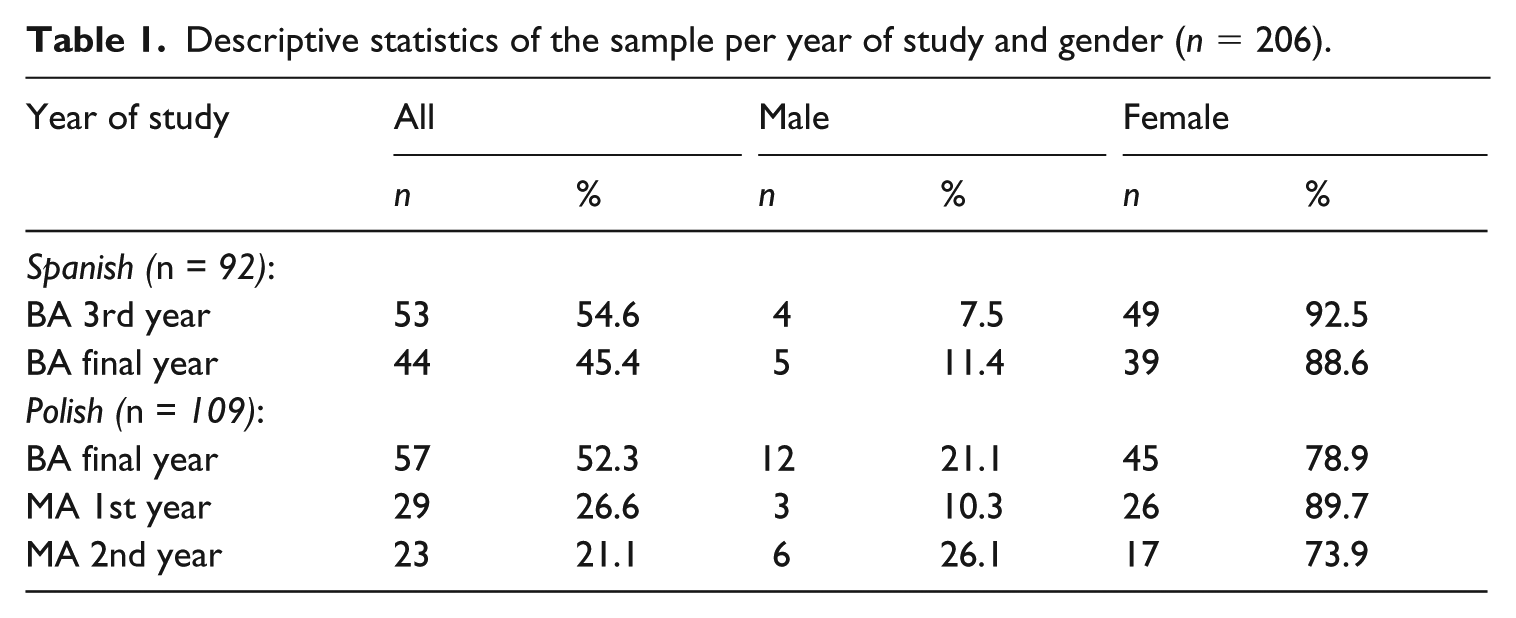
Given the differences in the educational systems – Spanish undergraduate students have to complete four years whereas Polish students only three – and in order to avoid confusion, in this study ‘3rd year’ refers to Spanish students only, while ‘final year’ comprises both Polish (3rd year) and Spanish (4th year) students because it is their last year of studies.
In line with the L2 teacher education standards in the two countries, the Polish final year BA students had completed a 30-hour EFL didactics course and 30 hours of general pedagogical practice at primary school, and had just started their ELT school practice, involving both classroom observations and teaching. The MA students were continuing their didactics courses and teaching practice at secondary school, having completed at least the required 120 hours of ELT practicum at the BA level. Within the Spanish sample, the BA 3rd year participants had just started the EFL didactics course and the final year students were continuing it. Although none of the Spanish groups had participated in any teaching practice devoted specifically to English yet, they had had considerable general pedagogical school placement experience (3rd year: 100 hours, and the final year: 300 hours). L2 teacher training programs at the three institutions from which the participants were recruited are conducted in English and are based on communication-oriented principles in L2 teaching.
2 Data collection instrument
Data were collected via a questionnaire made up of three parts. The first part elicited information about the participants. In the second part, participants completed an ad hoc Likert scale made up of 35 items which measured the extent to which they agreed on aspects connected with the place of L1 in ELT. The scale ranged from 1 ‘Strongly disagree’ to 5 ‘Strongly agree’. The third part consisted of three open-ended items, only one of which will be analyzed here. This question pertained to their previous experience, whether at school or in private language schools, in relation to the amount of the L1 used.
3 Data analysis
Participants’ responses on the Likert scale were analyzed with IBM SPSS v.21. Significance level (p) was .05 for all statistical analyses. First, descriptive statistics were calculated. Then, principal component analysis with Varimax rotation was run in order to identify how scale items would group together, reduce the number of items, and thus fine-tune the instrument. Internal consistency of the resulting factors (see the Procedure section) was calculated with Cronbach’s Alpha. Normality of the sample’s responses to the two factors identified was tested with the Kolmogorov–Smirnov test, revealing that the data were normally distributed, thus independent samples t-test, one-way ANOVA and Tukey’s HSD post hoc test could be used for comparing means.
Qualitative data obtained through the open-ended question selected for this article were analyzed using Atlas.ti. After skimming participants’ responses independently, the researchers agreed to code data using five categories (levels) reflecting the presence of L1 and/or L2 in participants’ previous experience learning L2 English in the following manner: (1) L1 only or mostly; (2) L1 dominance; (3) Mixture of L1 and L2; (4) L2 dominance; and (5) L2 only or mostly. Cohen’s κ was run to measure agreement between the two coders, showing a substantial agreement (following Landis & Koch, 1977, p. 165) or an excellent agreement (according to Fleiss, 1981) between the two authors’ judgments (κ = .764 (95% CI, .696 to .833), p < .000). Discrepancies were then discussed until a 100% agreement was reached and three cases were excluded due to irrelevance. Once data were coded and categorized, a recoding of qualitative responses into quantifiable data was carried out (following suggestions by Friedman, 2012). This enabled frequencies of occurrence of the qualitative categories to be described, thus comparing open-ended question data with the Likert scale to check for congruence or discrepancy in results.
4 Procedure
a Instrument development procedure
The questionnaire items were developed by the researchers on the basis of an extensive review of the literature and were inspired by the instruments used in previous studies (Levine, 2003; Rolin-Ianziti & Varshney, 2008). The initial draft with 35 items was piloted on a group of 15 students at one of the Polish universities and the potentially misleading items were removed from it while some items required rewording.
In order to ensure that the Likert scale developed in this study had adequate psychometric properties and indeed measured participants’ beliefs about the use of their L1 in the EFL class, reliability (Cronbach’s Alpha) and construct validity (factor analysis) were calculated. Reliability of the questionnaire was .720 with the full sample (n = 206), while α = .630 with only the Polish sample (n = 109), and α = .783 with only the Spanish sample (n = 97). In addition, principal component analysis with Varimax rotation was performed in order to identify the unidimensionality of items and fine-tune the instrument. As items with loadings below .250 were discarded, the final solution showed one factor (referred to as Factor 1 in subsequent analyses) which comprised 11 items on L1 for classroom management and affective aspects, and another factor (Factor 2) with 11 items on L1 for teaching L2 grammar, vocabulary, and skills development, so the final version of the scale had 22 items. The reliability of these two factors was α = .811 (Factor 1) and α = .803 (Factor 2).
b Data collection procedure
After obtaining permission from the education authorities and the lecturers in charge of the target groups, as well as oral consent from the participants, the researchers collected data from the teacher-trainees present in class at given scheduled teaching hours. The instrument was administered during week 5 of the winter term in the academic year 2016–17. Administration time was approximately 20 minutes. Instructions on the aim of the study were explained before collecting data so as to inform participants and ensure confidentiality of responses.
IV Results
1 Polish and Spanish trainees’ beliefs about the L1 in ELT
An independent samples t-test was used to identify differences between mean scores of the two Factors of Polish and Spanish participants, revealing statistically significant differences and moderate effect sizes between these groups in Factor 1 (t(204) = −4.34, p = .000; r = .24) and in Factor 2 (t(204) = −6.99, p = .000; r = .48). Polish participants held more positive beliefs towards the use of the L1 for classroom management and affective aspects (M = 3.2, SD = .5), as well as for teaching L2 components (M = 3.6, SD = .5) than Spanish participants (M = 2.9, SD = .7; M = 3.0, SD = .6, respectively).
In order to gain a deeper view of the data and allow comparisons, Tables 2 and 3 present selected items from both Factors and illustrate the considerable differences between the two nationalities in the frequencies of answers provided. As can be seen in Table 2, while similar percentages (about 37%) of Polish and Spanish participants agreed that organizational matters can be explained in the L1, significantly more Polish (58.7%) than Spanish (28.9%) participants supported the usefulness of the L1 in giving instructions to activities. More Polish than Spanish trainees saw a connection between a teacher’s use of the L1 and their approachability, and a justification for using the L1 for keeping classroom discipline. Negative perceptions about the relationship between classroom atmosphere and a teacher’s L1 use prevailed in both groups, while both groups agreed (with about 68% positive answers in each) that the L1 contributes to lower anxiety levels in learners.
Frequencies of answers and descriptive statistics of selected items from Factor 1 (management and affective functions).
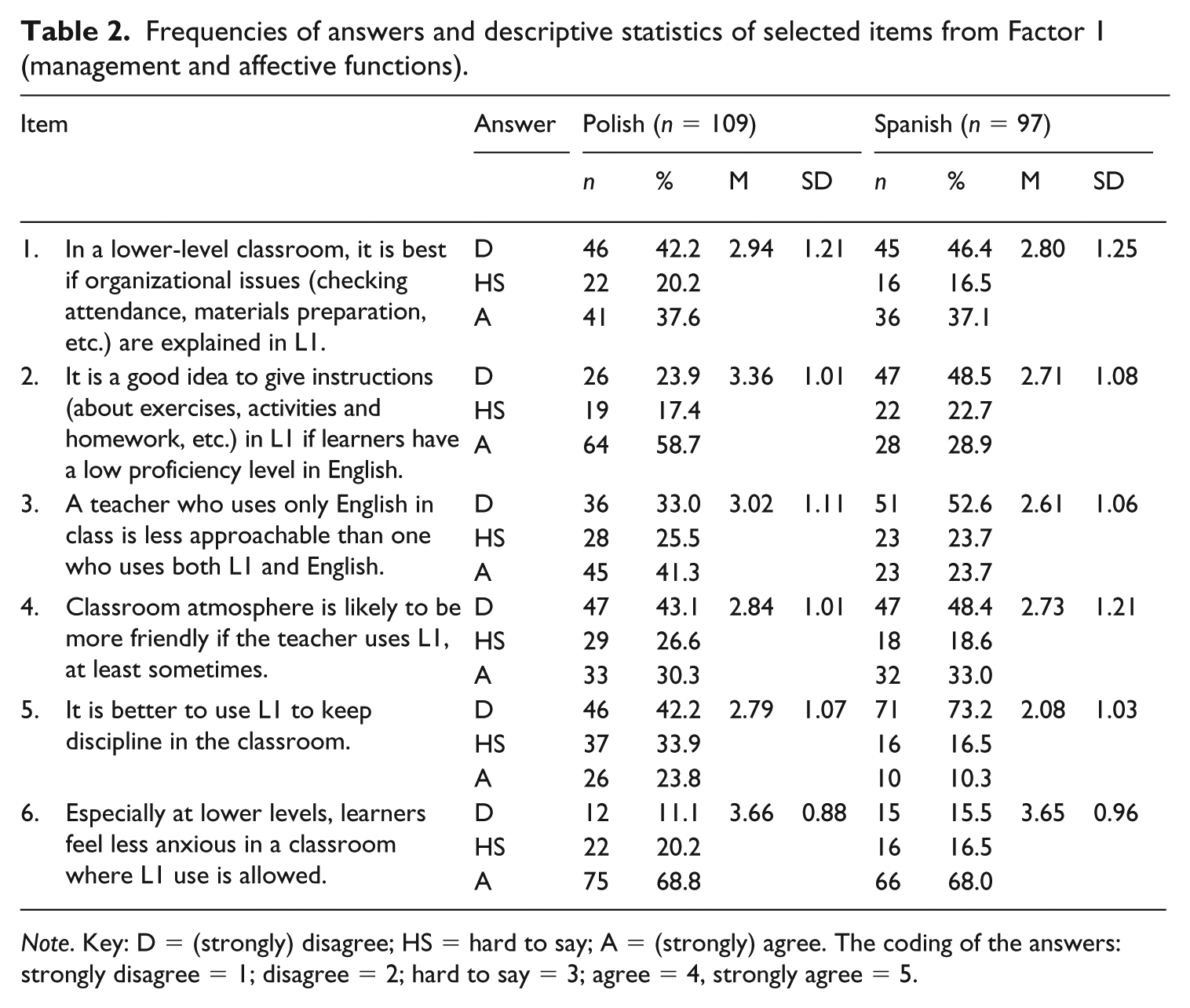
Note. Key: D = (strongly) disagree; HS = hard to say; A = (strongly) agree. The coding of the answers: strongly disagree = 1; disagree = 2; hard to say = 3; agree = 4, strongly agree = 5.
Frequencies of answers and descriptive statistics for selected items from Factor 2 (teaching particular aspects of the L2).
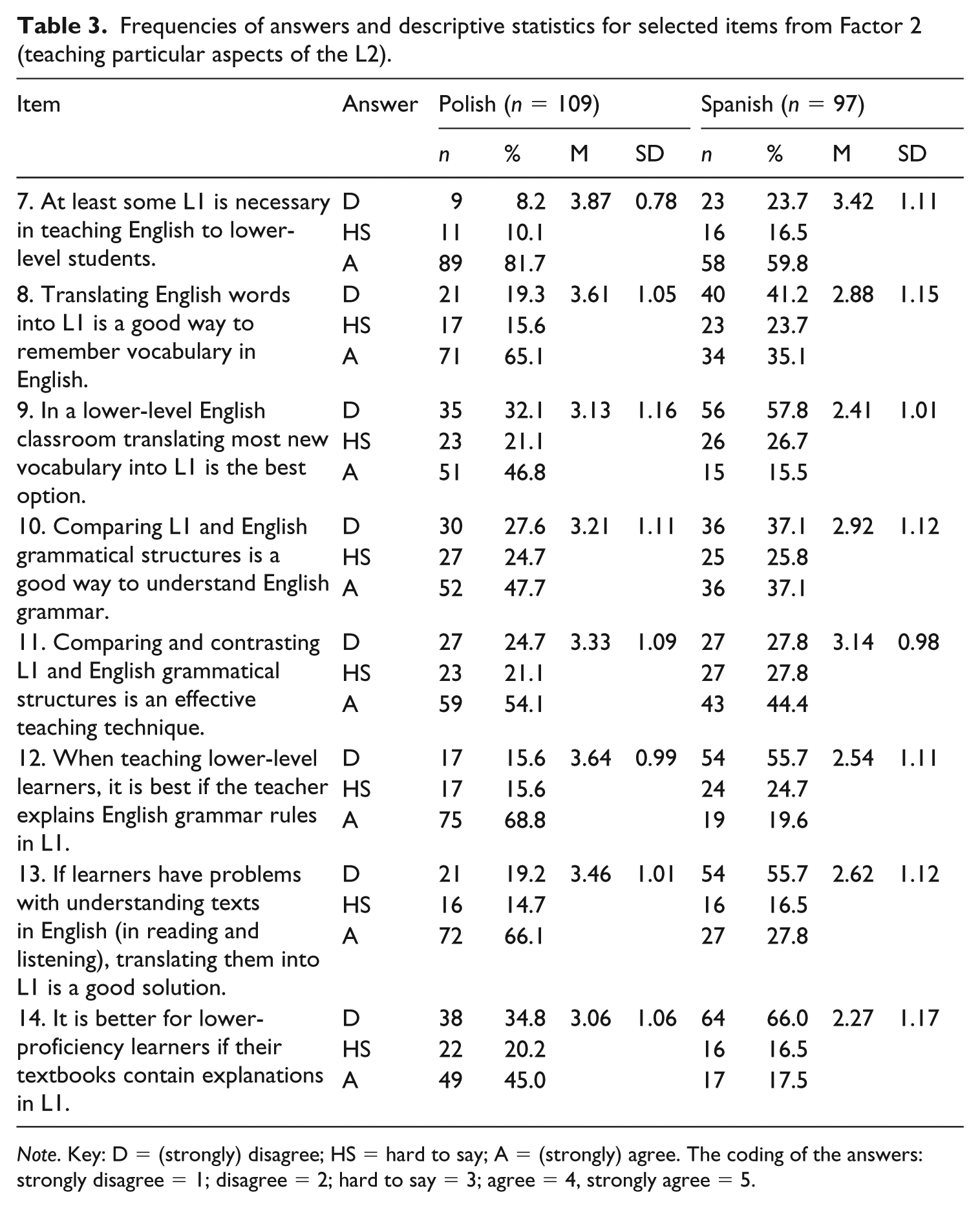
Note. Key: D = (strongly) disagree; HS = hard to say; A = (strongly) agree. The coding of the answers: strongly disagree = 1; disagree = 2; hard to say = 3; agree = 4, strongly agree = 5.
As for participants’ beliefs about using the L1 to teach particular L2 areas, responses differed between nationalities even more considerably (Table 3). Although an opinion supporting the necessity of using the L1 in teaching lower-proficiency learners prevailed in both groups, the percentage of positive answers was significantly greater in the Polish subsample (81.7% versus 59.8% in the Spanish group). The same tendency was evident in the frequencies of answers given to the remaining items as well. There were notable differences in items related to the L1 in teaching L2 grammar, particularly in the provision of rules (item 12). A majority of the Spanish participants (55.7%) disagreed that grammar rules should be provided in the L1, with 19.6% agreeing with this statement. The distribution of answers was the opposite in the Polish group. A similar trend can be observed in relation to learning and teaching vocabulary, with 46.8% Polish and 15.5% Spanish trainees believing that lexical translation is the best option, to translation as a technique supporting text comprehension, and to the benefits of L1 explanations in coursebooks. It is also worth stressing that in both Factors standard deviation values were at similar levels for particular items in both groups, indicating comparable levels of uniformity across the subsamples.
2 Differences between participants’ beliefs in different years of study
The beliefs of participants in different years of study were compared by means of an analysis of variance (one-way ANOVA) with post-hoc (Tukey’s HSD, p < .05) in the case of the Polish group, and an independent groups t-tests in the case of the Spanish group. The former showed no statistically significant differences between any of the three years of study in the Polish sample in Factor 1 (F = .210, df = 2/108, p = .811) and Factor 2 (F = 1.365, df = 2/108, p = .260). However, the t-test revealed that Spanish 3rd year students (Factor 1: M = 3.014, SD = .6883; Factor 2: M = 3.206, SD = .6153) differed from final year students (Factor 1: M = 2.713, SD = .6131; Factor 2: M = 2.812, SD = .5281) in Factor 1 (t(95) = 2.251, p = .027) and in Factor 2 (t(95) = 3.344, p = .001), with final year students expressing less favorable beliefs about L1 use.
3 Participants’ prior learning experiences of the use of L1 in the EFL classroom
Participants’ prior learning experiences with the L1 and L2 in the classroom were gathered via an open-ended question, which was analyzed qualitatively and the categories then quantified. The most notable inter-group differences concerned the extent to which the L1 and the L2 were reportedly used in class, particularly in Levels 1 and 3 (Table 4). Answers fitting Level 1 (L1 only or mostly) prevailed in the Spanish group (40.6%, versus 21.5% in the Polish group), while the Polish participants most frequently (35.5% of responses) admitted to have experienced a balanced L1–L2 mixture (Level 3) in their EFL lessons at school.
Frequencies and percentages of opinions about previous experience learning EFL (n = 203).
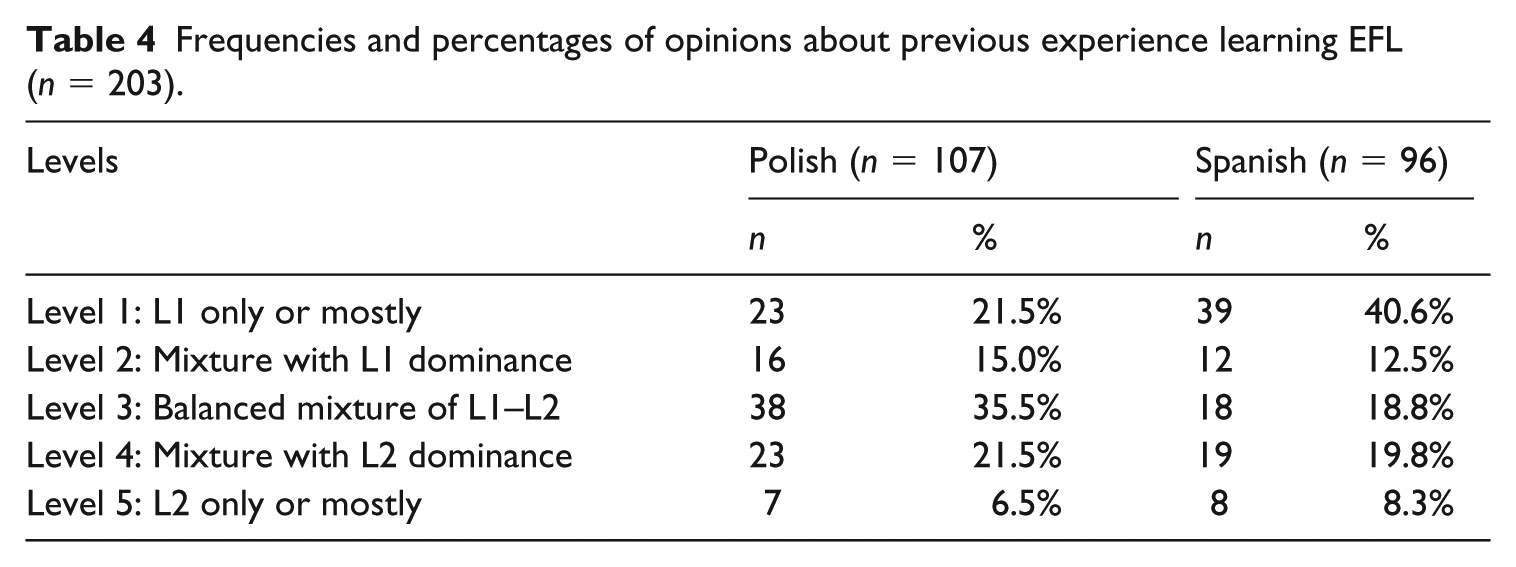
The qualitative responses provided by the participants give an insight into their experience as learners. The answers which denoted Level 1 often conveyed disappointment and frustration about L1-based L2 learning. A Polish participant wrote, ‘L1 was used most of the time, to explain tasks, to keep discipline, to translate new vocabulary. In my opinion it was a waste of time’ (ID 2081, Polish). Moreover, such responses often indicated teachers’ focus on teaching about the L2 instead of promoting learners’ skills, as aptly illustrated by this quote: I have been learning English my whole life from the age of three, and now that I am 21 I wonder how it is possible that my level it’s not better after spending so many years studying English. The reason is simple and specific: I have only studied grammar and vocabulary as isolated phenomena and independent from each other; in addition, my teachers always spoke Spanish. (ID 1082, Spanish)
There were many comments about extensive L1 use hindering L2 development, e.g., ‘We could do a grammar exercise perfectly well, but we could not hold a conversation’ (ID 1061, Spanish). Some Spanish trainees noted that even speaking activities were conducted in the L1. They also frequently stated that English was used only in situations when textbook exercises were read out.
Teaching grammar and, to a lesser extent, vocabulary, were the most frequently mentioned reasons for L1 use in the responses which indicated L1–L2 mixture in the classroom. The following quotations, which are quite representative in this respect, were both ranked as Level 4 because the reported L1 use was occasional: ‘My teachers tried to use as much English as possible, especially in speaking to us. But when it came to vocabulary and grammar, they used Polish’ (ID 2049, Polish); ‘In my school in Madrid our teacher would explain grammar questions in Spanish but the rest of the class was conducted in English and because of this I learned English and I understand it’ (ID 1026, Spanish). Some comments highlighted L1 use as an additional support in the case of a lack of understanding. Other functions of the L1, connected with management, also appeared. One participant wrote, ‘In high school I attended a “bilingual” program; my teacher only used English, except when keeping discipline (when scolding someone)’ (ID 1019, Spanish). Some of the participants explained that L1 use was motivated by learners’ low proficiency in English, causing tensions in mixed-level classes, and generally decreasing at higher levels of education. Moreover, the teachers’ proficiency level was also mentioned by some Spanish trainees. One of them wrote, ‘My English teacher used to always speak Spanish. I suppose it was because of her low level of English. We never had conversations in English, listening, etc. The aim was to complete the workbook’ (ID 1050, Spanish).
Those who admitted having participated in L2-mainly or L2-only instruction (Levels 4 and 5) generally expressed highly positive opinions about it, stressing that it promoted the development of their communicative skills. An interesting account of L2-only experience is illustrated by the following quote: The first year I understood nothing, … and the teacher only used English. However, during the second year I could understand her if by magic. Half way through the year, the whole group experienced a dramatic improvement … By the end of that year the whole class was able to communicate in English perfectly well. (ID 1021, Spanish)
Comments underscoring a relationship between L2 use and effective learning were frequent, and the participants often attributed their high levels of L2 attainment to consistent use of the L2 by the teacher, which also set a good example for the learners. At the same time, however, a few Polish participants suggested that some Polish was or would have been advantageous, especially in teaching complicated grammar. One of them wrote, ‘Lessons were conducted in English. Grammar was taught in English and I came to the conclusion that it’s better to use more L1, especially for teaching grammar’ (ID 3020, Polish), and another commented, ‘My teacher used too much English’ (ID 2089, Polish). Such comments were not made by the Spanish participants.
V Discussion
Addressing the first research question, the results showed considerable differences between the beliefs expressed by the Polish and Spanish EFL teacher-trainees about the usefulness of learners’ L1 in teaching L2 English. While both groups agreed that it is necessary to use the L1 in lower-proficiency classrooms, the Spanish participants provided more negative than positive answers about many crucial issues concerning the usefulness of the L1, such as a justification of the translation technique in teaching vocabulary, of grammatical explanations being conveyed in the L1, of translating texts for comprehension, of coursebooks containing explanations in the L1, etc. The views expressed by the Polish group showed a reversed pattern for a clear majority of items, in which positive answers outnumbered negative ones. The general trend reflected in the quantitative analyses was that Polish participants’ responses indicated a higher appreciation of the role of the L1 in the EFL classroom than the Spanish group’s responses. This concerned both management and affective roles of the L1, and its functions in teaching particular aspects of the L2. A picture emerging from these analyses is that while the Spanish trainees’ views on the L1 in L2 teaching were balanced with a negative inclination, the Polish groups’ opinions seemed to be balanced with a positive inclination. In other words, the Spanish participants did not condemn or reject the L1 as a resource in L2 teaching, but at the same time did not appreciate it as an important or necessary element in helping learners develop L2 competence, thus reflecting the ‘maximal position’ in Macaro et al.’s (2016) terms. On the other hand, Polish trainees seemed to recognize a role for the L1 in performing management, affective, and didactic functions in an L2 classroom, reflecting the ‘optimal position.’ It should be stressed that the findings revealed a diversity and complexity of trainees’ beliefs and are in this respect congruent with most research on teacher cognition (e.g., Borg, 2003, 2006) and with previous research on EFL trainees’ beliefs about the L1 in L2 teaching (e.g., Higareda, López, & Mugford, 2009). The trends and inclinations traced in this study are generally in line with the other studies set in the Polish (Tetiurka, 2016) and Spanish (Agudo, 2017) contexts, although the Spanish trainees’ preference for L2-mainly instruction was even stronger here than in Agudo’s study. Such convergences indicate an interplay of factors, such as individual variation, training at university, and educational cultures at institutional levels, as affecting teacher-trainees’ beliefs (also discussed in Borg, 2006; Johnson, 2009, 2015).
Turning to the second research question, the stage of teacher training appeared not to be a factor influencing the participants’ beliefs about L1 use in the Polish subsample, despite MA level students’ longer participation in training courses and greater teaching practice experience. In the Spanish subsample, however, final year students’ beliefs about the L1 were less favorable than was the case among the 3rd year students. Although there may be various reasons for this, it can be hypothesized that the volume of general pedagogical school experience, as well as the pedagogical training they had obtained at the university, played a role here. None of the Spanish groups had participated in ELT practicum, but they may have experienced CLIL instruction, both through observation and teaching, in their general school placement, and the final year students had had considerably more training and practicum experience than those in the lower year. Consequently, with the popularity of the CLIL approach in Spain, the Spanish trainees may have been more convinced of the benefits of conducting lessons exclusively in the L2 to a larger extent than their Polish counterparts. It is possible that they had observed positive examples of L2-mainly or L2-only lessons in their school placement practice, or perhaps their sensitivity to the benefits of L2-only instruction could have been raised through discussing CLIL with their mentor teachers and in their training sessions at the university. CLIL is usually associated with L2-medium instruction, although it can be implemented with different intensity of the L1 involved (Lasagabaster, 2013). At the same time, it is likely that the Polish trainees’ beliefs were largely congruent with the L1/L2 ratio that they had observed in their practicum. As they had been participating in EFL didactics courses, their training at the university might also have been a factor influencing their rather positive beliefs about the L1.
Concerning the third research question, related to the participants’ accounts of the amount of the L1 in their prior experience as L2 learners, more than half of the Spanish participants admitted that their English instruction was conveyed through the medium of the L1 or through L1–L2 mixture with L1 dominance, and about one-fifth of the Spanish group wrote that they had been taught English through L2 exclusivity or dominance. According to the responses provided by the Polish participants, fewer of them experienced L1-based teaching of English; however, the responses showed that the L1 had been present, sometimes to a considerable extent, in their prior learning. Like the Spanish group, few Polish respondents acknowledged having been taught in an English-only classroom. These data suggest that, to various degrees, the L1 is present in EFL classrooms in Poland and in Spain, and that L2 exclusivity is rather rare. Although the responses pointed to differences between the two nationality groups, it cannot be assumed that the amount of the L1 is a differentiating factor between EFL classrooms in the two countries. For example, according to the European Commission/EACEA/Eurydice (2012) report, target language use in L2 classrooms is at comparable levels in Poland and Spain, with Spain reporting slightly higher L2 use by both teachers and learners. Therefore, what is apparently revealed in the present study is the participants’ perceptions about L1 use in their prior learning rather than an objective state. Moreover, numerous functions of the L1 were listed by the participants, of which providing support in L2 grammar and vocabulary instruction was the most frequently mentioned. These findings corroborate the results of other studies (e.g., Hall & Cook, 2013; Sali, 2014) which investigated the presence and roles of the L1 in L2 teaching in various countries and educational contexts.
With regard to the fourth research question, the data elicited appear to indicate certain relationships between the participants’ declared prior experience as L2 learners and their current beliefs as teacher-trainees. These relationships, however, differed regarding the two participant groups. The Polish trainees’ prior experience was dominated by a ‘balanced’ L1–L2 use, and was mirrored in their stated beliefs about the L1–L2 proportion. On the other hand, the beliefs reported by the Spanish participants clearly illustrated the anti-apprenticeship of observation phenomenon discussed by Moodie (2016). It can be inferred from their accounts that the way English was taught was not considered to be satisfactory by many of the respondents, and most of them blamed over extensive L1 use for their insufficient L2 development. It is therefore likely that the negative perceptions about the L1 in L2 teaching had been influenced by their prior learning experience. This was further illustrated by the comments about not necessarily positive effects of L2-only instruction made by the Polish participants, which were absent in the Spanish group. The Spanish participants’ perceptions seemed to equate too much L1 with failure, and L2 exclusivity with success in L2 learning.
VI Conclusions, limitations and implications
The study is a contribution to the ongoing discussion about teacher-trainees’ beliefs on the use of the L1 in L2 instruction. It offers a cross-country comparative investigation. The results show considerable differences between the beliefs held by Polish and Spanish participants, with much more favorable attitudes toward the various functions of the L1 expressed by the Polish group, and a preference for L2-only instruction among the Spanish group. These significant differences can be interpreted as revealing the role of contextual factors, such as a culture of L2 learning and teaching, evidenced in teacher training and L2 learning, in influencing prospective teachers’ cognitions. Prior experience of learning English, reflecting the educational culture in a given country, appeared to be a factor strongly connected with the participants’ stated beliefs. In the Polish subsample, the beliefs seemed to reflect what the participants experienced as learners, that is, a balanced L1–L2 proportion in the classroom, while the Spanish participants’ beliefs stood in opposition to their prior experience: the negative perceptions of L1-dominated teaching could have led them to renounce the roles of the L1 in the L2 classroom.
The study has some limitations, one of which concerns the non-random sampling, which does not allow generalization of the results. Moreover, the number of the participants, and of the institutions from which they were recruited, was limited. It would be recommendable for future research to involve trainees from a larger selection of universities in each of the countries compared. A further limitation results from the subjective character of coding qualitative data. Despite the researchers’ attempts to enhance the reliability of qualitative analyses by establishing interrater agreement, the coding process may not have avoided a subjective bias.
Despite these limitations, this study shows that teacher-trainees’ beliefs about L1 use depend, to a large extent, on contextual factors and reflect the educational cultures within which they are formed. Thus, it can be argued that these factors need to inform teacher education when discussing relevant issues, such as L1 use, in order to raise future teachers’ awareness on how to optimize the selection of instructional procedures. Neither teaching nor learning occurs in a vacuum; therefore, trainees need to be prepared to make informed choices of teaching options while taking into account the specificity of their educational contexts.
