



Abstract
Building up on Munro and Derwing, the current study set out to re-examine and generalize the Functional Load (FL) principle (Brown, 1988) as a tool to identify a set of relatively crucial segmental features for successful understanding in L2 communication. In Experiment 1, 40 Japanese learners of English in English-as-Foreign-Language settings engaged in a semi-structured task (i.e. timed picture description). Their speech was assessed by native speaking raters for overall comprehensibility (ease of understanding); and then coded for the number of high vs. low FL segmental substitution errors according to the FL principle. The results showed that it was only high FL consonant substitutions (e.g. mispronunciation of /l/ as /r/ or /v/ as /b/) that negatively impacted on native listeners’ comprehensibility judgments. In Experiment 2, 40 Japanese learners of English with a wide range of immersion experience in English-speaking countries participated. The results replicated the significant impact of high FL consonant substitutions as observed in Experiment 1. Taken together, this study suggests that the FL principle may greatly help teachers and students prioritize communicatively important segmental features, a crucial step towards improving L2 oral proficiency in an effective and efficient way.
I Introduction
With an emphasis on learners’ communicative success in a second language (L2) as the ultimate goal of acquisition (Derwing & Munro, 2005; Field, 2005; Levis, 2005), scholars have extensively worked on identifying dimensions of speech directly relevant to listeners’ understanding of accented speech (Kang, 2010; Kang, Rubin, & Pickering, 2010; Munro & Derwing, 2001; Saito, Trofimovich & Isaacs, 2017; Trofimovich & Isaacs, 2012). While evidence from such research has advanced our understanding of two interrelated yet different constructs of speech (comprehensibility and accentedness), a growing amount of attention has been given to investigating which pronunciation features are relatively important for attaining successful comprehensibility regardless of accentedness (Levis, 2005). The relative importance of various prosodic features (e.g. word stress, sentence stress, intonation, rhythm) has been examined; however, segmentals are often treated as a single measurement (Isaacs & Trofimovich, 2012). Furthermore, all the relevant findings emerge from one single task condition (i.e. picture description task): a methodological problem that may prevent researchers from investigating potential task effects on learners’ segmental productions and narrowing down the list of essential segmentals to be taught. In what follows, we will first highlight Munro and Derwing’s (2006) study, wherein the researchers took a very first step towards examining which segmental substitutions impaired comprehensibility via the Functional Load (FL) principle (Brown, 1988). Next, we will report general findings based on an empirical study which examined the role of high and low FL segmental errors in native listeners’ comprehensibility of Japanese speakers of English under two experimental conditions (different task type, different sample type).
II Background
1 Second language comprehensibility
Despite English as a Second Language (ESL) learners’ desire to speak like native speakers (Derwing, 2003; Foote, Holtby, & Derwing, 2012; Kang, 2010; Scales, Wennerstrom, Richard, & Wu, 2006; Timmis, 2002), second language acquisition (SLA) researchers have reported that hardly any L2 learners ever accomplish native-like control over the phonological dimensions of speech due to having retained foreign accents (Abrahamsson & Hyltenstam, 2009; Flege, Munro, & MacKay, 1995; Ortega, 2009; Saito, 2015). Moreover, researchers have found that foreign-accented speech can be highly intelligible (Murphy, 2014). In the language teaching context, English as a Second Language/English as a Foreign Language teachers have realized that native-like phonological control is not an essential goal for L2 learners as long as learners continue to progress towards relevant levels of intelligibility (Kanellow, 2009; Munro & Derwing, 2011). Accordingly, the general emphasis of the current agenda for L2 speech development and teaching has shifted towards the achievement of effective and efficient communication, with a particular focus on ease of understanding, rather than on the suppression of a foreign accent (Derwing & Munro, 2009). As Levis (2005) pointed out, a word comprehensibility is frequently used in L2 pronunciation research as the synonym of intelligibility (for more discussion of the term, see Isaacs, 2008), a rather clear account has been provided by Munro & Derwing (1995, 1999). According to their explanation, intelligibility and comprehensibility both indicate the listener’s ability to understand L2 speech in the broader meaning, yet, in a narrower sense, they are different in the way they tap into listeners’ processing during L2 speech judgments. Intelligibility relates to the amount of actual understanding, typically operationalized via orthographical transcriptions. Comprehensibility indicates the ease of understanding through scalar ratings. In the current study, we focused on comprehensibility instead of intelligibility.
In previous research, the listeners’ degree of understanding of L2 speech is often measured via raters’ intuitive, scaler judgments of comprehensibility. These studies have shown that comprehensibility encompasses a broad range of features (for a comprehensive review, see Isaacs, Trofimovich, & Foote, 2018), as follows:
Temporal, such as pause, discussed by Kang, Rubin, and Pickering (2010), and speech rate investigated by Crowther, Trofimovich, Isaacs, and Saito (2015);
Prosodic, such as word stress, studied by Field (2005) and Hahn (2004); tone choice by Pickering (2001) and Wennerstrom (2001); and pitch range and syllable length by Kang et al. (2010), Tajima, Port, and Dalby (1997), and Winters and O’Brien (2013);
Lexicogrammatical, such as grammatical accuracy, as mentioned by Munro and Derwing (1995); Saito, Webb, Trofimovich, and Isaacs (2016b); Varonis and Gass (1982);
Lexical richness/appropriateness, as noted by Appel, Trofimovich, Saito, Isaacs & Webb (2019); Fayer and Krasinski (1987); Saito et al. (2016b, 2017); and
Segmental features, as identified by Derwing and Munro (1997), Isaacs and Trofimovich (2012), Munro and Derwing (1995), Saito et al. (2017); Trofimovich and Isaacs (2012).
According to previous L2 speech studies with native listeners, there is some research evidence suggesting that prosodic accuracy should be prioritized (Derwing & Rossiter, 2003; Derwing, Munro, & Wiebe, 1998; Hahn, 2004; Warren, Elgort, & Crabbe, 2009). However, such evidence does not mean that the accurate use of segmentals is irrelevant to L2 learner’s communicative success. Instead, a number of L2 speech studies with various conditions (such as speakers’ first language [L1] backgrounds and proficiency levels) have suggested that making certain segmental errors cannot be ignored for native listeners’ successful understanding of L2 speech (Isaacs & Trofimovich, 2012). For example, segmental errors are associated with the comprehensibility of learners with certain L1 backgrounds, such as Francophone, Japanese and Chinese. In their investigation of mixed L1 speakers, Crowther, Trofimovich, Saito, and Isaacs (2015) demonstrated that the negative impact of segmental substitutions on comprehensibility rated by native listeners differed depending on the speakers’ L1s. According to their results, involving Chinese, Hindi and Farsi learners of English, only Chinese speakers’ segmental errors were associated with a lower comprehensibility rating. Their finding illustrated a unique influence of speakers’ L1-specific patterns on the weight of segmental accuracy concerning comprehensibility.
2 Segmental issues in L2 speech
In the context of the research on attaining global intelligibility by L2 speakers from various L1 backgrounds, Jenkins (2000) established the framework of the Lingua Franca Core (LFC) and suggested the importance of learning core segmentals as a key component for producing intelligible speech. LFC is based on conversational and information gap task data she collected from non-native speakers of English. For example, among all the English segmentals, learners are suggested to approximate most consonants (with few exceptions, such as /θ, ð/) and certain vowel articulations (e.g. /æ/ in sad and sat: for more detail please, see Jenkins, 2000). LFC has led to a quantity of empirical research that has investigated the elements of mutual intelligibility among non-native speakers of English (Deterding & Kirkpatrick, 2006; Osimk, 2009; Pickering, 2009; Pitzl, 2005). As the results of such research are quite mixed (some evidence supporting LFC fully and other evidence not), further research is required to determine the contribution of segmental accuracy to global intelligibility (for a review, see Luchini & Kennedy, 2013).
Compared to the number of studies that focused on the interactions among non-native speakers of English (Dauer, 2005; Jenkins, 1998, 2000, 2007; Smith & Nelson, 2006; Walker, 2010), native listener-based research, which assumes the interaction between non-native and native speakers of English, lacks empirical evidence to prove the importance of prioritizing certain segmentals for attaining higher comprehensibility. It can be argued that the method of segmental analysis in the aforementioned comprehensibility research usually specifies any deviations from the native baseline or identifies substitutions for other sounds (for example, THink pronounced as Tink; see Trofimovich & Isaacs, 2012). Therefore, ‘a more nuanced approach’ (Isaacs and Trofimovich, 2012, p. 498) is called for to identify the segmentals that hinder native listeners’ understanding more than others.
3 Functional load principle
Notably, Munro and Derwing’s (2006) study aimed to identify crucial segmentals by adopting the Functional Load (FL) principle (Brown, 1988; Catford, 1987). FL is a list of segmental contrasts that are ranked based on their communicative value. These contrasts were developed from minimal pairs in frequently used words, the degree of neutralization among regional English dialects, and the segmental position within a word. Using this concept, they further divided the segmental contrasts into high and low FL categories by simply dividing the ranked numbers in two: 10 to 6 as high FL, and 5 to 1 as low FL according to Brown’s (1988) ranking, and 100% to 51% as high FL, and 50% to 1% as low FL based on Catford’s (1978) ranking. Using speech samples of Cantonese speakers elicited via a sentence-reading task, they identified that substitutions of high FL consonants (for example, /n/ is pronounced as /l/, as in Need is pronounced as Leed) led to significantly lower comprehensibility ratings by native listeners than did low FL consonant substitutions (such as /θ/ is pronounced as /f/, as in mouTH is pronounced as mouF).
In essence, Munro and Derwing’s (2006) study confirmed that there is variation in the acquisitional values of individual sounds (high and low FL distinctions of segmentals), suggesting that teachers should prioritize high FL segmentals in foreign language classrooms in which the time to teach pronunciation is often limited (Derwing & Munro, 2005; Munro, Derwing, & Thomson, 2015). However, it is noteworthy that virtually no other studies have examined the varying importance of segmentals on listeners’ comprehensibility nor have they developed an efficient and effective pronunciation syllabus by adapting FL (for a study of FL in the oral assessment context, see Kang & Moran, 2014). One of the goals of the current study was, therefore, to provide further evidence to support the high/low FL approach for L2 pronunciation research.
4 Role of tasks
While research on L2 pronunciation and speech comprehensibility has usually employed some form of picture description task (Derwing & Munro, 2009; Hopp & Schmid, 2013; Isaacs & Trofimovich, 2012; Munro & Mann, 2005; Saito, Trofimovich, & Isaacs, 2015) to elicit extemporaneous speech, other aspects of L2 speech research such as fluency research (Foster & Skehan, 1996; Skehan & Foster, 1999) have demonstrated that the quality of the speech produced is attributed to the nature of a task. The impact of task type on L2 speech performance has been discussed actively in the area of fluency along with accuracy and complexity (e.g. Bygate, 1996; Ejzenberg, 1992; Skehan & Foster, 1999). For instance, Derwing, Rossiter, Munro, and Thomson (2004) provided an account of task differences based on the degree of freedom speakers had in terms of lexical choices, structures, and content during task completion. Derwing et al. reported that, while a personal information exchange task and a collaborative decision-making task were found to be associated with higher fluency ratings, a picture description task received significantly lower fluency ratings. Thus, Derwing et al. suggested that the picture description task may be the most difficult for their participants to complete due to the speakers’ limited control over the content and lexical choices about the content they needed to describe, as they were compelled to adhere to the topic shown in the pictures. On the other hand, a personal information exchange task and a collaborative decision-making task may be relatively easy for the speakers because the task formats allow for a great deal of topical, structural and lexical freedom. In those two tasks, thus, the participants could scaffold their speech easily by accessing the familiar topics they had conceptualized previously, either in their L2 or their L1.
In the context of L2 pronunciation research, however, impact of the task type has received less attention. More recently, Crowther et al. (2015a) demonstrated how different types of task affected the linguistic correlates of comprehensibility using two tasks with different complexity (The International English Language Testing System [IELTS] and Test of English as a Foreign Language [TOEFL] tasks 1 ). While some variations among the speakers’ L1s could be observed (Chinese, Hindi/Urdu, Farsi and Roman), the overall result showed that comprehensibility rated by native listeners was linked to pronunciation and fluency measures in the task with lower cognitive demands (IELTS task), whereas it was associated with a wider range of measures ranging from lexicogrammatical aspects to pronunciation variables in the task with high cognitive demands (TOEFL task).
The study provided evidence that task type affected the linguistic variables to which native listeners paid attention when judging comprehensibility. While pronunciation (including segmental accuracy) and fluency are crucial for L2 comprehensibility regardless of task complexity, the importance of other features of speech such as lexis, grammar, and discourse tend to increase as the complexity of the task increases. Although such evidence suggests that refined segmental accuracy plays a crucial role in L2 learners’ communicative success, it remains unclear which segmental errors are consequential to L2 comprehensibility than others, and whether such categorizing is resistant to different conditions. Therefore, the second goal of the current study is to address the generalizability of the crucial segmental features for L2 comprehensibility by conducting a separate experiment with different task type and sample type.
5 Motivation for the current study
Despite the general lack of further scrutiny of segmental correlations with raters’ L2 comprehensibility judgments (Trofimovich & Isaacs, 2012), few studies have investigated how both vowel and consonant substitutions affect listeners’ perception of comprehensibility, and how such results vary according to different task conditions. Furthermore, despite researchers’ interest in the use of FL to identify segmental impacts on communication breakdowns (Zielinski, 2008), virtually no studies have been conducted except for Munro and Derwing’s (2006) study with a sentence-leading task (for an FL application in an oral assessment context, see Kang & Moran, 2014). Considering the task effect on L2 comprehensibility (Crowther et al., 2015a; Derwing et al., 2004), further examinations of the segmental influences on L2 comprehensibility are required to demonstrate how such findings could be generalizable across different task conditions, and to advance the current agenda of effective and efficient segmental instruction. Therefore, the current study investigated this topic (i.e. which segmental features are crucial for L2 comprehensibility judgments) by conducting two separate experiments with adopting Functional Load principle.
We first report the results of our original experiment, where we tested the predictive power of the Functional Load principle in the context of a picture description task (Experiment 1). As this type of task has been often used to elicit a sufficient length of spontaneous speech from L2 speakers of various proficiency levels in the research on L2 speech development (for example, for inexperienced L2 learners, see Saito & Hanzawa, 2016; for intermediate to advanced L2 learners, see Saito, Trofimovich, & Isaacs, 2016a). To re-examine and replicate the results obtained in Experiment 1, the second experiment (Experiment 2) is conducted with different participants under different task conditions. Experiment 2 highlighted a relatively unstructured task: an IELTS long-turn interview task (henceforth, IELTS task) to elicit a longer stretch of more extemporaneous speech, as this task format allowed the speakers much more structural and conceptual freedom than would the picture description task (Foster & Skehan, 1996). The speakers recruited for Experiment 2 also differ from Experiment 1 in their length of residence (LOR) (LOR = 0 in Experiment 1 vs. LOR = 0–24 in Experiment 2), indicating that variety in speech proficiency level of the two groups was assumed to be different (see Flege, Takagi, & Mann, 1996; Munro & Derwing, 2008; Trofimovich & Baker, 2006).
Extending Munro and Derwing’s (2006) research framework, (a) timed picture description for Experiment 1 and (b) IELTS task for Experiment 2 were selected as these tasks were sufficiently different in topical, structural and lexical freedom for comparing the results. According to previous studies, comprehensibility ratings were negatively affected by segmental errors when L2 speech was elicited from the timed picture description task and the IELTS task (Crowther et al., 2015b; Saito et al., 2017).
The participants’ L2 speech in Experiment 1 was first assessed by four native speakers of English concerning comprehensibility (for a similar decision concerning number of raters, see Zielinski, 2008), and then analysed acoustically by three Japanese coders who are highly proficient in English to identify high- and low-FL vowel and consonant substitutions. The same procedure was taken for the L2 speech sample in Experiment 2. Subsequently, the results of Experiment 1 were discussed together with the results of Experiment 2 to draw a general finding concerning segmental correlates of L2 comprehensibility.
III Experiment 1
1 Method
a Speakers
A total of 40 Japanese learners of English participated in the current study in 2016 summer. They were freshman students at universities in Tokyo, Japan (Mage=18.42; Range = 18–19). Their TOEIC 2 scores widely varied from 450 and 910 (equivalent of B1–C2 in The Common European Framework of Reference for Languages [CEFR]), indicating that their L2 proficiency levels could be considered intermediate to advanced. At the time of the experiment, all the participants reported that they had no prior study abroad or living abroad experience, suggesting that their L2 learning had been taken place in English as a foreign language setting (see Muñoz, 2008).
b Speaking task: Timed picture description
Timed picture description tasks are often used as a way to elicit learners’ spontaneous speech production in L2 oral development and speech intelligibility studies to examine their state of speech proficiency (e.g. Saito et al., 2016b). The task is regarded as a simple information transmission that requires relatively little cognitive requirements: understanding an image and construct a response by using the provided keywords (for example, speakers describe an image of a cloud in the blue sky with keywords blue sky, road, and cloud). The task does not involve conceptualizing of their experience, interpreting causal relationships, and integrating multiple perspectives for forming their opinions.
The speech samples used in the experiment were elicited via a timed picture description task of three prompt pictures. They depicted a table left out in a driveway in heavy rain (keywords: rain, table, and driveway), three men playing rock music with one singing a song and the other two playing guitars (keywords: three guys, guitar, and rock music), and a long stretch of road under a cloudy blue sky (keywords: blue sky, road, and cloud). A careful selection of the keywords was made to include challenging segmentals and syllables features for Japanese speakers. Prior to the three target pictures, four practice pictures were used to control for speakers’ lack of familiarity with the task. In addition, speakers were given 5 seconds of planning time before describing each picture to minimize the conscious speech monitoring (see Ellis, 2005).
c Global analysis
For the speech rating, the first 30 seconds of the entire speech was excised from each of the 40 speakers’ performance (hence, approximately three minutes each) for preparation of the ratings in order to (a) be in line with previous speech judgment studies (e.g. Derwing & Munro, 1997; Iwashita, Brown, McNamara, & O’Hagan, 2008), and to avoid raters’ fatigue, which affects the accuracy of the rating result due to its time-consuming nature. In addition, since this study’s focus is on pronunciation, not lexicogrammar or fluency, it was decided that 30 seconds is long enough to identify pronunciation errors on the basis of the empirical evidence shown by Munro, Derwing, and Burgess (2010), which revealed that native speakers could detect accents even with a single word. To assess the comprehensibility of the 40 speech samples of Japanese learners of English, four English native judges of (Mage = 31.8 years; range = 29–37) were recruited in London as rates. According to the results of background questionnaire, they are ESL/EFL teachers with teaching experience (M = 5.8 years; Range = 3–8.5) and extensive phonological knowledge. Their familiarity with Japanese accented English was quite high on a 6-point scale (M = 5.5 years; Range = 4–6).
The rating sessions were conducted individually in a quiet room using the rating software Praat (Boersma & Weenink, 2017). Each rater participated in rating sessions on different day and time. With the software, raters judged speeches by clicking a number in a box-shaped 9-point Likert scales (1 as hard to understand, 9 as easy to understand) depending on their perceived comprehensibility level.
All the rating results were automatically recorded in the software. The raters listened to the audio through a pair of earphones connected to the researcher’s laptop computer. For each rating, the raters were asked to listen to the whole audio (30 seconds) before they made the judgments. The software played the speech only once in a randomized order, and the next speech was played right after the raters made the judgment for the previous speech.
Prior to the actual rating sessions, a language background questionnaire and sufficient instruction for the rating were given to the raters. First, the researcher asked the raters to complete the language background questionnaire to obtain the information about (a) the languages they speak, and (b) their degree of the familiarity with Japanese and Japanese accented English. Second, a training session was directed by the researcher to ensure that the raters adequately understood the concept of comprehensibility. In the training phase, the concept of comprehensibility (how effortless it is to understand L2 speech) was introduced to the raters with a 9-point scale (1 = hard to understand, 9 = easy to understand) based on the definition used in the previous research on comprehensibility (e.g. Trofimovich & Isaacs, 2012). They were asked to make intuitive judgments and use the scales flexibly. To confirm the raters’ accurate understanding of the scale, they completed a practice rating session with the rating software and discussed the results with the researcher before the actual rating.
In order to examine the consistency of the four native raters’ judgments, inter-rater reliability was calculated. Cronbach’s α of the raters was .91 (p < .001). The Cronbach’s α value indicates that three raters were internally consistent and reacted to the speech samples in a very similar way. Therefore, we proceeded to calculate mean comprehensibility scores of each speaker by averaging the scores rated by the four raters.
d Segmental analysis
Building on the existing fine-grained coding approach in L2 speech proficiency studies (e.g. Saito, Suzukida, and Sun, 2019a), the speech samples were objectively analysed in terms of high- vs. low-FL segmental substitutions.
A total of three Japanese natives who were highly proficient in L2 English conducted the segmental analyses. They were considered ‘experienced’, as they had a great deal of EFL teaching experience (M = 4.3 years of teaching experience), completed MA degree in TESOL or Applied Linguistics, and have knowledge of English phonology and phonetics. As conceptualized and demonstrated in Riney, Takada, and Ota (2000), experienced coders, who share the same L1 background as the speakers, are assumed to be better capable of detecting a subtle impact of the L1 phonological transfer on speakers’ interlanguage (for similar decisions, see Saito et al., 2019a).
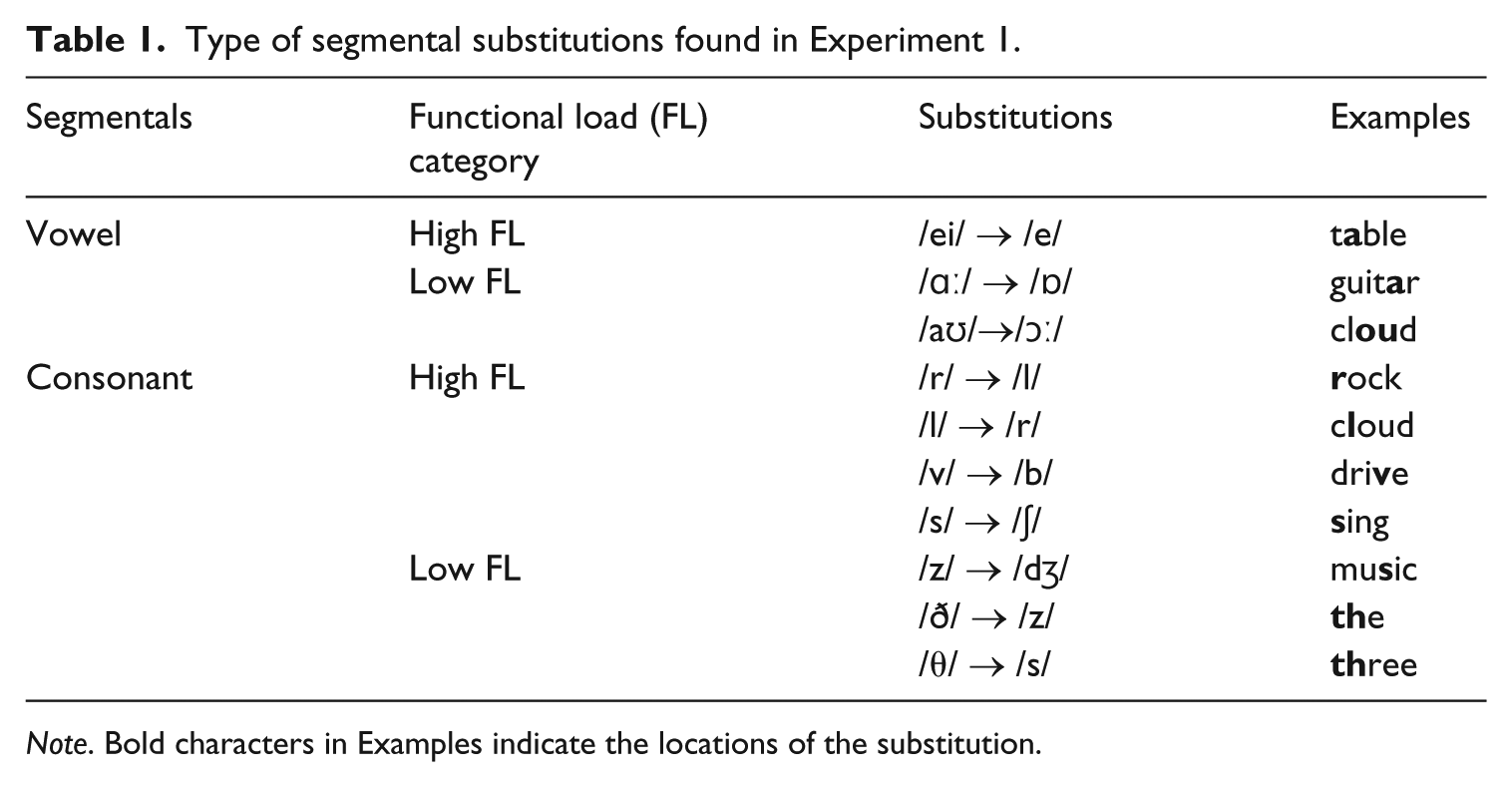
First, the researcher who is a native speaker of Japanese and familiar with Japanese-accented English completed the coding. Any substitutions of English segmentals with Japanese sounds were identified and counted as segmental substitutions. For instance, salient substitutions observed in the speech samples include the use of Japanese liquid /r/ for English /l/ in cloud or challenge, and Japanese /b/ for English /v/ in driveway.
Subsequently, in order to (a) ensure the correctness of such coding by the researcher, and (b) pursue a fine-grained objective analysis of the speech, the result of the first coding was re-coded by two Japanese coders. Prior to the re-coding procedure, the two additional coders were sufficiently instructed for the accurate detection of the substitutions (i.e. any substitution of English segmentals with Japanese sounds). The results of the two additional codings did not show a major difference from the first coding result. The three coders’ Cronbach’s α was .91 (p < .001), suggesting that the three coders’ judgments were internally highly consistent. Table 1 illustrates all the substitutions (e.g. /v/ → /b/) identified in the speech samples and actual examples of those substitutions (e.g. dri
Type of segmental substitutions found in Experiment 1.
Note. Bold characters in Examples indicate the locations of the substitution.
After ensuring the internal consistency of the coders, the total number of segmental substitutions was calculated for each sample. Subsequently, in order to examine the gravity of high FL and low FL substitutions, the total number of substitutions was divided into four subcategories based on the FL lists by Brown (1988) and Munro and Derwing’s (2006) distinction of high and low FL (i.e. 1–5 are low FL, 6–10 are high FL): high FL and low FL vowel substitutions and high FL and low FL consonant substitutions. For instance, the use of Japanese /r/ for English /l/ was categorized as a consonant substitution, then further subcategorized as a high FL consonant substitution as /r/-/l/ substitution is ranked 10th in Brown’s (1988) FL list and 10th is regarded as high FL in Munro and Derwing’s (2006) distinction.
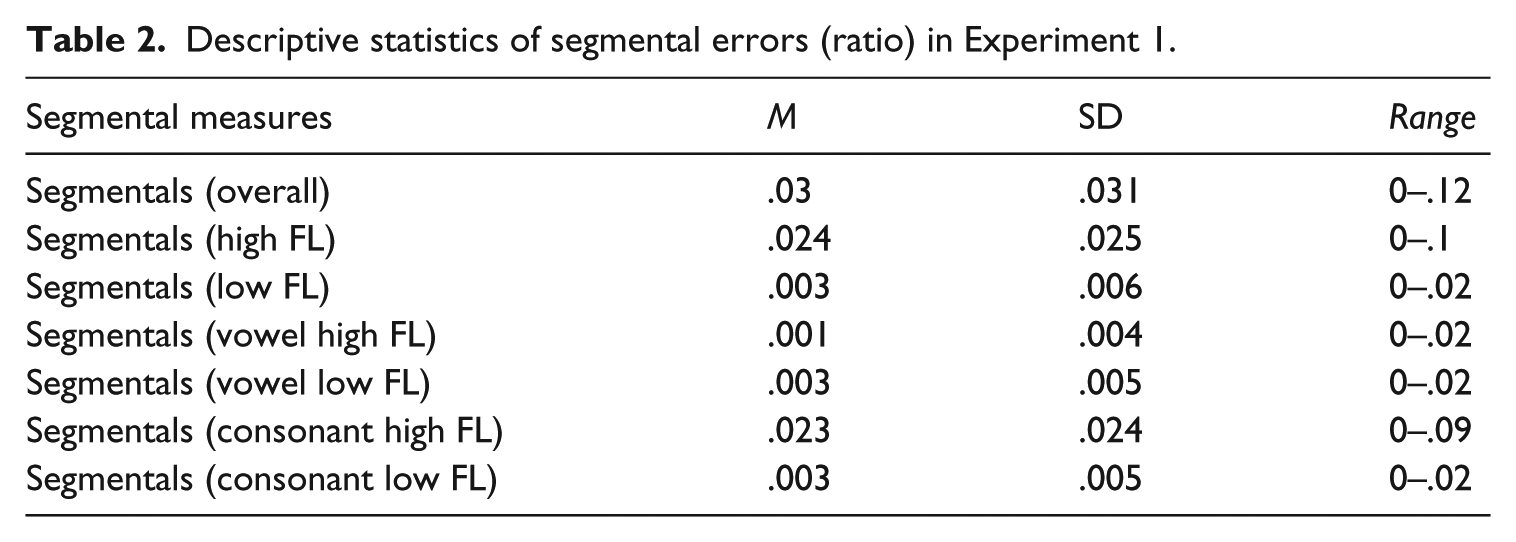
Overall, seven variables (i.e. overall segmental substitution, high FL vowel substitutions, low FL vowel substitutions, high FL consonant substitutions, and low FL consonant substitutions) were calculated. To calculate the ratio of each type of segmental substitutions, the total numbers of the seven variables were then divided by the total number of segments articulated for each sample (e.g. Kang & Moran, 2014; Saito et al., 2019a; Trofimovich & Isaacs, 2012). Table 2 shows the results of categorization and calculation of the ratio for seven segmental measures.
Descriptive statistics of segmental errors (ratio) in Experiment 1.
2 Results
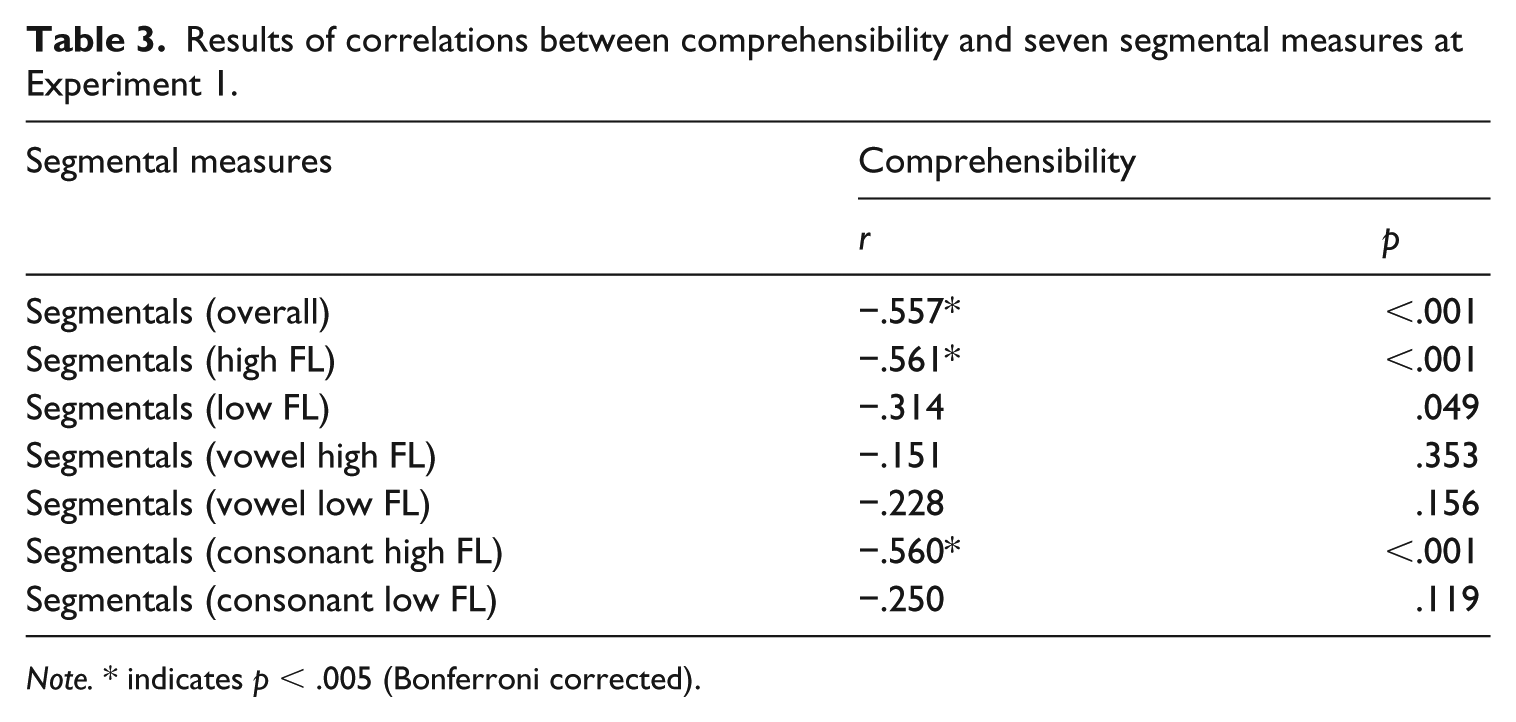
In order to identify crucial segmental features for L2 comprehensibility, a set of correlation analyses was computed in Experiment 1. Seven segmental measures and comprehensibility scores of 40 speech samples were submitted to a Spearman’s correlation coefficient (summarized in Table 3). According to the results, significant negative correlations with comprehensibility judgment were found in overall segmental substitutions (r = −.557, p < .001), high FL substitutions (r = −.561, p < .001), and high FL consonant substitutions (r = −.560, p < .001). However, correlation values of high and low FL vowel substitutions and low FL consonant substitutions did not reach statistical significance (p > .05).
Results of correlations between comprehensibility and seven segmental measures at Experiment 1.
Note. * indicates p < .005 (Bonferroni corrected).
IV Experiment 2
Although Experiment 1 aimed to identify the segmental correlates of L2 comprehensibility, the findings here could have been specific to the particular task; i.e. timed pictured description. Considering the task effect on L2 speech production as observed in previous literature (e.g. Derwing et al., 2004), we need to re-examine the segmental correlates under different task conditions. This follow-up experiment (henceforth Experiment 2) was conducted with different task and another group of speakers in 2017 spring.
1 Method
a Speakers
In order to cover wider variety of L2 speech proficiency level, 40 Japanese learners with varied L2 immersion experience (measured via LOR in English-speaking countries) were participated. The participants were comprised of college-level students in Japan (without any experience overseas) and Japanese learners of English who resided in Calgary, Canada at the time of the experiment (LOR: M = 4.6 years, Range = 0.1–24 years). According to the findings from the previous studies in L2 speech development (e.g. Flege, Takagi & Mann, 1996; Munro & Derwing, 2008; Trofimovich & Baker, 2006), L2 learners can greatly improve their pronunciation accuracy and fluency as a function of increased LOR. This suggests that the participants in Experiment 2 could be considered to have more varied, advanced L2 speech proficiency than those in Experiment 1 (i.e. EFL students without any experience abroad).
b Speaking task: IELTS Interview
Compared to timed picture description tasks, IELTS tasks require a greater number of cognitive activities to complete the task (e.g. favorite place to visit). These include interpreting the prompt, recalling their previous personal experience, organizing the ideas in a sequenced manner, and articulating their answers.
The IELTS task used in the experiment followed a condition applied to the actual IELTS speaking test. The test is conducted in an interview style with an examiner. In the long-term part of the IELTS speaking test (i.e. the second part of the test), the examiner provides a test-taker with a prompt sheet and asks him/her to speak after one minute of preparation time. Following this procedure, a prompt ‘Describe the hardest and toughest challenge in your life’ with few supporting questions was developed and used for the elicitation of the speech samples, and the speakers were given one-minute preparation time and talked for three minutes.
c Global analysis
Speech samples were prepared (30 seconds each) and rated (comprehensibility rating on a 9-point scale) in the same way as the speech samples described in Experiment 1.
Four raters participated in Experiment 1 were recruited (see Experiment 1 for the rater profile). In order to examine the consistency of the four native raters’ judgments, inter-rater reliability was calculated (Cronbach’s α = .87, p < .001). Since the raters demonstrated consistent rating pattern, mean comprehensibility scores of each speaker were calculated.
d Segmental analysis
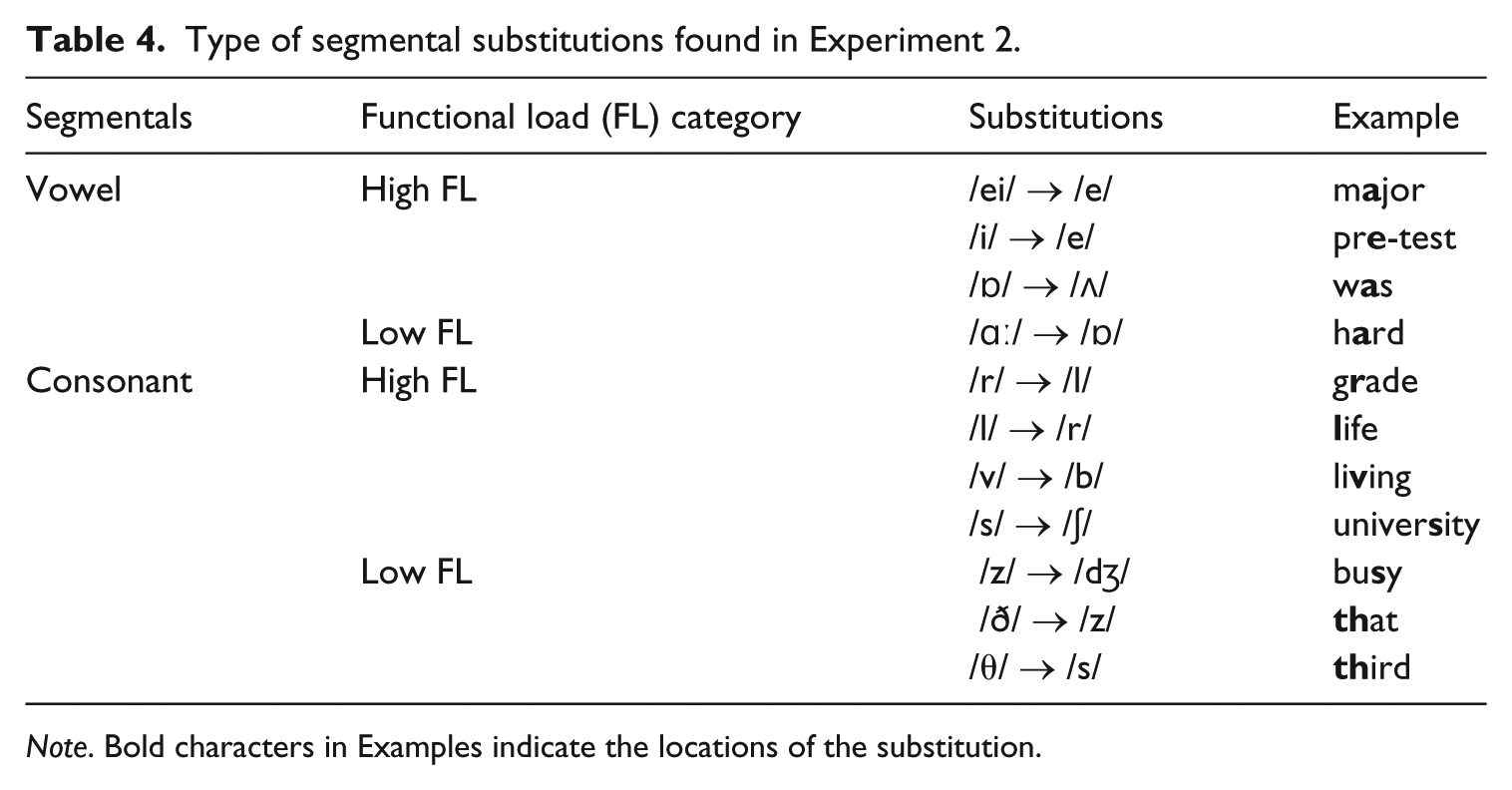
Coding procedure and coders of segmental analysis were the same as Experiment 1. The three coders’ Cronbach’s α was .94 (p < .001), suggesting that three coders’ judgments were internally highly consistent. Table 4 illustrates all the substitution types (e.g. /ð/ → /z/) and examples identified in the speech samples (e.g.
Type of segmental substitutions found in Experiment 2.
Note. Bold characters in Examples indicate the locations of the substitution.
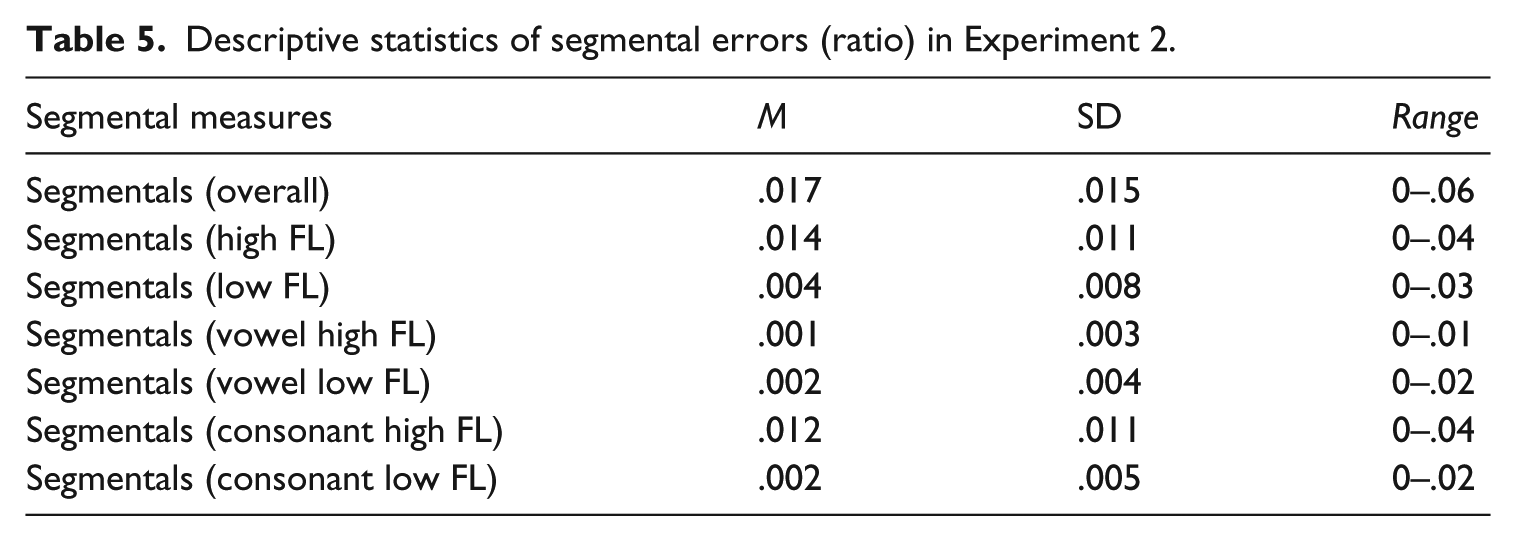
Descriptive statistics of segmental errors (ratio) in Experiment 2.
3 Results
A set of Spearman’s correlations was run for examining segmental correlates of comprehensibility (summarized in Table 6). Similar to the results observed in Experiment 1 with the timed picture description task, the variables that showed statistical significance in the IELTS task included overall segmental substitutions (r = −.798, p < .001*), high FL substitutions (r = −.685, p < .001*), and high FL consonant substitutions (r = −.617, p < .001*) but high and low FL vowel substitutions and low FL consonant substitutions.
Results of correlations between comprehensibility and seven segmental measures in Experiment 2.

Note. *indicates p < .005 (Bonferroni corrected).
V Discussion and conclusions
With using two different tasks and groups of speakers (Experiment 1 with timed picture description task and EFL Japanese learners of English vs. Experiment 2 with IELTS task and Japanese learners of English with varied immersion experience), the current study examined how both high- and low-functional load segmental errors differentially impact raters’ L2 comprehensibility judgments.
To this end, Brown’s (1988) FL principle and Munro and Derwing’s (2006) approach of high/low FL distinctions were adapted to provide a full-fledged picture of the impact of different types of segmental substitutions on L2 comprehensibility. The correlation analyses between seven segmental phonetics variables and the comprehensibility rating in Experiment 1 showed statistical significance in overall segmentals, high FL segmentals (consonants, vowels combined), and high FL consonants, and the results of Experiment 2 demonstrated the same pattern: while overall segmentals, high FL segmentals, and high FL consonants showed statistical significance, none of the vowels and low FL consonants showed any correlations. Overall, the importance of high FL segmentals (and especially, high FL consonants) was highlighted in Experiment 1, and these findings, which may be potentially biased due to its use of single task and specific participants, were confirmed by the results obtained in Experiment 2.
First and foremost, our results (from Experiment 1 and 2) showed the relative weights of high FL errors over low FL errors in terms of their detrimental effects on L2 comprehensibility judgments. More specifically, our results revealed that high FL consonants substitutions lowered the comprehensibility more than that of high FL vowel substitution. The findings here (high FL > low FL; consonants > vowels) are in line with the result of Munro and Derwing (2006). In their study, it was found that sentences with high FL consonant substitutions received significantly lower comprehensibility rating than those with low FL consonant substitutions. Furthermore, it is important to note here that previous L2 pronunciation studies have focused more on consonants than vowels in pronunciation instruction (e.g. Munro et al., 2015). In contrast, other L2 pronunciation research has offered evidence that L2 vowel errors are less likely to hinder L2 communication especially between L2 users (Jenkins, 2000). Our results can be taken as indicative of this very same lack of effect of vowel errors on comprehensibility when native listeners are involved in the speech judgment task.
Second, to seek generalizability in segmental correlates of L2 comprehensibility, the current study conducted two separate experiments (Experiment 1 and 2). Since the results obtained from single speaking task can be subject to the effect of task type (e.g. Derwing et al., 2004), each experiment employed different tasks. Following Derwing et al. (2004) and Foster and Skehan (1996), a selection of the two tasks – timed picture description, IELTS Interview – was made based on the structural, topical, and lexical freedom they offer to the speakers: little freedom in the timed picture description task, and relatively more freedom in the IELTS task. Interestingly, unlike fluency studies that found the differences in the results in picture description task from that of the monologue and conversation tasks (Derwing et al., 2004; Foster & Skehan, 1996), any differences in the correlation results were not found: high FL consonant substitutions hampered comprehensibility significantly than the others regardless of task conditions.
The null effect of task type in the current study is worthy of attention. In the timed picture description task, the participants had to use a total of nine key words to describe three different pictures. As such, the participants were induced to make certain segmental errors (including a number of high FL errors) in Experiment 1. For example, the frequency of mispronunciations of /z/ in the timed picture description was maybe due to a fixed keyword music that need to be used when the speakers described the given picture, and a number of speakers mispronounced as mugic. Thus, the strong correlations between FL and L2 comprehensibility in Experiment 1 were not surprising. However, the FL-comprehensibility link was successfully replicated in the IELTS task (Experiment 2) where the participants were encouraged to provide extemporaneous, free speech. The results of Experiment 1 and 2 provide strong evidence that the ratio of segmental errors with high-level FL hinders L2 comprehensibility in various social settings. Therefore, overall, the same results obtained from two experiments (different task and different samples) may serve as positive evidence of the importance of accurate articulation of high FL segmentals for comprehensibility irrespective of other mediating variables (e.g. task type, topic, sample type). Based on these findings in the current study, a pedagogical implication can be made for Japanese learners of English. In order for their English speech to be comprehensible, it is crucial to work on accurate production of high FL consonants (e.g. /v/ → /b/ in drive). Subsequently, they should move on to other segmental such as high FL vowels (e.g. /i/ → /e/ in pre-test) and low FL segmental to attain higher comprehensibility.
Lastly, it is important to provide a range of directions that future researchers should take in order to further replicate and expand the findings of the current study. First, the raters in this study were limited to native speakers of English. Considering the fact that there are more English users who have different L1 backgrounds than native speakers (Trudgill & Hannah, 2017; for English as lingua franca, see Seidlhofer, 2011) and listener factor has received considerable attention in regard to L2 oral interaction (e.g. Kang, 2012; Munro, 2010; Zielinski, 2008), it is crucial to take into account the perceptions of native speakers and L2 users from various L1 backgrounds. However, L2 listeners could be characterized as a multifaced phenomenon, as their backgrounds may differ to a great degree in terms of L1–L2 distance, experience, familiarity, attitude, and cognitive/sociopsychological profiles. Indeed, it needs be noted here that existing research so far has yielded mixed results regarding non-native listeners. For example, while some studies demonstrated that L1 listeners rate differently from L2 listeners when speakers’ L1s are closer to or the same as that of L1 listeners (e.g. Foote & Trofimovich, 2018), other studies have shown that L1 and L2 listeners arrive at similar rating results, and shared L1 backgrounds would have little to do with rating behavior (e.g. Gallardo del Puerto, García Lecumberri, and Gómez Lacabex, 2015 with trained L2 listeners; Major, 2007; MacKay, Flege, & Imai, 2006; Munro, Derwing, & Morton, 2006). The discrepancy here indicates a necessity of generalization of the findings in order to forward L2 speech research to examine potential listener-oriented effect on segmental correlates of L2 comprehensibility. We strongly call for future studies which will carefully examine the complex relationship between different types of segmental features, different groups of listeners and L2 comprehensibility judgments while elaborating a controlled design (see Saito et al., 2019b). Second, although the current study employed two different tasks to elicit L2 speech, contribution to an ongoing discussion of task effect on L2 production (e.g. Derwing et al., 2004; Foster & Skehan, 1996) was out of the scope for the current study. Therefore, the current study acknowledges that investigations of task effect are a future direction of L2 pronunciation proficiency. Finally, the current study only focused on Japanese speakers as the participants. Considering the pedagogical practicality for the variety of learner background, the study should have included different L1 speakers. Thus, further study should include speakers from other L1 backgrounds to make pedagogical implication more general.
