




Abstract
The past 40 years have witnessed significant developments in ELT research, reflecting the changes in learners’ language needs and the extensive development of various language learning/teaching methods in different times and places. The aim of this study is to provide a systematic and comprehensive account of changing ELT methods (oral-structural approach, communicative language teaching and task-based language teaching) in Hong Kong’s secondary education between 1975 and the present. By adopting Richards and Rodgers’s (2014) framework (approach, design and procedure), it examined how ELT theories have been transformed into local curricula (1975, 1983, 1999 and 2002/07) and commercial textbooks (Longman, Oxford University Press) via detailed content analysis. The findings suggest that research into ELT methods in Hong Kong over the past decades has generally directed the designs of the language curricula. Changes in the textbooks, however, have been relatively limited, although considerable attempts have been made to align textbook design with ELT trends. By considering various constraints in the theory-to-practice process, this study offers suggestions for future research and language teaching, particularly regarding the recent debate over the choice between the ‘weak’ and ‘strong’ versions of task-based language teaching in EFL contexts, and the post-methods perspective in language teaching.
Keywords
I Introduction
With the growing demand for English language teaching worldwide in the past 40 years, there have been significant developments in ELT research that exert considerable influence on second and foreign language teaching practices. Dominating European and foreign language teaching from the 1840s to the 1940s, grammar translation was ‘a way of studying a language that approaches the language first through detailed analysis of its grammar rules, followed by application of this knowledge to the task of translating sentences and texts into and out of the target language’ (Richards & Rodgers, 2014, p. 6). It was questioned and gradually rejected around the middle of the 19th century, because of the increasing demand for oral proficiency in foreign languages (Richards & Rodgers, 2014). The direct method was developed in the early 20th century, with the primary focus being on speech and giving a more prominent role to teaching pronunciation through question-and-answer exchanges between teachers and students and the use of pictures, objectives and actions to introduce and explain new language (Howatt & Widdowson, 2004).
The 1950s to the 1980s was the most active period in the development of language teaching approaches and methods. The 1950s and 1960s saw the emergence of the audiolingual method (ALM) in the USA and the situational approach in the UK, which accompanied academic trends such as behavioural psychology and structuralism in linguistics. These teaching methods were superseded by communicative language teaching (CLT) in the late 1960s and early 1970s, and by the related task-based language teaching (TBLT) method in the 1990s (Hall, 2016). This major paradigm shift was mainly due to learners’ undesirable outcomes in audiolingualism, which focused exclusively and excessively on manipulating linguistic structures of the target language but failed to equip students with the ability to use it in real life outside the classroom (Kumaravadivelu, 2006). Informed by ground-breaking second language acquisition (SLA) research, CLT and TBLT emerged from a concern with language functions and notions and the idea of ‘communicative competence’ (Hymes, 1972, p. 277); they focus on what language does in the real world rather than what language is (Thornbury, 2011).
Since the start of the 21st century, English language education in a wide range of English as a second language (ESL) and English as a foreign language (EFL) contexts have undergone (or are undergoing) a transition from more traditional approaches to CLT and/or TBLT, which have become commonplace and generally accepted ELT methods. As Richards and Rodgers (2014, p. 104) suggest, language teaching tends to be a ‘localized activity’, ‘subject to the constraints and needs of particular contexts and cultures of learning’; the application of global and generic solutions to local problems may inevitably encounter difficulties. It is crucial to research and document how specific ELT methods have been transformed into local practices at different levels of ELT including curricula, and subsequently, classroom practices.
Against this background, the study reported in this article is one of the few attempts to provide a systematic and comprehensive account of the transition in ELT methods from a chronological perspective, using Hong Kong as the case for investigation. As a former British colony and now an international city of China, its education system has been influenced by Western and global research and theories. By adopting Richards and Rodgers’s (2014) framework of language teaching methods, this investigation took the form of a detailed document analysis to examine how local ELT curricula and locally published commercial textbooks have changed when transitioning from an oral-structural method (similar to the audiolingual/grammar-focused method) to CLT and TBLT over the past four decades. The study can shed light on the theory-to-practice process in the context of EFL, which involves the implementation of ELT methods discussed in the literature at different levels of English language education, including language policies, instructional materials and subsequently classroom practices.
II Approaches and designs in ELT methods
The definitions of ‘approach’, ‘method’ and ‘technique’ in the literature have been inconsistent and sometimes confusing. In Richards and Rodgers’ (2014, p. 36) widely adopted framework, a ‘method’ comprises three elements: ‘approach’ (i.e. the theory of the nature of language and language learning); ‘design’ (i.e. the objectives of the method, syllabus model, types of learning and teaching activities, role of learners, teachers and instructional materials); and ‘procedure’ (classroom techniques, practices and behaviours). The first two components aid our understanding of how the different ELT methods as described in the scholarly literature (e.g. ALM, CLT and TBLT) can be implemented into the design of curricula and instructional materials, and are the foci of this article.
1 Audiolingual method (ALM)
A structural linguistics perspective is taken in ALM, in which language is regarded as a system of structurally related elements including phonemes, morphemes or words that combine to create meaning through phrases, clauses and sentences (Celce-Murcia, 2014; Howatt & Widdowson, 2004). The emphasis is on oral pattern drilling, based on the conditioning and habit-formation models proposed by behavioural psychologists (Skinner, 1957). Accordingly, it adopts a linguistic and lexical syllabus consisting of the key linguistic and vocabulary items of the target language, and language skills are taught in the order of listening, speaking, reading and writing. In practical terms, ALM is primarily a teacher-dominated method in which the teacher directs learners by skill-training techniques (i.e. drills and exercises in relevant situations to practice structures) to produce correct responses (Richards & Rodgers, 2014). When instructional materials such as textbooks and printed materials are used (which is usually not the case for elementary students), they provide texts of dialogues and cues for drills and exercises (Richards & Rodgers, 2014).
2 Communicative language teaching (CLT)
Unlike ALM, the focus of CLT is not on linguistic structure, and instead its aim is to enable learners to do things with language, to express concepts and to achieve different communicative functions (Widdowson, 1990). Central to the theory of language at its developmental stage is the notion of communicative competence (Hymes, 1972), which was later reconfigured to include grammatical competence (i.e. ‘knowledge of lexical items and of rules of morphology, syntax, sentence-grammar semantics, and phonology’), sociolinguistic competence (i.e. knowledge of ‘sociocultural rules of use’ and ‘rules of discourse’) and strategic competence (i.e. ‘verbal and nonverbal strategies that may be called into action to compensate for breakdowns in communication due to performance variables or to insufficient competence’; Canale & Swain, 1980, p. 29–31). The theories of learning underlying CLT are influenced by the growing body of SLA research during the 1970s and 1980s (e.g. Krashen, 1985; Swain, 1985). Based on a notional/functional syllabus, language learning and teaching activities in CLT emphasize the process of real communication (rather than mastery of language forms) in classroom situations, which resembles real-life language use. As CLT is learner-centred, the teacher serves various roles of facilitator, monitor, needs analyst, counsellor and group process manager (Richards & Rodgers, 2014).
3 Task-based language teaching (TBLT)
Along with the development of CLT, TBLT shares similar principles and assumptions following the functional view of language, and is firmly grounded in SLA theories (Long, 2015). However, the definition of a task and the meaning of TBLT have diverged since they were introduced, as has their relationship with CLT (Kumaravadivelu, 2006). Van den Branden (2016, p. 240) identifies seven definitions of ‘task’, as put forward by Bygate et al. (2001), Ellis (2003), Long (1985), Nunan (1989), Prabhu (1987), Willis (1996) and Van den Branden (2006), all of which share the commonality that ‘a task is a goal-oriented activity that people undertake and that involves the meaningful use of language.’ Nonetheless, a major discussion in the literature is the distinction between the ‘weak’ and ‘strong’ versions of TBLT, which, according to Littlewood (2004), are positioned towards opposing ends of the ‘focus-on-forms’ to ‘focus-on-meaning’ continuum.
As Long (1985, 2015) suggests, the ‘strong’ version of TBLT should be based primarily on a detailed needs analysis of the real-world communicative activities most relevant to learners. Instructional materials for TBLT should take the form of pedagogic tasks developed through the modification and elaboration of target tasks in real-life language samples (Long, 2015). A series of these pedagogic tasks, sequenced according to their task complexity rather than linguistic complexity, form a task syllabus. Nevertheless, despite Long’s (1985, 2015) emphasis on the importance of a needs-based syllabus, this approach is found to be challenging in some EFL contexts (e.g. East Asia; Ellis, 2017; Shehadeh, 2012). Alternatively, in terms of the ‘weak’ version of TBLT (or task-supported language teaching: TSLT), Ellis (2017, p. 522) argues for the need of a ‘hybrid syllabus’ that consists ‘primarily of a task-based component but supported by a task-supported component to address recalcitrant linguistic problems when these become evident’. In contrast to the ‘strong’ version that advocates the use of unfocused tasks (i.e. tasks involving general samples of language; e.g. Skehan, 1998), Ellis (2003, 2017) suggests that explicit instruction involving focused tasks (i.e. those designed to elicit the processing of specific, pre-determined linguistic features) is effective and necessary (see also Ellis, 2016). In TBLT, instructional materials play a pertinent role in providing appropriate classroom tasks, and their development often requires considerable time, ingenuity and resources (Richards and Rodgers, 2014). In the ‘strong’ version of TBLT this is particularly the case, as the development of needs-based syllabi and teaching materials for specific contexts is essential.
III Research into theory-to-practice in EFL contexts
Given the popularity of CLT and TBLT in contemporary ELT, recent research has sought to address whether or how this teaching paradigm could be implemented effectively in different English learning contexts. Three categories of factors that lead to difficulties in adopting TBLT in EFL settings are identified in the literature (Ellis, 2012; Shehadeh, 2012; Van den Branden, 2016): instructional (e.g. exams and assessment, class size, learning diversity), teacher (e.g. training, knowledge, beliefs) and student (e.g. beliefs, expectations). Most of these challenges were present in China, Japan, Korea, Vietnam, Taiwan and Hong Kong when CLT became the dominant model for official English language teaching policies in the 1970s (Butler, 2011; Littlewood, 2007).
At the institutional level, assessments for L2 learning, particularly high-stakes examinations in countries such as China (Hu, 2002), Korea (Shim & Baik, 2000) and Japan (Gorush, 2000), have been found to be mainly norm-referencing, summative, knowledge-based and vocabulary and grammar-focused, rather than reflecting learners’ abilities to communicate in English. These may induce the traditional, explicit and rote-learning approaches to teaching as seen in ALM, given that the ‘washback’ effect is particularly common in the Asian educational context (Carless, 2007; Li, 1998; Littlewood, 2004). In addition, classroom conditions such as large class sizes and mixed-ability classes are also reported to add to the difficulties of implementing CLT/TBLT (e.g. Carless, 2007; Li, 1998). In these situations, teachers often find it difficult to introduce interactive activities and ensure student participation.
Regarding classroom practices, previous research has revealed teachers’ insufficient knowledge or misunderstandings of CLT/TBLT and implementing tasks (Adamson & Davison, 2003; Chen & Wright, 2017; Li, 1998), while retaining the traditional teaching approaches with which they feel more comfortable. Similarly, many students prefer the traditional ways of teaching that prioritize accuracy over fluency and individual or independent work over pair/group work, relying on the teacher as a source of authority (Adamson & Davison, 2003; Li, 1998). As Butler suggests (2011, p. 40), traditional literacy-focused and teacher-centred practices are influenced by ‘the Confucian norms’ in Asia, in which a teacher is seen as ‘possessor and messenger of profound knowledge’ and the student as ‘the recipient of that authoritative knowledge’. These cultural values may conflict with the Western premises of CLT instruction. Thus the aforementioned constraints may mean that in practice CLT or TBLT are often adapted in various ways (Carless, 2007, 2015), with learning and teaching activities somewhere between what Ellis called an ‘exercise’ and a ‘task’ (Ellis, 2003, 2017).
Although commercial textbooks are the main sources of instructional materials in real practice, especially for teachers who lack time and confidence in developing their own materials (Tomlinson, 2012), there is a dearth of research that reviews their development in relation to the curricula (see Stapleton & Shao, 2018). Previous investigations into ELT documents are generally descriptive and based on experts’ experience and opinions (e.g. Chow, 2014), and only a very few empirical studies have investigated how ELT methods are reflected in the design of commercial textbooks. For example, Nitta and Gardner (2005) developed a framework of consciousness-raising and practice task types and applied it to nine contemporary ELT course books from four major international publishing houses. Their findings suggest that these textbooks are essentially based on a presentation-practice approach (PPP) to grammar teaching, involving inductive and deductive approaches in the presentation stages, followed by two types of practising tasks. Using qualitative and quantitative content analyses, Chan (2013) examined the extent to which situational authenticity has been implemented in three commercial ELT textbook series in Hong Kong, revealing the difficulties in achieving a close alignment between language-use contexts in textbooks and real-world EFL contexts. More recently, Butler et al. (2018) analysed government-approved primary school textbooks in China and South Korea and found that most activities in them would be classified as non-tasks, according to the conceptualization of tasks in the literature.
Given the relatively small scale and scope of previous studies, this study set out to systematically investigate how ELT methods suggested in the literature have been implemented in ELT curricula and, subsequently, commercial textbooks in Hong Kong over the past four decades. It serves as an exemplar case as the Hong Kong government was the first within the Asia-Pacific region to introduce TBLT as a core part of its English language curriculum (Carless, 2015). Since 1975, Hong Kong’s secondary ELT curricula have undergone three major reforms, in alignment with global trends in ELT research and methods transitioning from ALM to CLT and TBLT (Chow, 2014). The analysis sheds light on the theory-to-practice process during this transition in the adoption of ELT methods in Hong Kong as well as other EFL contexts.
IV The study
1 Objectives
The main purpose of this study was to investigate how ELT methods (according to Richards and Rodgers’ (2014) framework) have been transformed into curricula and textbooks in Hong Kong’s secondary education between 1975 and the present. Specifically, the following two research questions are addressed:
Research question 1 (RQ1): What are the changes and trends in the design of Hong Kong’s ELT curricula and textbooks from 1975 to the present?
Research question 2 (RQ2): How are ELT methods implemented in Hong Kong’s ELT curricula and, subsequently, in textbooks?
This systematic, chronological investigation not only documents the historical development of ELT in Hong Kong, but also increases our understanding of the theory-to-practice process. Given the pioneering role of Hong Kong’s English education in making the transition from ALM to CLT/TBLT, the findings about any (mis)alignments between theories and practices can provide important insights into future ELT development in other EFL contexts.
2 Research design
The key research method in the study was content analysis of the ELT curricula and textbooks published between 1975 and the present. Based on Richards and Rodger’s (2014) framework, the ELT curricula are likely to reflect the ‘approach’ (e.g. theory of nature of language and language learning) and ‘design’ (e.g. objectives of the method, syllabus model, types of learning and teaching activities, role of learners, teachers and instructional materials), whereas the textbooks mainly reveal the ‘design’, both of which largely influence ‘procedure’ (i.e. classroom techniques, practices and behaviours).
The document analysis consisted of two phases. First, the different ELT curricula were examined to identify themes associated with ‘approach’ and ‘design’. The second stage was to evaluate how these themes have been implemented in textbooks corresponding to the specific ELT curriculum. Qualitative content analysis was applied to all of the documents to ‘identify (and compare) distinct categories or themes through a largely inductive process’ (Springer, 2010, p. 421). In addition, quantitative content analysis was conducted on the textbooks. As Neuman (2011) notes, content analysis is particularly useful for research that involves ‘a large volume of text’, content that ‘may be at a distance or scattered’ and ‘content that is difficult to see or document with causal observation’ (p. 363).
3 Selected documents
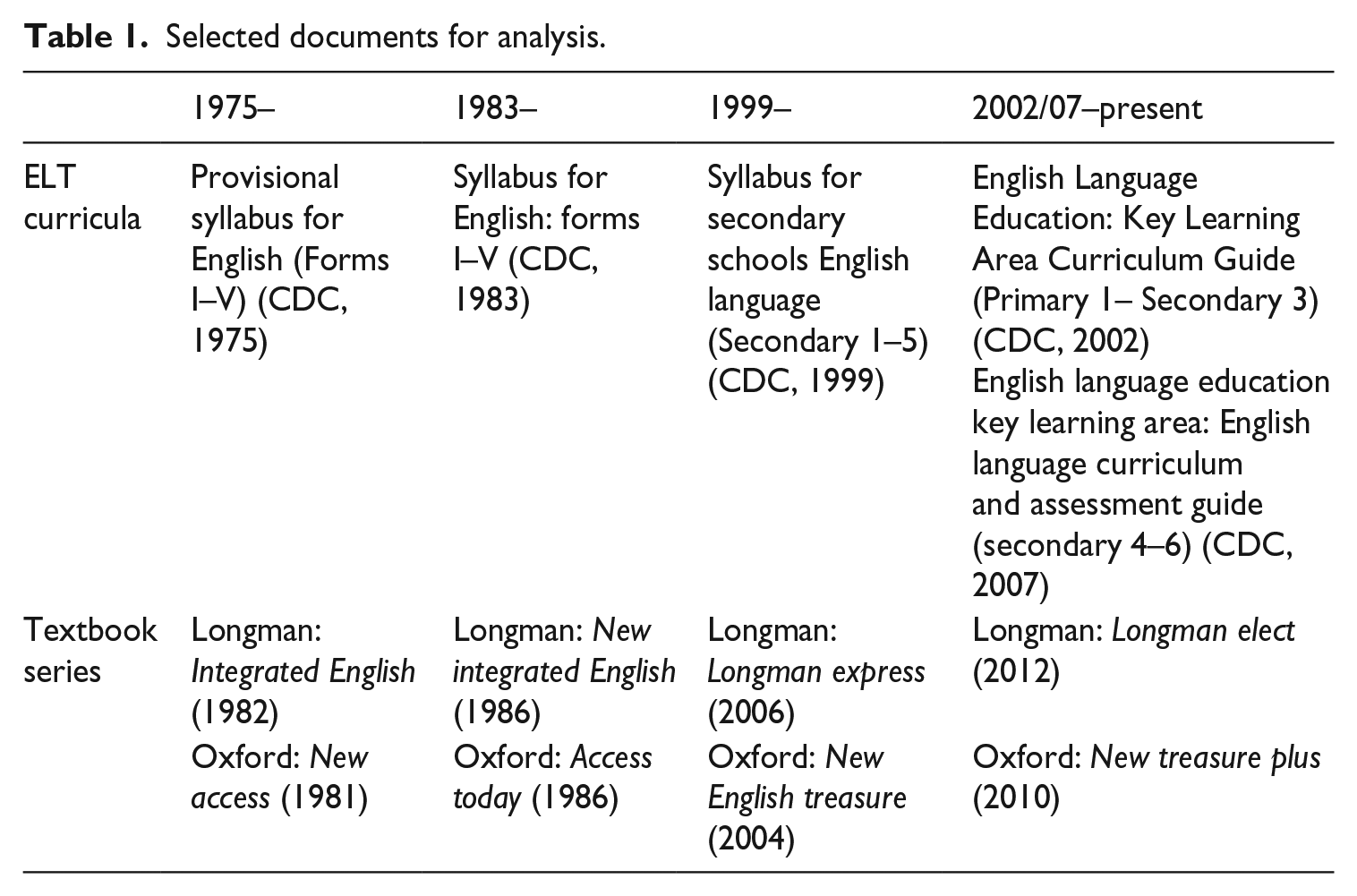
Four secondary ELT curricula and their corresponding textbooks published between 1975 and the present were collected in alignment with the identified four periods of English language education in Hong Kong (Table 1). The documents for each of these curricula provides information about its aims and design, learning targets and objectives, organization of the subject at school, recommended learning and teaching strategies/approaches, assessments and teaching resources. In 1975, a provisional syllabus for English language teaching (grades 7–11) was first published as a guide, advocating the adoption of the ‘oral-structural’ approach (resembling ALM; CDC, 1975). A communicative syllabus was subsequently introduced in the early 1980s (CDC, 1983). A task-based curriculum (sharing many principles with CLT) was adopted in primary schools from the mid-1990s onwards and in secondary schools from the new millennium (Carless, 2015). In 2007, there was a structural reform in the secondary education system in Hong Kong from a five (secondary 1–5) to a six (secondary 1–6) year framework. The 1999 ELT curriculum (secondary 1–5; CDC, 1999) was replaced by the 2002 (ELT curriculum for primary 1– secondary 3) and 2007 (secondary 4–6) documents. All of the selected textbook series were designed for the relevant ELT curricula. They were published by two of the main local commercial publishers, Longman and Oxford University Press, whose textbooks have traditionally been used in the local schools. This study only analysed the junior secondary textbooks (i.e. secondary 1–3) from these publishers because these commercial textbooks are used more at the junior than senior level. Particularly, schools in Hong Kong typically take a practice-based approach (or drilling) to prepare senior secondary students for the school-exit public examination (Lam, 2015).
Selected documents for analysis.
4 Data analysis
a ELT curricula
The qualitative analysis of the four ELT syllabi involved a coding process, which was aimed at identifying and then categorizing themes corresponding to Richards and Rodger’s (2014) discussion of ‘approach’ and ‘design’ in ELT methods. As theories of language and language learning in the ‘approach’ component are generally not explicitly discussed in the curriculum documents, the main themes that emerged from the analysis are mostly associated with the ‘design’ component, including ‘objectives’, ‘teaching approach’, ‘learning/teaching activities’, ‘role of learners’, ‘role of teachers’ and ‘role of instructional materials’. The analysis also took account of the overview of these curricula provided by Chow (2014), who discusses how changes in the conceptualization and design of ELT curricula in Hong Kong have responded to the major changes in ideology and values systems that emerged in the global context of education. Chow compares the different curricula in numerous dimensions, including aims, design, learning and teaching approach, teachers’ roles, assessment and contents of textbooks and learning/teaching materials.
b Textbooks
The focus of the analysis of textbooks published by Longman and Oxford University Press was mainly on their overall structures and activity formats, and was informed by the themes identified in the curriculum analysis. The descriptive qualitative analysis served to examine how recommendations in the curricula are implemented in the instructional materials. Further quantitative content analysis was conducted to more systematically visualize the changes and trend in the sets of textbooks over time. The basic units of analysis for coding were activities or language notes in the textbooks: the former required students to perform any of the four language skills (reading, writing, speaking or listening), and the latter were language inputs presented as notes for students (e.g. grammar/vocabulary items). The language notes were analysed separately from the activities as they only presented linguistic items and explanations to students without requiring them to apply any of the four skills. Each activity in every textbook was coded according to type (e.g., Q&A, composition, fill-in-the-blanks), language focus (i.e., one or more of the four skills; focus on forms versus functions) and instructional approach (i.e., direct instruction, situated instruction or no instruction), all of which are relevant to ELT approaches.
Each of the language notes (i.e. language inputs for students) was coded based on the language focus (e.g. the four skills). The categorization of activities and notes was primarily based on the textbook design rather than how they could be used in the classroom. For instance, the textbooks often explicitly suggest one of the four skills as the focus of an activity (e.g. speaking), even though these skills may not be mutually exclusive in practice (e.g. a discussion task may also involve students’ listening). Some activities focusing on more than one skill (e.g. speaking and writing) according to the textbooks were counted in two (or more) categories. A total of 7,464 activities (Longman: 3,330; Oxford: 4,134) and 1,511 language notes (Longman: 744; Oxford: 767) were identified in the analysed textbooks.
All of the analyses in this study were conducted by two researchers, who crosschecked and met weekly to negotiate, clarify and agree on the emerging themes and counts throughout the coding process.
V Findings and results
1 Changes in English language curricula
a Aims, teaching approaches, syllabus content and activities
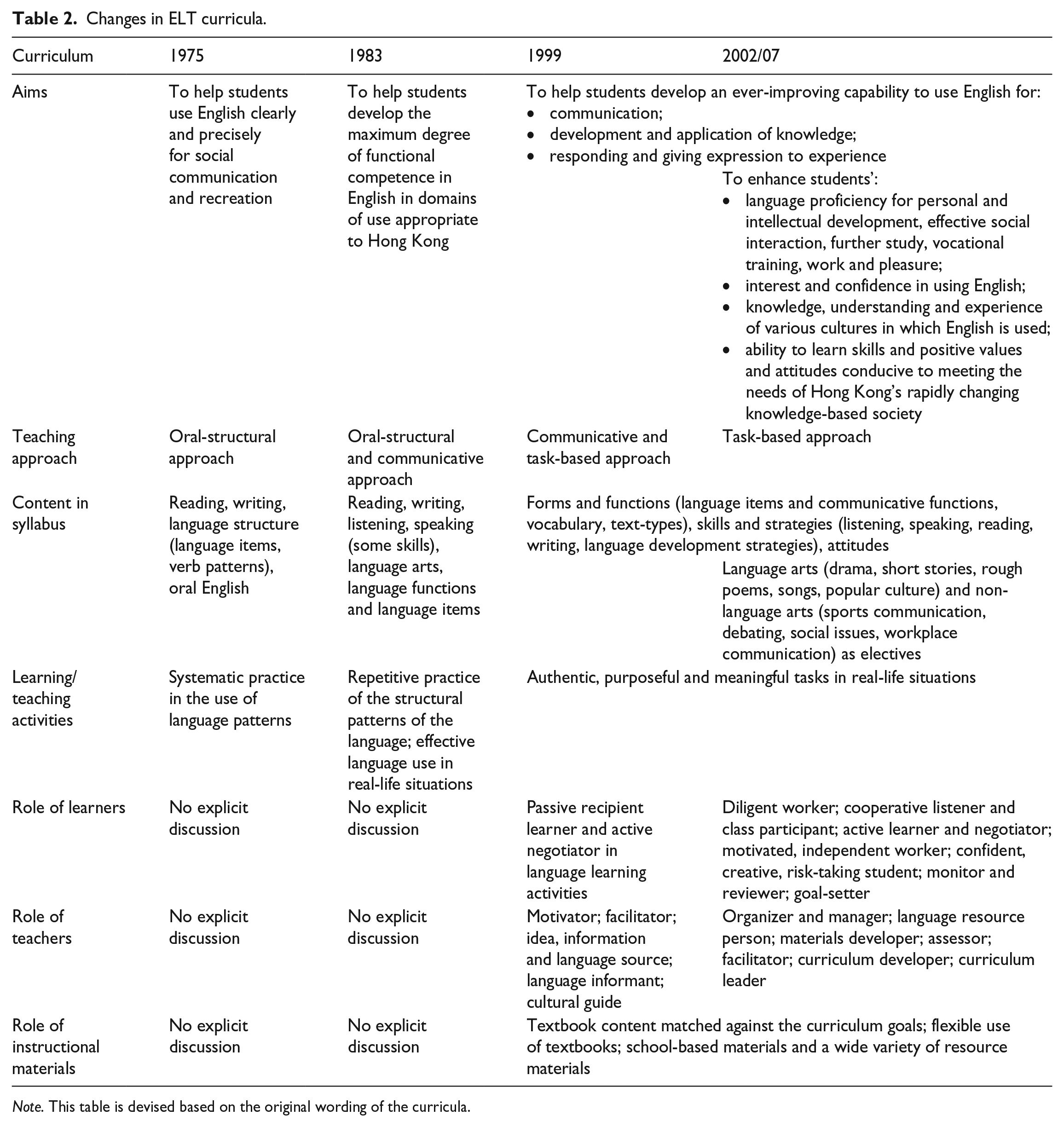
The first stage of the analysis was to identify themes in the English language curricula relevant to the components of ‘approach’ and ‘design’ in Richards and Rodgers’s (2014) framework. These emerging themes in the four curricula demonstrate that there was a clear transition from the adoption of the oral-structural approach to CLT and TBLT (Table 2). The aim of the 1975 curriculum was students’ mastery of the language structure, alongside several suggested lists of structural linguistic items (e.g. pronouns, articles, different question types, adjective phrases/clauses) (CDC, 1975, pp. 81–113).
It is important that all pupils in the first three years of the secondary school should be given a firm basis and grounding in the most commonly used structures of the language, and emphasis during these three years should always be on simple, everyday English . . . Active use of the more complicated structures and tenses can well be postponed until Form 4 . . . (CDC, 1975, pp. 1–2).
Changes in ELT curricula.
Note. This table is devised based on the original wording of the curricula.
In terms of the oral-structural approach, this 1975 curriculum highlighted 14 key principles, such as focusing on speaking, habit formation, explicit teaching and exercising of 4 language skills and systematic practice in language use patterns (pp. 156–157). A selection is given below:
Learning to speak a new language is basically a question of establishing a new set of speech habits . . .
The four language skills should be taught and exercised in the following order: hear (and understand); speak; see (i.e. read); write . . .
Systematic practice in the use of patterns is in itself grammar teaching . . .
Structural words and sentence patterns are more important than content words . . .
All exercises should produce natural English (but not necessarily complete sentences) . . .
Teach one new pattern at a time . . .
Chorus work is of great importance in oral drilling . . .
Ability to speak is the fundamental language skill . . .
The notion of ‘functional competence’ was introduced in the 1983 curriculum as the ‘principal objective’, and defined as ‘the ability to carry out successfully certain tasks and communicative transactions through the medium of English’ (CDC, 1983, p. 8). This curriculum marks the transition between ALM and CLT, in that it ‘reflects a more communicative, purposive type of approach rather than a structural one’, but it is also noted that ‘this approach, new to Hong Kong schools, is only one among many, and teachers should feel free to adopt and experiment to suit the needs of their class’ (p. 5). Although it is suggested that ‘the learner needs to be given the opportunity to use the language he is learning in a meaningful way to carry out acts of purposeful communication’, equal emphasis is placed on English as both ‘a medium of communication’ and ‘a formal, linguistic system’ (p. 15). Like the previous curriculum, lists of linguistic items and vocabulary are provided alongside their corresponding functions (pp. 130–144).
While the 1975 and 1983 ELT curricula generally focused on language structure and functions, those that followed were more specifically aimed at developing students’ ability to use English more broadly in their communication, development and application of knowledge, and in responding to and expressing their experiences (for the objectives of the curricula, see Table 2). The 1999 curriculum includes specific sections on ‘task-based learning’ (CDC, 1999, pp. 41–58) and a ‘communicative approach’ (pp. 159–161) with an emphasis on the ability to communicate. Probably because the distinction between tasks and exercises was a central point of discussion in the literature when TBLT was first introduced (see Ellis, 2003), the term ‘task’ is specifically defined in this curriculum as having a ‘purpose’ and providing a ‘context from which the purpose for using language emerges’, involving ‘learners in a mode of thinking and doing’, leading ‘towards a product’ and requiring learners ‘to draw upon their framework of knowledge skills’ (CDC, 1999, p. 43). Subsequently in the 2002/07 ELT curriculum the task-based learning and teaching approach, rather than the communicative approach in general, became the main focus of the discussion.
The task-based approach aims at providing opportunities for learners to experiment with and explore both spoken and written language through learning activities which are designed to engage learners in the authentic, practical and functional use of language for meaningful purposes. (CDC, 1999, p. 41) The task-based approach to language learning emphasizes learning to communicate through purposeful interaction. Through the use of tasks, learners are provided with purposeful contexts and engaged in processes that require them to exercise critical thinking and creativity, explore issues and solutions, and learn to use the language skills and functions, grammar items and structures, vocabulary, and tone, style and register for meaningful communication. (CDC, 2007, p. 73)
The ‘communicative purposes’ mentioned in these curricula are broadly aligned with Ellis’s (2003, p. 339) concept of ‘situational’ and ‘interactional’ authenticity; the former concerns whether a task corresponds to ‘a situation found in the real world’ and the latter establishes ‘patterns of interaction similar to those found in the real world’. However, all of the communicative and task-based curricula place equal emphasis on the learners’ mastery of the forms and their meaningful use, as in the 1983 curriculum. The main types of forms and functions (e.g. text types, vocabulary, communicative functions and language items) are covered in the curriculum documents (CDC, 1999, pp. 14–23; CDC, 2007, pp. 13–23).
The analysis of curricula from the four periods reveals a transition from a linguistic and lexical syllabus to one oriented towards communicative functions, that uses tasks as the main activities and considers language forms as equally important. In addition to the four language skills, the more recent curricula (CDC, 2002, 2007) also focus on students’ language development strategies and their development of positive values (e.g. honesty, self-esteem, and perseverance) and attitudes (e.g. responsibility, open-mindedness and cooperativeness). Influenced by genre-based pedagogy, the 1999 and 2002/07 curricula recommend exposing students to a wide variety of text types (e.g. brochures, reports, formal letters, minutes, proposals). The 2007 secondary curriculum (secondary 4–6) offers electives in language arts (i.e. learning English through ‘drama’, ‘short stories’, ‘poems and songs’ and ‘popular culture’; CDC, 2007, p. 29) and non-language arts (i.e. learning English through ‘sports communication’, ‘debating’, ‘social issues’, and ‘workplace communication’; CDC, 2007, p. 30) to the students, to reinforce different aspects of English language learning.
b The roles of learners, teachers and instructional materials
In the 1975 and 1983 curricula, the specific roles of students and teachers are not discussed in any detail, although the 1983 curriculum highlights the need to provide students with ‘opportunities to put the English language to use in the classroom’ (CDC, 1983, p. 6). A greater consideration of the active roles of students as language users and teachers as facilitators (in addition to many other roles) is provided in the subsequent curricula (Table 2), which provide designs for a communicative approach to language teaching.
The main focus of the discussions about instructional materials in all of the curricula is on how teachers should select appropriate textbooks to achieve the curriculum goals, rather than on their function. For instance, the 1975 curriculum specifies that textbooks should ‘provide for oral practice to precede reading and writing’ and ‘the vocabulary and structural items should be carefully controlled and graded’ (CDC, 1975, p. 15), in alignment with the ALM curriculum. However, the curricula following that of 1975 contain little discussion about the design of textbooks but highlight the ‘flexible use’ of resource materials based on teachers’ judgements. In the curriculum documents from 1999 and 2002/07, the possibility of schools developing their own teaching and learning materials and using more diverse source materials is discussed, in addition to selecting materials appropriate to achieving the curriculum goals and meeting learners’ needs (CDC, 1999, p. 33; CDC, 2002, p. 117; CDC, 2007, pp. 123–124).
2 Changes in textbooks
a Content and organization
A systematic analysis of textbooks can enable us to understand how the main publishers (Longman and Oxford University Press) responded to the changing curricula in recent years. The key features of the textbooks, as described in the introduction and/or blurb, are in close alignment with the corresponding curricula. The main changes in textbook design can be summarized as:
Textbooks designed for the 1975 curriculum emphasize sequenced language structure and vocabulary, in addition to the four language skills.
The concepts of communicative functions and purposeful language use appear in the textbooks for the 1983 curriculum, although they place equal emphasis on language forms and skills. The overall structures (e.g. organization of topics and language skill foci) of these textbooks and those of the previous curriculum, however, are in general similar.
Textbooks published after the 1999 curriculum claim to adopt a task-based approach and to promote student participation in communicative activities. Pre-tasks are often included but they mainly focus on providing language inputs (e.g. target vocabulary, grammar items), which resemble the traditional PPP approach (Littlewood, 2007). This corresponds more to the ‘weak’ version of TBLT or Ellis’ suggestion of TSLT, rather than the form of TBLT suggested by Willis and Willis (2007), in which the pre-task stage often aims to introduce the topic and identify topic language. In accordance with the curriculum, these textbooks are also theme-based (i.e. having a theme in each unit such as ‘wonders in the world’ and ‘a trip to Macau’) and follow the recommended hierarchical module-unit-task structure.
b Language notes
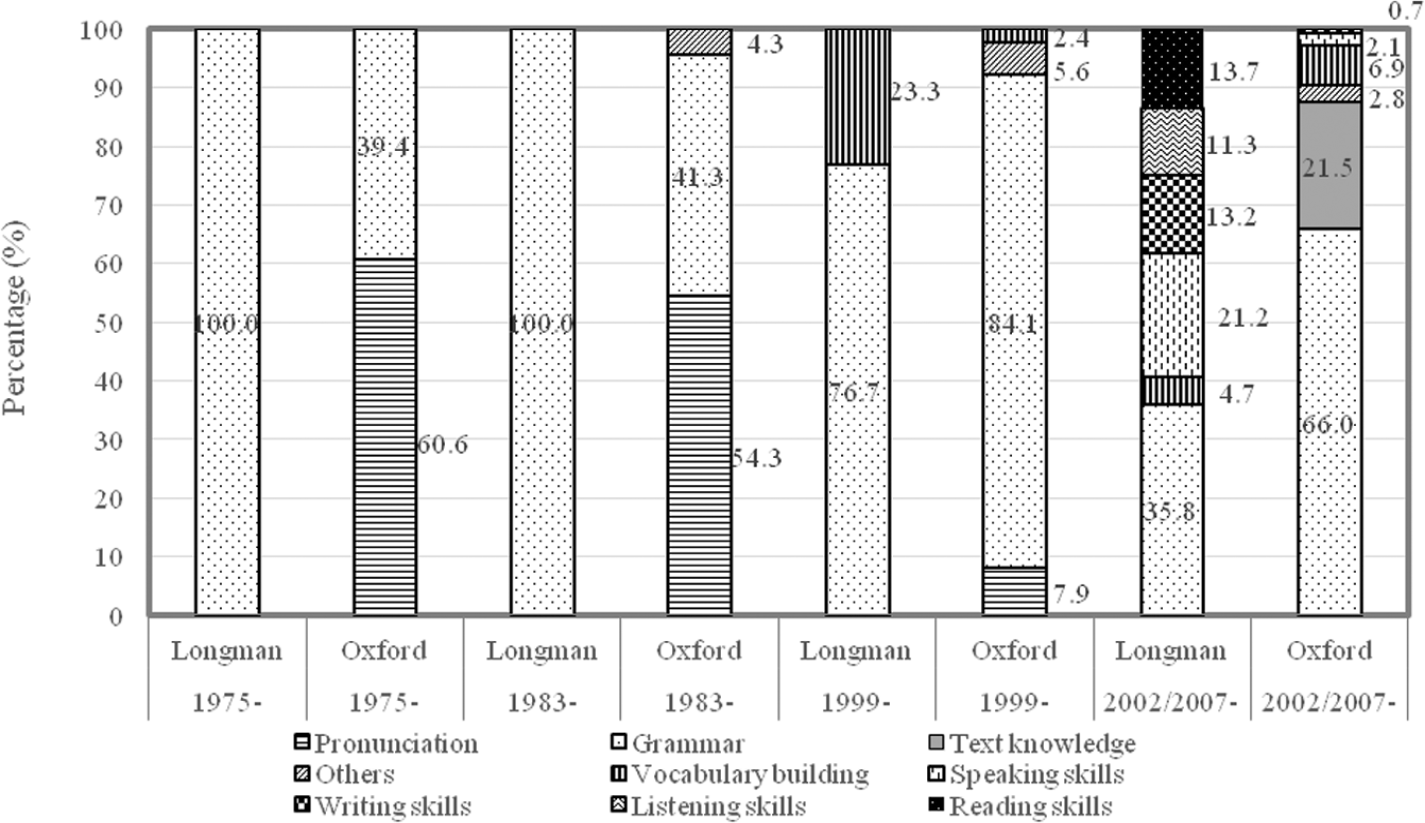
As all of the textbooks generally include language notes (i.e. language inputs) and activities (which require students’ performance), they were treated separately in the quantitative content analysis. Figure 1 shows that there is a similar proportion of language notes to activities (around 2:8) in the textbooks of the different periods, which suggests the perceived necessity of including a certain amount of explicit language inputs. Nevertheless, a more detailed analysis of the language notes suggests a shift in their content from linguistic knowledge to language skills: the language inputs in textbooks of the 1975, 1983 and 1999 curricula focus on grammar items (and in the Oxford textbooks, pronunciation) whereas those designed for 2002/07 curriculum have a broader focus, including vocabulary building and the four main language skills (Figure 2). Specifically, the Oxford series designed for the 2002/07 curriculum includes explicit knowledge about different text types, in accordance with genre-based pedagogy.

Proportions of language notes and activities in secondary textbooks.
Language notes in secondary textbooks.
c Activities
All of the activities were analysed according to their pedagogical foci, as derived from the textbooks. As illustrated in Figures 3 and 4, the Longman textbooks for the 1975 and 1983 curricula provide more activities related to grammar, reading and speaking while most activities in the Oxford textbooks concern speaking, followed by reading and grammar. The pedagogical focus is generally in line with the linguistic and lexical syllabus, although textbooks for the 1983 curriculum claim that they also pay attention to communicative functions. In contrast, activities in the subsequent textbooks provide a more balanced focus on different language skills in addition to vocabulary building (e.g. activities that introduce new vocabulary) and text knowledge (e.g. analysing different aspects of a text). Due to technological advancement, there are more listening-related activities based on audio-recordings in the more recent textbooks.

Activities in Longman textbooks.
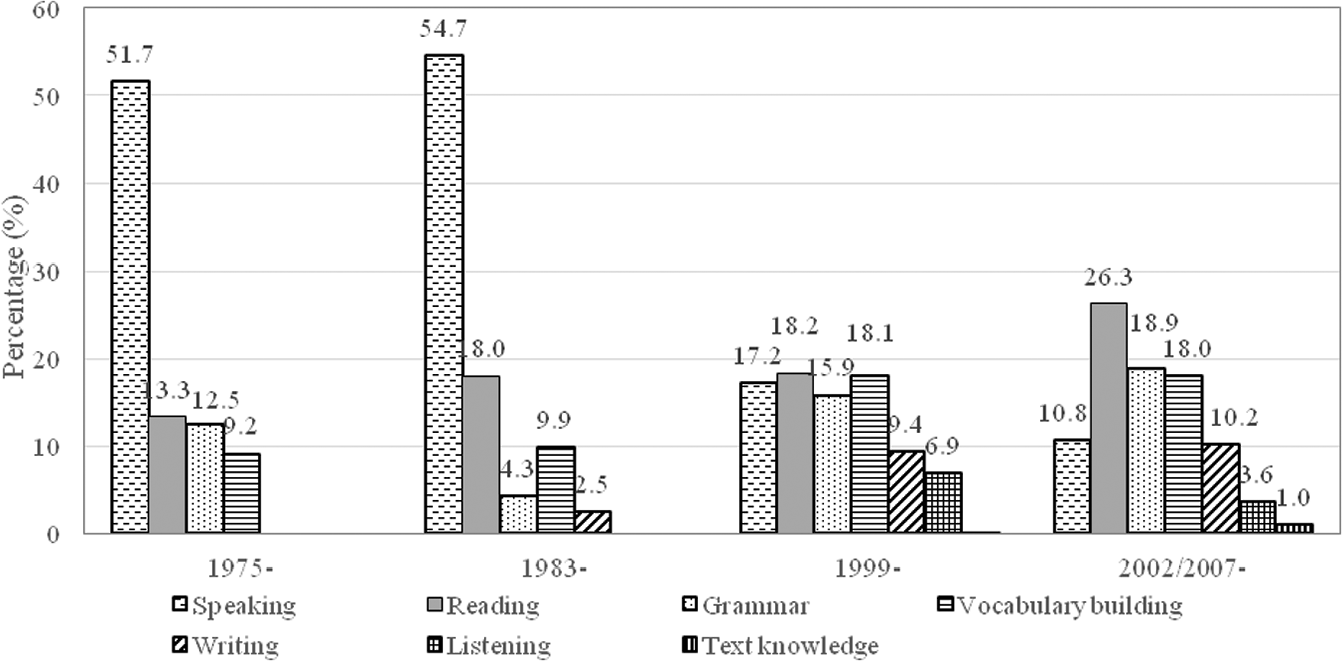
Activities in Oxford textbooks.
Four activities types (Q&A, composition, discussion and fill-in-the-blanks) are commonly found in all of the textbooks, regardless of the publisher or ELT curriculum (Tables 3 and 4). The activities are associated with reading, writing, speaking and grammar. Some activities (e.g. reading aloud, picture description, dialogue reading, question/sentence making, dictation) that were more relevant to the oral-structural approach under the 1975 and 1983 curricula have been replaced by others in more recent textbooks, such as presentation, proofreading, textual analysis and peer evaluation. The design of these activities is likely to be influenced by the development of research into TBLT, genre-based pedagogy and formative assessment (e.g. assessment for learning) in ELT.
Top 10 activity types in Longman textbooks.

Note. Actual number of activities in the textbooks is given in parentheses. The activity types in bold appear in all textbook series. Q&A = question and answer.
Top 10 activity types in Oxford textbooks.
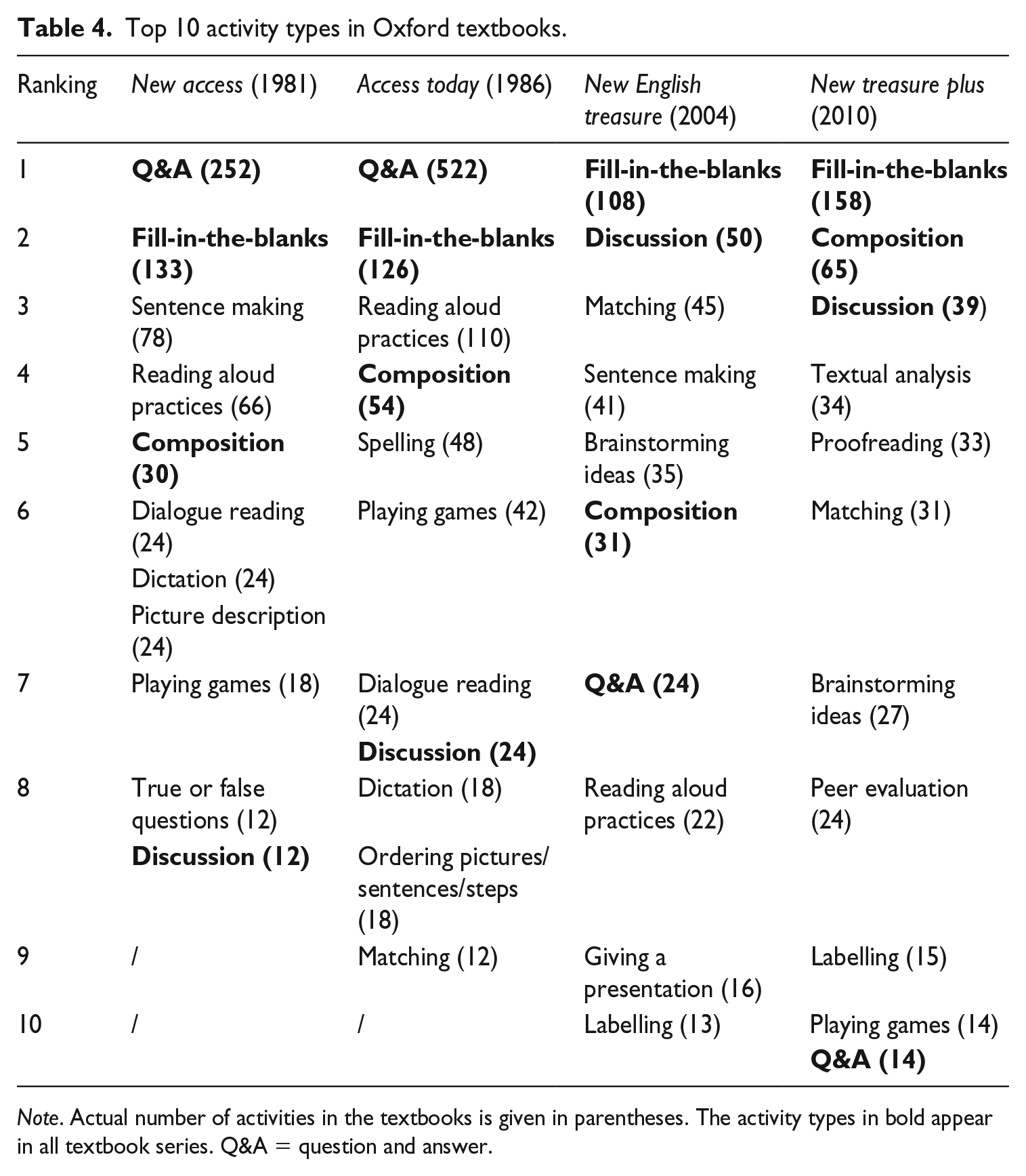
Note. Actual number of activities in the textbooks is given in parentheses. The activity types in bold appear in all textbook series. Q&A = question and answer.
A noticeable change is observed in the instructional statements, in terms of how students are instructed to complete a textbook activity. They can be categorized as direct, situated and no instruction. As Figure 5 shows, direct instructions (e.g. ‘read these sentences aloud’) are more common in earlier textbooks. As CLT and TBLT emphasize the use of language in meaningful contexts, the more recent textbooks often provide students with an imaginary role or scenario (e.g. being an interviewee) in each activity. Although the intention is to provide learners with a language-use context, these situated instructions are often somewhat artificial (e.g. filling in some faded words in an old postcard) and distant from the students, so they do not necessarily enhance the situational authenticity of the activities. As suggested by Chan (2013) students may neglect the situations provided in the instructional statement if the activity can be completed without them. Thus, these imaginary situations may fail to provide a ‘meaningful’ and ‘purposeful’ context for the learners, as emphasized in the TBLT curricula. Similarly, some of the textbook activities (e.g. fill-in-the-blank, matching) do not facilitate interactional authenticity, as they are more like typical exercises that focus on practising linguistic items.

Types of instructions in secondary textbooks.
d Functions and forms
One major change in the focus of curricula in recent years (alongside the changing ELT methods) has been from solely language forms to a more equal emphasis on both language functions and forms, and so each activity in the textbooks was evaluated in terms of how students were guided to produce the language. 1 In Figures 6 and 7, the activities focusing on forms imply that students are required to write or speak the language through repetition, imitation or modelling in a controlled manner (e.g. reading a dialogue aloud). The focus-on-functions activities are those that allow students to use the language to achieve certain goals (e.g. participating in a discussion, writing a text) without any prior explicit language inputs. Activities focusing on both functions and forms often begin with sample language, followed by instructions for students that prompt the more flexible use of the language (e.g. discussing an issue with the provision of some sample questioning and responding patterns). Throughout the different periods, there is a clear decrease in the amount of forms-focused activities in the textbooks and an increase in activities focusing on functions, or equally on both functions and forms. As an activity design, introducing forms before functions is more reflective of the weak form of TBLT or TSLT as suggested by Ellis (2017), rather than the strong version that reflects real-world communicative activities.

Production of forms and/or functions in textbook activities: Longman.

Production of forms and/or functions in textbook activities: Oxford.
VI Summary and implications
This study has offered a systematic analysis of Hong Kong’s ELT curricula and textbooks over the past four decades (1975 to the present), which reveals (RQ1) the changes and trends in the design of these documents and (RQ2) the implementation of ELT methods in the different sets of documents. By adopting Richards and Rodgers’s (2014) framework of ELT methods, the analysis suggests that the four curricula corresponding to the different periods reflect the general global development of ELT methods, and the transition from ALM (1975) to CLT and TBLT (1983–2002/07). All of the textbooks claim to have followed the teaching approaches recommended in the corresponding curricula, although their designs differ somewhat from the ELT methods discussed in the literature. A summary of the main changes in the curricula and textbooks is provided below.
Curricula:
The 1983 curriculum marks the transition from an oral-structural to a communicative language teaching approach, while the 2002/07 curriculum emphasizes the use of TBLT. Despite the focus on communicative functions in the recent curricula, the emphasis on linguistic forms has continued over the years. The recent curricula encompass broader language and educational aims, in addition to the changing ELT methods, and feature a variety of pedagogical recommendations (e.g. genre-based pedagogy, formative assessment) drawn from education and applied linguistic research.
Textbooks:
Although recent textbooks have incorporated activities in which the focus on different language skills is more balanced, they have retained some of the activity types from previous curricula. Function-focused activities appear more often in recent task-based textbooks, although some of them correspond more to the PPP approach or ‘weak’ version of TBLT as language inputs are introduced in the pre-task stage. Imaginary roles or scenarios are often provided for learners in the task-based textbook activities, which are intended to enhance situational authenticity.
In general, research into ELT methods over the past decades has directed the design of language curricula in Hong Kong, but its implementation in commercial textbooks has been relatively limited. The findings can have significant implications for future research and language teaching, particularly regarding the recent debate over the choice between the ‘weak’ or ‘strong’ versions of TBLT in EFL contexts, and the post-methods perspective in language teaching.
First, the major developments in ELT research are not fully reflected in the relatively small changes to the textbooks, demonstrating how the transition process from theories to practices (if any) is typically slow and gradual, particularly in large-scale English language education. While commercial publishers often claim that their textbooks are designed to correspond with the most up-to-date ELT theories and curricula, they will in general build on previous editions. Even if recent ELT curricula acknowledge the ineffective learning outcomes of solely focusing on linguistic accuracy in the oral-structural approach, the current curriculum and textbooks continue to strongly emphasize the importance of language forms, albeit with an additional focus on communicative functions. The changes in revised editions of textbooks often only include the fine-tuning of activity designs, while some of the forms-focused elements are retained. This may demonstrate the pervasiveness of traditional approaches (e.g. grammar translation, ALM) to grammar teaching in curriculum and textbooks. From this perspective, the weak version of TBLT (or TSLT) appears to be better aligned with the gradual and transitional theory-to-practice process. For example, the current curriculum and textbook activities to some extent reflect what Ellis (2017, p. 522) calls a ‘hybrid syllabus’, which is primarily task-based with explicit language support. Activities developed with this approach, as provided in the textbooks, may have a specific language focus (Ellis, 2017).
Second, the gradual and transitional theory-to-practice process of ELT development may pose challenges for the implementation of the ‘strong’ version of TBLT, which differs significantly from traditional ELT practices that focus on forms and requires more substantial revisions of the existing syllabus and instructional materials. As the findings of this study reveal, new curricula and textbooks are often based on previous versions, with more up-to-date education and language teaching theories/approaches from the literature being incorporated (but without complete replacement). In addition to other constraints, such as the need for financial resources and stakeholders’ unwillingness to accept abrupt changes, implementing a drastic reform in large-scale English language education is difficult. Unlike the ‘weak’ version of TBLT that is more comparable with traditional ELT methods (e.g. with forms-focused elements), the ‘strong’ version may require more fundamental changes in its implementation in the curriculum and textbooks. According to Long (1985, 2015), it will involve a comprehensive needs analysis of the global and local communicative activities relevant to local learners, the development of pedagogic tasks through modifying and elaborating on target tasks in real-life language samples and sequencing these pedagogic tasks according to their complexity. To date, very few studies have conducted such needs analysis by investigating the functions and contexts of English use in Hong Kong (e.g. Evans, 2010; Chan, 2016, 2018), and they were not designed for the development of ELT curriculum and textbooks from a TBLT perspective. A more systematic, larger-scale investigation is essential if such a task syllabus is to be developed.
Given the various learning/teaching recommendations in the curricula influenced by past and present ELT research, a third implication of this study concerns the increasingly important role of English teachers from a post-methods perspective, which questions the existence of a single best method for diverse learning and teaching contexts (Celce-Murcia, 2014; Littlewood, 2014). Kumaravadivelu (2006) argues that in this post-methods era teachers are principled pragmatists who shape students’ classroom learning. They should consider learners’ goals, interests and learning contexts and creatively apply new research findings and adjust past practices to develop, reflect on and improve their daily classroom teaching (Celce-Murcia, 2014). As our findings reveal the inclusion of elements of different ELT recommendations in the curricula and instructional materials, which are sometimes inconsistent with the literature, it is important for teachers to be familiar with up-to-date ELT research and be empowered to experiment and choose the most suitable methods in their classroom teaching, through teacher education and collaboration between teachers and researchers (Littlewood, 2014). Recognizing the importance of textbooks, Tomlinson (2012) insists that contemporary textbooks should be designed ‘to be flexible and to offer teachers and students opportunities for localisation, personalisation and choice’ (p. 158). Thus, although the present study has revealed Hong Kong’s ELT development in terms of ‘approach’ and ‘design’, as identified in Richards and Rodgers’s (2014) framework, further studies should be conducted to investigate the ‘procedure’ dimension by taking account of the key stakeholders’ (teachers and students) perceptions and practices of different ELT methods in relation to the curricula and textbooks.
