




Abstract
The language learner strategies research field has often tried to identify the good language learner (GLL) by distinguishing more proficient from less proficient learners. However the notion of ‘good’ may be problematic without taking into account an individual’s linguistic knowledge (LK). This article foregrounds LK in relation to strategy use in the context of ‘listening to the teacher’: a language use task relatively under-researched. Secondary school students in Hong Kong (n = 646) completed a questionnaire and tests of LK including vocabulary and grammar. Lower LK learners reported using more translation strategies, whereas those with higher LK reported using a range of additional strategies. A further cluster analysis, however, indicated that a sub-group of lower LK learners were comparably strategic with the higher LK group perhaps compensating for low LK via strategy deployment. This article provides evidence that strategy deployment when listening to the teacher is not wholly constrained by levels of LK. Pedagogical implications are suggested.
Keywords
I Introduction
In more than 40 years of language learner strategy (LLS) research, a central aim has been to identify individuals who are better at learning and/or using a foreign or second language (L2) than others. This research endeavour stems from Rubin’s (1975) seminal notion that there exists a good language learner (GLL) and that poor learners can become better learners by modelling themselves on GLLs: a theme taken up by Naiman et al. (1978) and more recently Griffiths (2008, 2018). It also stems from Canale and Swain’s (1980) original definition of communicative competence which included ‘strategic competence’ which compensated for relatively limited linguistic resources, a theory further developed by Bachman (1990). This article is concerned with strategy use in a specific context: the strategies used by learners when listening to the teacher. This is a context which has hitherto been underexplored.
The above relationship, where better strategy use leads to better language use and therefore recognition of a GLL, deserves further theorizing. First, the construct of ‘good’ itself may be problematic; for example, we often do not know how long it has taken a learner to become ‘good’ and what other social factors might have led to that advantageous position. Second, if the measurement by which we attribute the word ‘good’ to a successful learner is one involving a measurement of proficiency, then strategy use is almost certainly a component of the proficiency construct because any task which measures proficiency, and which is pitched at a sufficiently challenging level, must perforce involve the learner in deploying some level of strategic behaviour in order to make the best use of the relatively limited linguistic resources that s/he has, as in the Canale and Swain model.
Thus to understand whether an L2 learner is ‘good’, that is to say successful at carrying out a language use task (task being interpreted in a broad sense), we have to measure the linguistic resources that an L2 learner has at his/her disposal and then explore the strategic behaviour s/he deploys in order to compensate for any shortcomings in those resources. In this article we adopt Macaro (2010) distinction between proficiency and linguistic knowledge where the latter includes (inter alia) lexical-semantic knowledge and morphosyntactic knowledge. Proficiency therefore involves the use of the linguistic knowledge (LK) available to an L2 user plus strategic behaviour. We are of course not suggesting that LK and strategic behaviour are the only components of proficiency but it is a central aim of this article to examine the relationship between LK and strategic behaviour as two important components.
II Language learner strategies
Empirical evidence for the GLL in the 1980s and 1990s tended to focus on frequency of strategy use. For example, O’Malley et al.’s (1985) quantitative study found that intermediate learners of English as a second language (ESL) used proportionally more metacognitive strategies than beginners. O’Malley, Chamot and Küpper’s (1989) qualitative study suggested that ‘effective listeners’ tended to use some strategies more, such as the metacognitive strategy of monitoring 1 and the cognitive strategy of elaboration (use of prior knowledge), than less effective ones. Such findings encouraged researchers such as Oxford and Burry-Stock (1995) to conclude that ‘more proficient students use strategies more frequently’ (p. 10). However, two questions arise from these conclusions in relation to the theoretical problems raised earlier. First, is the implication, therefore, that there is a direction of causality: more frequent use of strategies leads to becoming more advanced or more proficient learners? Second, by ‘frequency’ do we mean all strategies are used more or only some? This is an important distinction to make because when O’Malley et al.’s (1985) data is examined, the total number of strategies used by the beginners almost doubled that of intermediate learners (409 against 229 instances).
More recently researchers have reconsidered the relationship between GLL and LLS by, for instance, taking into account the effective use of strategies in particular situations and settings such as second language versus foreign language (Hsiao and Oxford, 2002) or proposing the notion of effective ‘strategy combinations’ (see, for example, Briggs 2015; Chamot and El-Dinary, 1999; Graham, 1997; Graham and Santos, 2015; Macaro, 2001; Vandergrift, 1998).
Problems of terminology and definition are not absent from the research literature on listening strategies. Researchers have used ‘listening proficiency’ (e.g. Chien and W. Li, 1998; Taguchi, 2001), ‘listening abilities’ (e.g. Goh, 1998), ‘listening effectiveness’ (e.g. O’Malley et al., 1989) or ‘skills in listening’ (e.g. Vandergrift, 2003), for what we have defined, in our introduction, as proficiency in carrying out a listening task. For example, Murphy’s (1985) 12 university ESL students were divided into two groups of high and low listening proficiency based on two listening comprehension tests and one reading test. He found that the more proficient listeners used a relatively wider variety of strategies more often, such as paraphrasing (using one’s own words to recall the meaning of the listening text), inferring (making inferences based on textual clues), personalizing (using prior knowledge regarding private opinions), connecting (using prior knowledge regarding general knowledge), and anticipating (predicting information to come), individually and sometimes in combination. Goh (2002) distinguished her two university students as more effective and less effective based on the score of a listening task, as did Vandergrift (2003) who split 36 grade 7 French L2 learners into more skilled and less skilled listeners. Both studies’ findings suggested that the students who did better at the listening tasks used a wider range of strategies including metacognitive ones such as monitoring and evaluating. Vandergrift (2003) also identified that the listeners who performed better drew more on their prior knowledge while those who performed less well relied more on translation.
Thus a conclusion that can be drawn from these studies of listening strategies is that more and less proficient students (usually defined by a listening comprehension task) differ in their strategy use. Less proficient students tend to translate the incoming speech stream more and are less able to deploy inferencing, monitoring, and elaboration (or recall of prior knowledge) strategies. However, these generalizations do not mean that a causal link can unproblematically be established between the use of strategies and high proficiency. In other words, as Yeldham (2017) succinctly concluded, some strategies might be deployed when the learners became more advanced, and these strategies might not necessarily be the source or cause of becoming advanced. More importantly, the findings regarding the correlation between proficiency and strategies would be predictable unless the researchers were able to establish that both groups of students had roughly (1) equal prior knowledge, and (2) equal linguistic resources to draw upon.
Prior knowledge (or knowledge of the topic) has been identified as an important variable in listening strategy research (see, e.g. Long, 1990; Tsui and Fullilove, 1998). More proficient listeners appear to deploy more frequently their prior knowledge as a ‘top-down’ strategy. One question to ask therefore is whether the prior knowledge of more and less proficient listeners is matched and if not matched then whether lack of prior knowledge constrains the ability to deploy the top-down strategy. In our current research context of listening to the teacher, we would argue that the potential selection of ‘topic’ in the teacher talk is more constrained than in all the possible ‘topics’ selected by course-book authors for audio-recording. This is especially true when we consider the uniqueness of classroom interaction. Teacher talk in a classroom includes more predictable and repetitive speech acts such as direct (i.e. giving instructions) and nominate (see, for example, Tsui, 1985; Lo & Macaro, 2012). Such predictability might also arise from the relationship between the teacher and the students: that there may be some catchphrases used by the teacher or that the particular teacher would use certain linguistic units to perform certain speech acts. Additionally, in the classroom context, the teacher can also modify his or her input and give explanation and feedback where necessary, something rarely possible in tasks involving audio-recordings. This under-researched context of listening to the teacher is one of the contributions that this study makes to the field. The other is the relationship between linguistic resources and strategy use to which we now turn.
It would be reasonable to predict that a listener with half the vocabulary of another listener would attempt to mentally translate more words or phrases in the speech stream thereby allocating less working memory space for inferencing and monitoring. A study by Graham, Santos and Vanderplank (2011) found that listeners in the top proficiency group used more comprehension monitoring strategies in combination with other strategies. However, one lower proficiency listener appeared trapped by his or her lack of understanding even if s/he did use comprehension monitoring, and did not move on by combining it with other strategies to facilitate his/her understanding. This would suggest that despite deploying similar strategies as higher proficiency students, this lower proficiency student could not overcome difficulties which could be attributed to low LK. Thus, if we can control, at the very least, the linguistic resources of vocabulary and grammar knowledge, then we can investigate whether different levels of LK are or are not associated with different strategic behaviour.
If we consider a hypothetical situation where two students are engaged in the same listening task and where one student has lower LK than the other, then the former student will have to rely much more on strategies to overcome their comparatively fewer linguistic resources. The short-circuit hypothesis (see, e.g. Clarke, 1979) however would suggest that there are situations in which the LK is so low that no amount of strategic behaviour can compensate and overcome the comprehension problem.
Another way of testing the LK hypothesis is to investigate whether, within the same learner, manipulation of the task increases or decreases strategic behaviour. This was carried out in experimental conditions by Takeuchi, Ikeda and Mizumoto (2012). Adult Japanese L1 speakers were administered the same task twice with the only variation being that one session was carried out in L1 and the other in L2 English. Using brain scanning techniques, they found greater brain activity occurred in the prefrontal cortex in the L2 task than in the L1 task. The same learner was having to work much harder in a situation in which s/he had reduced LK.
LK was purposely a variable in Graham et al. (2008) who provided an in-depth account of two 17-year-old learners of French (Alan and Sue), matched for LK, using vocabulary and grammar tests. A further listening proficiency test placed Alan in the top proficiency group and Sue in the bottom group. Put differently, Alan and Sue had the same LK but achieved quite different levels of listening comprehension. Qualitative analysis suggested that Alan employed monitoring and evaluating strategies, whereas Sue did so less. What is interesting for the purposes of the current study is that strategic behaviour, instead of LK, appeared to be differentiating these two students of differing listening proficiency; strategic behaviour appeared to have become a value-added element in determining listening proficiency. Graham et al. (2010) further explored this relationship between LK and strategic behaviour by using a vocabulary recognition test and a grammaticality judgement task to categorize 14 secondary school students of French into two groups of top and bottom LK respectively. Again they found that listeners with higher LK combined comprehension monitoring with other strategies while their lower LK counterparts did not. Furthermore, they found that some students with lower LK relied on strategies at the single-word level. However, it should also be pointed out that students with higher LK did not necessarily listen successfully and at times they could be inflexible and ineffective in deploying strategies. This suggests that it is not automatically the case that higher LK leads to different strategy use.
To summarize, claims about effective strategy use have shifted over the decades from frequency of strategy use being a goal to subtle combinations of strategies as the objective. While the combination of strategies is an important way forward, we explore that topic in another article and instead aim in this article at problematizing and tackling the under-researched relationship between LK and strategy use. Most previous research has not attempted to establish a direction of causality between the variables of strategic behaviour and successful language learning/use as measured by proficiency (tests/tasks) or achievement (e.g. placement in a particular class) and this is in part because studies have rarely controlled for LK. Those that have attempted to do so have used relatively small sample sizes, something the current study seeks to address. We rarely know how the GLL has become a GLL.
III Methodology
The above discussion led us to formulate the following research questions:
Research question 1: Do students with different levels of linguistic knowledge differ in the strategies used when listening to a teacher?
Research question 2: Do students with the same level of linguistic knowledge differ in the strategies used when listening to a teacher?
We adopted a quantitative research design to complement some of the qualitative research cited earlier (e.g. Graham et al., 2010). For strategy elicitation a Likert-scale questionnaire was developed and to measure LK we used a vocabulary levels test (VLT) and a grammaticality judgement test (GJT).
As already stated we used ‘listening to the teacher’ as our ‘language use task’. Listening to the teacher, especially in the Hong Kong context described below, where research reports a relative absence of interaction, is a valid conceptualization of a language use task but one which has been almost totally neglected in the strategies literature and this separate issue is explored in another publication.
1 Population and sampling
The target population for this study was Secondary 3 (aged 14) intermediate learners of English as a foreign language (EFL) studying in mainstream (i.e. not private and international schools) schools in Hong Kong (HK). Adopting a purposive sampling method, 6 schools in the three major regions in HK: Kowloon, Hong Kong Island, and the New Territories took part, providing a total sample of 646 students. These students represented a homogeneous group with similar language backgrounds: Chinese being their first language (L1) and English their second (L2). All had studied English formally at school for around 8 years (6 in primary, and 2 in secondary education). The classroom interaction, as observed by one author in lessons, in the 6 schools can confidently be described as dominated by teacher talk. Students were in general passive and rarely initiated any conversational exchange, and student talk was mostly restricted to the ‘response’ act in the initiate–response–feedback (IRF) sequence. Such a trend was in line with Tsui (1985) who found 0% student-initiate classroom interaction and Lo & Macaro (2012) who identified 87%–96% teacher talk. When students were assigned classwork, they would work on their own quietly without much discussion.
2 Likert-scale questionnaire
Because ‘listening to the teacher’ is a relatively new area of LLS research, the questionnaire was developed through a grounded approach, 2 as suggested by Gu (2014), and followed the design of Nakatani (2006) when validating his Oral Communication Strategy Inventory. We first administered an open-ended questionnaire for a sample of students to self-report their strategies. Additionally, and in order to increase construct validity, individual and focus group interviews were conducted so that the strategies reported were of a greater variety than those used in the audio-recorded texts settings of studies described earlier. These strategies collected from students were then included as items of a Likert-scale questionnaire.
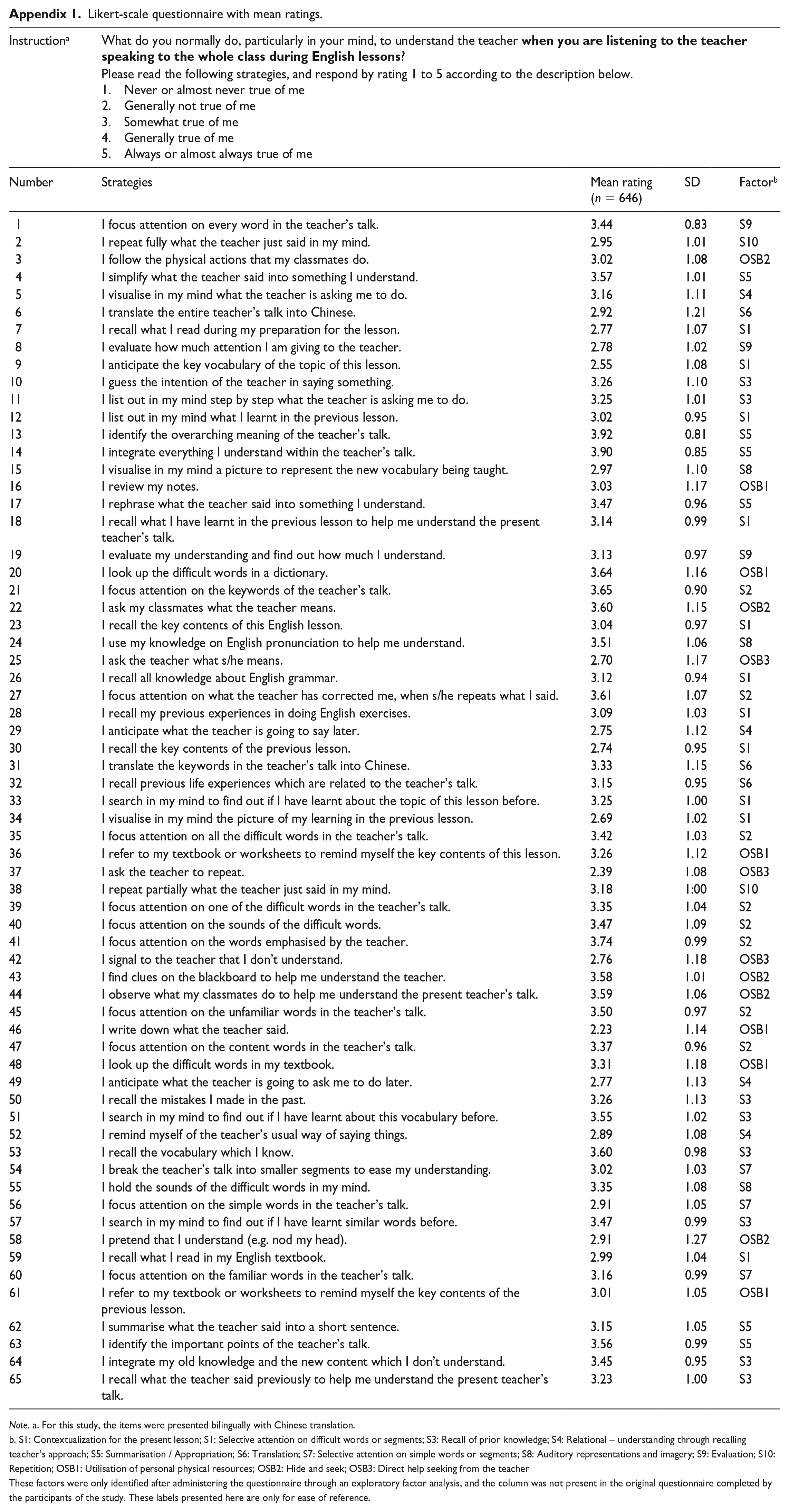
The Likert-scale questionnaire (see Appendix 1) was presented bilingually so that students would not find difficulties understanding the items. Following Briggs (2015), some items were classified as ‘strategies’ (mental actions) and others ‘opportunities for strategic behaviour’ (e.g. reviewing my notes, following what my classmates do, asking the teacher to repeat). These are physical/observable actions, during which strategic behaviour may occur. For instance, ‘reviewing notes’ may or may not give rise to the use of several strategies: attend to certain elements in the teacher’s input selectively, make inferences, recall what was learnt in previous lessons, and so forth.
The questionnaire underwent an exploratory factor analysis (EFA) and identified 10 strategy factors and 3 opportunities for strategic behaviour factors (for a full account of the EFA process, see Fung, 2016). The 10 strategy factors include:
contextualization for the present lesson;
selective attention on difficult words or segments;
recall of prior knowledge;
relational: understanding through recalling teacher’s approach;
summarization;
translation;
selective attention on simple words or segments;
auditory representation and imagery;
evaluation;
repetition.
These factors were treated as the dependent variables in this study.
3 Tests of linguistic knowledge
a Receptive VLT
A receptive vocabulary test was considered relevant to the context of listening. Nation (2006) maintains that coverage of 98% of receptive vocabulary items in a listening text is required for unassisted comprehension. Below this percentage, listeners may be required to draw more from their strategic repertoire to overcome listening problems. Van Zeeland (2014) found that learners’ vocabulary size explained 23% of variance in lexical inferencing in a listening context. Wang and Treffers-Daller (2017) also revealed that vocabulary explained 19% of variance in listening comprehension, corroborating the importance of vocabulary knowledge.
We adopted the VLT developed by Nation (1990), with words chosen from the word lists compiled by Nation (2012). The bilingual version with options (i.e. the meanings of target words) provided in Chinese was used so as not to introduce an additional variable, following Li (2009) who proposed that the bilingual version was more valid, based on her findings that some students reported ‘I know the meaning but in Chinese’ (p. 76).
Originally, our VLT contained the 1,000, 2,000, and 3,000 level on the General Service List. Using these higher frequency words could gain some support from Lo and Murphy (2010), who found that HK Secondary 3 learners only scored a mean of 9.83 and 9.23 out of 18 in the 2,000 and 3,000 level respectively. When piloting it, however, we observed a ceiling effect with one of our participating students, in that he only made one mistake at the 3,000 level and scored full marks in the other two. Consequently, the VLT was modified to include the 5,000 and academic levels as well. The latter was also added because teachers sometimes used academic texts in these classes. The final VLT, therefore, included 5 levels: 1,000, 2,000, 3,000, 5,000, and academic level, each of which consisted of 30 items and totalled 150 items.
Each item carried equal weighting and one mark was given when a student chose the correct answer for a question. Therefore, the maximum achievable score was 30 for each level and 150 for all five levels.
b GJT with error identification
The GJT is not without controversy (Birdsong, 1989). Ellis (1991) found that re-testing the same learner with the same sentences yielded different results. However, most criticisms relate to the most basic GJT-type which only requires learners to rate sentences as correct or incorrect, not asking for error location or correction. We therefore adopted a GJT of 30 items, with error identification, with a variety of grammatical structures and tense-aspects. The selection was based on the curriculum set out by the Hong Kong Education Department (1999) in describing what learners should master before the end of Secondary 3. There was an even split of grammatical and ungrammatical sentences to eliminate guessing.
To validate the GJT and to check that every ungrammatical sentence contained only one target error, native speakers completed the test by locating and correcting the errors. They were further asked if they found the sentences odd to circumvent semantic anomaly as an additional variable. Subsequently, the GJT was piloted with a sub-sample of the same population of our study. With students scoring between 17 and 21 out of 30 (i.e. no ceiling or floor effects), we considered it a test which could reliably differentiate students with stronger and weaker grammatical knowledge.
In analysing the results, a sensitive scoring system was adopted. 3 For each of the 15 grammatical sentences, one mark was given if they were correctly rated as grammatical. For each of the 15 ungrammatical sentences, one mark was given if they were correctly rated as ungrammatical, and another mark was given if the error was correctly located. Therefore, the maximum score for the GJT was 45.
4 Data collection procedure
After normal ethical procedures (including obtaining student consent) were carried out, participants used 30 minutes to complete the Likert-scale questionnaire, and another 30 minutes to complete the VLT and GJT in class.
IV Results
Before addressing the two research questions it is useful to note briefly the descriptive statistics of the questionnaire and the LK tests. Table 1 provides means and standard deviations (SD) of the 10 factors of strategies resulting from the questionnaire (for the mean ratings and SD of individual items, 4 see Appendix 1). Students in general claimed using summarization / appropriation strategies (e.g. ‘I rephrase what the teacher said into something I understand’) the most, followed by selective attention on difficult words, and recall of prior knowledge. Conversely, contextualization for the present lesson, relational strategies, and selective attention on simple words were among the least used. Table 2 presents the descriptives for ‘opportunities for strategic behaviour’ (henceforth OSBs). As the purpose of this article is not to discuss the nature of strategies or OSBs in detail 5 we only do so where we have used relatively new strategy classifications. Thus ‘hide and seek’ (defined as: students hiding their lack of understanding from the teacher while seeking help from external resources) appears to be an often used OSB and more so than use of personal physical resources. Seeking help directly from the teacher is the least frequent among the learners.
Descriptive statistics of 10 factors of strategies.
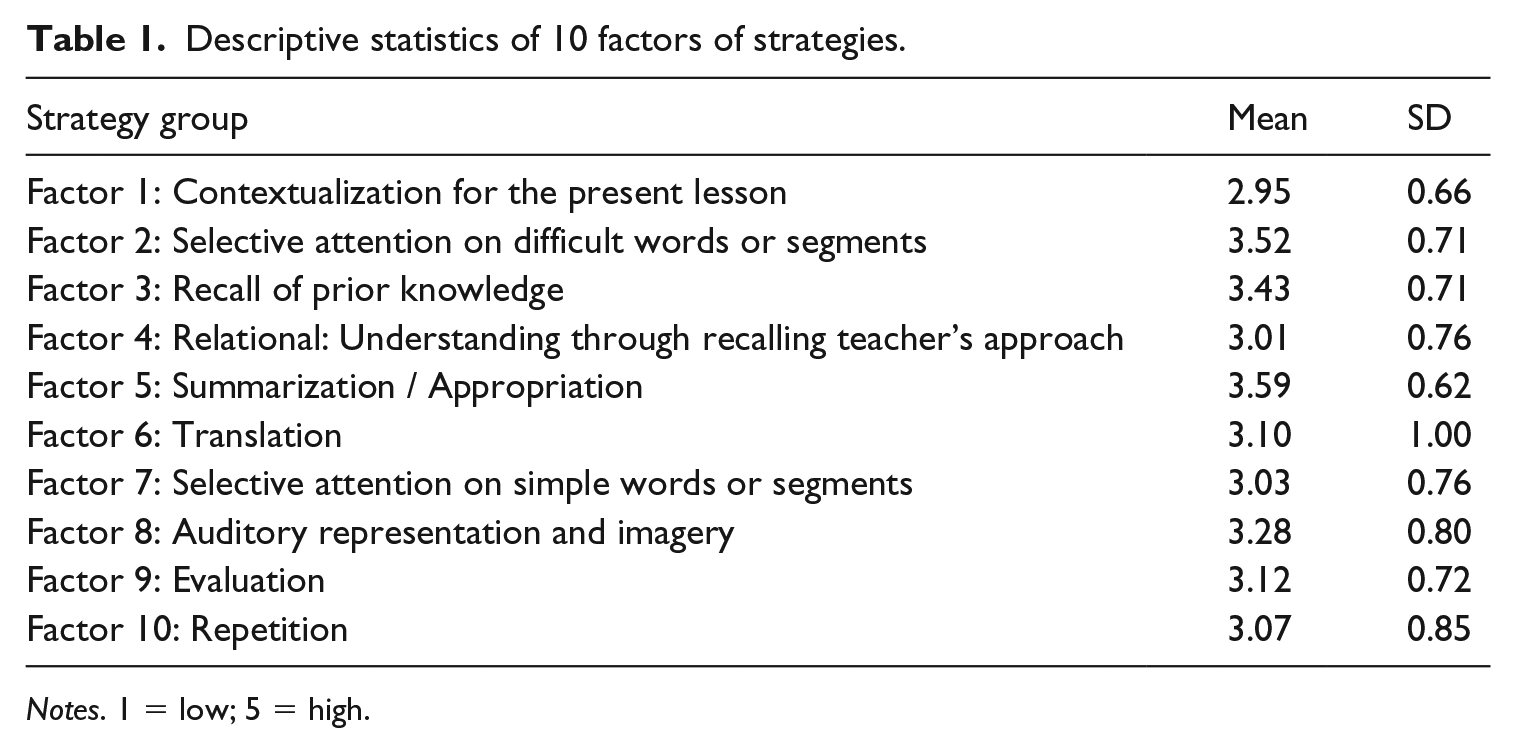
Notes. 1 = low; 5 = high.
Descriptive statistics of three factors of opportunities for strategic behaviour (OSBs).
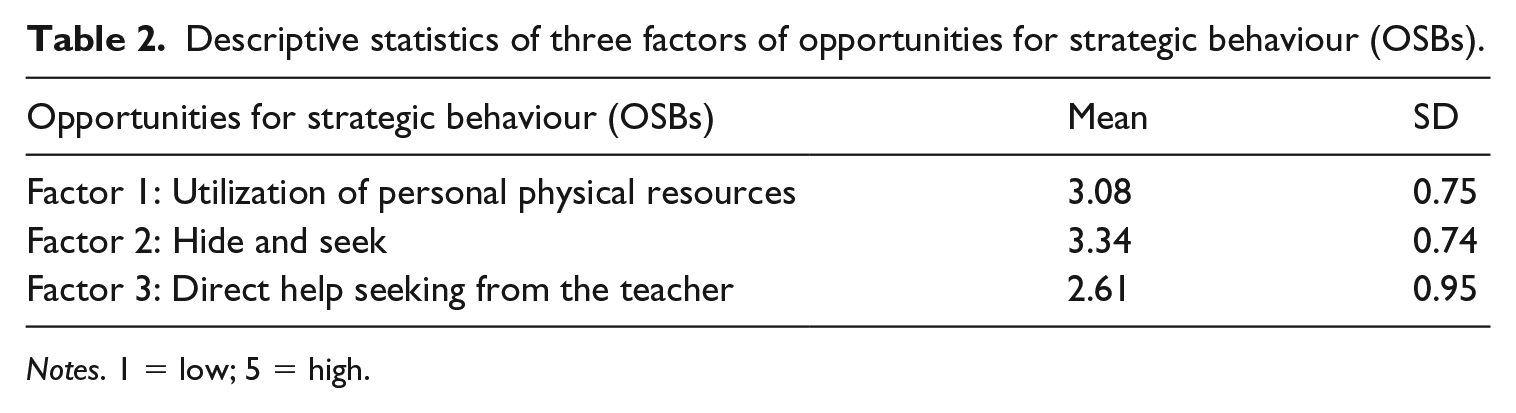
Notes. 1 = low; 5 = high.
Turning to the LK tests, Table 3 presents the descriptive statistics. Regarding the VLT, the decreasing means from level 1,000 to 5,000 demonstrated an increasing difficulty. For academic vocabulary, the mean was close to that of the 3,000 level. With the five levels combined, the mean was 123.77 (out of 150), indicating that students on average scored around 82.5%. Concerning the GJT, the mean was 33.95 (out of 45), showing that students on average had a score of around 75%.
Descriptive statistics for VLT and GJT.
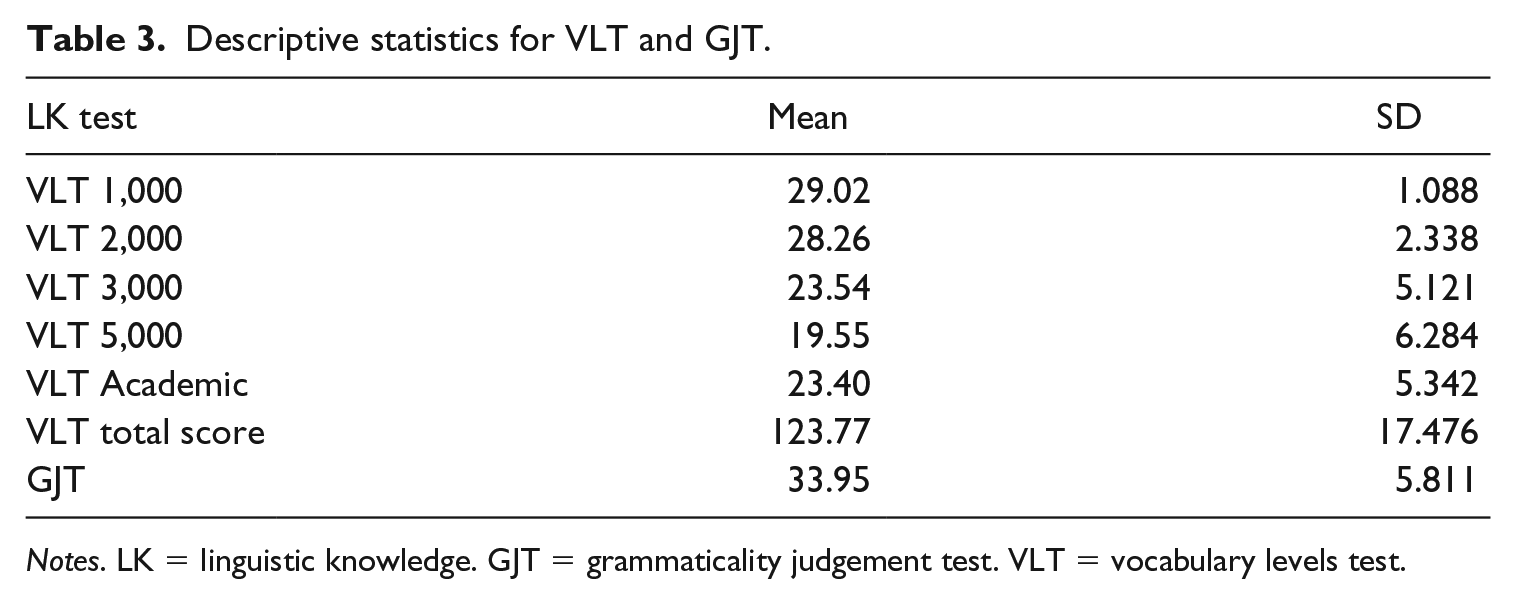
Notes. LK = linguistic knowledge. GJT = grammaticality judgement test. VLT = vocabulary levels test.
Borrowing support from Sağlam (2014) who found that vocabulary and grammatical knowledge separately explained 49.6% and 48.9% of the variances of listening comprehension respectively, this article considers vocabulary and grammatical knowledge as equally important towards listening comprehension. 6 Thus, an LK (i.e. linguistic knowledge) score for each participant was computed by converting the VLT and GJT score into a score out of 100 and then averaged. A median split was performed to dichotomize students into two groups of low and high LK. Independent-samples t-tests were conducted to confirm whether the two groups were significantly different in their VLT and GJT scores (see Table 4).
Comparison of students with low and high linguistic knowledge (LK).
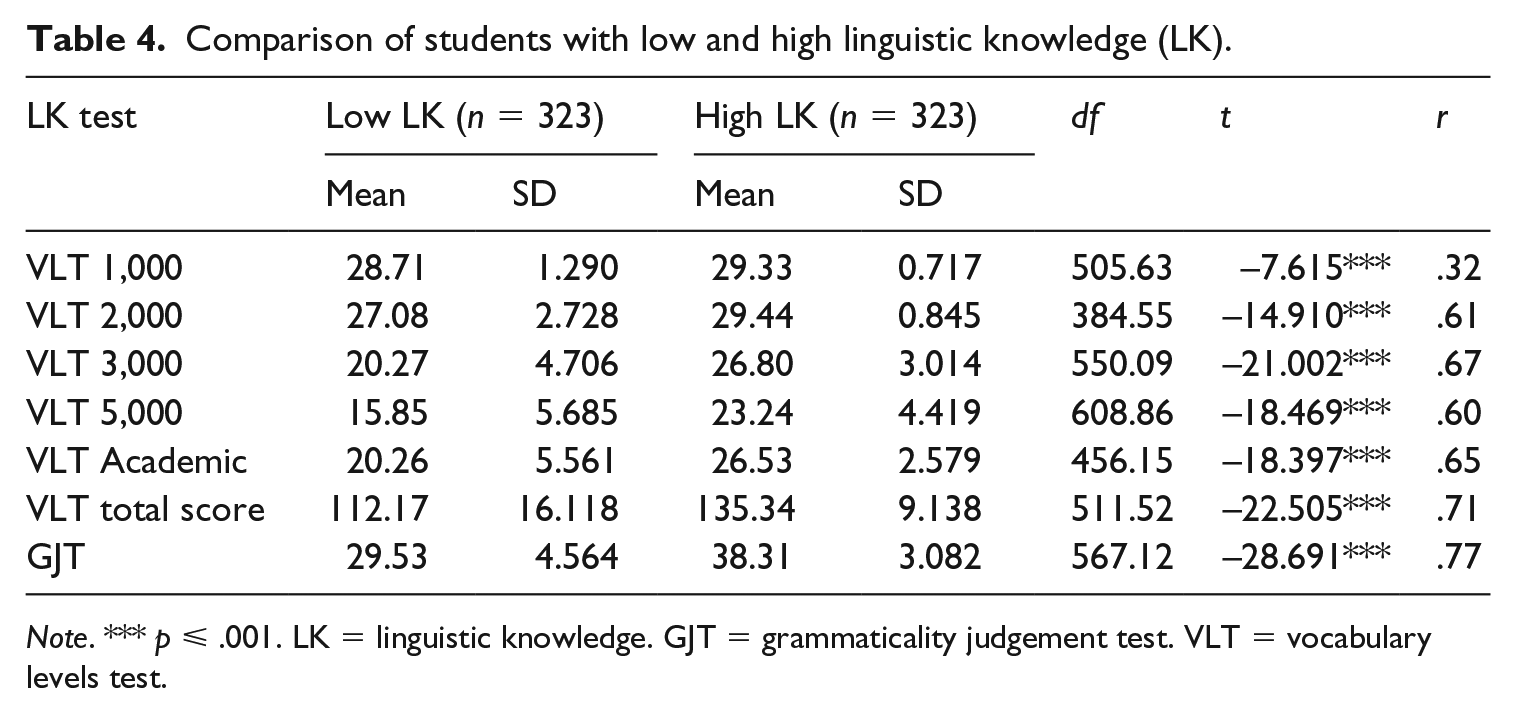
Note. *** p ⩽ .001. LK = linguistic knowledge. GJT = grammaticality judgement test. VLT = vocabulary levels test.
It can be observed that the two groups of students were significantly different in their VLT and GJT scores. Next, we explored how the two groups differed in their strategies used, as per research question 1. Table 5 indicates that descriptively, students with higher LK used most of the strategies and OSBs more often than students with lower LK, except (and importantly, see discussion) for translation, selective attention on simple words, and hide and seek. To explore whether the two groups were statistically different, independent-samples t-tests were conducted and revealed that Strategies 2, 3, 6, 8, and 9 showed significant differences. In other words, students with higher LK tended to selectively attend to difficult words or segments, recall their prior knowledge, use auditory representation and imagery, and evaluate their understanding more than the low LK students. The low LK group, in contrast, used translation significantly more than the high LK group. All these differences revealed only small effect sizes, following Cohen (1988, 1992) who suggested that r = .10, .30, and .50 represented small, medium, and large effect sizes respectively. Finally, no significant differences were identified for the OSBs.
Comparison of students with low and high linguistic knowledge (LK) on strategy and opportunities for strategic behaviour (OSB).
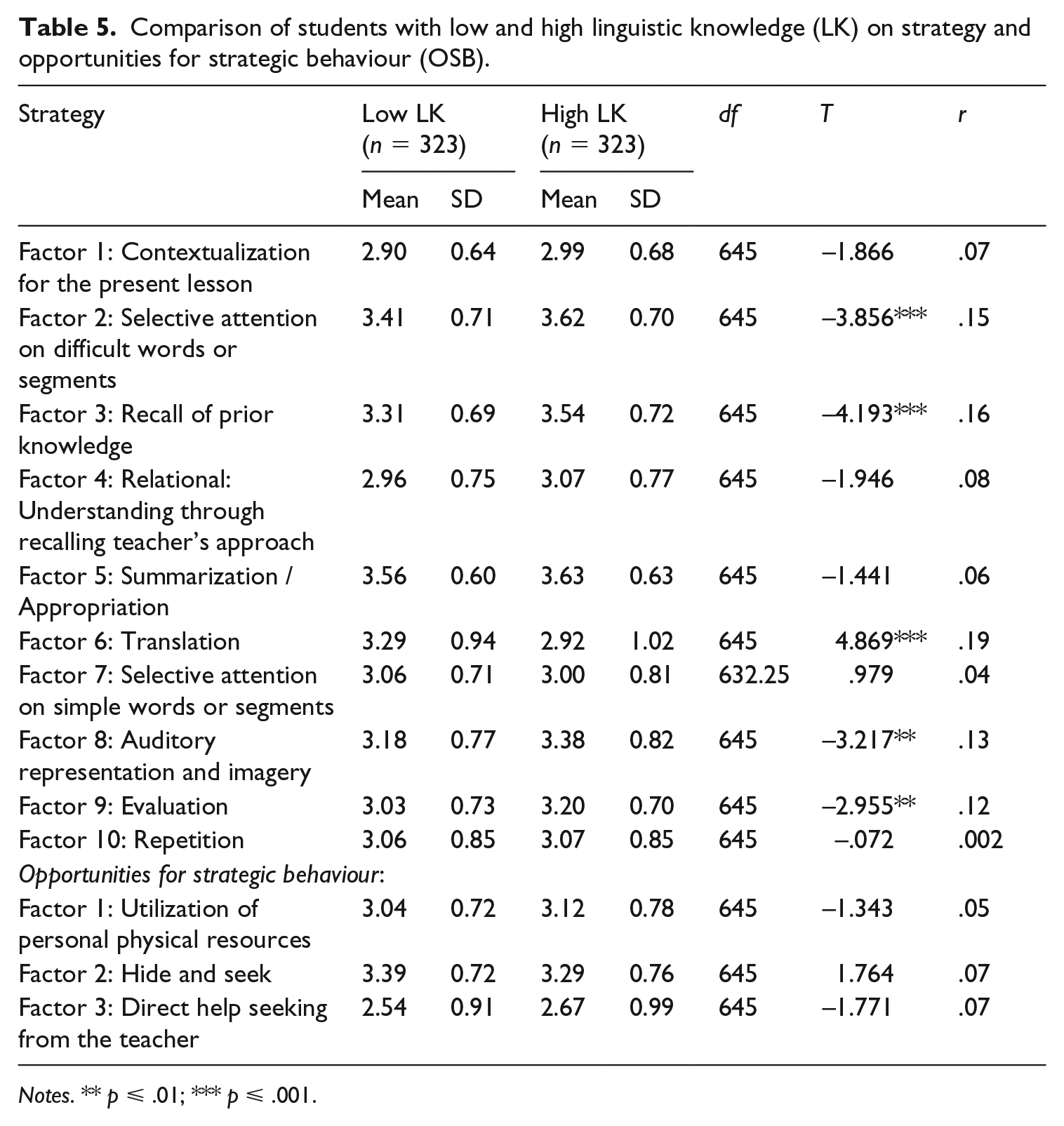
Notes. ** p ⩽ .01; *** p ⩽ .001.
Our second research question asked whether students with the same level of LK differed in the strategies used. Although the analysis so far which contrasted the low and high LK groups is revealing, it does not tease out how some learners of low LK might use strategies to compensate for their inadequate LK. Indeed, the comparison of learners with low and high LK produced relatively small effect sizes and high standard deviations, which might indicate great variability within group.
A cluster analysis was conducted to break down the low LK group into two distinctive clusters of more strategic and less strategic learners. Given that our study intended to explore whether and how students with the same level of LK might differ in their strategies, non-hierarchical K-means clustering was employed to maximize within-cluster homogeneity, following Morissette and Chartier’s (2013) suggestion for exploratory data analysis. Further, K-means is most relevant because of our predetermined specification of 2 clusters of low LK learners. On the other hand, hierarchical clustering, which identifies nested clusters (see, e.g., Tan, Steinbach, and Kumar, 2006), might not be useful because we only intended to separate learners into two distinctive (and not nested) groups of more versus less strategic. To perform the cluster analysis, variables have to be selected to predict group membership. In light of the findings so far that learners with higher LK tended to use certain strategies (selective attention on difficult words or segments, recall of prior knowledge, auditory representation and imagery, and evaluation) significantly more than those with lower LK, these strategies were selected as predictors. Such a selection would maximize the distances (and differences) of the clusters in these four strategies and allow the identification of a sub-group within the lower LK group who resembled more learners of higher LK. Specifying two clusters to be identified, learners of low LK were separated into a less strategic group (LLK/LS) and a highly strategic group (LLK/HS). Similar procedures were employed to divide the high LK learners into two clusters of less (HLK/LS) and highly strategic (HLK/HS). These cluster analyses, we would argue, are informative because subsequent analysis (see below) can find out whether (1) the two sub-groups of lower LK learners were still homogeneously less strategic than the two sub-groups of higher LK learners or (2) some low LK learners might be comparably strategic with the high LK learners in some or the whole range of strategies.
It was essential to first confirm that the LLK/LS and LLK/HS groups were still equally low in LK. Put differently, if the cluster analysis had separated the low LK group into two groups of differing LK, LK would be considered a confounding variable and research question 2 could not be answered. Likewise, it was of crucial importance to establish comparable LK for the HLK/LS and HLK/HS groups. Therefore, one-way analyses of variance (ANOVAs) were conducted, indicating a main effect of group with large effect sizes for VLT (F(3,642) = 173.20; p < .001; r = .67) and GJT scores (F(3,642) = 278.83; p < .001; r = .75). A post-hoc comparison (Games–Howell) revealed that with both tests, the HLK/LS and HLK/HS groups outperformed the other two groups with low LK (p < .001) whereas the two high LK groups did not differ from each other, as was the case with the two low LK groups.
Having established that the two low LK groups were equally low in their LK when compared to the two equally high LK groups, we turn to the comparison across groups in their strategic behaviour (see Table 6). Descriptively, the LLK/HS group reported more frequent use of all the strategies (and, importantly, not only those used to predict group membership in the cluster analysis) when compared to the LLK/LS group, and an almost identical trend was observed with the HLK/HS group reporting more use of strategies than the HLK/LS group. Crucially, the LLK/HS and HLK/HS group resembled each other in almost all the strategies variables except that the former group reported using more translation. A similar observation could be drawn by comparing the LLK/LS and HLK/LS groups with generally similar descriptive statistics except for translation, which was used more by the LLK/LS learners, but in addition to translation they also favoured more hide and seek.
Comparison of strategies across the LLK/LS, LLK/HS, HLK/LS, and HLK/HS groups.
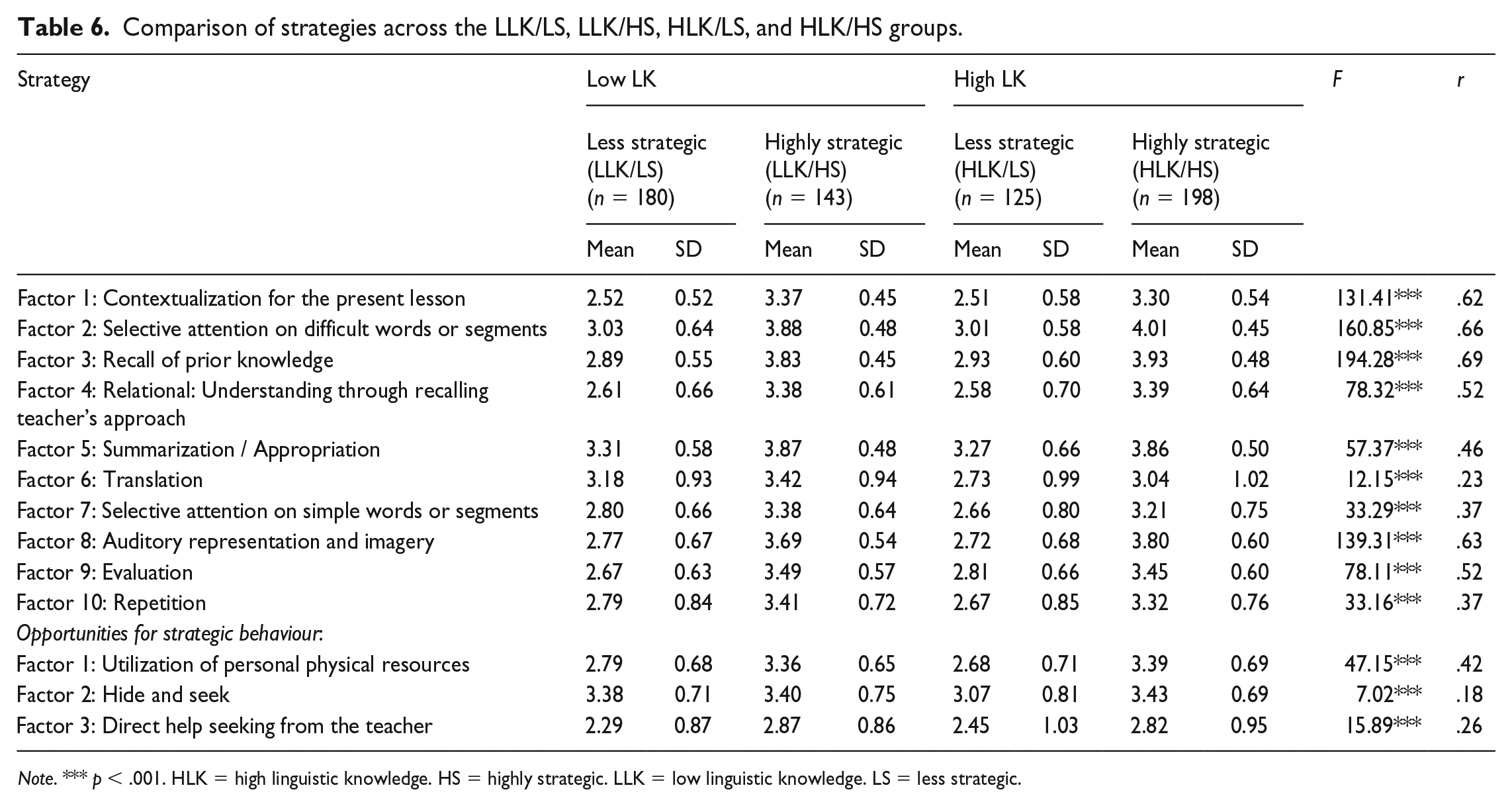
Note. *** p < .001. HLK = high linguistic knowledge. HS = highly strategic. LLK = low linguistic knowledge. LS = less strategic.
The one-way ANOVAs for each strategy factor indicated significant main effects of groups in all strategies (p < .001). Except for translation, hide and seek, and direct help seeking from the teacher which revealed small to medium effect sizes, all other differences showed medium to large effect sizes. Next, post-hoc tests were conducted (see Table 7).
Post-hoc tests to identify differences across groups.
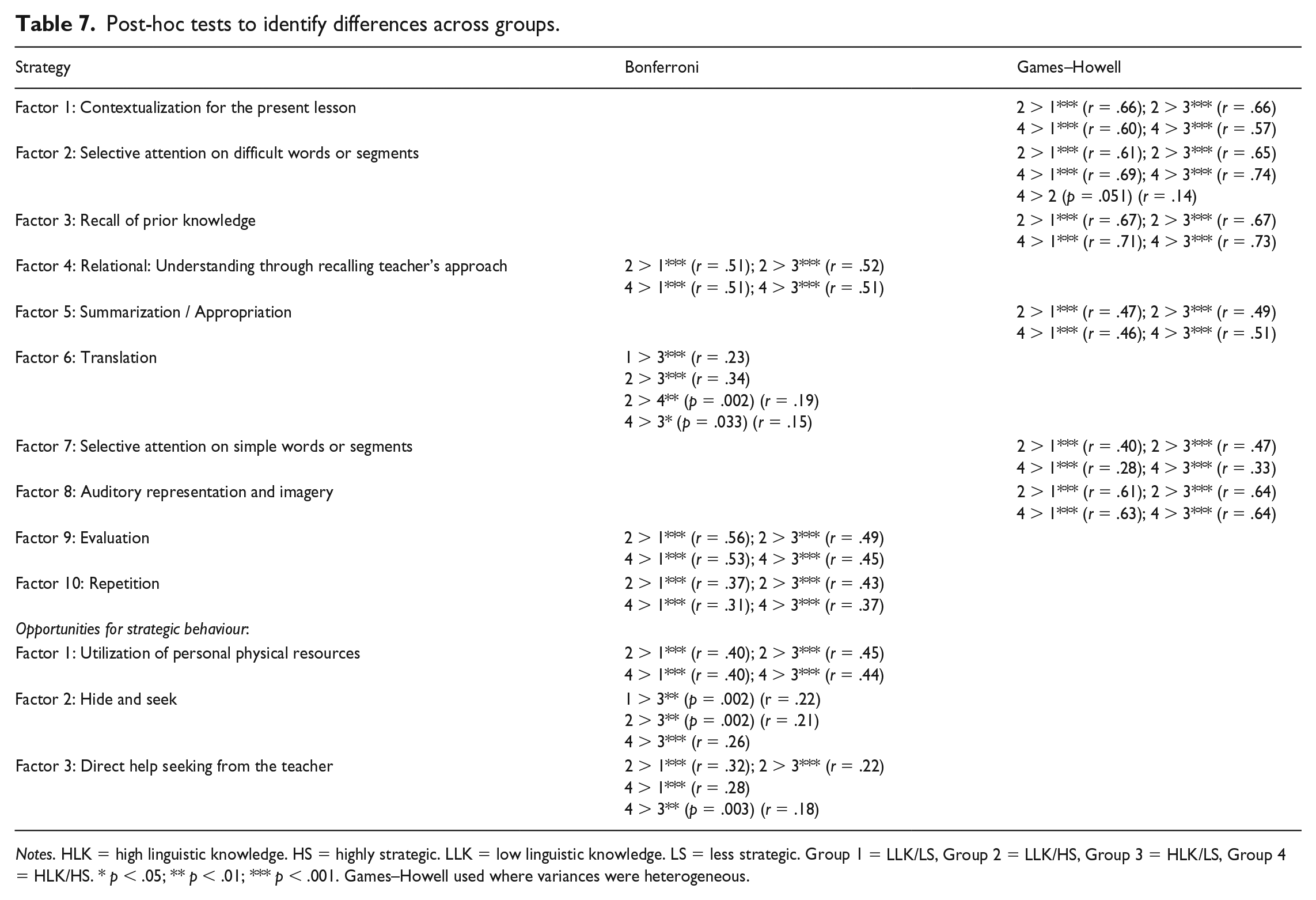
Notes. HLK = high linguistic knowledge. HS = highly strategic. LLK = low linguistic knowledge. LS = less strategic. Group 1 = LLK/LS, Group 2 = LLK/HS, Group 3 = HLK/LS, Group 4 = HLK/HS. * p < .05; ** p < .01; *** p < .001. Games–Howell used where variances were heterogeneous.
Most of the differences favoured group 2 (LLK/HS) and group 4 (HLK/HS), who reported being more strategic than group 1 (LLK/LS) and group 3 (HLK/LS). The two highly strategic (HS) groups did not differ from each other in most strategies, suggesting that they were comparably strategic in general (and again not only the four strategies used to predict membership in the cluster analysis) despite their different levels of LK. Similarly, the two less strategic (LS) groups did not differ from each other in most strategy variables. Of special interest is that the LLK/HS group used more strategies than some students with higher LK (the HLK/LS group). Such findings indicated that some lower LK learners might rely more on their repertoire of strategies to compensate for their inadequate LK.
These trends – the two HS groups being comparable and both reporting more strategies than the two comparable LS groups – were maintained in all strategies and OSBs with medium to large effect sizes except two: translation and hide and seek. For translation, the two LLK groups did not differ from each other, and both groups reported more use of translation than the HLK/LS group. The LLK/HS group also used more translation than the HLK/HS group, which in turn used more translation than the HLK/LS group, although the significance value was not as high (p = .033). These findings indicate that while the two HS groups were comparable in a range of strategies, the lower LK students relied more on translation strategies than those with higher LK. Similarly, the LLK/LS group was comparable to the HLK/LS group in a range of strategies but relied more heavily on translation. More interestingly, while the LLK/LS group was less strategic than the two HS groups, these LLK/LS students were comparable in their use of translation strategies with the HS students, further showing their heavy reliance on translation. Such an observation contrasted how the HLK/LS students did: that they were consistently using fewer strategies in the whole range of strategies including translation, without relying on any particular strategies.
With hide and seek, the HLK/LS group used it less than the other three groups, further suggesting their not favouring any particular strategies than the other three groups. Interestingly, the LLK/LS group was again comparable with the two HS groups in their use of hide and seek.
Finally, it was noteworthy that the HLK/HS group almost significantly (p = .051) used more selective attention on difficult words or segments than the LLK/HS group. This finding could be indicative of the role of LK in strategy use because the limited LK of the LLK/HS students might be constraining how they could selectively attend to the difficult words.
V Discussion
We begin by summarizing the findings of our study before relating them more discursively to the research questions:
A group of strategies was reported as being used more frequently than others: recall of prior knowledge; selective attention on difficult words; summarization. It is not surprising that in a task such as listening to a teacher there should be some strategies reported as being used more than others. This does not mean that they are effective strategies (Anderson, 1991; Macaro, 2010) merely that they are highly likely to be deployed when listening to spoken text. That in general students did not seek help from the teacher was also in line with the context of our study.
Lower LK students used translation statistically more often than Higher LK students. These are different findings from those presented in studies which equate proficiency with general high strategy use (O’Malley et al., 1985) but in line with studies which show that lower proficiency students try to translate words they don’t recognize (Vandergrift, 2003).
Higher LK students reported using selective attention on difficult words or segments, recall of prior knowledge, auditory representation and imagery and evaluation significantly more than Low LK students (cf. Vandergrift, 2003).
When the LK groups were subdivided, some Low LK students reported using different strategies from their Low LK peers. Some of these strategies resembled those of High LK students but not all; translation, for example, was retained as typical of the Low LK students’ repertoire of strategies.
When the LK groups were subdivided, some High LK students reported using different strategies from their High LK peers. Some of these strategies resembled those of Low LK students but not all.
This study sought to investigate whether students with different levels of vocabulary and grammatical knowledge reported adopting different strategic behaviour. If this question was answered positively then we might conclude that strategic behaviour was dependent on the levels of LK. However, we would not be able to draw that conclusion without also investigating our second research question: whether students with the same level of vocabulary and grammatical knowledge reported adopting different strategic behaviour. If we found that the first research question pertained but also did the second, then we could not assume or conclude that strategic behaviour was wholly dependent on LK. This is because the strategic behaviour would appear to be, in at least some cases, independent of LK.
Our findings overall suggest that this is in fact the case: LK may be both constraining and enabling (e.g. Graham et al., 2010). It probably allows High LK learners to use certain strategies more easily than low LK learners because higher vocabulary recognition in the speech stream disposes of the need to selectively attend to individual words and think about what they might mean in L1. Higher grammatical knowledge perhaps leads to fewer interpretation problems involving such domains as agency, anaphora and tense.
Conversely, low vocabulary and grammatical knowledge leads to a focus on individual words and possibly greater selective attention to parts of the speech stream where ambiguity may reside, in turn leading to greater attempts at translation. However, unlike previous interpretations, we interpret the fact that Lower LK students using frequent translation as being an inevitable consequence of having low LK and not in any way related to some abstract notion of listening proficiency. We can assert this because regardless of whether the Lower LK students were clustered as high strategy users or low strategy users they equally reported using translation to help them comprehend the teacher’s input.
However, crucially, our findings also suggest that LK may not just be enabling to those who have lots of it and constraining to those who have less. A sizeable subgroup of our overall sample showed that students with low LK reported deploying a much wider range of strategies than their low LK peers. In other words, their strategic behaviour was much more independent of the constraints imposed by low LK. Although they manifested some similarities with their low LK peers (they were inevitably forced to ‘translate’ words), they also were able to deploy other strategies to potentially compensate for their low LK. Our findings therefore provide a strong insight into LLS and contribute to building LLS theory. Our findings also make sense at face value. Some listeners with low LK are never able to free themselves from the constraints that low LK (in relation to a task) impose on them thereby matching quantitatively previous qualitative findings (e.g. Graham et al., 2010). Other low LK listeners are able to free themselves; this is what makes them strategic.
Given these findings, the present study also suggests important pedagogical implications. First, in addition to vocabulary instruction (e.g. Pan et al., 2018), teachers can encourage students to use a broader range of listening strategies (and OSBs), both generally and, as in our case, when listening to their teacher. Raising learners’ awareness of and competence in using listening strategies can potentially enhance the effectiveness of teaching and learning, as shown by previous research on the effectiveness of listening strategy instruction. At the same time, teachers should themselves be more aware of the possibility that learners could be using a range of strategies when trying to comprehend their input in the L2 classroom, even at times when they do not make their lack of understanding known to the teacher. Therefore, teachers can at least recognize that learners, including those with low LK, might be trying hard in their mind to understand the teacher talk.
VI Conclusions
Our findings would lend support to the notion of the Good Language Learner (Naiman et al., 1978; Rubin, 1975) but we are now able to define the GLL differently. We are not suggesting that a GLL is someone who has attained high levels of proficiency, high levels of achievement, high levels of language learning success and so on. What we are saying is very akin to what Canale and Swain were alluding to 39 years ago when they talked about ‘the compensatory communication strategies to be used when there is a breakdown in one of the other competencies’ (Canale and Swain, 1980, p. 27). Of course their suggestion was restricted to language production, the strategies a speaker might use when stumped for words or unsure about a grammatical construction, but the basic principle is the same. The GLL is likely to be the learner who overcomes linguistic difficulties brought about by inadequate linguistic knowledge, the high linguistic knowledge required to ‘sail through’ a task without stopping to think about it.
We use the word ‘likely to be’ because in our study we do not have two important measures, and these we consider to be limitations that future studies might put right. The first is a measure of the four groups’ (LLK/LS, etc.) listening proficiency as measured through one but preferably a minimum of two different listening comprehension tasks (different ones needed to ensure a whole range of task type strategies). If we had this measure, we could say that the LLK/HS group demonstrated their compensation for their lack of resources by being strategic and the result was better comprehension than the LLK/LS group. However, we were constrained by the nature of the listening task we were investigating: listening to the teacher. We were not able to find a way of measuring a class of students’ understanding of teacher talk for both logistical reasons and reasons of professional tact. A number of other variables would have to be controlled for such as prior knowledge of the topic (see, e.g. Chou, 2015), but this could not be done in our study because of the impact it would have on the students’ time in class.
The second measure that is missing is some kind of longitudinal measure, showing a change over time in two of the variables (see Macaro, 2010). A recent study by Dong (2016) also adopted a dynamic conceptualization of listening strategy use and listening performance through following the development of a Chinese EFL learner.
A possible third area that might be explored is a broader interpretation of LK to go beyond the most obvious vocabulary and grammar as we have done in this study and also perhaps incorporate phonological and pragmatic knowledge. Such inclusion would be helpful because understanding the teacher would involve some degree of decoding ability.
We very much hope that our article will serve as a springboard for further research in the areas delineated above. We believe that as a first large-scale study foregrounding the importance of LK in relation to strategic behaviour within an under-researched context of ‘listening to the teacher’: an apt context in revealing how language learning can be strategically achieved, researchers in the field can continue refining and theorizing the concept of the GLL.
Supplemental Material
Appendix_A – Supplemental material for Exploring the relationship between linguistic knowledge and strategy use in listening comprehension
Supplemental material, Appendix_A for Exploring the relationship between linguistic knowledge and strategy use in listening comprehension by Daniel Fung and Ernesto Macaro in Language Teaching Research
Footnotes
Appendix
Likert-scale questionnaire with mean ratings.
| Instruction a | What do you normally do, particularly in your mind, to understand the teacher |
|||
| Please read the following strategies, and respond by rating 1 to 5 according to the description below. |
||||
| Number | Strategies | Mean rating (n = 646) | SD | Factor b |
| 1 | I focus attention on every word in the teacher’s talk. | 3.44 | 0.83 | S9 |
| 2 | I repeat fully what the teacher just said in my mind. | 2.95 | 1.01 | S10 |
| 3 | I follow the physical actions that my classmates do. | 3.02 | 1.08 | OSB2 |
| 4 | I simplify what the teacher said into something I understand. | 3.57 | 1.01 | S5 |
| 5 | I visualise in my mind what the teacher is asking me to do. | 3.16 | 1.11 | S4 |
| 6 | I translate the entire teacher’s talk into Chinese. | 2.92 | 1.21 | S6 |
| 7 | I recall what I read during my preparation for the lesson. | 2.77 | 1.07 | S1 |
| 8 | I evaluate how much attention I am giving to the teacher. | 2.78 | 1.02 | S9 |
| 9 | I anticipate the key vocabulary of the topic of this lesson. | 2.55 | 1.08 | S1 |
| 10 | I guess the intention of the teacher in saying something. | 3.26 | 1.10 | S3 |
| 11 | I list out in my mind step by step what the teacher is asking me to do. | 3.25 | 1.01 | S3 |
| 12 | I list out in my mind what I learnt in the previous lesson. | 3.02 | 0.95 | S1 |
| 13 | I identify the overarching meaning of the teacher’s talk. | 3.92 | 0.81 | S5 |
| 14 | I integrate everything I understand within the teacher’s talk. | 3.90 | 0.85 | S5 |
| 15 | I visualise in my mind a picture to represent the new vocabulary being taught. | 2.97 | 1.10 | S8 |
| 16 | I review my notes. | 3.03 | 1.17 | OSB1 |
| 17 | I rephrase what the teacher said into something I understand. | 3.47 | 0.96 | S5 |
| 18 | I recall what I have learnt in the previous lesson to help me understand the present teacher’s talk. | 3.14 | 0.99 | S1 |
| 19 | I evaluate my understanding and find out how much I understand. | 3.13 | 0.97 | S9 |
| 20 | I look up the difficult words in a dictionary. | 3.64 | 1.16 | OSB1 |
| 21 | I focus attention on the keywords of the teacher’s talk. | 3.65 | 0.90 | S2 |
| 22 | I ask my classmates what the teacher means. | 3.60 | 1.15 | OSB2 |
| 23 | I recall the key contents of this English lesson. | 3.04 | 0.97 | S1 |
| 24 | I use my knowledge on English pronunciation to help me understand. | 3.51 | 1.06 | S8 |
| 25 | I ask the teacher what s/he means. | 2.70 | 1.17 | OSB3 |
| 26 | I recall all knowledge about English grammar. | 3.12 | 0.94 | S1 |
| 27 | I focus attention on what the teacher has corrected me, when s/he repeats what I said. | 3.61 | 1.07 | S2 |
| 28 | I recall my previous experiences in doing English exercises. | 3.09 | 1.03 | S1 |
| 29 | I anticipate what the teacher is going to say later. | 2.75 | 1.12 | S4 |
| 30 | I recall the key contents of the previous lesson. | 2.74 | 0.95 | S1 |
| 31 | I translate the keywords in the teacher’s talk into Chinese. | 3.33 | 1.15 | S6 |
| 32 | I recall previous life experiences which are related to the teacher’s talk. | 3.15 | 0.95 | S6 |
| 33 | I search in my mind to find out if I have learnt about the topic of this lesson before. | 3.25 | 1.00 | S1 |
| 34 | I visualise in my mind the picture of my learning in the previous lesson. | 2.69 | 1.02 | S1 |
| 35 | I focus attention on all the difficult words in the teacher’s talk. | 3.42 | 1.03 | S2 |
| 36 | I refer to my textbook or worksheets to remind myself the key contents of this lesson. | 3.26 | 1.12 | OSB1 |
| 37 | I ask the teacher to repeat. | 2.39 | 1.08 | OSB3 |
| 38 | I repeat partially what the teacher just said in my mind. | 3.18 | 1:00 | S10 |
| 39 | I focus attention on one of the difficult words in the teacher’s talk. | 3.35 | 1.04 | S2 |
| 40 | I focus attention on the sounds of the difficult words. | 3.47 | 1.09 | S2 |
| 41 | I focus attention on the words emphasised by the teacher. | 3.74 | 0.99 | S2 |
| 42 | I signal to the teacher that I don’t understand. | 2.76 | 1.18 | OSB3 |
| 43 | I find clues on the blackboard to help me understand the teacher. | 3.58 | 1.01 | OSB2 |
| 44 | I observe what my classmates do to help me understand the present teacher’s talk. | 3.59 | 1.06 | OSB2 |
| 45 | I focus attention on the unfamiliar words in the teacher’s talk. | 3.50 | 0.97 | S2 |
| 46 | I write down what the teacher said. | 2.23 | 1.14 | OSB1 |
| 47 | I focus attention on the content words in the teacher’s talk. | 3.37 | 0.96 | S2 |
| 48 | I look up the difficult words in my textbook. | 3.31 | 1.18 | OSB1 |
| 49 | I anticipate what the teacher is going to ask me to do later. | 2.77 | 1.13 | S4 |
| 50 | I recall the mistakes I made in the past. | 3.26 | 1.13 | S3 |
| 51 | I search in my mind to find out if I have learnt about this vocabulary before. | 3.55 | 1.02 | S3 |
| 52 | I remind myself of the teacher’s usual way of saying things. | 2.89 | 1.08 | S4 |
| 53 | I recall the vocabulary which I know. | 3.60 | 0.98 | S3 |
| 54 | I break the teacher’s talk into smaller segments to ease my understanding. | 3.02 | 1.03 | S7 |
| 55 | I hold the sounds of the difficult words in my mind. | 3.35 | 1.08 | S8 |
| 56 | I focus attention on the simple words in the teacher’s talk. | 2.91 | 1.05 | S7 |
| 57 | I search in my mind to find out if I have learnt similar words before. | 3.47 | 0.99 | S3 |
| 58 | I pretend that I understand (e.g. nod my head). | 2.91 | 1.27 | OSB2 |
| 59 | I recall what I read in my English textbook. | 2.99 | 1.04 | S1 |
| 60 | I focus attention on the familiar words in the teacher’s talk. | 3.16 | 0.99 | S7 |
| 61 | I refer to my textbook or worksheets to remind myself the key contents of the previous |
3.01 | 1.05 | OSB1 |
| 62 | I summarise what the teacher said into a short sentence. | 3.15 | 1.05 | S5 |
| 63 | I identify the important points of the teacher’s talk. | 3.56 | 0.99 | S5 |
| 64 | I integrate my old knowledge and the new content which I don’t understand. | 3.45 | 0.95 | S3 |
| 65 | I recall what the teacher said previously to help me understand the present teacher’s talk. | 3.23 | 1.00 | S3 |
Note. a. For this study, the items were presented bilingually with Chinese translation.
S1: Contextualization for the present lesson; S1: Selective attention on difficult words or segments; S3: Recall of prior knowledge; S4: Relational – understanding through recalling teacher’s approach; S5: Summarisation / Appropriation; S6: Translation; S7: Selective attention on simple words or segments; S8: Auditory representations and imagery; S9: Evaluation; S10: Repetition; OSB1: Utilisation of personal physical resources; OSB2: Hide and seek; OSB3: Direct help seeking from the teacher
These factors were only identified after administering the questionnaire through an exploratory factor analysis, and the column was not present in the original questionnaire completed by the participants of the study. These labels presented here are only for ease of reference.
Funding
The author(s) received no financial support for the research, authorship, and/or publication of this article.

Supplemental material
Supplemental material for this article is available online.
Notes
References
Supplementary Material
Please find the following supplemental material available below.
For Open Access articles published under a Creative Commons License, all supplemental material carries the same license as the article it is associated with.
For non-Open Access articles published, all supplemental material carries a non-exclusive license, and permission requests for re-use of supplemental material or any part of supplemental material shall be sent directly to the copyright owner as specified in the copyright notice associated with the article.
