



Abstract
This article investigates how engaging students to discuss topics that reflect their ideologies in lingua franca (LF) virtual exchanges can help facilitate global citizenship development. A six-week virtual exchange is explored with students from universities in Mexico, Poland, Spain, and the USA. This study utilizes five key elements of CALL-related tasks and three categories of telecollaborative tasks in order to promote students’ global citizenship, defined as awareness, caring, and embracing cultural diversity while promoting social justice and sustainability, coupled with a sense of responsibility to act. During the exchange, 55 participants, registered for foreign language courses (English or Spanish) or for a content area course (such as business and pedagogy) taught in English, met weekly in groups via Zoom video conferencing. In addition to discussing weekly topics, via selected current event photos, and using either English or Spanish as a LF, participants completed individual weekly pre- and post-Zoom session activities. Qualitative analyses revealed that weekly topics offered opportunities to problem solve, negotiate ideologies, and make connections to participants’ belief systems. Also, results indicated that participants became more socially responsible as shown by their increased citizenship awareness and civic-mindfulness.
Keywords
I Introduction
Virtual exchanges 1 have been increasingly used in the language learning context and beyond to develop the skills needed for meeting challenges of the complex contemporary world (Lewis, O’Rourke, & Dooly, 2016). Defined as ‘sustained, technology-enabled, people-to-people education programmes or activities in which communication and interaction takes place between individuals or groups who are geographically separated and from different cultural backgrounds, with the support of educators or facilitators’ (EVOLVE, 2018), virtual exchanges have been reported to promote development of linguistic and intercultural competences (Çiftçi and Savaş, 2018; O’Dowd, 2018a), learner autonomy (Fuchs, Hauck, & Müller-Hartmann, 2012) multiliteracies (Guth and Helm, 2011) and overall, to create a transformative learning experience (Bohinski 2 and Leventhal, 2015).
Linguistic and intercultural competences are interconnected with ideologies (Bouchard, 2017). Embracing ideological perspectives of learners with diverse cultural background closely relates to the setting of virtual exchanges. Described as ‘collectively operational, power-driven systems of beliefs, valuations, and feelings that intersect with social constructs such as identity, agency, language, learning, and education and social issues such as linguistic rights and language policies’ (The Douglas Fir Group, 2016, p. 37), ideologies are present in every aspect of social activity and influence ways of perceiving and interpreting the world. In sum, because of their affordances to develop intercultural and linguistic competences, virtual exchanges provide a suitable space to discuss ideological perspectives.
As globalization has become the world’s reality, education has been significantly affected, and the needs for curriculum internationalisation (Dorner, 2016) relocating learning beyond the traditional classroom (Lock, 2015), as well as developing among students’ competencies for global citizenship have been recognized (Byram, 2012; Leask, 2015; O’Dowd, 2017). That is why it is necessary to identify learning environments and teaching methods to advance development of not only key skills for the socio-economic growth of the 21st century (Partnership for 21st Century Skills, 2009), but also more ethical competences for citizenship and global community awareness (Council of Europe, 2016; Leask, 2013). Consequently, also crucial are equipping learners with critical intercultural competences and helping them develop into ‘informed and engaged global citizens’ (Godwin-Jones, 2015, p. 18).
Developed from foreign language learning and teaching contexts, Byram’s (2008) concept of intercultural citizenship is related to a more current concept of global citizenship (Wu, 2018). Byram’s (2008) framework for intercultural citizenship draws on both language and political learning and, as a result, heightens cultural awareness and fosters taking action in the world. To reach these goals, the following set of orientations needs to be adopted: (1) evaluative orientation, i.e. developing critical approach towards own and other’s culture, (2) cognitive orientation, i.e. acquiring procedural knowledge about cultures and democratic processes, (3) comparative orientation, i.e. allowing for both taking and mediating alternative perspectives, (4) the communicative orientation, i.e. gaining linguistic, sociolinguistic and discourse competence, and (5) the action orientation, i.e. cooperating with community and showing responsibility for common interests (Byram, 2008).
Concerns about learning outcomes, related to global citizenship, have been voiced in the virtual exchange contexts, indicating not only the need of awareness raising towards ‘different cultural perspectives on local and global issues’ (Guth and Helm, 2011, p. 42), but also a more active engagement of students (O’Dowd, 2018a; O’Dowd, 2019). Preparing students for global citizenship through online exchanges has been highlighted in studies exploring digital literacy skills (Orsini-Jones et al., 2017), intercultural communicative competence (Orsini-Jones and Lee, 2018) and non-native/lingua franca (LF) speaker identity (Kohn and Hoffstaedter, 2017). This study, however, is the first one to discuss how engaging students with ideologies, may enable them to recognize responsibility to act and foster development of global citizenship. Authors focus on ideologies (The Douglas Fir Group, 2016) so that attention is brought to ‘themes which are of social and political relevance’ (O’Dowd, 2019, p. 11). Because of this, ideologies are contextualized into what authors call societal macro topics, to centre on specific global themes.
1 Defining global citizenship
On one side of the continuum, Kirkwood (2001) defines global citizenship as a matter of awareness and knowledge. At the other extreme, there is a more proactive model of global citizenship, in which prosocial values, civic engagement and willingness to leave one’s comfort zone play an important role (Lilley, 2014; Reysen & Katzarska-Miller, 2013). Lilley (2014) finds the global citizenship construct to be complex and multi-level, grounded in moral and cosmopolitan values while Reysen and Katzarska-Miller (2013) interpret global citizenship as ‘a mind-set or attitude one takes’ (p. 860). Although there are many definitions of global citizenship in the existing relevant literature (De Wit, Hunter, Jones, and Leask, 2013), this study adopts the following definition of the term global citizenship: ‘awareness, caring, and embracing cultural diversity while promoting social justice and sustainability, coupled with a sense of responsibility to act’ (Snider, Reysen and Katzarska-Miller, 2013, p. 1600).
2 Lingua franca virtual exchanges
Although a dominating position of English as a lingua franca (ELF) in the world communication has become evident (Seidlhofer, 2005), there is little research in organizing virtual exchanges utilizing ELF (Akiyama and Cunningham, 2018) among university students (Guth & Helm, 2011) or teacher candidates (Loranc-Paszylk, 2018). LF exchanges, in which participants do not share the same first language, have been characterized by ‘multilingual communication in which English is available as a contact language of choice’ (Jenkins, 2015, p. 73). Interaction which utilizes English as a multilingua franca (EMF) may occur in heterogeneous groups involving both native and non-native speakers (Seidlhofer, 2005), and most importantly, it is characterized as ‘functionally by its use intercultural communication rather than formally by its reference to native-speaker norms’ (Hülmbauer, Böhringer, & Seidlhofer, 2008, p. 26).
Discussing ideologies can offer a chance to allow students to make connections to their belief systems (The Douglas Fir Group, 2016), which in turn can provide opportunities to trigger deeper discussions to explore global citizenship. They also reflect action orientation (Byram, 2008) and can be interpreted as an indication of the attitude of ‘civic-mindfulness’ (Council of Europe, 2016) which ‘involves a sense of belonging to [the]community, an awareness of other people in the community, an awareness of the effects of one’s actions on those people, solidarity with other members of the community and a sense of civic duty towards the community’ (pp. 12–13). Discussing ideologies have also been used in a limited number of virtual exchange studies and reported to facilitate intercultural learning (Guarda, 2013; Helm, Guth, & Farrah, 2012). In their virtual exchange study, Helm et al. (2012) qualitatively explored learners of English as a foreign language (EFL) from universities in Palestine and Italy. The students discussed political issues dividing the Western World and the Arab and Muslim world via audio-video conferencing. This dialogue allowed learners to discuss perspectives regarding their countries and the critical issues they were facing. The researchers found that such virtual exchange settings provided ‘the opportunity to overcome the hegemonies that exist on the macro-level in our societies and allow people to get to know and understand each other’ (Helm et al., 2012, p. 118).
In a similar vein, Guarda (2013) investigated the effectiveness of LF virtual exchanges in enriching participants’ intercultural learning. Students from universities in Italy and Austria took part in this exchange, their weekly diaries and online posts were analysed and showed that they looked at metacultural issues from a critical perspective. The topics discussed were related, for example, to stereotyping, the role of the media in shaping social labels, gender and ethnic discrimination. ‘[T]he transnational character of the topic is embedded in the constant shift of focus from the personal to the local, national and global level’ (Guarda, 2013, p. 145). Finally, the post project questionnaires revealed that the use of ELF promoted creation of shared spaces.
3 Task design in virtual exchanges
Virtual exchanges have been traditionally situated in a task-based language teaching (TBLT) framework, where the task is the central unit to L2 learning (Dooly, 2017). In their review of over 40 reports, O’Dowd and Ware (2009) identified 12 different task types in the following three categories for virtual exchanges: (1) information exchange tasks, (2) comparison and analysis tasks, and (3) collaborative tasks. In the information exchange task, information is exchanged between partners with little negotiation of meaning. In comparison and analysis tasks, by exchanging ideas with their partners, students need to compare and analyse cultural artefacts. While in collaborative tasks, students complete the work of information exchange tasks, comparison and analysis tasks, then afterwards collaborate on a final output activity with their partners.
González-Lloret and Ortega (2014) identified five key elements of CALL-related tasks: (1) Primary focus on meaning, (2) Goal orientation, (3) Learner-centredness, (4) Holism, and (5) Reflective learning. First, there should be a primary focus on meaning. Although there may be language goals already predetermined by the instructor, it is important that for at least part of the task, learning occurs organically, without explicitly stating a language focus. Second, students must be working towards a goal. Therefore, tasks must be designed with a communicative purpose and a specific outcome achieved through the task. Third, the task needs to be learner-centred. Fourth, the task must be a holistic one where students are engaged in real-word and authentic language use. Finally, the task must have a reflective piece so that students can contemplate their experience.
There has been some debate related to task content and topics that the students should be given to discuss while engaged in virtual exchange tasks. O’Dowd (2018b, p. 8) criticized tasks which utilized ‘a superficial approach to culture’ (O’Dowd, 2018b, p. 8) and involved students with topics related to food or holiday celebration. El-Hariri (2016), while investigating the type of topics that would be of interest to students in virtual exchanges, found that students preferred topics related to their daily lives, in which could utilize their existing background knowledge and as a result be able to interact spontaneously and express their opinions.
Regardless of the type of telecollaborative tasks, they can be carried out through synchronous computer-mediated communication (SCMC). SCMC allows students to interact (Chen, Ko, Kinshuk et al., 2005) and provides students with opportunities to collaborate in a group and community-building setting (Branon and Essex, 2001). Utilizing Web 2.0 has made incorporating virtual exchange into the language classroom relatively easy through video conferencing (Hartwiger and Moore, 2015), such as Skype (Terhune, 2016) and Zoom (Bohinski & Mulé, 2016).
II Research question
In order to address the importance of developing global citizenship among students (O’Dowd, 2017), the aim of this study is to explore the use of ideologies in LF virtual exchanges and its impact on students’ perceptions of global citizenship. This study laid much needed groundwork for ways to design activities that integrate ideologies to prepare learners for the challenges of the 21st century and answers the following research question: In what ways do LF virtual exchanges that utilize the societal macro topics of Sports and patriotism, Advertising, Crime, and Natural disasters facilitate global citizenship development?
III The Study
1 Project goals
This project had three main goals. They included the following: (1) to promote intercultural learning through engaging students in online interactions with peers from another country, (2) to promote collaborative learning and teamwork by organizing tasks which require students to co-construct output, and (3) to allow the students the opportunity to obtain perspectives on the differences and similarities on given topics related to ideological structures (The Douglas Fir Group, 2016, p. 25).
Having those goals in mind, this virtual exchange study’s design included LF telecollaborative tasks in all of the three categories: (1) information exchange tasks, (2) comparison and analysis tasks, and (3) collaborative tasks (O’Dowd and Ware, 2009). In addition, when researchers were planning the weekly procedures for this six-week exchange, they made sure that the exchange included all five key elements of technology-mediated TBLT (González-Lloret and Ortega, 2014). First, participants were able to focus on ideologies since there was not a focus on language learning. Second, participants worked towards completing communicative goals and achieving specific outcomes. Third, all the activities were learner-centred as the participants completed synchronous sessions and activities pertaining to the virtual exchange outside of class time. Fourth, participants were using language in an authentic way to discuss meaningful, purposeful activities related to ideologies. Finally, participants were not only able to reflect about and in their synchronous sessions, but also in worksheets.
2 Methodology
This study used qualitative methods. All participants completed surveys before and after Zoom sessions during the virtual exchange. Qualitative analyses, including word frequencies and coding, were completed on open-ended responses using NVivo for Windows 12. In addition, video transcripts were used to triangulate the data.
3 Participants
There was a total of 55 participants, with an average age of 23.3 years old (SD = 7.0). Each participant was grouped into one of four partnerships for the six-week virtual exchange. Each partnership was comprised of participants from two of five institutions from one of four countries. Participants were either registered undergraduate or graduate students from a variety of courses, ranging from language to pedagogy courses. The virtual exchange that the 55 participants took part in was a required part of their coursework, and they consented to be research participants. Regardless of the course content, the same procedures were followed by all participants and carried out in a LF (English or Spanish). 3 This LF was dependent on the language of instruction for the registered courses (English or Spanish), which all participants were at minimum Intermediate (B1) learners on the Common European Framework of Reference.
4 Technology used
Building on past work (Lenkaitis, 2019a, 2019b; Lenkaitis & English, 2017; Lenkaitis, Calo & Venegas Escobar, 2019; Lenkaitis, Loranc-Paszylk & Hilliker, in press), the authors chose to utilize Zoom (https://zoom.us) so that participants could video conference their partner(s) to discuss weekly topics in a LF in an online small group setting (Lenkaitis & English, 2017). Participants also used Google to complete weekly activities.
5 Weekly procedures
Echoing Lenkaitis (2019a), each of six weeks consisted of at least one 15-minute synchronous Zoom session. To ensure that all participants were given the same instructions, everything, including how-to information about Zoom, was shared on the Google drive. All participants were instructed to use a LF (English or Spanish), which was identical to the language of instruction in their registered courses.
6 Weekly topics and images
Ideologies (The Douglas Fir Group, 2016) were contextualized into societal macro topics that had relevance to each of the partnering countries. The following were chosen by researchers and utilized in the LF virtual exchange: Sports and patriotism, Advertising, Crime, and Natural disasters so that themes pertaining to society (O’Dowd, 2019) were the foci. For each weekly topic, authentic images from each partnering country was used during activities. All images chosen by researchers, in consultation with instructors from each country of the exchange, and then piloted by L2 learners.
7 Weekly Zoom sessions
Prior to meeting about the weekly topics, during Week 1 of the virtual exchange, participants met on Zoom and introduced themselves to their group member(s).
For Weeks 2–5, Zoom sessions centred around the weekly societal macro topics of Sports and patriotism, Advertising, Crime, and Natural disasters. Participant(s) from each side of the partnership were given different images, without any information about it. The image that was given coincided with the weekly topic and was from their group member(s)’ institution’s country. For example, in groups that partnered L2 learners from the USA and Poland, participants from the USA were given images from Poland and participants from Poland given images from the USA. In this way, it was the researchers’ aim that during the Zoom session, lasting at least 15 minutes, the opposing group member(s)’ would be able to share information about the image taken from their country in order to promote interaction in task-based call (González-Lloret, 2003). Not only did participants exchange information, but also compared and contrasts their cultural artefacts (images) with one another. Before and after each Zoom session during Weeks 2–5, participants completed worksheets where they answered an open-ended question (Explain how this week’s topic is related to global citizenship) about the weekly societal macro topic. During Week 6, participants were instructed to meet with their partner(s) and talk about their entire virtual exchange experience.
IV Results
Over the 6-week implementation period, the 55 participants recorded approximately 112 hours of total Zoom time. Therefore, on average each participant completed over 2 hours of videoconferencing sessions during the entire virtual exchange. Researchers watched videos to ensure that all participants completed the SCMC activities as instructed.
1 Global citizenship relevance
Post-Zoom worksheet
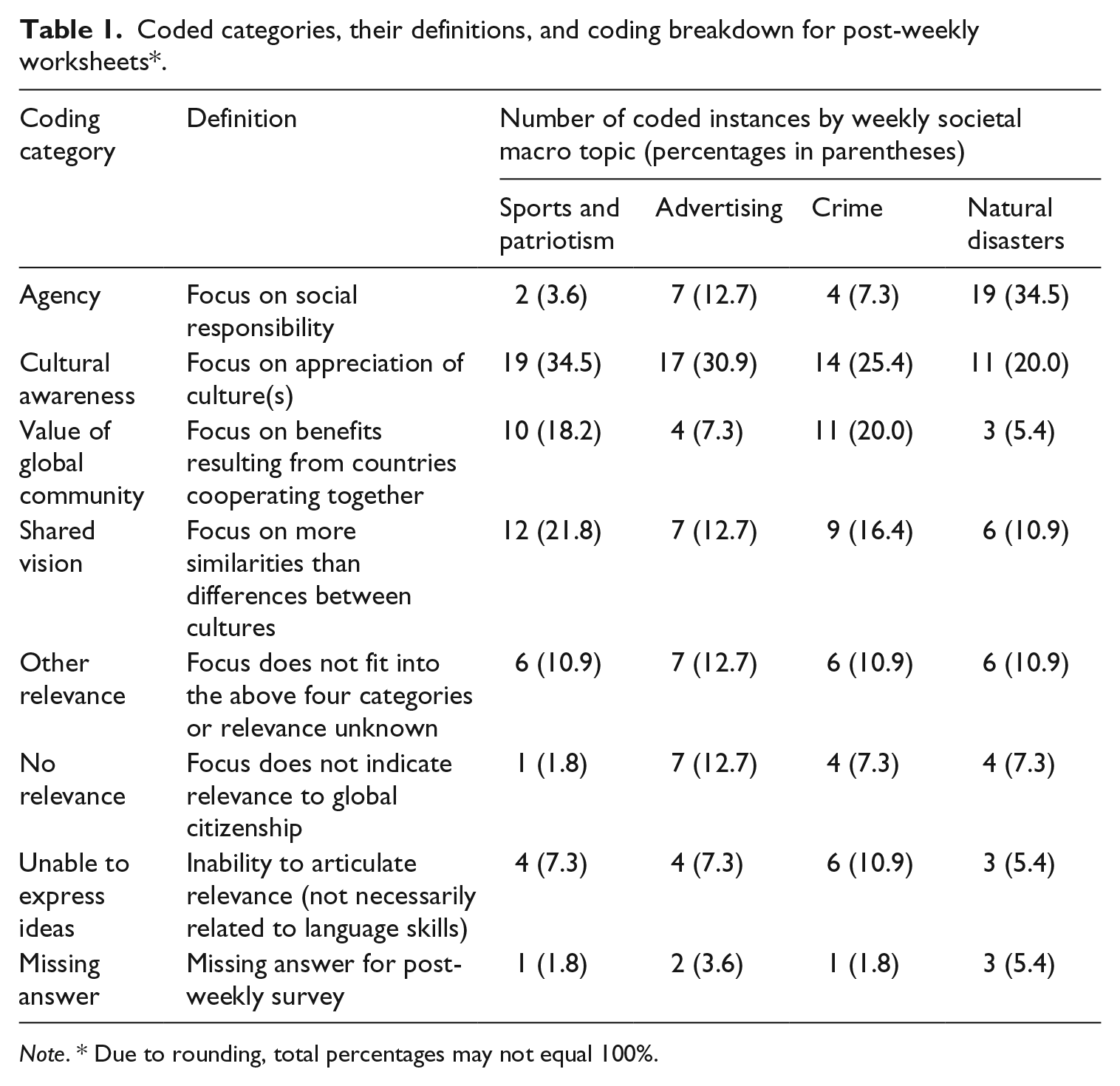
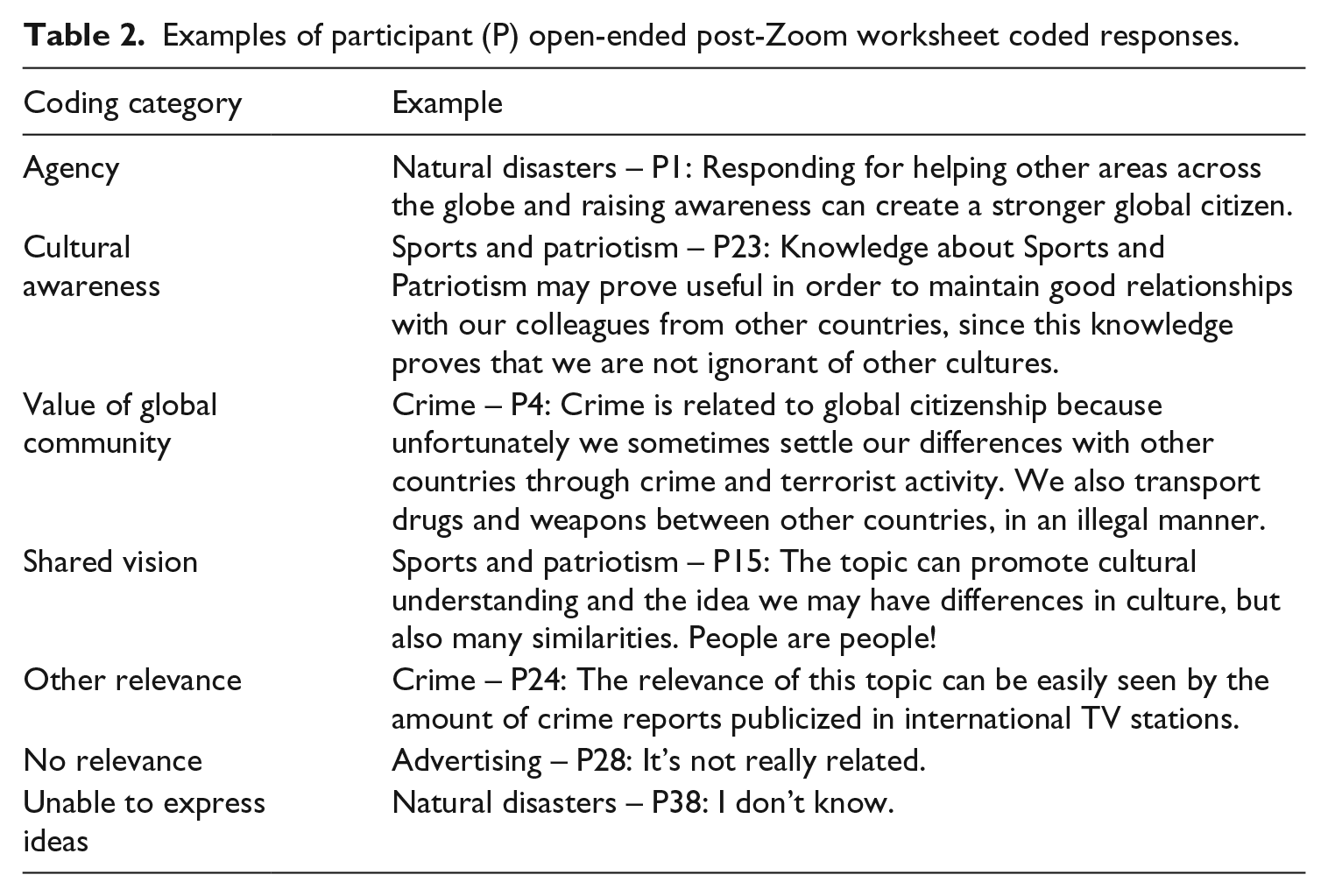
After the weekly video conferencing session, participants were asked to explain how each weekly societal macro topic related to global citizenship on a post-Zoom worksheet. By doing so, researchers wanted to focus on participants’ perceptions of how each theme fostered global citizenship. From word frequencies completed on NVivo, patterns in the data emerged. From these patterns, researchers created the following coding categories: Agency, Cultural awareness, Value of global community, Shared vision, and Other and/or no relevance. The data were independently coded by two researchers using NVivo 12. Initially, they reached a 93.8% agreement (kappa = 0.68) before reconciling differences to reach a 100% agreement. Table 1 details the researcher-created coding categories and coding breakdown while Table 2 lists coded examples from the weekly worksheets.
Coded categories, their definitions, and coding breakdown for post-weekly worksheets*.
Note. * Due to rounding, total percentages may not equal 100%.
Examples of participant (P) open-ended post-Zoom worksheet coded responses.
The societal macro topic that was coded highest for Agency was Natural disasters while for Cultural awareness it was Sports and patriotism. In addition to Cultural awareness, the majority of coded instances for Shared vision was also for Sports and patriotism. However, for the Value of global community, the societal macro topic that was most relevant as perceived by participants was Crime and the least relevant topic was Advertising.
Video transcripts
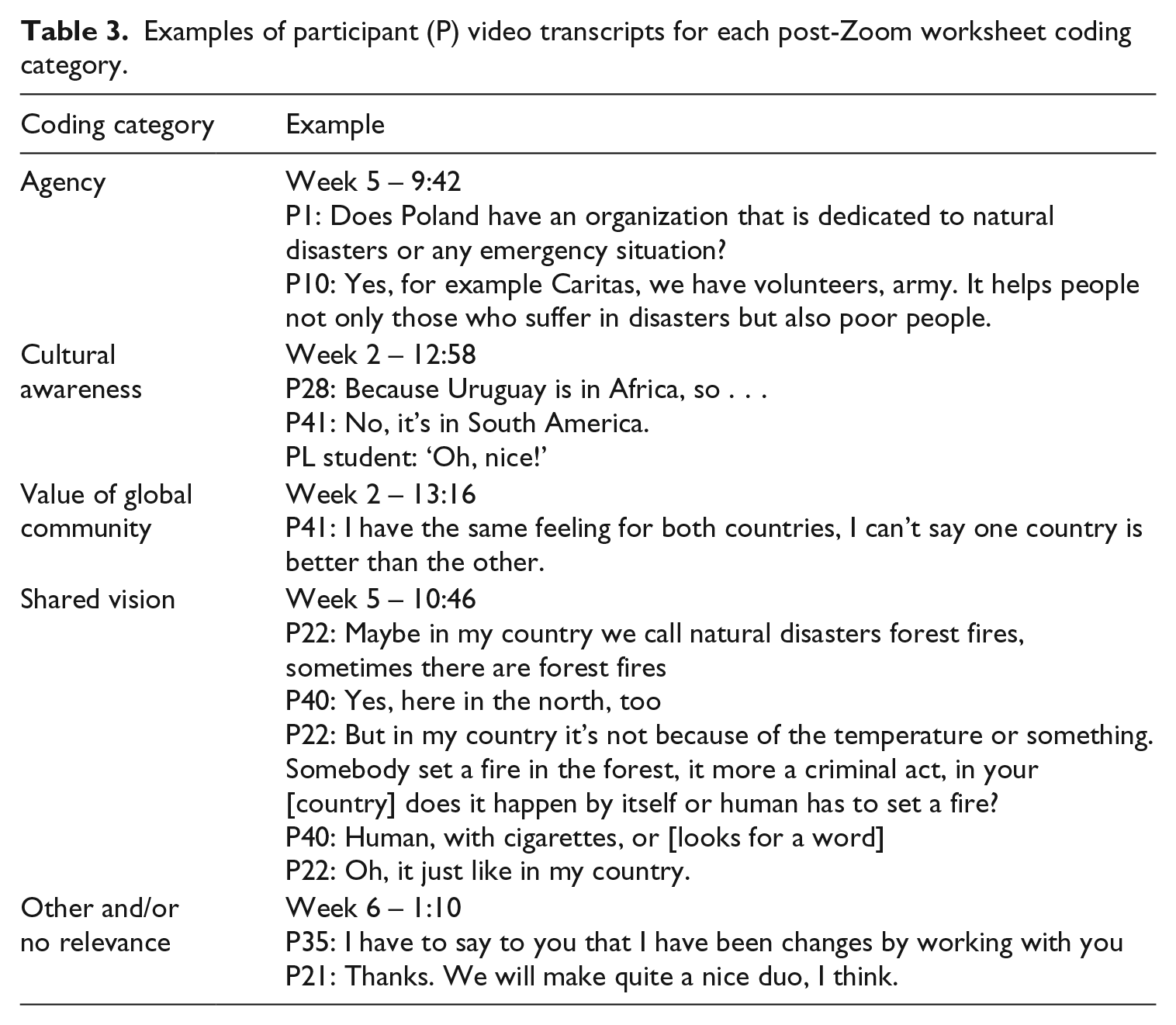
In order to triangulate the data, researchers utilized video transcripts to give additional support of the how this virtual exchange study’s tasks facilitated global citizenship development. Table 3 lists examples for each of the coding categories used for the post-Zoom worksheets. These examples are particular critical incidents that highlighted key components that also showed that the virtual exchange led to the development of global citizenship.
Examples of participant (P) video transcripts for each post-Zoom worksheet coding category.
2 Change of global citizenship relevance
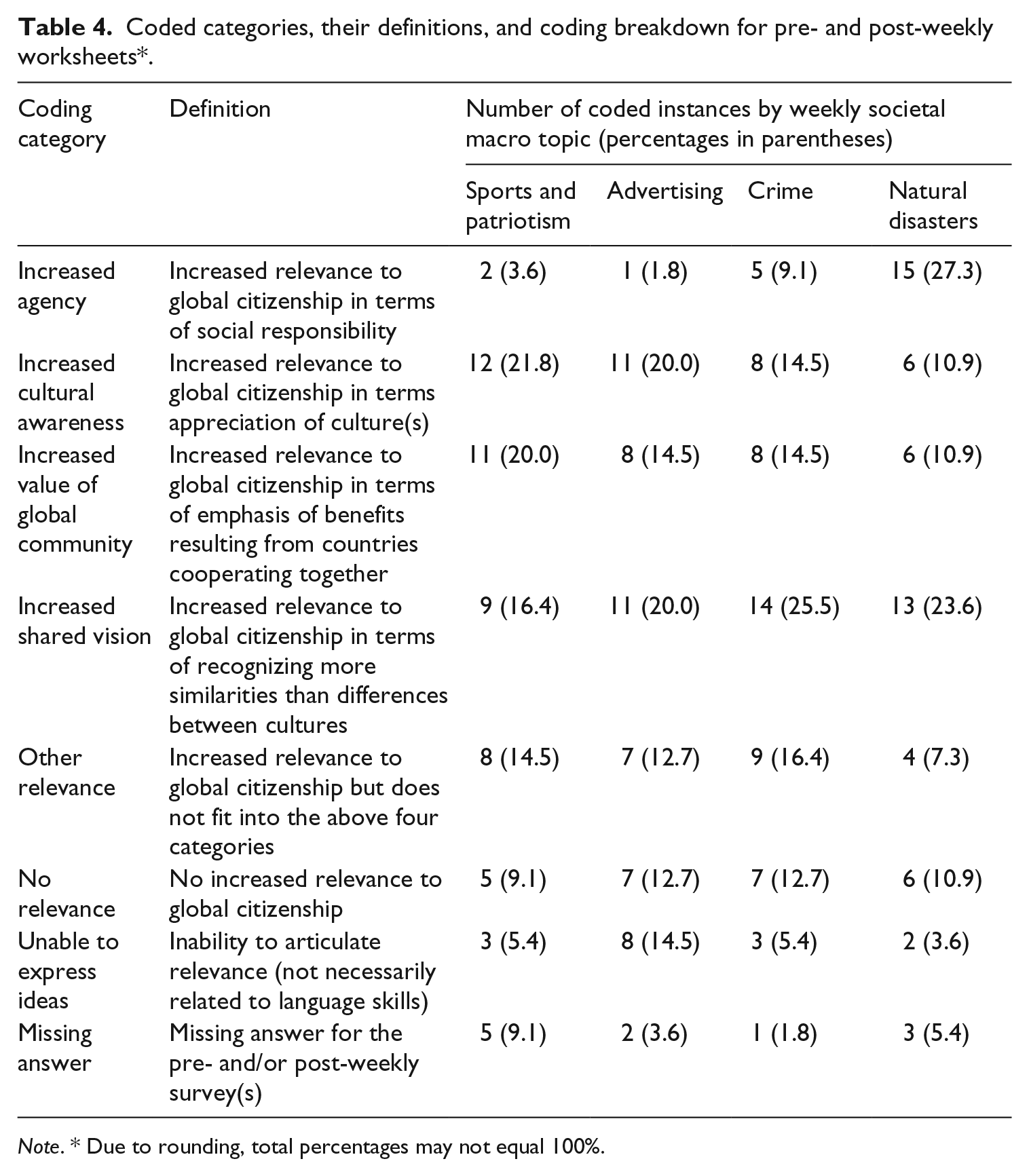
Since participants were asked to explain each weekly societal macro topic how it related to global citizenship before each videoconferencing session, researchers also coded the change that they noticed from pre- to post-Zoom worksheets in order to focus on participants’ development of global citizenship. The coding categories that were used originated from the global citizenship relevance coding categories. In this way, these main themes were utilized, but in order to show development, categories were adapted to note an increase in these new coding categories. Consequently, the following categories were used to code the change from the pre- to post-Zoom worksheets: Increased agency, Increased cultural awareness, Increased value of global community, Increased shared vision, Other relevance, No relevance, Unable to express ideas, and Missing answer.
Both researchers independently coded data to examine the change of participants’ opinions of the weekly topic’s relevance to global citizenship from pre- to post-weekly survey. Using NVivo 12, they reached a 93.2% agreement (kappa = 0.69). Then they worked together to reconcile differences to have a 100% agreement. Table 4 details the researcher-created coding categories by weekly societal macro topic while Table 5 lists coded examples from the pre- and post-Zoom weekly worksheets.
Coded categories, their definitions, and coding breakdown for pre- and post-weekly worksheets*.
Note. * Due to rounding, total percentages may not equal 100%.
Examples of participant (P) open-ended pre- and post-Zoom worksheet coded responses.
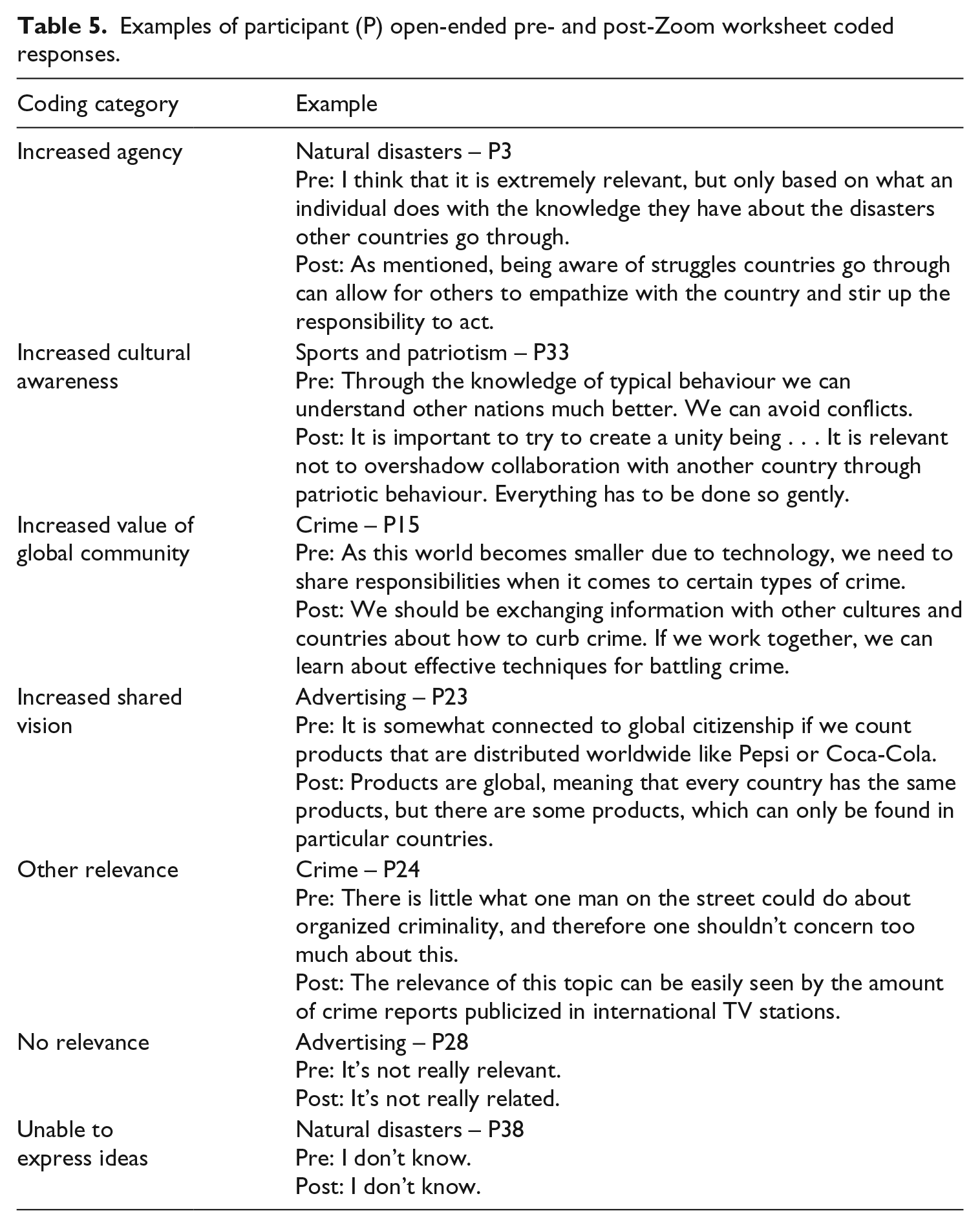
Participants’ coded responses showed the most Increased agency for Natural disasters. Answers indicated that Sports and patriotism was the topic where participants’ Increased cultural awareness and Increased the value of global community while participated noted Increased shared vision for Crime. When looking at Advertising, although instances showed that there were some changes in global citizenship relevance as per the coding categories, these totals were lower than the other three societal macro topics.
V Discussion
It was evident that the focus on the weekly societal macro topics of Sports and patriotism, Advertising, Crime, and Natural disasters facilitated development of global citizenship. In learner-centred activities (González-Lloret and Ortega, 2014), participants utilized LF to exchange views and explore ideologies, triggering deeper discussions and making connections to ‘belief systems, cultural values, political values, religious values, [and] economic values’ (The Douglas Fir Group, 2016, p. 25). The global citizenship relevance as coded in the post-Zoom worksheets and the change that took place between pre- and post-weekly worksheets of topic relevance showed that the virtual exchange allowed participants to reflect on these macro-level topics and make connections to global citizenship. Following the qualitative analysis of the participants’ weekly worksheet, the components of agency, cultural awareness, value of global community, and shared vision emerged from both sets of weekly worksheet data. Therefore, the authors propose that these four components are aspects of global citizenship and must be considered when designing a LF virtual exchange for global citizenship development. Data triangulation showed that specific societal weekly topics addressed these certain components of global citizenship more adequately than others, as seen by the coded responses. Therefore, results illustrated that some societal macro topics may be more relevant than others when designing a LF virtual exchange with a global citizenship aim.
Natural disasters was most helpful in having participants recognize agency. Not only did participants realize that ‘we have to help each other’ (P32), but also that ‘If we erase our emotional distance between a disaster which happens far away, it will promote worldwide empathy for other situations’ (P15). Sports and patriotism appeared to be better suited for cultural awareness. Participants saw this topic as connected with a specific culture or country as opposed to the entire world. ‘Each country has its own unique ideas about sports and patriotism–and often widely different sports are important–so sports cannot necessarily support movement and participation in a global community. Or, they are a point of division and separation’ (P17). For shared vision and value of global community, both Sports and patriotism and Crime were useful. Participants noted that ‘understanding that there are similar crime issues around the world helps people feel a sense of unity’ (P18). Even though these three societal macro topics proved to be beneficial in having participants connect with their partners and draw on their belief systems, Advertising was considered the least relevant and would not be the most supportive topic that would best facilitate global citizenship development. Although this societal macro topic was perceived the least relevant to global citizenship, it was still valuable in bringing attention to cultural awareness and shared vision. Participants realized similarities that existed across cultures with products and that ‘Gimmicks are common in each country’ (P11).
Regardless of what connections were made to global citizenship through the weekly societal macro topics, the task content, via a variety of types of categories of exchange (O’Dowd and Ware, 2009) and key TBLT elements (González-Lloret and Ortega, 2014) promoted participants intercultural learning. Through this learning, participants become more active and socially responsible global citizens by reflecting (González-Lloret and Ortega, 2014) on macro-level topics pertaining to global affairs and belief systems (Collier, 2015). In their weekly worksheets, participants recognized that ‘our world is an increasingly complex web of connections and interdependencies. One in which our choices and actions may have repercussions for people and communities locally, nationally or internationally’ (P43). All weekly societal macro topics proved to be springboards for Zoom synchronous sessions. Through these communicative real-world activities (González-Lloret and Ortega, 2014), participants recognized the relevance of the topics to global citizenship and demonstrated through their weekly worksheets that the four weekly topics were related to the following components of global citizenship: agency, cultural awareness, value of global community, and shared vision.
Upon analysing weekly worksheets in conjunction with video transcripts, it was evident that participants noticed that they ‘ may have differences in culture, but also many similarities. People are people!’ (P15). Regardless of the weekly societal macro topic, participants observed the need to be more socially responsible and take action. For example, P4 wrote ‘As a country, again we need to be aware and good citizens and reach out to people who need help rebuilding.’ Not only did participants realize that as global citizens, everyone should be helping others in need, but they also recognized that countries should be working together.
1 Limitations
Because the qualitative data that was used was predominantly self-reported, some participants may have not been as forthcoming about their reflections. Nevertheless, coding was complete to find commonalities and the authors did try to choose the most representative examples from the analysis. In addition, although ideologies (The Douglas Fir Group, 2016) were contextualized into societal macro topics, having additional themes apart from Sports and patriotism, Advertising, Crime, and Natural disasters may have been beneficial in facilitating global citizenship development.
2 Implications
Drawing on the results of this study, the following implications should be considered for task design to promote global citizenship in LF virtual exchanges. First, regarding the content of the tasks, the authors suggest engaging students in interactions about topics related to macro level of ideological structures (The Douglas Fir Group, 2016). Unlike many of virtual exchange tasks which utilized ‘a superficial approach to culture based on traditional communicative classroom themes such as musical tastes, travel, sports and so on’ (O’Dowd, 2018b, p. 8), in this study, participants discussed Sports and patriotism, Advertising, Crime, and Natural disasters and utilized images related to current events during their Zoom sessions. Discussing these societal macro topics, as coined by the authors, had ‘a real impact on students’ understanding of the partner culture’ (O’Dowd, 2018b, p. 9).
Second, in addition to the content of the tasks, the different types of categories of exchange that include information exchange tasks, comparison and analysis tasks, and collaborative tasks (O’Dowd and Ware, 2009) as well as individual and group tasks should be implemented into virtual exchange projects in order to facilitate global citizenship development. For example, this study may suggest that utilizing societal macro topics resonates with addressing Byram’s (2008) framework for intercultural citizenship. Discussing these topics allowed participants to deepen their knowledge about the world (cognitive orientation) and increase their awareness by recognition and reflection on similarities and differences between their belief systems (evaluative orientation). Through synchronous sessions, participants also had the opportunity to develop skills related to searching for information and cooperation (action orientation), interpreting and relating (comparative orientations), and last but not least, practising their language skills (linguistic orientation).
Finally, using a LF to discuss the societal macro topics also helped to facilitate these interactions since speakers shared a ‘one common language’ (P54). Participants realized that ‘human being[s] feel a strong connection not only with one county but also with other countries and cultures as well on the same level,’ (P26) showing how they enhanced intercultural learning and global citizenship development. Participants saw themselves as more similar to than different from their international partners and their countries and/or cultures. Not only did a LF allow for a dialogue since communication was the priority, but the utilization of societal macro topics helped participants to recognize the multifarious components of global citizenship such as agency, cultural awareness, value of global community, and shared vision.
VI Conclusions
This article has presented a LF virtual exchange study in which university students from Mexico, Poland, Spain, and the USA synchronously met to discuss the following weekly societal macro topics: Sports and patriotism, Advertising, Crime, and Natural disasters. This study contributes to the greater body of research by providing implications on task topic to promote communication and development of global citizenship in LF virtual exchanges. In conclusion, the authors believe that in order to facilitate global citizenship development, LF virtual exchanges should: (1) address ideologies via societal macro topics, (2) incorporate tasks that allow participants to explore Byram’s (2008) framework for intercultural citizenship, and (3) design tasks to embrace the components of global citizenship which include agency, cultural awareness, value of global community, and shared vision.
Footnotes
Acknowledgements
In carrying out this study, the authors received assistance from the following colleagues who deserve our thanks: Carlos Fernando Dimeo Álvarez, Shannon M. Hilliker, María Pérez-Blanco, Kayla Roumeliotis, and Salvador Venegas Escobar.
Funding
The author(s) received no financial support for the research, authorship, and/or publication of this article.
