




Abstract
This study discusses the impact of interactionist output-oriented approaches, specifically, the effects of collaborative text reconstruction on subjunctive recognition and production in the written modality by English-dominant Spanish second-language learners. It also examines whether students’ text length and text complexity increase after treatment. A total of 104 fifth-semester Spanish learners participated in the study and were assigned to three conditions: control (n = 36), dictogloss (n = 33) and dictogloss plus explicit instruction (n = 35). In order to measure target form recognition and production as well as text quality, participants completed a pre-, post- and delayed-post-test that included a guided written task and a recognition task. Results indicated that participants in both treatment groups increased their production of the subjunctive mood in the written modality in expected contexts at similar rates, which was also maintained over time. Participants also increased recognition rates, irrespective of group, pointing to a lack of relationship between this type of collaborative text reconstruction and subjunctive recognition. Lastly, an effect of group and time was also observed for text length and syntactic complexity, as participants in the treatment groups produced significantly longer texts, as well as a higher number of complement clauses.
Keywords
I Introduction
Due to its pivotal role in various theories of second language acquisition, interaction has been considered essential in different instructional models. The Interaction Hypothesis (Long, 1983, 1996), as one of the first theoretical frameworks that discussed and described the nature and implications of interaction, accounted for instances of modified input in interactional exchanges among native and non-native speakers. Interaction is also regarded as fundamental in Sociocultural Theory (Lantolf, 2000, 2014; Lantolf & Thorne, 2006; Vygotsky, 1978). In this case, however, the understanding of cognitive development as a socially situated enterprise places interaction as a default strategy and as the means for the cognitive processes involved in language learning.
Interaction is paramount in collaborative writing tasks, for which decision-making is a negotiated, and therefore, an interactively mediated endeavor. It has been the center of attention in many of the studies that have explored the effectiveness of such tasks. For instance, collaborative text reconstruction tasks such as dictogloss have been implemented and evaluated in different instructional settings, with participants at different proficiency levels and with various second languages (L2s) and first languages (L1s). In most cases, studies have analysed the nature of the interaction, the effects of interaction on morphosyntactic development, and have looked at the quality of texts produced during the task’s reconstruction stage. These investigations have, to date, rendered heterogeneous results with regard to language development (see, amongst others, Basterrechea & García Mayo, 2013; Basterrechea, Leeser, & García Mayo, 2014; Fortune, 2005; Gallego, 2014, 2016; García Mayo, 2002; Kowal & Swain, 1994; Leeser, 2004; Malmqvist, 2005; Nabei, 1996; Qin, 2008; Salazar Campillo, 2006; Storch, 2013; Swain, 1998, Swain & Lapkin, 2001; Uludag & VanPatten, 2012). Target form intake, L2 development, and the quality of learners’ writing as evidenced by post-treatment assessment have been less frequently examined.
The goal of the present study is to address some of those underexplored issues by analysing the effects of collaborative text reconstruction on L2 morphosyntactic development, L2 writing development and the quality of texts produced after treatment. Specifically, it seeks to determine whether L2 Spanish learners increase their subjunctive mood production and recognition abilities after engaging in a set of dictogloss tasks. There are several important reasons for investigating the effects of instructional models on this particular structure, with the main one being the fact that mood alternation abilities and particularly subjunctive production develops slowly in interlanguage (see, amongst others, Bonilla, 2014; Collentine, 1995, 1997, 1998, 2002, 2003, 2010; Gallego, 2016; Stokes, 1988; Terrell & Hooper, 1974; Terrell, Baycroft, & Perrone, 1987). Additionally, the suggested need for more research regarding issues such as: the potential impact of explicit instruction, the benefits of metalinguistic awareness, and the need for noticing opportunities (Collentine, 2010, 2014) should be attended. Taking those suggestions into consideration, analysing learners’ subjunctive production pre- and post-treatment would be optimal as it would provide further evidence regarding approaches that promote subjunctive production and possibly contribute to a more rapid development of mood production and mood alternation abilities in L2ers. Because it is essential to consider both immediate and long-term effects of instructional treatments (Wong, 2004), the present investigation adds to this body of work by analysing the effects of dictogloss with a repeated measure design. This constitutes a critical step toward ensuring well-justified interpretations of the impact of collaborative writing on L2 development.
II Background
To date, collaborative writing and, specifically, collaborative text reconstruction has received a great deal of attention. In this article, the operationalization of the term collaborative writing follows Storch (2013) and includes the creation of new texts, or the reconstruction of texts as processed through aural input. A task such as dictogloss, originally proposed by Wajnryb (1990), is therefore included in this categorization, as a task that requires collaborative text reconstruction.
Following seminal studies such of those of Swain and Lapkin (1998, 2001) and Storch (1998), research evaluating the effectiveness of collaborative text reconstruction has primarily focused on the interactional exchanges and the nature of the metatalk the learners carry out during the shared reconstruction. Studies have explored issues such as type of Language Related Episodes (LREs), 1 LREs resolution, turn taking, type of dyadic interaction (Leeser, 2004; Storch & Aldosari, 2013), dyad vs. individual reconstruction (Fernández Dobao, 2012; Kuiken & Vedder, 2002, Storch, 2005), and L1 vs. L2 during LREs (Alegría de la Colina & García Mayo, 2009; Azkarai & García Mayo, 2015; Storch & Wigglesworth, 2003). Other aspects that have been examined are the content and/or organization and complexity of the texts produced (Elola & Oskoz, 2010; Fernández Dobao, 2012; Storch, 2005; Storch & Wigglesworth, 2007; Wigglesworth & Storch, 2009), and evaluation of dictogloss effectiveness in different classroom settings: content and language integrated learning (CLIL) vs. English as a foreign language (EFL) (Basterrechea & García Mayo, 2013). Analysing these issues has advanced the field in understanding the role of collaborative writing, not only as a means to develop second language writing abilities, but also regarding possible overall language learning implications, the value of metatalk and enhanced feedback, as well as L2 intake and form-meaning mappings. However, the development of L2 writing as evidenced, for example, in the quality of written text produced after treatment has received scant attention. As the purpose of the present study is to evaluate the overall effectiveness of dictogloss, the data were collected from assessment instruments administered before and after treatment rather than analysing the interaction or the texts produced during treatment. Particularly, the main goal is to examine the impact of collaboration on target form recognition (operationalized here as the ability to alternate between moods and/or to identify the subjunctive mood without engaging in any oral or written, spontaneous or semi-spontaneous production) and production (operationalized here as the ability to create clauses and/or texts in which the subjunctive is present in expected contexts) as well as to determine whether learners’ writing improves after engaging in this task. It is therefore relevant to report on previous work that has been conducted with a repeated measure design analysing language learning.
Studies with a pre- and post-test design have rendered heterogeneous results regarding the effects of collaboration on target form recognition, detection, intake, uptake and acquisition, concepts that have been operationalized with variations in every study. Some appear to indicate that collaborative text reconstruction and the interaction generated during collaboration can impact acquisition and/or target form production and recognition (Gallego, 2016; Jabbarpoor & Tajeddin, 2013; Qin, 2008). Others, however, found a less significant effect (Kuiken & Vedder, 2002; Reinders, 2009; Swain & Lapkin, 2001; Uludag & VanPatten, 2012) as compared to other tasks or instructional models. For example, Reinders (2009) explored the effects of collaborative text reconstruction on uptake and acquisition. Uptake was operationalized as correct suppliance of target structure and acquisition as the improved performance over time on a grammatically judgement test. Twenty-eight upper-intermediate EFL learners were assigned to the conditions of dictation, individual text reconstruction and collaborative text reconstruction. Results revealed that all participants showed certain degree of uptake at different rates: the dictation group outperformed the individual text reconstruction group and the collaborative text reconstruction group outperformed the individual text reconstruction group, and, while collaborative text reconstruction was the most effective task at enhancing uptake, there was no significant difference across groups regarding acquisition. The results of Uludag and VanPatten (2012) are relatively comparable with those of Reinders (2009) in that a text reconstruction task such as dictogloss was beneficial but did not appear to be significantly more advantageous when compared to other pedagogical interventions. Learners were divided into three groups: (1) processing instruction, (2) dictogloss and (3) a control group. Learners completed a pre-, post- and delayed-post-tests that included an interpretation task, a sentence completion task and a reconstruction task. While participants in the processing-instruction group were able to develop correct interpretation of passive structures at higher rates, both treatments rendered similar results with regard to production and text reconstruction and both treatment groups significantly outperformed the control group. Kuiken and Vedder (2002) analysed the impact of dictogloss on acquisition of passive voice among learners (L1 Dutch) who were in their fifth year of an EFL course. For this, participants were assigned to the treatment group, in which they were required to reconstruct a text collaboratively, and the control group in which they reconstructed it individually. There was no significant difference between groups when comparing pre- and post-test scores in terms of target form detection (which was operationalized as the underlining of passive voice) or more frequent passive voice production in the reconstructed texts. However, an analysis of the interaction conducted by the collaborative reconstruction group showed noticing of the target structure, as well as explicit rule formulation. Similarly, Swain and Lapkin (2001) evaluated the quality of the reconstructed texts, types of LREs, and language gain as measured by a pre- and post-test. Their participants were assigned to different treatments: one group conducted a dictogloss task and the other conducted a jigsaw task. While the test comparison did not render statistically significant differences between groups, it was observed that the learners engaging in dictogloss were able to produce the target structure more accurately in the reconstructed texts.
Qin (2008) compared the effects of processing instruction and dictogloss with beginning EFL learners. For that study, the dictogloss task was modified as it was implemented with some changes if compared to the original version proposed by Wajnryb (1990). For instance, in this case, perhaps the most significant adaptation was that participants did not hear but rather read a text. The pre-, post- and delayed-post-test included several tasks that tested participants’ comprehension and production of English passive voice. Regarding comprehension, results indicated that the processing-instruction group outperformed the dictogloss group, but this gain was not sustained over time. As for production, both groups increased at the same rate indicating that processing instruction and dictogloss had a similar degree of effectiveness. Jabbarpoor and Tajeddin (2013) examined input enhancement, individual text reconstruction and collaborative text reconstruction on the acquisition of English inversion structures by low-proficiency EFL learners. Their results revealed significant benefits of enhanced input in the short run and collaborative output in the long run and showed that collaborative text reconstruction was effective to a greater extent when compared to individual text reconstruction, however, participants in the input enhancement group outperformed the others. Similarly, Gallego (2016) found that Spanish L2 learners who engaged in two dictogloss tasks increased subjunctive production in the oral modality as well as subjunctive recognition in the written modality. Task impact on target form production was measured before and after treatment in oral interviews. Recognition was measured in the written modality by means of mechanical recognition tasks, for which all groups showed increased performance in the post-test, at different rates: the group engaging in dictogloss and receiving explicit instruction outperformed the other two groups (control and dictogloss).
The studies reviewed above offer evidence regarding the effects of both collaborative writing in general and collaborative text reconstruction tasks such as dictogloss. The mixed results observed could be attributable to the fact that these studies varied in several aspects: the methodology (collecting data during treatment and/or with a repeated-measures design), the operationalization of the dictogloss task itself (stages, pair vs. individual reconstruction, modifications, etc.), number of participants, the proficiency levels of the participants, their L1 as well as the L2. Therefore, due to the various ways in which this task has been implemented in different studies, it is not yet possible to draw a more generalized conclusion regarding its effectiveness.
In addition to exploring the quality of the interaction and whether the task was effective at enhancing language development, studies have also explored the relationship between collaborative writing and text quality and complexity. Syntactic or linguistic complexity has been defined as structural complexity, variety of forms, as well as degree of elaborateness, sophistication, and robustness (Housen & Kuiken, 2009; Norris & Ortega, 2009; Ortega, 2003), and it has generally been measured with an analysis of clauses per T-unit (Fernández Dobao, 2012; Norris & Ortega, 2009; Storch, 2005). Learners are able to process complex structures at different stages, starting with coordination, which has been considered an incipient sign of complexity for low-proficiency stages of development (Bardovi-Harlig, 1992). Subordination, conversely, is typically seen in more advanced proficiency levels (Norris & Ortega, 2009). For instance, Spanish L2 learners at intermediate level or below tend to operate at a pre-syntactic stage (Collentine, 1995) and even though there has been discussion regarding patterns of morphological and syntactic development and whether one precedes the other, there is no consistent evidence established (Bonilla, 2014).
Fernández Dobao (2012) analysed text complexity as produced by individual learners, pairs and small groups. Complexity was measured by dividing texts into segments of 50 words each and calculating the mean type–token ratio for all the segments. Results showed that the learners who worked in pairs or groups were able to produce more complex and accurate texts. The studies of Storch (2005) and Wigglesworth and Storch (2009) also revealed that collaboration rendered positive results as the learners working in pairs produced accurate and more complex texts. Wigglesworth and Storch (2009) analysed fluency (average number of words per text, average number of T-units per text, and average number of clauses per text), complexity (proportion of clauses to T-units and percentage of dependent clauses of total clauses and accuracy (percentage of error-free T-units and percentage of error-free clauses) and found no significant differences regarding fluency and complexity. Results did, however, indicate that participants working collaboratively were more likely to pool resources together and therefore produce more accurate texts.
Storch (2005) also explored fluency, accuracy and complexity, which were measured in terms of the total number of words and number of T-units and clause analysis, respectively. Results indicated that the texts produced collaboratively were shorter but more accurate and more complex and that the collaboration was also effective in that students exchanged ideas and received immediate feedback. These findings were attributed to the opportunities to provide and receive immediate feedback which might have had an impact on the accuracy as well as the syntactic complexity of the text.
The effects of collaboration on target form acquisition and writing complexity has been analysed comparing individual versus joint work as well as comparing performance on different tasks. It is then relevant to continue this line of work by conducting more empirical research that explores the complexity of texts produced collaboratively, not only during treatment, but also before and after, as well as elucidating whether engaging in a collaborative reconstruction task facilitates the morphosyntactic development and the systematic production of target forms.
Previous research on L2 Spanish morphosyntactic development including the recognition and production of the subjunctive mood, established that while learners can develop the ability to recognize the subjunctive mood in early stages of interlanguage development and tend to perform well in input-oriented 2 tasks, the ability to produce the subjunctive tends to develop at more advanced stages (Bonilla, 2014; Collentine, 1995, 1997, 1998, 2002, 2003, 2010; Gudmestad, 2012a, 2012b; Henshaw, 2013; Stokes, 1988; Terrell & Hooper, 1974; Terrell et al., 1987). Indeed, advanced second language learners (L2ers) show signs of mood production abilities (Bonilla, 2014; Gallego, 2016; Gudmestad, 2012a, 2012b) and highly-advanced L2ers display target-like production patterns (Gudmestad, 2012a, 2012b).
Furthermore, studies on subjunctive development presented evidence of how different instructional models impact subjunctive acquisition at different rates (Adrada-Rafael, 2017; Collentine, 1998; Farley, 2001, 2004; Fernández, 2008; Gallego, 2016; Henshaw, 2013; Kirk, 2013) showing the benefits of input-oriented approaches (Collentine, 1998, 2002; Farley, 2004; Fernández, 2008; Henshaw, 2013; Kirk, 2013) as well as other approaches (Adrada Rafael, 2017; Collentine, 1998; Gallego, 2016). Findings of studies that have been set to determine, mostly, whether learners who are exposed to explicit information can increase awareness and therefore notice and ultimately produce the subjunctive appear to indicate that explicit instruction presents some advantages (Adrada-Rafael, 2017; Farley, 2004; Fernández, 2008; Gallego, 2016). Fernández (2008) showed that participants in the explicit instruction group were able to process the subjunctive sooner and more accurately. Similarly, Farley’s (2004) participants improved mood selection abilities after having received explicit information and strategies for subjunctive processing. Both studies explored Processing Instruction, an approach in which, by receiving explicit information the learner is thought to become more aware of how the form works. The premise is to focus on one form at a time and to include information about default processing strategies that do not lead learners to the appropriate processing of the form (Farley, 2004; Fernández, 2008). Other studies have provided explicit instruction by presenting a definition of the target form, its uses, examples in one or more forms, and the contexts in which the form is typically found (Adrada Rafael, 2017; Collentine et al., 2002; Gallego, 2016) and have also offered initial evidence of the advantages observed in participants who received explicit instruction.
Elucidating the role of instructional models on the development of mood selection abilities has been instrumental in providing answers for researchers and practitioners, yet many issues remain inconclusive. In spite of the suggested need (Collentine, 2010, 2014; Sessarego, 2016), since less attention has been paid to exploring output-based approaches, there is scant evidence regarding the impact that these models, or certain tasks, could have on subjunctive development (Collentine, 2010, 2014). Moreover, because the studies that explored the potential impact of explicit instruction were framed within different instructional approaches which in turn prevents the generalization of results, more research is needed to provide additional evidence of such effect or lack thereof.
It is evident that the trajectory of subjunctive development and the impact of instructional models on subjunctive acquisition are still at the epicenter of a fruitful, ongoing debate. Evaluating production-oriented approaches, with and without the inclusion of explicit teaching could therefore add to this debate.
III The present study
In light of the aforementioned reasons, this study seeks to determine the impact of collaborative text reconstruction on language learning and the degree to which engagement in collaborative text reconstruction could enhance the complexity of written texts as well as target form production and recognition.
The study’s main goals are to (1) evaluate the effects of interactionist output-oriented instructional models on subjunctive mood production abilities, (2) determine the impact, if any, of collaborative text reconstruction (with and without explicit instruction) on L2 development and (3) measure the complexity of texts produced after treatment. Three research questions guided this investigation:
Does engaging in dictogloss (with and without explicit teaching) promote subjunctive production in a semi-spontaneous writing task?
Does engaging in dictogloss (with and without explicit teaching) promote subjunctive recognition in the written modality?
Does engaging in dictogloss have an impact on the quality of the written texts as measured in length and syntactic complexity?
1 Setting and participants
Data were collected in 6 fifth-semester intact L2 Spanish classes at a public four-year American university. Demographic information was gathered by means of a questionnaire that addressed issues such as time spent abroad, time spent interacting with native speakers of Spanish, time spent using Spanish in the home, as well as experience with Spanish in classroom settings: number of classes taken in high school and number of classes taken at the current institution or any other postsecondary institution.
A total of 122 participants attended class the days in which data were collected, however, not all of their production was considered. While all students in attendance completed the activities, they were given the option to have their production analysed for the study. Several measures were taken to account for prior exposure to the target form. Firstly, demographic information was analysed to determine, among other factors, contact with the language. While 97% of the participants had taken a number of Spanish classes in high school, and 100% had taken at least another Spanish class at the institution at the time of data collection, none identified as bilingual and/or heritage speakers. All spoke English as their primary and only language outside of Spanish class, and eight had spent time abroad, and were therefore eliminated from the analysis.
The pre-test was used to identify the participants with high command of subjunctive recognition and production. Because students enrolled in this course had been previously exposed to the concept of mood alternation and to the subjunctive mood, some degree of mood alternation ability was expected. Research with low-proficiency learners has established the cut-off at 20–30% (see for example Qin, 2008) but because participants with more advanced proficiency have been likely exposed to target forms, setting the cut-off at 60% allows researchers to discard data to prevent a ceiling effect. Therefore, participants who scored higher than 60% on both tasks were not included in the analysis (for a similar threshold see Farley, 2001; Gallego, 2016; Uludag & VanPatten, 2012).
2 Treatment operationalization
Both the treatment and the assessment were completed during class time. No changes were introduced to the curriculum, the syllabus calendar, regular forms of assessment, and in-class tasks. The course meets three times per week during a 16-week semester and the use of subjunctive in different clause types is typically covered over the span of four weeks.
Each intact class was taught by the respective instructor. All instructors were either TAs or adjunct faculty members who participated in a training provided by the researcher during a one-day workshop. After the training, all instructors were required to pilot the dictogloss task in class at the beginning of the semester, prior to introducing the subjunctive. The researcher observed and videotaped each class in order to monitor whether adjustments were necessary to the operationalization of the task.
One day before engaging in the first dictogloss task, participants completed the pre-test. Three days later, the second dictogloss task was conducted in class, and was followed by the post-test which was administered two days later. Lastly, participants completed the delayed-post-test eight weeks after the post-test.
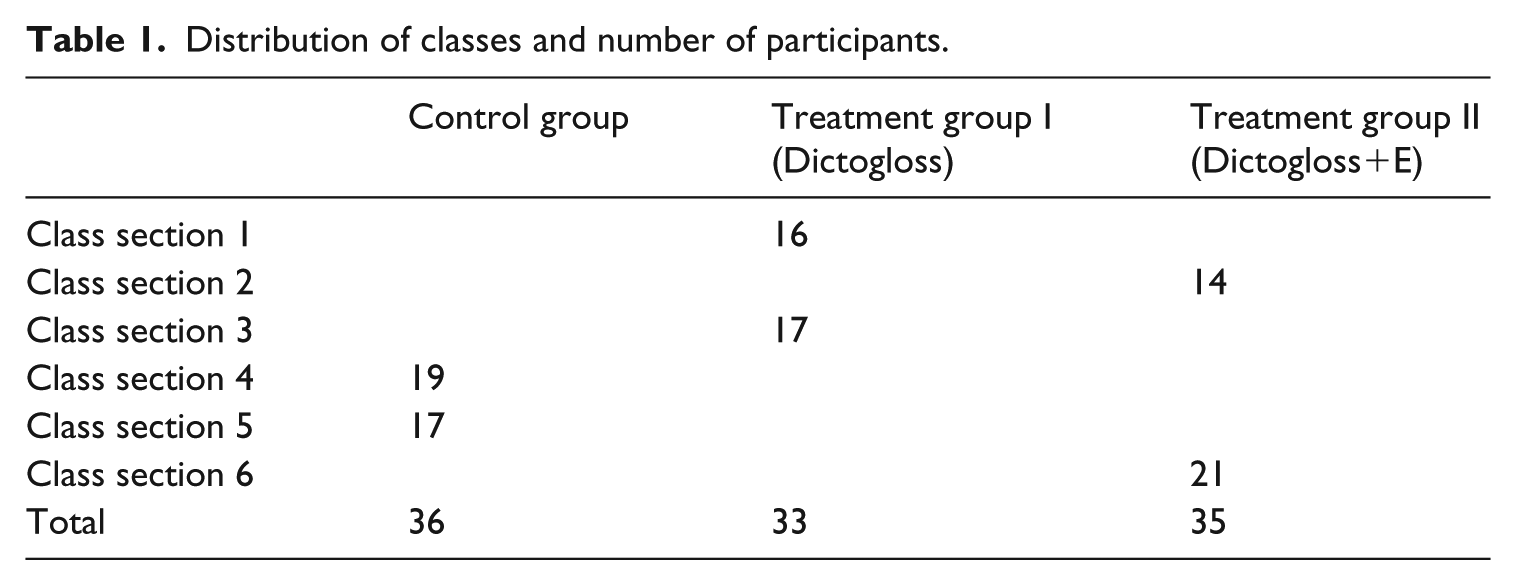
Each treatment was randomly assigned to different sections. Table 1 illustrates the distribution of classes to treatment, and the final number of participants that were included in the data analysis, for each group. Lesson plans for each section were the same for the two treatment groups. The lesson was organized around the dictogloss task and the dictogloss followed all four stages suggested by Wajnryb (1990). Each dictogloss started with the preparation stage, during which participants completed a warm-up and two vocabulary tasks. Instructions for the task were then provided. Lastly, participants were organized into dyads and were shown a reconstruction example through a brief video in which two students discuss how to reconstruct a sentence by sharing their notes and producing several LREs. Since it has been observed that learners tend to focus on meaning more so than on form during the reconstruction (García Mayo, 2002; Nabei, 1996), the interaction depicted in the video showed students producing more grammatical than lexical LREs. Moving to the dictation stage, each instructor read the text twice, and participants took brief notes during the second reading. Dyads then shared and compared notes and reconstructed the texts. Lastly, participants conducted the analysis and correction stage. Because this last stage is conceived as an opportunity for feedback provision (Wajnryb, 1990), dyads were first required to share examples from their reconstructed texts on a sentence-by-sentence basis. Instructors then reviewed the shared sentences with emphasis on the target form, showed the original text and encouraged students to compare and reflect on what they produced.
Distribution of classes and number of participants.
The treatment groups differed in that one group received explicit instruction (Dictogloss+E) and one did not (Dictogloss). Both groups engaged in the dictogloss task following the stages indicated above and, additionally, the Dictogloss+E group received explicit instruction that was organized as follows: during the first treatment session, students received explicit rule teaching in the form of oral and written explanations and were also given time to ask questions before engaging in the dictogloss. During the second treatment day, participants in the Dictogloss+E group were required to write down the rules they recalled from the previous session. Lastly, a brief review was provided on the third treatment session.
All dyads in both treatment groups were self-selected except for the three participants who scored higher than 60% in the pre-test, who were in class and had to participate as well but had to be assigned to work with the other high scoring partners, as they would not be included in the data analysis. The Control group did not engage in the dictogloss task, nor in any other collaborative activity that promoted metatalk, nor did it receive any in-class explicit instruction, instead the Control group engaged in a series of subjunctive-triggering meaning-oriented activities.
3 Target form
The targeted form was the subjunctive mood in the present tense in complement clauses. The multifaceted nature of the subjunctive and the cognitive demands it posits on learners might impact, along with other issues, the development of mood selection abilities. Certain factors such as frequency, saliency, functional value, regularity and processability appear to play a central role in determining whether a certain grammatical feature is processed as implicit knowledge (Ellis, 2006). Some of those factors might impact subjunctive acquisition and determine that subjunctive forms go unnoticed or are not accurately processed. First, its low frequency (Biber et al., 2006; Collentine, 2010) and the non-categorical nature of subjunctive use across varieties (see, amongst others, Fernández Ulloa & Portillo Mayorga, 2000; Gallego & Alonso-Marks, 2014a, 2014b, 2015; Lastra & Butragueño, 2012; Silva-Corvalán, 1994, 2001). Second, its redundancy. The subjunctive mood is found primarily in dependent clauses, with a handful of exceptions, and it is a redundant representation of the modality expressed in the matrix clause. A form is considered redundant if its meaning is expressed by another element in the sentence (DeKeyser, 2005). Perhaps because of this redundancy, is that subjunctive lacks functional value and it is not essential for communication and learners can extract meaning without having been exposed to the form (Lee, 1987). Third, its lack of saliency. Spanish expresses its mood through morphology by inflecting the form of the verb. The present subjunctive is formed using the stem of the first-person-singular present indicative and the morphological difference between the two moods in the case of regular verbs might be imperceptible for L2ers (Collentine, 1997, 2014; Lubbers Quesada, 1998; Gallego & Pozzi, 2018), as illustrated in (1) below. Learners, however, have been found to be able to recognize the subjunctive at higher rates with irregular verbs such as the examples in (2).
(1) hablamos talk.1st.pl.pres.ind hablemos talk.1st.pl.pres.subj corren run.3rd.pl.pres.ind corran run.3rd.pl.pres.subj abro open.1st.sg.pres.ind abra open.1st.sg.pres.subj (2) tenemos have.1st.pl.pres.ind tengamos have.1st.pl.pres.subj van go.3rd.pl.pres.ind vayan go.3rd.pl.pres.subj hacen do.3rd.pl.pres.ind hagan do.3rd.pl.pres.subj
It has been argued that the subjunctive does not constitute a novel nor a significant stimulus (Collentine, 1997) due to its low communicative value in addition to the fact that subjunctive verbs with regular morphology might lack saliency (Collentine, 1997; Fernández, 2008; Gallego & Pozzi, 2018; Lee, 1987; Lu, 2010). Morphological irregularity has an impact on subjunctive recognition and production among intermediate and advanced learners in the written and oral modalities (Collentine, 1997; Gudmestad, 2006, 2012a, 2012b; Lubbers Quesada, 1998) and while further research would be needed to determine the generalizability of the findings, a similar, yet less clear, trend was observed among low-proficiency learners (Gallego & Pozzi, 2018).
4 Assessment and treatment instruments
All materials were synchronized with the course syllabus and were specifically created for the purpose of this study. The assessment instruments consisted of a semi-spontaneous writing task and a mechanical subjunctive recognition test. Three different sets were created for each one of the testing times (pre-test, post-test and delayed-post-test).
a Production
The semi-spontaneous writing task was designed to elicit subjunctive production in the written modality. Participants received a prompt with a brief description of a scenario and were required to write a minimum of 10 sentences (see Appendix 2). The prompt also included eight images and eight subjunctive-triggering questions that accompanied each image. Three more subjunctive-triggering questions were included without images, as well as five non-subjunctive-triggering questions. The purpose of the images was to illustrate possible character interactions and to guide the writing process. Participants were instructed to write a cohesive story based on the questions and pictures.
b Recognition
Recognition has often been measured by administering tasks such as multiple choice, form detection, think aloud protocols, etc., which, in turn, have contributed to understanding intake. In this article, I follow Reinders’ (2012) definition of intake: ‘Intake is a subset of the detected input (comprehended or not), held in short-term memory, from which connections with long-term memory are potentially created or strengthened’ (p. 28). According to Reinders (2012) intake tests are only valid if administered soon after treatment and any assessment that measures retention of knowledge for extended periods of time is an indication not of intake but rather of knowledge in long-term memory. Based on this, the recognition test was designed to investigate intake, however, because there was a delayed-post-test retention over time was also measured. The tests included a total of 25 tokens and 15 distractors to prevent overextension that were randomized between and within tests. Recognition was operationalized as the ability to identify the subjunctive mood for which tokens were designed as two types of selected-response: 12 tokens required forced choice mood selection and 13 required identifying the subjunctive verb. All items, both token and distractors, were in the present tense, and the subjunctive contexts only included complement clauses (see Appendix 1).
c Treatment materials
The treatment consisted of three dictogloss sessions. During each session a different text was used, which was specifically written for the purpose of the study, aligned with the thematic unit. Each text contained six token complement clauses (with different matrix types), and four non-token sentences and were similar to texts regularly used in class for both reading and aural recognition and comprehension. Both the indicative and the subjunctive moods were in the present tense.
5 Coding and analysis
All three tests (pre-test, post-test and delayed) were coded by both the researcher and two research assistants. The coding of the texts focused on two aspects: subjunctive production and text length and complexity. The coding for subjunctive production was based on number and type of subjunctive verbs per text. The writing prompt provided to participants included eight subjunctive triggering scenarios, and participants were required to write at least ten sentences, each sentence produced was considered a possible [SUBJ] context. First, all clauses were identified and each complement clause produced was marked for [±SUBJ]. One full point was assigned for each [+SUBJ] even if subject–verb agreement was not consistent or if the subjunctive verb contained orthographical errors. All verbs in the subjunctive were also coded for [±REGULARITY].
Text complexity was measured based on clauses produced per T-unit (C/TU). Clauses were coded as independent and dependent, with a focus on the number of dependent clauses produced. A clause was considered dependent if it contained a verb (finite or non-finite) and at least one additional clause element of the following: subject (either overt or not), object, complement or adverbial. Measuring complexity by calculating the number of subordinate clauses per T-unit is a common coding practice (Storch, 2005; Fernández Dobao, 2012) and is recommended by Norris and Ortega (2009) as a measuring tool for learners with intermediate or advanced proficiency who are able to produce full sentences and clauses in the written modality.
A mixed-design ANOVA with time (pre-, post- and delayed-post-tests), as a within-participants factor and group (Control Group, Dictogloss Group, Dictogloss + Explicit instruction Group) as a between-participants was conducted for both instruments. Both tasks were analysed separately. For the recognition task, a Mauchly’s test indicated that the assumption of sphericity had been violated χ2(2) = 47.4, p < .001, therefore, degrees of freedom were corrected using Greenhouse–Geisser estimates of sphericity (ε = .64).
IV Results
1 Subjunctive production in the written modality
Results of the analyses of texts produced before and after treatment showed two main effects. A main effect of group was observed, suggesting that the performance varied among the three groups, F(2, 57) = 10.10, p < .001, while collapsing across time level. A main effect of time was also observed, suggesting that the performance differed among the three tests (pre-, post- and delayed-post-tests), F(2, 57) = 59.03, p < .001, while collapsing across groups level. There was a significant interaction between time and group, F(2, 57) = 6.45, p < .001. Following up with simple effect analysis revealed that there was no significant difference among the three groups in the pre-test. However, there was an effect of group in both the post-test and delayed-post-test. In the case of both the post-test and the delayed-post-test, the control group underperformed the treatment groups; however, there was no significant difference between the groups completing the dictogloss tasks (Dictogloss = Dictogloss+E > Control). While the control group increased subjunctive production in the post-tests, performance in delayed-post-test was not significantly different than in the pre-test, and showed that production decreased over time. On the contrary, the treatment groups showed significant differences over time. The Dictogloss group and Dictogloss+E group performance in post-test, and delayed-post-test was significantly better than performance in pre-test, with no significant difference between post-test and delayed-post-test, indicating that, while there was no additional gain over time, participants retained initial gain.
2 Subjunctive recognition
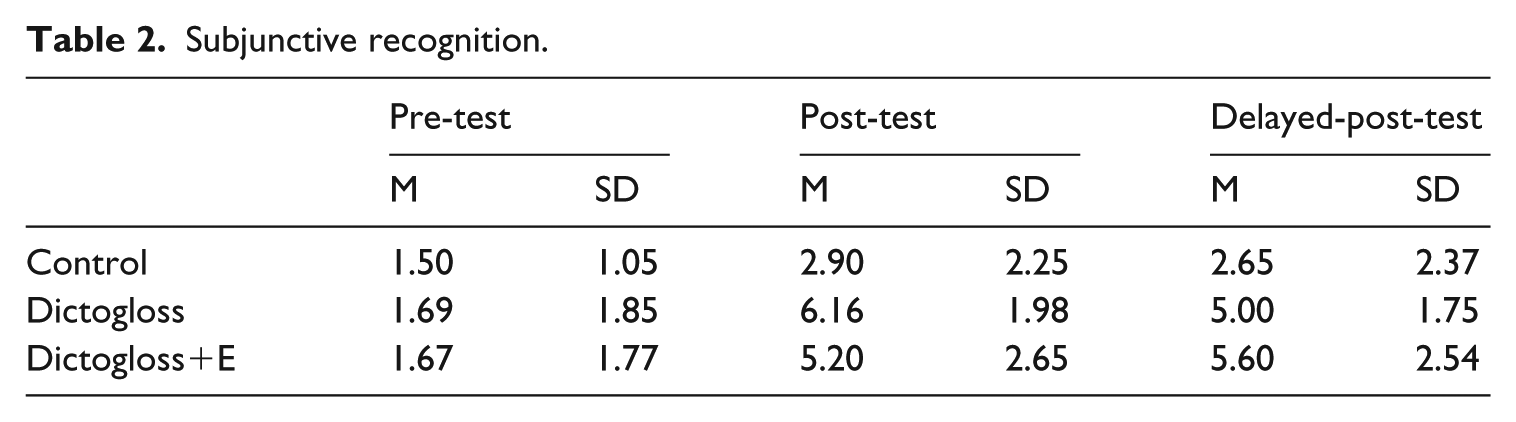
Results of the subjunctive recognition tests indicate that after treatment participants increased their ability to recognize the subjunctive in written contexts. A main effect of time was observed while collapsing group level, F(1.27, 72.56) = 78.17, p < .001. Pairwise comparison revealed that the performance in the delayed-post-test was significantly higher than that of the post-test, which in turn was significantly higher than that of pre-test. There was no significant difference among groups, F(2, 57) = 2.47, p = .09 and no significant interaction was detected, F(2.55, 72.56) = 1.86, p = .15. Table 2 includes the descriptive statistics for subjunctive recognition.
Subjunctive recognition.
3 Text length and complexity
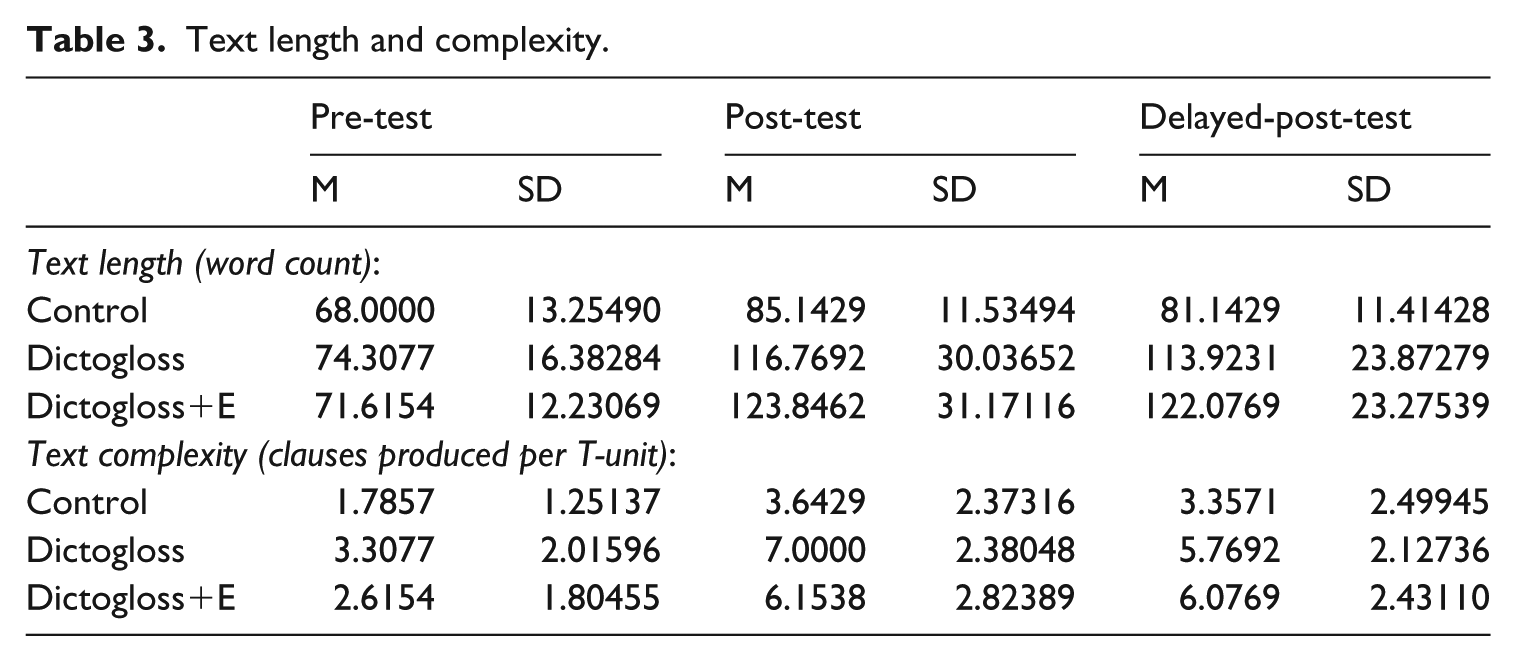
Text length was analysed based the number of words per text. A mixed-design ANOVA with time (pre-, post- and delayed-post-tests), as a within-participants factor and group (Dictogloss, Dictogloss+E, Control) as a between-participants showed a main effect of group, suggesting that text length varied among the three groups, F(2, 37) = 12.28, p < .001, while collapsing across time. A main effect of time was also observed, suggesting that text length differed among the three tests, F(2, 74) = 67.15, p < .001, while collapsing across groups level. There was also a significant interaction between time and group, F(4, 74) = 6.18, p < .001. Following up simple effect analysis revealed that in the pre-test, there was no significant difference among the three groups. In both post-test and delayed-post-test, texts produced by the control group were significantly shorter than those produced by the treatment groups (Dictogloss and Dictogloss+E), among which there was no significant difference.
To determine complexity, complement clauses were analysed. A mixed-design ANOVA with time (pre-, post- and delayed-post-tests), as a within-participants factor and group (Dictogloss, Dictogloss+E, Control) as a between-participants was conducted. Results revealed a main effect of group, as the number of complement clauses produced varied among the three groups, F(2, 37) = 8.8, p < .001, while collapsing across time level. Time had also a significant effect, indicating that the number of complement clauses produced was different at the three testing times, F(2, 74) = 26.69, p < .001, while collapsing across groups level. There was no significant interaction between time and group, F(4, 74) = 1.47, p < .22. Descriptive statistics for text length and syntactic complexity are included in Table 3.
Text length and complexity.
4 Number and type of subjunctive verbs produced
A mixed-design ANOVA with time (pre-, post- and delayed-post-tests), as a within-participants factor and group (Dictogloss, Dictogloss+E, Control) as a between-participants was conducted to determine the number of subjunctive verbs produced across participants. A main effect of group was observed, suggesting that number of verbs varied among the three groups, F(2, 36) = 7.54, p < .001, while collapsing across time level. A main effect of time was also observed, suggesting that number of verbs differed among the three tests, F(2, 72) = 38.71, p < .001, while collapsing across groups level. There was also a significant interaction between time and group, F(4, 72) = 2.71, p < .04. Following up simple effect analysis revealed that in the pre-test, there was no significant difference among the three groups. After treatment, both in the post-test and delayed-post-test, the number of subjunctive verbs produced by the control group was significantly less than that of Dictogloss and Dictogloss+E groups. In all the tests, there was no significant difference between the Dictogloss group and Dictogloss+E group.
Additionally, verbs were analysed in terms of [±regularity] to determine whether participants produced more regular or irregular verbs. A mixed-design ANOVA with time (pre-, post- and delayed-post-tests), as a within-participants factor and group (Dictogloss, Dictogloss+E, Control) as a between-participants was conducted. Results showed a main effect of time suggesting that the number of irregular verbs was larger than that of regular verbs in the pre-test, but the difference became smaller in the post-test and the delayed-post-test F(2, 74) = 5.1, p < .001, while collapsing across groups level. There was no difference among groups, F(2, 37) = .31, p = .74. There was no interaction between group and time, F(4, 74) = 2.20, p = .08. Table 4 includes descriptive statistics for subjunctive verbs produced and the difference between regular and irregular verbs.
Subjunctive verbs and difference in regular vs. irregular verbs.

V Discussion
Based on the results presented in the previous section, it is clear that mood alternation abilities increased after treatment. In the case of recognition, the increase was irrespective of condition, while for production there was a significant difference between participants in the control and treatment groups. The latter also displayed an increase in text length and text complexity. The significance of these results is twofold: they contribute to the existing body of research that has explored the effects of collaborative writing in the L2 classroom and they advance our understanding of the impact of certain tasks on subjunctive production.
The first research question was concerned with L2 subjunctive production in the written modality. Results of between and within-groups comparisons indicated that time and treatment conditions impacted morphosyntactic development. Participants in both treatment groups were able to increase subjunctive production at similar rates. This gain was not only higher than that of the control group, but it was also retained over time. These findings are in line with those of Qin (2008) and Uludag and VanPatten (2012) who found that participants who completed a dictogloss task were able to increase target-form production after treatment.
The lack of significant difference among treatment groups could be interpreted in light of the impact collaboration might have had. It can be argued that the increased subjunctive production was not due to explicit grammar teaching but rather to the nature of the interaction and the opportunities for metatalk, reflection, and the co-construction of knowledge during the text reconstruction. This has been amply documented in previous studies, in which, upon analysing the quality of the interaction and the metatalk as well as impressions from participants, both attention to meaning and form were observed (Kowal & Swain, 1994; Kuiken & Vedder, 2002; Gallego, 2014; Nabei, 1996; Qin, 2008; Swain & Lapkin, 2001). Working collaboratively might activate the cognitive processes that enhance language development due to opportunities to formulate hypotheses about both form and meaning (Swain, 2000; Williams, 2012). It appears then that by reconstructing a text collaboratively learners benefitted from metacognition and metatalk, as they might have reflected on their own language production, as well as offered and received immediate feedback, which can subsequently impact language development (Fortune, 2005; Gallego, 2014, 2016; García Mayo, 2002; Leeser, 2004; Malmqvist, 2005; Nabei, 1996; Qin, 2008; Salazar Campillo, 2006; Swain, 1998; Swain & Lapkin, 2001). Since the present study did not account for an evaluation of the interaction and potential LREs produced, it was not possible to determine the exact extent to which participants were engaging in metatalk.
In evaluating whether learners could increase their ability to produce the subjunctive, the number and type of subjunctive verbs was analysed. It was observed that the number of subjunctive verbs in subjunctive-triggering contexts significantly increased after treatment and a noteworthy pattern was observed regarding morphological features. An analysis of verb type showed that the number of irregular subjunctive verbs produced was higher in the pre-test and subsequently decreased after treatment. If irregular verbs are more easily available for retrieval because they represent a more novel, significant, and salient stimulus (Collentine, 1997; Gallego & Pozzi, 2018), it is then not surprising that participants produced more irregular verbs before treatment.
While the number of irregular verbs produced by participants in all groups decreased, the impact of this task on learners’ ability to recognize and produce regular verbs remains unclear. Sessarego (2016) pointed out that irregular verbs such as sea, haya, pueda, tenga, vaya, quiera, and haga are high frequency and used in a wide selection of discourse, as evidenced in Corpus del español (Davies, 2014). Therefore, it is not possible to discern whether participants decreased the number of irregular verbs produced because this pedagogical intervention increased participants’ ability to recognize regular morphology or because participants incorporated a wider variety of lexical items into their mental lexicons and were therefore able to produce them in their written output. More research could determine whether the lack of saliency is also overcome in the context of different instructional approaches.
The present investigation suggests that collaborative text reconstruction is a task that facilitates subjunctive processing and could enhance learners’ ability to produce the subjunctive in the written modality. These findings taken together with those of Gallego (2016) present initial evidence of increased subjunctive production in both the written and oral modalities after having engaged in collaborative text reconstruction tasks for learners who have been previously exposed to the concept of mood. Since it has been argued that subjunctive intake would be facilitated once learners have achieved a certain level of interlanguage development (Collentine, 1997; Leow; 1995), pedagogical interventions might be more effective at certain stages and after learners are able to process complex syntax (Collentine, 1995, 2010). More research is essential to determine whether this task can be as effective with learners at other stages of interlanguage development.
In spite of its lack of frequency and low communicative value, the subjunctive continues to occupy a central role in formal L2 instruction (Collentine, 2010, 2014). It is evident that there is still much to be explored concerning pedagogical approaches as new suggestions emerge and further empirical testing becomes necessary. For example, Sessarego (2016) argues in favor of the implementation of a discourse-pragmatic approach that would allow learners to comprehend the subjunctive’s communicative value moving away from an itemized approach in which subjunctive is presented, and mechanically practiced in stand-alone sentences. Busch (2009, 2014, 2017) emphasized the importance of a systematic description of subjunctive use considering also the value of [+alternative]. In this way, events are discussed in spite of weather they happened or not, but rather as possible alternatives in their realization and the indicative/subjunctive contrast, he maintains, could be presented as the non-existence of an alternative in the speakers’ mind versus the existence of an alternative in the speakers’ mind.
Supplementing these pedagogical proposals I suggest that instructional models that seek to enhance spontaneous production of the subjunctive should take into consideration: including (or designing) tasks that foster collaboration (Gallego, 2014, 2016), ways of raising awareness regarding subjunctive’s communicative value/function in the case of redundancy (Collentine, 2010; Farley, 2002; Sessarego, 2016), and ways of increasing learners’ ability to overcome the lack of morphological saliency in regular verbs (Collentine, 1997; Lubbers Quesada, 1998; Gallego & Pozzi, 2018).
The second research question was concerned with subjunctive recognition. Even though this study focused primarily on subjunctive production, analysing recognition was relevant for it contributed to illustrating the overall effectiveness of this type of collaborative task and added to the existing evidence regarding the development of mood recognition in English-dominant Spanish L2ers.
Results indicated an increase in subjunctive recognition rates for all groups and some findings are particularly notable. Because previous research has shown that learners have difficulty with subjunctive production, which does not necessarily increase after periods abroad, but can, however, perform fairly well in mechanical recognition tasks (see, amongst others, Bonilla, 2014; Collentine, 1995, 1997, 1998, 2002; Gudmestad, 2012a, 2012b; Henshaw, 2013; Isabelli, 2007; Isabelli & Nishida, 2005; Stokes, 1998; Terrell & Hooper, 1974; Terrell et al., 1987) and given participants’ prior exposure to mood alternation and the subjunctive mood in various tenses, it was feasible to predict high scores in the pre-test, which was not the case. While it is not surprising that learners were not able to extensively produce subjunctive in the pre-test, not achieving high scores on the recognition component (Control M = 1.50, SD = 1.05, Dictogloss M = 1.69, SD = 1.85, Dictogloss+E = 1.67, SD = 1.77) was not an anticipated outcome. These results suggest that the ability to recognize the subjunctive mood and complete mechanical mood alternation tasks might not necessarily be retained for long periods of time. Longitudinal studies could shed more light on this issue.
Findings of the present study are partially in line with previous research that showed that mood recognition abilities develop before mood production abilities (for a review of this issue and others, see Collentine, 2003, 2010, 2014). Conversely, although subjunctive recognition did not appear to be an ability that was readily available at the time of pre-test taking, learners were able to significantly increase recognition rates after treatment, irrespective of the treatment received. For instance, results showed an effect of time (F(1.27, 72.56) = 78.17, p < .001), yet no significant difference among groups (F(2, 57) = 2.47, p = .09), suggesting that collaborative text reconstruction does not necessarily increase recognition rates, nor does explicit teaching when accompanying a text reconstruction task. The findings of Kuiken and Vedder (2002) and Swain and Lapkin (2001), for example, also showed that collaborative text reconstruction did not appear to have an impact on target structure detection. Because previous work on subjunctive acquisition presented evidence of some of the benefits of explicit instruction (Adrada-Rafael, 2017; Farley, 2004; Fernández, 2008; Gallego, 2016), it was possible to hypothesize that explicit instruction would have an impact as well. While that was a foreseeable outcome, current findings could not confirm that hypothesis.
Given that this investigation only focused on one target form, it is not possible to generalize the extent to which this type of task impacts form recognition irrespective of form and proficiency level. Further research could incorporate two or more target forms to determine whether there is an interaction, for example, between task impact on recognition based on target form complexity. Additional evidence could come from longitudinal analyses to measure task impact across proficiency levels and whether this type of task renders long-term effects.
The last research question focused on analysing the quality of the texts produced and was established to determine whether text length and complexity could be enhanced by engaging in collaborative text reconstruction. Participants in both treatment groups produced longer and more complex texts after treatment, as well as a higher number of accurate complement clauses with verbs in the subjunctive. Simply put, both text complexity and length varied by group, with a similar pattern in both cases: Dictogloss group = Dictogloss+E group > Control group. Participants who engaged in collaborative text reconstruction were able to move from parataxis, coordination and the reliance on L1 syntactic structures, to complex structures including subordination and embedding. For example, in the pre-test, as participants were prompted to suggest and recommend, they encoded the semantic value of influence but produced sentences such as Recomiendo: estudiar mucho y leer todos los días or resorted to commands such as A mi amiga le sugiero: estudia en la biblioteca. Simplification and reliance on English syntax was also noticeable in sentences such as Espero para mi amiga pasar la clase and Quiero para mi amiga tene un GPA bueno. Collentine’s (1995) intermediate level participants also produced these types of structure, which led him to conclude that learners at this level are approaching the syntactic stage.
Since the subjunctive mood is almost exclusively found in subordinate clauses, text complexity and subjunctive production go, in this case, hand in hand. Collentine and colleagues explored whether imparting explicit instruction on subjunctive in conjunction with instruction regarding subordination would facilitate subjunctive acquisition but found that, even though such pedagogical intervention was beneficial in certain aspects, the impact was less than anticipated (Collentine et al., 2002). Results of the present study are somewhat similar in that explicit instruction did not increase the production of complex structures, nor did it help participants increase subjunctive recognition rates. Therefore, the increased number of complex sentences observed after treatment for both groups suggests that the learner-generated attention to form that occurs during the text reconstruction interaction impacts both target form recognition and form production as well as L2 writing development evidenced in the sophistication of texts written after treatment. It has been argued that writing collaboratively is an effective way to activate existing knowledge and to co-create new knowledge (for a review, see Williams, 2012), which, in turn, facilitates language learning. Results of the present study align with that claim and also suggest that collaboration facilitates morphosyntactic development and the ability to process and produce complex syntax. Two additional factors could have contributed to enhancing the production of longer and syntactically more complex texts: the nature of written output, which allows learners to spend more time reflecting, and the possibility of visually attending to the written output produced.
These findings add to our understanding of two main aspects in relation to the quality of texts produced. First, they provide further evidence regarding the value of pedagogical interventions that include collaborative writing tasks as both the means for language learning and for the development of L2 writing abilities, indicating that writing to learn and learning to write appear to be two operations working in tandem (Manchón, 2011; Williams, 2012). Second, they indicate that collaborative text reconstruction impacts learners’ ability to produce syntactically complex texts, which is essential for learners of Spanish who face the challenge of acquiring subjunctive morphology, developing mood alternation abilities and producing complex sentences.
VI Conclusions
The research presented here evaluated the effects of collaborative text reconstruction on learners’ ability to recognize and produce the subjunctive mood in the written modality. It also analysed the complexity and length of texts produced before and after treatment. It was observed that learners in the treatment groups increased not only subjunctive production but also wrote longer and more complex texts. Subjunctive recognition rates, conversely, increased as well but did not significantly vary across groups, therefore, whether this was due to engaging in text reconstruction tasks or due to previous mood recognition abilities remains unclear.
The results of this line of research have potential implications in several areas. First, they corroborate the effectiveness of collaborative text reconstruction and can inform practitioners regarding different instructional models that contribute to L2 development. They align with previous observations regarding the relationship between L2 writing and language learning and contribute to the discussion of whether text reconstruction tasks have a short-term as well as a long-term impact on the production of the target forms, particularly in the case of target forms such as the subjunctive mood that are more easily recognized than produced. Second, they advance our understanding of subjunctive development in interlanguage and constitute initial evidence regarding the impact of this type of task on subjunctive production in the written modality. Third, these results also contribute, albeit moderately, to elucidating the degree of complexity that can be achieved in Spanish L2 writing by learners at intermediate-advanced proficiency levels.
Footnotes
Appendix 1
Appendix 2
Acknowledgements
The suggestions from the anonymous reviewers were instrumental in the improvement of this paper. I am very thankful for their contribution. Any remaining issues are my own.
Funding
The author received no financial support for the research, authorship, and/or publication of this article.
