



Abstract
Teacher scaffolding plays a crucial role in shaping the quality of classroom learning, yet little is known about the effective features of scaffolding in classes using content language integrated learning (CLIL), especially in terms of its effects on learners’ language and cognitive development. To address this issue, the study adopts a classroom discourse analysis approach to capture features of effective teacher scaffolding in a CLIL-framed intensive reading class. Results showed a perceived increase in learners’ language and cognitive abilities while also revealing a series of effective teacher scaffolding strategies in CLIL. These include frequent use of dialogic inquiry and incidental feedback in discourse extensions, and the variation of teacher scaffolding strategies in response to students’ learning needs. The findings will inform the development of the CLIL pedagogy in EFL (English as a foreign language) education in China and other parts of the world.
Keywords
I Introduction
Classroom talk plays an important role in developing socially appropriate ways of thinking and knowing, and thus has a strong bearing upon students’ language and intellectual development (Hicks, 1996; O’Connor & Michaels, 2008). Teacher talk as an important component of classroom talk is considered crucial in shaping the ‘type, scope and quality of learning likely to occur’ (Boyd, 2015, p. 371). This is particularly achieved through moment to moment classroom interactions advanced by teacher instructional scaffolding, which will eventually extend learners’ competences (Lantolf & Poehner, 2008). Recently, there has been research on teacher scaffolding investigating its effects in naturalistic instructional settings (Koole & Elbers, 2014; van de Pol, Volman & Beishuizen, 2010; Nikula, Dalton-Puffer & García, 2013). Yet, while content language integrated learning (henceforth, CLIL) is gaining its prominence in second language classrooms around the world, particularly in tertiary EFL (English as a foreign language) classrooms in China, empirical studies in such classrooms are rather limited (Lorenzo, Casal & Moore, 2009; Nikula et al., 2013).
CLIL is an ‘an educational approach in which various language-supportive methodologies are used which lead to dual-focused form of instruction where attention is given both to language and content’ (Coyle, Hood & Marsh, 2010, p. 4). In this case, the need to learn subject matter knowledge engenders multiple meaningful negotiation opportunities for language learning, thus making it authentic and cognitively challenging (Dalton-Puffer, 2011). To navigate productive classroom interactions and safeguard the quality of learning in the CLIL-framed context, high pedagogical skills are expected on the part of the teacher. Exploring teacher scaffolding in the context can not only reveal such classroom interactional features but can also shed light on effective pedagogical practices conducive to learning.
The study takes place in a Chinese tertiary EFL (English as a foreign language) major curriculum reform under a three-fold objective of an integration of language competence, critical thinking and disciplinary competence development (Zhang et al., 2013; Zhang & Li, 2019; Zhang & Sun, 2014). The choice of the curriculum goal is to address the long-standing problem in Chinese tertiary EFL education in terms of the imbalanced development of students’ language and cognition (Sun, 2017). Traditional EFL education in China lays much emphasis on form-focused instruction and language skills training at the expense of cognitive development. As a result, language learning in university cannot well prepare for the development of advanced literacy skills and higher order thinking skills which take on a crucial role in tertiary education (Byrnes, Maxim & Norris, 2010). To address this issue, a series of curriculum reforms have been launched in the context of the study in the past ten years. For example, the percentage of language skill courses in the whole curriculum dropped from 66.7% in 2007 to 33.3% in 2012, followed by a slight increase to 51.5% in 2016. The increase is manifested in the fundamental restructuring of language skill courses by introducing CLIL in both curriculum and material design and development. The prime example of these efforts is the innovation in intensive reading instruction. Compared with the traditional teacher-centered, form-focused instruction, the CLIL-framed intensive reading class is more learner-centered, dialogic and heuristic, featured by rich opportunities for meaningful negotiation and exploration that facilitates and nurtures critical thinking in language learning. Under these circumstances, teachers have put much endeavor in adapting to the reform which has particularly posed great challenges for effective classroom instruction (Zhang & Ye, 2018).
However, despite all the efforts and perceived ongoing changes, there still seems to be a paucity of empirical evidence that can link effective pedagogical practices to students’ development. Based on these concerns, the study adopts a classroom discourse analysis approach to explore the complex interrelations among discourse, pedagogy and learning to see how teacher scaffolding in classroom interactions can help construct a linguistically and cognitively rich learning environment. It is thus hoped that results of the study can not only shed light on the development of an effective CLIL pedagogy but also inform EFL education in China and other parts of the world.
II Literature review
As is mentioned previously, the intensive reading instruction in the study is CLIL-framed. The underlying assumption of CLIL is that language learning is never an end to itself but a means of meaning-making and problem solving (Ruiz de Zarobe, 2017). Therefore, language in CLIL is both the ‘subject’ and ‘object’ for learning (Cammarata, Tedick, & Osborn, 2016). The complex interactions between language and content can be demonstrated in two ways. First, the goal of content learning has rendered language learning in CLIL both culturally meaningful and cognitively authentic (Cammarata et al., 2016). Second, learning subject matter knowledge through a foreign language can promote consciousness-raising and more advanced meaning-making (Dalton-Puffer, 2011). This can be explained by the linkage between thinking and speaking from a Sociocultural Theory perspective, which holds that the development of higher-order mental functioning is originated in mediated interactions on a social plane (Wertsch, Tulviste & Hagstrom, 1993). Therefore, the need for content learning in CLIL has created an ‘acquisition rich’ environment with multiple meaning-making resources for learners to think and explore with language (Dalton-Puffer, Nikula & Smit, 2010; Ruiz de Zarobe, 2015).
The potentiality of CLIL for content and language learning can mainly be actualized in its mode of classroom interactions. As mentioned previously, the need for subject matter knowledge learning has made CLIL classroom discourse an embodiment of rich learning opportunities (Dalton-Puffer, 2011; Ruiz de Zarobe, 2015). A number of studies have been done to acknowledge the benefits (see, among many others, Jäppinen, 2008; Jexenflicker & Dalton-Puffer, 2010; Lasagabaster, 2011; Lorenzo et al., 2009; Whittaker & Llinares, 2009; Whittaker, Llinares & McCabe, 2011). It is agreed that to account for the underlying learning mechanisms, more process-oriented research is necessary (Nikula et al., 2013).
Recent studies on CLIL classroom discourse reported a series of interactional features conducive to learning. These included frequent use of teacher questioning to expand learners’ discourse, and a more symmetric teacher–learner relationship to promote their participation in interactions (Nikula, 2010). These findings were complemented by Urmeneta & Walsh’s (2017) research revealing a series of interactional features in CLIL that afforded learning, such as ‘teachers’ deployment of multimodal resources’ and frequent use of elicitations for more elaborated learner responses (Urmeneta & Walsh, 2017, p. 183). Yet, what is further needed is to figure out how and why better learning takes place. Just as mentioned by Skidmore (2016, p. 100), ‘what matters is not simply the frequency of particular exchange structures in classroom discourse, but how far students are treated as active epistemic agents’. To reveal that learning mechanism, in-depth analyses on both the quantity and quality of interaction are necessary.
This has obviously pointed to the necessity to study teacher talk in CLIL from an educational perspective, especially in terms of the pedagogical support provided in moment-to-moment interactions, which is mainly achieved through teacher scaffolding. The notion of scaffolding initially comes from Vygotsky’s definition of the Zone of Proximal Development (ZPD), which means ‘the distance between the actual developmental level as determined by independent problem solving and the level of potential development as determined through problem solving under adult guidance or in collaboration with more capable peers’ (Vygotsky, 1978, p. 86). It is considered as the kind of guidance for problem solving from a more capable person (van de Pol et al., 2010; De Guerrero & Villamil, 2000; Walqui, 2006). What is demonstrated in the notion is that the importance of teacher scaffolding to learning can largely be attributed to its developmental orientation to indicate ‘the presence of certain maturing functions which can be a target for meaningful interactive action’ (Chaiklin, 2003, p. 43).
Compared to traditional form-focused foreign language instruction with relatively low cognitive demand, the goal of content learning in CLIL poses relatively high cognitive challenges for learners who have to make content comprehensible through a foreign language (Ball, Kelly & Clegg, 2015). This often requires high-quality teacher scaffolding to navigate learners along the form-meaning continuum based on classroom interactional contingencies (Daniels, 2016; de Graaff et al., 2007; Gibbons, 2003, 2015; Walqui, 2006). As mentioned by Gibbons (2015), the role of teacher scaffolding in CLIL is two-fold, that is constantly engaging students into cognitively challenging tasks while providing them with adequate support. This support, however, gradually retreats as learners become more competent and are able to engage in higher order thinking with more automatized language use (Coyle, 2007; Gibbons, 2015).
However, while these studies have been enlightening in revealing the effective features of teacher scaffolding in CLIL classroom discourse (de Graaff et al., 2007; Gibbons, 2003; Urmeneta & Walsh, 2017), few have explored their long-term developmental effects. While detailed conversation analysis can reveal the micro-genesis of learning in moment-to-moment interactions, development often takes time to occur (De Guerrero & Villamil, 2000; Larsen-Freeman, 2006). In this sense, it is only by mapping long-term developmental outcomes onto positive interactional features that the efficacy of teacher scaffolding in CLIL classroom discourse can be better justified. In addition, in order to unveil the intricacies between classroom interactions and learners’ cognitive and linguistic development, multiple strata of data analysis are often necessary. As was proposed by Nikula et al. (2013, p. 92), ‘future CLIL classroom research would also benefit from complementing linguistically and socioculturally-oriented analyses of classroom discourse with ethnographically-oriented approaches’. The efficacy of pedagogical practices in CLIL can only be justified with reference to its cognitive and linguistic developmental effects.
Therefore, the study adopts a classroom discourse analysis approach to trace a cohort of Chinese English Majors’ intensive reading learning experiences for a whole semester under the intention to unveil effective CLIL pedagogies. A ‘multi-level coding system’ is adopted to achieve a comprehensive understanding of the complex interrelations between teaching and learning (Zhang, 2016, p. 52). Based on that, quantitative analysis is applied on the initial qualitative coding to look for group developmental features. This can help promote theorization from practice, especially in terms of the patterns of teacher talk in CLIL that can effectively shape the quality of learning.
In the study, three research questions are addressed:
How can the implementation of CLIL impact the patterns of interaction in the intensive reading class?
What are features of effective teacher scaffolding in CLIL-framed intensive reading learning?
How can teacher scaffolding impact learners’ language and cognitive development in this process?
III Research methods
1 Data collection
Under the curriculum reform context, intensive reading instruction lasts for four semesters from the beginning of freshmen to the end of sophomore, encompassing four subject areas, namely: linguistic, literature, sociology and philosophy. Altogether four textbooks were written and published by a renowned publishing house in China to cover the span of the first two years’ ‘intensive reading’ instruction. In the study, the major theme of instruction is ‘sociology’ for first semester sophomore students, and the course objective is to get them familiar with the major sociological concepts and theories as well as developing their language ability and critical thinking skills.
The teaching was CLIL-framed, encompassing a series of activities including: in-depth text analysis integrated with dialogic inquiry and exploratory talk focusing on a particular sociological issue for critical evaluation, and incidental ‘focus on language’ (van Lier, 1996, 2004) based on students’ output for feedback and discourse extension (Wells, 1999). Also, the teaching was conducted in English as a tradition of the school to cultivate integrated high-end language talents. Due to its highly competitive enrolment policy, students usually achieve a high English language proficiency and are exposed to content-rich curriculum since their enrolment. In the study, the students are all L1 Chinese speakers learning English as their first foreign language. Therefore, while there are accumulating evidence suggesting the cognitive and social benefits of L1 usage in L2 learning, especially in terms of translanguaging (Creese & Blackledge, 2010; Garcia & Li, 2014), the current pedagogical choice is mainly grounded by the concern to prompt more pushed output on the part of the learner for deeper syntactic and semantic processing (Swain, 2005, 2006; Yang & Zhang, 2010). This process is highly scaffolded by the teacher and supported by the relatively safe, critical and resourceful classroom learning environment. Excerpt 1 of teacher–student interaction serves as a typical example.
Excerpt 1: Teacher–student interaction in the CLIL-framed intensive reading class 1 T: Anybody who can help him? Any volunteers? Or can you rephrase it even other ways to make it simpler and easier to be understood? Your neighbor please. 2 S: The total amount of the income of the poor is small, so . . . 3 T: The total amount of the income of the poor is small and then? 4 S: A man with a fixed amount of money which he regarded as taxes, will account for a larger part in their income in comparison to the rich. 5 T: But obviously the rich pay more money to taxation. How can we also say that it is the poor who have contributed more to the society? . . . Don’t you think that it is the rich who pays more tax to the government? Then how could the author say that it is the poor who contributed more to the society? Please. 6 S: I think it’s the poor who takes more of their income to . . . 7 T: It is the poor who take more of your income in that sense they contribute more. So considering their low income they take a higher proportion of their income out as tax. Maybe the absolute amount is smaller compared to the tax the rich pour to the government. But considering that they earn a smaller amount of money, the percentage is very high, so actually the contribution is higher.
From this excerpt, it can be seen that teacher–student interactions in this CLIL-framed intensive reading class are highly meaningful and authentic, organized through critical reading of classical sociological texts to encourage learners to make sense a social phenomenon based on their own experiences. The role of the teacher in these interactions is more like a facilitator (Ball et al., 2015), pushing learners to engage in deeper levels of cognitive processing (i.e. in Turn 3 and Turn 5), elaborating on their responses and modeling language (i.e. in Turn 7) (Nassaji, 2016). These practices have generally created an acquisition rich learning environment for learners to gradually expand their linguistic and cognitive repertories.
2 The intensive reading teacher ‘May’ and her students
In the study the teacher, who was given the pseudo-name ‘May’, taught the intensive reading course for a whole semester and was responsible for both content and language teaching. She holds a PhD degree of cultural studies and has 20 years of language teaching experience. She was easy-going and initiated to participate in the study, which she thought can push her to further reflect on her own practices. In addition, she is highly supportive of the curriculum reform in terms of the integration of subject matter knowledge and critical thinking into language learning. Ever since the initiation of the curriculum reform, she has taken on the teaching of ‘intensive reading’ and has a series of innovations in her own pedagogies. When asked about her beliefs on CLIL in after class conversations, she revealed that one of the best ways to integrate content and language learning is through exploratory talk (Barnes, 2008), where learners are fully engaged to explore their ideas on real world issues with well-grounded, creative and critical thinking. However, it also requires high pedagogical skills on the part of the teacher to ensure the quality of such exploratory talks. This is demonstrated in her effort to engage the learners in deep language and cognitive processing during discussions while providing them with adequate support. This rich experience have all guaranteed her qualification as a CLIL teacher both in terms of her content knowledge and pedagogical skills (Troyan et al., 2017).
The students usually achieve a good command of English. They all passed TEM-4 (Test for English Majors 4), a national standardized test for English Majors in China (Jin & Fan, 2011), with 70% of them scoring over 80. With reference to the China’s Standards of English Language Ability (the CSE), the students in the study are generally between the level of CSE 6 and CSE 7, corresponding to CEFR 1 B2 to C1 level (Council of Europe, 2001; Liu, 2018; Ministry of Education, 2018). This can be ascertained both with reference to their TEM-4 scores and the CSE overall language ability descriptors in terms of the students’ ability to ‘understand language materials in a range of topics’ and ‘to discuss a range of familiar topics in academic and work interactions’ (Liu, 2018, p. 6). Since enrolment, these students were exposed to a content-rich curriculum with regularly 9 to 10 content courses taken each year. These learning experiences not only prepared them linguistically and cognitively for their participation in classroom discussions, but also nurtured a creative and critical learning culture in which students generally feel ease to express their opinions and challenge each other.
For research purposes, the classes under investigation were videotaped over the semester with the consent of both the teacher and students. Recording was done by professional recorders with standard equipment, ensuring clear sound and motion effect. Altogether six classes were selected at a relatively equal interval about every two to three weeks, ranging within the period from mid-September to mid-December in 2017. Each class lasted about one and a half hours.
3 Data analysis framework and tools
The study adopted the initiation–response–follow-up (IRF) framework (Hall, 2011) as the basic unit of classroom discourse analysis, which was mainly conducted on three levels: cognitive complexity, scaffolding functions and discourse extensions.
First, cognitive complexity was coded under the revised framework of the ‘Blooms Taxonomy’ (Anderson et al., 2001), encompassing six cognitive functions within a hierarchy, namely: remember, understand, apply, analyse, evaluate and create. The first two (remember, understand) constituted ‘low-level’ cognitive activities; the following two (apply, analyse) ‘mid-level’ cognitive activities; and the last two (evaluate, create) ‘high-level’ cognitive activities. The purpose was to define the extent to which classroom interactions were featured by higher order mental functioning.
Second, teacher scaffolding functions were operationalized with reference to the works of Wood, Bruner & Ross (1976) and Walqui (2006) under the framework of sociocultural theory. Wood et al. (1976) defined six scaffolding functions: recruitment, reduction in degrees of freedom, direction maintenance, marking critical features, frustration control and modeling. Walqui (2006) has subsequently added five complementary functions: bridging, contextualizing, schema building, representing text and developing meta-cognition. While Wood et al. (1976) mainly focused on mother-infant interactions, Walqui’s (2006) framework oriented more to features of teacher scaffolding that can promote learning. Therefore, the study combined these two frameworks and integrated them into an adapted version (see Table 1). In this version, functions for task and emotional control like recruitment, direction maintenance and frustration control were omitted since the students under concern are all high-proficiency level English learners. Therefore, only several scaffolding functions were selected from the initial resource pool.
Classroom discourse coding scheme.
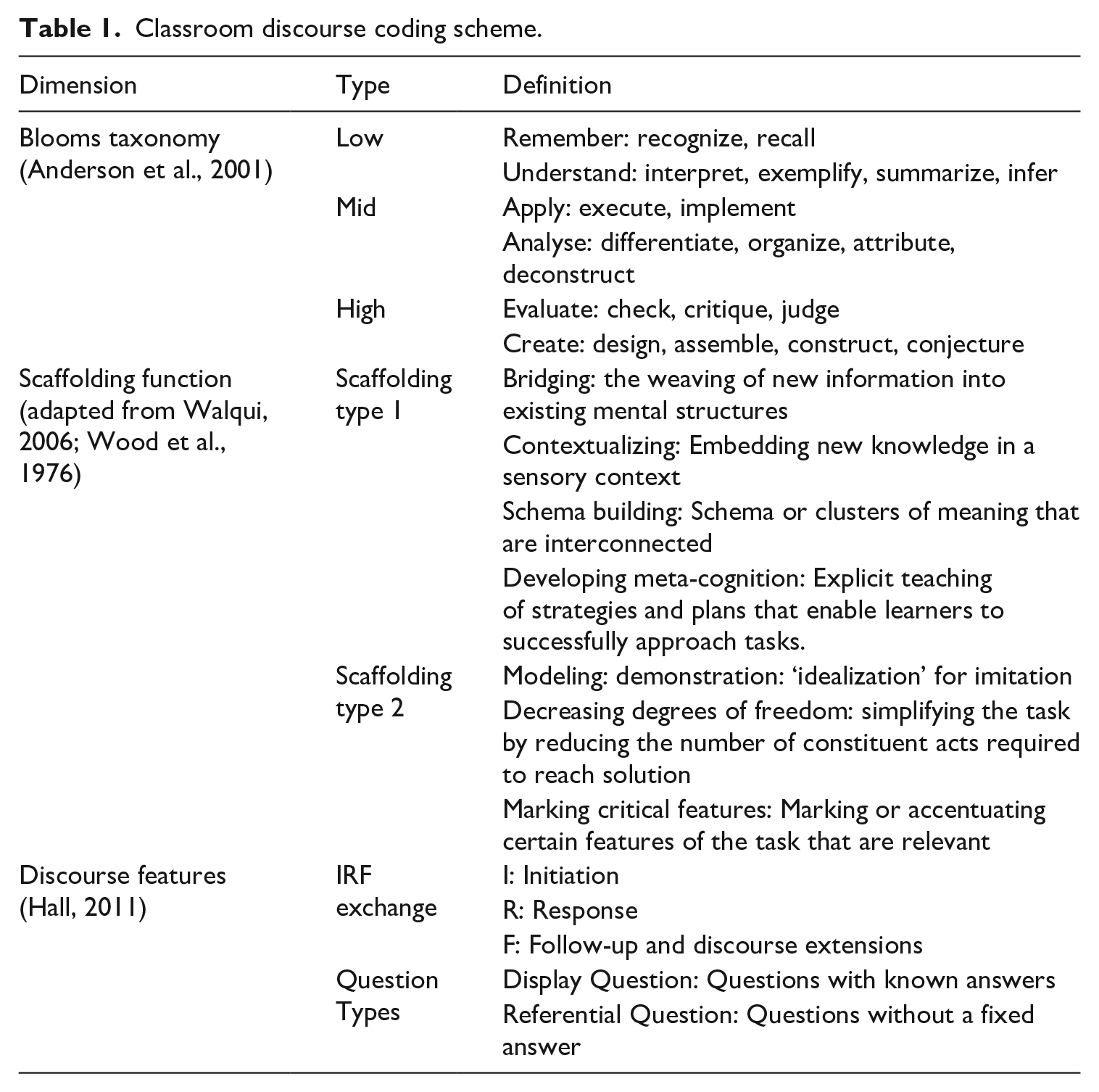
The distinctions between the two sets of scaffolding functions can best be described by that of simplifying and amplifying (van Lier, 2004). Just as van Lier (2004, p. 150) mentioned, ‘constructivist educators would generally propose that task should not be simplified, but rather be amplified for development to occur.’ Scaffolding in the latter part concerns the provision of ample contextual affordances to mediate students’ learning rather than simplifying its requirements. However, ‘simplifying’ the task may sometimes be necessary to make teaching responsive to learners’ needs.
Third, discourse extensions were mainly defined in terms of turn-taking and types of teacher questioning. While turn-taking was captured by the Initiation-Response-Feedback pattern which depicted the general flow of classroom interactions, question types were coded as display questions and referential questions respectively (Hall, 2011). The purpose was to manifest the extent to which the CLIL classroom discourse was interaction-oriented (Walsh, 2011). Overall, the intention to integrate interaction analysis with teacher scaffolding strategy analysis is to reveal the complex interactions among pedagogy, discourse and learning in L2 classrooms (Zhang, 2016, pp. 47–54). Therefore, compared to previous studies which either focused more on discourse (Nikula, 2010; Urmeneta & Walsh) or pedagogy (de Graaff et al., 2007; Gibbons, 2003), the current methodological framework integrates these two dimensions to see how effective teacher scaffolding can promote high quality classroom interactions that are conducive to the development of both language and cognition.
In the study, two coders took part in qualitative data analysis, with Coder 1 in charge of the coding of all data, and Coder 2 responsible for 30% of the coding of the total data. Coder 1, the main researcher of the study trained Coder 2 in advance concerning the coding procedure, and the two coders have done 10% of the coding together through negotiation for agreements to be reached. The other 30% of coding (classroom discourse excerpts taken randomly) was done independently by Coder 2, with the inter-coder reliability between the two coders all above 80%. In addition, to serve for quantitative language analysis, data-cleaning was done on the raw data by the first researcher, which involves removing the modal particles, conversation fillers, dys-fluency and language repair for subsequent analysis. This was conducted to facilitate corpus analysis of teacher–student interactions in terms of word count and linguistic complexity. However, in future studies, these features may be returned to for more in-depth qualitative analysis of the classroom ecologies.
Language analysis in the study mainly involves tracing learners’ oral language complexity in classroom interactions diachronically. The basic unit of analysis is a T-unit (Czwenar, 2014). Altogether four measurements were taken: lexical sophistication, lexical variation, syntactic subordination and ratio of complex nominals, with the first two dealing with lexical complexity and the latter two syntactic complexity. Lexical sophistication was measured as the ratio of the number of sophisticated word types (i.e. the ‘beyond 2,000’ words) to the total number of word types in a text (Lu, 2012). Lexical variation was measured by corrected type–token ratio (CTTR), a mathematical correction of type–token ratio (TTR), counted as T/√2N2 (Lu, 2012). Measurements for syntactic complexity were operationalized as syntactic subordination and complex nominals respectively. The former was referred to as ‘the number of clauses per T-unit’, and the latter as ‘complex nominals per T-unit’ (Lu, 2010) (see Table 2).
Measurements of students’ language performance.

IV Data analysis
Results showed that the CLIL-framed intensive reading instruction offers multiple learning opportunities to enhance learners’ discourse contribution and cognitive engagement. The teacher maintained the direction and quality of classroom interactions strategically by adjusting the content and functions of scaffolding to learners’ needs. In the long term, development was perceived on learners’ language and cognition as a demonstration of the efficacy of classroom interaction.
1 Features of CLIL classroom discourse conducive to learning
Data in the study revealed that the CLIL-framed intensive reading instruction was largely interaction-oriented, with active learner participation and rich teacher and learner-initiated discourse extensions. The teacher facilitated learners’ discourse extension and cognitive engagement by using a series of scaffolding strategies, such as dialogic inquiry and incidental feedback.
Initially, in terms of discourse structure, it can be seen that the CLIL classroom discourse was generally co-constructed by both the teacher and the students, each playing an important role (see Table 3). First, concerning question types, it was manifested that the number of referential questions generally amounted to over 60% of the total number of questions, almost about twice as much as the display questions. This phenomenon revealed that the teaching was highly communicative and students were encouraged to freely express their ideas using their own language. Second, concerning the total amount of teacher and student discourse, it can be seen that students’ discourse accounted for about 20% to 30% of the total discourse, and the amount of teacher discourse about twice as much as that of the students. Compared to traditional language classes where teacher talk took up to around 70% to 80% of the class time (Ball et al., 2015, p. 44), the intensive reading course in the study offered ample opportunities for students’ participation. Roughly every student had a chance to speak once in a class, although some contributed more in free discussions which were featured by less rigid participation structure and more self-selection. Generally, the need for content learning not only triggered ample meaningful negotiation, but also generated heated discussions and debates among the learners under a genuine communicative need.
Features of CLIL classroom discourse.

Third, data revealed that frequent teacher and learner discourse extensions were perceived. From Table 3, it can be seen that learners’ discourse extensions generally amounted to about 2 times per turn, and that of the teacher over 4 times. This has further justified the communicative nature of the class, encouraging meanings to be socially examined and negotiated.
In the meantime, the teacher in the CLIL classroom tended to combine dialogic inquiry with incidental feedback to engage learners into complex cognitive activities. It was revealed that generally two techniques were used by the teacher in the follow-up move. One was the use of questions (usually that of ‘what’, ‘how’ and ‘why’) to prompt learners to reflect on their answers and think more deeply. The other was the teacher’s elaboration and extension on students’ ideas to incidentally feedback on both meaning and form.
For dialogic inquiry, questions asked can be either reflective or additive. Reflective questions require the learners to elaborate on their own ideas to make it clearer and more precise. This can serve as a kind of ‘pushed output’ (Swain, 1988, 2005) to prompt learners to engage in the process of ‘languaging’ (Swain, Kinnear & Steinman, 2011). In this way, learners were led to experience and explore with language (Swain et al., 2011) that constituted valuable learning opportunities. Additive questions often serve to push the learners to further enrich or embellish their answers and make them more comprehensible. This can be achieved, for example, by asking learners to provide reasons (i.e. why do you think so?) or give more comments on their answers (i.e. what do you think of this issue?). In this way, the teacher not only guided the learners to gradually approach a more ‘ideal version’, but more importantly created a pedagogical space (van Lier, 2000, 2004) which rendered them precious opportunities for modified output (Nassaji, 2016; Yang & Zhang, 2010).
In terms of teacher feedback, data revealed that it was mainly achieved through elaboration and extension. For elaboration, the teacher often rephrased students’ answers to create opportunities for ‘focus on form’ (Ellis, 2016), which were then turned into language input for all the other students. In the meantime, the quality of ideas was also enhanced, often with higher levels of abstraction and conceptualization. For extension, the teacher not only elaborated on students’ ideas but also built on them, co-constructing knowledge with the students. Scaffolding provided in this phase was often more inductive and thought-provoking, aiming at initiating multiple perspectives and developing higher order thinking skills. Excerpt 2 provides a good example.
Excerpt 2: Teacher feedback through dialogic inquiry 1 T: Any comment on that? Look at the first two lines, ‘poverty is used to guarantee the status of those who are not poor’. This is also a very fresh perspective. 2 S: I have a good question. Can it be explained by the functionalist or conflict theory? 3 T: You think it’s from the conflict theory. 4 S: Because you mentioned hierarchy. 5 T: Functional, she thinks it’s functional, why? 6 S: Because it says that the poor hope to maintain their status maybe far from the middle class. They probably suppose that the poor will conquer the existence of such classification but now . . . 7 T: ‘Will conquer’ what do you mean? If it is conflict theory, how could it be explained? 8 S: The hierarchy shouldn’t exist . . . 9 T: Or the hierarchy exists because of class conflict, or we hope it could be eliminated. That’s conflict theory. Yeah, I think she’s right.
This excerpt shows that much of the teacher extensions were open-ended, encouraging active thinking and multiple perspectives (i.e. in Turns 1, 5 and 7). In this way, the teacher kept on eliciting students’ responses and prompted them to think deeper in exploratory talk. In addition, the teacher also provided incidental feedback on students’ ideas by further elaborating on or extending their contributions (i.e. in Turn 9). By doing this, she created valuable learning opportunities closely tailored to students’ current developmental levels and learning needs.
2 Teacher scaffolding in relation to students’ language and cognitive performance
This section investigates how teacher scaffolding are provided to enhance learners’ language and cognitive performance. This relationship can mainly be revealed from three perspectives. The first dimension counted the number of turns containing low, middle and high-level cognitive activities respectively by referring to the ‘Blooms Taxonomy’ (Anderson et al., 2001). The second dimension calculated the number of teacher scaffolding within two broad terms, namely: Scaffolding 1 (amplifying) and Scaffolding 2 (simplifying) within each cognitive level. The third dimension measured the mean number of scaffolding per turn in tasks of different cognitive complexities (see Table 4). Results showed that the teacher adjusted the content and function of scaffolding in terms of task complexity and learners’ performance. And by doing so, the teacher constantly balanced between the level of challenge needed to maximize learners’ cognitive engagement and the amount of support required for problem solving (van Lier, 2004).
Relations between teacher scaffolding functions and task cognitive complexity (total, with percentages in parentheses).

Notes. a S1 refers to Scaffolding 1, namely: bridging, contextualizing, schema building and developing meta-cognition. b S2 refers to Scaffolding 2, namely: modeling, decreasing the degree of freedom and marking critical features. c S-Total refers to Scaffolding total, combining both Scaffolding 1 and Scaffolding 2. d Mean S per turn refers to mean number of teacher scaffolding per turn.
Table 4 shows that the amount and functions of teacher scaffolding vary in terms of the cognitive complexity of the learning tasks. First, looking at the total number of scaffolding in each cognitive level, it can be seen that mid-level cognitive activities share the highest number of scaffolding (160 times), amounting to about 55% of the total scaffolding provided. This figure is followed by low-level (89 times) and high-level (42 times) cognitive activities, amounting to about 31% and 14% of the total each. However, when taking into account the number of turns in each cognitive level, it is manifested that besides the unevenly high distribution of scaffolding in mid-level cognitive activities (48%), the remaining proportion of scaffolding are rather evenly shared by low (25%) and high-level cognitive activities (27%), with that of high level ones slightly higher. In general, it can be seen that the amount of teacher scaffolding increased sharply in mid-level cognitive activities followed by a drop in the high-level ones. This trend revealed a need for teacher scaffolding in face of increasing cognitive demand but was gradually removed as learners became more competent (see Figure 1).
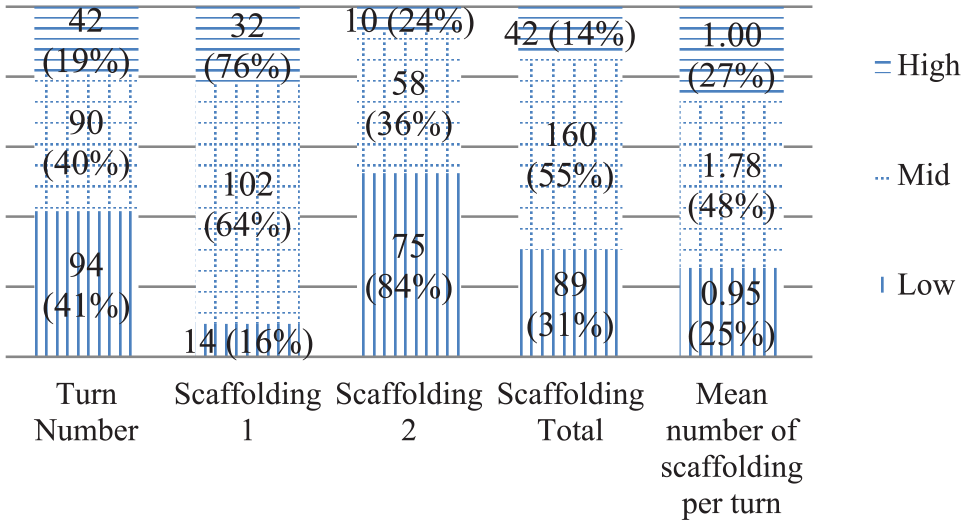
Teacher scaffolding functions and task cognitive complexity.
The second relationship lies in the function of teacher scaffolding which varies in terms of the cognitive complexity of the learning tasks. Looking at the proportions of the two types of scaffolding (abbreviated as S1 and S2) within each cognitive level, it can be seen that S1 were perceived most frequently in high-level cognitive activities (76%), followed by 64% in mid-level ones and only 16% in the low-level ones. On the other hand, the proportion of S2 showed a completely different trend, with the highest frequency of occurrence found in low-level cognitive activities (84%), followed by a sharp decrease in mid (36%) and high (24%) level ones. This can possibly be explained by the nature of the two types of scaffolding. While ‘Scaffolding 1’ generally amplified the context and information for problem-solving, ‘Scaffolding 2’ most often simplified it by narrowing down the uncertainties for answering. Therefore, while the teacher initially simplified the task demand in lower-level cognitive activities for language analysis and text processing, she gradually amplified the learning environment in higher level cognitive activities by providing less explicit cues, expanding the possibilities for alternative answers and giving learners more autonomy. Excerpt 3 in the following is a typical example.
Excerpt 3. Teacher scaffolding strategies in relation to cognitive complexities 1 T: Then, what is the most revolutionary development in the McDonaldized labor process? Is there a revolution according to Richard? If yes, what is it? 2 S: The most revolutionary development in the McDonaldized labor process is that they get the customers involved in the service. 3 T: They get the customers involved in the service. Why is this a revolution? 4 S: In the past, the service process is just the workers fully serve the customers, but now the customers have to serve themselves. There is some progress. 5 T: It’s a progress . . . Richard called it a revolution in what sense? In what sense is it a revolution? 6 S: Because it is the key to the success of this McDonaldization. 7 T: Why is it the key to success? Why? There was a good change compared to the industrial jobs. Then why is it a revolution and a key to success in the modern society? 8 S: They have the . . . the exploitation of the employees . . . 9 T: What do you mean by exploitation of the employees? Exploitation of what? Who is exploited? 10 S: Customers. 11 T: Why? 12 S: Because they have to do something by themselves. 13 T: They do something by themselves, so why is it an exploitation? 14 S: This exploitation cuts down the expense of the . . . 15 T: Because the customers are not paid, it saves money for the employers. So the employers could cut down the cost. In that sense it is the exploitation of the customers. The customers are not paid for their contribution of the labor process . . . 16 T: Do you agree with him on this? Do you think you have been exploited when you enter the McDonalds, doing all the service by yourself? 17 S: Yes. 18 T: You agree with him. 19 S: But I think it’s also a convenience for us, because we can save more time. 20 T: Aha, you don’t have to wait for the waitress. It’s more efficient you think. In that sense you are repaid. You are awarded because of the efficiency. You think you are not exploited because you save your time. 21 S: Yes. 22 T: So, in that sense, you don’t agree you are being exploited. How many of you agree with Richard that you are being exploited by doing most of the service by yourself? Those who disagree, tell me why. 23 S: I think like I have already been McDonaldized. Because when I enter the Macdonald, it’s just their model and it’s just how this kind of fast food restaurant works. And I am used to the process that I have to do it. 24 T: So, you take it for granted. 25 S: Yes, I don’t feel this exploitation. I take it for granted until I read this article that there is a possibility that I have been exploited.
From this excerpt, it can be seen that the teacher varied her scaffolding strategies in terms of the cognitive complexity of different learning activities. While in low-level cognitive activities, more ‘simplifying’ strategies were used, such as ‘marking critical features’ and ‘decreasing degrees of freedom’ (Wood et al., 1976) (i.e. in Turns 5, 7 and 9), more ‘amplifying’ strategies were adopted in higher-order cognitive activities to enrich the cognitive learning environment (i.e. in Turn 20). It is also observed that in higher-order cognitive activities, the degree of teacher control in discussion gradually decreased, changing from prompting to elaborating and commenting on learners’ responses (i.e. in Turns 20 and 24). This not only enhanced the level of learner autonomy in classroom discussions by giving them more choices, but also provided them with an opportunity to internalize and automatize the language and content knowledge just learned.
The third relationship lies between the function of teacher scaffolding and learners’ language performance in terms of oral language lexical and syntactic complexity. Data revealed a perceived increase in learners’ oral language lexical complexity in mid-level cognitive activities which subsequently dropped in high-level ones. However, learners’ oral language syntactic complexity kept on rising over the three levels, reaching its highest point in high-level cognitive activities (see Table 5 and Figure 2).
Relations between task cognitive complexity and learners’ language performance.

Notes. a LS2 refers to lexical sophistication, calculated by ‘the ratio of the number of sophisticated word types (Ts) (i.e. the ‘beyond 2,000’ words) to the total number of word types in a text.’ (Lu, 2012). b CTTR refers to corrected type–token ratio (TTR), a method to count lexical variation. c CN/T refers to complex nominals per T-unit. d C/T refers to clauses per T-unit, a method to count syntactic sophistication.
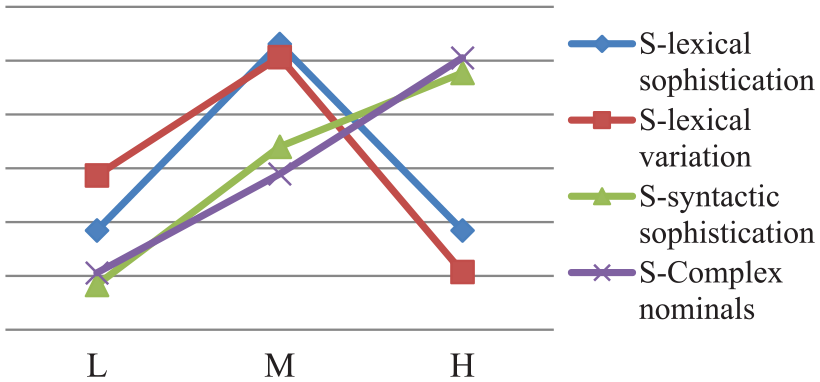
Patterns of learners’ language performance in tasks of different cognitive complexity.
This can possibly be explained by the increasing cognitive complexity in higher level cognitive activities which generated more complex meaning-making, especially in terms of perspective-taking and complex reasoning (LaRusso et al., 2016; Robinson, 2011). The study proposed that students’ relative ease of expression in higher order thinking activities can largely be attributed to the provision of coherent teacher scaffolding in low and mid-level cognitive activities. These scaffolded interactions not only made subject matter knowledge comprehensible but also enhanced students’ understanding of the social phenomena through deep reasoning (see Excerpt 3). Therefore, in contrast to Barnes’s (2008) position that learners’ language is often hesitant and incomplete in exploratory talks, the relatively spontaneous and complex learner language production in the study can possibly be attributed to the effects of teacher scaffolding on preparing learners both linguistically and cognitively for critical inquiry.
However, from Table 5 it can also be seen that contrary to the continuously rising syntactic complexity, learners’ oral language lexical complexity dropped in high-level cognitive activities. This can possibly be accounted by the nature of open-ended discussions in higher order thinking, encouraging the exploration of new ideas and multiple perspectives without restricting the scope of discussion within a particular domain. As the scope of discussion gradually goes beyond the text to encompass more real-world issues, learners are more likely to resort to their already automatized language systems for expression. In this sense, it is hypothesized that the in-depth text processing required for content learning in low and mid-level cognitive activities has to some extent created a genuine disciplinary context for academic language use especially in terms of the internalization of the newly learned language knowledge. This has also stressed the need for teacher scaffolding to guarantee the quality of language learning in content classrooms by creating contexts for the internalization of the newly learned knowledge.
3 Teacher scaffolding developmental effects
To further verify the effectiveness of classroom interactions on learning, the study also measured learners’ diachronic language and cognitive development in-class. Results showed that learners’ oral language complexity showed a general increase over the semester, while the correlation between the amount of teacher scaffolding and learners’ higher order cognitive functions gradually decreased. This can be an indication of their increasing ability to engage in higher order cognitive activities independently. Results can be seen in Table 6 and Table 7.
Learners’ language development (mean).
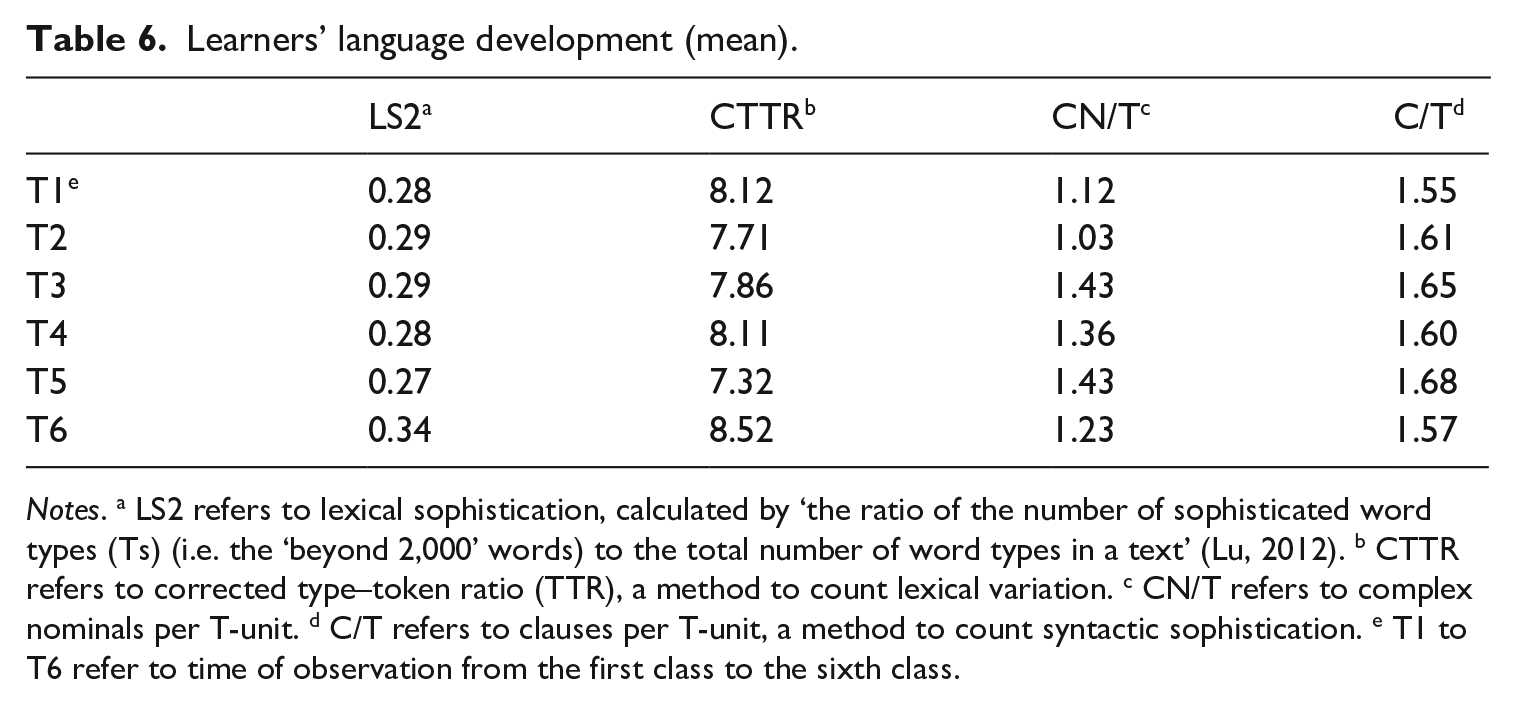
Notes. a LS2 refers to lexical sophistication, calculated by ‘the ratio of the number of sophisticated word types (Ts) (i.e. the ‘beyond 2,000’ words) to the total number of word types in a text’ (Lu, 2012). b CTTR refers to corrected type–token ratio (TTR), a method to count lexical variation. c CN/T refers to complex nominals per T-unit. d C/T refers to clauses per T-unit, a method to count syntactic sophistication. e T1 to T6 refer to time of observation from the first class to the sixth class.
Relations between teacher scaffolding, task cognitive complexity and discourse extensions (r).
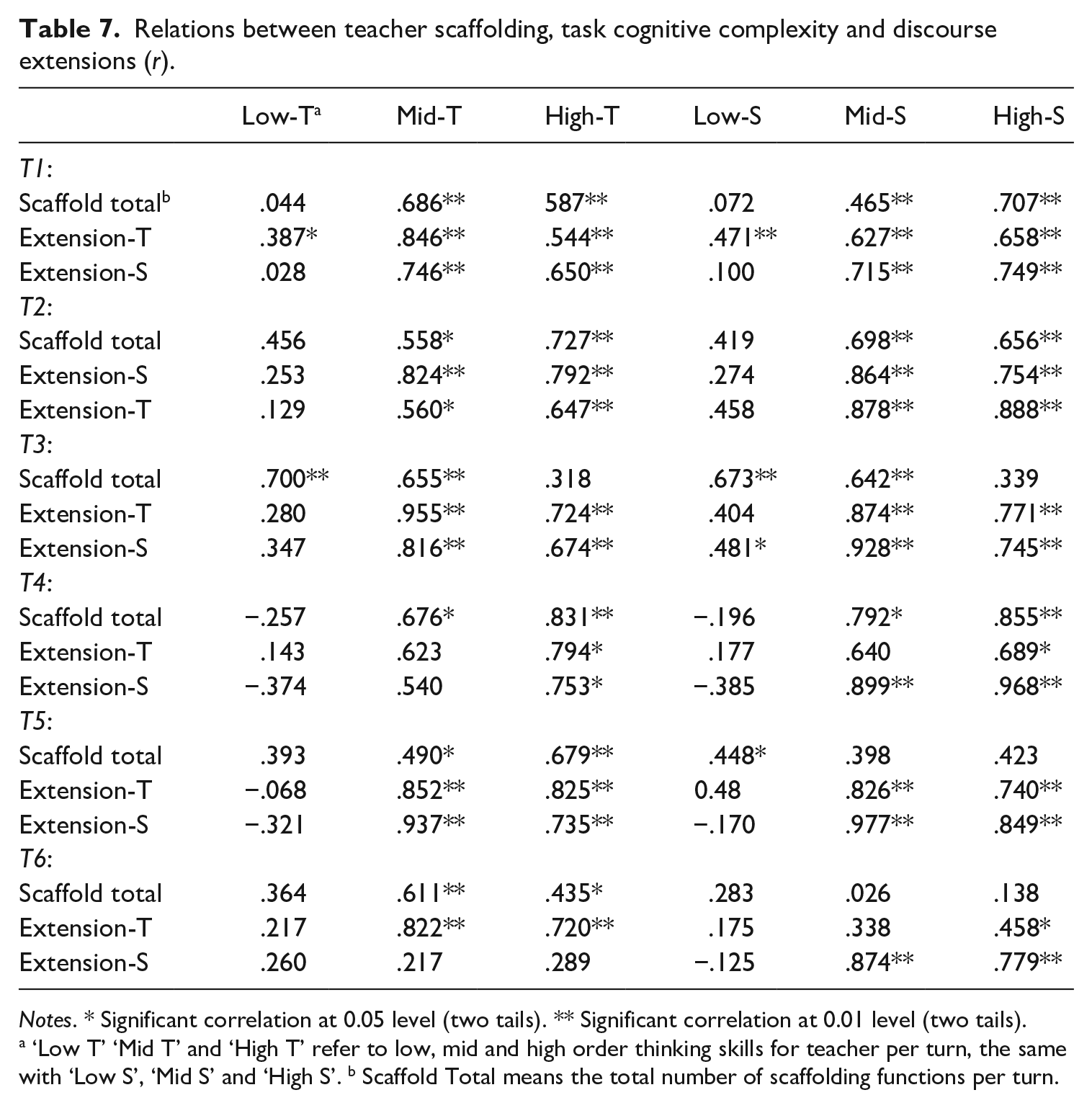
Notes. * Significant correlation at 0.05 level (two tails). ** Significant correlation at 0.01 level (two tails). a ‘Low T’ ‘Mid T’ and ‘High T’ refer to low, mid and high order thinking skills for teacher per turn, the same with ‘Low S’, ‘Mid S’ and ‘High S’. b Scaffold Total means the total number of scaffolding functions per turn.
From Table 6, it is manifested that learners’ oral language lexical and syntactic complexity showed a general increase over the semester. First, concerning lexical complexity, while the ratio of sophisticated word types kept on fluctuating from T1 to T5, it increased sharply in the last time. Development of lexical variety, counted by CTTR, revealed a similar pattern, with a shape increase at T6. Development of syntactic complexity however, showed a different trend, demonstrating an increase from T1 to T5 before a subsequent drop in the last time. However, despite the temporary fluctuation over the period, development on syntactic complexity was perceived.
One possible account for this phenomenon may have to do with the time of observation. Although the time range of observation lasted for over three months, it may be that inter-language restructuring was just about to occur at T6, as manifested in a marked change in a trend of development not ever witnessed. This again confirmed that the process of language development is not linear, but filled with turns, frequent setbacks and fluctuations (Larsen-Freeman, 2006). However, in the study, the developmental trend was still fairly convincing.
In addition to language development, cognitive development was mainly manifested in terms of the changing correlations between learners’ engagement in higher order cognitive activities and the amount of teacher scaffolding required (see Table 7).
From Table 7, it can be seen that teacher scaffolding played an important role in shaping learners’ cognitive functions. This is manifested as the significant correlation between the total number of teacher scaffolding per turn and the amount of students’ higher-order cognitive activities. However, this correlation gradually reduced along with learners’ increasing ability in independent higher-order thinking. A similar pattern was observed in discourse extensions with regard to the gradually decreasing correlation between the teacher’s discourse extension and learners’ higher-order mental functions, compared to an opposite trend manifested in learners’ discourse extensions, which generally increased (see Figures 3 and 4).
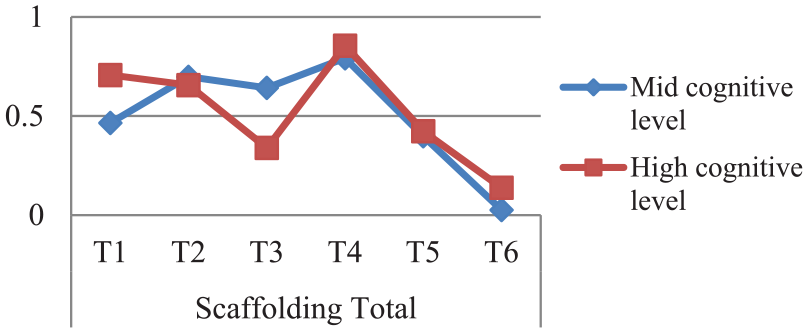
Correlation between task cognitive complexity and teacher scaffolding quantity.
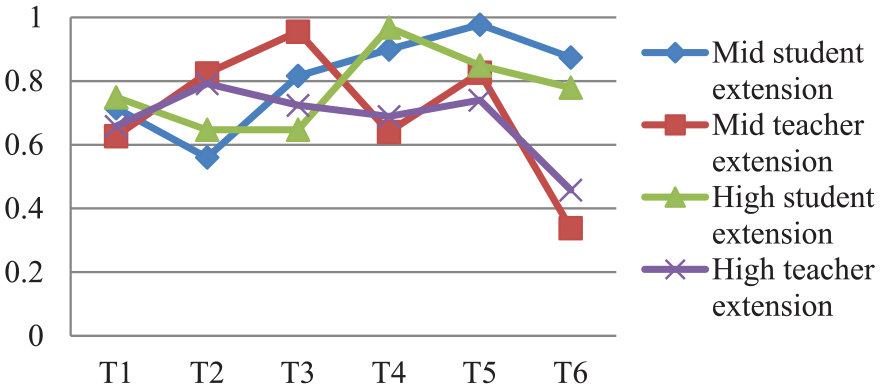
Correlation between task cognitive complexity and discourse extensions.
This phenomenon can be accounted as an indication of increasing learner autonomy, when learners were gradually able to participate in complex mental activities more independently, manifested as a gradual removal of teacher scaffolding both cognitively and discursively. Excerpt 4 is a typical manifestation.
Excerpt 4. Decreasing amount of teacher scaffolding along with increasing learner autonomy 1 T: But that’s safer. I don’t know much about Vietnamese food, but I know McDonalds, so it’s predictable. That’s one of the positive elements here. You say because it is predictable it’s safer. I can control what I order. You could see that if you look at it from other perspectives, you see different things. So, anybody else? 2 S: And, in Macdonald you can be treated similar, regardless of your race, your nation, your gender. 3 T: Yes. 4 S: We can receive the same service. 5 T: Equality 6 S: And the service is . . . 7 S2: I think that makes sense, because the customers’ idea is ok. But to those waiters and waitresses, just like the article mentioned, a lot of waiters and waitresses are minorities from lower classes. And this is unfair because you are the one to serve the other people. 8 T: So, there is a low entry in McDonalds and in the labor market. 9 S: I also think her point is good, because I have other ideas like hers. I’d like to analyse McDonaldization from symbolic interactionism. Those roles in McDonalds or in fast food restaurants will make you feel you contribute to equality at least in these restaurants, because you have to pick up the food by yourself and you have to clean up your desk by yourself. All these actions will make you look as a responsible citizen. Like I’m doing this, not asking other people to serve me. I can make them less . . . I don’t know, something like that. So, in turn the employees will feel that they are respected. 10 T: They are respected. 11 S: They are treated more like equally by customers because in the traditional sense, employees should serve customers like god.
It is shown in Excerpt 4 that in open-ended discussions, the amount of teacher scaffolding gradually decreased, giving way to increasing self-selection in students’ participations as they began to complement and challenge each other in exploratory talks (i.e. in Turns 7, 9 and 11). What is also to be noted is the increasing amount of contribution students made in high-level cognitive activities in comparison to the lower level ones. It also seemed that students tended to contribute more when engaging in higher-order thinking, especially in terms of perspective-taking when evaluating a social phenomenon (i.e. in Turn 9). This can probably be accounted by their genuine communicative need in authentic discussions and their gradually expanding linguistic and cognitive repertoire attained through high-quality scaffolded interactions in lower-level cognitive activities.
V Discussion
Referring to the general purpose of the study, data analysis results mainly address two questions:
Whether the CLIL-framed intensive reading class can promote learners’ language and cognitive development? and
What is the role of teacher scaffolding in the processes of learning?
The following parts aim to address these questions.
1 Teacher scaffolding in relation to learners’ task performance
Results of the study show that teacher scaffolding plays an important role to ensure the quality of interaction in CLIL. In the study, the amount and type of teacher scaffolding varies in terms of the cognitive complexity of the tasks and learners’ in-task language performances. First, the amount of teacher scaffolding increased sharply from low to mid-level (89–160) cognitive activities, followed by a dramatic decrease (160–42) in high-level ones (see Table 4 and Figure 1). Second, although students’ oral language lexical complexity increased evidently from low to mid-level activities, it subsequently dropped in high-level ones (LS2: 0.208–0.235–0.211) (see Table 5). However, there was a continuous increase of learners’ oral language syntactic complexity all the way from low to high-level cognitive activities (CN/T: 1.29–1.72–1.95) (see Table 5). Third, the function of teacher scaffolding demonstrated a sharp distinction between low-level cognitive activities and that of the mid- and high-level ones, with the former mainly oriented to ‘simplifying’ and that of the latter ‘amplifying’ (see Table 4 and Figure 1) (Gibbons, 2015; van Lier, 2004).
The study proposed that changes in teacher scaffolding strategies may reflect her pedagogical decisions on students’ moment-to-moment language and content learning needs. For instance, ‘simplifying’ strategies are mainly applied in lower-level cognitive activities with high language demand, under the teacher’s intention to bridge the gap between learners’ current language abilities and those required for subject matter learning (Barnes, 2008). However, ‘amplifying’ strategies are more frequently used in higher-order cognitive activities to enrich the learning environment for deeper exploration and cognitive inquiries. It is also noticed that compared to the ‘simplifying’ strategies, the use of ‘amplifying’ strategies generally renders learners more autonomy in classroom discussions, with the support of necessary linguistic and cognitive resources (Gibbons, 2015; van Lier, 2000, 2004).
This echoes the ‘high challenge, high support’ principle in the CLIL pedagogy to probe content learning and exploration with adequate language support (Ball et al., 2015; Coyle, 2007). Teacher scaffolding provided at the instance of complex meaning-making or ‘languaging’ can serve as valuable learning opportunities for learners to ‘notice the gap’ and modify their output (Guk & Kellogg, 2007; Innes, 2007; Long, 2015; Nassaji, 2016; Robinson, 2011; Swain, 1988, 2006; Swain et al., 2011). Gradually, these language resources are internalized and automatized by the learners through repeated use, paving way for their more autonomous and spontaneous language production in higher order thinking activities. However, the perceived decrease in learners’ oral language lexical complexity in high-level cognitive activities may also suggest that to some extent teacher scaffolding is necessary to guarantee the language learning quality.
2 Effective teacher scaffolding in CLIL
Data analysis results revealed a series of effective teacher scaffolding strategies in CLIL. These include: (1) provision of teacher scaffolding along a sequence of task chains to make it coherent and graduated, (2) frequent use of dialogic inquiry and incidental feedback, and (3) variation of scaffolding strategies to balance between the level of support and autonomy.
First, the goal of content learning in CLIL has made classroom interaction coherent all the way from low to high-level cognitive activities. This has also made teacher scaffolding systematic and interrelated within task chains. For example, ‘understanding’ subject matter knowledge and appropriating text resources pave way for further ‘applying’ them in problem-solving situations or ‘analysing’ their internal causes. In this way, teacher scaffolding is not only task-specific, but is provided along a continuum in line with learners’ cognitive development around a series of coherent disciplinary themes (Innes, 2007; Toth, 2011). This also contributes to more academic language exposure, when words and expressions tend to reoccur within a particular disciplinary context (Paltridge, 2002).
Second, the need for content learning in CLIL has created a series of meaningful negotiation opportunities, featured by frequent discourse extensions by both the teacher and students. Effective teacher scaffolding in this respect takes a crucial role to guarantee the quality of interaction (O’Connor & Michaels, 2008; Gibbons, 2015). Data in the study reveal that this is mainly achieved by the teacher’s consistent use of dialogic inquiry and incidental feedback on students’ responses. The use of dialogic inquiry can engage learners into complex meaning-making activities, through which they gradually expand their language and cognitive abilities (Engeström, 1999; Lantolf, 2000; Lantolf & Poehner, 2008; Lantolf & Thorne, 2006; Wells, 1999). In the meantime, provision of incidental feedback can make output ‘comprehensible’ (Gibbons, 2003; Swain, 1988, 2005), by evidently signifying possible form-meaning-function mappings (Ellis, 2016). Therefore, while the use of dialogic inquiry can promote deeper levels of processing by actively engaging learners in cognitively and linguistically challenging tasks, incidental feedback provided in interactions can inform the diagnosis of ‘learners’ emerging abilities’ to support the development of new ways of thinking and knowing (Poehner & Infante, 2016, p. 6).
Finally, appropriate teacher scaffolding in CLIL should be responsive to students’ learning needs. That is providing adequate support for task completion, but no more than necessary as to hamper the development of learner autonomy. This is manifested in the study as the teacher’s gradually decreasing support in higher level cognitive activities to ‘empower’ the learners as they became more competent, rendering them greater responsibilities to organize the classroom discourse (see Table 4 and Figure 1). As suggested in Excerpt 4, teacher scaffolding gradually retreated as learners began to take more initiatives in discourse extensions and peer scaffolding, which was also an indication of their increasing language and cognitive abilities.
3 Developmental effects of teacher scaffolding in CLIL
According to Coyle et al. (2010, p. 39), ‘effective content learning has to take account of the defined knowledge and skills within the curriculum or thematic plan, but also how to apply these through creative thinking, problem solving and cognitive challenge’. CLIL advocates an integrated development of knowledge and skills transferable to other contexts. To achieve this goal, teacher scaffolding in CLIL should also transcend task-specific problem solving for the ultimate goal of developing individual higher-order mental functioning (Poehner & Infante, 2016, pp. 4–5).
Therefore, the study traces teacher–student interactions diachronically to capture the possibly changing relationships between teacher scaffolding and learners’ higher order mental functioning. As Aljaafreh & Lantolf (1994, p. 480) stated, ‘a learner who is able to produce a particular structure as a consequence of more strategic (implicit) forms of regulation is developmentally more advanced than one who need direct and explicit feedback for the same property’. Decreasing levels of scaffolding in higher order cognitive activities can also be an indication of increasing cognitive abilities. This is manifested in the study as the gradually decreasing correlation between the amount of teacher scaffolding and learners’ higher order mental functioning (see Table 7 and Figures 3 and 4).
These processes reveal that future research on teacher scaffolding would better take a longitudinal orientation to establish a link between teacher scaffolding and learners’ development with reference to the gradually changing classroom interactional mechanisms. As mentioned by Smagorinsky (2018, p. 74), ‘if educational scholarship does not emphasize long-term human development in relation to the mediation of social contexts, then it’s just not Vygotsky’, the ultimate goal of teacher scaffolding is more than assisted performance in task-specific problem solving, but a wider developmental perspective to equip learners with transferrable knowledge, skills and abilities.
VI Conclusions
In conclusion, findings of the study suggest that teacher scaffolding plays a crucial role to guarantee the quality of classroom interaction in CLIL. Effective teacher scaffolding takes on a series of features. First, effective teacher scaffolding in CLIL is coherent, which gradually evolves along a series of task chains to prepare learners for more complicated tasks. Second, effective teacher scaffolding in CLIL is often inquiry-based to promote learners’ engagement in higher order thinking and complex meaning-making. Third, adequate support from the teacher is often necessary to safeguard learning. Effective teacher scaffolding often creates contexts for academic language use to facilitate the internalization of newly learned knowledge.
The study has a series of implications. The first readdresses the intrinsic link between language and content learning in CLIL and other L2 pedagogies. The development of language and cognition are intrinsically connected. Learning language for its own sake not only decreases the efficiency of learning but also deprives learners of the potential opportunities for cognitive development. On the other hand, the integration of content and language learning in CLIL creates an acquisition-rich learning environment, signifying its potentiality in offering a possible direction for innovations of EFL curriculum and pedagogy in China. However, the learning effects of CLIL need to be guaranteed by effective instruction, of which teacher scaffolding plays an important role. Results of the study suggest that effective teacher scaffolding skilfully navigates content and language learning by balancing between the level of challenge and support. In this way, students are often pushed for deep cognitive processing and complex reasoning in scaffolded interactions by fully stretching their current interlanguage systems. However, the juncture and function of teacher scaffolding is still largely an incidental issue grounded in the teachers’ contingent pedagogical decisions. In this sense, a classroom discourse analysis approach can provide insights on the underlying learning mechanisms of these effective practices.
This has led to the second implication of the study concerning the use of multi-level coding in classroom discourse analysis. In the study, the integration of teacher scaffolding strategies and task cognitive complexities within the IRF framework has shed light on the impact of teacher scaffolding on learners’ cognitive development. Considering the intrinsic relations among pedagogy, discourse and learning, the use of multi-level coding provides us a lens to view learning as discursive and dynamic, in which the quality of classroom interactions serves as a major impetus. In addition, it is also important for future studies to take a developmental orientation. As development occurs in learning, a longitudinal and in-depth analysis of the learning processes is often necessary.
However, the use of multi-level coding can also have possible methodological downfalls. One reason is that by structuring classroom interactions into rigid categories, one may also face the peril to lose its whole complexity. This can be manifested in the micro-genesis of classroom ecologies, for instance: the multimodalities in discourse and learning and the possibly varying individual learning trajectories. Perhaps in future studies, these features can be reincorporated into the analysis as complementary to unveil the potentialities of high-quality pedagogical CLIL classroom discourse for learning.
Footnotes
Acknowledgements
We would like to express our sincere gratitude to the instructor May for her effort and dedication to teaching during the research processes. We are very grateful to two anonymous Language Teaching Research reviewers for their insightful comments on the original manuscript.
Funding
The author(s) disclosed receipt of the following financial support for the research, authorship, and/or publication of this article: The study is jointly supported by the National Social Science Fund of China (for key projects) for National Standards for Undergraduate Programs in Foreign Languages and Literatures: Interpretation and Application (Ref. No. 18AYY011) and BFSU Landmark Research Projects for “Double-First Class” Construction—Critical Thinking-oriented English Language Education: Research and Development (Grant No. 2021SYLZD002).
