



Abstract
A large number of studies have explored grammar instruction through implicit and explicit instructional conditions. The general conclusion drawn from these studies points to the superiority of explicit instruction; however, the claim has been attenuated by a number of reservations raised regarding its generalizability across types of grammatical structures and learners of different characteristics. Therefore, the present study aims to investigate the comparative effectiveness of these two types of instructional conditions in acquiring explicit and implicit knowledge of complex and simple linguistic features by participants holding different epistemic beliefs. The results demonstrated a relative advantage for explicit instruction. However, the results also showed that the effectiveness of explicit/implicit instructional conditions varied for the participants. Additionally, the findings provided evidence against the assumption that complex structures are best learned through implicit instructional conditions and simple structures are best taught explicitly. The hypothesis that learners with more sophisticated epistemic beliefs outperform those with more naive epistemic beliefs in learning complex grammatical structures was not borne out by the analyses. Conclusions and suggestions for further research are provided.
I Introduction
Grammar has often been viewed as a central component in language pedagogy. For good reason, then, for 2,500 years, language instruction was regarded equivalent to grammar instruction (Rutherford, 1987). Motivated by the importance of grammar in language education, foreign language educators, methodologists and applied linguists have actively pursued the question of what is the best way to teach grammar. Within this line of research, a great deal of attention has been focused on the ‘much-debated grammar instruction category’ (Andrews, 2007, p. 1): explicit approach to grammar instruction, defined in terms of provision of explanations for how a morphosyntactic rule works employing metalinguistic terminology (Macaro & Masterman, 2006), vs. implicit approach to grammar instruction, defined as provision of sample uses of the target feature without any metalinguistic explanation (R. Ellis, 2008). Researchers who support the implicit approach to grammar instruction maintain that learners do not necessarily need to receive information regarding the rules/regularities underlying the input while those supporting the explicit approach argue for the provision of such information to the learners (Hulstijn, 2005).
To provide empirical support for the relative effectiveness of these two approaches to grammar instruction, a good number of studies have been carried out over the past few decades (e.g. Andrews, 2007; Paesani, 2005; Robinson, 1996; Tammenga-Helmantel, Arends, & Canrinus, 2014; Vogel, Herron, Cole, & York, 2011). Although inconclusive, the results reported from this line of research support the general conclusion that ‘explicit types of instruction tend to prove more effective than implicit types’ (Jean & Simard, 2013, p. 1023). The strength of this conclusion has, however, been attenuated by a number of reservations raised regarding its generalizability across types of grammatical structures and learners of different characteristics.
Regarding the effectiveness of explicit instruction across types of grammatical structures, a number of researchers argue that explicit instruction is more effective in teaching simple grammatical rules compared to complex grammatical constructions which yield themselves better to implicit learning. This assumption was mainly motivated by Krashen’s (1981, 1985, 1994) proposals regarding the existence of two distinct processes operating in L2 acquisition – a conscious process of deduction and an unconscious process of induction. The former is based on rule application and often results in a ‘learned’ system which is restricted to a small number of simple rules while the latter is responsible for a substantial share of L2 production and results in an ‘acquired’ system (Robinson, 1995). Complex rules are assumed to be better learned through the unconscious implicit process (Tammenga-Helmantel et al., 2014). Support for this assumption also comes from Reber’s (1989, 1993) seminal works on theorizing about implicit learning of artificial grammar. Reber assumed that where a ‘stimulus domain was complex, as in the case of natural language, it could only be learned implicitly, that is, without participants knowing what they learned or how they learned it’ (Robinson, Mackey, Gass, & Schmidt, 2012, p. 249). There are, however, other researchers who contest these views and argue that complex structures should also be explicitly taught to learners to notice them (Andrews, 2007; de Graaff, 1997).
Additionally, there is evidence supporting the assumption that the effectiveness of one instructional approach compared with another is moderated by such learner characteristics as age, aptitude, proficiency level, learning styles, motivation, working memory, etc. (Andrews, 2007; Dornyei, 2005; de Graaff & Housen, 2009; Jean & Simard, 2013; Robinson, 1997; Schulz, 2001; Suzuki & DeKeyser, 2017). As posited by Jean and Simard (2013, pp. 1025–1026), ‘individual differences or learner characteristics may account for learner variation in L2 performance and play an important role in how well one reacts to instructional treatments.’ Against this background, the present study aims to fill some of this void by examining how individual differences may cause variations in the way learners react to explicit vs. implicit instructional approaches to grammar instruction.
The individual difference variable that the present study aims to investigate in relation to explicit/implicit instructional dichotomy is learners’ epistemic beliefs, defined as implicit assumptions about various aspects of knowledge including its nature, acquisition, structure, sources, and justification (Hofer & Bendixen, 2012). These beliefs are considered important factors with respect to students’ academic performance as they have been reported to be associated with learners’ learning/study approaches, learning outcomes and processes, conceptions of learning, problem-solving, knowledge understanding, achievement goal orientations, persistence in information seeking, etc. (Bråten & Ferguson, 2014; Lee & Chan, 2018; Lee, Johanson, & Tsai, 2008; Liang & Tsai, 2008; Madjar, Weinstock, & Kaplan, 2016). Despite extensive investigative attention paid to these beliefs in the literature, they have not been investigated in relation to grammar instruction through explicit and implicit instructional conditions. What highlights the relevance of epistemic beliefs to learning complex and simple grammatical structures through explicit or implicit instructional approaches are dimensions of these beliefs dealing with the source of knowledge (the degree to which knowledge is believed to originate outside oneself from an authority figure as opposed to being reasoned, discovered or created by the individual), and the structure of knowledge (the degree to which knowledge is viewed in terms of isolated bits as opposed to knowledge in the form of interconnected networks).
II Literature review
1 Explicit/implicit grammar instruction
As discussed above, the explicit/implicit dichotomy in grammar instruction is a hotly debated issue in the literature on grammar teaching. Instruction would be considered explicit if the pedagogic intervention aims at encouraging the learners to develop metalinguistic awareness of the rules which can be presented either deductively or inductively (R. Ellis, 2008). In this type of instruction, (1) the linguistic structure is presented in isolation for focused attention, (2) learners are presented with data illustrating the targeted linguistic feature, (3) learners are required to perform operations on the data, (4) intellectual effort, on the part of the learners, is required to consciously understand the targeted structure, and (5) metalinguistic information regarding the use of the targeted feature is provided for the learners (Housen, Pierrard, & Van Daele, 2005). Implicit instruction, on the other hand, is ‘directed at enabling learners to infer rules without awareness’ (R. Ellis, 2008, p. 438). In fact, it is often done in the absence of rule presentation. Through exposing the learners to exemplars of the targeted feature in meaningful contexts, they are expected to extract patterns and generalizations underlying the input.
Numerous studies have been carried out to explore the effectiveness of these two approaches to grammar instruction in various contexts (e.g. Akakura, 2012; Doughty, 1991; Klapper & Rees, 2003; Scott, 1989). For example, Radwan (2005) examined the comparative effectiveness of explicit and implicit attention-drawing instructional conditions on the acquisition of English dative alternation by low-intermediate learners of English as a second language (ESL) assigned to (1) textual enhancement, (2) rule-oriented, (3) content-oriented experimental conditions and a control group. The results of the study showed that the less explicit forms of input enhancement did not effectively induce changes in the learners’ language ability. However, the participants receiving explicit instruction outperformed participants in the other groups.
Also examining the comparative short-term and long-term effects of explicit and implicit instructional conditions on the learning of copula be among junior high school Japanese students, Tode (2007) found positive effects for explicit instruction in the short term compared with the implicit instruction. Additionally, the effects of the explicit instructional condition were reported not to last for long, especially after the presentation of the progressive be. Andringa, Glopper, and Hacquebord (2011) also explored whether learners’ correct use of two grammatical structures differed across participants taught in either explicit or implicit instructional conditions. Learners’ progress was measured before the treatment, after the treatment and after a four-week delay through both an untimed grammaticality judgment task and a free written-response task. The results indicated an advantage for explicit instruction over implicit instruction in the grammaticality judgment task but the two approaches were found to be equally effective in promoting the correct use of the structure in the free written-response task. For one of the structures, though, the advantage of explicit instruction was supported when the participants’ L1 displayed similarity to the structure taught.
Overall, the results of the studies reviewed in this section and a number of other studies on either the comparative effectiveness of explicit vs. implicit approaches to grammar instruction or on the effectiveness of one or the other approach or the subcategories of these approaches point to the superior role of explicit instruction in promoting L2 ability (e.g. DeKeyser, 1994; Doughty, 1991; Klapper & Rees, 2003; Macaro & Masterman, 2006; Tammenga-Helmantel et al. 2014; Vogel et al., 2011).
2 Structure/rule complexity and explicit/implicit instruction
As pointed out earlier, instructional effectiveness is assumed to be moderated by a number of factors including the nature of the target linguistic feature (de Graaff & Housen, 2009). One of the aspects of this ‘nature’, which has been extensively studied, is the complexity associated with the linguistic feature targeted for instruction. Interest in this topic rose with Krashen’s (1985, 1994) ‘No Interface Hypothesis’ according to which less complex rules can be taught whereas ‘hard rules are by their very nature too complex to be successfully taught and thus difficult to learn through traditional explanation and practice pedagogy . . . [and] are thought to be best learned implicitly, embedded in meaning-based practice’ (Spada & Tomita, 2010, p. 264).
Along the same line, Reber (1989, 1993) proposed the ‘implicit learning theory’ which considers implicit learning as ‘the default mode for the acquisition of complex information about the environment’ (Reber, 1993, p. 25). Reber’s works focused mainly on the implicit learning of ‘complex, rule-governed stimuli generated by a synthetic, semantic-free, Markovian grammar’ (Reber, 1993, p. 11). The rule system characterizing these artificial grammars were assumed to be complex which could only be learned through the implicit mode of acquisition. Central to Reber’s claims was the assumption that ‘conscious explicit learning is only effective where the rules are simple and the structural pattern of covariance they describe is salient to the learner’ (Robinson, 1997, p. 28).
Motivated by these dual-system explanations of human learning (Robinson, 1997), a large number of studies have examined the link between the complexity of a grammar structure and the effectiveness of grammar instructional approaches (e.g. Andrews, 2007; de Graaff, 1997; DeKeyser, 2005; Robinson, 1995; Tammenga-Helmantel et al., 2014, 2016). Despite the proliferation of studies, there is not yet an agreed-upon definition of complexity. As de Graaff and Housen (2009, pp. 739–740) state: different studies have variably defined complexity in terms of such factors as the perceptual salience and frequency of a structure in the input, its communicative value (or redundancy), the linguistic domain to which it pertains (syntax, morphology, lexis, phonology), the degree of contrast with the corresponding structure in the L1, the scope and reliability of a linguistic rule, the type of processing mechanisms involved in the learning of a feature (i.e. item vs. rule-based learning), the transparency of the mapping between a structure’s form and function, its compositional nature, its markedness, and so forth.
In one of the earlier studies examining the complexity of grammatical structures across implicit and explicit conditions, Robinson (1995) explored claims by Krashen and Reber that ‘(a) implicit learning is more effective than explicit learning when the stimulus domain is complex, and (b) explicit learning of simple and complex stimulus domains is possible if the underlying rules are made salient’ (Robinson, 1995, p. 27). The study was conducted with ESL learners assigned to one of four conditions including implicit, incidental, rule-search, and instructed conditions. The results of the study did not support the first of the claims but lent support to the second claim. Participants taught in the implicit condition did not outperform learners in the other conditions in learning complex rules; however, learners in the instructed condition outperform learners in the other groups in learning simple rules.
Housen et al. (2005) also investigated the comparative effectiveness of explicit instruction on learning two simple and complex French grammatical constructions among French as a foreign language learners. Complexity was defined in terms of functional markedness of the targeted feature in this study. The findings supported the effectiveness of explicit instruction in promoting learners’ mastery of the structures targeted for instruction. Additionally, learners receiving instruction on the complex structure were reported to have systematically gained more from the explicit instruction than learners receiving instruction of the simple structure.
Distinguishing between two types of explicit instruction – explicit-deductive and explicit-inductive instruction – in teaching grammar, Tammenga-Helmantel et al. (2016) investigated how these two approaches to instruction affect the learning of a complex structure. Explicit-deductive was defined in terms of presenting the grammar rules to the learners followed by a practicing phase while explicit-inductive was defined in terms of guiding the learners to explore/discover a grammar rule and explicitly formulating the rule after the exploration phase followed by a practicing phase. German subjunctive construction was used as a highly complex structure on grounds of semantic and structural complexity and low transparency. The results indicated that both types of instruction have positive effects on learners’ mastery of the target structure. On the grammaticality judgment test, though, learners taught in the explicit-inductive condition showed a significantly better performance.
As seen in the review reported above, complexity has been variably defined in the studies conducted. However, despite theoretical claims, the more positive effect of implicit instructional conditions on the acquisition of complex features has not been empirically verified, particularly in relation to individual differences, a point the present study sets out to investigate.
3 Epistemic beliefs
Epistemic beliefs are a set of beliefs individuals hold regarding knowledge and knowing (Hofer & Sinatra, 2010) which are, in origin, ‘regarded as the subjective counterpart of epistemology, i.e. the branch of theoretical philosophy that is concerned with characteristics, criteria, and justification conditions of knowledge’ (Richter & Schmid, 2010, p. 48). These beliefs were first introduced into educational psychology through the pioneering works of William Perry (Perry, 1970) who initiated a unidimensional approach to the study of these beliefs. Perry and other researchers adopting a developmental perspective (e.g. Baxter Magolda, 2004; King & Kitchener, 1994; Kuhn, Cheney, & Weinstock, 2000) view epistemic development through an ontogenetic progression in a series of qualitatively different stages of development. Although different labels have been used for the stages across various developmental frameworks, they can be generally labeled ‘along three levels: (1) absolutism/objectivism (knowledge is right or wrong, authorities have the answers), (2) multiplism/subjectivism (knowledge is mere opinion, and anyone’s opinion is valid), and (3) evaluativism/objectivism–subjectivism (knowledge must be evaluated for evidence)’ (Muis & Franco, 2009, p. 307).
There are also those who view epistemic beliefs from a multidimensional perspective (e.g. Hammer & Elby, 2002; Hofer & Pintrich, 1997; Schommer, 1990). This perspective views epistemic beliefs in terms of a number of dimensions which are independent of each other and may not necessarily develop synchronously (Karimi, 2014a, 2014b).
Schommer (1990) provided the pioneering framework, also adopted in the present study, viewing epistemic beliefs in terms of a collection of relatively autonomous beliefs.
These included beliefs about the structure of knowledge (ranging from simple to complex), the stability of knowledge (certain to uncertain), the source of knowledge (omniscient authority to reason and evidence), the speed of learning (quick to gradual) and the ability to learn (fixed to improvable) (Schommer-Aikins & Duell, 2013, p. 318).
These dimensions of beliefs fall on continua ranging from naive to sophisticated. Beliefs about certainty of knowledge range from the view of knowledge as fixed and unchanging (naive) to the view of knowledge as tentative and evolving (sophisticated). The simplicity of knowledge continuum ranges from the belief that knowledge is characterized in terms of isolated bits (naive) to the belief that knowledge is best described in terms of highly interrelated networks/theories (sophisticated). Omniscient authority dimension encompasses the belief that knowledge originates from an authority figure (naive) as opposed to the belief that knowledge is best reasoned and discovered by the individual (sophisticated). Beliefs on the quick learning continuum range from the belief that learning takes place quickly (naive) to the belief that learning is gradual (sophisticated). Finally, beliefs on the innate ability continuum range from the idea that the ability to learn is fixed at birth to the idea that the ability to learn can evolve throughout an individual’s lifetime (sophisticated) (Bell, 2006).
There is disagreement, though, in the literature that the two latter dimensions capture the essence of epistemic beliefs. In response, Schommer-Aikins (2002) considers these two dimensions as reflective of beliefs about learning rather than knowledge or knowing.
Schommer (1990) designed an instrument to measure the five dimensions of epistemic beliefs she initially hypothesized in her theoretical framework. Factor-analytic validation run on the instrument provided evidence for four of the five dimensions, but no evidence was found for the omniscient authority factor. To expand and refine previous work on epistemic beliefs, Schraw, Bendixen, and Dunkle (2002) developed and validated an instrument to measure the five dimensions of the epistemic beliefs hypothesized by Schommer (1990). The authors reasoned that parceling items by Schommer prior to factor analysis might have influenced the factorial structure of the instrument she developed and, therefore, aimed to rectify the shortcomings. Validation of the instrument provided evidence of the five factors described by Schommer (1990) and as described by the authors, the measure – called Epistemic Beliefs Inventory (EBI) – proved to be a more efficient and reliable measure of epistemic beliefs.
Epistemic beliefs have attracted increasing investigative attention over the past decades for their predictive power over positive learning gains (Lee & Chan, 2018). These beliefs have been examined in relation to different aspects of students’ academic performance including learning motivation (Mason, Boscolo, Tornatora, & Ronconi, 2013), study approaches (Lee & Chan, 2018), science achievement (Bråten & Ferguson, 2014), learning strategies (Muis & Franco, 2009), conceptions of learning (Tsai, Ho, Liang, & Lin, 2011), conceptual change (Mason, Gava, & Boldrin, 2008), achievement goals (Mason et al., 2013), text comprehension (Bråten & Strømsø, 2010), among others. The Karimi (2014a) also recently demonstrated that epistemic beliefs can be associated with grammar learning.
III Rationale for the present study
Despite some conflicting evidence, the overall conclusion drawn from the studies on explicit vs. implicit grammar instruction approaches points to the relative advantage of some explicit focus on form (see, amongst others, DeKeyser, 1994; Doughty, 1991; Klapper & Rees, 2003; Macaro & Masterman, 2006; Tammenga-Helmantel et al., 2014; Vogel et al., 2011). The present study, thus, aims to examine whether this finding is replicated in the present study. Therefore, the first research hypothesis is proposed:
Hypothesis 1: Learners taught grammatical structures through explicit instruction will outperform those taught through implicit instruction.
Additionally, in light of the dimension of epistemic beliefs dealing with the source of knowledge (knowledge handed down by an authority vs. knowledge being reasoned and discovered by the learner) and speed of learning (knowledge is acquired quickly vs. knowledge is acquired gradually), we hypothesize that the effectiveness of explicit vs. implicit grammar instructional approaches are moderated by learners’ epistemic beliefs. Therefore, the following null hypothesis is proposed:
Hypothesis 2: Learners with more sophisticated epistemic beliefs are hypothesized to outperform those with more naive epistemic beliefs in learning grammatical structures taught through implicit instruction. In contrast, those with more naive epistemic beliefs will perform better in learning grammatical structures taught through explicit instruction.
Furthermore, as discussed above, motivated by claims by Reber and Krashen making a distinction between rules which yield themselves better to explicit instruction for learning (simple rules) and those which are assumed to be learned better through implicit instruction (complex rules), a plethora of studies have been carried out. The results reported from these studies are mixed and inconclusive (Spada & Tomita, 2010) with ‘two seemingly contradictory views: those who argue that instruction should focus on simple rules . . . and those who argue that instruction should focus on complex rules’ (Housen et al., 2005, p. 237). Motivated by this yet-unresolved issue, the third hypothesis is formulated as follows:
Hypothesis 3: Complex rules are learned better through implicit instruction and simple rules are learned better through explicit instruction.
However, apart from the type of instruction, learning complex stimuli can be moderated by individual difference variables. Given that one dimension of epistemic beliefs concerns beliefs about the structure of knowledge (ranging from the view that what counts as knowledge is complex and integrated to the view that what counts as knowledge is a piecemeal collection of isolated facts), the present study also aims to examine whether the learning of complex rules is mediated by learners’ epistemic beliefs. Therefore the following hypothesis is presented:
Hypothesis 4: Learners with more sophisticated epistemic beliefs are hypothesized to outperform those with more naive epistemic beliefs in learning complex grammatical structures.
IV Method
1 Participants
Forty English as a Foreign Language learners participated in the study. The learners studied general English courses at two private language institutes providing evening language instruction courses to learners. The participants’ age ranged from 16 to 25 with an average age of 20.57 years. They were considered beginners by institutes’ records and placement regulations of the institutes. These participants were selected after administering the Epistemic Beliefs Inventory to 87 learners. It should be pointed out that due to the low number of enrolments, the study was conducted in two consecutive semesters but the conditions and the procedures were kept similar across the conditions/semesters. The 20 top-scoring (Sophisticated-Epistemic) and the 20 lowest-scoring (Naive-Epistemic) participants on the epistemic measure were selected. Ten participants from each group were randomly assigned to either explicit or implicit instructional conditions. This assignment procedure then yielded four different groupings:
learners with sophisticated epistemic beliefs taught in the explicit condition (ExSoph) (n = 10);
learners with naive epistemic beliefs taught in the explicit condition (ExNaiv) (n = 10);
learners with sophisticated epistemic beliefs taught in the implicit condition (ImSoph) (n = 10); and
learners with naive epistemic beliefs taught in the implicit condition (ImNaiv) (n = 10).
To check for the comparability of the four groups on the pre-test measures of explicit and implicit knowledge of both simple and complex linguistic features, a series of Kruskal–Wallis tests were run which indicated no significant difference between the four groups (χ2 (3) = 1.16, p = 0.76, for the explicit knowledge of the complex feature; χ2 (3) = 4.62, p = 0.20 for the explicit knowledge of the simple feature; χ2 (3) = 2.34, p = 0.50 for the implicit knowledge of the complex feature; and χ2 (3) = 1.36, p = 0.71 for the implicit knowledge of the simple feature).
2 Epistemic Beliefs Inventory (EBI)
To measure the participants’ epistemic beliefs, the Epistemic Beliefs Inventory (Schraw et al., 2002) was used. In its original form, the inventory comprises 32 items measuring five dimensions of epistemological beliefs including: (1) simple knowledge (8 items), (2) certain knowledge (7 items), (3) omniscient authority (5 items), (4) innate ability (7 items), and (5) quick learning (5 items), which was later revised to include 28 items. A number of the items are reverse-scored and the score for each dimension is obtained through adding the score for each item. In this study, only scores on two dimensions of the epistemic beliefs – simple knowledge and omniscient authority – were used for classifying the participants into Sophisticated-Epistemic and Naive-Epistemic groups. These two dimensions were used only because the study dealt with the instruction of complex vs. easy in explicit vs. implicit instructional conditions. Simple knowledge best resonated with the dichotomy between complex as opposed to easy conceptualization of the target grammar feature and the omniscient authority also resonated with the explicit (taught by an omniscient authority) and implicit (having the learners reason/discover the target grammar features). The Cronbach Alpha reliability indices for these two dimensions were computed to be .76 and .73, respectively.
3 Target linguistic features
Different conceptualizations have been proposed for the notion of complexity in the literature including communicative value, ease and duration of acquisition, difficulty of processing, reliability of the rule, semantic redundancy, markedness, perceptibility, etc. Following DeKeyser (2005), N. Ellis (2006), and N. Ellis and Collins (2009), the researchers in the present study defined complexity in terms of functional complexity (transparency) and the contingency of form-function mapping. According to N. Ellis (2006), the low contingency between a cue and its outcome interpretation, or alternatively, the lack of a one-to-one form-function mapping can define the relative complexity of a grammatical functor. Similarly, DeKeyser (2005) believes in functional complexity referring to ‘the degree of multiplicity (transparency) of the mapping between the form and the function of a structure’ (Housen et al., 2005, p. 242). From this perspective, a distinction is made between univocal structures and plurivocal structures. Univocal structures are believed to be simpler to acquire because of a clear isomorphy between the form and its function (one-to-one correspondence) while the plurivocal structures are said to be more complex because of the absence of such isomorphy (Housen et al., 2005). Both authors consider simple present -s as functionally complex because of ‘its highly syncretic nature, expressing several abstract grammatical functions simultaneously (present time, 3rd person, singular number)’ (Housen et al., 2005, p. 242) and because of the many instances of the form being there but the functional interpretation not pertaining (N. Ellis, 2006). Therefore, simple present -s was selected as the complex morphological rule. Both in the instructional input in the explicit condition and in the example sentences used in the implicit condition, all other uses of the functor with rival interpretations including plural -s, possessive -s, and the contracted allomorphic variants of the copula and auxiliary be, were introduced to add to the complexity of the functor. What still adds to the complexity of the functor is the ‘conditioned phonological variation (for example, the [/s/, /z/, /ez/])’ (N. Ellis, 2006, p. 172) as allomorphs of the third person singular -s, which were again found in the instructional input in both conditions. The functor -ed representing past tense was also selected as the simple morphological rule because of the relatively transparent form-function mapping. Although this functor has another much less frequent use, past participle, this was not introduced in the instructional input in both conditions to highlight the transparent one-to-one form-function mapping.
4 Pre- and post-treatment tests
a Untimed grammaticality judgment task (UGJT)
Two forms of an untimed grammaticality judgment task, consisting of 30 statements containing correct and incorrect instances of the use of the two target grammatical functors, simple present -s, and -ed, were administered to the student participants both prior to the instructional treatment, as pretest, and after the treatment, as post-test. The students were required to read each statement and evaluate its (un)grammaticality on a three-point scale: (1) Correct, (2) No Opinion, and (3) Incorrect. Fifteen of the items on the test measured knowledge of simple present -s, and fifteen items measured knowledge of -ed. Cronbach Alpha value for the test was computed to be .86 indicating that the test was a reliable measure of grammatical ability.
b Unplanned oral production task (UOPT)
To measure the student participants’ implicit communicative use of the two target linguistic features before and after the treatment, two forms of an unplanned oral production task were used. Given that the students were at the beginning levels of proficiency, they were not able to engage in free communicative interaction with the interviewee. Therefore, a set of 10 oral mini-contexts (Five for the simple present -s, and five for -ed), as the pre-test, and 20 oral mini-contexts (Ten for the simple present -s, and ten for -ed), the post-test, were provided to the participants which aimed to elicit unplanned production of the target linguistic features. The mini-contexts were constructed using pictures and objects. The participants were given little or no planning opportunity to limit the activation of their explicit knowledge and rely more on implicit knowledge mechanisms (Housen et al., 2005).
V Instructional conditions
1 Explicit instruction condition
In the explicit instruction condition, rules underlying the use of the target linguistic features were explained to the student participants. Explicit distinctions were made between the target features and other similar features assumed to add to the opacity of the form-function mapping of the target linguistic features. Additionally, sample mini-texts were provided to the learners wherein instances of the use of the linguistic features were found. Variant instances of the functor and similar functors instigating rival interpretations, for the complex linguistic feature, were also included. The participants were required to read these mini-texts and find instances of the target feature and explain them in pedagogical terms. Further, exercises were also provided which required the students to use correct forms for elliptical sentences. The explicit instruction was given in two one-hour sessions.
2 Implicit instruction condition
For the implicit instructional condition, no rule was provided explicitly. To control for the similarity of the instructional input, the same mini-texts and statements used in the explicit instruction condition were used. The student participants were required to comprehend the input and this was checked by questions provided by the teacher after each statement or mini-text. At times when the words used in the instructional input were difficult, they were illustrated or explained by the teacher for better comprehension. However, no attempt was made to direct learners’ attention to the target linguistic features. The time for this instructional condition was the same as that for the explicit condition – two one-hour sessions.
VI Analyses
For the first research hypothesis of the study, a series of Mann–Whitney U tests were run. These tests were run to specifically investigate the differences in the participants’ explicit knowledge of the complex and simple features (based on their performance on UGJT) gained across implicit and explicit instruction conditions and their implicit knowledge of the two linguistic features (based on their performance on the UOPT) gained through explicit and implicit instruction conditions. To address the other three questions in the study a series of Kruskal–Wallis tests, with pair-wise post hoc comparisons, were run. Kruskal–Wallis was selected as the appropriate statistical analysis procedure because the data violated the normality assumption.
VII Results
As the first aim of the study, it was hypothesized that the participants taught through the explicit condition would outperform those taught in the implicit condition in acquiring the target linguistic features. As the study aimed to investigate the acquisition of both explicit (based on performance on UGJT) and implicit (based on performance on UOPT) knowledge of simple and complex linguistic features, a series of analyses were conducted. However, prior to running the analyses, the data were screened for normality. The results are presented in Table 1.
Tests of normality of the data.
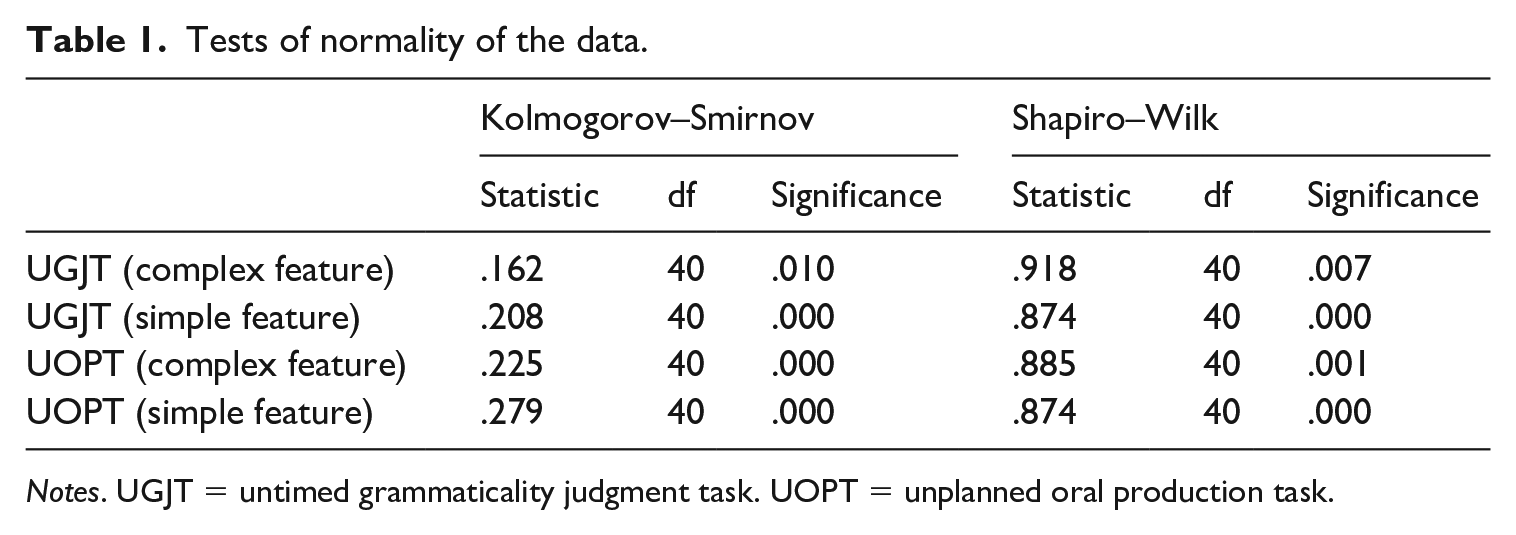
Notes. UGJT = untimed grammaticality judgment task. UOPT = unplanned oral production task.
As indicated in the table, the participants’ scores on all the four measures were not normally distributed (W = .007; p < .01, for the UGJT (complex feature); W = .000; p < .01 for UGJT (simple feature); W = .000; p < .01 for UOPT (complex feature); and W = .000; p < .01, for UOPT (simple feature). Therefore, a series of Mann–Whitney U tests were run. The descriptive statistics and the Mann–Whitney U tests results are presented in Table 2 and Table 3, respectively.
Descriptive statistics and ranks for the participants taught through explicit and implicit conditions.

Notes. UGJT = untimed grammaticality judgment task. UOPT = unplanned oral production task.
Mann–Whitney U results for explicit vs. implicit conditions.
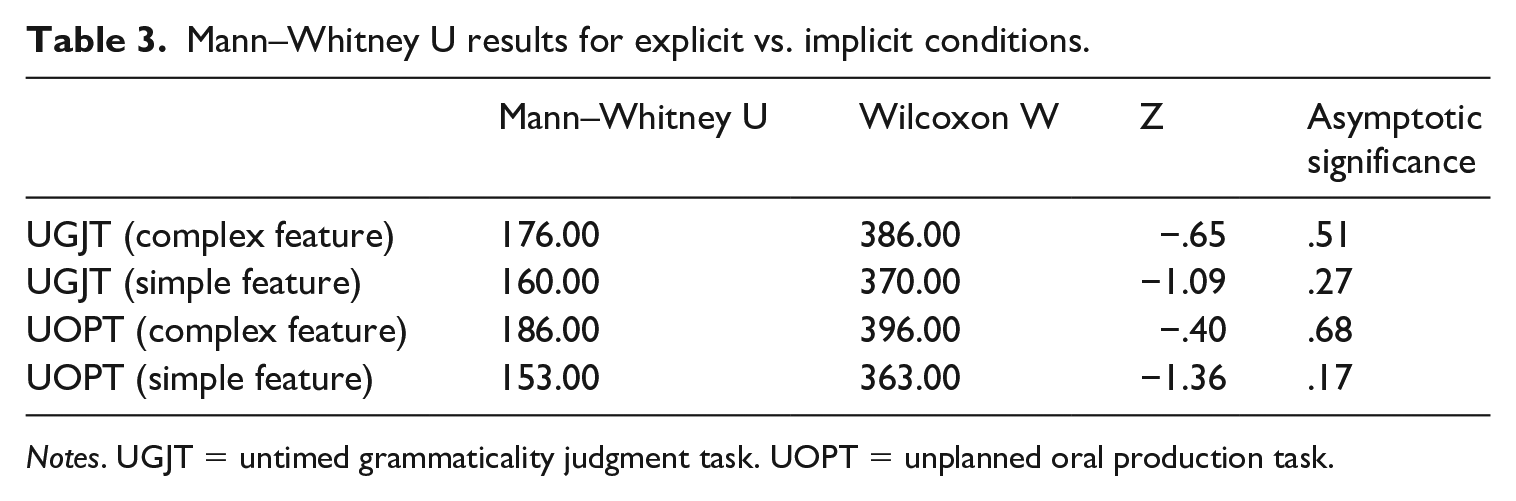
Notes. UGJT = untimed grammaticality judgment task. UOPT = unplanned oral production task.
As shown in Table 3, there are no significant differences between learners taught in the explicit and those taught in the implicit instructional conditions in their performance on UGJT (complex feature) (U = 176.00, p = .51) and UGJT (simple feature) (U = 160.00, p = .27). However, a comparison of the medians (Mdn = 11.00/12.00 for the explicit condition and Mdn = 9.00/9.50 for the implicit condition) points to a relative advantage for the explicit instruction condition. The results do not also show significant differences between learners taught in the explicit and those taught in the implicit instructional conditions in their performance on UOPT (complex feature) (U = 186.00, p = .68) and UOPT (simple feature) (U = 153.00, p = .17).
As the second aim of the study, it was hypothesized that learners with more sophisticated epistemic beliefs would outperform those with more naive epistemic beliefs in learning grammatical structures taught through implicit instruction while those with more naive epistemic beliefs would perform better in learning grammatical structures taught through explicit instruction. As the aim was to assess the learners’ performance on both UGJT and UOPT, a series of Kruskal–Wallis tests were conducted. The medians for the four groups and the results of the Kruskal–Wallis tests are presented in Table 4 and Table 5, respectively.
Medians for the four groups’ performance on UGJT and UOPT measures (complex and simple features).
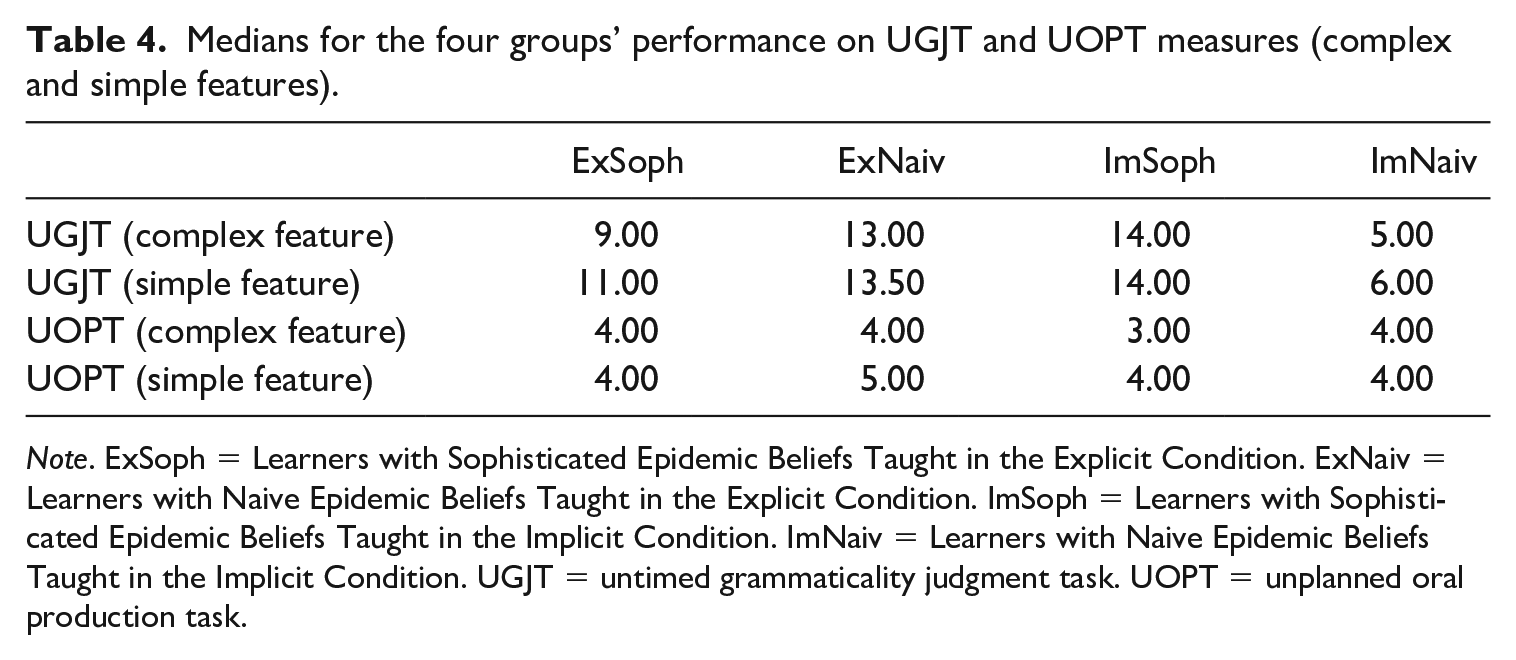
Note. ExSoph = Learners with Sophisticated Epidemic Beliefs Taught in the Explicit Condition. ExNaiv = Learners with Naive Epidemic Beliefs Taught in the Explicit Condition. ImSoph = Learners with Sophisticated Epidemic Beliefs Taught in the Implicit Condition. ImNaiv = Learners with Naive Epidemic Beliefs Taught in the Implicit Condition. UGJT = untimed grammaticality judgment task. UOPT = unplanned oral production task.
Kruskal–Wallis test results for the four groups of learners’ performance on UGJT and UOPT measures (complex and simple features).

Notes. UGJT = untimed grammaticality judgment task. UOPT = unplanned oral production task.
As can be seen in Table 5, there are significant differences between the four groups of participants in their performance on UGJT measure (complex and simple features) (χ2 (3) = 32.37, p = .00, for UGJT (complex feature); χ2 (3) = 31.63, p = .00 for UGJT (simple feature). However, no significant difference was found among the groups in their performance on UOPT (complex and simple features) (χ2 (3) = 2.76, p = .00 for UOPT (complex feature); and χ2 (3) = 3.80, p = .00 for UOPT (simple feature)). To probe the second hypothesis of the study, it was required to specifically pinpoint where the differences lay among the four groups. To this end, further post hoc pairwise comparisons were made the results of which are presented in Table 6.
Post hoc pairwise comparisons among the four groups.
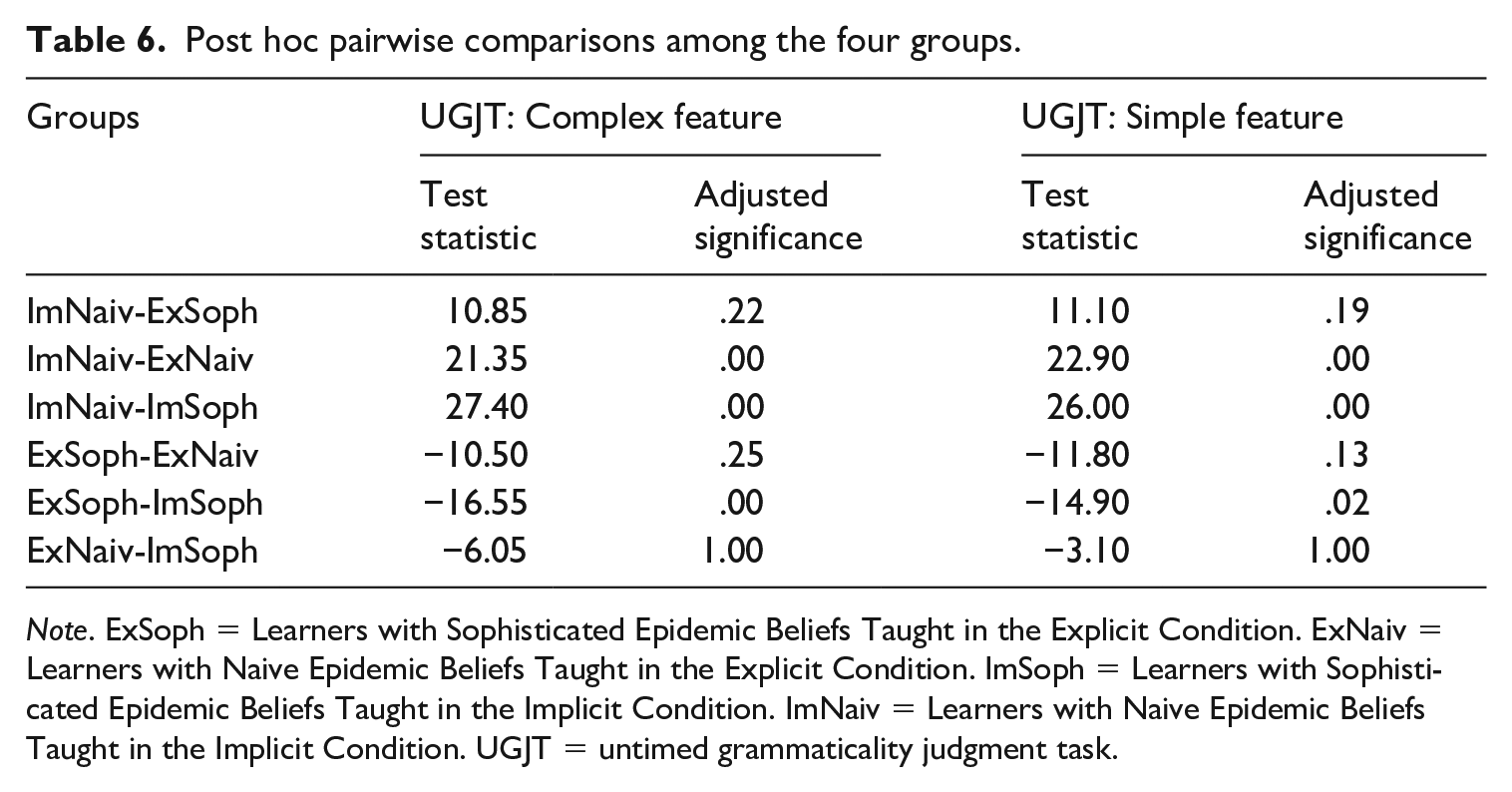
Note. ExSoph = Learners with Sophisticated Epidemic Beliefs Taught in the Explicit Condition. ExNaiv = Learners with Naive Epidemic Beliefs Taught in the Explicit Condition. ImSoph = Learners with Sophisticated Epidemic Beliefs Taught in the Implicit Condition. ImNaiv = Learners with Naive Epidemic Beliefs Taught in the Implicit Condition. UGJT = untimed grammaticality judgment task.
Based on hypothesis two, ImSoph and ExNaiv participants were expected to outperform participants in the other groups. As shown in Table 6, ExNaiv is significantly different from ImNaiv in their performance on UGJT (complex feature) and UGJT (simple feature) with the ExNaiv participants having a better performance. However, ExNaiv is not significantly different from ExSoph in their performance on UGJT (complex feature) and UGJT (simple feature). These two groups were both taught through the explicit instruction condition. Further, ImSoph is significantly different from ImNaiv in their performance on both UGJT (complex feature) and UGJT (simple feature) with ImSoph participants outperforming ImNaiv participants in both measures. ImSoph and ExSoph groups are also not significantly different in their performance on both measures of the two linguistic structures. Finally, there is no significant difference between ImSoph and ExNaiv groups on UGJT (complex feature) and UGJT (simple feature).
Based on the results, hypothesis two can be partially supported as participants with more sophisticated epistemic beliefs learn more effectively in implicit instructional condition. Additionally, learners with more naive epistemic beliefs learn more effectively in the explicit instruction condition. The lack of a significant difference between ExSoph and ExNaiv groups, however, seems to attenuate the strength of this finding. But when the medians for the two groups are considered, the ExNaiv group is shown to have a better performance which lends support to the finding.
As the third aim of the study, it was hypothesized that complex rules are learned better through implicit instruction and simple rules are learned best through explicit instruction. Based on this hypothesis, we expected a significantly better performance on the part of the participants taught in the explicit condition on both UGJT (simple feature) and UOPT (simple feature) and a significantly better performance on the part of the participants taught in the implicit condition on both UGJT (complex feature) and UOPT (complex feature). To probe the hypothesis, the comparisons between participants in the two instructional conditions were consulted (Table 2 and Table 3). As displayed in Table 3, there are no significant differences between participants taught in the two instructional conditions in their performance on UGJT (complex feature) (U = 176.00, p = .51), UGJT (simple feature) (U = 160.00, p = .27), UOPT (complex feature) (U = 186.00, p = .68), and UOPT (simple feature) (U = 153.00, p = .17). Therefore, based on the results, the hypothesis cannot be supported.
As the fourth aim of the study, it was hypothesized that learners with more sophisticated epistemic beliefs outperform those with more naive epistemic beliefs in learning complex grammatical structures. To probe this hypothesis, a series of Mann–Whitney U tests were run. The descriptive statistics and Mann–Whitney U tests results, for both explicit vs. implicit instructional conditions, are presented in Tables 7 and 8, and Tables 9 and 10, respectively.
Descriptive statistics and ranks for the naive-epistemic and sophisticated-epistemic groups (explicit condition).
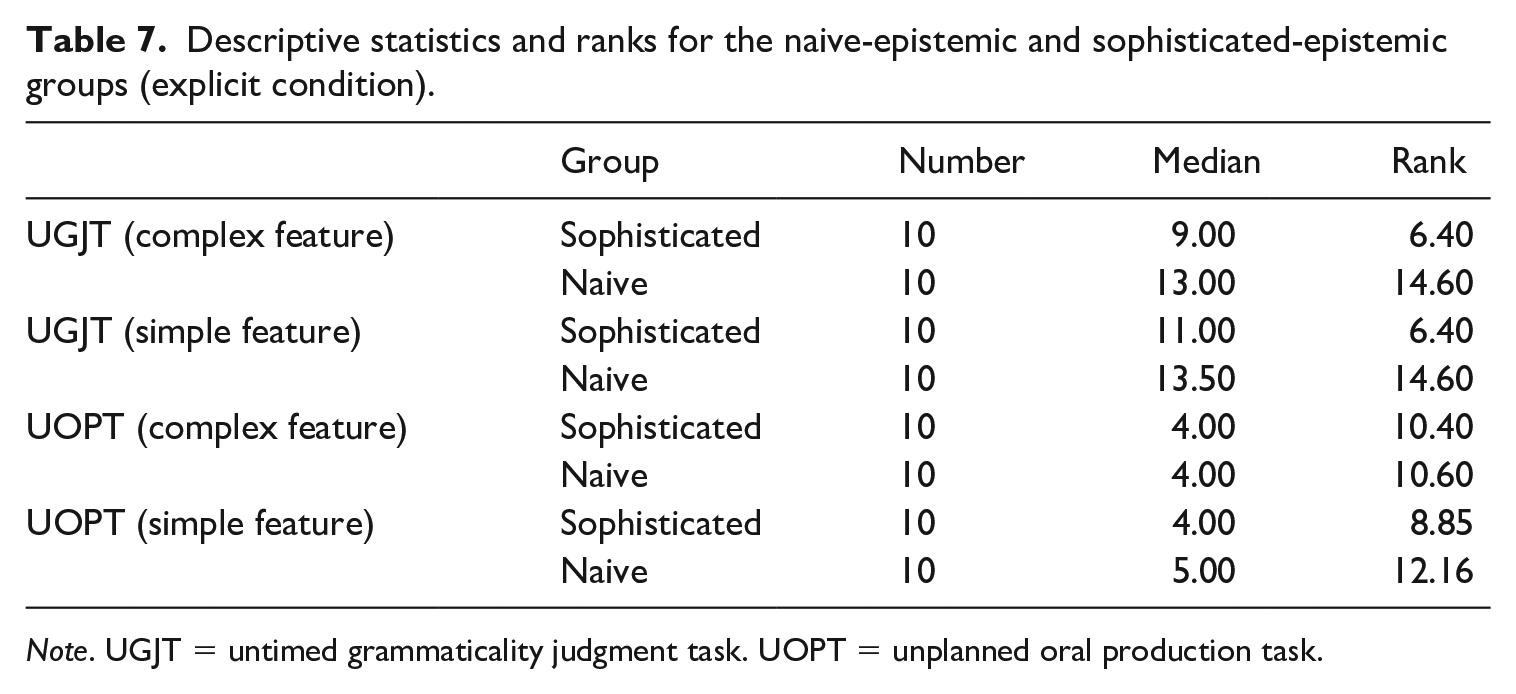
Note. UGJT = untimed grammaticality judgment task. UOPT = unplanned oral production task.
Mann–Whitney U results for the naive-epistemic and sophisticated-epistemic groups (explicit condition).
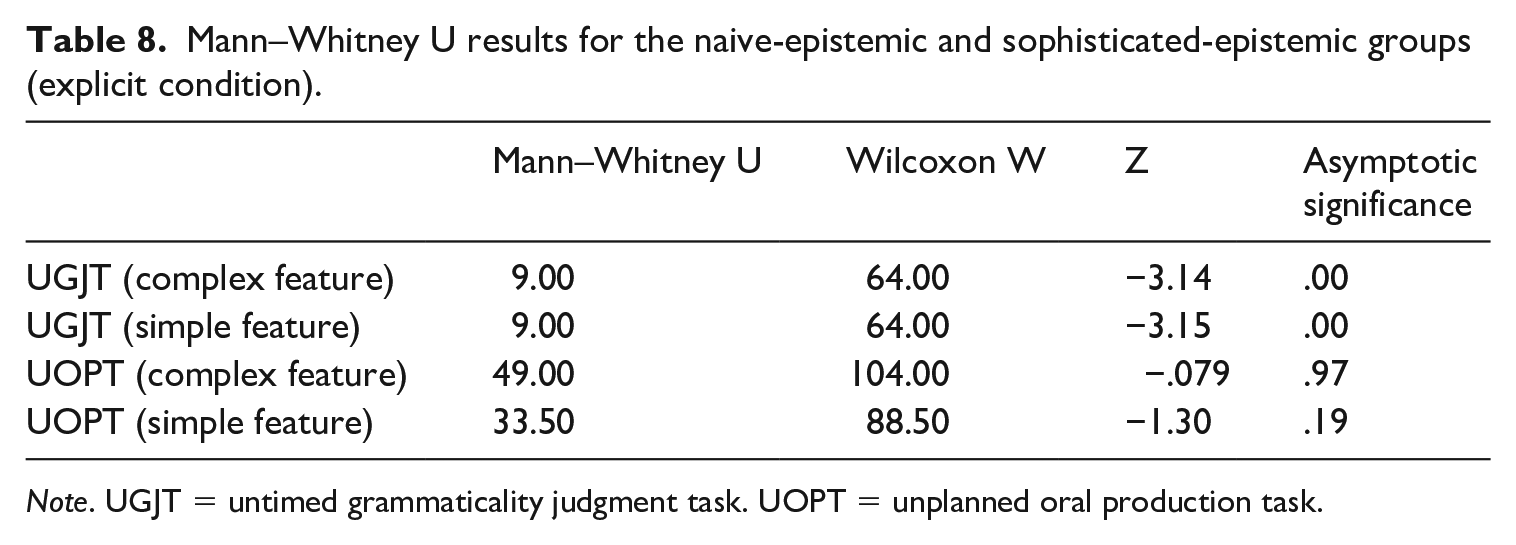
Note. UGJT = untimed grammaticality judgment task. UOPT = unplanned oral production task.
Descriptive statistics and ranks for the naive-epistemic and sophisticated-epistemic groups (implicit condition).
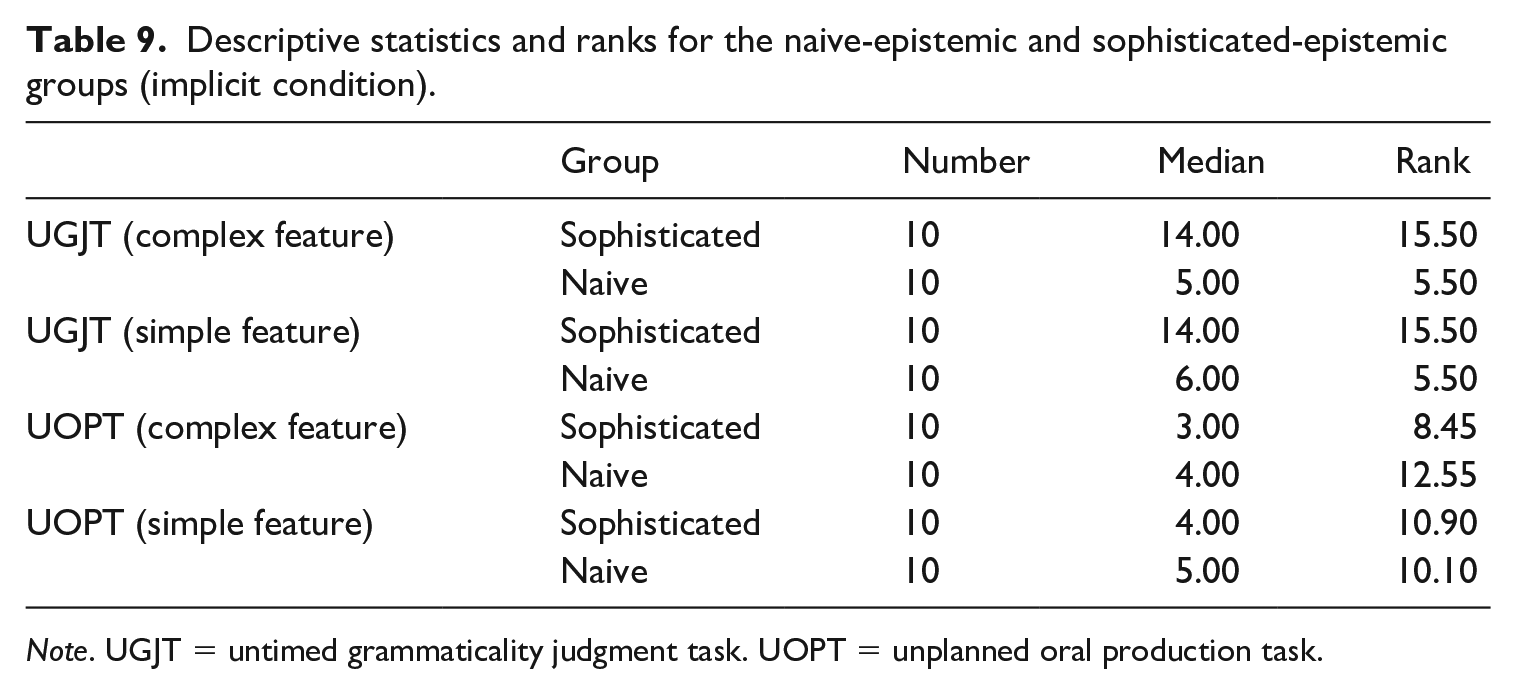
Note. UGJT = untimed grammaticality judgment task. UOPT = unplanned oral production task.
Mann–Whitney U results for the naive-epistemic and sophisticated-epistemic groups (implicit condition).

Note. UGJT = untimed grammaticality judgment task. UOPT = unplanned oral production task.
As shown in Table 8, there are significant differences between the sophisticated-epistemic and naive-epistemic groups of participants in their performance on UGJT (complex feature) (U = 9.00, p = .00, r = .70) and UGJT (simple feature) (U = 9.00, p = .00, r = .70) with the latter group outperforming the former. There are, however, no significant differences between the two groups in their performance on UOPT (complex feature) (U = 49.00, p = .97) and UOPT (simple feature) (U = 33.50, p = .19). Moreover, a comparison of the means of the sophisticated-epistemic and naive-epistemic groups of participants in the implicit condition reveals there are significant differences between the two groups in their performance on UOPT (complex feature) (U = .000, p = .00, r = .85) and UOPT (simple feature) (U = .000, p = .00, r = .85) with the sophisticated-epistemic learners outperforming the naive-epistemic learners. As pointed out earlier, learners with more sophisticated epistemic beliefs were hypothesized to outperform those with more naive epistemic beliefs in learning complex grammatical structures. As the comparisons indicate, this hypothesis is not borne out by the results. However, the findings support the congruency between the source of knowledge dimension of epistemic beliefs and learners’ achievement.
VIII Discussion
As reported in the results section, the explicit and implicit instructional conditions did not differentially affect the participants’ performance on UGJT (complex and simple structures) and UOPT (complex and simple structures). However, a comparison of the medians points to a relative advantage for the explicit instructional condition, though this relative advantage held only for the participants’ performance on UGJT, which may indicate that the transfer from explicit knowledge to implicit knowledge may not occur automatically. This finding partially corroborates the results from a number of previous studies (see, for example, amongst others, DeKeyser, 1994; Doughty, 1991; Klapper & Rees, 2003; Macaro & Masterman, 2006; Tammenga-Helmantel et al., 2014; Vogel et al., 2011). The lack of a difference between the two instructional conditions in the UOPT (both complex and simple features) and no relative advantage for one group also corroborates the results reported from previous studies such as Andringa (2005) and Tammenga-Helmantel et al. (2014) who reported no significant difference between implicit and explicit instructional conditions in promoting productive knowledge.
Through testing the second hypothesis of the study, as discussed above, it was found that participants with more sophisticated epistemic beliefs learn more effectively in the implicit instructional condition. Additionally, learners with more naive epistemic beliefs were found to learn more effectively in the explicit instruction condition. This finding was, however, attenuated by the lack of a significant difference between participants with more sophisticated epistemic beliefs in the explicit condition and learners with more naive epistemic beliefs in the explicit instructional condition. But when the medians for these two groups were considered, learners with more naive epistemic beliefs were found to have a better performance which lends support to the finding. This finding could be explained with reference to the epistemic characteristics associated with participants holding naive vs. sophisticated epistemic beliefs. Learners with more naive beliefs hold the view that knowledge is handed down by an omniscient authority figure (Hofer, 2016) as opposed to the view that knowledge originates inside the individual through his/her own processes of meaning making which is the view held by participants with more sophisticated beliefs (Elby, Macrander, & Hammer, 2016). In the explicit instructional condition, rules are often presented to the learners by the teacher (Housen et al., 2005), as an authority figure assumed to possess adequate knowledge of the subject which, in Schommer’s (1990) words, is not otherwise accessible. This resonates better with participants holding more naive epistemic beliefs. On the other hand, in the implicit instructional condition, learners are often presented with exemplars of the targeted feature in meaningful contexts and they are often expected to extract patterns and generalizations underlying the input. This view of learning resonates better with participants holding more sophisticated epistemic beliefs. These beliefs can even influence the achievement goals students set for themselves (Chinn & Rinehart, 2016). For example, students with more sophisticated beliefs often hold mastery goals characterized by inward focus on task mastery which motivates a more active role in learning (Winberg, Hofverberg, & Lindfors, 2018). These are the characteristics which are often required in implicit learning conditions.
As its third aim, the study investigated the hypothesis that complex rules are learned better through implicit instruction and simple rules are learned best through explicit instruction. The hypothesis was not supported. The findings provided evidence against Krashen’s (1985, 1994) ‘No Interface Hypothesis’, which assumes that less complex rules can be taught whereas ‘hard rules . . . are thought to be best learned implicitly, embedded in meaning-based practice’ (Spada & Tomita, 2010, p. 264), and Reber’s (1993, p. 25) ‘implicit learning theory’ which considers implicit learning as ‘the default mode for the acquisition of complex information about the environment’. Based on a different conceptualization of the notion of complexity – transparency of form-function mapping – the results were found to be congruent with findings reported from other studies with different notions of complexity employed (e.g. Housen et al., 2005; Robinson, 1995).
Motivated by the fact that one dimension of epistemic beliefs – simple knowledge – concerns the view that what counts as knowledge is complex and integrated (sophisticated) as opposed to the view that what counts as knowledge is a piecemeal collection of isolated facts (naive) (Bell, 2006), the study also explored the hypothesis that learners with more sophisticated epistemic beliefs outperform those with more naive epistemic beliefs in learning complex grammatical structures. The results did not support this hypothesis which falls in contrast to a number of findings reported in the literature such as Schommer, Crouse, and Rhodes (1992) who found that belief in the complexity of knowledge can account for comprehension test performance. This finding could be attributed to the differences in the way complexity is conceptualized in this study and the way complexity is conceptualized in the literature on epistemic beliefs. In this study, complexity was conceptualized as transparency in form-function mapping while in the epistemic beliefs literature complexity concerns the extent to which knowledge is believed to be of a closely interconnected nature (Karimi, 2014a) or represented as complex theories (Schraw et al., 2002). It is also likely that the nature of the instruction – explicit vs. implicit – and the congruency between the source of knowledge dimension of epistemic beliefs and the instructional conditions have been stronger than the congruency between structure of knowledge dimension of epistemic beliefs and the complexity/simplicity of the targeted structures.
IX Conclusions
In line with indications in the literature suggesting that individual differences such as age, aptitude, proficiency level, learning styles, motivation, working memory, etc. might play a role in the way learners react to instructional conditions, the results of the present study indicate that the effectiveness of explicit and implicit instructional conditions can vary across learners with different individual characteristics. Simply preferring one instructional condition over another without considering factors which might moderate their effectiveness is to be discouraged. The individual difference variable investigated in the present study was epistemic beliefs defined as the beliefs learners hold regarding the nature of knowledge and knowledge acquisition processes (Hofer, 2016). Moreover, the results provided evidence against propositions that complex structures are learned better through implicit instructional conditions (Krashen, 1994; Reber, 1993). Additionally, the hypothesis that learners with more sophisticated epistemic beliefs learn complex structures more effectively was not borne out by the analyses.
One of the implications of the present study would be to differentiate instruction in the light of the learners’ perspectives on the source of knowledge (omniscient authority vs. the self) and the structure of knowledge (simple vs. complex). Differentiated instruction provides a framework for responding to student variability by adjusting content, process and learning environments to optimize a match between students’ profiles and learning opportunities (Tomlinson & Jarvis, 2009). In particular, learning environments and teaching processes can be designed reflecting the epistemic preferences of the learners. The results could also shed some light on the long-standing debate about whether to teach grammar explicitly or implicitly. For example, learners with more sophisticated epistemic beliefs could be identified and assigned to the implicit learning conditions while those with more naive epistemic beliefs could be assigned to explicit learning conditions.
In conducting the study, attempts were made to provide comparable conditions across the two types of instruction. However, limitations of the study as well as suggestions for future research should be underscored. First, given the feasibility concerns, the study was conducted with ten participants per grouping. The study could be replicated with more participants included. Another limitation of the study relates to the use of an oral production task as a measure of implicit knowledge while the treatments were made using written texts. As one of the reviewers of the article suggested, perhaps a (computerized) timed written task would have been a better choice. Additionally, the present study treated only a couple of target features distinguished in terms of form-function transparency. A wider range of grammatical features based on other conceptualizations of complexity could be also targeted.
