



Abstract
This study examined the role of growth mindset, self-efficacy, and intrinsic value in self-regulated learning (SRL) and English language learning achievements in Hong Kong primary school students. A sample of 690 4th graders participated in the study. The findings suggest that the level of SRL strategy use (i.e. monitoring, effort regulation, and goal setting and planning) was driven by the students’ motivational beliefs (i.e. growth mindset, self-efficacy, and intrinsic value) in different ways. Monitoring and effort regulation, in turn, were significant contributors to the participants’ English language learning achievements, but goal setting and planning did not predict their English language learning achievements. The finding suggests that growth mindset was a stronger predictor of SRL than self-efficacy and intrinsic value. Implications for fostering adaptive motivational beliefs and SRL are discussed. Future research should consider the influence of the socio-cultural context on the relationships between motivational factors, SRL strategy use, and English language learning achievements.
Keywords
I Introduction
As a world language, English language is crucial for educational and professional development (Tsang, 1996). In most countries and regions where English is a non-native language, e.g. Hong Kong, South Korea, and Malaysia, English language is one of the key learning areas together with their first language (Tsui & Tollefson, 2017). Investigating the factors that may affect English as a foreign/second language (EFL/ESL) learning achievements is crucial for informing theory, practice and policy. Researchers have long attempted to identify factors that contribute to English language learning achievements for students in EFL/ESL contexts (Bai, 2018; Muñoz, 2017; Wang & Bai, 2017).
Motivational beliefs (e.g. self-efficacy and intrinsic value) are crucial factors that drive students’ learning. Research on motivation has sought to answer the question of what moves people to act and why people think and do what they do (Eccles & Wigfield, 2002; Wigfield & Cambria, 2010; Wigfield et al., 2015). Depending on motivational beliefs, students may choose different tasks and activities to do. Once students are engaged in tasks, motivation relates to their quality and intensity of engagement according to expectancy-value theory (Eccles & Wigfield, 2002; Jansen, Scherer, & Schroeders, 2015). Expectancy-value theory posits that students’ task value beliefs and beliefs about their capabilities to complete a task are determinants of academic achievements. On the other hand, calls to examine growth mindset are becoming increasingly prevalent given its significance in promoting persistence and resilience. Growth mindset has been incorporated in empirical research as another important motivational belief that can help students make a significant difference in their EFL/ESL learning (Bai & Guo, 2019). Especially, the concept of growth mindset may be a very significant motivational belief that impacts Asian students’ learning achievements, given the special value attached to efforts in learning in Confucian cultural contexts. According to implicit theories of intelligence, students’ beliefs that intelligence is malleable and can be improved through efforts (i.e. growth mindset) are central to positive learning achievements (Blackwell, Trzesniewski, & Dweck, 2007; Dweck, 2006). Although both expectancy-value theory and implicit theories of intelligence highlight the important role of students’ beliefs in their learning, it is surprising that the two strands of research have rarely been considered together with regard to EFL/ESL students’ learning.
Furthermore, research suggests that motivational beliefs help to promote and sustain self-regulated learning (SRL), which in turn directly contributes to academic success (Pintrich, 2003). Self-regulated language learning strategies are learners’ deliberate and goal-directed attempts to manage and control their efforts in order to learn the language (Oxford, 2011). Self-regulated learners apply a variety of SRL strategies, e.g. metacognitive self-regulation, cognitive strategies, and environment and resource management, to effectively regulate their learning (Zimmerman & Schunk, 2001). For example, self-regulated learners may persist or continue to invest their time and efforts in the face of setbacks (i.e. effort regulation). Self-regulated learning is particularly important in EFL/ESL contexts, such as Hong Kong. EFL/ESL learners may not be provided with sufficient interaction opportunities because their target language learning may be largely limited to the classroom and they have limited exposure to the target language in everyday settings (Kormos & Csizér, 2014). Therefore, it is necessary for them to become self-dependent and autonomous lifelong learners, which means that they need to learn on their own outside the classroom and employ various SRL strategies. Self-regulated learning has been considered an important type of 21st century competence that underlies the idea of lifelong learning (Trilling, 2009). Understanding how SRL may promote English language learning achievements can offer EFL/ESL learners a great advantage in overcoming their difficulties.
Despite our growing knowledge of the above constructs, the relations between motivational beliefs, SRL, and English language learning achievements in EFL/ESL contexts have not been adequately explored. Further to this, relatively little is known about how they contribute to young students’ EFL/ESL learning. Therefore, this study aimed to examine the role of motivational beliefs in SRL and English language learning achievements in Hong Kong primary schools. Specifically, three motivational beliefs (i.e. growth mindset, self-efficacy, and intrinsic value) and three types of SRL strategies (i.e. monitoring, effort regulation, and goal setting and planning,) were included in the present study. In the hypothesized model proposed in the present study, motivational beliefs were assumed to impact SRL, which in turn would contribute to English language learning achievements.
One significant contribution of this study is to offer insights into the impacts of motivational beliefs and SRL strategies on primary school EFL/ESL learners’ language learning achievements in an Asian context. If young students believe that they can learn English well through efforts, have confidence and feel that English language learning is interesting, such beliefs will probably remain till their adulthood. Otherwise, their negative beliefs may lead to their disengagement in English language learning. Especially, this study highlights the importance of both growth mindset and self-efficacy, two similar but also different concepts in English language learning. English teachers can better capitalize on such motivational beliefs of their students in order to enhance their English language learning achievements. In addition, this study will map out how various motivational beliefs (i.e. growth mindset, self-efficacy, and intrinsic value) may impact English language learning achievements through the use of various SRL strategies (i.e. monitoring, effort regulation, and goal setting and planning). As such, this study can provide a better understanding of how motivational beliefs and SRL strategies may work on young students so that early interventions and pedagogical reforms can be made possible.
1 Relating motivational beliefs (i.e. self-efficacy, growth mindset, and intrinsic value) to self-regulated learning
Expectancy-value theory posits how students behave can be predicted by beliefs about their capabilities in accomplishing a task, i.e. self-efficacy, and whether the task is worth pursuing, i.e. task values (Bandura, 1997, 2001; Eccles & Wigfield, 2002). Self-efficacy is a domain-specific belief that is strongly related to students’ previous learning experiences in a given task (Bai, Chao & Wang, 2019; Hsieh & Schallert, 2008). Difficulties of tasks vary and students’ ability levels are different. Students’ self-efficacy beliefs therefore vary across academic domains because their success and mastery experiences as well as setbacks in each task are different (Pajares, 2006). Additionally, Hsieh and Schallert (2008) point out that language learning is particularly linked to possible loss of face and embarrassment, which influences students’ self-efficacy.
A wide range of empirical studies have confirmed that self-efficacy plays a significant role in language learning. Language learners who maintain higher self-efficacy beliefs are more self-regulated (Liem, Lau, & Nie, 2008; Pintrich & De Groot, 1990). Specifically, Pintrich and De Groot’s (1990) study found that students’ self-efficacy was a significant predictor of cognitive strategy use (measured by use of rehearsal strategies, elaboration strategies, and organizational strategies), self-regulation (measured by use of metacognitive and effort management strategies), and English language learning achievements. In Liem et al.’s (2008) study with 1475 secondary school students in Singapore, self-efficacy was found to be positively related to cognitive strategy use (measured by use of elaboration strategies), and English language learning achievements, and was negatively related to task disengagement for English language learning. Kim, Wang, Ahn, and Bong (2015) found that the students with high self-efficacy profiles were significantly more self-regulated (measured by 68 items in 10 scales, such as self-evaluation, seeking social assistance, keeping records, and monitoring) than the students with low self-efficacy profiles. Thus, self-efficacy can be considered a positive predictor of self-regulation in English language learning.
There are several types of task values (e.g. intrinsic value, importance, and utility). Intrinsic value, also called interest or perceived enjoyment, pertains to students’ beliefs that the task is interesting (Wigfield et al., 2015). Intrinsic value has been proposed as a central goal of many curriculum guides worldwide to sustain and promote EFL/ESL learners’ interest, e.g. the Japanese Ministry of Education (MEXT, 2008), and the Hong Kong Curriculum Development Council (Curriculum Development Council, 2017). In Deci and Ryan’s (2000) view, individuals have the inherent tendency to explore and learn, to seek out novelty and challenges, and to improve competence. Intrinsically motivated behaviors are those through which people get enjoyment and will engage in tasks without the necessity of consequences. If students enjoy learning the task, they are more likely to engage in learning and use effective learning strategies (Pintrich & De Groot, 1990; Wigfield & Cambria, 2010).
Intrinsic value has been found to significantly predict SRL in science, math, and general education (Durik, Vida, & Eccles, 2005; Pintrich & De Groot, 1990). Some researchers have argued for the importance of intrinsic value in language learning (Oga-Baldwin, Nakata, Parker, & Ryan, 2017; Noels, Vargas Lascano, & Saumure, 2019). According to Noels et al. (2019), when language learners are intrinsically motivated, they enjoy the process of mastering that language and language learning is pleasurable in itself. In addition, intrinsic value has a lasting effect on language learning achievements and engagement. When extrinsically motivated, however, individuals learn a language for instrumental or other reasons, e.g. gaining rewards and avoiding punishment, meeting parents’ and teachers’ expectations, and interacting with others. Intrinsically motivated students are more inclined to continue to learn a foreign/second language than those extrinsically motivated. For primary school students, developing a positive affect for the foreign/second language is particularly important as intrinsic value may lead to a lifelong effect. Our study, thus, focused on primary school students’ intrinsic value. Pintrich and De Groot (1990) found that students’ intrinsic value was very strongly related to use of cognitive and metacognitive strategies, and was mildly related to English language learning achievements. Bonney, Cortina, Smith-Darden, and Fiori (2008) examined the relation between motivational beliefs and strategy use among 694 high school students in foreign language classrooms (e.g. French, German, Latin, and Spanish). They found that intrinsic value was the best predictor of the students’ reports of self-regulated extracurricular learning activities. In a survey with 128 Canadian learners of Japanese, McEown, Noels, and Saumure (2014) found that the students’ intrinsic value was a significant predictor of learning engagement (e.g. efforts and intentions to continue studying the foreign language) and academic outcomes. In the present study, we hypothesized that intrinsic value was a positive predictor of self-regulation in English language learning among Hong Kong primary school students.
Whereas language teaching and learning research has benefited greatly from the work on such motivational variables as self-efficacy and task values, another important motivational variable that has positive effects on language learning is growth mindset. Implicit theories of intelligence are concerned about whether intelligence is malleable or fixed (Blackwell et al., 2007; Claro, Paunesku, & Dweck, 2016; Dweck, 2006). Growth mindset refers to an individual’s belief that ability is malleable and can be increased through efforts (Claro et al., 2016). People with a growth mindset are more likely to persist in the face of adversity because they view failures as a sign that they need to expend more efforts to improve. Burnette, O’Boyle, VanEpps, Pollack, and Finkel’s (2013) meta-analysis of previous research on general learning suggests that growth mindset is positively related to learners’ persistence, planning, monitoring, and regulating their learning process, as well as enjoyment. Blackwell et al. (2007) found that students’ growth mindset was positively related to their use of positive and effort-based strategies in mathematics learning, and positively predicted an upward trajectory in grades over the two years of junior high school.
Although the influence of growth mindset has been widely examined across various academic domains, it has rarely been considered in EFL/ESL contexts (Lou & Noels, 2019). Especially, many students may believe that achievements in language learning are well associated with a gift or the ear for languages, and thus they may be less likely to report having a growth mindset in language learning than in other areas (Horwitz, 1999; Lou & Noels, 2016). Within the limited research on growth mindset in language learning, there is some evidence showing the positive impacts of growth mindset on self-regulated language learning. Lou and Noels (2016) investigated Canadian university students’ language growth mindset and found that second language learners with a growth mindset reported a stronger intention to continue learning, and gave fewer helpless responses in challenging situations. Nevertheless, Lou and Noels’s (2016) study focused on English speaking students who were studying a second or foreign language such as Arabic and Chinese. In EFL/ESL contexts, empirical research shows that the students with a growth mindset adopted a feedback seeking orientation in English writing (e.g. analysing the teacher’s questions and clarifying comments with the teacher) instead of a feedback avoiding orientation (Waller & Papi, 2017).
Growth mindset should be a particular important area of research to understand EFL/ESL learning given the challenges faced by learners and the important role of growth mindset in response to failures. EFL/ESL learners, especially young students, experience many fundamental but essential problems in English language learning due to unconducive language environments (Kormos & Csizér, 2014; Tsang, 1996). For example, only 7% of the English learners in China may often use English in their daily lives, given a lack of the language environment (Bolton & Graddol, 2012). Evans’s (2017) survey study with 828 university students in Hong Kong suggest that speaking and writing English were not their regular daily activities. Most of the students spoke little English on a daily basis because they found it challenging to use the language if they studied in Chinese-medium secondary schools. A major reason offered by Evans (2017) was the issue of language typology. Hong Kong students would face more challenges than European EFL/ESL learners because Cantonese, a local Chinese dialect, and English do not belong to the same language family, whereas European students’ native languages have the same writing system as English.
Notably, growth mindset may be particularly relevant to Hong Kong students due to the emphasis on efforts in learning in East Asian Confucian societies (Tweed & Lehman, 2002). For example, Wang and Rao (2019) found that Chinese teachers transmitted Confucian values of education that competence is malleable and can be improved through hard work. Prior studies have also shown that the Chinese tend to attribute academic success to efforts rather than perceived competence, i.e. self-efficacy (Hau & Ho, 2010; Leung & Shek, 2015). It is believed that as long as students expend efforts, they will achieve desirable learning outcomes.
2 Relating self-regulated learning to EFL/ESL learning achievements
Being motivated is far from enough, students need to independently and effectively manage their EFL/ESL learning. Various theorists have proposed that motivational beliefs are not a direct cause of academic achievements. It is students’ academic engagement, e.g. SRL strategy use, and investment of time and energy, that in turn directly predict students’ academic achievements (Fredricks, Blumenfeld, & Paris, 2004; Wigfield et al., 2015). Among the various types of engagements, SRL has been considered a pivotal contributor to performance in English language learning (Bai, 2018; Oxford, 2011; Wang & Bai, 2017; Xiao & Yang, 2019). Zimmerman (1990) describes self-regulated learning as a self-oriented feedback loop, in which students initiate the setting of goals and subgoals (e.g. making plans for the sequence and time to complete tasks), monitor their learning effectiveness, evaluate the quality and progress of learning by comparing observed outcomes with their own goals, and modify their learning progress. Self-regulated learners proactively set personal goals, make efforts and manage the environment, monitor and regulate their learning, and make reactions constantly to achieve preset goals (Pintrich & Zusho, 2002).
Language learning research has examined the impacts of employing a wide range of SRL strategies, which include but are not limited to 1) metacognitive self-regulation strategies, which are used to monitor, plan, and adjust learning, 2) cognitive strategies, which help students select, organize, and store information in the long-term memory, and 3) environment and resource management, which helps manage the assistance and create an appropriate learning environment (Wang & Bai, 2017; Xiao & Yang, 2019). Oxford and her colleagues developed a widely used strategy inventory with six subscales: memory strategies, cognitive strategies, compensation strategies, metacognitive strategies, affective strategies, and social strategies (Oxford, 1996; Oxford & Burry-Stock, 1995). Moreover, a recent study by Wang and Bai (2017) examined English language learners’ use of nine main types of SRL strategies: (1) goal setting and planning, (2) record keeping and monitoring, (3) self-consequences (i.e. students arrange rewards or punishment for themselves), (4) self-evaluation, (5) effort regulation, (6) organization and transformation, (7) rehearsal and memorization, (8) seeking social assistance, and (9) seeking opportunities to practice English. Their study showed that seven types of SRL strategies were frequently used by Chinese learners of English. Only two types, i.e. seeking opportunities to practice English, and goal setting and planning were seldom used.
In the present study, we focused on three types of metacognitive self-regulation strategies, namely monitoring, effort regulation, and goal setting and planning. The three types of SRL strategies are especially useful for Hong Kong primary school students due to a general lack of exposure to English in their daily lives (Li, 2018). Students need these types of SRL strategies to regulate their English learning not only in the classroom but also beyond. Prior studies have shown that metacognitive self-regulation is a positive predictor of English language learning achievements (Oxford, 2011; Xiao & Yang, 2019). Specifically, high-achieving English learners were found to use more metacognitive self-regulation strategies than low-achieving learners, e.g. making a study plan in the learning process, checking own understanding by asking questions, and checking homework before turning it in (Wang & Bai, 2017). Xiao and Yang (2019) found that secondary school EFL learners in China set up such learning goals as setting quality quizzes or writing a concise essay, and they planned their use of SRL strategies (e.g. coping with word choices) beforehand. They also conciously monitored their whole learning process from goal setting to taking actions to achieve their goals. In a study with 168 Chinese university English learners, Nisbet, Tindall, and Arroyo (2005) found that metacognitive strategies most strongly contributed to performance in the Test of English as a Foreign Language (TOEFL). Shih and Reynolds (2018) found that Taiwanese EFL learners’ reading proficiency improved better through goal setting, compared with those who did not use goal setting strategies. With regard to effort regulation, a self-regulated learner would not give up when s/he encounters difficulties and controls her/his attention in the face of distractions, which reflects a commitment to achieving one’s goals. Research has well documented a positive relationship between effort regulation and English language learning achievements (Liem et al., 2008; Mega, Ronconi, & De Beni, 2014). Thus, monitoring, effort regulation, and goal setting and planning were hypothesized to predict English language learning achievements positively among Hong Kong primary school students.
3 Integrating motivational beliefs, self-regulated learning and English language learning achievements in one hypothesized model
This study examined the relationships between EFL/ESL students’ motivational beliefs (i.e. growth mindset, self-efficacy, and intrinsic value), SRL strategy use (i.e. monitoring, effort regulation, and goal setting and planning), and English language learning achievements. The following research questions were addressed:
What is the relationship between motivational beliefs and SRL strategy use among Hong Kong primary school students?
What is the relationship between SRL strategy use and English language learning achievements among Hong Kong primary school students?
Figure 1 presents the theoretical model to be tested in the present study. The model shows that SRL strategy use mediates the relation between motivational beliefs and English language learning achievements (i.e. test scores). In addition, gender was included as a covariate in the model. Gender has shown associations with English language learning achievements in prior studies. Boys generally showed a lower level of SRL and achievements in language learning than girls (Fraine, Damme, & Onghena, 2007; Yeung, Lau, & Nie, 2011). Thus, it was hypothesized that girls would obtain higher English test scores than boys in general.
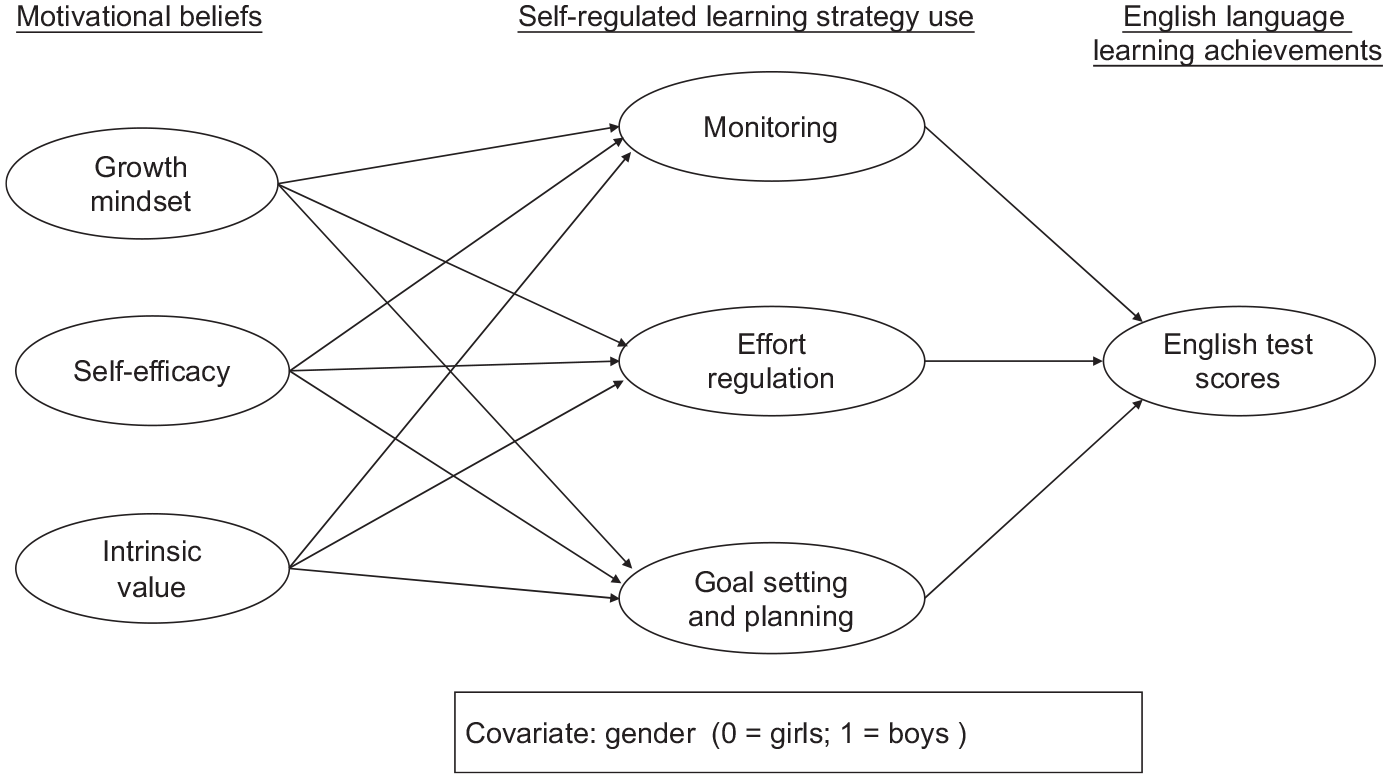
A theoretical model on the relations between motivational beliefs, self-regulated learning (SRL) strategy use, and English language learning achievements.
II Method
This study was conducted in Hong Kong. Most Hong Kong primary school students’ mother tongue is Cantonese, a local Chinese dialect. Hong Kong children start to learn English from kindergarten. After entering primary school, they begin to systematically learn English. Out of the requirements of the Hong Kong Education Bureau (EDB) subject curriculum, Hong Kong primary school students have seven to 10 general English lessons each week, and each one lasts 35 to 40 minutes. Their English learning focuses on four key areas, i.e. listening, speaking, reading, and writing. The participants comprised 690 4th graders aged between 9–10 years old (M = 9.33, SD = .79) from eight government-aided primary schools in Hong Kong. The students’ English proficiency levels varied from low to high, and each school had the autonomy to choose suitable textbooks for their own students according to students’ English proficiency levels. Based on our survey with the schools, most schools adopted Longman Elect or Longman Express as their main textbooks and they also used some supplementary materials to suit their students’ needs better. There were seven co-educational schools and one all girls’ school in the study. Thus, there were more girls (n = 407, 59%) than boys (n = 283, 41%).
III Measures
1 Measures of motivational beliefs in English language learning
Items on growth mindset were adapted from Dweck’s (2006) measures on implicit beliefs. The scale (4 items, α = .88) consists of four statements that measured the extent to which students believe that they can change their general ability in English language learning. A sample item is ‘I can always greatly change how intelligent I am in English language learning.’ Items on self-efficacy and intrinsic value were adapted from Pintrich and De Groot (1990). The self-efficacy scale (4 items, α = .86) measured the extent to which students believe in their capability to master skills for English language learning. Sample items are ‘I am sure I can learn the skills taught in the English class well’ and ‘I can learn English well even if the work in English is hard.’ The intrinsic value scale (4 items, α = .84) measured the degree to which students engage in English language learning for enjoyment. Sample items for this scale are ‘I am interested in learning English’ and ‘I enjoy learning English.’ The students responded to the items on a five-point scale from 1 (strongly disagree) to 5 (strongly agree).
2 Measures of self-regulated learning in English language learning
Three subscales of metacognitive self-regulation were included, i.e. monitoring, effort regulation, and goal setting and planning. The monitoring scale (5 items, α = .76) was adapted from Pintrich, Smith, and García (1991) and Wang and Bai (2017). Sample items included in this scale are ‘I ask myself questions to make sure I understand the materials I have been studying in English’ and ‘When studying English, I try to determine which concepts I don’t understand well.’ The effort regulation scale (4 items, α = .86) was adapted from Pintrich et al. (1991) and measured students’ effort regulation in the face of challenging situations. Sample items are ‘I will not give up when the work in English is difficult’ and ‘Even when learning materials are dull and uninteresting, I keep studying until I finish.’ Items on goal setting and planning (3 items, α = .85) were adapted from Zimmerman and Pons (1986) to examine the extent to which students set goals and make plans for themselves. Sample items for this scale are ‘I set a concrete English learning plan for myself’ and ‘I have my own English learning goals.’ The students responded to the items on a five-point scale based on their frequency of use from 1 (never) to 5 (always).
3 English language learning achievements
English language learning achievements were measured by the students’ scores in a standardized English test. Three experienced English teachers designed the test, checked the validity and clarity, and ensured that the test was appropriate for assessing 4th graders’ English language learning achievements. The test comprised of multiple-choice questions in five parts, i.e. listening comprehension (7 points), word reading (15 points), sentence comprehension (10 points), vocabulary (15 points), and passage comprehension (12 points). The students were assigned points for correct answers in each part of the test. The five parts were summed up to derive a composite total score on a 59-point scale, ranging from 0 to 59.
4 Procedures
All ethical protocols were followed in conducting the research. Invitations were sent to school principals, and consent forms were obtained from the students’ guardians. The questionnaires were translated into Chinese and checked by one researcher and two English teachers to ensure accuracy. The students’ own English teachers administered the questionnaires to them in class. Before the questionnaire administration, their English teachers informed them that their answers would be kept confidential and only for research purposes. The teachers also reminded students to be very serious and answer all questions, ensured that the students would not discuss the questions with each other, and handled the students’ questions if any. The students answered the Chinese version of questionnaires, most of whom completed the questionnaires within around 15–20 minutes. In the same week of the questionnaire administration, the standardized English proficiency test was administered by their English teachers in another English class. The students finished the English test independently. On average, it took the students 40–50 minutes to complete the English test.
IV Results
1 Reliability and discriminant validity of the English test
This study adopted Ebel and Frisbie’s (1986) classification levels on the discrimination power (D value) of a test: > .39 (excellent), .30–.39 (good), .20–.29 (mediocre), and .00–.20 (poor). The average D value for the English test was .47, and difficulty degree was .53, suggesting that the English test used in this study had an excellent discrimination power. We also compared the differences of the test scores between the high achievers and the low achievers to test the discriminant validity. To do this, six sets of t-tests were conducted to compare the main differences in the English test scores between the top 27% (n = 186, Mtotal = 46.05, SD = 5.04) and the bottom 27% (n = 186, Mtotal = 18.22, SD = 4.53) of the participants. Results of the t-tests showed that the top group and the bottom group performed significantly differently in the five parts of the test, listening comprehension, t = 25.606, p < .001, word reading, t = 27.538, p < .001, sentence comprehension, t = 41.640, p < .001, vocabulary t = 24.677, p < .001, passage comprehension, t = 30.294, p < .001, and total scores, t = 25.606, p < .001.
2 Confirmatory factor analysis
Confirmatory factor analysis was conducted to test the measurement model. Maximum likelihood estimation was used as skewness and the kurtosis values (within the recommended levels of 2 and 7) indicated that the distributions did not depart substantially from normality (West, Finch, & Curran, 1995). The analyses rendered a six-factor model comprising growth mindset, self-efficacy, intrinsic value, monitoring, effort regulation, and goal setting and planning (see Table 1). These six variables were allowed to correlate freely with each other. Based on the criteria summarized by Byrne (2001), multiple fit indices were used to evaluate the overall goodness: Chi-square (χ2) testing (χ2/df < 5 is an acceptable fit, and χ2/df < 3 is an excellent fit), Comparative Fit Index (CFI > .90 is an acceptable fit, and CFI > .95 is an excellent fit), Tucker–Lewis Index (TLI > .90 is an acceptable fit, and TLI > .95 is an excellent fit), Root Mean Square Error of Approximation (RMSEA < .08 is an acceptable fit, and RMSEA < .05 is an excellent fit), and Standardized Root Mean Square Residual (SRMR < .08 is a good fit, and SRMR < .05 is an excellent fit). The fit indices suggested a good fit between the hypothesized model and the data: χ2 (215, n = 690) = 625.73, p < .01, χ2/df = 2.91, CFI = .97, GFI = .93, TLI = .96, RMSEA = .05, 95% CI [.048, .057], SRMR = .039. The model showed a significant χ2, but the chi-square statistic was sensitive to the sample size (n = 690) in this study. Thus, the current fit was still considered good with the other model fit indices. Factors loading for all the items were significant at p < .001. The factor loadings for growth mindset ranged from .68 to .86, self-efficacy from .76 to .84, intrinsic value from .86 to .94, monitoring from .59 to .74, effort regulation from .81 to .86, and goal setting and planning from .80 to .86.
Goodness of fit indices for the confirmatory factor analysis (CFA) and structural equation modeling (SEM) (n = 690).

Notes. CFI = Comparative Fit Index. TLI = Tucker–Lewis Index. RMSEA = Root Mean Square Error of Approximation. SRMR = Standardized Root Mean Square Residual.
3 Descriptive statistics and correlation analyses
Table 2 shows the means, standard deviations, the Cronbach’s alpha values, and correlations for all the variables. The internal consistency, i.e. Cronbach’s alpha values of the three motivational beliefs and three SRL strategy scales, were acceptable. According to Oxford’s (1990) classification levels of a 5-point Likert scale, a mean in the range of 3.5–5.0 is considered a high level, 2.5–3.4 medium level, and 1.0–2.4 low level. Overall, the participants reported a medium level of motivational beliefs. They maintained a high level of growth mindset (M = 3.76, SD = .99), but a medium level of self-efficacy (M = 3.28, SD = .91) and intrinsic value (M = 3.14, SD = 1.16). The rank order of SRL strategy use showed that the students reported more effort regulation (M = 3.40, SD = 1.04) than monitoring (M = 3.22, SD = .83), followed by goal setting and planning in English language learning (M = 2.94, SD = 1.14). With regard to correlation analyses, the results showed that growth mindset, self-efficacy, and intrinsic value were positively associated with monitoring, effort regulation, and goal setting and planning. All the motivational beliefs, the three types of SRL strategies, and the English test scores were positively related (.26 ⩽ r ⩽ .74, p <.01).
Correlations among the key measures (n = 690).
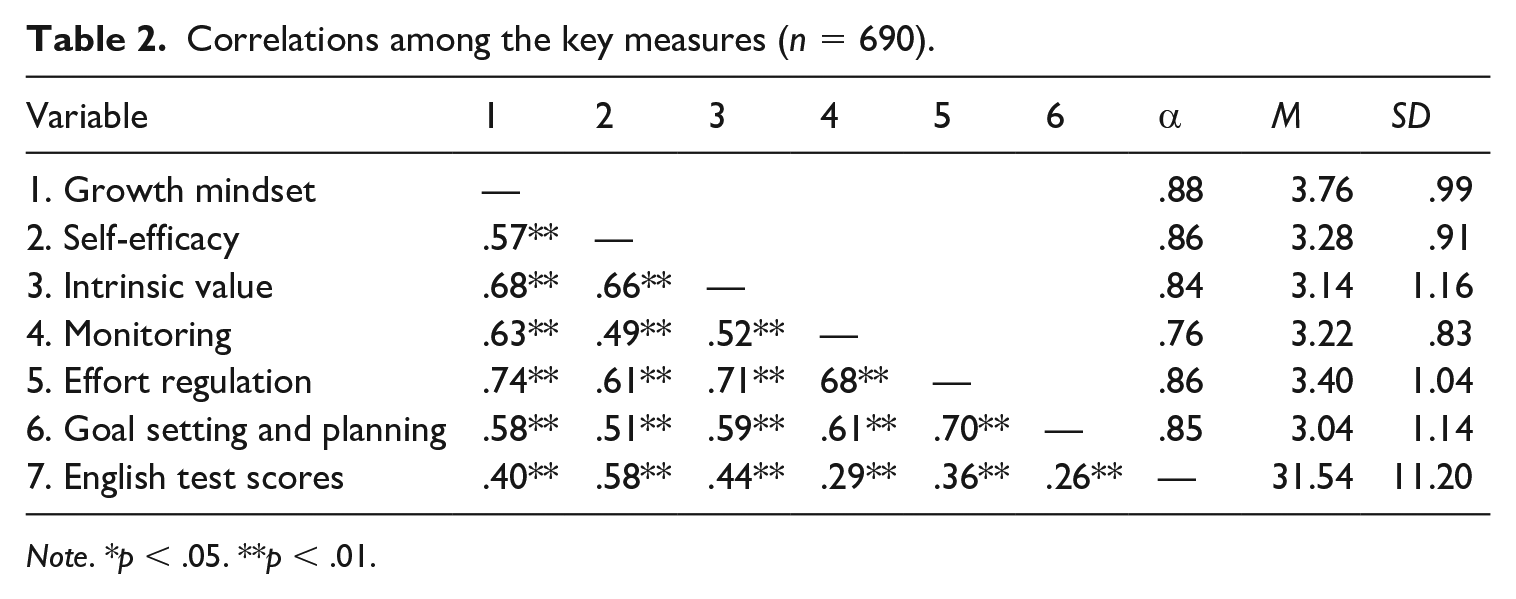
Note. *p < .05. **p < .01.
4 Structural equation modeling (SEM)
Structural equation modeling (SEM) was conducted to examine the impacts of motivational beliefs and the mediating role of self-regulated learning. The full SEM model considered measurement errors that empowered the results to be more reliable and trustworthy. First, we tested an initial model based on the theoretical model. Each construct was treated as a latent variable, and its items were used as observed variables. The English language learning achievements were also treated as a latent variable with scores for listening comprehension, word reading, sentence comprehension, vocabulary, and passage comprehension as five indicators. The model had a significant χ2 and the χ2/df (χ2/df = 3.39, p < .001) was higher than an excellent value χ2/df < 3. However, a fit model may report a significant χ2 and high square value relative to degrees of freedom because of a large sample size (Rigdon, 1995). Our sample size (n = 690) was relatively large. Thus, the model fit was considered reasonable based on other indices: CFI = .94, TLI = .93, RMSEA = .059, 95% CI [.055, .063], SRMR = .066. The data supported 11 out of the 13 hypothesized paths. Only two paths were not significant, i.e. the path from intrinsic value to monitoring and the path from goal setting and planning to English language learning achievements. In the second step, the non-significant paths were deleted to have a more parsimonious model, resulting in the following model fit (see Table 1): χ2/df = 3.38, p < .001, CFI = .94, TLI = .93, RMSEA = .059, 95% CI [.055, .062], SRMR = .065. The final model is presented in Figure 2.
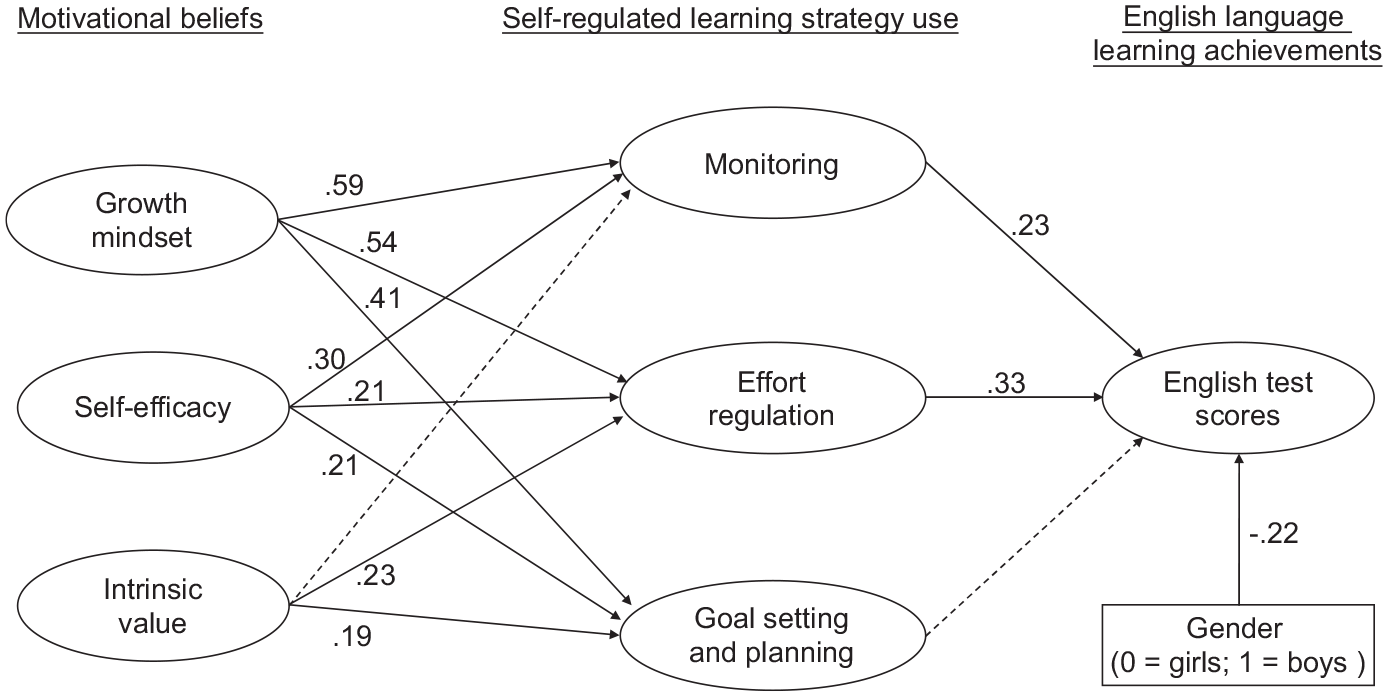
Final structural equation modeling (SEM) model showing the relations between motivational beliefs, self-regulated learning (SRL) strategy use, and English language learning achievements.
Concerning the impacts of motivational beliefs on self-regulated learning, the results showed that all three motivational beliefs significantly predicted effort regulation and goal setting and planning. A total of 77.8% of the variance in the students’ effort regulation was accounted for by the model. Effort regulation was predicted by growth mindset (γ = .54, p < .001), self-efficacy beliefs (γ = .21, p < .001), and intrinsic value (γ = .23, p < .001). For goal setting and planning, the model accounted for 53.4% of the variance. Goal setting and planning was predicted by growth mindset (γ = .41, p < .001), self-efficacy beliefs (γ = .21, p < .001), and intrinsic motivation (γ = .19, p = .001). However, when the students needed to control their process of monitoring activities (i.e. monitoring), only growth mindset (γ = .59, p < .001) and self-efficacy beliefs (γ = .30, p < .001) were significant, and intrinsic value was insignificant. Growth mindset and self-efficacy beliefs explained 65.2% of the variance in monitoring.
With respect to the impacts of self-regulated learning on English language learning achievements, more monitoring (γ = .23, p < .001) and higher effort regulation (γ = .33, p < .001) were related to higher English test scores. The impact of goal setting and planning was not significant. A total of 27.1% of the variance in English language learning achievements was explained by monitoring and effort regulation. The female students showed better achievements in English language learning than the boys (γ = –.22, p < .001). With respect to the indirect impact of motivational beliefs on English language learning achievements, bootstrapping (5000 bootstrapping sample) was used to understand the mediation effects. The results showed that the relationship between growth mindset and English test scores was mediated (indirect effect = .27, p = .001) by monitoring and effort regulation. The relationship between self-efficacy and English test scores was mediated (indirect effect = .12, p = .009) by monitoring and effort regulation. The indirect impact of intrinsic motivation on English test scores was not significant (indirect effect = .07, p = .21).
V Discussion
This study examined the role of motivational beliefs in self-regulated learning and English language learning achievements among Hong Kong primary school students. A major contribution was the empirical test of a hypothesized model in which motivational beliefs predicted English test scores through self-regulated learning among young EFL/ESL learners. The results showed that growth mindset, self-efficacy, and intrinsic value predicted SRL strategy use, which in turn predicted English test scores. This study thus confirmed the importance of motivational beliefs and self-regulated learning among young EFL/ESL learners (Bai & Guo, 2019), which may advance our understanding of young learners’ motivational beliefs in EFL/ESL learning.
Research question 1: relationship between motivational beliefs and self-regulated learning
The first research question concerned the impacts of motivational beliefs on SRL strategy use. The impact of self-efficacy in language learning has been found in many studies (Bai et al., 2019; Liem et al., 2008). In line with the findings of previous studies, the present study also showed that English self-efficacy was positively associated with all three types of SRL strategy use, i.e. monitoring, effort regulation, and goal setting and planning.
In addition, the students’ intrinsic value significantly predicted effort regulation and goal setting and planning in line with the findings of prior studies in other academic areas (Durik et al., 2005; Pintrich & De Groot, 1990). The finding means that the students who get enjoyment in English language learning are more likely to control their efforts and attention in the face of distractions and setbacks, and make plans for their own learning. It is obvious that those who have enjoyment in learning itself are less likely to be disturbed by distractions and would focus on academic tasks for a longer time (Deci & Ryan, 2000). The students who feel happy in the learning experience are more likely to initiate their learning and plan their learning activities. This finding underscores the importance of the learner’s positive intrinsic motivation (Noels et al., 2019). However, intrinsic value was not a significant predictor of monitoring. Although this finding appears to contradict the literature that indicates a positive role of intrinsic value, it is not surprising. The students who enjoy learning English itself are more likely to invest time and energy but may not effectively monitor and regulate their own learning.
The present study is one of the first empirical investigations into the predictive role of growth mindset in EFL/ESL learning. The results showed that the students’ growth mindset, which has been largely neglected in EFL/ESL contexts, was significantly linked to monitoring, effort regulation, and goal setting and planning. Previous studies have widely documented that growth mindset is a key factor in explaining effort regulation in the face of setbacks in many academic domains (Blackwell et al., 2007; Claro et al., 2016; Dweck, 2006). The result is also aligned with Lou and Noels’s (2016) findings, which showed that university students with a growth mindset were more likely to persist in the face of failure in language learning. Thus, the present study confirmed the positive role of growth mindset in EFL/ESL learning for young learners.
Moreover, this study is one of the first empirical investigations into the impacts of motivational beliefs (i.e. growth mindset, self-efficacy, and intrinsic value) in the same model that were derived from divergent theories (i.e. expectancy-value theory and implicit theories of intelligence). It offers insights into the specific effects and comparative merits of these beliefs by examining how they work together to predict self-regulated learning. The model showed that in comparison to self-efficacy (.21 ⩽ γ ⩽ .30), growth mindset (.41 ⩽ γ ⩽ .59) was a stronger predictor of self-regulated learning. The result highlights the importance of growth mindset in EFL/ESL learning. This finding may challenge the traditional view on the impacts of motivational beliefs on self-regulated learning. Self-efficacy has been found to be the most powerful predictor in empirical research (Bai et al., 2019; Liem et al., 2008; Wang & Bai, 2017). However, the present study suggests that growth mindset may play a more important role in self-regulated learning in EFL/ESL contexts. Although self-efficacy possesses a unique predictive power, EFL/ESL learners in East Asian Confucian societies may value a growth mindset better. In such societies, efforts are highly valued by students, teachers and parents (Wang & Rao, 2019). Through efforts, students may figure out effective ways for self-regulated learning as well. Of course, more research should be conducted to differentiate the role of growth mindset and self-efficacy in the future in order to understand their unique contributions.
Research question 2: relationship between self-regulated learning and English language learning achievements
The second research question concerned the role of self-regulated learning in eventual achievements in English language learning. The correlation analyses showed that monitoring, effort regulation, and goal setting and planning were all positively related to English language learning achievements. The result is aligned with the findings of previous studies that show self-regulated learning is an important predictor of EFL/EFL learning achievements (Bai, 2018; Waller & Papi, 2017). However, goal setting and planning did not show significant impacts on the English test scores in the SEM. This is an unexpected finding because goal setting and planning constitutes an important part of SRL (Zimmerman, 1990) and is an especially important component of self-regulated language learning (Oxford, 2011). The absence of a significant path between goal setting and planning and English language learning achievements in the model was most likely due to a lack of use of goal setting and planning strategies by the participants in English language learning, who reported a relatively low level of goal setting and planning (M = 2.94, SD = 1.14). Our sample was a group of 4th graders in Hong Kong primary schools. Teachers may require young students to follow their pace of teaching and complete daily homework, but they may not stress the importance of setting goals and planning by students themselves. Thus, primary school students may not set their own personal goals for English language learning. According to social cognitive theorists, the SRL process is not only determined by students themselves, but is also influenced by environmental events (Bandura, 2001). If teachers or parents have not guided students to plan their own learning or offered them opportunities to practice self-regulated learning, they may not be able to set goals for themselves. Specifically, the lack of goal setting and planning may be due to the controlling teachers in Asian cultures. For example, Chinese classrooms have been described as teacher-centered with controlling teachers who have great power to direct students’ attention and behaviors (Rao & Chan, 2010). Students may have few opportunities to set their own goals without a flexible curriculum and support from teachers. This explanation can also be supported by Wang and Bai’s (2017) study, which shows that goal setting was missing from the frequently used strategies list among Chinese secondary school students. In other words, the Chinese students in their study seldom set goals by themselves. An alternative explanation for the non-significant impact is the controlling of shared variance of the other variables, such as monitoring and effort regulation. Correlation analyses showed that goal setting and planning was related to English language learning achievements. However, when goal setting and planning and the other factors were analysed together in the model, the correlation strength decreased.
Additionally, the present study showed that the female students had better English language learning achievements than the male students. This was not surprising because many studies have found that girls outperformed boys in language learning, (Fraine et al., 2007; Yeung et al., 2011). Researchers have explained gender differences in language arts in terms of gender stereotypical beliefs (Yeung et al., 2011). That is, girls are more gifted and motivated in language arts, whereas boys tend to be more motivated in math and science, and express stronger self-beliefs in natural science. Although the present study found gender differences in English language learning achievements, it did not examine explanations for the finding. A worthwhile direction for further research would be to understand the gender difference and its antecedents so as to cater to the different needs of boys and girls in English language learning.
VI Conclusions
1 Practical implications
The present study suggests that self-regulated EFL/ESL learners who effectively monitor and expend efforts to regulate their learning are more likely to achieve desirable English language learning results. Additionally, nurturing growth mindset, intrinsic value, and self-efficacy can foster students’ self-regulated learning. Experimental studies suggest that motivational beliefs are dynamic and can be changed through students’ engagement in different contexts, and are also influenced by interactions with teachers, peers, and parents (Dweck, 2006; Yeager et al., 2016). Therefore, universities and schools should provide more teachers’ professional development opportunities and family education programs. These programs should cover knowledge of motivational beliefs and self-regulated learning. For example, growth mindset stands out as the best predictor of SRL strategy use in English language learning. Practical tips on how to foster students’ growth mindset, self-efficacy, and intrinsic value, and how to promote use of SRL strategies should be provided.
Specifically, growth mindset can be fostered in several ways. First, research suggests that students’ incremental beliefs can be primed by the scientific evidence on growth mindset. For example, in Blackwell et al.’s (2007) study, growth mindset was primed through eight sessions in which the students learned scientific research findings that changes occur in the brain as a result of learning (e.g. formation of new and stronger connections between nerve cells). Therefore, EFL/ESL teachers can read scientific articles on growth mindset and discuss its importance with students in practical ways appropriate to school students. Second, teachers and parents should focus on students’ learning process, interpret outcomes in terms of improvement and help students set self-referenced evaluation standards, and attribute academic success to efforts, to avoid attenuating ability differences. Third, it is important that teachers tell students that mistakes and setbacks are inevitable and highlight the positive role of failures rather than dismissing them as a sign of low competence. Teachers can explain that setbacks can expose students’ problems. By amending weaknesses, students can develop more skills and master more knowledge.
For self-efficacy, teachers can emphasize skill development that raises students’ competence through authentic mastery experience (Liem et al., 2008). Effective learning methods for enhancing English language learning achievements should be introduced, through which students can make improvements in English language learning. Teachers should also praise and encourage students honestly for their improvements made. Additionally, similar to practices that can promote growth mindset, teachers also can promote self-efficacy through recognizing efforts and improvements, minimizing social comparison, and guiding students to develop their own internal standards for outcome evaluation (Pajares, 2006). With regard to intrinsic value, students should be provided with personally challenging, meaningful, and interesting tasks (e.g. making presentations, dubbing English films, English singing competitions, and playing drama), to foster enjoyment of learning. EFL/ESL teachers should offer multiple interesting tasks so that students can choose what they are personally interested to engage in (Wigfield & Cambria, 2010).
In order to facilitate self-regulated learning, it is necessary for teachers to raise students’ awareness of the importance of self-regulated learning, and introduce various SRL strategies, demonstrate strategy use, and give support to students while they use the strategies. For students to apply monitoring strategies, teachers can encourage students to check their progress and quality of learning through keeping a record. Then, students should identify discrepancies between their current state of learning and desired learning outcomes. If their current EFL/ESL learning fails to reach their desired learning outcomes, further actions should be taken. With regard to effort-regulation, teachers can encourage students to keep trying multiple times and/or seek help when encountering difficulties, and find a conducive place when the environment is disturbing. Teachers should constantly remind their students that it takes great efforts to learn English well so students should learn how to regulate their efforts with their teachers’ guidance.
2 Limitations and future directions
A number of limitations in the study should be noted. First, the survey data were cross-sectional, which prevents us from making causal claims between motivational beliefs and self-regulated learning. The variables in the model may have reciprocal effects or relations. Although our model was justified by the literature on expectancy-value and implicit beliefs theories, more future studies with a robust longitudinal or experimental design are needed to test causal relationships. Second, although this study captured the students’ English language learning achievements by a test, our data on motivational beliefs and self-regulated learning relied on one data source, i.e. students’ self-reports. Relying on students’ own reports may potentially induce biases in social desirability. Students may answer the survey items in a way that are favored by the researcher, especially statements on self-regulated learning. This may lead to overestimation of the natural occurrence of SRL strategy use. Future work should collect data with multiple methods, such as qualitative interviews, objective school records, and teachers’ spontaneous reports of students’ behaviors, to investigate EFL/ESL learners’ motivational beliefs and actual SRL behaviors in depth. Third, the current study did not include the students’ prior achievements as a covariate. Research suggests that students with higher prior achievements tend to have higher self-efficacy beliefs and more enjoyment in the learning process (Bandura, 1997). Thus, future studies should control for prior achievements together with gender to better understand the relationships between motivational beliefs, self-regulated learning, and English language learning achievements.
3 Final conclusions
To conclude, expectancy-value theory has traditionally been a central concern in educational research, and implicit theories of beliefs have been the focus of much research recently. However, there is a lack of studies that investigate motivational beliefs in the domain of EFL/ESL learning among young learners. The present study examined how motivational beliefs derived from divergent theories worked together to predict self-regulated learning and English language learning achievements among Hong Kong primary school students. The results showed that growth mindset, self-efficacy, and intrinsic value were contributors to self-regulated learning. Self-regulated learning in turn played an important mediating role between motivational beliefs and English language learning achievements. The results also indicated that growth mindset was a stronger predictor of self-regulated learning and achievements than self-efficacy and intrinsic value. Goal setting and planning failed to predict the students’ English language learning achievements. Such findings may point to the importance of understanding the socio-cultural context, in which learning and teaching take place because the better predictive power of growth mindset (i.e. learning through great efforts) and lack of goal setting and planning may be uniquely situated in educational contexts, influenced by Confucianism.
Supplemental Material
17.05.20_How_SRL_mediates_motivational_beliefs_in_ESL_R4 – Supplemental material for The role of growth mindset, self-efficacy and intrinsic value in self-regulated learning and English language learning achievements
Supplemental material, 17.05.20_How_SRL_mediates_motivational_beliefs_in_ESL_R4 for The role of growth mindset, self-efficacy and intrinsic value in self-regulated learning and English language learning achievements by Barry Bai and Jing Wang in Language Teaching Research
Footnotes

References
Supplementary Material
Please find the following supplemental material available below.
For Open Access articles published under a Creative Commons License, all supplemental material carries the same license as the article it is associated with.
For non-Open Access articles published, all supplemental material carries a non-exclusive license, and permission requests for re-use of supplemental material or any part of supplemental material shall be sent directly to the copyright owner as specified in the copyright notice associated with the article.
