




Abstract
This study focuses on understanding language teachers’ lived experiences of their stressors and positive uplifts from a holistic perspective covering their professional lives in school, their personal lives beyond, and the connection between the two. The aim was to explore the nature of teachers’ experiences of stress and how they spilled over from work into home domains. We also were keen to understand the dynamics of their experiences of stress and how their perception of daily stressors was related to their overall sense of wellbeing as well as their life and chronic stressors. The data were collected via a specially created app, which collected survey data and experience sampling method (ESM) data from language teachers across the globe. Teachers’ wellbeing was investigated using the PERMA Profiler (Butler & Kern, 2016), their personality using Goldberg’s (1992) Big Five measurement tool, and a questionnaire on chronic stressors and stressful life events. From a larger sample (n = 47), a set of 6 case studies of teachers who scored highly for wellbeing and those who scored low on wellbeing was examined to explore in depth and across time, the relationships between overall wellbeing, chronic stressors and stressful life events, the experience of daily stressors, and perceptions of health. The findings point to the complexity of the relationships between stress, wellbeing, and health as well as the dynamism of stress and the relationships between stress experienced in the workplace and at home. The study has important implications for research in this area and reveals the merits of working with this innovative data collection tool.
Keywords
I Introduction
Teacher wellbeing plays a critical role in the ability of language teachers at all levels of teaching, from pre-school through adult education, to build positive relationships with learners, teach creatively, have fewer discipline problems, and contribute to heightening learners’ levels of achievement (e.g. Bajorek, Gulliford, Taskila, 2014; Briner & Dewberry, 2007; DeVries & Zan, 1995; Kern, Waters, Adler & White, 2014). When teachers enjoy higher wellbeing, they are able to teach to the best of their abilities. As such, teacher wellbeing is not an extraneous luxury, but a key determinant of good practice. However, teaching learners of any age is currently characterized by high levels of stress, large number of educators leaving the profession, and it is a career with some of the highest rates of burnout (Borman & Dowling, 2008; Johnson et al., 2005). Long overdue is the prioritization of teacher wellbeing in policy-making and research so that educators can receive the support they need to perform their jobs optimally.
Although the origins of stressors of teachers in different parts of the world may vary, a vast number of stressors are known to adversely affect teacher wellbeing including among others an unreasonable workload, time consuming administrative responsibilities, unproductive workplace cultures, dysfunctional social relationships with colleagues, autocratic leadership styles, discipline problems, a lack of resources, and testing or performance pressures and evaluation (Borg, 2006; Cosgrove, 2001; Gkonou & Miller, 2017; Horwitz, 1996; Mercer & Gregersen, 2020; Mercer, Oberdorfer & Saleem, 2016; Skovholt & Trotter-Mathison, 2016; Wieczorek, 2016). Language teachers specifically also face additional stressors potentially in the form of higher demands in terms of emotional labour, language anxiety, intercultural encounters, and typically high energy methodologies (Borg, 2006; Gkonou & Miller, 2017; Horwitz, 1996; King & Ng, 2018). In this study, we take an in-depth detailed look at language teachers’ experience of stress and wellbeing in order to cast light on how teachers experience stress on a daily basis, in what contexts, and how they are able to recover from experiences of stress. We also wanted to understand how their overall wellbeing scores connect with their perception of stress on a daily basis and other determinants of wellbeing such as health, chronic/life event stressors, and personality.
II Literature review
Two main approaches to defining and understanding wellbeing prevail in the literature. The first draws on the construct of ‘subjective wellbeing’ (SWB), which highlights the overall emotional tenor an individual perceives (relative balance between positive and negative emotions), and their sense of life satisfaction (Diener, 1984; Diener, Suh, Lucas, & Smith, 1999). The second understanding of wellbeing is eudemonic and refers to a more long-term sense of self-actualization. A popular framework that integrates the hedonic and eudemonic notions of wellbeing is Seligman’s (2011) PERMA framework which refers to the Positive emotions, Engagement, Relationships, Meaning, and sense of Accomplishment that an individual experiences. In this study, we draw on the PERMA framework to understand an individual’s overall sense of wellbeing.
A major contributory factor to wellbeing stems from how an individual experiences and copes with stressors in their lives. Stress itself is complex and a distinction is typically made between (1) chronic stressors and stressful life events, and (2) daily stressors or hassles (Jones & Bright, 2001). Kanner, Coyne, Schaefer and Lazarus (1981) characterize daily hassles as ‘the irritating, frustrating, distressing demands that to some degree characterize everyday transactions with the environment’ (p. 3). They explain that the positive parallel are uplifts, which refer to positive experiences in daily life such as hearing some good news, savoring a good night’s rest, or experiencing a manifestation of love (p. 6). How we experience the balance of stressors and uplifts creates the emotional tenor of our wellbeing. A focus of this body of research on hassles and uplifts seeks to understand its complex relationship to health and attempts to explain whether major life events influence how an individual experiences their daily stressors and uplifts and/or how they affect a person’s ability to cope (Kanner et al., 1981). DeLongis et al. (1982) have criticized studies of stress which examine only stressful life events (without examining the daily trials and tribulations) and note that these are not typically strongly related to measures of health. Instead, their study shows how measures of daily hassles (frequency and intensity) have a stronger relationship with health outcomes than life event stressors. The implications are that we need data on daily stressors in combination with life event stressors to gain a fuller picture of an individual’s experience of stress and the possible connections to health. DeLongis, Folkman and Lazarus (1988) also found a stronger relationship between daily stressors and health outcomes; however, they further showed that people who had low social-psychological resources to draw upon (such as low levels of self-esteem or poor relationships) were more vulnerable to illness as stress levels increase.
Howell et al. (2007) describe a bi-directional connection between health and wellbeing. Correlations between wellbeing and physical health outcomes demonstrate improved immune system responses, higher pain tolerance, and more effective reactions to stress (Diener & Chan, 2011). Ruffin (1993) also found that the daily stresses individuals experience impact more profoundly on health than do the more major life events. These findings suggest that how we experience daily stressors and their effects on health may be mediated by a range of psychological and social resources that can buffer an individual against the potential negative effects of stress as well as how these combine with life events. Together, these studies show that the relationships between life events stressors, daily hassles and uplifts, an individual’s socio-psychological resources, and their health are complex, dynamic, and highly individual.
Within the teaching profession, burnout is a glaring concern (Bottiani, Duran, Pas, & Bradshaw, 2019; Herman et al., 2020). Teachers’ response to stressors can affect their psychological adjustment and well-being (Gustems-Carnicer & Calderón, 2013; Pyhältö et al., 2020; Talbot & Mercer, 2018). Reactions to stress can include coping responses but also maladaptive behaviors such as denial, withdrawal, alcohol or substance abuse, and anger or aggression (Carver & Connor-Smith, 2010). Teachers will encounter stress, and therefore coping is particularly important both for teachers’ health and because of the influence teachers can have on learners, sometimes called stress-contagion (Oberle & Schonert-Reichl, 2016). The degree to which a teacher experiences stress is related to a variety of factors, such as appraisals of what is at stake and coping resources, expectancies, strategies, skill, preparedness and practice in effectively dealing with stress (Bottiani et al., 2019; Dunham, 1992). Being a language teacher triggers its own unique sources of stress. Teaching languages often requires labor-intensive methodologies that can put them on an emotional rollercoaster (Gkonou, Dewaele & King, 2020). Given the cultural aspects of the job, language teachers may experience self-doubts about their own identity and linguistic ability and a need to continuously deal with anxious learners, not to mention the precarious working conditions around the world (Gkonou & Miller, 2017; Horwitz, 1996; Wieczorek, 2016).
Despite the difficulties, the growing literature on positive psychology in general, and in language teaching and learning in particular (MacIntyre, Gregersen & Mercer, 2019), makes it clear that it is essential to consider both positive and negative outcomes of complex situations. It is becoming clear that ‘well-being is not simply the absence of negative function, but rather is something more. That is, a lack of negative affect, depression, loneliness, insecurity, and illness is not the same as the presence of positive affect, happiness, social connection, trust, and wellness’ (Butler & Kern, 2016, p. 2). With respect to stress, Carver et al. (1989) suggested that it is ill-advised to declare certain coping strategies better than others. Rather, it is necessary to consider the fit between an individual’s coping strategies and the constraints of a given situation (Nelson & Lyubomirsky, 2014). For language teachers, responses to stress will change over time, and ‘there may be moments when denial, distraction, venting, and so on are the best available responses as a short-term strategy’ (MacIntyre et al., 2020).
In this study, we seek to better understand how teachers experience the stressors and uplifts of their daily lives inside and outside of work. Our main interest was to take a holistic view of educators’ lives and examine language teacher stress and uplifts in both professional and personal contexts, while performing work-related and/or life tasks. Does being in school in class, in school out of class, at home and working, at home not working or being out and about make a difference in teachers’ reported stress levels? What activities are teachers engaged in that stress them or lift them up? As we measured wellbeing and personality, we also wanted to know whether specific profiles could be drawn of those who experience certain stressors or uplifts or levels of wellbeing. In this study, we focus on understanding the teachers’ lived experiences of their stressors and uplifts from a holistic perspective, including their health, covering their lives in school and beyond, and the connection between the two.
III Methodology
1 Participant selection and instruments
This study investigated six case study participants drawn from a larger sample of 47 teachers worldwide who were part of a psychometric study on stress, personality, and coping (MacIntyre et al., 2019). The language teachers in the larger sample were from countries across the globe who taught a variety of languages at all levels from pre-school to adult education. They were originally recruited via email and social media through snowball sampling to join an experience sampling method (ESM) study on factors that cause them stress and positivity in their daily lives as language educators over the period of one week (seven days). Specific information on each of the case study participants follows in the next section.
Data was captured via an app called eMoodie (www.eMoodie.com), which participants installed on their smartphones (both Android and iPhone compatible). Two main sets of data were collected via the app. One set of data stemmed from four separate questionnaires used to contextualize the respondents’ lives and generate an overall profile. First, they responded to a basic biodata questionnaire to contextualize their personal situation, including aspects such as age, gender, years of teaching experience, personal situation, etc. The second questionnaire was used to measure wellbeing as defined by PERMA using the PERMA Profiler (Butler & Kern, 2016), which in addition to the PERMA dimensions, includes three-item measures for physical health and negative emotion, plus a single-item question on loneliness. The third questionnaire measured personality using Goldberg’s (1992) 50-item International Personality Item Pool (IPIP). Finally, stressors were measured using a multi-item checklist that was adapted from Jones and Bright (2001, pp. 26–27) to establish the presence of both chronic stressors (i.e. long term) and life event stressors (i.e. caused by change). Respondents could complete these questionnaires at any time during the research period. The responses to these questionnaires are integrated in Sections III and IV.
The second main source of data was the ESM survey daily responses. Participants were sent notifications at random intervals, ten times a day for seven days, and were asked to respond as soon as possible after the notification. Although the intention was for each respondent to participate for seven days, some ended up participating longer in the study. This was because we asked the participants to email the team after they had completed their study period so that we could ensure that their data were properly secured, and some failed to respond.
Each daily ESM survey response took between 30 and 60 seconds to complete. The survey responses were structured from broad questions to a narrower focus on the specific moment. This meant participants had to answer how stressed they were feeling, what they were doing in the moment, and if something in particular was either stressing them out or facilitating positivity. The surveys contained questions such as, ‘Where are you?’, ‘What are you doing at the moment?’, ‘Are you doing a job-related task?’ and ‘How would you rate your levels of stress now on a scale of 1–10?’ An individual’s response to any question dictated which question they would see next and their pathway through the survey. For example, if the participant responded with an answer of zero to two, they were taken to a series of questions about ‘uplifts’. If they scored themselves above a three, they were taken to a series of questions about ‘stressors’. The last question for each survey asked participants to ‘Please add any additional information to your experience or rating to the text box below.’ Participants had the option to ‘snooze’ responding for 15 minutes. There was also an option for participants to manually fill out a survey response they might have missed at a time that was more convenient and as a strategy to capture missing data.
To select our case study participants (n = 6) from the larger sample population (n = 47) of EFL/ESL teachers from across the world who had consented to participate in the ESM study, we considered individuals’ PERMA wellbeing scores as well as the percentage of questions each participant had answered during the ESM procedure. We were interested in identifying the individuals who reported experiencing the highest and the lowest levels of well-being according to PERMA as well as those who had the most complete sets of responses. The PERMA Profiler (Butler & Kern, 2016) is a general assessment which determines wellbeing, defined as comprising five different components: positive emotion, engagement, relationships, meaning, and accomplishment (Seligman, 2011). The mean for the sample population was 7.5 with a standard deviation of 1.168. Those who completed over 70% of the questions from the ESM study were ranked from the highest PERMA score (9.3) to the lowest (3.7). At this point, we selected the participants with the three highest and three lowest PERMA scores, provided they had completed at minimum 70% of their daily surveys. If a participant scored high or low in well-being but had not completed 70% of their daily surveys, we moved to the next name on the list. In the case that a participant’s PERMA score was equal to another participant, we elected for the participant who answered a higher percentage of daily surveys. Table 1 identifies the six participants, using pseudonyms, who were selected for our in-depth case study along with a breakdown of their PERMA scores. Hana, Himari and Helena with overall PERMA scores of 9.3, 8.9, and 9.1 respectively evidenced high wellbeing, while the scores of Linda, Lola and Larissa identified them as low wellbeing in the context of the case study population with scores of 5.0, 5.7, and 6.2 respectively. We will describe each participant in greater detail as we present her ESM responses.
PERMA scores.

The last data set that we used from the larger initial study to provide insight into our case study ESM data were responses to the questionnaire concerning distinct types of stressors: chronic stressors such as insufficient income and heavy workload, and stressful life events such as changes in employment or conflicts at work. We include this information in our results and interpretations of each case study participant.
All participants consented and were aware that their participation was voluntary and that they could withdraw from the study at any time. An ethical concern in an app-based study is participant anonymity. To address this, only one individual in the research team corresponded with participants through email while the rest knew the participants by number only. No potentially identifying information was collected by the app itself.
2 Data analysis
To organize the data, tables were created per day for each participant with five questions on the vertical axis (Where are you? What are you doing? What is your stress level? What stressors or uplifts are you experiencing? Please add any additional information to your experience or rating to the text box below) and the time at which the participant responded across the horizontal axis, creating an average of eight to ten columns (depending on the number of times the app signaled during the day). From these tables, we were able to ascertain the location of each participant, the activity in which she was involved each time the app signaled, and the perceived level of stress being experienced.
These tables permitted researchers to calculate the number of responses provided in each location and the activity being performed along with the associated stress level in order to calculate the mean stress level in each category (location and activity).
IV Findings: Case study participants
In the findings, we describe the lived experiences of the six teachers looking first at those who overall scored highly for wellbeing and then turning to look at the three who scored low on wellbeing. We hope by examining their overall profiles, reported chronic life stressors, and the detail of their daily stressors and uplifts to be able to create a fuller, more nuanced picture of how micro-level factors may interact with long-term factors to generate the overall sense of wellbeing experienced by these individuals and its connection with their health.
1 Teachers scoring high on PERMA
a Hana
Hana is a single Slovenian female, between 35 and 44 years of age, with no children, and living in her homeland. She has been teaching between seven and 18 years, speaks German and has been teaching at two different universities for 15 to 20 hours a week for the past 4–6 years in a tenure-track position. Besides teaching a language in which she reportedly has near native-like proficiency, she also manages a number of other roles for her faculty. She describes her relationships with colleagues and the culture of her workplace as ‘excellent’. She claims her institution provides advancement opportunities and permits her to maintain a high degree of control over the organization of her own work. Although she recognizes the positive aspects of her professional life, she also reports three chronic stressors: (1) financial stress, (2) suffering from physical problems, and (3) a heavy workload that demands long or irregular work hours. Furthermore, in the past year, Hana has had to cope with three stressful life events including (1) the end of a close relationship, (2) money problems, and (3) changing her living situation.
Hana’s overall PERMA score (9.3) (Table 1) was the highest of all case study participants and placed her in the top quartile of well-being for the larger sample population who took the profiler. We used the data from her participation in the ESM survey that lasted nine days and generated 56 data points with an average of 6.2 responses per day. Table 2 shows her location and activity status when she responded to the app’s signal and her average reported stress level in each place.
Hana’s data.

Noteworthy in Hana’s responses is the reported absence of daily stress when she is not working. The only occasions during which she reported feeling no stress were at home and refraining from schoolwork and while she was out. There were two times during the nine days that she did household chores (rating both a two), but she also commented that such efforts made her feel satisfied with herself. It is important to note that ‘while not working’ and ‘while at home’ are different things for Hana. When Hana is home and not working, she feels no stress whatsoever, but when she does schoolwork at home, she feels the same levels of stress as she does when she is working at school but is not in class. This reveals that while Hana may not have temporal or physical boundaries that compartmentalize her stress (because she works at home during her ‘off’ hours), she does have psychological borders, hence her ability to ‘shut out’ the daily stressors related to teaching when she is not working.
Both in and out of school, Hana – an extravert according to her personality score (score: 3.9) and capable of maintaining strong relationships (score: 9.0) according to the PERMA – reports uplifts in social encounters. She also participates in sports and hobbies, and according to her qualitative data, resting is the way that Hana finds sensory comfort, energy, and invigoration.
Unlike other case study participants in this study, Hana reported feeling a moderate level of stress while teaching. Of the five times the app prompted her to respond while teaching, she consistently reported feeling a level five. Only one of the other five case study participants came close to this relatively high score, allocating a four, and this happened only once. This stress accompanies Hana whether she is teaching the whole group or facilitating pair and group work. However, Hana stated the following in response to her level five stress while teaching: ‘I think I feel “positive alertness” stress’, which can be a form of ‘eustress’ or positive stress (Rogers, 2012). She recognized that although she reported feeling stress, it was a balanced emotion that did not overstretch her but rather stimulated her. Furthermore, time pressure (15 times) and juggling roles (three times) are also stressful for her, especially when Hana is doing administrative tasks, lesson planning or preparation, whether at home or at school.
b Himari
Himari, a married Eastern European female aged between 45 and 55, has one child and is currently teaching in two universities in Japan where she has been working for the past 1–3 years. She teaches for a total of 14 hours a week, one of her positions is tenured while the other is part-time. Her responsibilities also include syllabi writing. She has seven to 18 years of teaching experience. Like Hana, she reports relationships with colleagues and the quality of the culture in her workplace as both being excellent. Although she enjoys opportunities of advancement and a high degree of control over the organization of her work life, she reports two chronic life stressors: (1) she is currently contending with the responsibilities of being a caregiver for a relative, and (2) she has had to cope with a change in her employment over the past year.
Himari’s overall PERMA score (8.9) (Table 1) placed her in the top quartile of well-being for the larger sample population. Her participation in the ESM survey lasted eight days and generated 74 data points with an average of nine responses per day. Table 3 shows her location and activity status when she responded to the app’s signal and her average reported stress level in each place.
Himari’s data.

Himari evidenced low stress levels throughout the ESM process (overall average = 0.82). She felt stressors at school when she was not in class and carrying out administrative tasks (mean 2.6). She separates ‘admin tasks’ from lesson planning and preparation, the latter which she claims to enjoy as they make her feel as if she is learning. Although Himari’s stress level (0.3) while at home and not working on school-related tasks is very low, it would have been ‘0’ if it had not been for the three times the app elicited a response while she was doing household chores, and even then, she only showed minimal stress on three occasions even though she was interrupted doing ‘chores’ a total of 13 times throughout the study.
As for Himari’s uplifts, wellbeing advocates often mention socializing with others, participating in sports and exercise and engaging in hobbies and leisure activities as a means of maintaining wellbeing (Mercer & Gregersen, 2020). Himari does not report doing any of these. In her eight days, she mentioned socializing and engaging in a hobby only once and never took part in sports or exercising. This is particularly surprising given the fact that of the six case study participants, her Big Five extraversion score (4.0) was the highest of all. She did, however, rest sporadically throughout her day (11 times total) and seemed to eat quite often and at unpredictable times (10 times total). Himari registered an average stress level of 1.8 during the four occasions she went out, but that number was skewed higher as two of those four excursions were to the dentist. Eliminating those two data points results in Himari’s mean stress level while out at 0.5 as the other two data points reflect back-to-back outings to shop and grab a bite to eat. In her ESM data, it is notable that she signaled 17 times that she enjoyed the tasks she did daily, whether at home or at school, most of which synchronized with her positive sensory feelings of experiencing comfort, energy, and excitement. This might be linked to her high Big Five ‘agreeableness’ score of 4.8, the highest score among these case study participants.
c Helena
Helena is a 25–34-year-old single female originally from the Balkan region currently living in Austria. She has been teaching both children and adults for less than 3 years using an online teaching platform. She is a freelancer teaching from home for 29 hours a week, which makes her stress at home frequently affect her work performance. She maintains excellent relationships with colleagues and praises highly the quality of her institution’s culture, which also provides room for advancement and offers her a high degree of control over the organization of her work life. However, she feels: (1) the chronic pressures of financial worries, (2) loneliness, and (3) other unspoken long-term sources of stress. She also studies, which adds even more strain on her limited time and emotional resources. Additionally, over the past year, in terms of chronic life stressors, Helena: (1) changed jobs, (2) suffered financial hardship, and (3) became involved in a family dispute, among other (4) notable (unmentioned) life experiences.
Helena’s PERMA score (9.1) (Table 1) also put her in the highest quartile of the larger sample population. Her ESM experience lasted 11 days and produced 65 data points with an average of 5.9 responses per day. The location and activity status when she responded to the app’s signal and her average reported stress level in each place is found in Table 4.
Helena’s data.

In Helena’s particular case, her home is her workplace and vice versa as she teaches online from home. Her greatest stressors are time pressure and juggling roles. For Helena, over half of the days she was surveyed, she was in class by 9:00, was sometimes still teaching at 18:25, and on two occasions was still working on work-related tasks past 20:00. The first day of the ESM procedures registered Helena’s highest level of stress (mean score: 4) because of a disagreement about work, but the next day demonstrated a large comeback as ten out of her 11 responses showed zero level stress. ‘Household chores’ are the other significant stressor in Helena’s life. Over the course of the procedure, Helena did chores eight times and on each occasion, her stress level invariably rose to four, which was relatively high for her (mean level 0.45 when at home and not working on school-related tasks). She credited the high score while doing domestic duties as having to ‘juggle roles’.
On the other hand, Helena receives great satisfaction from her teaching as well as her relationships. In one instance after having elected the app option that she was feeling a sensory uplift of comfort, energy, and excitement, she was prompted with an opportunity to add a qualitative response. She wrote, ‘I love teaching. It relaxes me. Being in the classroom with my students makes me forget the whole world. Nothing exists but us in that moment’ – a description that is reminiscent of the state of ‘flow’ (Csikszentmihalyi, 2013). Furthermore, of her 65 responses, 11 of them (17%) mentioned that she was involved in positive social interaction and on two separate occasions, she reported speaking to her mother and her brother by phone. Helena also mentioned a total of 15 times that she was ‘enjoying’ what she was doing at the moment of being prompted. As a person tending toward extraversion (Big Five score: 3.4) and having the highest score of all the case study participants on the Relationship dimension of the PERMA (9.6), Helena’s low stress during times of socialization and learner-teacher interaction are perhaps not surprising.
2 Teachers scoring low on PERMA
a Linda
Linda is a 35–44-year-old British female living in England with seven to 18 years of English teaching experience in a secondary school, her only place of employment. She is divorced with no children. As a full-time permanent member of the faculty, she teaches 26 hours a week and is also responsible for managing the school’s Modern Foreign Language department. The quality of the relationships she maintains with colleagues as well as the quality of the workplace culture she labeled as ‘good’. Linda reports that she has an average degree of control over organizing her work life and that there are opportunities for advancement. However, Linda chronically contends with (1) financial stress, (2) long or irregular work schedules, and (3) is responsible for being a caregiver for a relative. Over the past year, most of her coping skills have been directed toward coping with financial difficulties.
Linda’s overall PERMA score (5.0) (Table 1) placed her in the lowest quartile of well-being within the larger sample population who took the profiler. Her participation in the ESM survey lasted eight days and generated 79 data points with an average of 9.9 responses per day. Table 5 shows her activity status and location when she responded to the app’s signal and her average reported stress level in each place.
Linda’s data.
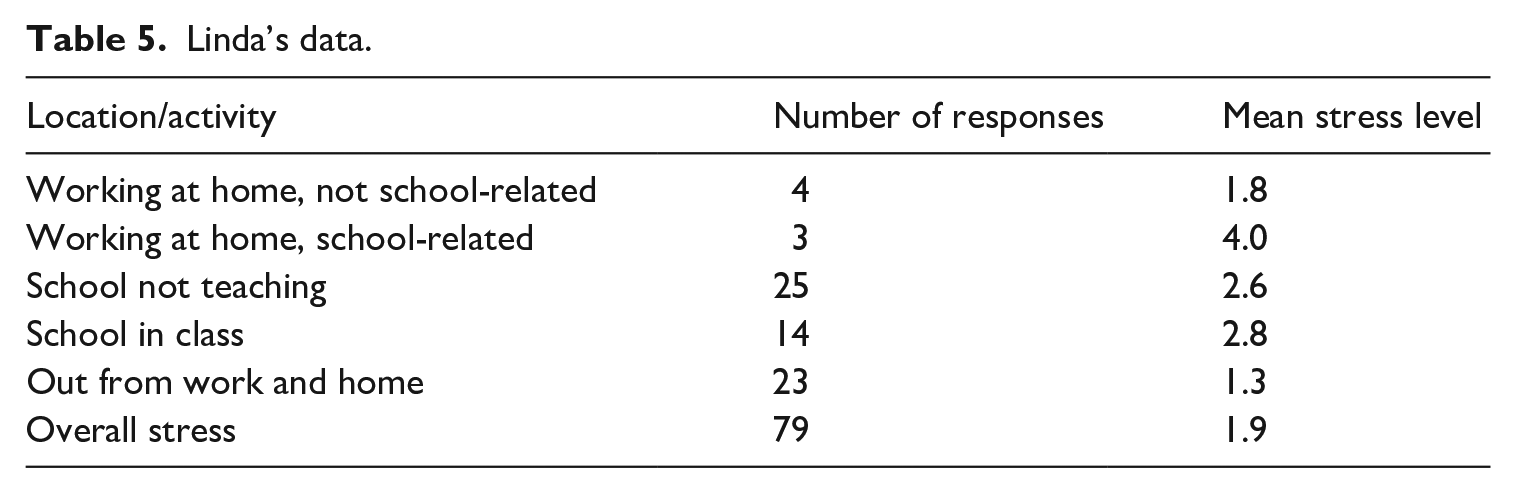
Of all of the six case study participants, Linda takes on the most responsibilities outside of teaching. During her eight-day ESM participation, she taught lunchtime Spanish (and complained about being hungry), taught in an after-school program, led parent–teacher conferences, took responsibility for fixing a church mini-bus, led a youth group two nights, visited an ill relative, and traveled outside the city for a whole day. Although she only once bemoaned juggling roles, her greatest stressor came in the form of feeling time pressure, which she mentioned on 18 occasions (29% of the time). However, as a middle-aged veteran teacher, Linda was able to cope with many professional issues that might potentially stress younger, less experienced teachers. For example, the app interrupted Linda in the middle of disciplining her class and she rated her stress at that moment only on level two. She was also interrupted three times during parent–teacher conferences and reported an average stress rating of three. Classroom management problems and parent teacher conferences are often among the greatest sources of teacher stress (Rieg, Paquette, & Chen, 2007), and Linda’s rankings, compared to her other high stress ratings, demonstrate that she seemed somewhat unfazed by these professional events. This would mirror other research which suggests that mid-career years of experience teachers reach a peak in self-efficacy and strategies for coping with classroom management and instructional issues (Klassen & Chiu, 2010).
Even though Linda’s extraversion score on the Big Five was the lowest of all of the case study participants (1.5), she still experienced uplifts in the form of social interaction. She mentioned positive social encounters 13 times over the eight-day ESM procedure, and for each of these, she rated her stress either zero or one. She also exercised two hours twice a week outside her home, which translated into four separate ratings of two. Her lowest stress ratings were captured on her day away from home where her stress ranged from zero to two with an average of 0.6. However, while Linda’s higher wellbeing counterparts used the word ‘enjoy’ 17 times (Hana and Himari) and 15 times (Helena), she only expressed it three times: while traveling, participating in youth group, and during exercise. Of the ten times her stress level was four or above, nine of them corresponded to moments when she was in school or doing job-related tasks.
b Lola
Lola is a 25–34-year-old single American female who has been teaching English, her first language, full time (at least 30 hours a week in front of students) on a yearly contract at a primary school for the past 1–3 years, although she has 4–6 years of overall teaching experience. Besides teaching, she also runs an intervention group and supervises the parking lot and the loading of children on to buses arriving and departing from school. Although she reports that her stress at home ‘somewhat’ affects her performance at work, she still believes that the quality of her relationships with colleagues and the culture of her school are ‘good’, that advancement opportunities exist, and that she has an ‘average’ degree of control over organizing her life at work. She states that she is chronically contending with: (1) financial stress, (2) mental illness, (3) loneliness, (4) a heavy workload, (5) a lack of control over work events, and (6) role conflict between her professional and personal lives. Additionally, in the past year, she: (1) had a person close to her die, (2) she changed jobs, and (3) she’s suffered financial setbacks.
Lola’s overall PERMA score (5.7) (Table 1) placed her in the lowest quartile of well-being within the larger sample population who took the profiler. Her participation in the ESM survey lasted eight days and generated 62 data points with an average of 7.8 responses per day. Her activity status and location when she responded to the app’s signal along with her average reported stress level in each place is found in Table 6.
Lola’s data.
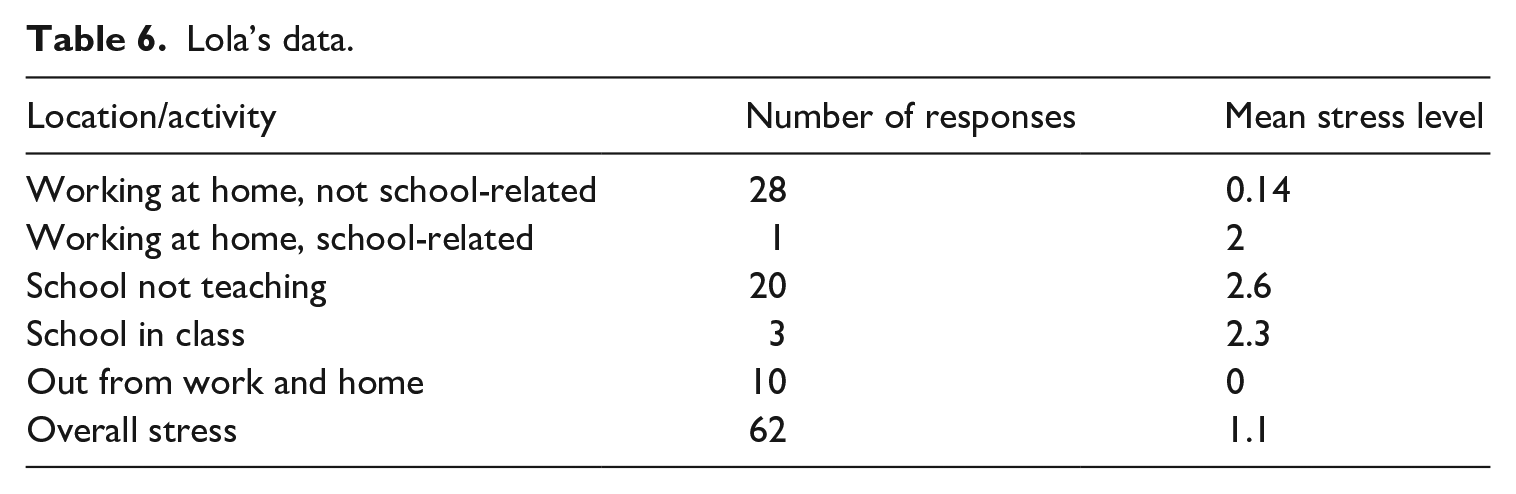
The boundaries Lola sets between work and home are practically impermeable. She crossed the school-home border only once and it was to attend a webinar after school, which could possibly not have been voluntary. It is important to note that the week Lola participated in the ESM study was not ‘normal’ in that snow days were announced. Even given the cancelation of school due to weather-related issues, this still did not induce Lola to work at home. While at home, her stress levels vacillated between zero and one, with ‘chores’ being the cause of two of the five times a one, rather than a zero, was cited. While home, her most cited activities were hobbies and leisure (15 times) and resting (9 times). With the exception of the two times she went shopping, the other eight times she went out were to socialize.
More than any of the other case study participants, Lola has the most chronic and recent deep stressors in her life. Her daily stressors were most commonly time pressure and juggling roles. However, her daily stressors were only felt while at school. On the first and second days of the study, for example, Lola’s characteristic stress levels hovered around four all day while at work, but upon arriving home, they plummeted to zero and on rare occasions, one. In fact, on day two, Lola responded to the ESM signal at 16:40 at school while doing an administrative task with a five rating and complaining of sensory feelings of discomfort and anxiety, yet at the next interval (20:45) a few hours later, she was out relaxing and socializing and reported zero stress, showing a good recovery. Although Lola’s PERMA scores position her in the low quartile of wellbeing, she appears to have the ability to compartmentalize her stress which seems to immunize her private life against the worries of her professional life.
c Larissa
Larissa is a Russian 35–44-year-old married mother of two, who has between 19 and 31 years of teaching experience, with only 1–3 years at her current jobs in Russia teaching both high school and university English classes for 40 hours a week. Besides teaching in her tenured job, she is also an academic director, a position that demands organizing conferences, teacher training and professional development. She reports that her relationships with colleagues as well as the quality of the culture of her workplaces are ‘good’ and that she has a high degree of control over organizing her work life, but that advancement opportunities do not exist. She confesses that her stress at home affects her performance at work ‘quite a bit’ and that she is currently contending with: (1) a heavy workload, and (2) family problems, including in the past year, having to deal with family disputes.
Larissa’s overall PERMA score (6.1) (Table 1) placed her in the lowest quartile of well-being within the larger sample population who took the profiler. Her participation in the ESM survey lasted eight days and generated 64 data points with an average of eight responses per day. Her activity status and location when she responded to the app’s signal along with her average reported stress level in each place is found in Table 7.
Larissa’s data.

To understand fully Larissa’s work/life reality, there are two factors in her ESM data that need to be highlighted. First, on day one of her participation, she and her son were sick at home, which accounts for seven of the 14 instances she reported being home and not working. Secondly, nine of the instances she reported being out from work and home were because of her attendance in a professional development seminar in Moscow, and four instances were spent traveling on trains between schools. In total, of Larissa’s 63 data points, only nine could be attributed to non-work, typical wellbeing-enhancing activities such as resting at home when not ill (four times), socializing with friends (three times), and exercising (one time). In other words, if we were to remove the data from the day Larissa was sick, she spent 73% of her time traveling between classes, in class, preparing for class, or doing work-related activities. On five of the eight days of Larissa’s participation, she was already at school when her first notification from the ESM app arrived, and she was still in class or doing work-related tasks past 21:00 on four nights.
Furthermore, Larissa had two of the single highest stress ratings of all the case study participants (seven and nine), both of which were related to dealing with her teenage daughter. A parent–teacher conference with her daughter’s teacher received a seven and an argument with her daughter obtained a nine. She was able to recover her composure fairly quickly as the rankings that immediately followed those especially stressful events were both rated a zero, an hour and 24 minutes after the conference while resting at home, and a two, an hour and 22 minutes later after the argument while teaching class. That is to say, while Larissa has profound stressors in her life, she appears not to dwell on these instances but moves on. However, the extensive amount of time involved in work and the possible intensity of the reported chronic stressors could be reasons for the overall low wellbeing score.
3 Comparing the dynamism across high/low wellbeing participants
Table 8 illustrates the overall average stress level of each participant and the percentage of ‘uplift’ and ‘stressor’ responses they provided throughout the study in order to offer an indication of each teacher’s dynamism and relative volatility in terms of perceived levels of stress.
Overall stress level and percentages of ‘uplift’ and ‘stressor’ responses by participant.
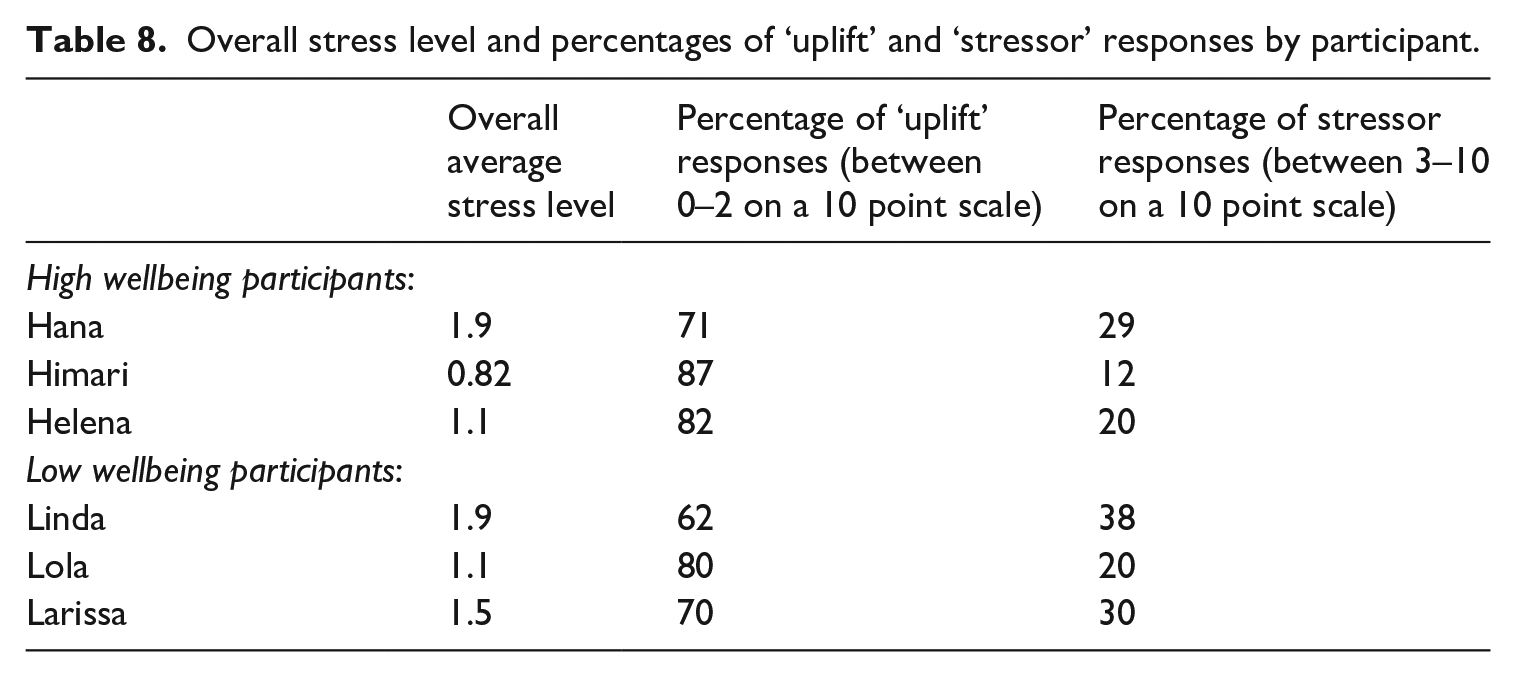
This view of the data is interesting in that it reveals that overall average daily stress levels did not vary dramatically between the high and low wellbeing participants. Indeed, for Linda and Hana, the scores were equivalent. At least in terms of how these teachers were experiencing their daily stressors and uplifts, there was very little difference between those who reported high and low wellbeing. However, further analysis revealed other distinctions. Perhaps the most notable difference concerns reported levels of health. High wellbeing participants consistently self-report health between 8.6 and 9.6 (which is very high), while low wellbeing participants report health levels between 3.3 and 5.6. This finding mirrors other research, which suggests a relationship with overall wellbeing levels and health. Additionally, in this study, two participants with high wellbeing report lower levels of negative emotion with scores of 1.3 and 1.6 and two participants scoring low in wellbeing both report 5.3 which is notably higher. The remaining two (one high and one low) report 3.6 and 3.0 respectively.
In order to understand further possible contributory factors to wellbeing, we also compared the participants in terms of personality to look for intrapersonal variation, which could potentially explain differences in how individuals deal with stress. Table 9 shows the differences in personality scores.
Participants’ personality scores.

Research on correlates between subjective wellbeing and the Big Five Personality traits suggest a relationship between the scales for extraversion and neuroticism and experiences of positive/negative affect and wellbeing (Gutiérrez, Jiménez, Hernández & Puente, 2005). In examining the main population from which these cases were taken, MacIntyre et al. (2019) provided evidence that both personality and stress correlate with teacher wellbeing but found no correlation between personality and stress. Here there is too little data to make statistical comparisons and there appears to be few notable differences between the groups; however, the scores for extraversion suggest a possible difference which could explain how people experience their lives, especially the highly social nature of the job of teaching. Given the findings in the MacIntyre et al. (2019) study, there is a suggestion that these personal individual trait differences could be one explanatory factor for understanding differences in overall wellbeing scores.
The final possible explanation for observed differences in wellbeing coupled with similarities in the experience of daily stressors and uplifts could stem from the number of chronic stressors, stressful life events, and their personal significance for an individual. All participants reported a number of ongoing chronic stressors as well as stressful life events (see Table 10).
Sum of participants’ chronic and life stressors.

Apart from Lola who stands out for the large number of chronic stressors and stressful life events she has experienced ongoing and in the past year, there is little other notable difference in the number of stressors reported by participants in either group. However, what we cannot ascertain from the data is how personally significant these events were for the individuals. Although the sheer volume and number of stressors are likely to play a role in wellbeing (Hefferon & Boniwell, 2011), it is perhaps their significance, meaning, and intensity for the individual that is important to understand and the effects on their overall wellbeing. Unfortunately, these data cannot tell us that but it suggests a promising avenue for future research.
V Discussion
Part of discovering balance is enjoying reprieve from both home and school in wellbeing-enhancing ways. Hana and Lola, for example, both single women, were using their time away from school duties to socialize, participate in leisure activities, and exercise. Both of them ranked their average stress level during these times at zero. In contrast, Linda had an enormous number of out-of-school-and-home responsibilities, yet her average daily stress level still remained relatively low. Both Himari and Larissa, on the other hand, rarely had time away from home and/or school. Himari, a married woman with a child, went out only to shop and go to the dentist, and even under those stress-inducing conditions, rated her average stress at 1.8. She found peace at home while not working, having an average stress level of only 0.3. Larissa was not as fortunate as her rare occasions at home were tension-filled, often clashing with her teenage daughter.
Another question we considered concerns the rankings of the most frequent stressors and uplifts: What activities are teachers engaged in that stress them out or lift them up? The most powerful stressors by far were feeling time pressure and the juggling of roles, two variables that were more often than not linked by the participants. Hana and Linda both credited their stress to them 18 times; Helena mentioned it 13 times; followed by Lola, seven times; Larissa, six times; and Himari, four times. The greatest uplifts were felt while socializing followed by the stress-reducing activity of ‘resting’. Lola and Linda both commented on the positivity of social encounters 13 times; Hana mentioned it 12 times and Helena 11 times. On the other hand, Larissa and Himari, the only two married teachers with children, found social uplifts three times and one time, respectively. Instead, Himari reported feeling relaxation while resting with 11 references, followed by Lola and Hana with nine, Larissa with six, Helena with four, and Linda with one.
It is known that particular activities can induce additional pressure or provide respite from it. For example, cultivating interpersonal relationships at work (Deci & Ryan, 2000) and nurturing personal relationships with friends, family, and partners have been shown to be critical to wellbeing (Hartney, 2008). Researchers also recommend paying attention to physical health by participating in sports or regular exercise as it increases positive emotion, energy, and resilience and decreases anxiety, stress, and fatigue (Ratey & Hagerman, 2010). Pursuing hobbies and leisure eases stress and provides distractions that permit individuals to switch off from obligations and explore other interests for a while and are a recognized coping mechanism against burnout (Seidman & Zager, 1991).
Lastly, through evidence accumulated via various self-report measures such as the PERMA, Big Five, a demographic questionnaire, stressors, and the ESM survey, we wanted to understand how daily stressors and uplifts relate to overall wellbeing scores, chronic stressors, stressful life events, individual traits, and possible contextual experiences. The findings are interesting in revealing that experiences of stressors on a daily level do not clearly distinguish these two groups of participants who score high and low respectively for overall wellbeing. However, a notable distinction is between reported levels of health. Those with higher wellbeing overall also had higher perceptions of health (Hana: 8.6; Himari: 9.0; Helena: 9.6) than those with low wellbeing (Linda: 3.3; Lola: 5.6; Larissa: 5.0). From the literature, there is a clear suggestion that wellbeing scores and physical health are connected (Howell, Kern, & Lyubomirsky, 2007). However, these data imply that it is possible that chronic stressors play a mediating role given the acknowledged negative effects of long-term experiences of stress on physical health (Sapolsky, 2004). What is apparent is that the relationship between overall wellbeing scores, perceptions of long-term chronic stressors, and experiences of stress on a daily basis is complex, individual, and clearly dynamic over time. The fact that every teacher’s perceptions of daily stress showed fluctuations across time and place serves as a warning to studies seeking to measure perceptions of stress using single data collection points and the findings overall caution against implying simplistic relationships between wellbeing scores and experiences of stress.
VI Conclusions
In conclusion, this study has raised many interesting questions and has illustrated the complexity of the relationships between overall wellbeing, chronic stressors and stressful life events, the experience of daily stressors, and health. It has looked at individual variation and dynamism across time. The findings do not offer any simple definitive conclusions but that in itself is a salutatory warning for research in this area. The findings do show how important it is to take a holistic view of teachers’ lives where the boundaries between personal and professional spaces are often blurred (Day & Gu, 2013). The findings suggest a need to be cautious about making any assumptions about relationships between experiences of stress and overall wellbeing with daily stressors and uplifts varying little across individuals who vary considerably in their overall wellbeing scores. It is possible that the underlying role and individual significance of ongoing chronic stressors and stressful life events may be an important factor to appreciate in how this is impacting on a person’s overall wellbeing and resilience. Similarly, the role of health is unclear from these data but could be significant when seeking to understand wellbeing. Further, the data show the potential for considerable individual variation in how stress is experienced and the possibility that effects on wellbeing could be mediated by a range of factors including the perceived significance of chronic/life event stressors, personal contexts, and health. Our data also suggests that the professional/institutional context plays a significant role in the stressors and uplifts of language teachers, making their wellbeing a collective concern that must be a genuine priority in every aspect of the educational system. Institutions are accountable for a myriad of other factors, the most imperative of which includes safeguarding space for teachers to flourish and thrive in order to reach their highest potential (Mercer & Gregersen, 2020). This study naturally has limitations, particularly in terms of the small sample that we chose deliberately in order to enable a detailed, in-depth, complex reading of individual data. More research is now needed to add to this picture to help clarify how different types of stress relate to wellbeing and health as well as the kinds of socio-psychological resources individuals draw on to manage these. Given the critical importance of teacher wellbeing for good practice, there is much work to be done in adding detail to our understandings of exactly how teacher lives, roles, and responsibilities contribute to their wellbeing overall and their experience of stress on a daily basis.
