



Abstract
Future second language (L2) self-images have proven integral to L2 motivation, prompting several attempts to purposefully develop learners’ ideal L2 selves over the past decade through the use of vision-building techniques. Some of these ‘vision interventions’ have reported successfully enhancing learners’ L2 self-images and motivation; other studies, however, diverge from an unqualified success narrative, citing for example a lack of increase in learner effort despite stronger future vision. Data collection has also been typically restricted to the period of the intervention itself, and so insight into the long-term take-up of the introduced techniques, or how potential outcomes develop over time, remains limited. To gain further understanding into such issues, we have charted the evolving nature of the L2 vision intervention over the past decade, and complemented the learning from previous studies by conducting a five-week vision-building course with 25 learners of English for academic purposes (EAP) in the UK university-pathway system. Interview data gathered over the course of 10 months – the longest investigation of vision-building we are aware of – demonstrated fluctuating engagement with visualization, and accordingly, our analysis looks critically at the notion of self-image-centred intervention in instructed second language acquisition (SLA). While we believe that L2 vision can indeed be consciously enhanced, we argue that success depends largely on how general principles are adapted to specific learning contexts. The discussion highlights challenges that instructors may encounter in staging such interventions, and offers practical lessons for using self-images in the classroom.
I Introduction
The motivating power of ‘vision’ (or ‘mental imagery’ as it is usually termed in the social sciences) is perhaps best articulated in Markus and Nurius’s (1986, 1987) influential theory of possible selves, which proposes that vivid mental images of the people we would like or hope to become (a desired future state), or the people we are afraid of becoming (a feared future state), are instrumental in driving human behaviour in the present. While determining precisely how vision exerts this motivational impact is a challenge that still faces the research community (for a detailed discussion, see Dörnyei, 2020), Higgins’s (1987) self-discrepancy theory has served as a useful starting point in thinking about such mechanisms. Using empirical evidence, Higgins suggests that ‘frustration from unfulfilled desires’ (p. 322) can trigger action to reduce the discrepancy between the current self-concept and an ‘ideal self’ embodying an individual’s own hopes and desires for the future. Similarly, mismatch between the now self and a future ‘ought self’ state – a representation of an individual’s responsibilities and duties, whether self-imposed or based on the expectation of others – can mediate behaviour to avoid feared negative consequences.
Interventions evoking possible future selves and mental imagery have been shown to improve motivation and performance in areas such as business management (Kouzes & Posner, 2017), psychotherapy (Skottnik & Linden, 2019), sports (Morris et al., 2005), and education (see Hock et al., 2006; Oyserman et al., 2002; Sheldon & Lyubomirsky, 2006). In the field of second language acquisition (SLA), the motivational potential of vision has been most prominently advocated by Dörnyei’s (2005, 2009) second language Motivational Self System (L2MSS), a tripartite framework of motivational sources:
the ideal second language (L2) self, the L2 component of a desired future self-image;
the ought-to L2 self, which embodies L2 competencies a learner believes they must have in order to satisfy perceived external expectations; and
the L2 learning experience, accounting for the ways in which situated, ‘executive’ motives related to the immediate L2 learning environment impact on motivation to learn (for a recent discussion, see Dörnyei, 2019).
The L2MSS has received considerable attention in L2 motivational research (Boo et al., 2015), with a number of works attesting to the capacity of a vision of an ideal L2 self to motivate learning (Csizér & Kormos, 2009; Henry, 2011; Papi, 2010; Ryan, 2009; You & Dörnyei, 2016). This finding has in turn given rise to a new pathway for motivating learners, namely, by familiarizing them with mental-imagery practices and helping them develop a vivid vision of an ideal future L2 self (see Dörnyei & Kubanyiova, 2014; Hadfield & Dörnyei, 2013). But while several vision-building programmes have attempted to enhance learners’ L2 self-images and motivation over the past decade (for a detailed overview, see Appendix 1), they display considerable variation in their design and outcome measures, and among these accounts there are reports of unchanged motivational indicators (e.g. learner effort) despite stronger future vision. All of this raises questions about the optimal form and overall value of such programmes, making it unclear what return on investment instructors and learners might reasonably hope for. Thus, some 15 years on from Dörnyei’s initial proposal for building vision in the classroom, and a decade since the first recorded L2 vision intervention (Magid, 2011), we might usefully reflect on what happens in the classroom when vision-building is introduced – that is, how participants engage with, or respond to, key elements of a vision intervention such as visualization and goal-setting; the challenges involved in vision-building in instructed SLA settings and how these might be mitigated; and how instructors might approach measuring the ‘success’ of a vision intervention in their context.
Our reflection begins by setting out the general principles of Dörnyei and Kubanyiova’s (2014) framework for L2 vision-enhancement programmes and tracing how vision interventions informed by these principles have evolved over time. We then report on our own visionary intervention in a context common in instructed SLA in the UK: an English for Academic Purposes programme at a provider of foundation courses for international students wishing to study at a UK university (‘university-pathway college’). Rather than trying to quantify outcomes and success, our focus has been on examining how participants engaged with the programme components we designed and the concept of vision in general, exploring their feedback on activities, their preferences for certain elements of the intervention and what they took away from the programme in the long run. Linking our experiences to the lessons offered by other intervention studies, we draw up recommendations and vision-building principles, and highlight areas that instructors might usefully focus on to better harness the motivational capacity of vision-building programmes.
II Literature review
1 A framework for vision-building
Since it was first proposed by Dörnyei (2005), a number of studies have demonstrated the potential of future self-guides to energize and maintain language learning. The key question in this respect is how the motivational capacity of an ideal L2 self-image is mediated, and Dörnyei and Kubanyiova (2014) articulate nine conditions that must be met in order to harness the motivational potential of vision, namely, that the vision needs to be:
(1) available to the learner in an (2) elaborate and vivid form;
(3) plausible, or realistic, while at the same time (4) not comfortably within reach;
substantially (5) different from the current self while remaining (6) in harmony with other constituent elements of the learner’s self-concept, including an ought-to self;
(7) operationalized through practical strategies that help the learner work towards their vision, thereby forming a clear ‘roadmap’ to the desired destination;
regularly (8) activated through reminders; and
(9) counterbalanced by an awareness of negative consequences should the vision not be realized.
These prerequisites are becoming prominent in the expanding literature on vision’s motivational impact. For example, Papi and Abdollahzadeh’s (2012) work has helped to confirm that ideal L2 self-guides have to be purposefully operationalized, while Hessel (2015), Henry (2015) and You et al. (2016) have highlighted the salience of frequency, plausibility and vividness of envisioning, respectively. On the basis of the above list of motivational conditions, Dörnyei and Kubanyiova (2014) have proposed six broad stages of vision enhancement:
creating the learner’s vision, which involves helping learners to construct a vision of whom they could become as L2 users;
strengthening the vision through visualization practice;
substantiating the vision by making it plausible through addressing unrealistic beliefs about language learning, conducting reality checks on future aims, predicting obstacles to progress and planning remedial action;
transforming the vision into action through action plans, goals, tasks and strategies for improving specific L2 skills;
keeping the vision alive through regularly activating it by various reminders and ‘priming stimuli’ in the teaching content; and
counterbalancing the vision by priming learners sensitively with possible negative consequences of not achieving the vision.
2 Vision-building interventions
Over the past decade several interventions have sought to make an ideal L2 self-image salient in students’ future vision, broadly following the above principles. We have compiled a detailed table (see Appendix 1) which summarizes 13 published studies (a comprehensive list as far as we are aware) conducted in this vein, and which clearly demonstrates the considerable variation that the programmes display in context, design and findings. One salient development in the format of vision interventions has been a marked shift away from the treatment-only (e.g. Chan, 2014a; Magid, 2011), voluntary nature (Magid, 2011) of pioneering early studies and towards quasi-experimental designs that are integrated in L2 curricula, thereby investigating the outcomes of vision interventions in an ecological setting (e.g. Mackay, 2014; Sato, 2020; Sato & Lara, 2019). Motivational gains resulting from the interventions were measured in several different ways (e.g. pre- and post-intervention questionnaires, semi-structured interviews, teacher and learner diaries, classroom observation), and studies which looked at changes in motivated behaviour did so using data ranging from self-reports of intended or actual effort to learn (e.g. attempts to seek out contact with native speakers of the L2) to observed changes in classroom interaction with the teacher. Exploratory-practice and action-research programmes have further contributed motivational indicators such as working more collaboratively and listening actively to peers. Finally, some studies also reported gains in confidence and a sense of agency among additional outcomes of vision interventions, pointing to potential outcomes beyond quantifiable motivated behaviour.
A further area of interest in the context of the current study is the length of each investigation. Data collection was typically conducted within the lifetime of the intervention, with long-term trends traced, at most (and exceptionally), up to three months after the end of the treatment (see Magid, 2011). As a consequence, caution is needed when thinking about notions of outcome and success, since the data reported could technically be referring to participants’ motivation for engaging with the very activities used in the intervention, which are often more interesting and self-relevant for the learners than materials they may have been exposed to before (see, for example, Machin, 2020; Mackay, 2014; Safdari, 2019). That is, the question whether the motivation experienced by students during the intervention translates to a more sustained shift in their motivation for learning the L2 (and if so, how?) has remained largely open; a symptom of the admittedly complex task of capturing changes in learner psychology over time (see Sato & Csizér, 2021).
The variation outlined above, combined with the relative absence of longitudinal data, can be seen as a detriment for L2 instructors who might otherwise share the excitement of the research community about vision as a motivational tool. In order to address the potential challenges of staging an intervention, the present investigation placed special emphasis on two broad research questions:
Research question 1: How did participants engage with the vision intervention (e.g. how did they appraise the notion of vision, and what were their attitudes towards the practice of mental imagery), and how did this engagement evolve over time?
Research question 2: How did the outcomes of the intervention unfold in the long run, both in terms of core motivational indicators (e.g. effort, persistence) and other motivational components (e.g. confidence)?
On the basis of the lessons of our intervention as well as the trends observed in other studies, we intend to offer our recommendations for ‘packaging’ a vision intervention – its format and possible content – in the hope of assisting researchers and practitioners to harness the motivational capacity of visualization tasks in their own unique contexts.
III Method
1 Participants and context
Twenty-five English learners (1 Cambodian, 23 Chinese and 1 Korean) volunteered to take part in the vision intervention at a university-pathway college in the UK between July and August 2018; a group of participants and a learning context somewhat comparable to Magid’s (2011) pioneering study (see Appendix 1). The programme took place in parallel with an intensive English for academic purposes (EAP) course that the learners were taking before starting a two-semester credit-bearing foundation-year or pre-Master course as preparation for joining a UK university. Their overall IELTS scores ranged from 4.5 to 6.0, and their previous English learning experience ranged from 0.5 to 17 years. They were between 17 and 28 years old, with the majority (19) of the students aged 22–25 years. The optional nature of the programme, the varying availability of participants, and our guiding purpose of reflecting critically on the process of conducting an intervention led us to dividing the 25 volunteers into three groups of 8–9 members. Over the course of five weeks, each group took part in weekly two-hour workshops (10 hours total per group) before or after a scheduled English class. All workshops, tutorials and interviews took place in the familiar setting of the participants’ college, where the first author was a language tutor but not the participants’ principal instructor.
Attendance fluctuated throughout the programme, and because we were keen to record critical voices, we made sure that the student responses drawn on in the current study represented the whole range of engagement. Table 1 provides data about the attendance of quoted participants, and when they were interviewed. Two students reported leaving the project due to house-hunting pressures, and one was prevented from attending by a personal accident away from the college.
Attendance of and interviews recorded with quoted participants.
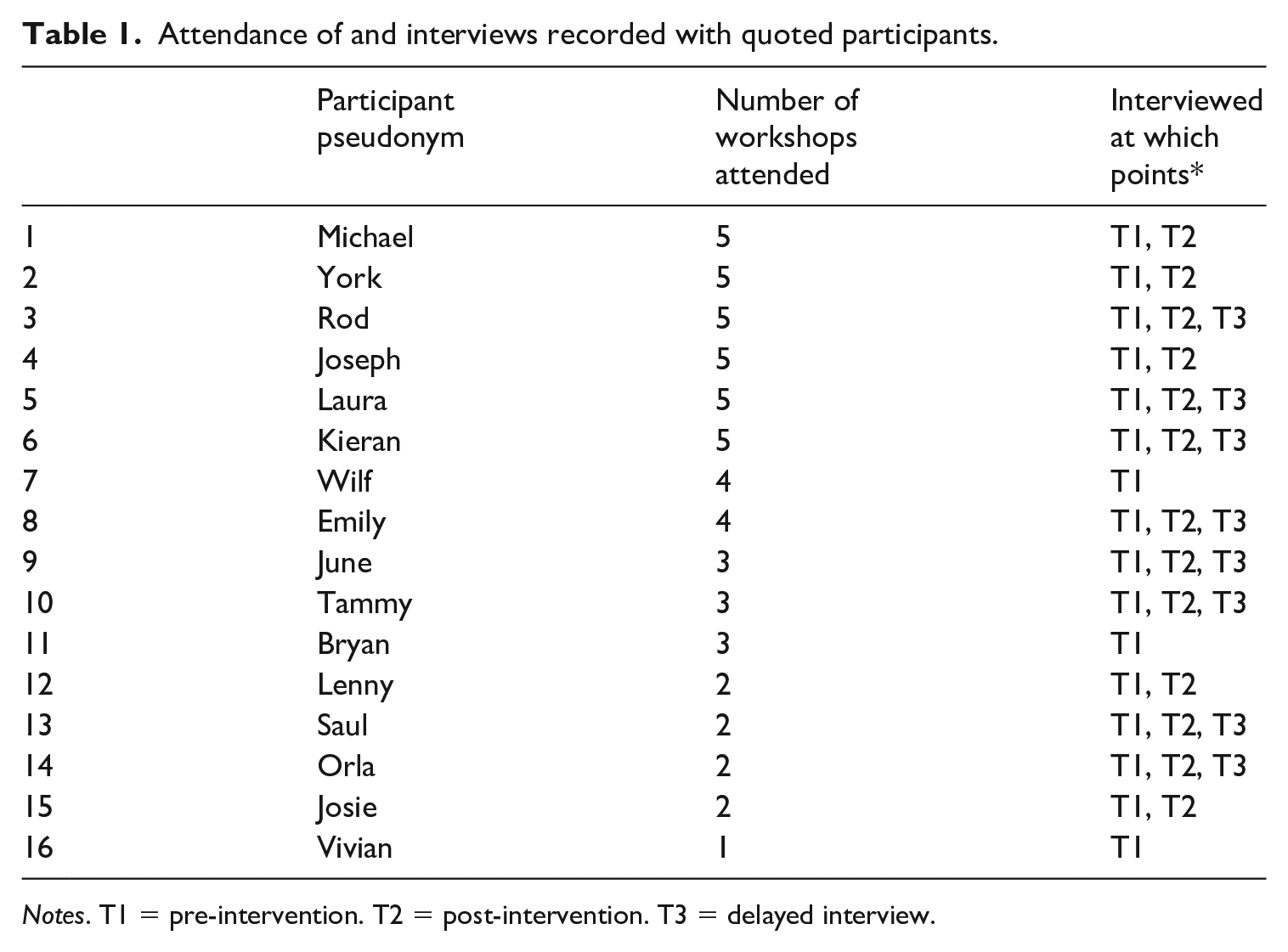
Notes. T1 = pre-intervention. T2 = post-intervention. T3 = delayed interview.
2 Data collection
In the current study we opted for purely qualitative data collection with an extended longitudinal dimension in order to examine mechanisms underlying imagery training. This was partly due to the fact that the use of quantitative pre- and post-intervention measures in some previous studies with small sample sizes posed a threat to the validity of the findings (as pointed out, for example, by Mackay, 2014; Sato & Lara, 2019), and partly due to the difficulty of providing quantitative indicators of the dynamics of the visionary process, for example the qualitative changes that occur in the engagement with visualization over time (this latter issue is related to the more general question of the inadequacy of group-average-based measures used in statistics to evaluate dynamic trajectories of individual development; see, for example, Dörnyei & Ushioda, 2021). The following qualitative data were collected, in English, between mid-July 2018 and mid-May 2019:
Pre-intervention interviews (T1, 25 students) aimed to capture baseline information regarding attitudes to learning English, learning effort, future selves, imagery ability, and learning goals. While our specific interview schedule was not piloted, this was based on established instruments widely used in the literature; it borrowed extensively from Jones (2012), who in turn drew on L2MSS-focused questionnaires by Taguchi et al. (2009), Csizér and Kormos (2009), Ryan (2009), and Al-Shehri (2009).
Focus group discussions (FG) aimed at eliciting student reflection and feedback after each workshop and sometimes even during sessions.
Detailed research journal (RJ) entries included the first author’s interim reflections on patterns emerging during the study.
Post-intervention interviews (T2, 16 students) took place approximately 3–4 months after the intervention, and roughly half-way through the first semester of learners’ credit-bearing programme. Participants first completed a five-item rating task about the frequency of visualization, clarity of goals, use of learning strategies and L2 confidence levels; this information served as the basis for a discussion on the project’s outcomes, supplemented by further questions concerning what students took away for the long term.
Delayed interviews (T3, 9 students) took place between half-way and the end of the second (and final) semester of the participants’ credit-bearing programme (3–5 months following the post-intervention interviews and 7–9 months after the end of the intervention). This interview partly mirrored the approach taken at the post-intervention stage, with questions probing for the longevity of the intervention’s outcomes and, more specifically, any role of vision/visualization in the learners’ studies at that point.
3 Data analysis
Interviews (both individual and focus group) and research-journal entries were transcribed for analysis, omitting repetitions, false-starts, and other surface artefacts. Qualitative content analysis of the data was carried out using NVivo 12, following multi-level coding guidelines set out in Dörnyei (2007) to identify patterns relevant to the research questions. The cycles of coding involved inductive pre-coding deliberation (to identify insight pertaining to participants’ engagement with the practice of visualization, the duration of vision’s impact, and any confounding factors relating to these), followed by initial annotations and preliminary coding to summarize the data descriptively. In the subsequent stage we introduced analytical categories to focus attention on possible meaning and interpretations (following Richards, 2015), and also prepared memos for in-depth reflections on the findings. During the analysis, the two authors regularly discussed the processes and findings, and as a result of these negotiations the dataset was revisited and rescanned several times.
4 The intervention
The intervention can be divided into six main stages (see Table 2). While workshop aims were identical across the three separate groups at each stage, running the three workshops on consecutive days (Tuesdays, Wednesdays, and Thursdays) allowed us to act on participant feedback, and refine the make-up and chronology of activities on subsequent days. Thus, the Tuesday workshop was a natural pilot for Wednesday’s session, and Wednesday’s workshop for the session on Thursday, with research journals and focus-group feedback informing the iterative development of the intervention. The early stages of our study were initially modelled on the approach described in Magid (2011, 2014a) and Chan (2014a, 2014b), where individually experienced scripted and guided imagery are emphasized. However, this prompted some participants in the first Tuesday session to ask for ‘more activities’ (Bryan, FG, Week 1) – meaning tasks in group contexts – while others deemed visualization ‘too simple’ (Vivian, FG, Week 1), and suggested a switch from solitary imaging to some sort of group imagination activity: ‘maybe we can change to another way to imagine – not closing our eyes, or those things . . . Maybe we can imagine together, not by ourselves’ (Vivian, FG, Week 1). As a result and in the spirit of the evolving process we adopted, subsequent workshops were overhauled to include pair, group and whole-class tasks (e.g. imagining the end of a partially viewed short film; attending an imaginary party taking on a new identity; guessing and discussing each other’s future possible selves), which proved popular with our learners and likely led to the successes in engagement we report later in this article.
Description of the main stages of the intervention programme.

Attrition was higher among Tuesday participants than in the other two groups, and while those learners also responded less to requests for subsequent interviews, we surmise that this pattern was due at least in part to the emergent process described earlier. Given the broadly similar main components of the Wednesday and Thursday sessions, and the more stable attendance recorded – six Wednesday participants attended all five workshops, and four of the Thursday learners attended four times or more – the intervention content summary provided in Table 2 reflects the content of those workshops.
IV Results
We present our findings under three rubrics. First, we examine the extent and nature of participants’ engagement with the practice of visualization and, more generally, with the intervention. A key issue in this section will be the variety in response and the fluctuation we observed on the learners’ part. Second, we summarize students’ engagement, over time, with the notion of vision. Finally, we provide indicators of the outcomes of the intervention, focusing on behaviour and confidence. It will be shown that while there were several positive findings to report, some of these were not sustained in the long term, as self-reported intended effort did not always translate into self-reported actual effort.
1 Engagement with visionary practice
Our data present several broad patterns of engagement, ranging from an enthusiastic response to complete rejection of visionary practice. In some cases, initial engagement showed signs of waning over time, while elsewhere a learner’s engagement with visualization completely disappeared, only to resurface later. Let us take a brief look at the most prominent patterns.
a Successful Engagement
Enthusiastic initial responses to mental imagery were notable in our dataset. Similarly to respondents in previous published studies, participants reported ‘really enjoy[ing]’ (Saul,
1
FG, Week 1) the guided imagery exercises, which were also a source of ‘positivity’ (Tammy, FG, Week 1) and welcome ‘breathing space’ for learners who ‘don’t have any time to relax’ (June, FG, Week 1). Importantly, the potential of visionary practice as a powerful source of motivation was immediately obvious to participants such as Wilf, who stressed how it could make the endeavour more meaningful and self-relevant: Maybe through the imagination, I know the reason why I should . . . study English very well, because . . . I was imagining I have my own company and I am sitting in my meeting room, [concluding] last year’s job and planning for the future. (FG, Week 1)
Over the long term, we found that engagement with motivational imagery can endure, albeit with some fluctuation. A poignant example was June, who initially stated that visualizing communicating successfully in English ‘feels real good’ and was ‘not a dream, is just my plan, I will make it be true’ (FG, Week 1). Some three months after the end of the intervention, and half-way through her first credit-bearing term at the college, she had stopped imagining herself speaking English well (‘I never imagine that’), citing pressing communication difficulties: ‘I just . . . hope in the future I can understand the teacher’s pronunciation and . . . the meaning of the lesson’ (T2). A further four months on, however, academic pressures actually led her to regularly ‘imagine I use English in the future’ to sustain her motivation. The apparently spontaneous, unconscious application of visionary training is notable: ‘When I used this method on my work, [at first] I didn’t remember this from the project, but . . . later I found “Ah, this method I studied from your project” ’ (T3).
A question tentatively raised by our data is whether or not guided imagery was most fruitfully applied by learners who naturally took to mental imagery, or already had some experience of it. June herself stated that she often visualized ‘when I play yoga, but now we don’t have enough time to do that’ (FG, Week 1), suggesting that the programme helped her re-connect to an existing habit rather than forge a new one. In a similar vein, Saul, a self-professed keen visualizer (‘I always do it’, FG, Week 3) who only attended two of the five workshops, reported perhaps the most striking example of imagery use in the long term, and one going beyond motivational purposes. For him, ‘the most useful thing’ from the project was the realization that he could apply his existing imagery skills to enhance L2 learning activities; so much so, that at the end of his credit-bearing programme he attributed tangible linguistic improvement in part to visualizing: I have tried listening to BBC English to improve my listening skills, and also to read some newspapers . . . I could imagine the visual of the conversation, or the situation they are talking about in the reading. And it’s . . . easier for me to understand and to, you could say, put myself in that story . . . After the visualization, I could use more academic vocabularies in my examination, and in my writing, and I could understand the listening and reading more than I ever did. It’s quite helpful, you know. (T3)
b Delayed engagement
An interesting finding was that, even where the potential of visualization to support language learning was not initially grasped or the link between imagery and the more obviously practical elements of the programme was unclear at first, more positive responses to imaging could still emerge gradually. At the start of the study, Michael admitted that ‘it is difficult to connect between visualization and English, . . . to get the point . . ., even though I didn’t have any problems when I imagined.’ In the last session of the intervention, he appeared to have come full circle: When I heard the recording from you, that all [came] from me – I wrote that and I made the plan – so today I can feel a kind of, little, satisfaction. If I make a plan like this . . . and then I hear kind of recording, maybe it can help us. (FG, Week 5)
In Joseph’s case, a transformative process took place during the weeks after the programme. While at the end of the intervention he still wondered ‘what’s the link between the visualization and other part – my plan, self-barrier, learning strategies’ (FG, Week 5), later he reported deliberately visualizing English-speaking situations relevant to his university subject, which resulted in improved learning techniques: ‘In my imagination, I try to speak [about] some part of business or management, so I will find some text or journal about that and try to make them become [part of] my speech’ (T2). This delayed engagement suggests that, for some learners, the skills inherent in visualization may take time to consolidate and bed in following initial instruction, a process further aided by making imagery content highly personal and, indeed, created by learners themselves.
c Decreasing engagement
As the learners progressed from their preparatory L2 course onto credit-bearing foundation and pre-master programmes with multiple subject coursework deadlines and exams, visualization started to seem to some students not so much a supporting tool as yet another strain on their already limited resources. While Kieran remained sympathetic to visualization as a ‘helpful’ tool in keeping learners ‘focused on how to study’, he also admitted that towards the end of his credit-bearing programme imagery lost its priority: ‘This term the environment makes people feel nervous and stressed, so I don’t want to imagine some details . . . I haven’t the patience to [think about] that’ (T3). We found a similar sentiment in Emily: ‘I think maybe when I am so tired . . . I will forget to imagine’ (T3).
For Tammy, it was the lack of external prompts that meant visualization remained infrequent: ‘I don’t have too much chance to imagine . . . if you have someone to give me a chance to imagine that, I can. But I’m not thinking about it every day’ (T3).
d Lack of engagement
It was notable that some participants consistently did not relate to the practice of visualization, either during or after the intervention. This was particularly clear in the case of Lenny, who struggled to find a link between imagery and learning – ‘to be honest, I don’t know how imagining can improve my English’ (FG, Week 2) – and who ‘never’ imagined himself speaking English (T2). In Orla’s case, visionary practice was rejected outright: ‘I’m not a person who has a very good imagination of my future, of my life, or something . . . I’m a person who believes that “just do now” ’ (T2), suggesting that visionary training – and a vision-building programme as a whole – may not be equally suited to all learners.
Further detrimental to engagement with visualization in our study was a self-perceived lack of detail, or vividness, in the generated vision: I think visualization is maybe a little difficult for me because I can’t imagine all details about my life . . . I tell myself to imagine details . . . sometimes a big situation like talking with the teachers, but I don’t know, talking what? . . . the subject is very difficult and I think I can’t imagine things in the future, so I give up. (Josie, T2)
2 Engagement with L2 vision
Our data provide evidence that the intervention was effective in helping some learners create a future professional self-image. Here is Tammy’s account for example: I think the project encouraged me to want to make a plan for my future, so, what kind of job do you like, or the English level you want to achieve . . . It’s like a dream or goal right now: I hope I can find a job in an international company. And I hope I can have some opportunities to travel to another country to communicate about our business, in English. And that picture is clear. (T3)
June also emphasized that the intervention made ‘clear my goals in the future’ (T3). This envisaged pathway remained accessible, and some months after the programme finished she still often imagined ‘for example, when I go back to China, if I have a job and I hope I can speak English fluently during my job. And I can talk with . . . foreign friends in English’ (T3).
For others like Laura, who joined the intervention with an established image of her future English-speaking self already in place (working in the UK ‘as a researcher connected to chemical engineering’), the intervention helped to strengthen the vision. She found the preparation of a specific action plan – a ‘vision map’ – particularly useful in this respect: ‘After I have that map, I’m clear about the future . . . I feel passion; full of energy. I think my future is really light; it’s like there is a big road in front of me, and I can just follow this road and catch my goal’ (T3). While this vision was still available to her some seven months after the intervention, its vividness and plausibility had faded: ‘it’s not light as before. And sometimes there are . . . some limits.’ This is likely due to the lack of activation she identified herself: also in her delayed interview, she highlighted the importance of revisiting personalized materials from the intervention (‘re-listening to the audio you gave me’) in order to ‘remind me of all of my goal’ because being ‘face-to-face with my vision map . . . just makes [me feel like] my vision is more possible.’ This was followed by Laura’s admission that ‘sometimes I just forget that I do have this kind of thing to help me,’ which suggests that the activation of the vision may be a challenge for learners without external prompts.
Another reason why an L2 vision may seem less plausible over time seems to be traced back to the perceived gulf between the imagined future success and the much less positive real-life experience. As Kieran explained: If you always imagine, ‘in future, I can find a good job and I can fluently communicate’, and other things, but in fact you can’t finish your homework, you can’t finish your essay . . . you feel, ‘ah . . . just focus on these things; don’t always imagine in the future.’ (T3)
This disconnect was already present at the post-intervention stage, with Kieran suggesting that a future vision can seem peripheral in driving learning where urgent priorities such as ‘get 6.0 in IELTS speaking’ reduced the need for a big-picture vision of L2 success: ‘Maybe I don’t like to always imagine that I will get some achievement, or I will speak the language very fluently. I think, if I have . . . clear aims, I needn’t always imagine’ (T2). Thus, another pattern in our dataset appears to be that proximal goals of passing imminent exams and achieving necessary academic prerequisites can eclipse focus on future vision in the long term.
3 Outcomes of the intervention
a Learning behaviour
There was some limited indication in the data of the capacity of visionary practice to boost learners’ intended effort, as was the case for June: ‘I think when I listen [to the guided imagery script], I don’t [just] imagine, I also make my plan that I will work harder and study harder to make it become true’ (FG, Week 1). The question, however, is to what extent this boosted intention was realized. June’s experience gives reasons for optimism: she reported in her delayed interview that activating her L2 vision helped her persist with learning: ‘I feel stressed about my work, and when I imagine that, I will have more energy to do something,’ elaborating that ‘maybe on every Monday, in the morning, I imagine some dream goals in the future. It can let me get all energy to face the work of this whole week.’ Elsewhere, however, accounts are less positive; Michael, for example, honestly admits that ‘I can feel and I can achieve through my imagination or visualization so it makes me feel good, I think, but that’s all, maybe’ (T2). Rod’s account echoes this sentiment: ‘[The images] made me feel that I have to study hard. But study very hard, not like now’ (T2). In a similar vein, he described the project’s impact on his motivation as ‘just a little bit helpful . . . because of my laziness’ (T2).
We found potential for invigorating learning also in the part of the intervention aimed at building learning skills; indeed, with the learning-strategy sharing in Week 3 proving popular (‘Now I have another way of doing things . . . I have more motivation,’ Lea, FG, Wk3) and filling the entire workshop, we set aside a whole session for goal-setting, in which breaking down goals into ‘more detail . . . and trying to think when, where and how to learn these things’ and creating a ‘whole plan to achieve our goal’ (York, FG, Week 4) were well received. That these workshops were popular is perhaps unsurprising given a lack of confidence around study skills in our sample, as summarized by Michael: ‘actually many people don’t know how to study, and what is a good way to improve our English’ (T1).
In the long run, we found some limited evidence that this exposure to new ways of learning can have an impact. For example, June reported that ‘I know my listening is poor so I make a plan about the listening, and this week, every night, I did some listening practice by TED talks,’ and the result of this strategy was that ‘after four weeks . . ., now I can understand more meaning than before’ (T2). However, we also found that initial enthusiasm was susceptible to daily academic pressures, as admitted by Tammy: ‘In the [non-credit-bearing] language course we didn’t have too much essay or academic work. So I had a lot of time to manage my own time. But now my plan does not depend on me, it depends on the work’ (T3).
b Confidence
The benefits of visualization for confidence are well documented in sport psychology (e.g. Cumming & Ramsey, 2009), and our findings also support this positive effect in the area of linguistic confidence. Joseph, who previously had low levels of confidence in his language abilities (‘when I came to England, I was afraid to speak English with others. I think my accent is horrible, my vocabulary is not rich’), claimed that ‘through imagination, I can get a feeling of [being] successful. . . . So in the real life I can also feel that and it makes me confident’ (T2). Reflecting on her very first week on the credit-bearing course, Tammy describes a similar impact of positive imagery on her confidence, after initially struggling to understand classroom content: ‘Next week’, I told myself, ‘you can understand the English, just listen to it, and you can understand.’ So I just did it, and I feel it worked . . . maybe just because of the confidence, I could understand. (T2)
She associates this technique, as well as more recent images of speaking ‘English like a native speaker, very confidently’, with the visualization training in the first week of the intervention: ‘Remember that one time you let us just imagine a scene that we are in a special place and we can speak English very well . . . I think it has the same meaning’ (T2).
V Discussion
In our account of how our participants engaged with visionary practice and what motivational outcomes this practice led to over time, we indicated in several places that our findings did not conform to the success story of some past vision interventions. Such shortfalls – reminiscent of results in other recent programmes (see Appendix 1) – are significant not because they question the power of mental imagery’s motivating function; this has received ample confirmation across several fields in the social sciences, from sports psychology to business management (for a recent review, see Dörnyei, 2020). Rather, issues arising in an intervention programme potentially reveal why the motivational capacity of vision may not always be straightforward to harness in the L2 classroom, thereby pointing to possible lessons for the future.
To start with, learners will have different initial attitudes towards visualization. While some of them will be familiar with visionary practice, and therefore translating their existing enjoyable pastime into a more purposeful approach is relatively straightforward, others may experience varying degrees of scepticism. Doubts about the utility of visualization training have also surfaced in past studies; for example, Safdari (2019) mentioned some initial participant confusion over the link between visionary activities and English learning, and Chan (2014a) reported that some of her participants questioned the use of mental imagery as a motivational strategy. While it is relatively easy to provide learners with a convincing theoretical rationale for mental imagery training and persuasive illustrations of the considerable power of vision (e.g. celebrity videos freely available on YouTube), our study demonstrated this may not be enough for learner buy-in. Helping learners experience the motivating power of mental imagery – for example, by carefully introducing visualization after a specific goal, strategy, plan or learning achievement has been discussed and adopted – may be an essential strategy in ensuring both ‘believers’ and ‘doubters’ are brought on board. It was notable, for example in Michael’s case, that transitioning to a more positive view of the motivational potential of vision could be facilitated by listening to scripted imagery based on his own writing and earlier visualization after goals and learning strategies had been examined cognitively.
In addition, for many of our participants, the practice of imagery appeared to dissipate after the intervention; given Hessel’s (2015) evidence that the motivational power of an ideal L2 self-image is a function of the frequency with which it is constructed in the mind, the trend we observed is a direct threat to the longevity of the intervention’s motivational outcomes. While Chan’s (2014a) suggested remedy – increasing the frequency of visualization by encouraging learners to produce personalized scripted imagery every few days – is one potential solution, it might not be followed through by already overstretched learners. The indication from our own data – where those who developed or deepened an L2 imagery habit were the ‘serial imagers’ – is that a vision intervention should attempt, among other things, not just to coach visualization skills but also to cue their application automatically, in order to ensure the long-term success of the visionary training. Future research might usefully glean insights as to how this could be achieved from sport psychology – with imagery becoming ‘second nature’ to elite athletes – and novel work on ‘functional imagery training’ (Andrade et al., 2016; Solbrig et al., 2019), a short motivational intervention aimed at coaching participants in the construction and priming of goal-directed visualization, with promising results for behaviour change.
With regards to the specific nature of possible-self-promoting activities, we reflected earlier that participants engaged well in collaborative imagination activities. Action-research work such as Sampson’s (2012) has devoted a great deal of attention to investigating how possible-self-promoting tasks might be motivating for L2 learners, also concluding that activities with a social-interaction element (e.g. predicting own and other learners’ futures, drafting a conversation skit with an overseas friend, sharing strategies for learning English) were particularly popular with students. Ogawa’s (2018) exploratory practice further highlights the value assigned by participants to fellow learners’ active input in helping to construct their own future visions, as near-peer role models. While we hardly need a reminder of the motivational properties of group work and cooperative learning in the L2 classroom (see, for example, Poupore, 2016), our data nevertheless lend additional weight to Sampson’s (2012) observation that ‘although the process of developing one’s self-image is, by definition, a very personal undertaking, the social element of activities appeared to motivate students’ (p. 326).
A further point about the make-up of vision interventions concerns the balance between the practice of mental imagery, other activities necessary for the successful development of vision (including setting manageable goals and learning-strategy development) and learners’ obvious need to develop actual L2 mastery. As the outline of our intervention reflects, we found that our own participants had a greater than anticipated need to engage with ‘roadmap’ elements of the intervention – likely fuelled by the reported lack of confidence in their learning skills – which resulted in our shifting the balance perhaps too far in the study-skills direction, consuming time allocated to either visualization or general L2 learning activities. Fortunately, other scholars are already taking on the challenge of finding the right balance, whether by providing vision-building in the form of communicative interaction embedded in scheduled lessons (Sato, 2020; Sato & Lara, 2019) or as part of projects, homework and other individual or collaborative tasks that have a dual purpose of also building L2 mastery (Safdari, 2019). Future research would further assist by providing specific related guidance: on the proportion of a language course that can realistically be devoted to intervention activities, the pace and timing of the intervention, as well as which activities can be done in class, at home or both. Since the vision interventions we identified have all focused on learners of English, we would also welcome insight into how learners of other languages might engage with visualization and imagery of an ideal L2 self.
VI Pedagogical implications
The inevitable question teachers will have when considering the inclusion of vision-building in their classes is whether such an intervention would be, in the words of Munezane (2015), a ‘good investment of time’ (p. 188). Indeed, when facing the common scenario that some students are struggling to meet basic requirements and are worried about being up to the tasks imposed on them, or when it becomes evident that the learners’ study skills are rather wanting, can we really justify a vision-building intervention as the most useful input we can provide? We believe that this issue boils down to whether vision training can be productively integrated into ongoing L2 instruction and whether its content can be ‘understood by language learners as meaningful, relevant, and conducive to ultimate achievement’ (Safdari, 2019, p. 18). Our answer is a qualified yes, as achieving this objective will require increased awareness about both the nature of vision treatment and the students’ specific needs: success will depend on how the two can be synthesized. The current study is characterized by several obvious limitations – the lack of a control group; fluctuating attendance and subsequent use of insight from participants who did not attend all workshops; attrition and the unavailability of many participants in the closing stages of data collection – all in the context of learning English in an English-speaking environment (and not, as might be more common, in participants’ home countries). It nevertheless allows us to offer the following basic pedagogical recommendations, further supported by our review of the existing literature and successful visionary programmes such as Le-Thi et al’s (2020) intervention to enhance L2 vocabulary acquisition:
Embed vision interventions in L2 instruction proper: Vision-building programmes have come a long way since Magid and Chan’s (2012) proposal for a standalone, concentrated, voluntary programme comprising several two-hour sessions. It would seem that such formats – to which admittedly our current study also belongs – may be on their way ‘out’, to be replaced by long-term, ongoing vision-building that helps with activating learners’ vision and assists in translating intentions into action as part of pre-existing curricula.
Target mental imagery at the proximal objectives learners are pursuing: While our programme aimed to follow the standard recommended steps for building long-term future vision, we found that such an approach was somewhat at odds with the very situated nature of our learners’ circumstances; that is, the very urgent need to achieve university entry, and an already well-developed understanding of the central role English played in attaining this goal. Thus, it was difficult to sustain a focus on (potentially very motivating) ideal future L2 vision when immediate academic pressures took hold, which is in fact in accordance with Dörnyei and Kubanyiova’s (2014) argument that that future self-images must be anchored in the reality of the learners’ most immediate and pressing concerns. Therefore, instead of beginning with the ‘big picture’, an alternative starting point may be the interrogation of (much more proximal) course goals and using mental imagery to model progress and success in those (see next recommendation for detail), potentially building learners’ confidence during a challenging period.
Sequence visualization training incrementally, and build ‘up’ to vision: Once the most tangible course goals have been identified, break these down into smaller and more specific ones (e.g. ‘obtaining IELTS 6.0 in speaking’ can be divided into more actionable constituent aims such as ‘being able to give a 2-minute persuasive talk on the use of technology in education’). Then, select strategies appropriate for pursuing these learning targets and connect them together in a coherent action plan. This is the point when visualization can be most effective, as it can focus on these articulated and personalized goals and processes. Once learners have explored the ‘near’ distance through mental imagery and the path to a future self is clearer, scaffolding vision for the following 5–10 years may prove easier and more sustainable. By following this sequence, we are in effect building up to vision rather than cascading down from it.
VII Conclusions
In his recent overview of the relationship between vision/mental imagery and motivation, Dörnyei (2020) concludes that, given the fact that developing L2 competence is a holistic, whole-person enterprise, ‘the utilisation of one of the most powerful and remarkable human faculties – the faculty of vision/mental imagery – can become a hugely profitable learning strategy’ (p. 167). Over the past decade there have been promising attempts to harness the motivational impact of vision for SLA purposes, and the current study confirms this powerful potential. However, in order to make vision-building an attractive and feasible instructional strategy that is applicable to a wide range of students and learning contexts, we need to move beyond the generic techniques of the ‘close-your-eyes-and-believe-that-you-can-do-it’ nature. Our study provided strong evidence that mental imagery is experienced and processed by different learners in diverse manners, and we discussed the most salient patterns documented in our dataset. Key lessons drawn from the findings include building up positive learner attitudes towards visualization, automatizing visualization skills through L2 content-related practice and, more generally, embedding vision interventions in L2 instruction proper. In order to achieve this, vision-building needs to be aligned with the specific objectives of the course, and visualization training needs to be sequenced incrementally, parallel to emerging L2 instructional goals. The challenges are considerable but so are the potential rewards, because, as Jerome Singer (2006, p. 128) famously declared in his seminal book on vision, ‘Our capacity for imagery and fantasy can indeed give us a kind of control over possible futures!’
Supplemental Material
sj-pdf-1-ltr-10.1177_13621688211014551 – Supplemental material for Vision enhancement and language learning: A critical analysis of vision-building in an English for Academic Purposes programme
Supplemental material, sj-pdf-1-ltr-10.1177_13621688211014551 for Vision enhancement and language learning: A critical analysis of vision-building in an English for Academic Purposes programme by Denny Vlaeva and Zoltán Dörnyei in Language Teaching Research
Footnotes
Appendix
The main characteristics of vision-building programmes in second language acquisition (SLA) (listed in chronological order).

| Context and participants | Treatment content and length (where stated) | Design |
Key |
Behavioural outcome measures | |
|---|---|---|---|---|---|
| Fukada et al. (2011) | • Japan • English courses at six universities over one academic semester • 466 students (proficiency and age unstated) |
Pair, group, and social-interaction activities: • brainstorming and sharing future possible selves (e.g. ideal future career); discussing the role of English in these • constructing ‘future histories’ (Dörnyei & Kubanyiova, 2014) by simulating a 10-year reunion |
Mixed methods: • Pre-/post-intervention questionnaires (semester start and end) measuring self-beliefs about past L2 successes/failures, in-class and out-of-class effort, and possible selves • Open-ended question on English possible selves |
• Positive re-attribution of past learning experiences • Enhanced understanding of link between classroom activities and future selves • Increases in in-class and out-of-class ‘investment’ |
• Self-reported in- and out-of-class ‘investment’ (Norton, 2000): learners’ attitudes to language acquisition, and the actions they take to engage with it; also referred to by the authors as study ‘effort’ |
| Magid (2011, 2014a) | • UK • Specially designed, four-week voluntary L2 (English) vision intervention for Chinese international university students • 31 advanced learners (age 20–40 years) |
4×-1 hour sessions: • developing ideal L2 vision through visualization, articulating goals, plans and examining feared L2 selves • visualization practice (adapted from Arnold et al., 2007; original scripts) • action timelines (‘School to Jobs’ programme, Oyserman et al., 2002) |
Mixed methods: • Initial questionnaire before programme designed (learner backgrounds, topics of interest). • Pre-/post-intervention questionnaire measuring strength of L2 vision • Two follow-up interviews (six and 12 weeks after intervention) |
• Greater confidence in learners’ English • More positive L2 attitudes • Stronger, clearer ideal L2 self-image • Five hours a week (average) more spent improving L2 skills |
• Self-reported time and effort spent on L2 |
| Sampson (2012) | • Japan • 15-week English-medium Interpersonal Communication course at women’s university • 34 elementary to working proficiency learners (average age 19 years) |
10-session enhancement programme: • Cycle 1: ‘Best-possible English self’ free-writing exercise • Cycle 2: Task-based activities enhancing the ideal-self concept (e.g. skits imagining successful L2 use) • Cycle 3: More ideal L2 self enhancement activities, and action planning (e.g. discussing role models, strategy-sharing). |
Action research • Three cycles, with subsequent stages reflecting on data collected in previous ones • Learning journals and possible-self-related written outputs from task-based activities • Learning-experience questionnaire |
• Greater recognition of learners’ own importance and agency in learning process • Self-images pertinent to the students’ current lives (e.g. to their studies) appeared more motivation-inducing than more distant visions of a future professional self |
• Not explicitly stated; focus on qualitative self-reported evidence of increased desire to learn |
| Chan (2014a, 2014b) | • Hong Kong • Independent-learning component of a 12-week mandatory English course at English-medium university • 80 high-intermediate to advanced learners (age 20–23 years) |
Six treatment sessions. • Possible Selves Trees (Hock et al, 2006): schematic representations of L2 futures • guided-imagery visualization (4×10 minutes) • individual language-counselling sessions (2×20 minutes) |
Mixed methods: • Pre-/post-intervention questionnaires (weeks 1, 12) measured strength of L2 selves and evaluated intervention • Interviews (weeks 2, 10, and two months after course end) investigated ideal and feared L2 selves, and views of intervention |
• Stronger ideal L2 selves, L2 confidence and ability to visualize future L2 success; unchanged feared selves; evidence of increased intended and actual effort • Positive response to intervention, but success can be tempered by visualization scepticism and infrequent activation |
• Self-reported increases in intended or actual learning effort |
| Mackay (2014, 2015, 2019) | • Spain • Optional 12-week English course at university language school, across two academic terms • 98 upper-intermediate learners (mean age of class groups 21.4–28.9 years) |
12×- 1 hour sessions: • Preparation and imagery training (Arnold et al., 2007; Hadfield & Dörnyei, 2013; specially designed tasks) • Visualization of possible selves • Developing goals, strategies and action plans |
Quasi-experimental: • Two control and two treatment groups (four intact classes) • Pre-/post-intervention Language Contact Profile questionnaire (Freed et al., 2004) (shortly before and after intervention) • Pre-/post-intervention motivation questionnaire (based on Ryan, 2009) and interviews (intervention start and end) measured motivational aspects including future L2 selves • Teacher and learner diaries; field notes |
• Enhanced ability to articulate ideal L2 vision • Modest gains in voluntary target-language contact and willingness to communicate for treatment group • Motivational impact moderated by factors such as past learning experience and learner attitudes |
• Self-reported extent and frequency (hours per day, days per week) of L2 contact outside the classroom, both learning and using (e.g. communicating with English speakers) |
| Magid (2014b) | • Singapore • Specially designed, eight-part L2 (English) vision intervention at an elementary school • 16 students (proficiency unstated, indication is that learners were underperforming; age 10–13 years) |
8×- 1 hour sessions: • Generic imagery training using Arnold et al. (2007) (both participant groups) • Scripted imagery of successful English use, plus goal-setting and action planning (experimental group only) • Some components based on Oyserman et al. (2002) (e.g. researching and describing role models; devising action plans to achieve learning goals) |
Quasi-experimental: • One control and one treatment group (8 participants each) • Pre-/post- intervention questionnaires based on Taguchi et al. (2009) measured motivation, attitudes to L2, ideal L2 self, confidence, imagery capacity • Interviews with participants and teacher • Additional questionnaire applied one month after intervention end • Focus-group interview with experimental group (last session) |
• Confidence and motivation to learn English increased among 90% of experimental group • Ideal L2 vision increased among half of experimental participants • Positive attitudes toward learning English increased across both groups |
• Self-reported time and effort spent on L2 |
| Munezane (2015) | • Japan • 14-week English modules at two universities • 373 beginner to advanced English learners (age 18–23 years) |
13 weekly sessions: • Control: comprehension, vocabulary and communicative tasks based on current events • Treatment 1: Control + visualization of ideal L2 selves and group presentations as experts in specialist subjects • Treatment 2: Treatment 1 + goal-setting, brainstorming life/proximal/course goals and English proficiency required to achieve them, setting and evaluating lessons goals |
Quasi-experimental: • One broad control group and two broad treatment groups, each comprising multiple classes • Pre-/post- questionnaires (course start and end) measuring impact on willingness to communicate • Open-ended questionnaire (during course lifetime) for qualitative evaluation of visualization’s impact |
• Willingness to communicate increased significantly only for Treatment 2 group • Some limited qualitative evidence of enhanced confidence and motivation to increase intensity of English learning, for Treatment 2 participants |
• Not explicitly stated; focus on qualitative self-reported evidence of increased desire to learn |
| Sampson (2016) | • Japan • One-year English course at technology college • 40 English learners (proficiency unstated, age 15–16 years) |
Twice-weekly sessions, adapting course textbook Widgets (Benevides & Valvona, 2008) into future professional L2 self activities: • Orientation at fictitious international technology company • Developing product proposals in groups • Creating video infomercials to ‘sell’ products |
Action research • Five cycles, with subsequent stages reflecting on data from previous ones • Cycle 1: Free-writing activities to provide details of learners’ present self-concepts and motivation • Cycles 2–5: Learning journals, Possible-self Trees worksheets, questionnaires, reflective researcher journal |
• Increased understanding of L2 learning as investment in personal future • Heightened in-class motivation detected in positive, collaborative group-project interaction |
• Self-reported ‘want’ for future action (akin to intended effort) • Observations of learner behaviour in classroom activities |
| Ogawa (2018) | • Japan • 13-week mandatory general English course at a Japanese university • 25 beginner/lower-intermediate learners (age 18–19 years) |
13 weekly sessions: • Understanding learners’ L2 self-perceptions through self-introductions and sharing learning histories (past focus) • Introducing ‘vision’ (future focus) • Writing up and discussing future visions • Sharing and monitoring use of learning strategies • Exchanging intercultural stories |
Exploratory practice: • Student narratives • Researcher field notes • Audio and video recordings of classes • Course evaluations • Semi-structured interviews reflecting on vision-based approach and eliciting strength of L2 vision. |
• Participants valued their L2-relevant futures more • Group dynamics – and in particular near-peer role models in the classroom and role-play activities – especially important in increasing enjoyment of learning experience and enhancing L2 visions |
• Not explicitly measured |
| Safdari (2019) | • Iran • 11-week optional English course at private language academy • 51 intermediate English learners (age 16–38 years) |
Twice-weekly sessions over seven weeks: • Matched extent and chronology of all main stages and nearly all sub-stages of vision-building described in Dörnyei and Kubanyiova (2014) • Wide variety of imagery-training and other activities, original or adapted from Hadfield and Dörnyei (2013), Dörnyei and Kubanyiova (2014) |
Quasi-experimental • Two control and two treatment groups across four intact classes (two female and two male groups) • Pre-/post- intervention questionnaires • Learners’ written commentaries on intervention (course end) |
• Imagery capacity, ideal L2 self, attitudes to learning, intended effort increased for treatment group • Qualitative evidence of more effort and time actually spent, and greater consistency and stability of engagement • Ought-to L2 self unchanged for both treatment and control groups |
• Self-reported intended and actual effort |
| Sato and Lara (2019) | • Chile • Eight-week mandatory English course for business-management university students • 45 beginner English learners |
Eight sessions integrated into eight scheduled 90-minute classes: • Intervention group: Paired communicative tasks aimed at eliciting and strengthening personal visions of professional L2 selves (e.g. visualization, future-self interviews, viewing videos of and interviewing business role models). • Control group: Communicative activities only generally related to business management |
Quasi-experimental • One control and one treatment group (two intact classes) • Pre-/post- intervention questionnaires • Post-intervention interviews |
• Intervention group: Ideal self strengthened, learning experience perceived more positively, significance of ought-to self decreased • Control group: Ideal L2 self and attitudes to the learning experience unchanged, ought-to self increased in significance • Intended effort unchanged for both groups |
• Self-reported intended effort |
| Machin (2020) | • Spain • 11-week mandatory English course for university students • 28 learners at levels A2–C2 (age 18–25 years) |
Integrated into scheduled twice-weekly 2- hour classes over five weeks: • Individual ‘time-travel’ compositions • Class discussion of current motivation levels • Role play with student-scripted and -led visualization of near-future ideal L2 selves |
Exploratory practice: • Three stages of pedagogic activities, each subsequent stage reflecting on data from the previous one • Learners’ compositions and visualization scripts • End-of-term comments about final intervention stage (visualization) • Researcher’s classroom observations of classroom atmosphere, learner comments and behaviour |
Enhanced motivation in the classroom, as indicated by: • excitement about visualization activity • effort invested in preparation • actively listening and reacting spontaneously to peer scripts |
• Students’ observed behaviour while reading out/listening to visualization scripts • Compliance with script content brief • Self-report of enjoyment of visualization, motivation for script-writing and motivation for learning English following project |
| Sato (2020) | • Chile • Nine-week mandatory English course for business-management university students • 50 lower-intermediate learners (age 20–24 years) |
Six weekly 45-minute sessions: • Visionary tasks designed to elicit business-major learners’ possible ideal selves: internationally successful entrepreneurs • Counterbalancing the vision by identifying and understanding potential obstacles to reaching ideal selves, and strategies to proactively avoid the obstacles. |
Quasi-experimental • One control and one treatment group • Pre- and post-intervention questionnaires (weeks 1 and 8 of course) • Exit interviews (week 9 of course) • Learner behavioural data from teacher-student classroom interaction (number of words and turns in English and Spanish) |
• Positive impact on ideal L2 self and international posture • Ought-to self and intended effort unchanged • Increase in target-language use over time (experiment group) • Increase in use of Spanish (control group) |
• Self-reported intended effort • Observed in-class target-language use in teacher-student interaction |
Declaration of conflicting interests
We have no known conflicts of interest to disclose.
Funding
The author(s) disclosed receipt of the following financial support for the research, authorship, and/or publication of this article: This work was partially supported by the Economic and Social Research Council [grant number ES/P000711/1].

Supplemental material
Supplemental material for this article is available online.
Notes
References
Supplementary Material
Please find the following supplemental material available below.
For Open Access articles published under a Creative Commons License, all supplemental material carries the same license as the article it is associated with.
For non-Open Access articles published, all supplemental material carries a non-exclusive license, and permission requests for re-use of supplemental material or any part of supplemental material shall be sent directly to the copyright owner as specified in the copyright notice associated with the article.
