



Abstract
This study investigated the relationship between task-based teacher training and novice English language teachers’ cognitions and implementations of tasks in Honduran bilingual schools. After participating in a four-week training program on task-based language teaching, teachers with little or no prior teaching experience designed task-based lessons and were video-recorded implementing those lessons with English language learners ages 5 to 12. Following the classroom observation, teachers participated in a stimulated recall interview. A rubric aligned with 10 key principles of task-based language teaching (TBLT) as outlined by Long (2015) was used to rate teachers’ performance and code stimulated recalls. Ratings of video observations showed varied success in TBLT implementation after training, with some teachers’ lessons clearly aligned with key TBLT principles, and others relying on focus on forms strategies. Analysed data also uncovered a link between previous training and teaching experiences and the success of teachers’ implementations. Stimulated recalls showed that teachers focused primarily on maintaining a cooperative learning environment, and less on reactive aspects of TBLT such as providing corrective feedback. Results are discussed in terms of their implications for teachers and teacher training programs seeking to implement TBLT as an approach to language teaching.
Keywords
I Introduction
The current study investigated the role of teachers and teacher training practices in the implementation of task-based language teaching (TBLT). In task-based teaching, syllabi, curricula and lessons are organized around ‘tasks,’ as opposed to discrete linguistic forms, which are derived from authentic learner needs in the target language (Long, 2015; Long & Crookes, 1992). TBLT has grown to occupy a prominent position in contemporary approaches to language teaching thanks, in part, to its grounding in second language acquisition (SLA) and pedagogical theories and the wealth of empirical support for task-based interaction-driven learning (e.g. Keck et al., 2006; Mackey & Goo, 2007). Much effort has been dedicated to investigating the effects of specific task-related variables for various second language (L2) outcomes (Plonsky & Kim, 2016). More recently, there have been efforts towards investigating TBLT implementations at the programmatic level in educational contexts worldwide (e.g. Byrnes, Maxim & Norris, 2010; Samuda, Van den Branden & Bygate, 2018) and with more diverse learner populations such as younger learners (e.g. Shintani, 2016). However, despite purporting to be a pedagogical approach suitable for diverse contexts, the majority of TBLT research continues to take place in economically developed regions, an issue for applied linguistics research in general (Andringa & Godfroid, 2020).
Countries in Latin America have made considerable investments in English language education in recent years, with varied outcomes throughout the region (Cronquist & Fiszbein, 2017). For example, despite national efforts to promote English language development in Honduras, outcomes have been limited, reportedly due to the low proficiency levels of English language teachers and quality of teacher training programs (Stanton & Fiszbein, 2019). However, there is little research in any world region connecting language teacher education programs to implementation and language development (Borg, 2015). This lack of prior research is especially problematic for TBLT, an approach that requires teachers to be trained in specialized skills such as identifying and responding to individual learner needs, devising tasks responsive to those needs and tailoring corrective feedback (Long, 2016). Training is especially critical for novice language teachers, whose prior language teaching and learning experiences have been shown to influence how they approach various aspects of teaching (e.g. Borg, 2003). The current study investigates novice English language teachers’ implementation of TBLT following training and examines their cognitions and practice in light of their prior teaching experiences.
II Literature review
1 The role of the teacher in TBLT
TBLT’s approach to language teaching centers around the use of tasks, or what the learners need to do with the target language, as opposed to traditional approaches to language teaching which typically center instruction around grammatical forms (Long, 2015; Long & Crookes, 1992). With student-centered interaction and learning highlighted as key elements of TBLT, critics have argued the role of the teacher in a task-based classroom is downgraded to the manager or overseer of activities (Swan, 2005). However, the importance of the role of the teacher in TBLT has been consistently stressed as in fact requiring greater expertise and resourcefulness than teaching in a traditional ‘focus on forms’ approach (e.g. Samuda, 2001; Van den Branden, 2016). As Long (2016) points out in his response to common criticisms of TBLT, teachers implementing a TBLT approach must employ more creativity and decision-making in order to tailor input and corrective feedback to individual learners. Teachers are known to modify lesson plans and tasks moment-to-moment while teaching, making constant pedagogical decisions to adapt to classroom and learner needs (Borg, 2003). This tension has been referred to by Breen (1989) as the difference between ‘task-as-workplan’, or, the tasks the teacher designed and set out to implement, and ‘task-as-process’ the reconstructed tasks that result when they are adapted to meet contextual learner or classroom constraints. Furthermore, teachers must be reactive to learners’ individual syllabi in the corrective feedback, input and forms they provide as well as attending to other individual differences (IDs). All of this occurs in the harmonious, safe classroom environment that the teacher supports and maintains for students. Despite these critical roles for teachers in task-based classrooms, teachers’ experiences have received considerably less attention in previous research when compared with other task-related variables (Van den Branden, 2016).
The majority of prior research on the role of the teacher in TBLT has centered around the questions teachers have, or difficulties they face, when designing or preparing to teach task-based lessons (Van den Branden, 2006). For example, McDonough and Chaikitmongkol’s (2007) case study of the implementation of a task-based EFL course in a Thai university found that while teachers and learners generally reacted positively to TBLT, they were concerned about the lack of grammar instruction. More recently, Oliver and Bogachenko (2018) investigated teachers’ perceptions about tasks in Western Australia, finding inconsistencies in how teachers defined and described tasks and assessed their students’ performances. Studies like these have contributed to our understanding of how teachers’ perceptions and understandings of tasks interact with different cultures and contexts.
Teachers’ prior teaching experiences have also been shown to play a role in how they interpret and approach various aspects of language teaching both in the general education literature (see Carter, 1990 for a review) and in language education (e.g. Mackey, Polio, & McDonough, 2004). In a task-based study by Vandommele, Van den Branden and Van Gorp (2018), two experienced and two less experienced instructors team teaching beginner learners of Dutch were observed teaching four tasks. Findings indicated that overall, teachers succeeded in implementing key TBLT principles during the observed lessons; however, the more experienced teachers were rated higher on average than less experienced teachers. Notably, this study examined the extent to which teachers’ classroom practices aligned with some main principles of TBLT (as defined by Long, 2015) calling for further research into which principles are easiest or most problematic for novice teachers. However, the ability of teacher education programs to train teachers to implement these key principles has been called one of the remaining ‘real issues’ for TBLT (Ellis, 2017; Long, 2016).
2 Training task-based teachers
Despite the critical role of the teacher in implementing tasks, much less empirical research has examined the connection between teacher education or training programs and subsequent successful TBLT implementation – however, some patterns have emerged. Teachers’ beliefs about second language pedagogy, defined as ‘statements teachers make about their ideas thoughts and knowledge that are expressed as evaluations of what “should be done”, “should be the case” and “is preferable” ’ (Basturkmen, Loewen, & Ellis, 2004), have been examined in a variety of prior research (Borg, 2015). These studies have demonstrated how teachers’ beliefs are impacted by their own experiences learning second languages (e.g. Warford & Reeves, 2003), status as a native or nonnative speaker of the target language (e.g. Gurzynski-Weiss, 2010) and their experiences in teacher education programs (e.g. Busch, 2010). In a study by Ogilvie and Dunn (2010), student teachers participated in a constructivist-based curriculum course that targeted teachers’ dispositions towards TBLT concepts and their ensuing utilization of tasks during a teaching practicum. Findings revealed that preservice teachers’ dispositions towards TBLT increased after the course; however, those positive dispositions did not translate to successful implementation in the classroom. Additionally, teachers raised concerns about challenging their own cultural norms for teaching and fears of negative reviews by their mentor teachers.
In the Latin American context, Solares-Altamirano (2020) investigated Mexican teachers’ experiences in an online task-based training course. Through the examination of pre- and post- course questionnaires and written self-assessments from teachers’ reflections, the author found teachers developed in their understanding of the SLA principles underlining tasks and TBLT in terms of their own beliefs and practical skills for task implementation. However, teachers continued to struggle in differentiating between task types (as defined by Ellis, 2003) and strategies for increasing L2 input and focusing-on-form in their classrooms. The teachers also emphasized the limitations of time and resources for creating tasks and task-based lessons.
The difficultly of translating knowledge from teacher training programs to task design and implementation has been echoed in other work. In one example, Chan (2012) found that elementary school teachers who took a task-based professional development course in Hong Kong had difficulty grasping the concepts of TBLT to apply to their own teaching. The author suggested teachers use self-reflection and peer-evaluation strategies to evaluate themselves and their task implementations. In a study in New Zealand by Erlam (2016), forty-three teachers of seven different languages participated in a year-long professional development course that highlighted TBLT. At the end of the program, the teachers designed tasks for their own classrooms which were evaluated based on Ellis’s (2003) criteria. Results indicated that about half of the tasks the teachers designed fulfilled all four of Ellis’s criteria, with 82% fulfilling three or more of the criteria. The criteria that was most difficult for the teachers to satisfy was to allow learners to utilize their own linguistic resources to complete the task, while the easiest criteria for the teachers to satisfy was for the task to have a clearly defined outcome. However, as Erlam warned in her study, this research does not offer data on how tasks were implemented in the classroom, nor how learners interpreted or learned from their experiences with the tasks. She identifies the difference between tasks-as-workplans and tasks-as-process, as a fruitful area of future inquiry.
Despite this previous work on training teachers to implement TBLT, there are few investigations that adequately describe the training teachers receive and examine connections between aspects of the training and the success of subsequent TBLT implementation. Given these gaps, the current study addressed the following research questions:
To what extent are novice teachers able to successfully implement key principles of TBLT in their classrooms following training?
To what extent do prior teaching experiences affect novice teachers’ implementation of TBLT?
III Methods
1 Context and participants
The study took place in several English–Spanish bilingual schools in western Honduras that partner with a US-based nonprofit. In Honduras, English–Spanish bilingualism is seen as a significant asset for accessing further education and sustainable employment, mainly due to the region’s sociopolitical ties and geographic proximity to the United States. However, high-quality English instruction is expensive and typically only accessible to upper-class Hondurans in major cities who can afford international private schools. Children in rural communities often attend public schools in large, multi-grade classrooms where English teachers, where they are available, often speak at a level below what is expected of their students (Cronquist & Fiszbein, 2017). These children are also disproportionally impacted by the poverty and violence that is endemic to the region. The collaborating nonprofit aims to dismantle these structural inequalities by recruiting, training and placing English-speaking teachers in existing schools at very low cost or no cost to rural, under-resourced communities. The nonprofit also covers housing, some meals and provides stipends for the recruited English-speaking teachers, many of whom are locals.
The schools operate primarily with a content and language integrated approach to language teaching, in which students spend half of their day in English-medium courses – math, English Language Arts (ELA), and science – and half of their day in Spanish-medium courses: social studies and Spanish). The classes taught in English are staffed by nonprofit-recruited English-speaking teachers, while the classes taught in Spanish are taught by local Honduran staff who are monolingual Spanish speakers.
Prior to the current study, a needs analysis and program evaluation were carried out to identify the needs and target tasks of graduates of the schools. By surveying graduating or recently graduated students, administrators and teachers, it was found that the majority of students’ English language needs upon graduation included: applying for local jobs in English-speaking industries such as tourism, call-centers, translation services, becoming English teachers or continuing their education in an English–Spanish bilingual high school or university. As a result of the needs analysis and evaluation, TBLT principles were integrated into the teacher training program to support language learning outcomes and drive unit and lesson planning.
The participants in the current study were 19 novice (teachers with less than 2 years prior experience) English-speaking teachers, newly recruited by the nonprofit to teach ELA, math and science in English to students’ grades PreK through 9th grade (see Table 1). Of these teachers, all 19 participated in the training, a subset of 16 teachers participated in the video recordings and 12 focal teachers participated in stimulated recall interviews.
Teacher backgrounds.

Of the 19 teachers, eleven indicated on a pre-training survey they had some form of prior teaching experience (teachers were asked to describe any prior teaching experience and the amount of prior experience in months). These teachers noted that they had taught in teaching practicums during their university education including in TESOL certificate programs, general education programs, or in informal teaching situations such as tutoring and summer camp counseling. While not all of these may be considered formal teaching experiences, this represents an authentic range of experiences novice teachers may bring with them into their teaching programs. The remaining 8 teachers indicated they had no prior teaching experience. None of the teachers had previously taught in the Honduran school system or at the participating schools.
2 Procedures
The 19 newly recruited teachers took part in a summer training program designed for first-year English-speaking teachers. The 160-hour training provided a ‘crash-course’ in best practices of language teaching and general pedagogy, integrating culturally responsive pedagogical practices, which have been found to be effective in other short-term teacher training programs (e.g. Nero, 2018). Although intensive short-term language teacher education courses such as CELTA (Certificate in English Language Teaching to Adults) have received criticism in the past (Ferguson & Donno, 2003; Horne, 2003), this course is designed to prepare teachers for the specific teaching contexts they will encounter at the schools and is the only practical length given the short-term commitment of the volunteer staff, a common situation for many language programs worldwide. The training was four-weeks long and split into two parts. Part one included training sessions on a variety of topics related to TBLT including: task-based principles, task and task-based lesson planning, and task-based assessment design. The training sessions were themselves task-based, in that TBLT strategies were modeled by trainers in an interactive learning environment. The researcher designed and implemented the task-based trainings.
In each training session, teachers were introduced to the material through demonstrations, video recordings and example artifacts such as tasks or lesson plans designed by experienced teachers. They subsequently had the opportunity to engage with materials through interactive discussions and small-group work. Finally, trainees were guided through the creation of their own materials targeted at their grade-level. Teachers also participated in training sessions on classroom management strategies and best practices in content areas such as math, science and literacy.
The second part was a teaching practicum where teachers designed and implemented tasks with groups of students from one of the partner schools. Teachers taught classrooms of students from Pre-K to 6th grade (ages 5 through 12) that ranged in size from 11 students to 20 students. During the practicum, teachers were observed by their peer teachers and mentors. Each day of the practicum the observing teachers provided feedback to the those who taught lessons. Throughout the training, teachers engaged in one-on-one or small-group advising sessions with mentors where they workshopped lesson and unit plans and were given opportunities to ask questions and discuss content provided in the whole-group training. The training sessions, mentorship meetings and practicum were all conducted in English.
The data for the current study were collected during the final week of training during the teaching practicum 1 (see Figure 1). In the final week of the practicum, teachers chose an hour-long lesson for the researcher to observe and record. The videos were uploaded and trimmed to account for interruptions and classroom breaks (when student or teachers were not in the room) resulting in a 30- to 40-minute sample per teacher. The recordings were then utilized as the stimulus in stimulated recall interviews. Twelve focal teachers met with the researcher approximately one hour following their recorded lesson to participate in semi-structured and stimulated recall interviews. Following recommendations by Gass and Mackey (2017), teachers heard instructions about stimulated recall interviews, watched the researcher model an example and had the opportunity to ask questions. Then, teachers were able to pause the video whenever they wanted to vocalize what they were thinking at the time of recording. Stimulated recalls interviews were audio recorded and transcribed.

Training timeline.
3 Instrument for task-based lesson assessment
The meaning of ‘task’ and the main principles of TBLT have been defined and described in various ways in prior literature (e.g. Ellis & Shintani, 2013; Long, 2015). The current study adopted the Methodological Principles (MPs) of TBLT described by Long (2015) to assess teachers’ implementations. These principles are defined by Long as the ‘universally desirable instructional design features motivated by theory and research findings in SLA, educational psychology, philosophy of education, general educational curriculum design and elsewhere, which show them to be either necessary for SLA or facilitative of it’ (2015, p. 301). In the current study, a rubric was created that assessed teachers’ instruction against the MPs. Table 2 describes how the MPs were applied to the rating criteria in the current study.
Descriptions of rating criteria and empirical support.
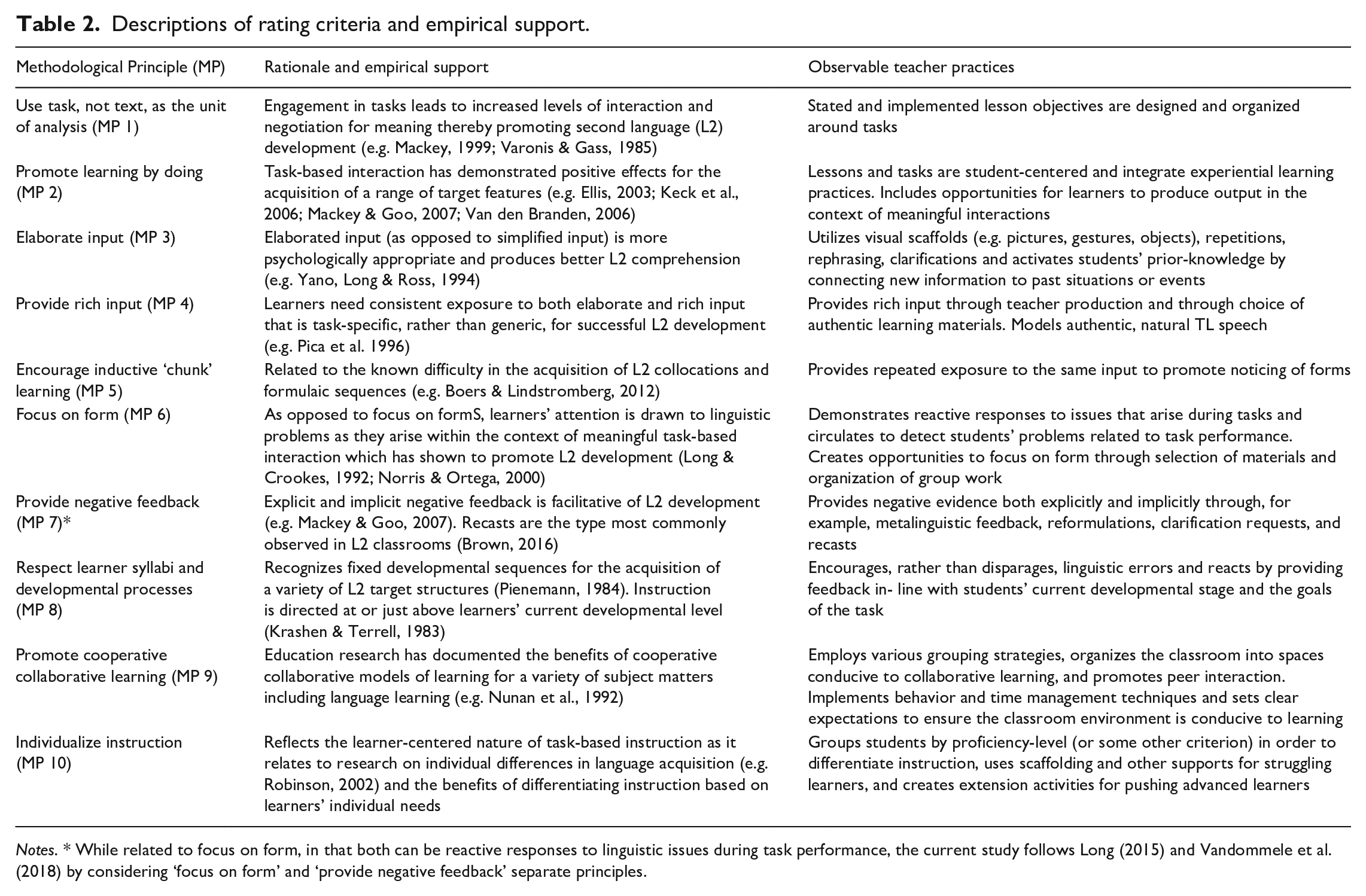
Notes. * While related to focus on form, in that both can be reactive responses to linguistic issues during task performance, the current study follows Long (2015) and Vandommele et al. (2018) by considering ‘focus on form’ and ‘provide negative feedback’ separate principles.
Following the descriptions of the MPs above, a rubric was created to evaluate the video-recorded lesson from each teacher. The rubric listed the MPs, a score for each and space for comments related to the score. For each MP in the rubric, the teacher received points for accomplishing that principle, zero points if the principle was absent, or were deducted a point for performing counter to the principle. For example, for MP 2, if a teacher demonstrated the use of encouragement strategies to promote student English output, for example through a classroom routine of sharing, they received a point. If the teacher showed no evidence of encouraging student output in English during the lesson, for example a lesson where only the teacher spoke, they received zero points. And if the teacher actively discouraged output, for example by reprimanding students for talking, they lost a point. Teachers could gain or lose a maximum of 4 points per MP. MP 1 was coded based on whether the teachers’ tasks were considered tasks or not according to the criteria set by Ellis (2003). These MP descriptions were also used to code stimulated recall data thematically as related to one or more of the principles of TBLT.
4 Analysis
The MP rubric described above was utilized to score the video-recorded lessons. The higher the score, the greater adherence to TBLT principles. To score the video recordings, the researcher and two trained coders played back clips and entered scores iteratively into a coding scheme document along with illustrative quotes and notes from the video. For stimulated recall data, coders transcribed the teacher’s recall and noted what was happening in the video recording of the lesson at the time of the recall (e.g. teacher or student actions). Then, the teacher’s recall was coded with any associated MPs (as described above). If the recall was not thematically related to any MPs, the rater coded it as ‘not applicable’.
Due to the high-inference nature of coding of TBLT characteristics, raters were carefully trained and completed multiple iterations of coding and discussion. In order to train the raters to code the observation and stimulated recall data, three previously rated video samples from classroom observations and three transcribed samples from stimulated recall interviews were shown to the raters. The researcher and the raters reviewed the coding scheme and rated two samples from each type of data together. Then, the rater coded a third sample on their own and asked any questions. The raters watched clips from classroom recordings or stimulated recall interviews and coded according to the relevant coding scheme. Following training, the two raters coded a random sample of 36% of the classroom observation data as well as a random sample of 42% of the stimulated recall interview data. A simple percent-agreement was calculated between the researcher’s ratings and the rater’s coded samples. Coding had an initial rate of 85% agreement. Following this, any disagreements were reanalysed and discussed until 100% agreement was achieved. Discussions involved replaying video clips and considering multiple view points against the description of the MP and the corresponding descriptions discussed in Long (2015).
Raw scores from observation rubrics (ranging from −38 to +38 possible points) were converted to a positive scale by doubling scores (resulting in a possible 76 total points). These scores were then converted to percentages by summing up points scored on the rubric and dividing by the total possible score, and descriptively analysed. For stimulated recall data, the number of recalls coded per MP were divided by the total number of recalls made by all teachers to provide an average per MP. Experience levels were collapsed into a categorical variable, ‘some’ vs. ‘no’ prior experience, based on pre-survey data. Given the small sample size, which represents the classroom-based nature of the study design, the data is examined descriptively and qualitatively for general trends.
IV Results
Research question 1: To what extent are teachers able to successfully implement key principles of TBLT in their classrooms following training?
Ten hours and 46 minutes of video data of the teachers’ practicum lessons from a subset of sixteen of the nineteen teachers were analysed. Results from the teachers’ video scores showed wide variability with scores ranging from a low of 20 points (26.3%) to a high of 63 points (82.8%) (M = 49.88, SD = 10.97) out of 76. When examined by the percentage of points earned by each MP, scores were on average highest for MP 3 ‘elaborate input’ (94% of possible points earned) and lowest in the category of MP 10 ‘individualize instruction’ (40% of possible points earned; see Table 3).
Video coding results across teachers.

To further illustrate these results, Christina (all names are pseudonyms) scored among the highest for her lesson for a 2nd grade writing class. She designed and implemented a task-based lesson that had the objective of brainstorming ideas for writing projects using web-diagrams. Her unit plan indicated that this would be the first lesson in a series of lessons where students developed a writing project called ‘All About Me’ to introduce themselves to her and their classmates. The writing, once drafted and ‘published’, would be shared and stored in the classroom library. She began the lesson by modeling a web-diagram brainstorm whole-class on the white board. She demonstrated with herself, generating topics, such as ‘family’ and ‘favorite things’ and connecting those topics to words and pictures associated with each. Then, she asked students to help her demonstrate how to use a web-diagram to brainstorm sentences they could use later in their writing. In example 1 below, Christina can be seen recasting student output (MP 7) from one-word phrases to full sentences and connecting them on her model web-diagram. Despite her 2nd graders’ limited proficiency, she provides rich, authentic input (MP 4) as she models the process of creating sentences from single words or pictures, and pushes students to supply their own output.
High-scoring teacher.

Notes. (T) refers to teacher (S) refers to student. For transcription conventions, see Appendix 1.
After this model, Christina then required students to work in small groups to create their own web-diagrams. Students did not copy Christina’s ideas, but instead wrote about their favorite hobbies, their pets and other ideas for their ‘All About Me’ writing project (MPs 1 and 2). Students were able to share ideas as they worked while Christina circulated providing feedback (MP 7) and extra support to struggling students (MP 10). Christina’s discourse style is notable in that she provides most of the input, building off on students’ responses integrating and elaborating on key vocabulary. This style of input-based teacher-student discourse with young learners has also been noted by Shintani (2011) as a productive site for both receptive and productive vocabulary development as well as comprehension development. Christina did not have prior teaching experience, but she did have a background in linguistics from her undergraduate degree.
By contrast the teacher with one of the lowest scores, Raquel a 4th grade teacher, designed a lesson that primarily took on a forms, rather than task, focus (MP 6) when it was implemented. Her lesson plan indicated that the lesson’s objective was to read and retell a story. Raquel wrote this objective clearly on the board at the start of class. While this objective may have led to the use of tasks throughout the lesson, Raquel decided to focus much of the class time on reviewing regular vs. irregular past tense verbs, a topic she had briefly introduced in her previous class. She reflected later, in her stimulated recall interview, that in the moment she rationalized that the students needed to know the past tense to retell a story. She said, ‘How am I going to do my activity if I don’t remind them about the verbs?’ Example 2 demonstrates how she reviewed the forms with her students.
Low-scoring teacher.
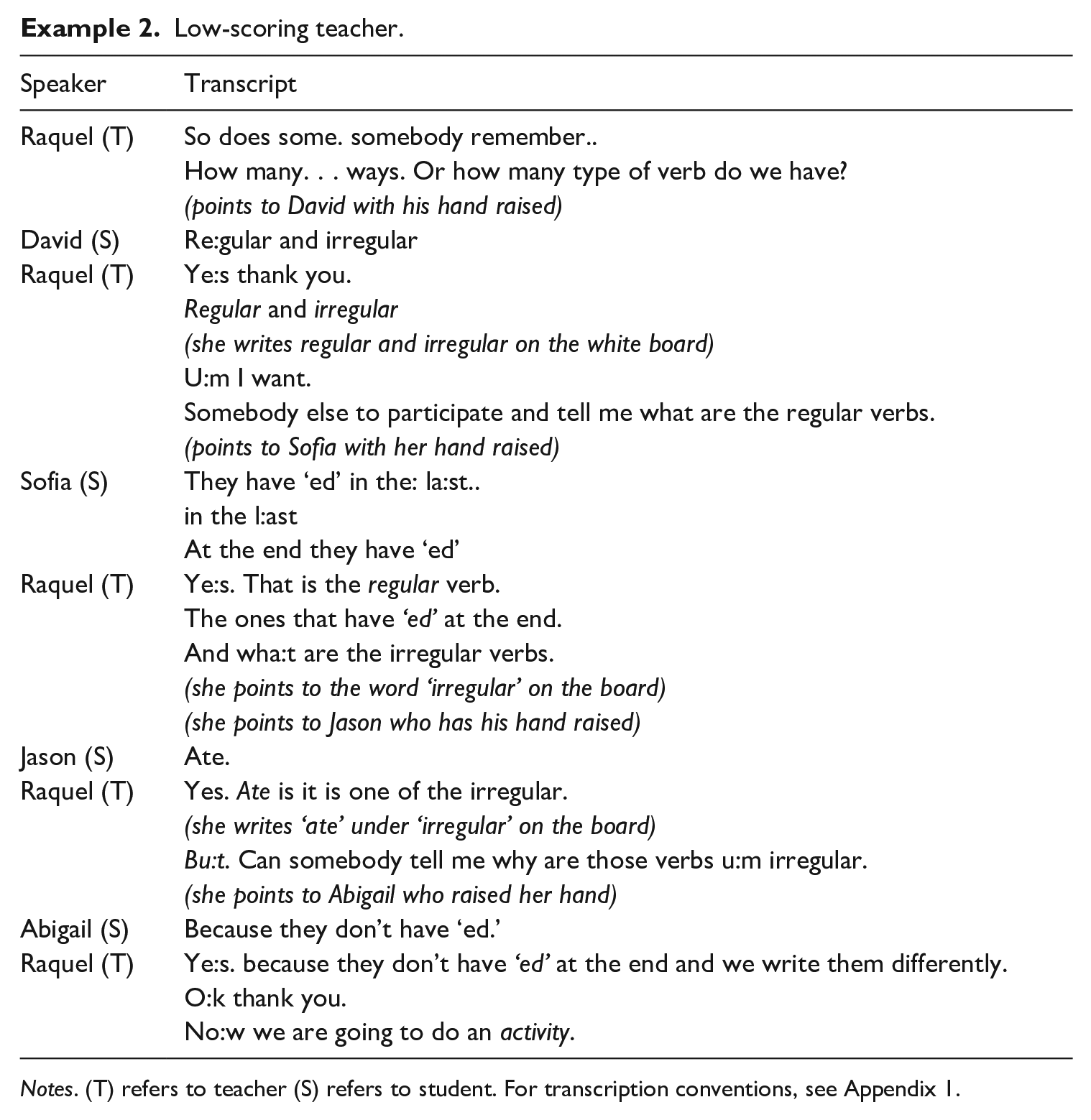
Notes. (T) refers to teacher (S) refers to student. For transcription conventions, see Appendix 1.
The students have clearly acquired some metalinguistic knowledge about past tense verb forms in English. However, the activity that followed this example included underlining verbs in example sentences and distinguishing between regular and irregular verbs. Continuing to focus on forms, the students then worked in small groups to create past tense sentences with word banks. Only in the last ten minutes of class did the topic shift to retelling stories. This final part of her lesson became more task-focused as she modeled retelling the story of Cinderella, a book the students had previously read, asking students to brainstorm story elements such as setting and characters together. Raquel did not have any previous teaching experience prior to participating in the training.
In order to better understand the extent to which teachers’ cognitions about their own teaching practices aligned or misaligned with the MPs, a total of 410 individual recalls were analysed from twelve focal teachers who participated in stimulated recall interviews following their recorded classroom observation (M = 34.17 recalls per participant, range = 16 to 50). As shown in Table 4, on average the highest number of recalls were coded as MP 9, promote cooperative and collaborative learning environment. The least number of recalls were coded as MP 8, respect learner syllabi and developmental processes.
Stimulated recalls coded by Methodological Principles (MPs).
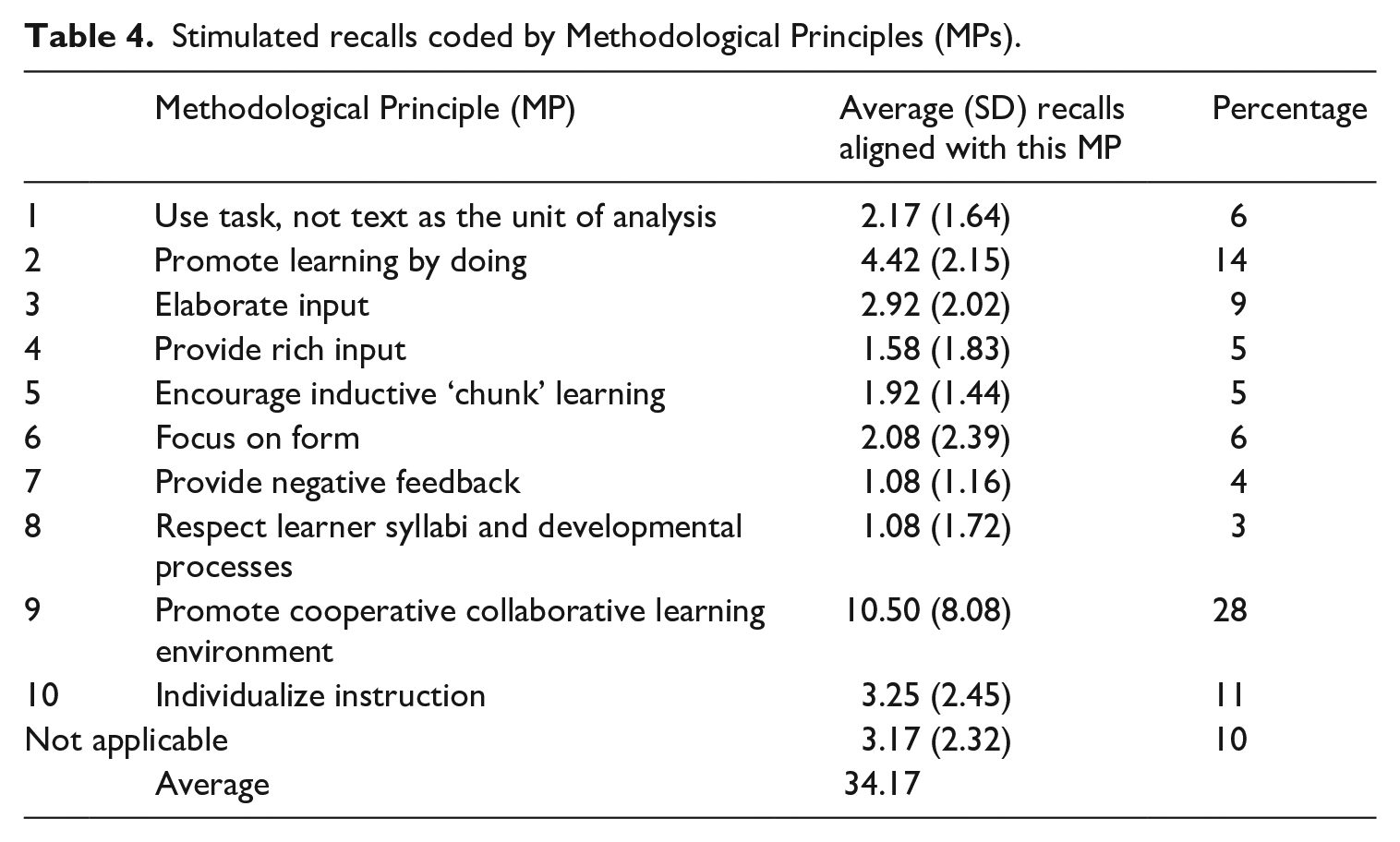
The recalls coded as MP 9 mainly focused on teachers’ ability to maintain control over student behaviors so that they could ensure that the environment was conductive to learning and felt comfortable continuing on in their lesson with students’ full attention. For example, after watching a clip of herself telling the class they would earn class points if they were silent and that she would wait before giving the directions, Claudia a 2nd grade teacher recalled: ‘I think they were mostly quiet but there was a couple of people that were still just totally not paying attention. . . so then I was hoping if I gave them time then those kids that were already doing really good would influence their friends.’ Here, Claudia describes thinking about how she can better promote student autonomy in her classroom through her classroom procedures and routines. Claudia demonstrated her persistence in enforcing her classroom management systems by waiting until she had the students’ attention before moving on in her lesson.
By contrast Chris, another 2nd grade teacher, recalled that during a moment when students did not follow his directions as expected, that he decided to just move on with his lesson rather than trying to adjust his students’ behaviors. He said he was thinking at the time: ‘This is not even a little bit what I wanted. This is not going to look good. can I press a rewind? . . . We’re just going to roll with it and see what happens,’ indicating his reluctance in the moment to stop teaching and redirect students. He also recalled: ‘I thought my directions were clear. . . But I obviously didn’t repeat it back to them I didn’t rephrase it.’ Here, Chris is reflecting on how his lack of elaborated input (MP 3) may have resulted the breakdown in student understanding and attention in the classroom.
Other teachers recalled times where elaborating input (MP 3) worked to support student comprehension after students misunderstood a direction. For example, one teacher recalled that she added gestures while giving directions after she noticed students did not understand her the first time: ‘I mean they were answering my question, but not where I wanted to go. So that’s why I was like “why” (gestures) “do YOU” (gestures) “THINK” (gestures) “I have a chair?” Like every word for me for me is this [gesturing].’ In Paulina’s 1st grade science class, she asked students to look under their desks where she had hidden pictures of animals. When the students misunderstood her direction, looking inside their desks instead of under, she began gesturing (MP 3), repeating key vocabulary from the instructions in manageable chunks (MP 5) and modeling with students around the room. Paulina also adapted her instruction when she saw peer-to-peer interaction and engagement. After failing to get the classes attention by clapping a rhythm, she instead let them talk at their tables. She recalled: ‘I heard conversations going on I just saw them they were right in front of me like matching their pictures and. . . I kept on thinking like I had to give them the time to talk about their cards.’ Paulina demonstrated recognition of the benefits of letting students interact feely, allowing them to produce output and engage with the science materials (MP 2). This adaptability to students’ needs in real time was reflected in her video score and overall performance.
Fourteen percent of the recalls were coded as MP 2 because teachers reflected frequently on how they strategized during the lesson to push learners to interact and engage with class materials vs. lecturing. For example, one teacher recalled while watching herself circulating the classroom during small group work: ‘I was like internally struggling with how much do I say and how much do I let them show [me].’ The teacher in this example is reflecting on the tension between providing answers directly and pushing learners to engage deeply with task materials and explore answers independently.
Research question 2: To what extent do prior teaching experience affect teachers’ implementation of TBLT?
Of the 16 teachers that participated in the video recordings, 7 indicated on biodata forms that they had no prior teaching experience while 9 indicated they had 1–2 years prior teaching experience. Descriptively, teachers who had some prior teaching experience scored higher and had smaller variation in scores (M = 55.55, SD = 2.55, N = 9) than teachers who had no prior teaching experiences (M = 41.42, SD = 13.99, N = 7 see Figure 2).

Video scores by prior teaching experience.
Under closer examination, the difference between the teachers with some prior teaching experiences and those without any teaching experience were greatest for MP 7, provide negative feedback, where teachers with experience scored on average 47.22% higher than teachers without experience. Similarly, there was a large difference for MP 8, respect learner internal syllabi and processes (mean % difference = 40.87). By contrast, both groups performed similarly well in the category of MP 2, promote learning by doing, where teachers with experience performed only 7.14% higher than teachers without experience (for a complete breakdown of scores by experience, see Table 5).
Video scores by experience.

Additionally, as shown in Table 5, the standard deviations were generally wider for the scores of the less experienced teachers than for the experienced teachers. This indicated that there was larger variation in their performance across the ten MPs than for the experienced teachers.
V Discussion
1 Novice teachers’ implementations of TBLT
Results from video observations showed varied success in TBLT implementation after training. Some teachers (e.g. focal teacher Christina) successfully implemented a majority of the MPs and devised a lesson that guided young learners towards the goal of sharing a biographical piece of writing (a common task for 2nd graders in any context). Other teachers (e.g. focal teacher Raquel) designed and implemented lessons that continued to have a forms, rather than form, focus. In the case of Raquel, the breakdown seemed to happen at the moment of implementation. Prior to class, Raquel had designed a task-based lesson on story retelling, but decided subsequently to dedicate much of the lesson to reviewing past tense verbs based on an in-the-moment concern over students’ comprehension.
This finding is in line with previous studies of TBLT teacher training such as Erlam (2016) and Ogilvie and Dunn (2010) which also found that training on TBLT principles did not necessarily translate to successful classroom implementation. In the study by Ogilvie and Dunn (2010), some teachers were also observed implementing lessons that lacked key principles of TBLT after attending training. Similarly, Erlam (2016) found that after a year-long professional development course that highlighted TBLT, only half of the tasks teachers designed for their own classrooms reflected four essential criteria for tasks established by Ellis (2003). The low-scoring teacher from the current study described above did not suggest she misunderstood the concepts of TBLT, rather that she felt that a grammatical lesson on verbs was critical for students to successfully complete the tasks later in her lesson. She also indicated in her post-training interview that she struggled with lesson planning and that she felt overwhelmed by the amount of information packed into the training. This result provides evidence that a lack of implementation of TBLT principles may related to teachers’ beliefs about TBLT or issues with the way in which the training was delivered, rather than their understanding of key TBLT concepts. For example, teachers may find TBLT principles to be in conflict with their own experiences in second language learning or teaching if they positively associate language learning with a PPP (Presentation-Practice-Production) or other grammar-oriented approach (see Bryfonski, 2019 for a full analysis of these teachers’ beliefs). Furthermore, this is evidence that teachers do not experience task-based trainings uniformly and instead may interpret and implement trainings differently based on their own beliefs about language teaching pedagogy.
Despite some mismatch between TBLT principles as presented in training and the implementation documented through classroom observations, the average score for implementation was 66% aligned with the MPs. This finding supports the ability of a short-term training program to impact on teachers’ implementation of TBLT principles. Despite the short-comings of intensive teacher training programs (e.g. Ferguson & Donno, 2003), the month-long timeframe examined here is representative of many international teacher training programs (Horne, 2003) and is therefore critical to empirically examine. These teachers implementing TBLT for the first time on average scored highest for MP 3, elaborate input, by using a variety of strategies to support input comprehension such as: including visuals, gestures, and by activating prior knowledge or referencing prior learning. Teachers also had high scores in the category of MP 5, encourage inductive ‘chunk’ learning, by providing repeated exposure to the same input and introducing and repeating critical vocabulary or collocations.
By contrast, teachers scored lowest in the categories of providing negative feedback (MP 7), respecting learner syllabi/developmental processes (MP 8) and individualizing instruction (MP 10), notably all principles that require in-the-moment reactivity to linguistic issues. This finding also aligns with the results of Vandommele et al.’s (2018) study which found that teachers averaged higher scores for promoting learning by doing (MP 2), focusing on form (MP 6) and providing rich input (MP 4), but lower for providing negative feedback (MP 7) and individualizing instruction (MP 10). Vandommele et al. suggested that the teachers in their study scored higher for MPs 2, 4 and 6 due to their reliance on a pre-existing task-based syllabus. Similarly, in the current study, teachers earned lower scores for MP 10, individualize instruction, which may be explained by their relative unfamiliarity with the students they were teaching. The teachers had only been in the practicum with those students for two weeks when they were recorded. When teachers did demonstrate individualizing instruction, it was typically at the level of addressing individual behavioral issues and not individualized attention to language development or other learner characteristics related to linguistic outcomes.
The results also bear resemblance to Erlam’s (2016) finding that allowing learners to utilize their own linguistic resources to complete tasks was the most difficult criteria for teachers in her study to satisfy. When learners are able to accomplish tasks with their own linguistic resources, they are empowered to approach the task at their current developmental level, utilizing whatever linguistic resources correspond with that level, rather than a prescribed list of vocabulary or grammar. Similarly, teachers in the current study found the most difficulty with respecting learner internal syllabi and developmental processes, although this domain may be particularly difficult to evaluate from teacher observations. The current study operationalized MP 8 in the observations as showing evidence of encouraging, rather than disparaging, linguistic errors and reacting to learner output and errors by providing feedback in- line with students’ current developmental stage and the goals of the task. In this way, learners were encouraged to make errors in the pursuit of language production, rather than focus on grammatical accuracy, which may have misaligned with their current developmental stage. Similarly, teachers were empowered to focus on correcting only the forms developmentally appropriate for individual students. However, this MP could also be examined by reviewing teachers’ task plans, sequencing and modifications along with their reflections on their own lesson planning and task design to better understand how teachers adjust tasks and lessons to reflect learners’ individual developmental stages. Erlam suggested teachers provide support via individualized scaffolding and other resources in order to ensure language learners are able to meet the language demands of the task.
Long (2016) has noted that teaching a TBLT curriculum requires more expertise and is overall more demanding than a typical PPP-style curriculum due to the need for ‘quick-thinking reaction, triggered by unforeseen learner errors or by the surprising direction in which learners sometime take a task’ (p. 24). The findings presented here suggest training programs could focus more attention on these difficult, reactive teaching techniques, such as individualizing instruction, and include more training in these areas in professional development programming that extends throughout the academic year. Teacher trainers should also aim to emphasize these techniques in modeling sessions during ongoing training to better prepare teachers to implement them in their classrooms.
2 Novice teachers’ cognitions
The pattern of stimulated recalls reflected the trend of scores for classroom observations. Teachers recalls were rarely associated with the MP 7, provide negative feedback, or MP 8 respect learner syllabi and developmental processes, areas where they also had low scores in the classroom observations. Instead, teachers’ recalls were most commonly associated with MP 9, promote a collaborative learning environment, where they recalled thinking about classroom management and MP 2, promoting learning by doing by encouraging student participation. This finding demonstrates how managing a classroom in which learners engage in interactive tasks was at the forefront of teachers’ minds as they taught. Difficulties with classroom management has been documented criticism of TBLT implementation in other contexts (Carless, 2003). In this case, stimulated recall data indicated that novice TBLT teachers do seem to prioritize the principles of collaboration and learning by doing in order to maintain control of the classroom. However, this may be especially true for teachers who work with small children, who may need to focus more on classroom management in general, rather than a concern specific to task-based teaching. Future work in this area should empirically compare young children, vs. older children vs. adults to better understand the implications of classroom management for TBLT implementation.
The lack of recalls associated with MPs 7 or 8 indicated that the more reactive aspects of TBLT, such as providing negative feedback and tailoring the tasks in real time to learner developmental stages, may require more mental resources than teachers have at their disposal when they are teaching for the first time. As Long (2016) points out, TBLT is ‘harder . . . than working through tedious drills and exercises one item at a time, knowing what the learners are supposed to say or write before they say or write it’ (p. 25). The findings from this study provide evidence that not all aspects of TBLT principles will be equally as accessible to novice and pre-service teachers, who are still developing many reactive teaching skills as they teach language and content for the first time. As a result, these skills should be highlighted in task-based training programs as critical elements for supporting students’ second language development and practiced alongside more concrete skill sets such as lesson and task design.
3 Teacher individual differences in implementation
Results from video recorded classroom observations uncovered a link between previous training and teaching experiences and success of TBLT implementation. Findings from prior investigations have also uncovered prior teaching experiences as a factor in the implementation of language teaching pedagogies (e.g. Richards, 1998; Tsui, 2003; Vandommele et al., 2018). These studies have demonstrated how more experienced language teachers exhibit more reflective practices and are better at problem solving in-class issues as they arise whereas novices exhibit inconsistency (Tsui, 2003). Richards (1998), for example, found that inexperienced teachers were less likely to improvise when things went wrong in the classroom, than experienced teachers. Mackey et al. (2004) found that more experienced teachers of English as a second language used more incidental focus-on-form techniques (those typically associated with TBLT pedagogy) than inexperienced teachers. This may be due to experienced teachers’ ability to focus their attention to the implementation of new pedagogy, such as TBLT, having already gained experience in some general best teaching practices (e.g. classroom management techniques and familiarity with grade-level content), while novice teachers may be focused more explicitly on developing those general teaching practices. These results were born out in the current study which found that teachers with some prior teaching experiences scored higher on average than teachers without experience, and specifically in the category of MP 7, provide negative feedback, a skill that requires teachers to reactively address nontargetlike student output.
This result further suggests that for inexperienced teachers, it may be useful to leverage the experiences of those with even relatively small amounts of prior teaching, even less than 2 years, as this seems to be an early predictor of teachers’ ability to implement TBLT principles effectively. However, even those teachers with some limited prior teaching experience continued to struggle with some MPs, notably MP 10 individualize instruction, an area known to be difficult for pre-service teachers in general (e.g. West & West, 2016). Programs that implement TBLT might also consider requiring novice teachers to observe or volunteer in classroom contexts or complete relevant coursework, such as a course on SLA or TESOL, prior to engaging in training, to maximize the impact of the TBLT instruction. These results also point to a need for teacher training programs to take individual teacher differences into account as part of the training process perhaps tailoring aspects of the course according to teachers’ backgrounds to best support their learning. Differences in how native and nonnative speaking teachers experience training have also been uncovered as a critical individual difference in prior work (e.g. Warford and Reeves, 2003) as well as the ‘apprenticeship of observation’, or how prior experiences as students shapes how teachers approach their own instruction (Lortie, 1975). These teacher IDs were also uncovered as critical factors in interpreting the teachers’ experiences in task-based training (for more detail, see Bryfonski, 2021b). Other teacher individual differences that are important to explore in future studies include: teachers’ prior experiences learning second languages, educational backgrounds, beliefs about second language learning and pedagogy, as well as affective factors such as their motivation and engagement.
VI Conclusions
Previous investigations of TBLT as a potential pedagogical innovation in language teaching and learning have focused on examining language programs as they attempted to implement TBLT. Much less work has investigated the role of teachers and teacher training programs in task-based contexts despite being considered a critical issue (Long, 2016). The current study contributes to this line of inquiry by shedding light on how novice and pre-service teachers experienced a task-based training program and documented their struggles and successes and the factors that contributed to their implementation. The study is among the first to align implementation and stimulated recall data to the ten methodological principles laid out by Long (2015) in order to assess teachers’ implementation and cognitions about their own teaching practices. By utilizing the ten MPs as a rubric, the study aims to provide a framework for observing novice teachers within the domain of TBLT. Results suggest teacher trainers should pay attention to trainees’ individual differences in prior teaching experiences and investigate the ways these differences could impact on how they implement tasks for the first time. Trainers and programs should also consider dedicating more training time to areas shown to be difficult for teachers to implement, such as reactive practices like providing negative feedback and individualizing instruction. Given that not all of the MPs were implemented equally across the novice teachers in this study, teacher trainers might also use observational methods, such as the ones described in this article, to identify topics from training that require longer term professional development. The results from this study indicate that novice teachers in particular may require ongoing training in targeting task-based instruction for individual student differences and needs.
This study only provides a snapshot of a small group of teachers’ understandings of TBLT following training. Teachers may have understood, and successfully implemented, aspects of TBLT that were not captured by the single video recording available for analysis in the current study. Another limitation of the study was that the analysis of a full TBLT lesson necessitates in-depth, high-inference coding. While the current study employed multiple raters and an iterative coding process in order to code the video-recorded lessons, the outcomes inevitably represent the interpretations of the research team. However, given the authentic, classroom-based nature of the study, the findings still provide the basis for further inquiry. Future research should follow teachers longitudinally to examine how their practices change or develop the further removed they are from their training experiences. Teaching practices should also be associated with student L2 outcomes, which could shed further light on the extent to which task-based approaches impact L2 development, especially when novice and pre-service teachers attempt to implement TBLT for the first time.
Footnotes
Appendix 1
Acknowledgements
The author would like to thank Dr. Alison Mackey (dissertation advisor), Dr. Kendall King, Dr. Meg Malone and Dr. Luke Plonsky for their feedback and support of this project. Additionally, the author would like to thank research assistants Derek Reagan, Linxi Zhang, Chenyue Guo and Dulce Perez Briones and all the teachers and administrators for their participation.
Funding
The author(s) disclosed receipt of the following financial support for the research, authorship, and/or publication of this article: The research presented here was financially supported by a doctoral dissertation grant from The International Research Foundation for English Language Education (TIRF) and a dissertation research travel grant from Georgetown University.
