




Abstract
The increasing linguistic diversity of the students in schools poses a major challenge for inclusive educational systems in which everyone can learn the language of instruction effectively and, likewise, can have access to contents, being language the necessary tool to the latter end. Research suggests that there is a robust connection between interaction and language acquisition. Therefore, there is a need to identify the forms of interaction that are most effective for that purpose. In this sense, a greater emphasis on dialogic teaching and learning that increases quality interactions among students may facilitate the learning process. The present study analyses the implementation of a dialogue-based educational action called Dialogic Literary Gatherings (DLG) to promote teaching and learning Basque, a minority language, in a linguistically diverse context. Our research is an exploratory case study: 9 lessons were video-recorded and 2 interviews were conducted with a group of students and their teacher respectively. Results suggest that the DLG creates affordances for encouraging participation in collaborative interactions in the second language, promoting the inclusion of L2 learners, and fostering literature competence as well as a taste for the universal literature. We discuss the implications of these findings for second language learning.
I Introduction
The growing linguistic and cultural diversity of pupils in schools in recent decades is a challenge for the development of inclusive education systems that respond to the needs of all pupils (Gogolin, 2002). According to UNESCO (2016), 40% of the students world-wide do not have access to education in a language they speak or understand. Furthermore, some of these languages, which are often neither familiar nor the mother tongue, are used as languages of instruction for the learning of curricular contents (Ball, 2010; UNESCO, 2018). When these circumstances lead to having difficulties acquiring knowledge and developing skills, school performance may be affected and the risk of school dropout may increase (UNESCO, 2016). In the last two decades, there has been a general commitment to implementing linguistic immersion models in Western Europe. However, there is evidence that inequality at the educational level still persists (Sierens & Van Avermaet, 2015).
Therefore, the demand to offer inclusive teaching and learning environments that respond to the needs of the students is urgent for every single child to fulfil their potential. This is aligned with the Sustainable Development Goal 4 that proposes the development of quality and equitable education for all students (United Nations, 2015), which should be at the heart of any educational intervention. Language learning plays an essential role in this endeavor. According to the Reference Framework of Competences for Democratic Culture (Council of Europe, 2018), the actions that make the learning of languages possible are a key component, since language is a fundamental tool to allow access to education and social competences, as well as for communication and knowledge acquisition in schools. Research suggests that contents related to science, for instance, are strongly mediated by the usage of language (Mercer et al., 2004). This challenge has to be posed bearing in mind that schools are very diverse multilingual contexts in which students with very different profiles coexist (UNESCO, 2003).
In this context, some studies in the field of language acquisition and language teaching suggest that there is a need for advancing towards a sociocultural theory of learning, where the main focus is the social organization of learning, the activity and the quality of the mediation (Razfar et al., 2011). To that end, as the dialogic approach of learning poses, promoting dialogue and interactions in the classroom is fundamental (Mercer et al., 2019).
This approach, which has shown a positive effect in both social and academic competences among very diverse students, is based on a wide array of scientific evidence (García-Carrión, López de Aguileta et al., 2020). Among them, the concept of the Zone of Proximal Development established by Vygotsky (1980) is highlighted, situating the learning process in an interpersonal and subsequent internalization level. It also integrates Habermas’ (1981) Theory of Communicative Action, arguing that the dialogues produce transformative actions at the same time that they reduce educational inequalities. In this sense, the dialogic approach is in line with Chomsky’s (1986) concept of universal grammar and his theorization of the relationship between mind and language, which points out that all humans have an innate language faculty composed of cognitive systems that function for storing and accessing information (Chomsky et al., 2006).
The present exploratory study aims to analyse the impact of Dialogic Literary Gatherings (DLG) in the L2 (Basque) students’ learning process, promoting their inclusion in classroom through dialogue around universal literature. This educational action, grounded on the theory and practice of dialogic learning, consists on reading and debating universally recognized classic literary works while guaranteeing the use of egalitarian dialogue (Flecha, 2000). The study is set in a linguistically diverse context in which the vast majority of the population speaks Spanish, whereas Basque, the minority language, is used as the language of instruction at school, and English is taught and learnt as a foreign language. Furthermore, the study also explores the development of a taste for reading classic literature translated into Basque. In the following sections, an overview of language learning and dialogic learning is provided, including the theoretical underpinnings of DLG. Next, the present study is presented, describing the methods used for the data collection and analysis. Findings obtained are reported, following with a discussion, and final conclusions are provided.
1 A sociocultural approach to language learning
Socio-cultural research considers interactions as fundamental in the learning of second languages. Indeed, this approach argues that learning a language is not only a cognitive challenge, but that it is, above all, a social process through which one learns to use a tool to develop more effectively in the environment (Van Lier, 2000). This is the action-oriented perspective advocated by the Common European Framework of Reference for Languages (Council of Europe, 2001), which understands languages as instruments for social action.
The sociocultural theory starts from the contributions of Vygotsky (1980, 1986), who establishes that learning occurs first in the social plane, to be later internalized by each individual. From this perspective, human neurobiology is a necessary condition for language learning, but it is considered that the development of such higher order processes occurs when people’s cognitive activity interacts with their social and material contexts (Lantolf & Thorne, 2006; Kuhl, 2011). Building on the sociocultural theory, among others, the dialogic learning conception states that learning depends on egalitarian interactions with diverse people and, therefore, encourages individuals to engage in reflexive and critical participation across contexts to enhance individuals’ communicative skills (Racionero & Valls, 2007). Consequently, the dialogic approach to teaching and learning advocates for the creation of interactive learning environments (Villardón-Gallego et al., 2018) which have been proven to be effective in advancing towards UNESCO’s Sustainable Development Goal 4: ‘ensuring inclusive and equitable quality education and promoting lifelong learning opportunities for all people’ (UNESCO, 2014).
Today, research on how human beings learn to read and write emphasizes the need to go beyond the understanding of these processes as individual cognitive operations to understanding them as social processes that are produced through interaction (Serrano et al., 2010). Bakhtin (1981, 1986) contributes a way of conceptualizing dialogue in which communication is always influenced by interlocutors, both those present and from the past. All sorts of communication are linked in a chain of dialogues that resonate in each communicative episode. Hence, Bakhtin contends dialogism instead of monologism, since he considers the former much richer.
2 Interaction and learning in the second language
Although it had been argued that instruction in weaker second languages created problems in the content acquisition, by the 1970s several studies indicated that the so-called ‘linguistic mismatch’ (i.e. the language(s) spoken at home and at school are not the same) did not necessarily lead to problems in the learning of content (Cummins, 1976, 1978). Indeed, Cummins, (1979) pointed out that bilingualism has a positive impact on both cognitive and linguistic development as long as the development of L1 and L2 is reinforced by appropriate forms of educational treatment.
In this sense, interaction in the target language has been identified by research as an essential component for an effective learning process (Loewen & Sato, 2018). This hypothesis of interaction proposed by Long (1981, 1983) has given rise to the development of numerous investigations within the framework of the interactionist approach of language learning (Mackey & Gass, 2015). In particular, it has been shown that interaction is beneficial for the acquisition of second languages (Loewen & Sato, 2018): Keck and colleagues (2006) analysed 14 quasi-experimental studies which reflected that individuals who had interactions in the target language scored much higher in the post-test results than those individuals who did not participate in those interactions. Mackey and Goo (2007) analysed 28 studies that pointed out results in the same direction, even with a higher positive effect of the interaction in the results in the medium term. At the same time, studies carried out from the interactionist approach have highlighted key aspects in the acquisition of second languages such as language exposure (input) and language production (output) (Long, 2015; Gass & Mackey, 2015).
Since there is a significant consensus regarding the relationship between interaction and learning in the second language (Bryfonski & McKay, 2019; Gass & Mackey, 2015), the current focus of research is not to demonstrate that interaction is indispensable, but to try to deepen on the identification of the conditions in which interaction is more or less effective (Mackey et al., 2012). Likewise, from a socio-cultural perspective it is emphasized that not all interaction leads to language learning (Storch, 2002). Several studies suggest that collaborative interactions are the most effective ones (Dobao, 2012; Kim, 2008; Lapkin et al., 2002; McDonough, 2004; Storch, 1998, 2002, 2004, 2019; Storch & Aldosari, 2013; Swain & Lapkin, 1998; Watanabe & Swain, 2007). The synergies triggered by collaboration facilitate language learning because learners share their resources and co-construct new knowledge (Swain & Lapkin, 2013). On the other hand, Hammond and Gibbons (2005) defend the combination of high expectations with effective scaffolding, of which collaborative interactions can be a fundamental component for language learning. Transforming teacher-centered classroom discourse into more collaborative discourses (Mehan & Cazden, 2015) makes the necessity of promoting language production easier to meet because, given that as Swain (1985) proposed in the Output Hypothesis, exposure to the target language was not enough to develop L2 learning effectively.
3 A dialogue-based approach for the inclusion of learners: Dialogic Literary Gatherings
Dialogic Literary Gatherings (DLG) are framed within the interactionist approach. The DLG is an interaction format (Bruner, 1985) in which classic literature is read and feelings and thoughts about the readings are shared through egalitarian dialogue. They are implemented in over 7,000 schools in fourteen different countries across Europe and Latin America which aim at transforming the realities of the schools, neighborhoods and communities involved in them (Soler, 2019). Research has shown that the DLG promotes the development of novel and deeper interpretations of classic texts and fosters a taste for reading effectively (Serrano et al., 2010). In addition, research has also shown that DLG favors the acceleration of instrumental learning; several studies highlight the development of linguistic competence, improvements in the use of language and, specifically, the enrichment of vocabulary (De Botton et al., 2014; Soler, 2015) and the improvement of academic language (López de Aguileta, 2019). Likewise, the DLG generates and consolidates relations of friendship and respect (García-Carrión, Villardón-Gallego et al., 2020), accentuates the sense of community (García et al., 2018) and self-confidence (Díez-Palomar et al., 2020), and improves prosocial behavior (Villardón-Gallego et al., 2018) among participants. Based on the biographies of 15 children and adults, the DLG have shown to be particularly effective in the inclusion of people from very disadvantaged situations (Soler, 2015).
All this takes place thanks to the group dynamics generated in this interaction format in which dialogic interactions characterized by the desire to share different reflections and interpretations prevail over power interactions that aim at imposing one’s opinion over others’ (Serrano et al., 2010). In fact, unlike in monologic classrooms in which the discussion is mainly dominated by the teachers, it has been found that in DLG over 75% of students participate in the debates, and that student-led interactions make up over 80% of the whole class discussion (Hargreaves & García-Carrión, 2016). However, the quantity of interactions is not the only communicative feature that increases in this dialogic environment. Indeed, the DLG transforms the socio-cultural context of participants to generate more enriching interactions (Alvarez et al., 2018).
In the DLG the first step is to choose one among the greatest works of the universal classic literature that the group will read and discuss over several sessions. While each participant reads the text at home, they select paragraphs that they find interesting. In the session, participants read their paragraphs and explain why they have chosen them, which opens up the possibility of discussing the topics presented. Classic works of literature help participants share reflections, feelings, and opinions about the universal themes that human beings share, such as love, war, social relations, and everyday life experiences (De Botton et al., 2014; Villardón-Gallego et al., 2018). Participants expose and analyse complex ideas that require the activation of higher psychological processes (Hargreaves & García-Carrión, 2016). In this way, they construct and reconstruct the meaning of their lives and experiences while reading and debating the classic texts (Flecha, 2000). There are no correct or incorrect answers, but rather reflections and experiences shared through dialogue among themselves (García-Carrión, 2015). The objective of the DLG is not to reach agreements, but to open a dialogue in which the different points of view can be shared, and in this process, the participants come to read not only the word but also the world, according to a Freirean approach to dialogic education (Ramis Salas, 2018).
In the DLG, expert commentary does not prevail over others simply because of the use of more specialized knowledge or more academic linguistic register. All contributions are valued as long as they bring personal experiences or reflections that enrich the group and are supported by arguments (Llopis et al., 2016). The role of the moderator is therefore essential, as they must ensure an environment in which all participants feel they are able to learn and contribute with their knowledge and experience (Barros-del Rio et al., 2020).
II The present study
Our research aims to analyse the impact of Dialogic Literary Gatherings (DLG) in a linguistically diverse context where the language of instruction is Basque (L2) to promote students’ inclusion through dialogue around universal literature. For that purpose, an exploratory case study was conducted in a public high school with which the first author had previously collaborated. The school is situated in the Basque Autonomous Community (BAC), in the north of Spain, where Basque and Spanish languages are co-official (Cenoz, 2005), and English is taught as a foreign language. Spanish is spoken by the vast majority of the population, whereas Basque is the minority language (Basque Government et al., 2016; Soziolinguistika Klusterra, 2017): 28,4 % are able to speak it, 12,6 % speak it usually, and 15,1 % of the inhabitants of the BAC have Basque as the main language in their family and 5,4 % as one of the languages in their family. In this diverse socio-linguistic context, the schools have been considered of paramount importance to offer all the students the possibility to learn Basque, which is why it is widely used as the main language of instruction in the educational system (Cenoz, 2005). However, introducing Basque as the main language of instruction has not been enough to guarantee that students become proficient enough, since only 62,6 % of the 9-10-year-old students and 54,4 % of the 13-14-year-old students achieve a communicative competence that goes beyond the most basic level in which they can only understand and produce very simple oral and written language (ISEI-IVEI, Basque Government, 2017). Because of this lack of proficiency among many students, access to school contents is also compromised, which raises a major challenge to guarantee quality and inclusive education. Evidence suggests that DLG are successful in promoting language learning in other contexts, but no study has analysed whether they are effective in a trilingual context, with a minority language such as Basque.
III Method
A qualitative methodology study has been conducted within the framework of the Communicative Methodology (CM) of Research (Gómez et al., 2019). As a response to the dialogic turn in our societies, this methodology is grounded on an egalitarian dialogue between researchers and participants through which, from the beginning to the end of the research process, they both create scientific knowledge that contributes to social transformation (Gómez et al., 2011). It aims at identifying the social dimensions which lead to participants’ and their communities’ exclusion and those dimensions which contribute to their transformation. In this study, researchers, mainly the first author, have been engaged in a continuous dialogue with the participants in order to identify the elements which hamper Basque language learning and to identify those which contribute to its learning and to students’ inclusion.
1 Participants
Participants in this study were the Basque Language teacher and twelve 17-18-year-old students, 10 girls and 2 boys who have been participating in DLG for five years. The classroom is composed of diverse linguistic profiles: some of the students’ L1 is Spanish and L2 is Basque, others’ L1 is Basque and L2 is Spanish, and others’ L1 are both Basque and Spanish. The high school is located in a rural area with students from an intermediate socio-economic status. Despite the increasing number of immigrants at the school in recent years, the participant students belong to a homogeneous group in terms of their cultural background, being all of them raised in the small town located in the countryside of the Basque Country.
2 Data collection
The data collection was conducted during the academic year 2018–19. Primarily, before starting the study, the first author held a meeting with the school management team and the participant teacher in order to inform them about the research proposal, its objectives and the process. Once they agreed to participate in the study, informed written consents of students and their families or tutors, were gathered. Second, data was collected from January to June 2019, and it comprised (1) observation of nine DLG sessions, and (2) two in-depth interviews.
Nine DLG sessions were observed by one of the researchers (first author). The DLG sessions took place once a week within the course ‘Universal Literature’. The corpus of the books read and discussed were the following universal classics translated to Basque: Mary Shelley’s Frankenstein, Gustave Flaubert’s Madame Bovary, a Poem Anthology by C. P. Cavafy, and A Room of One’s Own, by Virginia Woolf. During each 50-minute session, as is the basis of DLG, students shared their thoughts, reflections and feelings regarding the books read in an egalitarian dialogue. While students were engaged in these dialogues, the researcher observed and took notes on some of them and sometimes participated as well. The sessions were video-recorded and afterwards transcribed verbatim.
Subsequently, a guide for conducting in-depth interviews was designed and the participant teacher and two students with different linguistic profiles were interviewed separately in order to get a deeper insight of the impact of the DLG. One of the students’ L1 is Basque, whereas the other one’s is Spanish. During the interviews, both teacher and students were asked about the difficulties experienced within the DLG sessions as well as the progress observed regarding their interactions when using Basque language and their effect on students’ inclusion in the classroom. Accordingly, the interviews focused on participants’ perceptions and experiences in the DLGs as individuals and as a part of a whole-class group. The interviews were also video-recorded and transcribed verbatim.
3 Data analysis
Two categories have been defined for the data codification aiming at exploring students’ inclusion when discussing the greatest literary works in Dialogic Literary Gatherings, as presented in Table 1.
Categories of codification.
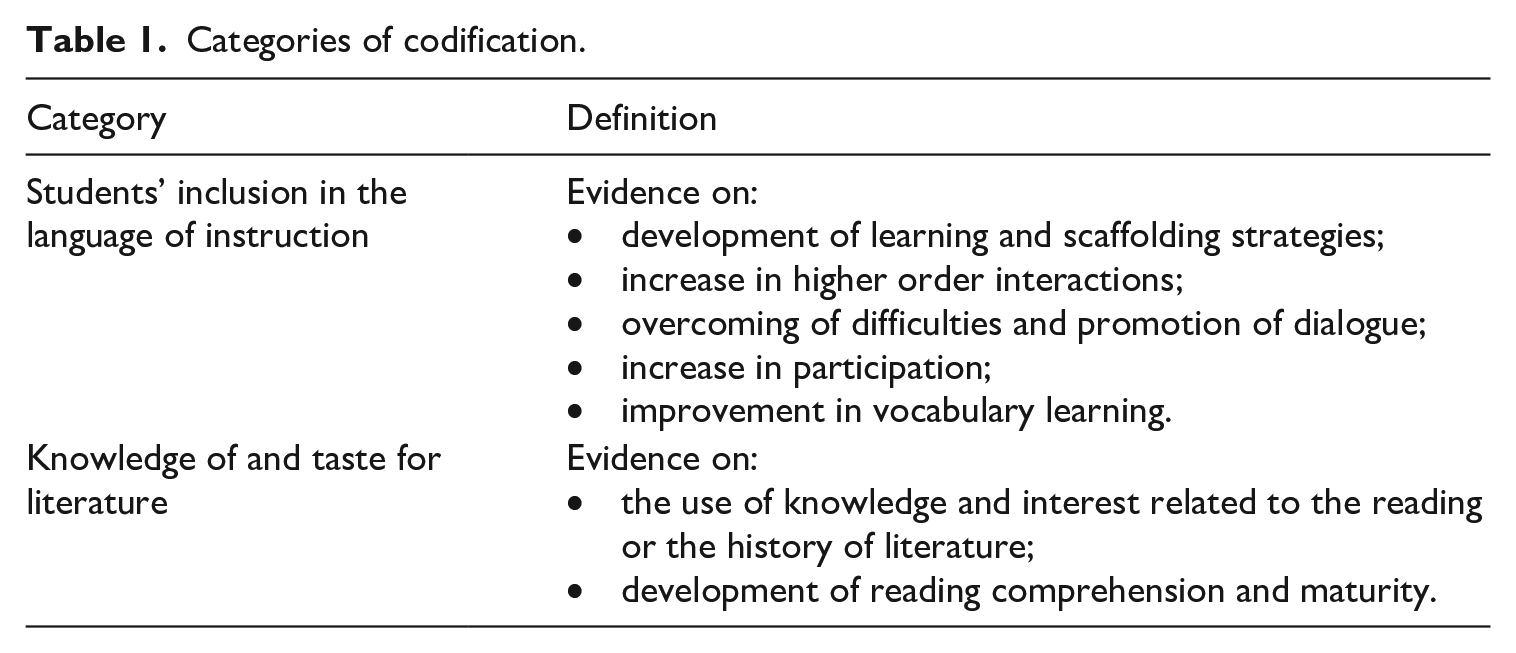
First, data was analysed deductively according to the categories defined in Table 1 and agreed by the four researchers. Subsequently, following the Communicative Methodology approach as described above, the data was re-codified under two dimensions: exclusionary and transformative, aiming at not only describing the educational context explored in the DLG but also at identifying drivers and barriers. Those categories are defined as follows:
- Transformative dimension: includes evidence that report strategies for promoting students’ interaction and inclusion in L2.
- Exclusionary dimension: includes evidence that poses barriers for students’ interaction and inclusion in L2.
Data coding of the transcripts was conducted using Nvivo software.
IV Results
The study has been able to identify some central axes of the impact of the DLG on the learners. In many schools, the language of instruction is many students’ L2, which poses a barrier for many of them to learn and understand school content due to a lack of mastery of that language, which might negatively influence their academic performance and inclusion. Along these lines, exclusionary elements emerged from the data analysed. Particularly, the teacher and the students reported difficulties in the category ‘Students’ inclusion in the language of instruction’ that appeared when doing DLG in Basque. Specifically, the interviews pointed out pupils had limited oral and written competence in Basque, including some of the pupils from bilingual families. Several limitations appeared during the interviews conducted with the teacher and the students. Eight exclusionary quotations were analysed as exclusionary, six of them reported by the teacher and two by the students. This represents the 7% of the data coded, whereas the 93% of the data was identified as transformative as presented in detail below.
Specifically, participants reported difficulties to find the proper word in Basque and communicated feeling themselves uncomfortable speaking in Basque about certain topics during the Dialogic Literary Gatherings. The reasons participants identified underlying those limitations referred mainly to a) the non-priority use of Basque in their daily interactions, b) the limited time and attention/recognition of oracy in the classroom and in the curriculum, and c) the tendency to read almost exclusively in Spanish outside school.
Nonetheless, in line with the dialogic approach of learning and, in particular, of language learning, DLG promoted interactions in L2 which facilitate students’ development of communicative skills in such language. Accordingly, transformative elements prevail in the data analysed with a total of 109 quotations, 25 by the teacher and 84 by students, that is most of the data coded (93%). Indeed, the data revealed that DLG contribute to the inclusion of all the students, regardless of their mother tongue and L2, by promoting dialogues based on support and solidarity, in which students scaffold each other through the communication and correct use of L2. Moreover, students enrich their interpretations, vocabulary and reading comprehension while discussing issues which deeply concern and move them. In what follows, we provide evidence from these transformative dimensions analysed in detail.
1 Overcoming communicative barriers: Promoting classroom dialogue and language practice together
One of the identified and characteristic threads of the DLG was the constant flow of supportive and helpful interactions between all the people involved in the dynamics. According to the teacher and the students, the discussions were spaces for testing, learning together and overcoming barriers and fears regarding communication. Participation was encouraged not only by asking students to speak, but also by creating a context with appropriate conditions for student participation to emerge, such as knowing that all voices will be heard and that the aim of the gathering is not to find the right interpretation, but to share each other’s feelings, experiences and reflections. In this sense, the teacher provided supportive interactions for the students to feel confident to speak up, as reported in the interview by herself:
So, when in a DLG, for example, they have difficulties with expression, linguistic difficulties [. . .] There are many times when they tell me: ‘I’ve done it, but it’s wrong’. I say: ‘It cannot be wrong, it’s your opinion, it’s what you have understood. So, let’s see, you can understand different things. And well, say it, and we’ll all think if . . . Something will be useful’
The egalitarian dialogue which is at the core of DLG allowed students to give their opinion and dialogue freely, while at the same time everyone felt listened to. Indeed, effective dialogue relies on contexts that encourage both real opportunities for speaking and attentive listeners who not only receive what others have said, but also participate in the conversations actively. The students emphasized, during the interview, that the DLG made a difference in that sense in comparison with regular lessons:
It is the most important thing. To be listened. Because expressing your opinion without anyone listening to you is the worst thing that you can do.
You are right.
And it happens in regular lessons. Teachers kind of ignore us. And in the DLG since it is a group, (. . .) yes, it is like a connection we have created. At the end you connect and you are heard.
I think that in the DLG we are more focused on listening to our classmates.
Yes.
At the end you have an opinion and something to add about it. Then I think so. We are more attentive to what the others say.
Hence, the dialogic interaction format of the DLG facilitated the active and collaborative participation of students in the classroom dialogues. In fact, around 60% of turns were taken by students, and 40% of the turns taken by the teacher were embedded in collaborative conversations and not in Initiation-Response-Evaluation (IRE) or Initiation-Response-Feedback (IRF) type classroom discourses.
2 Going in depth into the reading: Enriching students’ interpretations, reading comprehension and motivation
The dialogic activity observed was based on using language as a tool to share opinions about readings and co-construct the interpretation of the book by articulating contents from the book together with personal narratives, knowledge and feelings of the participants. The observed and recorded DLG sessions reflect that the students managed to understand and get into the stories offered by the book. Likewise, the students were able to compare the contexts in which the stories take place and their current daily life. The DLG also encouraged further analysis of the characters by discussing participants’ understanding of the experiences they live and their way of thinking. These discussions focused on those topics that were of most interest to the participants, as the following students’ quotes during a DLG evidence:
Well, I have to say, it’s happened to me a little bit like what happened to Emma. Not with love, but on a day-to-day basis I get bored. I mean, Emma sees that her love relationship is very boring and that it’s always the same and that nobody listens to her, and that’s what happens to me. In the day to day I get bored. I’m looking for something else, and Emma’s looking for that something else too. And she finds it in Rodolfo
Regarding what S1 said, on the one hand I can agree, but if you then put yourself in Emma’s place, [. . .] you can see that maybe she’s not so in love. Maybe she does say she’s in love, but you have to prove it every day, and saying ‘I love you’ and all that is fine, but . . .
In this regard, it should be noted that the DLG affords a space, which according to the teacher, allows students to make sense of the topics addressed in class. That makes them reflect and encourages them to take part during the class session:
And then I think it also has quite a few advantages in that they can express what they are interested in. It is always related to books, but [. . .] the reading they choose, [. . .] they take it because it has to do with their life, with their feelings, with the stage of their evolution of adolescence that they are living, with their relationships with friends, with parents, at school, or with their role in society [. . .] The book always leads us to other aspects.
It is significant to notice that the students’ motivation for sharing ideas or thoughts overcomes the barriers, difficulties or prejudices regarding their Basque language skills.
There are topics [of their lives] that [. . .] they would never have thought would be expressed in Basque or read in a book in Basque [. . .] Maybe the gatherings give them the opportunity to express themselves more freely [. . .] It’s not just about understanding the book, but about identifying with the story or with the characters or with some situation that occurs
Moreover, prejudices regarding classic literature were neutralized as the DLG sessions progressed. By reading and sharing readings of classic works translated into Basque, they became aware that they were accessing these books in practice, and that, moreover, they were having fun doing so.
When we see a classic, we think that we won’t like it [. . .] I think that a [classic] book can also hook you, just like a contemporary one [. . .] Because at the end of the day, since everyone [in the DLG] makes different comments, I think you know the work in a different way.
In the end, you connect things that instead of following the play, you get carried away and you discover even more about the play, right? It’s very good.
All the evidence provided by the students and the teacher reports that DLG enable participants to improve their reading comprehension and interpretation skills. This allows for the creation of inclusive classes in which participants work together, as the teachers points out:
Well, I think they’ve all come a long, long way. They have advanced a lot in understanding [. . .] in reading different subjects, reading different types of books and with more and more difficulty in understanding, in understanding the language . . . in understanding the narrative, but also in understanding the topics and the depth of the topics that are expressed or reflected in the different works that we have read. So, the books have been increasing in difficulty within the same academic year.
3 Mutual scaffolding
The dialogic environment facilitates participants’ mutual scaffolding such as modeling, corrective feedback, clarification and calls for reformulation. The dialogic activity makes these scaffolding dynamics easily accepted emotionally and, thus, more effectively taken into account for improving communicative skills. In the following excerpt from the interview with the students, they highlight that the DLG increased opportunities for production in L2 as well as for taking participants’ language resources as models for improving communication skills. It seems that the wide participation promoted by the DLG activated language resources derived from the students’ diverse linguistic profiles.
Because some people use a larger vocabulary than you do, and you end up picking up words. Then you say, ‘Wow, I didn’t know that word.’ Well, for the next one, I use it.
And even not only words. There are people who even in regular lessons don’t express themselves well in terms of language. They say three short words and that’s it. And here you say: ‘Wow, he spoke super well and I love it.’ And you even take the form that he spoke, that he described . . . and you say: ‘Look, I can take it too, can’t I?’ We learn from each other in the end [. . .] And we all surprise each other in the gatherings, I think.
Yes, yes. I think so.
In the excerpt below the students stress the differences between regular lessons and DLG in terms of providing corrective feedback. Although our study identified mainly scaffolding regarding vocabulary, in this excerpt S2 highlights the difference between receiving corrective feedback about the ergative, a linguistic feature of Basque, in a regular presentation, or receiving it in DLG, the latter being a format in which corrective feedback is received in an emotionally more comfortable way. Basque is an ergative language, which means that depending on whether the verb is transitive or intransitive, the subject of the verb is marked differently. Marking the subject correctly tends to be one of the challenges in the process of learning Basque L2.
And we internalize it, and by the next one [DLG session] we know it’s like that.
I would compare it perhaps to a presentation in front of the whole class. In the end, if they correct you an ergative there, you’re in front of the whole class and you say: ‘Wow, that’s bad.’ But here, at the end, you say: ‘Ah, it’s true, I failed there.’ You know it, you repeat it and that’s it. And in the end you don’t have a bad time in front of the whole class.
Maybe here it’s more fellowship.
Yes.
In the other it’s more . . . they interrupt your presentation. Here’s for helping out a little.
The dialogic space facilitates for the teacher to intervene and ask other participants to elaborate further their utterances.
I ask them: ‘I didn’t quite understand what you meant by that.’ Then they have to reformulate it. And I think it’s a way to improve, because they have to speak in the DLG. So that improves their use of language [. . .] The discussion not only depends on the student, it also depends on the teacher.
4 A space promoting the process of learning vocabulary
There are moments in which mutual scaffolding consists on providing the vocabulary required, as if classmates were walking dictionaries. In the example below, in the DLG about Cavafy’s anthology of poems, S4 asks for the translation of a word from Spanish into Basque, then two options are given, and S4 chooses S10’s option. Although S4 is still not able to make it work properly in a sentence, in the process of learning a word, this is obviously a step forward, as can be seen in the following excerpt.
And that’s why I really liked it, because it made me . . . How is it? How do you say . . . reflexio [reflection, in Spanish].
Hausnarketa [Reflection].
Gogoeta [Reflection].
An hausnarketa [Reflection]. And that’s why I found the poem beautiful.
Eta asko gustatu zait horregatik. Zeren egin didate . . . zelan da? Zelan esaten da reflexio?
Hausnarketa
Gogoeta
Hausnarketa bat. Eta horregatik polita iruditu zait poema hau.
Sometimes it is the teacher who requires students to speak in Basque, and so she promotes output in Basque. In the example below, while commenting Madame Bovary, S2 encounters a gap in her knowledge of the L2 when she wants to express the idea that one character of the book does not seem to accept things. Although she tries to pull her language resources, the utterance is mainly in Spanish, and so, as the teacher reminds, the interlanguage outcome is not contextually acceptable. At that moment, without the intervention of the teacher, S9 contributes by providing the correct word, although it is not grammatically adapted to the requirements of the situation. Then S10 provides feedback to bring the word closer to the correct usage. S2 not only notices the gap but also takes advantage of the scaffolds provided by other participants of the DLG and modifies her output, so that she adapts it to some things more situationally efficient. By doing so, she takes a step further in her language learning process. This type of production is made possible by the mutual assistance provided by DLG participants.
No. It seems no aceptar las cosas [not accepting things, in Spanish].
Eh? In Basque.
I mean, it seems to me no aceptar [not accepting] things.
Not accept.
Accepting.
Not accepting. Thank you.
Ez. Dirudi no aceptar las cosas.
E? Euskaraz.
O sea, iruditzen zait gauzak ez aceptatzea.
Ez onartu.
Onartzea.
Ez onartzea. Eskerrik asko.
This research identified new vocabulary introduced to the DLG that is not dropped out once used the first time, but it becomes a key resource to develop the conversation more efficiently. In the example below, while commenting Madame Bovary in the fourth recorded DLG session, at first S13 is not able to recall the Basque common word for future. The teacher provides a translation, but S13 together with the other participants of the DLG seems to drop out the word.
Days go by and we leave a lot behind, and then our future [future in Spanish]. . .
Etorkizuna [Future in Basque].
We’re getting ready now, and it’s a little sad because we’re leaving a lot behind. These are things that we won’t be able to have later.
However, during the 6th DLG, when the teacher re-introduces the word etorkizuna [future], it becomes the core of the conversation by being used quite frequently and by being the key to understand what they are talking about. At the same time, aurreikusi [foresee in Basque], another related word introduced by the teacher, starts to be used, although even the most proficient learners struggle with it.
The future will always happen. What we thought it will happen or maybe something else, but anyway the future will happen.
But if Caesar had seen this on the Ides of March . . . aurreikuskariaren [incorrect word standing for foresee or expectation in Basque] . . . What he could foresee [using the correct form of the word in Basque]. . .
if he had stayed home, then his future would have been to stay home, and not die. Then the future will always happen to you.
S11: But the future you were meant to have won’t happen to you
(. . .)
I don’t understand what S11 means. I mean, if the future that you were meant to finally happens . . .
T: If they tell you that tomorrow you’re going to get on a plane and have an accident and die . . .
Pues no me subo [I am not getting on, in Spanish].
V Discussion
The present study demonstrated that the DLG developed in a L2 minority language creates inclusive learning environments in which learners of diverse linguistic profiles are encouraged to participate in interactions in the target language. For this to happen, it is essential to transform the classroom into a socio-cultural context (Vygotsky, 1980, 1986) that favors dialogic and egalitarian interactions. This dialogic learning environment is in line with the perspective that prioritizes the social organization of learning, activity and quality of mediation as the most efficient way to improve the language learning process (Loewen & Sato, 2018; Long, 1981; Mackey & Gass, 2015; Van Lier, 2000). Previous research has shown that DLG was effective in creating interactive learning environments that were inclusive (Villardón-Gallego et al., 2018). Nonetheless, the inclusion of L2 learners in classrooms where their second language is that of instruction had not been reported yet.
As observed in the DLG, the egalitarian dialogues in which students engage promote the inclusion and participation of all students also in L2. This is consistent with research conducted with elementary students in L1 (English) where high rates of participations were reported (Hargreaves & García-Carrión, 2016). Indeed, this contributes to the overcoming of potential communication barriers and regardless of their linguistic profile, all students feel that they are legitimate participants in the dialogues in the target language. Learners are entitled to speak, because the DLG affords real opportunities for everyone to participate in the dialogue (Flecha, 2000). The contribution of the listeners is fundamental for the dialogic interactions to occur: in the DLG there are always people who listen to all types of speakers attentively because the listeners acknowledge and value all participants’ contributions for enriching the conversation.
Furthermore, in the DLG the interaction in the L2 does not aim at using the target language just for the sake of practicing the L2. In line with the Common European Framework of Reference for Languages (Council of Europe, 2001), the DLG is aimed at using language as an instrument to access contents, build dialogues, develop reflections and maintain social relations. The interpretation of the books is built from the present of the participants who make the literature offered by the classics their own. Participants co-construct the interpretation of the book by articulating contents from the classics with personal narrative. The experiences and the way of thinking of the characters are discussed, so that participants understand the stories, get into the book, and analyse the fictional and their own personal narratives jointly and thoroughly. Hence, by sharing reflections and thoughts in the L2, in which students receive input and produce output, DLG become an optimal space for second language learning while using the target language as a tool to read the word and the world (Freire & Macedo, 1987) and to raise students’ critical awareness (Tohidian & Taskoh, 2020). In this context, the L2 is the indispensable instrument that catalyses the synergies that originate in the DLG. The L2 is the tool used to read the book, reflect on ideas derived from the stories and from personal narratives, discuss all the emerging ideas and build all the social relations that are developed while the DLG goes on. Simultaneously, the interpretations of the books’ contents and the social relations generated in the DLG are the engine that gives life to the interactions in the target language and makes the interactions in the L2 meaningful for the participants (Flecha, 2000; García et al., 2018; Soler, 2015). Finding such meaning and usefulness in the L2 encourages the learners to continue using it in the dynamics of the DLG. Moreover, the gatherings promote the development of reading skills while fostering a taste for literature and the classics, which some of the students recognized had never appealed to them prior to participating in the DLG.
Thus, the DLG gives a specific response to the need to identify conditions that favor the most effective interactions in the L2, which is highlighted as an important objective in some of the research in the field (Mackey et al., 2012). The transformation of the participants’ socio-cultural context is the way in which the DLG creates affordances for encouraging participation in collaborative interactions in the target language. Compared to teacher-fronted lessons, previous studies found that in DLG students contribute to 80% of the classroom talk (Hargreaves & García-Carrión, 2016). In this particular context, the DLG creates conditions in which learners have more time for the use of the L2, have more interactions with more diverse types of people, and the interactions are more socially effective and rewarding. The DLG’s dialogic learning environment favors the emergence of participation and facilitates a comfortable environment for mutual scaffolding by introducing new language resources such as new vocabulary, creating constant opportunities for modeling, making corrective feedback emotionally easy, and ultimately helping students to overcome barriers, difficulties and prejudices around L2 learning.
VI Conclusions
Creating affordances so that all students have real opportunities to engage in dialogic interactions in the L2 (Basque) offers a unique opportunity for learners to make sense of the language of instruction beyond the curriculum. The DLG serve as a tool for teachers and students to transform the classroom communicative patterns so that it favors the flow of dialogic interactions that promote students’ mutual scaffolding. In our study, using DLG in Basque promotes the increase of interactions because the L2 is the fundamental tool used to co-construct the interpretation of the classics while reinterpreting the personal narratives of the participants. This is an activity that motivates the learners and encourages them to use Basque as a tool to access contents, share feelings and enriching social relations.
However, some limitations must be acknowledged. This study was only conducted to one group in a very specific linguistic context and, therefore, the results obtained may not be generalizable to other minority language or L2 learning contexts. Further research should determine whether inclusion of L2 learners in DLG is also promoted in schools where the minority language is not co-official or official. Moreover, the linguistic competency in L2 of the participants was not determined, which should also be taken into account in future research to determine the L2 learning boosted through DLG.
This study contributes evidence to a body of research on the impact of DLG in a wide array of learning, development, and transformative aspects. Several studies have shown that DLG promote inclusive spaces in which all students’ participation and listening to one another is encouraged as they connect the readings with their everyday lives, feelings and reflections (García et al., 2018; Soler, 2015). Nevertheless, no study had focused on the inclusion of students in the target language especially among Basque (L2) learners, so far. Through promoting participation and students’ scaffolding, they get to use the target language, receive corrective feedback and use it over and over until they learn its use in connection to issues of great importance in their lives. Hence, students help and support each other in using the target language and sharing reflections about some of humanity’s deepest issues that, following Bakhtin’s concept of dialogism (1981, 1986), they will carry to new communicative situations in the future.
Footnotes
Funding
The author(s) disclosed receipt of the following financial support for the research, authorship, and/or publication of this article: This research has been supported by the Spanish National Programme for Research Aimed at the Challenges of Society. Ministry of Science. Ref: EDU2017-88666-R.
