




Abstract
Drawing on positioning and sociocultural theories, this study examines heritage language (HL) and second language (L2) learners’ negotiation of linguistic expertise in mixed interactions. Through a case study of four interactions between the same HL learner and three different L2 classmates, it investigates how learners’ positioning regarding linguistic expertise shifts across interlocutors and time, shaping language learning. Data was collected at four different stages of a 10-week high-intermediate Spanish course, as learners completed four collaborative writing tasks. Posttests, a pretest, and two questionnaires were also administered. The analysis of discursive positioning showed how the HL learner initially enacted the linguistic expert position associated with his heritage status. As experiences accumulated and pre-established conceptions of expertise were contested, the HL learner came to occupy more of a peer position. The sociocultural analysis of language-related episodes confirmed that this shift resulted in more balanced interactions and enhanced opportunities for HL development.
Keywords
I Introduction
While there is general consensus that heritage language (HL) learners are better served in HL courses tailored to their specific linguistic and affective needs, in the US most heritage learners take classes alongside second language (L2) learners (Beaudrie & Marrero-Rivera, 2024; Carreira & Chik, 2018). In these mixed classes, interactions between HL and L2 learners are a common practice, intended to leverage the complementary knowledge and skills of both groups of students (Carreira, 2016) and to foster bi-directional scaffolding (Bayona, 2023). Research has confirmed that both HL and L2 learners can benefit from working together. However, it has also been consistently observed that L2 learners tend to benefit more than their HL counterparts. In mixed interactions, HL learners often find themselves providing more linguistic feedback and assistance than they receive (Blake & Zyzik, 2003; Bowles et al., 2014; Fernández Dobao, 2020b; Henshaw, 2015). Furthermore, some studies have observed that some HL learners feel frustrated with their L2 classmates’ unrealistic expectations regarding their level of linguistic expertise and note that they are being placed in an expert position that they do not necessarily enjoy (Fernández Dobao, 2020a; Henshaw, 2015, 2022). This creates an equity issue for mixed classes (see Leeman & Serafini, 2021).
Building on this previous research, Fernández Dobao (2023) examined the construction of linguistic expertise in mixed HL–L2 interactions. This study showed how HL learners were often assigned expert positions that constrained their access to the feedback and help needed for language development. When pre-established conceptions of linguistic expertise were challenged and HL students were positioned as learners, opportunities for HL development expanded. Following Fernández Dobao (2023), the current study adopts a qualitative case study approach to investigate change and development in the discursive construction of linguistic expertise across four interactions between a Spanish HL learner and three separate L2 classmates. These interactions took place at four different stages of a 10-week high-intermediate Spanish language course, as learners completed four collaborative writing tasks. The HL learner was selected as the focal participant due to the unique pattern exhibited by the four mixed interactions in which he participated. Two of these interactions, with the same L2 learner, illustrated the typical distribution of learning opportunities in mixed dyads, i.e. they benefited mostly the L2 learner; while the other two, with two different L2 learners, defied this pattern. Drawing on positioning theory (Davies & Harré, 1990), the study examines the discursive processes through which the HL learner and his L2 interlocutors negotiated expert, novice, and peer positions. Building on sociocultural theory (Vygotsky, 1978), it analyses how these positioning practices shaped learners’ production of language-related episodes (LREs), ultimately determining who benefited the most from each interaction. Shifts in positioning across interlocutors and time are investigated in relation to learners’ attitudes towards and perceptions of mixed interactions. The final aim is to ascertain how more balanced interactions, that can equally benefit both HL and L2 learners, can be facilitated in mixed classes.
II Background
1 Positioning theory
Positioning theory (Davies & Harré, 1990) draws on the concepts of position and positioning to examine the moment-to-moment construction of the self in and through conversation. A position is ‘a complex cluster of generic personal attributes, structured in various ways, which impinges on the possibilities of interpersonal, intergroup and even intrapersonal action through some assignment of such rights, duties and obligations to an individual as are sustained by the cluster’ (Harré & van Langenhove, 1999, p. 1). A central premise of the theory is the idea that positions come with rights and duties, which means that positions determine what individuals can say and do. In Harré’s (2012) words, ‘not everyone involved in a social episode has equal access to rights and duties to perform particular kinds of meaningful actions at that moment and with those people’ (p. 5). Research within this framework aims ‘to highlight practices that inhibited certain groups of people from performing certain sorts of acts’ (Harré, 2012, p. 7).
Positioning refers to the discursive process through which, tacitly or intentionally, a position is assigned, appropriated, or rejected. A key distinction is made between reflexive and interactive positioning, i.e. self- and other-positioning. Individuals may resist or reject positions interactively assigned to them in an attempt to reposition themselves. However, the range of positions available in any social encounter is contingent on context, ‘on who we are and with whom we interact’ (Kayı-Aydar, 2019, p. 22).
In language classrooms, positioning theory has been applied to examine how students position themselves and each other, and how teachers, intentionally or not, position each of their students. This allows us to understand how rights and duties are distributed in the classroom, i.e. who gets to participate in what kinds of talk. Although research from this perspective is still quite limited (see Kayı-Aydar, 2019), studies involving HL learners have exposed how discursive positioning determines who gets to be accepted, and participate, as a legitimate heritage speaker (Abdi, 2011) or how standard language ideologies underlie HL learners’ positioning as experts or novices in ‘correct’ Spanish (Showstack, 2017). Research in dual immersion settings has examined how proficiency is constructed and sometimes used to marginalize and silence less proficient students (Martin-Beltrán, 2010; Young & Tedick, 2016). Martin-Beltrán (2013), analysing positioning practices between language-minority and language-majority students in a multilingual extracurricular program, unveiled how each of the different positions enacted by her participants – experts, learners, and multilingual users – afforded different learning opportunities. Similarly, Fernández Dobao (2023), examining HL and L2 learners’ self- and other-positioning in a mixed class, noticed how learners’ positions regarding linguistic expertise contributed to either facilitate or constrain language development. The current study builds on this previous research to examine how positions and positioning acts develop and change across interlocutors and time, with the final goal of uncovering the implications of different positioning practices for language learning.
2 Sociocultural theory
The sociocultural theory of mind (Vygotsky, 1978) views learning as an inherently social process mediated by physical and psychological tools, such as language. From this perspective, knowledge is constructed through interaction between an expert and a novice, as the expert provides the scaffolding required for the novice’s development within their zone of proximal development. The expert is typically an adult or a teacher, and the novice a child or a student, but scaffolding can also occur between peers. SLA researchers have observed that L2 learners of similar proficiency levels can act as both experts and novices, taking turns to offer and receive assistance (Ohta, 2001) or collectively scaffolding each other to build new knowledge (Donato, 1994). Development occurs as learners internalize this socially constructed knowledge.
The concept of languaging, defined as ‘the process of making meaning and shaping knowledge and experience through language’ (Swain, 2006, p. 98), captures the mediating role of language in language learning. Languaging can be individual, i.e. private speech, or social, i.e. collaborative dialogue (Swain, 2000). Collaborative dialogue emerges in interaction when learners encounter language-related problems and collaborate in their solution by pooling their individual knowledge and talking them through. The LRE is the unit of analysis used to investigate collaborative dialogue. An LRE is ‘any part of dialogue where the students talk about the language they are producing, question their language use, or correct themselves or others’ (Swain & Lapkin, 1998, p. 326). Sociocultural research has shown that the lexical, grammatical, and mechanical knowledge learners co-construct in their LREs tends to be internalized and retained, thus confirming that language learning takes place through collaborative dialogue and languaging (Storch, 2002, 2008; Swain & Lapkin, 1998).
Previous research has observed that LRE production is influenced by learner-related factors, including proficiency level as well as linguistic background. Leeser (2004) first compared LREs across both mixed and matched proficiency pairings, noticing that the number and percentage of correctly resolved LREs increased with the overall proficiency of the pair. Similar results were obtained, for instance, by Basterrechea and Leeser (2019). Other studies, however, noticed that pair dynamics and patterns of interaction (Storch, 2002), influenced by learners’ perceptions of each other, often had a stronger impact on LRE production than actual proficiency differences (Kim & McDonough, 2008; Storch & Aldosari, 2013; Watanabe & Swain, 2007). All these studies examined peer interaction between L2 learners. Research involving learners from different linguistic backgrounds, i.e. HL and L2 learners, is discussed in the next section.
3 Research on HL–L2 interaction
An HL learner is a student who has been exposed to a minority language at home, from birth, and is ‘to some degree bilingual’ (Valdés, 2000, p. 1) or who has a familial and cultural connection to the language (Hornberger & Wang, 2008). Bilingual HL learners have acquired the language naturalistically, as opposed to L2 learners, who have learned it through instruction. As a result, they have stronger oral skills and more vocabulary and implicit grammar knowledge than their L2 counterparts. L2 learners, on the other hand, have more explicit grammar knowledge and are more familiar with written language conventions and formal registers. They also have higher levels of disciplinary literacy (Carreira, 2016) and are more used to focusing on form (Torres, 2018). This means that HL and L2 learners have different needs, but also complementary knowledge and skills. Therefore, in mixed classes, interactions between HL and L2 learners offer an opportunity for reciprocal learning (Carreira, 2016).
The study of language learning in mixed interactions has been approached from cognitive-interactionist and sociocultural perspectives. Blake and Zyzik (2003), for instance, analysed computer-mediated interactions between 11 Spanish HL–L2 dyads focusing on negotiation for meaning. They were the first to notice that, even though both groups of learners initiated and resolved negotiations, HL learners provided more assistance than they received. HL learners assisted L2 learners in 23 of the 30 instances of negotiation for meaning identified in the data. Subsequent research has primarily relied on the LRE as a unit of analysis. Bowles (2011) examined LRE production by nine proficiency-matched HL–L2 dyads as they completed one oral and two written tasks face-to-face. Contrary to Blake and Zyzik (2003), she observed that Spanish HL and L2 learners assisted each other with similar frequency, but with different problems. L2 learners helped with spelling and accentuation in the written task, while HL learners provided lexical and, to a lesser extent, grammatical assistance. However, Bowles et al. (2014), partially replicating this study in a classroom context, obtained different results. The analysis of 13 Spanish HL–L2 interactions during an oral spot-the-difference task revealed that most LREs were resolved by the HL learner, directly benefiting the L2 learner.
Henshaw (2015) and Fernández Dobao (2020b) investigated HL–L2 interaction during collaborative writing tasks, using a posttest design to assess learners’ retention of the lexical, grammatical, and mechanical knowledge built in their mixed interactions. Henshaw (2015) approached her study from an interactionist perspective, examining form-focused episodes, while Fernández Dobao (2020b), drawing on sociocultural theory, analysed LRE production. Both studies yielded comparable results. In most episodes, particularly those dealing with vocabulary and grammar difficulties, the HL learner assisted the L2 learner. The posttests confirmed that both HL and L2 learners tended to retain the knowledge constructed through interaction, even though Henshaw (2015) noticed that some HL learners were reticent to trust the linguistic information provided by their L2 partners.
Using posttask questionnaires, some studies have surveyed HL and L2 learners’ perceptions of each other and their mixed interactions. In Bowles et al. (2014), HL learners’ Spanish knowledge and skills were rated higher than those of their L2 classmates, while the mixed interactions were perceived as more beneficial for the L2 learner. Similar observations were recorded in Henshaw (2015) and Fernández Dobao (2020a, 2020b). In Fernández Dobao (2020a), both HL and L2 learners noticed language gains, but they were highly aware that their mixed interactions had benefited the L2 learner more. The comments made by some of the HL learners indicated that they enjoyed their expert role, which contributed to ‘reinforcing a more positive self-image of their superior cultural and linguistic knowledge’ (Blake & Zyzik, 2003, p. 541). However, others felt frustrated with their L2 classmates’ unrealistic expectations regarding their knowledge of Spanish and made it clear that they did not enjoy this expert positioning (see also Fernández Dobao, 2023). In Henshaw (2015), two HL learners admitted to feeling so uncomfortable in their expert roles that they decided to mask their abilities and avoid using words that would be unfamiliar to their L2 partners (see also Henshaw, 2022).
To sum up, the collective evidence from previous studies shows that, although both HL and L2 learners benefit from working together, L2 learners benefit more. HL learners are aware of this imbalance and while some enjoy their role as linguistic experts, not all of them do. As stated by Martin-Beltrán et al. (2020), ‘we cannot assume that all HLLs [heritage language learners] want to be the “experts” and help L2 peer “novices” ’ (p. 534). Yet, to date, only one study, Fernández Dobao (2023), has investigated what happens when the HL learner challenges the expert position assumed of them due to their heritage status. Drawing on positioning and sociocultural theory, Fernández Dobao (2023) conducted a microanalysis of three mixed interactions involving three different HL learners, and documented the direct impact of HL and L2 learners’ negotiations of linguistic expertise on LRE production and subsequent language learning. This study did not explore, however, the factors mediating the different positioning practices identified in each interaction. The current study addresses this issue by examining four interactions involving one of the HL learners in Fernández Dobao (2023) working with three different L2 classmates at four different stages of a 10-week course. It aims to unveil how different L2 interlocutors impact the HL learner’s discursive practices and moment-to-moment positioning, how these positioning practices change over time as a result of the learners’ accumulated experiences in the mixed class, and how these shifts in discursive positioning shape the nature of collaborative dialogue, ultimately determining who gets to benefit the most from each interaction. It addresses the following questions:
• Research question 1: How do the positioning practices of an HL learner during mixed HL–L2 interactions shift across interlocutors and time?
• Research question 2: How do the different discursive positionings enacted by the HL learner and their L2 interlocutors shape LRE production?
III Method
1 Setting and participants
Data for the study comes from a larger research project examining mixed interactions between Spanish HL and L2 learners (Fernández Dobao, 2020b). The HL learners (five females, three males; average age 20 years) were enrolled in a third-year Spanish HL course intended for bilingual/heritage students who could speak Spanish fluently but had received limited or no instruction in the language. Writing skills were not required. Learners had been placed in this course after completing a placement test and an interview. The L2 learners (seven females, three males; average age 21 years) were enrolled in a third-year Spanish L2 course at the same US public university. They had been studying Spanish for an average of four and a half years and had been placed in the course after completing the previous level class. Both courses were considered equivalent in level (ACTFL intermediate-high to advanced-low). They were both the first in a series of three third-year language courses and fulfilled the same requirements. Students had to take either of these two courses as a prerequisite for the Spanish major literature, culture, and linguistics courses. While both courses followed a communicative approach and aimed to develop the language skills necessary for success in upper-level major courses, the L2 course focused primarily on oral skills, whereas the HL course emphasized writing skills.
The two courses met five days per week for 10 weeks. One day per week, on Fridays, HL and L2 learners met in the same classroom and worked together as a single group, i.e. as a mixed class. The mixed interactions here analysed were collected during these Friday sessions, as learners completed four collaborative writing tasks designed to leverage their complementary knowledge and skills.
Elías, an HL learner, was selected as the focal participant. He worked with the same L2 learner, Steve, in his first and last collaborative writing task, and with two different L2 learners, Holly and Megan, in tasks two and three. His interactions with Steve followed the typical pattern of LRE distribution, i.e. most LREs benefited the L2 learner, while his interactions with Holly and Megan defied this pattern.
Elías (male, 20 years) learned Spanish and English simultaneously, from birth. Both his parents spoke Mexican Spanish, and he used ‘mostly Spanish’ at home. He had no siblings or other Spanish-speaking family members in the US. In a beginning-of-the-course questionnaire, designed to gather information about his linguistic profile and goals in the course, he rated his Spanish speaking skills as ‘good’ and his listening, reading, and, writing abilities as ‘very good’, but his English skills as ‘better’ or, in the case of writing, ‘much better’ than his Spanish skills. Elías had taken Spanish language classes in high school, but this was his first quarter studying Spanish in college. His goal, as stated in his questionnaire, was ‘to eventually speak Spanish at the same or better level than my English’ and to major in Spanish.
Steve (male, 39 years) was a graduate student and therefore older than his classmates. English was his first language (L1). This was his fifth quarter studying Spanish in college. He had also completed a 3-week study abroad program in Spain and taken Spanish classes in high school. Steve had just received a one-year fellowship to study Spanish, as his doctoral dissertation required ‘extensive research in Spain.’ In his beginning-of-the-course questionnaire, he also indicated that his goal was ‘to improve as much as possible in the coming year.’
Holly (female, 19 years) was an L1 English speaker. She had studied Spanish for four years in high school and this was her fourth Spanish language course in college. Her plan was to major in International Studies with a minor in Spanish. In her questionnaire, she also mentioned: ‘I enjoy learning the language and would like to become proficient in it.’
Finally, Megan (female, 21 years), also an L1 English speaker, had studied three years of Spanish in middle school, three years in high school, and one year in college. Her goal was to minor in Spanish and she was planning on studying abroad the following quarter: ‘I want to set myself up for studying abroad in Ecuador during winter quarter.’
At the beginning of the course, all learners completed an individual writing task intended as a pretest. The prompt for this task, like those for the four collaborative writing tasks, was directly related to the autobiographical novel Cajas de Cartón, by Francisco Jiménez (see Appendixes A and B). Students had to read one chapter of this novel per week. The individual writing task was completed in class after discussing the first chapter of the novel. All learners were given the same amount of time, approximately 15 minutes, and instructed to write their texts by hand, without using dictionaries or any other aids.
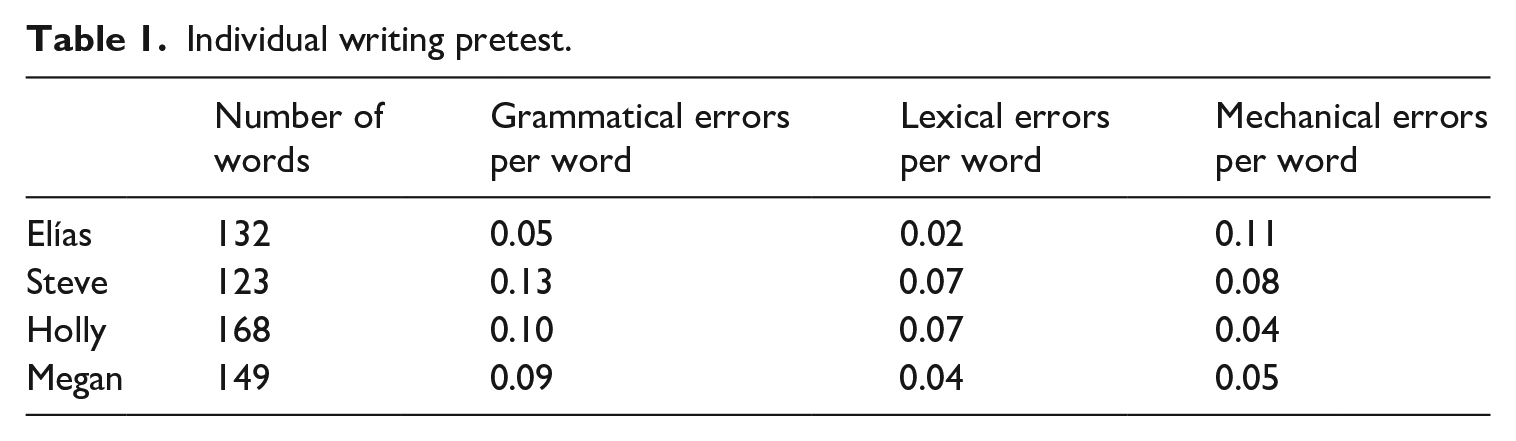
Since previous research has observed that, in mixed dyads, HL learners tend to help with vocabulary and grammar, while L2 learners assist mostly with spelling and accentuation (e.g. Bowles, 2011; Fernández Dobao, 2020b; Henshaw, 2015), the individually written texts were analysed for lexical, grammatical, and mechanical accuracy. As shown in Table 1, the HL learner made fewer grammatical and lexical errors than the L2 learners, but more mechanical ones, thus confirming the complementarity of the HL and L2 learners’ weaknesses and strengths as described, among others, by Carreira (2016). Differences were also observed between Steve and the other two L2 learners. He wrote a shorter and linguistically less accurate text than both Holly and Megan.
Individual writing pretest.
2 Instruments and procedure
Data were collected throughout the 10-week course. In the first week, in addition to the pretest, all learners completed a beginning-of-the-course questionnaire designed to gauge their attitudes towards pair work, collaborative writing, and mixed classes. It also included linguistic background questions.
From week 2 to week 8, learners completed the four collaborative writing tasks. Collaborative writing involves two or more learners working together to produce one joint text. Learners share ownership of the text, which pushes them to talk about the language they are using and to collaborate in solving their language-related problems. In this way, collaborative writing encourages collaborative dialogue (Storch, 2013).
The four tasks in this study were similar in format and content, and all followed the same instructions. Learners had 15 minutes to write a short opinion text (100–150 words). The prompts were tied to the novel the students were reading, Cajas de Cartón, and therefore addressed issues of immigration directly related to the Latinx experience in the US (see an example in Appendix B). Instructions emphasized learners’ shared responsibility for the linguistic accuracy of the text. To avoid the use of automatic spell-checkers and online writing tools, all texts were handwritten.
Each writing task was followed by an individual tailor-made posttest. Three to four days after the collaborative writing activity learners received a typed copy of the text they had written in pairs. The text had been altered to include fill-in-the-blank and multiple-choice items targeting the vocabulary, grammar, and spelling issues discussed in a subset of their LREs (see Appendix C).
Finally, in week 10, learners chose to complete an end-of-the-course written questionnaire or an oral interview. Both included the same combination of closed and open-ended items. Learners were asked to reflect on the collaborative writing activities and the overall experience of working in mixed dyads (for full details, see Fernández Dobao, 2020a). Steve chose the interview, while Elías, Holly, and Megan completed the written questionnaire. 1
3 Data analysis
The audio-recorded interactions between Elías and his L2 classmates as they completed the four collaborative writing tasks constitute the main source of data for the study. Each interaction was analysed for positioning acts and LREs. Applying grounded theory methods (Corbin & Strauss, 2008), I conducted a micro-analysis of moment-to-moment discursive positioning. I focused on both reflexive and interactive positioning. Through iterative rounds of analysis, I identified key moments in which learners accepted and enacted, or resisted and rejected, the linguistic expert or novice positions assigned to them, as well as intentional or unintentional acts of other-positioning.
Following Swain and Lapkin (1998), I looked for those segments of interaction where learners talked about language, questioned their language use, or corrected themselves or others. The LREs thus identified were classified as either lexical, grammatical, or mechanical based on their focus, and as successfully or unsuccessfully resolved based on their outcome. I also identified the trigger and the solver of each episode. The trigger is the learner who notices the gap or makes the error that initiates the LRE, while the solver is the learner who offers the knowledge to solve it. Since the LRE addresses a language problem experienced by the trigger, the trigger benefits the most from it.
Learners’ responses to the tailor-made posttests were analysed for evidence of retention of the knowledge built in the successfully resolved LREs. Retention was documented when, in the posttest, the trigger used the language agreed upon in the LRE, and lack of retention when they did not.
Finally, the beginning- and end-of-the-course questionnaires and interview were examined. Data from these questionnaires, on learners’ attitudes and perceptions of the work completed in mixed dyads, were used to support the analysis of oral interactions, i.e. of learners’ positioning practices and LRE engagement.
IV Findings
Interaction 1: Elías and Steve
The first collaborative writing task, between Elías and Steve, was completed in week 2. Both learners were highly engaged in the task, producing a total of 276 turns and 1,221 words. The amount of talk was evenly distributed, with Elías producing 49% of the words and Steve 51%. Elías volunteered to write down the text.
Drawing on positioning theory, I analysed Elías and Steve’s discursive positioning in this first interaction. This analysis revealed that both Elías and Steve conformed to, and reinforced, pre-established conceptions of how linguistic expertise is distributed in mixed dyads. Steve self-positioned as a novice, with limited language knowledge, while simultaneously positioning Elías as an expert. Elías accepted and enacted this linguistic expert position assumed of him due to his heritage status.
Throughout the interaction, Steve displayed his linguistic insecurity. Hesitations, false starts, repetitions, and pauses were frequent in his speech. He often struggled with language and verbalized his language-related problems, asking directly or indirectly for Elías’s help. When contributing to the text, he mitigated his suggestions with hedges and rising intonation. This hesitant stance contributed to his positioning as the less competent member of the dyad. Turn 1 in Excerpt 1 illustrates some of these discursive practices (see transcription conventions in Appendix D).
Excerpt 1 1 Steve: nosotros pensamos que (.) que: (.) los: padres: (.) ya creían? que Torito (.) e:h (.) va a muer-, va a morir (we think that the parents already believed that Torito is going to die) 2 Elías: i- iba a morir (was going to die) 3 Steve: iba a morir? 4 Elías: mhm 5 Steve: iba a mo- a morir (.) e:h 6 Elías: los padres (.) pensaban (the parents thought) 7 Steve: sí, pensaban, pensaban (yes, they thought) 8 Elías: mhm (.) que: Torito (.) se iba: a morir? (that Torito was going to die) 9 Steve: se iba a morir
Elías accepted most of Steve’s contributions, but editing them for linguistic accuracy, thus advancing his self-positioning as an expert and the L2 learner’s positioning as a novice. In Excerpt 1, for instance, he corrected Steve’s use of the present tense verb ‘va’ (he goes) (turn 2). He then changed ‘creían’ to ‘pensaban’ (they were thinking), even though both verbs functioned here as synonyms (6). Finally, he added ‘se’ to ‘iba a morir’ (was going to die), which was grammatically correct but unnecessary in this context (8). Steve relied on Elías’s linguistic expertise and accepted his suggestions without questioning, repeating his words verbatim in what seemed a conscious attempt to internalize the input received (3, 5, 7 and 9). In essence, in Excerpt 1 we see Elías exerting his ‘right’ as the linguistic expert to fix Steve’s language, and Steve fulfilling his ‘duty’ as the novice to accept Elías’s corrections, a frequently repeated pattern in their interaction.
Elías’s expert position granted him the right to act as a teacher, which in turn contributed to reinforce his positioning. On several occasions, Elías evaluated Steve’s language and praised his work with comments like ‘exactamente’ (exactly) or ‘muy bien’ (very good). In Excerpt 2, we see him probing Steve. Instead of correcting the L2 learner’s use of the past tense, he guided him to notice his error and repair his utterance, like a teacher, not a peer, would do.
Excerpt 2 1 Steve: iba a: (.) ayudarlo iba a salvarlo no? (he was going to help him to save him, wasn’t him?) 2 Elías: mhm (.) mhm (.) entonces (.) en el presente? en el tenso (.) presente? (so in the present? in the present tense?) 3 Steve: oh! sí (.) e:h (yes) 4 Elías: el santo: (the saint) 5 Steve: el santo (.) eh el santo va: (the saint is going to) 6 Elías: mhm 7 Steve: a salvar (to save) 8 Elías: exactamente (.) uh-huh (exactly)
As the linguistic expert, Elías tried to solve his problems on his own. In Excerpt 3, struggling with the present subjunctive of the verb ‘ver’ (to see), we see him verbalizing his thinking (turns 6 to 14) and using writing as a mediating tool (10) to eventually solve the problem successfully. His comment in turn 12, ‘hasta yo tengo que pensar’ (even I have to think), could only be made from an expert position, that of a learner who assumes he should not ‘have to think’ to help their L2 classmate. It uncovers the pressure felt by Elías to perform at a higher level than Steve, i.e. as the expert.
Excerpt 3 1 Steve: no quiero que: (.) that you see him die? no quiero que: e:h (I don’t want that) … 6 Elías: okay, tenemos que hacerlo en el subjuntivo? (we must do it in the subjunctive) 7 Steve: sí (yes) 8 Elías: entonces, no quiero (so, I don’t want) 9 Steve: no quiero que: (I don’t want that) 10 Elías: escribo aquí (.) no: (.) quiero (.) que:* (I write here, I don’t want that) 11 Steve: que: viste:? (.) lo viste morir? viste:? [heh morir no (that you saw- 12 Elías: [uso el verbo uh-huh, hasta yo tengo que pensar, (I use the verb, even I have to think) 13 Steve: sí (yes) 14 Elías: yo tengo que ver, (.) oh!, no quiero que ver (.) okay, (.) veas (.) creo que así se dice (.) [el subjuntivo (I need to see, I don’t want to see- 15 Steve: [sí, sí, no es pasado, sí (yes, it is not the past) 16 Elías: mhm (.) okay, no quiero que veas (I don’t want you to see) 17 Steve: no quiero que veas * Elías writes down: no quiero que ver / veas.
In his beginning-of-the-course questionnaire, Elías displayed a positive attitude towards pair work, whether in matched or mixed dyads, but was concerned that differences in proficiency level with his L2 classmates could create challenges: ‘The only real challenge I foresee at this point is the issue of being partnered up with a student that is not at a level proficient.’ In his interaction with Steve, these differences became evident, which helps to explain his self-positioning as an expert. Steve also showed a positive attitude towards pair work but made it clear he did not see himself as a peer to his HL classmates. He referred to them as ‘native speakers’ who ‘provide a better example to imitate.’ He specifically said: ‘I would expect the exchange to be lopsided: I think it may be quite a pain for the heritage speakers to wait for us to try to formulate intelligible sentences. I understand the principle of how we might improve their learning experience too, but I find it hard to believe the second language speakers won’t benefit more.’ This belief manifested itself in his interaction with Elías, underlying his active self-positioning as a novice, expected to receive but not necessarily offer help.
Figures 1 and 2 present the results of the LRE analysis. Most LREs, 15 out of 19, were triggered by Steve, i.e. they addressed a linguistic difficulty or knowledge gap of the L2 learner. The four LREs triggered by Elías were successfully resolved, three of them by Steve, thus confirming that Elías also benefited from working with Steve. However, overall, Steve benefited more. Fourteen of his LREs were successfully resolved, eight of them with Elías’s help. The posttest revealed that Steve retained the knowledge built in 75% of these LREs, and Elías in two of the three successfully resolved LREs included in his posttest. These findings show that language learning took place, but also that Steve benefited from his novice position, while Elías’s expert position limited his opportunities for language learning.
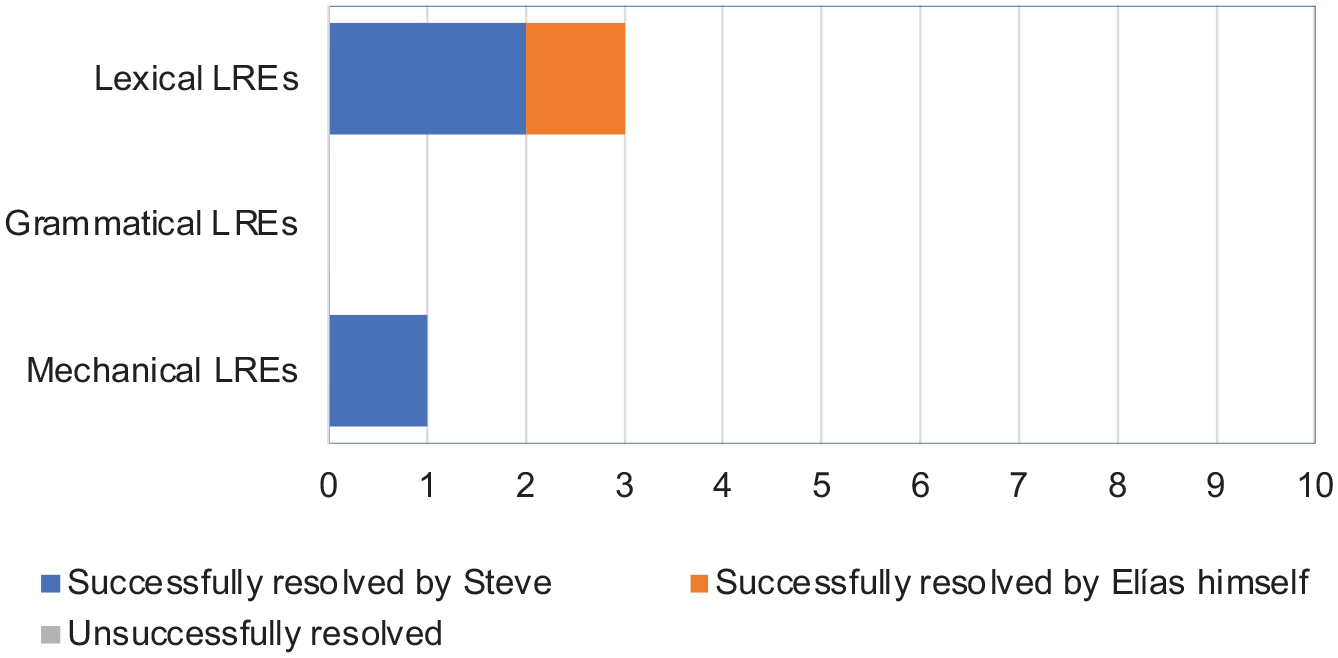
Language-related episodes (LREs) triggered by Elías, working with Steve.

Language-related episodes (LREs) triggered by Steve, working with Elías.
Interaction 2: Elías and Holly
In week 3, Elías worked with Holly on the second collaborative writing task. They were highly engaged and contributed very similar amounts of talk. Elías produced 158 turns and 816 words, and Holly 157 turns and 806 words. The L2 learner volunteered to write down the text.
The positioning analysis of Elías and Holly’s interaction revealed a more confident L2 learner than Steve. Holly shared her knowledge gaps and asked for Elías’s help, but also did not hesitate to offer linguistic feedback and even rephrase Elías’s contributions. While Steve accepted and repeated Elías’s words, Holly often suggested alternative wordings, thus positioning herself as a peer rather than a novice. At first, Elías enacted the same expert position he had previously occupied with Steve. Intentionally or not, he positioned Holly as a less competent interlocutor by repeatedly questioning her linguistic expertise. However, he changed his stance as the conversation progressed, accepting Holly as a peer while simultaneously positioning himself as a co-learner.
Excerpt 4 illustrates Elías’s initial self- and other-positioning. In turn 1, he used the word ‘anticuado’ (antiquated) but soon questioned its accuracy (3), openly recognizing a lexical hole, ‘no sé cómo, cuál es la palabra’ (I don’t know how, what the word is) (5). He seemed to be downgrading his epistemic stance and asking for Holly’s assistance, but in fact he was just thinking out loud while trying to solve the problem on his own. When Holly tried to help (2, 4 and 6), Elías ignored her. Instead, he suggested consulting a dictionary (7). In turn 12, Holly insisted on the accuracy of ‘anticuado’. Elías first accepted Holly’s input, ‘mhm’ (13), but immediately asked the teacher for confirmation (15), thus questioning again Holly’s feedback. The teacher’s response ratified Holly’s linguistic expertise (19), positioning her as a trustable source of knowledge.
Excerpt 4 1 Elías: ilegales? (.) es: un término: (.) an-ti-cuado? (illegals? is an antiquated term?) 2 Holly: sí (yes) 3 Elías: or cómo se dice? cómo antiquated? (how do you say it? like) 4 Holly: anticuado 5 Elías: no sé cómo:, cuál es la palabra heh (I don’t know how, what’s the word) 6 Holly: pienso que es (I think that it is) 7 Elías: mhm (.) voy a buscar (I am going to look it up) … 12 Holly: pienso que anticuado (I think that antiquated) 13 Elías: mhm 14 Holly: e:h 15 Elías: profesor (.) se puede decir anticuado? (teacher can we say antiquated?) 16 Teacher: se puede decir? (can we say?) 17 Elías: esta palabra? anticuado? (this word? antiquated?) 18 Holly: anticuado 19 Teacher: sí (yes) 20 Elías: okay
As the interaction progressed, the roles of expert and novice became fluid, with both learners offering and receiving linguistic feedback, thus positioning themselves and each other as peers. In Excerpt 5, Elías checked for Holly’s confirmation of the word ‘convivencia’ (coexistence) (1). Contrary to what we saw in the previous segment, he immediately accepted her feedback, ‘mhm’ (3), thus recognizing her linguistic expertise.
Excerpt 5 1 Elías: no, no van a querer convivir (.) convive:n-cia (.) convivencia? (they will not want to coexist, coexistence?) 2 Holly: sí heh (yes) 3 Elías: mhm, menuda palabra! (what a word!)
In Excerpt 6, Holly questioned Elías’s vocabulary use (8, 10). Elías accepted her questioning which, after some negotiation, led them to agree on the use of ‘confidencia’ (secret, confidence) instead of ‘confianza‘ (trust, confidence), even though the latter was the appropriate term in this context. In the posttest, both Elías and Holly used ‘confidencia’, which confirms that Elías internalized the feedback provided by Holly and shows that he trusted her language knowledge.
Excerpt 6a 1 Elías: mi: confianza (my confidence) … 8 Holly: sí? confianza? 9 Elías: la con- (.) confianza 10 Holly: no [confianza es trust (no, confidence is) 11 Elías: [or (.) confidencia, mhm (confidence/secret) 12 Holly: confiencia? (confidence/secret?) 13 Elías: confidancia (confidence/secret) 14 Holly: confidancia!? 15 Elías: mhm Excerpt 6b 1 Elías: creo que es así confi-den, confidencia (I think it is confidence/secret) 2 Holly: confidencia 3 Elías: mhm
In her beginning-of-the-course questionnaire, Holly described pair work as an opportunity to help and be helped, and collaborative writing as a site to give and receive feedback, which aligns with her performance in this task. Like Steve, she also referred to HL learners as ‘native speakers’. She expected them to have ‘much higher speaking abilities’ and felt it would be ‘difficult to converse … without feeling somewhat intimidated.’ In her interaction with Elías, however, she presented herself as a confident and assertive student. In her end-of-the-course questionnaire, she still saw her HL classmates ‘at a much higher speaking level’ but did not find ‘any significant difficulties or challenges in working with them.’ In line with what we observe in this interaction, she thought that she and her HL partners ‘usually contributed a roughly equal amount to the task. Our ideas were mostly collaborative and we’d both correct the other at times,’ even though she was aware that she ‘probably gained the most.’
As shown in Figures 3 and 4, Elías and Holly generated a relatively high number of LREs. Contrary to what we saw in Elías and Steve’s interaction, these LREs were quite evenly distributed. Thirteen LREs were triggered by the L2 learner and 10 by the HL learner. Most of Holly’s LREs were successfully resolved, four by herself and seven with Elías’s help. Holly retained the knowledge built in six of the eight successfully resolved LREs included in her posttest. Most of Elías’s LREs were also successfully resolved, three by Holly, one by the teacher, and four by Elías himself. Elías retained the knowledge built in half of the successful LREs included in his posttest. Elías still offered more help than he received, but overall benefited more from working with Holly than with Steve. By positioning themselves and each other as learners and therefore peers, with knowledge to gain and to share, Elías and Holly generated more balanced learning opportunities.

Language-related episodes (LREs) triggered by Elías, working with Holly.
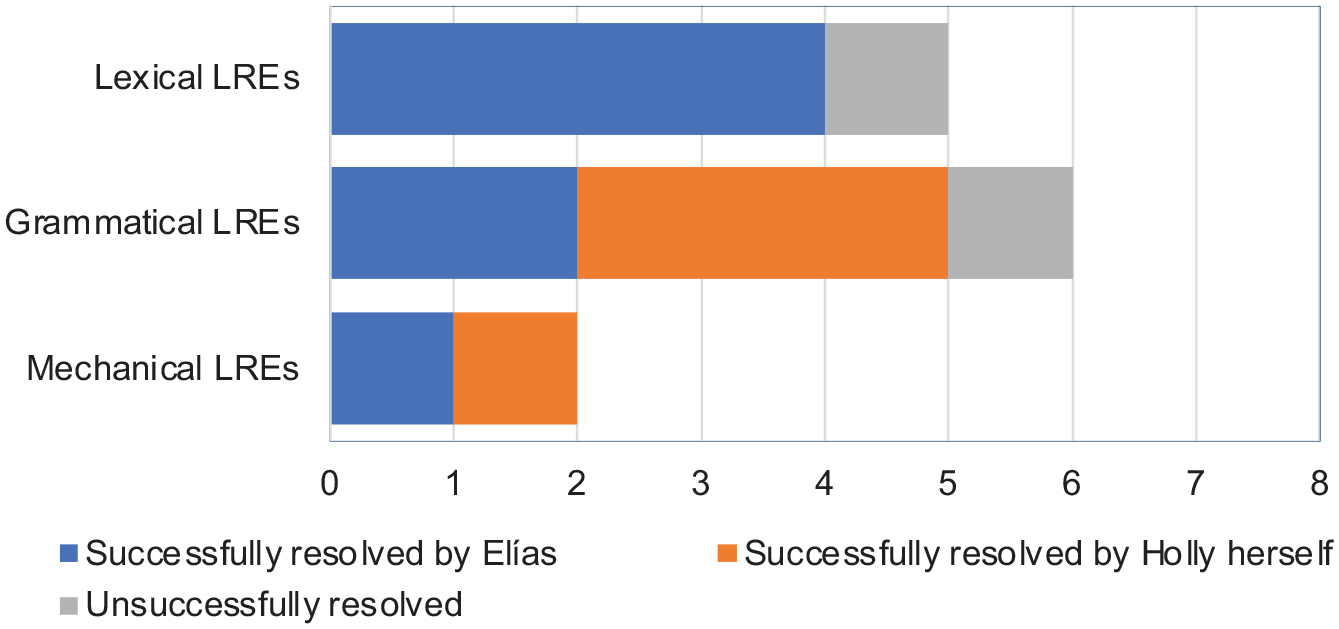
Language-related episodes (LREs) triggered by Holly, working with Elías.
Interaction 3: Elías and Megan
In the third collaborative writing task, completed in week 6, Elías worked with Megan. Although both learners were quite engaged, producing a total of 248 turns and 1,112 words, their talk was not as evenly distributed as in the previous two tasks. Elías talked more, producing more than 60% of the words. Megan, however, volunteered to write down the text.
The analysis of Elías and Megan’s interaction through a positioning lens showed a very confident L2 learner, who actively self-positioned as a peer to her HL classmate. Elías contributed to Megan’s positioning by self-positioning as a non-expert, i.e. a learner and therefore a peer to Megan. They worked as equals throughout the entire activity (see also Fernández Dobao, 2023).
Elías often downgraded his epistemic stance by mitigating his statements with rising intonation, modal verbs, and hedges like ‘I think’, ‘me parece’ (it seems to me), or ‘I guess’. He acknowledged his gaps with explicit comments like ‘I don’t know’ or ‘no sé’ (I don’t know) – Excerpt 7, and repeatedly asked for Megan’s help with direct and indirect appeals for assistance – Excerpt 8. His hesitations, repetitions, false-starts, and use of English, as illustrated in the following two segments, also contributed to his positioning as a learner.
Excerpt 7 1 Megan: cómo: cómo se dice road sign? (how do you say?) 2 Elías: lo- (.) mhm mhm e:h (.) un señal de: (.) la calle, I don’t know (.) mm: I don’t know (.) can we ask? (a sign from the street,) Excerpt 8 1 Elías: mhm que representa: (.) como: (.) lleguen a veces (.) how would you say that? (.) mmm (that represents how sometimes they arrive)
Megan answered Elías’s questions with confidence and did not hesitate to correct him when noticing lexical – Excerpt 9, grammar – Excerpt 10, or spelling mistakes, but rarely asked for help for herself. Contrary to what we saw with Holly, Elías never questioned Megan’s linguistic expertise. He accepted her feedback without hesitation, as illustrated in Excerpts 9 (turn 5) and 10 (5 and 7). Throughout the interaction, he accepted and positioned Megan as a knowledgeable interlocutor.
Excerpt 9 1 Elías: bloquear (.) la: ent- la: en- entranza (block the entrance) 2 Megan: okay (.) bloquear (to block) 3 Elías: I think 4 Megan: la entrada? (the entrance?) 5 Elías: la entrada uh-huh Excerpt 10 1 Elías: okay (.) el segundo i- el segundo imagen (the-MASCULINE second-MASCULINE image) 2 Megan: hm hm 3 Elías: podemos empezar a escribir también (.) sobre esa (.) mm (we can also start writing about that) 4 Megan: la: segunda imagen? (the-FEMININE second-FEMININE image?) 5 Elías: uh-huh (.) segunda? porque es fe- femenina? (second-FEMININE? because it is feminine) 6 Megan: yeah
Contrary to Steve and Holly, Megan did not display a positive attitude towards pair work or collaborative writing in her beginning-of-the-course questionnaire. She said: ‘I like working on my own the best’ and ‘I enjoy writing by myself the best because writing is one of my strengths. I find it difficult when writing in small groups to refrain from correcting everything the other people write down.’ Furthermore, she viewed the work with her HL classmates as an opportunity to improve her speaking skills, not necessarily her writing or grammar: ‘They don’t necessarily have to be a strong writer, because what I need to work on the most is speaking … I will be able to pick up on the natural flow of the language instead of just concentrating on grammar.’ It should be noted, however, that her attitude changed throughout the course. In her end-of-the-course questionnaire, when asked whether she would have preferred to write alone, she answered: ‘I would have initially, because I find that in group projects I typically do most to all of the work. I liked this activity though, and I’m glad I didn’t do it individually because I learned a lot from my partners.’
Megan’s attitude towards collaborative writing explains why she did not openly seek for Elías’s help with grammar and vocabulary, as Steve and Holly did, but instead asserted her linguistic expertise and positioned herself as a knowledgeable peer. As a result, her interaction with Elías benefited mostly the HL learner. Elías triggered 12 LREs, six lexical, five grammatical, and one mechanical, while Megan triggered only five LREs, none of them focused on grammar. Most of Elías’s LREs, eight, were successfully resolved. One episode was solved by the teacher, three by Elías himself, and the remaining four by Megan. Elías retained the knowledge built in seven of these eight LREs. As for Megan’s LREs, four were solved by Elías. Three of these LREs were included in the posttest. Megan retained the knowledge built in two of them. This means that Elías provided as much help to Megan as he received from her, even if, overall, Elías benefited more from their interaction (Figures 5 and 6).
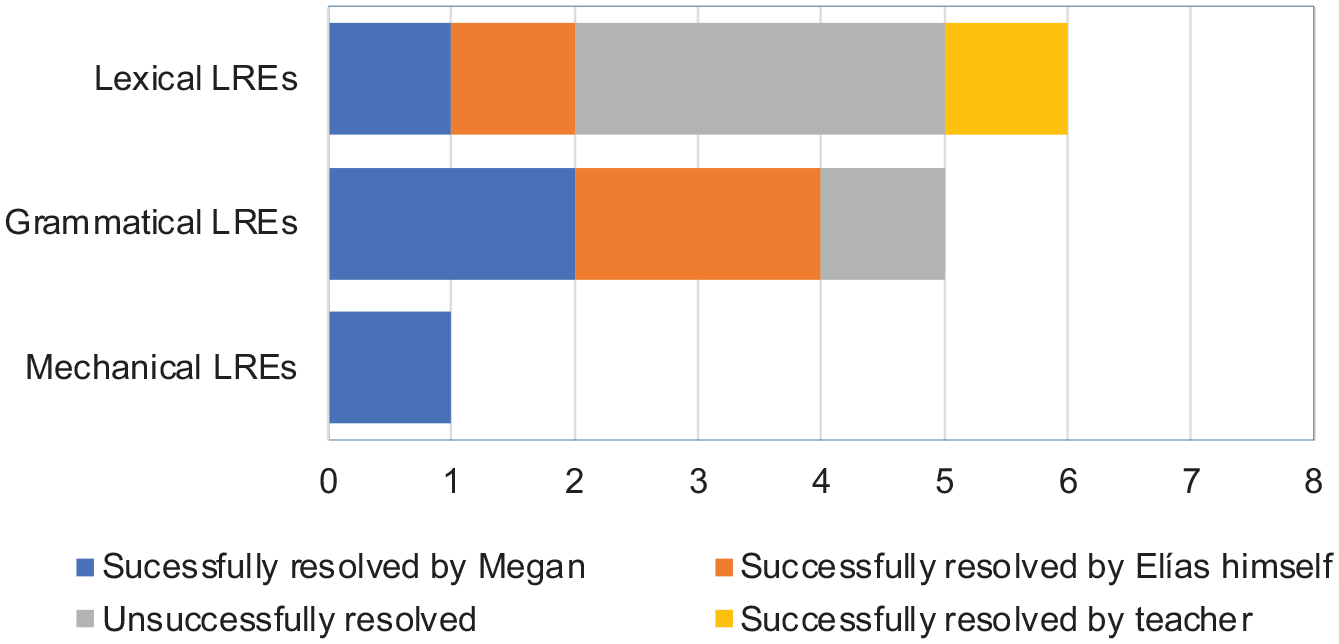
Language-related episodes (LREs) triggered by Elías, working with Megan.
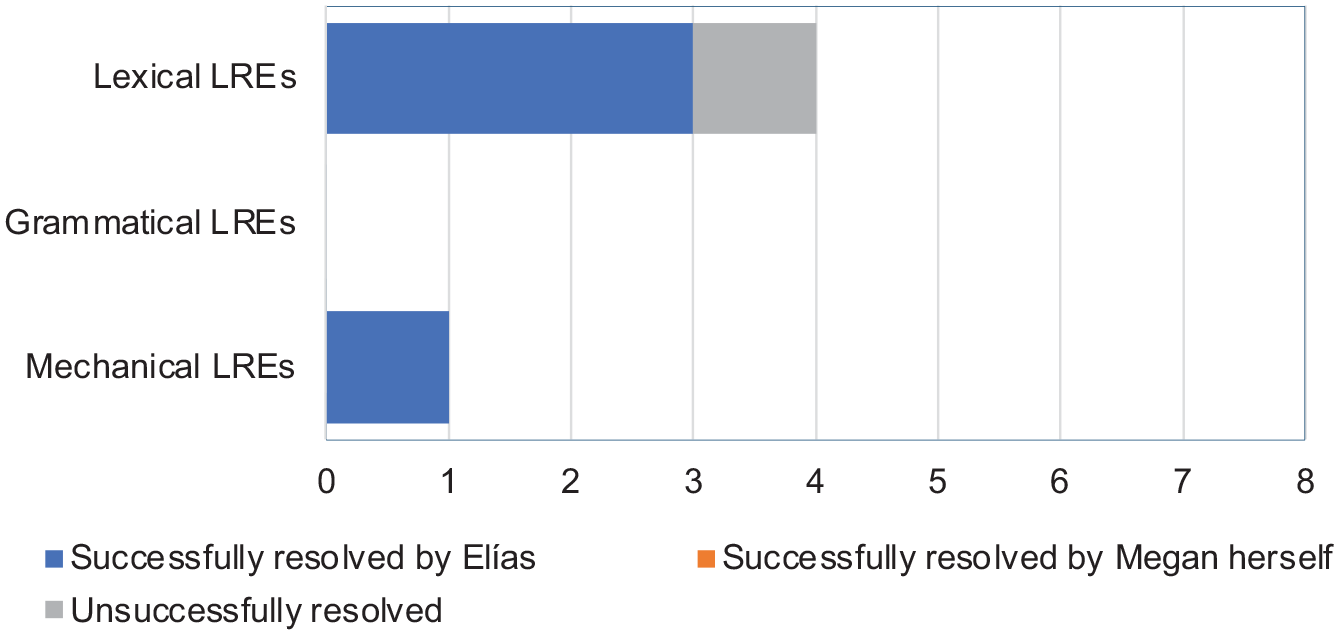
Language-related episodes (LREs) triggered by Megan, working with Elías.
Interaction 4: Elías and Steve
The final collaborative writing task was completed in week 8. Elías worked with Steve again, but this time Steve wrote down the text. As in their first interaction, they were highly engaged in the task and talk was very evenly distributed. Elías produced 687 words and Steve 638.
The positioning analysis of this fourth interaction showed some shift in both learners’ discursive practices. Steve was more assertive than in week 2. He portrayed himself as a more confident learner, answering language-related questions and offering linguistic suggestions, something that Elías noticed and commented upon in his end-of-the-course questionnaire. Elías also adopted a less assured approach, downgrading his epistemic stance and asking for Steve’s help on several occasions. However, Elías ended up offering more help than he received and assuming responsibility for most linguistic decisions, thus being positioned, again, as an expert.
Excerpt 11 shows Elías questioning his own language use. He changed ‘hablando’ (speaking) (1) to ‘quejando’ (complaining) (19), which he then rejected in turn 23. Steve contributed actively to the episode, suggesting ‘mandando‘ (commanding) (40) and ‘exigir’ (to demand) (42). Yet, in the end, the two learners agreed on the use of ‘dictando’ (dictating), a term suggested by Elías (47).
Excerpt 11 1 Elías: esta persona (.) que está hablando es (this person who is talking is) … 18 Steve: hablando? (talking?) 19 Elías: quejando (complaining) 20 Steve: que:jando!? 21 Elías: mm pues se pue-, se puede decir quejar (you can say to complain) 22 Steve: quejar 23 Elías: mm or: no, no, no quejar 24 Steve: no!? 25 Elías: en este instancia quejar significa: complain (in this instance ‘quejar’ means) 38 Steve: u:h! 39 Elías: mm: 40 Steve: está: mandando? [está:? (he is mandating?) 41 Elías: [hay una palabra, mhm (there is a word) 42 Steve: o: como e- exig- exigir? es mejor? o (or like to demand? is it better? or) 43 Elías: se puede decir eso uh-huh (you can say that) 44 Steve: sí? (.) exigido? está exigido:? e:h el escritor? (yes? demanded? is demanded? the writer?) 45 Elías: mm 46 Steve: no? o que de-, que está hablado, hablando (or he is talked, talking) 47 Elías: la: la persona que: (.) está dictando (the person who is dictating) 48 Steve: ah! está dictando 49 Elías: uh-huh 50 Steve: está dictando
In Excerpt 12, Elías openly acknowledged that he did not know whether ‘demográfica’ (demographic), a word he had previously introduced in the conversation, was correct (2 and 4). Steve could not help with this term but was able to offer a recast of ‘en este país’ (in this country) (11). He edited Elías’s words, something we never saw in his first interaction.
Excerpt 12 1 Steve: una demográfica (a demographic) 2 Elías: no sé si: esa palabra es: (I don’t know if that word is) 3 Steve: heh 4 Elías: la correcta, pero heh (the correct, but) 5 Steve: pero:, vale [eh demo: (.) gráfica (.) gráfica (but it works) 6 Elías: [uh-huh, es un poco lógico (.) uh-huh (it’s a little logic) 7 Steve: e:h 8 Elías: mm 9 Steve: de e e u u? (from the US?) 10 Elías: mhm (.) o: en este país? (or in this country?) 11 Steve: de? de este país? (from this country?) 12 Elías: de este país, mhm
Throughout the interaction, however, Steve struggled with language more often than Elías and subsequently initiated more appeals for assistance, which contributed to his overall positioning as a less competent interlocutor. Elías’s position as the expert is evident in Excerpt 13. In turn 1, Steve questioned the grammatical gender of ‘actitud’ (attitude). He initially chose to use ‘actitud’ with the feminine determiner ‘esta’ (this-FEMININE) (7), but finally crossed ‘esta’ and wrote ‘este’ (this-MASCULINE) when Elías indicated that ‘este actitud’ was the correct form (10 and 12). Elías enacted the linguistic expert position, which granted him the ‘right’ to make the final decision, even though ‘actitud’ is in fact feminine.
Excerpt 13 1 Steve: sí (.) e:h sí (.) ese: (.) actitud? esa actitud? o esTA actitud? (yes that-MASCULINE attitude? that-FEMININE attitude? or this-FEMININE attitude) … 7 Steve: esta ac-ti:- 8 Elías: el actitud, la actitud (the-MASCULINE attitude, the-FEMININE attitude) 9 Steve: actitud 10 Elías: este actitud, I think (this-MASCULINE attitude) 11 Steve: este? 12 Elías: uh-huh este 13 Steve: este actitud
Elías’s perception of mixed interactions changed throughout the course, as his experiences with his L2 classmates accumulated. In his end-of-the-course questionnaire, he assessed his L2 interlocutors’ proficiency level as ‘lower than mine’, but no longer saw it as a problem and believed that the ‘potential to learn was always there.’ He was able to identify gains in vocabulary, grammar, and writing skills, and recognized that he and his L2 classmates had ‘both benefited’ even if ‘typically my partner extracted a little bit more.’ He specifically said: ‘I worked to assist and be assisted by my peers.’ Steve still had difficulty seeing how his HL classmates could benefit from working with him. Interestingly, in his end-of-the course interview he mentioned that he had felt particularly comfortable working with Elías and thought they had ‘got a little better with doing the specific task.’
The distribution of LREs in Elías and Steve’s final interaction reflects the shift in the way the two learners enacted their expert and novice positions. Although most LREs (16 out of 24) were triggered by Steve, Elías triggered a considerably higher number of LREs than in their first interaction. However, most of Elías’s LREs, five, were resolved by Elías himself and only one by Steve. Four of these LREs were included in the posttest and evidence was obtained of Elías retaining the knowledge built in three of them. Most of Steve’s LREs were also successfully resolved, 12 with Elías’s help and two by the L2 learner himself. Steve retained the knowledge built in eight of the nine episodes included in his posttest. In sum, the LRE analysis shows that both learners worked ‘to assist and be assisted’, but in the end, differences in their lexical and grammatical competence favored the L2 learner, who overall benefited the most from collaborative dialogue (Figures 7 and 8).
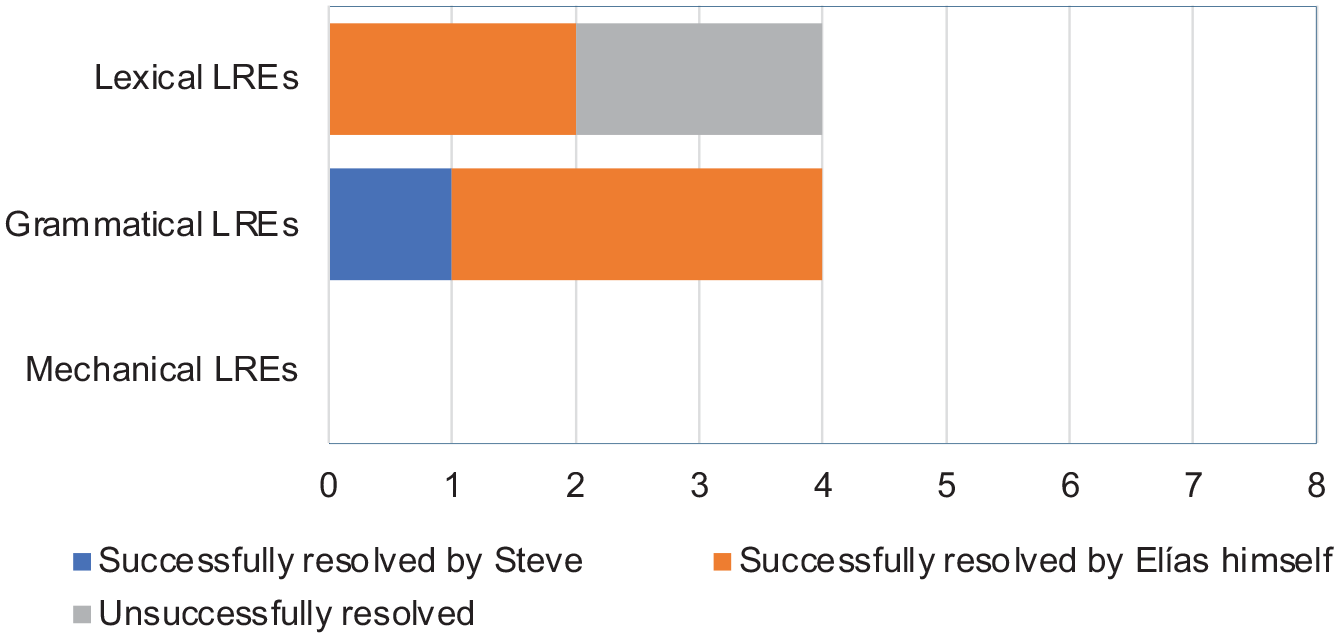
Language-related episodes (LREs) triggered by Elías, working with Steve for a second time.
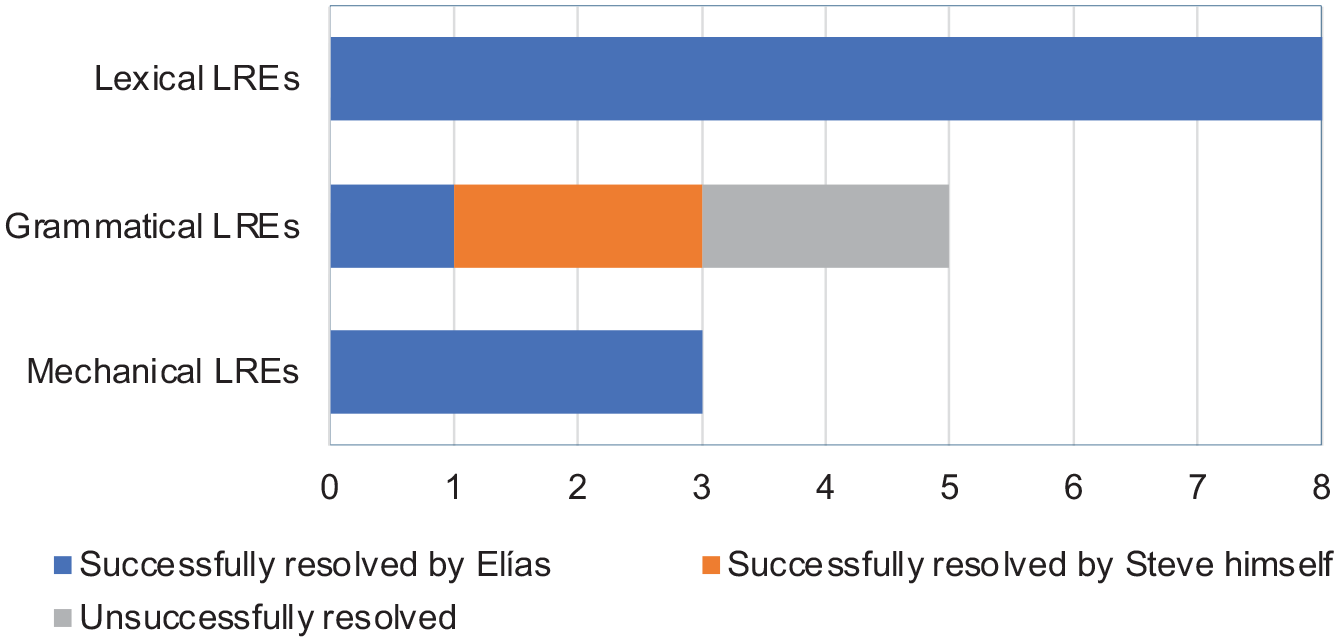
Language-related episodes (LREs) triggered by Steve, working with Elías for a second time.
V Discussion and implications
This article presents the qualitative analysis of four interactions between the same HL learner, Elías, and three of his L2 classmates, Steve, Holly, and Megan, as they completed four in-class collaborative writing tasks. Combining positioning theory and sociocultural perspectives, it examines the dynamic construction of linguistic expertise in mixed interactions. Findings illustrate how learners’ negotiations of expert, novice, and peer positions, shifting across interlocutors and time, shaped opportunities for language learning, either facilitating or constraining HL development.
Positioning theory aims to understand ‘how rights and duties are constructed and distributed in the fine grain of the social and discursive practices in daily life’ (Kayi-Aydar, 2021, p. 8). The current study contributes to this aim by investigating how rights and duties are distributed between HL and L2 learners. Previous research observed that in mixed interactions HL learners tend to be perceived, and expected to perform, as linguistic experts (e.g. Bowles et al., 2014; Fernández Dobao, 2020a, 2020b; Henshaw, 2015). The analysis of Elías’s first interaction with Steve shows Elías accepting this pre-positioning, i.e. enacting the expert position assumed of him due to his heritage status. It shows how this position and the complementary novice position taken up by the L2 learner determined both learners’ ‘rights and duties to perform particular kinds of meaningful actions’ (Harré, 2012, p. 5). As the novice, Steve exerted the right to ask for help, while Elías fulfilled the expert’s duty to contribute to the solution of the L2 learner’s language-related problems. When in trouble, Elías solved his problems on his own (see Excerpt 3).
Drawing on sociocultural theory, the interaction was analysed for collaborative dialogue. In line with previous research (e.g. Bowles et al., 2014; Fernández Dobao, 2020b), this analysis revealed that most LREs addressed Steve’s linguistic problems and gaps, and therefore benefited, primarily, the L2 learner. It thus confirmed that Elías’s position as an expert, expected to offer rather than receive help, limited his opportunities for learning (see Fernández Dobao, 2023).
As discussed in Section II.1, positioning theory posits that individuals may challenge the positions assigned to them and try to reposition themselves (van Langenhove & Harré, 1999). Positions, however, are interactively constructed, which means they are contingent upon context and interlocutors. The analysis of Elías’s interactions with Holly and Megan highlights the co-constructed and fluid nature of discursive positioning. It shows how Elías enacted different positions with different interlocutors and underscores the critical influence of learners’ attitudes towards the interaction on their positioning practices. Through both self- and other positioning acts, Elías, Holly and Megan successfully positioned themselves and each other as peers, i.e. as two learners with knowledge to gain and knowledge to share, and therefore with the right and duty to receive and offer linguistic feedback and help. The sociocultural analysis of their interactions revealed that this expanded opportunities for HL development. Elías’s position as a learner, rather than an expert, opened a space for mutual collaboration where both the HL and the L2 learner triggered and solved lexical, grammatical, and mechanical LREs. These findings extend existing research and support Fernández Dobao (2023) by showing how, when pre-established conceptions of the distribution of linguistic expertise in mixed dyads are contested, the HL learner can benefit as much as or even more than their L2 partner.
The comparative analysis of Elías and Steve’s first and last interaction revealed that, in addition to the interlocutor, learners’ previous experiences also impacted their positioning practices. Nuanced but noticeable differences between these two interactions show how, over time, as Elías’s experiences in the mixed class accumulated and his perceptions of his L2 classmates developed, his positioning changed. This shift was not always linear, since any position occupied by the HL learner had to be negotiated with his L2 interlocutor, and not all L2 learners were open or able to act as a peer to Elías. Still, we observe a development in Elías’s positioning across his four interactions that led to an overall more balanced distribution of the right and duty to help and be helped and, consequently, enhanced opportunities for HL development.
Sociocultural research on peer interaction has documented the impact of proficiency differences, actual or perceived, on L2 learners’ collaboration and LRE production (e.g. Leeser, 2004; Storch & Aldosari, 2013; Watanabe & Swain, 2007). In the same vein, the two interactions between Elías and Steve indicate that proficiency differences between HL and L2 learners cannot be ignored. In his pretest, Steve exhibited a lower command of vocabulary and grammar than Holly and Megan. The analysis of his interactions confirmed that he struggled with language quite frequently. This explains, at least in part, the positioning patterns observed in his interactions with Elías. It suggests that, when proficiency differences are too large, HL learners will inevitably occupy an expert position and benefit less than their L2 interlocutors. Yet, proficiency differences alone cannot fully explain Elías and Steve’s positionings and the differences observed between their two interactions. Data from the beginning and end-of-the-course and interview suggest that learners’ perceptions of each other and attitudes towards the task at hand may interact in complex ways with proficiency differences to influence the negotiation of expert, novice, and peer positions.
Finally, we cannot forget that HL learners can also benefit from the LREs they solve, even when triggered by their L2 interlocutor. Previous sociocultural research has observed that learners may consolidate existing knowledge or acquire new knowledge by helping less able peers (Ohta, 2001; Storch, 2008). Excerpt 3, for instance, shows how Elías, in his attempt to help Steve through languaging, built new language knowledge both for himself and his interlocutor. In his second interaction with Steve most of his LREs were self-resolved, but still constitute instances of learning. As Steve observed in his end-of-the-course interview: ‘in terms of grammar, sometimes just being forced to talk about it … helps to figure out what is going on.’
This study adopted a case study approach and hence focused on one focal participant, Elías. The aim was not to obtain generalizable findings, but rather to illustrate how more balanced interactions, offering more equitable language learning opportunities, are possible in mixed classes. However, important pedagogical implications can be drawn from the study. First, it shows that in mixed classes teachers need to monitor their learners’ self- and other-positioning acts, and make sure that all students get to occupy positions that facilitate their learning. The findings of this study stress the importance of asking HL learners to change partners, so they can get exposed to different interlocutors, with different sources and levels of knowledge, but also different attitudes, perceptions, and positioning practices. Finally, teachers need to find ways to validate the richness of the linguistic and cultural knowledge that HL learners bring to the classroom without assuming that they all enjoy being positioned as experts, and they should be particularly aware of classroom activities and routines that repeatedly position HL learners as resources for their L2 classmates.
VI Limitations and suggestions for future research
The study has several limitations. First, it presents a case study of one HL learner. HL learners constitute a highly heterogeneous group of students. Different experiences, motives, and goals may lead them to approach their mixed interactions in very different ways. Future research involving a variety of HL learners and possibly incorporating quantitative or mixed methods needs to be conducted before any generalizable conclusions can be drawn.
The findings of the study suggest that learners’ attitudes have a notable influence over their interactions and positioning practices. However, data on learners’ attitudes and perceptions was limited. Furthermore, the instruments used to gather some of this data – an end-of-the-quarter oral interview for Steve but a written questionnaire for the other three participants – may have affected its nature. Future research should collect data from more than one source, using a variety of instruments across all participants. Furthermore, for a comprehensive understanding of the factors underlying learners’ shifts in positioning, retrospective data should be collected after each interaction.
The study investigates mixed interactions during collaborative writing activities. In mixed classes, HL and L2 learners collaborate in a wide range of tasks and activities. Future studies should investigate HL learners working with different L2 interlocutors across a variety of tasks. This research will contribute to a better understanding of the construction of language knowledge in mixed interactions but, most importantly, should help teachers of mixed classes find ways to promote equitable learning opportunities for all learners.
