



Abstract
From a social cognitive perspective, self-regulated learning is essentially and increasingly recognized as a complex and dynamic experience. The use of self-regulated learning strategies is also inherently subjective, shaped by individuals’ experiences, beliefs, learning styles, and environmental influences. Although existing research has explored self-regulated learning via a complex dynamic system theory lens, relevant studies that depart from a learner’s point of view and elucidate complexity and subjectivity in their understanding of self-regulated learning strategy use remain limited. Researching the complexity of self-regulated learning in second language acquisition aids in fostering a supportive and inclusive language learning environment. Hence, this study aimed to identify, depict, and compare divergent opinions regarding self-regulated learning strategy use among Chinese English-as-a-foreign-language learners using Q methodology and semi-structured interviews. Thirty learners of English as a foreign language participated in Q-sorting, ranking 50 self-regulated learning-related statements on a grid from “-4” (strongly disagree) to “+4” (strongly agree). The data were analyzed using principal component analysis and varimax rotation in KenQ Analysis Desktop Edition to identify self-regulated learning patterns. Interviews provided additional insights. The study identified five distinct self-regulated learning patterns in English-as-a-foreign-language learning: (F1) introspective self-regulated learning; (F2) proactive self-regulated learning; (F3) insecure self-regulated learning; (F4) flexible self-regulated learning; and (F5) dysfunctional self-regulated learning. The study also explored internal factors (e.g., self-efficacy, mindsets, proficiency) and external factors (e.g., prior experiences, learning environments) underlying these emerging patterns. The findings proffer both theoretical and practical implications for understanding and supporting diverse self-regulated learners in English-as-a-foreign-language contexts.
Keywords
1. Introduction
Self-regulated learning (SRL) refers to intentionally and strategically adapting learning activities to achieve goals of learning. The concept was initially introduced in the 1980s (Zimmerman & Pons, 1986) and later applied to the context of second language acquisition (SLA) (Dörnyei, 2005). Because of the later introduction, SRL principles been fully incorporated into SLA research (L. S. Teng & Zhang, 2022), and relevant exploration is still ongoing.
SRL is not a static process but one influenced by a variety of internal and external factors that interact in complex, non-linear patterns and evolve in response to changes in context, experience, and feedback over time. Therefore, there is a strong rationale for conducting further SRL research through the lens of complex dynamic systems theory (CDST; Li et al., 2022). Yet most CDST research on language development follows case study-based designs, which tend to overlook the condensation and emergence of the dynamic system as a whole (Zheng, 2020). Identifying subsets within a group that share highly similar patterns helps infer individual traits from the group’s overall pattern, revealing language development at both individual and group levels (Molenaar & Campbell, 2009; Zheng & Li, 2023). The approach compensates the deficiency of common CDST design, providing a way to capture complexity at a manageable level without getting overwhelmed by the details of individual cases.
In SRL, the ability to select, integrate, and manage cognitive and emotional strategies is pivotal (Boekaerts, 1999). Learners develop differing perceptions of strategy effectiveness based on a diverse range of personal and environmental factors. In China, the exam-driven culture and teacher-centered instruction often hinder SRL development (Lu et al., 2022), necessitating additional effort to excel in English learning. Over years of practice, English-as-a-foreign-language (EFL) learners are likely to refine their learning approaches and identify effective self-regulated strategies in the domestic context. These insights, shaped by past experiences, highlight the subjectivity of SRL. By recognizing the varied ways students understand SRL, educators can not only better assist students in developing strategies that align best with their individual needs and preferences, but also ensure they can offer personalized guidance that scaffolds underperforming learners.
Therefore, hoping to profile the complex SRL system, this study attempts to identify the emergence of SRL patterns among Chinese EFL learners via Q methodology, with both theoretical and pedagogical implications proffered.
2. Literature Review
SRL involves proactive engagement in learning through metacognition, motivation, and behavior to accomplish goals (Zimmerman & Schunk, 2001). Metacognition primarily refers to one’s awareness and knowledge of one’s own cognitive processes, including planning, monitoring, and evaluating strategies. Although metacognition is generally considered a prerequisite for effective SRL, the latter extends beyond it to include motivation, behavior, emotion, and environmental adaptation (Pintrich, et al., 2000). Conceptual ambiguity between the two constructs may lead to measurement inconsistencies and interpretive confusion in empirical research (Schunk, 2005). Therefore, clearly positioning metacognition as a key component within the broader SRL framework provides stronger theoretical grounding and fosters a more coherent understanding of how learners regulate their processes.
2.1. Conceptualizations of SRL
Existing theoretical perspectives diverge in their explanations of its underlying mechanisms and development. Operant approaches underpin the role of contingent actions and self-recording in learning (Broden et al., 1971); information-processing models stress recursive metacognitive feedback loops, as in Winne and Hadwin’s (1998) COPES (conditions, operations, products, evaluations, standards) model; and volitional views emphasize learners’ willpower, forming the basis of Boekaerts’s dual processing model (Boekaerts & Cascallar, 2006; Watson, 1963). The socio-cognitive approach originated from Bandura’s (1986) triadic model of human functioning. Unlike other perspectives, it emphasizes that SRL emerges from the dynamic interaction of personal, behavioral, and contextual factors (Zimmerman & Schunk, 2001), aligning well with CDST.
Building on the socio-cognitive perspective, various models have been developed to depict different facets of SRL. For instance, Efklides proposed the Metacognitive and Affective Model of Self-Regulated Learning (MASRL; Efklides, 2011), dividing metacognition into stable person-level traits (metacognitive knowledge/beliefs) and dynamic task-level metacognitive experiences (e.g., feelings of difficulty/confidence) that interact closely with affect and motivation. Hadwin et al.’s (2011) model extends SRL to collaborative settings by proposing that regulation encompasses self-regulation, co-regulation, and socially shared regulation. To capture the entirety of SRL, Zimmerman (1989) proposed the Triadic Model, which illustrates how personal, behavioral, and environmental factors interact to shape learners’ regulatory processes, portraying SRL as a complex system. He further came up with the Cyclical Phases Model (Zimmerman, 2000) that describes SRL across through three interconnected stages: forethought (task analysis, goal setting, strategy selection, and motivation via self-efficacy), performance (strategy use, self-monitoring, and effort control), and self-reflection (evaluating outcomes, attributing causes, and emotional responses). Zimmerman’s models essentially embody the core qualities of a complex dynamic system because they depict the continuous, reciprocal cycles of interaction among personal factors, behaviors, and environmental influences in SRL. This dynamic flow gives rise to key features of CDST, including nonlinearity, where small events like a setback or positive feedback can alter motivation or strategy; emergence, as strategy preferences gradually take shape through repeated cycles; self-organization, with learners intuitively refining their own approaches from within; interdependence, since the three factors are interdependent; and contextual sensitivity, with the environmental factors exerting impacts throughout the process. Together, they thus provide a comprehensive and robust framework to examine the complexity of SRL. Leveraging the Cyclic Phase Model, Pintrich’s (2000) model consists of four phases, namely forethought and planning, monitoring, control, and reaction and reflection, each involving regulation of cognition, motivation or affect, behavior, and context. This model also emphasizes the close relationship between SRL and motivation (Schunk, 2005).
The above-mentioned models demonstrate the socio-cognitive perspective’s strength in capturing the SRL process. Given the current aim of presenting a panoramic view of SRL from a CDST perspective and ensuring theoretical consistency, the socio-cognitive perspective, as well as Zimmerman’s Cyclic Phase Model and the Triadic Model, is adopted in the present study.
2.2. SRL as a Complex Dynamic System
The socio-cognitive perspective conceptualizes SRL as a complex, dynamic, and contextually situated construct, aligning with CDST’s focus on nonlinear interactions among interrelated components that give rise to emergent and sometimes unpredictable patterns (Larsen-Freeman, 1994). Despite growing interest in investigating SRL from a CDST perspective, explicit empirical studies are limited (Hilpert & Marchand, 2018). Li et al. (2022) explored SRL as a complex system in science learning, finding that high performers displayed more complex SRL processes, whereas low performers had more structured behaviors. Saqr and López-Pernas (2024) confirmed SRL’s complexity using network analysis, capturing dynamic interconnections across individuals and time. Indirect CDST attempts to capture SRL subgroups via latent profile analysis have also increased, allowing heterogeneity to be revealed at group level and homogeneity at the individual level (Chen et al., 2023; Ning & Downing, 2014). Yet these direct CDST endeavors focused on contexts outside EFL, leaving a vacancy for more relevant research within EFL settings.
Previous research has also identified a wide range of internal and external influencing factors that suggest the complexity of SRL. Internally, high self-efficacy promotes proactive self-regulation whereas low self-efficacy leads to avoidance (Maldonado-Mahauad et al., 2018), with past experiences refining strategies (Ye et al., 2022). Personality traits like extraversion positively correlate with resource use (Efklides et al., 2017; Robbins et al., 2004), and a growth mindset enhances strategic knowledge (Karlen et al., 2021), whereas public self-consciousness undermines academic self-concept (Martin & Debus, 1998). Externally, constructive input significantly fosters the SRL progress (Esnaashari et al., 2023). In addition, teacher, parental, and peer support (Liu et al., 2022; J. Tao & Xu, 2022; Yin & Luo, 2024) all further shape one’s SRL experience. However, how these factors collectively form learners’ subjective SRL patterns remains underexplored.
2.3. SRL in the Chinese EFL Context
SLA research spans multiple disciplines, and the effectiveness of learning strategies often depends on context (Broadbent & Poon, 2015). In the mid-2000s, researchers introduced self-regulation theory from educational psychology into SLA, shifting the focus from strategy outcomes to the underlying learning processes and learner capacities involved (Tseng et al., 2006). SRL was soon regarded as a major development in the field (Oxford, 2011) and later attracted growing attention among Chinese SLA scholars.
Empirical research on SRL in the Chinese EFL context can be systemically categorized into four main directions, namely the measurement of strategies, influencing factors, effects on outcomes, and intervention development. Studies in the first direction measure SRL strategies by assessing their levels, frequency, and contextual variations across EFL tasks, mostly adopting quantitative methods. This research mostly reported a moderate to medium level of Chinese learners’ SRL, and positive links to EFL performance (e.g., Shen & Wang, 2024; W. Zhang et al., 2024). The second direction explores the prominent internal and external influencing factors of SRL in Chinese EFL contexts. Internal factors such as growth mindset, motivation, and self-efficacy consistently predict stronger regulation (e.g., Shen & Bai, 2022). External factors often highlight contextual barriers, such as regional differences in teachers’ online SRL capabilities (e.g., Y. Zhao et al., 2024) or limited appreciation of peer assessment (e.g., Wu & Zhang, 2025). The third direction examines SRL’s impacts on learning outcomes. Empirical research has proved that SRL fosters greater autonomy, persistence, and adaptive learning, resulting in improved language outcomes (e.g., Chen, 2022; Qi, 2021; X. Tao, 2025). The fourth direction focuses on interventions designed to strengthen SRL and related performance which usually confirms that targeted training yields meaningful gains. Shen and Bai (2024) reported lasting enhancements in SRL writing strategies and performance after a 12-week strategy-based program. In a more general context, Yang et al. (2024) applied the Cyclical Phase Model in a mixed-methods design and observed significant increases in motivation, strategic competence, and English proficiency.
Despite the breadth of research, relatively few studies have explicitly pointed out the complex nature of SRL strategy use among Chinese EFL learners. A large proportion of the existing literature quantitatively explores interrelationships and patterns among SRL variables in Chinese EFL learners. For instance, Lin et al. (2021) and Hu et al. (2022) examined online EFL learners’ SRL via latent profile analysis, reporting three SRL profiles of low, moderate, and high. Chen et al. (2023) analogously identified these three SRL profiles in a high-stakes testing context via latent profile analysis. However, the statistical insights from latent profile analysis fail to support teachers in understanding the underlying reasons for students’ profile formation and the embodied patterns, thus providing limited implications for actual learning and teaching practices. Further investigation that provides qualitative insights into subsets in SRL strategy uses in Chinese EFL context is thus warranted.
Q methodology sorts statements to reveal factors in participants’ perspectives and is well suited to studying complex systems like SRL due to its mixed methods (MacIntyre et al., 2017; Stephenson, 1953). A previous study of SRL in a clinical context has applied Q methodology, and five SRL behavior patterns were identified: immersive, critical opportunistic, uncertain, restrained, and effortful SRL (Berkhout et al., 2016). The findings reflected the regularities among individual SRL behaviors and confirmed the complexity of SRL. It also proved the feasibility of using Q methodology to qualitatively identify patterns within SRL in educational fields, proffering insights for SLA research.
Hence, this study aimed to explore and categorize the varied SRL strategy patterns among Chinese EFL learners and identify the factors influencing them. Zimmerman’s SRL Cyclic Phase Models are adopted to guide the implementation of Q methodology and semi-structured interview studies. To reach the research aims, the following research questions (RQs) are proposed:
3. Methodology
3.1. Research Context
This study is conducted within the Chinese EFL context, focusing on learners currently or previously enrolled in universities across China. In China, college students are required to complete English courses and pass the College English Test for graduation. The predominance of an exam-oriented culture and teacher-centered instructional methods often restrict students’ self-regulated learning capabilities (Lu et al., 2022) and language development. Furthermore, as in many other populous regions, especially Asian countries, the intense competition and pressure from the employment situation within China’s education system (Yu et al., 2016) often compel students to utilize SRL strategies to cope with learning stress and enhance efficiency when facing a large volume of study materials and examinations. Thus, additional effort on SRL is necessary for Chinese EFL learners to excel.
3.2. Instruments
3.2.1. Q methodology
In studying a complex dynamic system, case study-based research often overlooks the broader system patterns, while traditional quantitative methods tend to inappropriately generalize group-level development to individuals.
Q methodology (Stephenson, 1953) combines quantitative and qualitative methods and has been introduced into language research in recent years (Irie & Ryan, 2015). Q methodology is considered to maximize the potential of mixed-methods research, particularly suitable for studying dynamic systems in language learning (MacIntyre et al., 2017; Zheng & Li, 2023). Q methodology allows researchers to systematically examine the viewpoints among a group of participants, identifying core subgroups of attitudes or emotions shared within the group (Watts & Stenner, 2012), and is thus suitable for the present research concerning learners’ understandings of SRL strategies.
3.2.2. Semi-Structured Interviews
In Q methodology, post-sorting interviews are typically conducted to elucidate participants’ understanding of and reasoning behind their ranking decisions, particularly for statements that elicited the strongest responses (Kirschbaum et al., 2024). The semi-structured interviews enable subjective reasoning behind Q sort rankings, adding qualitative depth to quantitatively identified patterns, and thus proffer rich insights into the influencing factors behind the emerged patterns.
3.3. Procedure
In brief, the research steps of the Q methodology include: (a) gathering the Q concourse; (b) developing the Q set; (c) selecting participants (P sample); (d) conducting Q sorting; and (e) interpretation and analysis. In addition to Q methodology, after the testing phase, this study also conducts retrospective semi-structured interviews with participants to assist in the analysis of Q methodology results.
3.3.1. Gathering the Concourse
In Q methodology, concourse contains “the flow of communicability surrounding any topic” (Brown, 1993). The concourse can be collected through interviews, participant observation, popular literature, and scientific literature like papers, essays, and books (Van Exel & De Graaf, 2005). The Q concourse for the present study was primarily derived from Zimmerman’s (1989, 2000) Triadic Analysis Models of SRL and Cyclical Phases Model, Pintrich (1988)’s Motivated Learning Strategies Questionnaire (MSLQ), and supplemented by classroom observation to incorporate updates concerning e-learning strategies. Initially, the study obtained approximately 160 statements.
3.3.2. Developing the Q Set
After collection, the present research has all 160 statements evaluated by experts in the domain to select the most representative and comprehensive statements to constitute the Q set. Three rounds of statement selection were carried out in the present research. The first round assessed clarity, ambiguity, and applicability. In this round, around 20 statements that may lead to confusions were eliminated. For instance, the statement “I always stick to my goals when learning English, even if my reasons for doing so sometimes change” contains two layers of meaning and was omitted due to its ambiguity. The first half expresses the learner’s persistence in their learning goals, while the second half implies that the premise for this persistence—that is, the underlying reasons—may shift. This contradiction leads participants to question how the goals are defined and developed, creating confusion and hesitation in selection. The second round focused on comprehensibility, overlap, and completeness, for which each strategy type in Zimmerman’s Cyclical Phases Model was ensured to be represented by at least three statements. Overlapping statements, such as “Before starting English study, I always first determine the course assessment or self-evaluation criteria to guide my learning” and “Before I begin studying, I know what I want to achieve” were identified and compared, and the second expression was removed for being less explicit. After this round of selection, around 60 statements remained in the concourse. As most of these statements were derived from the MSLQ and Zimmerman’s frameworks and were thus generated originally in English, they were translated into Chinese for this study, validated by domain experts. The remaining items related to e-learning, which were based on classroom observations, were developed in Chinese. A pilot test with 5–6 EFL learners was lastly conducted to assess the concourse, resulting in a finalized Q set of 50 statements. (see Appendix A).
3.3.3. Selecting the P Set
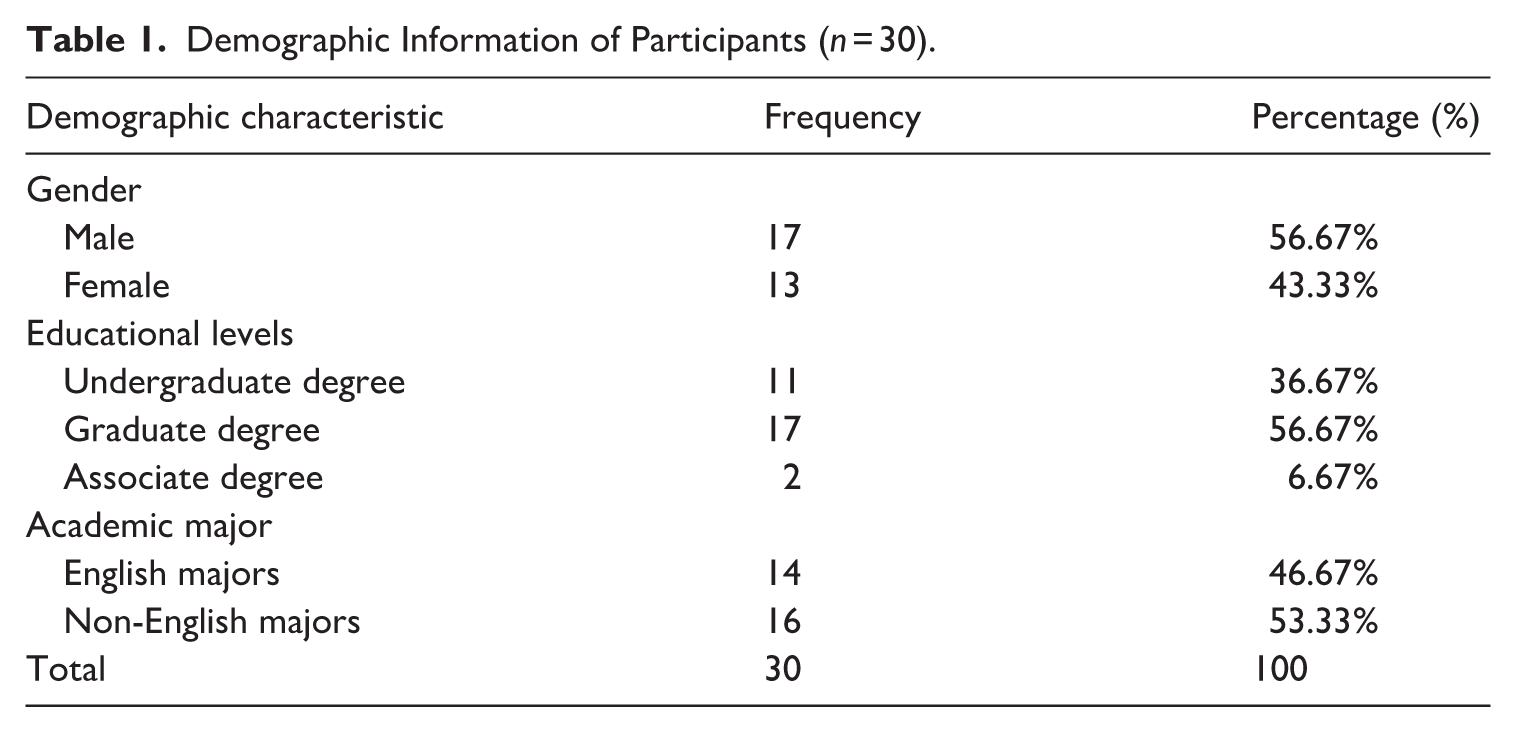
The P sample in the Q methodology refers to the participants whose perspectives are central to the study (Watts & Stenner, 2005). For Q methodology, it is important to include participants representing diverse viewpoints (Berkhout et al., 2016). This study attempted to maximize variability by strategic sampling. Participants were selected from different regions, educational stages, and disciplines across China, with a mostly balanced representation of English and non-English majors, and male and female learners. The present research posited that adult learners have more autonomy and thus richer personal experience and understanding of SRL, compared with younger learners who primarily follow teacher-directed instruction in Chinese high schools. All chosen participants were therefore current or former tertiary-level students. To further enhance variation, participants were selected from multiple academic levels, including undergraduate, postgraduate, and associate degree programs. Although there is no specific requirement for the number of participants in Q methodology studies, generally the sample size ranges from 12 to 40 participants (Webler et al., 2009). This study selected 30 participants. The demographic information of participants is presented in Table 1.
Demographic Information of Participants (n = 30).
3.3.4. Administering Q Sorting
In the present study, Q sorting was performed in person. Participants completed the paper-based Q sorting grids as instructed: Self-regulated learning (SRL) refers to the process where learners take control of their own learning. SRL strategy refers to the specific methods or techniques employed to manage and improve the learning process. Please indicate to what extent the following statement reflects your use of self-regulated learning strategies in learning English.
The sorting grid ranks the 50 statements included in the Q set from “-4 most disagree” to “+4 most agree” in 9 levels, following a mandatory normal distribution (see Figure 1). The sorting results formed the 30 Q sorts for later analysis.

Q sorting grid.
3.3.5. Data Analysis and Interpretation
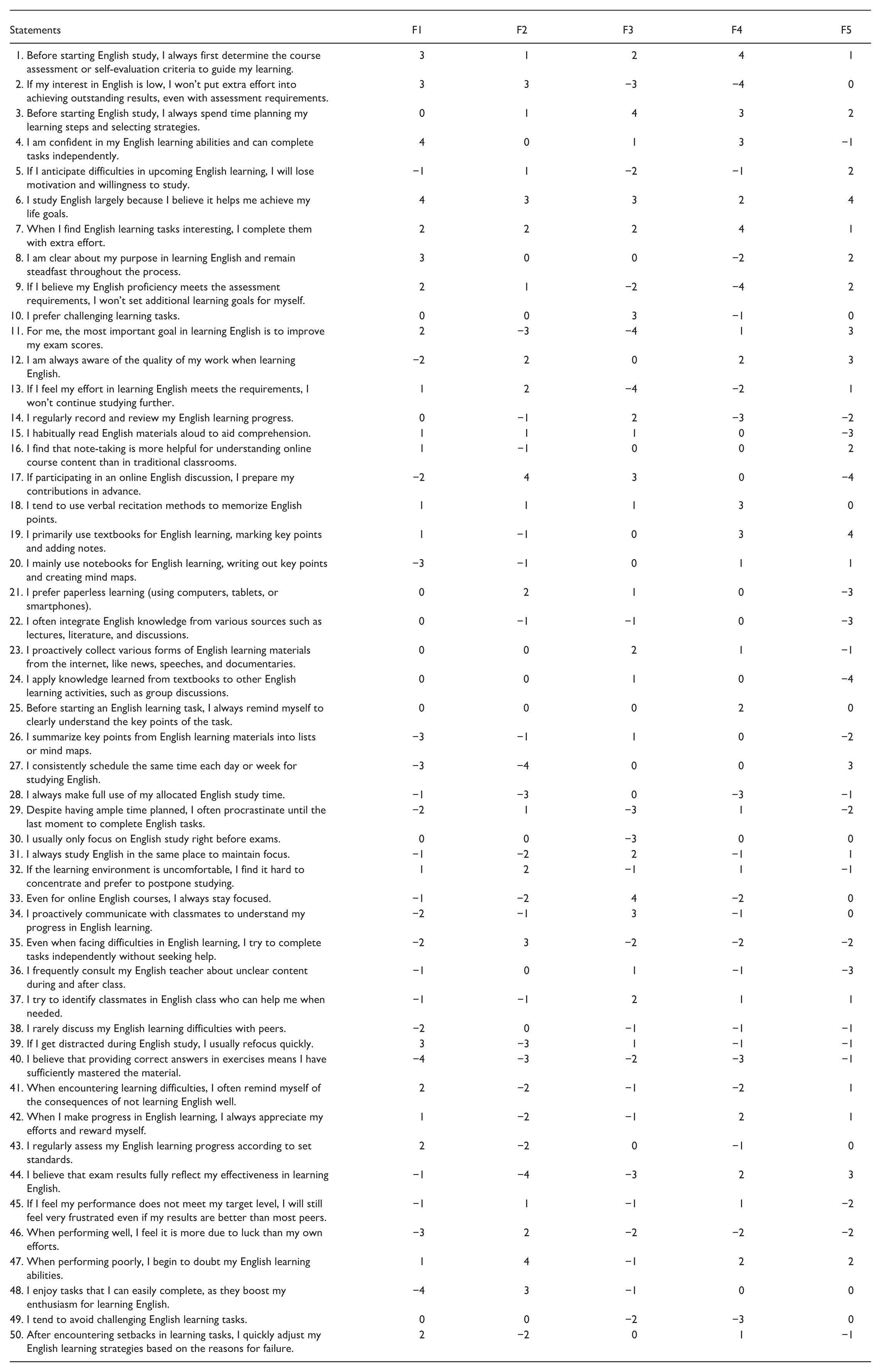
After collecting the Q sorting data, KenQ Analysis Desktop Edition (KADE; Banasick, 2019) were employed to extract statistically significant factors corresponding to patterns of SRL strategy uses. Common techniques of Q methodology, centroid factor rotation and varimax rotation, were employed for the analysis (Watts & Stenner, 2012). The analysis generated a correlation matrix among the 30 sorts through centroid extraction. This matrix was then subject to principal component analysis with varimax rotation. To determine all factor structures, the analysis employs the following criteria: (a) eigenvalues greater than 1.00 (McKeown & Thomas, 2013); (b) a minimum of two sorts with statistically significant loading in the same factor (p < .01) (Watts & Stenner, 2012); and(c) a significant loading threshold. As noted by Watt and Stenner (2012) and Zheng and Li (2023), the significant loading threshold in Q methodology is calculated using the formula 2.58×(1 ÷ √N), where N represents the number of Q statements. In the present research, the value is 0.33. Eventually, a five-factor final solution was selected, explaining 48% of the variance, which is considered a good solution (above 35%) (Watts & Stenner, 2012; see Table 2). Detailed rankings of each statement within the factor arrays are provided in Appendix A. Following this, the study combined the actual analysis results to calculate an idealized sort for each retained factor and conduct subsequent retrospective interviews to understand participants’ insights and interpretations of the given Q sorts. After analyzing the compensability, clarity, and uniqueness of the classified analysis, the final pattern classification and description were drawn.
Factor Extraction.

3.3.6. Semi-structured interviews
Semi-structured interviews were conducted following Zheng et al. (2020) and Z. Wang et al. (2024). The full interview protocol is provided in Appendix B. During the semi-structured interviews, participants were first shown the grids they had completed and then asked questions such as “How do you interpret the meaning of these statements in relation to your learning experience?” and “Can you share any specific experiences that influenced your rankings for these items?” They were encouraged to clarify their interpretations of the statements, describe relevant experiences, and explain their reasoning. They were also invited to reflect on how their views might change under different interpretations. Additional prompts, tailored to each participant’s Q analysis results, were used to elicit further comments and ensure a comprehensive understanding of their perspectives.
4. Findings
The findings were interpreted by examining the individual rankings and overall configuration of Q sort values for each statement within the factor arrays, with excerpts from interview data used to triangulate the interpretation. Special attention is paid to characterizing statements (i.e., statements ranked at both ends) and distinguishing statements (i.e., statements that differentiate between factors) of each factor. The findings were reported in a narrative format to provide a holistic view (Watts & Stenner, 2012). From the analysis, five main SRL strategy patterns emerged: (F1) Introspective SRL, (F2) Proactive SRL, (F3) Insecure SRL, (F4) Flexible SRL, and (F5) Dysfunctional SRL.
4.1. SRL Profiles of Chinese EFL Learners
4.1.1. Factor One: Introspective SRL
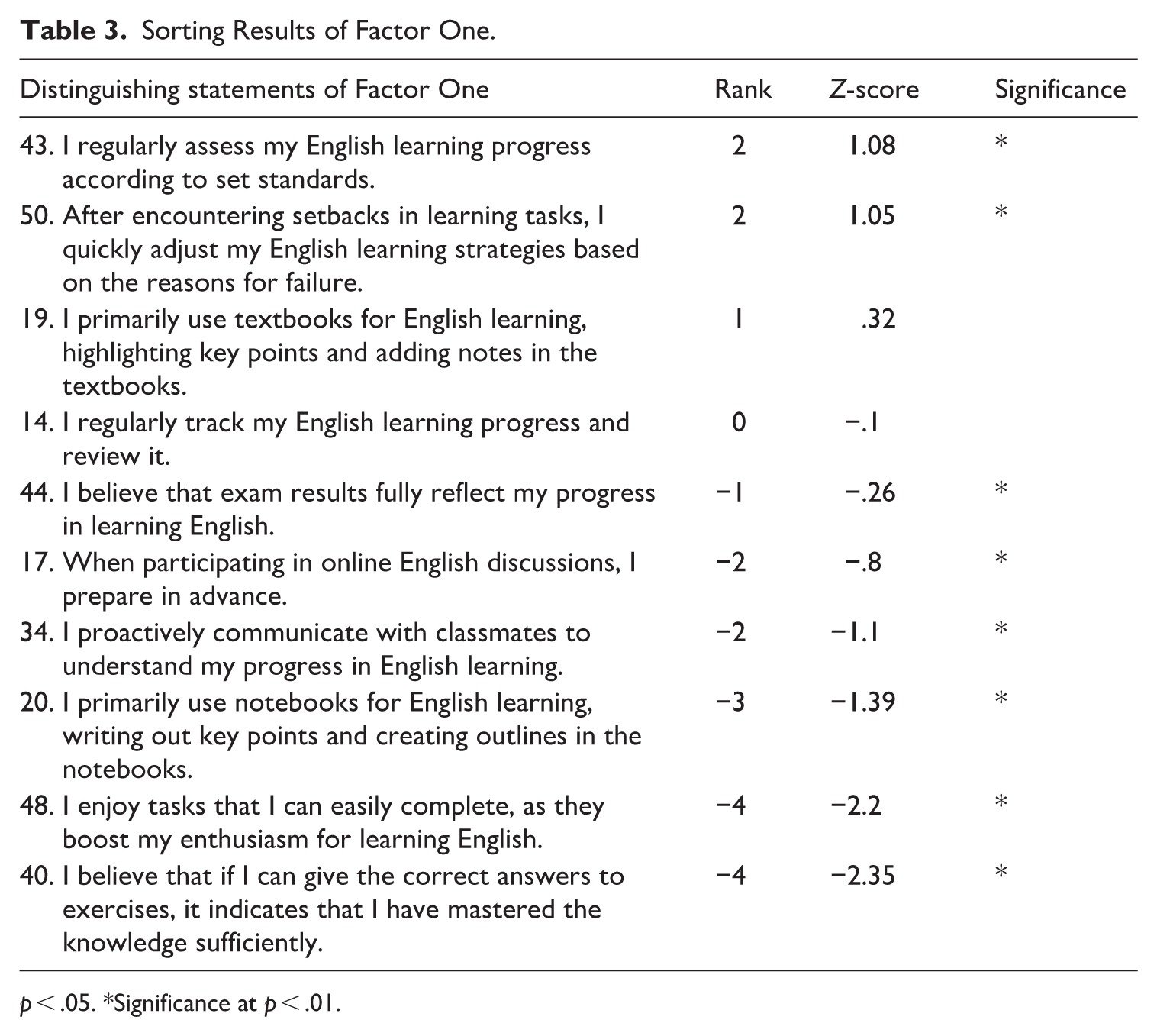
Factor One, comprising five sorts, accounted for 16.67% of total sorts and explained 13% of the variance. These sorts were best characterized as introspective SRL. Table 3 shows that, during the performance, these learners did not enjoy communicating with their peers for external feedback (S34: -2), nor were they willing to prepare for discussion with others (S17: -2), showing a somewhat introverted trait. They had internalized assessment criteria and did not rely solely on external standards to evaluate their performance (S40: -4). For self-reflection phase, self-assessment and internal feedback were deemed more comfortable and efficient (S43: 2). Also, as P2 (P stands for participant) suggested in their interview, they could have rapid adjustments to learning strategies in response to unfavorable results, which likewise indicated that they were adaptive toward feedback and believed in the effectiveness of this introspective approach to learning English (S50: 2). Their preference for challenging tasks also showed inner stability, as their learning status could remain unaffected by setbacks or risks (S48: -4).
Sorting Results of Factor One.
p < .05. *Significance at p < .01.
Interview data from P3 and P2, respectively, with a defining loading of .59 and .58 on Factor One, complemented the above illustration: Tasks that are too easy do not excite me, instead, they bore me . . . I usually quiz myself to see if I have made progress. Sometimes, getting the right answer for exam involves guessing, so I don’t consider it a true indication of mastery . . . I don’t feel like discussing the details of my English learning with others, I just don’t see the necessity . . . and I’m not really comfortable talking about my learning progress with others. (P3) If a problem arises, to complete the task better next time, I would immediately adjust my strategy and won’t allow the same failure happen again. (P2)
4.1.2. Factor Two: Proactive SRL
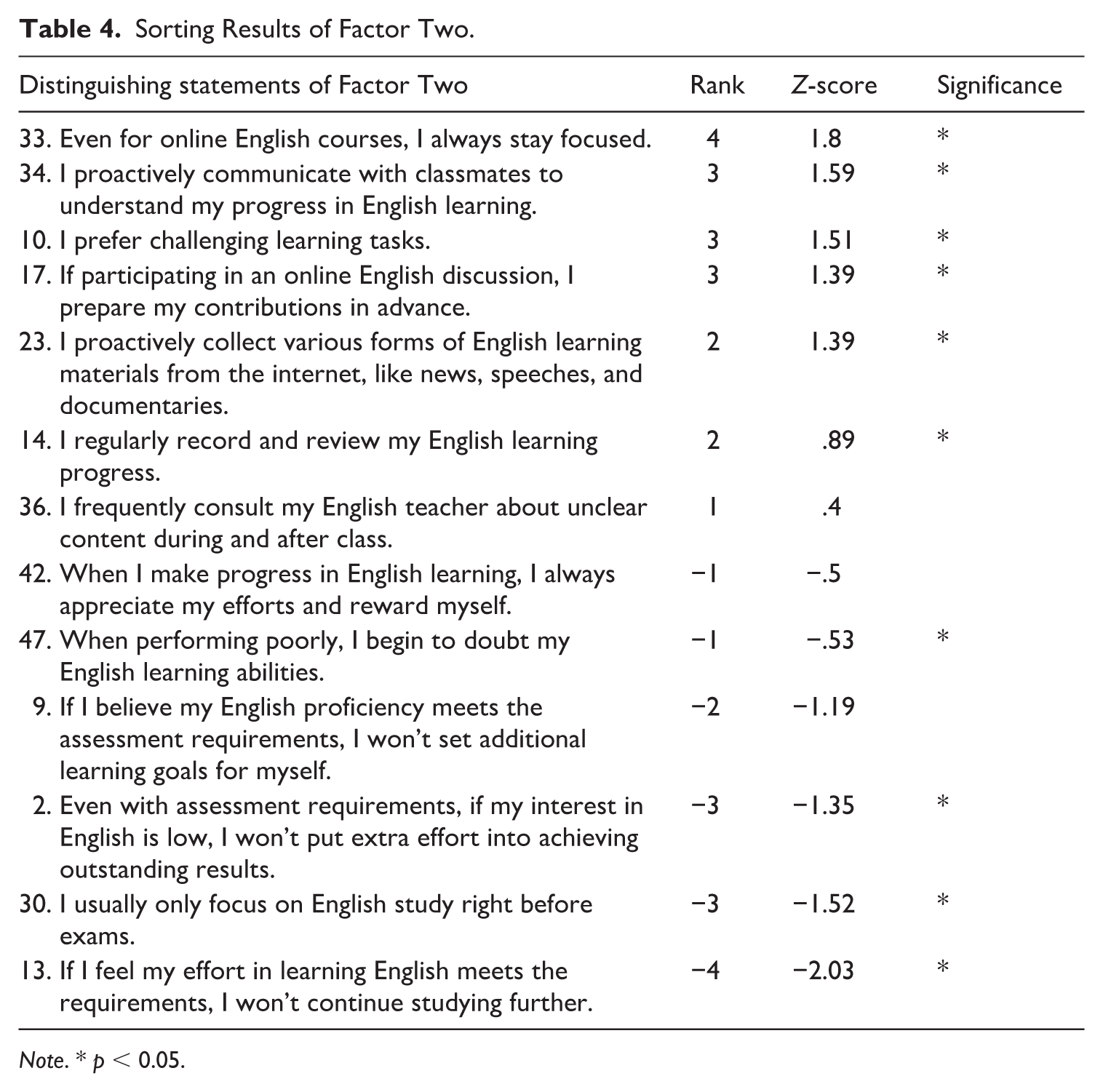
Five sorts associated with Factor Two made up 16.67% of the total. The factor explained 11% of the variance and was labeled as the proactive SRL type. From Table 4, it is suggested that these participants were genuinely confident, active, and reflective in their learning English. During the forethought phase, they were both intrinsically and extrinsically driven to excel in English as suggested by the interview with P4. They always remained committed to maintaining good learning conditions for satisfying grades (S2: -3). They also had high self-requirements, willing to set extra goals and put in extra efforts (S10: 3, S9: -2). During the performance phase, they reached proactively toward improvements. They liked to challenge themselves with extra hard tasks (S13: -4). Moreover, they actively collected all kinds of English learning resources. They liked to seek feedback from their peers (S34: 3) and English teachers (S36: 1). They were also the only type that reported actively collecting diverse English learning materials from the internet (S23: 2). They happily recognized their meritorious learning habits, including staying consistently focused (S33: 4), being well prepared for discussions (S17: 3), regularly tracking and reflecting on their progress (S14: 2), and avoiding last-minute cramming for exams (S30: -3). By remaining modest (S42: -1) in their abilities, these learners wished to make continuous progress in English. In self-reflection, they displayed also a confident and positive attitude toward failure, not attributing them to their capacity (S47: -1).
Sorting Results of Factor Two.
Note. * p < 0.05.
Interviews with P15 and P4, with respectively .68 and .53 defining loadings on Factor Two, aligned with the above interpretation: If I would pay attention in a physical classroom, then I would do the same online . . . I proactively communicate with my classmates because I need to ensure that my understanding doesn’t deviate and aligns with theirs . . . I read articles from The New Yorker or The Economist. These are challenges I give myself, so I’m more motivated to complete them. (P15) I personally consider English to be one of my strengths, so I find that challenging tasks give me a greater sense of accomplishment . . . I generally have a strong interest in English, and when there are assessments, I want to perform well because I’m afraid of embarrassing myself if I do poorly . . . If I have time, I’ll want to study English because I believe language skills can fade if not used, and I have a genuine interest in it . . . I’m rarely satisfied with myself, so external standards usually don’t determine my level of effort in English; I might only stop when I feel content with my own progress. (P4)
4.1.3. Factor Three: Insecure SRL
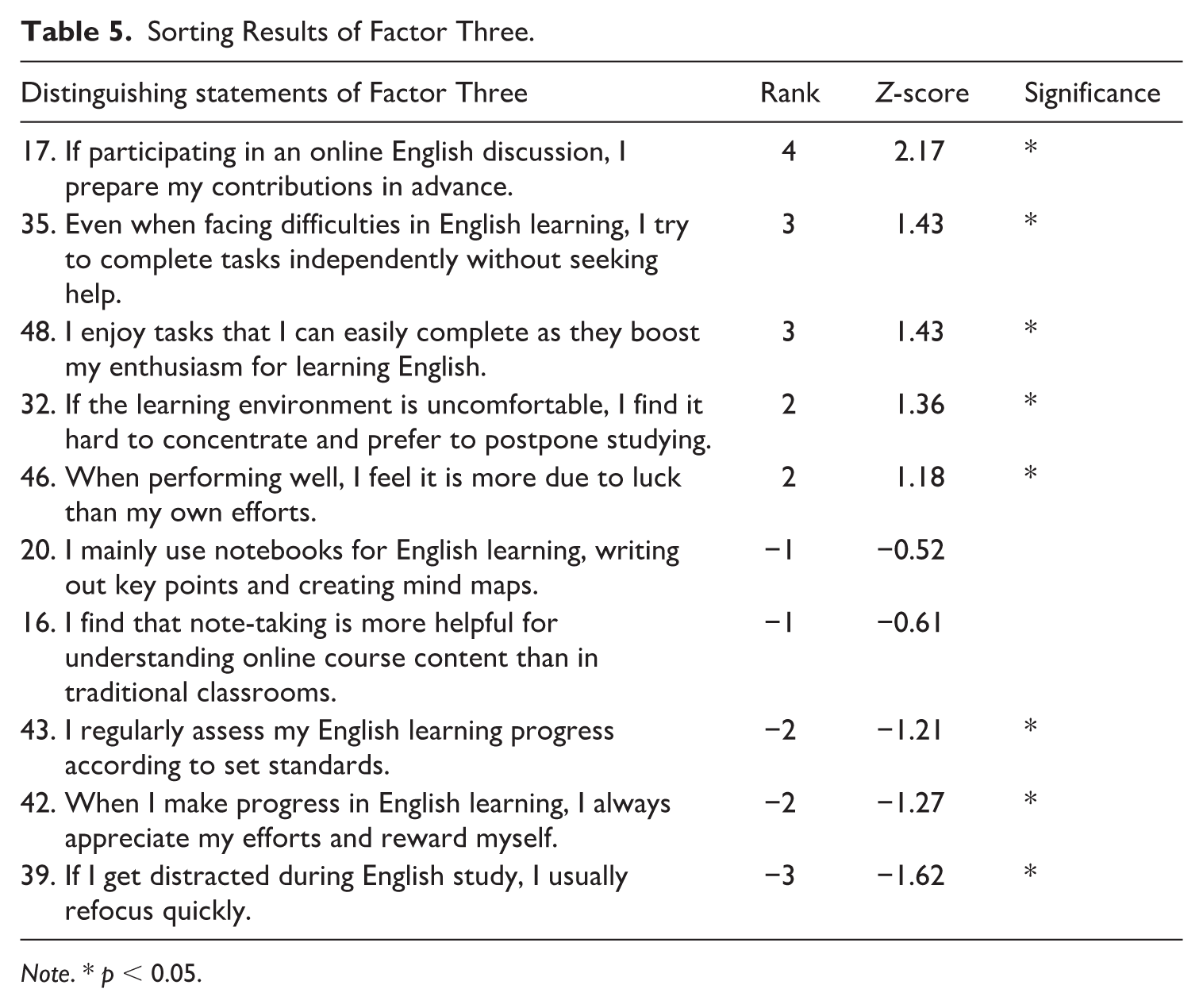
The 8 sorts loaded on Factor Three constituted 26.67% of the 30 total sorts. This factor accounted for 9% of the variance and represented an insecure SRL type. As indicated in Table 5, throughout the performance phase, these learners were insecure and often anxious. They had to get fully prepared before engaging in discussions with others (S17: 4) because they want to reduce anxiety and mitigate shortcomings, as P30 noted. Despite facing challenges, they were generally reluctant to seek assistance from others, showing a clear aversion to exposing their weaknesses (S35: 3). Furthermore, their attention and motivation were susceptible to their learning environment (S32: 2), and, if distracted, they often had difficulty reconcentrating (S39:-3), as P30 and P22 both indicated, suggesting an insecure and highly nervous learning status. Even when they performed well or made promising progress in learning English, they rarely recognized their own efforts and refrained from self-encouragement (S42: -2). During the self-reflection phase, these learners critically evaluated their learning habits (S43: -2), as indicated by P30’s remark: “limited.” Even when progress was made, their lack of confidence made them attribute achievements to luck (S46: 2). Additionally, they tended to select tasks they felt they could perform well in, gravitating toward activities where success was more achievable (S48: 3).
Sorting Results of Factor Three.
Note. * p < 0.05.
Interview with P30, a participant with a defining loading of .77 on Factor Three, vividly supports the above illustration: I believe that thinking ahead helps compensate for my weaknesses in English speaking and communication . . . My multitasking ability is also limited, so distractions significantly reduce my learning efficiency . . . Although my current progress is encouraging, it only meets the basic requirements for an English major. For me, a punishment-based approach may be more effective than rewards, so I don’t always praise or reward myself when I make progress.
An interview with P22, a participant with a defining loading of .50 on Factor Two, also proves the above interpretation: Relying too much on others for help is seen by me as a lazy and avoidant tactic, which is not suitable for learning a tool like English . . . In environments prone to external distractions or where other tasks interfere, I find it difficult to maintain stable focus.
4.1.4. Factor Four: Flexible SRL
The nine sorts grouped under Factor Four constituted 33.3% of the total sorts, accounting for 8% of the variance. Table 6 lists the features of the “flexible SRL” type. At the forethought phase, they had adaptable motivational drive. These learners were intrinsically driven by interest (S7: 4), yet when interest waned, extrinsic factors like exams or peer pressure could still compel them to put in extra effort (S2: -4). They recognized both the long-term benefits of mastering English skills for personal development (S6: 2) and the immediate impact of exam results on their GPA (Grade Point Average) and rankings (S11: 1). Being integrally motivated, their learning purposes can adaptably alternate between improving skills and attaining good grades, depending on the circumstances (S8: -2). Similar to participants in Factor Three, they were willing to set additional goals beyond external requirements (S9: -4). During the performance phase, they were also willing to put in extra effort (S13: -2), and deal with challenges (S49: -3). However, their self-expectations and standards for evaluating their performance were not particularly rigorous, as suggested by the interview with P13, who said: “I feel really happy whenever I achieve a small goal or make some progress. It makes me feel like I’m steadily improving.” This flexibility/casualness in assessing performance was also evident in their lack of consistent monitoring and reflection on their actual progress (S14: -3) and their tendency to reward themselves (S42: 2).
Sorting Results of Factor Four.
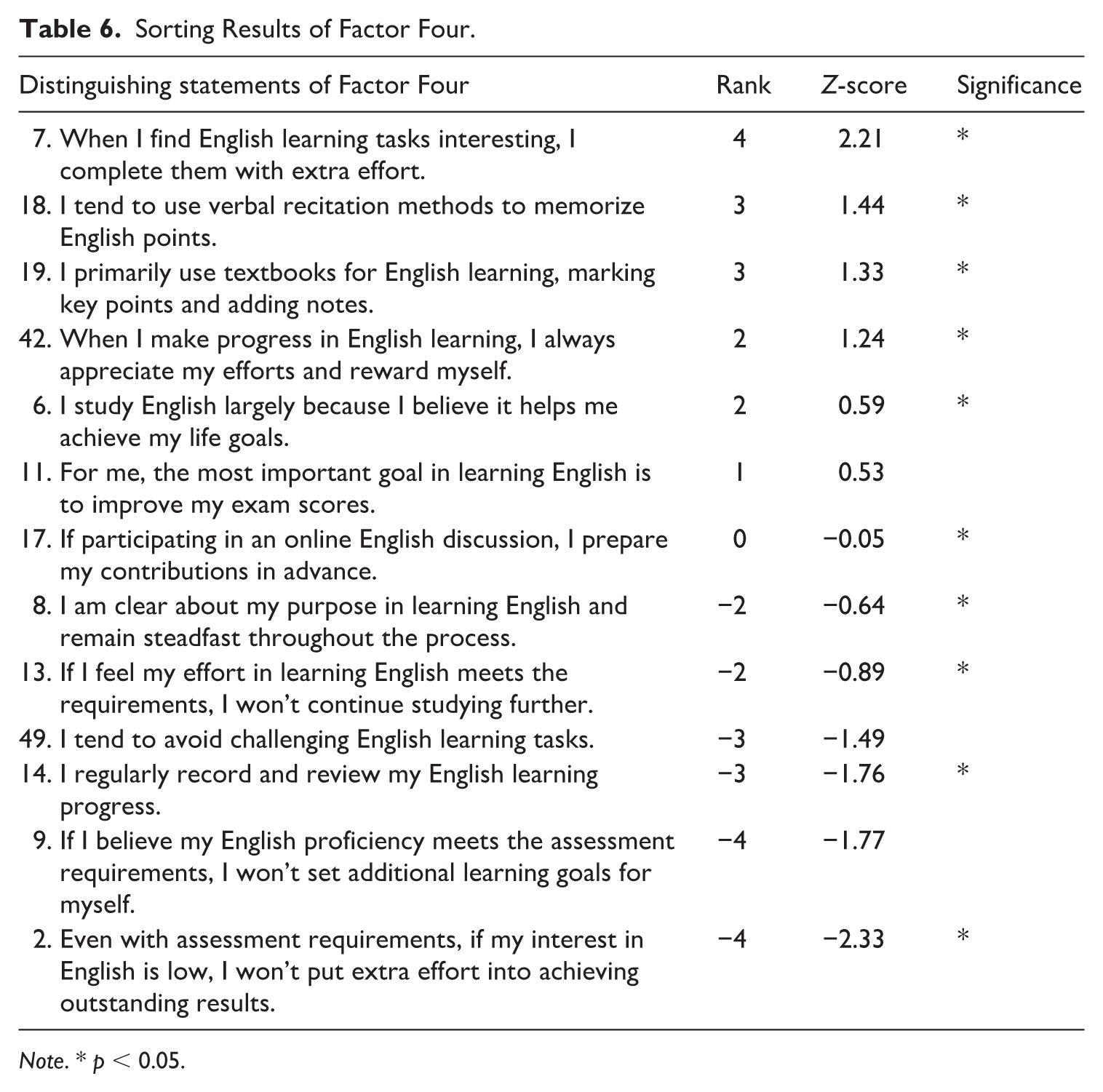
Note. * p < 0.05.
Interviews with P17 and P13, with respectively .56 and .46 defining loadings on Factor Four, aligned with the above interpretation: My study mood and environment really affect how I do, but I can't let myself fail exams because it would mess with my GPA . . . If I just focus on meeting the assessment standards, it’s tough to actually improve my English skills to the level I want. Even though I set high goals, I don’t always hit them. Plus, my reason for learning English changes a lot—sometimes it’s just about getting better at it, other times it’s about grades. When that goal changes, it definitely impacts how I approach studying. (P17) I feel pretty happy whenever I hit a small goal or make progress—it gives me a sense of moving forward. I treat myself sometimes, like with a beverage to kick off my study session, likely because my parents did the same to encourage me when I was younger, and it became a habit . . . I don’t avoid challenges, but that doesn’t mean I enjoy them. I usually have a broad outline for my studies but like to keep it flexible because if the plan’s too detailed, I’ll end up ditching it. (P13)
4.1.5. Factor Five: Dysfunctional SRL
Constituting 10% of the total, the three sorts of Factor Five—two male and one female—explained 7% of the variance and were best described as dysfunctional SRL, as they exhibited a minimal level of SRL. As Table 7 suggests, aside from statements 19 and 27, all other distinguishing statements were ranked negatively, indicating this group’s generally negative attitude. During performance, participants in Factor Five insisted on paper-based learning approaches and showed an aversion to all forms of e-learning (S19: 4, S21: -3) due to their lack of adaptability, as explained by P28. They did learn from textbooks (S19: 4) and scheduled English learning regularly (S27: 3), but they were generally passive during the learning process. They seldom made a deliberate effort to utilize learning resources (S22: -3, S23: -1) and were reluctant to seek assistance from teachers (S36: -3). They also tended to shy away from reading English passages aloud or participating in discussions with others (S15: -3, S17: -4). The pessimistic outlook displayed by P23 and P28 revealed dysfunctions in the cyclical SRL process for learners of Factor Five.
Sorting Results of Factor Five.
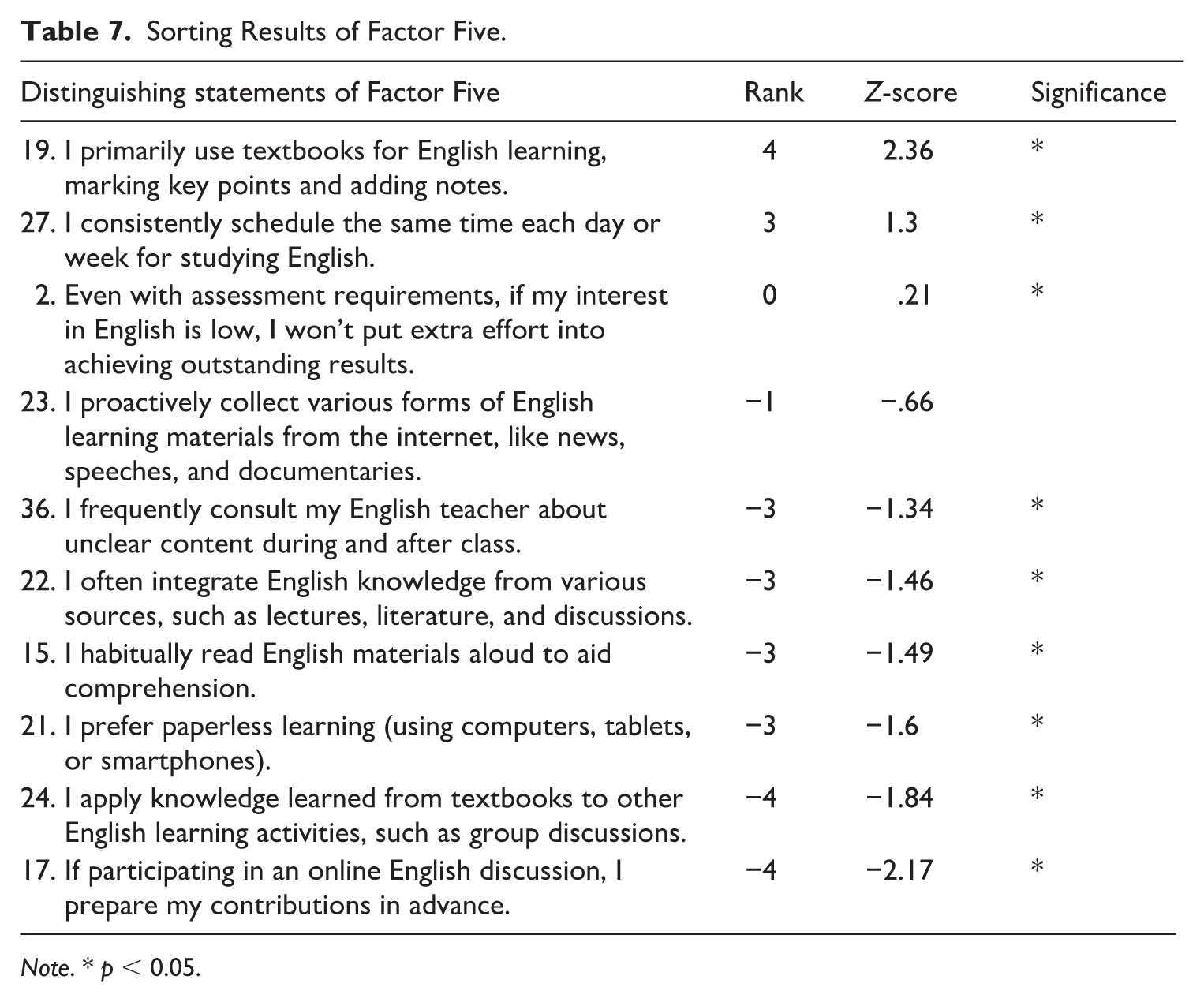
Note. * p < 0.05.
Interviews with P23, a participant with a defining loading of .74, and P28, with a defining loading of .63, well supported the above interpretation: Since I don’t have a particularly good environment for learning English, and my English proficiency is quite poor, I’m not very motivated to learn the language. My goal is just to meet the basic requirements for school exams and work needs. So I choose to learn English, to be honest, in a quite passive manner. Most of my learning happens in the classroom, following teachers’ requirements, like previewing and reviewing the material. I haven’t bothered to use additional resources beside school textbooks. I don’t usually participate much in discussions or lectures related to English learning—basically, I rarely take part. (P23) I can’t seem to learn anything from digital versions; the feel is all wrong. I honestly don’t know how people manage to study on an iPad—I tried for half an hour and quickly realized it’s just not for me . . . When it comes to group discussions, if we have to report to the teacher, I’ll probably prepare a bit; but if the teacher just asks us to chat among ourselves, I won’t bother. I’ve never liked group discussions anyway, I’m too introverted. (P28)
5. Discussion
The Q sort analysis identified five distinct patterns—that is, introspective SRL, proactive SRL, insecure SRL, flexible SRL, and dysfunctional SRL—which again evidenced SRL as a dynamic system, validating the role of Q methodology in advancing SRL research within the CDST framework.
Factor One presented an introspective SRL type. They were oriented toward internally valued goals, expressed a strong preference for autonomy. and believed in the effectiveness of self-reliance. This partly aligns with Zimmerman’s Cyclical Phases Model’s depiction of effective SRL learners as proactive agents who, in the forethought phase, establish personally meaningful, intrinsically motivated goals and activate strong self-efficacy beliefs. Learners exhibiting this pattern also resembled the reflective-oriented learners reported in Li et al. (2022), who similarly preferred refining their strategies to developing an efficient internal SRL system. Despite appearing effective with high agency, their SRL may occasionally stall due to the absence of external feedback during the reflective stage. There might be several factors explaining this tendency as the semi-structured interviews indicated. Firstly, participants of this type reported a relatively introverted personality, like P3, who said: “I’m not really comfortable talking about my learning progress with others.” Previous research has unveiled a strong link between extraversion and the use of academic resources, suggesting that students who are more introverted may be less inclined to seek help when facing academic challenges (Robbins et al., 2004). Meanwhile, different from those of Factor Two, which also demonstrated an introverted feature, participants of Factor One still believed that their independent self-regulation of the learning process could be effective. This might be attributed to their high self-efficacy. Self-efficacy refers to individuals’ beliefs in their ability to accomplish tasks or achieve goals. Research has shown that higher academic self-efficacy is positively associated with greater use of SRL strategies and improved learning outcomes (W. Wang & Zhan, 2020). Students who are confident in their abilities are more likely to regulate their learning effectively and adjust strategies independently (M. F. Teng, 2019). The fact that these learners attributed mistakes to their strategy choices rather than a lack of ability and could quickly adjust their strategies demonstrated this point. Thus, an introverted personality and high self-efficacy were key factors shaping this pattern of learners developing an internalized system for managing their SRL strategy uses.
Factor Two, proactive SRL, demonstrated an approach particularly effective for ongoing English language development. The proactive learners exhibit activeness during the whole cycle in Zimmerman’s Cyclical Phases Model as they initiate adaptive goal-setting and planning in the forethought phase, actively apply strategies, monitor their progress, and manage resources during the performance phase, then reflect on outcomes to refine their approach in the self-reflection phase, leading to desirable learning outcomes. In Dörrenbächer and Perels (2016), a high SRL and high motivation pattern were identified and reported to have the best performance. This aligns with the features of learners with proactive SRL, who actively set goals, seek external resources, and refine their strategies in response to changing academic demands. A few reasons may contribute to this healthy and consistent pattern: positive past learning experience, high self-efficacy, and a positive mindset. Past learning experiences significantly influence one’s language goals and aspirations, as well as one’s perception of current abilities (Kwag & Park, 2022). As the Q results and the interview with P4 revealed, these participants generally had a good learning experience and a certain degree of English proficiency, which allowed them to view English as one of their core strengths. With a high self-efficacy, they were thus willing to set goals that exceeded both external expectations and those of their peers, aiming not only for scores but also for continuous improvement. They understood errors as a natural part of language learning and, instead of avoiding situations where they might fail, they embraced them as opportunities to refine their skills, demonstrating a general attitude of optimism and resilience. This perspective reflects a broader attitude of optimism and resilience, key attributes that have been linked to more effective SRL strategy use (Karlen et al., 2021). Over time, this proactive SRL pattern might endow these learners with sustained progress and improvement in their English proficiency.
Factor Three represented the insecure SRL pattern. Learners of this type learned in an intense and anxious status. As P30 indicated, she felt the need to cover her weaknesses in front of others and was critical about her performance. Their sense of insecurity toward external opinions influenced their SRL, especially in the forethought phase, where their motivation is driven more by external validation than personal growth (Zimmerman, 2000). In other words, although they recognize the practical value of English, their strongest motivation came from a fear of public embarrassment, pushing them to excel but also making them overly anxious. This perfectionism further extended to their performance and reflection phases, where they resisted seeking help unless they had exhausted all other options, as doing so feels like an admission of failure or irresponsibility. The core reasons behind this pattern may be an overly high self-consciousness and a low self-efficacy. These highly self-conscious learners, who were constantly concerned about external perception of themselves, strove to present themselves as capable in English while avoiding any risks of public embarrassment. Consequently, they often established strict self-standards and steered clear of situations that required showcasing their English skills. Previous study in a mathematics setting has reported that public self-consciousness negatively predicted academic self-concept and was associated to a tendency to underrate oneself in the domain (Martin & Debus, 1998). Along with their excessive self-consciousness, this group also displayed a low level of self-efficacy. As their expectations and standards were often too high to attain, a sense of satisfaction and achievement was rare. Instead, negative opinions and undervaluation about their learning ability took place. And to dig deeper, both traits might result from negative previous experiences in English learning, as well as social expectations. Within China’s test-oriented education system, there is a strong emphasis on correctness and performance rather than on the learning process itself (H. Zhao, 2022). When learners are repeatedly subjected to criticism and conditioned to believe that there is always a single correct answer, they may develop a deep-seated fear of making mistakes. Although this approach to SRL may initially appear effective in boosting test scores, it could have long-term negative consequences.
Participants of Factor Four learned in a flexible manner. They enjoyed learning English for its own sake rather than for exams, yet external pressures motivated them to achieve satisfactory grades. Willing to invest extra effort to improve, they maintained moderate personal standards and were not overly discouraged by occasional setbacks, unlike participants in Factor Three. As their learning goals evolved, they adapted their strategies accordingly, keeping plans simple and flexible. This allowed them to continuously adjust their SRL approach, creating a dynamic and responsive learning experience. These features indicate an ongoing process of monitoring, reflection, and strategic adaptation across SRL cycles, as well as the complex influence of contexts, reflecting the complex and cyclical nature of SRL (Zimmerman, 2000). The profile aligned with Bergamin et al.’s (2012) finding that groups with greater learning flexibility tended to use a broader variety of strategies than those with lower flexibility. This pattern may be attributed to a supportive environment where success was not the only measure of achievement, as well as a personal temperament not driven by competition. As highlighted in the interview with P13, whose self-reward habit was influenced by their parents, environmental support may play a role in shaping one’s self-assuring SRL strategies. This interpretation was also in line with prior research (Liu et al., 2022) showing that supportive environments, such as family and peers, helped reduce student anxiety, whereas competitive learning attitudes were linked to increased anxiety. With less anxiety, learners of this type could maintain a relatively unaffected inner status and be adaptive when conducting the SRL process.
Factor Five clearly illustrated the SRL patterns in learners experiencing dysfunctions. These dysfunctions arise from their reliance on reactive strategies, rather than proactive ones, as described in Zimmerman’s (2000) Cyclic Phase Model. Reactive methods typically involve responding to challenges only when they occur, rather than anticipating and preparing for them in advance (Zimmerman, 2000). These learners rarely took a proactive approach to improving their English. Instead, they tended to wait until they inescapably encountered failure or negative feedback to identify areas for improvement. This reactive approach disrupted their cyclical process by undermining effective planning and foresight, ultimately leading to poorer learning outcomes and reduced performance. However, despite their seemingly resigned attitude toward SRL, these learners’ self-critical reflections revealed an awareness of their limitations and a latent desire for improvement. Such a dysfunctional SRL pattern was shaped by negative past experiences, discouraging learning environments, and low English proficiency, leading to passive and disengaged learning. Prior ineffective SRL experiences undermined strategy adaptation (Ye et al., 2022), while repeated failures fostered learned helplessness, lowering self-efficacy and motivation. China’s exam-oriented culture and large class sizes, which led to rigid, test-focused teaching and limited tutorial support, further strengthened their negative views of English learning. Their reluctance toward e-learning, partly due to technical challenges and limited digital literacy, also hindered SRL. Combined with introversion and reluctance to seek help, these factors created a cycle of stagnation, leaving learners uncertain about how to adjust strategies (Esnaashari et al., 2023). Without intervention, such as ample resources, more supportive learning environments, and targeted guidance to rebuild their confidence, these learners were unlikely to break free from this dysfunctional approach and take initiative in their English learning journey.
6. Conclusion
Via Q methodology and semi-structured interviews, the present research identified five factors of Chinese EFL learners’ SRL, along with the underlying causes. The results proffered a holistic and panoramic view of SRL as a complex dynamic system. Both significant theoretical and practical implications were generated.
Theoretically, this study enhanced our comprehension of SRL profiles, particularly within the Chinese EFL context. Given the large population of foreign-language learners in China, research in the target context contributed to a broader understanding of SRL as a widespread practice. This study also enriched the content of Zimmerman’s (2000) Cyclical Phase Model. The three phases of SRL are interconnected and influence one another in a dynamic interplay, with different SRL patterns emerging based on learners’ varying preferences across the three phases. In addition, the feasibility and effectiveness of Q methodology in the SLA field, especially in the Chinese EFL context, were reassured. Q methodology bridges the gap between case studies and broader generalizations, allowing for the statistical identification of distinct SRL groups while also revealing the complexity of the SRL experience. The present research hence provided referential insights for future practices.
As for pedagogical practice, understanding the potential SRL profiles is advantageous for learners, as it helps them easily recognize their strategy use patterns and quickly grasp the associated strengths and weaknesses, allowing them to effectively address personal challenges. More importantly, for instructors, a better understanding of the possible types of their students facilitates more tailored assistance. For instance, if educators identify traits of an introspective SRL pattern in students, they may consider providing regular assessments or tutorials to offer external feedback on students’ learning pathways. This complementary support may help students detect and address potential issues in their SRL processes more effectively than relying entirely on their preferred self-judgment. Over time, reflection based on regular external feedback can become an integrated part of their SRL process. Analogously, when guiding a learner with insecure SRL, the prior task is supposed to be affective, including building teacher–student rapport and creating an environment that embraces mistakes. Instructors, by encouragement, can help the insecure student gradually accept imperfections, making it easier for them to acknowledge their limitations and recognize their abilities. Through consistent and supportive instruction, their self-efficacy may gradually improve, making their learning experience more enjoyable. Moreover, the present research unveiled the underlying causes of students’ performance in SRL. This finding promotes instructors’ comprehension of students’ occasionally unsatisfactory behaviors and performance, strengthening the rapport between educators and learners while creating opportunities for collaboration and improvement. For instance, if an instructor identifies learners with traits similar to Factor Five, they should understand that, despite appearing disengaged or underperforming, these students may still wish to improve. Their poor performance is the result of dysfunctional factors like an unsupportive environment or negative past experiences. With additional support from instructors, including personalized feedback, guidance in effective SRL strategies, and sufficient learning materials, these students can be guided toward progress. With these understandings, tailored teaching strategies and supportive environment can be more effectively implemented for different SRL groups based on their specific needs.
Although this study provides valuable insights, several limitations should be noted. First, the relatively small Q methodology sample may limit the generalizability of the findings to all EFL learners in China. Additionally, the study focuses on China’s exam-driven, teacher-centered context, which may limit its ability to reflect how learners in more communicative, student-centered environments adopt SRL strategies. Future research could expand participant diversity, include learners of other foreign languages, and compare SRL across varied cultural and educational contexts, potentially using comparative Q methodology. In addition, investigating specific learning situations, such as exam preparation or writing tasks, would allow for more targeted interventions. Considering the growing role of technology, exploring the impact of e-learning and digital tools on SRL is also recommended. Finally, examining SRL through the lens of CDST and applying longitudinal Q methodology could enrich understanding of how SRL develops and changes over time.
Footnotes
Appendix A
Statements and Factor Rays.
| Statements | F1 | F2 | F3 | F4 | F5 |
|---|---|---|---|---|---|
| 1. Before starting English study, I always first determine the course assessment or self-evaluation criteria to guide my learning. | 3 | 1 | 2 | 4 | 1 |
| 2. If my interest in English is low, I won’t put extra effort into achieving outstanding results, even with assessment requirements. | 3 | 3 | −3 | −4 | 0 |
| 3. Before starting English study, I always spend time planning my learning steps and selecting strategies. | 0 | 1 | 4 | 3 | 2 |
| 4. I am confident in my English learning abilities and can complete tasks independently. | 4 | 0 | 1 | 3 | −1 |
| 5. If I anticipate difficulties in upcoming English learning, I will lose motivation and willingness to study. | −1 | 1 | −2 | −1 | 2 |
| 6. I study English largely because I believe it helps me achieve my life goals. | 4 | 3 | 3 | 2 | 4 |
| 7. When I find English learning tasks interesting, I complete them with extra effort. | 2 | 2 | 2 | 4 | 1 |
| 8. I am clear about my purpose in learning English and remain steadfast throughout the process. | 3 | 0 | 0 | −2 | 2 |
| 9. If I believe my English proficiency meets the assessment requirements, I won’t set additional learning goals for myself. | 2 | 1 | −2 | −4 | 2 |
| 10. I prefer challenging learning tasks. | 0 | 0 | 3 | −1 | 0 |
| 11. For me, the most important goal in learning English is to improve my exam scores. | 2 | −3 | −4 | 1 | 3 |
| 12. I am always aware of the quality of my work when learning English. | −2 | 2 | 0 | 2 | 3 |
| 13. If I feel my effort in learning English meets the requirements, I won’t continue studying further. | 1 | 2 | −4 | −2 | 1 |
| 14. I regularly record and review my English learning progress. | 0 | −1 | 2 | −3 | −2 |
| 15. I habitually read English materials aloud to aid comprehension. | 1 | 1 | 1 | 0 | −3 |
| 16. I find that note-taking is more helpful for understanding online course content than in traditional classrooms. | 1 | −1 | 0 | 0 | 2 |
| 17. If participating in an online English discussion, I prepare my contributions in advance. | −2 | 4 | 3 | 0 | −4 |
| 18. I tend to use verbal recitation methods to memorize English points. | 1 | 1 | 1 | 3 | 0 |
| 19. I primarily use textbooks for English learning, marking key points and adding notes. | 1 | −1 | 0 | 3 | 4 |
| 20. I mainly use notebooks for English learning, writing out key points and creating mind maps. | −3 | −1 | 0 | 1 | 1 |
| 21. I prefer paperless learning (using computers, tablets, or smartphones). | 0 | 2 | 1 | 0 | −3 |
| 22. I often integrate English knowledge from various sources such as lectures, literature, and discussions. | 0 | −1 | −1 | 0 | −3 |
| 23. I proactively collect various forms of English learning materials from the internet, like news, speeches, and documentaries. | 0 | 0 | 2 | 1 | −1 |
| 24. I apply knowledge learned from textbooks to other English learning activities, such as group discussions. | 0 | 0 | 1 | 0 | −4 |
| 25. Before starting an English learning task, I always remind myself to clearly understand the key points of the task. | 0 | 0 | 0 | 2 | 0 |
| 26. I summarize key points from English learning materials into lists or mind maps. | −3 | −1 | 1 | 0 | −2 |
| 27. I consistently schedule the same time each day or week for studying English. | −3 | −4 | 0 | 0 | 3 |
| 28. I always make full use of my allocated English study time. | −1 | −3 | 0 | −3 | −1 |
| 29. Despite having ample time planned, I often procrastinate until the last moment to complete English tasks. | −2 | 1 | −3 | 1 | −2 |
| 30. I usually only focus on English study right before exams. | 0 | 0 | −3 | 0 | 0 |
| 31. I always study English in the same place to maintain focus. | −1 | −2 | 2 | −1 | 1 |
| 32. If the learning environment is uncomfortable, I find it hard to concentrate and prefer to postpone studying. | 1 | 2 | −1 | 1 | −1 |
| 33. Even for online English courses, I always stay focused. | −1 | −2 | 4 | −2 | 0 |
| 34. I proactively communicate with classmates to understand my progress in English learning. | −2 | −1 | 3 | −1 | 0 |
| 35. Even when facing difficulties in English learning, I try to complete tasks independently without seeking help. | −2 | 3 | −2 | −2 | −2 |
| 36. I frequently consult my English teacher about unclear content during and after class. | −1 | 0 | 1 | −1 | −3 |
| 37. I try to identify classmates in English class who can help me when needed. | −1 | −1 | 2 | 1 | 1 |
| 38. I rarely discuss my English learning difficulties with peers. | −2 | 0 | −1 | −1 | −1 |
| 39. If I get distracted during English study, I usually refocus quickly. | 3 | −3 | 1 | −1 | −1 |
| 40. I believe that providing correct answers in exercises means I have sufficiently mastered the material. | −4 | −3 | −2 | −3 | −1 |
| 41. When encountering learning difficulties, I often remind myself of the consequences of not learning English well. | 2 | −2 | −1 | −2 | 1 |
| 42. When I make progress in English learning, I always appreciate my efforts and reward myself. | 1 | −2 | −1 | 2 | 1 |
| 43. I regularly assess my English learning progress according to set standards. | 2 | −2 | 0 | −1 | 0 |
| 44. I believe that exam results fully reflect my effectiveness in learning English. | −1 | −4 | −3 | 2 | 3 |
| 45. If I feel my performance does not meet my target level, I will still feel very frustrated even if my results are better than most peers. | −1 | 1 | −1 | 1 | −2 |
| 46. When performing well, I feel it is more due to luck than my own efforts. | −3 | 2 | −2 | −2 | −2 |
| 47. When performing poorly, I begin to doubt my English learning abilities. | 1 | 4 | −1 | 2 | 2 |
| 48. I enjoy tasks that I can easily complete, as they boost my enthusiasm for learning English. | −4 | 3 | −1 | 0 | 0 |
| 49. I tend to avoid challenging English learning tasks. | 0 | 0 | −2 | −3 | 0 |
| 50. After encountering setbacks in learning tasks, I quickly adjust my English learning strategies based on the reasons for failure. | 2 | −2 | 0 | 1 | −1 |
Appendix B. Semi-Structured Interview Sample
Objective: Clarifying the intention of the Q sorts of each participant and further discovering the underlying reasons for their sorting.
Target participants: Two most significantly loading participants for each factor. Ten participants in total.
Duration: 15–25 minutes.
Interview setup: In person and via email.
Introduction: Thank you for your participation in our study. Based on the analysis of your grid responses, we have identified a significant pattern regarding the following items:
To further understand your perspectives on these statements, we would like to ask a few questions regarding these responses.
Semi-structured questions:
Probing questions:
Acknowledgements
We would like to express our gratitude to all the anonymous reviews and the editors for their constructive and insightful comments and suggestions on this article. We are grateful to the teacher and students who participated in this research. This article would not have been possible finished without their help. Any errors and omissions that remain are our own responsibility.

Ethical Considerations
All ethical protocols were strictly followed in conducting the research. The participants provided their written informed consent to participate in this study.
Funding
The authors received financial support for the research, authorship, and/or publication of this article from the Fujian Social Sciences Key Project Fund (Award no. FJ2025A022).
Declaration of Conflicting Interests
The authors declared no potential conflicts of interest with respect to the research, authorship, and/or publication of this article.
Data Availability Statement
All the data included in this writing are available from the corresponding author by request.