




Abstract
In typical development, children learn an extensive range of idioms and other figurative (non-literal) language expressions during childhood and adolescence. However, many children with autism fall far behind in their idiom comprehension and production and never fully reach adult levels. The current study measured the effectiveness of a group idiom intervention for ten children, aged 7 to 12 years, with autism spectrum disorders. This intervention was conducted by a community-based social skills program. The children were initially very low in idiom understanding, but were able to learn and remember the meaning of idiomatic phrases that they were taught during the 2-week-long intervention. The children showed greater increases at a delayed post-test for idioms trained in the intervention than idioms that were untrained controls. Implications for future educational possibilities are discussed.
Children with autism often have a difficult time interpreting the meaning of idioms and other types of figurative language (Kerbel and Grunwell, 1998; Norbury, 2004; Rundblad and Annaz, 2010). Idioms are a relatively complex and varied type of figurative language, and ‘although an idiomatic phrase can be interpreted literally, when used in a specific or specialized context, its meaning is nonliteral and it expresses an idea or concept’ (Bernstein, 1987, p. 136). For the idiomatic phrase ‘kick the bucket,’ the figurative meaning conveys that something or someone died (e.g. Mary cried for weeks when her rabbit kicked the bucket), rather than the literal meaning of performing an action on a bucket. As with most idioms, the figurative meaning of ‘kick the bucket’ rests on shared usage among speakers of a language. Idioms vary on dimensions such as compositionality (how much the individual words contribute to the figurative meaning), how familiar the phrase is to the individual, and whether or not the phrase is presented in a supportive context (Titone and Connine, 1994). Research has found that all three of these dimensions have an impact on an individual’s comprehension of the idiom phrases in both childhood and adulthood, although the mechanisms of how children acquire idiom knowledge is still under debate in the literature (Gibbs, 1992; Hamblin and Gibbs, 1999; Levorato and Cacciari, 1992; Levorato and Cacciari, 1999; Nippold and Martin, 1989; Titone and Connine, 1994).
While the focus of the present empirical study is on idioms, it seems probable that what is learned will have some relevance for children’s learning of three other types of figurative expressions: proverbs (‘too many cooks spoil the broth’), similes (‘her nose is like a cherry’), and metaphors (‘the girl is a tiger’), which also have been found to be difficult for children with autism and other language disorders (Berman and Ravid, 2010; Nippold, 1991; Rundblad and Annaz, 2010). Each of these types of figurative language share the common feature that the listener must go beyond what is literally said (in words and their syntactic arrangement) and remember the figurative meaning from past common usage, or create on the spot a new contextually appropriate meaning, for a phrase or sentence (Bernstein, 1987; Berman and Ravid, 2010).
Children with autism who fail to develop the understanding of figurative expressions may have difficulty with school and in interacting with their peers. This implication is highlighted when considering that figurative language expressions (including metaphors, similes, indirect requests, and idioms) are relatively common in children’s literature and in mainstream classrooms (Colston and Kuiper, 2002; Lazar et al., 1989). Additional instruction in the form of interventions for children with autism who fall behind in their idiom knowledge may help to aid them in understanding the language being used in classroom instruction, in addition to being better able to follow conversations with their parents and typically developing peers.
Development of idiom comprehension in children
Typically developing children in elementary school are able to interpret some idioms, and idiom comprehension increases throughout childhood and adolescence. In research by Ackerman (1982), children as young as six were able to interpret a small percentage of idioms when they were presented in a context biased towards the figurative meaning. The percentage of idioms correctly interpreted increased significantly with age for 8- and 10-year old children, with none of these age groups reaching adult comprehension levels. The role of context in aiding the interpretation of figurative phrases (idioms, metaphors, similes, and proverbs), has been highlighted for both typically developing and disordered children (Berman and Ravid, 2010; Bernstein, 1987; Levorato and Cacciari, 1992). Children have a more difficult time interpreting unfamiliar idioms, and may rely more on context for interpreting unfamiliar idioms than familiar idioms (Nippold, 1985; Nippold and Martin, 1989). Multiple studies have found that children are more likely to produce a figurative meaning for the idiom when the idiom is presented in a context biased towards the figurative meaning, rather than presented in isolation or a literal context (e.g. Ackerman, 1982; Levorato and Cacciari, 1992).
While understanding figurative language may be difficult for all young children, it is significantly more difficult still for children with autism or language disorders (Berman and Ravid, 2010; Dennis et al., 2001; Norbury, 2004). Children with autism and language impairment have difficulty understanding idioms and are more likely to provide literal meanings to idioms than their typically developing peers (Kerbel and Grunwell, 1998; Norbury, 2004). Nikolaenko (2004) found that typically developing children (age 10 to 15) performed around 90 percent correct on their idiom task, whereas children with Asperger’s syndrome were performing below 40 percent on the idiom task.
There are several cognitive and linguistic skills that predict individual differences in idiom comprehension, such as syntax, vocabulary, theory of mind, and working memory (Norbury, 2004). These abilities may be impaired in children with autism and contribute to difficulties with idiom comprehension. Norbury (2004) found that children with autism and low language skills performed worse than the children with autism who had high language skills, showing that language ability is a significant predictor for idiom comprehension ability. Children with autism and language disorders show similar difficulty with comprehending other types of figurative language, probably because of their delays in language development and other important cognitive skills (Berman and Ravid, 2010; Nikolaenko, 2004; Rundblad and Annaz, 2010).
Even though typically developing children may use the linguistic context to help them determine the meaning of idioms and other figurative phrases, children with language impairments may benefit considerably less from the contextual information when interpreting various types of figurative language, such as proverbs, metaphors, and idioms (Berman and Ravid, 2010; Norbury, 2004). Qualls et al. (2004) suggest that the ability to make use of context in interpreting figurative language may rely on linguistic processing resources that are reduced in children with impaired language abilities.
Idiom intervention studies
Two previous intervention studies have been successful at teaching idioms to children with communication disorders or intellectual disabilities (Abrahamsen and Smith, 2000; Ezell and Goldstein, 1992). Abrahamsen and Smith (2000) used computer-based and classroom-based interventions to teach 16 idioms to children with communication disorders. The eight participating elementary school children included a heterogeneous group of children with communication disorders. The results of the intervention were that the children were able to learn the meaning of at least some of the idioms. In addition, the children learned better from the classroom intervention than the computer-based intervention, perhaps because the classroom group lessons allowed more interactive and naturalistic dialog (Abrahamsen and Smith, 2000).
In research by Ezell and Goldstein (1992), the meanings of 12 idioms were taught to four children, age 9 years, with intellectual disabilities. The idioms were presented in context biased towards the figurative meaning with sets of pictures depicting idiom meanings, and each child learned individually with an adult trainer. Over the course of up to 20 sessions across several weeks, children learned to discriminate between the literal and figurative meanings of idioms used in their training sessions (Ezell and Goldstein, 1992).
Several researchers have suggested that children with language impairments (including children with autism) should be taught how to comprehend idioms with a focus on presenting idioms in context (Bernstein, 1987; Norbury, 2004; Wiig, 1989). Nippold (1991) suggests that idioms should be taught to children by presenting the idioms orally in the context of a short story and asking questions that draw their attention to contextual cues in the story supporting the idiom’s figurative meaning. The goal of this teaching approach is to emphasize a comprehension strategy based on drawing active attention to the multiple contextual clues, which may be more helpful for the children than simply teaching the meanings of a set of idioms outside of any contextual framing (Nippold, 1991).
The purpose of the current study was to examine the effectiveness of a group idiom intervention for children with autism at a community social skills summer program. To measure the comprehension of idioms, children were given a pre-test definitions task, in which they were asked to define idioms embedded in short paragraphs. These paragraphs provided contextual information highlighting each idiom’s figurative meaning. Nine treatment idioms and nine untreated control idioms were chosen and matched based on low comprehension scores at pre-test. It was hypothesized that children would score better on the treatment items after intervention than before intervention, with these gains still being evident at a delayed post-test two weeks after completion of the idiom intervention unit.
Methods
Participants
Participants were ten children with autism, ages 7 to 12 years (nine male, one female, mean age = 9.5 years), who were enrolled in a community-based summer social skills program for children with autism in Pennsylvania. During the summer, the social skills program was conducted 5 days a week, for 3 hours each day.
To be enrolled in the social skills program, a child was required to have a diagnosis of an autism spectrum disorder. As identified by a parent report questionnaire, the children in this study had received a primary diagnosis of autism or Asperger’s syndrome. Three participants were also diagnosed with intellectual disability. Comorbid secondary diagnoses included attention deficit hyperactivity disorder (five children) and Cornelia De Lang syndrome (one child). At pre-test, the children were administered the Peabody Picture Vocabulary Test - III (Dunn and Dunn, 1997). See Table 1 for descriptive information on the sample of children with autism (age, vocabulary, and number of days they attended out of the possible 9 intervention days).
Descriptive information for each child.
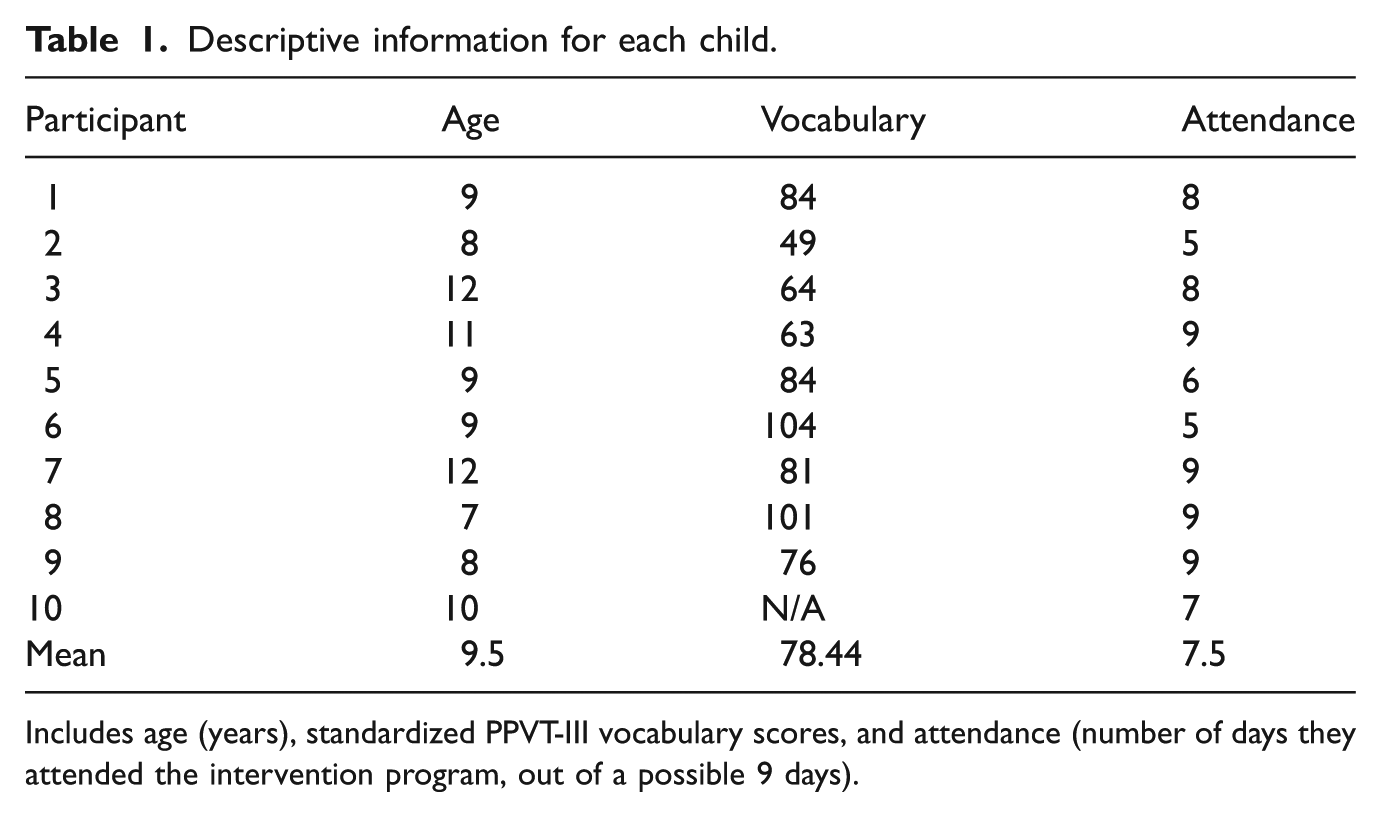
Includes age (years), standardized PPVT-III vocabulary scores, and attendance (number of days they attended the intervention program, out of a possible 9 days).
Measures
The 26 idioms were presented in the context of a paragraph biased more towards the figurative meaning of the idiom, with two to three short sentences (see example in Appendix 1). Then, the child was asked to state the meaning of the idiom. The child provided a verbal response to each item, which was coded following the classifications used in Abrahamsen and Smith (2000). These classifications are: correct (figurative meaning), related (to figurative meaning), literal, restated, or not related (to the idiom).
Two scores were computed for idiom performance. First, total number of correct idioms was recorded (out of 26), with all other responses scoring zero. Second, a composite of correct (2 points each) and related responses (1 point each) was calculated (total score out of 52), with literal, restated, and not related answers scoring zero. Related answers showed that the children were trying to think figuratively about the idiom, but did not yet know the correct figurative answer.
Results for the individual items of this pre-test were used to determine which idioms to target in the group and intervention phase, and for within-participant control-tracking, as a result of not having an available control group. From the 26 idioms, a subset of 18 items were chosen on the basis of being incorrectly answered consistently across children in the pre-test. Similar difficulty for the nine treatment and nine control items was assured by pairing treatment and control items on the basis of the number of correct and related responses the children gave. They were also matched as closely as possible on number of words in the phrase, and ratings of familiarity, compositionality, and meaningfulness reported by Titone and Connine (1994). See Appendix 2 for all 26 items on the pre-test; these are sub-classified as treatment items, matched controls, and the remaining supplemental items.
Procedure
An idiom intervention was integrated into the curriculum of a group social skills program run by a community-based organization in Central Pennsylvania. The group of children were introduced to one idiom each session, for a total of nine idioms presented over 2 weeks of the summer program. All idiom intervention sessions were conducted by the staff of the social skills program, using materials developed by the researchers. The staff of the program met periodically with the experimenter to discuss the lesson plans and idiom teaching strategies.
The summer social skills program lasted approximately 3 hours for each session and met 5 days a week, with a different topic covered every few weeks. The program followed the same general structure every session, with 15 minutes allocated for every activity. The sessions started with circle time, during which the children sat on the floor gathered around the program’s lead staff member and talked with each other about various topics. This was followed by various other activities, usually consisting of lessons or crafts completed at the tables, playing outside, snack time, story reading, and so on. Throughout the intervention, the staff members used applied behavior analysis-based prompting strategies, with prompting targets tailored to the individual child’s social skill development needs.
During the idiom intervention unit, a staff member introduced the topic of idioms during circle time, and read a paragraph to the group that presented the idiom in context. The children answered several questions asked by the staff member about the paragraph, including information about the context relevant to the idiom meaning, and then about the figurative meaning of the idiom. The paragraphs were longer in length than the ones used in the pre- and post-tests, and differed in specific content (see Appendix 1 for an example).
After they were finished with the paragraph activity, the children were asked to sit down at the tables and complete a worksheet related to the idiom. All worksheets for each idiom contained the following components: a clip-art picture related to the figurative meaning that the children could color, a place for the child to write the figurative meaning of the idiom, a place for the child to write their own sentence containing the idiom, and a large space for the child to draw their own picture of the idiom meaning (the last two components required the child to think creatively and come up with their own contexts that meaningfully related to the idiom). Children with poor writing skills were given assistance by the staff members for completing any of the sections that they were unable to complete alone. In addition, the staff members discussed the content of these worksheets with each child as they were completing the task, to help make the worksheets an interactive learning tool.
Results
Pre-analysis
For the immediate post-test analysis, the total number of correct responses for intervention items violated normality (severe skew and kurtosis values), and therefore a nonparametric (Wilcoxon’s signed-rank) test was conducted. For the delayed post-test analysis (composite scores of correct and related responses or with the full set of 26 idioms), the data upheld normality such that t-tests and analysis of variance (ANOVA) were appropriate.
Idiom pre-test comprehension
Most of the children did not know the meanings of the vast majority of idioms on the pre-test prior to intervention. Total number of correct responses on the pre-test ranged from 0 to 6, with a mean of 3.1 out of the 26 idioms on the test. For the composite score of correct and related answers, children scored between 0 and 25 out of 52 points.
Pre-test versus immediate post-test
Children showed significant improvement in their definitions of idioms after the immediate post-test, with a greater number of correct responses on the treatment items at immediate post-test than pre-test, Z = −2.68, p < .01. See Table 2 for each child’s pre-test and immediate post-test number of correct answers. In addition, on the multiple choice question testing comprehension at the immediate post-test, children were correctly able to identify the meaning of between 80 to 100% of the idioms on the days that they attended the program.
Number of correct figurative explanations and percentage of correct multiple choice responses.
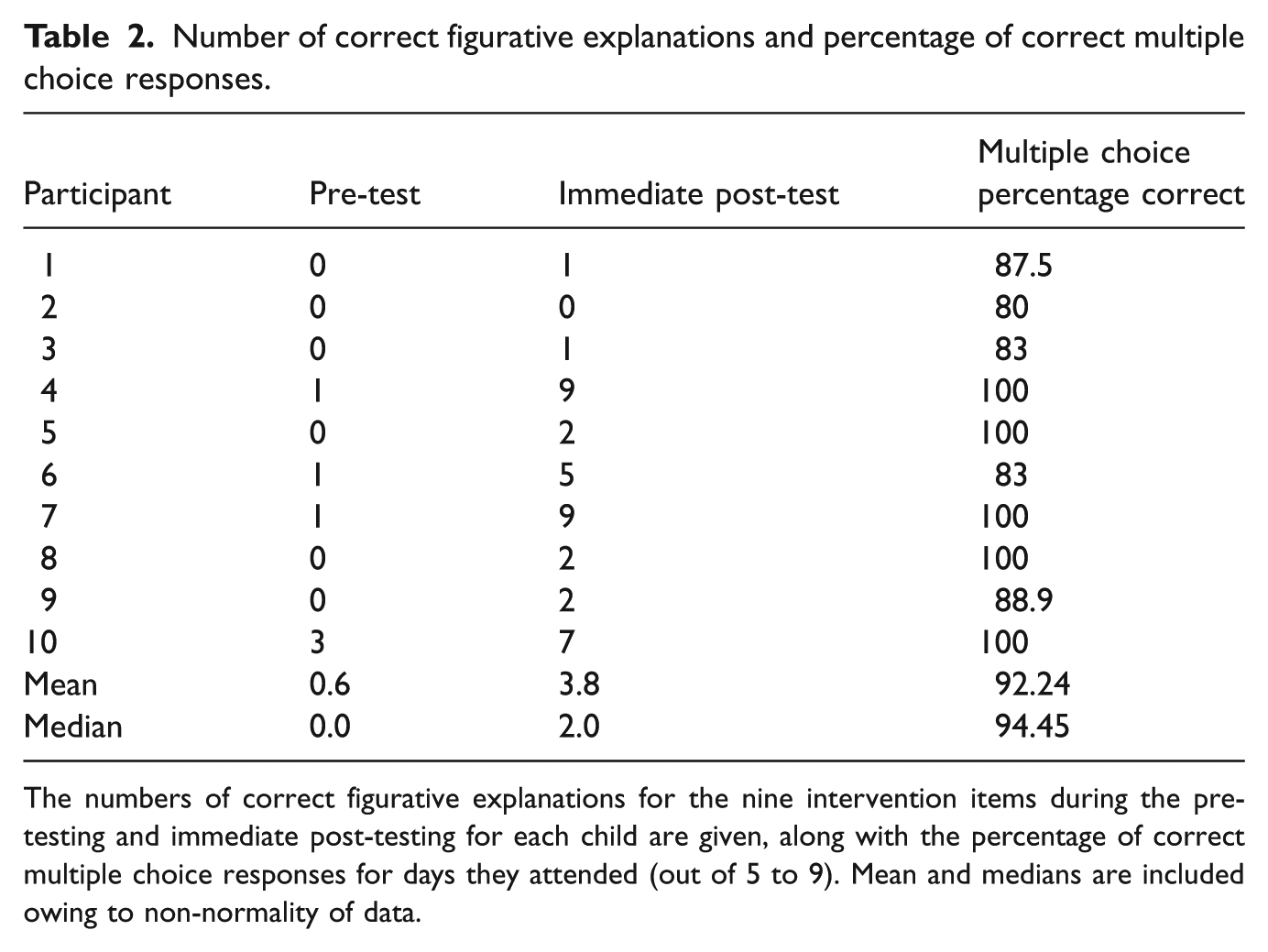
The numbers of correct figurative explanations for the nine intervention items during the pre-testing and immediate post-testing for each child are given, along with the percentage of correct multiple choice responses for days they attended (out of 5 to 9). Mean and medians are included owing to non-normality of data.
Another measure of improved idiom comprehension was idiom definition performance on the first 2 immediate post-test items for each participant compared with their last two immediate post-test items. These children with autism spectrum disorders improved significantly from the first two intervention idioms (mean = 2.6 correct and related responses out of a possible 4) to the last two (mean = 3.1), t(9), = 1.86, p < .05.
Delayed post-test
The intervention also led to improved idiom understanding as measured 10 days to 3 weeks after the intervention. For the composite of correct and related responses, delayed idiom post-test scores were compared with pre-test scores for the intervention and control items, using a 2 (treatment vs. control items) × 2 (pre-test vs. delayed post-test) ANOVA. Children scored significantly higher in idiom skills at the delayed post-test than the pre-test, F(1,8) = 25.44, p < .001, ηp2 = .761 (large effect size). Children also scored significantly higher on treatment than control items, F(1,8) = 26.21, p < .001, ηp2 = .766 (large effect size). In addition, there was a significant interaction of pre-test/post-test by treatment/control, F(1,8) = 18.73, p < .01, ηp2 = .701 (large effect size).
Figure 1 contains the pre-test and delayed post-test score averages for the composite of correct and related responses for treatment and control items. On the pre-test, there was no significant difference between treatment and control items, t(9) = 1.46, p > .1. On the delayed post-test, children scored significantly higher on idiom understanding for the treatment items (mean = 8.78 out of 18) than for the control items (mean = 2.22 out of 18), t(8) = 5.2, p < .001, d = 1.49 (large effect size). This suggests that the gains for the intervention items are probably not due to learning outside of the program, and also suggests that children did not generalize learning to the matched-difficulty control phrases on the delayed post-test.

Mean scores (with standard error bars) for the children’s correct and related figurative meanings for the pre-test and delayed post-test, for both treatment and control items (out of a possible 18 points each).
To examine the overall difference for the pre-test versus delayed post-test, the number of correct responses was compared for all 26 idioms. Children correctly stated the figurative meaning of more idioms at the delayed post-test than at the pre-test, t(8) = 3.39, p < .001, d = 0.57 (medium effect size). See Table 3 for the total number of correct and related responses at pre-test and the delayed post-test for each child.
Total correct and related responses.
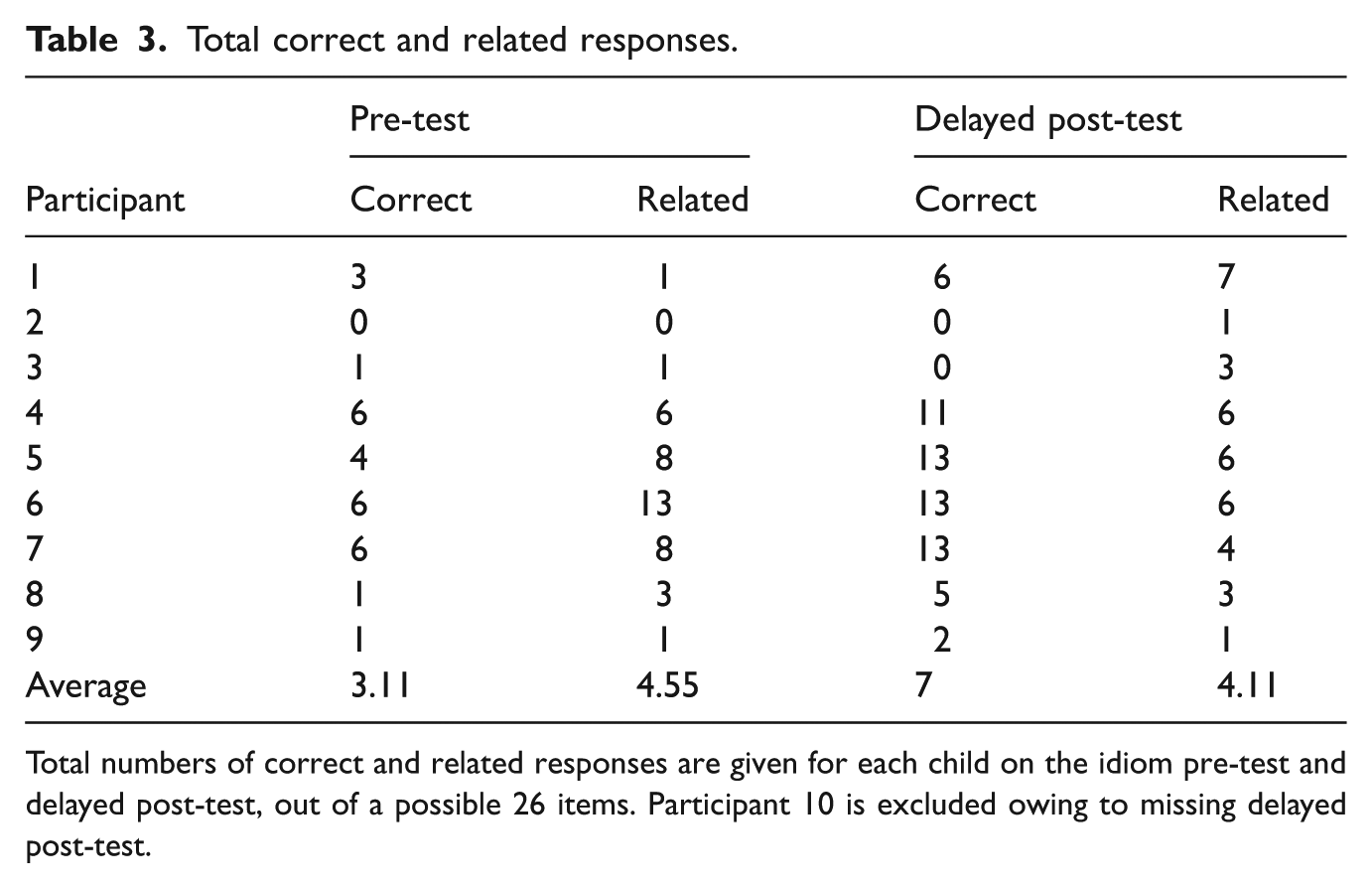
Total numbers of correct and related responses are given for each child on the idiom pre-test and delayed post-test, out of a possible 26 items. Participant 10 is excluded owing to missing delayed post-test.
Compositionality analyses
Possible performance differences in relation to compositionality were examined by comparing idioms high versus low in compositionality by median split. Analyses were run at pre-test and separately for intervention and control idioms at post-test. At no phase of the study was there a significant differences in participants’ performance for items high versus low in compositionality.
Discussion
Children with autism spectrum disorders readily learned the meaning of multiple idioms during the two weeks of a social skills intervention program that included engaging activities for exploring idioms. Before the intervention, scores on idiom comprehension were very low for most children in the program, in line with previous descriptive studies of children with autism. Increases in idiom comprehension were found in daily immediate post-tests during the intervention and retention was shown in delayed post-testing several weeks after completion of the intervention. These gains seen several weeks after the end of the intervention are especially promising because they show retention of information taught outside of a controlled laboratory setting (a community-based social skills program). Children were better able to explain the meaning of idioms included in the intervention, whereas matched but untreated control idioms showed no gains from pre-test to post-test. These results for control items were expected both because the intervention seemed too short to support much generalization of idiom comprehension to the untreated idioms and because these participants with autism spectrum disorders were not expected to learn many control items from experience outside the study. The present finding of substantial improvement on idioms taught in intervention does not speak to whether or not the children memorized the phrases or developed learning strategies for figuring out the meanings of idiom phrases. During the intervention, nine items were presented in a paragraph context with the teachers drawing attention to the contextual cues by asking the children questions about those cues, which previous research suggests should be done for helping children figure out the meaning from context (Nippold, 1991). Because of the short nature of the intervention, presenting and teaching only nine idioms may not have been enough for the children to learn strategies for interpreting new phrases. However, the performance of the children with autism in the current study at the delayed post-test shows that even if they only memorized the meanings of the phrases, they were still able to recall those meanings 10 to 22 days after learning the phrases, which is especially promising for children who started relatively low in their idiom knowledge. It could also be possible that other methods (such as multiple choice) would be more sensitive at assessing generalization beyond the intervention items, especially for the children with overall poor language abilities. Finally, it is important to note that during intervention the children made significant improvement in defining idioms from early to late intervention items. This result may possibly reflect some carryover from earlier learned items of some generalized awareness or idiom-interpretation strategies that eased learning of the last two intervention idioms.
The staff of the community-based program was able to make the idiom learning process fun and engaging for the children. The multiple interactive teaching tools (stories and worksheets) used by the program’s staff were enjoyable activities that called attention to the idiomatic meanings and also tried to hold the children’s social-emotional and cognitive engagement. In this kind of group setting, the stories served as a good introduction to the idiomatic phrase, and allowed the group to discuss what they thought the meaning of the idiom was. The question and answer component of the paragraph reading session allowed the children to talk about the contextual cues that were useful for figuring out the idiom’s meaning. The worksheets designed for the current study were very engaging for most of the children, who were able to draw pictures or write sentences with examples of the idiom’s idiomatic meaning which they created themselves. For example, when the idiom for the day was ‘fish out of water’, one of the children drew a picture of a boy wearing a pink dress who was sad because the other boys (who were wearing pants) were laughing at him. Thus, the worksheets allowed the children to be actively involved and creative, and allowed each child to explore their own examples of the idiom in contexts that were meaningful to them. In addition, the worksheets allowed the children to practice what they had learned in new contexts, which is thought to help aid children’s understanding of idioms (Nippold, 1991).
Control item comparisons revealed that the autism spectrum children were relatively low in idiom comprehension before intervention, and that passage of time or learning opportunities outside the idiom intervention procedures probably led to no improvement on idiom abilities during the several month time-period of this study. Each child was exposed to idioms during intervention that they had not mastered before, because items were chosen for the intervention on the basis of the fewest number of children at pre-test producing the correct meaning. This kind of focused concentration on multiple language challenges for each child, together with a mix of socially engaging ways of presenting those challenges, has been empirically tested in a rich variety of language-intervention studies. For example, Nelson and his colleagues have used a dynamic systems theoretical perspective in the design and the interpretation of interventions shown to have high impact on learning by children with autism of new reading and oral language skills (Nelson, 2001; Nelson et al., 1997), but had not previously addressed the figurative language expressions used in the present study. More broadly, for other language domains – including syntax, vocabulary, and reading facilitation for children with typical and atypical language development, a dynamic systems stress in the design of interventions has been used to present children with individual challenges in language with highly engaging methods (Camarata and Nelson, 2006; Nelson and Arkenberg, 2008; Nelson et al., 2004). In future research, it may be possible to extend the combination of challenges and social engagement from dynamic systems-focused language interventions to interventions designed to teach multiple varieties of figurative language, such as metaphors, similes, and proverbs, to children showing deficits in figurative language comprehension (Berman and Ravid, 2010). In addition, because vocabulary and syntax are strong predictors of figurative language production or understanding, it may be possible to intervene both directly on figurative language and indirectly through strengthening of other language skills known to relate highly to increased figurative performance.
Abrahamsen and Smith (2000) found that classroom-based idiom interventions were more effective than computer-based instruction for teaching idioms to children with communication disorders, because the classroom settings allowed naturalistic dialog between the teacher and the children, as well as interactive activities. In the current study, the stories and worksheets were also effective in teaching and engaging the students, as they allowed students to explore contexts related to the meaning of the idioms, and allowed the adults to interact with the children as a group and on an individual basis that supported the children’s learning.Presenting the phrases in context may be particularly important, because Nippold (1991) suggests that this may aid in helping children learn how to interpret unfamiliar idiomatic phrases. While typically developing children are able to use context to help them interpret idioms, children with language disorders and autism may not be as skilled at using context to help interpret figurative phrases (Ackerman, 1982; Levorato and Cacciari, 1992). New research could seek to address multiple possible avenues for strengthening awareness and learning of idioms and extend teaching methods to other figurative expressions such as metaphors, similes, and proverbs (with adjustments made for each type of figurative language). Bernstein (1987) recommends also teaching metaphor, simile, and proverb phrases in a supportive figurative context, similar to the importance of presenting idioms in a figurative context. Additional strategies that could be taught might include ‘spotting’ that what has been said in a story or conversation does not make literal sense. The children could also look for idioms commonly used in other sources relevant to the child, such as television programming or classroom discussions. Such awareness could be used to motivate searches for clues to meaning in contextual details, or in requests for clarification, or to seek out focused direct help from other people, reference books, or internet resources.
All such complex strategies for finding appropriate figurative language interpretations should be taught with adjustments to the child’s current levels of attention, memory, and language skills and type of figurative language (see Berman and Ravid, 2010; Bernstein, 1987; Nelson and Arkenberg, 2008; Nelson, 1989; Nippold, 1985; Nippold, 1991). For the teaching of proverbs, it may be helpful to highlight how the individual words in the phrase contribute to the figurative meaning. It may also be helpful to introduce syntactically easier and more frequently heard phrases before moving on to more difficult constructions (Nippold, 1985). Proverbs may need to be taught after other types of figurative phrases are understood, because this type of figurative language is thought to be more difficult for children to learn (Bernstein, 1987; Nippold, 1985). Thus, the most difficult proverbs may need a direct teaching strategy, emphasizing committing the meanings to memory, for children who show the most difficulty with understanding the proverb phrases in context. For similes, the syntax carries a clear framework of comparison and this should be used in teaching both the core meaning (e.g. ‘smooth as glass’) and nuances that depend on the particular entities being compared and the context of use (e.g. differences between the kind of smoothness in ‘a lake smooth as glass’ versus a ‘sales pitch smooth as glass.’). For metaphors, Nippold (1985) suggests they should be taught by starting at a perceptual level for easier metaphor constructions by asking the child to ‘notice various similarities between different pairs of common objects’. Then, children should gradually work their way up to understanding more difficult metaphorical phrases (Nippold, 1985). To master the wide variety of metaphoric expressions in a language, it may be valuable to call explicit attention to their many different forms, to the active examination of the possible similarities and differences involved in a particular metaphor. Child engagement could be raised by choosing text or oral presentation contexts which are rich in metaphors and idioms and that are of particular interest to a child, including varied books, poetry, sports programs, news and weather reports, and television series.
Future research should be conducted to determine the relative effectiveness of different approaches to teaching idioms and idiom-awareness to children with autism. For example, it may be more helpful for some children to learn idioms from individual sessions, similar to the strategies used by Ezell and Goldstein (1992). This individualized approach has been successful as well in many studies that have facilitated language skills in language-delayed children through combining individual challenges with rich emotional-social and conversational supports (e.g. Nelson, 2001; Nelson et al., 2004). It may be possible that some children with autism learn better when they have more individual attention, and the ability to hear the same idiom on more than one day.
The compositionality of idiom phrases often has an effect on idiom comprehension by adults, and this factor could also have an effect on how children learn idiomatic phrases (Gibbs, 1987; Gibbs, 1992; Levorato and Cacciari, 1999; Titone and Connine, 1994). Even though there were no significant contributions of compositionality on pre-test idiom comprehension or in the learning of idioms in the current study, future idiom intervention studies should take compositionality of the phrases into account. With more intensive intervention, compositionality clues could be part of an acquired set of useful strategies in interpreting new idioms in varied contexts. Further, the varying compositionality of the idiom phrases may have an effect on the intervention strategies best used to teach the phrases, or for which items are easier to learn in various intervention settings. For idioms higher on decompositionality (where it is easier to identify the meaning from the individual words in the phrase), an intervention strategy may be to focus on how the individual words relate to identifying the figurative meaning of the phrase. For example, Hamblin and Gibbs (1999) highlight how verbs in the idiomatic phrase may help contribute to the meaning of the phrase, and so for idioms containing verbs, it may be possible to capitalize on the relations between the meaning of the verbs and the figurative meaning.
Abrahamsen and Smith (2000) recommend a direct teaching strategy for children with communication disorders, which this study also supports. However, the time scales of both interventions were relatively short and children were taught fewer than 20 out of the many hundreds of idiomatic phrases that most people learn by adulthood. Future research should examine multiple-month interventions allowing presentation of more exemplars in context along with a range of context-interpretation strategies, to see whether such a longer-term and more multi-faceted intervention could have more success at teaching generalizable idiom interpretation strategies. Given that teaching hundreds of idioms on an individual basis could be very burdensome and time consuming, one goal for therapy should be to teach strategies that the children can use to figure out the figurative meaning from contextual semantic, narrative, and nonverbal clues. Other longer term intervention strategies, such as integrating idioms into individualized speech language therapy sessions at school, might also be successful at teaching children strategies they can use to abstract the meaning of idioms from general conversations and contexts (with the focus on trying to teach strategies that can be used to generalize learning to new phrases).
One of the limitations of the current study is that the sample size was small, as a result of being able to observe the intervention in only one community-based after school program. A control group was not available because of this small sample size and because we were conducting applied research in an existing program that works with these children year-round. Fortunately, the nature of this type of language research allowed participants to serve as their own controls, through within-participant control items built into the testing. Inconsistent attendance owing to the nature of the program was also a potential problem, with children attending an uneven number of intervention sessions. However, even with these limitations, the data with this small group of children in this community intervention setting are promising, because all children made at least some gains in learning the intervention idiom phrases on days on which they attended.
In conclusion, the present study demonstrates the effective teaching of idioms to children with autism spectrum disorders in a group setting. Gains on idiom understanding for taught items were far higher than for matched, untaught control items. This was achieved through a treatment procedure that included language challenges for all children and consisted of a combination of highly engaging techniques implemented by the staff of a community-based social skills training program. Children with very low pre-intervention idiom skills advanced significantly in idiom knowledge, which holds promise for further development of effective procedures for teaching idioms and other figurative expressions to children with autism and other language impairments. In future work, an important priority is to build and evaluate refined interventions that include procedures sufficient to support both the learning of some new idioms and the acquisition of generalized awareness of idiomatic language and interpretive strategies that are applied when new idioms are encountered in varied contexts.
Footnotes
Appendix 1
Idiom pre-test and intervention example items for the idiom ‘out of the blue’ (figurative meaning: happening suddenly, or unexpectedly).
Pre-test item: ‘Max thought that his best friend wasn’t going to come over this weekend. Later, Max heard a knock on the door. His friend decided to come by out of the blue.’
Intervention paragraph read to children: Adam’s class was going to take a field trip to the beach. When he got to school, it was sunny and warm outside. Adam’s teacher said that it was supposed to be nice outside all day. However, after they got to the beach, big rain clouds appeared and it started pouring down rain. The whole class was surprised, and all their stuff got wet. Adam said ‘It looks like that rain came from out of the blue.’
Appendix 2
The 26 idioms from the pre-test and delayed post-test were divided between treatment, matched controls, and supplemental (not matched with treatment) items.