



Abstract
This study aims to explore the relationship between developmental ability, autism and adaptive skills in preschoolers. Adaptive function was assessed in 152 preschoolers with autism, with and without developmental delay, and without autism, with and without developmental delay. Their overall adaptive function, measured by the general adaptive composite on the Adaptive Behaviour Assessment System, was closely correlated to developmental ability as measured by the general quotient on the Griffith Mental Development Scales. Children with autism performed significantly less well on both scales. Domain scores discriminated between children with and without autism, with poorer performance on both the social and practical domain scores for children with autism, even when controlling for the effects of development. Children with average development, both with and without autism, had lower adaptive skills than expected for their developmental level. The importance of considering domain scores as well as the general adaptive composite when determining support needs is emphasised.
Keywords
Adaptive behaviour is the ability to apply cognitive skills in day-to-day life, and it is dependent on a number of factors including cognition, motor skills and emotional regulation. Adaptive behaviour includes the ability to use language to make needs known, participate in community and home activities, learn functional academic and motor skills, participate in play and leisure activities, relate to others, amuse oneself and look after one’s own self-care and safety. These skills determine a person’s ability to function independently and are considered so essential that the diagnosis of intellectual disability requires a person to score more than two standard deviations (SDs) below the mean on a standardised developmental or intelligence test and have concurrent deficits or impairments in adaptive functioning in at least two of the following skill areas: communication, self-care, home living, social/interpersonal skills, use of community resources, self-direction, functional academic skills, work, leisure, health and safety. Autism spectrum disorders affect children with and without a delay in development. They involve markedly abnormal or impaired development in social interaction and communication and a markedly restricted repertoire of activity and interests, and delays or abnormal functioning in at least one of the following areas with onset prior to 3 years: social interaction, language as used in social communication and symbolic or imaginative play (American Psychiatric Association, 1994). Autism spectrum disorders have been found to affect an individual’s adaptive skills more than what would be expected for their developmental or intelligence level (Carpentari and Morgan, 1996; Rodrigue et al., 1991; Volkmar et al., 1987), and measures of adaptive function have been found to increase the accuracy of diagnosis of autism (Tomanik et al., 2006).
Recent advances in the diagnosis of autism spectrum disorders have led to an increasing awareness of the early symptoms and more subtle presentations, and increasing numbers of preschoolers being referred for evaluation. Limited information is available however, as to the nature and extent of adaptive skill disorder in preschoolers with autism spectrum disorders, and those studies that do exist have not clearly differentiated between the effects of autism, and those of concurrent delays in development.
Deficits in communicative and social adaptive ability (Stone et al., 1999), receptive communication, interpersonal relations and play and leisure activities (Loveland and Kelly, 1991) have been reported in children under 3 years with autism and undefined developmental ability compared to matched controls. Preschoolers with autism have been found to have greater discrepancies between their adaptive behaviour and developmental level than controls (Stone et al., 1999), and while differences in socialisation scores between children with and without autism seem to depend on cognitive abilities, this relationship is complex, and large increases in intelligence quotient (IQ) have only modest effects on increasing social skills and daily living skills (Schatz and Hamdan-Allen, 1995). The degree of autism symptomatology does not seem to relate to the degree of adaptive function deficit (Klin et al., 2007; Paul et al., 2004). While adaptive function has been found to improve with age in children with Down’s syndrome, for children with autism, only communication skills improve with age (Loveland and Kelly, 1991). A recent study by Perry et al. (2009) of preschool children with autism found that IQ was higher than adaptive function (measured with the Vineland Scales) for high-functioning preschoolers, but lower than adaptive function for preschoolers with lower IQ. Children with autism and moderate-to-severe developmental delay have also been found to have more even adaptive behaviour profiles (Fenton et al., 2003).
Most studies of adaptive function have used the Vineland Scales (Sparrow et al., 2005). The Adaptive Behaviour Assessment System–Second Edition (ABAS-II) (Harrison and Oakland, 2003) is however a more recent assessment that is frequently used in clinical practice, but has been less extensively used in research. Its construct is based on guidelines by the American Association on Mental Retardation (1992, 2002), and the general adaptive composite (GAC) correlates closely to the Vineland Adaptive Behaviour composite (0.70) (Harrison and Oakland, 2003). Its advantage is a separate form for preschool-aged children. Preschoolers with autistic disorder have been found to have significantly lower GAC scores than controls, and on all skill areas and domain scores, except functional pre-academics (Harrison and Oakland, 2003). Their greatest deficits were in communication, health and safety, leisure and social skills. Overall, 71% had scores more than 2 SDs below the mean for GAC. Preschoolers diagnosed with mental retardation had significantly lower GAC, domain and subscale scores than controls. Their greatest deficits were found on the conceptual domain score (Harrison and Oakland, 2003).
This study explores the relationship between developmental ability, autism and adaptive skills in preschoolers. Specifically, we wished to explore the adaptive function of preschoolers in relation to the impact of developmental delay and a diagnosis of autism spectrum disorder, and to answer the following questions:
How do the distributions of scores and the mean scores for general quotient (GQ) and GAC compare for children with and without autism, and are the correlations between the two scores significant for these two groups of children?
How do the distributions of scores and mean scores for the three domains (conceptual, social and practical) differ for children with and without autism, and are the correlations between their GQ and domain scores significant?
Are there differences in the distribution of scores and mean scores for children with and without developmental delay, and does the presence of autism influence this difference?
Method
In all, 281 preschoolers were referred to the Campbelltown Child Assessment Team for evaluation from January 2007 to June 2009. This clinic requires a paediatrician referral, and it assesses preschool-aged children who are thought to have a significant developmental delay, or autism with or without a developmental delay. Children are evaluated by a multidisciplinary team including a paediatrician, occupational therapist, physiotherapist and speech therapist, and a social worker.
Developmental progress
Development was evaluated using the Griffiths Mental Development Scales–Extended Revised (ER) 2–8 (Luiz et al., 2006a, 2006b). A general developmental quotient (GQ) was calculated by determining the average age level of all scales, based on the age levels given in the manual for the raw scores on the 50th percentile (Luiz et al., 2006a, 2006b). Developmental delay was defined as a GQ score ≤ 70 as recommended by Diagnostic and Statistical Manual of Mental Disorders, Fourth Edition (DSM-IV) (American Psychiatric Association, 1994). The term developmental delay was used in preference to intellectual disability, due to the young age of the subjects.
ABAS forms
Adaptive function was measured using the ABAS-II (Harrison and Oakland, 2003). These scales incorporate current American Association of Intellectual Disabilities (AAID) guidelines (Lukasson et al., 2002) for evaluating the three general areas of adaptive behaviour (conceptual, social and practical) and assess all 10 specific adaptive skills areas specified in the DSM-IV (American Psychiatric Association, 1994). Parents were given the ABAS Parent/Primary Caregiver Form 0–5 to fill out at home before the assessment. The ABAS forms were scored according to the instructions in the manual (Harrison and Oakland, 2003). The ABAS consists of 10 skill areas, combined to give three domain scores: the conceptual domain (communication, functional pre-academics and self-direction), the social domain (leisure and social skills) and the practical domain (community living, home living, health and safety and self-care skills); scores are also measured for motor skills. All 10 skill areas are used to determine a GAC.
Diagnosing autism
Autism, or one of the autism spectrum disorders (pervasive developmental disorder–not otherwise specified (PDD-NOS) and Asperger’s syndrome), was diagnosed using the DSM-IV criteria. Information was gathered using parent interview, the Child Behaviour Checklist (Achenbach and Rescorla, 2000), structured play observation, a standardised developmental assessment and preschool reports. A Childhood Autism Rating Scale (CARS; Schopler et al., 1998) was scored on each child following the assessment, and where doubt remained, an Autism Diagnostic Assessment Scale (ADOS) assessment (Lord et al., 2002) was carried out at a separate appointment. For the purpose of this study, the autistic group included the full range of autism spectrum disorders (autistic disorder, Asperger’s syndrome and Pervasive Developmental Disorder- not otherwise specified (PDD-NOS)).
Ethics approval
Approval was received from the Human Research Ethics Committee (Western Zone) of Sydney South West Area Health Service (QA2009/053) to carry out the study. As this study was deemed to be of ‘negligible risk’ and to ‘involve the use of existing collections of data or records that contain only non-identifiable data about human beings’, signed consent of the parents was not required.
Statistical analysis
Statistical analysis was performed using Microsoft Excel and Statistical Package for the Social Sciences (SSPS) statistical programmes. Pearson’s chi-squared test was used to compare the proportion of children with and without autism scoring in the clinically delayed range for GQ, GAC and domain scores. Mean scores on these scales were compared using the student t-test, and the relationship between GQ and GAC, and GQ and domain scores for children with and without autism was examined using Pearson’s correlation coefficients. The correlations for children with and without autism were compared using formulas for independent groups (Cohen et al., 2003; DeCoster and Iselin, 2009). Univariate analysis of variance (ANOVA) was used to compare the effects of GQ on GAC and domain scores, and the effects of autism on GAC and domain scores. Multivariate regression analysis was used to clarify the effects of autism on GAC and domain scores while controlling for GQ.
Results
Subjects
In all, 152 children (54%) had both the ABAS-II and the Griffiths assessments, and the results from these children were included in this study.
Of these, 79 children were diagnosed with an autism spectrum disorder (65 boys and 14 girls). They ranged in age from 25 to 69.7 months (mean: 50.8 months). Whereas, 73 children did not have autism (50 boys and 23 girls). They ranged in age from 24.4 to 72.0 months (mean: 51.6 months). Developmental delay was present in 112 (74%) children.
Distribution and mean GQ scores for children with and without autism
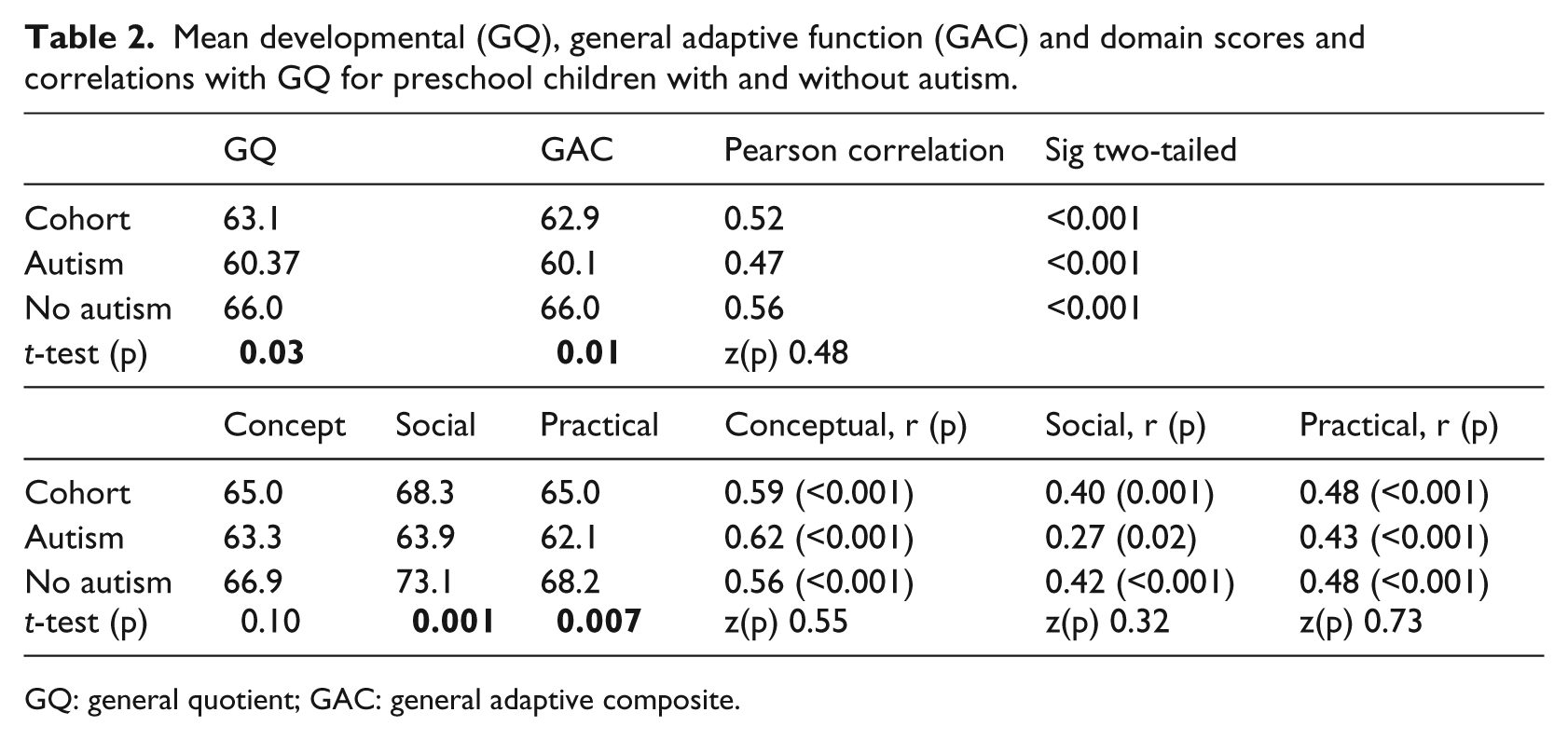
The distribution of GQ scores for children with and without autism is shown in Table 1. Overall, 82.3% of children with autism had GQ scores in the clinically delayed range (≤70) compared to 63.0% of children without autism (χ12 = 7.8, p = 0.008). The mean GQ score for all children was 63.1 (SD = 16.1). Children with autism had a mean score of 60.4 (SD = 13.0) that was significantly lower than the mean score for children without autism 66.0 (SD = 18.5) (Table 2).
Development (GQ) and adaptive function (GAC) score distributions for preschool children with and without autism.

GQ: general quotient; GAC: general adaptive composite.
Mean developmental (GQ), general adaptive function (GAC) and domain scores and correlations with GQ for preschool children with and without autism.
GQ: general quotient; GAC: general adaptive composite.
Distribution and mean GAC scores for children with and without autism
The distribution of GAC scores for children with and without autism showed a similar pattern to GQ as shown in Table 1. Of children with autism, 83.5% scored more than 2 SDs below the mean on GAC scores (≤70), compared to 65.8% of those without autism. The proportion of children with autism, who were delayed on their GAC, was significantly more than for children without autism (χ12 = 6.4, p = 0.01). The mean GAC score for all children was 62.9 (SD = 14.0). Children with autism had a mean score of 60.1 (SD = 11.6) that was significantly lower than the mean score for children without autism 66.0 (SD = 15.8) (Table 2).
Correlations between GQ and GAC scores for children with and without autism
Next, we explored the correlation between GQ and GAC for children with and without autism (Table 2). The GAC was significantly correlated with GQ scores for the cohort as a whole, and for children both with and without autism, and there was no significant difference between the correlations (z(p) 0.48).
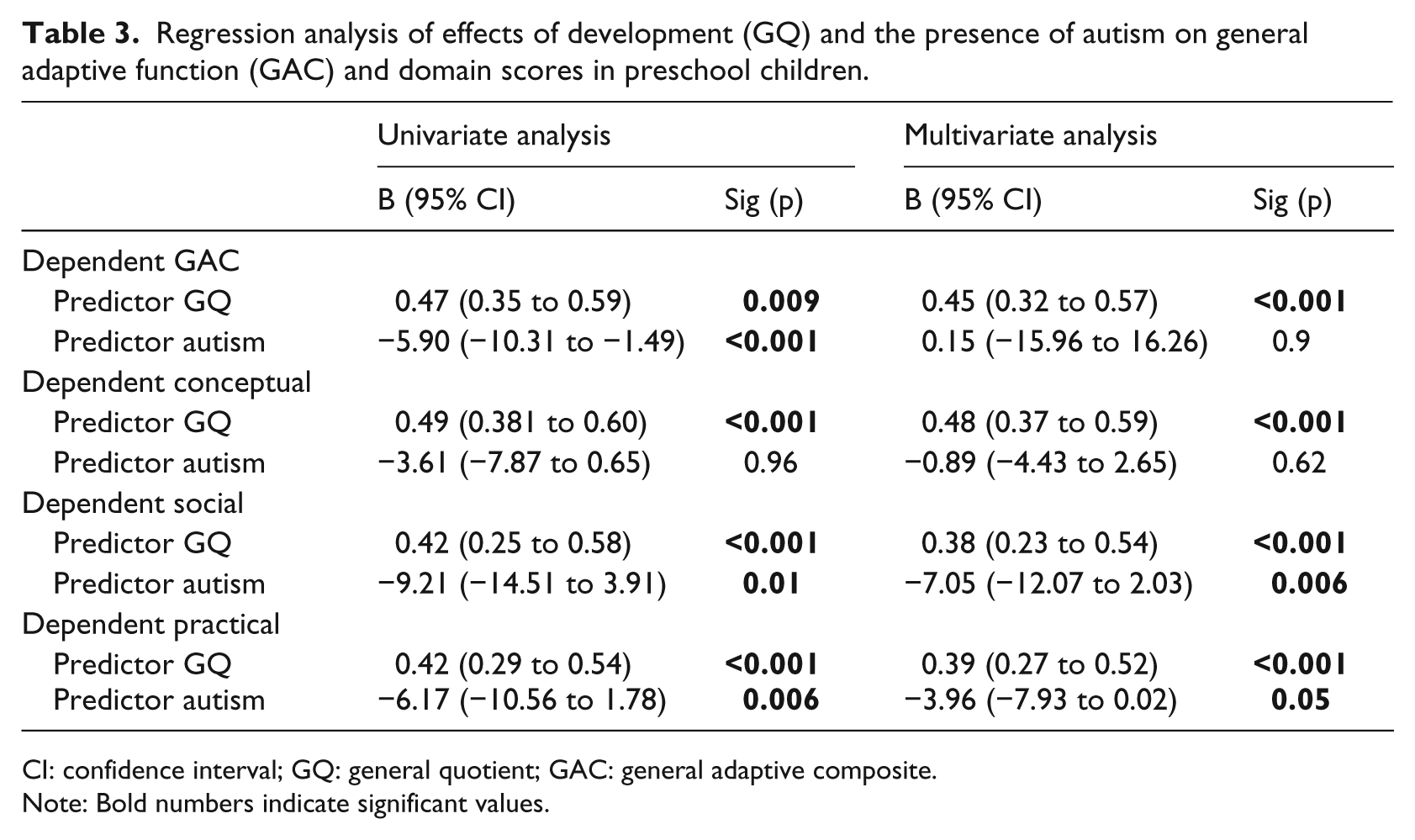
Univariate analysis confirmed significant relationships between GQ and GAC, and the presence of autism and GAC. Multivariate regression analysis, however, found no significant effect of the presence of autism on GAC scores once GQ was taken into account (Table 3).
Regression analysis of effects of development (GQ) and the presence of autism on general adaptive function (GAC) and domain scores in preschool children.
CI: confidence interval; GQ: general quotient; GAC: general adaptive composite.
Note: Bold numbers indicate significant values.
Distribution and mean adaptive function domain scores for children with and without autism
The percentage of children falling within the clinically delayed range was similar on all three domain scores for children with autism (conceptual: 70.9%, practical: 75.9% and social: 74.7%), while for those without autism, the percentages were smaller, and there was more variation (conceptual: 63.0%, practical: 56.2% and social: 45.2%)). These differences in proportions were significant for practical (p = 0.01) and social (p < 0.001) domain scores only.
Mean domain scores for children with and without autism are shown in Table 2. Children with autism had significantly lower mean scores for social and practical domains. Differences in conceptual skills were not significantly different.
Correlations between adaptive function domain scores for children with and without autism and GQ scores
All domain scores were significantly correlated with GQ scores for children both with and without autism, but this association was not as strong for social skills in children with autism. There was no significant difference between the correlations (Table 2).
Univariate analysis confirmed significant relationships between GQ and all domain scores, and the presence of autism with social and practical domain scores, but not conceptual scores (Table 3). Multivariate regression analysis also confirmed that children with autism performed less well on the social and practical domain scores than those without autism, even when the effects of GQ were controlled (Table 3), confirming that the presence of autism had an effect on social and practical skills beyond that of their developmental difficulties.
Distribution and mean scores for GAC and adaptive function domain scores for children according to the presence of developmental delay
As preschoolers with autism have been reported to perform differently on measures of adaptive function according to their developmental levels (Perry et al., 2009), the adaptive function scores for children with and without developmental delay were considered separately. The numbers and mean scores are presented in Table 4.
Significance of differences in mean general adaptive function (GAC) and domain scores for preschool children with and without autism according to the presence of developmental delay.

GQ: general quotient; GAC: general adaptive composite.
Children with autism both with and without developmental delay tended to have lower social skill domain scores than those without autism, but otherwise their performance was similar.
Children with average development performed significantly lower than expected for their GQ on GAC and practical skills. Those without autism also performed significantly lower than expected for conceptual skills and those with autism tended to have lower than expected social skills.
For children with average development, 71.4% with autism and 51.9% of those without autism had a GAC or domain score of more than 2 SDs below the mean. For the GAC score alone, the percentages were 64.3% of those with autism and 40.7% of those without autism (Table 5). More children with autism were delayed on the social and practical scales, and less on the conceptual scale. Differences in proportions of delay for children with and without autism did not reach statistical significance on any of the scales.
Number and percentage of preschool children with and without autism, scoring >2 SD below the mean on the ABAS-II GAC and domain scores, according to the presence of developmental delay.

GQ: general quotient; GAC: general adaptive composite; SD: standard deviation; ABAS-II: Adaptive Behaviour Assessment System–Second Edition; FE: Fischer’s Exact test.
Children with delayed development performed better than expected by their GQ on GAC and all domain scores (Table 4); 93.8% of those with autism and 82.6% of those without autism had scores more than 2 SDs below the mean of the GAC or a domain score. For the GAC, 87.7% of those with autism and 80.4% of those without autism were delayed. Neither of these differences reached statistical significance. A higher percentage of children with autism were delayed on each of the domain scores, with the differences in social skills (78.5% with autism and 54.3% of those without autism) reaching statistical significance (Table 5).
Discussion
This study found that preschoolers’ overall adaptive function was very closely correlated to developmental ability. We found that the poorer performance of children with autism on both developmental and adaptive functions reflected their lower developmental level overall rather than an additional effect. Domain scores, however, did discriminate between children with and without autism, with poorer performance on practical and social domain scores for children with autism. Children with average development, both with and without autism, had lower adaptive skills than expected for their developmental level, whereas those with developmental delays performed significantly better than expected for their developmental level.
This study clarifies the relationship between adaptive function and autism, controlling for the effects of developmental ability. Delayed adaptive function in children with average development both with and without autism has not been previously described and has considerable importance in assessing preschoolers’ need for additional support at school. This study did not confirm previous reports of differences in overall adaptive function between children with and without autism (American Association on Mental Retardation, 1992), showing that it closely reflected differences in GQ.
The lower GQ scores in children with autism compared to those without autism in this study may reflect the difficulty many of these children have in complying with the demands of the testing situation and also the delays in learning caused by being less engaged with what is happening around them. It may also reflect a referral bias as preschoolers with developmental delay as well as autism are also more likely to be recognised and referred for assessment. Higher adaptive skills in children with developmental delay were influenced by the standard scores on the ABAS-II, which did not extend below 40, but also reflects the potential that these children have to learn functional skills above that expected for their development. Future studies should use developmental quotient scores to counter this effect.
While this study does not have a typically developing control group, the comparison between large clinical populations with and without autism allowed the effects of autism to be more accurately determined. Unfortunately, due to the large numbers of children being referred for assessment, limitations on funding, and resulting long waiting lists, the ADOS was only used for the diagnosis of autism when information collected during the interview and assessment was not sufficient to make the diagnosis clear. This assessment is the gold standard for diagnosing autism, and its use would have allowed quantification of the extent of this disability. The ABAS-II is a relatively new instrument, and although it is frequently used in clinical practice, it has not often been used in research.
The score for overall adaptive function closely reflected developmental ability, and although useful in confirming the practical implications of developmental disability, it did not illuminate the additional difficulties found in children with autism. Domain scores, however, did discriminate between children with and without autism, and these scores should be considered when determining the school’s support needs. Children with autism had deficits in both social and practical skills when compared to children without autism, and these skill areas should be carefully considered during diagnosis and specifically targeted in early intervention programmes. For children with autism, the social skill domain score was not as strongly associated with GQ as the other domain scores, reflecting the main area of difficulty in these children. The lack of difference in the conceptual skills possibly relates to its component skills, which include functional pre-academics, an area of strength in many children with autism, as well as communication, which is an area of strength for those without autism. This similar performance on the conceptual domain score may mask the extent of functional disability in preschoolers with autism and result in school placements with insufficient support particularly for children with average development.
The poor performance of children with average development, both with and without autism, was unexpected, with over 70% of those with autism, and more than half of those without falling in the clinically delayed range on their GAC or a domain score. This suggests that they were not functioning in day-to-day tasks as well as would be expected by their developmental level, and explains why they were referred for assessment. This pattern has been reported earlier (Bolte and Poustka, 2002; Perry et al., 2009) using the Vineland Adaptive Behaviour Scales on preschool children with autism spectrum disorders. This study, however, shows a similar pattern for children without autism and has important clinical significance for both groups, whose difficulties are often underestimated due to their average performance on developmental testing. The children with average development in this study had been referred because of the suspicion of autism, or suspected developmental disability or both. Those without autism had a range of difficulties arising from environmental, attention, neurological and behavioural difficulties. Their poor performance on adaptive skills reflects their difficulty learning functional skills and has implications for referral recommendations, for example, occupational therapy intervention to target these skills directly, as well as treating their underlying difficulties.
Summary scores such as GQ and GAC provide inadequate information for determining how a child will function in the school environment, particularly for those with autism. This may result in a placement that underestimates support needs and learning potential.
This study explores the adaptive function of a large number of preschoolers referred by their paediatricians with suspected developmental problems. It differs from previous studies in that it explores the effects of autism and developmental disability both independently and together. It refutes the common belief that children with autism have lower overall adaptive function but shows that their profiles are different, and that they do have deficits in both practical and social skills. A large proportion of children with average development had significant deficits in overall adaptive function. These children clearly have significant deficits that interfere with their ability to adapt to different situations and could be predicted to have difficulty at school. Further research following the progress of these children at school could confirm these findings and may support the use of the ABAS-II as a measure of support requirements.
Footnotes
Funding
This research received no specific grant from any funding agency in the public, commercial or not-for-profit sectors.