



Abstract
Social-cognitive deficits differentiate parents with the “broad autism phenotype” from non–broad autism phenotype parents more robustly than other neuropsychological features of autism, suggesting that this domain may be particularly informative for identifying genetic and brain processes associated with the phenotype. The current study examined whether the social-cognitive deficits associated with the broad autism phenotype extend to the general population and relate to reduced social skill. A total of 74 undergraduates completed the Broad Autism Phenotype Questionnaire, three standardized social-cognitive tasks, and a live social interaction with an unfamiliar research assistant. Social broad autism phenotype traits were significantly associated with deficits in social cognition and reduced social skill. In addition, the relationship between social broad autism phenotype traits and social skill was partially mediated by social cognition, suggesting that the reduced interpersonal ability associated with the broad autism phenotype occurs in part because of poorer social-cognitive ability. Together, these findings indicate that the impairments in social cognition and social skill that characterize autism spectrum disorder extend in milder forms to the broad autism phenotype in the general population and suggest a framework for understanding how social broad autism phenotype traits may manifest in diminished social ability.
Introduction
Autism spectrum disorders (ASDs) are defined by impairments in the domains of social interaction, communication, and repetitive and restricted behaviors (American Psychiatric Association (APA), 2000). Because these impairments vary in severity among individuals with specific ASD diagnoses, including autistic disorder, Asperger syndrome, and pervasive developmental disorder–not otherwise specified (PDD-NOS), the characteristics of autism have increasingly been conceptualized along a dimensional spectrum of impairment (Volkmar et al., 2004). Over the past two decades, research has accumulated indicating that the characteristics associated with this spectrum are not specific to clinical threshold, but rather exist in milder forms in the “broad autism phenotype” (BAP), a term referring to the presence of subclinical levels of autism symptoms that exist outside the categorical boundary for diagnosis (Bolton et al., 1994; Piven and Palmer, 1999). BAP characteristics can be dissociated into subdomains corresponding to the primary features of autism, including traits that are social (e.g. socially reticent and untactful behavior) or nonsocial, specifically ritualistic/repetitive behaviors such as difficulty adjusting to change and a perfectionistic personality (Losh et al., 2009).
While foundational work on the BAP focused on genetic liability for autism by examining autistic traits in a subset of first and second degree relatives of individuals with ASD (for a review, see Bailey et al., 1998), subsequent studies have demonstrated that the autism-related traits comprising the BAP exist within the general population as well (Baron-Cohen et al., 2001; Constantino and Todd, 2003, 2005). Indeed, a wealth of recent studies has indicated that a range of characteristics found in autism are continuously distributed within the general population (Wainer et al., 2011), including restricted activities and interests (Baron-Cohen et al., 2001), atypical visuospatial and cognitive performance (Grinter et al., 2009; Stewart et al., 2009), reduced gaze reciprocity (Chen and Yoon, 2011), and abnormal speech perception (Stewart and Ota, 2008).
Recently, Ingersoll (2010) reported that the BAP in the general population is also associated with impaired affect recognition from faces and body language. These two abilities fall within the domain of social cognition, a term that refers to the cognitive processes that mediate social experience, including the perception, processing, and interpretation of social information (Brothers, 1990). Individuals with ASD demonstrate a wide range of social-cognitive impairments (for reviews, see Pelphrey et al., 2004; Sasson, 2006; Sasson et al., 2011), including deficits in face processing, emotion recognition, and theory of mind (i.e. the ability to infer the mental states of others) that are associated with abnormalities in neural regions subserving the processing of social information (Pelphrey et al., 2004; Pinkham et al., 2008). Deficits in social cognition directly contribute to social functioning impairments in ASD (Hughes et al., 1997; Klin et al., 2002), suggesting that social-cognitive ability may not only contribute to the quality of an individual’s social skill but also represent an avenue for social remediation in ASD (Turner-Brown et al., 2008).
Despite the significant contribution of social cognition to broader social impairments in ASD, only a handful of studies have investigated whether the BAP is similarly characterized by deficits in social-cognitive ability. First-degree relatives of individuals with ASD, specifically those identified as exhibiting an “aloof” social profile, exhibit reduced performance on a variety of social-cognitive tasks, including emotion recognition and theory of mind even though they are not impaired clinically, nor exhibit abnormalities in executive functioning or central coherence (Losh et al., 2009; Losh and Piven, 2007). These studies highlight the importance of dissociating social from nonsocial BAP features, as only the social BAP in relatives appears associated with reduced social-cognitive performance. It remains unclear, however, whether the reduced social-cognitive ability extends to BAP characteristics in the general population. Ingersoll (2010) took a first step in this direction by reporting that greater autism-related traits in typically developing college students predicts reduced sensitivity to nonverbal social information. This study, however, was narrow in the social-cognitive abilities it assessed, restricting its focus to the knowledge of nonverbal social cues and did not dissociate whether this association is specific to the social BAP, as has been reported in studies of first-degree relatives of individuals with ASD (Losh et al., 2009; Losh and Piven, 2007). In addition, it is still unknown whether BAP characteristics in the general population affect real-world social functioning, a pattern that may be expected given that impairments in social functioning are a hallmark characteristic of ASD. Indeed, given that autism is defined and diagnosed largely by abnormalities in social behavior, the lack of research on observed social differences related to the BAP is a significant oversight.
The current study was therefore designed to examine the relationship between BAP characteristics, real-world social skill, and social-cognitive abilities. Specifically, building upon the works of Losh and Piven (2007) and Losh et al. (2009), who found that the social BAP but not other BAP characteristics predict social-cognitive performance, we hypothesized that social aspects of the BAP, as measured by the Broad Autism Phenotype Questionnaire (BAPQ; Hurley et al., 2007) social and pragmatic language subscales, would be associated with reduced social-cognitive abilities, while nonsocial aspects of the BAP, as measured by the BAPQ rigidity subscale, would not demonstrate such association. Similarly, we predicted that these social BAP characteristics would predict quality of social skill within a live social interaction. If substantiated, this result would be the first to demonstrate that the presence of greater autism-related social traits within the general population is associated with deficits in social behavior. We further predicted that social cognition and social skill would be positively related, suggesting that better social-cognitive ability is associated with greater real-world social skill. Such a finding would suggest that the contribution of social cognition to social functioning is not limited to affected clinical populations, but rather may constitute a set of abilities more broadly associated with individual differences in social skill. Finally, to test whether social cognition mediates the relationship between social BAP traits and social skill, a series of regression analyses were conducted according to the steps outlined by Baron and Kenny (1986). Evidence of mediation would indicate that the predicted association between social BAP characteristics and reduced social skill occurs in part because of reduced social-cognitive ability and highlight social cognition as an important mechanism linking the social BAP to differences in social behavior.
Methods
Participants
In total, 541 undergraduates at the University of Texas at Dallas were screened using an online version of the Autism Quotient (AQ; Baron-Cohen et al., 2001). From this screening, 80 individuals stratified on AQ scores were recruited to participate in the full protocol. This stratified approach ensured that a sufficiently broad range of subclinical autism characteristics was represented in the final sample, thus affording enough variability to examine the relationship between these traits and social cognition and social skill. In total, 6 out of the 80 participants were excluded from analyses for the following reasons: one was under the age of 18 and thus not approved for inclusion, one rapidly clicked the same response through the computerized social-cognitive tasks indicating a lack of a sincere effort, two were more than 3 standard deviations (SD) higher than the mean for age (one of whom also would have also been excluded for reporting an immediate family member with ASD), and two were more than 3 SD lower than the mean on an estimate of intellectual functioning, the verbal section of The Wide Range Achievement Test, 3rd edition (WRAT-3; Wilkinson, 1993), suggesting an impaired cognitive profile relative to the rest of the sample. The final sample of 74 participants consisted of 32 individuals from the highest quartile of all screened AQ scores (M = 26.81, SD = 4.64), 22 from the bottom quartile (M = 10.64, SD = 2.04), and 20 from the middle half (M = 16.75, SD = 1.86). The sample ranged in age from 18 to 41 (M = 22.26, SD = 4.60) and was 54% female. Participants’ self-identified ethnicity was 51.3% Caucasian, 25.7% Asian American, 13.5% Hispanic, and 9.5% African American. AQ scores in the sample did not significantly correlate with age (r = −.14, p = .244), parental education (r = .15, p = .193), or WRAT-3 scores (r = .07, p = .536). All included participants reported that neither they nor any immediate family member had a diagnosis on the autism spectrum. All participants provided informed consent prior to the start of the experiment and received course credit for their participation. The study was approved by the Institutional Review Board at the University of Texas at Dallas.
Measures
Autism-related traits: screening measure
The AQ is a 50-item self-report scale that measures personality traits and behaviors associated with autism (e.g. “I prefer to do things with others rather than on my own,” or “I am fascinated by numbers”). Responses are given on a 4-point scale, which includes the following choices: “definitely agree,” “slightly agree,” “slightly disagree,” and “definitely disagree.” Scores are dichotomized as “0” or “1,” with “1” reflecting responses consistent with autism-related characteristics (Baron-Cohen et al., 2001). Scores can range from 0 to 50.
Autism-related traits: study measure
Subclinical autism-related traits were assessed using the BAPQ (Hurley et al., 2007). We opted to supplement our screening measure with the BAPQ for several reasons. First, unlike other self-report measures of autism symptomatology such as the AQ or the Social Responsiveness Scale (SRS), the BAPQ was specifically designed for capturing BAP traits. Furthermore, a recent analysis of the psychometric properties of the BAPQ suggests it is a better instrument than the AQ and SRS at measuring the BAP in the general population due to the high internal consistency of its subscales that together reflect a factor structure corresponding to the full nature of the BAP (Ingersoll et al., 2011). Finally, the subscales of the BAPQ separate social from nonsocial aspects of the BAP, and thus afford the opportunity to test the hypothesis that only social BAP characteristics will be associated with reductions in social skill and social-cognitive ability.
The BAPQ consists of three 12-question subscales that reflect the triad of characteristics associated with the primary diagnostic domains of autism as follows: (a) social abnormalities, (b) pragmatic language difficulties, and (c) rigid personality and a desire for sameness. The BAPQ defines the social subscale as assessing “a lack of interest in or enjoyment of social interaction,” and the pragmatic language subscale as assessing “deficits in the social aspects of language, resulting in difficulties communicating effectively or in holding a fluid, reciprocal conversation.” Thus, because both of these subscales assess interpersonal characteristics that may be related to aspects of social skill and social cognition examined in this study, we chose to combine the two subscales to form our measure of the social BAP. Integrating the social and communication aspects of the BAP is also consistent with proposed changes to the diagnostic criteria of ASD in the Diagnostic and Statistical Manual of Mental Disorders–Fifth Edition (DSM-V) that conceptualizes these domains as inseparable (APA, 2012). We used the rigidity subscale of the BAPQ, defined as “little interest in change or difficulty adjusting to change,” as our measure of the nonsocial BAP. Responses to each item on the BAPQ are given on a 6-point scale and are averaged across all 36 items to create a total score ranging from 1 to 6.
Social skill
Social skill was assessed using the conversation probe (CP) role play (Penn et al., 1994; Pinkham and Penn, 2006). The CP is a videotaped, 3-min interaction between the participant and an unfamiliar research assistant intended to reflect a naturalistic “get to know you” conversation. Participants are informed that the goal of the conversation is to get to know their conversation partner and that “if it helps, imagine you are at a party and are just meeting this person for the first time.” The research assistant is instructed to be pleasant and actively engage in the conversation, but to speak less than half of the time in order to ensure a large enough sample of participant interpersonal behavior for analysis. The conversations were then coded on 9-point Likert scale by two research assistants who were trained to satisfactory reliability based upon a gold-standard criterion (Intraclass Correlation Coefficient (ICC) = .88). These research assistants were not present during the taping of the CP and were blind to BAP information about the participants. The following specific interpersonal skills were rated as follows: clarity (clear enunciation of speech), fluency (absence of verbal interruptions), appropriate affect, eye contact, and engagement (involvement in the conversation). A summary rating of social skill was also given, which was defined as “the participant’s overall level of social skill and their ability to interact in a meaningful way.” In earlier studies using this measure, a principal components and factor analysis on the individual social skills resulted in a single primary factor that was highly correlated with the rating of overall social skill (Pinkham and Penn, 2006). Thus, in order to include a summary variable of social skill, this study uses the overall social skill rating as the primary dependent variable of social behavior.
Social cognition
Social cognition was measured using three well-validated tasks assessing primary components of social cognition: face processing, emotion recognition, and theory of mind. Face processing was assessed using the Benton Facial Recognition Task (BFRT; Benton et al., 1983). Participants viewed a black and white image of a face and were instructed to select the same identity from six choices. Trials increase in difficulty as identity choices begin to vary in orientation and lighting. While the BFRT was originally designed as a neuropsychological test of brain functioning and prosopagnosia, it has since been used to highlight face recognition impairments in various clinical populations (Annaz et al., 2009), including autism (Annaz et al., 2009; Losh and Piven, 2007; Wallace et al., 2008).
Emotion recognition was assessed using the Penn Emotion Recognition Task (ER40; Kohler et al., 2000), which consists of 40 color photographs of faces displaying evoked happy, sad, angry, fearful, and neutral expressions. Both high- and low-intensity emotional expressions are included, and the stimuli are balanced for age, gender, ethnicity, and emotion category. The ER40 is sensitive for eliciting performance differences within the general population (Sasson et al., 2010), as well demonstrating affect processing impairments in clinical groups (Kohler et al., 2000).
Theory of mind was assessed using the Cartoon Theory of Mind (CTOM) task (Brunet et al., 2003), a nonverbal measure consisting of 42 three-panel comic strips depicting a brief narrative. The participant is asked to select a fourth panel that completes the story from three possible choices. One of the three included conditions (“Attribution of Intentions”) depicts a human character performing actions in order to accomplish a goal, and successful selection of the fourth panel requires attributing the correct intention to the portrayed character. The remaining two conditions require understanding of physical causality with and without human characters. Clinical populations with social impairments (Brunet et al., 2003) demonstrate performance deficits in attribution of intention condition but not in the other two control conditions, suggesting they are characterized by selective theory of mind impairment.
Although face processing, emotion recognition, and theory of mind each represent independent components of social cognition, they cannot individually reflect the breadth of the construct. Thus, we chose to combine them into a composite variable to assess the overall impact of social cognition as a broad skill set on social skill and BAP characteristics. Z-scores were computed for the number of correct identifications on the BFRT, the ER40, and the “Attribution of Intentions” condition of the CTOM, and averaged to create a single social-cognitive composite variable. For interested readers, data for the individual social-cognitive tasks are also reported.
Procedures
After providing informed consent, participants provided demographic information and then completed the CP (described above) with an unfamiliar research assistant and the verbal section of the WRAT-3. The social-cognitive battery was then administered in a counterbalanced order on a desktop PC. Participants concluded the experiment by completing the BAPQ.
Data analysis
Correlational analyses were used to determine if, as predicted, social BAP characteristics, but not nonsocial BAP characteristics, were negatively associated with both social skill and social-cognitive abilities. Next, to determine if social cognition mediates the relationship between the social BAP and social skill, a series of regression analyses were performed according to the method outlined by Baron and Kenny (1986). For the current study, demonstration of mediation requires the following steps:
The independent variable (social BAP) must be significantly associated with the outcome measure (overall social skill).
The independent variable (social BAP) must be significantly associated with the mediator (social cognition).
The mediator (social cognition) must be significantly associated with the outcome measure (overall social skill).
When controlling for the effects of the mediator, the previously significant association between the independent variable and the criterion variable should be attenuated.
Mediation occurs if the independent variable (social BAP) is no longer significantly correlated with the outcome measure (social skill) when the effect of the mediator (social cognition) is controlled. Thus, if the social BAP, social cognition, and social skill are all significantly correlated with each other, we can perform a final mediational test to examine the change, if any, in the relationship between the social BAP and social skill after controlling for social cognition (see Figure 1). Because recent guidelines recommend supplementing the Baron and Kenny (1986) method with a direct test of the mediation effect, we also employed a resampling bootstrapping approach (Preacher and Hayes, 2008) that estimated the mediation effect over 1000 samples. A 95% confidence interval is constructed, and when this interval does not include zero, the effect of mediation is considered significant at p < .05.
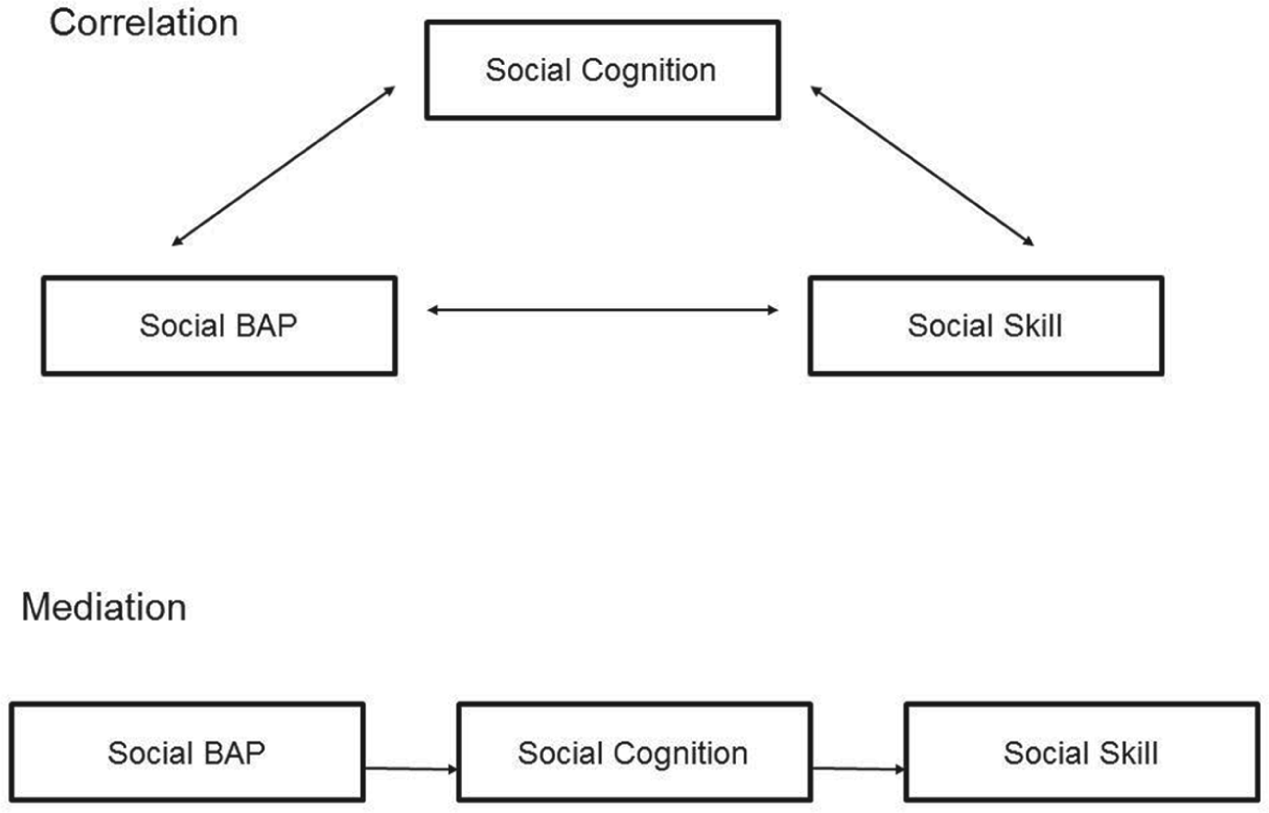
Mediational model.
Results
Initial inspection revealed that BAPQ scores, social skill, and social cognition were each normally distributed with acceptable levels of skewness and kurtosis. These three variables were not related to age, parental education, or the WRAT-3 verbal, with the exception of a positive relationship between age and social skill (r = .30, p = .009). Furthermore, these three variables did not differ by gender or ethnicity, except for females demonstrating greater social skill than males (t (72) = 2.21, p = .030). The overall BAPQ score for 40.5% of the sample exceeded the cutoff value reported by Hurley et al. (2007) for being BAP positive. Total scores on the BAPQ (M = 3.01; SD = .69) and AQ (M = 19.28; SD = 7.78) were highly correlated in our sample (r = .76, p < .001; see Figure 2).
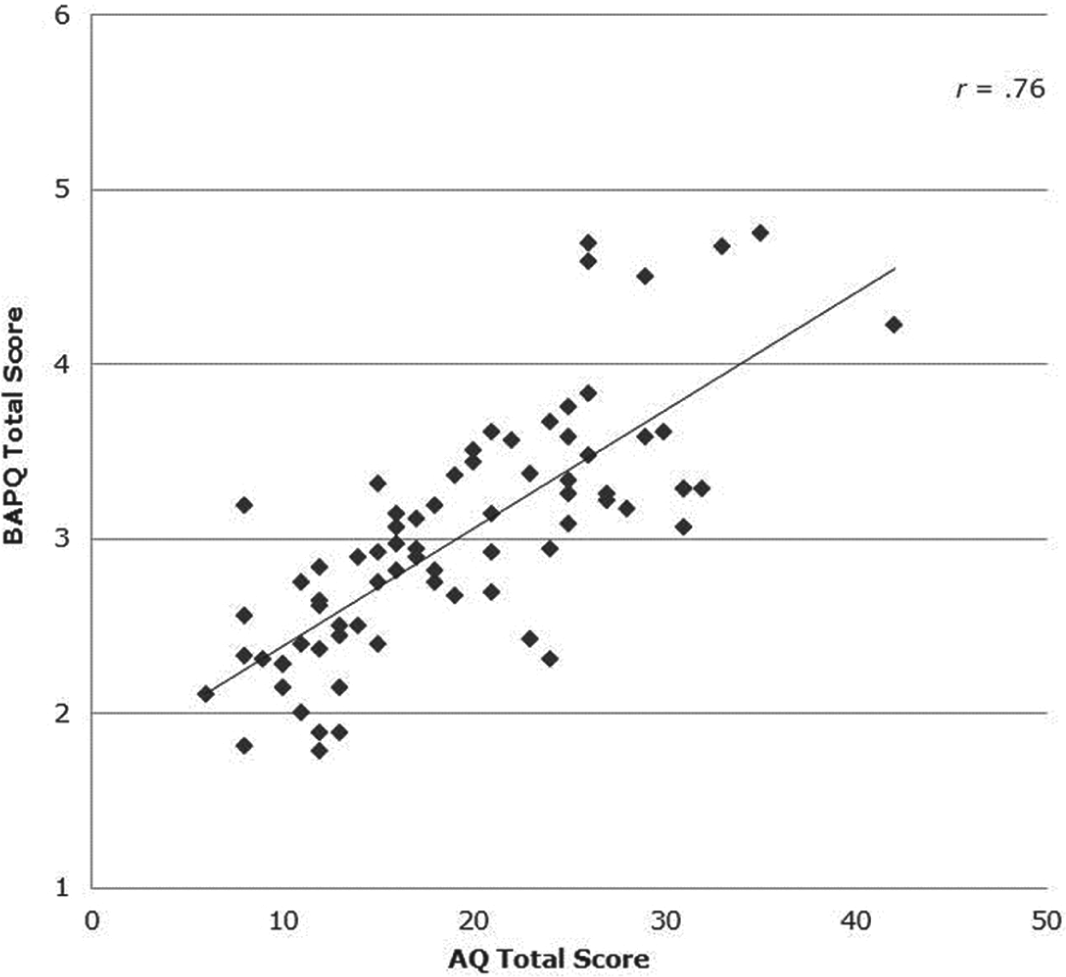
Correlation between total scores on the BAPQ and the AQ. BAPQ scores range from 1 to 6 and AQ scores range from 0 to 50.
Correlations
Correlation coefficients between BAP characteristics, social skill, and social cognition can be viewed in Table 1. The overall BAPQ score was negatively associated with social skill (r = −.24, p = .044) and approached significance in its correlation with performance on the social-cognition composite score (r = −.20, p = .097). We predicted, however, that this pattern would differ for specific BAP characteristics (i.e. social BAP characteristics would be related to social skill and social cognition, while nonsocial BAP characteristics would not). Indeed, the social BAP was negatively associated with both social skill (r = −.29, p = .012) and social-cognitive performance (r = −.24, p = .037), while the nonsocial BAP was not significantly correlated with either social skill (r = −.04, p = .712) or social cognition (r = −.03, p = .784). Social-cognitive performance was positively associated with social skill (r = .38, p = .001). Correlation coefficients between BAP characteristics and the three individual social-cognitive measures (face processing, affect recognition, and theory of mind) can be viewed in Table 2. In addition to using the BAPQ as a continuous measure, participants were also categorized as either “social BAP positive” (i.e. they exceeded cutoff scores on both the social and pragmatic language subscales; n = 26) or “social BAP negative” (n = 48) based upon the values for identifying the presence of the BAP reported by Hurley et al. (2007). A one-way analysis of variance (ANOVA) between these groups indicated trend-level differences, with “social BAP positive” participants demonstrating reduced social skill (social BAP positive: M = 5.65, SD = 1.47; social BAP negative: M = 6.25, SD = 1.23; F (1, 72) = 3.46, p = .067), and reduced social-cognitive performance (social BAP positive: M = −.16, SD = .66; social BAP negative: M = .13, SD = .62; F (1, 72) = 3.38, p = .070) relative to the “social BAP negative” group.
Correlations between measures of BAP, social skill, and social cognition.
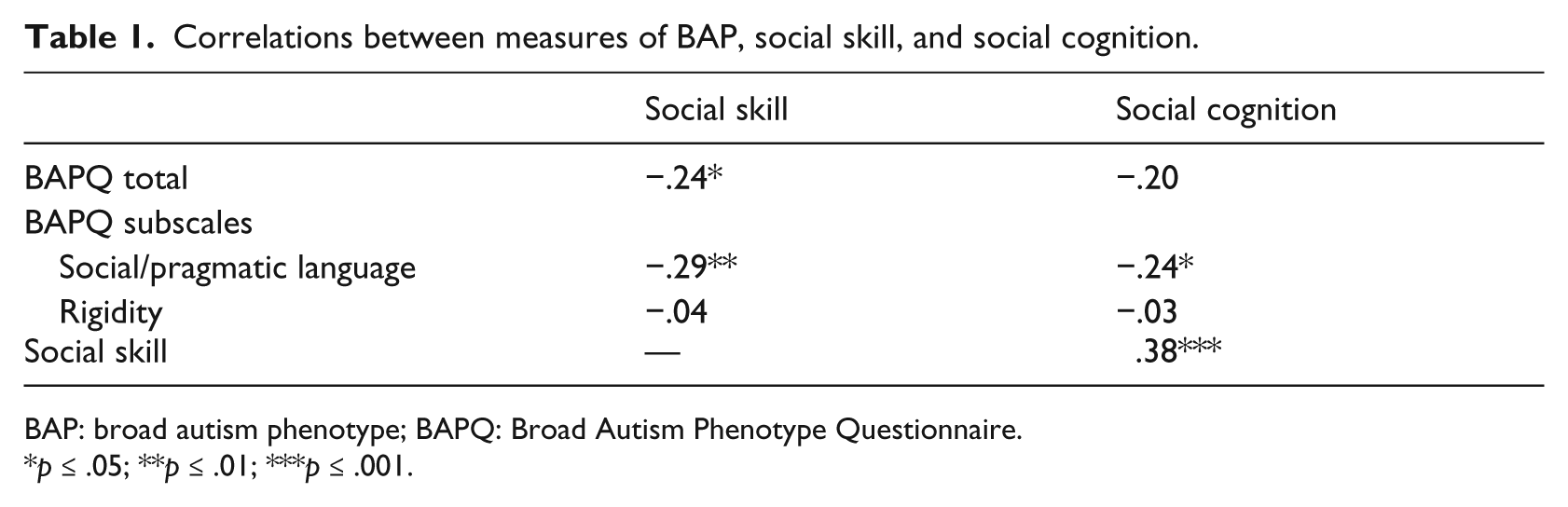
BAP: broad autism phenotype; BAPQ: Broad Autism Phenotype Questionnaire.
p ≤ .05; **p ≤ .01; ***p ≤ .001.
Correlations between BAP, social skill, and individual social-cognitive measures.
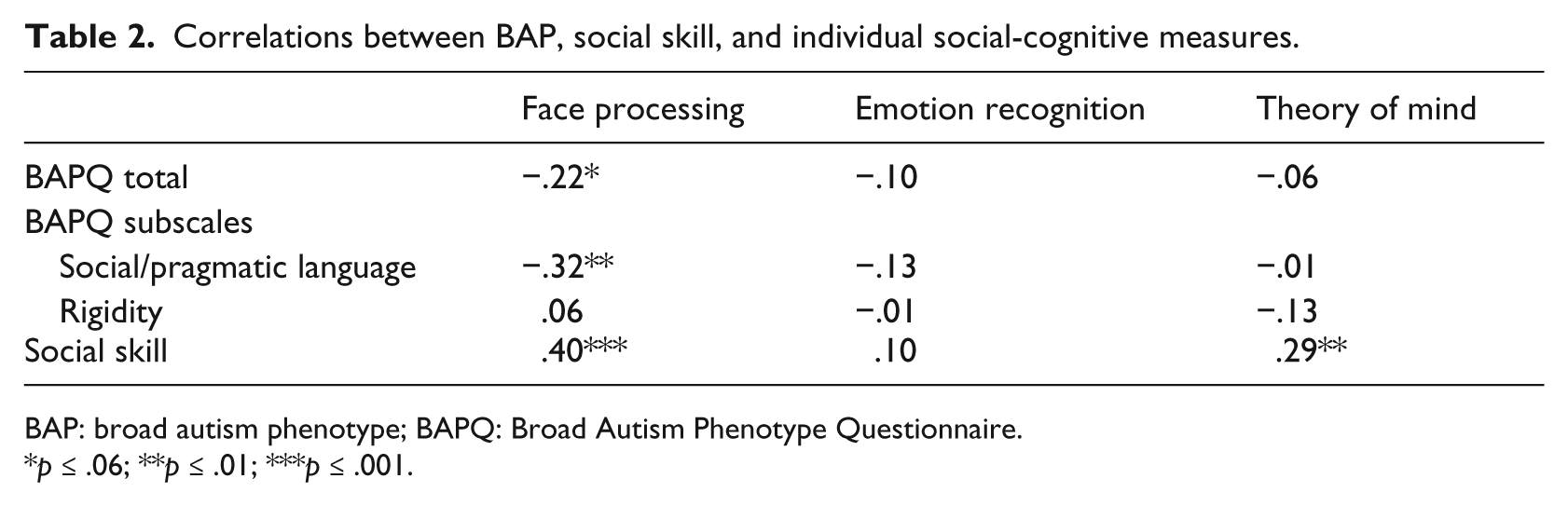
BAP: broad autism phenotype; BAPQ: Broad Autism Phenotype Questionnaire.
p ≤ .06; **p ≤ .01; ***p ≤ .001.
Mediation
Regression analyses demonstrated that social BAP traits predicted 7% of the variance in social skill (adjusted R2 = .072; F (1, 73) = 6.63, p = .012) and 5% of the variance in social cognition (adjusted R2 = .046; F (1, 73) = 4.51, p = .037). Social cognition predicted 14% of the variance in social skill (adjusted R2 = .135; F (1, 73) = 12.43, p = .001). Although social BAP traits originally predicted social skill (p = .012), the relationship was attenuated and no longer significant once social cognition was added to the model (p = .061). The bootstrapping method using repeated sampling (Preacher and Hayes, 2008) to estimate the indirect effect of social BAP traits on social skill revealed a 95% confidence interval of mediation (mean ± standard error) that did not contain zero, indicating that the mediating effect of social cognition was significantly different from zero at p < .05. Thus, the relationship between the social BAP and social skill was partially mediated by social-cognitive abilities.
Discussion
The present study reports that subclinical autism-related social traits within the general population are related to reductions in social skill and social-cognitive ability. Aspects of the BAP, as measured by the BAPQ, were associated with reduced social skill during a live interaction, as well as poorer performance on an aggregate social-cognitive composite comprising face recognition, affect processing, and theory of mind abilities. These associations differed for social compared to nonsocial aspects of the BAP. Analysis by Ingersoll et al. (2011) indicated that the subscales of the BAPQ are particularly and uniquely adept at measuring independent BAP components, and that these independent components may provide predictive value above and beyond overall score. Indeed, the social and pragmatic language aspects of the BAP, but not nonsocial characteristics related to rigidity, predicted poorer social skill and social cognition in this study. Mediational analysis determined that the relationship between social BAP traits and social skill is partially mediated by social-cognitive ability, suggesting that the social differences associated with BAP characteristics occur in part due to deficits in social cognition.
These findings expand our understanding of BAP characteristics is several ways. This study is the first to report that aspects of the BAP within the general population are related to reduced real-world social skill. While previous research indicated a relationship between the BAP and self-reported social functioning (Jobe and White, 2007; Wainer et al., 2011), the present study reports that this association extends to an in vivo assessment of observed social behavior. Participants with greater social BAP characteristics were judged during a “get to know you” conversation with an unfamiliar individual to be less socially skilled than individuals with fewer of these characteristics, suggesting that the social BAP may manifest in reduced interpersonal ability. Thus, not only do these findings indicate that variation exists in the general population for both social BAP traits and general social skill but also that the two characteristics co-vary.
Second, these data build upon the findings of Losh and Piven (2007) and Losh et al. (2009) by demonstrating that the predictive relationship between social aspects of the BAP and reduced social-cognitive performance extend beyond parents of individuals with autism and continue into the general population. Similar to the findings of Losh et al. (2009), we found that only social BAP traits, and not other aspects of the BAP (i.e. rigidity), are associated with deficits in social cognition. This dissociation suggests separability in BAP characteristics that may be uniquely related to specific features of autism symptomatology. Furthermore, while social cognition varied as a function of BAP traits, general cognitive ability did not, suggesting that social cognition represents a distinct cognitive domain associated with the BAP. Thus, this profile mirrors many higher functioning individuals with ASD who exhibit marked impairments in social cognition but are relatively unimpaired in other areas of intellectual functioning (Baron-Cohen, 1995).
Third, these findings suggest that reductions in social-cognitive abilities and social skill found in individuals with the social BAP do not operate independently, but rather are inter-, and perhaps mechanistically, related. Social cognition and social skill were highly correlated, but mediation analysis revealed that poorer social-cognitive ability in social BAP individuals constituted a small but significant contribution to their lower quality of social skill. Thus, while social-cognitive ability has been linked for many years to social functioning within clinical populations (Couture et al., 2006; Pinkham and Penn, 2006), and thus is increasingly viewed as a profitable target for social remediation across many disorders including autism (Roberts and Penn, 2009; Turner-Brown et al., 2008), the findings here suggest that the functional contribution of social cognition to social behavior spans both clinical and nonclinical populations. Indeed, after reporting that the BAP is associated with reduced sensitivity to nonverbal cues, Ingersoll (2010) noted that mediational analyses were needed to determine whether such difficulties contribute to social abnormalities. We supply such evidence here.
The study has several limitations that should be considered when interpreting the reported findings. First, while the composite social cognition score used here was sensitive to differences in BAP profiles and social skill, the individual social-cognitive tasks exhibited variable predictive value (see Table 2). All three tasks were developed for assessment within clinical populations and thus may not have been maximally sensitive to social-cognitive variability within typically developing adults. This may have limited the degree to which social cognition mediated the relationship between the social BAP and social skill in our study. To explore whether more sensitive social-cognitive measures would have elicited stronger effects, we conducted a post hoc examination of the ER40, our measure of emotion recognition that did not correlate significantly with either the social BAP or social skill in our initial analyses. The ER40 includes both mild and intense displays of facial emotion, and earlier research has demonstrated that the mild expressions, which are subtle and require greater social-cognitive ability to correctly identify, are far more sensitive for revealing differences in the general population than the intense expressions (Sasson et al., 2010). Our post hoc analyses revealed that correct identification of mild expressions on the ER40 was negatively correlated with the social BAP (r = −.25, p = .033) and positively correlated with social skill (r = .27, p = .022), while correct identification of intense expressions was not correlated with either (p =.913 and p = .429, respectively). Thus, it appears likely that the relationship between social cognition to the social BAP and social skill would have been even stronger if more sensitive social-cognitive measures were used.
Similarly, while statistically significant, social BAP traits accounted for a relatively small portion of the variance in social skill (7%) and social cognition (5%). This may have occurred because the current examination focused on individuals within the general population, who as undergraduates may demonstrate competent levels of social ability. The predictive relationship between autism characteristics and social skill and social cognition may be expected to increase once past clinical threshold.
In addition, while we screened for autism diagnoses and family history of ASD, we did not screen for other psychiatric conditions that may have affected performance. We also only used a brief estimate of cognitive functioning (WRAT-3) that did not allow for a more thorough analysis of effects of general cognitive ability. However, all participants were students at the same university, suggesting a comparable level of cognitive and adaptive functioning. Finally, autism-related characteristics were assessed via self-report, which may be less reliable than ratings that are combined with informant information (such as the informant version of the BAPQ) or other more clinically based measures.
In sum, this study provides additional information about the BAP in the general population by showing an association between subclinical social symptoms of autism and deficits in social cognition and social skill. Viewed in the context of previous studies, these findings offer further evidence that the BAP is related to a cognitive and behavioral profile mirroring autism characteristics. The current study also supports analyses by Ingersoll et al. (2011) suggesting that the BAPQ is an effective measure for capturing and dissociating social and nonsocial aspects of the BAP that predict both neuropsychological and interpersonal performance. The process of identifying dissociated BAP profiles in the general population may provide significant utility for assessing genetic liability for autism and its related characteristics. Future studies that assess genetic and neural correlates of specific BAP characteristics in subclinical populations are warranted.
Footnotes
Funding
This research received no specific grant from any funding agency in the public, commercial, or not-for-profit sectors.