



Abstract
While there is a strong sex bias in the presentation of autism, it is unknown whether this bias is also present in subclinical manifestations of autism among relatives, or the broad autism phenotype. This study examined this question and investigated patterns of co-occurrence of broad autism phenotype traits within families of individuals with autism. Pragmatic language and personality features of the broad autism phenotype were studied in 42 fathers and 50 mothers of individuals with autism using direct assessment tools used in prior family studies of the broad autism phenotype. Higher rates of aloof personality style were detected among fathers, while no sex differences were detected for other broad autism phenotype traits. Within individuals, pragmatic language features were associated with the social personality styles of the broad autism phenotype in mothers but not in fathers. A number of broad autism phenotype features were correlated within spousal pairs. Finally, the associations were detected between paternal broad autism phenotype characteristics and the severity of children’s autism symptoms in all three domains (social, communication, and repetitive behaviors). Mother–child correlations were detected for aspects of communication only. Together, the findings suggest that most features of the broad autism phenotype express comparably in males and females and raise some specific questions about how such features might inform studies of the genetic basis of autism.
Introduction
Autism is more common among males than females, with approximately four males affected for every one female (Fombonne, 2003, 2005). Although this ratio fluctuates with cognitive ability (increasing sharply to 11:1 in Asperger syndrome and decreasing to ~2:1 among individuals with intellectual disability), this male bias is a consistently documented feature of autism (Fombonne, 2005; Gillberg et al., 2006). Much research has focused on understanding the sex differences in autism for insights into the causes and transmission of autism. For instance, some have hypothesized that autism may constitute an extreme expression of the male cognitive profile, in which a “systematizing” cognitive style predominates over an “empathizing” style (Baron-Cohen, 2003), originating from biological differences between sexes (e.g. fetal androgens) (Auyeung et al., 2010; Chapman et al., 2006; Ingudomnukul et al., 2007; Knickmeyer et al., 2006; Lutchmaya et al., 2002). Some family studies of autism have also documented sex differences in the expression of subclinical features associated with autism in family members, which are believed to reflect genetic liability (Baron-Cohen et al., 1997; Baron-Cohen and Hammer, 1997; Bolton et al., 1994; De la Marche et al., 2012; Szatmari et al., 2000).
The broad autism phenotype (BAP) refers to heritable, subclinical traits that are often seen among unaffected relatives of individuals with autism (Bolton et al., 1994; Losh et al., 2008; Piven et al., 1997a, 1997b; Szatmari et al., 2000). The features of the BAP are qualitatively similar to the core communication, social, and restricted/repetitive domains of the autism triad. Mild communication features that have been documented among family members include pragmatic language differences (Landa et al., 1992; Losh et al., 2008; Piven et al., 1997b; Ruser et al., 2007), less coherent narrative production (Landa et al., 1991), and language and literacy delays in childhood (Bolton et al., 1994; Piven et al., 1997a). Elevated rates of socially aloof personality and lower quality friendships (believed to correspond to the social impairment domain in autism) and increased rates of rigidity (related to the restricted/repetitive features in autism) have also been reported in a number of family studies (Bolton et al., 1994; Losh et al., 2008; Murphy et al., 2000; Piven et al., 1994, 1997b). While individuals with autism, by definition, exhibit behaviors from all three domains of the autism triad, the milder manifestations of these features have been observed to segregate independently among family members (Bolton et al., 1994; Le Couteur et al., 1996; Losh et al., 2008; Piven et al., 1997b) and have been shown in twin studies to relate to separate genetic effects (Dworzynski et al., 2009; Happe et al., 2006; Happe and Ronald, 2008; Ronald et al., 2006b). Some studies have reported sex differences in the expression of the BAP in relatives (Bolton et al., 1994; Davidson et al., 2012; Dawson et al., 2007; De la Marche et al., 2012; Murphy et al., 2000; Ruser et al., 2007; Schwichtenberg et al., 2010; Szatmari et al., 2000), as well as sex-specific within-family associations (Constantino et al., 2006; Losh et al., 2010; Schwichtenberg et al., 2010; Virkud et al., 2009; Wilson et al., 2010).
The findings that features of the BAP may differ by sex (and perhaps show a male bias, as in autism) may hold important clues about modes of inheritance and causal mechanisms in autism. However, not all studies have reported such differences. Several investigations have documented increased expression of some (but not all) BAP features among male relatives using both family history (Bolton et al., 1994; Szatmari et al., 2000) and self-/informant-report questionnaire methods (Davidson et al., 2012; De la Marche et al., 2012; Schwichtenberg et al., 2010). Of those studies employing direct assessment methods, elevated aloof, rigid, irritable and sensitive traits (Murphy et al., 2000), and increased pragmatic language features (Dawson et al., 2007; Ruser et al., 2007) have been detected among male relatives. However, other direct-assessment studies of the BAP have not reported sex differences (e.g. Landa et al., 1992; Losh et al., 2008; Piven et al., 1997b). While it is unclear whether there are sex differences in the rates of the BAP, several studies have detected sex-specific associations between parent BAP features and child symptomatology (Losh et al., 2010; Schwichtenberg et al., 2010; Wilson et al., 2010). For instance, Schwichtenberg et al. (2010) found that fathers’ scores on a continuous measure of autism symptoms predicted autism severity in children, while this relationship was not detected among mothers. Similarly, Losh et al. (2010) detected a significant father–child association in verbal fluency processing (as indexed by rapid automatized naming ability), while no such association was detected with mothers. Conversely, Wilson et al. (2010) detected mother–child associations on performance on a facial identity recognition task, with no relationship between fathers and their children.
This study aimed to contribute to existing findings by examining within-family patterns of BAP expression using comprehensive direct-assessment measures of language and personality features used in prior studies of the BAP in a newly recruited sample of parents of individuals with autism. The primary questions addressed in this study were (a) do personality and language features of the BAP express differently in mothers versus fathers, (b) how do features of the BAP interrelate within families, and (c) do they correlate with child autism symptomatology in sex-specific ways? By addressing these questions, we hoped to provide data that might be informative for understanding the BAP and its significance for studies of the etiology and inheritance of autism.
Methods
Participants
Participants included 42 fathers and 50 mothers from 52 families of individuals with autism. Families were recruited from Southeastern and Midwestern regions of the United States through local advertisements and through the Research Participant Registry Core of the University of North Carolina’s Institute for Developmental Disabilities. All participants were native speakers of English. Families were screened for history of fragile X syndrome and other monogenic conditions associated with autism. Fathers and mothers did not differ on age, education level, household income, or race (p values > 0.429). The average age was 47.56 years (standard deviation (SD) = 6.81 years) for fathers and 46.42 years (SD = 7.07 years) for mothers. Eight families (three fathers and eight mothers) had more than one child with a clinical diagnosis of autism. Six of the children with autism were female. The average age of the individuals with autism was 16.54 years (SD = 6.24 years), with a range of 7.58–34.92 years.
Assessment of autism
All individuals with autism had received clinical diagnoses of an autism spectrum disorder, and diagnoses were confirmed through administration of the Autism Diagnostic Observation Schedule (ADI; Lord et al., 2001) and Autism Diagnostic Interview–Revised (ADI-R; Lord et al., 1994). The mother served as the informant for the majority (83%) of the ADIs, with either the father or both parents serving as the informant for the remaining ADIs. Thirty individuals met diagnostic thresholds for autism spectrum or autism on both instruments. Individuals who met diagnostic cutoffs on only one research instrument (n = 22; 5 on ADI only and 17 on ADOS only) were deemed to have a best-estimate diagnosis of autism spectrum disorder, given that they met diagnostic thresholds on two of the three diagnostic criteria (e.g. clinical diagnosis plus confirmation with one of the two gold-standard diagnostic instruments). Three families (not included in above ns) were recruited but dropped from the analyses due to the inability to confirm autism diagnosis of the child (two children did not meet diagnostic criteria on either ADOS or ADI; one child was deceased, and direct assessment was not possible). The ADOS and ADI were also used to quantify child autism symptoms; ADOS severity scores were computed as described by Gotham et al. (2009), and raw scores of the ADI diagnostic algorithm (which is focused on the behaviors exhibited from 4 to 5 years of age) and the current behavior algorithm were totaled to create summary scores for the total score and for social, communication, and restricted/repetitive subdomains.
Assessment of pragmatic language features among parents
Pragmatic language was assessed from videotaped conversational samples that were conducted within the context of a broader protocol. Conversations focused on the participant’s “life history,” in which interviewers used a series of probe questions to elicit conversation around standard topics, such as “What kind of activities did you enjoy as a child?” Interviewers followed the participant’s conversational lead, commented, and offered information in order to obtain a semistructured conversational sample. Samples averaged 30 min in length. Pragmatic language features were rated with the Pragmatic Rating Scale (PRS; Landa et al., 1992), which was developed specifically for characterizing pragmatic features of the BAP, and it is sensitive to subtle variations in ability among unaffected (with autism) family members of children with autism (Landa et al., 1992; Losh et al., 2008; Piven et al., 1997b). The PRS was modified to include additional items capturing suprasegmental speech characteristics (e.g. rate, intonation, volume) for a total of 26 items. Each item was scored on a 3-point scale based on operational definitions concerning the frequency or severity of each pragmatic violation. Scores were computed for overall performance, as well as for three subdomain scores of pragmatic language features: Dominating Style, Withdrawn Style, and Atypical Suprasegmental Characteristics (see Losh et al., 2012, for details on the determination of pragmatic subscales through factor analysis in an independent sample). The Dominating subscale includes items associated with conversational dominance (e.g. verbosity, topic preoccupations), whereas the Withdrawn subscale reflects failure to sufficiently engage during conversation and includes items such as terse and vague conversational turns. The Suprasegmental subscale is characterized by features related to the suprasegmental characteristics (e.g. rate, intonation, rhythm) and also includes unusual eye contact and pedantic word choice. The PRS was scored independently by two trained raters, and consensus scores were produced through discussion. Prior to consensus, intraclass correlations (ICCs) were computed to determine average interrater reliability (ICC (2, 8)): PRS Total Score: 0.799, Dominating subscale: 0.868, Withdrawn subscale: 0.692, and Suprasegmental subscale: 0.760.
Assessment of personality traits among parents
The Modified Personality Assessment Schedule (MPAS; Tyrer, 1988) was administered to assess aloof, untactful, rigid, and overly conscientious personality features. The MPAS has been used in many studies of the BAP as a tool for determining the presence of subtle personality traits that are thought to parallel the core features of autism (e.g. aloof and untactful traits corresponding to social impairment in autism, rigid and overly conscientious traits reflecting restricted/repetitive behaviors). The MPAS probes for these personality traits through a series of open-ended questions, and examiners follow up with additional probes to ensure sufficient information is obtained to code each behavior. Although the MPAS can include both self- and informant-report questionnaire, this study employed self-report questionnaire only due to time constraints. The MPAS was scored from video on a 5-point scale (0, 0.5, 1, 1.5, 2) based on operational definitions of each trait. While some prior reports utilizing the MPAS have employed a 3-point scale, a 5-point rating system was adopted in this study as it allowed for increased variance, improved interrater reliability, and for more subtle variation in personality style to be captured. A score of “0” signifies that the trait is absent, whereas a score of “2” signifies that the trait is unambiguously present. Scores of “0.5–1.5” signify that it is uncertain whether the trait is definitively present, although the participant may show varying degrees of behaviors that are consistent with the trait. Two trained raters coded each sample independently, and consensus scores were produced through discussion. Prior to consensus, ICCs were computed to determine average interrater reliability (ICC (2, 8)). Reliability was given as follows: aloof: 0.860, untactful: 0.749, rigid: 0.823, and overly conscientious: 0.830.
Analysis plan
All analyses were conducted using PASW Statistics 18 (IBM). Data were first examined for kurtosis and skewness to ensure normal distribution; no corrections were necessary. Mixed-effects hierarchical linear models (HLMs) were used to examine sex differences in PRS Total Score and three subscales while accounting for potential nesting within families. Planned Bonferroni-corrected post hoc comparisons were conducted. Chi-squared analyses were used to examine sex differences in the rate of expression of personality traits. For this analysis, MPAS scores were converted to a dichotomous rating system, with scores of 0–1.5 deemed negative for the trait, while scores of “2” were marked as positive. This allowed for a conservative estimate of whether each trait was “absent” or “present” and also facilitated comparison with prior literature that has used bivariate ratings to determine “BAP-positive” status as measured by the MPAS (e.g. Losh et al., 2008, 2009, 2012; Piven et al., 1997b). Finally, exploratory correlations were conducted to examine co-occurrence of language and personality traits within individuals and to assess for intrafamilial relationships.
Results
Pragmatic language and personality features
No sex differences were detected for any of the pragmatic language variables (see Figure 1). Fathers showed significantly higher rates of aloof personality than mothers (50% vs 20.4%; χ2 (1, N = 91) = 8.817, p = 0.004). There were no significant differences in the rates of untactful, rigid, and overly conscientious personality traits (see Figure 2).
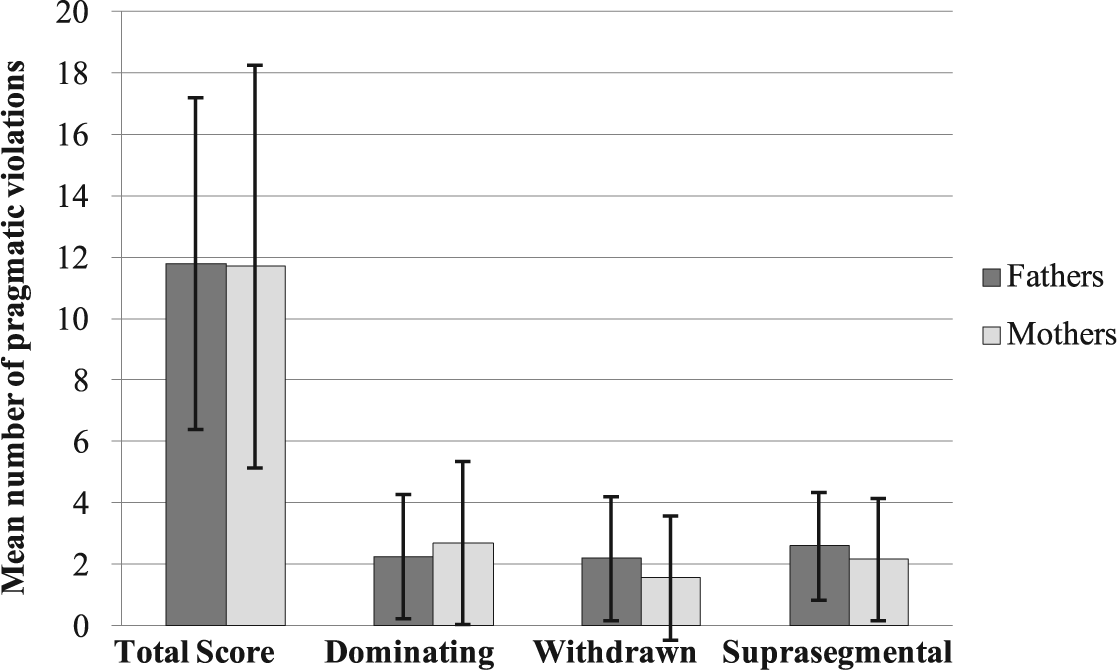
Comparison of pragmatic language across sexes.
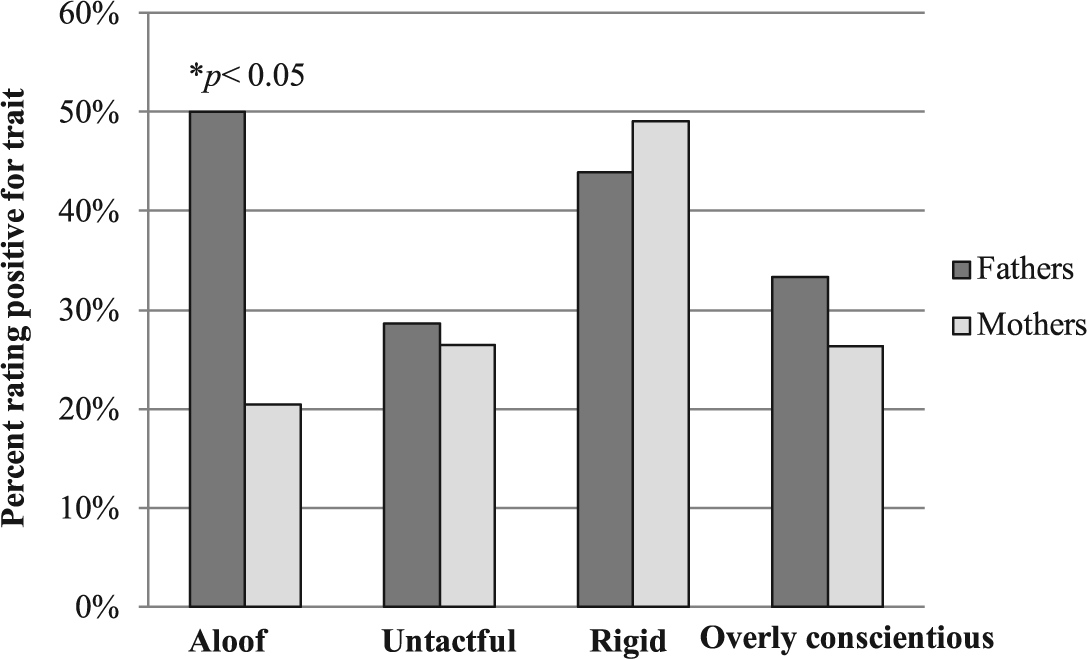
Comparison of rates of personality features across sexes.
Associations across BAP features within individuals
Among the group of fathers, overly conscientious and rigid traits were significantly correlated (r = 0.393, p = 0.011). Aloof trait was significantly associated with untactful (r = 0.485, p = 0.007) and rigid (r = 0.372, p = 0.015) traits among fathers. Rigid and untactful traits were also significantly associated with each other among the group of fathers (r = 0.380, p = 0.029). Similar to the relationships detected among fathers, significant associations were detected among mothers between overly conscientious and rigid (r = 0.432, p = 0.002) and aloof and untactful traits (r = 0.374, p = 0.021). While no significant associations were detected between pragmatic language and any of the personality traits among fathers, several trait associations were detected among mothers. Aloof personality was significantly associated with the PRS Total Score and all the three PRS subscales. The untactful trait was significantly associated with the PRS Total Score (r = 0.392, p = 0.015) and the Dominating subscale (r = 0.386, p = 0.017), while the relationship between untactful and the PRS Withdrawn subscale approached significance (p = 0.078) in mothers. Within-participant correlations are reported in Table 1.
Associations across BAP features within individuals.

p < 0.05, **p < 0.01, ***p < 0.001.
Intrafamilial relationships
Associations within spousal pairs
Several associations were detected between fathers’ language features and mothers’ language or personality traits. Fathers’ PRS Total Score, PRS Withdrawn subscale, and PRS Suprasegmental subscale were significantly correlated with mothers’ Suprasegmental PRS subscale. The PRS Total Score in fathers was positively associated with overly conscientiousness in mothers (r = 0.352, p = 0.033), while fathers’ PRS Dominating subscale was negatively correlated with mothers’ untactful trait (r = −0.426, p = 0.027). There were no significant relationships between fathers’ personality traits and mothers’ features, although there were several nonsignificant trends. The relationship between untactful in mothers and fathers approached significance (r = 0.364, p = 0.057), as did the association between rigid personality in fathers and pragmatic language in mothers (PRS Total Score; r = −0.299, p = 0.076) (Figure 3).
Associations between pragmatic language and personality features within spousal pairs. *p < 0.05; only significant correlations are depicted.
BAP: broad autism phenotype.
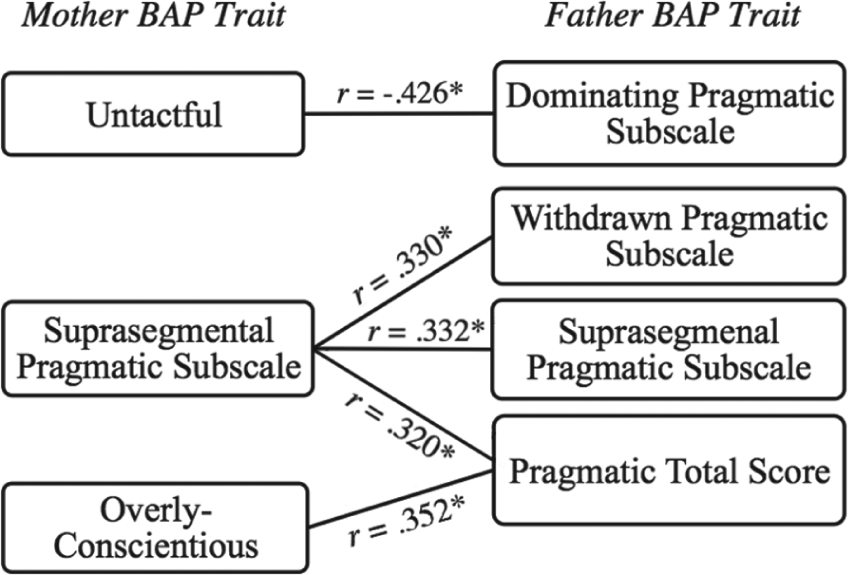
Parent–child associations
First, parent BAP features were examined in relation to early-emerging child symptoms (i.e. symptoms observed between 4 and 5 years of age, as measured by the diagnostic algorithm of the ADI). No mother–child associations were detected, but several associations emerged with fathers. The presence of untactful personality in fathers was significantly associated with children’s total severity, degree of social impairment, and deficits in communication. The severity of restricted and repetitive behaviors was positively associated with aloof trait but negatively associated with overly conscientious trait in fathers. Correlations with early-emerging child symptoms are reported in Figure 4.

Associations between parent BAP features and child autism symptoms at 4–5 years of age. *p < 0.05. All child variables were derived from the ADI. Only significant correlations are depicted.
Correlations were also examined between parent BAP features and concurrent autism symptoms severity, as measured by the ADOS and the ADI current diagnostic algorithms. Children’s current autism symptoms were significantly associated with select BAP features in both mothers and fathers. Among mothers, the PRS Total Score and Dominating subscale were positively associated with children’s current degree of communication impairment on the ADI. A trend-level association was detected between mothers’ aloof trait and children’s severity of autism symptoms as measured by the ADOS (r = 0.340, p = 0.096). Among the fathers, significant positive associations emerged between aloof trait in fathers and children’s current overall symptom severity and the current severity of restricted and repetitive behaviors. Fathers’ overly conscientious trait was negatively associated with a number of current child symptoms, including current overall severity and current degree of social impairment on the ADI. Correlations with children’s current autism symptoms are reported in Figure 5.

Associations between parent BAP features and current child autism symptoms. *p < 0.05. All child variables were derived from the ADI. Only significant correlations are depicted.
Discussion
This study examined sex differences in the BAP in a large, newly recruited sample of parents of individuals with autism, using direct-assessment measures of language and personality features of the BAP. The analyses revealed higher rates of aloof personality in fathers than in mothers, but no other sex differences in the rates of BAP features were detected. Males and females showed different patterns of co-occurrence of traits, where pragmatic language features tended to co-occur with aloof and untactful personality in mothers but not in fathers. The associations were also detected within spousal pairs, with particular conversational styles in fathers associated with untactful or overly conscientious personality traits in mothers. Finally, significant parent–child associations were detected with several BAP traits. Together, these findings support the presence of the BAP in both male and female relatives and raise some specific questions about how such features might inform studies of the genetic basis of autism.
First, the general lack of sex differences for most BAP features, despite the clear sex bias in autism, is consistent with several prior reports (Bolton et al., 1994; Landa et al., 1992; Piven et al., 1997b). One proposal to explain the lack of sex differences in the BAP is an etiological model in which males are at increased vulnerability to an additional unknown risk. While females may be at equal vulnerability to loci that are responsible for subclinical autism markers in their segregated forms (and therefore equally likely to show features of the BAP), the increased prevalence of autism among males might be accounted for by the presence of additional risk factors to which males are disproportionately vulnerable (or lack protective factors present in females) (Skuse, 2007). Prior research that supports the combined effects of multiple genetic alleles contributing to autism is consistent with this interpretation (Geschwind, 2009).
Why, then, did the aloof trait present more commonly in fathers? One possibility may be that males are at greater risk to the social domain of impairment associated with autism. Because of the universal presence of social deficits in autism, and their strong predictive power, it has been suggested that the social impairments in autism may be primary relative to other domains (Bishop et al., 2007; Charman et al., 2005; Chevallier et al., 2012; Dawson and Bernier, 2007). Aloof personality trait, defined in this study as the lack of interest and/or participation in social interaction, appears to tap subtler manifestations of core deficits in socially motivated behaviors. Prior studies of the BAP also point toward aloof as a principal characteristic of the BAP. For example, two studies of the BAP reported that social–cognitive differences were evident only among the subgroup of parents who displayed social characteristics of the BAP, while those showing nonsocial features of the BAP performed comparably to control parents on tasks of social cognition (Losh et al., 2009; Losh and Piven, 2007).
The sex-specific co-segregation of BAP traits detected within individuals (e.g. whereas aloof personality was associated with pragmatic language in mothers, this trait tended to co-occur with rigid personality in fathers) raises questions regarding environmental and biological influences that may differentially affect males and females and that could perhaps lead to different patterns of presentation of the BAP. Given that pragmatic language ability is intimately related to social engagement (Tager-Flusberg, 2000), it is somewhat surprising that social BAP traits (aloof and untactful) were associated with pragmatic language features in females only. It could be the case that relationships observed in women were an environmental artifact; perhaps cultural expectations lead females who are less adept at conversation to develop avoidance behaviors that manifest as social disinterest (aloofness). Along these lines, heightened awareness of one’s pragmatic language difficulties may lead to inflated reports of difficulty in handling delicate communicative situations (untactfulness). Alternatively, sex-specific co-occurrence patterns may reflect biologically mediated patterns in BAP expression that differ across males and females, with shared pathways for language and social traits of the BAP among females but not males. This interpretation is consistent with our finding that aloof and untactful traits were not associated with pragmatic language among males, despite the fact that males were equally as likely to display pragmatic language and untactful features as females and more likely to display aloof personality.
Patterns of BAP features detected within spousal pairs, where fathers showing pragmatic language features tended to pair with mothers showing overly conscientious traits or pragmatic language features, may be suggestive of assortative mating. This finding replicates and extends those of Losh et al. (2008), who also detected a tendency for fathers who were positive for the BAP “language” domain to pair with mothers who were positive for the “rigid” domain (which encompassed both overly conscientious and rigid traits). Evidence of partner selection based on certain BAP traits might inform how fractionalized BAP features (which could represent independent biological pathways) might aggregate within families to produce autism in offspring. The social, rigid, and language features of autism have been observed to show low covariation in twin studies, suggesting that independent causal pathways may underlie the three domains of the autism triad (Happe et al., 2006; Happe and Ronald, 2008; Ronald et al., 2006a). Thus, the social, language, and rigid features of the BAP might represent similar fractionation of the autism triad, conferring independent risk factors for autism. The aggregation of multiple independent risk factors within spousal pairs might lead to increased likelihood that offspring inherit a combination of susceptibility variants that together contribute to the development of the full clinical presentation of autism.
Another important finding concerns the different parent–child associations detected in mothers and fathers. A number of father–child associations emerged between early-emerging and concurrent child autism symptoms, which could suggest stronger patrilineal inheritance patterns. More specifically, aloof and untactful personality features in fathers were positively associated with the severity of children’s autism symptoms at 4–5 years of age, and aloof personality trait continued to be highly associated with the severity of children’s autism symptoms as they were assessed concurrently. Given that the social and untactful BAP features most closely parallel the core social deficits in autism, these findings might underscore the genetic significance of the social features of autism and the BAP. Social characteristics associated with autism and the BAP are heritable in the general population (Hughes and Cutting, 1999; Scourfield et al., 1999) and, as previously noted, have been linked with the performance on neuropsychological tasks of social cognition (Adolphs et al., 2008; Losh et al., 2009; Losh and Piven, 2007; Spezio et al., 2007), suggesting that they are good candidates for autism endophenotypes. Other father–child relationships were detected only at younger developmental periods for individuals with autism. This is perhaps not unexpected, given possible intervention effects, along with the evidence that the severity of autism symptoms improves with age (Seltzer et al., 2003; Shattuck et al., 2007). It could be that the early developmental features probed by the ADI (focused on ages 4–5 years) are a better index of genetically meaningful features in autism because they are less influenced by developmental and environmental effects.
The findings that mothers’ pragmatic language skills were associated with the degree of communication impairment in individuals with autism are intriguing. Such domain-specific correlations between mothers and their children highlight pragmatic language differences as an endophenotype that is perhaps transmitted maternally. Of course, it is also possible that such associations reflect an environmental effect (though it is not clear why this would be detected in mothers only). Longitudinal studies of the BAP are needed to clarify how personality and language features in parents might relate to the emergence of child symptoms over time, which would inform how biological and environmental processes interact to produce autism and the BAP in unaffected family members.
A remaining question is why the overly conscientious trait in fathers was negatively associated with the severity of autism symptoms. It may be that this trait, rather than reflecting genetic liability, is instead a result of parental adaptation to child symptoms. Anecdotally, many participants have remarked during the MPAS interview that they have “learned” to be flexible and less perfectionistic or detail oriented from their child. Perhaps parents of the most severely affected children face greater pressure to lower their standards for perfection in order to accommodate their child’s behaviors. To date, no research has examined how the expression of the BAP might evolve over time or in response to environmental factors, which has implications for our understanding of these traits as behavioral risk markers for autism.
Limitations of this study include the lack of epidemiologic sampling and the small sample of female probands, which could reduce generalizability. Future studies would benefit by including larger population-based samples in order to further explore the findings presented here and in other works, including examination of familial patterns that might vary by sex of the affected child or by multiplex/simplex family status, given that multiplex families are thought to have increased genetic susceptibility to autism and in prior work with larger samples have been shown to exhibit elevated frequency of BAP traits (Losh et al., 2008; Szatmari et al., 2000; Virkud et al., 2009). Examination of multiplex families might enhance the ability to detect autism-related endophenotypes. While this study included both simplex and multiplex families of children with autism, the relatively small number of multiplex families precluded such analyses in this study. The strength of this study is the comprehensive nature of the clinical BAP assessments; all BAP ratings were assessed directly from in-person interviews. While questionnaire methods for assessing the BAP more readily allow the assessment of large samples, little research has addressed the comparability of direct assessment and questionnaire ratings of the BAP, and emerging evidence suggests that quantification of BAP features may differ significantly even across the use of different questionnaires (Davidson et al., 2012).
In conclusion, this study supports overall similar rates of BAP expression across male and female first-degree relatives of individuals with autism, with only aloof personality trait showing elevated expression in males. Despite generally similar rates of BAP expression across males and females (which might indicate similar genetic loading across the sexes), the finding of robust father–child associations across both early-emerging and later child symptoms seems to support greater patrilineal effects within families. Specific patterns of trait co-occurrence and sex-specific parent–child relationships may inform investigations of autism endophenotypes. For example, the associations between autism severity and fathers’ social personality traits may highlight such traits as particularly meaningful for consideration in genetic studies of autism. Similarly, the findings that language-related phenotypes were shared exclusively between offspring and their mothers (but not their fathers) might have implications for the study of language-related autism candidate genes, such as CNTNAP2 and FOXP2 (Penagarikano and Geschwind, 2012). Finally, the finding that some parent–child relationships shifted across periods of development in children highlights the need to consider environmental and developmental influences in the selection of behavioral targets in gene–behavior association studies of autism. Together, these findings may be informative for genetic studies of autism and for understanding the significance of the BAP in particular.
Footnotes
Acknowledgements
We are grateful to all of the families who participated, and for funding support from the National Institute of Deafness and Communication Disorders and the National Science Foundation. We also acknowledge the Research Participant Registry Core of the Carolina Institute for Developmental Disabilities, Grant Award P30 HD03110.
Funding
This work was supported by the National Institute of Deafness and Communication Disorders [grant number 1R01DC010191-01A1]; and the National Science Foundation.