



Abstract
This study examined associations between parent–child interactions and the development of social skills in 42 children (21 typically developing and 21 with autism spectrum disorders) between the ages of 3 years, 0 months and 6 years, 11 months. We expected that positive parent–child interaction qualities would be related to children’s social skills and would mediate the negative relation between children’s developmental status (typical development vs autism spectrum disorders) and social skills. Videotapes of parents and children during a 5-min wordless book task were coded for parent positive affect and emotional support as well as parent–child cohesiveness. Emotional support and cohesiveness were significantly related to children’s social skills, such that higher emotional support and cohesiveness were associated with higher social skills, R2 = .29, p = .02, and R2 = .38, p = .002, respectively. Additionally, cohesiveness mediated the relation between children’s developmental status and social skills. These findings suggest that parent emotional support and cohesiveness between parents and children positively influence children’s social skills. Parent positive affect was unrelated to social skills. Implications of these findings for social skills interventions are discussed, particularly for young children with autism spectrum disorders.
Poor social functioning is the hallmark of autism spectrum disorders (ASD) and remains a core component of current diagnostic criteria (Laushey et al., 2009; Vickerstaff et al., 2007). Social skills, defined as the strategies people use to interact positively and effectively with others (Rao et al., 2008), represent one component of social functioning and create the foundation for forming and maintaining positive relationships with others. Research suggests that typically developing children utilize a wide range of social skills (e.g. gestures, speech, social referencing, and facial expressions) when interacting with peers (Charlop et al., 2010). In contrast, children with ASD demonstrate significant challenges in the development and utilization of social skills (Charlop et al., 2010). Children with ASD show less interest in interacting with others, engage in more solitary play, are less preferred as playmates, experience fewer reciprocal friendships, and have lower quality interactions (Baker et al., 2007; Charlop et al., 2010; Cotugno, 2009; McConnell, 2002).
Deficits in children’s social skills increase the likelihood of later negative outcomes. Studies on typically developing children have linked poor social skills to peer rejection, social isolation, poor academic achievement and adjustment, delinquency, marginal employment in adulthood, and mental health problems (Bellini et al., 2007; Bijstra and Jackson, 1998; Cowart et al., 2004; Elliott and Gresham, 1987). Studies on children with ASD have found similar adverse outcomes, including depression, anxiety, academic underachievement, disruptive behavioral problems, poor social relationship quality, and fewer employment opportunities later in life (Macintosh and Dissanayake, 2006; Rao et al., 2008; White and Roberson-Nay, 2009). Prior research with the current sample confirmed that children with ASD had significantly lower social skills than typically developing children (Wilson and Montague, 2012). Given the strong association between poor social skills and negative life outcomes, it is crucial to identify factors that may contribute to the development of effective social skills.
The role of parent–child interactions in the development of social skills
Research on typically developing children suggests that the quality of parent–child interactions may play an important role in the development of children’s social skills (Baker et al., 2007; Cumberland-Li et al., 2003; Leidy et al., 2010). These interactions may provide a context in which children learn and assimilate adaptive social skills. For instance, while interacting with parents, children learn social rules (e.g. turn-taking and negotiation strategies) as well as ways to decode emotional cues (Guralnick, 1999). The quality of parent–child interactions appears to have long-term effects on social development for both typically developing children and children with developmental disabilities (McDowell and Parke, 2009; Skibbe et al., 2010). Although many aspects of parent–child interactions may influence the development of children’s social skills, our study focused on the qualities of positive affect, emotional support, and cohesiveness.
Positive affect
Parent positive affect expressed during parent–child interactions may be representative of the general emotional tone demonstrated by parents. Indicators of positive affect include smiling, using a positive tone of voice, and demonstrations of affection (Lindahl and Malik, 2000). Parental expressivity and warmth have been associated with typically developing children’s social skills (Zhou et al., 2002) and appear to predict social outcomes both concurrently and 1-year later (Isley et al., 1999). Isley and colleagues proposed that parent positive affect indirectly influences the development of social skills through children’s use of positive affect in social situations. The authors suggested that parents model positive affect in parent–child interactions, which is later imitated by the child during interactions with peers.
Previous research comparing parental positive affect in typically developing children and children with intellectual disabilities found that whereas parental positive affect predicted greater social skills for typically developing children, it was unrelated to social skills in children with intellectual disabilities (Green and Baker, 2011). Additionally, this study found that children with intellectual disabilities had fewer social skills and had interactions with their parents that were characterized by less positive displays of emotions than children in the typically developing group. No research to date has examined the influence of parental positive affect on social skills in children with ASD.
Emotional support
Emotional support reflects parents’ emotional attunement toward their children and the ability of parents to appropriately identify and respond to children’s emotional cues (Lindahl and Malik, 2001). Carson and Parke (1996) found that parents’ ability to respond contingently to their children’s emotions and encourage emotion regulation predicted children’s social competence with peers. Several studies suggest that emotional support indirectly influences the development of social skills by fostering emotional competence. For instance, Denham et al. (1997) found that parents’ emotional support was related to preschool children’s emotional competence, which predicted children’s social skills. Few studies have examined a similar link between parents’ responsiveness to children’s cues and early social skills in children with ASD. Siller and Sigman (2008) found that the parents’ synchrony (i.e. responsiveness) with children’s behaviors during play interactions predicted language development over time in children with autistic disorder. Given the deficits in social and emotional competence commonly associated with ASD, this may be an important area of research for this group.
Cohesiveness of the parent–child relationship
Cohesiveness represents a sense of closeness between family members as demonstrated by the level of affection, warmth, comfort, and concern (Lindahl and Malik, 2001). Research suggests that family cohesiveness is linked to social development in typically developing children. Bennett and Hay (2007) found that cohesiveness predicted children’s development of social skills. Similarly, Leidy et al. (2010) found that high cohesiveness, along with effective parental communication, predicted increases in children’s social skills (particularly, social problem solving and self-efficacy) at a 9-month follow-up. In contrast to research on typically developing children, there is little parallel research on this relation in children with ASD. Siller and Sigman (2008) found that the responsive behaviors of both children with autistic disorder and their parents contributed to the quality of parent–child interactions and predicted children’s later language development. Given that children with ASD demonstrate considerable difficulty with reciprocal interactions as well as initiating and maintaining relationships (McConnell, 2002; Paul et al., 2009), it seems likely that maintaining cohesiveness may be more difficult during interactions between children with ASD and their parents. Therefore, we expected that differences in children’s social skills would be partially explained by levels of cohesiveness within parent–child interactions.
Current study
To our knowledge, no studies have examined the influence of parent–child interaction qualities on social skills in both typically developing children and children with ASD. Additionally, no studies have examined whether these qualities might help explain observed differences in social skills between typically developing children and children with ASD. Research on the mediating role of parent–child interaction qualities may provide valuable information on potential mechanisms influencing social skills development. If mediating processes are identified, these could be used to inform future social skills interventions for children with and without ASD. In the current study, we used a sample of 3- to 6-year-old typically developing children and children with ASD to examine the role of several different aspects of parent–child interactions (i.e. positive affect, emotional support, and cohesiveness) in children’s social skills. We also investigated whether these variables mediated the relation between children’s developmental status and social skills. Based on previous research, we expected that
Parent–child interaction qualities would be related to socials skills for both typically developing children and children with ASD, such that children who experienced higher quality interactions would have better socials skills;
Parent–child interaction qualities would mediate the relation between children’s developmental status and social skills.
Method
Participants
The participants included 42 children, their parents, and teachers who took part in a larger study examining self-regulation in young children. Participants were recruited through local autism centers, special education programs, private and public schools, and through advertisements placed in local magazines and listservs. The sample included 21 children diagnosed with ASD and 21 typically developing children matched to children with ASD on verbal mental age. Demographic information for the sample is included in Table 1. The two groups appear to be relatively similar on several demographic variables. However, the ASD sample was significantly older than the typically developing sample and was more ethnically diverse.
Demographic information by status group (n = 21).
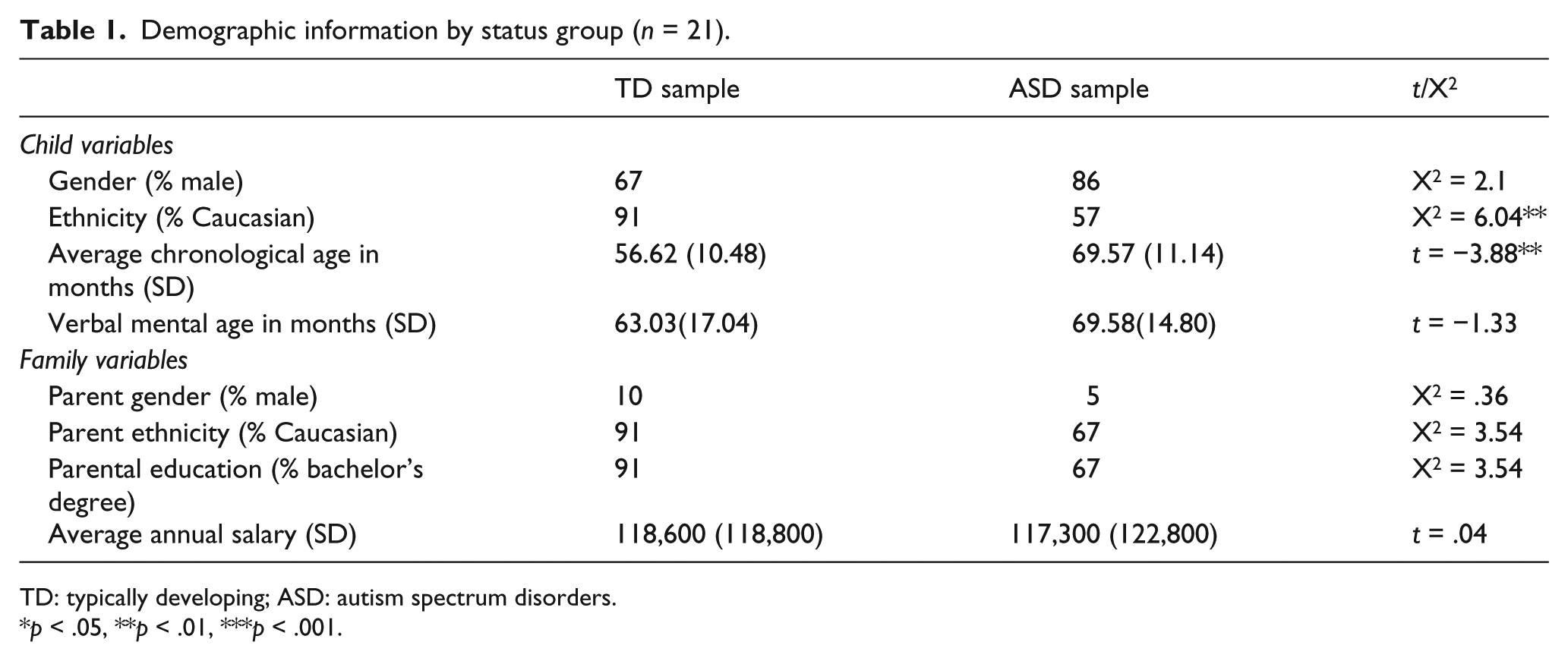
TD: typically developing; ASD: autism spectrum disorders.
p < .05, **p < .01, ***p < .001.
A number of eligibility criteria were required for inclusion in this study. Children were required to be between 3 years, 0 months and 6 years, 11 months of age. Children needed to demonstrate sufficient language skills that would enable them to answer basic questions and follow three-step commands. Therefore, children from both groups were excluded if their verbal abilities were below a set minimum criterion. Additionally, a screening measure ensured that children in the typically developing group did not exhibit high levels of symptoms suggestive of ASD. Furthermore, previous diagnoses of autistic disorder, Asperger’s disorder, or pervasive developmental disorder–not otherwise specified were confirmed for children in the ASD group.
Procedures
Screening visit
Data for this study were collected over two visits. The first visit typically took place in families’ homes. Children’s language abilities were assessed, and parents completed a set of questionnaires, including a screener for ASD symptoms during this visit. In addition, parent consent was obtained to contact teachers for their evaluation of children’s social skills. On average teachers knew the participants for 12.37 months (SD = 9.37 months, N = 26) at the time they were asked to complete the measures.
Experimental visit
If children met this study’s eligibility requirements, they completed a second visit at the university research laboratory. Parents and children were videotaped as they looked at two wordless picture books for 5 min. Although specific instruction was given regarding which book to look at first, no other instructions were provided about how to look at the books together.
Measures
Developmental status
A third-party service was contracted to collect medical records in order to confirm ASD diagnoses. This company specializes in record retrieval and contacted diagnosing health providers to obtain original diagnostic reports. Additionally, we distinguished the two groups based on cutoff scores derived from parent reports on the Autism Behavior Checklist (ABC; Krug et al., 1980). The ABC is a 56-item questionnaire that assesses ASD symptoms. Previous research (e.g. Luteijn et al., 2000) has demonstrated the utility of the ABC as a screening instrument. This measure is composed of five subscales with items presented in a forced-choice format (Naar-King et al., 2004). A total score of 68 (0.5 SD below the ASD sample mean) is considered the “high-probability cut-off point for the classification of autism” (Krug et al., 1993: 27).
Verbal mental age
The verbal reasoning cluster on the Differential Abilities Scale–Version II (DAS-II; Elliott, 2007), consisting of the Verbal Comprehension and Naming Vocabulary subtests, was used to screen for verbal abilities and to determine mental age for matching procedures. The Verbal Comprehension and Naming Vocabulary subtests of the DAS-II Early Years cognitive battery are appropriate for children ages 2:6–6:11. Participants were required to score above 85 on this cluster for inclusion in this study.
Social skills
The Behavioral Assessment System for Children–Preschool and Elementary Version 2, Teacher Rating Scale (BASC-2-TRS; Reynolds and Kamphaus, 2004) was used to assess children’s social skills. The present study used scores on the social skills subscale, which consists of six items in the preschool version and eight items in the elementary version. Teachers rated items on a 4-point Likert scale ranging from 1 (never) to 4 (almost always).
Parent–child interaction qualities
Parent–child interaction qualities were measured during the wordless book-reading task, a procedure that has commonly been used to stimulate interactions between parents and young children (LaBounty et al., 2008). These sessions were videotaped and subsequently coded using three scales that were adapted from the System for Coding Interactions and Family Functioning (SCIFF; Lindahl and Malik, 1996). For the purpose of our study, we chose to focus on the individual parent codes of positive affect and emotional support as well as the family interaction code of cohesiveness. We adapted the coding system to reflect behaviors that were relevant for a book-reading task.
Parent–child interaction qualities were coded every 10-s intervals. Interactions were rated on a 5-point Likert scale, ranging from 1 (very low) to 5 (high). The positive affect code reflected parents’ emotional tone throughout the parent–child interaction. Positive affect was operationalized as parents’ cheerful facial expressions, warm or happy tone of voice, laughter, and physical displays of affection such as hugging (Lindahl and Malik, 2000). The emotional support code assessed parents’ attunement toward their children, as characterized by their ability to appropriately identify and respond to their children’s emotional cues, interests, and desires. This code included behaviors such as supporting the child’s ideas and desires in storytelling (e.g. following the child’s lead or giving praise) and validating children’s signs of disinterest or dislike in the story. The parent–child cohesiveness code evaluated the sense of closeness between family members as demonstrated by the level of reciprocity between parent and child, the degree of engagement and responsiveness, and mutual enjoyment within the interaction (Lindahl and Malik, 2000). This code included behaviors such as physical closeness (e.g. sitting on parent’s lap or leaning in toward one another), mutual displays of affection or enjoyment (e.g. looking at one another or laughing together), and turn taking.
Prior to coding these interactions, coders trained for approximately 2 months to establish reliability. In 12 instances, coders served in the role of the assessor for participants and were not blind to participants’ developmental status. Interrater reliability estimates for the parent positive affect, emotional support, and parent–child cohesiveness codes, calculated using intraclass correlation (ICC), were .83, .81, and .87, respectively.
Planned analyses
Prior to data analysis, data were screened to ensure that there were no missing data points or violations to the assumptions of normality and independence. To test our first hypothesis that parent–child interaction qualities would be associated with social skills for both groups of children, we separately regressed social skills on positive affect, emotional support, and cohesiveness.
To test whether parent–child interaction qualities mediated the relation between developmental status and social skills, we conducted a series of multiple regression models using a macro command to test mediation models that include covariates (Preacher and Hayes, 2008).We selected this method because it is robust to assumptions of normality, an assumption typically supported in large samples. As such, this method is recommended for use with small samples (Preacher and Hayes, 2008). This method employs a bootstrap procedure in which the data are sampled, with replacement, 5000 times. Following the recommendations of researchers (e.g. Mallinckrodt et al., 2006; Shrout and Bolger, 2002), bootstrap resampling methods were used to test for the significance of indirect effects in mediated models as statistical power is maximized by computing nonsymmetric confidence intervals and, thus, reducing the probability of Type II error. A 95% bias-corrected and accelerated confidence interval was estimated using the indirect effect coefficients generated from the 5000 resamples. When zero is not included in the confidence interval, the mediation model is considered significant at the error rate of α = .05 (Figure 1).

Significant mediation model paths (standardized coefficients).
Results
Descriptive analyses
Correlations between all study variables for the total sample, typically developing subsample, and ASD subsample are displayed in Table 2. Correlation analyses indicated that both emotional support and cohesiveness were significantly related to social skills for the total sample. However, when examining the typically developing and ASD subsamples separately, emotional support was not significantly correlated with children’s social skills for either group, and cohesiveness was related to social skills only for the ASD group. Means, standard deviations, t-tests, and effect sizes for study variables for each group are reported in Table 3. Results demonstrated that levels of positive affect and emotional support were not significantly different between the typically developing and ASD groups. However, the typically developing group had significantly higher levels of cohesiveness and social skills than children with ASD.
Correlations among key variables.
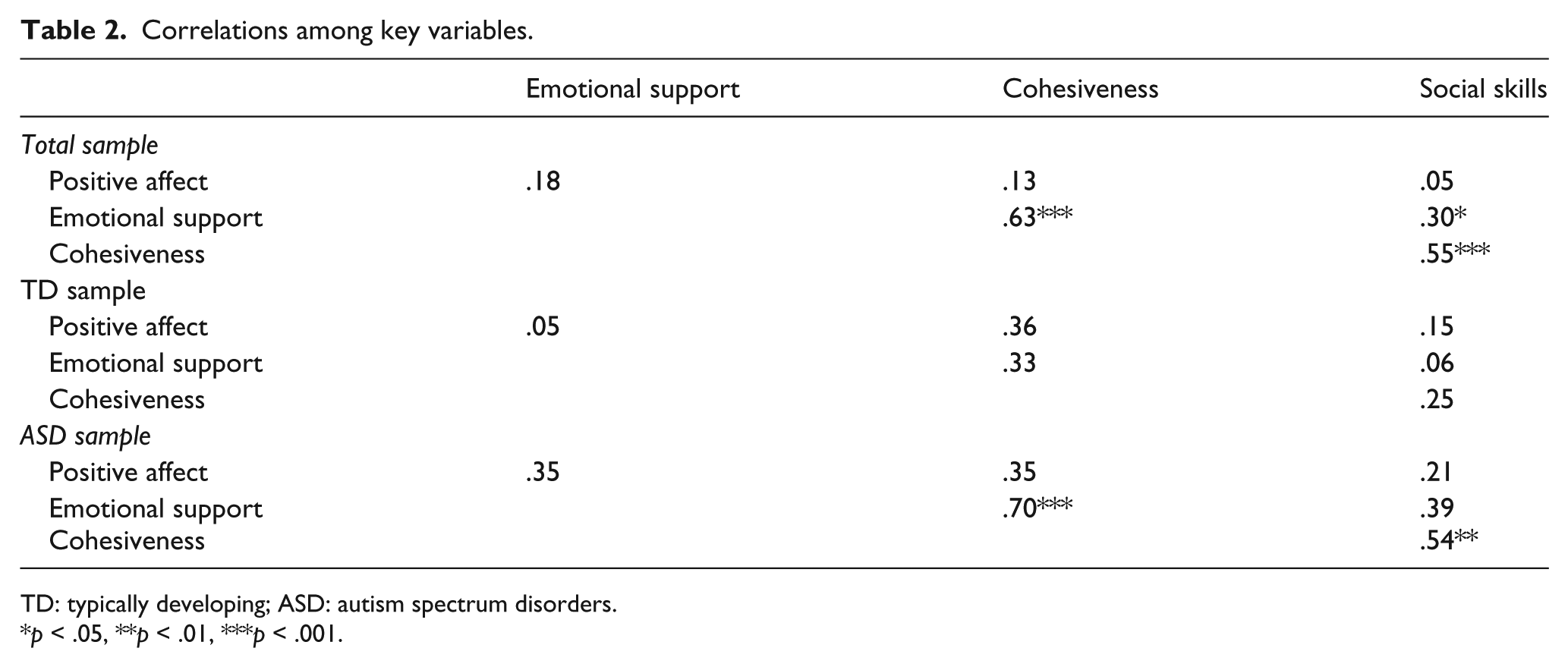
TD: typically developing; ASD: autism spectrum disorders.
p < .05, **p < .01, ***p < .001.
Means, standard deviations, and effect sizes for study variables by status (N = 42).
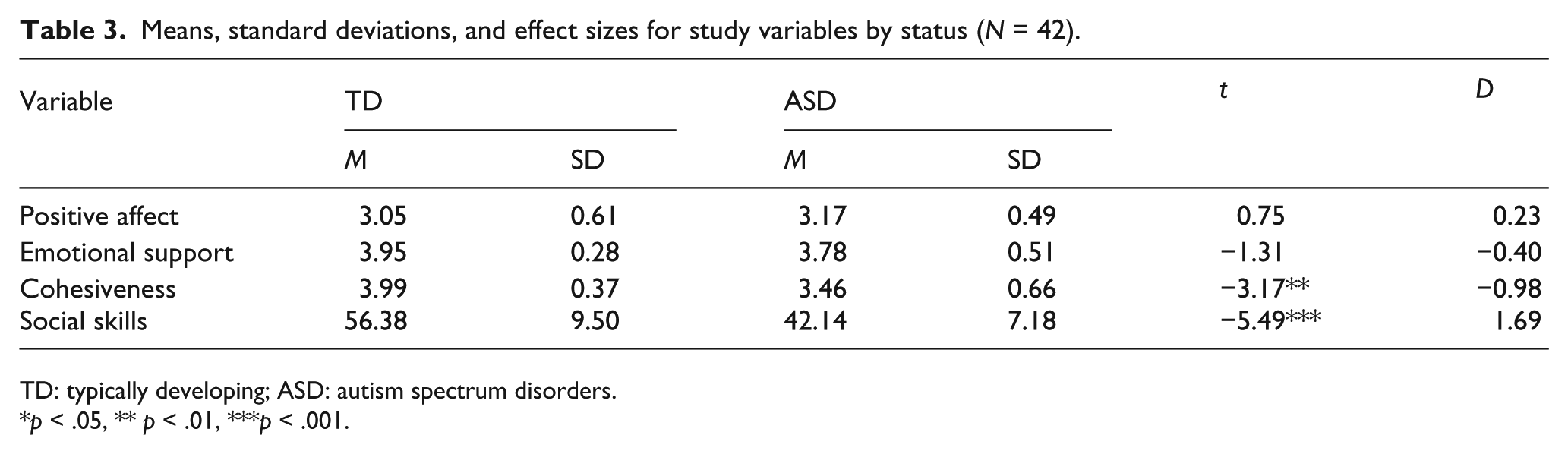
TD: typically developing; ASD: autism spectrum disorders.
p < .05, ** p < .01, ***p < .001.
Analysis of main effects
We tested the direct relation between the three parent–child interaction variables (positive affect, emotional support, and cohesiveness) and social skills by conducting three separate hierarchical regression analyses. Control variables of child ethnicity and gender were entered in the first block because these variables were significantly related to social skills. In the second block, the parent–child interaction variable was entered. Results indicated that after controlling for covariates, positive affect was not significantly related to social skills (β = .13, p = .40, R2 = .21). In contrast, emotional support and cohesiveness were both significantly associated with children’s social skills (β = .33, p = .02, R2 = .29; β = .46, p = .00, R2 = .38, respectively). These findings suggest that greater parental emotional support and parent–child cohesiveness were significantly related to higher social skills for the entire sample.
Mediation analyses
We examined three separate mediation models in which the parent–child interaction qualities of positive affect, emotional support, and cohesiveness were hypothesized to mediate the relation between children’s developmental status and social skills. Regression equations tested each pathway in the mediation models, while controlling for children’s ethnicity and gender.
We first tested the mediation model for parent positive affect. Developmental status was significantly related to social skills, β = −.58, t(41) = −4.43, p < .001; typically developing participants demonstrated greater social skills than those with ASD. However, developmental status was not significantly associated with parent positive affect, β = .05, t(41) = .28, p = .78. Positive affect did not have a significant relation to social skills, β = .13, t(41) = .85, p = .40. When positive affect was added into the model, the direct effect of status on social skills was not reduced and remained significant, β = −.59, t(41) = −4.51, p < .001. The confidence interval for the effect of the indirect pathway via positive affect included “0” (−0.53 to 1.07), indicating that positive affect was not a significant mediator of the relation between status and social skills.
We then tested the mediation model for parent emotional support using the same procedure described above. Developmental status was significantly associated with social skills, β = −.58, t(41) = −4.43, p < .001, and showed a trend toward being significantly related to emotional support, β = −.29, t(41) = −1.75, p = .09. This relation was negative, indicating that there was tendency for parents of children with ASD to show less emotional support than parents of typically developing children. The path from emotional support to social skills was significant; children who experienced more emotional support had higher social skills, β = .33, t(41) = 2.34, p = .02. With emotional support in the model, the direct effect of status on social skills was reduced although it remained significant, β = −.52, t(41) = −3.91, p < .001. The confidence interval for this mediation model included “0” (−2.19 to 0.17), indicating that emotional support was not a significant mediator of the relation between status and social skills.
Finally, we tested the mediation model for parent–child cohesiveness. Developmental status was significantly related to social skills, β = −.58, t(41) = −4.43, p < .001. Additionally, the path between status and cohesiveness was significant; children with ASD had less cohesive parent–child interactions than typically developing children, β = −.38, t(41) = −2.46, p = .02. Similarly, the path between cohesiveness and social skills was significant; children who engaged in parent–child interactions with higher cohesiveness had higher social skills, β = .46, t(41) = 3.34, p = .002. With cohesiveness in the model, the direct effect of status on social skills was significantly reduced although this was still significant, β = −.47, t(41) = −3.5, p = .001. The confidence interval did not include “0” (−3.50 to −0.04), indicating that cohesiveness was a significant mediator of the relation between status and social skills. The overall mediation model accounted for 53% of the variance in social skills, with the indirect effect of cohesiveness uniquely accounting for 19% of the variance.
Discussion
This study examined the relations between developmental status, the quality of parent–child interactions, and social skills in preschool children. The primary purpose of this study was to examine the mediating effects of parent–child interaction qualities on social skills among young children with ASD and typically developing children. Our hypothesis that parent–child interaction qualities would be related to children’s social skills, regardless of developmental status, was partially supported. Emotional support and cohesiveness were significantly associated with children’s social skills. Consistent with previous studies (e.g. Bennett and Hay, 2007; Denham et al., 1997; Guralnick, 1999; Leidy et al., 2010), we found that higher levels of emotional support and cohesiveness within parent–child interactions were associated with higher social skills among children. However, when the groups were examined separately, parent–child interactions were not significantly related to social skills for typically developing children. In contrast, cohesiveness was associated with social skills for children with ASD. These findings suggest that cohesiveness within parent–child interactions may be more influential on social skills for children with ASD as compared to typically developing children.
We found partial support for our hypothesis that parent–child interaction qualities would mediate the relation between developmental status and social skills. Parent–child cohesiveness partially mediated the relation between status and social skills, whereas parent positive affect and emotional support did not. This finding suggests that the ability to engage in reciprocal interactions while working toward a common goal and demonstrating a sense of warmth and connectedness is related to children’s social skills for both typically developing children and children with ASD. Our findings indicated that interactions between parents and children with ASD generally had lower levels of cohesiveness than those of typically developing children and their parents. Given that children with ASD often demonstrate difficulties in reciprocal interactions, forming cohesive interactions may be more challenging for parents of these children. Because we found that cohesiveness partially accounted for the relation between developmental status and social skills, it seems logical that this may be an area of potential intervention for children with ASD.
It is interesting to note that of the three parent–child interaction qualities, cohesiveness was the only one that captured the way in which children and parents respond to one another. The qualities of positive affect and emotional support focused exclusively on behaviors specific to parents and did not account for the observed group differences in social skills. This pattern of findings suggests that when investigating the contribution of parenting to the social skills of children with and without ASD, it may be more informative to consider the bidirectional effects of parents and children. More specifically, research should examine parenting behaviors in the context of child characteristics rather than focusing solely on parents’ contributions to these interactions.
Strengths and limitations
This study investigated a group of children at significant risk for continuing social problems and focused on parenting qualities as a potential area of intervention. In addition to the strengths of this study, its limitations should be noted. First, our findings may lack generalizability to the larger population due in part to the small sample size and sample characteristics. Overall, the full sample exhibited considerable homogeneity with regard to key demographic variables, including socioeconomic status, parent sex, parent education, and locale (i.e. urban vs rural). Our sample predominantly comprised Caucasian families with high socioeconomic status, and parents were almost exclusively mothers. As a result, these findings may not be generalizable to fathers and individuals of other socioeconomic levels, ethnicities, and geographic locations.
A second limitation rests in the utilization of the SCIFF (Lindahl and Malik, 1996) coding system, which originally examined family functioning during problem-solving and conflict resolution discussions. We made several adaptations to this coding system to account for the behaviors observed during our wordless book-reading task. As such, this coding system may not have captured important elements of this particular interaction for this sample of parents and children.
Implications and future research
In this study, we sought to understand how interactions between parents and children would relate to social skills in children with and without ASD. To our knowledge, our study is one of the few to examine the relation between parent–child interaction qualities and social skills in children with ASD. Given the increasing prevalence rates and adverse outcomes across the life span associated with ASD, our results are promising and may be used to inform social interventions for children with this diagnosis. In addition to teaching social skills to children, interventions should include parents and place a particular emphasis on building cohesiveness as well as increasing parent emotional support within interactions with their children. Future research should seek to identify other parent–child interaction qualities that may influence social skills. Additionally, a clearer understanding of how to develop and sustain cohesiveness within interactions with these at-risk children is required.
Footnotes
Funding
This work was supported by a Seattle Pacific University Senior Faculty Grant and a School of Psychology, Family & Community Faculty Research Grant to the fourth author.