



Abstract
Anecdotal reports and empirical evidence suggest that sensory processing issues are a key feature of autism spectrum conditions. This study set out to investigate whether adults with autism spectrum conditions report more sensory over-responsivity than adults without autism spectrum conditions. Another goal of the study was to identify whether autistic traits in adults with and without autism spectrum conditions were associated with sensory over-responsivity. Adults with (n = 221) and without (n = 181) autism spectrum conditions participated in an online survey. The Autism Spectrum Quotient, the Raven Matrices and the Sensory Processing Scale were used to characterize the sample. Adults with autism spectrum conditions reported more sensory over-responsivity than control participants across various sensory domains (visual, auditory, tactile, olfactory, gustatory and proprioceptive). Sensory over-responsivity correlated positively with autistic traits (Autism Spectrum Quotient) at a significant level across groups and within groups. Adults with autism spectrum conditions experience sensory over-responsivity to daily sensory stimuli to a high degree. A positive relationship exists between sensory over-responsivity and autistic traits. Understanding sensory over-responsivity and ways of measuring it in adults with autism spectrum conditions has implications for research and clinical settings.
Introduction
Autism spectrum conditions (ASC) are characterized by social and communication problems alongside unusually narrow interests and highly repetitive behaviour (American Psychiatric Association (APA), 1994). In addition, anecdotal reports and empirical evidence suggest that sensory processing issues are a key feature of ASC and have a profound impact on the daily life of individuals with ASC (Ben-Sasson et al., 2007; Brown et al., 2001; Chamak et al., 2008; Dunn et al., 2002; Grandin, 1996; White and White, 1987). Previous research has utilized sensory questionnaires to quantify sensory issues in ASC. However, only a few of these studies focus on adults (Crane et al., 2009; Dunn et al., 2002; Ermer and Dunn, 1998; Kern et al., 2007; Kientz and Dunn, 1997; Tomchek and Dunn, 2007). Self-reports are essential when assessing the extent to which sensory experiences are problematic for an adult. The few studies that have investigated sensory issues in adults with ASC use the Adolescent/Adult Sensory Profile (Crane et al., 2009) on which over 90% score at the most extreme end of the theoretically proposed sensory quadrants (Sensation Seeking, Low Registration, Sensation Avoiding and Sensory Sensitivity) with high within-group variability. Age trends in sensory over-responsivity have been documented with ASC and control groups with older participants demonstrating fewer differences than younger participants (Crane et al., 2009). Although the Adolescent/Adult Sensory Profile is a useful clinical tool, it does not permit the investigation of each sensory domain separately.
Recently, a self-report, the Sensory Processing (SP) Scale, was developed to investigate each sensory domain separately in children and adults. One subscale of the SP Scale is the Sensory Over-Responsivity Inventory (also known as SensOR), which was developed to specifically investigate sensory over-responsivity, defined as exaggerated responses to one or more types of sensory stimuli (Schoen et al., 2008). Examining sensory over-responsivity in adults with ASC is important because over-responsivity is frequently linked to high rates of depression and anxiety (Kinnealey et al., 2011; Kinnealey and Fuiek, 1999) and co-morbid sensory symptoms often compromise an individual’s quality of life (Kinnealey et al., 2011). The goal of this study was to investigate sensory over-responsivity in adults with ASC compared to control participants, that is, the extent to which daily life experiences are endorsed as uncomfortable or distressing by those with ASC. We hypothesized that adults with ASC would report more sensory over-responsivity than controls. Second, we aimed to test whether sensory over-responsivity is linked to autistic traits in adults with and without ASC. A recent study reported a positive association between autistic traits and sensory reactivity problems in the general population, using the Glasgow Sensory Questionnaire (Robertson and Simmons, 2012). In the future, the SP Scale could be used to measure sensory over-responsivity and the effectiveness of treatments and/or differentiate sensory subtypes. This is of particular importance with regard to the proposed changes to the Diagnostic and Statistical Manual of Mental Disorders (5th ed.; DSM-V), which will include ‘hyper- or hypo-reactivity to sensory input’, but so far there is no consensus on how to measure hyper- and hypo-reactivity, in other words over- and under-responsivity in ASC.
Methods
Data were collected online via Autism Research Centre, the Cambridge University, portals (www.autismresearchcentre.com and www.cambridgepsychology.com) with a combined recruitment effort through the Sensory Processing Disorder Foundation, Colorado, USA. Participants could choose a convenient time to complete the online tests and could log out between tests. The study had approval of the Psychology Research Ethics Committee of the University of Cambridge and the Institutional Review Board at Rocky Mountain University of Health Professions.
Participants
In total, 402 participants took part in this study: 221 adults with ASC (106 males/115 females) and 181 controls (52 males/129 females) (see Table 1). All participants provided background demographic information including age, gender, history of psychiatric conditions and when, where and by whom they were diagnosed. Control participants were included if they reported no history of any form of ASC or other psychiatric or medical conditions.
Participant characteristics.
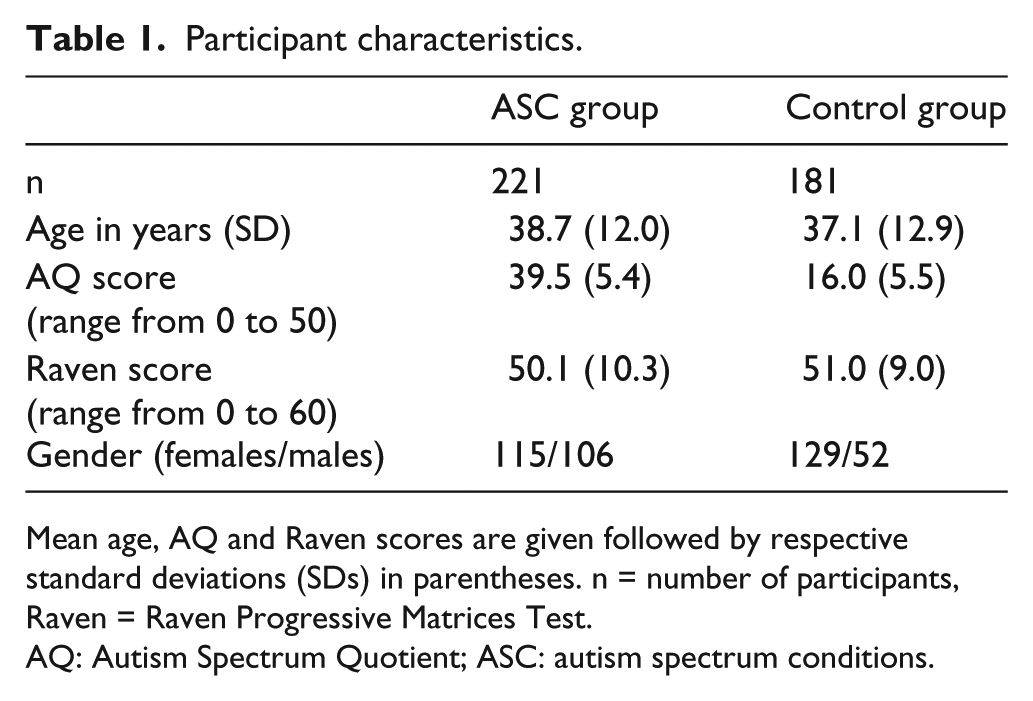
Mean age, AQ and Raven scores are given followed by respective standard deviations (SDs) in parentheses. n = number of participants, Raven = Raven Progressive Matrices Test.
AQ: Autism Spectrum Quotient; ASC: autism spectrum conditions.
To validate the diagnosis of ASC, participants completed the Autism Spectrum Quotient (AQ) (Baron-Cohen et al., 2001). Inclusion criteria consisted of a cut-off score of 26 and above for ASC and a score below 26 for controls (Woodbury-Smith et al., 2005). All participants completed this double-gating procedure and were included only if they met both conditions: self-referred status as ASC or control and AQ score cut-off criteria for ASC and control.
Measures
AQ
The AQ is a questionnaire measuring autistic traits, with five subscales (social skills, attention switching, attention to detail, imagination and communication; Baron-Cohen et al., 2001). Results from the AQ have been replicated across cultures (Hoekstra et al., 2008; Wakabayashi et al., 2007) and across ages (Auyeung et al., 2008). The AQ demonstrates acceptable test–retest reliability (r = .78) (Hoekstra et al., 2008).
SP Scale: sensory over-responsivity
The SP Scale (more specifically, we used the SensOR subscale), is a self-report questionnaire that measures over-responsivity in several sensory domains (touch, vision, hearing, smell, taste and proprioception) (Miller and Schoen, 2012). Participants indicate which items in their daily life bother them, for example, tactile domain: labels in clothing, auditory domain: a clock ticking. Previous editions of the SP Scale have undergone detailed item analysis. The internal reliability for the total test is high (r = .97). Concurrent validity of the SP Scale score with the Sensory Profile (Dunn, 1999) quadrant scores of sensory sensitivity (r = .74) and sensory avoiding is moderate (r = .40), suggesting that the two scales likely sample different constructs. The SP Scale is correlated with the SensOR Assessment (r = .74 in adults), the companion examiner-administered performance measure that includes activities similar to daily life, such as response to background noise (Schoen et al., 2008). Work on the SP Scale is ongoing to develop a scale that encompasses all subtypes of sensory processing disorders (Miller et al., 2007).
Raven Progressive Matrices Test
IQ was estimated using an online short version of the Raven Progressive Matrices (60 items) as a timed performance task (Raven, 2000). The Raven Progressive Matrices Test is considered an intellectual screening measure, is language free and is used for a wide range of ages as well as across cultures. Each item consists of a pattern with a missing section for which the participant selects the best option that accurately completes the pattern shown (with 15 s allowed for each item).
Results
Descriptive statistics
SPSS Statistics 18 was used to analyse the data. Tests of normality (Kolmogorov–Smirnov test; KS) suggested that the data were normally distributed (p > .20). No significant differences existed between groups on age or IQ (both p > .05). Due to inclusion criteria, the ASC group had a higher AQ score than the control group (Mann–Whitney U ≤ .001, p < .01) Additionally, the gender ratio differed across groups (χ2(1) = 14.91, p = .0001) (see Table 1). For further analyses, gender was entered as a covariate.
SP Scale: sensory over-responsivity
A multivariate analysis of covariance (MANCOVA) with group as fixed factor was conducted. Since the gender representation in groups differed significantly, gender was covaried. Adults with ASC had significantly higher self-reported sensory over-responsivity, more narrowly higher SP Scale scores than the control group (F = 16.05, p = .0001). The effect size was large (Cohen’s d = 1.3, r = .56). To control for multiple comparisons, a Bonferroni correction was used, maintaining an overall alpha level of 5%. Seven comparisons between groups (seven subscales) were performed, and when the predetermined 5% alpha level was adjusted (i.e. the value of .05 divided by the number of comparisons), the individual alpha level was set at p < .007. Adults with ASC had higher scores on all subscales (total score, visual, auditory, tactile, olfactory, gustatory and proprioceptive) than controls (p < .0001) (see Table 2).
Mean scores for self-reported sensory over-responsivity as measured using an SP Scale are shown for adults with ASC and without ASC (control group). Total and subscale scores for vision, hearing, touch, smell, taste and proprioception are given followed by respective ± standard deviation scores. Finally, group differences and respective significance levels (p) are shown.

ASC: autism spectrum conditions; SP Scale: Sensory Processing Scale. ** significant at the .01 level.
Correlations among sensory symptoms, autistic symptoms, age and IQ
Sensory over-responsivity as measured using the SP Scale was positively correlated with autistic traits (AQ scores) across the combined sample (r = .64, p < .0001) and within groups: ASC (r = .34, p < .0001) and controls (r = .24, p < .0001) (see Figure 1). A direct positive relationship was found between the number of sensory symptoms and the number of autistic traits. However, no significant correlations were found between the SP Scale and age or intelligence (p > .05).

Scatterplot showing the significant positive correlation between sensory over-responsivity, measured using the SP Scale, and autistic traits, measured using the AQ, for the ASC group in black and control group in grey. Higher scores indicate more impairment on both the SP Scale (maximum score of 76) and AQ Scale (maximum score of 50).
Discussion
This study, to our knowledge, is the first to investigate sensory over-responsivity in multiple sensory domains separately and the link to autistic traits in an adult sample. Adults with ASC reported more sensory over-responsivity to stimuli in the environment and within their body compared to controls, as measured by the SP Scale, more specifically, the SensOR subscale. In addition, a positive relationship was demonstrated overall, regardless of group, between sensory sensitivity and autistic traits, with more sensory responsivity being associated with more autistic-related traits. This highlights the importance of evaluating sensory symptoms in ASC as is proposed for the DSM-V, that is, including the classification of ‘hyper- or hypo-reactivity to sensory input or unusual interest in sensory aspects of environment’. The SP Scale could become a useful research and clinical tool to measure sensory over-responsivity.
Adults with ASC reported sensory over-responsivity overall and in each sensory modality (vision, hearing, touch, smell, taste and proprioception). These findings highlight the importance of measuring each sensory domain separately rather than combining scores from various sensory domains. Most previous research in sensory processing in adults with ASC reported only an overall total score obscuring differences within specific sensory domains. In this study, adults with ASC showed greater sensory over-responsivity on all subtests compared to controls. The SP Scale allowed investigation of vision, touch, hearing, smell, taste and proprioception independently and appears to be a useful tool for researchers interested in specific modalities (e.g. vision only). The importance of domain-specific differences is also highlighted in a recent study that examined the association between tactile processing and the core features of ASC (Foss-Feig et al., 2012), which found that sensory over-responsivity in the tactile domain was not significantly correlated with any core feature. However, no data were reported about the other sensory domains.
Notable in this study was the association between sensory over-responsivity and autistic traits. Increased sensory sensitivity was associated with more self-reported autistic traits, both across and within groups. This is in line with a recent study reporting a positive association between autistic traits and sensory reactivity problems (Robertson and Simmons, 2012). Understanding sensory issues in adults with ASC is critical to the detection and prescription of appropriate interventions especially in light of studies that propose a theoretical relationship between anxiety and sensory over-responsivity (Green and Ben-Sasson, 2010). Co-morbid sensory and anxiety symptoms could further compromise an individual’s ability to function in daily life. Sensory over-responsivity has also been linked to higher rates of depression and anxiety (Kinnealey et al., 2011; Kinnealey and Fuiek, 1999). In addition, a theoretical relationship between sensory over-sensitivity and attention to detail has been proposed (Baron-Cohen et al., 2009).
One limitation of this study is its nature, an online survey. Since our samples were self-selected, it is possible that the typically developing controls chose to participate in order to obtain information about their sensory processing. This sample is also weighted towards people who have the ability to use a computer. Therefore, they may not be representative of the general population. However, we were able to recruit a larger number of participants by choosing an online survey. Furthermore, all participants completed a double-gating procedure and were included only if they met two conditions: self-referred status as ASC or control and AQ score cut-off criteria for ASC and control.
Another limitation is that we only investigated sensory over-responsivity. Participants may have had other sensory processing issues that were not addressed in this study. However, to date, the SensOR subscale was the most validated SP Scale (Schoen et al., 2008). Additional research is needed on other reported sensory symptoms in ASC such as sensory under-responsivity and sensory craving (Miller, 2006). Empirical evidence (Baranek et al., 2007) and anecdotal reports (Grandin, 1996) related to sensory processing note both over- and under-responsivity, often within the same individual, indicating the need to broaden the investigation of sensory processing in ASC to areas other than over-responsivity.
A third limitation of this study was the unequal gender ratio. However, it was important to include female participants with ASC, a neglected group. A recent study suggests that women with ASC report more sensory issues than men (Lai et al., 2011). In this study, there were more women and fewer male control participants compared to the ASC group. Therefore, gender was used as a covariate in our analyses and not examined as a primary research question. It is possible however that gender may have a differential effect on domain-specific sensitivities. Future studies should test whether females with ASC are more affected by sensory issues and explore the implications that these gender differences may have for aetiology of ASC.
Despite its limitations, this study shows that adults with ASC self-report over-responsivity across multiple sensory domains that affect their daily life routines and thus quality of life. Future research should include comparisons of the presence of symptoms among the various sensory domains, and the SP Scale appears to be a useful tool in this regard. The most recent version of the SP Scale (Miller and Schoen, 2012) also permits investigation of other sensory symptoms reported in individuals with ASC such as sensory under-responsivity and/or sensory craving.
Evaluating and attending to over-responsivity in adults with ASC have implications for understanding and addressing the sensory components of their daily life routines and roles. Appropriate intervention should be directed towards sensory issues that may be contributing to emotional and psychological challenges and towards designing sensory friendly domestic and work environments. Overall improvements in the quality of life could then be expected for individuals with ASC.
Footnotes
Acknowledgements
TT was supported by the Pinsent Darwin Trust and Autistica during the period of this work. SBC was supported by the MRC UK. This work was conducted in association with the NIHR CLAHRC for Cambridgeshire and Peterborough NHS Foundation Trust. The authors of this paper report no biomedical financial interests or potential conflicts of interest. We are grateful to the participants for their generous cooperation, and to Carrie Allison and Jennifer Brout.
Funding
This research received no specific grant from any funding agency in the public, commercial or not-for-profit sectors.