



Abstract
Much controversy surrounds questions about whether humans have an aversion to inequity and how a commitment to equality might play a role in cooperation and other aspects of social interactions. Examining the social decisions of children with autism spectrum disorders provides a fascinating opportunity to explore these issues. Specifically, we evaluated the possibility that children with autism spectrum disorders may be less likely than typically developing children to show a prioritisation of equality. A total of 69 typically developing (mean age 11;6 years) and 57 cognitively able children with autism spectrum disorders (mean age 11;7 years) played a social decision game in which the equality option was pitted against alternatives that varied in instrumental outcomes. Results showed that both groups were more likely to choose the equality option when there was no cost to the self. However, even though children with autism spectrum disorders appeared to view equality as preferable to causing explicit harm to others, they departed from an equality stance when there was an opportunity to increase instrumental gain without any obvious harm to the self or the other. Typically developing children, in contrast, showed similar prioritisation of equality across these contexts. Future research needs to address the question of how differences in the commitment to equality affect children’s social behaviour and relationships in daily life.
Keywords
In the context of experimental economics, a much cited article by Fehr and Schmidt (1999) introduced a theory of ‘inequity aversion’ to explain why, at least in some cases, ‘people resist inequitable outcomes; i.e., they are willing to give up some material payoff to move in the direction of more equitable outcomes’ (p. 819). Fairness considerations were suggested as explanations for observed patterns of responses on social decision games that did not fit the default assumption that people act to maximise self-interest. This theory, and the empirical work that followed, sparked a significant debate about the presence of, explanations for and implications of human commitments to equality (see Binmore and Shaked, 2010; Eckel and Gintis, 2010).
Questions about if and how equality-promoting behaviour might underpin efforts to establish and maintain cooperative relationships with others remain controversial (see Brosnan, 2011; Dawes et al., 2007). Nonetheless, there seems to be clear evidence that behavioural orientations towards or away from equality can at least be investigated and described, even in young children. Children as young as 3 years old notice and react negatively to unequal distributions, particularly when they are disadvantaged themselves (LoBue et al., 2011). At this age, children show little willingness to share, but a non-negligible percentage is willing to make choices that are beneficial to the recipient if it is not costly (Fehr et al., 2008). From 5 years of age, children explicitly talk about fairness (LoBue et al., 2011) and they start to develop behaviour motivated by other regarding preferences (Fehr et al., 2008; Güroğlu et al., 2009). At the age of 7 to 8 years, according to some authors, a preference for equality is well established in most children (Fehr et al., 2008).
In comparison to typically developing (TD) children, existing theory and research suggests that cognitively able children with autism spectrum disorders (ASD) may have a distinctive motivational orientation in interpersonal interactions. It is very well established that children with ASD exhibit qualitative impairments in social interaction (see Begeer et al., 2008; Chamberlain et al., 2007; Scheeren et al., 2010). One possibility – hitherto unexplored – is that the typical developmental increase in preference for equality could be compromised by ASD children’s tendency to favour goals linked to instrumental outcomes (e.g. gaining tangible rewards) over goals linked to relational outcomes (e.g. maintaining harmonious social relationships), in contrast to TD children who come to favour relational goals over instrumental goals (Adamson et al., 2010; Dawson et al., 1998, 2004; Greene et al., 2011). Given the availability of experimental paradigms for investigating preferences for equality, we can ask whether ASD children may show distinctive patterns of responses to decision tasks where choices must be made regarding the allocation of resources to the self and others. In particular, are ASD children similar to TD children in deciding whether or not to favour equality in the face of competing concerns (e.g. self-interest or instrumental gains)?
Challenges to equality
In the present study, a social decision game will be used in which children have to choose between an equal distribution and an unequal distribution several times. The unequal distributions vary in instrumental outcomes in ways that will enable us to tap into two motivational factors involved in decisions about resources.
The first factor is self-interest, which is a key force in social decisions (Miller, 1999). One can legitimately predict that decisions in favour of equality will be challenged when this decision is costly to the self (Fehr and Schmidt, 1999). In this respect, the orientation of children with ASD is not expected to be substantially different from that of TD children. Indeed, children with ASD have been described as living in a self-centred world and having an egocentric perspective, even though they may show impairments in self-referential cognition (Frith and De Vignemont, 2005; Lombardo and Baron-Cohen, 2010). This egocentric view can be expected to lead to choices in favour of the self. Thus, both ASD and TD children should be less likely to choose equality when this carries a cost to the self (i.e. fewer resources allocated to the self for equal choice compared to unequal choice).
A second way of investigating the commitment to equality in a social decision-making process is by making a distinction between (a) situations in which equality is challenged by an unequal distribution that involves obvious harm to the other and (b) situations in which equality is challenged by an unequal distribution where there is an overall economical gain and no one is disadvantaged relative to the equality option. We draw this key distinction in the present study by comparing decisions where the unequal choice presents explicit harm to others (A and B in Table 1) and decisions where the unequal choice involves unequal gain for self versus other (C and D in Table 1). We use ‘explicit harm’ to refer to unequal resource allocation outcomes where, in comparison to the equal distribution, there is obvious harm to the other. Specifically, in this condition (A and B in Table 1), choosing the unequal distribution means that the other person receives no resources at all. In contrast, we use ‘unequal gain’ to refer to a decision in which choosing the unequal distribution does not obviously harm the other, but there is an unequal gain such that one (and only one) person receives additional resources. By choosing this unequal distribution over the equal distribution, overall instrumental gain has been maximised without obviously harming anyone, but, by definition, equality between self and other has been precluded.
The equal and unequal distribution of coins for each of the four conditions.

We expect TD and ASD children to be similarly reluctant to choose an unequal distribution with explicit harm to the other. By the early school years, TD children judge moral transgressions to be more serious, punishable and wrong than conventional transgressions (Smetana, 1981; Smetana et al., 1993; Turiel, 2008). Children with ASD of 9 to 12 years are able to make a similar distinction between moral and conventional transgressions, independently of theory of mind ability (Blair, 1996). Furthermore, children with TD and ASD both judge damage to people to be more serious than damage to property (Grant et al., 2005). Thus, at least at a basic level, children with ASD seem capable of detecting and judging moral violations in a way similar to TD children. Moreover, children with ASD have been found to be highly motivated to follow rules (Corbett et al., 2009; Russo et al., 2007). Following these lines of argument, it can be expected that children with ASD have a basic understanding that it is wrong to harm others and that they are motivated to follow this rule in the case of explicit harm.
A crucial decision – and most important for the purposes of this study – is the choice between the equality option and an alternative distribution that represents an overall (albeit unequal) instrumental gain with no obvious harm to anyone. This decision task provides a key test of a preference for equality because the alternative reflects a more economical choice. If it is the case that choosing equality reflects a broader orientation to fairness in social relationships, at least within the context of the decision game, it could be argued that children with ASD would prefer an alternative distribution that provides the greatest overall economical gain. In fact, some existing evidence suggests that children with ASD are less likely than TD children to prioritise social factors when making decisions. For example, children with ASD more often group people together based on glasses or hats, than on their facial emotional expression compared to their TD peers (Begeer et al., 2006; Weeks and Hobson, 1987). This kind of pattern might reflect the lower tendency in children with ASD to acknowledge the affective significance of social relationships, whereas reading a mathematics book made a boy with ASD happy, social events were not listed once by children with ASD as a cause for happiness, in strong contrast to TD children (Rieffe et al., 2007). Although we cannot make assumptions about the precise mechanism accounting for children’s social behaviour in a decision game, this kind of research does at least raise the possibility that children with ASD might be more likely to prioritise instrumental gains over a ‘socially fair’ option.
The present study
The main aim of this study was to evaluate preferences for equality in the face of alternatives that vary in instrumental outcomes. We carried out our investigation with children aged between 9 and 15 years, well above the age at which TD children are expected to demonstrate a clear preference for equality. Building on the methodological approach used by Fehr et al. (2008), we utilised a social decision task in which children were required to choose one of two given ways of dividing coins between themselves and an anonymous other. For every condition, one of the two response options is an equal distribution in which each player gets one coin. However, the unequal option varies in instrumental outcome across the four conditions (see Table 1).
We expect that both TD and ASD participants will be more likely to choose the equality option when there is No Cost to Self than when there is Cost to Self. However, we expect group differences with regard to the Alternative to Equality variable. Specifically, we expected that TD participants will show the same preference for equal distributions whether the alternative is Explicit Harm or Unequal Gain. In contrast, the ASD group was expected to prefer equal distributions only when the alternative is Explicit Harm; according to our hypothesis, unequal distributions in the case of Unequal Gain should appear relatively attractive to them.
Method
Participants
A total of 181 (116 TD and 65 ASD) children participated in the study, which involved a test battery of social–emotional tasks. In order to match the ASD group, a selection of 70 TD children was made based on age, gender and socioeconomic status (SES) (parental education, job and income). After this selection, one TD child was excluded because the number of responses on the task was lower than 12 (out of 16). Eight ASD children were excluded because they did not perform the allocated task due to lack of time.
The final sample included in this study consisted of 126 children (see Table 2). The sample included 57 cognitively able ASD children. All children fulfilled established diagnostic criteria according to the Diagnostic and Statistical Manual of Mental Disorders–Fourth Edition–Text Revision (DSM-IV-TR) (American Psychiatric Association (APA), 2000), based on the Autism Diagnostic Interview–Revised (Lord et al., 1994) by child psychiatrists from specialist centres. The ASD children were recruited from the Centre for Autism, Leiden, the Netherlands; Dr Leo Kannerhuis, Doorwerth, the Netherlands; or CP Van Leersumschool, Zeist, the Netherlands. These institutions specialise in diagnosing and treating children with ASD.
Characteristics of participants per group.

n = 49; bn = 50; cn = 62.
A total of 69 TD children were drawn from primary and secondary schools in the area in and around Leiden and The Hague, the Netherlands. Inclusion criteria for the TD children were adequate functioning in regular elementary schools and no diagnosed developmental disorders. The TD children were selected based on age, gender and SES (parental education, job and income) to form a comparison group to the ASD group. The TD and ASD groups were similar in age (t(124) = −0.304, p = 0.762) and in racial and ethnic breakdown, and were primarily from middle-class and upper-middle-class Dutch families. There were no significant differences between the groups on performance on the Block Design and Picture Arrangement tasks from the Wechsler Intelligence Scale for Children-III (WISC-III) (p > 0.70). However, the groups differed significantly on verbal ability measured by a Sentence Comprehension Task (t(110) = 2.048, p = 0.043) and a Narrative Comprehension Task (t(109) = 3.232, p = 0.002). For both tasks, the TD group had higher means than the ASD group.
Procedure
Recruitment of participants took place in the context of a study on social–emotional development in children between 9 and 15 years of age. The Ethics Committee of the Centre for Autism granted permission for the study, and all parents gave their written consent before testing. A battery of various tasks and questionnaires was administered to the children by trained researchers in a safe and known environment for the child, that is at home, at school or in their institutions (in case of ASD children). The allocation task was performed on a laptop.
Measures
As a measure of cognitive ability, norm scores were computed for two nonverbal subtests of the Dutch version of WISC-III (WISC-IIINL) (Kort et al., 2002; Wechsler, 1991): Block Design, in which children had to copy small geometric designs with four or nine plastic cubes, and Picture Arrangement, in which children had to arrange cartoon pictures to make sensible stories.
As a measure of verbal ability, two tasks of the Dutch version of the Clinical Evaluation of Language Fundamentals®–Fourth Edition (CELF®-4) (Kort et al., 2008; Semel et al., 1987) were used; a Sentence Comprehension Task, in which children were presented with sentences and four multiple choice answers and were instructed to select the answers that matched with the sentence, and a Narrative Comprehension Task, where children were told short stories after which questions were asked.
In the computerised allocation task (Fehr et al., 2008), children were instructed to decide how a certain amount of coins will be divided among themselves and the other anonymous same-age and same-sex players. In reality, all rounds were computer-generated. In addition, children were told that at the end the computer would calculate the amount of money they and the other players would get and that all players would receive this money. See Appendix 1 for the exact instructions of the allocation task.
For each trial, the child had to choose between two distributions that were determined in advance. As described earlier, there were four conditions, and for every condition, one of the two distributions was an equal distribution, in which each player gets one coin. The unequal distribution varied in instrumental outcome across the four conditions: in two conditions (A and B in Table 1), the unequal option involved Explicit Harm (i.e. the other gets no coins), whereas in the other two conditions (C and D in Table 1), the unequal option involved Unequal Gain (i.e. one person gets one coin and the other person gets two coins). In each of these pairs of conditions, choosing the equal option carried either No Cost to Self (i.e. the self gets one coin in both options; A and C in Table 1) or Cost to Self (i.e. the self gets one coin in the equal option but two coins in the unequal option; B and D in Table 1). For all decisions, choosing the equal distribution was scored as a ‘1’ and choosing the alternative choice was scored as a ‘0’.
After an explanation of the task, the experimenter sat down at the other side of the table, at the back of the laptop screen so it was clear that the participants’ responses were not observable. A total of 16 trials (4 per condition) were randomly presented. In order to make the distributions understandable, the coins were presented visually instead of numerically. Each trial started with the presentation of a fixation cross for 1 s, followed by a visual presentation of two offers. The coins at the top of the button would be distributed to the other and the coins at the bottom to the self, as indicated by the names on the left, as shown in Figure 1. The participant had to choose between the two distributions of coins that were presented. They had to click within 5 s on the button, which showed the distribution of choice. The presentation of distributions was counterbalanced, in that for each condition the equal distribution was presented twice on the left side and twice on the right side of the screen. At the end, the participants were told that they had won 1 Euro and they received this Euro.
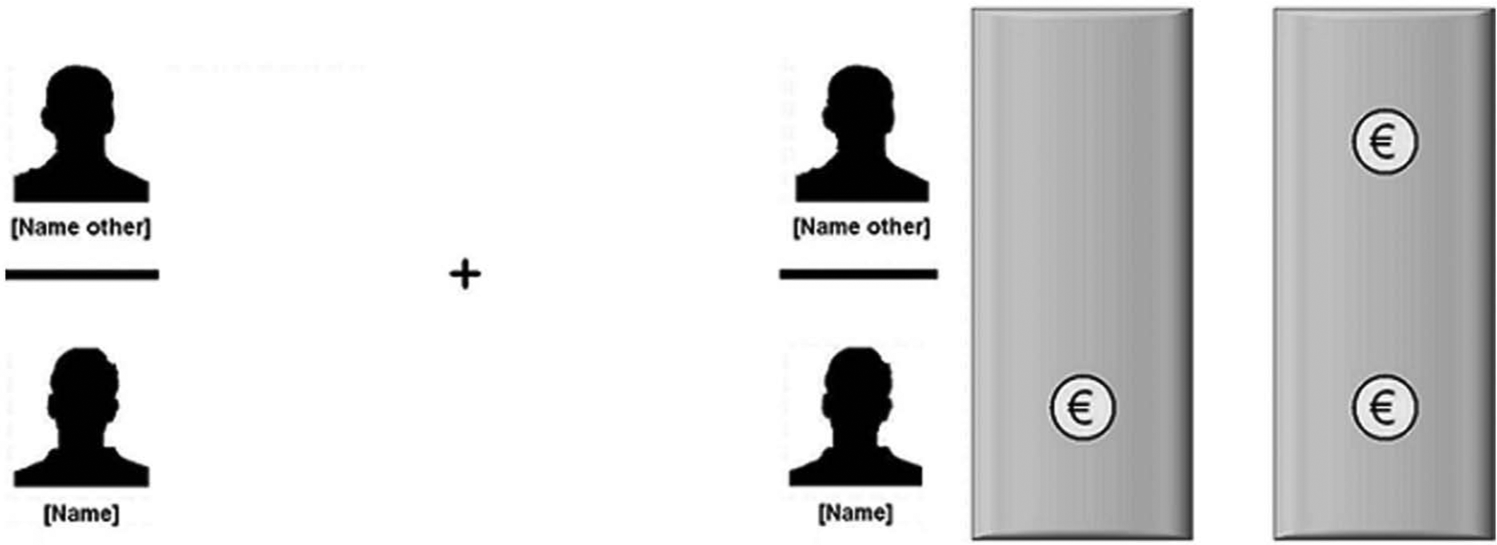
Layout of allocation task. Left: screen one (fixation); right: screen two (two options of distributions).
Results
Of the 126 children who were included, 111 participants responded to all 16 trials of the allocation task and 121 responded to at least 15 trials. All 126 participants responded to 12 trials or more. As per condition each child had at least two responses. Mean scores were calculated per condition.
Inspection of the data showed that cognitive and verbal ability and age variables as well as the variables of the four conditions were symmetrically distributed (skewness within a range of −0.562 to 0.460, not more than twice their standard errors; see De Vaus, 2002). Table 3 shows the children’s mean scores in each of the four conditions, subdivided by group. The scores represent the average number of trials (out of 4) in which the equal option was chosen over the alternative option. In order to evaluate our hypotheses regarding the preference for equality in the face of alternatives which vary in instrumental outcomes, a 2 (Group: TD, ASD) × 2 (Self: No Cost, Cost) × 2 (Alternative: Explicit Harm, Unequal Gain) mixed-design analysis of variance (ANOVA) was performed. Group was the between-subjects variable, and Self and Harm were the within-subjects variables.
Mean scores (and SD) of equality choices in each of the four conditions, subdivided by group.

First, the analysis showed a significant main effect for Self, F(1,124) = 25.36, p < .001, η2 = .17, but no significant interaction effect of Self × Group, F(1,124) = 0.00, p = .974, η2 < .01. As expected, simple effects analysis confirmed that both groups were more likely to choose the Equal option when there was No Cost to Self in comparison to a Cost to Self, ASD: F(1,124) = 11.73, p = 0.001; TD: F(1,124) = 13.83, p < 0.001, see Figure 2.
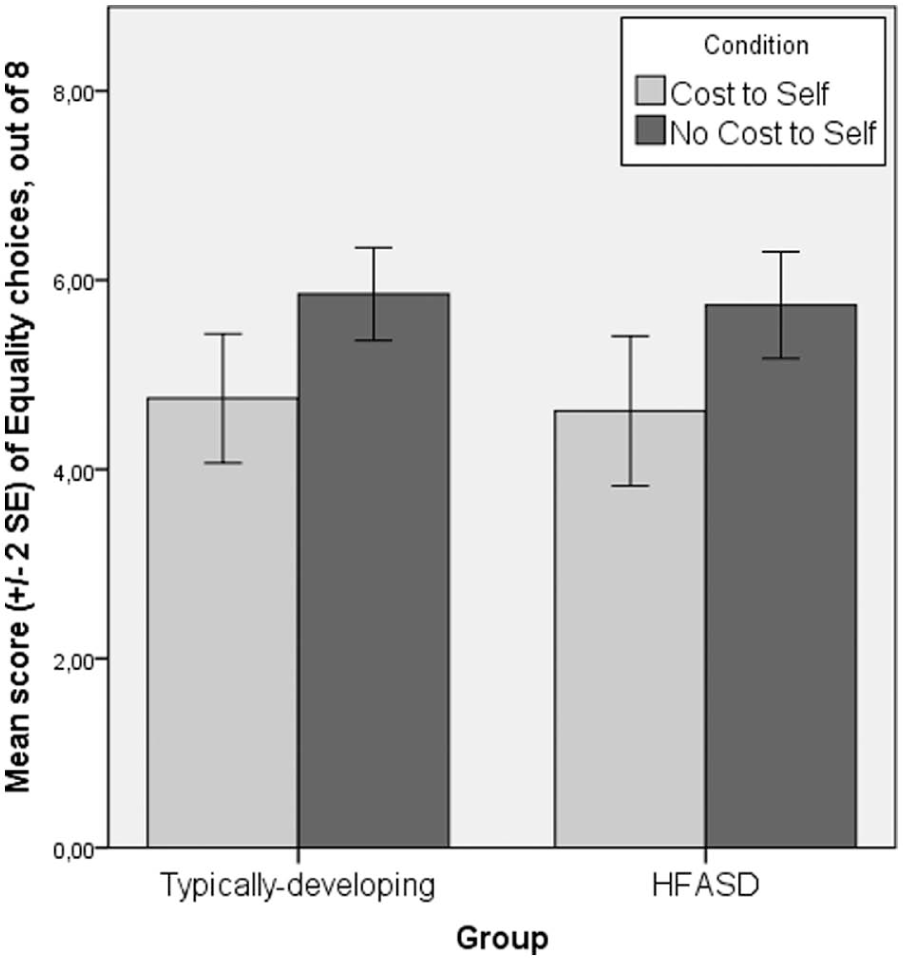
Main effect for Cost to Self in the preference for equality.
Second, there was a significant main effect for Alternative, F(1,124) = 4.54, p = 0.035, η2 = 0.035, but this was qualified by an interaction effect of Group × Alternative, F(1,124) = 4.06, p = 0.046, η2 = 0.032. Simple effects analysis showed that TD children were as likely to choose the Equal option when the alternative was Explicit Harm or Unequal Gain, F(1,124) = 0.01, p = 0.932. However, ASD children were less likely to choose the Equal option when the alternative was Unequal Gain in comparison to the alternative of Explicit Harm, F(1,124) = 7.84, p = 0.006. This interaction is illustrated in Figure 3.
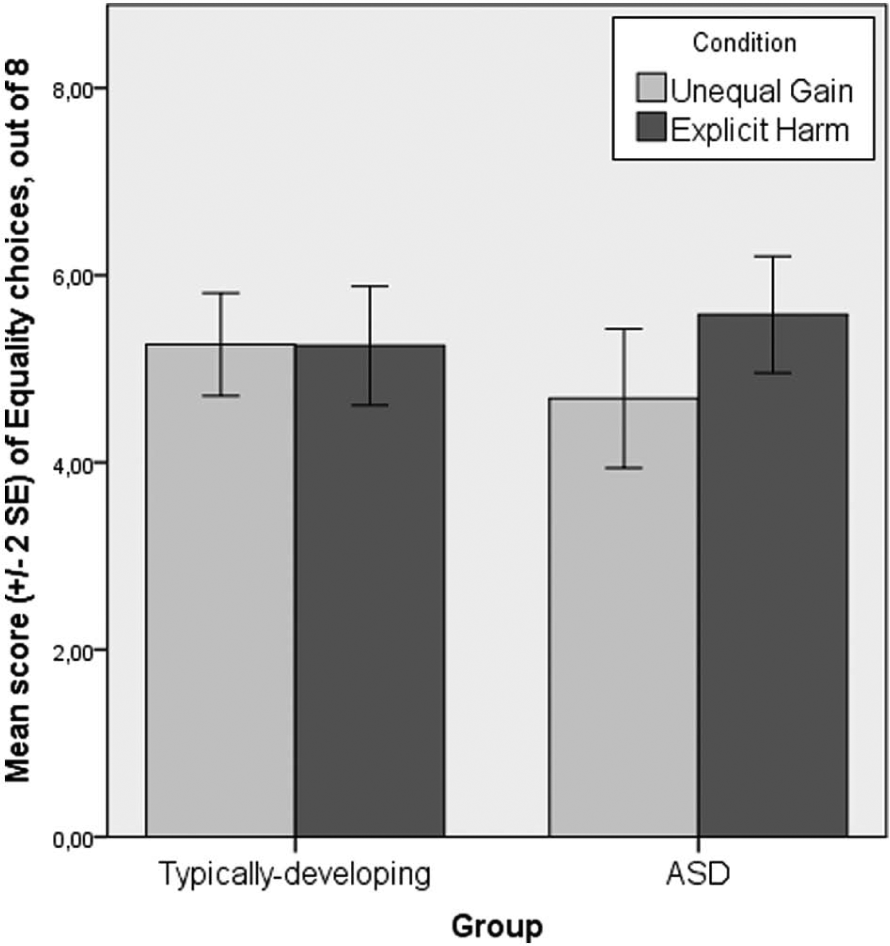
Interaction effect of Group × Alternative in the preference for equality.
Third, Unequal Gain can take two forms, one that involves a more selfish choice where the gain is for the self and not for the other (condition D), and a more generous choice where the gain is for the other and not for the self (condition C). It is possible that effects involving Unequal Gain could therefore be driven by a specific preference for generous or selfish choices. However, the three-way interaction between Group, Self and Alternative was not significant, F(1,124) = 1.51, p = 0.221, defeating this alternative explanation.
Fourth, further analyses showed that verbal ability was not correlated with the overall number of equal choices in either the TD group or the ASD group (ps > 0.05). However, analyses were carried out including both measures of verbal ability as covariates because of the difference in verbal ability between the two groups. However, the key results described above remained unchanged. Both groups showed a virtually identical pattern of differentiation between the No Cost to Self and Cost to Self conditions, even after controlling for verbal ability: adjusted mean difference between the two conditions = −1.23 and −1.00 for ASD and TD children, respectively, F (1, 107) = 0.22, p = 0.638. In addition, the key interaction between Group and Alternative remained significant after controlling for verbal ability, F(1, 107) = 5.77, p = 0.018. That is, the mean difference between the Explicit Harm and Unequal Gain conditions was significantly greater for the ASD group (adjusted mean difference = 1.01) than for the TD group (adjusted mean difference = −0.11).Thus, the ASD group differentiated between the Explicit Harm and Unequal Gain trials to a far greater extent than the TD group.
Discussion
The present study has demonstrated both similarities and differences in the social decisions of ASD and TD children. Our findings showed a similar response for children with ASD and TD children when it came to choosing in favour of their own interest. Both groups showed an understandable tendency to choose the equal distributions more often when these did not involve any cost to the self. Thus, as expected, ASD children are as capable as TD children of adopting positions in decision games that are advantageous to the self. Moreover, children with ASD clearly do display at least some prioritisation of equality, in that they are less likely to choose an unequal distribution where there is obvious harm to the other. However, we also observed one subtle but potentially crucial difference between the two groups. While TD children prioritised equality similarly, regardless of the instrumental challenge to equality, children with ASD more often opted for an unequal distribution which produced an overall economic gain over the equal distribution, as long as no one was obviously harmed relative to the equal distribution.
The finding that children with ASD were reluctant to violate the equality rule in ways that caused obvious harm to another person might be related to a tendency that has been reported in other studies, whereby children with ASD show knowledge of social norms and rules – and a willingness to follow them – when these are framed explicitly. For example, we noted earlier that children with ASD have an appreciation of basic moral rules that are often explicitly highlighted in socialisation contexts (see Blair, 1996; Grant et al., 2005). But the more nuanced patterns of social behaviour might escape children with ASD unless explicit guidance is provided. For example, researchers have already observed that children with ASD show an understanding of the basic principles of self-presentation but fail to behave strategically in the absence of explicit instructions (Begeer et al., 2008; Scheeren et al., 2010). Thus, in cases where the ‘fair’ outcome is pitted against an outcome that delivers an overall economical gain with no obvious harm, the tendency of ASD children to focus on instrumental goals may come to the fore. Specifically, in the present study, as long as both parties were getting at least as much as they would have done in the equality distribution, the prospect of one person getting more resources than the other was seen as less problematic by ASD children than their TD counterparts.
Directions for further research
This study offers an intriguing pattern of results that we see as a foundation upon which future research can be built. At present, some issues still remain uncertain about both the explanation for the results obtained, as well as the implications for children’s social behaviour and relationships in everyday life. As noted earlier, one explanatory framework might rely on the notion that children with ASD may focus on instrumental outcomes at the expense of relational goals of fairness and cooperation. However, we cannot assume the validity of such a broad conclusion; indeed, authors have argued that a wide variety of situationally triggered social norms could potentially affect participants’ behaviour in decision games (see Binmore and Shaked, 2010).
In fact, in at least some situations, a departure from equality seems to have relational advantages. For example, under some circumstances, it might be beneficial for the relationship to divide resources unequally as this can be a signal of generosity. An example of this is the relationship between a mother and a child. In order to take good care of the child, mothers often give more resources to their child instead of to herself. Also in relationships with others who are less fortunate than ourselves, it might enhance our relationship with the other when we give some extra resources to the other; indeed, in the future, this might lead to reciprocation. Thus, in these circumstances, it can be beneficial for a variety of reasons not to stick to equality. Returning to the context of the present study, if an additional resource can be allocated to another person without any direct loss for the self (compared to the equal choice), might that not be both a more economically rational and perhaps even a more prosocial response? Future research must meet the important challenge of addressing these questions about the relationship between the commitment to equality and actual relational outcomes, investigating both short- and long-term consequences as well as more concrete versus more abstract gains.
Researchers should also address developmental trajectories involved in the children’s social decisions, to determine in more detail the nature of differences between ASD and TD samples in the emergence of egalitarian motives. In particular, it would be helpful to know if the preference for equality is simply developmentally delayed or more fundamentally impaired in the ASD group. Further research with an extended age range is needed for answering this question. A related question is the extent to which differences in verbal ability might influence children’s social decisions. Although language did not appear to play a crucial role in the prioritisation of equality in this study, Happé (1995) has observed that the threshold of verbal ability needed to pass false belief tasks is considerably higher than in TD children. Thus, it would be helpful to direct future efforts to untangling the contributions of verbal ability, theory of mind and motivation to autistic children’s social decisions as they move from early childhood to middle childhood to adolescence. Also, it would be relevant for future studies to investigate the effect of gender on social decisions. Our TD sample consisted of twice as many girls as the ASD sample, and the role played by gender needs careful attention in future work.
The social context of the decision task itself also needs attention in future research. For example, we need to understand more about how reputation management might play a role in the kinds of resource allocation tasks used here. Previous studies have found a diminished tendency for reputation management in the behaviour of children with ASD (Chevallier et al., 2012), and have also shown that the behaviour of adults with ASD is less influenced by the presence of an observer than TD adults (Izuma et al., 2011). Based on this, Izuma et al. (2011) suggested that adults with ASD have a specific deficit into taking into account how others might think of them.
Although the children in the present study made their decisions privately, the question of how much concerns about social desirability influence equality choices, is an important one. Studies have found a relationship between fairness behaviour in social decision tasks and theory of mind ability in both TD (Takagishi et al., 2010) and ASD (Sally and Hill, 2006) children. It could be that theory of mind is a basic ability needed to think about one’s reputation and that this in turn is related to social decisions. However, even though this might explain the lower number of equal choices in the Unequal Gain condition, differences in reputation management cannot account for all the patterns observed: one might predict on the basis of this account that children with ASD might also not be concerned with harming others explicitly, yet this is contrary to our results. Therefore, future studies need to address questions about when, how and to what extent reputation management and theory of mind combine to influence behaviour on social decision tasks.
These kinds of intricate analyses of factors involved in social decisions are a crucial next step in understanding what may be rather subtle differences between TD and ASD children. For example, previous research has found that children with autism do show a similar cooperative response as TD children in a social decision game, as well as a willingness to approach others socially. Yet, they do show higher levels of ‘active-but-odd’ social behaviour (Downs and Smith, 2004). Future studies therefore need to work towards a more elaborate understanding of what considerations and rationales children with ASD employ when making social decisions in everyday life.
In conclusion, the present study has revealed a subtle but potentially important pattern of convergence and divergence between the decisions in equality choices between TD and ASD children. Future studies should elaborate on these findings, in order to evaluate hypotheses about the emergence of this pattern and the extent to which it explains and predicts qualitative impairments in ASD children’s social interactions.
Footnotes
Appendix 1
Acknowledgements
The authors thank all participating children, their parents and schools. A special thanks to Berna Güroğlu for her advice and work on the allocation task.
Funding
This research was supported by the Innovational Research Incentives Scheme (a VIDI grant) by The Netherlands Organisation for Scientific Research (NWO), no. 452-07-004 to Carolien Rieffe.