



Abstract
This study investigated questions adults asked to children with autism spectrum disorder in inclusive pre-kindergarten classrooms, and whether child (e.g. autism severity) and setting (i.e. adult-to-child ratio) characteristics were related to questions asked during center-time. Videos of verbal children with autism spectrum disorder (n = 42) were coded based on the following question categories adapted from the work of Massey et al.: management, low cognitive challenging, or cognitively challenging. Results indicated that management questions (mean = 19.97, standard deviation = 12.71) were asked more than less cognitively challenging questions (mean = 14.22, standard deviation = 8.98) and less cognitively challenging questions were asked more than cognitively challenging questions (mean = 10.00, standard deviation = 6.9). Children with higher language levels had a greater likelihood of receiving cognitively challenging questions (odds ratio = 1.025; p = 0.007). Cognitively challenging questions had a greater likelihood of being asked in classrooms with more adults relative to children (odds ratio = 1.176; p = 0.037). The findings present a first step in identifying the questions directed at preschoolers with autism spectrum disorder in inclusive classrooms.
Keywords
Introduction
Language input in early childhood classrooms is thought to be related to children’s social, literacy, language, and cognitive growth (Diamond et al., 2013). As such, the questions asked by adults in the classroom setting have received particular attention recently. A key focus has been on identifying the different types of questions asked in early childhood settings because they may be related to the development of linguistic complexity and foster the use of decontextualized language (De Rivera et al., 2005; Massey et al., 2008; Zucker et al., 2010). Little is known, however, about the types of questions specifically directed at preschool children with autism spectrum disorder (ASD).
Recently, there has been an increase in the number of children with ASD entering inclusive classrooms (Technical Assistance and Dissemination Network, 2012). Research suggests that teachers in inclusive settings, in particular, may have difficulty differentiating their language, which includes questions, to meet the developmental needs of children with versus without disabilities (Hestenes et al., 2004). Specific to children with ASD, there is evidence suggesting the amount of language these children are exposed to in preschool settings may be related to both child (e.g. cognitive abilities) (Dykstra et al., 2013; Irvin et al., 2013) and classroom (e.g. adult to child with ASD ratio) characteristics (Irvin et al., 2013). However, a systematic exploration of the questions children with ASD receive as well as the influence of child and classroom characteristics on these questions has not taken place. Therefore, the purpose of this study was to add to the knowledge base by (1) identifying the types of questions adults ask to children with ASD in inclusive settings and (2) examining whether certain within-child (i.e. autism severity, language, and cognitive ability) and classroom factors (i.e. adult-to-child ratio) impact the types of questions that are asked. This exploratory study solely focused on children who have the ability to verbally respond to a range of questions in inclusive classroom settings and may provide an important base for comparison to future studies of children with more limited expressive language.
Questions asked in preschool
There are several reasons why adult questions in preschool classrooms are important. From a transactional perspective of child development (Sameroff and Chandler, 1975), the exchanges that result from the questions asked by adults may be related to the development of language and cognitive growth. For example, adults use question–answer exchanges to teach children novel language about objects, people, and events (Parnell and Amerman, 1983). Additionally, the context of question–answer exchanges provides cues that are often explicitly used for turn-taking sequences that draw children into a speaker’s role. This potentially provides an opportunity for the child to practice more complex language (de Rivera et al., 2005).
Adult questions can be explored from a variety of perspectives. It is possible to examine questions in terms of their syntactic structure (De Villiers et al., 2008), pragmatic function (James and Seebach, 1982), or whether they advance conversation (De Rivera et al., 2005). While important, these perspectives do not permit examination of the questions’ cognitive load, which may influence children’s language growth and later academic success. One way to examine the cognitive load is to differentiate questions along lines of abstraction (e.g. Blank et al., 1978; Massey, 2004). Recently, coding schemes have been developed that categorize adult questions in terms of whether they exhibit high cognitive challenge or low cognitive challenge (Massey et al., 2008; McGinty et al., 2012). Questions of low cognitive challenge are typically related to perceptually present referents (e.g. “What is this?” and “Where is the car?”). Questions that possess greater cognitive challenge require more abstract reasoning such as recalling past events, making inferences, or perspective taking (e.g. “What did you do over the weekend?” and “How do you think he feels?”).
The use of questions that share elements similar to cognitively challenging ones has been linked to positive outcomes among children who are typically developing. For example, a relationship has been shown between open-ended questions and longer responses from preschool-aged children (De Rivera et al., 2005). Additionally, adults in classroom settings have used inferential questions as a way to facilitate more advanced, abstract language skills in book-reading contexts with children who have language impairment (Van Kleeck et al., 2006) and who are typically developing (Wasik and Bond, 2001). These skills are presumably important for later literacy growth and achievement in the classroom. For these reasons, questions like these are commonly recommended in a variety of language and literacy interventions (e.g. Ruston and Schwanenflugel, 2010; Whitehurst and Lonigan, 1998).
Few studies have specifically examined the cognitive challenge of questions asked in preschool classrooms. One recent study of teachers in classrooms serving at-risk children found that questions designed to manage behavior (e.g. “Can you give me that?”) or conversation (e.g. “What did you say?”) made up the near majority of the ques-tions asked across contexts (45%; Massey et al., 2008). Questions with lower cognitive complexity were 23 percent of all questions asked, and questions with higher cognitive complexity were 33 percent of all questions asked. Of note is evidence indicating that teachers in inclusive classrooms ask children with and without disabilities a preponderance of questions that are intended to manage behavior and have less cognitive complexity as opposed to questions of higher cognitive complexity (Hestenes et al., 2004).
Investigations of the questions addressed to preschoolers with ASD in preschool classrooms appear to be lacking. One exception is Burgess, Audet, and Harjusola-Webb (2013) who investigated the quantity and quality of the language directed at preschool children with ASD. During periods of high verbal interaction, approximately 27 percent of all utterances from classroom adults were yes/no questions and approximately 26 percent were open-ended questions. While these findings are important in that they describe the language richness of these preschool classrooms, this study does not provide specifics about the questions asked, particularly regarding their level of cognitive challenge.
Factors that may impact the questions directed at children with ASD
Within-child factors such as the severity of ASD symptoms, language, and cognitive impairments may affect the types of questions asked to children with ASD. Warren et al. (2010) examined the natural language environment of the home for young children with ASD in comparison with children who are typically developing. The results indicated that increased language ability and decreased severity of autism, as reported by caregivers, were associated with the number of words (i.e. adult language) children experienced. In other words, children with better language skills and fewer symptoms of ASD received more language input from adults. Similarly, in the preschool classroom, there is evidence suggesting within-child factors affect language input. For example, researchers report that young children with ASD experience fewer words from classroom adults if they have lower cognitive (Dykstra et al., 2013; Irvin et al., 2013) and language abilities (Dykstra et al., 2013). Taken together, these studies suggest a link between adult language, which encompasses questions asked, and certain child characteristics.
Adult-to-child ratio is also a salient factor affecting the types of questions directed at children with ASD in classroom settings. For example, in inclusive preschool classrooms higher teacher-to-child ratios (e.g. more teachers per children in the classroom) are linked to higher quality teacher–child interactions, as evidenced by teacher practices such as using an appropriate tone of voice and responding to children in a positive manner (Hestenes et al., 2008). Specific to ASD, some authors have found in self-contained preschool classrooms that a lower adult-to-child with ASD ratio results in less language being directed at children with this disorder (Irvin et al., 2013). As classroom adult-to-child ratio appears to be related to the type and quantity of the language children with disabilities experience, it is important to determine whether this relationship extends to the types of questions classroom adults ask in inclusive settings.
To our knowledge, there is an absence of studies that employ fine-grained methods to examine the type of questions directed at children with ASD in inclusive preschool classrooms. The specific research questions in this study were as follows: (1) what types and quantity of questions do children with ASD receive from classroom adults in the preschool classroom, and (2) is there any association between specific child characteristics (i.e. autism severity, language, and cognitive ability) and classroom adult-to-child ratio and questions classroom adults direct at preschoolers with ASD?
Methods
Participants
Children
In all, 42 children who were part of a larger project evaluating the efficacy of preschool programs serving young children with ASD were included in this study. All participating children were enrolled in inclusive classrooms. The children were between the ages of 3–5 years (M = 50.12 months, standard deviation (SD) = 7.64) at the time of study participation. Videos of children with ASD within center-time occurred within the first 3 months of the school year on a single day. The children had varying levels of ASD severity, as well as verbal and cognitive abilities (see Table 1). All measures were administered by trained staff who possessed or were in the process of obtaining a master’s or doctoral degree.
Child assessment descriptives.

SD: standard deviation; PLS-4: Preschool Language Scale, Fourth Edition; CARS: Childhood Autism Rating Scale; VR: visual reception.
All children in the study had a prior educational or community diagnosis of either ASD or developmental delay and met diagnostic criteria for ASD on the Autism Diagnostic Observation Schedule–Generic (ADOS-G; Lord et al., 2000). In addition, all children with ASD included in this study were verbal, and this was determined primarily based on the ADOS module they received. The ADOS is divided into four modules, and assessors determine the most appropriate module based on a child’s language abilities (e.g. children who receive Module 2 must have phrased speech). More children in this study received an ADOS Module 2 (n = 26; total score: M = 12, SD = 3.06) than a Module 1 (n = 8; total score: M = 19, SD = 2.73) or 3 (n = 8; total score: M = 15.63, SD = 4.14). However, a child who received Module 1 could be nonverbal; therefore, an additional criterion was established. Specifically, children administered Module 1 must have received a score of “0,” “1,” or “2” on item A1 Overall Level of Non-Echoed Language, indicating the child had at least five functional words. For this study, research-trained assessors administered 75 percent of the ADOS assessments; someone who was at least clinically trained and had established reliability with the research-trained assessor administered the remaining ADOS assessments.
Classrooms
Children with ASD from a total of 29 inclusive preschool classrooms participated in this study, with an average of two children per classroom. The inclusive classrooms comprised two classroom types, either Learning Experiences: Alternative Program for Preschoolers and Parents (LEAP; Strain and Hoyson, 2000) or Business-as-usual (BAU; i.e. eclectic) programs. Dr Phil Strain established the LEAP model in 1981, and the prevailing theoretical/conceptual foundation for the model is applied behavior analysis. In LEAP, children who are typically developing learn peer-mediated methods aimed at improving the social interaction skills of children with ASD. The term BAU refers to classrooms in which teachers do not adhere to one theoretical/conceptual framework to guide their instructional practices (e.g. applied behavior analysis). Rather, teachers in these classrooms use a variety of intervention approaches from multiple instructional models. This eclectic model is the one typically used with children with ASD in public schools (Stahmer and Mandell, 2007), and the BAU classrooms included in this study conformed to this conceptualization (see Boyd et al., 2014, for an additional description of enrolled BAU classrooms). LEAP and BAU classrooms included in the study had to be operating in a public preschool.
LEAP classrooms operate on a half-day schedule; thus, the duration of classroom instructional time for children was 2–3 h per day (M = 2.05 h). The instructional time for BAU classrooms ranged from 2 to 5 h (M = 2.78 h). The average number of children who are typically developing to children with ASD in LEAP (3:1) and BAU (4:1) classrooms was similar. It was not the purpose of this study to examine group differences; therefore, data were aggregated across both classroom types.
Teachers
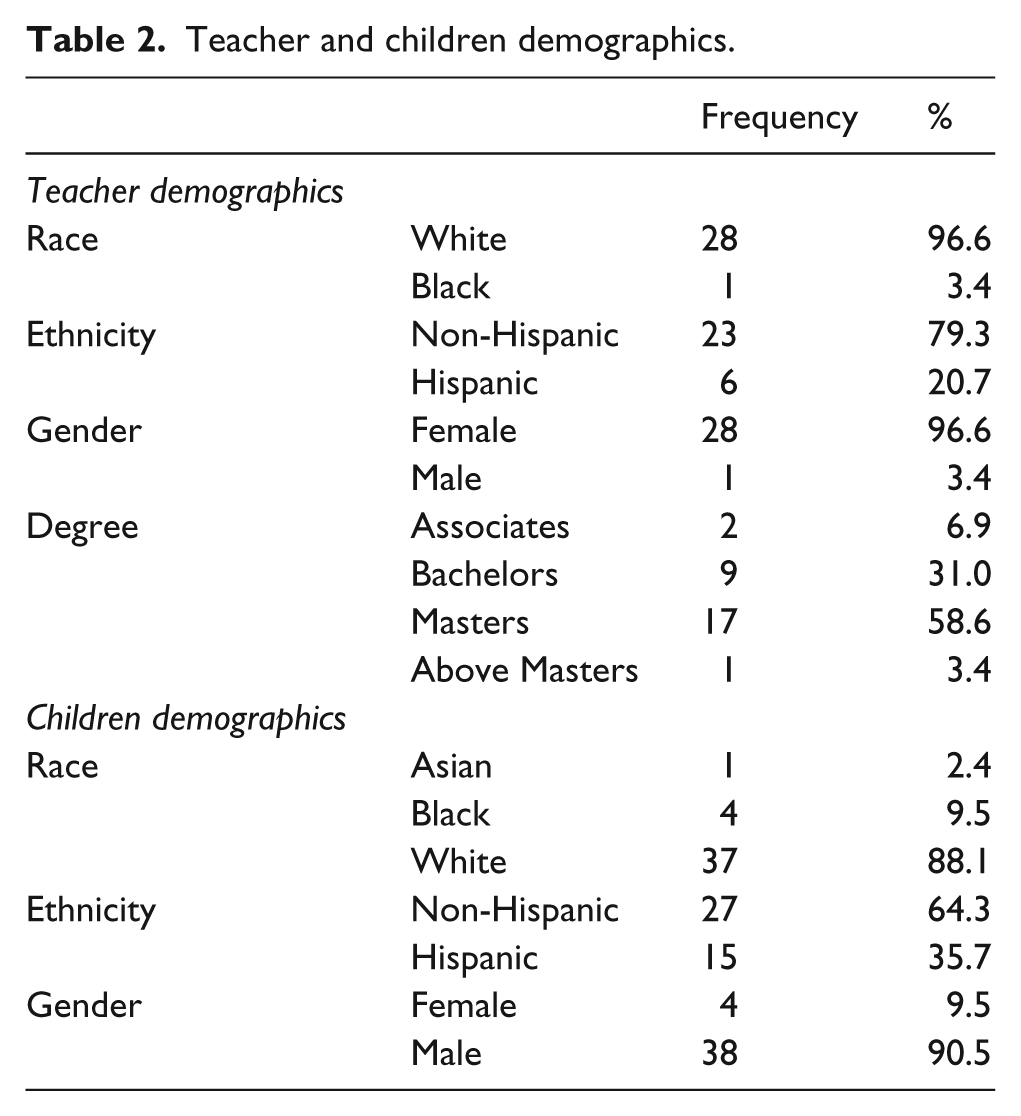
All lead teachers in these classrooms (n = 29) were certified to teach in their respective state and taught in a LEAP or BAU classroom for at least 2 years prior to study enrollment. Across both classroom types, lead teachers had an average of 10.78 years of experience in the classroom and 5.28 years of experience implementing their respective classroom treatment. Each LEAP and BAU classroom had one to two teachers as well as one to two teaching assistants. Teacher and child demographic information can be found in Table 2. Demographic data are presented on the lead teacher; however, it is important to clarify that we coded talk from any adult in the classroom that was directed toward the focal children. We thought this was more reflective of the real-world experiences of children with ASD in classrooms. That is, they interact with a number of adults throughout the school day and not just the lead teacher. Unfortunately, demographic data were not systematically collected for classroom assistants or related service providers as part of the larger study.
Teacher and children demographics.
Measures
The Mullen Scales of Early Learning (Mullen, 1995) is a standardized, comprehensive assessment that measures gross motor, fine motor, visual reception (VR), and language abilities of children from birth through 68 months. The calculated VR subscale raw score was used in this study as a proxy for the child’s nonverbal cognitive abilities. For the current sample, the VR subscale was highly correlated with children’s total standard score (r = 0.85, p = 0.000) on the Mullen.
Preschool Language Scale, Fourth Edition (PLS-4; Zimmerman et al., 2002) is a standardized measure used to assess language development, both receptive and expressive language ability, for children from birth through 6 years, 11 months. For the Mullen and PLS-4, raw scores were used because standard scores had floor effects and age equivalents scores were not available for all subscale or composite scores.
Childhood Autism Rating Scale (CARS; Schopler et al., 1988) is a 15-item rating scale that is intended to differentiate children with ASD from peers who are typically developing and children with developmental delays. For each of the 15 items (e.g. relationship to people, listening response, verbal communication), an informant assigns a rating of 1 (normal for child’s chronological age), 2 (mildly abnormal for child’s chronological age), 3 (moderately abnormal for child’s chronological age), or 4 (severely abnormal for child’s chronological age). Thus, the total CARS score may range from 15 to 60. A total score greater than or equal to 30 is interpreted to suggest the child shows at least a moderate degree of ASD symptom severity. The instrument has more than acceptable reliability (i.e. an alpha of 0.94). Total scores were used in data analysis for this study. Research staff administered this assessment and had to meet the following reliability criteria: be within ±0.5 on 12 of 15 items (equal to an 80% reliability criterion) and within ±3 on the total score. Prior to the collection of any data, this study was approved by the Institutional Review Board at the University of North Carolina at Chapel Hill.
Procedures
Children and classroom adults were videotaped during 30 min of center-time. In preschool classrooms, center-time can be conceptualized as the free time or space during which children are provided an opportunity to engage with adults and/or peers in designated areas containing academic and/or play materials. Center-time was selected because it was one of the few classroom activities that occurred consistently across classroom types (i.e. LEAP and BAU classrooms). The types of center activities available to children in this study included large blocks/manipulatives, pre-academic areas such as reading storybooks and computer time, and sensory motor activities such as art and large motor activities. For this study, no instructions were provided to adults other than to continue with their normal classroom routines and activities. The PROCODER software program (Tapp and Walden, 2000) was used to code each 10-s interval of the approximately 30-min video samples for adult questions. This typically resulted in 179 intervals (range: 129–192, M = 176, SD = 13.68) per observation. Each 10-s interval was coded for the presence or absence of each question type. Given that only four types of questions were being coded (see section “Coding scheme”), it was not necessary for coders to view videos multiple times in order to make coding decisions.
Coding scheme
The coding scheme comprised categories and codes adapted from Massey et al.’s (2008) teacher questions coding scheme. Partial interval coding was used to code the questions that were either directed solely at the focal child or to a group that included the focal child (e.g. during circle time). The question classification for this study included the following categories: (1) management, (2) less cognitively challenging, (3) cognitively challenging, and (4) more cognitively challenging. More cognitively challenging questions were subsequently combined with the cognitively challenging category for data analysis purposes because they occurred infrequently and they were related to each other conceptually (see Appendix 1 for categories and examples of adult questions).
Inter-rater reliability
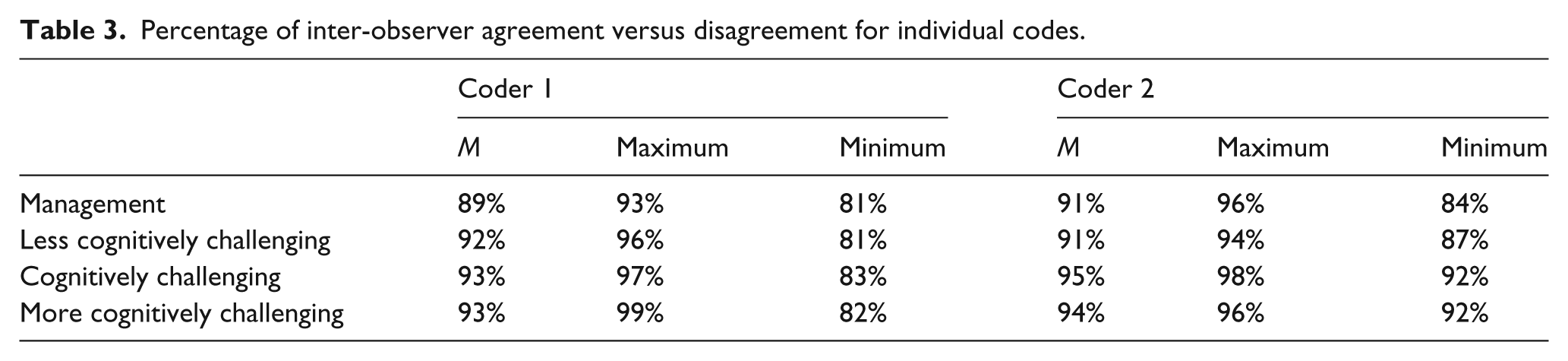
All videos were independently coded by two primary coders, one of whom held a PhD in speech-language pathology and the other was pursuing a PhD in speech-language pathology. Across the two coders, 20 percent of their videos were subsequently coded by a secondary rater (the second author of this study) for reliability purposes. Raters first had to reach at least an average of 80 percent agreement per code as well as overall agreement on the coding scheme across three consecutive non-study training videos. Coders had to maintain at least a mean 80 percent reliability criterion for each code as well as overall agreement throughout coding project videos. See Table 3 for complete reliability results.
Percentage of inter-observer agreement versus disagreement for individual codes.
Data analysis
Research Question 1. What types and amounts of questions do children with ASD receive from adults in the preschool classroom?
Descriptive statistics were used to identify the types and amounts of questions children with ASD experience in the classroom. In addition, chi-square analysis was employed to determine whether there were differences between types of questions asked.
Research Question 2. How do child characteristics (i.e. autism severity, language, and cognitive ability) and adult-to-child ratio affect the questions adults direct at preschoolers with ASD?
To answer this question, we first examined the intra-class correlations (ICCs) to assess whether a multilevel model was necessary (Snijders and Bosker, 2012). The multilevel structure was such that each child had multiple 10-s observations and each classroom contained several children. We opted to use a three-level model (see Table 4) to preserve the original structure of the data, ensure ample power to detect effects, and because there was a substantial amount of variance explained at Level 2 (i.e. children) and Level 3 (i.e. the classroom). Using PROC GLIMMIX (SAS Institute Inc, 2010), we estimated a mixed binomial logit model for each question type, predicting the odds of children receiving a particular question based on their raw PLS-4 total score, raw Mullen-VR score, CARS total score, and the ratio of adults to children. Classroom type (i.e. LEAP or BAU) was included as a covariate because we found that children in BAU classrooms were more likely to be asked cognitively challenging questions than those in LEAP classrooms (χ2(1) = 14.579; p = 0.0001). Classroom type did not affect the likelihood of management (χ2(1) = 1.802; p = 0.1794) and less cognitively challenging (χ2(1) = 2.643; p = 0.1039) questions being asked. Single imputation using the expectation-maximization (EM) algorithm was used to address the small amount of missing data for the PLS (2.4%).
Intra-class correlations.

Results
Research Question 1. What types and amounts of questions do children with ASD receive from adults in the preschool classroom?
Children with ASD received, on average, 19.97 management questions (SD = 12.71), 14.22 less cognitively challenging questions (SD = 8.98), and 10.00 cognitively challenging questions (SD = 6.90). Of the percentage of 10-s intervals in which children with ASD received a question, management questions were asked most often (8.85%), which were followed by less cognitively challenging (6.14%) and cognitively challenging questions (4.32%). The results of the chi-square analysis indicated significant differences between the proportion of “yes” responses between each pair of questions, such that management questions are most common versus less cognitively challenging: χ2 (df = 1) = 15.281; p < 0.001 versus cognitively challenging: χ2(df = 1) = 22.803; p < 0.001. Less cognitively challenging questions were also asked more frequently than cognitively challenging: χ2 (df = 1) = 10.559; p = 0.001.
Research Question 2. How do child characteristics (i.e. autism severity, language, and cognitive ability) and adult–child ratio affect the questions adults direct at preschoolers with ASD?
There were no significant predictors of management or less cognitively challenging questions, but higher scores on the PLS-4 (i.e. more language skills; β = 0.025; standard error (SE) = 0.009; p = 0.007; odds ratio (OR) = 1.025) and a larger ratio of adults to children (β = 0.163; SE = 0.078; p = 0.037; OR = 1.176) predicted higher odds of the children receiving a cognitively challenging question. More specifically, for every one point increase in the child’s PLS-4 raw score, the odds of that child being asked a cognitively challenging question increased by 2.5 percent, controlling for Mullen-VR score, CARS score, and the adult-to-child ratio. For every additional adult in the classroom, the odds of a child being asked a cognitively challenging question increased by 17.6 percent, controlling for the other variables in the model (see Table 5).
Questions by child characteristics, adult-child ratio, and classroom type.
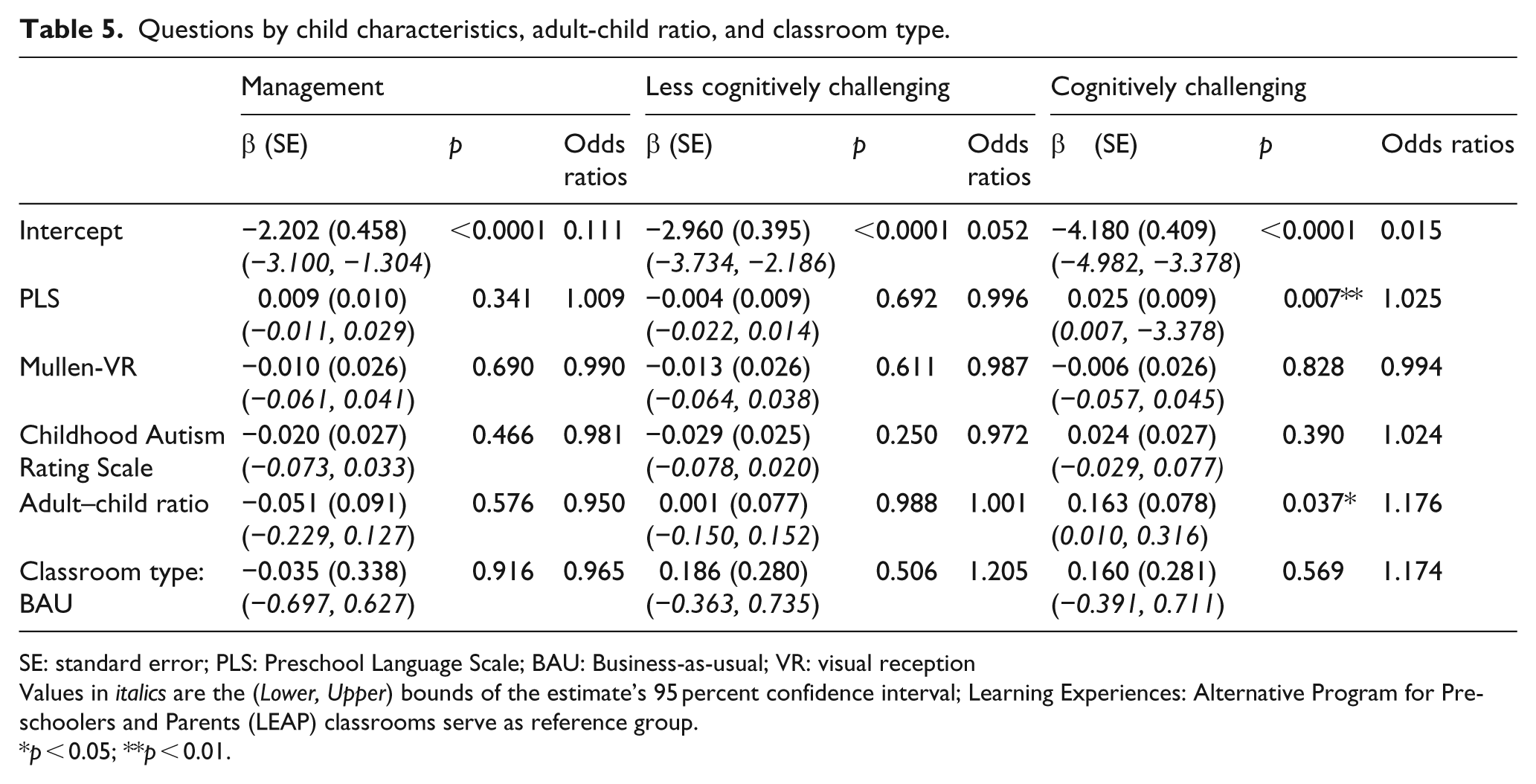
SE: standard error; PLS: Preschool Language Scale; BAU: Business-as-usual; VR: visual reception
Values in italics are the (Lower, Upper) bounds of the estimate’s 95 percent confidence interval; Learning Experiences: Alternative Program for Preschoolers and Parents (LEAP) classrooms serve as reference group.
p < 0.05; **p < 0.01.
Discussion
The questions children experience through adult–child transactional exchanges are thought to play an important role in their language development (Parnell and Amerman, 1983). This study identified the types of questions children with ASD are exposed to in inclusive preschool settings, and whether child characteristics or adult-to-children ratio is related to the types of questions asked. Our results indicated that verbal preschool-aged children with ASD in inclusive classroom settings were asked management questions more frequently than less cognitively challenging questions and less cognitively challenging questions more often than cognitively challenging questions. Additionally, cognitively challenging questions were more likely to be asked to children with greater language skills and when there were more classroom adults relative to children.
Types of questions asked
Overall, the total number of questions asked appears to be lower than what would be anticipated. However, the study reveals similar trends in the types of questions asked to preschool children with ASD when compared to other groups of children. Specifically, classroom adults asked preschool-aged children with ASD more management questions than less cognitively challenging or cognitively challenging questions, a finding similar to studies with at-risk children (e.g. Massey et al., 2008). This finding is unsurprising as management-style questions are often directive in nature, and this type of language is common in preschool classrooms serving children who are typically developing (Powell et al., 2008) as well as children with disabilities (Hestenes et al., 2004). Future research is necessary to determine how such management questions are related to the long-term cognitive and social outcomes of children with ASD.
Furthermore, less cognitively challenging questions were asked less frequently than management questions but more frequently than cognitively challenging questions. This finding resembles previous research on the questions asked in inclusive classrooms (Hestenes et al., 2004). However, it is contrary to the results Massey et al. (2008) reported, who found that at-risk preschoolers received questions that were more cognitively challenging more often than questions with less of a cognitive challenge. One reason for the discrepancy between our findings and those of Massey and colleagues may be related to that fact that all of our less cognitively challenging questions were required to have visual referents while theirs did not. The use of visuals aligns with prevailing views of instruction that suggest children with ASD be provided concrete, visual supports (Rao and Gagie, 2006). Furthermore, it is possible that classroom adults asked less cognitively challenging questions more than cognitively challenging questions because they assumed children with ASD were more capable of answering these types of questions. It is also conceivable that activity context impacted the type of questions that were asked. For example, Massey and colleagues looked at the questions that were asked across a range of classroom activities, while our study only looked at questions during center-time. It should be noted that this study did not examine whether certain types of questions asked are linked to child outcomes. If future research identifies this relationship, professional development efforts will likely be needed to help classroom adults be intentional in their question-asking.
Child and classroom characteristics related to question-asking
Previous studies indicated that the quantity of language directed at children with ASD may be affected by certain child characteristics. We anticipated similar findings in terms of types of questions asked. Our results indicated that children with greater language ability were more likely to be asked cognitively challenging questions. This finding qualifies previous studies that reported children with ASD with higher language levels received more language from adults (Dykstra et al., 2013; Warren et al., 2010). It is possible that adults were more likely to ask children with more language cognitively challenging questions simply because it was assumed they were more capable of answering these types of questions in comparison with children perceived as having lower language abilities. This may indicate that adults were being sensitive to, or in tune with, the language levels of their students. For example, classroom adults may have purposefully used fewer amounts of cognitively challenging questions with children who had less language in order to provide more appropriate language scaffolds. Additionally, it is possible that the power of different types of questions may be aligned with child characteristics such as language ability. Related to this, it is conceivable that children with more language elicit more cognitively challenging questions than those with less language because they are producing more and different types of language. In other words, classroom adults may have provided more complex input based on the language children used.
Unexpectedly, more cognitively challenging questions were not asked when children had higher cognitive ability. Previous research suggests that higher cognitive ability may be related to higher amounts (Dykstra et al., 2013; Warren et al., 2010) and different types (Irvin, et al., 2014) of language input directed to preschool-aged children with ASD. Additionally, cognitive and language levels are often moderately to highly correlated in children with ASD (e.g. Dykstra et al., 2013). We also did not find a link between autism severity and cognitively challenging questions asked. This was less surprising, as Dykstra et al. (2013) also did not find a link between quantity of language and autism severity in preschool classrooms.
Finally, there was a greater likelihood of cognitively challenging questions being asked when there were more adults in the classroom relative to children. This finding qualifies previous research indicating that more adults in a classroom relative to children may play a role in the type of interactions (e.g. using directives appropriately) between adults and children in inclusive preschool settings (Hestenes et al., 2008). Specifically, a higher adult-to-child ratio may result in increased opportunities for adults to engage in more in-depth transactions with children and, therefore, facilitate opportunities for more complex questions to be asked. However, these results should be interpreted cautiously as a more in-depth analysis of group composition and question–answer exchanges are necessary to draw firm conclusions about the influence of group size on child-related outcomes.
Limitations and future directions
There are several limitations of this study that should be addressed. First, this study investigated question-asking during one time of the school day during the first 3 months of the school year, and the types of questions asked may vary across contexts and months of school year. Furthermore, we were unable to determine the identity of the adult speaking to the focal children, so it is unknown whether certain educational service providers (e.g. teaching assistant vs speech-language pathologist) asked different types of questions. Additionally, only verbal children were included in this study and different types of questions may have been directed at those who were nonverbal.
This study is an important first step in examining the nature of question-asking in preschool classrooms serving children with ASD. It is important to note that although transactions resulting in cognitively challenging questions may promote language growth in children who are typically developing, the outcomes of these types of questions may be different in children who have ASD. Future iterations of this research should examine the quality of responses in relation to the types of questions classroom adults direct at young children with ASD. For example, it should be determined whether cognitively challenging questions do indeed promote more linguistically and conceptually complex responses in young children with ASD and whether language ability, cognitive ability, and autism severity are related to their responses. Related to this, there is need to explore how adults use children’s responses to scaffold linguistic and conceptual growth.
It may also be important to examine the impact and frequency of questions based on factors such as length or whether the adult or child initiates the topic of the conversation. Furthermore, researchers should examine the questions asked within the context of other teacher utterances. For example, educators may prefer using other language facilitation strategies such as modeling, repetition, and recasting. They may also be concerned that asking questions of greater cognitive challenge may not promote linguistically complex responses (e.g. McGinty et al., 2012). This may also aid in determining appropriate guidelines for frequencies of questions. Finally, it is imperative to further explore the relationship between group composition (i.e. number and types of peers and adults within a given activity area) and context (e.g. children in circle time vs. snack) and the type of questions being asked. It is highly likely that ecological factors such as these contribute to differences in the types and number of questions asked.
Conclusions
The use of questions by adults in preschools is important for the development of critical language, literacy, and academic skills among children who are typically developing. Little is known, however, about the questions preschool-aged children with ASD are exposed to in the classroom. This study is a first step in addressing this gap. Our results indicated that management questions are asked with greater frequency than less cognitively challenging questions, which are asked more frequently than cognitively challenging questions. Additionally, children with greater language ability had a greater likelihood of hearing cognitively challenging questions. Finally, there was a greater likelihood of cognitively challenging questions being asked when there were more adults in a classroom relative to children. These results point to important next steps in determining how children respond to different types of questions and how adults help children answer these questions. Ultimately, future research will be needed to develop strategies for teaching children with ASD how to answer questions and classroom adults how to ask questions that most contribute to child outcomes.
Footnotes
Appendix
Categories and examples of teacher questions

| Management—Questions used by the adult to regulate the behavior of the student. These questions do not necessarily have to be questions related to the present (e.g. “You’re supposed to walk in the classroom, remember?”); however, the purpose of them is to get the student to act or not act in a certain way (e.g. to get them to pay attention, sit down, participate in an activity). These questions can also be used to clarify a response or maintain conversation. | |
| Examples: | Non-Examples: |
| Can you use your inside voice during circle time? | Where do you want to go to? |
| Can you put some glue there? | What is next, cutting or gluing? |
| What did you say? | Is this your lunch-box? |
| Less cognitively challenging—These are questions are typically about events and materials in the present and provide the child with a voice in an activity. The answer to the question is directly in front of the child (e.g. concrete choices are provided to the child). | |
| Examples: | Non-examples: |
| Do you want to play with the truck or the car? | What do you want to do next? |
| Is this a square or a circle? | What did you do over the weekend? |
| Cognitively challenging—Questions about objects or events that may or may not be present AND require the focal child to predict, remember, draw an inference or analyze. These can be about pretend play (e.g. the child has to pretend an object is something else to answer the question). | |
| Examples: | Non-examples: |
| Did you go to the movies over the weekend? | Can you not hit your friends when we go outside today? |
| Does Noah or Jerry have more crayons? | |
| Can’t Tell—If the adult and child are outside of camera range and you are not able to determine whether interactions between them are taking place—code can’t tell. This code should be used sparingly. | |
| No Question—No question directed to the focal child occurs during the 10-s interval. If an adult is asking individual children where they would like to go for free play during circle time, no (question) should be coded unless the question is specifically directed at the target child. | |
Funding
The research reported here was supported in part by the Institute of Education Sciences, US Department of Education through Grant R324B070219 awarded to the University of North Carolina at Chapel Hill (UNC-Chapel Hill). The opinions expressed represent those of the authors and do not necessarily represent views of the Institute or the US Department of Education.