



Abstract

I will not attempt to detail why the puzzle piece as a symbol for autism is offensive; it is easy to search online and find many and varied reasons from different authors. Recently, Professors Grinker and Mandell authored an editorial in the journal Autism, which was prompted by a Tweet from Autism Rights Group Highland (ARGH), an Autistic people’s organisation based in the United Kingdom. I was Tweeting from the @ARGHighland account that day.
I found the response to my Tweet – the editorial itself – quite disappointing. Often when the use of the puzzle piece and its offensiveness is highlighted, people are keen to engage in discussion and most decide to stop using it because they conclude ‘why choose to use an offensive symbol when there is no real need to do so’?
It is true that the United Kingdom’s National Autistic Society (NAS) did use the symbol themselves (see Figure 1). However, as Professors Grinker and Mandell explain, the NAS (along with many other organisations) stopped this because they recognised the inappropriateness and the potential to offend. It should be noted that this is not just a concern of Autistic people; many nonautistic parents and practitioners also dislike this puzzle symbolism and the outdated stereotypes it unfortunately represents.
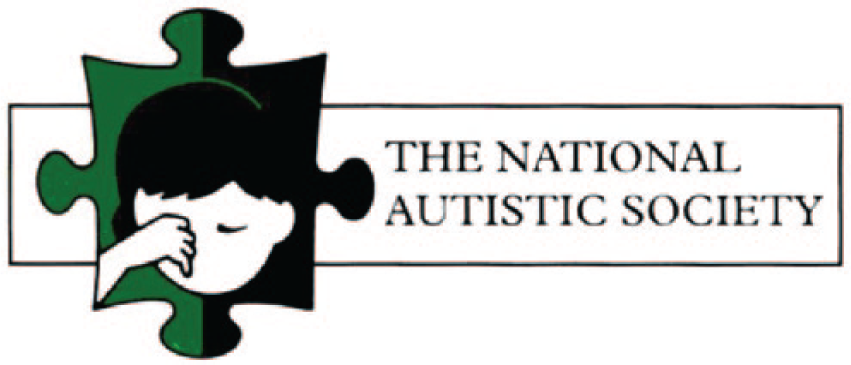
The original logo of the National Autistic Society (UK), who introduced the notion of the puzzle piece as a symbol for autism.
Disappointingly, the editorial made no reference to symbols currently used within Autistic community: for example, the infinity symbol, which is used by some for autism and has a wider neurodiversity message for many. Although I agree with the notion of symbols that are ‘owned’ by the Autistic community (rather than being imposed from the outside), I am not entirely sure that we need ‘a symbol for autism’ at all. I believe that the only true symbol for ‘my autism’ is myself: my Autistic self is what defines me as a person, not some abstract image or the imaginings of a nonautistic designer or public relations (PR) executive living in their nonautistic bubble.
I am a fully rounded human, as are all of my siblings within the Autistic community; we cannot be pigeonholed or symbolised by any one thing, we are far too individual for that. My request for the rethinking of the puzzle piece imagery was just that – a request for a rethinking to remove the offensive symbol. I was not suggesting that there should be a new ‘one size fits all’ replacement.
I do not feel that reducing millions of diverse Autistic people around the world to be represented by one universal symbol is healthy or desirable. In the editorial, the authors stated,
we can think of no other image that is so clearly associated with a particular condition.
Maybe this is because it really isn’t a good idea to collate people under imagery imposed by others. It may even be seen as a way to continue to deny our humanity. We are not just more than a puzzle; we are fully human and cannot be reduced to a simple logo style concept. Perhaps the lack of similar attempts at imagery for other groups shows that other fields have reached this conclusion sooner, perhaps the autism machine is lagging in its modernisation, or maybe it is just more honest. People with a label of Learning Disability are not given a kitsch universal symbol to pretty up the papers that are written about them or to soften the blow of the charity model that adds to stigma and increases pity rhetoric. Even so, they are no nearer to autonomy and full human rights, as a group, than Autistic people are.
To sum up, I sadly felt that the editorial very much came from an ‘I know best’ standpoint; how could an Autistic person possibly know or have a right to express opinion on how we are regarded or spoken about, or how autism is described. Ownership of autism is currently firmly in the hands of those that regard us, rather than our own. Surely, it is a most basic request to allow us Autonomy; a right to self-define and create our own imagery that reinforces our self-identity. This is instead of ideas imposed from the outside in – ideas that often rely upon stereotypes that Autistic people reject or see as prejudicial.
Too often in situations such as this, there is an immediate justification and search for people who disagree with the Autistic questioner (and agree with the nonautistic view). As a community, we are used to being silenced either because we are deemed too vocal (and therefore are not representative) or because it is decided that we are not verbal enough or conversationally skilled enough for our opinion to matter. I really hope that this is not one of those times and that we can have a conversation that focuses on the question: why continue to use a symbol when those that you rely on to sustain your journal (or other organisation) find it offensive; without Autistic people, there would be no Autism journal, there would be no autism industry.