



Abstract
Several studies have suggested that contingent adult imitation increase nonverbal communication, such as attention and proximity to adults, in children with autism spectrum disorders. However, few studies have shown the effect of contingent imitation on verbal communication. This study examined whether children with autism were able to promote verbal interaction such as vocal imitation, vocalization, and vocal turn-taking via contingent imitation. We used an alternating treatment design composed of the conditions of contingent imitation and control for six children with autism (aged 33–63 months). For contingent imitation condition, adults imitated children’s vocalization immediately. For control condition, adults did not imitate but gave a vocal response immediately. Results showed that in contingent imitation condition, all children increased the number of vocal imitations and vocal turn-takings compared with control condition. The number of vocalizations increased in both condition for all children. Overall, it is suggested that all children promote verbal interaction via contingent imitation.
Keywords
Children with autism spectrum disorders (ASDs) exhibit significant deficits in imitation skills (Ingersoll, 2008; Rogers et al., 2003; Young et al., 2011). For example, they showed a low frequency of imitation compared with typically developing children and those with other developmental disorders (Edwards, 2014; Vivanti et al., 2014; Young et al, 2011). Because imitation skills can predict later language acquisition in children with autism (Thurm et al., 2007; Toth et al., 2006), it has been suggested that the acquisition of imitation skills plays a pivotal role in the development of social communication such as language, joint attention, and play (Ingersoll, 2008; Ingersoll and Schreibman, 2006). Hence, imitation is one of the most important target behaviors in early intervention programs (Warreyn et al., 2014).
When teaching vocal imitation to children with autism, an adult usually models vocalization and uses vocalization such as verbal praise as a contingent response to a child’s appropriate imitation (Ross and Greer, 2003; Sanefuji and Ohgami, 2013; Young et al., 1994). A contingent response from an adult is defined as the verbal praise and comments that are contingent on the child’s vocalization (Escalona et al., 2002; Gazdag and Warren, 2000; Heimann et al., 2006). However, the use of contingent response alone is not sufficient to establish imitation. First, it has been suggested that verbal praise and/or comments are not functional as reinforcement at the beginning of treatment for the facilitation of vocal imitation (Gazdag and Warren, 2000).
Second, in light of promoting reciprocal interaction (Koegel et al., 2005; MacDonald et al., 2009), in which an adult and a child imitate each other, contingent response did not elicit subsequent vocalization from the child (Field et al., 2001; Gazdag and Warren, 2000). Therefore, it is suggested that contingent response does not sufficiently promote reciprocal interaction.
Alternatively, one of the strategies for teaching imitation skills is contingent imitation (Dawson and Adams, 1984; Gazdag and Warren, 2000; Ingersoll and Schreibman, 2006). In contingent imitation, when a child emits a motor or vocal response, the adult immediately returns the same action or vocal sound, including pronunciation, prosody, and rhythms. Several authors have implied that the similarity of the stimuli presented by both the adult and the child can function as reinforcement to enhance the child’s response (Dawson and Lewy, 1989; Hirsh et al., 2014; Pelaez et al., 2011b; Rovee-Collier et al., 1985). Polick et al. (2012) have suggested that descriptive praise that is the same as the child’s vocalization could promote the acquisition of imitation skills when compared with general praise that does not include the child’s vocalization as a response topography. Thus, it would take less time to acquire imitation skills using contingent imitation compared with contingent response, as the adult would return the vocalization the child used previously. After contingent imitation by an adult, the child and the adult exchange the roles of imitating and being imitated and establish a reciprocal interaction.
To identify the effect of contingent imitation, a direct comparison with contingent response as the control condition was needed. There are, however, few studies that have examined the effect of contingent imitation on children with ASDs compared with that of contingent response. Therefore, contingent response may be the best control condition for determining the effects of immediate response or immediate imitation. (Escalona et al., 2002; Field et al., 2001; Gazdag and Warren, 2000; Heimann et al., 2006; Sanefuji and Ohgami, 2011).
Recent studies have suggested that adult contingent imitation is correlated with the development of nonverbal communication in children with autism (Escalona et al., 2002; Field et al., 2010, 2013; Heimann et al., 2006; Sanefuji and Ohgami, 2011). A series of studies have shown that the contingent imitation condition, in which the adult imitates all of the child’s behaviors such as actions and vocalizations in an unstructured setting, increase the proportion and proximity of touching of the adult (Field et al., 2001; Escalona et al., 2002; Heimann et al., 2006) and increase the referential looking and gaze following (Ezell et al., 2012) compared with the contingent response condition. Sanefuji and Ohgami (2013) also revealed that social behaviors, such as looking at the mother, improved when parents repeatedly conducted contingent imitation at home for 5 min during free-play interaction sessions. Thus, previous studies suggest that contingent imitation promote nonverbal communication skills more so than contingent response.
Although the effect of contingent imitation on nonverbal communication has been examined, little has been known about the effect of contingent imitation on verbal communication in children with autism. Field et al. (2001) showed that contingent imitation increased the number of vocalizations, but further research is needed to examine the effect on verbal communication.
The effect of contingent imitation on verbal communication has been studied for typically developing infants and children with intellectual disabilities. In typically developing infants, several studies have shown that contingent maternal imitation is associated with the infant’s verbal communication (Goldstein and Schwade, 2008; Hirsh et al., 2014; Masur and Olson, 2008; Pelaez et al., 2011b). Dunst et al. (2010) concluded that contingent maternal imitation as a consequent stimulus was more effective for increasing an infant’s vocalization compared with contingent verbal comments or nonverbal sounds.
Pelaez et al. (2011a) directly compared the effect of contingent maternal imitation with that of noncontingent maternal imitation on typically developing infants. Contingent maternal imitation was defined as an immediate and accurate response that included the same topography and duration of the infant’s vocal sounds. As the result, the infant showed more vocalizations in the contingent maternal imitation condition than in the noncontingent condition.
For children with intellectual disabilities, Gazdag and Warren (2000) conducted interventions using adult vocal contingent imitation. To establish a baseline, the therapist provided five vocal models of imitation scenarios and responded contingently to all of the child’s vocalizations in an unstructured setting. In training, the therapist offered the child a doll and elicited the child’s vocalization. Then, the adult immediately imitated the child’s vocalization. The result showed that contingent imitation training facilitated spontaneous vocal imitation but did not increase elicited imitation, in which the adult said the word “say” before presenting the vocal models. The previous results suggest that contingent imitation is more effective in eliciting spontaneous vocal imitation in an unstructured setting from children with developmental disorders.
Reciprocal imitation training (RIT) was established as a comprehensive intervention for facilitating verbal and nonverbal communication skills in children with autism (Ingersoll, 2010; Ingersoll and Gergans, 2007; Ingersoll and Schreibman, 2006; Walton and Ingersoll, 2012). RIT includes contingent imitation as a technique for teaching object imitation. In the training, the experimenter taught object imitation using modeling, contingent imitation, and physical prompts. The results show that RIT increases object imitation, language, pretend play, and joint attention. However, few studies specifically identified the effect of contingent imitation on verbal communication skills.
Vocal turn-taking, in which both a child and an adult alternatively emit vocalizations, had an effect on the acquisition of reciprocal verbal interaction (Koegel et al., 2005; MacDonald et al., 2009). Vocal turn-taking has facilitated the development of verbal communication in typically developing children (Hane, 2003; Locke, 2001). Children with autism, however, have difficulty engaging with other persons in social interactions, such as turn-taking behavior (Chiang et al., 2008; Prizant, 1996; Warlaumont et al., 2014). Typically developing children engage in vocal turn-taking through mutual imitation, wherein the child and caregiver imitate each other’s vocalizations (Locke, 1992, 2001). It is suggested that mutual imitation is an effective procedure for increasing vocal turn-taking to promote reciprocal verbal interaction in infants (Masur and Olson, 2008; Reissland and Stephenson, 1998). Based on these results, we need to examine whether children with autism engage in mutual imitation and increased vocal turn-taking when contingent imitation is applied.
In most studies, reciprocal interaction in children with autism has been measured by the total number of occurrences or the duration of nonverbal and verbal communication (Koegel et al., 2005; MacDonald et al., 2009). In this study, we measured the number of chained occurrences of vocal turn-taking to quantify the effect of contingent imitation on reciprocal interaction.
In summary, the purpose of this study is to, first, examine whether contingent imitation will increase verbal interaction, such as the number of vocal imitations and vocalizations of children with autism, compared with contingent response as a control condition. The second purpose is to examine whether contingent imitation will increase vocal turn-taking and promote reciprocal interaction between the child and the adult.
Method
Participants and setting
Six Japanese children with autism (all male) participated in this study. Participants were recruited from several local clinic centers in the Tokyo region, from which we obtained permission to distribute leaflets containing information about this study. Parents saw the leaflet, sent an email to the laboratory, and set the day of intake. During intake, informed consent for the child’s participation in the study was obtained from all parents. Inclusion criteria were that the child was 2–6 years old at the time of intake and diagnosed with “ASD” by a doctor or clinical psychologist using the standard diagnostic criteria of the Diagnostic and Statistical Manual of Mental Disorders (4th ed., text rev.; DSM-IV-TR; American Psychiatric Association (APA), 2000).
All children were assessed using the Kyoto Scales of Psychological Development, 2001 (KSPD; Ikuzawa et al., 2002), which is the official standardized scale in Japan. We assessed the children’s developmental quotients using the entire scale, which comprises the following subscales: physical-motion (P-M), cognitive-adaptation (C-A), and language-sociability (L-S). The KSPD can be used to assess children up to 14 years of age for all characteristic types. In Japan, we commonly use the standard scores of the entire scale to determine developmental age as a measure of mental age, and the L-S subscale as a measure of verbal mental age.
This study used the Childhood Autism Rating Scale (CARS; Schopler et al., 1988) because standardized diagnostic scales such as the Autism Diagnostic Observation Schedule (ADOS; Lord et al., 2000) and the Autism Diagnostic Interview, Revised (ADI-R; Le Couteur et al., 1989; Lord et al., 1994) had not been adopted in Japan when this study began. The CARS rates 15 areas on a scale of 1 to 4 for each child’s behavior. A score of 29.5 and below indicates a “non-autistic range,” 30 to 36.5 indicates “mild to moderate autism,” and 37 to 70 indicates “severe autism.” Children in this study had CARS scores ranging from 30 to 45.
The experiment including the subjects Yasu, Gin, Teru, and Taka was conducted in a testing room at a laboratory. There was only one table and one chair. Because Yuta and Kai resided more than 2 h away from the laboratory, the experimenter went to their homes and used a room that contained only a table and chair to conduct all of the experimental phases. In contrast to previous studies conducted in an unstructured setting (Escalona et al., 2002; Field et al., 2001; Nadel et al., 2000), these studies were conducted in a structured setting to more easily direct the child’s attention. The children and experimenter in this study sat on chairs facing each other during the sessions. To elicit a maximal vocal response from the children during the sessions, we used picture cards for Gin, Yuta, Kai, and Taka, and toys for Yasu and Teru, because Gin, Yuta, Kai, and Taka had little interest in toys. In addition, Yasu and Kai could not engage in naming the picture cards for the 2-min duration. Although the materials used for each child were different, both the picture cards and toys were used for the same purpose of eliciting vocalization from the children.
Participants characteristics
The participant profiles are shown in Table 1. The children ranged in age from 33 to 63 months. Yasu was 4 years old and attended kindergarten. At the time of this study, he was able to imitate and speak two or three words at a time, such as “red car,” and answer some simple questions, such as “What’s your name?” or “How old are you?” in one or two words, but he was not engaged in reciprocal interaction and needed prompting from an adult. Gin was 3 years old and attended kindergarten. He was also able to imitate and speak two or three words at a time, such as “red car,” and answer some simple questions, but he also did not engage in reciprocal interaction at the beginning of the study. Yuta was 5 years old and attended preschool. He could imitate single words, such as “car,” but the frequency of his spontaneous speaking was very low. He did not answer any questions and needed verbal prompting to express one-word utterances. Teru was 2 years old and went to the public community center at the beginning of the study. He was also able to imitate single words, but did not use spontaneous words. His pronunciation was not clear and usually consisted of babbling or nonmeaningful utterances. Kai was 5 years old and attended kindergarten. At the time of the study, he was able to imitate single words, but the frequency of his speaking was very low, and his pronunciation was not clear. He did not answer any of the simple questions and needed verbal prompting to express one-word utterances. Taka was 3 years old and attended kindergarten. He could imitate single words, such as “car,” but the frequency of his spontaneous speaking was very low at the beginning of the study. He did not answer any of the simple questions without adult verbal prompting. All sessions for each child were conducted by one experimenter.
Participant profiles.
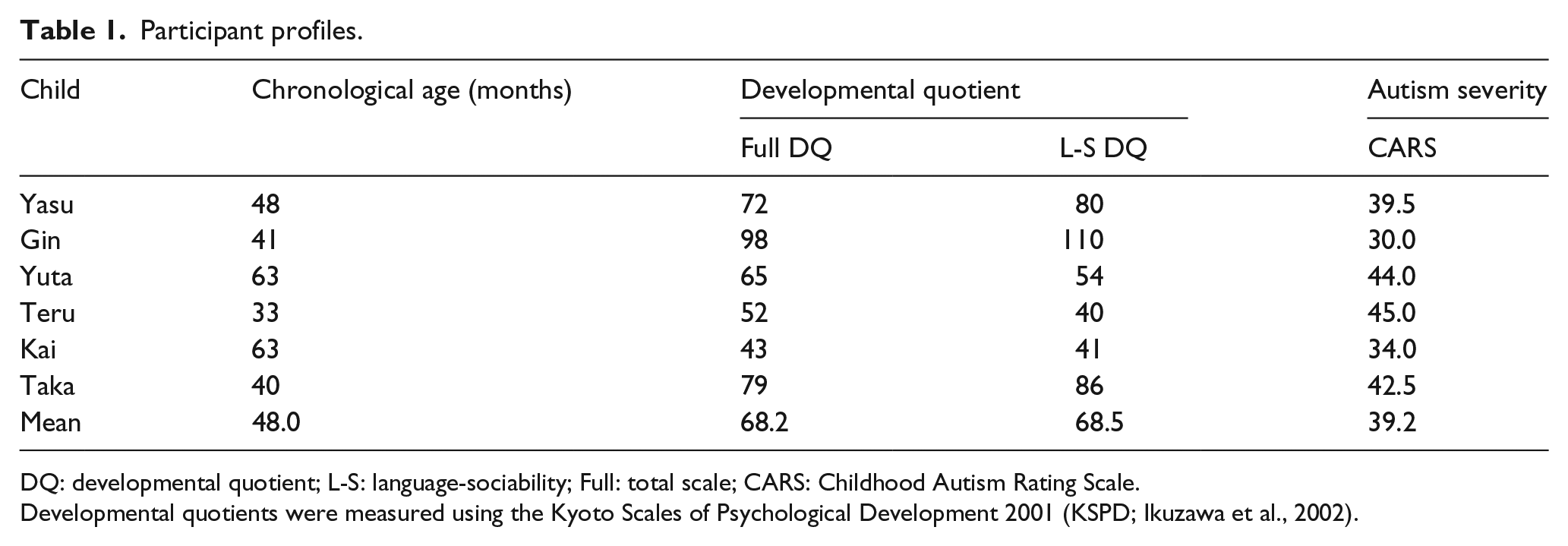
DQ: developmental quotient; L-S: language-sociability; Full: total scale; CARS: Childhood Autism Rating Scale.
Developmental quotients were measured using the Kyoto Scales of Psychological Development 2001 (KSPD; Ikuzawa et al., 2002).
Experimental design and procedures
We used the within-subject multi-element design in a particular, rapidly changing reversal design (Cooper et al., 1990, 1993; Dunlap et al., 1991) to compare the effects of contingent imitation and contingent response. One condition was that of contingent response (phase A), in which the experimenter responded to the child’s vocalization with praise but did not imitate them, whereas the other condition was that of contingent imitation (phase B), in which the experimenter imitated all vocalizations. For all children, the order of the conditions was ABAB-BABA-ABAB-BABA.
Each session lasted 2 min for each condition, with a short break between sessions (approximately 30 s). The two conditions were alternatively implemented. The sequence of the conditions changed for each of the four sessions, ABAB or BABA. For each child, the experimenter conducted eight sessions (ABAB-BABA) on the first day, and the other eight sessions (BABA-ABAB) on the second day. The experiment consisted of 16 total sessions. Once a week, children came to the laboratory or the experimenter went to their homes.
Contingent response (control) condition
The experimenter sat facing the child across the desk, and after getting the child’s attention, the experimenter showed them some picture cards or toys and said, “Oh, it’s a car,” or, “What could you see in picture?” to elicit vocalization from the child. When the child named the object, the experimenter did not imitate them, but immediately responded with a contingent response to the child’s vocalization. For example, when the child said “car,” the experimenter responded “great,” “good,” or “nice.” If there was no response, the experimenter redirected the child’s attention and changed the picture cards or toys.
Contingent imitation condition
The experimenter followed the same procedure for the contingent response condition. The experimenter imitated and extended the child’s vocalization using contingent imitation. That is, when the child said “car,” the experimenter immediately responded with “car.” The experimenter also imitated the prosody, sound volume, and cadence of the child. In addition, when the child imitated the experimenter’s vocal response, the experimenter continued to imitate the child’s vocal response. For example, when the child imitated the vocal response “car,” the experimenter used the extended “red car” as a contingent imitation.
Dependent measures and interobserver agreement
All sessions were videotaped. An analysis of three dependent measures was conducted: (a) the number of vocal imitations, (b) the number of vocalizations, and (c) the average, minimum, and maximum number of vocal turn-taking interactions. Table 2 shows the definition of each measurement. To examine the length of the verbal interactions, we counted the average, minimum, and maximum number of vocal turn-taking interactions between the child and the experimenter.
The definition of dependent measures.
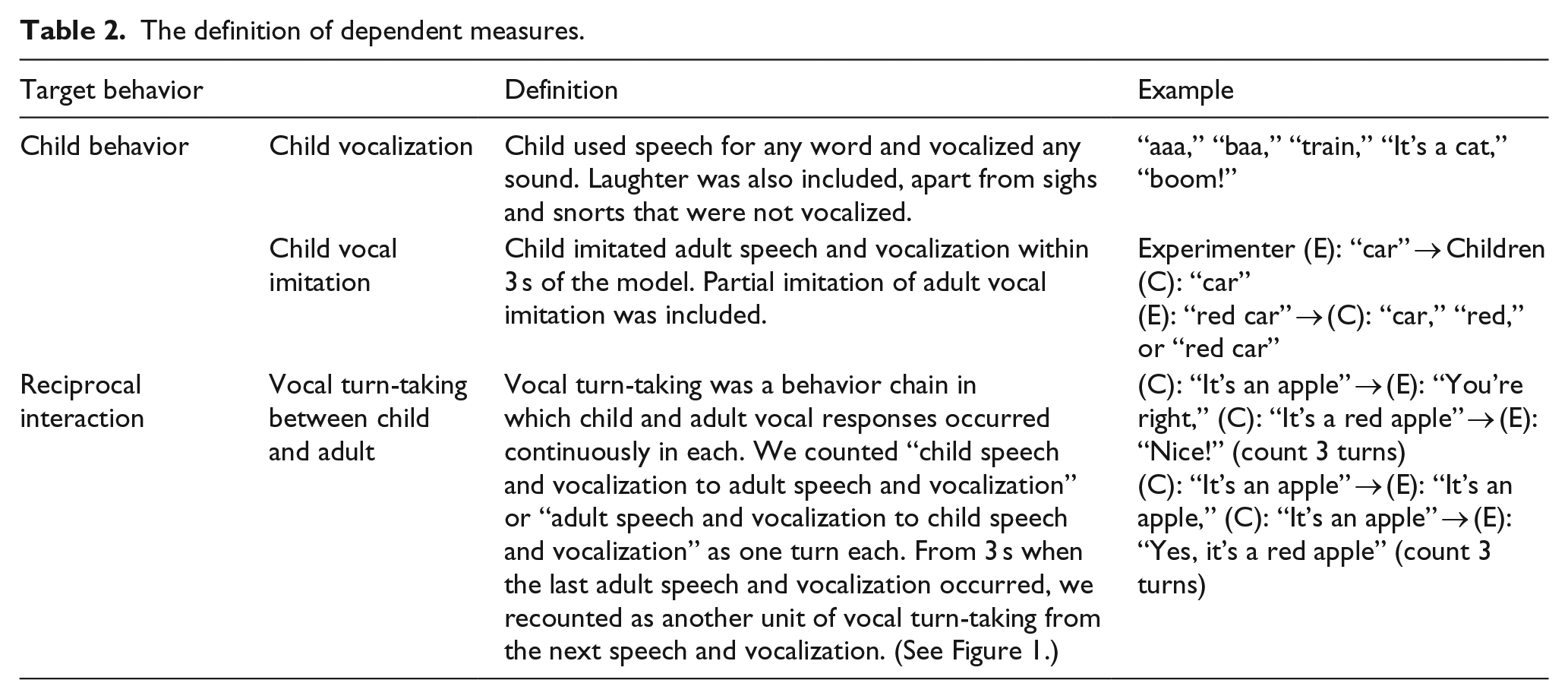
We defined one turn as the child’s (or adult’s) verbal response that sequentially occurred within 3 s after the adult’s (or child’s) verbal response. Adult verbal responses included contingent imitation and contingent response. A two-turn response was defined as the child’s (or adult’s) second verbal response within 3 s after the one-turn response. A three-turn response was defined as the adult’s (or child’s) third verbal response within 3 s after the two-turn response. We also counted four-turn, five-turn, and so on responses. When the child’s (or adult’s) response did not follow the end of the adult’s (or child’s) vocal response within 3 s, we counted the turn as new one (Figure 1). For example, when the child said “car” (vocalization) and the adult followed with “car” (contingent imitation) or “great” (contingent response) within 3 s, we counted it as one turn. When the child said “car” and the adult immediately followed with “car” or “great,” and then the child vocalized anything, such as “car” (include vocalization and vocal imitation) or “red” (vocalization) within 3 s, we counted it as two turns. We counted turns as the number of vocal turn-taking throughout all eight sessions (16 min) in each condition for all children. We calculated the average, minimum, and maximum numbers of vocal turn-taking interactions. We used the Wilcoxon signed-rank test to examine whether the average numbers of vocal turn-taking interactions had a significant difference across all conditions.
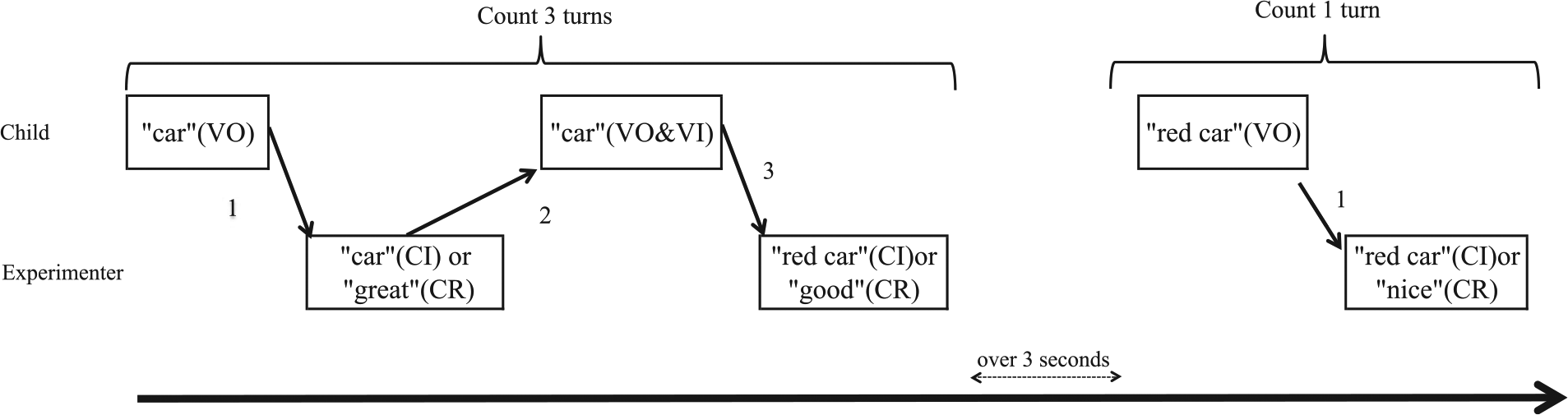
Example of calculating vocal turn-taking.
An author and a graduate student, who did not know the purpose of the study, observed the number of vocal imitations and vocalizations using a 10-s interval recording; interobserver agreement was obtained for 25% of all sessions from the videotapes. Kappa coefficients (Cohen, 1968) were calculated for each dependent measure, yielding 0.72 for vocal imitation and 0.71 for vocalization. Kappa coefficients were acceptable for all children. The average rate of agreement of the number of vocal turn-taking between the experimenter and child was 0.86.
To establish that the number of vocal cues from the experimenter was consistent, adult vocalization and speech that could provide an opportunity to the child were calculated for a 10-s interval recording. Adult vocalization and speech included all vocalizations and songs sung by the adult, except for sighs and snorts, which were not vocalized. There were no differences between the conditions for each child.
Fidelity of implementation
The fidelity of conditions was measured for 10% of the sessions by an independent observer. Four questions were used to establish the correct implementation of both conditions. The percentages of 30-s intervals in which the following behaviors were conducted correctly were the following: contingent imitation (93.8%), contingent response (91.7%), get the child’s attention (90.0%), and provide an opportunity for the child to vocalize (95.0%).
Results
The number of vocal imitations for all children is shown in Figure 2. Upon analysis, all children showed a higher occurrence of vocal imitation during the contingent imitation condition compared with the contingent response condition or control condition. For all children, the mean number of vocal imitations showed a significant increase in contingent imitation compared with contingent response (Wilcoxon signed-rank test: Z = 2.20, p = 0.028, two-sided). The mean number of vocal imitations in the contingent imitation condition was 4.0 for Yasu, 11.6 for Gin, 7.4 for Yuta, 7.1 for Teru, 4.6 for Kai, and 8.9 for Taka. The mean number of vocal imitations for all sessions of the contingent response condition was 1.0 for Yasu, 3.4 for Gin, 0.4 for Yuta, 1.3 for Teru, 0.9 for Kai, and 2.4 for Taka. The percentages of vocal imitations from each individual session in the contingent imitation condition, non-overlapping the mean number of vocal imitations in the contingent response condition, were 100% for Yasu, Gin, Yuta, and Teru, and 88% for Kai and Taka. The Yasu’s vocal imitations increased continuously during the contingent imitation condition throughout all of the sessions. There was a rapid increase in Gin’s vocal imitations during the 10th and 12th sessions. The vocal imitations for Yuta increased continuously during the contingent imitation condition throughout all of the sessions. Teru’s vocal imitations increased continuously during the contingent imitation condition throughout all of the sessions. There was no significant difference in Kai’s vocal imitations between conditions until the 7th session; however, the frequency of vocal imitations was greater in the 10th to 15th sessions than in the control condition. Taka also emitted a higher frequency of vocal imitations. Yasu and Teru, who used toys as test materials, also emitted increased vocal imitations in the contingent imitation condition at the same rate as did the other four children who used picture cards as test materials.
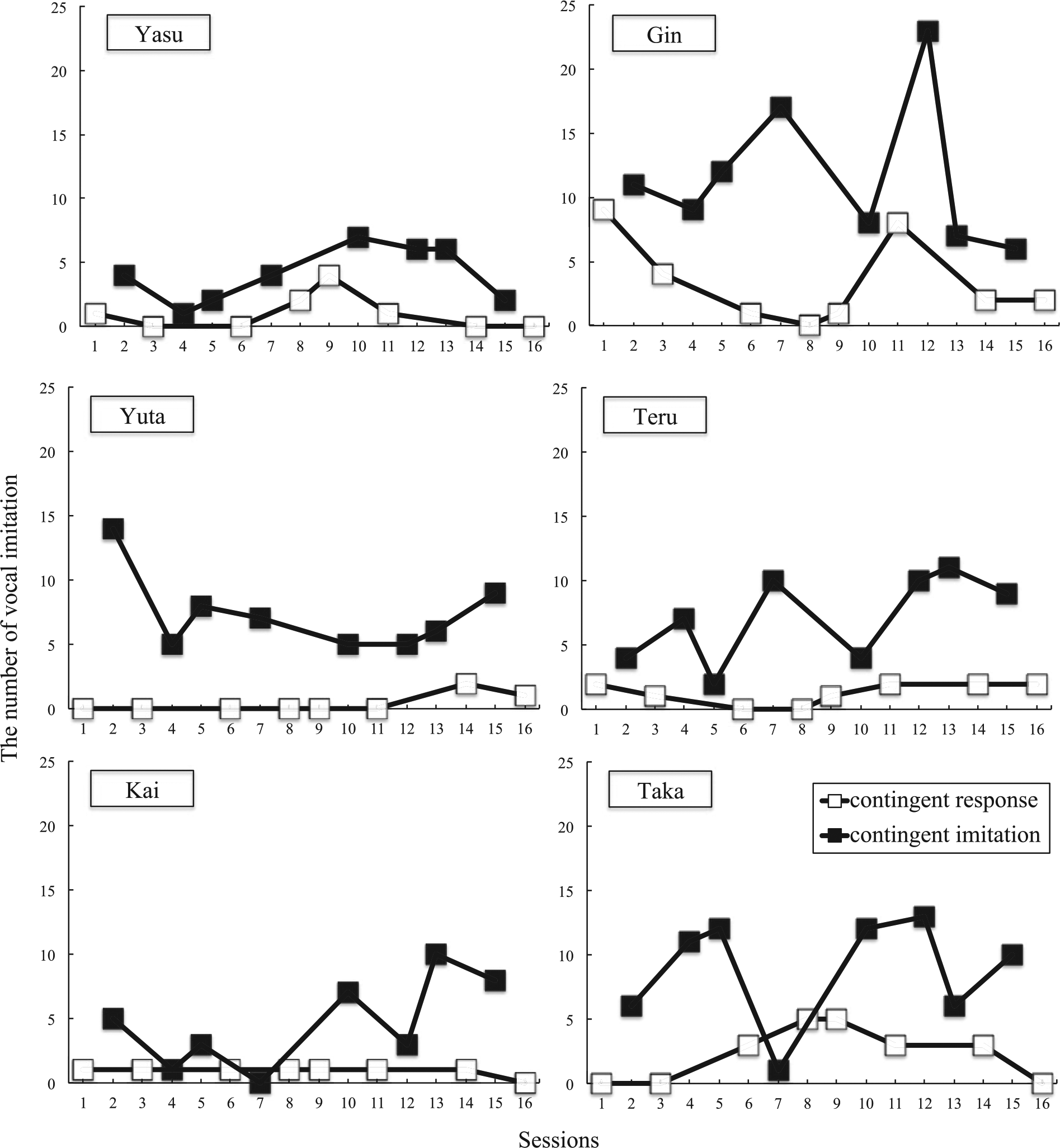
The number of vocal imitations across conditions for all children.
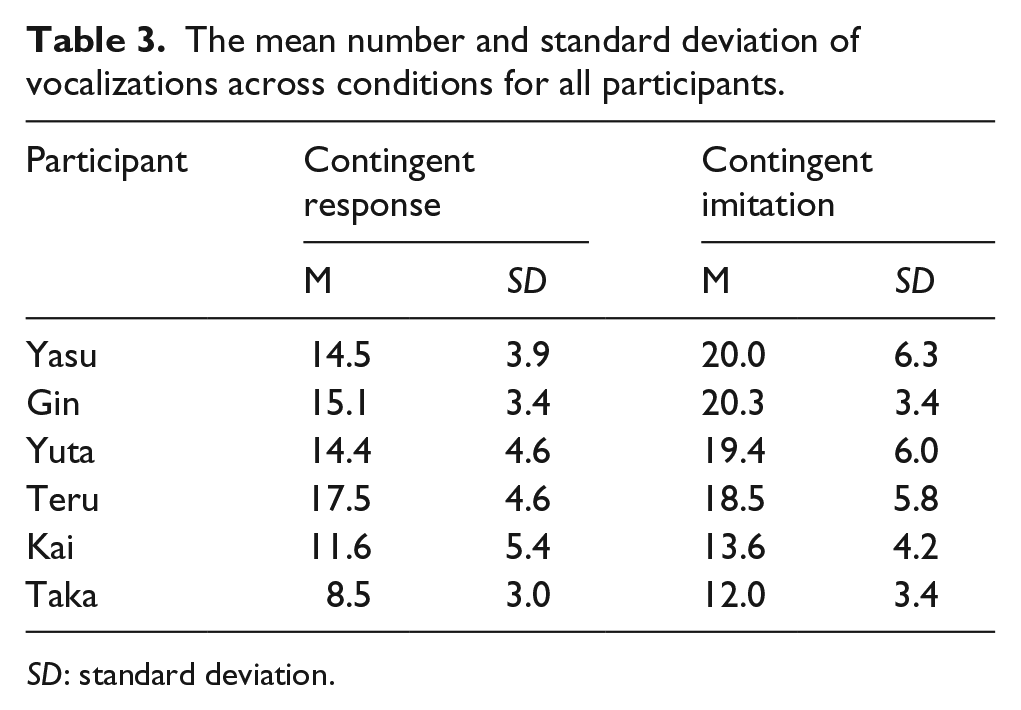
Table 3 shows the number of vocalizations for all children in both conditions. For all children, the mean number of vocalizations showed a significant increase in contingent imitation compared with contingent response (Wilcoxon signed-rank test: Z = 2.20, p = 0.028, two-sided). The percentages of vocalization in each individual session under the contingent imitation condition, non-overlapping the mean number of vocalizations in the contingent response condition, were 75% for Yasu, 100% for Gin, 88% for Yuta, 50% for Teru, 63% for Kai, and 75% for Taka. Yasu and Teru, who used toys as test materials, also demonstrated increased vocalizations in the contingent imitation condition at the same rate as the other four children who used picture cards as test materials.
The mean number and standard deviation of vocalizations across conditions for all participants.
SD: standard deviation.
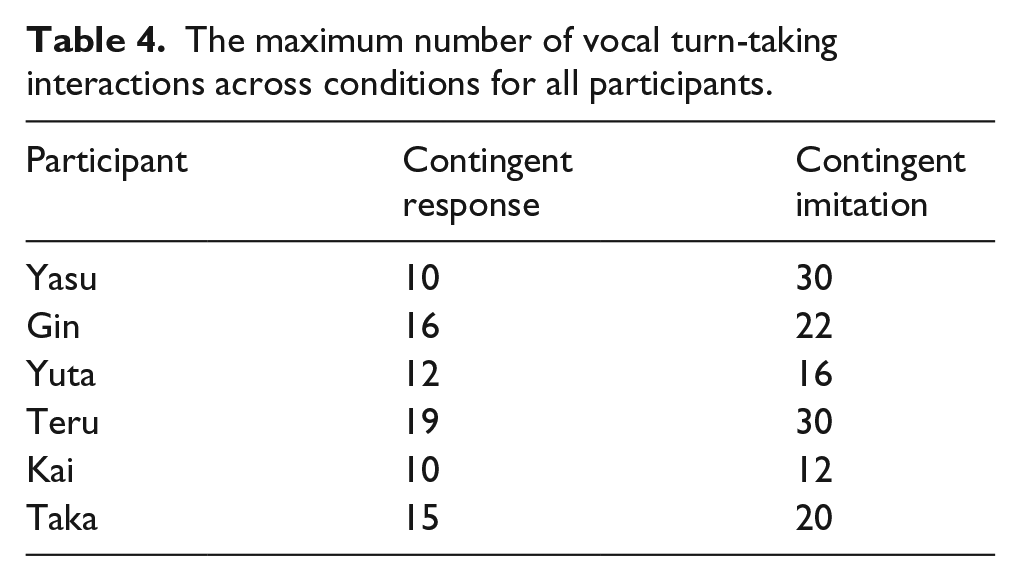
The mean number of vocal turn-taking interactions across both conditions is shown in Figure 3. There was a significant increase in the contingent imitation condition compared with the contingent response condition (Wilcoxon signed-rank test: Z = 2.20, p = 0.028, two-sided). Thus, all children showed increased vocal turn-taking during the contingent imitation condition. The maximum number of vocal turn-taking interactions is shown in Table 4. For all children, the maximum number of vocal turn-taking interactions in the contingent imitation condition was higher than in the contingent response condition. The minimum number of vocal turn-taking interactions was one turn for all children in both conditions. Yasu and Teru, who used toys as test materials, also showed increased vocal turn-taking in the contingent imitation condition at the same rate as the other four children who used picture cards as test materials.
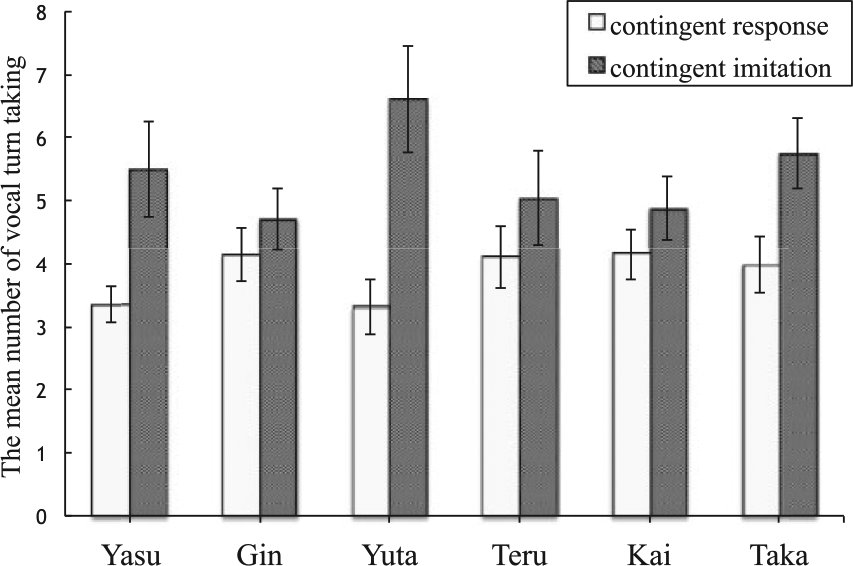
Mean number of vocal turn-taking across condition for all children.
The maximum number of vocal turn-taking interactions across conditions for all participants.
Discussion
The purpose of this study was to examine whether contingent imitation increased verbal interaction more than the contingent response condition in children with autism. The results indicated that the number of vocal imitations and vocal turn-taking interactions increased much more in the contingent imitation condition than in the contingent response condition for all children. The most important finding is that adult contingent imitation sequentially facilitate the child’s vocal imitations and thereby promote reciprocal interaction, as indicated by the turn-taking data.
Although there were already some data indicating that contingent imitation was effective for eliciting vocal imitation from children with autism (Field et al., 2001; Ingersoll and Schreibman, 2006), a direct comparison between the two conditions strongly confirmed the evidence. A single-case experimental design made it possible to discern the effect of immediate contingent imitation from that of contingent response (Field et al., 2001, 2010; Escalona et al., 2002; Heimann et al., 2006; Gazdag and Warren, 2000). The present results suggest that immediate imitation feedback is more effective at facilitating verbal interaction than immediate contingent feedback in children with autism.
This study is the first to specifically identify the effect of contingent imitation on verbal interactions such as vocal imitation, vocalization, and vocal turn-taking in children with ASDs when directly compared with the effect of contingent response. These results support the evidence that contingent imitation is shown to be effective for the emergence of preverbal behaviors compared with contingent response (Escalona et al., 2002; Field et al., 2011; Gazdag and Warren, 2000; Heimann et al., 2006).
In particular, our results suggest that contingent imitation promoted vocal imitation more than contingent response. This study shows results similar to those from previous studies involving children with intellectual disabilities Gazdag and Warren (2000).
As for vocalization, this study shows that contingent imitation also resulted in increased vocalization when compared with contingent response, although the effect of vocal imitation increased vocalization much more significantly than contingent imitation. Field et al (2001) also reported that the frequency of a child’s vocalization increases in contingent imitation in comparison with contingent response. For typically developing infants, previous findings show that both contingent imitation and contingent response function as a reinforcement for increasing vocalization. (Pelaez et al., 2011a). Sanefuji and Ohgami (2011) also showed that both contingent imitation and contingent response increased nonverbal communication, such as gaze behavior in children with typical development, whereas children with autism showed an increase in nonverbal communication in contingent imitation than contingent response. Thus, the present results indicate that contingent imitation is more effective for encouraging vocal communication than contingent response in children with autism. Because the cumulative effect of the similarity between a response and its consequence would facilitate the emergence of vocal imitation and vocalization, the responsiveness of children with autism was increased with contingent imitation (Dawson and Adams, 1984; Field et al., 2010, 2001, 2013; Nadel et al., 2000).
In the contingent imitation condition in this study, the topography of the vocal response of the adult was similar to the child’s vocal response in contrast to the contingent response, as the adult always used the vocal sounds and/or words that were already in the child’s vocal repertoire in contingent imitation. For example, it is easy for the child to imitate the adult’s vocal response, such as “car,” when the child has “car” in his or her vocal response repertoire. Previous research also suggested that the similarity of the stimuli presented by the adult and the child enhance the child’s vocal response (Dawson and Lewy, 1989; Hirsh et al., 2014; Pelaez et al., 2011b; Rovee-Collier et al., 1985). This study suggests that similarities between the child’s and adult’s vocal responses facilitate child reciprocal verbal interaction and contribute to the effect of contingent imitation.
This study’s results show that mutual imitation, comprising a behavior chain of adult contingent imitation and child imitation, occurs sequentially for all children. Thus, it may be suggested that contingent imitation would initiate reciprocal interaction (Koegel et al., 2005; MacDonald et al., 2009). Previous studies have indicated that for typically developing infants, vocal turn-taking is the foundation of early reciprocal interaction (Van Egeren et al., 2001; Warlaumont et al., 2014). The current study reveals that contingent imitation is one of the intervention techniques that encouraged reciprocal interaction between the child and adult.
The present results show that contingent imitation elicited a higher increase in vocal turn-taking and promoted higher reciprocal verbal interaction than contingent response. Because most studies have not focused on vocal turn-taking, it may become a useful dependent measure for examining the effect on reciprocal interaction. This study implies that the number of vocal turn-taking interactions is one of the dependent measures for quantifying the effect on reciprocal verbal interaction.
This study has several limitations. First, to analyze the effect of contingent imitation, this study was conducted in an experimental situation in which the child and the experimenter each sat on a chair and faced each other across a desk. Considering the setting for implementing contingent imitation, previous studies were conducted in an unstructured play interaction (Escalona et al., 2002; Field et al., 2001; Gazdag and Warren, 2000; Heimann et al., 2006; Ingersoll and Schreibman, 2006; Nadel et al., 2000), while this study was conducted in the structured setting, as the experimenter could easily be in the child’s visual field and could elicit the child’s attentiveness. These settings might encourage a child’s verbal communication. Future study is needed to examine whether vocal interaction acquired through contingent imitation could be generalized to an unstructured setting and a naturalistic environment.
Second, as for the dependent measures of vocal turn-taking, we could quantify reciprocal interaction only as an aspect of the frequency of verbal interaction. The function of turn-taking needs to be defined in future studies.
Third, we assigned two of the six children to use toys and the other four to use picture cards to encourage engagement in the tasks. The results were no difference between the materials, but further research would be needed to determine the appropriate materials and settings to use.
The purpose of this study was to find the difference between contingent imitation and contingent response in a short period of time in an experimental setting. From an applied point of view, future research is needed to clarify the effect of the long-term intervention of contingent imitation on the development of verbal interaction and reciprocal interaction. Moreover, we will further examine whether contingent imitation and extended contingent imitation have an effect on language acquisition in children with autism by determining whether they promote vocal responses to greater than a single word; that is, two- or three-word utterances.
Footnotes
Acknowledgements
The authors are very grateful to all the children and their parents who participated in this research. The authors would also like to thank M. Omori, A. Kondo, and S. Maeda for assistance with the experiments. The ethical approval was provided for this study in Ethics Review Subcommittee of Keio University Research Ethics Committee (No. 12008).
Funding
This study was supported by a Grant-in-Aid for Japan Society for the Promotion of Science (JSPS) Fellows and the CREST research project on Social Imaging, Japan Science and Technology Agency (JST).