



Abstract
We examined whether media reports linking criminal behaviour and autism spectrum disorder foster negative attitudes towards individuals with autism spectrum disorder. In a between-subjects design, participants were exposed to (a) a media story in which a murderer was labelled with autism spectrum disorder (media exposure condition) or not labelled with any disorder (control) and (b) an autism spectrum disorder-education condition attacking the myth that people diagnosed with autism spectrum disorder are likely to be violent criminals or a no-autism spectrum disorder-education condition. Participants attitudes towards three different crime perpetrators (one with autism spectrum disorder) described in separate vignettes were probed. The media exposure linking crime and autism spectrum disorder promoted more negative attitudes towards individuals with autism spectrum disorder, whereas the positive autism spectrum disorder–related educational message had the opposite effect.
Media coverage of violent and other serious crimes sometimes suggests that the perpetrator may have autism spectrum disorder (ASD), despite the absence of evidence of any formal diagnosis of the perpetrator or the presence of other plausible explanatory factors. Speculation is not surprising given the obvious public interest in serious or unusual crimes, our tendency to seek explanations for behaviour in terms of stable individual characteristics (cf. Ross, 1977), and the connotations of social behavioural abnormalities or deficits associated with the label of ASD (May and Rinehart, 2012). Nevertheless, two obvious questions that arise are whether media suggestions of a crime-ASD connection are justifiable and whether such suggestions contribute to negative attitudes toward, or stereotyping of, individuals with ASD. Recent comprehensive evaluations of a wide array of studies which are relevant to the assessment of crime prevalence in individuals with ASD (Brewer and Young, 2015; King and Murphy, 2014; Maras et al., 2015) challenge the notion that there may be a direct link between ASD and likelihood of becoming involved in criminal behaviour. The second question posed above is the focus of the present study in which we examined experimentally whether a media report suggesting a link between crime and ASD contributes to negative attitudes toward ASD, and whether such effects are moderated by positive educational messages.
Media reports can shape a variety of social and political judgments (e.g. Banaji et al., 1993), including public perceptions of people with various psychiatric disorders (e.g. Angermeyer and Matschinger, 1996). Labels denoting a psychiatric illness have been linked to a variety of negative attitudes (e.g. Angermeyer and Matschinger, 2003; Link et al., 1999). Moreover, by suggesting that perpetrators of violent crimes may have a psychiatric disorder, the media can shape negative attitudes towards such individuals, with other individuals reporting a desire to distance themselves socially from those with the disorder, and perceiving an increased likelihood of criminality and a lesser degree of trustworthiness or credibility in such individuals (Angermeyer and Matschinger, 1996; Penn et al., 1999). Yet, to date, there has not been a single controlled experimental investigation of the impact of media exposure about criminality in individuals with ASD on attitudes towards such individuals. Consequently, this issue was a primary focus of our study.
A second focus was whether negative attitudes shaped by adverse media publicity might be moderated, or simply counteracted, by positive educational messages. Educational campaigns have been used by mental health professionals and advocacy groups to reduce the negative attitudes that arise from the media’s inaccurate portrayal of people with a psychiatric disorder. Although attitudes towards people with a psychiatric disorder can be changed (Eagly and Chaiken, 1993), moderating people’s negative attitudes towards those with psychiatric disorders requires more than simply providing information about the disorder (Corrigan and Penn, 1999). For example, successful educational media campaigns have been associated with approaches such as directly attacking myths, increasing empathy through simulations and discussions, and providing personal information concerning the person diagnosed with a psychiatric disorder (e.g. Corrigan and Penn, 1999; Mann and Himelein, 2008; Penn et al., 1999). Here, we examined whether the positive effect of educational messages could be extended to those with ASD, thereby moderating the effect of media exposure on negative attitudes.
Using a controlled experimental design, participants were exposed to a media story in which a murderer was either labelled with ASD (media exposure condition) or not tagged with any clinical condition (control). Crossed with this manipulation was an educational message manipulation, one level of which included personal information regarding a person diagnosed with ASD and attacked the myth that people diagnosed with ASD are violent and criminal (cf. Corrigan and Penn, 1999; Mann and Himelein, 2008). We examined the effects of media exposure and any moderating influence of the educational message on a composite negative attitudes measure that included items tapping the desire to maintain social distance from individuals with ASD and perceptions of the likelihood of criminality and trustworthiness in individuals with ASD.
Method
Participants and design
A total of 186 predominantly undergraduate volunteers (39 male, 17–57 years, M = 24.0, standard deviation (SD) = 8.8) were recruited through the department’s research participation or Facebook websites or from a list of individuals who were prepared to take part in studies; seven did not complete the study and were excluded from all analyses. One hundred of these participants were enrolled in degree programmes incorporating psychology topics, and the rest came from various other programmes. A 2 (media exposure: exposure, control) × 2 (educational message: ASD-education, no ASD-education) between-subjects design was used, with a composite negative attitudes score as the dependent variable.
Materials and measures
Stimulus materials were presented by computer with participants randomly assigned to conditions by the computer and following simple on-screen instructions to progress from one phase of the study to the next.
Media exposure manipulation
Participants in both the exposure and control conditions read three identical media articles, except for a small section in the first article, thereby controlling for the number and length of articles read across conditions (see Supplementary Materials A pp. 1–4 for articles). 1 In the exposure condition, the ASD label was assigned in the first article to the perpetrator of a violent crime, whereas no formally classified disorder or condition was indicated in the control condition. The other two articles were about a celebrity arrested for drug possession and a politician arrested for drunk-driving, and they were used as distractors to reduce the likelihood of demand effects (cf. Domke et al., 1998). In natural settings, the news coverage of a story about a perpetrator of crime labelled with ASD is likely to be recurring, and consequently, there is likely to be repeated activation of associated judgments. Given the difficulty of effecting such a manipulation in the laboratory without producing strong demand effects, the delay between the media exposure and subsequent experimental phases was deliberately short as the impact of such exposure may depend on the recency of the activation (Domke et al., 1998) and can fade after 15–20 minutes in the absence of reactivation (Roskos-Ewoldsen et al., 2009).
Following this phase, participants answered questions about the media articles, embedded in which was a check on whether participants detected that the perpetrator in the first media article had been diagnosed with a psychiatric disorder.
Educational message manipulation
Participants in the ASD-education condition read a narrative about a young man with ASD. The narrative provided a brief description of his life, and noted the lack of a relationship between ASD and criminal behaviour. To reduce demand effects, these participants also read another narrative about the risks of alcohol consumption, a subject that had also been discussed in one of the three previously administered media articles. Participants in the no ASD-education condition were also presented with two educational messages, one of which was the narrative about alcohol consumption risks. The other educational message covered the prevalence of violent crime in Australian youths (see Supplementary Materials A pp. 5–7). This phase was followed by a brief filler task.
Vignettes
After the filler task, participants read three vignettes describing a crime. The vignettes outlined different scenarios to the previously presented media articles, although each described a person whose situation was similar to one of the three people described in the media articles. The aim was to reduce demand effects by further distracting participants from the focus on attitudes towards people with ASD. The first vignette presented concerned a man diagnosed with ASD who was charged with numerous offences and corresponded to the previously administered media article. The second vignette described a celebrity who was arrested for drunk-driving, resulting in his passengers being critically injured. The third and final vignette presented described a politician charged with the offence of misappropriating public funds to pay off his gambling debts (see Supplementary Materials p. 8 for vignettes).
Negative attitudes questionnaire
The dependent measure contained 12 items (see Supplementary Materials B) tapping the participants’ negative attitudes towards people like the person described in each of the three vignettes. The questionnaire was administered after each vignette, but the responses of interest were to the vignette about the man diagnosed with ASD. Four items were based on items from Link et al.’s (1987) Social Distance Scale, which has been used to examine the desire for increased social distance (e.g. How willing would you be to work on the same job as someone like ***: 0 = definitely willing; 3 = definitely unwilling) from, for example, people with schizophrenia and depression. Five items were adapted from Link et al.’s (1987) Perceived Dangerousness of Mental Patients questionnaire to tap perceptions of likelihood of criminality (e.g. If a group of people like *** lived nearby I would not hesitate to allow young children under my care to play on the sidewalk: 0 = strongly agree; 5 = strongly disagree). Three items tapped perceptions of trustworthiness (e.g. Please rate the extent to which you believe *** is trustworthy: 0 = not at all; 7 = extremely). With individual items from the different sub-scales reverse-coded where appropriate, the item-total coefficients ranged from 0.43 to 0.72. Coefficient alpha for all 12 items was .89, though we note the reservations regarding the interpretation of alpha (Sijtsma, 2009). Given the different response scales used for the three sub-groups of items, z-scores for each of the 12 items of the negative attitudes questionnaire were averaged to make a composite negative attitudes score for each participant. A larger, or more positive, average z-score denotes a more negative attitude.
Background questionnaire
This questionnaire obtained information regarding participants’ age and gender, knowledge of ASD when asked to list six characteristics of ASD, and the overall believability of the three media articles.
Procedure
Participants were informed that the study was exploring attitudes towards different types of crime and were randomly assigned to one of the four cells of the design. They were asked to read three media articles, followed in order by (1) the questions which included the manipulation check for participants’ detection of any psychiatric diagnosis or clinical condition; (2) the educational messages; (3) a video filler activity; (4) three vignettes to read, each followed by the negative attitudes questionnaire framed with reference to the person in the vignette just read and (5) the background questionnaire.
Results
Manipulation checks
Most (94.4%) of participants in the media exposure condition correctly reported that the perpetrator in the first media article was diagnosed with ASD, whereas 85.6% of control participants indicated that the perpetrator was not diagnosed with any psychiatric disorder or clinical condition. Participants’ views about the believability (0 = not at all believable; 6 = very believable) of the media articles averaged on the believable side of the scale midpoint (M = 3.33, SD = 1.43).
Negative attitudes dependent variable
A 2 (media exposure: exposure, control) × 2 (educational message: ASD-education, no ASD-education) between-groups analysis of variance (ANOVA) was performed on the composite negative attitudes score variable. The ANOVA revealed significant main effects of media exposure, F(1, 175) = 4.25, p = .04, d = 0.31, 95% confidence interval (CI): (.01, .60), and educational message, F(1, 175) = 15.71, p < .001, d = 0.59, 95% CI (.29, .89). As shown in Figure 1, negative attitudes towards people with ASD were more pronounced in the media exposure condition and in the absence of ASD-education. However, the Media Exposure × Educational Message interaction was not statistically significant, F(1, 175) < 1, η2p, indicating that the impact of media exposure was not moderated by the educational message.
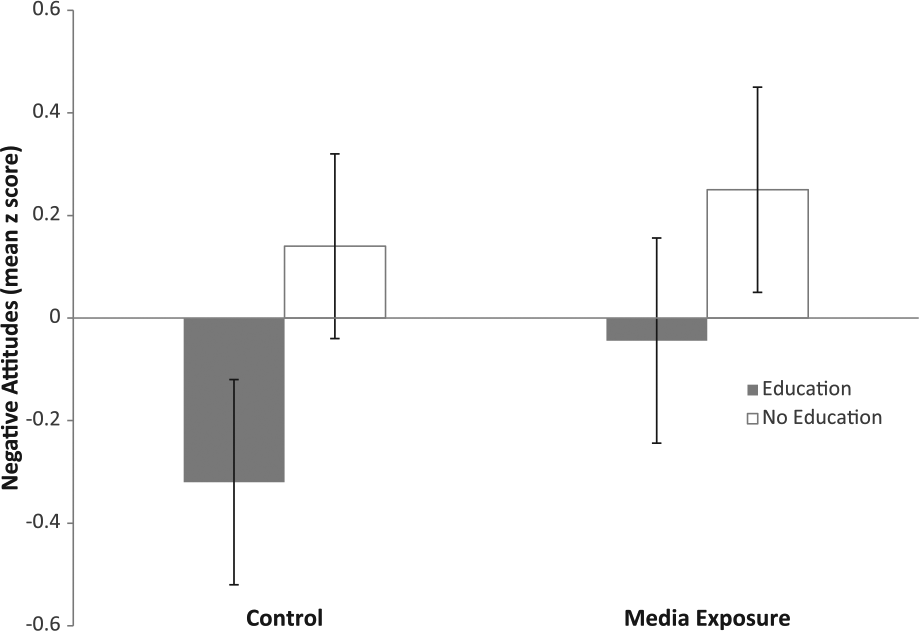
Means (95% confidence intervals) for composite negative attitudes* (12-item average z-score) by media exposure and educational message.
Discussion
Negative media reports suggesting a connection between ASD and violent behaviour promoted negative attitudes towards individuals with ASD. This effect was produced by a single media exposure episode and is consistent with findings reported from, for example, research on schizophrenia. It seems conceivable that more powerful effects might be detected with (a) repeated episodes of exposure, as would often happen with media reports of real-life events, (b) more traditional and perhaps believable (i.e. non-simulated) media sources, and perhaps (c) non-student samples.
In contrast, a simple educational message resulted in less negative attitudes to individuals with ASD, although the absence of an interaction indicated that it did not moderate the negative effect of media exposure. A reason for the lack of interaction is suggested by performance on the brief knowledge test regarding ASD. Knowledge of ASD was generally poor; when asked to list six characteristics of ASD the mean number of correct characteristics listed was less than 2, even for those exposed to the educational message. Thus, the impact of the educational message was encouraging, suggesting that broader knowledge about the disorder might buffer the impact of negative media reports.
For some, these findings likely seem completely unsurprising. Yet, they provide the first empirical evidence that media-fuelled links between crime and ASD could have widespread unintended negative consequences. Thus, the findings provide a starting point for systematic research in this area and a basis for reflection about media behaviour. Of course, the tightly controlled experimental nature of the study means it is impossible to assess the likely influence of negative media exposure and educational messages when they are located within a more naturalistic context, the likely durability of any effects, the differential effects of such variables depending on the characteristics of the message recipients or, crucially, how attitudinal states engendered might translate into behaviour. Moreover, our data do not speak to the mechanism(s) underpinning the effects. It may be that both manipulations simply informed beliefs about the link between ASD and crime, with the media exposure and educational manipulations, respectively, increasing and decreasing participants’ beliefs about the association between ASD and crime. Also, there are certain to be features of individuals with ASD (e.g. special skills) that are likely to distinguish them, in the eyes of members of the broader community, from individuals with other formally classified psychiatric disorders and, hence, may moderate how media and educational messages are interpreted. What is clear, however, from these preliminary findings is that systematic research into such issues is required in order to understand the variety of influences that may compromise the interactions that people with ASD may have with the broader community.
Footnotes
Funding
This research was supported by a Faculty of Social and Behavioural Sciences Research Grant to N. Brewer and R. Young.