



Abstract
Students with autism are more likely to be bullied than their typically developing peers. However, several studies have shown that their likelihood of being bullied increases in the context of exposure to certain risk factors (e.g. behaviour difficulties and poor peer relationships). This study explores vulnerability to bullying from a cumulative risk perspective, where the number of risks rather than their nature is considered. A total of 722 teachers and 119 parents of young people with autism spectrum conditions participated in the study. Established risk factors were summed to form a cumulative risk score in teacher and parent models. There was evidence of a cumulative risk effect in both models, suggesting that as the number of risks increased, so did exposure to bullying. A quadratic effect was found in the teacher model, indicating that there was a disproportionate increase in the likelihood of being bullied in relation to the number of risk factors to which a young person was exposed. In light of these findings, it is proposed that more attention needs to be given to the number of risks to which children and young people with autism spectrum conditions are exposed when planning interventions and providing a suitable educational environment.
Introduction
Young people with autism spectrum conditions (ASC) are recognised as a group particularly vulnerable to becoming the victims of bullying (e.g. Cappadocia et al., 2012; Kloosterman et al., 2013). While estimates vary according to measurement and context, findings are consistently higher than among the general population (Maïano et al., 2015), and there is evidence to suggest that this group of young people may be among the most vulnerable of all those identified as having special educational needs (Humphrey et al., 2011). While an increasing number of risk factors 1 are being identified, it is likely that each individual’s risk profile is unique, making intervention challenging. However, research has yet to explore the relationship between the number of risks to which a young person is exposed and the severity of bullying. Studies on behaviour problems among the general population of young people (e.g. Lima et al., 2010) and more recently those with special educational needs (Oldfield et al., 2015) have indicated that negative outcomes increase disproportionately in relation to the number of risk factors to which the individual is exposed. In this article, we seek to determine whether such a ‘cumulative risk effect’ exists in relation to the level of bullying exposure among young people with ASC reported by their parents and teachers.
Bullying of young people with ASC
Bullying is a form of social aggression that can be direct (e.g. physical violence and name-calling) or indirect (e.g. spreading of malicious rumours). According to Olweus (1993), ‘a student is being bullied or victimised when he or she is exposed, repeatedly and over time, to negative actions on the part of one or more other students’ (p. 9). The consequences of being bullied can be severe and long-lasting, negatively affecting a child’s self-esteem (Bond et al., 2001), mental health (Turner et al., 2006), behaviour (Sourander et al., 2007) and educational success (Green et al., 2010). While all schools in England are required to have an anti-bullying policy that reflects legislation, bullying remains a concern, with young people with ASC considered particularly at risk (Reid and Batten, 2006).
However, some young people with ASC are bullied more than others, and indeed, some are not bullied at all. In light of this, research has begun to identify the risk factors associated with an increased likelihood of exposure to bullying. For example, Sofronoff et al. (2011) found social vulnerability to be the strongest predictor of being bullied among young people with Asperger syndrome. Similarly, Hebron and Humphrey (2013) found co-morbid behaviour difficulties to be the strongest predictor for becoming the victim of bullying in teacher and parent reports. Other significant risk factors were being older, attending a mainstream (rather than special) school, having lower levels of educational support, and using public transport to travel to and from school. Recent reviews of studies exploring risk for becoming the victim of bullying among young people with ASC (e.g. Schroeder et al., 2014) confirm that while there appear to be some key risks which have been explored in a number of studies, the range of potential risks is broad, encompassing contextual factors (e.g. type of school attended), as well as behavioural, cognitive, social and emotional domains.
This range of risk factors makes intervention problematic and challenging, as it is unlikely that two young people with ASC will be exposed to an identical set of risks. Indeed, it is possible that a situation that constitutes risk for one young person may not for another (e.g. break-time, travelling to and from school). Furthermore, it is simply not practical to have an intervention for every eventuality. Therefore, it is timely to consider whether it is the individual risks (e.g. relationships with others and type of educational setting) that are more important in predicting bullying or the number of risks (regardless of their nature). Surprisingly, this cumulative risk hypothesis has not been explored in relation to bullying and ASC. This constitutes a significant gap in the current knowledge base.
Cumulative risk
The identification of risk (and less commonly protective) factors is central to many studies investigating bullying among young people with ASC. However, it must be questioned whether focusing on risk factors in isolation is practical, as they are rarely completely independent of one another and can be said to cluster within or around individuals (Evans et al., 2013; Flouri and Kallis, 2007). Overall risk is frequently explored by entering variables independently into additive multiple regression models (Gutman et al., 2003). This permits predictor variables to be assessed, gives an overall model fit in terms of variance that can be explained (Field, 2013), and also provides a suitable way to explore the relative strength of predictors. Nevertheless, significant risk factors in additive models often tend to account for small amounts of variance in isolation (Dodge and Pettit, 2003).
By contrast, the cumulative risk hypothesis is more concerned with the effect of the number of risk factors in combination rather than their relative strength (Appleyard et al., 2005). This is based on the principle that summing identified risk variables to produce a cumulative risk score will result in a better predictive model than if they were analysed independently of each other (Appleyard et al., 2005). Within psychology, this approach has its origins in the study of maladjustment when Rutter et al. (1975) found that no risk factor in isolation was a significant predictor of behaviour problems, but when a child was exposed to two or more factors, there was up to a fourfold increase in these difficulties.
There are two underlying assumptions when using cumulative risk models. First, number is regarded as more important than the nature of risk (Morales and Guerra, 2006); in other words, the number of bullying risk factors to which an individual is exposed is more important than any single or combination of risk factors. This principle is based on equifinality (Dodge and Pettit, 2003); the notion that there are multiple pathways to an outcome. Therefore, children and young people with ASC may become vulnerable to becoming victims of bullying in response to a range of risks that are unique to their circumstances (i.e. individuals will have different sets of risks, and these will vary throughout their lives). Second, more risk factors equate to an increased severity of outcome (Trentacosta et al., 2008). In the context of ASC, as the number of risk factors to which a young person is exposed increases, so will vulnerability to becoming the victim of bullying.
Measuring cumulative risk
Cumulative risk is assessed by summing together identified risk factors. As each risk factor is treated equally in cumulative risk models, no weighting is required (Flouri and Kallis, 2007). This results in a cumulative risk score which is used during modelling as an explanatory variable (Gerard and Buehler, 2004). Risk variables are usually identified when they have a statistically significant association with the outcome variable (Lima et al., 2010). In the case of continuous variables, scores in the lowest or highest 25% (depending on the variable being measured) are deemed risk and given a score of 1, with the remaining 75% scored as 0. Similarly, for dichotomous variables, risk is coded 1 (present) or 0 (absent).
A key aspect of cumulative risk research relates to the functional form of the relationship between the cumulative risk score and the outcome variable (Appleyard et al., 2005), specifically whether it is linear or non-linear in nature (Flouri et al., 2010). If it is linear, then the increase in risk is proportional to the outcome. Such linear effects have been demonstrated in the behaviour literature (e.g. Gerard and Buehler, 2004; Raviv et al., 2010). If it is non-linear, then it is possible to describe either a saturation point (Evans, 2003) at which an increasing number of risk factors begin to have a less marked ‘plateau’ effect, or a quadratic relationship (Raviv et al., 2010) where there is a disproportionate increase in the bullying mean score beyond a certain threshold as the cumulative risk score increases. This latter effect has been termed mass accumulation (Gerard and Buehler, 2004).
This study
A notable gap in the literature on bullying of young people with ASC concerns the relative importance of the number of risks rather than their nature. We sought to address this gap in this study, which was driven by the following research questions:
Is there a cumulative risk effect on bullying exposure among children and young people with ASC?
What is the functional form of the relationship between the number of risk factors and the extent of bullying exposure?
Method
Design
A cross-sectional natural variation design was utilised, with data drawn from the larger government-funded evaluation of the Achievement for All pilot project (Humphrey et al., 2011). Data were analysed in two stages: first, by identifying significant predictors for becoming the victim of bullying by means of multiple regression analysis, reported in Hebron and Humphrey (2013); second, by summing these significant risk factors to form a cumulative risk score, enabling the cumulative risk hypothesis to be explored.
Participants
Teachers (N = 722) and parents (N = 119) of young people with ASC across 269 schools in 10 local authorities (LAs) in England took part in the study (see Hebron and Humphrey, 2013). The young people were drawn from four school year groups: years 1 (age 5/6) and 5 (age 9/10) in primary schools and years 7 (age 11/12) and 10 (age 14/15) in secondary schools. All of the pupils attended mainstream or special schools, had a primary need of ‘autism spectrum disorder’ confirmed by each school’s special educational needs co-ordinator (SENCO) and were receiving special educational needs and disability (SEND) provision according to the Code of Practice for Identification and Assessment of SEND (DfES, 2001).
Materials
Data on the pupils were gained through a number of sources (see Hebron and Humphrey, 2013). Questionnaire data were gathered through use of the Wider Outcome Survey for Teachers (WOST) and the Wider Outcome Survey for Parents (WOSP). The WOST contains three sub-scales: bullying (seven items), behaviour difficulties (six items) and positive relationships (seven items). The WOSP contains the same three sub-scales but has two additional ones: parental engagement and confidence (eight items) and wider participation (eight items). Teachers and parents were asked to read all of the statements in the sub-scales (e.g. the pupil/my child is called names or teased by other children; the pupil/my child says nasty things to other children) and respond using a four-point scale. Responses were scored from zero to three. Both surveys demonstrate good content validity, strong internal consistency, excellent construct validity, acceptable floor/no ceiling effects and good interpretability (for more information on the WOST and WOSP, see Humphrey et al., 2011; for the WOST, see Wigelsworth et al., 2013). Socio-demographic information (e.g. type of school attended, mode of transport to and from school and year group) was obtained through census data in the national pupil database (NPD) and LA databases, as well as contextual information (e.g. school location and size) from Edubase.
Procedure
Ethical approval was granted at the lead author’s institution. Consent to participate was provided on an opt-out basis. Teachers completed surveys for any eligible student(s), with parents completing it for their own child or children (if they had more than one in the study), allowing separate teacher and parent models for analysis.
Analysis
All data were screened prior to analysis. The teacher and parent datasets were found to be fit for purpose, with only minor violations of acceptable missing data tolerances (e.g. <5%, Graham, 2009). The initial task was to identify statistically significant predictors of bullying, and this was done by entering potential risk factors into a multiple regression models for teacher and parent responses (reported in Hebron and Humphrey, 2013). The teacher model revealed five variables that were significant predictors of bullying: increased behaviour difficulties, increased age, educational placement (mainstream rather than special), lower positive relationships and use of public/school transport to travel to and from school. The parent model contained four significant predictors of bullying: increased behaviour difficulties, increased age, lower parental engagement and being at School Action Plus (rather than having a Statement of SEND 2 ).
Cumulative risk scores
The significant predictors identified in our original study were summed to create a cumulative risk score for the parent and teacher models, thus enabling us to test the cumulative risk hypothesis (see Tables 1 to 3 for details of these variables, frequencies and correlations).
Risk factors used to calculate the risk score in the teacher and parent models.
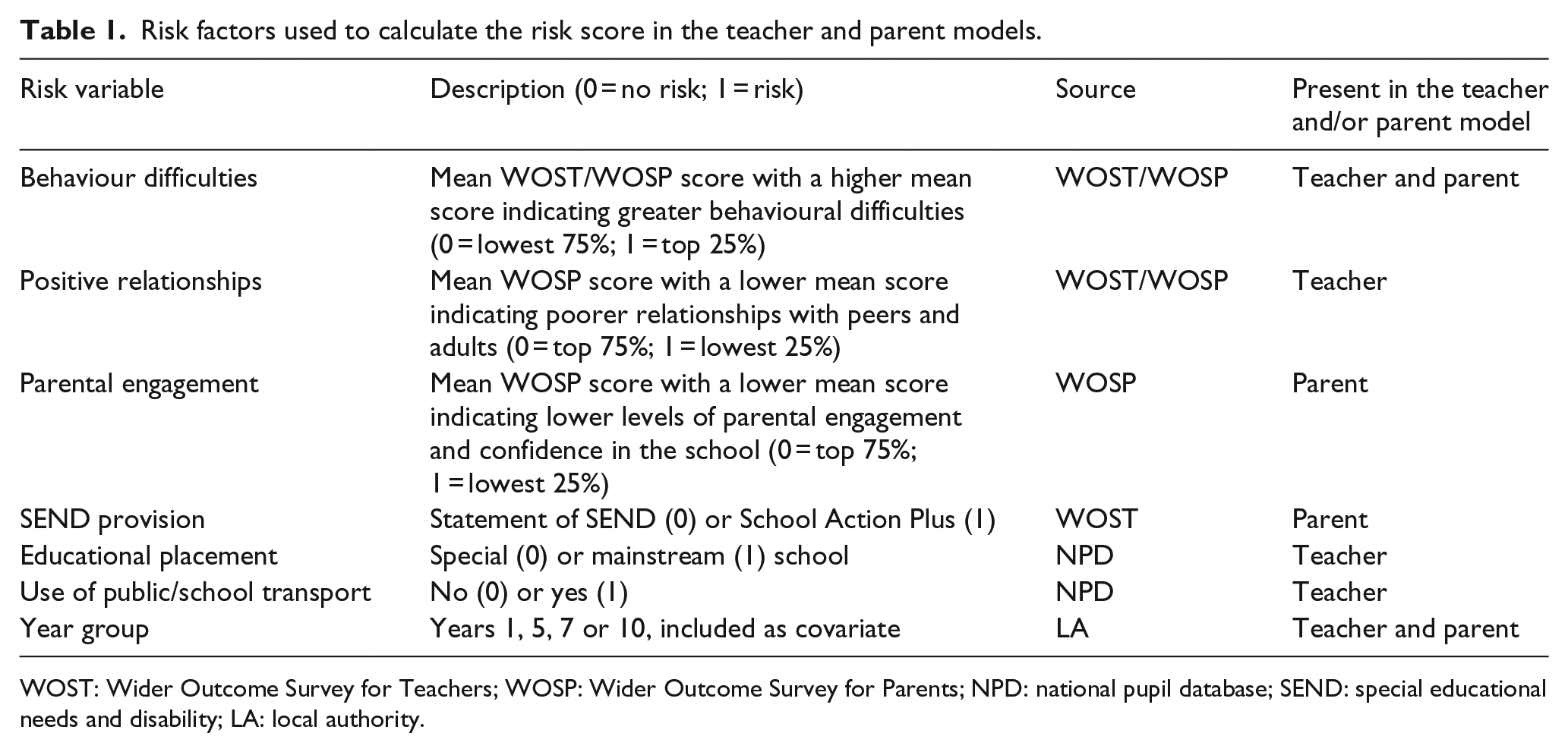
WOST: Wider Outcome Survey for Teachers; WOSP: Wider Outcome Survey for Parents; NPD: national pupil database; SEND: special educational needs and disability; LA: local authority.
Frequencies of predictor variables and correlation with the bullying mean in the teacher-rated model.

Frequencies of predictor variables and correlation with the bullying mean in the parent-rated model.

SEND: special educational needs and disability.
The risk variables range from those which have a robust literature base (e.g. positive relationships in Van Roekel et al., 2010), as well as those with a more inconsistent research base (e.g. educational placement in Reid and Batten, 2006). However, three of the risk variables used to form the cumulative risk score can be considered ‘new’ risk variables in the ASC bullying literature: use of public/school transport, parental engagement and SEND provision (Hebron and Humphrey, 2013).
Consistent with the literature (Flouri and Kallis, 2007), only variables that could be manipulated were used as risk variables, with the fixed variable of year group therefore entered as a covariate. There were two stages to the analysis: first, the summed cumulative risk score was regressed onto the bully mean score as a unique explanatory variable to test the cumulative risk hypothesis; second, the quadratic term (cumulative risk squared; Aiken and West, 1991) was added as a second explanatory variable in order to explore the functional form of the relationship (linear vs. non-linear).
Results
Is there a cumulative risk effect on bullying exposure among children and young people with ASC?
The bullying mean in both the teacher and parent models increased with each additional risk factor, indicating that the likelihood of becoming a victim of bullying rose incrementally according to the number of risk factors to which a child was exposed. Children in the teacher-rated model (Table 4) had between zero and four risk factors, while children in the parent-rated model (Table 5) were exposed to between zero and three risk factors. In both models, one risk represented the largest category of responses.
Number of risks and the increase in bullying mean (with standard deviation) in the teacher-rated model.
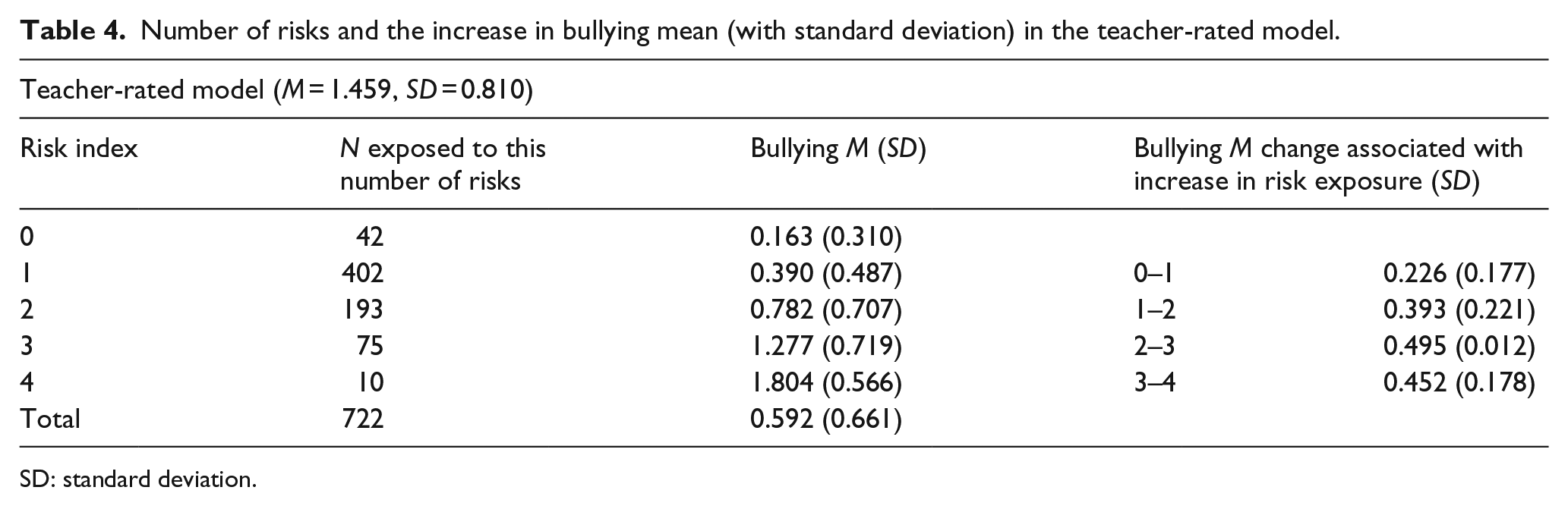
SD: standard deviation.
Number of risks and the increase in bullying mean (with standard deviation) in the parent-rated model.
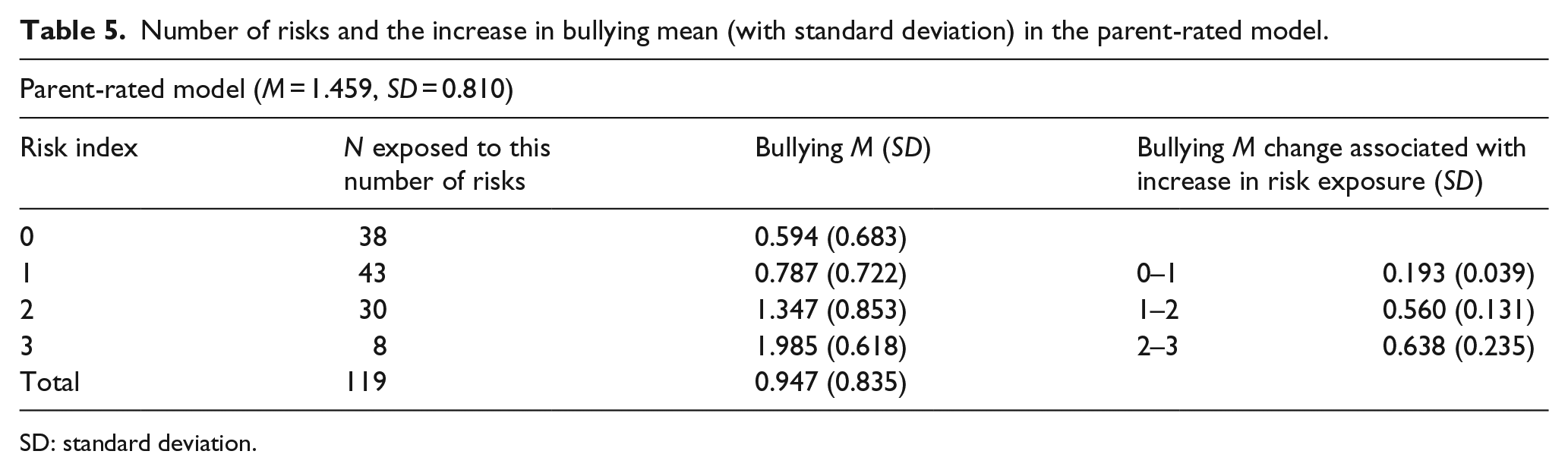
SD: standard deviation.
In order to assess whether the cumulative risk score showed a positive association with the bullying mean, a regression analysis was applied with the bullying mean score as the outcome variable. The cumulative risk score was added to the models, with year group included as a covariate.
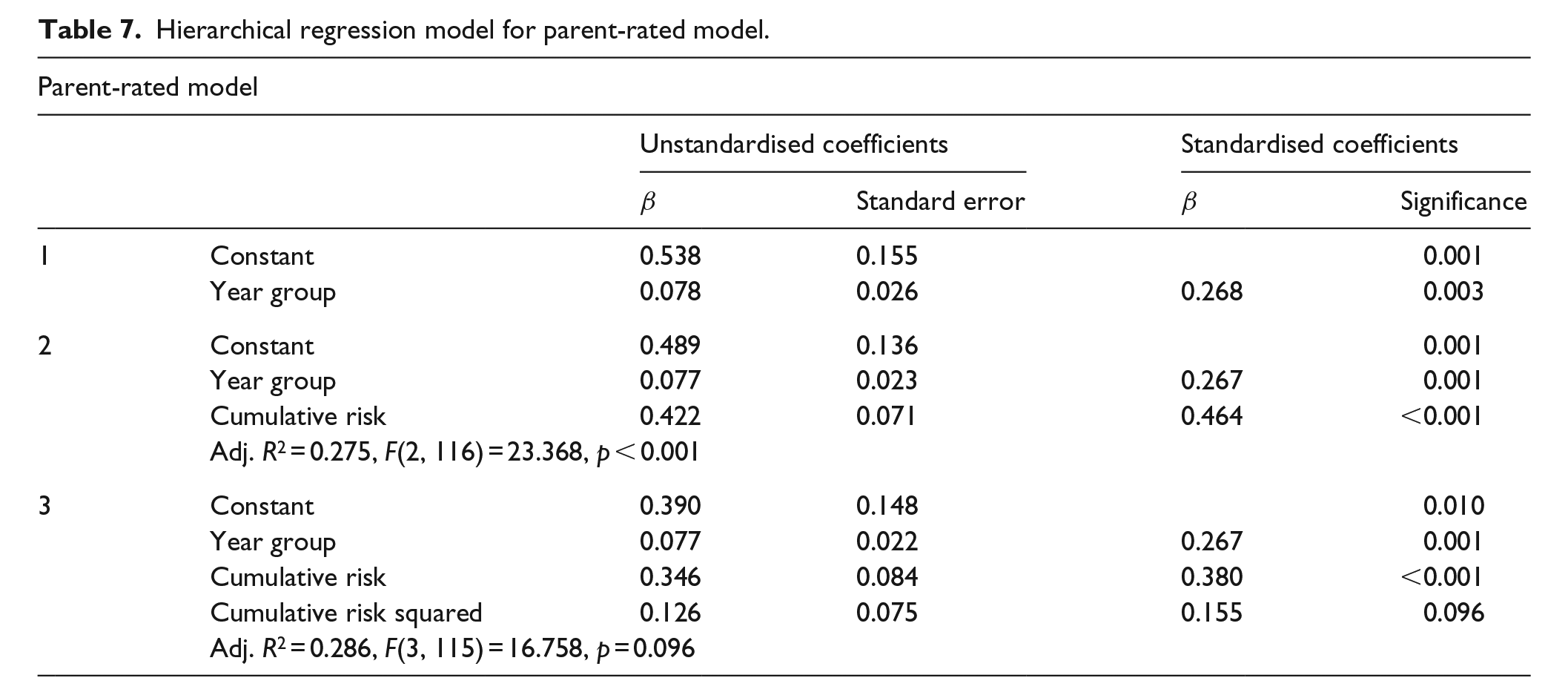
The results indicate that both the teacher-rated (Adj. R2 = 0.275, F(2, 719) = 137.429, p < 0.001) and parent-rated (Adj. R2 = 0.275, F(2, 116) = 23.368, p < 0.001) models were significant, both accounting for 27.5% of the variance in the bullying mean score, as demonstrated in Tables 6 and 7. Within both the teacher (β = 0.500, p < 0.001) and parent (β = 0.464, p = <0.001) models, the cumulative risk score was a significant predictor of bullying. With each additional risk to which the child is exposed, the bullying mean score increases by 0.500 in the teacher model and by 0.464 in the parent one. These findings support the cumulative risk hypothesis that levels of bullying are predicted by the number of risks to which a child is exposed.
Hierarchical regression model for teacher-rated model.
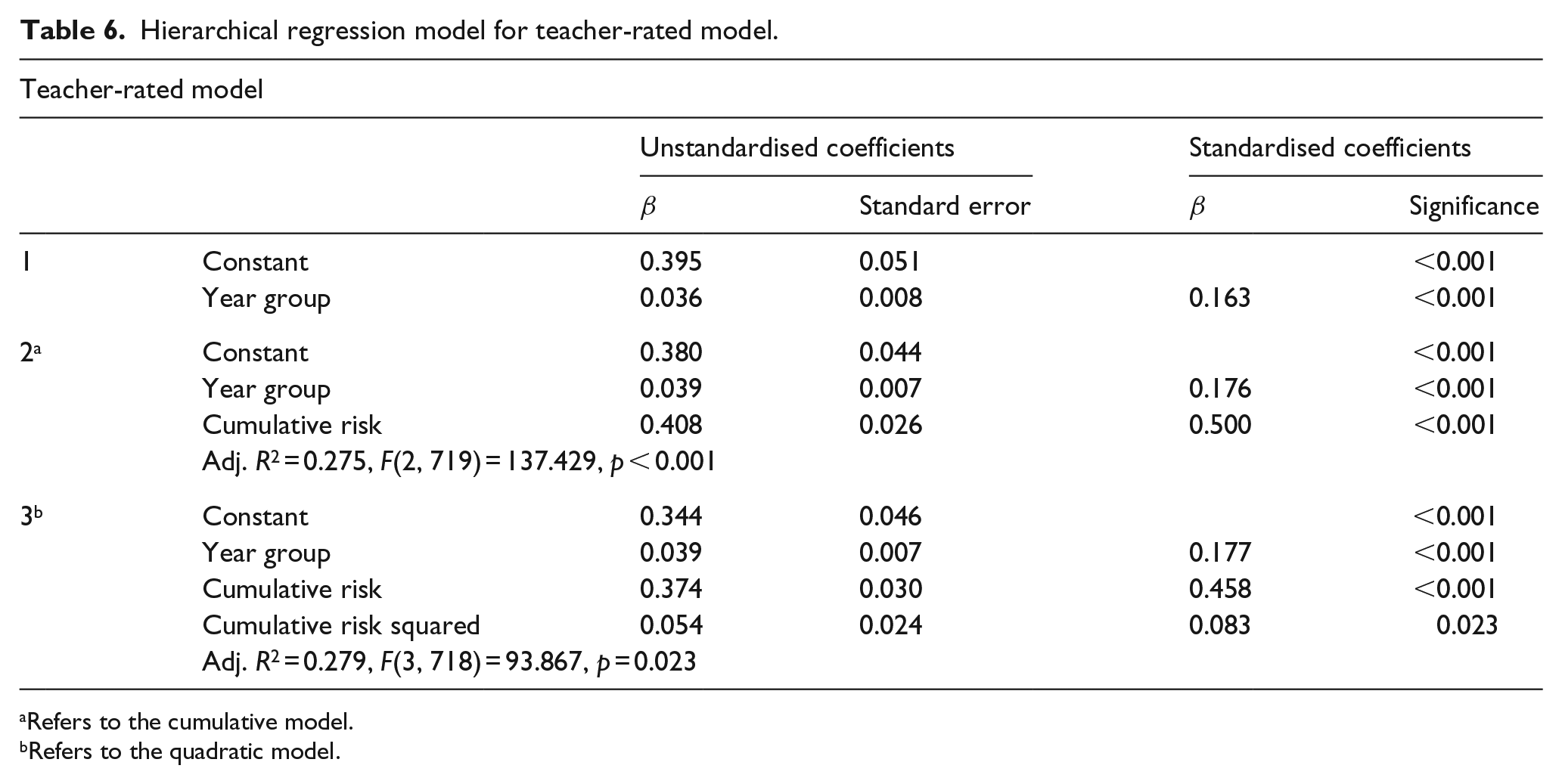
Refers to the cumulative model.
Refers to the quadratic model.
Hierarchical regression model for parent-rated model.
What is the functional form of the relationship between the number of risk factors and the extent of bullying exposure?
With an increase in the bullying mean noted in both models as the number of risks rose, the functional form of the increase was then explored, in order to determine whether it was linear or quadratic in nature. The changes in the bullying means as function of rising number of risks are shown in Tables 6 and 7, with the gradients illustrated in Figure 1. In the teacher model, there is evidence to suggest that the increase in bullying mean was not linear across all risks, with a smaller change in the bullying mean between 0 and 1 risk compared with the other risk points. The parent model was similar in that it did not indicate a linear relationship across all risks. In this latter model, a smaller increase in the bullying mean is observed between 0 and 1 risk compared with the other risk points.

Slope of cumulative risk scores for the teacher- and parent-rated bullying models.
The nature of this relationship was explored further by adopting the approach taken by Aiken and West (1991). To test for a non-linear quadratic relationship, an additional variable called cumulative risk squared was created. By adding this variable to a hierarchical multiple regression model, any additional variance beyond that found in the previous stage (testing for a linear relationship) would indicate a better model fit and therefore a quadratic relationship. The cumulative risk squared variables were centred in order to avoid the risk of multicollinearity before entering them into the teacher-rated and parent-rated regression models. This third stage became the quadratic model (Gerard and Buehler, 2004). The results of the analyses for the teacher-rated model are presented in Table 6 and for the parent-rated model in Table 7.
In the teacher-rated model (Adj. R2 = 0.279, F(3, 718) = 93.867, p = 0.023), the model fit slightly improved when the cumulative risk squared variable was added (increasing from a 27.5% to a 27.9% fit); this increase was statistically significant (R2 change = 0.005, p = 0.023). This would suggest that the increase in the risk of being bullied rises in a quadratic rather than linear manner. The parent-rated model fit (Adj. R2 = 0.286, F(3, 115) = 16.758, p = 0.096) improved to a marginal, non-significant degree when the squared term was added (R2 change = 0.017, p = 0.096), indicating that the functional form of the relationship between increased risk exposure and bullying is linear.
Discussion
The findings in this study – both in the teacher and parent models – indicate that cumulative risk is a significant predictor of increased bullying among young people with ASC. Of particular concern are the findings in the teacher model, which appear to demonstrate a mass accumulation effect (i.e. disproportionately high increase in exposure to bullying as the number of risks increase). Although this effect was not replicated in the parent model, where the relationship was linear in nature (i.e. exposure to bullying rose in line with the number of risks to which a young person was exposed), this could be due to a lower number of risks being assessed and also a smaller sample size limiting our statistical precision. The results presented here offer tentative support for the cumulative risk hypothesis in relation to bullying of young people with ASC. This study therefore adds to the growing evidence in support of the cumulative risk hypothesis (e.g. Oldfield et al., 2015; Raviv et al., 2010) and extends the knowledge base by focusing on a new population (e.g. those with ASC) and outcome variable (e.g. bullying).
Previous research into risk factors for becoming the victim of bullying among young people with ASC has revealed a growing number of risks, with some emerging more frequently than others (e.g. poor peer relationships in Bauminger et al., 2003; behaviour difficulties in Macintosh and Dissanayake, 2006; the importance of social vulnerability in Sofronoff et al., 2011), especially at the individual level. However, as research in this field continues to expand, an increasing number of contextual risk factors are being identified (e.g. using school/public transport to travel to and from school in Hebron and Humphrey, 2013; attending mainstream classes in Sterzing et al., 2012), highlighting that greater attention needs to be focused on factors external to the individual and which may be having a highly detrimental impact on their risk of exposure to bullying. While all are valuable findings, it is the authors’ contention that it is unlikely that two young people will have an identical risk profile, as this is unique to each person and depends on a potentially huge number of influences. For example, this may include the area in which a young person lives, school ethos, level of educational support provided, as well as the developmental trajectory of the young person, along with his or her personality traits. Indeed, it may be argued that what constitutes a risk for one young person may not be so for another in a different environment (e.g. peer attitudes towards a young person with ASC of exceptional ability in a comprehensive vs selective educational setting). Therefore, it can be contended that there are multiple and complex pathways to the risk of becoming a victim of bullying for young people with ASC, confirming the principle of equifinality (Dodge and Pettit, 2003).
It is without doubt important to consider the different risks to which a young person is exposed, but targeting each one in isolation is often neither practical nor feasible. Anti-bullying interventions are traditionally multi-component in nature, targeting a number of areas (for a meta-analysis, see Ttofi and Farrington, 2011). On the whole, anti-bullying interventions do appear to have an overall positive effect (Merrell et al., 2008; Ttofi and Farrington, 2011). Nevertheless, it is pertinent to question whether an enduring lack of high efficacy (i.e. medium and large effect sizes) in tackling a very common and well-researched problem could be due, at least in part, to a lack of focus upon the number rather than the precise nature of the risks to which a young person is exposed. Vulnerability to bullying among young people with ASC is the focus of a growing number of studies, and so it is perhaps surprising that there are few specific anti-bullying interventions for this group of vulnerable young people. Interventions tailored to those with ASC tend to focus on improving the individual’s understanding of social situations (e.g. DeRosier et al., 2011) without considering external/contextual factors which may be equally or indeed more important in reducing vulnerability to bullying (e.g. a safe environment and appropriate activities for the individual to engage in during lunch breaks).
The findings presented here highlight an area of potential significance in continuing to understand and address the issue of vulnerability to bullying among children and young people with ASC. First, if the number of identified risks to which a young person is exposed are predictive of the level of bullying reported, then research and intervention efforts need to look beyond individual-level risk factors – while still acknowledging them – and towards the contextual influences which have the potential to significantly increase the risk of a young person being bullied. For example, intervention with the peer group has been demonstrated to have an impact on bullying behaviour (e.g. training peers to avoid reinforcing bullying behaviour and offer more support to victims in Kärnä et al., 2011). The importance of educating the peer group is increasingly recognised in the literature (e.g. Campbell and Barger, 2014), contributing to more holistic and accepting educational environments in which the differences associated with ASC are valued. Adults can also be targeted by means of staff-training and parent-training aimed at challenging attitudes and raising awareness of young people at heightened vulnerability to bullying (e.g. Humphrey et al., 2015). Second, although some factors cannot be directly addressed through intervention (e.g. SEND provision, type of school attended and age in this study), awareness can and should be raised of their potential to raise a child’s vulnerability to being bullied. This should ideally become embedded in decision-making processes in order to assist in prevention rather than simply responding to bullying once it has started.
Therefore, as it is impractical to target each risk individually (and any risk profile is likely to be unique to the individual), it is arguably more appropriate and realistic to aim towards lowering the overall number of risks present in a young person’s life through intervention and raised awareness. This is a different way of approaching the issue of bullying prevention and should therefore be seen as complementary rather than as a challenge to current anti-bullying strategies.
A potential criticism of the approach taken in this article is that by treating all risks as equal, we ignore the possibility that different risks have varying effects on the outcome variable (Hall et al., 2010). The authors acknowledge this and argue that both the number and nature of risks need to be taken into consideration, due to the highly individualised nature of a person’s risk profile. This could be addressed by the development of integrated models of prevention that are designed with sufficient flexibility to permit more individualised approaches, thereby avoiding the ‘program for every problem’ (Domitrovich et al., 2010: 74) approach that has been criticised for its lack of real-life practicality. Furthermore, while previous literature in related fields (e.g. behaviour difficulties in Appleyard et al., 2005) has used identified risk factors to compose cumulative risk scores, future studies should consider whether inclusion of risk factors not individually predictive of bullying may potentially add to the cumulative risk to which children and young people with ASC are exposed.
It is also acknowledged that the absence of self-report in this study excludes the voice of young people with ASC. However, the youngest age-group involved (6 year olds) and the wide range of intellectual ability in the sample meant that it was unfortunately not practical to utilise self-report. This should be incorporated into future studies where possible. In addition, despite a relatively large number of identified risk factors for bullying emerging in the literature, only a small number were used in the predictive teacher and parent models in this study: this is an artefact of the data being drawn from a larger study. Replication of our findings with a more comprehensive range of risk factors is therefore warranted to test further the cumulative risk hypothesis examined here.
Conclusion
This study explored the cumulative risk hypothesis in relation to the bullying of young people with ASC, revealing it to be a significant predictor in both teacher- and parent-rated models. This suggests that reducing the number of risks for bullying through flexible approaches may be more important than tackling the specific risks to which a young person is exposed. Our findings reflect the need to acknowledge the unique and highly contextualised risk profile of each young person. As the first study to examine cumulative risk effects on bullying of young people with ASC, our findings require replication. However, it is hoped that this emergent evidence will contribute to the debate on how to reduce exposure to bullying among this highly vulnerable group of young people.
Footnotes
Acknowledgements
We are grateful to the parents and teachers who kindly gave up their time to participate in this research.
Funding
This research was funded by the Department for Education, England.