



Abstract
Although superior visual search skills have been repeatedly reported for individuals with autism spectrum disorder, the underlying mechanisms remain controversial. To specify the locus where individuals with autism spectrum disorder excel in visual search, we compared the performance of autism spectrum disorder adults and healthy controls in briefly presented search tasks, where the search display was replaced by a noise mask at a stimulus-mask asynchrony of 160 ms to interfere with a serial search process while bottom-up visual processing remains intact. We found that participants with autism spectrum disorder show faster overall reaction times regardless of the number of stimuli and the presence of a target with higher accuracy than controls in a luminance and shape conjunction search task as well as a hard feature search task where the target feature information was ineffective in prioritizing likely target stimuli. In addition, the analysis of target eccentricity illustrated that the autism spectrum disorder group has better target discriminability regardless of target eccentricity, suggesting that the autism spectrum disorder advantage does not derive from a reduced crowding effect, which is known to be enhanced with increasing retinal eccentricity. The findings suggest that individuals with autism spectrum disorder excel in non-search processes, especially in the simultaneous discrimination of multiple visual stimuli.
Introduction
Individuals with autism spectrum disorder (ASD) demonstrate superior performance on certain perceptual tasks such as the embedded figure task, block design task, and visual search task (Jolliffe and Baron-Cohen, 1997; Shah and Frith, 1983; Witkin et al., 1971). In the Diagnostic and Statistical Manual of Mental Disorders (5th ed.; DSM-5; American Psychiatric Association (APA), 2013), their sensory properties are included within the symptom domain of restricted, repetitive patterns of behaviors, interests, or activities, indicating that possessing superior skills in certain visual tasks is an important aspect of ASD. Of particular note, there is extensive research showing that those with ASD excel in visual search, where observers are asked to search for a pre-defined target stimulus among distractor stimuli (see Kaldy et al., 2013; Simmons et al., 2009 for review). Although there are a few exceptions to those findings (Constable et al., 2010; Iarocci and Armstrong, 2013; Pellicano et al., 2011), the ASD advantage in visual search was found at different stages of development such as infants at 2 months of age, toddlers, children, adolescents, and adults (Jarrold et al., 2005; Joseph et al., 2009; Kaldy et al., 2011; Kemner et al., 2008; O’Riordan, 2000, 2004; O’Riordan et al., 2001; O’Riordan and Plaisted, 2001; Plaisted et al., 1998). Moreover, these findings were extended to include various search tasks such as hard feature search and conjunction search (Jarrold et al., 2005; Joseph et al., 2009; Kaldy et al., 2011; Kemner et al., 2008; O’Riordan, 2000, 2004; O’Riordan et al., 2001; O’Riordan and Plaisted, 2001; Plaisted et al., 1998). However, the underlying mechanisms behind the advantage displayed by those with ASD in visual search still remain controversial.
Based on evidence that the ASD search advantage increased as a function of target-distractor similarity (O’Riordan and Plaisted, 2001), some researchers support the notion that individuals with ASD have enhanced shape discrimination (O’Riordan, 2000; O’Riordan and Plaisted, 2001). However, there is no consistent evidence for higher sensitivity to spatial or color contrast (Koh et al., 2010) or for higher visual acuity (Baldassi et al., 2009; Bölte et al., 2012; Falkmer et al., 2011) in those with ASD. Some studies emphasize that individuals with ASD have ability to extract visual information from a cluttered background (Baldassi et al., 2009; Vandenbroucke et al., 2008). Baldassi et al. (2009) reported that the orientation discrimination threshold was not affected by a surrounding array of distractors. Additional investigation is necessary to examine whether individuals with ASD show superior search skills outside a crowding effect. On the other hand, individuals with ASD are characterized as having an atypical attention system such as over-focus and a resistance to disengagement (see Keehn et al., 2013 for review). One pupillometry study found task-evoked, phasic pupil dilation in toddlers with ASD (Blaser et al., 2014). Phasic pupil dilation is thought to reflect the phasic activation of the locus coeruleus-norepinephrine system to facilitate performance on fixed, well-defined tasks (Aston-Jones and Cohen, 2005). Blaser et al. (2014) also found that a larger phasic pupil response correlates with better search performance.
Another issue regarding the ASD advantage in visual search is when individuals with ASD show superiority in various search processes. A visual search task consists of multiple processes including the initial parallel processing of basic stimulus features such as color and orientation, the planning and execution of the allocation of attention, and the focal processing of stimulus features once attention has been deployed to a location of interest (Itti and Koch, 2000; Treisman and Gelade, 1980; Wolfe, 1994). Presumably, attentional dysfunction in ASD can influence on any of those search processes, whereas the reduced crowding effect occurs in bottom-up vision processes. On the other hand, the enhanced perception makes it easier to distinguish the possible target from the distractors at an early level of analysis as well as at a focal processing stage of stimulus features. To our knowledge, there is no study that directly examined when the ASD advantage occurs in visual search. The purpose of this study is to specify when individuals with ASD show superiority in visual search. Specifically, we focused on a non-search process using briefly presented search arrays, which are replaced by a noise mask. We focused on this process because it was reported that children with ASD found it difficult to explore multiple targets in a large-scale environment where participants should analyze the distribution of target locations to make a search path optimal (Pellicano et al., 2011). The previous study showed that those with ASD have reduced sensitivity to the statistical properties of a large-scale search array, suggesting they do not excel in serial search strategy. In accord with that finding, another behavioral study revealed that ASD search superiority does not derive from an enhanced memory for the locations of already inspected distractors (Joseph et al., 2009). Joseph et al. (2009) employed a dynamic search task in which the position of the search item changed randomly every 500 ms. Although memory for distractor locations was not an informative cue for finding the target because of the dynamic change of stimulus position, overall children with ASD showed a faster reaction time (RT) than typically developing (TD) children.
This study used a noise pattern masking method with a 160-ms stimulus-onset asynchrony (SOA) to interfere with a serial search process while bottom-up shape processing remains intact. Several previous studies revealed that the masking effect changes depending on the SOA (Breitmeyer and Öğmen, 2006). It is assumed that masking effects at shorter SOAs are more likely to be due to target–mask sensory interactions, whereas masking effects at longer SOAs are more likely to be due to an interruption by the mask of selective attention mechanisms, which transfer target information from the iconic memory to higher levels of category representation (Enns and Di Lollo, 1997; Spencer and Shuntich, 1970). Spencer and Shuntich (1970) investigated backward pattern masking with a single-letter and a 12-letter target array. They compared three mask energy levels and revealed that the magnitude of backward masking increased with increasing mask energy for the single-letter array. The masking range was contained within 150 ms. On the other hand, with the 12-letter array the backward masking functions are quite different from those of the single-letter array, which has a range of 300 ms for all mask energies. In particular, low mask energy has comparable masking functions to higher energy masks at SOA ⩾150 ms, suggesting that the masking effect is different from that at shorter SOAs. Those results have been replicated by Enns and Di Lollo (1997) and Tata (2002).Some magnetoencephalographic (electroencephalogram (EEG)) recording studies support the hypothesis found in the behavioral studies (Boehler, et al., 2009; Hopf et al., 2006). Hopf et al. (2006) reported that the focus of attention in visual search produces an enhanced central area surrounded by a zone of sensory attenuation. A subsequent study analyzed the time course of the surround attenuation and revealed that the suppressive surround appeared with a delay of more than 175 ms relative to the search array’s onset (Boehler et al., 2009). It is assumed that the timing of the surround suppression is beyond the time course of the initial feed forward sweep of processing in the visual system (Boehler et al., 2009).
To improve our understanding of the ASD advantage in visual search, this study also assessed some other factors that can influence non-search processes. It is known that the inhomogeneity of the visual field as regards spatial resolution and color sensitivity affects search performance (Boynton et al., 1964; Carrasco and Frieder, 1996; Rovamo and Virsu, 1979). The size and contrast of the search items as well as the inter-stimulus distance can destabilize search performance. The tasks we used in this study (Figure 1(a)) were designed while taking the inhomogeneity of the visual field as regards spatial resolution and color sensitivity into consideration. We used a smaller search display (an imaginary circle with a diameter of 15° of visual angle) containing achromatic stimuli compared with those used in previous studies (e.g. an imaginary grid with a 33° visual angle (Plaisted et al., 1998). In addition, to examine whether individuals with ASD show superior performance outside a crowding effect, we used sparse search displays (set sizes: 4, 8, 12) and analyzed the target eccentricity effect on search performance. It is known that the crowding effect increases with increasing target eccentricity (Bouma, 1970). By analyzing the target eccentricity effect, we assessed the crowding effect on performance in briefly presented search tasks.
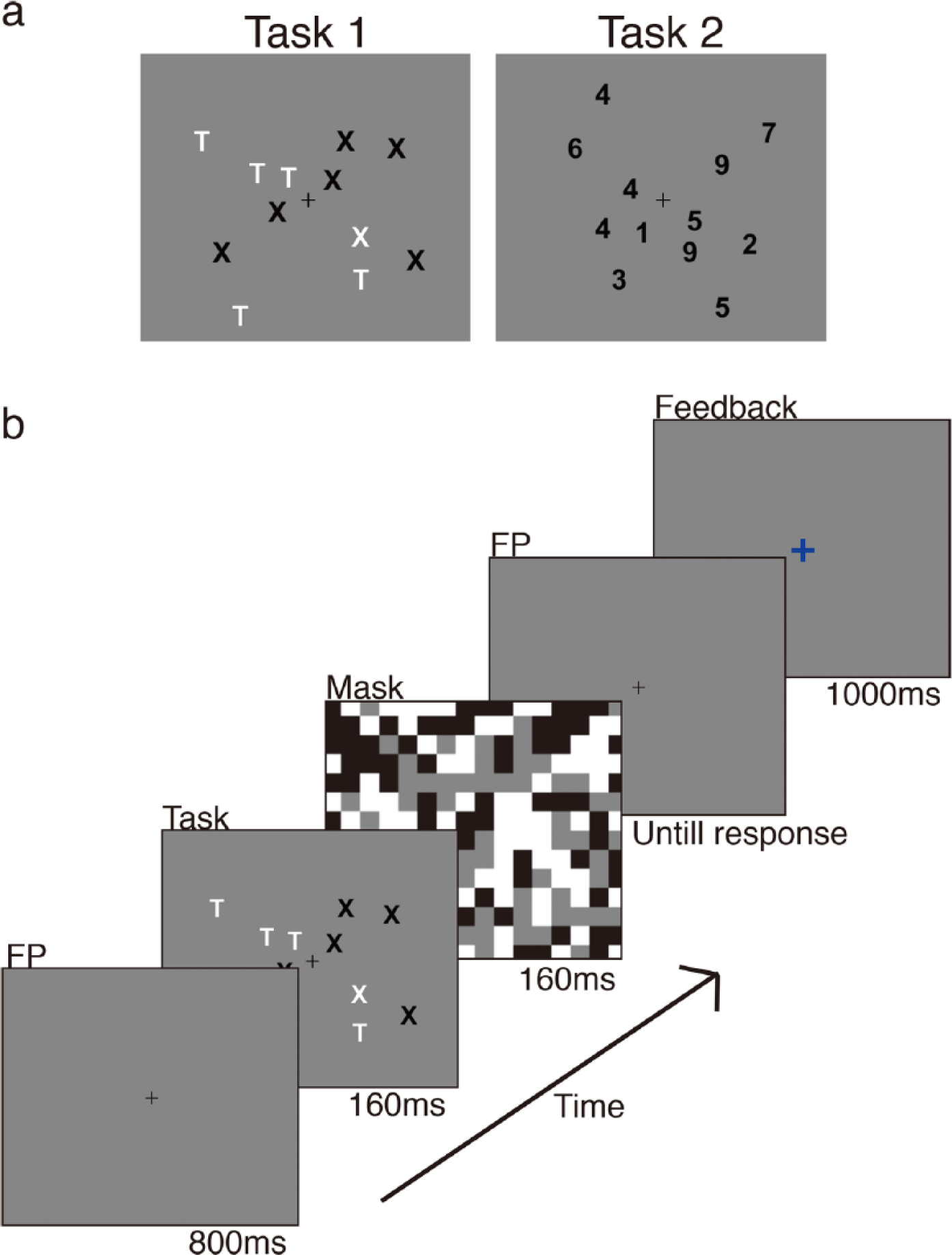
Visual search tasks and a sequence of a trial. (a) Examples of the search tasks used in this study. Task 1 is a conjunction search task in which the target (white X) shares its color with one set of distractors (white Ts) and its shape with the other set (black Xs). Task 2 is a hard search task in which participants were asked to search for a 2 among numbers 1–9. (b) The illustration of a trial of Task 1 in the masked condition. In the no-mask condition, the search array was not replaced by a mask stimulus.
We also investigated the effect of feature-based attention by comparing participants’ performances in some hard search tasks (Figure 1(a)). O’Riordan (2000) hypothesized that better control of feature-based attention can explain the superior visual search skills. In some visual search tasks such as a color and shape conjunction search task (e.g. search for a red X among green Xs and red Ts), it is thought that stimuli sharing a feature with the target are prioritized in the allocation of attention (Egeth et al., 1984; Treisman and Sato, 1990). O’Riordan (2000) modified a standard conjunction search task to interfere with feature-based attention by changing the identity of the distractors across trials. However, children with ASD were better than TD children in the modified conjunction search task as well as in a standard conjunction search task (O’Riordan, 2000). In this study, we conducted a hard search task in which the participants searched for a target among heterogeneous distractors (Experiment 2). It has been reported that top-down control of attention deteriorates more in heterogeneous contexts than in homogeneous contexts (Feldmann-Wüstefeld and Schubö, 2013).
Experiment 1
The purpose of Experiment 1 was to examine whether individuals with ASD showed better performance when a search display was replaced by a noise mask at a stimulus-mask asynchrony of 160 ms, which would interfere with shifts of visual attention. To ensure that the backward pattern masking interrupted the serial search process while the bottom-up shape processing remained intact, we compared task performance under mask and no-mask conditions.
Methods
Participants and clinical characterization
Two groups of adults participated in the study: a group of 14 TD participants (12 males, age: 25.8 ± 2.1 years) and a group of 14 participants with ASD (12 males, age: 25.9 ± 1.4 years). All the participants with ASD were diagnosed according to the DSM-IV-TR: Diagnostic and Statistical Manual of Mental Disorders (4th ed., text rev.; DSM-IV-TR) criteria for autism (n = 8) or Asperger’s syndrome (n = 6) by expert clinicians (including the second author (N.K.)). The ASD participants were recruited from an outpatient clinic specializing in developmental disorders at Karasuyama Hospital, Tokyo, Japan. The diagnostic assessment included the collection and analysis of detailed information about the individual from infancy to adolescence. Three experienced psychiatrists and a clinical psychologist interviewed the individual in detail regarding his development and behavior from infancy to adolescence including his developmental history, present illness, and past history as well as the person’s family history. Some suitable informants who knew the individual in early childhood cooperated by providing objective confirmation of the person’s responses in the interview.
The participants of a comparison group were selected to match the ASD group as closely as possible in terms of chronological age, gender, full intelligence quotient (IQ), verbal intelligence quotient (VIQ), and performance intelligence quotient (PIQ) as determined by the Wechsler Adult Intelligence Scale—Third Edition, revised Japanese edition (WAIS-III). See Table 1 for details of the participants in this study. An unpaired t test was used to obtain a statistical comparison of the groups as regards age, full IQ, performance IQ, and verbal IQ (p < 0.05 as significant). As a screening tool, we used the Japanese version of the Autism-Spectrum Quotient (AQ) test (Wakabayashi et al., 2006). None of the typical adults displayed clinically significant levels of autistic symptomatology, as indexed by the AQ. The control participants had no history of psychiatric illness or neurological disorders. The participants were all naive to the task and gave their written and informed consent before taking part. All the experiments reported here were conducted in accordance with the ethical standards stipulated in the 1964 Declaration of Helsinki and approved by the Ethical Committee of NTT Communication Science Laboratories. All individuals with and without ASD successfully completed all tasks.
Participant characteristics.

FIQ: full-scale intelligence quotient; VIQ: verbal intelligence quotient; PIQ: performance intelligence quotient; AQ: Autism-Spectrum Quotient; ASD: autism spectrum disorder; TD: typically developing.
Apparatus
The participants sat in front of a 21.3-in LCD monitor (1152 × 864 pixels at 75 Hz) at a distance of 57 cm. A chin-rest was used to stabilize the participants’ head position. Stimuli were generated by an iMAC 11.2 computer running MATLAB (Version 2010a; MathWorks Ltd, http://www.mathworks.com/) and the Psychophysics Toolbox extensions (Brainard, 1997; Pelli, 1997).
Stimuli and procedure
Stimulus displays consisted of 4, 8, or 12 items that appeared in 32 locations consisting of four concentric rings with eight positions per ring for the three briefly presented search tasks. The items in one trial were distributed equally in all four concentric rings as well as in all quadrants. Any item in a display could be a target and appear at one of four eccentricities 1.8°, 3.5°, 5.3°, or 7.0° from the center of the screen. Each element subtended approximately 1.1° of visual angle vertically and 0.9° horizontally and was presented against a gray background. Jitter of ±6 pixels (0.23° of visual angle) was introduced so that the stimuli were not perfectly aligned in the display.
The display items each had two dimensions: luminance (black or white) and form (X or T). Each distractor shared one feature with the target. The target was a white X (73.8 cd/m2) and the distractors were white Ts (73.8 cd/m2) and black Xs (0.5 cd/m2) in Arial font on a gray background (17.8 cd/m2). Plaisted et al. (1998) used the chromatic version of this task and reported that children with autism were faster than the control children at detecting the target. In particular, their RT × set size function had a shallower slope. Experiment 1 used a highly visible conjunction search task to distinguish low-level visual factors and a crowding effect from target discriminability. To take account of the degradation in color sensitivity and spatial resolution in the peripheral visual field (Boynton et al., 1964; Rovamo and Virsu, 1979), we used an achromatic version of the conjunction search task and presented the search items in the central visual field. In addition, relatively smaller set sizes reduce the crowding effect in the peripheral visual field (Bouma, 1970).
Figure 1(b) shows the timeline of an experimental trial. Each trial began with the presentation of a fixation point (+) at the center of the display for 800 ms. The participants were asked to respond as quickly and as accurately as possible, since both speed and accuracy would be recorded. The participants were advised to fixate on the center of the screen throughout the block of trials. A blue plus or red minus feedback sign, whose diameter was a 0.78° visual angle, appeared in the center of the display indicating whether their response was correct or incorrect and served as the fixation point for the next trial. Each display was presented for 160 ms to ensure that no eye movements were possible while the display was on. In the masked condition, the search display was replaced by a backward mask that remained on the screen for 160 ms in order to interfere more severely with serial covert shifts of attention. The backward mask consisted of a 20 × 20 grid of black (0.5 cd/m2), gray (17.8 cd/m2), and white (73.8 cd/m2) squares and subtended 23.4° of visual angle vertically and horizontally.
The participants responded by pressing one of two keys on a numeric keypad (the one key with the left hand for target-absent responses or the three key with the right hand for target-present responses). Prior to each task, participants were given a block of 10 practice trials, with the experimenter’s instruction and assistance. Following these practice trials, the participants were instructed to respond as quickly as possible and with as few errors as possible. The experiment consisted of four 92-trial blocks. The order of the blocks was pseudorandom across the participants.
Results
RT
The mean RT data are shown in Figure 2 (upper panels). The results show that the ASD group responded more quickly than the TD group regardless of target presence or set size (number of stimuli) under both the mask and no-mask conditions. These impressions were confirmed by statistical analyses. Except where otherwise stated, a significance level of p < 0.05 was adopted for all statistical comparisons. Partial eta-squared

Results of Experiment 1. The graphs show mean reaction time (RT) and percent error by group, target presence, and set size for each masking condition. Error bars indicate the standard errors of the mean.
Percent error
The mean percent error data as a function of the same variables for RT are shown in the lower panels in Figure 2. The results show that a speed-accuracy trade-off cannot explain the faster RTs in the ASD group as the RT analyses demonstrated. A mixed ANOVA on the error data, which were angular transformed, revealed main effects of group (F(1, 26) = 7.6, p < 0.05,
Experiment 1 illustrated that the backward masking caused performance to deteriorate only under larger set size conditions, indicating that the masking method we used in this study interferes with a serial search process rather than bottom-up shape processing. The results also illustrated that the ASD group showed better performance in brief search tasks, suggesting they excel in non-search processes.
Experiment 2
The purpose of Experiment 2 was to examine whether individuals with ASD also showed better performance when the participants were asked to find a target among heterogeneous distractors. We used Task 2 (Figure 1(a)) in which the participants searched for the number 2 among numbers 1–9 in Arial font on a gray background (17.8 cd/m2). In this task, all stimuli shared the luminance feature (0.5 cd/m2) with the target; the stimulus displays consisted of various shapes. It is unlikely that feature-based attention efficiently prioritizes some items sharing a feature with the target. The participants from both the ASD and TD groups and the procedure were the same as in Experiment 1, except that the experiment was conducted only under the masked condition.
To gain a further understanding of the better task performance produced by those with ASD, we analyzed the target eccentricity effect on search performance. The analysis of target eccentricity allows us to examine whether the ASD group has better target discriminability across the visual field.
Results
RT
The mean RT data are shown in Figure 3 We conducted a mixed ANOVA with the between-participants’ factor group (TD, ASD) and the within-participants’ factors of target presence (present, absent), and set size (4, 8, 12). There were main effects of group (F(1, 26) = 5.5, p < 0.05,
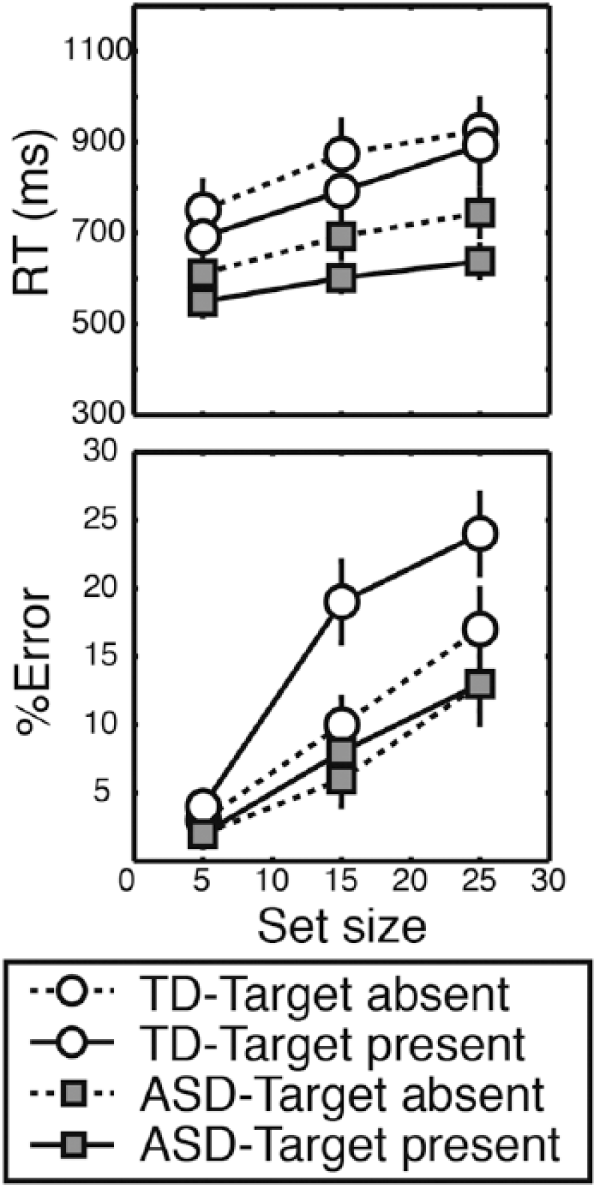
Results of Experiment 2. The graphs show mean reaction time (RT) and percent error by target presence, and set size in each group. Error bars indicate the standard errors of the mean.
Percent error
The mean percent error data are also shown in Figure 3. A mixed ANOVA with the same variables as the RT analysis revealed the main effects of group (F(1, 26) = 8.1, p < 0.01,
Target eccentricity effect
Figure 4 plots the mean RT and percent error data for set size 12 target-present trials as a function of target eccentricity, mask presence, and group. In order to ensure a large enough sample size, we analyzed the target eccentricity effect in each participant group by putting all the data of the three tasks together. Mixed ANOVAs revealed a main effect of eccentricity for percent error data (F(3, 78) = 9.3, p < 0.01,
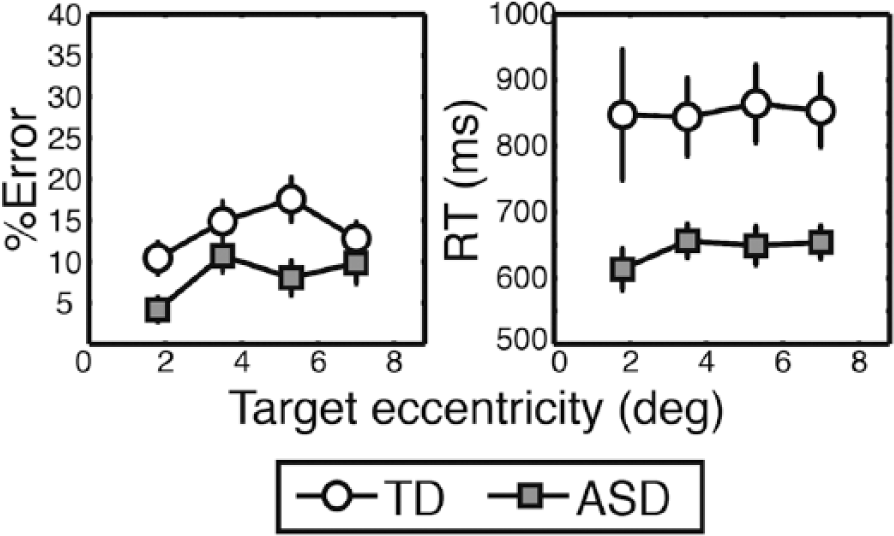
Target eccentricity effect on search performance. The graphs show mean reaction time and percent error for target-present trials with a set size of 12 as a function of target eccentricity, mask presence, and group. Each data point indicates the mean value of the three tasks in Experiments 1 and 2. Error bars indicate the standard errors of the mean.
Experiment 2 revealed that the ASD group responded more quickly and accurately when participants were asked to search for a target among heterogeneous distractors. The analysis of target eccentricity showed that individuals with ASD have higher target discriminability independent of target eccentricity. In addition, there was a significant intergroup difference when a sparse search array was presented, that is, each of four items was presented in each quadrant (set size 4 condition) as in Experiment 1. Those results suggest that neither feature-based attention nor a reduced crowding effect plays an important role in the ASD advantage in the present experiments.
General discussion
Despite the fact that visual search is one of the most well-established experimental paradigms in vision research, why those with ASD exhibit a superior visual search ability has remained a mystery. To specify the source of the superior search skills in those with ASD, this study used a backward pattern masking method to focus on a non-search process where multiple stimuli are processed simultaneously across the visual field rather than the focal processing of a single stimulus. The flash presentation method (160 ms SOA) is assumed to interfere with a serial search process but to have little effect on bottom-up shape processing. In Experiment 1, we compared the participants’ performance under mask and no-mask conditions to examine the effect of the masking method. The results showed that a noise mask at 160 ms SOA had a detrimental effect on the participants in both the TD and ASD groups only for larger set sizes. The results suggest that the mask interrupted the serial search process that is needed to find a target when a search array contains multiple indistinguishable items.
We also compared the task performance of the TD and ASD groups in Experiments 1 and 2. Due to the time limitation of the stimulus presentation, it is assumed that enhancement is required in a non-search process to realize better performance in briefly presented visual search tasks. Because the target position was unpredictable, it is unlikely that prioritizing a specific item in a search display in the allocation of attention would improve search performance. We found that the intergroup difference in the error rate increases with increasing set size without any speed-accuracy trade-off. The results suggest that the ASD group could distinguish more items instantaneously than the TD group. The RT data revealed that overall the ASD group showed a faster RT regardless of set size and the presence of a target. Furthermore, the analysis of target eccentricity showed that the ASD advantage was present independent of retinal eccentricity. It is unlikely that the ASD advantage in the present experiments derives from the attenuation of a crowding effect that changes its magnitude depending on retinal eccentricity (Bouma, 1970). This consistent shortening in RT regardless of set size and target eccentricity indicates that a non-search process, where participants discriminate multiple stimuli that are simultaneously processed across the visual field, plays an important role as regards the better performance of those with ASD. Furthermore, the present findings also suggest the possibility that those with ASD did not show higher sensitivity to spatial or color contrast or higher visual acuity in earlier studies (Bölte et al., 2012; Falkmer et al., 2011; Koh et al., 2010) because of their better discriminability for multiple stimuli, but not because of a single stimulus that is processed in a focused way.
Our results further characterize the superior search skill of those with ASD. Some previous studies investigated the association between the ASD advantage in visual search and feature-based attention (Milne et al., 2013; O’Riordan, 2000). Milne et al. (2013) reported that better visual searchers are less efficient at filtering out irrelevant stimuli by employing feature-based attention based on EEG recordings with TD adults. The experiment revealed that the P3b amplitude, which is thought to reflect later top-down attentional mechanisms, was larger when participants viewed relevant distractors sharing features with the target than when they viewed irrelevant distractors, suggesting that relevant distractors attract greater attention than irrelevant distractors. Milne et al. (2013) stated that individuals who are less able to filter out irrelevant stimuli are more efficient at visual search. In addition, it was also found that the performance of individuals with a higher AQ (Baron-Cohen et al., 2001) score can be related to the ability to filter out irrelevant stimuli. In contrast, our data suggest that it is unlikely that either inferior or superior control of feature-based attention produces the search skills of those with ASD. Our finding accords with a previous study that examined the ASD advantage in a visual search task where the identities of the distractors changed across trials to interfere with feature-based attention (O’Riordan, 2000).
Although it is unlikely that the ASD advantage found in this study derives from feature-based attention alone, it seems that there is a commonality between the study results in the expression of the superior search skills. In a hard search task, in which basic visual features extracted at a parallel processing stage are insufficient to find a target, the shifts of focal attention are thought to be necessary for discriminating between targets and distractors (Itti and Koch, 2000; Treisman and Gelade, 1980; Wolfe, 1994). However, it is assumed that a serial search strategy impairs performance in a briefly presented search task due to time limitations. As our error data demonstrated, the ASD group can distinguish more items instantaneously than the TD group, that is, more items remained unfiltered by attention focus. The results lead to the hypothesis that other types of reduced filtering such as weaker space-based attention contribute to the ASD advantage in the simultaneous discrimination of multiple stimuli. There is another example where it is assumed that participants improve their search performance by relying on rapid, automatic processes (Smilek et al., 2006). A behavioral study has shown that search performance improved when participants were asked to carry out an additional working memory task during a single task (Smilek et al., 2006). The results showed that focused attention does not always benefit task performance.
The present findings also provide an insight as to why there are a wide variety of study results. Early studies of the search skills of those with ASD reported a shallower RT × set size function (O’Riordan et al., 2001; O’Riordan and Plaisted, 2001; Plaisted et al., 1998). One subsequent study found a shorter intercept but discerned no difference in the search slope (Joseph et al., 2009). In oculomotor behavior studies, one study reported that adults with ASD made fewer eye movements than controls without increasing their fixation duration (Kemner et al., 2008), whereas another study reported a shorter fixation duration without an increase in the number of saccades in children with ASD (Joseph et al. 2009). Although a number of studies have contrasted the visual search skills of individuals with and without ASD, there are some exceptions, namely, research showing that there is no intergroup difference in search performance or even worse performance in individuals with ASD (Constable et al., 2010; Iarocci and Armstrong, 2013; Pellicano et al., 2011). It is assumed that the complexity of a search process destabilizes performance. For example, a search strategy influences performance; a passive searcher who prefers to look for a target covertly and without eye movement can find a target more quickly than an active searcher who overtly shifts attention by making multiple saccades (Boot et al., 2009). Better discriminability in simultaneous shape processing will be ineffective when the observer relies on intensively processed information alone that is obtained through shifts of spatial attention.
Among the previous studies, there are several prominent theories on the mechanisms underlying the superior search skills in individuals with ASD: perceptual enhancement (O’Riordan, 2000; O’Riordan and Plaisted, 2001), reduced filtering (Milne et al., 2013), and greater attention (Blaser et al., 2014) as mentioned earlier. Although our findings do not determine which account is more accurate, we clarified that individuals with ASD have superiority as regards the discrimination of multiple stimuli at an early level of processing. Influential visual search models such as the Feature Integration Theory and the Guided Search Model state that a parallel processing stage can be a basis for all visual search tasks (Itti and Koch, 2000; Treisman and Gelade, 1980; Wolfe, 1994). It is thought that only basic visual features of multiple stimuli such as color and orientation are analyzed simultaneously across the visual field at this stage. However, our data suggest that individuals with ASD distinguish more items based on more complex visual features than basic ones. Future work is required to explore the association between the anomalies of simultaneous processing and the previous models of the ASD advantage in visual search.
Footnotes
Declaration of conflicting interests
The author(s) declared no potential conflicts of interest with respect to the research, authorship, and/or publication of this article.
Funding
AS is supported by JSPS.