



Abstract
Rigorous research addressing complicated questions traditionally requires controlled and complex scientific infrastructure with a strong emphasis on internal validity. This research often is conducted uni-directionally (from researcher to communities) and yields results years after the study starts (Bohland et al., 2009; Fiks et al., 2015; Landsverk et al., 2011). In many ways, this method is antithetical to rapid discoveries that are valid and meaningful for families and other community stakeholders (Pellicano et al., 2014; Stadnick et al., 2013).
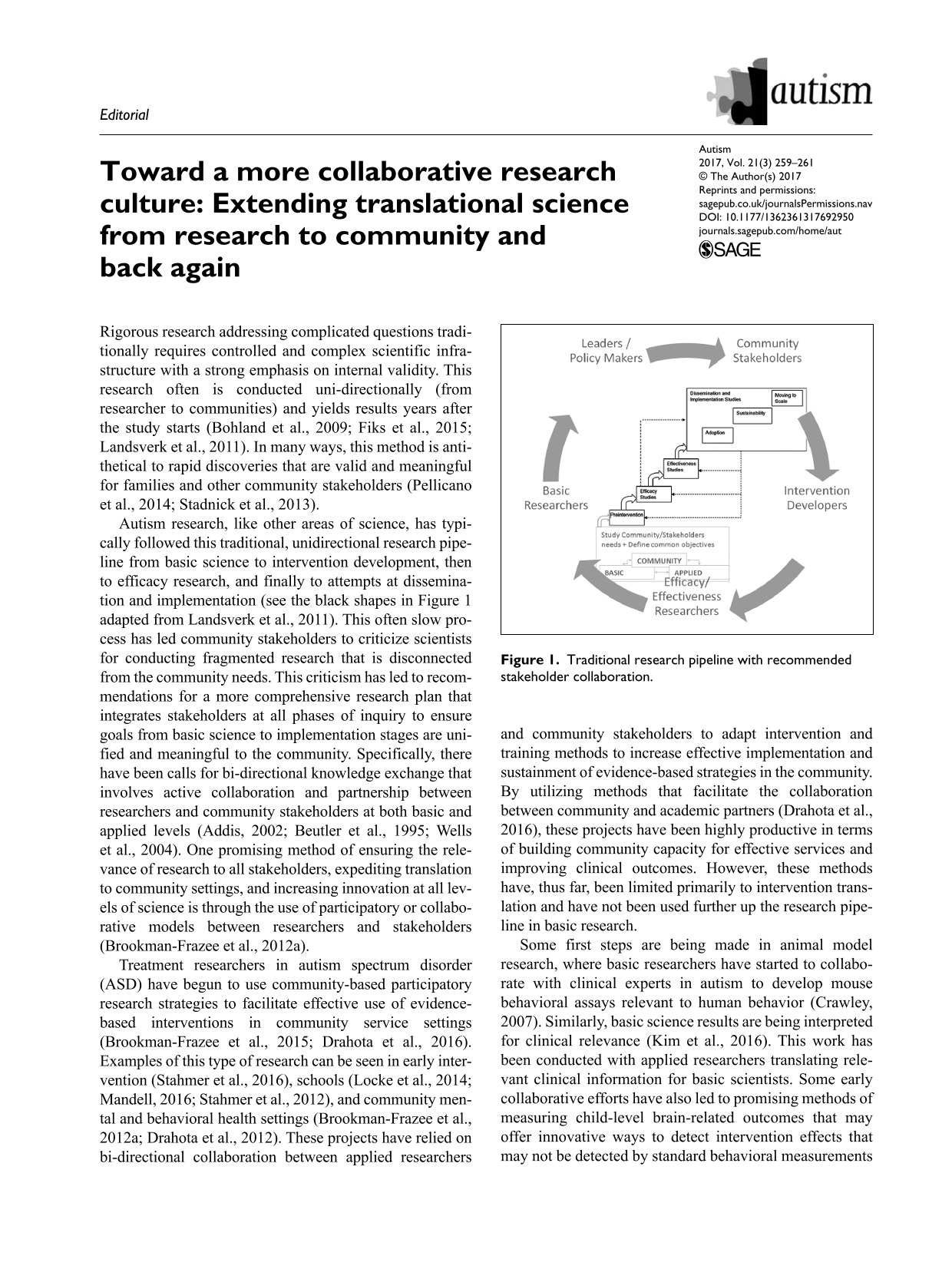
Autism research, like other areas of science, has typically followed this traditional, unidirectional research pipeline from basic science to intervention development, then to efficacy research, and finally to attempts at dissemination and implementation (see the black shapes in Figure 1 adapted from Landsverk et al., 2011). This often slow process has led community stakeholders to criticize scientists for conducting fragmented research that is disconnected from the community needs. This criticism has led to recommendations for a more comprehensive research plan that integrates stakeholders at all phases of inquiry to ensure goals from basic science to implementation stages are unified and meaningful to the community. Specifically, there have been calls for bi-directional knowledge exchange that involves active collaboration and partnership between researchers and community stakeholders at both basic and applied levels (Addis, 2002; Beutler et al., 1995; Wells et al., 2004). One promising method of ensuring the relevance of research to all stakeholders, expediting translation to community settings, and increasing innovation at all levels of science is through the use of participatory or collaborative models between researchers and stakeholders (Brookman-Frazee et al., 2012a).
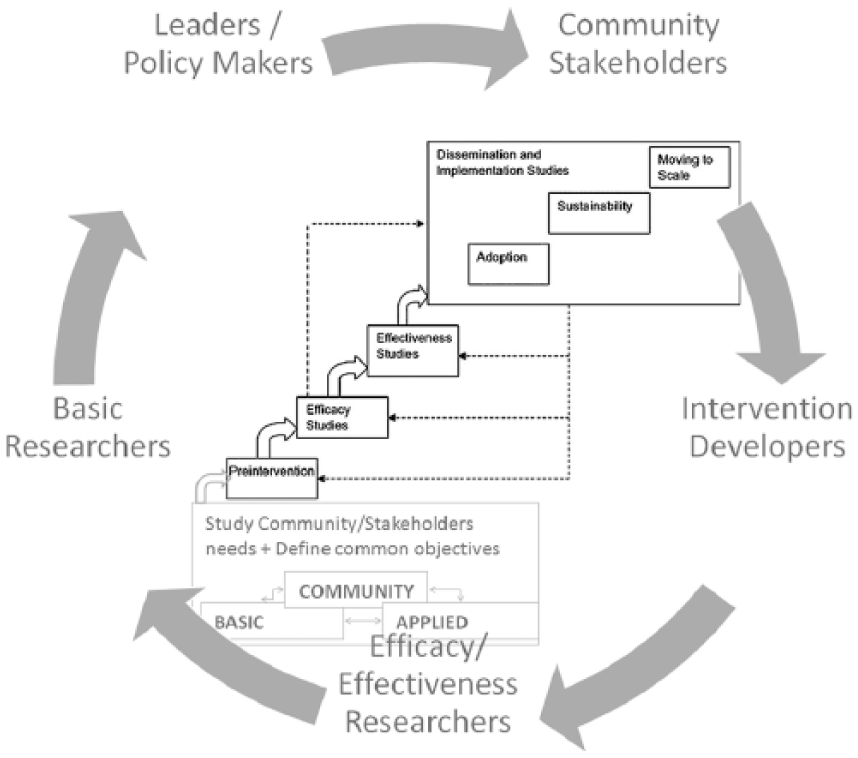
Traditional research pipeline with recommended stakeholder collaboration.
Treatment researchers in autism spectrum disorder (ASD) have begun to use community-based participatory research strategies to facilitate effective use of evidence-based interventions in community service settings (Brookman-Frazee et al., 2015; Drahota et al., 2016). Examples of this type of research can be seen in early intervention (Stahmer et al., 2016), schools (Locke et al., 2014; Mandell, 2016; Stahmer et al., 2012), and community mental and behavioral health settings (Brookman-Frazee et al., 2012a; Drahota et al., 2012). These projects have relied on bi-directional collaboration between applied researchers and community stakeholders to adapt intervention and training methods to increase effective implementation and sustainment of evidence-based strategies in the community. By utilizing methods that facilitate the collaboration between community and academic partners (Drahota et al., 2016), these projects have been highly productive in terms of building community capacity for effective services and improving clinical outcomes. However, these methods have, thus far, been limited primarily to intervention translation and have not been used further up the research pipeline in basic research.
Some first steps are being made in animal model research, where basic researchers have started to collaborate with clinical experts in autism to develop mouse behavioral assays relevant to human behavior (Crawley, 2007). Similarly, basic science results are being interpreted for clinical relevance (Kim et al., 2016). This work has been conducted with applied researchers translating relevant clinical information for basic scientists. Some early collaborative efforts have also led to promising methods of measuring child-level brain-related outcomes that may offer innovative ways to detect intervention effects that may not be detected by standard behavioral measurements (Dawson et al., 2012; Venkataraman et al., 2016). The next step should involve basic scientists working directly with both applied researchers and community stakeholders and assessing needs at the community level to increase the relevance of their work (Brookman-Frazee et al., 2012b; Pickard et al., 2016) both by helping stakeholders understand the purpose of basic science and by linking basic science findings to goals important to the community (e.g. early identification; intervention development).
One challenge to this approach is facilitating collaboration among diverse stakeholders at all levels of research (illustrated in the gray overlay to Figure 1) such that multi-directional feedback is available to and used by all. Difficulties for academic researchers in conducting community collaborations include that universities, funders, and peer-review journal editors often have limited understanding of the importance of this work. However, because so much can be learned from the community collaborative practices (e.g. Brookman-Frazee et al., 2015; Jones and Wells, 2007), institutions should encourage and reward researchers who collaborate with each other, community providers, families, and policy makers. Typically, these collaborations begin with a simple conversation that builds relationships, defines complementary goals, and considers roles in the collaborative arrangement. Once common goals are determined, the group can then consider funding sources and operational processes that ensure balance of power and development of mutually beneficial products (see Drahota et al., 2016; Weiss et al., 2002). These types of partnerships can lead to innovation in research and at the same time be highly productive for the community (Brookman-Frazee et al., 2012b).
Once we have a better understanding of all stakeholder interests and needs, needs through conversations and more formal systematic needs assessments, we will be in a better position to ensure relevance of basic research to intervention, assessment, and translation. This will, in turn, lead to more adaptable and feasible methods of using evidence-based practices (Wood et al., 2015) to address specific biomarkers and core symptoms of autism. Overall, successful collaboration across all stakeholders and stages of research can lead us toward more innovative science and meaningful social discoveries.