



Abstract
Previous research suggests impaired metacognitive monitoring and mathematics under-achievement in autism spectrum disorder. Within educational settings, metacognitive monitoring is supported through the provision of feedback (e.g. with goal reminders and by explicitly correcting errors). Given the strength of the relationship between metacognition, learning and educational attainment, this research tested new computer-based metacognitive support (the ‘Maths Challenge’) for mathematics learners with autism spectrum disorder within the context of their classroom. The Maths Challenge required learners to engage in metacognitive monitoring before and after answering each question (e.g. intentions and judgements of accuracy) and negotiate with the system the level of difficulty. Forty secondary school children with autism spectrum disorder and 95 typically developing learners completed the Maths Challenge in either a Feedback condition, with metacognitive monitoring support regarding the accuracy of their answers, goal reminders and strategy support, or with No Feedback. Contrary to previous findings, learners with autism showed an undiminished ability to detect errors. They did, however, demonstrate reduced cohesion between their pre- and post-test intentions. Crucially, support from the Feedback condition significantly improved task performance for both groups. Findings highlight important implications for educational interventions regarding the provision of metacognitive support for learners with autism to ameliorate under-performance in mathematics within the classroom.
Autism spectrum disorder (ASD) is characterised by impairments in social communication and behavioural flexibility and is estimated to affect around 1% of the population (American Psychiatric Association, 2013; Baird et al., 2006). These impairments may impact learning, and recent reports indicate greater gaps in attainment for pupils with ASD compared to their typically developing (TD) peers (Keen et al., 2016; Wilkinson and Twist, 2010), with many demonstrating a specific deficit in mathematics (e.g. Chiang and Lin, 2006; Mayes and Calhoun, 2006). Despite reports of the existence of a small sub-group of mathematically gifted people with ASD (Aagten-Murphy et al., 2015; Chiang and Lin, 2006; Iuculano et al., 2014; Jones et al., 2009; Mayes and Calhoun, 2003, 2006), on average, mathematics ability is substantially lower among people with ASD than would be expected on the basis of IQ (Aagten-Murphy et al., 2015; Chiang and Lin, 2007; Estes et al., 2011; Griswold et al., 2002; Mayes and Calhoun, 2003, 2006; see also Jones et al., 2009). Educational under-achievement in mathematics contributes directly to less-than-optimal economic outcomes (e.g. low levels of employment) and life chances among people with ASD (Estes et al., 2011).
One of the most effective and cost-efficient educational interventions is to support metacognition (Higgins et al., 2013). Metacognition can be defined as the ability to reflect on, understand and control one’s learning or ‘thinking about one’s thinking’ (Schraw and Dennison, 1994). It is well established that metacognition facilitates self-regulation of behaviour and learning: monitoring when or where mistakes are made means that learning strategies can be modified accordingly (e.g. revising until you are confident you know the topic). Within an educational context, research has highlighted that metacognition predicts academic achievement more powerfully than intellectual abilities (Hartwig et al., 2012; Thiede, 1999; Veenman et al., 2005), and there is extensive evidence that developing metacognition is an effective intervention in school children within and below the ‘normal’ range of ability (Dunlosky et al., 2003; Iuculano et al., 2014; Maxwell and Grenier, 2014; Schneider and Artelt, 2010; Van der Stel and Veenman, 2010; see also Roebers et al., 2012, 2014). Accordingly, teaching approaches that encourage learners to monitor, evaluate and strategise their learning are now widely recommended (Higgins et al., 2013; Special Education Support Service (SESS), 2009).
This is pertinent because research indicates that autistic individuals have a metacognitive deficit (Bebko and Ricciuti, 2000; Brosnan et al., 2015; Farrant et al., 1999; Grainger et al., 2016; McMahon et al., 2016; Vlamings et al., 2008; Wojcik et al., 2013). For example, children with ASD have specific metacognitive difficulties in identifying when they have made mistakes – they report more confidence in the accuracy of their answers, even when they are incorrect (Brosnan et al., 2015). This is striking because metacognitive monitoring relates to self-regulation of learning (e.g. Isaacson and Fujita, 2006), and a deficit in metacognitive monitoring could explain why children with ASD have difficulties with self-regulation of learning-related behaviour; not knowing what you know and what you do not know, or not knowing whether a mistake has been made severely impairs options for responding and adapting behaviour accordingly.
Brosnan et al. (2015) found that in addition to being more likely to think an erroneous answer was correct, when told they had made an error learners with ASD were significantly more likely to report that they had meant to make that error. This impaired intention monitoring in ASD has also been found outside of the educational context in other types of tasks such as knee reflex reactions (Williams and Happé, 2010) and matching goals with desirable but unintended outcomes (Phillips et al., 1998). Although Brosnan et al. suggested their finding that ASD learners reported they meant to get a question wrong was an intention monitoring error, there was no assessment of intention prior to answering the mathematics questions. It is possible therefore that some learners did in fact intend to get the answer wrong (thus when they report this after the event, this was not an intention monitoring error).
Research with TD children shows that learning can be improved with the provision of immediate formative feedback that clarifies goals and minimises uncertainty in relation to how well learners are performing on a task and what strategies they could take to achieve their goals (Azevedo and Bernard, 1995; Bangert-Drowns et al., 1991; Shute, 2008). Metacognitive self-regulation training in planning, monitoring and control is also successful in improving mathematics learning in both TD pupils (Desoete and Veenman, 2006) and those with learning difficulties (Cornoldi et al., 1995; Kroesbergen and Van Luit, 2003). Such training has been shown to be particularly successful when combined with cognitive and motivational strategies (Dignath et al., 2008) and when implemented via the use of a computer in a cognitive apprenticeship-style learning environment (Teong, 2003; Xin and Jitendra, 1999; Zimmerman and Tsikalas, 2005). Although there is some evidence that interventions such as reinforcements for successful task completions can support ASD learning (e.g. Adcock and Cuvo, 2009; Charlop et al., 1992; Chong and Carr, 2005; Dunlap and Koegel, 1980), no research has specifically targeted support for metacognition and self-regulated learning in ASD. The provision of appropriate metacognitive support for learners with ASD needs to be informed by where their difficulties lie specifically with respect to metacognitive monitoring.
This research therefore examined (1) the nature of the metacognitive difficulties in ASD with respect to monitoring the accuracy of answers, intentions and regulating learning strategy accordingly and (2) the use of feedback as metacognitive monitoring support in mathematics learners with ASD. Intentions to obtain a correct answer were assessed before as well as after each question was attempted. In addition, learners were able to adjust the level of difficulty at various points throughout the program. Mathematics performance was explored under two conditions – one condition provided metacognitive monitoring support through feedback and one did not. We predicted that the provision of metacognitive monitoring support would enhance strategy regulation (appropriately adjusting the level of difficulty), and thus mathematics performance (to obtain more points) of learners with ASD who have a deficit in metacognitive monitoring.
Different types of learning environments in and outside classrooms impact on self-regulation in learners, and research should be sensitive to this context (Boekaerts and Corno, 2005). Despite the many benefits of tightly controlled laboratory-based research, such a paradigm can impact on the participant’s perceived value of the task, and consequently the variables under investigation. Within the classroom, intrinsic value is strongly related to use of cognitive strategies and self-regulation by TD learners. For example, Pintrich and De Groot (1990) report that learners who are cognitively engaged and self-regulating are those who are interested in and value their classroom academic work. It was therefore felt crucial to examine metacognition and self-regulation within the context of the classroom, specifically a typical mathematics lesson, while acknowledging that this will limit the extent to which ASD and TD learners can be considered matched. Whether and how to match is an ongoing issue in ASD research (e.g. Barbeau et al., 2013; Jarrold and Brock, 2004). Importantly, the literature above suggests that those with ASD will have impaired mathematical ability and metacognition, and therefore matching on these (e.g. with a learning disabilities group – who may also have impaired language) is problematic. Matching mathematics ability with younger learners can also be problematic as the metacognitive factors under investigation do not predict ability until around 11 years of age (Roebers et al., 2014) and learners with ASD can make types of mathematics errors that are not evidenced in TD learners (and vice versa; Brosnan et al., 2015). In an attempt to address these issues, this study’s methodology presented mathematics questions at the appropriate level for each student individually in the context of their classroom-based mathematics lesson through a computer-based ‘Maths Challenge’ (described below).
Method
Participants and design
Forty secondary school children (30 males and 10 females) who had received a formal diagnosis of autism or Asperger syndrome by a qualified clinician according to Diagnostic and Statistical Manual of Mental Disorders (DSM; American Psychiatric Association, 2000, 2013) or the International Statistical Classification of Diseases and Related Health Problems (ICD) criteria (World Health Organization, 1993) were recruited from schools or units specifically for children with ASD. Secondary School in England covers ages 11–16 years where the curriculum is divided between Key Stage (KS) 3 (ages 11–14 years) and KS4 (ages 15–16 years). Under-achieving children may still be working at KS2 (for ages 7–11 years) or even KS1 (for ages 5–7 years). 1 The M age of the ASD group was 13.33 years (standard deviation (SD) = 1.25 years, range = 11–16 years), and the majority were working below the expected level, at KS1 (n = 10; M age = 12.70 years) or 2 (n = 20; M age = 13.35 years); however, four ASD pupils were working at KS3 (M age = 13.50 years) and six were working at KS4 (M age = 14.17 years). All children with ASD were educated within specialist provision classrooms housed within mainstream schools. Comparison participants comprised 95 secondary school pupils (58 males and 37 females) from mainstream schools, with a M age of 13.40 years (SD = 1.15 years, range = 11–15 years), and all were working at the appropriate level, at KS3 (n = 64, M age = 12.88 years) and 4 (n = 31, M age = 14.48 years). Ethical approval was prospectively obtained from the University of Bath research ethics committee.
It is important to note that the groups did not significantly differ on age, t(133) = 0.34, p = 0.74, d = 0.06, or proportion of males to females, χ2 = 2.41 (1, N = 135), p = 0.12, φ = 0.13, and the ASD group was under-achieving in mathematics as has widely been reported in the literature (e.g. Aagten et al., 2015; Chiang and Lin, 2007; Estes et al., 2011; Griswold et al., 2002). The samples were therefore reflective of the populations from which they were drawn. The focus of this study was not on absolute level of mathematical ability – as the computer program was flexible to start at the appropriate level for each student (KS1–4) – but on the influence of feedback on metacognition (see section ‘Discussion’). The study took place within the context of the classroom, and assessments of mathematical ability were from the classroom teacher and starting-level mathematics performance on the current task, as formal assessments of mathematical ability were not possible within this context.
A 2 (Group: ASD vs TD) × 2 (Metacognitive support: Feedback vs No Feedback) between-participant design was used, whereby participants were randomly assigned to either a ‘Feedback’ or a ‘No Feedback’ condition (see below for more details), with the constraint that there were approximately the same number of participants in each Group × Condition cell. The final sample comprised 40 ASD participants (21 feedback and 19 no feedback) and 95 TD participants (46 feedback and 49 no feedback). There was an even distribution in the ratio of males to females in each feedback condition for both the ASD (p = 0.57, φ = 0.03, Fisher’s exact test) and TD group (χ2(1, N = 95) = 0.21, p = 0.65, φ = 0.05), and age was evenly distributed between conditions for both ASD, F(1, 38) = 0.04, p = 0.84, ηp2 = 0.001, and TD groups, F(1, 93) = 0.18, p = 0.67, ηp2 = 0.002. There was an approximately even distribution of participants working at the different KSs between conditions for both the ASD (p = 0.51, φ = 0.26, Fisher’s exact test) and the TD group (χ2(1, N = 95) < 0.001, p > 0.99, φ < 0.001; Table 1). Finally, while starting-level mathematics performance, in terms of number of correct answers provided for the first block of questions (i.e. independent from metacognitive ability and feedback condition), was significantly lower among ASD participants compared to the TD group, F(1,131) = 9.90, p = 0.002, ηp2 = 0.07, it did not differ between feedback conditions, F(1, 131) = 1.02, p = 0.32, ηp2 = 0.01. A lack of Group × Condition interaction indicated that starting-level mathematics did not significantly differ between feedback conditions for either group, F(1, 131) = 1.17, p = 0.28, ηp2 = 0.01. Thus, we were confident that age, sex and mathematical ability did not significantly differ between the Feedback and No Feedback conditions.
Distribution of participants, mean ages and ratio of males to females working between the different Key Stages in each condition.

ASD: autism spectrum disorder; TD: typically developing; SD: standard deviation.
Materials and procedure
We developed the ‘Maths Challenge’ computer program in Real Studio (Xojo, 2011), whereby, to maximise points won, participants needed to monitor their performance and adapt their strategy accordingly. The program comprised seven levels of difficulty, and questions were more difficult the higher the level. Each question answered correctly was worth points commensurate to that level (e.g. 3 points per question answered correctly on Level 3), while errors were worth 0 points. Participants answered four blocks of three questions. To provide participants the opportunity to move up or down in level of difficulty from the outset (after completing the first block), all participants started the game at Level 4. After completing each block, participants decided themselves whether to stay at the same level (with the same points available per question), move up a level (with more points available per question) or move down a level for the next block (with fewer points available per question) and so forth until they had completed all four blocks. Thus, notwithstanding mathematics ability, an individual’s maximum points’ potential was determined by their metacognitive strategy regulation (e.g. if all questions on Level 4 were answered incorrectly, the most rewarding strategy would be to move down to Level 3 for the next block), as well as their ability to judge when errors are made.
Four versions of the Maths Challenge were developed to accommodate pupils at varying levels of mathematical ability in terms of the English KS level they were currently working at. Specifically, Version 1 comprised questions from KS1, Version 2 questions from KS2, Version 3 questions from KS3 and Version 4 questions from KS4. Within each version, Levels 1–7 comprised questions from lower to higher KS sub-levels within that respective KS. Mathematics questions were selected from UK National Curriculum past test papers and exam revision workbooks on the basis that they could be answered mentally, without the need for pen, paper or calculator. The program began with general instructions explaining the structure, aims and points allocations. Each mathematics question was preceded by a 5-point pre-test intention measure (‘how hard are you going to try to get the next question right’) and was followed by a 5-point post-test metacognitive monitoring confidence judgement (‘do you think you got that question right or wrong’), and finally a 3-point post-test intention measure (‘did you mean to get that question right or wrong’; Figure 1). For the purposes of the analyses, the 5-point pre-test measure was collapsed into 3 points (1 (try to get wrong), 2 (neutral) and 3 (try to get right)). A prototype of the program was piloted with both ASD and TD children and received positive evaluations, indicating that children were motivated to perform well.
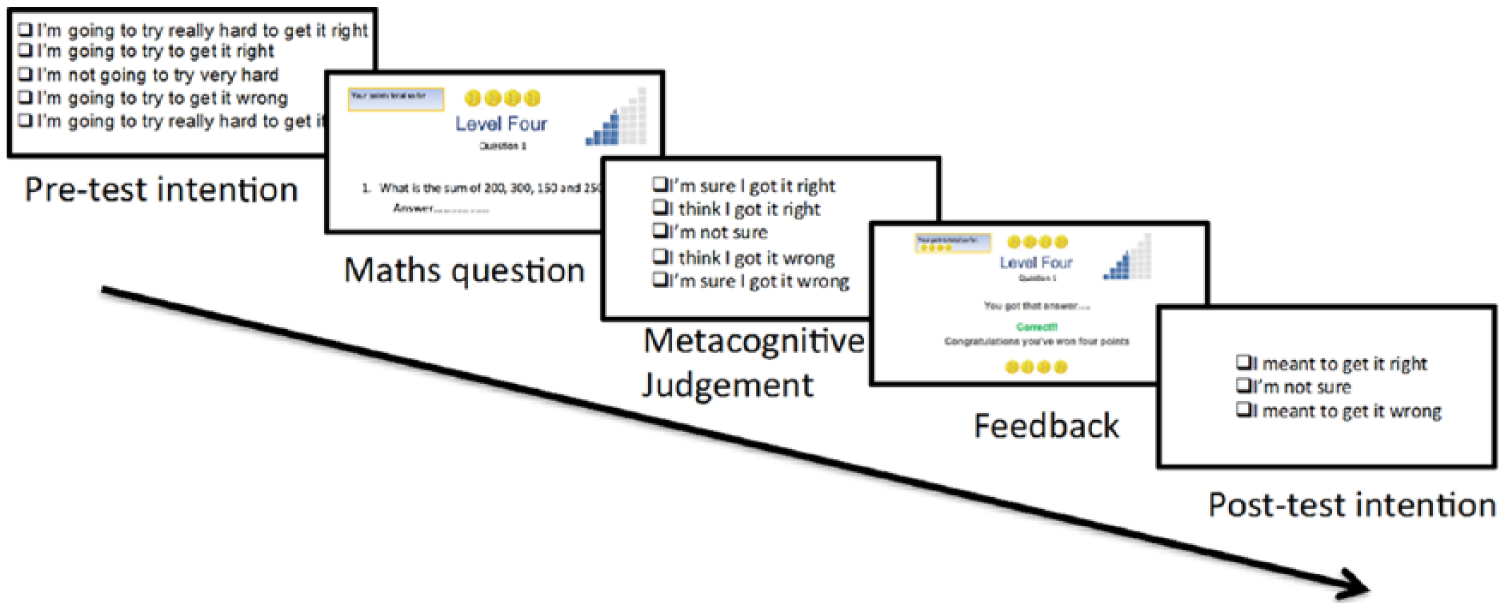
Order of pre- and post-test intention and metacognitive judgement measures for each mathematics question in the Feedback condition. Note that in the No Feedback condition, the correct answer (the fourth display box) was omitted.
Participants were tested in classroom groups during school lessons; however, each pupil completed the program individually at their own computer. In the Feedback condition, participants received feedback after each question regarding whether they had answered correctly or not and how many points they had won for that question. This was displayed in the text and also graphically with gold coins denoting the points won for that question, as well as a running total of points won thus far displayed in a box on the top left corner of the screen. After completing each level, Feedback participants also received a summary regarding the number of questions they had answered correctly and the number of points won, which was accompanied by a goal reminder that their task was to finish the program with as many points as possible. After completing the three questions in each level, all participants were asked whether they wanted to move up, down or stay on the same level. In the feedback condition, this was accompanied by strategy reminders; for example, that choosing to go down a level would mean easier questions, but fewer points available for each question. To examine metacognitive monitoring (of mathematics accuracy) and strategy regulation (level decisions that optimise correct answers and points won) in the absence of external support, the No Feedback condition provided no indication of whether questions had been answered correctly or not, and information regarding points won and goal/strategy reminders were omitted from the display (Figure 2).

Provision of feedback, goal reminders and metacognitive strategy support prior to level decisions in the Feedback condition (panel A). In the No Feedback condition, participants were simply asked to make a level decision (panel B).
Finally, participants completed a brief metacognitive questionnaire, comprising four questions (each answered on a 4-point scale) reflecting on their metacognitive performance, specifically awareness of performance (from never or rarely aware to always aware), points plan (from no plan to get as many points as possible), level strategy (from stayed on the same level regardless of difficulty to if easy then up; if difficult then down a level) and checking of answers (from never or rarely checked to always checked answers).
Results
Analysis overview
We report the results of analyses conducted to test the nature of the metacognitive difficulties in ASD (and whether experimental task performance differed between groups and feedback conditions) with respect to the following metacognitive variables: judgements of confidence for correct and incorrect answers, pre- and post-question intention monitoring and self-reported metacognition ratings. Finally, we report the effect of feedback in terms of the number of correct answers in the first and final blocks. Table 2 provides a summary of the Ms and SDs of each of these variables between groups and conditions.
Mean scores across all task variables (SDs are in parentheses).
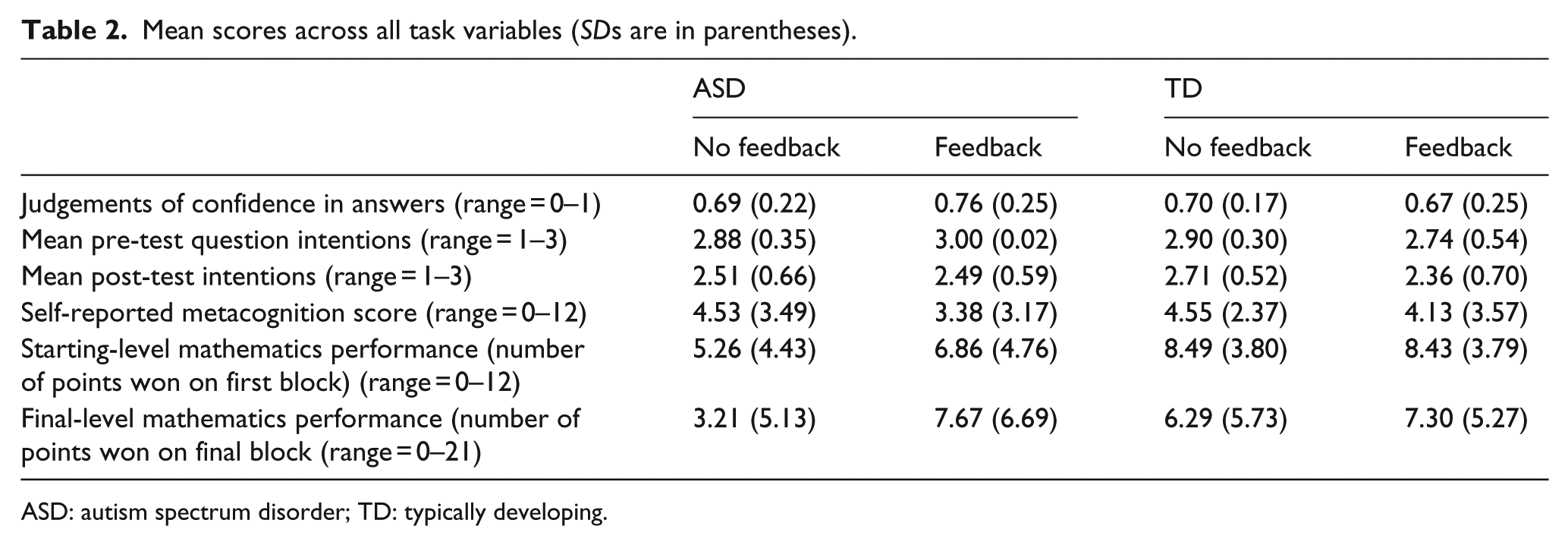
ASD: autism spectrum disorder; TD: typically developing.
Judgements of confidence
Participants’ ordinal metacognitive judgement ratings of their accuracy to each question on a 5-point confidence scale (I am sure I got it right, I think I got it right, I do not know, I think I got it wrong and I am sure I got it wrong) were translated question-by-question into interval data (1, 0.75, 0.5, 0.25 and 0) for the analyses.
To determine whether participants assigned higher confidence to correct compared to incorrect answers, a 2 (Group) × 2 (Condition: Feedback vs No Feedback) × 2 (Answer: correct vs incorrect) mixed-analysis of variance (ANOVA) was conducted, where Answer was the within-participant factor. 2 There was a main effect of Group, F(1, 120) = 4.15, p = 0.04, ηp2 = 0.03, whereby the ASD group was significantly more confident generally that their answers were correct (M = 0.73, SD = 0.23) than were the TD group (M = 0.68, SD = 0.21). There was also a significant main effect of Answer, F(1, 120) = 87.34, p < 0.001, ηp2 = 0.42, whereby confidence was significantly higher for correct answers (M = 0.80, SD = 0.18) than for incorrect answers (M = 0.56, SD = 0.27). There was no effect of Condition, F(1, 120) = 0.11, p = 0.74, ηp2 = 0.001, Group × Condition interaction, F(1, 120) = 2.69, p = 0.11, ηp2 = 0.02, or Group × Condition × Answer interaction, F(1, 120) = 1.60, p = 0.21, ηp2 = 0.01, indicating that the provision of feedback did not affect the nature of metacognitive judgements among either group. Finally, the Group × Answer interaction was not significant, F(1, 120) = 0.59, p = 0.45, ηp2 = 0.005, indicating that both groups showed higher confidence for correct than incorrect answers (Figure 3).

Mean confidence in correct and incorrect answers by ASD and TD participants (error bars indicate the 95% confidence intervals around the mean).
Intention monitoring
Pre-test intentions
A 2 (Group) × 2 (Condition) between-participant ANOVA revealed no significant main effects of Group, F(1, 131) = 1.82, p = 0.18, ηp2 = 0.01, or Condition, F(1, 131) = 1.23, p = 0.27, ηp2 = 0.01. The Group × Condition interaction for pre-test intentions was also not significant, F(1, 131) = 0.57, p = 0.45, ηp2 = 0.004.
Post-test intentions
A 2 (Group) × 2 (Condition) between-participant ANOVA revealed no significant main effects of Group, F(1, 131) = 0.06, p = 0.80, ηp2 < 0.01, or Condition, F(1, 131) = 2.56, p = 0.11, ηp2 = 0.02. The Group × Condition interaction for post-test intentions was also not significant, F(1, 131) = 2.06, p = 0.15, ηp2 = 0.02.
Predicting post-test intentions from pre-test intentions
Pre- and post-test intentions were significantly positively correlated for both ASD, r = 0.64, p < 0.001, and TD groups, r = 0.81, p < 0.001. To examine whether the strength of the association between pre- and post-test intentions was similar for both groups, Fisher’s Z-transformations were conducted. These indicated a significantly weaker association between pre- and post-test intentions for the ASD group compared to the TD group, Zr1–r2 = 1.89, p = 0.03. Figure 4 displays average post-test intentions (from 1 (I meant to get it wrong) to 3 (I meant to get it right)) for each pre-test intention option (from 1 (I am going to try to get it wrong) to 3 (I am going to try to get it right)) for errors made by ASD and TD groups. The TD group showed better calibration (with scores closer to the dotted line) than the ASD group.

Pre- and post-test intentions for errors. The dotted line indicates perfect calibration.
Metacognitive questionnaire
A 2 (Group) × 2 (Condition) multivariate analysis of variance (MANOVA) was conducted with participants’ four self-reported metacognitive ratings (awareness of performance, points plan, level strategy and checking of answers) as dependent variables. There was no multivariate effect of Group, F(4, 128) = 1.63, p = 0.17, ηp2 = 0.05, or Condition, F(4, 128) = 2.13, p = 0.08, ηp2 = 0.06, and the Group × Condition interaction was also not significant, F(4, 128) = 0.61, p = 0.66, ηp2 = 0.02.
Mathematics performance: effect of feedback
Groups significantly differed on starting-level mathematics, as described above and evidenced by significantly fewer points won by the ASD group on the first block of questions, F(1, 131) = 9.90, p = 0.002, ηp2 = 0.07, with no main effect of Condition or Group × Condition interaction at the start of the task (ps > 0.28). To examine whether feedback was effective in improving self-regulation, as measured by optimal strategy use to win as many points as possible, a 2 (Group) × 2 (Condition) between-participant ANOVA was conducted for points won on the final block. 3 There was a significant effect of Condition, F(1, 131) = 6.57, p = 0.01, ηp2 = 0.05, whereby more points were won in the Feedback (M = 7.42, SD = 5.71) compared to the No Feedback condition (M = 5.43, SD = 5.70) but no significant main effect of Group, F(1, 131) = 1.61, p = 0.21, ηp2 = 0.01 or Group × Condition interaction, F(1, 131) = 2.59, p = 0.11, ηp2 = 0.02. Thus, the provision of feedback improved performance for both groups (Figure 5).

Number of points won on the final block in the Maths Challenge as a function of Group and Feedback condition (error bars indicate the 95% confidence intervals around the mean).
Discussion
‘Metacognition’, or awareness of one’s cognition, makes a major contribution to the learning of mathematics and is a better predictor of educational achievement (e.g. exam performance) than assessments of intelligence. Self-regulated learning requires setting one’s own goals in relation to learning and ensuring that they are attained (Efklides, 2011). Effectively regulating learning, for example, through study time allocation and revision methods, is dependent on the ability to monitor what and how much material is known, as well as one’s goals and intentions (Metcalfe, 2009; Nelson and Narens, 1990). Despite the metacognitive difficulties and educational under attainment experienced by people with ASD, no research has specifically targeted support for metacognition and self-regulated learning in ASD. The context of self-regulated learning has been argued to be crucial, requiring research to be as context-sensitive as possible (e.g. Boekaerts and Corno, 2005); thus, the aim of this research was to test appropriate metacognitive support for ASD mathematics learners within the context of their mathematics lessons.
The present findings indicate that ASD learners can successfully distinguish correct from incorrect answers. This is contrary to previous reports that autistic children show diminished metacognitive monitoring, reporting more confidence in their answers, even when they are incorrect (e.g. Brosnan et al., 2015; Grainger et al., 2016; McMahon et al., 2016; Williams et al., 2016). Findings from this study indicate that while individuals with ASD showed a general bias towards higher confidence, they were still able to differentiate correct from incorrect answers. A potential explanation for the current diverging findings could lie with the types of tasks used, with this study adopting a non-socially delivered task in the classroom context with elements from serious gaming, which together may have increased ASD learners’ understanding, engagement and intrinsic motivation in the task (see Kenworthy et al., 2008; White et al., 2009; Whyte et al., 2015).
While monitoring the accuracy of their answers appeared undiminished, learners with ASD nevertheless showed reduced cohesion between their pre- and post-test intentions. Including a measure of pre-test intentions enabled this study to extend previous findings by Brosnan et al. (2015) to confirm that errors made on mathematics questions were not intended, and therefore that post hoc reporting that errors had been intended more likely reflects diminished intention monitoring. This is important as a diminished sense of one’s intentions towards a task could have a significant impact on one’s capacity to benefit from the experience of attempting the task. Interestingly, there were no differences in the absolute assessments of pre- and post-intentions to answer questions correctly; the group difference emerged in the relationship between pre- and post- intentions, thus indicating a more subtle impairment in monitoring one’s own intentions in ASD.
Learners with ASD benefited from metacognitive support, as evidenced by their better performance in the Feedback compared to the No Feedback condition. Although the Group × Condition interaction did not reach statistical significance, this feedback support appeared to be less effective for the TD group (Figure 5); however, these young people did not have a metacognitive deficit. The error bars in Figure 5 highlight the variability in performance and the need for caution in interpreting the data, but with no feedback the ASD group averages around half the number of points of the TD group and slightly more points than the TD group with the provision of feedback. The provision of feedback, goal and strategy support may be most effective for learners who have difficulties in metacognitive monitoring.
Higgins et al. (2013) report that supporting metacognition is a fast, efficient and low-cost method for supporting learning. Consistent with this, this research suggests that for learners with diminished metacognitive monitoring, metacognitive support should (1) affirm the goal (e.g. to get the answer correct), (2) feedback immediately (e.g. whether the answer was correct/incorrect) and (3) reflect on the goal (e.g. intention monitoring). A limitation of this study is that it was not possible to disentangle the relative benefits of each of these components of metacognitive support provided by the feedback condition. This is especially pertinent in the context of the present findings of an intention monitoring deficit alongside undiminished accuracy monitoring. For example, it is unclear whether the provision of feedback about performance was a necessary component in supporting task performance, or whether goal reminders alone would be sufficient. Moreover, although successful performance on the Maths Challenge was dependent on strategy regulation (to win as many points as possible), this study did not extricate where group differences lay in metacognitive strategy regulation. Further analysis of participants’ self-selecting of difficulty level, for example, may reveal differences between the two groups. If learners with ASD are also poorer at judging when to best shift difficulty levels, despite when feedback is provided, implementing dynamic difficulty adjustment (DDA; Hunicke, 2005), where game difficulty is modified automatically in response to students’ answers, may be beneficial. Andersen (2012) proposed developing a framework of conceptual knowledge for the teaching of fractions in a digital educational game, where the game keeps track of players’ knowledge and adapts the difficulty level accordingly. Future work may investigate differences in performance between self-selecting difficulty and DDA, and whether this can further support metacognition in ASD. Finally, the level of challenge in this study was individualised, which may be significant in the efficacy of support (e.g. not too easy/hard). Future research should tease apart these aspects to more specifically target where support is needed in terms of metacognitive monitoring, intentions and self-regulation, respectively.
These steps to support learning would be expected to extend to all learners with deficits in metacognitive monitoring, not just those with ASD, although this needs to be assessed empirically. There may be other reasons underpinning poor mathematical performance, such as developmental dyscalculia, which is thought to be a deficit in a basic capacity for understanding numerosity (e.g. Butterworth, 2005). People with ASD may also have additional deficits in numerosity (e.g. Aagten-Murphy et al., 2015), which one would not expect to be ameliorated through interventions addressing metacognition. The ASD group was mostly working at a KS level below where they were expected to be working (the TD group was not). Thus, while the ASD group was found to benefit from feedback, this does not necessitate that they were consequently at the same academic level as the control group. Future research could assess both mathematical skills and metacognitive skills to establish any interrelationships. We would expect that supporting metacognitive monitoring would be the first step in addressing numerosity deficits. It is worth reiterating, however, that while people with ASD typically show a specific impairment in mathematical ability incommensurate with their IQ, there is also a small group of mathematically gifted people with ASD (Aagten-Murphy et al., 2015; Chiang and Lin, 2006; Iuculano et al., 2014; Jones et al., 2009; Mayes and Calhoun, 2003, 2006); The present finding may not extend to such a group, and it would be interesting to identify how metacognition and numerosity skills differentiated this mathematically gifted sub-group from the typical ASD profile.
Metacognitive monitoring is considered essential for a sense of ‘self-concept’ (Roebers et al., 2012) and for day-to-day behavioural functioning, because accurate monitoring of one’s internal states facilitates the regulation of and control over those states, and over learning and behaviour (Nelson and Leonesio, 1988). We have used the term metacognitive monitoring to encompass assessments of intention before and after each task, and accuracy, as well as the capacity to control appropriate cognitive responses to these assessments. This process has been distinguished from metacognitive knowledge of cognition, which is the stored acquired knowledge of cognition (e.g. I am better at arithmetic than I am at spelling; Flavell, 1979; Lockl and Schneider, 2007; Nelson and Narens, 1990; Schraw and Moshman, 1995). Despite differences between groups in intention monitoring, there were no self-reported differences on the metacognition questionnaire. If we assume that the intervention did effectively target metacognitive monitoring, it may be that those with ASD are unable to self-report their own metacognition. This is consistent with Williams and Happé (2010) who argue that a metacognitive understanding of one’s own mind may be more impaired in ASD than the metacognitive understanding of other people’s minds. Indeed, Grainger et al. (2014) report that despite behaviourally demonstrating impaired metacognition (compared to controls), people with ASD self-reported higher levels of metacognition.
It is a limitation of this study that that we did not undertake an independent assessment of autism diagnosis. Working within the schools, this was not feasible. We used a convenience sample within the school environment, which resulted in a male-dominated sample consistent with the reported male domination of those who receive a diagnosis (e.g. our ratio of 3:1 is close to Baird et al. (2006) who report 3.3:1). The matching of ASD and TD groups on cognitive ability in such a novel study was also not ideal as mathematical ability level was derived from teacher report and not formal independent testing (again within the classroom context, additional assessments were not feasible). With suboptimal matching, we cannot discount the possibility that group differences in metacognitive ability were the result of general cognitive differences rather than diagnostic group membership per se. Independent assessments of both autism diagnosis and mathematical abilities would enable a more fine-grained analysis which would be useful additions to future research. However, when examining the relationship between metacognition and mathematics performance, this study’s focus on being context-specific to the classroom may prove crucial.
To conclude, this study reports a novel investigation of the impact of metacognitive support on autistic children’s mathematics performance – the results of which have the potential to make a significant impact on autism education. It is now widely recognised that there is a vital need for evidence-based guidance to enable improvements in educational provision for pupils with ASD (e.g. Charman et al., 2011; Keen et al., 2016; Wilkinson and Twist, 2010). An existing body of research indicates a metacognitive deficit in ASD, coupled with under-achievement in mathematics that is in disaccord with intellectual ability. The present findings add to this and indicate that support for metacognitive assessments of accuracy and post-test intention monitoring may be particularly crucial targets for supporting learners with ASD in mathematics, with the potential to remove widely reported under-achievement in mathematics.
Supplemental Material
AUT722028_Lay_Abstract – Supplemental material for Supporting metacognitive monitoring in mathematics learning for young people with autism spectrum disorder: A classroom-based study
Supplemental material, AUT722028_Lay_Abstract for Supporting metacognitive monitoring in mathematics learning for young people with autism spectrum disorder: A classroom-based study by Katie Maras, Tim Gamble and Mark Brosnan in Autism
Footnotes
Funding
The author(s) disclosed receipt of the following financial support for the research, authorship, and/or publication of this article: This work was completed under a grant to the first author from the Economic and Social Research Council (grant no. ES/N001095/1).
Notes
References
Supplementary Material
Please find the following supplemental material available below.
For Open Access articles published under a Creative Commons License, all supplemental material carries the same license as the article it is associated with.
For non-Open Access articles published, all supplemental material carries a non-exclusive license, and permission requests for re-use of supplemental material or any part of supplemental material shall be sent directly to the copyright owner as specified in the copyright notice associated with the article.
