



Abstract
Engagement with stakeholders is an essential part of the research process. This is particularly the case for early autism research with infant cohorts and their families, where a range of ethical issues are pertinent. Here, we report on a large survey of parents who have a child on the autism spectrum (n = 1040) which specifically probed attitudes to early autism research. The large majority of parents showed positive attitudes overall, and these were associated with greater access to services, higher service quality ratings and higher rates of intellectual disability among their children. Parents valued the scientific goals of research, but half of parents also reported that an intervention component would be an essential prerequisite for them to participate in research. If enrolled in a study, parents were positive about most commonly used measures though less favourably disposed towards brain scans for children. They valued direct contact with the research team and openness in data sharing. We interpret our findings in terms of lessons for the early autism research community and for stakeholder engagement projects.
Introduction
Autism spectrum disorder (hereafter ‘autism’) affects around 1% of the population worldwide (Elsabbagh et al., 2012) and has a dramatic impact both on those with the diagnosis and people around them. As well as entailing core challenges in social, communication and daily living (American Psychiatric Publishing (APA), 2013), autism is associated with reduced quality of life (Magiati et al., 2014) which extends to family members (Hayes and Watson, 2013; Khanna et al., 2011), low rates of employment (Roux et al., 2013) and a series of comorbid mental health difficulties (Simonoff et al., 2013). Autism is also linked with dramatically shortened life expectancies (Nordentoft et al., 2013). While intellectual disability is present in about a third of cases (Developmental, Disabilities Monitoring Network Surveillance Year (DDMNSY) and Centers for Disease Control and Prevention (CDC), 2014), associated difficulties and impairments affect cognitively able autistic people too. Thus, the life experiences of people with autism are often characterised by poor understanding, untapped potential and wasted opportunity. In an effort to better understand the challenges faced by people on the autism spectrum, large amounts of research are funded and published every year (Pellicano et al., 2013). We believe this research may be better able to achieve its broad goals – of understanding the autistic experience and providing supports to maximise opportunity and choice for those with a diagnosis – if it can be more effectively grounded in engagement with the community (Pellicano and Stears, 2011).
Direct engagement with autistic people and their supporters and family means that the goals of research, and the modes adopted to achieve those goals, better align with the needs of the community. This in turn helps to ensure that results inform not just scientific knowledge and theory but also policy and practice. Engagement with stakeholder groups also entails specific advantages for the academic community and individual research teams. For example, understanding how parents of children with autism conceptualise the condition can help us to design study recruitment materials that more effectively communicate the purpose of a project. Knowing how participants expect to receive information from a research team can inform protocol design – for example, in deciding whether to correspond by post, email, text message or via social media. These experiences can in turn be used to update overarching ethical guidelines for research. Recently, a longitudinal cohort study funded in the United Kingdom was forced to close after recruitment targets were missed by a very large margin. 1 Understanding of the barriers to participation experienced by potential participants is essential to prevent this occurring again. This knowledge can also help us to increase diversity in recruitment – for example, by engaging with more families having limited experience with academia (e.g. parents without University degrees) or those from Black and minority ethnic groups (George et al., 2014).
What is known already about attitudes to research among the autism community? Two reports published in the United Kingdom clearly show that there is some dissatisfaction in this community (incorporating autistic people, family members and practitioners from health, education and the third sector) about how the bulk of autism research funding is spent (Pellicano et al., 2013; Wallace et al., 2013). While investment principally focuses on basic science questions concerning the causes (genetic and otherwise) and characteristics (clinical, cognitive, behavioural, neurological) of autism, unsurprisingly stakeholders lament the relative paucity of research on practical supports applicable to education, healthcare and community settings. This pattern is replicated in early autism research which tends to address causal and developmental questions at genetic, neurological, cognitive and behavioural levels (Bolte et al., 2013; Dawson, 2010; Zwaigenbaum et al., 2007), rather than to test short- and long-term outcomes of early interventions, although the pattern is rapidly changing (Estes et al., 2015; Pickles et al., 2016; Rogers et al., 2014; Shire et al., 2016).
Another phenomenon apparent from previous investigations of attitudes is that there can be large differences of opinion between sub-groups within the autism community. The One in A Hundred report (Wallace et al., 2013) reported diversity in rankings of priorities for research between autistic adults versus parents of children with autism. On a more specific topic, Kenny et al. (2015) provided empirical support for a pattern already evident in social media and elsewhere – that differences exist in the preferred language used to describe autism both between stakeholder categories and within groups. On the other hand, the A Future Made Together report (Pellicano et al., 2013) highlighted significant overlap between stakeholder groups in priorities for research, and this was replicated in our own comparison of attitudes to early autism research across Europe (Fletcher-Watson et al., 2016).
In choosing to examine differences between stakeholder groups, and to attempt to derive consistent recommendations from diverse samples, one aspect that existing reports have not effectively probed is the degree of variation of opinion within a specific community sub-group. In this investigation, we address this by specifically analysing the responses of parents only, to a survey of attitudes to early autism research. We also relate variability in attitudes to other factors in an attempt to understand the personal experiences associated with different attitudes to research. This approach not only explores variability but also allows us to extract concrete recommendations for researchers in the field, and their ethical oversight bodies, which directly relate to the individuals who are approached to enrol in early autism studies: parents of children with autism. Early autism research – specifically studies collecting data from infant participants known to be more likely (relative to the general population) to later receive an autism diagnosis (Fletcher-Watson et al., 2016; Jones et al., 2014) – is a research sub-field in particular need of effective stakeholder engagement. In fact, early autism research is not only subject to the issues highlighted above, such as the need to recruit and retain longitudinal cohorts and a dearth of intervention-focused projects (Bölte et al., 2013), but it also entails specific ethical concerns (Fletcher-Watson et al., 2016; Yudell et al., 2013; Zwaigenbaum et al., 2007).
Drawing on evidence from a large international survey, and comparing this with published protocols from existing early autism research studies, we aim to address the following questions. First, how are attitudes of parents of children with autism towards early autism research related to other factors? Factors under investigation include parent and child characteristics and access to/quality of local services which we hypothesise may link to more or less favourable attitudes to research. For example, could families with limited access to quality services display more positive attitudes to research, perhaps as a way to secure extra support for their child? Second, when enrolling in a research study, what expectations do parents have regarding availability of intervention, acceptable forms of measurement, preferred modes of contact and sharing of information? Finally, we investigate how parent expectations of research relate to the reality, as evidenced through examination of early autism research protocols.
Methods
Materials
A survey was developed focusing on early autism research defined as ‘a specific area of autism research looking at early signs of autism in babies and toddlers’. 2 Details of the survey design, which included focus groups across three European countries, iterative development by the research team, pilot tests with stakeholder representatives and translation into multiple languages, can be found in Fletcher-Watson et al. (2016). The survey was designed for use by four different stakeholder groups (autistic adult, parent, healthcare practitioner, education practitioner), but in this report we focus on parent data only. Parents provided information about their children including diagnostic information for the (youngest, if more than one) child with autism and were asked to rate the quality of their local autism services. Parents were also asked if they had, or suspected they should have, an autism diagnosis.
The final survey section was prefaced with a short introduction to the field of early autism research in order to ensure a shared basic level of knowledge among respondents. Subsequently participants were asked questions about their attitudes to early autism research in five domains: (1) reasons for doing research, (2) involvement in research projects, (3) measurement in research projects, (4) intervention and (5) ‘at-risk’ language. Finally, participants had the opportunity to add further comments in a final text box.
In order to draw a comparison between parents’ expectations of early autism research and actual research practice, we sourced the research protocol from Eurosibs (European Babysibs Autism Research Network, www.eurosibs.eu), a large consortium of researchers who are studying infants with risk factors for developmental disorders in several institutions in Europe (Birkbeck College and Cambridge University, UK; Utrecht University and Nijmegen University, The Netherlands; Ghent University, Belgium; Institute Pasteur and Neurospin Imaging Centre, France; University of Warsaw, Poland; University of Padua and Istituto Superiore di Sanità, Italy; Karolinska Institute and Uppsala University, Sweden).
Recruitment procedure
The survey was made available online and distributed by researchers affiliated to the Enhancing the Scientific Study of Early Autism (ESSEA) network in 11 countries: Czech Republic, Finland, France, Italy, Israel, Macedonia, Norway, Poland, Portugal, Spain and the United Kingdom. Recruitment routes were largely via parents’ associations, advocacy groups for autistic adults, and professional bodies. In addition, the survey was advertised through a variety of social media and directed to the professional networks of the authors. In Italy and the United Kingdom, but in no other countries, recruitment included circulation of the survey to parents whose families had previously taken part in early autism research studies, either directly through a register of former participants or indirectly via social media associated with a research group. These countries contributed about 20% of the sample, but we have no information on how many of these participants might have had direct contact with an early autism study.
Analysis methods
Responses were collected and compiled in a single English-language database for analysis. The design of the questions minimised the need for translation as respondents were asked to select from pre-set options in most cases. Where open-ended responses were permitted, native speakers of the original language translated the responses into English. Participants were excluded from the final sample if they did not complete the majority of the questions that probed attitudes to autism, and if they were not resident in one of the countries in which recruitment took place.
Before commencing analyses, we provide detailed descriptions of the parent sample including descriptions of their children with autism, and their services access and ratings. Here, we also describe attitude to early autism research, defined by response to the item ‘Do you think research into the early signs of autism should be done?’, and illustrate variability between countries. Thereafter, our analyses are in three stages corresponding to our research questions. First, we investigate attitudes to early autism research by contrasting groups with positive and negative attitude. These comparisons use t-tests adjusted for unequal variances with Bonferroni correction for multiple comparisons where required, or chi-square and Fisher’s exact tests depending on variable type. Where these analyses are hindered by the unequal size of the two attitude-defined groups, we use median splits based on other variables of interest, or contrast extreme ends of the response distribution to capture variability in attitudes.
Second, we describe preferences and expectations for parents enrolled in research using frequencies and graphic representations. The purpose of this section is not to contrast groups but to provide coherent recommendations to researchers based on community preferences. Finally, we directly compare parent preferences, represented by frequency counts, with a European common protocol of standardised and experimental measures for early autism research.
All analysis were performed in R, version 3.2.2, and graphs were produced using Microsoft Excel version 15.30.
Results
Sample characteristics and attitude to early autism research
A total of 1040 parents from 11 different countries completed the online survey. The characteristics of the sample are presented in Table 1. Parents reported largely positive attitudes when asked whether early autism research should be done, with 87.5% selecting Yes, definitely. These participants are referred to as the Positive attitude group (n = 910). To avoid a drastic imbalance in group sizes, which would impede interpretation of significance testing, the remaining categories – Yes, probably (9.5%); Probably not (0.7%); Definitely not (0.6%); Not sure (1.7%) – were combined to create a Less Positive attitude group (n = 130).
Participant characteristics by attitude to research on early autism.

SD: standard deviation; CI: confidence interval.
Totals and percentages shown here reflect the sample contributing data to the relevant survey item.
Significant differences at p < 0.05.
Significant differences at p < 0.01.
However, this method is also flawed because it conflates a range of attitude values into a single group. Therefore, we also repeated all between-groups analyses on two groups split at the midpoint of the response scale. These groups are Positive (97%) and Negative (1.3%), with participants responding Not Sure excluded. In subsequent sections, we note only results where the comparison of Positive versus Negative groups resulted in a different pattern of significance to that found when reporting Positive versus Less Positive group differences.
There was a significant difference in the proportion of respondents in each attitude group by country, illustrated in Figure 1. Less enthusiastic levels of support for early autism research were found in the United Kingdom, followed by Finland, Macedonia and the Czech Republic. When analysing based on Positive versus Negative attitude groups, the lowest levels of support were in Macedonia, the United Kingdom, Norway and Spain (in that order).

Level of support for early autism research by country.
The overwhelming preponderance of positive attitude to a simple question about early autism research may mask subtle differences of opinion between participants on specific topics within the field. Figure 2 illustrates the extent to which parents agreed with selected statements derived from pre-survey focus groups. In some areas, there is evidence of consensus among the parents who responded to this survey – for example, when asked about the importance of sharing information between researchers and participants, the large majority of parents indicated high levels of agreement (full data in Supplementary Table S1). However, other statements, selected for illustration here, reveal a greater spread of opinion, for example, when asking about the impact of ‘at-risk’ language, or about the meaning of an autism diagnosis (statements 3 and 5).
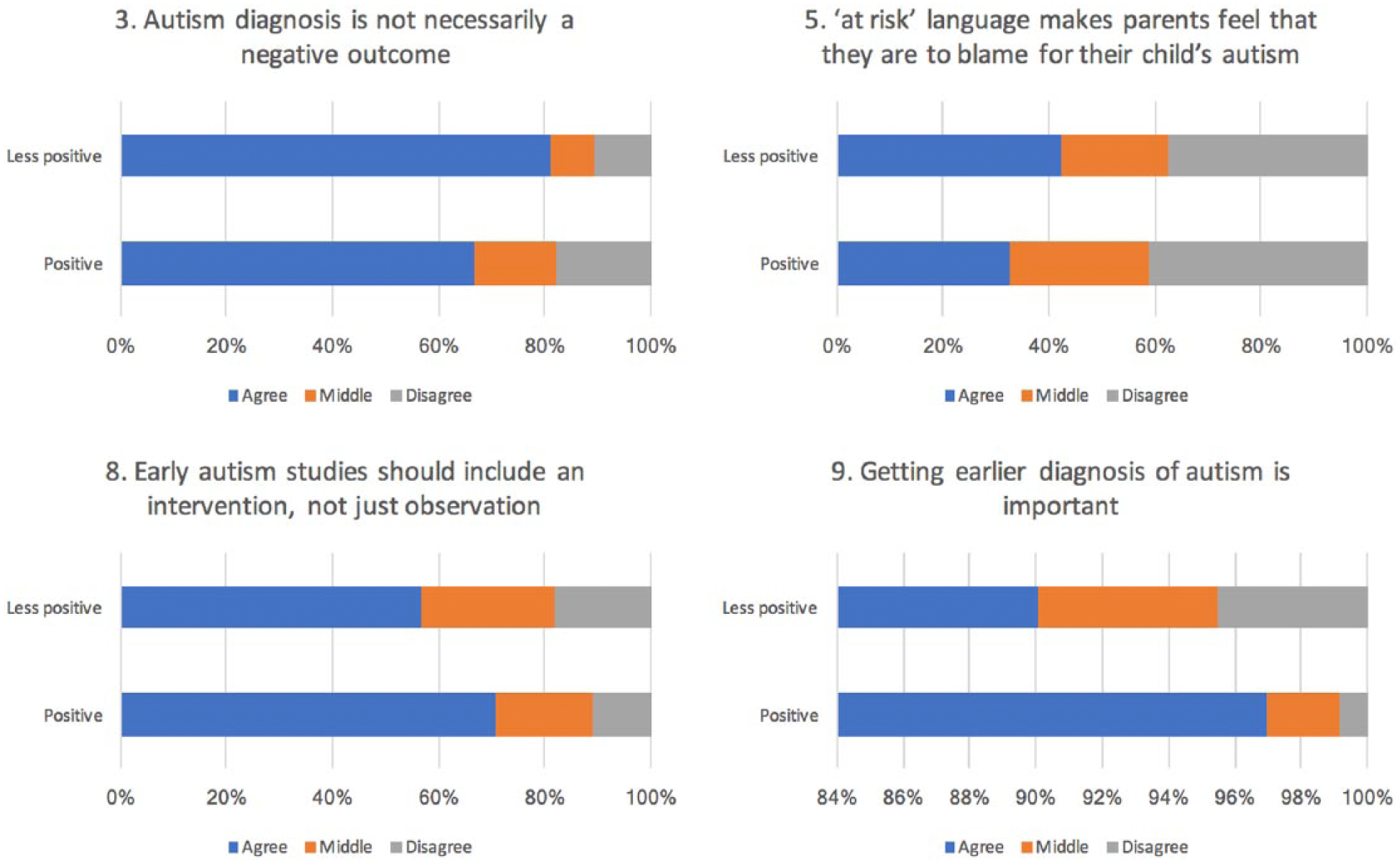
Difference in agreement on question 3, 5, 8 and 9 on focus group statements.
Attitudes and factors: age of diagnosis
One factor which may play a role in defining attitudes to early autism research could be the family’s experience during the diagnostic process. To capture this, we calculated mean age of diagnosis of the child with autism, for groups defined by the reported age-range at which concerns were first raised. Most parents report concerns before the age of 2 years (55.1%), or before the age of 4 years (36.0%). Only a small proportion of the parents report that their first concerns were evident later than 4 years of age (8.9%). This contrasts with the fact that in every age-of-concern category mean age of diagnosis is close to or over 4 years old. Additionally, in the large majority of cases, parents report that they or another family member were the first to raise concerns (74.6%). An estimate of time from first concern to diagnostic age was computed based on the midpoint in the collected age range of reported first concerns, and given diagnostic age. There was no significant difference between the Positive group (mean = 10.3 years, SD = 6.7) and the Less Positive group (mean = 9.6 years, SD = 5.7) on this variable.
Attitudes and factors: family characteristics
Group comparisons of demographic and parent characteristics indicated that parents in the Less Positive group were less likely to report that their children had ID compared with the Positive attitude group. There were no differences between the two attitude groups in any other parent or child characteristics. A sub-sample (n = 138) of parents reported that they either had an autism diagnosis or suspected that they were autistic. Direct comparison of this sub-group with the rest of the sample showed that parents self-identifying as autistic in this way were neither more nor less likely to declare positive attitudes to autism research than the rest of the sample (p = 0.48).
Attitudes and factors: access to services
Table 2 illustrates the frequency with which parents accessed various different kinds of education and health services, together with their mean ratings for those services. The Positive attitude group reported accessing significantly more services and also gave significantly higher quality ratings for support services. There was also a near-significant group difference in ratings of intervention services, again with the Positive group rating these more highly. When analysing based on Positive versus Negative attitude groups, the difference in number of services accessed remained significant in the same direction. However, comparing these groups, quality ratings for support and intervention services did not differ (both p > 0.20), but quality ratings for education services differed significantly (Positive mean = 2.5; Negative mean = 1.9; t (574) = 1.91, p = 0.05).
Self-rated autism knowledge, frequency of service access and service quality ratings by attitude group.

SD: standard deviation.
Range 0–9 for both groups.
Significant differences at p < 0.05.
To further explore the impact of receiving many versus few services on attitudes, we compared the group receiving services in the lowest quartile (0 services, n = 355) versus the top quartile (5 services or more, n = 296). A Fisher’s exact test revealed that the group receiving fewest services was more likely to be Less Positive about research on early autism than the group receiving most services (odds ratio (OR) = 0.43, confidence interval (CI) = 0.25–0.73, p < 0.001).
Expectations about research: the role of intervention
In a specific survey item, parents were asked to indicate whether provision of an intervention component was essential for involvement in a research study. Almost 50% of the parents (516) indicated that intervention is an essential part of involvement, and 342 parents answered that intervention is not an essential part. Only 83 parents indicated that they would prefer studies not to have an intervention component.
The parents were also asked to rank what information is most important in making a decision about participating in an early autism research study: these data are presented in Figure 3, ranking from 1 = most important to 7 = least important. These rankings demonstrate that the presence of an intervention component is ranked as less important in decision-making about research participation relative to more overarching factors such as what the study involves for family members. Also high-ranking is the science behind the research, indicating that this parent sample is concerned about the academic status of research not just the impact for them personally. These results indicate that parents consider a number of factors to have value in decision-making about research participation.
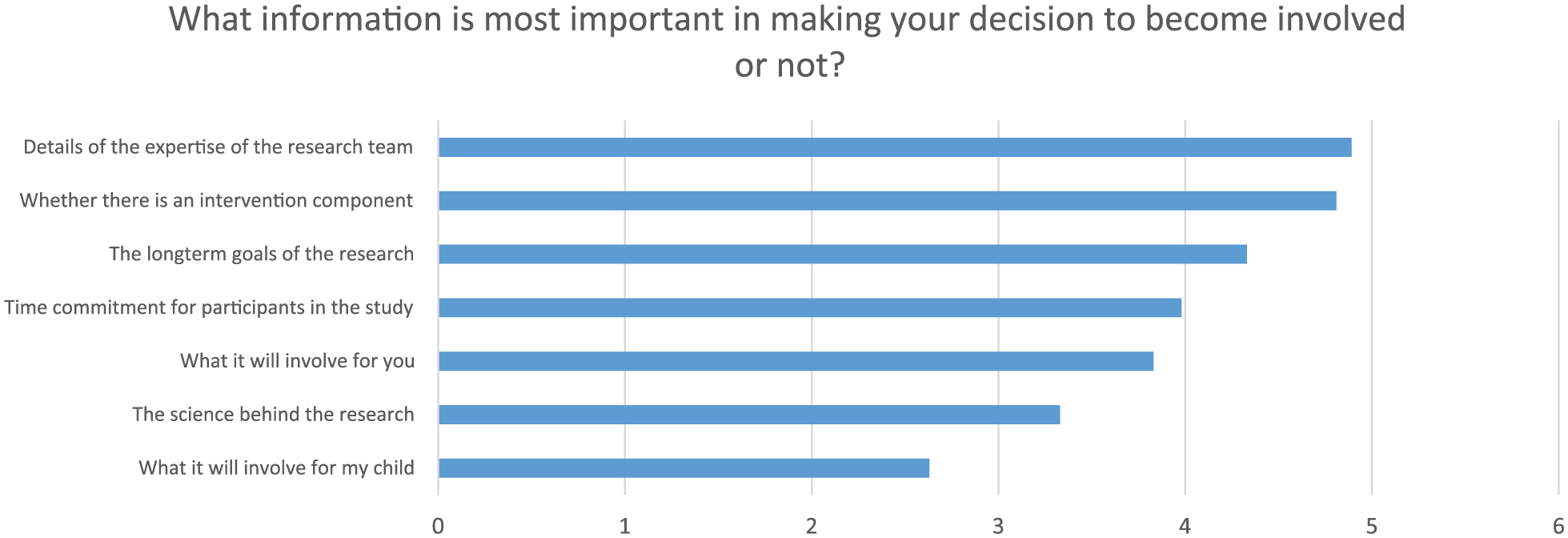
Mean rankings of the relative importance of different factors when deciding whether to enrol in research.
It is possible that the relatively low ranking given to intervention in this item belies some differences between sub-groups within the sample and may be explained by variability in existing intervention and support access. Table 3 illustrates differences in the mean ranking of the importance of intervention as a factor influencing participation in research studies according to self-reported quality and quantity of services accessed by the families. These data show that the need for an intervention component in a research study is not highly influenced by existing service access. However, there is a significant overlap between parents who consider intervention to be an essential research study component and those who rate support services as high quality. This could indicate a general endorsement of the value of autism support services.
Quantity and quality of services accessed by importance of intervention in research.

SD: standard deviation.
Significant differences at p < 0.05.
Expectations about research: measurement and communication preferences
Parents were asked to indicate what type of information they would allow research studies to collect about their child and themselves. Each listed type of information was rated on a 4-point scale: definitely yes, probably yes, probably not and definitely not. A separate check box was available if parents did not know what collecting this information would imply. Frequency counts (number and proportion selecting definitely yes or probably yes) for acceptability of each type of data are shown in Table 4. These show that there is a general high acceptability for all listed types of data, but this lowers slightly for medical procedures such as blood tests and brain scans. Comparison of parent acceptability ratings with the Eurosibs protocol shows that the least acceptable part of the protocol is the brain scan. All other measures in the protocol are rated as acceptable by about 80% or more of our parent sample, including DNA sampling.
Which types of research data are acceptable to parents?

MRI: magnetic resonance imaging; DTI: diffusion tensor imaging; ADOS-2: Autism Diagnostic Observation Schedule, Second Edition; EEG: electroencephalography.
We also asked parents about preferred forms of contact initially and during a research study. Parents selected all acceptable means of contact from a predefined list of communication modes. Frequency counts for each communication mode are shown in Figure 4(a) and (b). These indicate that participants value convenience (email communication) over the opportunity to have a discussion afforded by a personal meeting or phone call. In addition Table 5 provides information on where and how parents would prefer assessments to take place. These show that parents would prefer that assessments are face-to-face, and there is no clear preference for home, research lab or clinic visits.

Preferred contact method of parents of autistic children enrolled in a research study: a) initial contact and b) continued contact.
Where and how would you agree to assessments taking place?

The majority of parents (84.9%) further indicated that after data collection researchers should provide full disclosure of all child assessments. 3 Considerably fewer parents indicated that information should be passed on only when there is cause for concern, either to parents (17.8%) or to via the family doctor (8.1%). Only 0.3% of the participants selected Do not tell parents anything.
Discussion
This study aimed to capture data from a large, international, online survey of parents of children with autism in order to understand factors which shape attitudes to research and the expectations of potential participants. The specific focus was on the sub-field of early autism research which frequently employs longitudinal methodologies, recruiting families having an autistic child and a baby in order to chart the development of the younger sibling. These studies amplify and extend the usual repertoire of ethical issues in research and therefore are important areas in which to gain insight into community opinion. In this analysis, we focused on parents of children on the autism spectrum, aiming to extract practical recommendations for the research community who wish to recruit from and work with this group, and their children.
Our analysis hinged on responses to a single question directly asking participants whether early autism research should be done. Responses were overwhelmingly positive with a large majority of the sample selecting Yes definitely as their answer. This led to a difficult analysis decision: we chose to split the groups in a way which conflated responses ranging from less positive to actively negative, in order to avoid an even more dramatic disparity in group sizes. However, when comparing positive and negative attitude groups, we were able to replicate the patterns of data in almost every case. One exception was when probing the relation between attitude and access to services but even here, while the individual item results were different, both analyses revealed an association between lower access to, and quality ratings of, services in less-favourable attitude groups.
Why were attitudes so positively skewed? This is doubtless partly a function of the fact that all of our sample self-selected to participate in this research project – albeit a far less intensive experience than most early autism research studies. Indeed, we cannot rule out the possibility that some participants may have been enrolled in an early autism study themselves. However, other factors might also have contributed to this pattern. A wider analysis of the same survey data demonstrates that people in the autism community endorse goals of this research including determining the genetic origins and earliest behavioural signs of autism. In the current, specific analysis of parent data, we report on the lengthy temporal gap between parents’ first concerns about their child and their eventual diagnosis. It is not possible to speculate as to whether this gap is due to clinical waiting times or other factors – such as parents being slow to approach clinical services. But regardless, the subjective experience of the parent seems to be that they suspected their child was autistic long before this was confirmed. It is easy to see from this perspective why attitudes to early autism research might be so widely supported by parents.
Despite the overwhelmingly positive stance of our respondents, it was still possible to determine a series of factors which were related to attitudes, including rated quality of services, and amount of services accessed. This relation indicates that those parents who have not had positive experiences with local autism services may view the research community through the same lens. This is disappointing, as one intention among researchers is to build evidence which can contribute to quality service delivery. If families are reluctant to engage with research, it will continue to be difficult to deliver empirically supported services.
In addition, we probed attitudes by asking participants to respond to a series of focus group statements. These reveal significant agreement between participants on issues relating to participation in research studies. The sample strongly endorses the importance of sharing information between researchers and participants, and the need for responsivity to parents’ changing attitudes during a longitudinal study. However, in other cases, parents provide more variable responses. There were differences in opinion about the meaning of autism, as evidenced by variability in attitudes to the impact of a diagnosis, the importance of early diagnosis, and to use of ‘at-risk’ language, also found in our previous report on differences between stakeholder groups (Fletcher-Watson et al., 2017). These findings are good news for researchers in the field. They suggest that although there are differences between parents on thoughts about autism, when considering the more specific issue of engagement with a research project there is greater consensus. This should mean that we can not only extract clear guidelines for our research practices, but we are also able successfully to capture variability within that community in our research.
Responses to other focus group statements suggest that some areas of concern in the academic community may not be reflected among parents. For example, the majority of parents were relatively neutral when asked about preference to work with clinicians rather than academics and showed similar ambivalence over the question of whether an older child, already having an autism diagnosis, might be neglected in studies with infant siblings. On the other hand, parents did tend to agree that taking part in a longitudinal study of early autism might influence parenting – highlighting the profound responsibility researchers have to their participating families even when active intervention is not included in the project.
Recommendations for researchers
Our data included a series of questions asking directly about research participation. From these we can extract specific recommendations for the field. It is clear that participant burden is a key factor when parents decide whether or not to enrol in research studies. Unfortunately, these data cannot provide information about the upper limits of acceptable burden, but we can see that parents prefer email contact, perhaps because this mode of communication requires less time and effort than (for example) responding to a letter or engaging in a phone call. On the other hand, parents seem to find face-to-face data collection appointments preferable to phone interviews or data collection by post – and these are equally acceptable in home, university or hospital settings. We speculate that this is because parents prefer researchers and clinicians to get to know their children in person and also because a personal appointment allows them to ask questions and get more information. Of course, a participant preference for email contact needs to be balanced against other factors including a requirement that any confidential information be shared via a secure route.
Our survey reveals opinions on the topic of intervention which may seem at first glance to be conflicting. Whether research studies incorporate an intervention component is ranked sixth out of seven statements about reasons to participate in the research project. On the other hand, when asked directly whether intervention was an essential prerequisite for participation in a project, about half of parents said yes. There are also high levels of agreement with a focus group statement on the same topic. We interpret these findings as an indication of the even greater importance of the personal impact of participation on the family. Researchers should also note that we did not ask explicitly about participation in randomised controlled trials. Thus, we do not know whether parents responding to this survey would participate in studies with an intervention component, if there was a chance that they would not themselves receive the intervention.
An unexpected finding was that the scientific basis of the research ranked highly in parents’ list of priorities: second, above both impact on the parent and overall time commitment. Again, this is positive news for the academic community as it suggests that stakeholders in autism research are responsive to messages about the need for rigorous science. This may alleviate concerns over aspects such as the ethics of randomised controlled trials, and the acceptability of studies which only yield impact over a long timeline and as part of a larger body of work. While eliminating technical jargon and engaging with stakeholders as equals is clearly essential for high quality research, this finding indicates that researchers should not shy away from placing their project into its scientific context and sharing this with participants. Such information may be persuasive at the point of recruitment and also contributes to wider goals regarding public understanding of science.
In terms of acceptable measures in a research context, these positively disposed survey respondents were also receptive to the majority of data collection techniques listed in the survey. Our comparison between parents’ expectations and the common research protocol used in the Eurosibs consortium (Table 4) highlights that, broadly, parents find acceptable the measures used in early autism research to collect information both on themselves and on their children. Even intrusive methods such as blood samples, or sensitive information such as DNA from cheek swabs and access to medical records, were endorsed by the large majority of parents. However, about a third of respondents reported not finding brain scans for their children acceptable. It is unclear whether this reflects a concern about the time commitment associated with some brain scans, or worries over the possible impact of a scan on the developing brain. Providing parents with accurate yet accessible information and effectively communicating the rationale for the use of such measures, as well as disseminating findings in the community of stakeholders, may help to address such concerns. Finally, there is growing interest in studying the broader autism phenotype in parents of children with autism (Sasson et al., 2013), and in our sample, most parents (79%) would find it acceptable to be assessed for autism characteristics in the context of early autism research.
Limitations and next steps
This study is limited by the potentially biased nature of the sample who, by definition, are already positively disposed towards research as evidenced by their participation in this survey. That said, taking part in an online survey is very different from participation in an autism siblings study and these data suggest a large pool of families who are positive even about this sort of intensive research process and well informed about the issues. These survey data can necessarily only provide a superficial overview of attitudes and should be followed up with targeted recruitment of a more varied sample (e.g. parents of children diagnosed later in life; parents of autistic adults) and more in-depth studies. In particular, we would welcome qualitative explorations of the experiences of families enrolled in sibling studies, and especially research which aims to determine the attitudes of children, with and without an autism diagnosis, who grew up as a part of these cohorts. In addition, some key ethical questions were not addressed in this study. For example, we did not draw attention to the fact that many of the infants enrolled in early autism studies are effectively screened and may, in intervention studies, be offered pre-emptive parent-mediated intervention, despite having no developmental difficulties. Such ethical questions should be presented to stakeholders in future studies.
Implications of the study
This work aims to explore within-group differences in parent attitudes to early autism research. The overwhelmingly positive disposition which was uncovered, while informative in itself, hampered this goal. However, individual research teams should pay attention to the nuances of these data, such as attitudes to the sharing of data between researchers and families, or the need for long-running studies to responsive to changing family needs. We hope that research teams will draw practical lessons from these findings and that research into the perspectives of stakeholder groups will be woven in to future studies in the field.
Supplemental Material
AUT728436_Lay_Abstract – Supplemental material for What do parents of children with autism expect from participation in research? A community survey about early autism studies
Supplemental material, AUT728436_Lay_Abstract for What do parents of children with autism expect from participation in research? A community survey about early autism studies by Sue Fletcher-Watson, Kenneth Larsen and Erica Salomone in Autism
Supplemental Material
AUT728436_supplementary_material – Supplemental material for What do parents of children with autism expect from participation in research? A community survey about early autism studies
Supplemental material, AUT728436_supplementary_material for What do parents of children with autism expect from participation in research? A community survey about early autism studies by Sue Fletcher-Watson, Kenneth Larsen and Erica Salomone in Autism
Footnotes
Appendix 1
Members of the working groups who contributed to this research are as follows: Fabio Apicella, Bonnie Auyeung, Stepanka Beranova, Frederique Bonnet-Brilhault, Ricardo Canal Bedia, Tony Charman, Natasha Chericoni, Ines C Conceicao, Kim Davies, Teresa Faroni, Marie Gomot, Emily Jones, Anett Kaale, Katarzyna Kapica, Rafal Kawa, Anneil Kylliainen, Jeremy LeFort-Besnard, Joelle Malvy, Sara Manso de Dios, Silvana Markovska-Simoska, Inbal Millo, Natercia Miranda, Greg Pasco, Ewa Pisula, Marija Raleva, Bernadette Roge, Synnve Schjolberg, Przemyslaw Tomalski, Astrid M Vicente and Nurit Yirmiya.
Acknowledgements
This research would not have been possible without the contribution of hundreds of parents, who we thank for taking part. The authors recognise the contribution of research teams from across Europe to data collection for this survey including: Fabio Apicella, Bonnie Auyeung, Stepanka Beranova, Frederique Bonnet-Brilhault, Ricardo Canal Bedia, Tony Charman, Natasha Chericoni, Ines C Conceicao, Kim Davies, Teresa Faroni, Marie Gomot, Emily Jones, Anett Kaale, Katarzyna Kapica, Rafal Kawa, Anneil Kylliainen, Jeremy LeFort-Besnard, Joelle Malvy, Sara Manso de Dios, Silvana Markovska-Simoska, Inbal Millo, Natercia Miranda, Greg Pasco, Ewa Pisula, Marija Raleva, Bernadette Roge, Synnve Schjolberg, Przemyslaw Tomalski, Astrid M Vicente and Nurit Yirmiya.
Declaration of conflicting interests
The author(s) declared no potential conflicts of interest with respect to the research, authorship and/or publication of this article.
Funding
The author(s) disclosed receipt of the following financial support for the research, authorship and/or publication of this article: This work was supported by the European Co-operation in Science and Technology (COST) Action BM1004 Enhancing the Scientific Study of Early Autism (ESSEA).
Notes
References
Supplementary Material
Please find the following supplemental material available below.
For Open Access articles published under a Creative Commons License, all supplemental material carries the same license as the article it is associated with.
For non-Open Access articles published, all supplemental material carries a non-exclusive license, and permission requests for re-use of supplemental material or any part of supplemental material shall be sent directly to the copyright owner as specified in the copyright notice associated with the article.
