



Abstract
This study examined delay of gratification behaviors in preschool-aged children with and without autism spectrum disorder. Recent research has found that elementary-aged children with autism spectrum disorder showed challenges with delay of gratification and that there were individual differences in terms of children’s behaviors during the wait. We extend this work to a younger sample of children with autism spectrum disorder to understand whether these difficulties emerge by the preschool years. Moreover, we assessed whether individual differences in other key self-regulatory capacities (i.e. effortful control, emotion regulation, executive function, and joint attention) were related to delay of gratification wait durations or behavioral strategies. Findings revealed that preschoolers with autism spectrum disorder waited for a shorter duration, demonstrated more temptation-focused behaviors, and expressed less positive affect than their typical peers during the delay of gratification task. At the full-sample level, individual differences in children’s temptation-focused behaviors (i.e. visual attention and verbalizations focused on the temptation) were related to children’s executive function, joint attention, and parents’ ratings of emotion regulation. When we examined associations within groups, the associations were not significant for the autism spectrum disorder group, but for typically developing children, there was a positive association between temptation-focused behaviors and emotion regulation.
Keywords
One of the critical developmental tasks of early childhood is the ability to control one’s emotional and behavioral responses. This ability, called “self-regulation,” is more broadly defined by scholars as the organization or modulation of affective, mental, and behavioral responses (Blair & Diamond, 2008; Fuster, 1997; Kopp, 1989; Posner & Rothbart, 2007). Self-regulatory skills are comprised of both inhibitory and excitatory capacities such that children might need to actively suppress or delay their responses in some circumstances and/or initiate or activate their behaviors to respond to other situational demands. Self-regulation also requires the modulation or management of attention; distraction strategies are often needed to support the voluntary control of impulses. During the preschool years, self-regulation becomes increasingly important for children’s social adaptation and their ability to act in accord with others’ requests and with social standards (Eisenberg, Smith, & Spinrad, 2016; Kochanska, Murray, & Harlan, 2000; Posner & Rothbart, 2007). One such socially adaptive dimension of self-regulation is the ability to delay gratification, which refers to the capacity to wait for a more-desirable outcome when faced with the opportunity to obtain a less-desirable, but immediate, outcome.
Differences in self-regulatory processes were identified in some of the earliest work on children with autism spectrum disorder (ASD; Adrien et al., 1995; Courchesne, 1995; Degangi, Dipietro, Greenspan, & Porges, 1991), whose core challenges include delays in social and communication skills, as well as restricted, repetitive, stereotyped, and/or atypical sensory responses (American Psychological Association, 2013). More recently, there has been a renewed interest in better understanding the development of self-regulatory processes among children with ASD. In particular, there is a need for more work on strategies that may support children’s self-regulation in “everyday” behaviors, including their ability to delay gratification, which may have consequences for their adaptation across many different contexts (e.g. Eisenberg et al., 2016; Kochanska et al., 2000; Posner & Rothbart, 2007).
Delay of gratification in typical development and ASD
There exists a large body of work on delay of gratification in typically developing (TD) children by such scholars as Mischel (e.g. Mischel, Shoda, & Rodriguez, 1989), Kochanska (e.g. Kochanska et al., 2000), and Carlson (e.g. Carlson & Moses, 2001) whose work has helped us to understand the normative developmental course of such behaviors. Extant research suggests that the preschool years are an important period of growth in delay of gratification; by 3 years of age, TD children begin to show marked improvements on delay tasks that require them to do such things as wait for a snack or gift, slow down motor activity, or speak in a lower voice (Kochanska et al., 2000). As they enter the preschool years, children show continued improvements on impulse-control tasks like “Simon Says” (i.e. Jones, Rothbart, & Posner, 2003) and in the use of effective strategies on tasks requiring them to delay gratification for longer durations (Mischel et al., 1989). These developments reflect what Kopp (1989) has referred to as the balance between self-defined needs and social expectations during the preschool years.
To date, the research on delay of gratification in children with ASD is limited. A recent study by Faja and Dawson (2015) was the first, to our knowledge, to explicitly observe such behaviors in children with ASD (6- to 7-year-olds) using Mischel’s (1983) traditional delay of gratification paradigm (e.g. Mischel et al., 1989). Findings from this seminal work revealed that, on average, children with ASD waited for significantly shorter durations and were less likely to pass the task than typical peers. Observations of children’s visual attentional strategies during the wait (i.e. whether they looked at or away from the tempting snack) revealed no significant differences between groups. Interestingly, although parents of children with ASD rated their children lower in temperamental effortful control than those of TD children, children who waited during the delay of gratification task did not differ from those who did not wait in terms of ratings of effortful control or ASD severity. Together, the findings from Faja and Dawson’s (2015) work offer a critical first step in our understanding of the capacity for children with ASD to delay gratification, their use of attentional strategies as they wait, as well as possible sources of individual differences in these behaviors. Given what is known about the normative developmental course of delay of gratification, the next step in this line of work should be to extend these findings developmentally downward to even younger children to determine whether differences between children with ASD and their typical peers appear as these capacities are just beginning to develop in the preschool years. To that end, the present study examined latency to delay gratification in a sample of preschoolers (3- to 5-year-olds) with and without ASD in a delay of gratification task consistent with Mischel et al. (1989) and Faja and Dawson (2015). In line with Mischel et al.’s (1989) notion that typically developing children are generally more effective if they avoid temptation-focused behaviors (e.g. looking at the reward and thinking about its “gooey, delectable taste”), we sought to measure children’s focus on the tempting snack using a broader repertoire of behaviors. Thus, we coded children’s visual attention to the reward, their attempted contact with the tempting features of the reward (e.g. smelling the cup of candy), and their vocalizations about the tempting qualities of the reward (e.g. “M&Ms are yummy”). We referred to these behaviors, collectively, as children’s temptation-focused behaviors. Finally, because we were interested in the degree to which the delay of gratification situation was frustrating to the children, we coded both their negative and positive emotional expressions during the delay.
Individual differences in self-regulatory processes and delay of gratification
The work of Faja and Dawson (2015) also highlighted the importance of examining factors that might explain individual differences in children’s ability to wait and/or their use of attentional strategies during the delay. In the present study, we were particularly interested in understanding the degree to which other indices of self-regulation and attention regulation (i.e. temperamental effortful control, emotion regulation, executive function, and joint attention) were related to preschoolers’ delay of gratification. The convergence in developmental timing among several of these dimensions of regulation supports the potential that individual differences in these various regulatory domains may be related to preschool children’s development of delay of gratification (Calkins & Howse, 2004). Thus, we not only explored individual associations of these processes with children’s delay of gratification, but we also examined them collectively in one model, to examine whether one or more self-regulatory indices were most salient in explaining unique variance in children’s delay behaviors over and above the others. Such knowledge may be informative to identifying targets for intervention work.
First, similar to Faja and Dawson (2015), we examined parents’ reports of children’s temperamental effortful control, which has been defined as children’s “ability to suppress a dominant response to perform a subdominant response” (Kochanska et al., 2000; Rothbart & Bates, 2006). There is now clear evidence, including that from our own lab (Jahromi, Bryce, & Swanson, 2013) of developmental delays in parents’ reports of effortful control among preschoolers with ASD (Brock et al., 2012; Konstantareas & Stewart, 2006) and delays extending into adolescence (Samyn, Roeyers, & Bijttebier, 2011), despite some mixed findings when relying on different measures (Burrows, Usher, Schwartz, Mundy, & Henderson, 2016; Schwartz et al., 2009). Interestingly, Faja and Dawson (2015) found no association between children with ASD’s performance on the delay of gratification task and their parents’ ratings of effortful control, highlighting what the authors suggested could be a difference in the types of behaviors tapped by the two measures. Thus, in our study of individual differences, we aimed to include both parent reports and observed measures of children’s self-regulation behaviors to further explore this issue.
Specially, we aimed to examine individual differences in children’s executive function (i.e. mental or cognitive control processes), emotion regulation (i.e. modulation of emotional experiences and expressions), and joint attention initiations (i.e. skills used to coordinate attention with a social partner; Adamson, Bakeman, & Deckner, 2004). With respect to executive function, the present study focused on the dimension of inhibitory control, that is, the capacity to resist distraction and overcome a prepotent or perseverative response (e.g. Diamond, Prevor, Callender, & Druin, 1997). The results of several extensive reviews support the notion that individuals with ASD show difficulties with inhibitory control (Geurts et al., 2014; Hill, 2004a, 2004b). From a conceptual standpoint, it is possible that preschoolers’ executive function skills may facilitate their success in the delay by supporting their intensive concentration/attention away from the temptation, or by facilitating the flexible selection and deployment of other coping strategies (Mazefsky, Pelphrey, & Dahl, 2012; Ursache, Blair, & Raver, 2012). Although this notion has not been tested in children with ASD, studies of delay of gratification among preschoolers with typical development have shown both a concurrent and longitudinal association with such executive function tasks as the Day/Night Stroop task and the Go/No-Go task (e.g. Bindman, Pomerantz, & Roisman, 2015; Eigsti et al., 2006; Mann, Hund, Hesson-McInnis, & Roman, 2017; Poland, Monks, & Tsermentseli, 2016).
Studies of emotion regulation among preschoolers with ASD also support the notion of early self-regulatory delays. Young children with ASD have been observed to use fewer advanced strategies to regulate their emotions (Konstantareas & Stewart, 2006), including significantly fewer constructive strategies, and significantly more avoidance and venting strategies (Jahromi, Meek, & Ober Reynolds, 2012). These challenges appear to continue into adolescence, with reports of fewer social support seeking coping strategies (Rieffe et al., 2011), problems with the effective use of strategies (Samson, Hardan, Podell, Phillips, & Gross, 2015), and use of more maladaptive strategies like rumination and shutting down (Mazefsky, Borue, Day, & Minshew, 2014). From a theoretical perspective, Blair (2002) argues that emotionality and emotion regulation may influence the very appraisal processes that motivate goal-directed behavior. In the context of a delay, those children who have better emotion regulation may be better at identifying the sources of their frustration, reflecting on how similar emotions were alleviated in the past, and enlisting the appropriate strategies for self-soothing (Kopp, 1989). Moreover, given the pattern of findings from Mazefsky et al. (2014) with respect to children’s difficulty in selecting more adaptive and/or inhibiting less adaptive strategies, it will be interesting to understand whether the preschoolers’ emotion regulation is related to their strategy selection (i.e. temptation-focused behaviors) or emotional expressions in the delay of gratification paradigm.
Finally, given the potential importance of attention control strategies to children’s success in the delay of gratification context, we examined children’s joint attention initiations. Difficulties in the use of joint attention for social communication are considered a core challenge of ASD (e.g. Kasari, Freeman, & Paparella, 2006). Conceptually, Raver (1996) has suggested that the process of initiating and maintaining shared attention may facilitate the use of attentional control to modulate distress. Empirical evidence supports this notion, as Raver (1996) found that neurotypical children who engaged in more joint attention during mother–child free play also used more distraction self-regulation techniques during a delay of gratification task. Although no study has tested this notion in young children with ASD, there is growing evidence of an association between joint attention and other self-regulatory behaviors in early childhood, as Samson et al. (2014) found that emotion dysregulation was related to parents’ reports of social communication, and Morales, Mundy, Crowson, Neal, and Delgado (2005) found that 2-year-olds who spent more time jointly engaged with their parent in free play also used greater self-distraction when distressed (Morales et al., 2005).
The current study
The first goal of this study was to extend the work of Faja and Dawson (2015) to a younger sample of preschoolers with ASD to understand whether differences in delay of gratification behaviors emerge during this developmental period. In line with Faja and Dawson (2015), we tested whether high-functioning children with ASD differed in comparison to developmentally matched TD peers in terms of their capacity to delay gratification for a tempting reward. Consistent with Faja and Dawson (2015), we hypothesized that preschoolers with ASD would be less likely to delay gratification than their typical peers. Second, we examined the repertoire of temptation-focused behaviors children used in the delay paradigm. We explored children’s visual attention to the stimulus as well as their verbalizations about, and attempts to make contact with, the tempting stimulus. Moreover, we observed children’s positive and negative affect during the delay to understand whether there were group differences in children’s emotional expressions. We expected that preschoolers with ASD may show fewer effective strategies, overall, during the delay, given evidence of poor inhibitory control and difficulty in selecting adaptive regulation strategies among children with ASD (Geurts et al., 2014; Mazefsky et al., 2014). Because we expected the delay to be more challenging for preschoolers with ASD, we also predicted that they would show more negative and fewer positive emotional expressions. Finally, we also examined whether individual differences in delay of gratification behaviors were associated with children’s temperamental effortful control, executive function, emotion regulation, and joint attention, to begin to understand potential processes that may underlie delay of gratification for young children with ASD. Moreover, in an effort to inform intervention work about the most salient capacities that might underlie children’s delay of gratification, we examined those dimensions that showed correlations with delay of gratification collectively to understand the relative contribution of each component for children’s delay behaviors. Given that relations between measures of effortful control and delay of gratification were not found for children with ASD in Faja and Dawson’s (2015) study, this aspect of our study sought to explore whether a positive association would be found between children’s delay of gratification and a broader battery of self-regulatory measures, both direct assessments and parent reports (e.g. Mazefsky et al., 2012; Morales et al., 2005; Ursache et al., 2012).
Method
Participants
The study included a total of 38 children, 18 children with ASD (M = 57.61 months chronological age, standard deviation (SD) = 11.35, Range = 40–77 months) and 20 TD children (M = 50.2 months chronological age, SD = 11.12, Range = 33–78 months), matched on gender, mental age, expressive language age, and receptive language age. Children in the autism group had an independent clinical diagnosis of autism that was confirmed with an Autism Diagnostic Interview–Revised (ADI-R; Lord, Rutter, & Le Couteur, 1994) at the time of the first research visit, and children in the typical sample had scores below 15 (i.e. the cutoff criteria for possible ASD) on the Social Communication Questionnaire (SCQ), a companion screener with properties similar to the ADI-R (Rutter, Bailey, Lord, & Berument, 2003). Children were recruited from university preschools and a local agency that serves families with children with autism. With respect to ethnicity, 77.5% of the participants were White, 10% were Hispanic or Latino, 7.5% were of Asian origin, and 2.5% were considered biracial or another ethnicity. The mean age of mothers in the study was 36.3 years (SD = 4.92), and fathers had a mean age of 37.6 years (SD = 6.08). The majority of the parents in the study (97.5%) were married. No significant differences were found between groups in these demographic variables.
Procedures
Children attended two research visits at a university research laboratory or a local autism center. During the first visit, parents completed an informed consent (approved by the university’s Institutional Review Board). Assessments of children’s developmental functioning were obtained, while parents of children with autism completed the ADI-R. For the second visit, which occurred approximately two weeks after the initial visit, parents and children participated in a variety of self-regulation tasks. The delay of gratification task occurred after the other self-regulation tasks took place during the lab visit and no other snacks were provided to the child prior to the delay of gratification task.
Measures
Diagnostic status
The ADI-R (Lord et al., 1994), in combination with clinical diagnosis, was used to confirm the diagnostic status of children with ASD. Parents of TD children were administered the SCQ (Rutter et al., 2003), a screening tool for ASD, to confirm that they did not meet criteria as “at risk” for ASD.
Preschool Language Scale, Fourth Edition
The Preschool Language Scale, Fourth Edition (PLS-4), was used to assess children’s expressive and receptive language age (Zimmerman, Steiner, & Pond, 2002). This measure is designed for children from birth to 6 years, 11 months, and has been validated for use with children with autism.
Differential Ability Scales–II
The Differential Ability Scales–II (DAS-II) was used as a measure of children’s cognitive ability (Elliot, 2007). This measure is designed for children 2 years, 6 months to 17 years, 11 months, and has been validated for clinical samples with developmental delay. The measure yields a General Conceptual Ability (GCA) score from which a mental age score was derived for each child (mental age = chronological age × GCA / 100).
Delay of gratification task
The delay of gratification procedure was conducted in line with the procedures outlined by Mischel and colleagues (Mischel, 1983; Mischel et al., 1989). M&Ms were used as the tempting snack, and alternative snacks (i.e. goldfish crackers or fruit flavored cereal) were available for use if the parent indicated that the child had a dietary restriction or more strongly preferred another snack. Children were seated at a table, and the experimenter presented the child with two small cups and a bell. The experimenter placed two pieces of M&Ms in one small cup, and 10 pieces in another cup and told the child, “Do you see these two cups? One cup has two M&Ms and one cup has ten M&Ms.” The experimenter then asked the child which cup he or she would prefer to have. All children indicated that they would like the cup with 10 pieces. The experimenter told the child, If you wait until I return, you will receive ten M&Ms. But, if you cannot wait, then you may ring this bell [experimenter demonstrated ringing the bell] and I will return right away. However, then you will only get two M&Ms.
The experimenter confirmed that the child understood the rules by asking a series of test questions: “What do you need to do if you want ten M&Ms? What if you cannot wait? Then what would you get?” After ensuring that the child understood the rules, the experimenter left the room for the duration of an 8-min delay and observed the child through a one-way mirror. The session was video recorded for subsequent coding of children’s behaviors during the delay paradigm using a computerized video coding system, Datavyu (www.Datavyu.org) that records frequencies and durations of behaviors. A master’s-level graduate student conducted the observational coding, and a second doctoral-level graduate student independently coded 20% of the videos to calculate inter-rater reliability.
Observed behaviors during delay of gratification
Several behaviors were coded during the delay of gratification task. Wait duration reflected the precise duration of time (in seconds) that children waited during the delay (i.e. before either ringing the bell or ending the task by trying to leave the room). Children were successful if they waited for a maximum of 8 min (480 s). The Intraclass Correlation Coefficient (ICC) reliability was 0.98 for wait duration. Task outcome was coded using two mutually exclusive categories: (1) “pass” (i.e. waiting until experimenter returned) or (2) “fail” (i.e. all other outcomes, including ringing the bell, eating or tasting the reward, or leaving the room). The ICC reliability was 1.00 for task outcome. Visual attention to the temptation and Attention shifts were measured using duration coding. Attention to the reward was the time the child attended to the temptation (candy and/or bell), whereas attention shifts reflected any time that the child switched focus points away then back to reward for at least 1 s. The ICC reliability was 0.92 for attention to the temptation and 0.98 for attention shifts. Touching or smelling the temptation was coded when the child touched or smelled the cups or the bell. The ICC was 0.98 for the duration of touching or smelling the reward. Vocalizations about the temptation were coded if they made clear reference to the reward, including the reward’s taste or smell (e.g. “M&Ms are yummy”), the reward’s properties such as number or color (e.g. “those are red M&Ms”), or about the rules of the task (e.g. “I will get to eat the 10 M&Ms”). Due to low variance, a percent agreement was calculated instead of ICC for vocalizations about the taste or smell (1.0), the properties (1.0), and rules (1.0). In line with Mischel et al.’s (1989) notion that focusing on the temptation tends to disadvantage children in succeeding on the task, we created a composite code called temptation-focused behaviors that reflected all forms of such strategies (i.e. visual attention and attention shifts to the temptation, touching or smelling the temptation, and vocalizations about the temptation).
Observed Negative Affect and Observed Positive Affect were individually coded using a 7-point rating scale; anchors ranged from (1) no negative/positive emotion displayed to (7) three or more intense, heightened, or prolonged displays of negative/positive emotion. Negative affect and positive affect variables were not mutually exclusive; thus, the child’s highest level in each valence was captured. Due to low variance, a percent agreement was calculated instead of ICC for positive affect (0.80) and negative affect (0.80).
Emotion regulation
Emotion regulation was assessed using the Emotion Regulation Checklist (ER Checklist; Shields & Cicchetti, 1997), a 24-item parent report that yields a subscale for emotion regulation (i.e. modulation of emotional expressions), which was the focus of the present study. Using a 4-point Likert-type scale (Rarely to Almost always), parents reported how often their child exhibits certain behaviors (e.g. “can modulate excitement”). Cronbach’s alpha for emotion regulation was 0.84.
Executive function
Two measures of executive function were conducted directly with children during their second visit to the research lab. Scores for children’s performance on these tasks were considered separately.
Day/Night task
The Day/Night task (Gerstadt, Hong, & Diamond, 1994) is a Stroop-like task that is designed to assess children’s ability to inhibit a prepotent response while performing a subdominant response. Children were instructed to say “day” whenever they saw a card that had a picture of a moon on it, and to say “night” whenever they saw a card that had a picture of a sun on it. Practice trials were followed by 16 test trials in which children saw cards in a fixed random order. Children’s scores reflect the total number of correct test trials.
Hand Game task
The Hand Game task (“Luria’s Fist and Finger Hand Game”; Hughes, 1998) is designed to assess children’s ability to inhibit a prepotent response and perform a subdominant response. In the first portion of the task, children were instructed to make the same hand motion as the experimenter, either a pointed finger or a fist. After reaching a criterion of six correct trials, the experimenter explained the “new rules of the game,” specifically, to make an opposite hand motion to experimenter’s (e.g. to point their finger if the experimenter made a fist). A brief practice was conducted, followed by 15 post-switch test trials. Children’s scores reflected the total number of correct test trials.
Temperamental effortful control
Effortful control was assessed using the Children’s Behavior Questionnaire–Short Form (CBQ-SF; Putnam & Rothbart, 2006; Rothbart, Ahadi, Hershey, & Fisher, 2001), a parent-report temperament measure. Using a 7-point Likert-type scale (extremely untrue of my child to extremely true of my child), parents reported how true particular statements were about their child’s behaviors (e.g. “can lower his or her voice when asked to do so”). An effortful control factor (computed based on the subscales of inhibitory control, low intensity pleasure, perceptual sensitivity, and attention focusing) had an average Cronbach’s alpha of 0.70.
Joint attention
An adapted version of the Early Social Communication Scales (ESCS; Mundy, Hogan, & Doehring, 1996) was used to measure children’s joint attention initiation behaviors during a structured experimenter–child interaction task using a set of toys deemed developmentally appropriate for preschoolers (wind-up and hand-operated toys, a hat, comb, glasses, ball, car, balloon, and book). Initiating joint attention consisted of three behaviors, including coordinated looks (i.e. child looked between experimenter and object), point to share (child pointed toward an out-of-reach object or picture), and show (child held an object within experimenter’s visual field to share information rather than to give experimenter the toy). Instances of initiations were coded by an independent coder; frequencies were summed and divided by the total duration of the session to derive a rate of occurrence (ICC reliability = 0.98).
Results
Preliminary analyses
In terms of developmental and demographic variables, no significant differences were found between groups in expressive language age, receptive language age, and mental age, as the two groups were matched on these variables (see Table 1). The group difference in chronological age was at the p = 0.05 level, t(36) = 2.03, d = 0.66. Children in the autism group (M = 57.61, SD = 11.35) were, on average, about 7 months older than their (TD) peers (M = 50.2, SD = 11.12). Chronological age was included as a control in subsequent tests of group differences. Groups did not significantly differ in household income, t(31) = 0.645, p = 0.52, d = 0.47; mother’s ethnicity, χ2(4, N = 38) = 6.05, p = 0.20; or father’s ethnicity, χ2(4, N = 36) = 5.63, p = 0.23. Finally, as group differences in children’s effortful control (ASD < TD), executive function (ASD < TD), emotion regulation (ASD < TD), and joint attention (ASD < TD) have been reported in our prior work (Dakopolos & Jahromi, 2018; Jahromi et al., 2013), these were not reported as part of the present study.
Developmental characteristics of study participants by group.
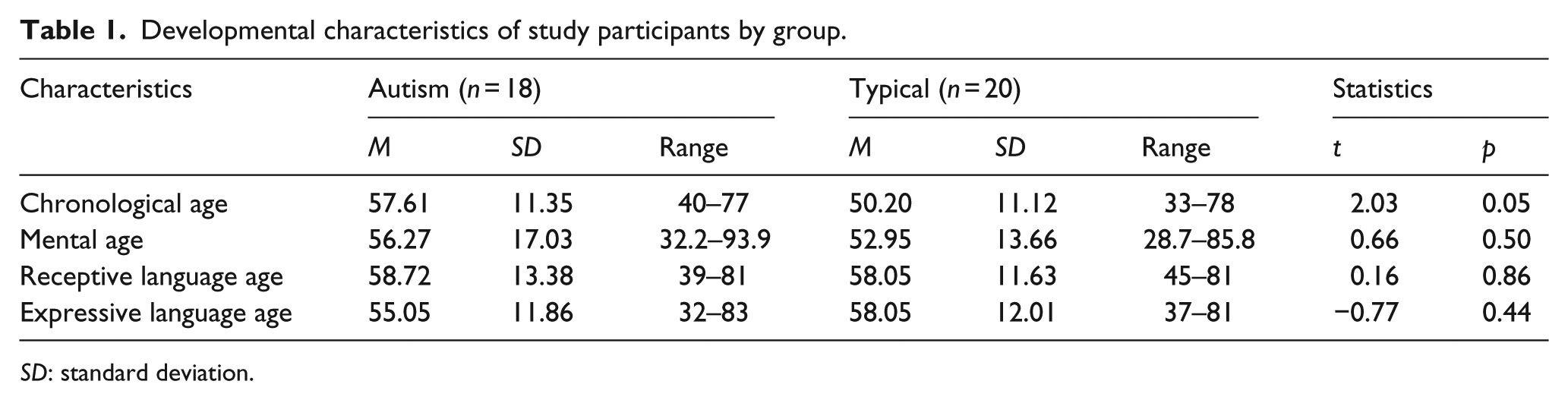
SD: standard deviation.
Group differences in children’s behaviors during delay of gratification
To test for group differences in pass/fail rate, a logistic regression was conducted with group as a fixed factor controlling for chronological age. A total of 8 children with ASD (44%) and 11 children with TD (55%) passed the delay of gratification task; there was no significant group difference in the outcome, Wald χ2(1, N = 38) = 0.69, p = 0.41. There was no significant difference in chronological age between those who passed and those who failed the delay of gratification task, t(36) = –0.425, p = 0.67, d = 0.14.
To test for differences in delay behaviors between diagnostic groups, Analysis of Covariances (ANCOVAs) were tested with chronological age as the covariate and group as the fixed factor. Results of these analyses revealed a significant difference between groups in their wait durations, F(1, 35) = 4.70, p = 0.037, d = 0.73, indicating that, on average, children in the ASD group waited significantly shorter durations than their TD peers. Children in the ASD group also exhibited a higher rate of attention shifts, reflecting less control over their attentional focus, during the delay of gratification task than the TD group after accounting for chronological age, F(1, 35) = 6.70, p = 0.014, d = 0.87; however, there was no significant difference in the groups in terms of the proportion of time children with ASD were visually focused on the tempting item, F(1, 35) = 0.90, p = 0.35, d = 0.32; the proportion of time spent touching or smelling the tempting items, F(1, 35) = 1.82, p = 0.19, d = 0.51; or the proportion of time they spent talking about temptation, F(1, 35) = 0.65, p = 0.43, d = 0.27. When we tested group differences using our composite temptation-focused behaviors variable, a difference between children with ASD and typical development emerged even after controlling for chronological age, F(1, 35) = 4.45, p = 0.042, d = 0.63, indicating that children with ASD used more temptation-focused behaviors (in total) during the delay task than their TD peers. Finally, with respect to children’s expressions of positive and negative affect, we found that although there was not a significant difference between groups in expressions of negative affect during the delay, F(1, 35) = 0.123, p = 0.728, d = 0.11, there was a significant difference in children’s observed positive affect during the task, F(1, 35) = 6.98, p = 0.012, d = 0.89, such that children with typical development were observed to show significantly more positive affect than children with ASD.
Links between indices of self-regulation and children’s behaviors during delay of gratification
To examine individual differences in children’s self-regulatory behaviors, we tested the association between children’s wait durations and the proportion of time they used temptation-focused behaviors. Using the full sample (see Table 2), a significant negative correlation emerged, such that children who used more temptation-focused behaviors waited for shorter durations during the delay, r(36) = –0.334, p = 0.04. Although children’s pass/fail status and wait durations were not related to the indices of self-regulation, χ2(1, N = 38) = 0.075, p = 0.79 (see Table 2), a consistent pattern of associations emerged with respect to children’s use of temptation-focused behaviors. Children who used fewer temptation-focused behaviors during the delay were those who also had better executive function performance on the Hand Game, r(37) = –0.34, p = 0.04; more joint attention initiations in the ESCS task, r(38) = –0.40, p = 0.016; and were rated by parents as having better emotion regulation, r(38) = –0.48, p = 0.002. Temperamental effortful control did not show significant associations with wait durations, r(37) = 0.021, p = 0.90, or temptation-focused behaviors, r(37) = –0.09, p = 0.61, but children’s expressions of positive affect while waiting during the delay of gratification were related to higher ratings of effortful control, r(37) = 0.34, p = 0.038. Magnitudes for significant associations were in the moderate range. We also attempted to control the false discovery rate using the Benjamini–Hochberg Procedure (Benjamini & Hochberg, 1995). After applying this procedure, the association between emotion regulation and temptation-focused behaviors withstood the adjustment, while the other correlations did not (see Table 2).
Means, SDs, and correlations among study variables for the full sample (N = 38).
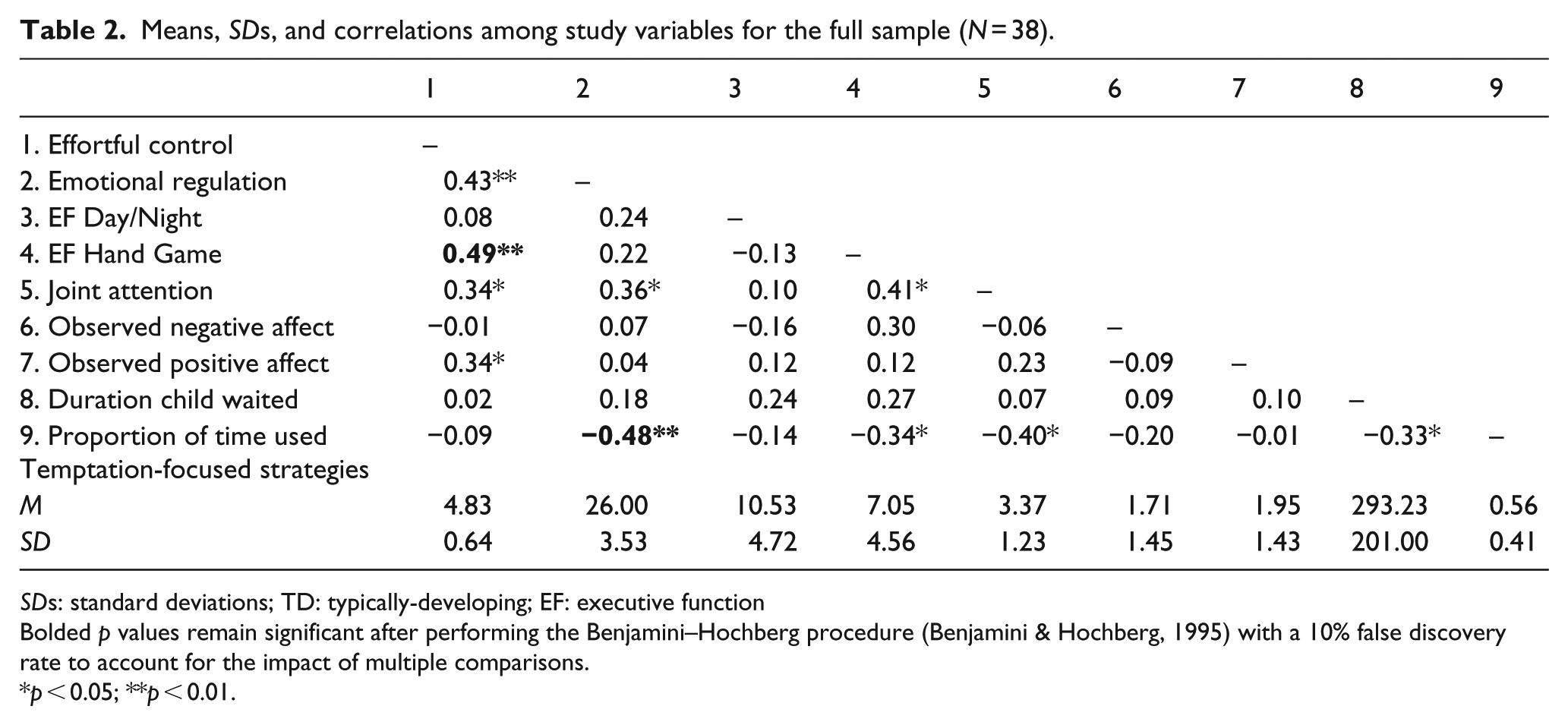
SDs: standard deviations; TD: typically-developing; EF: executive function
Bolded p values remain significant after performing the Benjamini–Hochberg procedure (Benjamini & Hochberg, 1995) with a 10% false discovery rate to account for the impact of multiple comparisons.
p < 0.05; **p < 0.01.
Next, the correlations were split by group to understand the pattern of associations within groups with respect to delay duration and temptation-focused behaviors (see Table 3, where correlations for the ASD group appear above the diagonal and those for the TD group appear below the diagonal). These analyses should be interpreted with caution, as the within-group sample sizes are quite small. For children with ASD, there were no significant associations between delay of gratification behaviors (i.e. delay duration and temptation-focused behaviors) and self-regulation, but for the children with TD, there was a significant association between temptation-focused behaviors during the delay and emotion regulation, r(20) = –0.60, p = 0.005, and between temptation-focused behaviors and joint attention, r(20) = 0.45, p = 0.045 (see Table 3). These associations were in the moderate to strong range in terms of magnitude. When we control for multiple comparisons using the Benjamini–Hochberg approach, the association between temptation-focused behaviors and emotion regulation for the TD group remained significant.
Means, SDs, and correlations among study variables within the ASD (n = 18) and TD (n = 20) groups.
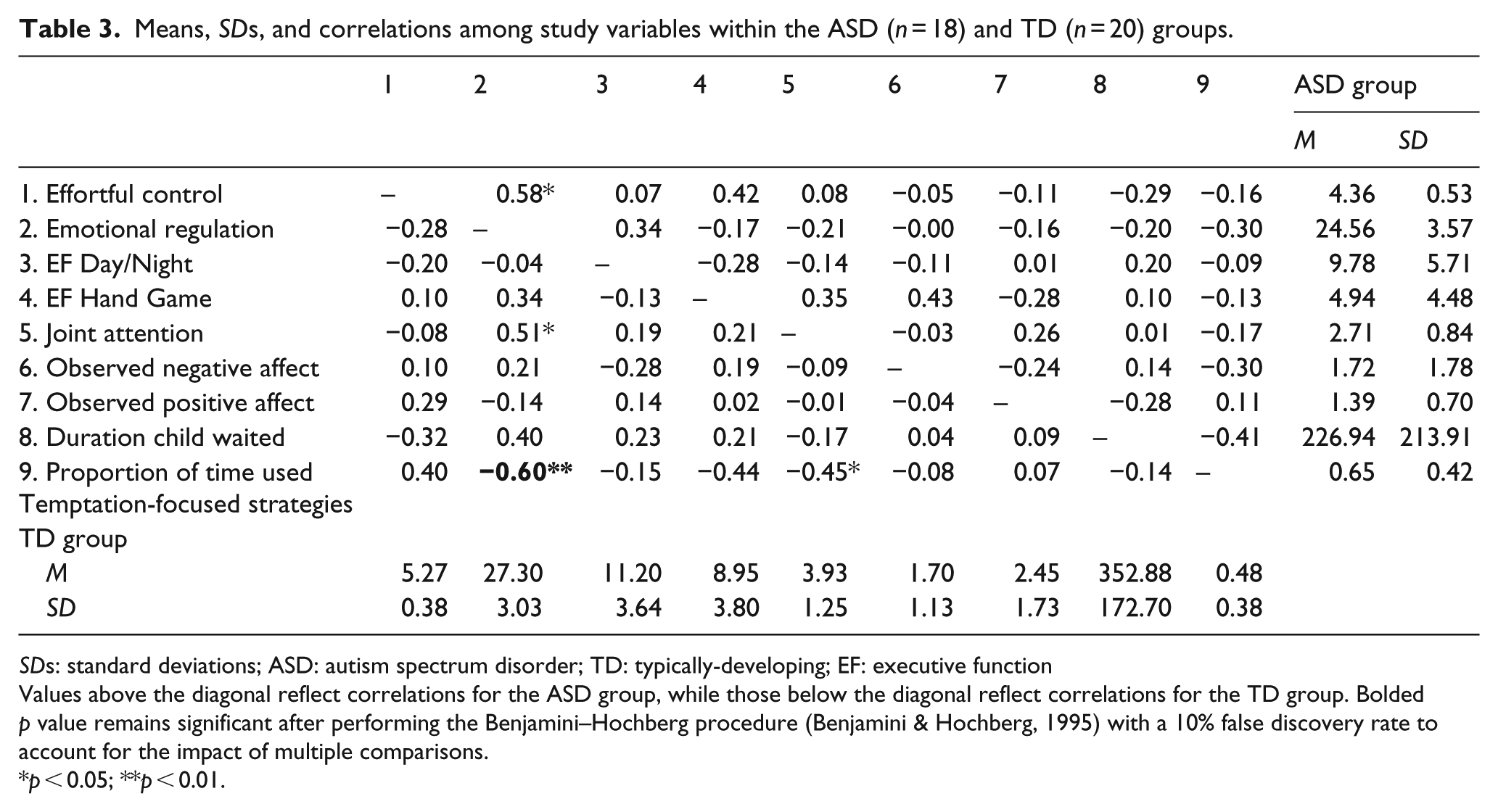
SDs: standard deviations; ASD: autism spectrum disorder; TD: typically-developing; EF: executive function
Values above the diagonal reflect correlations for the ASD group, while those below the diagonal reflect correlations for the TD group. Bolded p value remains significant after performing the Benjamini–Hochberg procedure (Benjamini & Hochberg, 1995) with a 10% false discovery rate to account for the impact of multiple comparisons.
p < 0.05; **p < 0.01.
Relative contribution of indices of self-regulation for preschoolers’ delay of gratification
Finally, to examine the relative contribution of individual indices of self-regulation to children’s behaviors in the delay of gratification, two regressions were conducted in which group and chronological age were first entered as covariates, followed by the individual indices of self-regulation that had significant associations to delay of gratification behaviors in the correlations (i.e. executive function Hand Game, emotion regulation, and joint attention). Results revealed a non-significant model when waiting duration was tested as the dependent variable, F(5, 31) = 0.99, p = 0.44 R2 = 0.14. When children’s temptation-focused behaviors was tested as the dependent variable, a significant model was found, F(5, 31) = 3.68, p = 0.010, R2 = 0.37. Emotion regulation, F(1, 31) = 5.22, p = 0.029, d = 0.82, emerged as the single significant self-regulatory predictor of children’s temptation-focused behaviors, above and beyond the others.
Discussion
This study examined delay of gratification behaviors among preschoolers with high-functioning ASD between the ages of 3 and 5 years. We found that preschoolers with and without ASD did not differ in their ultimate success on the task, a finding that was inconsistent with that of Faja and Dawson (2015) who found that 6- to 7-year-olds with ASD in their study were less likely than typical controls to pass the task. A smaller proportion of the preschoolers with ASD in our sample (44%) passed the task, as compared to 57% of children with ASD in Faja and Dawson’s (2015) sample, suggesting there may be some developmental improvement for the children with ASD from preschool to elementary age. Moreover, with respect to typical controls, we found 55% of preschoolers to pass the task in our study, whereas Faja and Dawson (2015) reported a 90% pass rate, consistent with the notion that by around 5 years of age, TD children show considerable maturation in their abilities to delay gratification. Thus, it may be that the delay of gratification skills of TD preschoolers are still relatively immature, such that a considerable difference from children with ASD is not yet apparent during the preschool years. By the time children reach the elementary age of Faja and Dawson’s (2015) sample, these differences are more prominent, possibly reflecting a failure on the part of children with ASD to keep pace with the developmental maturation of children with typical development in this self-regulatory capacity. However, given the cross-sectional nature of our study and that of Faja and Dawson (2015), we can only speculate as to these interpretations; future longitudinal work is needed to verify this notion. Our study also found that preschoolers with ASD waited, on average, for a shorter duration of time than their typical peers, suggesting that they “gave up” waiting earlier than those with typical development. These findings are in line with Mazefsky et al.’s (2013) notion that motivational challenges inherent to ASD (e.g. Koegel & Mentis, 1985) may be related to self-regulatory challenges evident in this disorder, and Jahromi et al.’s (2012) finding that children with ASD showed more resignation behaviors than their typical peers when engaged in a frustrating task.
In terms of behaviors displayed by children during the delay, children with ASD expressed significantly less positive affect during the task, showed less attentional control (i.e. a higher rate of attention shifts), and engaged in more overall temptation-focused behaviors during the task. What is interesting is that children’s use of temptation-focused behaviors (e.g. looking at the M&Ms/bell or talking about their tempting qualities) was related to a decreased wait duration. Thus, it appears that the use of ineffective strategies (i.e. those focused on the tempting qualities of the M&M) may have undermined the ability of preschoolers with ASD to wait longer during the delay. Such a notion would be consistent with Mischel et al.’s (1989) finding that the deliberate avoidance of such behaviors was associated with better performance on the delay task for TD children.
We found that TD children showed significantly more positive affect during the task than their peers with ASD, despite the two groups showing similar levels of negative affect. It may be that the preschoolers in our study generally found the delay of gratification task to be equally frustrating, but that TD children demonstrated better “up regulation” of their positive emotions (i.e. effortful strategies to actively increase one’s positive expressions during stressful experiences; Diamond & Aspinwall, 2003), a skill shown to be related to positive adaptation and resilience during negative situations (Tugade & Fredrickson, 2004). Although we did not explicitly measure children’s positive re-appraisals to verify that they were indeed up-regulating positive affect, it is important to note that parents’ reports of children’s effortful control were also related to their expressions of positive affect, lending support to the notion that those children with greater effortful regulation capacities were those who displayed more positive affect.
In terms of associations between delay of gratification behaviors and indices of self-regulation, a consistent pattern of associations emerged with children’s temptation-focused behaviors; these ineffective attentional strategies were related to children’s poorer executive function, emotion regulation, and joint attention (with emotion regulation withstanding a test for multiple comparisons). These findings support the notion that underlying regulatory processes may have supported children’s attention away from the temptation and strategy deployment (Mazefsky et al., 2012; Ursache et al., 2012).
Indeed, when indices of self-regulation were tested relative to one another, emotion regulation was found to have the strongest association with children’s temptation-focused strategies, above and beyond the others, suggesting that, although generally considered a measure of impulse control, the delay of gratification task may have also been tapping children’s capacity to cope with heightened emotions. Similar to Faja and Dawson (2015), there were no associations between delay of gratification and parents’ reports of effortful control, suggesting this temperament measure, which addresses everyday behaviors, may not have adequately captured children’s behaviors in the delay task.
It is interesting that children who demonstrated more joint attention initiations also engaged in fewer temptation-focused behaviors, in line with Raver’s (1996) finding that TD children who engaged in more joint attention in a parent–child interaction were also more likely to use attention regulation strategies in delay of gratification. It may be, as Raver (1996) argued, that the process of initiating shared attention facilitates the use of attentional control to modulate distress.
The study had several limitations that offer directions for future research. First, while we used a multi-method approach to studying the self-regulatory skills of young children with and without ASD (i.e. via direct tasks as well as parent reports), our sample size was relatively small and could have undermined our ability to identify some group differences and our assessment of individual differences by diagnostic group. Future work, with larger samples, is needed to truly understand whether there are differences in the pattern of associations among these measures for children with and without ASD. Furthermore, because our sample of preschoolers with ASD was high functioning, our findings cannot be generalized to the broader population of children with ASD, including those with intellectual and/or significant language delays. Indeed, the measures for executive function and delay of gratification have complex instructions requiring adequate cognitive levels; future work should develop and test measure of these constructs for lower functioning children with ASD. We relied on the ADI-R and clinical diagnoses to confirm ASD diagnosis. Future work would benefit from including an observational diagnostic measure (i.e. Autism Diagnostic Observation Schedule (ADOS)) to not only provide further confirmation of the ASD diagnosis but also understand whether preschoolers’ observed ASD symptoms were relevant to children’s acquisition of delay of gratification capacities. Given the importance of delay of gratification and other indices of self-regulation for children’s social competence with peers, and given the difficulty children with ASD have in such social domains, it will also be important for future work to measure these capacities in real-life settings with peers. Such work should also strive to utilize measures that may better isolate the underlying self-regulatory capacities (e.g. attentional vs behavioral inhibition) which are most relevant to children’s successes in delay of gratification.
Despite these limitations, the study is an important contribution to our understanding of the emerging self-regulatory behaviors of preschoolers with ASD. In the context of delay of gratification, these children may have difficulty avoiding or overcoming less adaptive temptation-focused strategies. Mischel et al.’s (1989) research demonstrated that children could be taught or coached on the use of effective strategies in the task to support them in this task (e.g. instructions about an alternative way to think about the temptation). It may be that interventions and/or classroom curriculum that provide children opportunities to gain experience waiting as well as explicitly model and practice effective attentional control strategies (e.g. covering eyes, self-talk, imagining an object other than the reward) could be particularly effective for young children with ASD. It will be important for future research to continue to explore the role of underlying skills that promote these children’s self-regulation and to examine longitudinal links between self-regulation and individual differences in these children’s developmental outcomes.
Supplemental Material
AUT828678_Lay_Abstract – Supplemental material for Delay of gratification in preschoolers with and without autism spectrum disorder: Individual differences and links to executive function, emotion regulation, and joint attention
Supplemental material, AUT828678_Lay_Abstract for Delay of gratification in preschoolers with and without autism spectrum disorder: Individual differences and links to executive function, emotion regulation, and joint attention by Laudan B Jahromi, Yanru Chen, Andrew J Dakopolos and Alice Chorneau in Autism
Footnotes
Acknowledgements
We thank the families who participated in the study, the undergraduate and graduate research assistants, and staff of the Southwest Autism Research and Resource Center for their contributions to the study.
Declaration of conflicting interests
The author(s) declared no potential conflicts of interest with respect to the research, authorship, and/or publication of this article.
Funding
The author(s) disclosed receipt of the following financial support for the research, authorship, and/or publication of this article: This research was supported by seed funding to Dr Laudan Jahromi.
References
Supplementary Material
Please find the following supplemental material available below.
For Open Access articles published under a Creative Commons License, all supplemental material carries the same license as the article it is associated with.
For non-Open Access articles published, all supplemental material carries a non-exclusive license, and permission requests for re-use of supplemental material or any part of supplemental material shall be sent directly to the copyright owner as specified in the copyright notice associated with the article.
