



Abstract
The EarlyBird programme is a group-based psychoeducation intervention for parents of young children with autism. Although it is widely used in the United Kingdom, the evidence base for the programme is very limited. Using a mixed method, non-randomised research design, we aimed to test (1) the acceptability of the research procedures (recruitment, retention, suitability of measures), (2) the parental acceptability of EarlyBird (attendance, views of the programme, perceived changes) and (3) the facilitator acceptability of EarlyBird (fidelity, views of the programme, perceived changes). Seventeen families with a 2- to 5-year-old autistic child and 10 EarlyBird facilitators took part. Pre- and post-intervention assessment included measures of the child’s autism characteristics, cognitive ability, adaptive behaviour, emotional and behavioural problems and parent-reported autism knowledge, parenting competence, stress and wellbeing. Semi-structured interviews were completed at post-intervention with parents and facilitators. For those involved in the study, the research procedures were generally acceptable, retention rates were high and the research protocol was administered as planned. Generally, positive views of the intervention were expressed by parents and facilitators. Although the uncontrolled, within-participant design does not allow us to test for efficacy, change in several outcome measures from pre- to post-intervention was in the expected direction. Difficulties were encountered with recruitment (opt-in to the groups was ~56% and opt-in to the research was 63%), and strategies to enhance recruitment need to be built into any future trial. These findings should be used to inform protocols for pragmatic, controlled trials of EarlyBird and other group-based interventions for parents with young autistic children.
Autism is characterised by difficulties in social interaction and communication, and the presence of restricted interests, repetitive behaviours and sensory differences (American Psychiatric Association, 2013). Approximately 1% of children are autistic (Baio et al., 2018; Baird et al., 2006; Russell, Rodgers, Ukoumunne, & Ford, 2014), and the condition is 3–4 times more prevalent in males than females (Loomes, Hull, & Mandy, 2017).
In the United Kingdom, young children displaying signs of autism are typically referred to specialist health professionals for a diagnostic assessment. Post-diagnostic support for families is highly variable, and many families are left without specific support until the child is old enough for a nursery or school placement (Ludlow, Skelly, & Rohleder, 2012). The National Autistic Society (NAS) EarlyBird intervention (Shields, 2001) is a supportive psychoeducational programme for parents for children younger than 5 years. It aims to support parents after the initial diagnosis by extending their understanding of autism, enhancing their social communication strategies and helping them analyse and manage challenging behaviours (Shields, 2001). EarlyBird consists of eight weekly group sessions and three intercalated home visits covering psychoeducation about autism, communication development, play techniques, using visual supports and structures, developing routines, techniques to understand behaviour and strategies for dealing with a range of behaviours, such as repetitive behaviours, temper tantrums and aggression, fears and phobias, and eating, sleeping and toileting problems. During group sessions, there are opportunities for small and whole-group work and families are encouraged to support each other and problem solve together. The group nature of the programme aims to provide support for families to enhance parenting confidence and wellbeing and reduce stress. Home visits provide individualised support where parents are encouraged to use the strategies learnt during the group sessions. Video clips of families interacting with their children are obtained during home visits and used in session to demonstrate progress and provide feedback. EarlyBird guidelines indicate a maximum group size of six families. Group sessions are to be presented by a minimum of two EarlyBird certified facilitators but home visits are usually conducted by one facilitator.
EarlyBird facilitators are health or educational professionals (e.g. speech and language therapists, child mental health workers, clinical psychologists, child care workers) who have experience working with autistic children and running workshops or training sessions and have attended the certified 3-day course provided by the NAS EarlyBird team. During their certification, facilitators receive teaching on the content of the course and are provided with a set of materials to deliver the programme (i.e. books and other materials for parents, presentation slides, and a detailed manual describing the aims and methods for each session).
Many parents with an autistic child attend EarlyBird courses each year, with reports of almost 11,000 families having attended the programme in the United Kingdom by 2012 (Stevens & Shields, 2013). Other English-speaking countries have also implemented EarlyBird (e.g. Anderson, Birkin, Seymour, & Moore, 2006, in New Zealand), and it is estimated that 27,000 families in 14 countries received an EarlyBird intervention between 1997 and 2003 (Dawson-Squibb, Davids, & de Vries, 2018). Despite its extensive use, the efficacy of the programme has yet to be tested using rigorous randomised controlled trial (RCT) designs.
Previous, non-randomised evaluations have described some parent-reported benefits including reduced parental stress and improvements in knowledge and perceptions of child behaviour (Dawson-Squibb et al., 2018; Engwall & MacPherson, 2003; Halpin, Pitt, & Dodd, 2011; Shields & Simpson, 2004; Stevens & Shields, 2013). Other group-based parent psychoeducation programmes developed for parents of school-aged autistic children, such as the Barnardo’s Cygnet programme and the Autism Spectrum Conditions–Enhancing Nurture and Development (ASCEND) programme, are also described as improving parents’ knowledge about autism, their self-efficacy and satisfaction and parent-reported child behaviour (Pillay, Alderson-Day, Wright, Williams, & Urwin, 2011; Stuttard, Beresford, Clarke, Beecham, & Morris, 2016). However, the non-randomised designs of these studies and use of parent-report and thus unblinded measures mean that conclusions about the effectiveness of these interventions are limited.
While increasing parental knowledge and competence and reducing stress are important outcomes to achieve in the post-diagnostic period, one key aim of EarlyBird is that positive parental outcomes will have indirect benefits for child behaviour. However, although the programme also includes components that focus on promoting social communication and managing behaviour, changes in these areas have not been systematically assessed. Thus, there is a need for future trials of EarlyBird to include measures of child functioning and behavioural outcomes.
The Medical Research Council (MRC) and National Institute for Health Research (NIHR) guidance on evaluating complex interventions recommend conducting feasibility and pilot studies prior to a main RCT (Craig et al., 2008; NIHR, 2016). Feasibility studies are defined as research that aims to answer the question, ‘Can this study be done?’. They are not designed to evaluate outcomes, rather to test procedures for their acceptability, to fine-tune methodology and estimate sample and effect sizes prior to a more substantial evaluation. A mixture of quantitative and qualitative research methods is recommended to obtain a more comprehensive understanding. Using both methods allows testing of relevant outcomes and an in-depth exploration of participant views.
The widespread take-up of the programme shows that it is broadly acceptable to parents. However, the current study was an independent feasibility study of a research evaluation of the EarlyBird intervention. It was designed to inform a future, pragmatic RCT by testing EarlyBird in centres where it was already being delivered. We hoped a pragmatic design would increase confidence that findings from a future RCT would translate into clinical practice. A mixed-methods design was used to determine whether a definitive RCT could be conducted. We aimed to test (1) the acceptability of the research procedures (recruitment, retention, suitability and completion of a range of measures, some of which overlapped in content to enable preferred measures to be included in future studies), (2) the parental acceptability of EarlyBird (attendance, views of the programme, perceived changes) and (3) the facilitator acceptability of EarlyBird (fidelity, views of the programme, perceived changes) when delivered in real-world healthcare settings.
Method
Procedure
Prior to starting the study, ethical approval was obtained from the London – Camden and Islington, North East NHS REC Office (reference: 13/LO/0087). Five local services in central London who delivered EarlyBird as part of their routine clinical service were approached and agreed to support recruitment for the study. As the EarlyBird intervention commenced prior to recruitment in one of the five services, only four acted as recruitment sources for the study. The fifth service was only involved in the post-intervention interviews that were conducted with facilitators and families.
In each of the four participating recruitment sites, autism diagnostic teams refer families of newly diagnosed children to EarlyBird. Wherever possible, information about the study was presented by the research team during routine pre-course meetings where EarlyBird facilitators introduce the intervention. Once families had enrolled in EarlyBird, the facilitators extended the invitation to take part in the study. For most families, this invitation was done during a home visit or a phone call and those who expressed interest were contacted by the research team. In one recruitment site, families enrolled in two EarlyBird courses were invited to take part by the facilitators via a personalised letter and follow-up phone calls.
Upon contact with the research team, interested families were sent information about the study and asked to sign a consent form. Baseline assessments were conducted prior to the first EarlyBird session, except for one family who was assessed 1 day after the first group session. The primary caregiver acted as the main informant for completing measures and baseline assessments took approximately 2 to 3 h to complete. Post-intervention assessments were completed within 1 month of the last intervention session (M = 11 days, SD = 9 days) and took approximately 2 h to complete.
Eligibility criteria
Families with a 2- to 5-year-old child with a clinical diagnosis of autism who had agreed to take part in EarlyBird were eligible for the study. Families were excluded from participating in the study if they had insufficient English to complete the assessments. Some of the clinical services that we recruited through used translators for non-English speaking families who would have required translators to arrange appointments, complete the questionnaires and attend the interviews. Their lack of English also impacted on the naturalistic play setting in which the child assessments take place (i.e. Autism Diagnostic Observation Schedule–second edition [ADOS-2] and the parent-child interaction [PCI]). Three families interested in participating required translators (one Bengali, one Somali and one British Sign Language) and therefore were not eligible to participate.
Participants
A total of 17 parents and 17 children (one family had two autistic children who were both eligible and assessed but one child was randomly selected for analysis) were recruited from the seven different EarlyBird interventions being run in the four participating local services. The sample consisted of 14 mothers and 3 fathers, and their children diagnosed with autism between 4 months and 3 years 5 months earlier. Most children were boys (76.5%); the average age was 4 years. Further details are provided in Table 1.
Sample demographics.
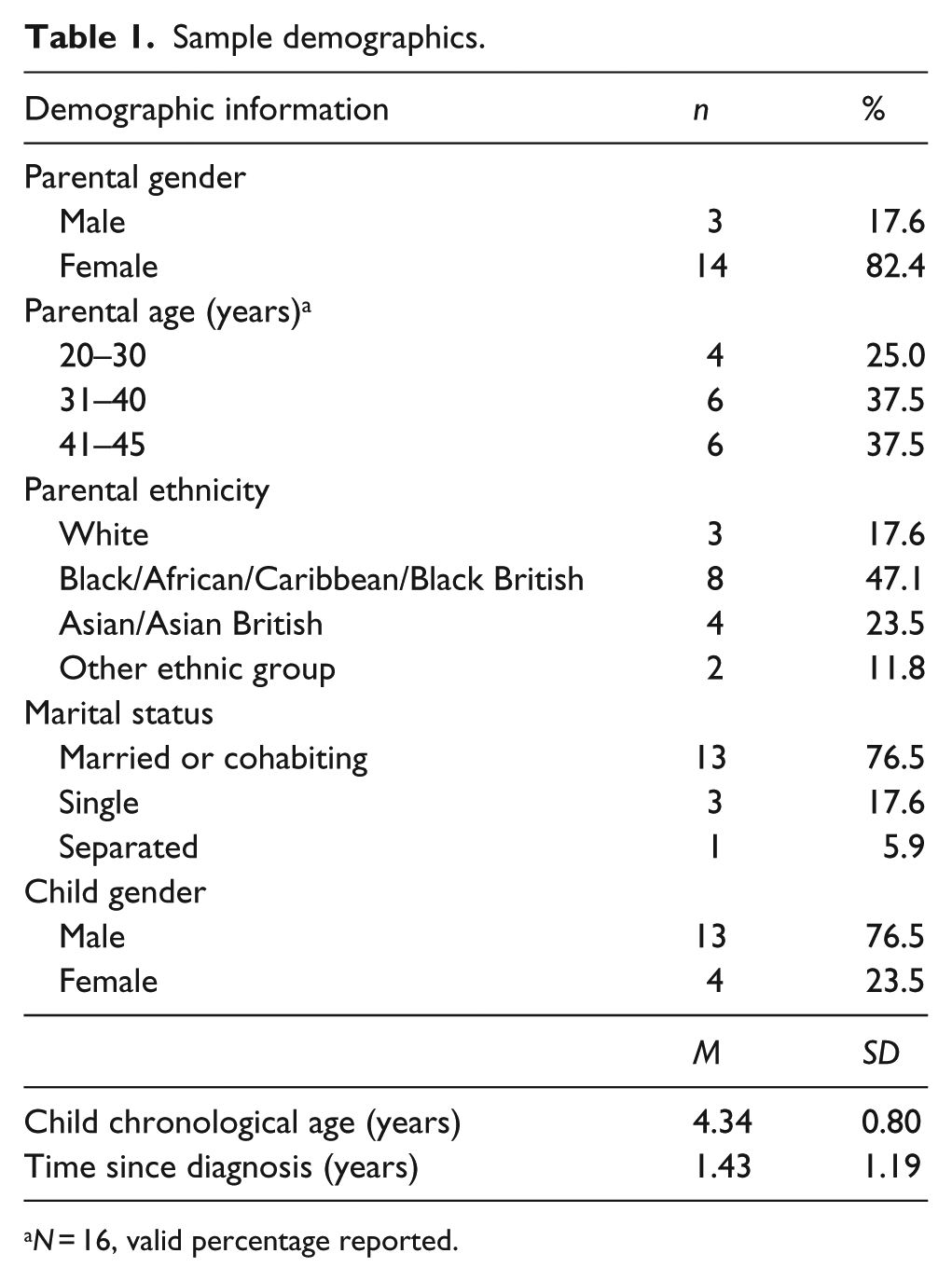
N = 16, valid percentage reported.
Measures
A range of measures was administered to assess the sample characteristics and to measure potential primary and secondary outcomes.
Sample characterisation
Demographic information on parental age, ethnic background, marital status and employment was obtained from parents at baseline. The ADOS-2 (Lord et al., 2012) was conducted during the baseline assessment to measure children’s autism characteristics (communication, social interaction, play, and restricted and repetitive behaviour). If the child had been diagnosed with autism within the previous 12 months, the ADOS-2 was not administered and scores were obtained from the diagnosing team. This was the case for 10 children and scores were received from the diagnosing team for five of these children. One clinical service did not complete ADOS assessments as part of their diagnostic procedures, so for three of the four children diagnosed by this service we conducted an ADOS-2 assessment at post-intervention. Of the 15 children who received an ADOS assessment either as part of the study or by their diagnosing clinical team, a module 1 ADOS-2 assessment was done with 11 children and module 2 assessments were completed with four children. As some diagnostic teams used the ADOS-G (Autism Diagnostic Observation Schedule–Generic; the earlier version of the tool; Lord et al., 2000) to assess autism severity, the algorithm scores are reported in the results with higher scores indicating more autism characteristics.
Parent-reported child autism characteristics were also measured at baseline using the Social Communication Questionnaire–Lifetime Version (SCQ; Rutter, Bailey, & Lord, 2003) and the Social Responsive Scale–second edition (SRS-2; Constantino & Gruber, 2012). The SCQ consists of 40 yes-no items that ask about the presence of autism traits. Scores range from 0 to 40 and higher scores indicate greater autism severity. Scores greater than or equal to 15 signify a possible autism spectrum condition. The SRS-2 is a 65-item questionnaire measuring the severity of autism by tapping into four aspects of social behaviour (receptive, cognitive, expressive, and motivational) and preoccupations. Items are rated on a 4-point scale ranging from ‘not true’ (1) to ‘almost always true’ (4). Total scores on the SRS-2 range from 65 to 260 with higher scores indicating greater autism severity. Scores of 76 or more suggest a clinical diagnosis of autism. The pre-school version of the SRS-2 (2½–4½ years) was used as deemed to be more appropriate for families in the current study.
An assessment of the child’s cognitive ability was conducted at baseline using the Mullen Scales of Early Learning (MSEL; Mullen, 1995). The MSEL measures fine and gross motor skills, visual reception, and expressive and receptive language. It provides T-scores for all domains in addition to a standard composite score (M = 100, SD = 15).
Child outcome measures
Adaptive behaviour was measured using the Vineland Adaptive Behaviour Scales–second edition (VABS-2; Sparrow, Cicchetti, & Balla, 2005), a semi-structured interview conducted with parents at baseline and post-intervention. It provides age equivalent and standardised scores for four domains of adaptive behaviour, including communication, socialisation, daily living and motor skills, together with an adaptive behaviour composite score (M = 100, SD = 15). If the child could remain by himself or herself in the assessment room, parental interviews were conducted simultaneously in a different room with a different researcher. Wherever possible, the same researcher conducted both time-point interviews. Increases in adaptive behaviour were expected after intervention.
Child emotional and behaviour problems were measured using the parent-report Strengths and Difficulties Questionnaire (SDQ; Goodman, 1997). The SDQ comprises 25 items that measure emotional, conduct and peer problems as well as hyperactivity and prosocial behaviour. Each of the five subscales consists of five items rated on a 3-point scale ranging from ‘not true’ (0) to ‘certainly true’ (2). Higher scores indicate more problems or prosocial behaviour, and a Total Difficulties score (0–40) is derived by adding together scores on all the subscales except prosocial behaviour. Scores of 16 or higher indicate clinically significant emotional or behavioural difficulties. Either the 3- to 4-year-old or 4- to 16-year-old versions were administered according to the child’s chronological age. We expected that the intervention would reduce child emotional and behaviour problems, reflected by lower scores on the SDQ at post-intervention.
Parent outcome measures
The Autism Parent Questionnaire (APQ; Anderson et al., 2006) was developed as part of an evaluation of EarlyBird in New Zealand to assess the effectiveness of the intervention. It consists of 27 items that are rated on a 6-point Likert-type scale ranging from ‘not true at all’ (1) to ‘definitely true’ (6). Greater autism knowledge is denoted by higher scores and it was anticipated that autism knowledge would increase following receipt of the intervention.
The Parental Sense of Competence (PSOC; Johnston & Mash, 1989) scale comprises 17 items measuring parenting satisfaction and parenting efficacy. Items are rated on a 6-point scale, ranging from ‘strongly disagree’ (1) to ‘strongly agree’ (6) with higher scores reflecting greater competence. Following EarlyBird, we expected parenting satisfaction and efficacy to increase.
Parental stress was measured using the Parental Stress Index–Short Form (PSI-SF; Abidin, 2012). This consists of 36 items rated on a 5-point scale, ranging from ‘strongly disagree’ (1) to ‘strongly agree’ (5). It measures parental distress, negative parent–child interactions and perception of a difficult child. Higher scores indicate greater parental stress (maximum score = 180) and it was anticipated that parenting stress would be lower after intervention.
A measure of positive parental wellbeing was obtained using the Warwick-Edinburgh Mental Well-Being Scale (WEMWBS; NHS Health Scotland, University of Warwick, & University of Edinburgh, 2006). The WEMWBS consists of 14 positively phrased items rated on a 5-point scale, ranging from ‘none of the time’ (1) to ‘all of the time’ (5), with higher scores indicting greater positive wellbeing (maximum score = 70). Positive wellbeing was predicted to increase following EarlyBird.
Intervention measures
For all families, rates of attendance were obtained from the EarlyBird facilitators. As there is no standard intervention fidelity measure of EarlyBird, a bespoke measure of provider-level intervention fidelity was designed for the study based on EarlyBird guidance for best practice. The resulting measure focuses on nine domains considered to be important for the delivery of EarlyBird: (1) knowledge is shared using jargon-free language, (2) parents are encouraged to problem solve themselves, (3) parents are encouraged to get to know one another, (4) taught strategies are personalised, (5) the facilitator creates an informal and relaxed atmosphere, (6) successes and progress are acknowledged, (7) small-group activities are conducted in pairs, (8) suggested timings are adhered with, and (9) the overall structure of the intervention is followed. Criteria for scoring each domain were based on the content of the certified materials from the EarlyBird providers. Fidelity was measured by the same researcher, who attended the sessions and coded them live. Each domain was rated as either present (1) or absent (0) resulting in a score from 0–9 for each session. Partially present domains (those which did not fulfil the full criteria defined for the domain) were assigned a score of 0.5. Seven of the EarlyBird programmes were assessed using this measure during one of their sessions (i.e. three during session 6, two during session 7, and two during session 8). The fidelity measure was not used to rate three of the programmes as they ended before the measure was developed.
Post-intervention interviews
Semi-structured interviews were conducted to explore parents’ and facilitators’ views of the intervention and perceived impacts. Parents were asked about their overall impression of the intervention, aspects they liked and suggestions for improvement, their views on the practical aspects and process of the intervention (e.g. the number of sessions, views on home visits), and about any differences the intervention had made. Facilitators were asked about recruitment, their views on the intervention and impacts of the course, and about the materials and practicalities of delivering EarlyBird.
The informants were (1) parents who attended EarlyBird (n = 6), representing views from four of the five different services delivering the intervention; (2) parents who were involved in the feasibility study (n = 3) and (3) facilitators who delivered EarlyBird from all five participating services (n = 10, two participated in a joint interview). Interviews were conducted once the intervention had finished; either at the participant’s home, the researcher’s workplace, where the EarlyBird programme was delivered, or over the phone. All interviews were conducted by the same researcher and audio-recorded.
The interviews were then transcribed and analysed independently by another member of the research team using an inductive thematic analysis approach based on grounded theory methods (Palinkas, 2014). After multiple readings of the transcripts, a coding scheme was developed based on identified themes and applied to the raw data. The framework method (Gale, Heath, Cameron, Rashid, & Redwood, 2013) was used to help reduce, code and display data for interpretation. A matrix displaying the summarised data was developed to facilitate analysis across and within participants. Identified key themes were then grouped together into conceptually related overarching themes. The parent and facilitator interviews were analysed using two separate thematic analyses. There was considerable overlap in themes that were identified from the interviews with parents and facilitators so in order to obtain a more comprehensive understanding and triangulate the findings, the themes across different participant groups are presented together (Patton, 1999). The interpretation of themes was checked by the researcher who conducted the interviews to ensure that the analysis adequately captured the interviews.
Results
Acceptability of the research procedures
Table 2 describes the recruitment rates for each of the seven EarlyBird intervention groups involved in the study. We assessed recruitment in two phases as information sessions were run by the EarlyBird teams independently of the research team. At the service level, from the 79 families who attended information sessions about EarlyBird, 44 families (56%) attended the intervention. At the research level, 27 families of these 44 families who attended an EarlyBird intervention were approached by the research team and invited to take part in the current feasibility study and 17 (63%) agreed to participate. In addition, 12 other families from another service who had already started their group sessions by the time this project commenced were invited to take part in the post-intervention interviews.
Recruitment figures.

Study researchers did not attend this information session and information on the study was not presented to the attendees. The percentage in the service level opt-in stage has been adjusted to take this issue into consideration.
This service assisted with recruitment for the post-intervention interviews only.
Not including borough 5.
Although during initial preparation meetings for the study, facilitators were keen to support recruitment, a key obstacle to successful recruitment was the need to rely on the EarlyBird facilitators for initial contact with the families. Due to data protection laws, researchers were not allowed to access personal data without families’ prior consent and unless the research team was invited to the pre-course information meeting, they could not contact families directly. Being able to attend the pre-course information meeting alongside the facilitators provided the opportunity for families to ask questions directly to the researchers and potentially promoted the engagement process.
Of the 44 families who attended an EarlyBird intervention, many did not want the facilitators to pass on contact details to the researchers. Wherever possible, families were asked about their reasons for not taking part in the study. The most common reason was insufficient time due to caring for other children. Other reported reasons for not taking part included: partner being in denial about autism diagnosis, questionnaires being too intrusive, concerns about the child’s challenging behaviour, previous negative experience with professionals, unexpected life events, and inconvenient location for assessments.
The other major barrier to successful recruitment was that the EarlyBird programmes ran simultaneously across the different services starting in January, April and September/October. This reduced the opportunity for recruitment of new participants throughout the year, and specific periods for recruitment coincided with times when families and research resources were less available (i.e. Christmas, Easter, summer school holidays). A further issue affecting recruitment was that some EarlyBird programmes exceeded the recommended group size, resulting in insufficient material resources or too few research staff to ensure completion of the assessments prior to the start of the intervention.
During interview, facilitators indicated that they felt recruitment into programmes like EarlyBird should be promoted through a range of sources (e.g. clinicians, schools) and that multiple approaches were often necessary to engage a family in the intervention. Approaching families to take part in EarlyBird immediately after diagnosis was deemed to be less likely to succeed.
Reasons why parents took part in the study
Three parents were interviewed at post-intervention about their experiences of taking part in the feasibility study. All mentioned that receiving a report about their child’s functioning was a key reason for participating. Another key reason for participation was to help evaluate EarlyBird and identify areas for improvement so other parents could benefit in the future.
Completeness and suitability of measures
Table 3 summarises the characteristics of the sample at baseline. The high completion rates (15–16/17) of these assessments indicate that they were appropriate and feasible to administer. Ten children (56% of the sample) had been diagnosed within the previous 12 months so local diagnostic teams were asked to provide ADOS scores. In one service, ADOS assessments were not conducted as part of diagnosis, so these were completed at post-intervention for three of the four families. For the remaining child, ADOS scores were not received from the diagnostic team prior to termination of the study and the research team missed the opportunity to administer the assessment at post-intervention. For children who completed the ADOS, scores around or above the cut-off indicated the appropriateness of the assessment for this group. High scores on the SCQ and SRS-2 measures of parent-reported autism characteristics also suggest that the families invited to take part in EarlyBird were suitable recipients.
Child characterisation measures.

Higher ADOS, SCQ and SRS-2 scores indicate more severe autism symptoms. MSEL: Mullen Scales of Early Learning; SCQ: Social Communication Questionnaire; SRS-2: Social Responsiveness Scale.
ADOS: Autism Diagnostic Observation Schedule, scores are provided from different modules according to verbal ability and chronological age and different scoring forms (i.e. ADOS-G and ADOS-2).
Table 4 displays completion rates for each parent and child outcome measure and the pre- and post-intervention scores and effect sizes (Cohen’s d) for families who completed measures at both time points. Retention of families for post-intervention assessments was high with the majority (15/17 families, 88.2%) completing some of the measures at post-intervention. The two families who did not complete post-intervention assessments had dropped out of the EarlyBird intervention and were unable to be contacted.
Completion rates and group Ms and SDs at pre- and post-intervention scores on child- and parent-related outcome measures.
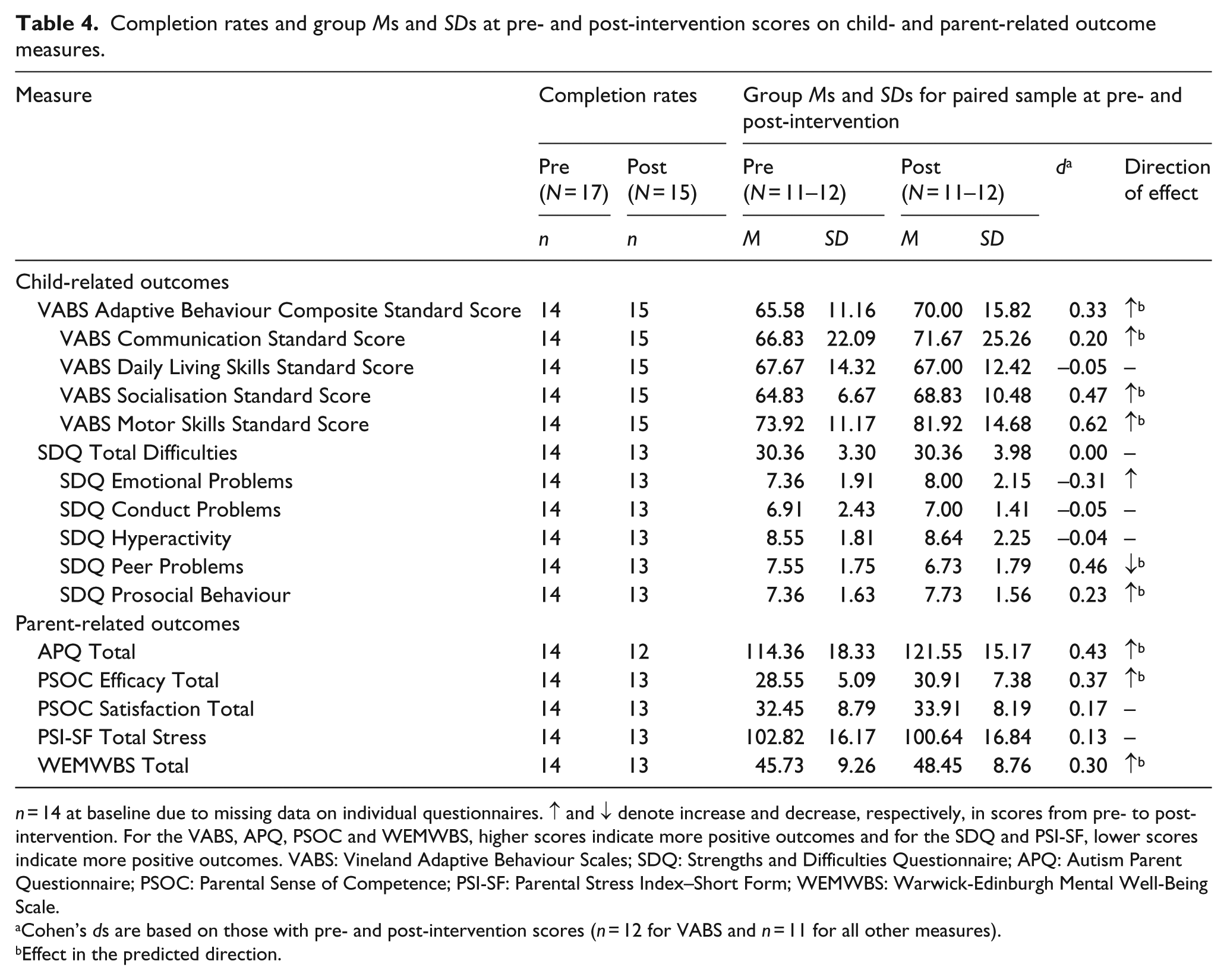
n = 14 at baseline due to missing data on individual questionnaires. ↑ and ↓ denote increase and decrease, respectively, in scores from pre- to post-intervention. For the VABS, APQ, PSOC and WEMWBS, higher scores indicate more positive outcomes and for the SDQ and PSI-SF, lower scores indicate more positive outcomes. VABS: Vineland Adaptive Behaviour Scales; SDQ: Strengths and Difficulties Questionnaire; APQ: Autism Parent Questionnaire; PSOC: Parental Sense of Competence; PSI-SF: Parental Stress Index–Short Form; WEMWBS: Warwick-Edinburgh Mental Well-Being Scale.
Cohen’s ds are based on those with pre- and post-intervention scores (n = 12 for VABS and n = 11 for all other measures).
Effect in the predicted direction.
Completion rates of the questionnaires were slightly lower than the direct assessments (the lowest completion rate was 12/17 for the APQ, 70.6%). One parent failed to return the questionnaires at post-intervention due to a lack of time. Of the three parents who were involved in the feasibility study and completed post-intervention interviews, two reported that they felt the number of questionnaires they were asked to complete was burdensome. One other family withdrew from the study before starting the assessments as the questionnaires were considered too intrusive.
The Vineland interviews had high levels of completion. Group mean adaptive behaviour scores were higher at post-intervention but in some cases substantial changes coincided with starting school. SDQ scores indicated that most children displayed behaviours that may challenge, such as high levels of emotional and conduct problems as well as hyperactivity. Except for emotional problems, SDQ scores for the group were lower at post-intervention suggesting that the measure may be sensitive to change.
With regard to parent measures, one parent refused to complete the APQ stating that the rating scale was difficult to understand and they disliked the wording of the questions. Scores for the PSOC Efficacy subscale, the PSI and the WEMWBS were in the expected range and appeared to be sensitive to change; for example, group mean parenting efficacy and satisfaction scores were higher after attending EarlyBird.
Parental acceptability of the EarlyBird intervention
Attendance
Parents attended an average of 6.6 out of the 8 sessions (median = 7, range = 2–8; n = 16) indicating that the intervention and number of sessions were acceptable to families.
Intervention fidelity
Intervention fidelity was moderate to high across the seven EarlyBird programmes that were evaluated using the measure (median = 7 out of 9 domains, range = 4–8). However, intervention fidelity varied across the different courses, with one course obtaining a total fidelity rating of four out of the nine domains suggesting that some sessions were not being delivered according to the manual (e.g. some topics were shortened, skipped or swapped for topics the facilitators considered more relevant for families, such as specific tips for toileting or feeding).
Views on the intervention
Ten key themes emerged from the interviews conducted at post-intervention with parents and facilitators which were then grouped into two overarching themes. They covered the following: (1) positive aspects of the intervention and (2) challenges to the delivery of EarlyBird. Descriptions and quotes to illustrate the themes are presented in Table 5. Pseudonyms are used to ensure individuals’ identities remain confidential.
Themes that emerged from post-intervention interviews with parents and facilitators.
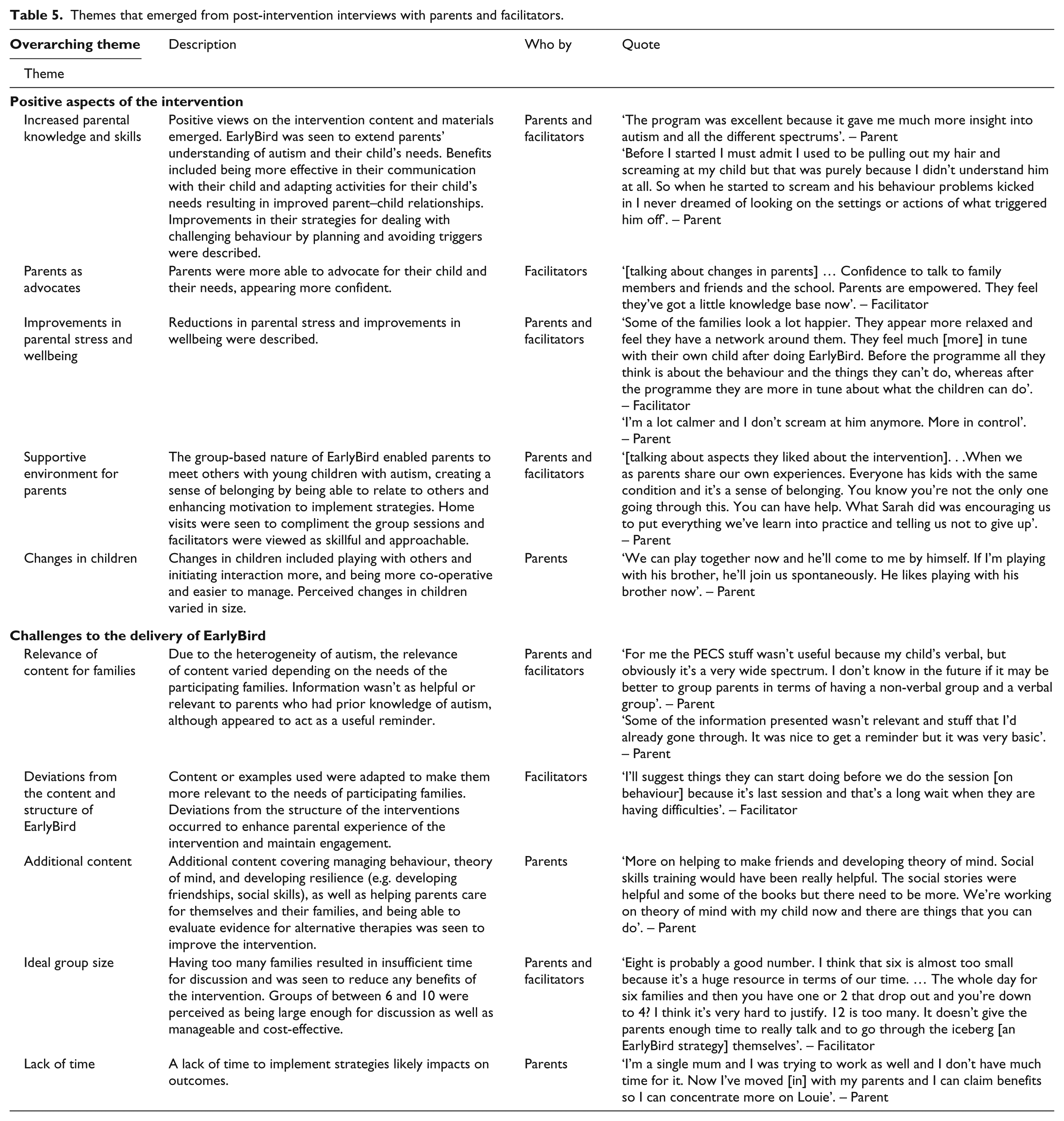
Parents and facilitators talked about a number of positive aspects of the intervention (see Table 5 for themes). The content of the EarlyBird programme was viewed as informative and improvements in parental knowledge and skills were reported by parents and facilitators, with parents now feeling they had more confidence to advocate for their child. Improvements in parental stress and wellbeing were also described. The mode of intervention delivery (mix of group sessions and home visits) was also viewed as favourable, by creating a supportive environment for parents to share experiences in addition to opportunities to practice intervention content in naturalistic environments with support from experienced facilitators. Changes in children’s communication skills and behaviour were also mentioned, and improvements were generally attributed to EarlyBird along with other therapies the parent and child had received.
Both parents and facilitators also talked about various challenges to the delivery of EarlyBird. These were coded into five themes (see Table 5). Some of the content appeared less relevant for some families and additional content was suggested by some parents. Indeed, it appeared that facilitators occasionally deviated from the manual to make content more relevant for the specific needs of the participating families or to ensure that parents remained engaged throughout the intervention and enhance their experience. The size of the group was an important factor for both parents and facilitators, who wanted to ensure there was sufficient time for discussion, and that the delivery of such interventions was manageable and cost-effective. Groups that were too large were considered to have a negative impact on the effects of the intervention by limiting opportunities for parents to share their experiences.
Discussion
The aim of this study was to establish the feasibility of evaluating EarlyBird when delivered in routine clinical practice. To our knowledge, this is the first independent feasibility study of EarlyBird examining perceptions of parents and facilitators, as well as testing research procedures. Given the high completion rates of study measures, it appeared that the selected measures were generally suitable for families and could be used in a larger pragmatic RCT. Themes that were identified in the interviews with parents and facilitators about the positive aspects of the intervention also suggested that the outcome measures used covered relevant areas of parent and child functioning. Changes reported by parents, such as changes in their interactions with their children, feeling less stressed and more in control, are in line with previous uncontrolled research suggesting that parental wellbeing improves following involvement in EarlyBird (Dawson-Squibb et al., 2018; Engwall & MacPherson, 2003; Halpin et al., 2011; Shields & Simpson, 2004; Stevens & Shields, 2013). In future studies, changes in parent–child interaction and in children’s behaviour could be more directly assessed using observational methods.
The findings also indicated that EarlyBird appears to be an acceptable intervention for families when delivered as part of routine care by local clinical services. Attendance was high, and parents and facilitators reported positive views of the programme, the materials, and the format of the intervention. Although high levels of satisfaction with EarlyBird were reported, the thematic analysis of the interviews identified that some of the information taught was not relevant to some families given the heterogenous presentation of autism. Facilitators noted that when this occurred, they tended to adapt the programme to better fit the needs of the individual families, affecting their fidelity.
Other aspects of intervention fidelity also need to be considered. One issue identified was the large size of some groups. Although EarlyBird guidelines note that group sessions should be conducted with a maximum of six families, the high volume of families seeking support resulted in some groups containing as many as 12 families. This affected parents’ ability to engage with the intervention material, thereby potentially reducing the effectiveness of the programme. On the contrary, having a maximum group size of six families may be too restrictive, with facilitators identifying between 6 and 10 families as the ideal size for generating discussion and accounting for drop out.
One key aim of EarlyBird is to enhance children’s social communication and reduce challenging behaviours by improving parental knowledge and skills. There is now a growing interest in the development and evaluation of parent-focused interventions for reducing behaviours that challenge displayed by autistic children (e.g. Bearss et al., 2015). Indeed, these behaviours are often cited by parents as their primary concern for their autistic child. Findings from parental interviews indicated their desire for further information on managing behaviour, developing resilience, and looking after themselves. This was also reported by facilitators who noted that parents wanted more time to discuss behaviour management and felt somewhat constrained by the set structure of the programme. Measurement of these outcomes is therefore important and appeared feasible in this study. Therefore, future evaluations of EarlyBird should consider the focus of primary outcome measures and ideally include measures of child behaviour that are not parent-reported as these are not blind to treatment status. The timing of such measurements may need to be delayed until several months after the completion of the intervention, given that the expected effects on child outcomes are mediated by parents (Landa, 2018). In addition, it is important to obtain information on other interventions and supports received by parents and children to understand whether any changes seen after the intervention may relate to participation in the delivered programme or to other support received.
Several methodological challenges will need to be addressed before moving on to conducting a larger, pragmatic RCT of EarlyBird. Most notable is recruitment. Within the context of the current feasibility study we were only able to assess opt-in rates in two stages. The first stage relied on information provided by the local EarlyBird teams and only 56% of families who attended information sessions about the EarlyBird programme started the intervention. In the second stage, the research team approached 27 families and 17 (63%) opted into the research study. Although we cannot accurately calculate a cumulative opt-in rate for all potentially eligible families, low opt-in would considerably limit the generalisability of findings from a larger efficacy study. The approach of contacting families via local practitioners proved challenging and recruitment into the study was relatively modest. Processes for inviting families may differ across services, likely influencing the resulting sample that would be obtained. Results from the study suggest that face-to-face invitations to take part in the study is important and should be factored into future evaluations of interventions delivered as part of routine clinical practice. However, face-to-face invitations can only take place with the collaboration of clinicians – meaningful and transferable research can only be done with the cooperation of stakeholders themselves (Pellicano, Dinsmore, & Charman, 2014a). Therefore, it is vital for future RCTs to involve a variety of stakeholders, including members of the autism community, and healthcare and education professionals to assist with the design process as much as the recruitment of families (Glasgow, Magid, Beck, Ritzwoller, & Estabrooks, 2005; Pellicano, Dinsmore, & Charman, 2014b). This could help facilitators to feel more invested in the research, ensure recruitment procedures are appropriate, and consequently motivate them to engage as many families as possible in the research. Additional important factors that may negatively impact on recruitment were not addressed by the current study but include time since diagnosis (where parents are still adjusting; Dale, Jahoda, & Knott, 2006) and the challenges busy parents face in attending a weekly group among other family commitments. Strategies to enhance recruitment need to be built into any future trial.
Another key limitation of this feasibility study was that randomisation procedures were not tested. It remains unknown whether randomisation to intervention or non-intervention conditions would be acceptable to families and facilitators, and if so, how this would be implemented to evaluate an intervention widely used in routine practice. These procedures could be tested in a pilot RCT and a waitlist control design could be used to randomly allocate families on waiting lists to a delayed or immediate start. Alternatively, an equivalence trial design could test the effects of EarlyBird compared to another programme. In addition, as this feasibility study involved clinical services that were experienced in delivering the intervention, it also is unknown how the acceptability and fidelity of the intervention may be influenced if delivered in settings with less expertise or experience. Furthermore, sample the size in this feasibility study was small and participants may not be representative of the wider population. Only three of the families (17.6%) identified themselves to be of White ethnic background in contrast to 44.9% of the population identifying as White British in the London area (Office of National Statistics, 2011). Therefore, the acceptability of the intervention and procedures may differ using samples recruited from different clinics and future studies should include a more representative sample. Finally, the uncontrolled, within-participant design of the current study does not allow us to test for efficacy and pre- and post-intervention assessments were conducted by the same researcher meaning potential bias cannot be ruled out. We present in Table 4 pre- and post-intervention data for child and parent measures for descriptive purposes only. This is in line with recommendations for conducting feasibility studies to answer the question ‘Can this study be done?’ (Craig et al., 2008; NIHR, 2016).
Nevertheless, the study also has a number of strengths. First, it reports findings from an independent feasibility trial of EarlyBird in routine healthcare settings. The results can inform a future pragmatic trial, conducted in a similar setting, to help ensure the findings accurately reflect outcomes when EarlyBird is delivered in real-world settings (Glasgow et al., 2005). Second, as well as exploring parental outcomes, the study included measures of child outcomes which have often been overlooked in previous EarlyBird evaluations. Finally, the findings of this feasibility study can be used as a basis for a larger scale RCT that will add to the growing literature exploring the effects of parent-mediated interventions for child behaviour in autism (French & Kennedy, 2018; Postorino et al., 2017; Tarver et al., 2019).
Supplemental Material
AUT851422_Lay_Abstract – Supplemental material for Feasibility study of the National Autistic Society EarlyBird parent support programme
Supplemental material, AUT851422_Lay_Abstract for Feasibility study of the National Autistic Society EarlyBird parent support programme by Melanie Palmer, Antonia San José Cáceres, Joanne Tarver, Patricia Howlin, Vicky Slonims, Elizabeth Pellicano and Tony Charman in Autism
Footnotes
Acknowledgements
We would like to thank the families who took part in the study, the facilitators who delivered the EarlyBird interventions, the professionals involved in referring families to the study, and Jo Stevens for useful discussions when planning the study.
Funding
The author(s) disclosed receipt of the following financial support for the research, authorship, and/or publication of this article: The study was funded by the Waterloo Foundation.

References
Supplementary Material
Please find the following supplemental material available below.
For Open Access articles published under a Creative Commons License, all supplemental material carries the same license as the article it is associated with.
For non-Open Access articles published, all supplemental material carries a non-exclusive license, and permission requests for re-use of supplemental material or any part of supplemental material shall be sent directly to the copyright owner as specified in the copyright notice associated with the article.
